If you’re comparing facelift techniques from a UK “expert patient” perspective, you’ll quickly see two terms dominate consultations, surgeon websites, and forum threads: SMAS vs Deep Plane Facelift. At first glance, the difference can sound like marketing—yet the distinction is rooted in anatomy, surgical planning, and how tension is managed across facial layers. In this article, we’ll unpack what each technique actually involves, how outcomes can differ (especially around the midface, jowls, and neck), and how to think about safety and recovery using a clear, evidence-minded approach grounded in medical science and what scientific research suggests about facial ageing and surgical planes.
Table of Contents
Quick Definitions (So You Know What You’re Comparing)
Before anyone can meaningfully discuss results, risks, or “which is better”, it helps to define the two techniques in plain language. This section gives you the baseline vocabulary to interpret surgeon explanations and before-and-after photos—without oversimplifying the underlying surgical concepts.
What “SMAS” actually means in facelift surgery
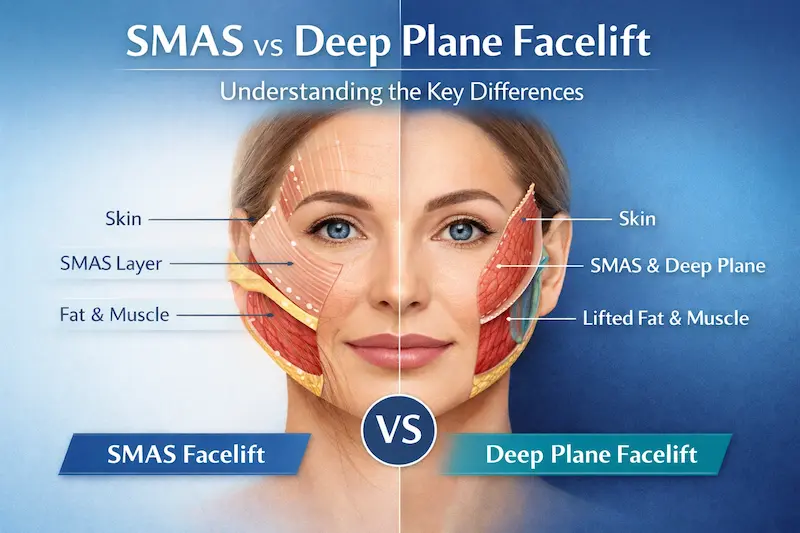
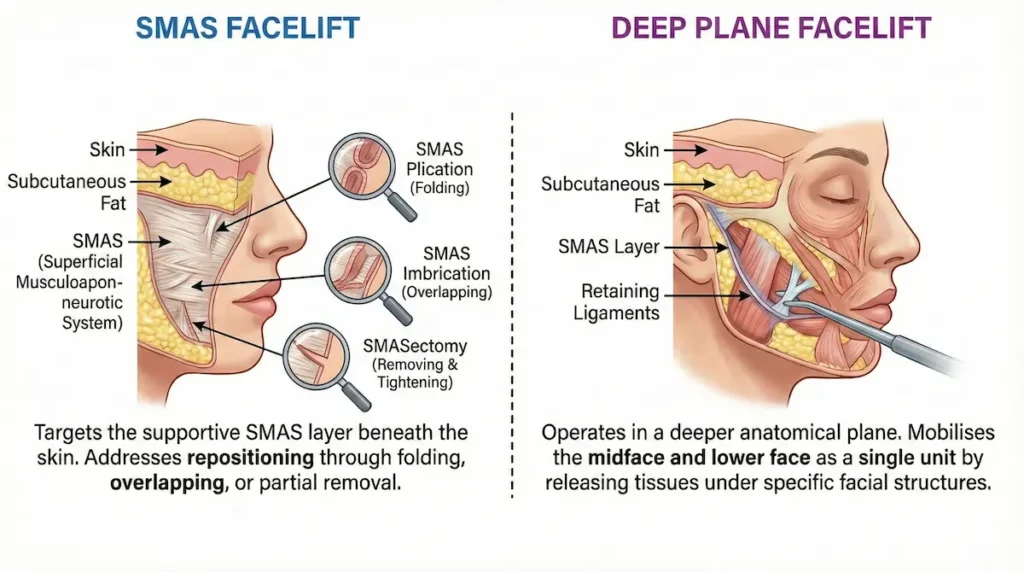
SMAS stands for the Superficial Musculoaponeurotic System: a fibrous, supportive layer that lies beneath the skin and subcutaneous fat in much of the face. In modern facelift surgery, “SMAS facelift” usually means the surgeon is not simply pulling skin tight; they are addressing this deeper support layer to reposition tissues and reduce the risk of a “wind-swept” look.
However, “SMAS facelift” is an umbrella term. It can include variations such as SMAS plication (folding/suturing), SMAS imbrication (overlapping), or SMASectomy (removing a portion and tightening). This is why online comparisons like SMAS facelift vs deep plane can be confusing—there are multiple SMAS approaches with different strengths and trade-offs.
What surgeons mean by “Deep Plane”
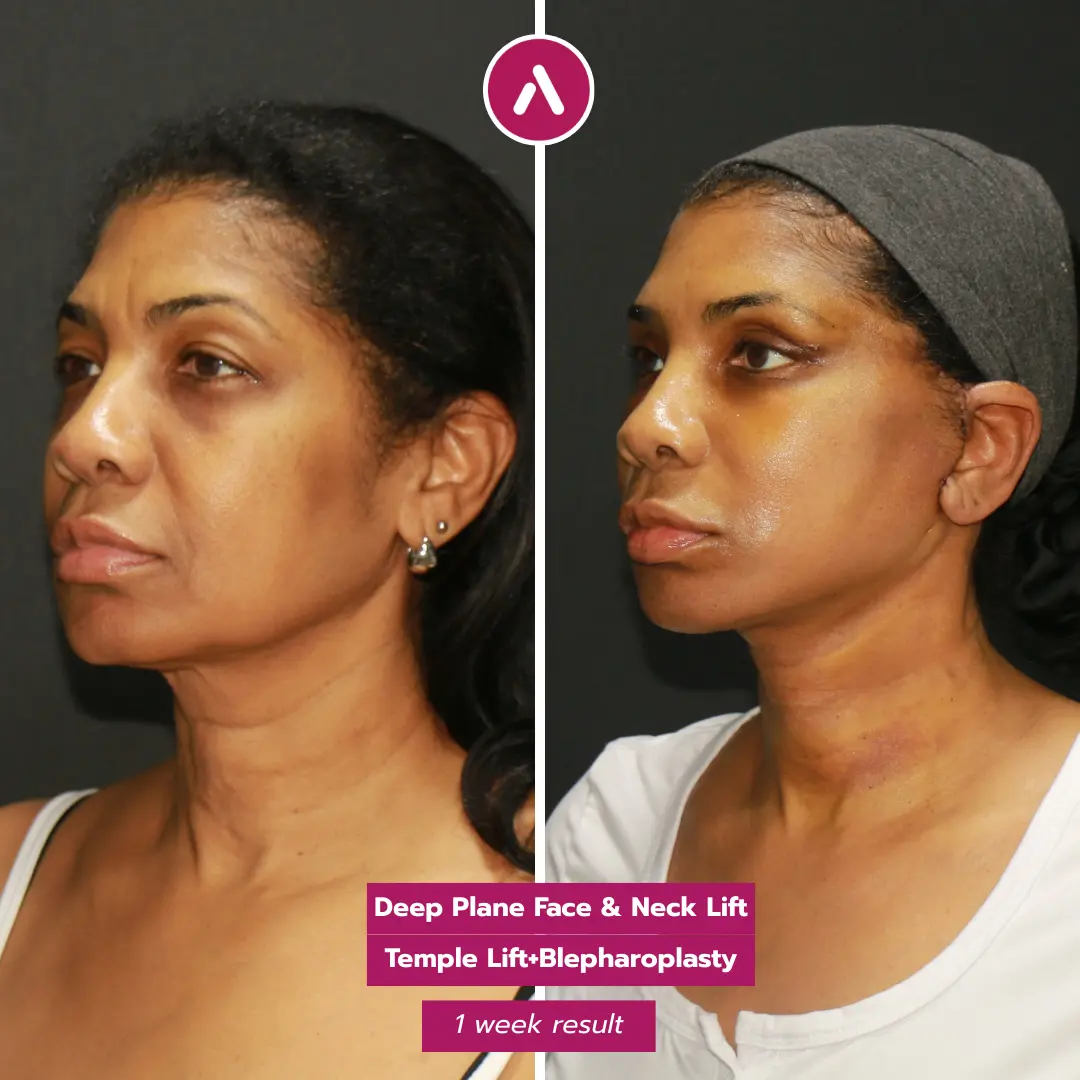
A Deep Plane facelift typically describes a technique where the lift is performed in a deeper anatomical plane than many classic SMAS methods, aiming to mobilise the midface and lower face more as a single unit. In practical terms, the surgeon works under specific facial structures (including retaining ligaments) to release and reposition tissues more effectively, particularly in patients with more pronounced midface descent and jowling.
This is the core of many “deep plane vs SMAS facelift differences” discussions: the plane of dissection, how tissues are released, and where tension is distributed during repositioning.
Why the names can be confusing in online forums
Patients often assume “Deep Plane” always equals “more advanced” or “more natural”, while “SMAS” is sometimes (incorrectly) assumed to be “less effective”. In reality, technique labels are not a guarantee of quality. Surgeon skill, anatomical suitability, and the specific method used matter enormously. That’s why a meaningful SMAS lift vs deep plane facelift comparison needs to consider what exactly was done, not just what it was called.
Anatomy & Surgical Planes (Where Each Technique Works)
To understand deep plane facelift vs SMAS in a non-mythical way, you need a simple map of facial layers. Ageing is not just “loose skin”; it involves changes in fat compartments, ligaments, skin elasticity, and deeper support structures. In both techniques, the goal is to reposition and support tissues in a way that looks refreshed—without obvious tension lines or an over-operated appearance.
The SMAS layer: structure, ageing changes, and why it matters
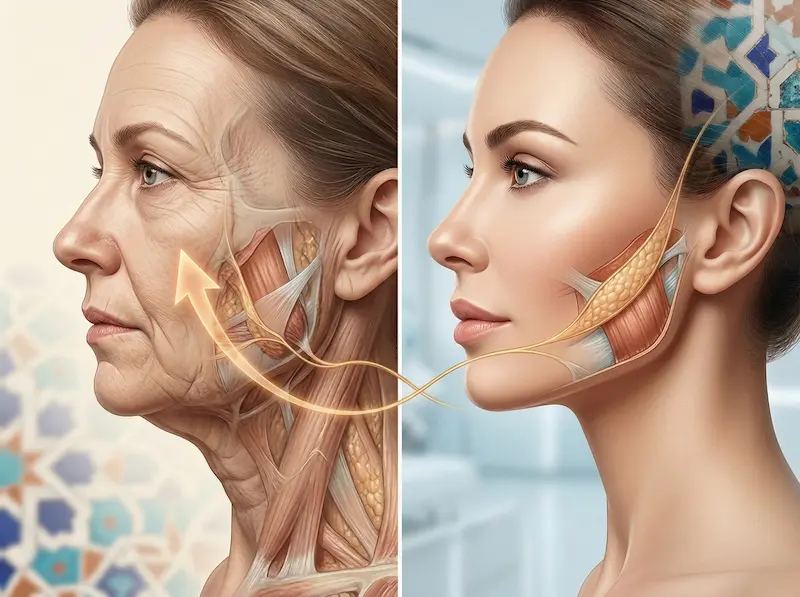
The SMAS layer functions like a supportive scaffold for the face. As we age, the combined effects of tissue descent, ligament laxity, and volume shifts can produce jowls, deepening nasolabial folds, and a loss of definition along the jawline. Addressing the SMAS can allow the surgeon to lift and support these structures more effectively than skin-only tightening.
In a typical SMAS-based plan, the surgeon tailors how the SMAS is tightened or repositioned depending on your facial anatomy, skin quality, and goals. This is one reason “SMAS facelift” is not one single operation—and why many searches for deep plane vs SMAS facelift differences don’t yield consistent answers.
The deep plane: ligaments, fat pads, and a more “unit” repositioning concept
Deep plane techniques often focus on releasing certain retaining ligaments and mobilising tissues in a deeper plane to reposition the midface and lower face more cohesively. In patient-facing terms: some surgeons favour deep plane approaches when the midface has dropped noticeably, and when they want strong correction without relying on skin tension.
When you see claims about deep plane facelift vs SMAS lift producing a “more natural” result, the argument is usually about how the tissues are moved and supported. The aim is to distribute lift forces through deeper structures so the skin can redrape more gently.
Why “skin-only tightening” is not the same as modern lifting
Both SMAS and Deep Plane approaches are designed to avoid the pitfalls of older, skin-only facelifts, where the skin carried too much tension. Excess skin tension can contribute to an unnatural look and can be less durable over time. Modern planning—supported by decades of surgical experience and ongoing scientific research into facial anatomy and ageing—generally prioritises deeper support, careful vector selection (direction of lift), and conservative skin redraping.
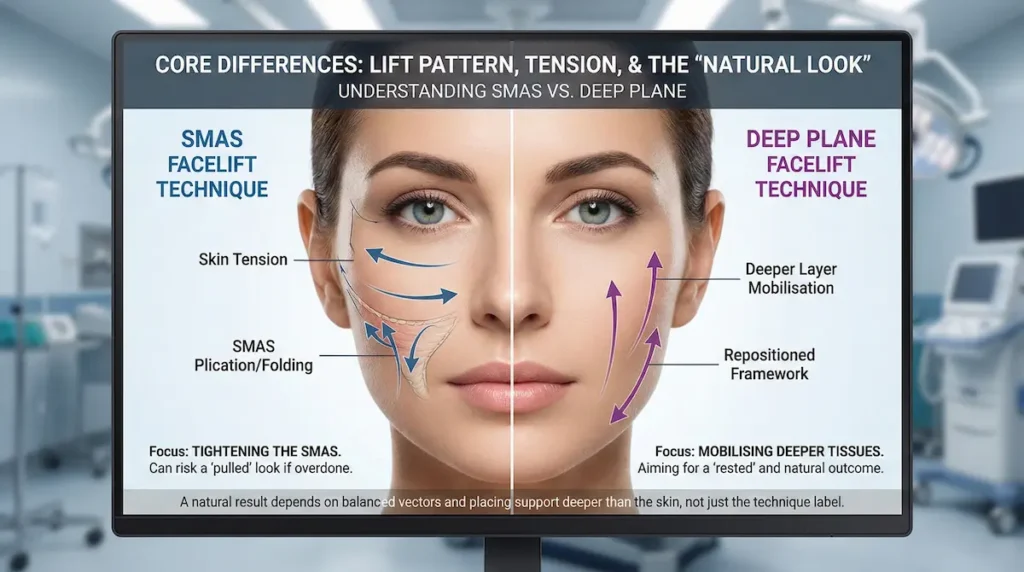
Core Differences: Lift Pattern, Tension, and the “Natural Look” Question
When patients type queries like deep plane facelift vs SMAS or SMAS facelift vs deep plane, they’re usually trying to answer one practical question: “Which one looks more natural?” The honest answer is that “natural” is not one single outcome—it’s the result of (1) where the lift is applied, (2) how tension is distributed, (3) how the skin is re-draped, and (4) the surgeon’s aesthetic judgement. This section breaks down the most meaningful differences you can discuss at consultation.
Where the tension goes: skin vs deeper layers
One of the biggest talking points in any SMAS lift vs deep plane facelift comparison is how tension is managed. In contemporary practice, both approaches aim to minimise skin tension. The difference is that deep plane techniques often place more emphasis on mobilising deeper tissues so the skin can sit more “passively” over the repositioned framework.
In many SMAS-based approaches, the surgeon tightens, folds, or repositions the SMAS to create support, then re-drapes the skin without excessive pull. In a well-executed SMAS lift, the skin still shouldn’t look “stretched”; the main support is deeper than the skin.
Midface vs jowls vs neck: which areas tend to respond best
Patients often notice ageing in different “zones”: midface (cheek descent), lower face (jowls), and neck (banding or laxity). In general, SMAS techniques can be excellent for jawline definition and jowls, while deep plane approaches are often discussed for their potential strength in midface mobilisation when there is noticeable descent.
That said, neck improvement frequently depends on whether additional neck work is performed (for example, platysma management), not just whether the operation is labelled “SMAS” or “Deep Plane”. This is a key reason “deep plane vs SMAS facelift differences” should include the full surgical plan, not just the facelift plane.
“Pulled” vs “refreshed”: how technique choice affects the UK aesthetic preference
Many UK patients want a result that reads as “rested” rather than “done”. The risk of a “pulled” look is usually linked to poor vector choices, excessive skin tension, or over-resection—not the mere presence of one technique label. A surgeon aiming for a subtle, British aesthetic will typically prioritise balanced vectors, conservative skin trimming, and a plan that restores structure rather than tightness.
So, if you’re comparing deep plane facelift vs SMAS lift, focus your consultation questions on how your surgeon achieves a natural outcome: where the lift is anchored, how the midface is managed, and how the skin is handled at closure.
Who Is a Good Candidate for Each Technique?
Technique choice is not a “best vs worst” contest; it’s a matching exercise between your anatomy, your ageing pattern, and your desired outcome. A thoughtful surgeon should be able to explain why they recommend one approach over another, using your face—not a generic template. This is where searches like deep plane vs SMAS facelift differences become genuinely useful, because you can translate that research into better consultation questions.
Age ranges and typical concerns (midface descent, jowls, neck laxity)
Chronological age is less important than tissue behaviour. Some people in their 40s can have prominent jowling and midface descent; others in their 60s have relatively good midface support but a neck that has aged more noticeably. SMAS-based plans are commonly used across a wide range of ageing patterns, while deep plane approaches are often discussed when midface descent and heavier lower-face tissues are more prominent.
Skin quality, facial volume, and previous weight loss considerations
Skin quality matters: thinner skin, sun damage, and reduced elasticity can influence how well skin re-drapes and how scars mature. Facial volume is also crucial—some patients need a lift plus volume restoration (for example, fat grafting) to avoid a “tight but hollow” look.
If you have had significant weight loss, you may have more laxity and deflation, which can change the surgical strategy. In these cases, the best plan may combine lifting and volume work regardless of whether the facelift is described as SMAS-based or deep plane.
Revision facelifts: when technique selection changes
Revision surgery (a second facelift after a previous one) can be more complex due to scarring, altered anatomy, and tissue quality changes. Here, the technique label matters less than the surgeon’s experience with revisions and their ability to design a safe plan. If you’re researching SMAS facelift vs deep plane because you’re considering a revision, prioritise a surgeon who can explain how they manage scar tissue, nerve safety, and realistic outcome limits.
Recovery & Downtime (What UK Patients Usually Want to Know)
For UK patients travelling for surgery, recovery planning is not just about comfort—it’s about being “flight-ready” and safe to return home. Rather than focusing on dramatic day-by-day promises, it’s better to plan around typical recovery milestones and understand the normal patterns of bruising and oedema. This section is designed to help you set realistic expectations and identify what should prompt a clinical review.
Expected bruising and oedema: what’s normal, what isn’t
Most patients experience bruising and swelling (oedema) after facelift surgery, regardless of whether it’s a deep plane facelift vs SMAS approach. Swelling can feel uneven early on and may shift as tissues settle. Mild asymmetry in swelling can be normal during the first couple of weeks.
What is not “normal” includes rapidly increasing swelling on one side with significant pain, expanding bruising, or symptoms that suggest a haematoma. Any clinic should give you clear instructions on what to watch for and how to reach your surgical team promptly.
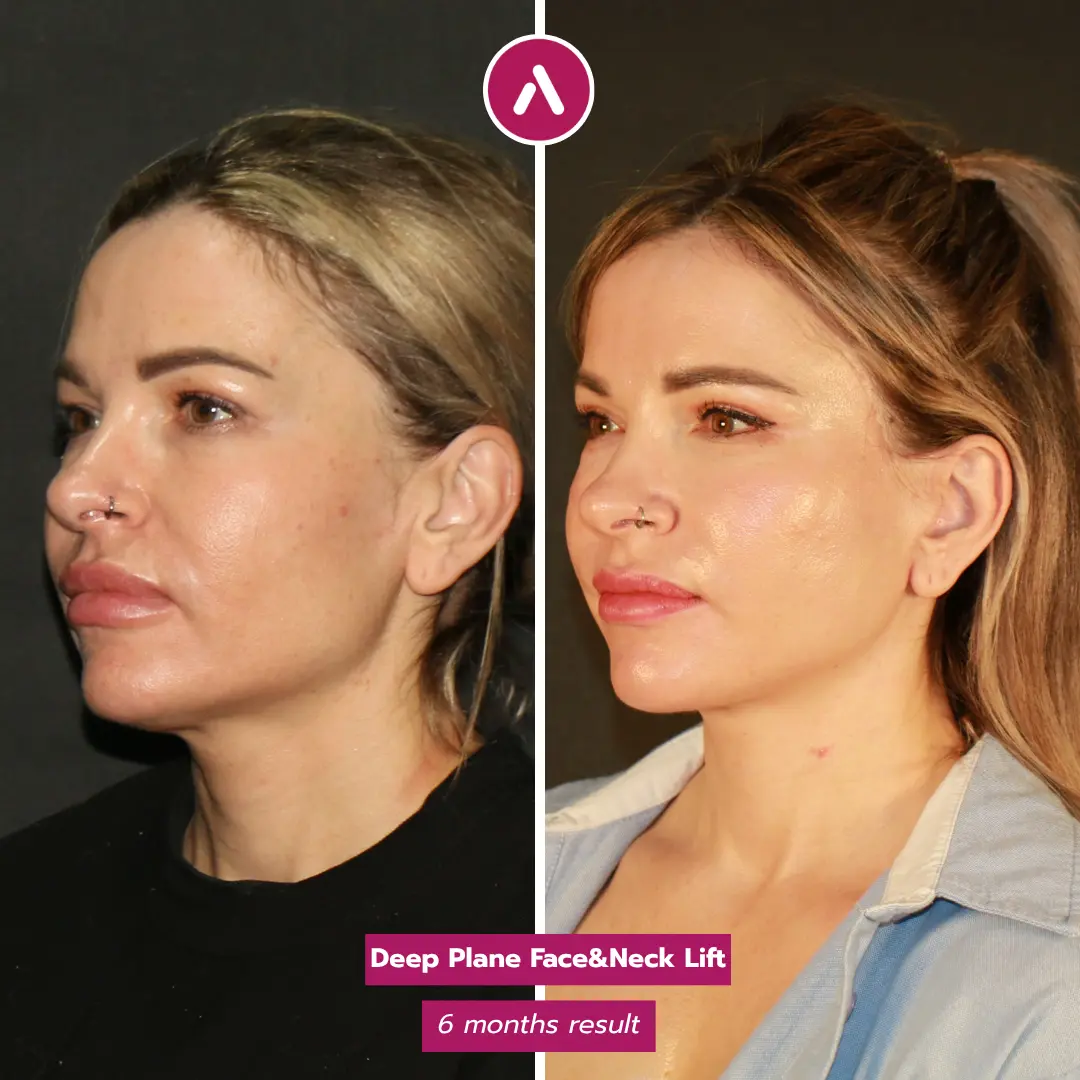
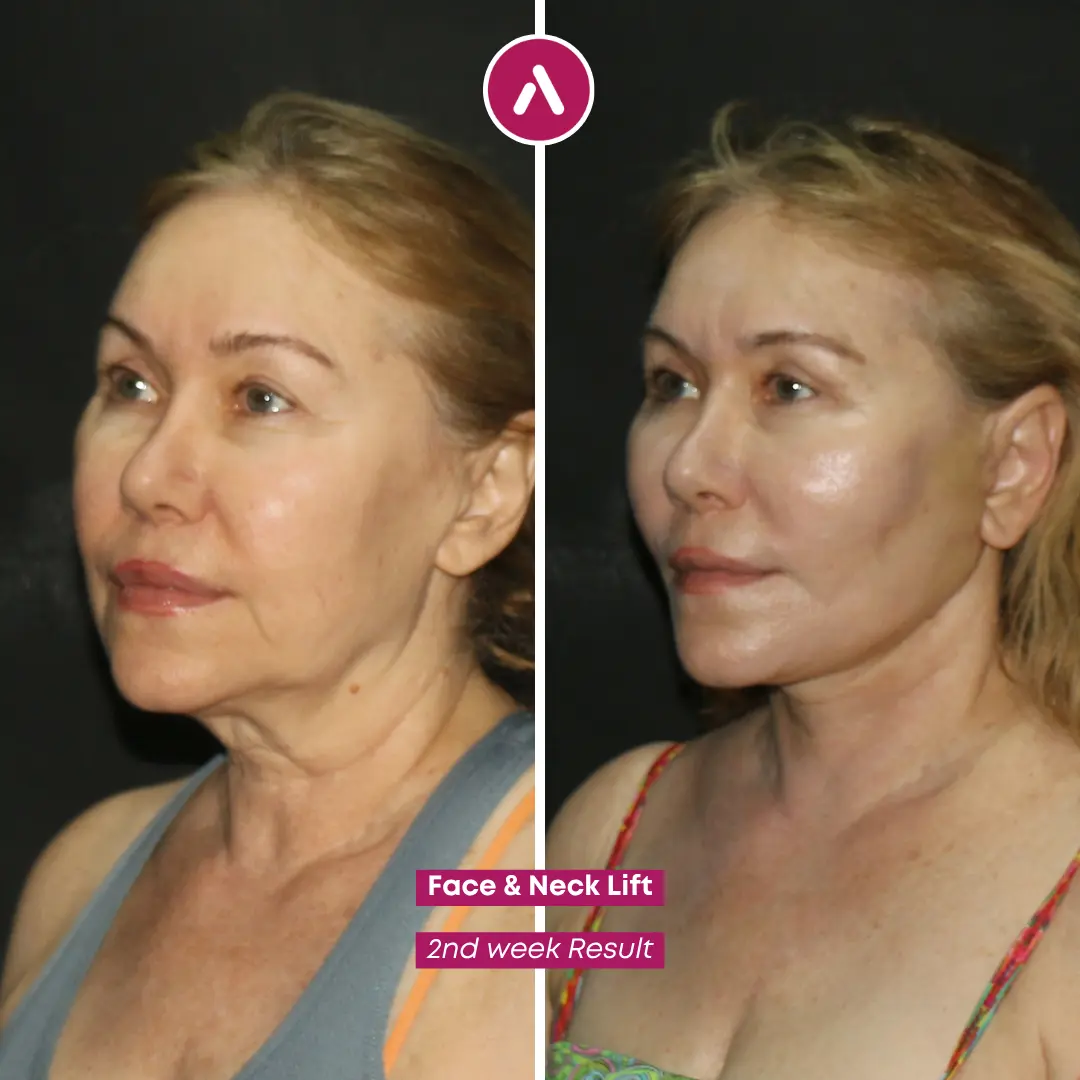
Typical timeline: day 1–7, week 2–4, month 2–3
- Days 1–7: Most swelling and bruising; you’ll focus on rest, head elevation, short walks, and prescribed aftercare.
- Weeks 2–4: Bruising typically fades; swelling reduces; many patients feel more socially presentable (with make-up and strategic hairstyling).
- Months 2–3: Further refinement; scars continue to mature; subtle tightness or numb patches may still improve.
In many real-world experiences, the difference between SMAS facelift vs deep plane is less about the existence of swelling and more about individual variation, extent of surgery, and how the neck and midface were managed.
When you can look “presentable” for work and social plans
“Presentable” means different things to different people. Many UK patients plan for at least 2 weeks before returning to public-facing work, and 3–4 weeks if they want to feel more comfortable without relying on hairstyles or make-up tricks. If you’re travelling, build buffer time into your schedule and prioritise clinics that offer structured aftercare and clear follow-up pathways.
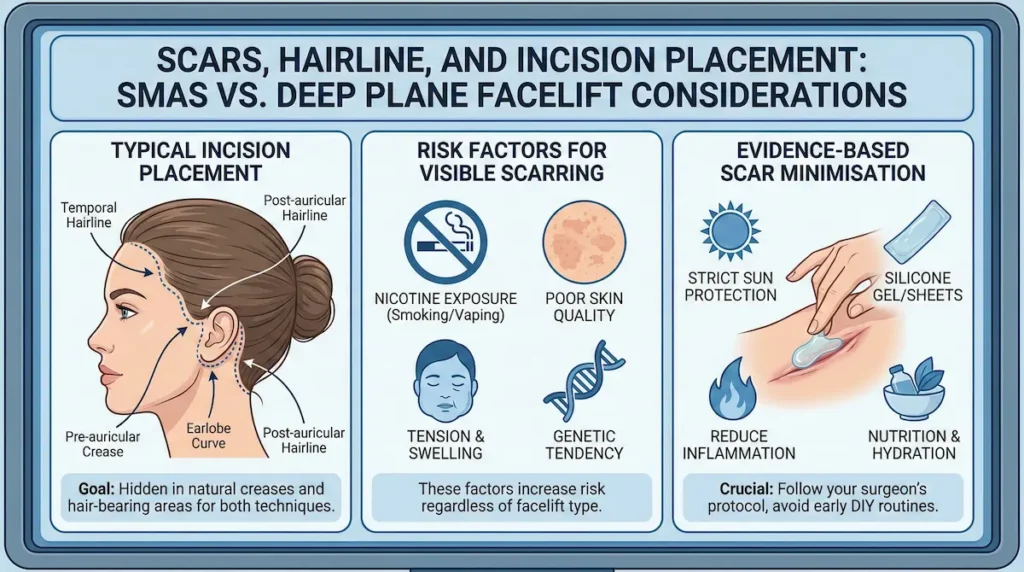
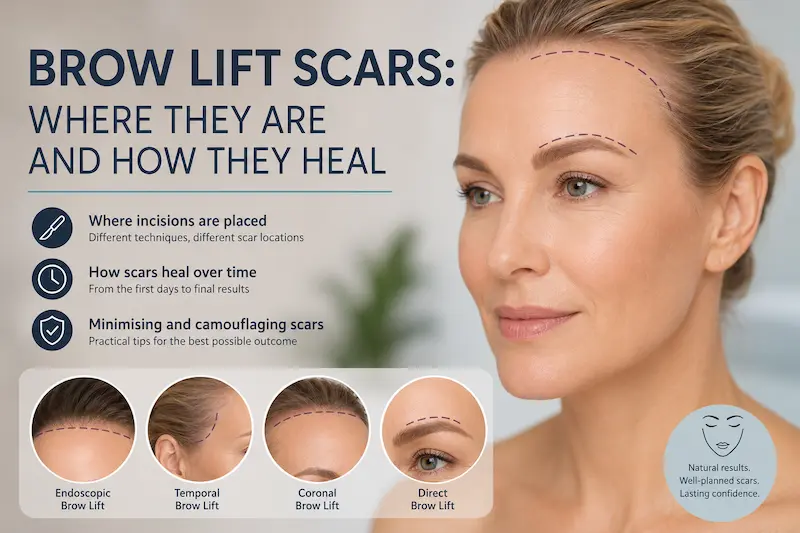
Scars, Hairline, and Incision Placement
Scarring is one of the biggest concerns for UK patients researching a deep plane facelift vs SMAS approach, especially if you wear your hair up, have fine hair, or are prone to raised scars. The reassuring point is that well-planned facelift incisions are designed to be hidden in natural creases and hair-bearing areas. The less reassuring point is that scarring risk depends on more than technique labels—it depends on incision planning, tissue handling, and aftercare compliance.
Common incision patterns and how they’re hidden
Most modern facelifts (whether described as SMAS facelift vs deep plane or vice versa) use incisions placed around the ear (often starting in the temple hairline, running in front of the ear, curving around the earlobe, and continuing behind the ear into the hairline). The goal is for scars to sit in:
- Natural skin creases and contour junctions
- The shadow line around the ear
- Hair-bearing areas where appropriate
Good planning also considers your hairstyle preferences and whether you’re concerned about visible scars when the hair is tied back.
Risk factors for visible scarring (skin type, aftercare, smoking)
Several factors can increase the likelihood of noticeable scars, regardless of whether you choose deep plane facelift vs SMAS lift:
- Smoking or nicotine exposure: impairs blood flow and raises the risk of delayed healing.
- Skin quality: very thin, sun-damaged skin can heal differently and may show scar lines more.
- Tension and swelling: excessive tension at the incision or prolonged oedema can worsen scar appearance.
- Genetic tendency: some patients are more prone to hypertrophic scarring.
If you’re using nicotine replacement products or vaping, disclose this—“no cigarettes” is not the same as “no nicotine”.
Strategies to minimise scar visibility (including evidence-based aftercare)
Scar outcomes can often be improved by doing the basics exceptionally well. While online advice varies, most evidence-informed approaches (aligned with principles of medical science) focus on:
- Strict sun protection: UV exposure can worsen scar pigmentation in the first months.
- Gentle scar care: silicone gel/sheets are commonly used once the wound is fully closed and your surgeon approves.
- Reducing inflammation: following aftercare guidance to limit swelling and avoid unnecessary strain.
- Nutrition and hydration: supporting normal healing (protein intake matters).
Most importantly: follow your surgeon’s protocol. “DIY scar routines” too early can cause irritation and set you back.
Risks & Safety Considerations (Transparent, Not Alarmist)
Any SMAS lift vs deep plane facelift comparison should include safety. The majority of patients do well, but it’s wise to understand the real risks and how reputable teams reduce them. Safety is also where UK patients often feel anxious about travelling: they want to know what happens if something doesn’t go to plan, and who is responsible for follow-up care.
Nerve-related risks: what they are and how surgeons mitigate them
Facelift surgery occurs near important facial nerve branches. Temporary weakness can occur due to swelling or traction; permanent nerve injury is uncommon but is one of the most feared complications. Risk is influenced by:
- Depth and extent of dissection
- Surgeon technique and anatomical familiarity
- Revision status (scar tissue can increase complexity)
If you’re comparing deep plane vs SMAS facelift differences, ask how your surgeon monitors nerve safety, what their approach is in the deep plane region, and what their revision/complication management pathway looks like.
Haematoma, infection, delayed healing: practical prevention steps
Commonly discussed facelift risks include haematoma (a collection of blood under the skin), infection, and delayed wound healing. Practical risk-reduction often includes:
- Pre-op optimisation: controlling blood pressure, stopping nicotine, managing anaemia if present.
- In-theatre precision: careful haemostasis and appropriate drains when indicated.
- Post-op discipline: head elevation, avoiding heavy lifting, and adhering to wound care.
Many patients underestimate how strongly blood pressure spikes can contribute to post-op bleeding risk. Ask what your clinic does to monitor and manage this.
Red flags in “too-good-to-be-true” surgery offers (UK patient perspective)
Whether you choose SMAS facelift vs deep plane, safety comes down to standards and transparency. Red flags include:
- Vague answers about who performs the surgery and who provides aftercare
- No discussion of risks, or “zero risk” claims
- Pressure to pay quickly, or heavy discounts tied to rushed scheduling
- Lack of clear written guidance for complications and follow-up
A reputable provider welcomes informed questions and provides a clear, documented plan.
Anaesthesia Options: Local, Twilight, and General Anaesthesia
UK patients often focus on anaesthesia because it affects the overall experience and recovery—especially nausea, grogginess, and the first 24 hours. The anaesthesia plan is also a safety conversation: your medical history, airway considerations, and procedure length all matter. In a thoughtful deep plane facelift vs SMAS discussion, anaesthesia is part of the overall surgical design, not a separate checkbox.
What “local anaesthesia + light sedation” can look like in facelift surgery
In selected patients and selected surgical plans, facelift surgery can sometimes be performed with local anaesthesia plus sedation (“twilight” or “conscious”). This may reduce post-op nausea for some patients and can make the immediate recovery feel smoother. However, it’s not suitable for everyone, and not every technique or extent of dissection is appropriate under lighter sedation.
Pros/cons for recovery, nausea, and overall experience
- Potential advantages: less nausea for some patients, quicker early alertness, potentially gentler immediate recovery.
- Potential limitations: not ideal for anxious patients, longer procedures may be uncomfortable, may not suit complex neck work or extensive revision surgery.
In other words: don’t assume “awake” or “twilight” is automatically better—choose what is safest for you.
Who may still be better suited to general anaesthesia
General anaesthesia is often recommended when the procedure is longer, more complex, or when you prefer to be fully asleep. Patients with higher anxiety, significant neck work planned, or revision cases may also be better candidates for general anaesthesia. A safe anaesthesia plan should be individualised, and you should feel comfortable that your anaesthetist has evaluated your health history properly.
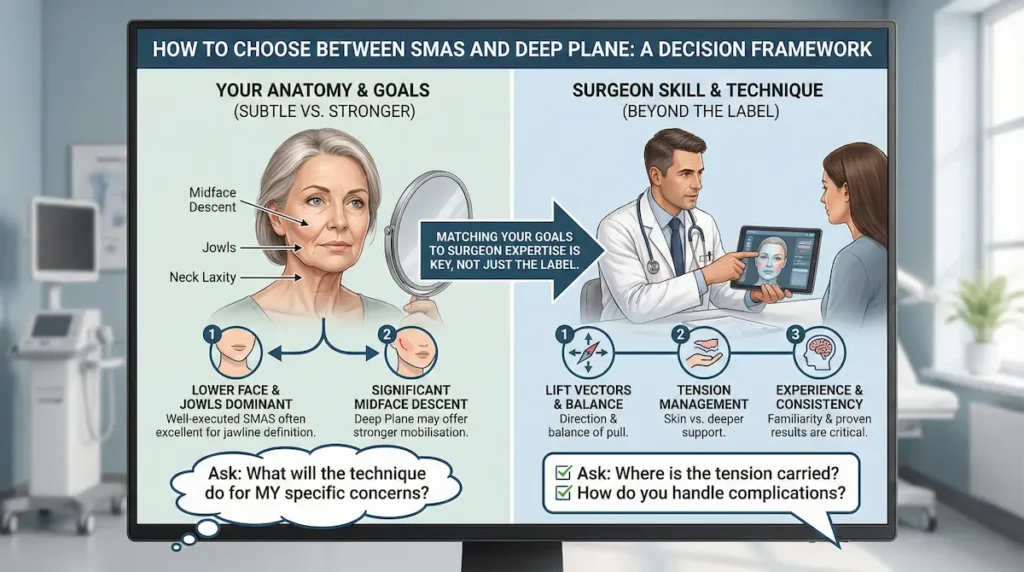
How to Choose Between SMAS and Deep Plane (Decision Framework)
By this point, you’ll have a clearer sense of the genuine deep plane vs SMAS facelift differences. The final decision, however, should be made using a framework that matches your anatomy and goals to a surgeon’s method and experience. In other words, the best choice is rarely “Deep Plane for everyone” or “SMAS for everyone”—it’s the technique that best fits your face, delivered by a surgeon who performs that approach consistently and safely. This section turns the comparison into a practical consultation tool.
Your goals: subtle rejuvenation vs stronger midface correction
Start with outcomes—not labels. When UK patients search SMAS facelift vs deep plane or deep plane facelift vs SMAS, they’re often concerned about:
- Looking refreshed, not “tight”
- Improved jawline and jowls
- Midface lift (cheek descent) without an artificial look
- Neck definition and a cleaner cervicomental angle
If your main concern is lower-face heaviness and jowls, a well-executed SMAS plan can be excellent. If midface descent is a dominant feature, your surgeon may discuss whether a deep plane approach could offer a stronger midface mobilisation. But do not let the label override the plan: ask what the technique will do for your specific concerns.
Surgeon preference and skill: why technique labels aren’t everything
From a patient safety standpoint, the surgeon’s familiarity with their chosen method is critical. In any SMAS lift vs deep plane facelift comparison, it’s worth remembering that outcomes are influenced by:
- How the surgeon designs the lift vectors (direction and balance)
- How they handle skin redraping and closure tension
- Whether they combine the facelift with neck work or volume restoration when needed
- How carefully they manage haemostasis (bleeding control) and post-op monitoring
Even if you prefer the theory of one approach, it may be safer to choose an experienced surgeon who consistently delivers natural results with the technique they perform most often.
Questions to ask at consultation to match technique to anatomy
Bring your research into the room. Here are questions that convert “online comparison” into a useful clinical conversation:
- Which areas of my face are you targeting most—midface, jawline, neck—and why?
- Where will the lift tension be carried in my case? (Skin vs deeper support)
- Will my plan include neck work? (And what exactly does that involve?)
- Do you recommend any volume restoration? (If yes, why?)
- What is the expected recovery timeline for me specifically?
- How do you handle complications and follow-up for UK patients?
These questions remain relevant whether you are leaning towards deep plane facelift vs SMAS lift or the reverse.
Frequently Asked Questions (FAQ): SMAS vs Deep Plane Facelift
The FAQs below reflect the most common UK-style search queries and consultation concerns around SMAS facelift vs deep plane, including safety, natural results, downtime, and anaesthesia. Keep in mind: individual anatomy and surgeon execution matter as much as the technique category.
Is a Deep Plane facelift always “better” than a SMAS facelift?
No. “Better” depends on your facial anatomy, the areas being targeted, and the surgeon’s expertise. Deep plane approaches may offer strong midface mobilisation in suitable patients, while SMAS-based approaches can deliver excellent, natural-looking jawline and lower-face correction when well planned and executed.
Which technique looks more natural for UK patients?
Either technique can look natural when the lift vectors are balanced, skin tension is minimised, and the plan is matched to your face. A “pulled” appearance is more often related to excessive tension or poor planning than to a specific label like “SMAS” or “Deep Plane”.
How long do results typically last with SMAS vs Deep Plane?
Durability varies by individual ageing, skin quality, lifestyle (including smoking), and surgical design. Both can produce long-lasting improvements. Rather than focusing on a single number of years, ask your surgeon what they expect for your anatomy and what maintenance (skin quality, sun protection, weight stability) supports longevity.
Is one technique more painful or uncomfortable during recovery?
Most patients describe tightness, swelling, and bruising rather than “pain” in the severe sense, especially when aftercare is well managed. Discomfort levels depend more on the extent of surgery (including neck work) and individual sensitivity than on whether it is labelled SMAS or deep plane.
What’s the difference in bruising and oedema between the two?
Bruising and oedema occur with both approaches. The range of normal is wide, and factors like blood pressure control, extent of dissection, and individual healing tendencies can influence the visible recovery more than the technique name.
Can either technique be done without general anaesthesia?
In selected cases, some facelifts may be performed with local anaesthesia plus sedation. Suitability depends on the surgical plan, your comfort level, and medical factors. Many patients still choose general anaesthesia for longer or more complex surgery.
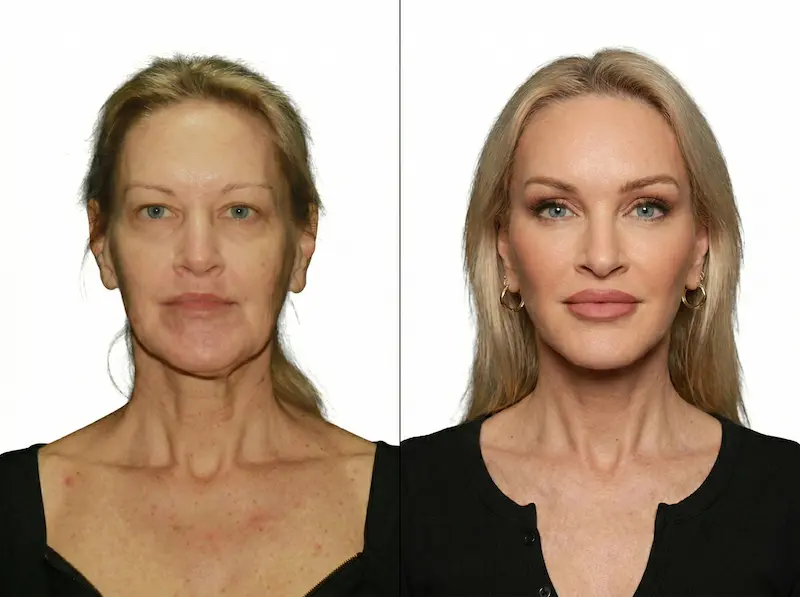
What should I look for in before-and-after photos to judge quality?
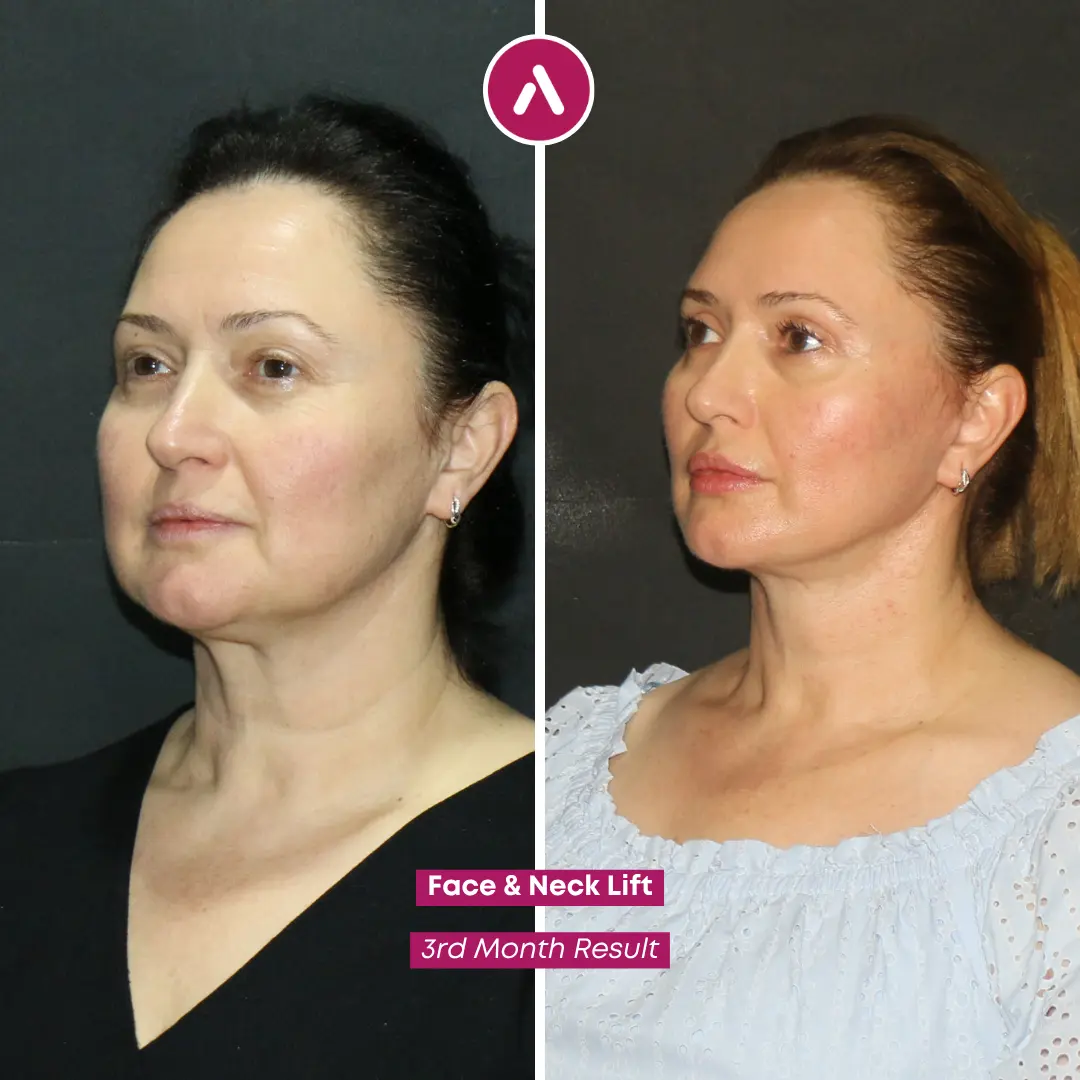
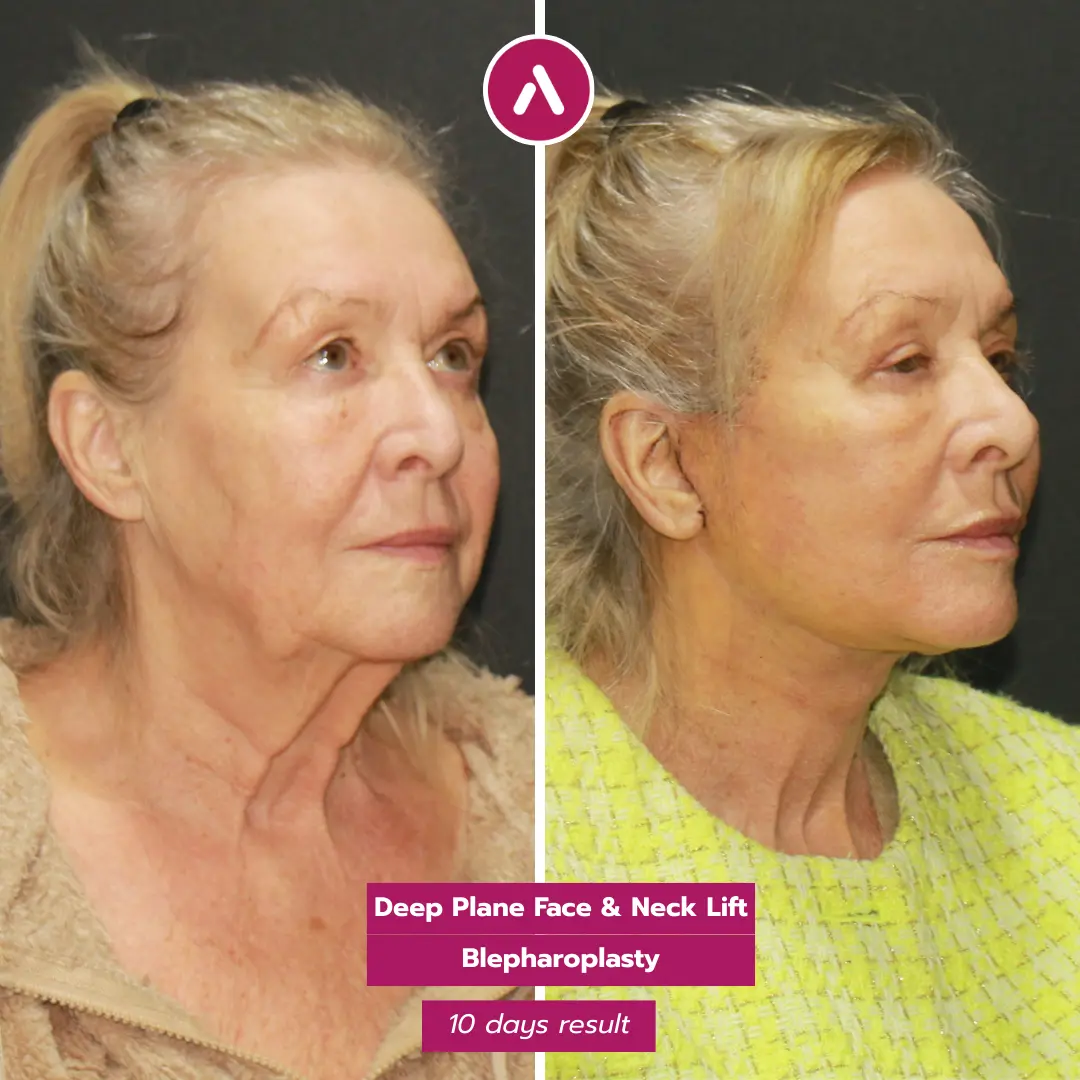
Look for consistent lighting and angles, and focus on naturalness: softened jowls, improved jawline definition, smoother neck contour, and a refreshed midface without distortion. Also evaluate scars (when visible), hairline preservation, and whether the result looks harmonious rather than “tight”.
If you’d like to go beyond the points covered above, you can also explore related guides on Deep Plane Facelift Before After results, how to choose a Deep Plane Facelift Surgeon, and what to expect from Deep Plane Facelift Cost comparisons. We also share a step-by-step Deep Plane Facelift Journey timeline, plus practical advice on when you can Fly After Facelift. For safety-focused research, you may find our resources on verifying a Plastic Surgeon Turkey and understanding Hospital Accreditation Turkey standards helpful before making any decision.
Medical Disclaimer: This page is provided for general educational purposes only and does not replace a face-to-face medical consultation, diagnosis, or personalised treatment plan. All surgery carries risks and outcomes vary between individuals. Suitability for a deep plane facelift, procedure selection, and anaesthesia choice can only be determined after a full clinical assessment by a qualified surgeon. Always follow your clinician’s instructions and seek urgent medical attention if you develop concerning symptoms during recovery.