
If you’re a British patient trying to choose a deep plane facelift surgeon, you’re probably doing what “expert patients” do best: verifying every claim, cross-checking credentials, and looking for evidence that stands up to scrutiny. That’s sensible. A deep plane facelift is a technically demanding operation, and outcomes depend heavily on who performs it, where it’s performed, and how your aftercare is managed once you’re back in the UK.
This guide is designed to help you separate marketing from measurable standards — using the same logic you’d apply to science, scientific research, and medical science: verify inputs, check methodology, and demand transparency. Along the way, we’ll naturally cover common search terms such as best surgeon for deep plane facelift, deep plane facelift best surgeon, deep plane facelift plastic surgeon, and the more destination-specific phrases like best deep plane facelift surgeon Turkey and best deep plane facelift surgeon in Turkey — but the goal remains the same: helping you choose safely and confidently.
Important note: There is no universal “best deep plane facelift surgeon” for everyone. The right choice is the surgeon who is demonstrably qualified for your anatomy, has consistent results you can evaluate, and provides a written aftercare pathway that works when you’re back home in Britain.
Table of Contents
Key Credentials You Must Verify (UK Board-Certified Equivalent)
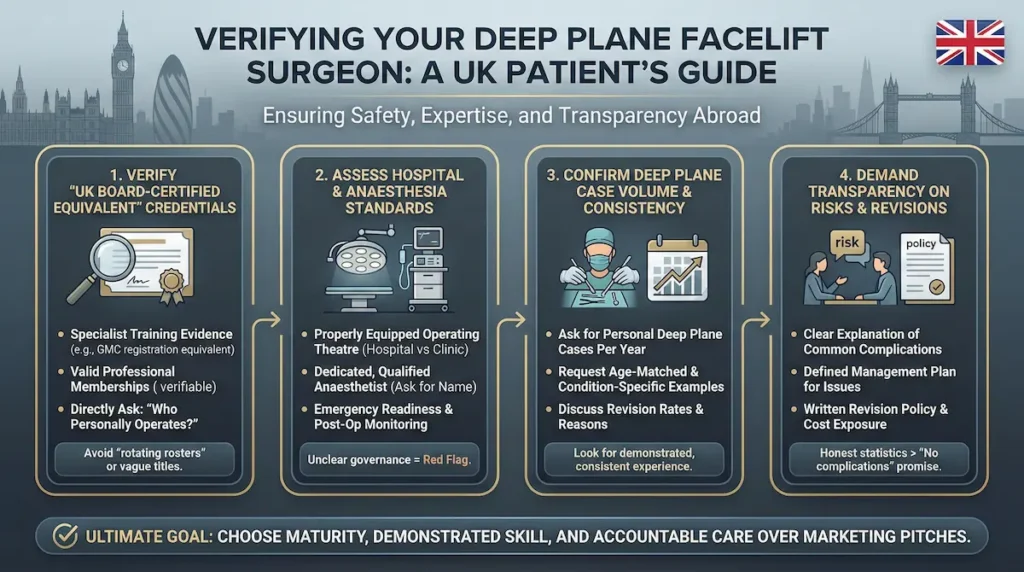
When patients search for the best surgeon for deep plane facelift, they’re usually trying to reduce risk. The safest approach is to treat credentials like a checklist: every item should be verifiable, not simply “claimed”. Your aim is to confirm that the person presenting themselves as a deep plane facelift plastic surgeon has the right surgical training, performs the procedure frequently, and operates within a properly governed hospital environment — with clear anaesthesia and emergency protocols.
What “UK board-certified equivalent” means (and what proof to ask for)
In the UK, patients often lean on recognisable structures (GMC registration, CQC oversight, Royal College pathways). When you’re considering surgery abroad, you need the nearest equivalent: formal specialist training, recognised board certification, and memberships that can be checked on official registers.
- Ask for the surgeon’s full name (as it appears on certificates and registers), not just a brand name or “team”.
- Request evidence of specialist training in plastic surgery and/or facial plastic surgery relevant to deep plane work.
- Confirm professional memberships that are meaningful and verifiable (not vague “international academy” logos).
- Ask directly: “Do you personally perform the deep plane dissection and SMAS/ligament release, or is any part delegated?”
If you’re being sold a package with a rotating roster, you may never know who actually operates — which is incompatible with choosing the deep plane facelift best surgeon for you.
Hospital privileges, operating theatre standards, and who provides anaesthesia
Deep plane surgery should be performed in a properly equipped operating theatre, with robust governance and immediate escalation options. Your safety hinges on the facility as much as the surgeon.
- Where is the operation performed? Hospital vs clinic-based theatre (and what happens if you need overnight monitoring).
- Who administers anaesthesia? Ask for the anaesthetist’s name, qualifications, and whether they are dedicated to your case.
- Emergency readiness: blood products policy, transfer pathway, critical care access, and on-site monitoring.
- Infection control: theatre sterility protocols, antibiotic policy, and post-operative wound care standards.
A clinic can advertise “best deep plane facelift surgeon in Turkey”, but if the environment and anaesthesia governance are unclear, the claim is not meaningful.
Deep Plane experience: how many cases per year is “enough” for consistency
Technique matters, but so does repetition. Because deep plane facelift surgery requires precise handling of facial anatomy, consistency typically improves with case volume. You’re not being difficult by asking numbers — you’re doing due diligence.
- Ask: “How many deep plane facelifts do you personally perform each month and each year?”
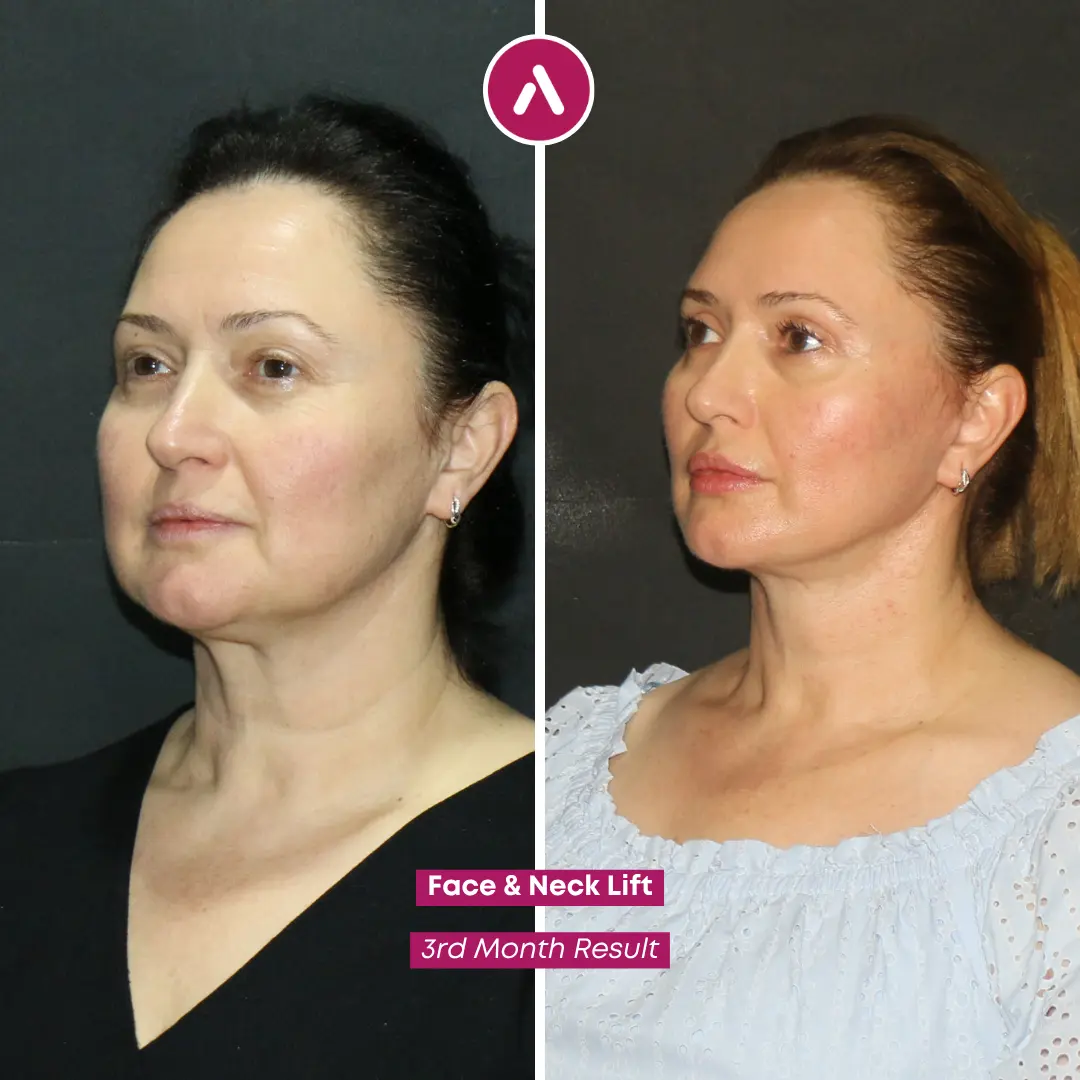
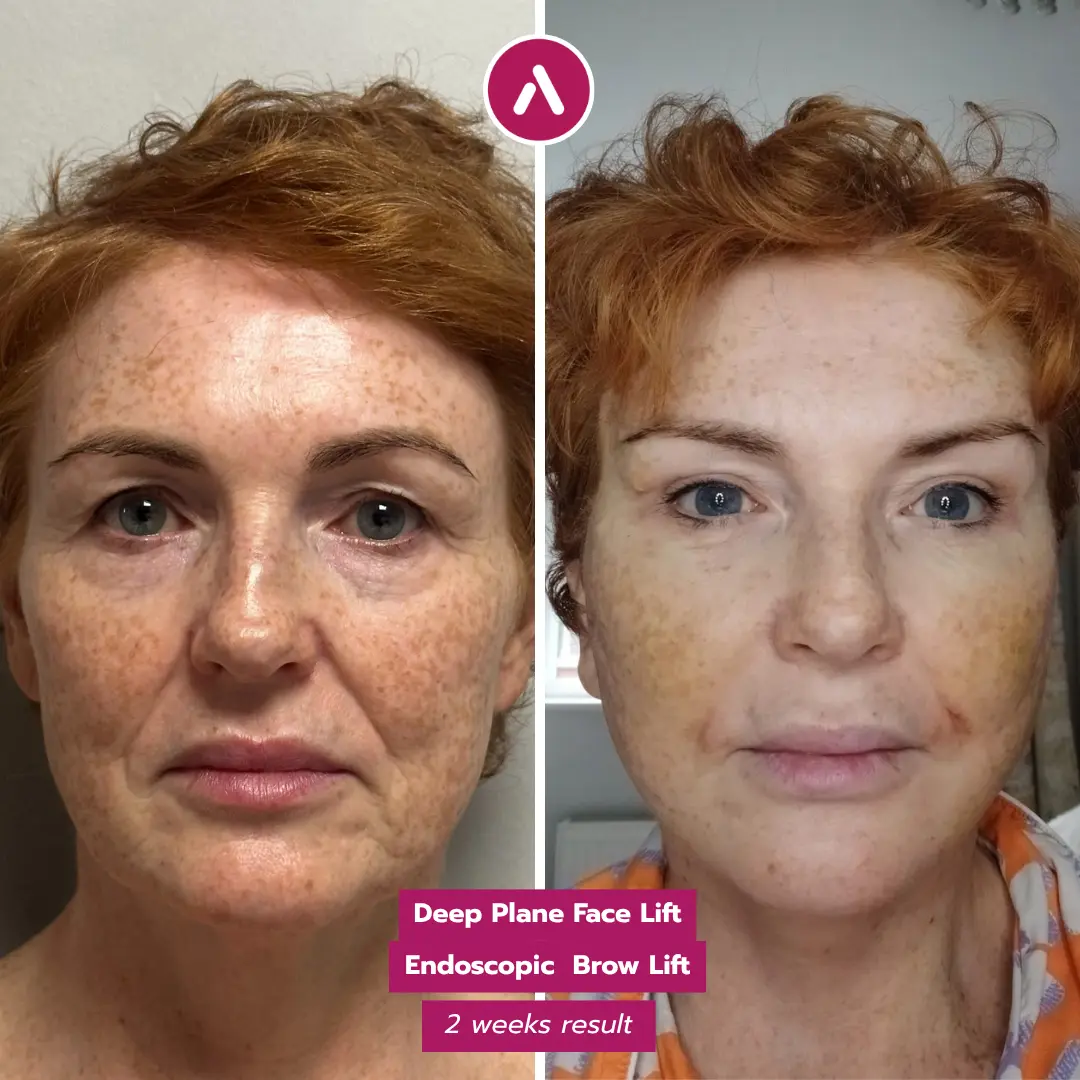
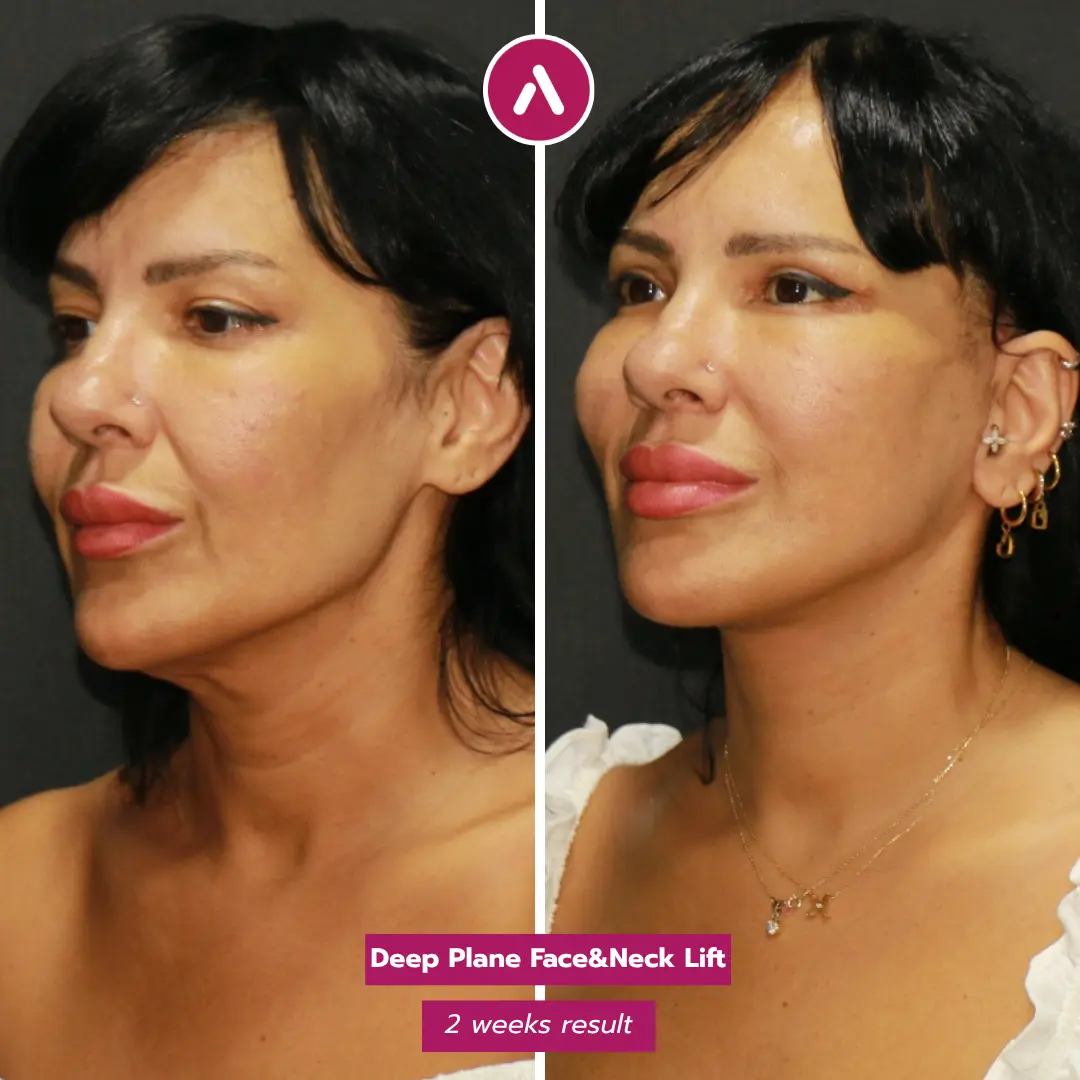
- Ask for case-matching: examples in your age range, skin quality, facial structure, and concerns (jowls, neck laxity, midface descent).
- Ask about revisions: how often, why they occur, and how they’re managed.
If a provider avoids specifics while still positioning themselves as the best deep plane facelift surgeon, treat that as a reliability issue.
Revision rates, complication transparency, and why honest statistics matter
Any surgery carries risk. What you want is not a promise of “no complications”, but a surgeon who demonstrates maturity: they can explain the risks clearly, show how they minimise them, and outline what happens if something deviates from plan.
| What to Ask | Why It Matters | What a Reliable Answer Sounds Like |
|---|---|---|
| “What are your most common complications, and how are they managed?” | Tests transparency and preparedness | Specific risks + prevention + management plan |
| “How do you reduce haematoma risk in the first 24 hours?” | Early safety is critical in facelifts | Monitoring, BP control, clear escalation steps |
| “What is your approach if I need a revision?” | Clarifies responsibility and cost exposure | Written policy, timelines, surgeon involvement |
Practical rule: If a clinic’s pitch sounds like a travel advert (“quick, painless, weekend transformation”), you are not being treated like a surgical patient — and that should disqualify any “best surgeon for deep plane facelift” claim.
Red Flags to Watch Out For When Booking Abroad
British patients who search for the best deep plane facelift surgeon Turkey are often balancing two competing needs: high standards and reasonable cost. That’s legitimate — but it also makes you vulnerable to slick marketing. Red flags are not “bad vibes”; they are specific patterns that correlate with poor governance, rushed decision-making, and weak aftercare. If you spot multiple red flags, walk away.
Unrealistic promises (zero swelling, “weekend facelift”, guaranteed perfection)
Swelling, bruising, and a staged recovery are normal. Anyone promising “no swelling” or a guaranteed outcome is either inexperienced or intentionally misleading. Deep plane recovery often evolves over weeks to months — and a surgeon who respects that timeline is usually safer than one selling fantasy.
- Be wary of “instant results” claims based on day-3 or day-7 photos.
- Be wary of “back to work in a week” promises without context (age, skin quality, extent of work).
- Be wary of pressure tactics like “limited slots” used to rush consent.
Vague surgeon identity (no named surgeon, no verifiable credentials, rotating teams)
If you cannot clearly identify the operating surgeon — full name, credentials, and specific experience in deep plane technique — you cannot rationally choose the deep plane facelift best surgeon. A brand is not a surgeon.
- Refusal to share surgeon details “until you pay a deposit”.
- Only generic titles (“our specialist”, “our consultant”) with no traceable record.
- Before-and-after galleries that don’t specify who performed the case.
Hidden costs and unclear package terms (what’s not included in GBP quotes)
Transparent pricing is part of medical ethics. If a quote is presented in GBP (£), ask what happens if you need additional nights, extra medication, or a change in plan once assessed in person. Clarity upfront prevents stressful surprises later.
- Ask for an itemised quote: surgeon fee, hospital fee, anaesthesia, medications, compression garments, follow-up appointments.
- Ask about contingencies: extra nights, unexpected tests, treatment of complications.
- Ask about revision policy: what is covered, what is chargeable, and on what timeline.
Aftercare gaps: no written follow-up plan, no escalation pathway, no UK contact point
This is the biggest practical risk for UK patients travelling for surgery. A reliable provider should give you a written aftercare plan that includes: day-by-day expectations, warning signs, how to send photos, who triages concerns, and what happens if you’re unwell once you’re back in Britain.
- Look for continuity: your surgeon remains involved, not just a coordinator.
- Look for structured follow-up: scheduled checks, not “message us if you need anything”.
- Look for UK reassurance signals: a UK-facing contact route (for example +44 WhatsApp) and clear response times.
If someone claims to be the best deep plane facelift surgeon but cannot provide robust aftercare governance, that claim should not survive your evaluation.
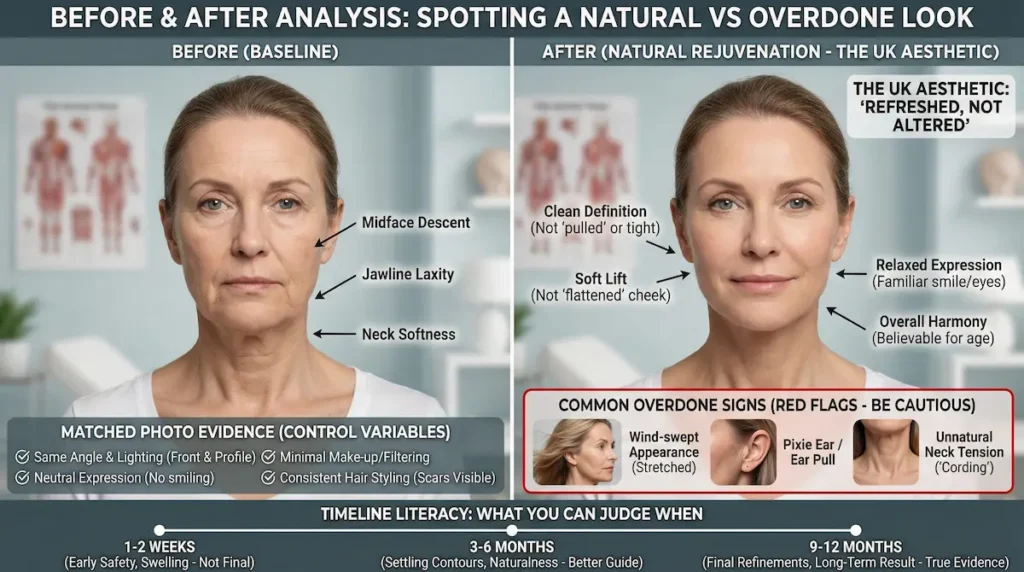
Before & After Analysis: Spotting a Natural vs Overdone Look
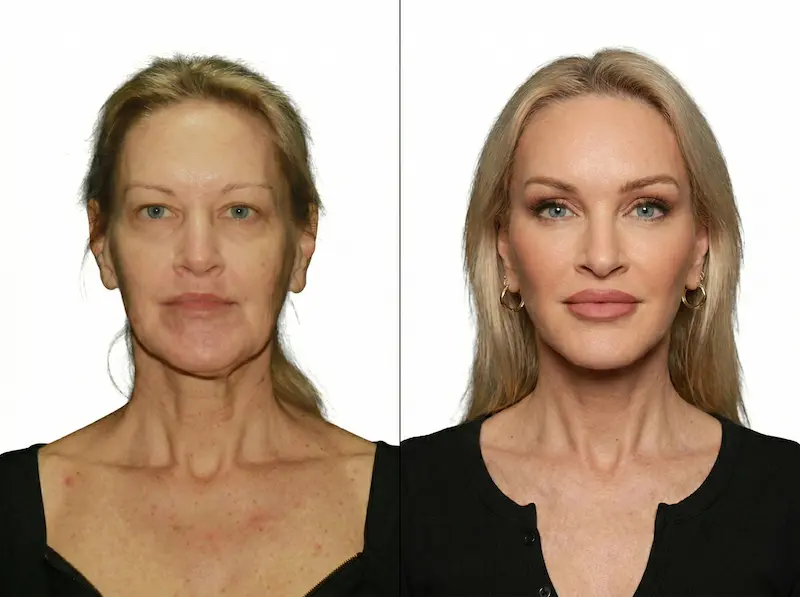
If you’re searching for the best surgeon for deep plane facelift, you’re not only buying technical skill — you’re buying judgement. The deep plane technique can produce beautifully natural rejuvenation, but poor planning (or overly aggressive traction) can create an “operated-on” look. Your job as a UK patient is to learn how to read before-and-after images like evidence: consistent methodology, comparable baselines, and results that match your aesthetic goals.
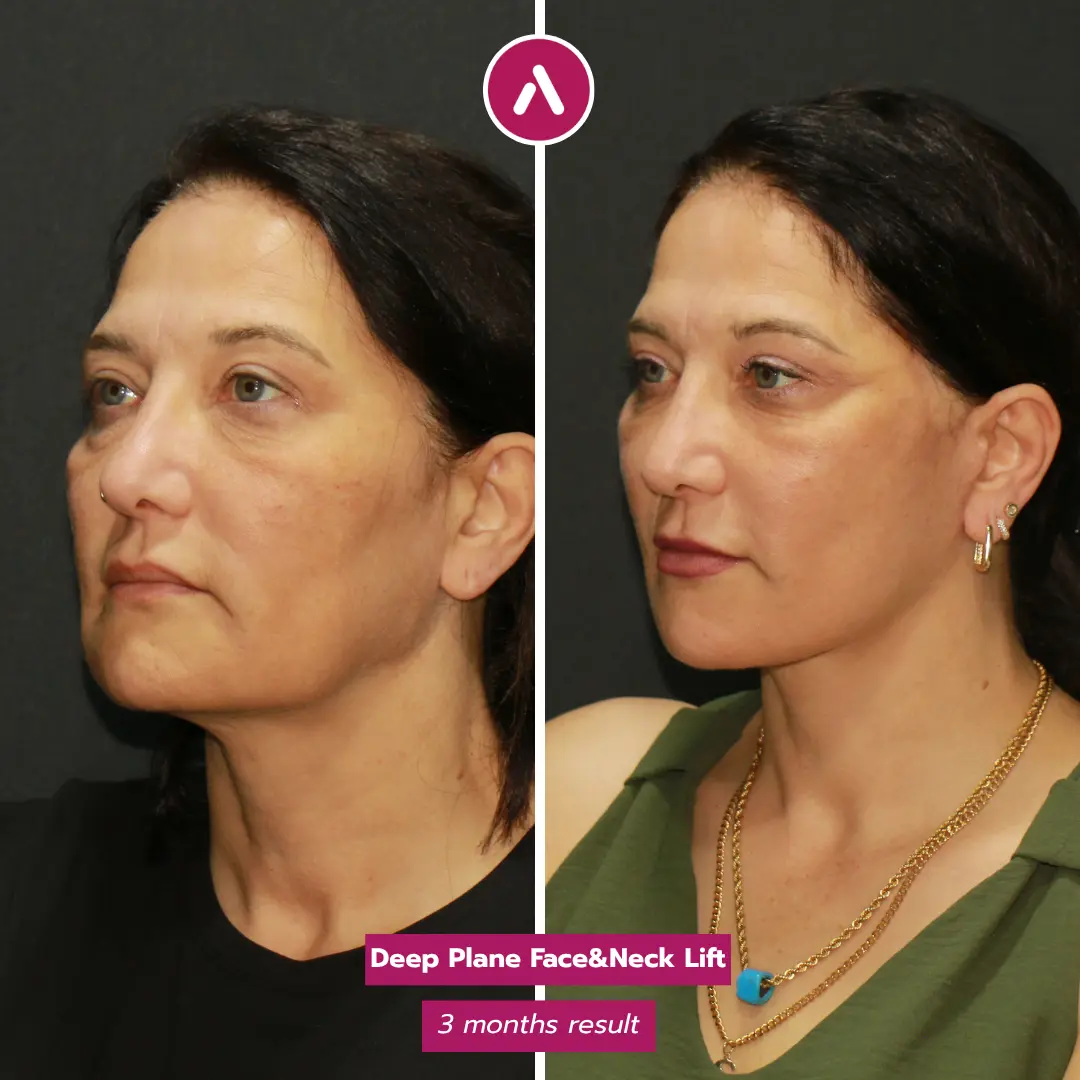
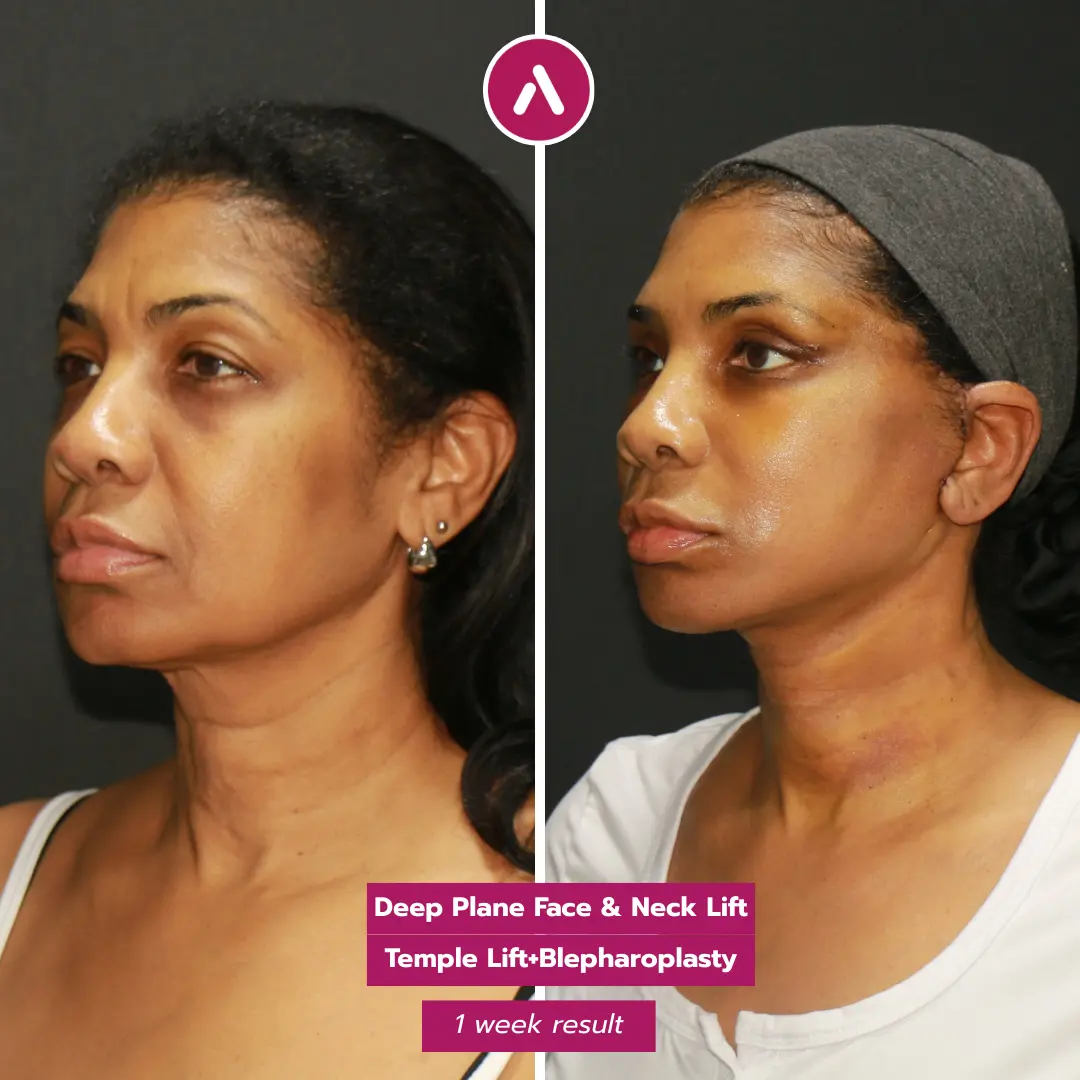
The UK aesthetic: “refreshed, not altered” — practical markers
Most British patients prioritise subtlety: looking well-rested, not “different”. In photo evaluation, look for outcomes that preserve identity.
- Jawline and neck: cleaner definition without a pulled, tight sheen.
- Midface: soft lift of descent rather than a “flattened” or unnaturally high cheek.
- Eyes and mouth: no distortion; smile and lower eyelids should look relaxed and familiar.
- Overall harmony: improvement should look believable for the person’s age.
This is why “best deep plane facelift surgeon” is less about hype and more about reliably natural outcomes across different faces.
Common signs of an overdone facelift (wind-swept, hairline distortion, ear pull)
Some red flags are visible even in marketing galleries — particularly when photos are heavily edited or angles change. If you see these patterns repeatedly, be cautious.
- Wind-swept appearance: lateral pull that makes the face look stretched.
- Hairline distortion: temple hairline shifted or widened scars hidden by styling.
- Pixie ear / ear pull: earlobe appears tethered or elongated.
- Unnatural neck tension: “cording” or tight banding shown early and presented as final.
Timeline literacy: what you can and can’t judge at 2 weeks vs 3 months
When comparing surgeons — whether in the UK or when assessing claims like best deep plane facelift surgeon in Turkey — ask for results shown at meaningful timepoints.
| Time After Surgery | What’s Normal | What You Should Evaluate |
|---|---|---|
| 1–2 weeks | Bruising, oedema (swelling), tightness | Incision care, early safety, not “final shape” |
| 4–6 weeks | Improving swelling, settling contours | Early scar quality, symmetry trends, comfort |
| 3–6 months | More stable contours, scars maturing | Naturalness, hairline/ear position, harmony |
| 9–12 months | Final refinements, scar maturation | True long-term result and consistency |
If a gallery is mostly “day 7 miracles”, you’re not looking at evidence; you’re looking at marketing.
What to look for in matched before-after photos (lighting, angle, expression, make-up)
Good comparison photography follows basic principles you’d recognise from scientific research: control the variables. Ask for matched sets where the only meaningful change is the surgery itself.
- Same angle: front, 45-degree, and profile — consistently repeated.
- Same lighting and distance: no flattering shadows in the “after”.
- Neutral expression: smiling can hide neck laxity and jawline irregularities.
- Minimal make-up and filtering: heavy contouring can fake a jawline.
- Comparable hair styling: hair should not be used to conceal scars or hairline changes.
Quick test: If you can’t tell whether the “after” photo is taken closer, in different light, or with a different head tilt — you cannot fairly compare surgeons, including anyone presented as the deep plane facelift best surgeon.
Questions to Ask During Your London/Istanbul Consultation
A consultation is not a sales call — it’s a clinical decision point. Whether you’re speaking with a UK-based provider or exploring the option of the best deep plane facelift surgeon Turkey, the aim is to confirm: (1) you are a suitable candidate, (2) the plan matches your anatomy, and (3) your safety and aftercare pathway are robust. Take notes, request answers in writing, and don’t be afraid to ask the same question twice in different ways.
Technique questions: Deep Plane vs SMAS — what they recommend for your anatomy
Deep plane is not automatically “better” for every face. A trustworthy deep plane facelift plastic surgeon should explain why they recommend a particular approach for you.
- Ask: “What problems are we treating — jowls, midface descent, neck laxity — and which layer addresses each?”
- Ask: “What exactly do you mean by ‘deep plane’ in your hands?” (Some providers use the term loosely.)
- Ask: “Will you combine neck work, fat grafting, or skin resurfacing — and why?”
- Ask: “What result should I realistically expect at 3 months and at 12 months?”
Safety questions: DVT prevention, bleeding risk, and overnight monitoring policies
Safety planning is where you see the difference between a clinic that prioritises governance and one that prioritises volume. This is especially important for patients travelling back to the UK.
- Ask: “What is your DVT prevention protocol for facelift patients?”
- Ask: “How do you manage blood pressure during and after surgery to reduce haematoma risk?”
- Ask: “Do you monitor overnight, and who is on-site if something changes at 2 a.m.?”
- Ask: “What is your emergency escalation pathway?”
Scar strategy: incision placement, hairline protection, and scar optimisation options
Scars are inevitable; poor scars are not. Ask for the incision plan and how the surgeon protects hair-bearing areas and ear position — particularly if you have a tendency to heal with thicker scars.
- Ask: “Where will my incisions sit around the ear and hairline?”
- Ask: “How do you avoid hairline distortion at the temples?”
- Ask: “What is your scar management plan from week 2 onwards?”
- Ask: “If I have a history of hypertrophic scarring, how do you adapt the plan?”
Recovery planning: when you’ll be “flight-ready” and what happens if swelling persists
Patients often type “best deep plane facelift surgeon in Turkey” while also worrying about the practicalities of getting home. A good plan is specific: where you stay, how long you’re observed, what checks happen before travel, and what your support looks like once you’re back in Britain.
- Ask: “On what day do you typically clear patients to fly, and what criteria do you use?”
- Ask: “What are the red flags after I’m home in the UK, and who do I contact first?”
- Ask: “How often will you review my photos during the first 2 weeks?”
- Ask: “If I’m worried at night in the UK, what is the escalation pathway?”
These questions will quickly reveal whether you’re dealing with a clinician who thinks like medical science — structured, evidence-driven, transparent — or a provider relying on vague reassurance.
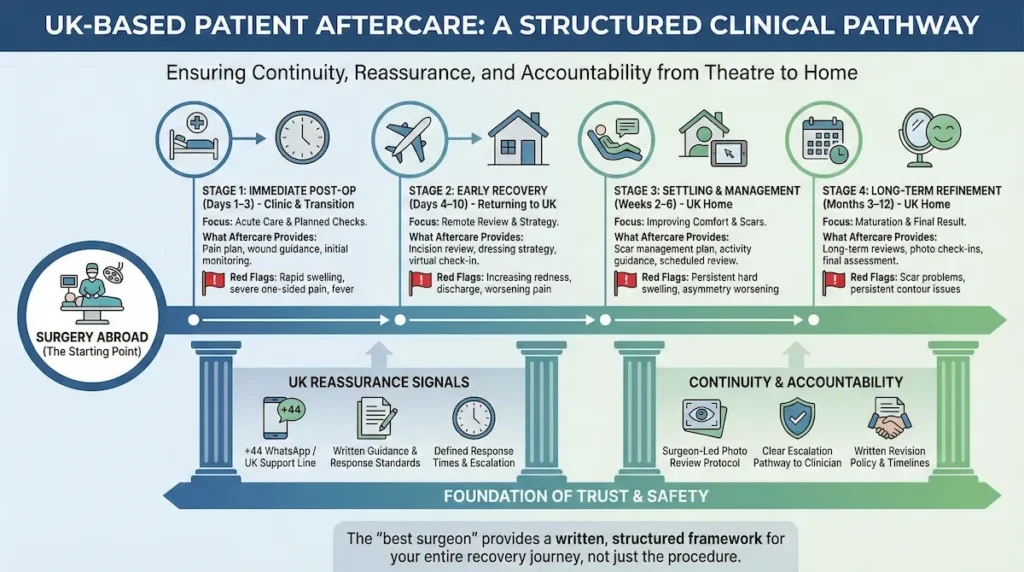
UK Based Patient Contact Point & Aftercare Support
For British patients, aftercare is where “best surgeon for deep plane facelift” claims either become credible — or fall apart. A deep plane facelift is not finished when you leave the operating theatre. The result settles over time, and you need a clear clinical pathway for monitoring, reassurance, and escalation. If you are travelling (including those searching best deep plane facelift surgeon Turkey or best deep plane facelift surgeon in Turkey), aftercare must be designed around the reality that you will return to the UK and still need structured support.
What “aftercare” should include (day-by-day follow-up milestones and red flags)
High-quality aftercare is proactive, scheduled, and documented. You should receive a written plan covering what is normal, what is not, and exactly how follow-up works.
| Post-Op Period | What You Should Expect | What Aftercare Should Provide | Red Flags (Seek Help) |
|---|---|---|---|
| Days 1–3 | Oedema, bruising, tightness | Planned checks, pain plan, wound guidance | Rapid swelling, severe one-sided pain, fever |
| Days 4–10 | Bruising shifts colour, swelling fluctuates | Review of incisions, dressing strategy | Increasing redness, discharge, worsening pain |
| Weeks 2–6 | Settling, improving comfort | Scar management plan, activity guidance | Persistent hard swelling, asymmetry worsening |
| Months 3–12 | Refinement, scar maturation | Long-term reviews, photo check-ins | Scar problems, persistent contour issues |
A clinic can call their doctor the deep plane facelift best surgeon, but without a written aftercare framework like this, the claim doesn’t protect you.
UK reassurance signals: +44 WhatsApp, UK support line, London correspondence address
Skeptical patients often fear being left without support once they land back in Britain. Strong UK-facing reassurance signals reduce that anxiety — not as marketing, but as practical access to help.
- Clear UK contact route: a UK-friendly channel (commonly a +44 WhatsApp number) that is monitored reliably.
- Defined response standards: what counts as urgent, and expected response times.
- Continuity: escalation to a clinician (not only a coordinator) when needed.
- Written guidance: you should have documents you can reference, not just verbal instructions.
When you’re assessing a deep plane facelift plastic surgeon, ask explicitly: “Who reviews my post-op photos — and is my surgeon involved?” That one question often reveals the true level of clinical accountability.
How revisions are handled (timelines, responsibilities, and realistic policies)
Revision planning is a mark of maturity in surgical practice. In medical science, outcomes are monitored and processes exist for when results deviate from the expected pathway. The same mindset should apply here.
- Define “revision” vs “normal settling”: swelling and tissue remodelling can take months.
- Ask for timelines: when would a surgeon consider intervention, and why?
- Ask for written policy: what is covered, what is chargeable, and what is excluded.
- Ask who performs it: ideally your original surgeon, not a different team.
If a provider advertises “best deep plane facelift surgeon” but refuses to discuss revisions clearly, treat that as a governance red flag.
Continuity of care: how your surgeon stays involved post-op
Continuity is part of safety. A reliable surgeon-led pathway includes routine follow-up, planned reviews, and access to advice as you recover.
- Scheduled check-ins: not just “message us if you’re worried”.
- Photo review protocol: how often you submit images and how they are assessed.
- Escalation pathway: what happens if there is suspected infection, haematoma, or wound concerns.
- UK return plan: guidance aligned with your travel and recovery timeline.
Patient-first standard: The “best surgeon for deep plane facelift” is the one who can show you a structured clinical pathway — before, during, and after surgery — and puts it in writing.
Frequently Asked Questions (FAQ): Deep Plane Facelift Surgeon
These FAQs reflect the most common concerns from British patients comparing surgeons, including those researching best deep plane facelift surgeon Turkey and best deep plane facelift surgeon in Turkey. They are designed to help you evaluate a deep plane facelift surgeon with evidence-led clarity.
How do I verify a deep plane facelift surgeon’s credentials if they’re abroad?
Ask for the surgeon’s full name, formal specialist training details, board certifications, and verifiable memberships. Cross-check on official registers where possible, and ensure the named surgeon is the person performing your operation.
What questions should I ask about anaesthesia and who delivers it?
Ask who the anaesthetist is, their qualifications, whether they are dedicated to your case, and what monitoring is provided after surgery. Confirm the procedure is done in a properly equipped operating theatre.
How many deep plane facelifts should a surgeon perform to be considered experienced?
There is no single perfect number, but you should expect a surgeon offering deep plane surgery to perform it regularly and be able to show consistent results across many comparable cases, including long-term follow-ups.
What are the most common red flags in facelift marketing for UK patients?
Unrealistic promises, unclear surgeon identity, heavily edited photos, pressure to pay quickly, and vague aftercare arrangements are major red flags — especially if you’ll be returning to the UK soon after surgery.
How can I tell if before-and-after photos are reliable and comparable?
Look for matched lighting, angles, distance, and neutral expressions, ideally at meaningful timepoints (such as 3–12 months). If variables change, the comparison becomes unreliable.
What aftercare support should I expect once I’m back in the UK?
You should have a written plan, scheduled follow-ups, clear guidance on red flags, and a reliable contact route that escalates to clinical staff. The surgeon should remain involved, not disappear after discharge.
When is it safe to fly back to the UK after a facelift?
It depends on your individual recovery, the extent of surgery, and your surgeon’s criteria. You should only fly when your surgeon confirms you are stable, your risk factors are addressed, and you have a clear support plan for when you land in Britain.
If you’d like to go beyond choosing a surgeon, you can also explore related guides on Deep Plane Facelift Cost, Deep Plane Facelift Before After, and SMAS vs Deep Plane Facelift to understand pricing in GBP, what “natural” results look like over time, and which technique may suit your anatomy. For broader travel-safety reassurance, our resources on Plastic Surgeon Turkey, Hospital Accreditation Turkey, and Turkish Plastic Surgery Myths can help you verify credentials, assess clinic standards, and separate facts from common misconceptions—so you can make a confident, UK-informed decision.
Medical Disclaimer: This page is provided for general educational purposes only and does not replace a face-to-face medical consultation, diagnosis, or personalised treatment plan. All surgery carries risks and outcomes vary between individuals. Suitability for a deep plane facelift, procedure selection, and anaesthesia choice can only be determined after a full clinical assessment by a qualified surgeon. Always follow your clinician’s instructions and seek urgent medical attention if you develop concerning symptoms during recovery.