



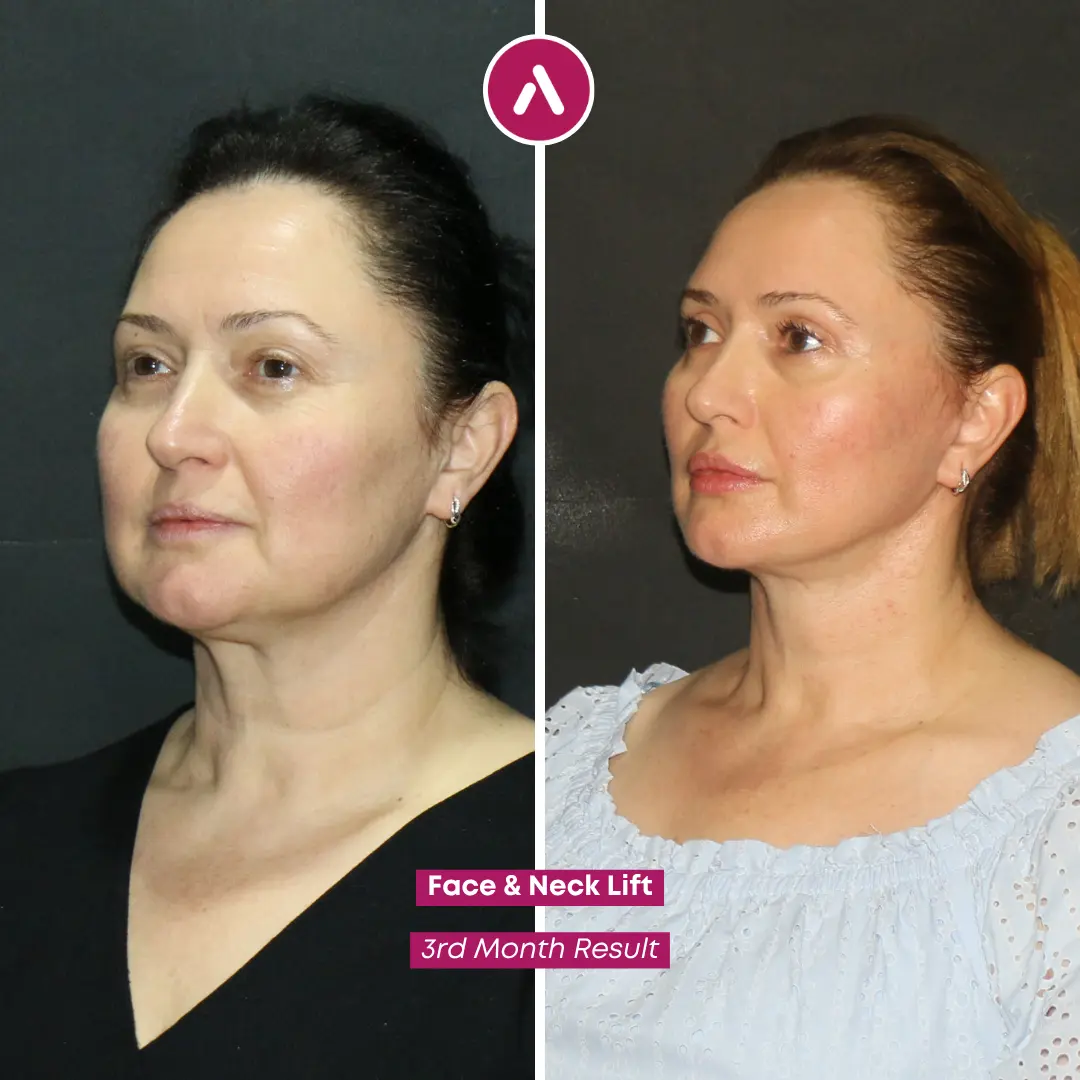
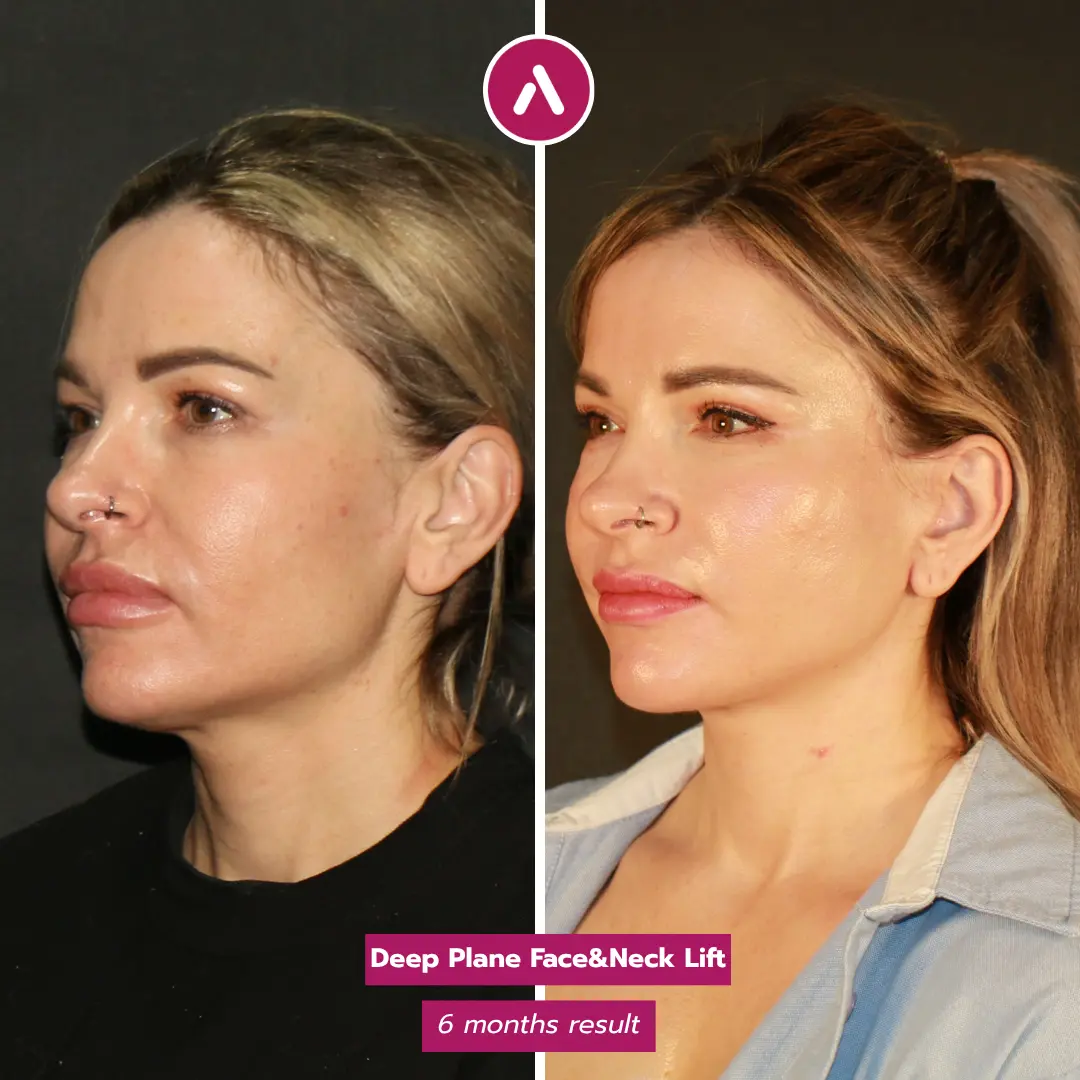
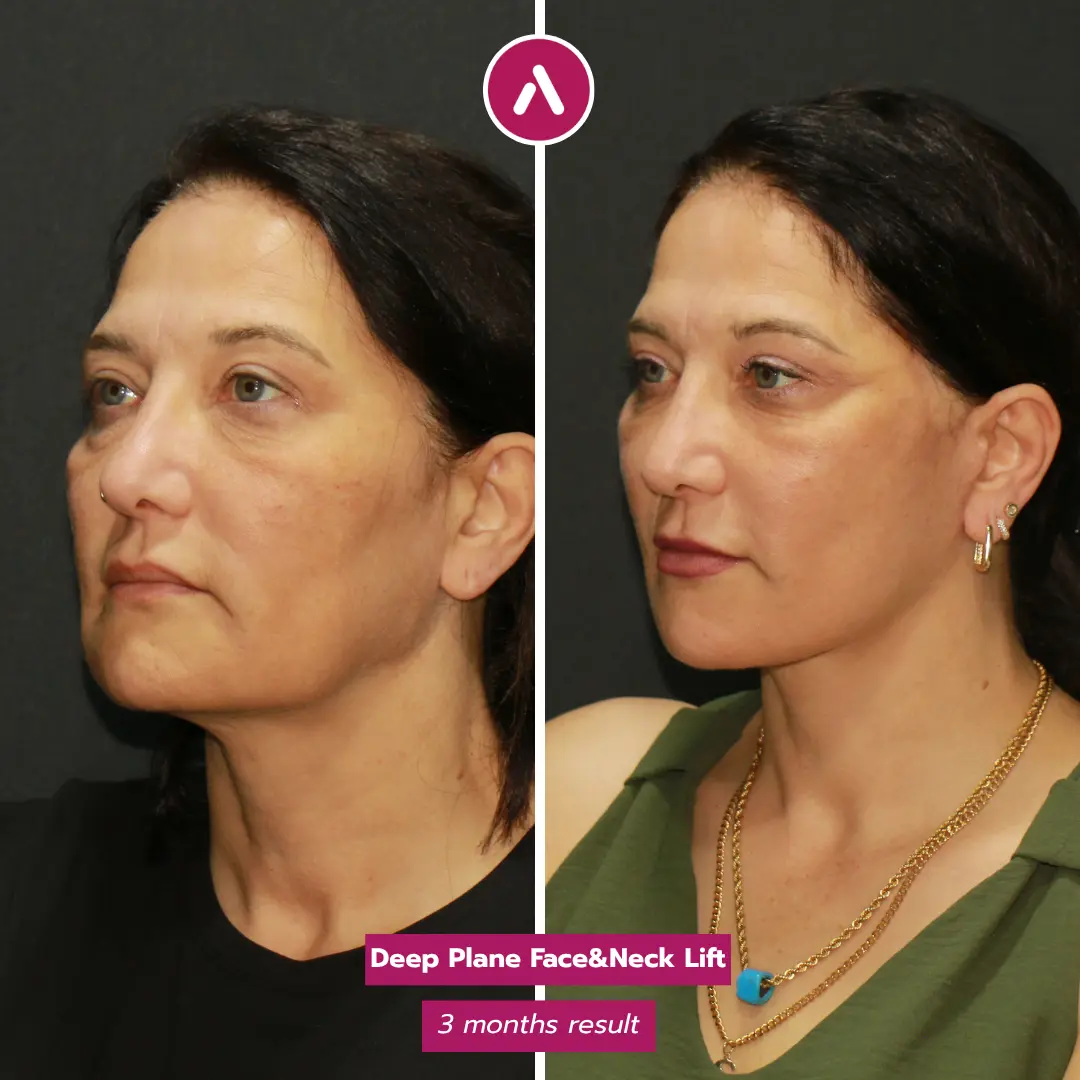
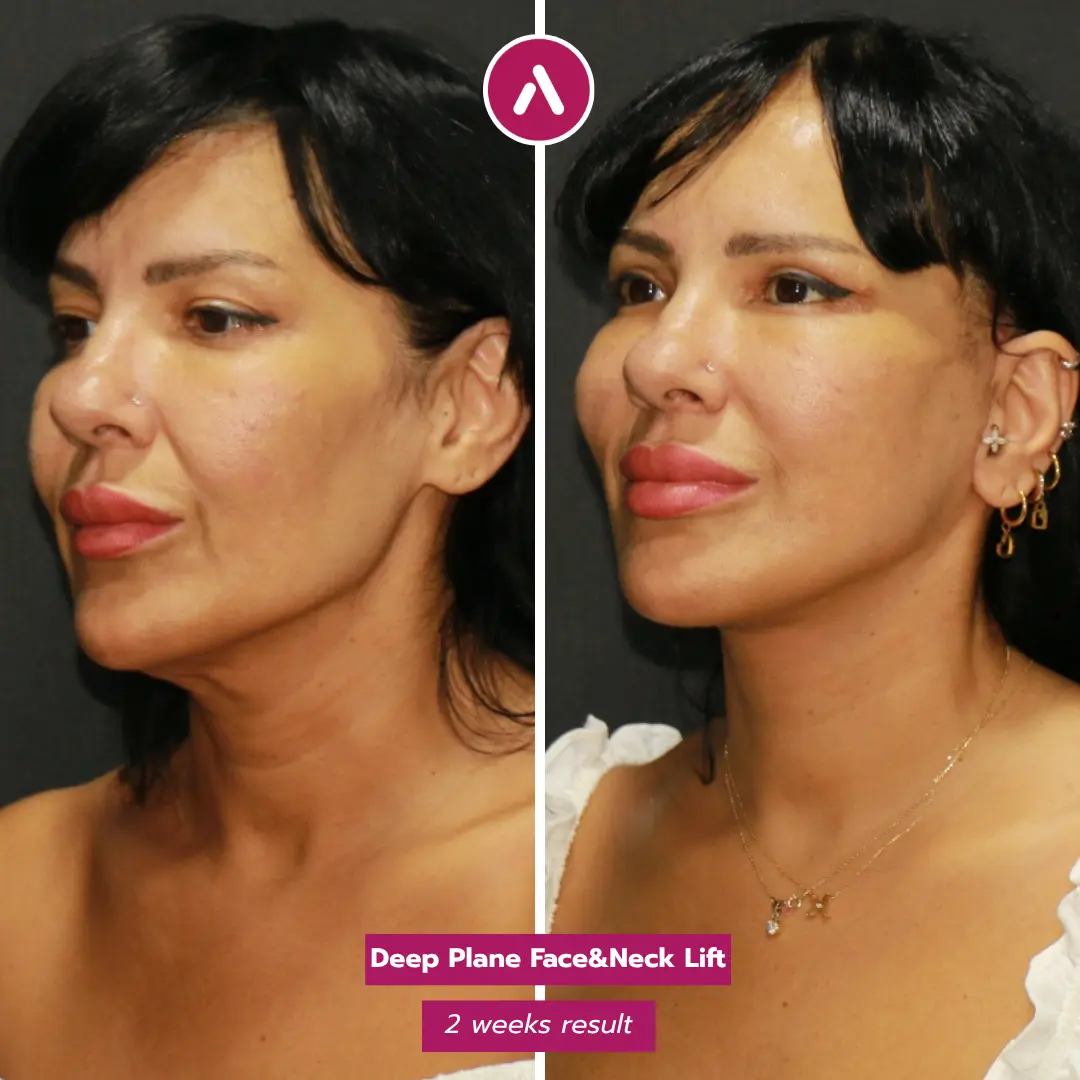
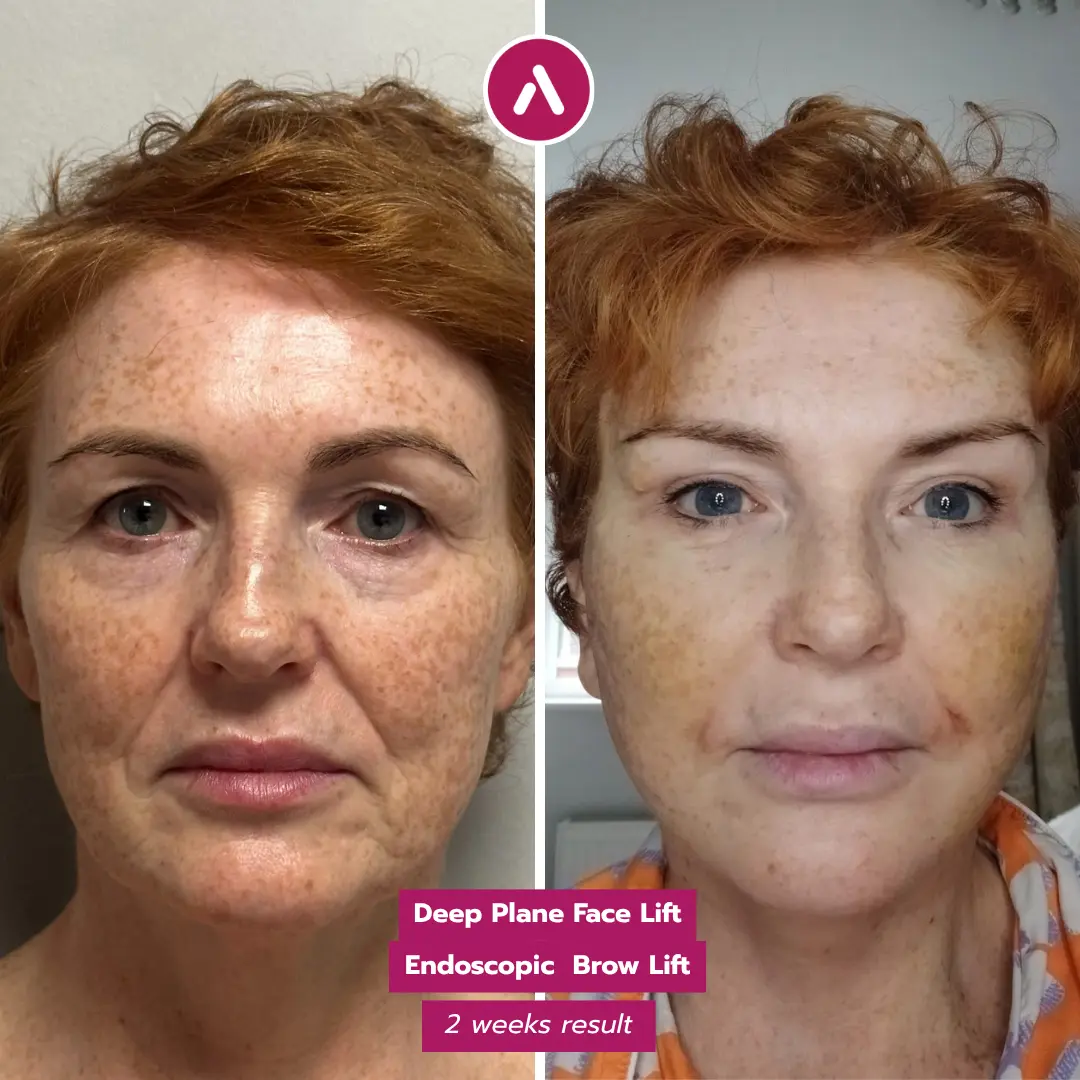
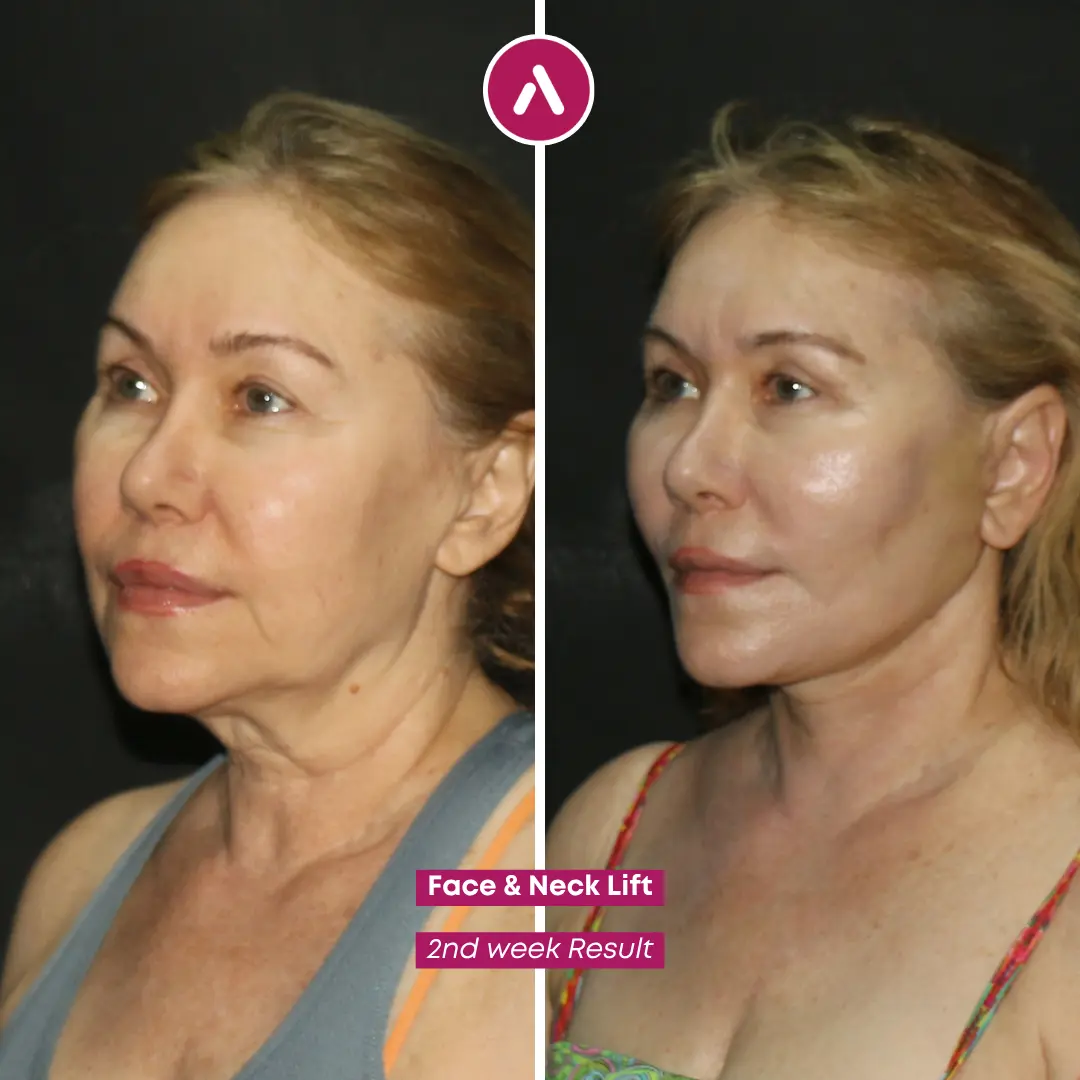
A SMAS Facelift is a structural facelift designed to reposition the SMAS layer, refine the jawline, and soften jowls without relying on skin tension. At AKM Clinic, we plan anatomically, explain technique options clearly, and prioritise natural-looking rejuvenation for UK patients considering treatment in Istanbul.
Where suitable, we offer awake or twilight sedation pathways to reduce concern around general anaesthesia, supported by advanced monitoring and international safety protocols. Recovery is guided by our HBOT + LLLT Rapid Recovery & Safety Protocol and structured follow-up after you return home, so you know what is normal at each stage of healing.
Table of Contents
What Is a SMAS Facelift?
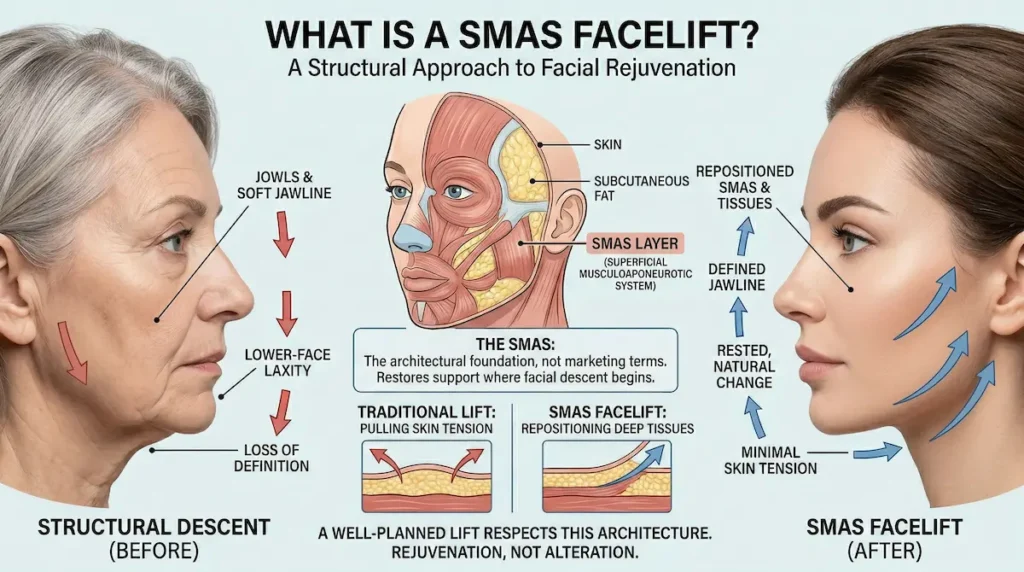
A SMAS Facelift is a structural facelift that repositions the superficial musculoaponeurotic system (SMAS) and the tissues attached to it. It targets the deeper cause of jowls and laxity, rather than relying on skin tension alone. Our aim is a rested, natural change. In short: rejuvenation, not alteration.
If you are researching techniques with an “expert patient” mindset, the key is understanding what is being lifted and why. A SMAS approach is designed to restore support where facial descent begins, then re-drape the skin with minimal tension. This is why SMAS facelift anatomy matters more than marketing terms.
The SMAS layer explained (why anatomy drives the result)
The SMAS is a fibromuscular layer that connects facial expression muscles to the skin and soft tissue. As the supporting structures descend with time, the surface changes you notice are often the final sign, not the starting point. A well-planned lift respects this architecture. It works with vectors, not brute force.
- Structural descent: the deep tissues settle downward, softening the jawline and mid-face.
- Loss of definition: the transition from cheek to jowl becomes less distinct.
- Skin laxity: the surface becomes looser, but it is rarely the only problem.
Why skin-only lifting can look unnatural
Many patients fear a “pulled” or “wind-swept” look, and it is a rational concern. Results can look unnatural when the skin is used as the main lifting structure. That approach tends to create visible tension, especially around the ear and hairline. Our preference is to create support beneath the skin and close without strain.
- Tension-focused lifting can shift the hairline or distort the ear contour.
- Surface-only tightening may improve briefly, then relax as the skin stretches.
- Structural lifting aims to reduce the need for aggressive skin pull.
What a SMAS facelift is designed to improve
This procedure is typically chosen for lower-face ageing patterns where deeper support has dropped and the jawline has softened. The goal is not a “new face”. It is a more defined, rested version of your own features. We plan improvements around proportion and harmony, not a single angle or filter.
- Jawline definition: reducing the heaviness that forms along the mandibular border.
- Jowls: improving the fold and shadow that develops beside the mouth.
- Lower-face balance: restoring a cleaner transition between cheek and jaw.
Some concerns need a combined plan (for example, a neck strategy or eyelid surgery). We cover that in dedicated sections, because suitability and surgical design matter as much as the technique itself.
“We believe the most successful aesthetic surgery is one that goes unnoticed. The goal is not to look like a different person, but to look like the most confident and revitalised version of yourself. This ‘Natural-First’ approach is our foundational promise.”
What Are the Benefits of a SMAS Facelift?
The benefits of a SMAS approach are best described in terms of structure, not “tightness”. When the deeper layer is repositioned, the skin can be re-draped with less tension. That usually supports a more natural-looking contour and a calmer scar line. For UK patients, this is often the difference between “obvious surgery” and a result that simply looks well-rested.
A more defined lower face, without the “pulled” look
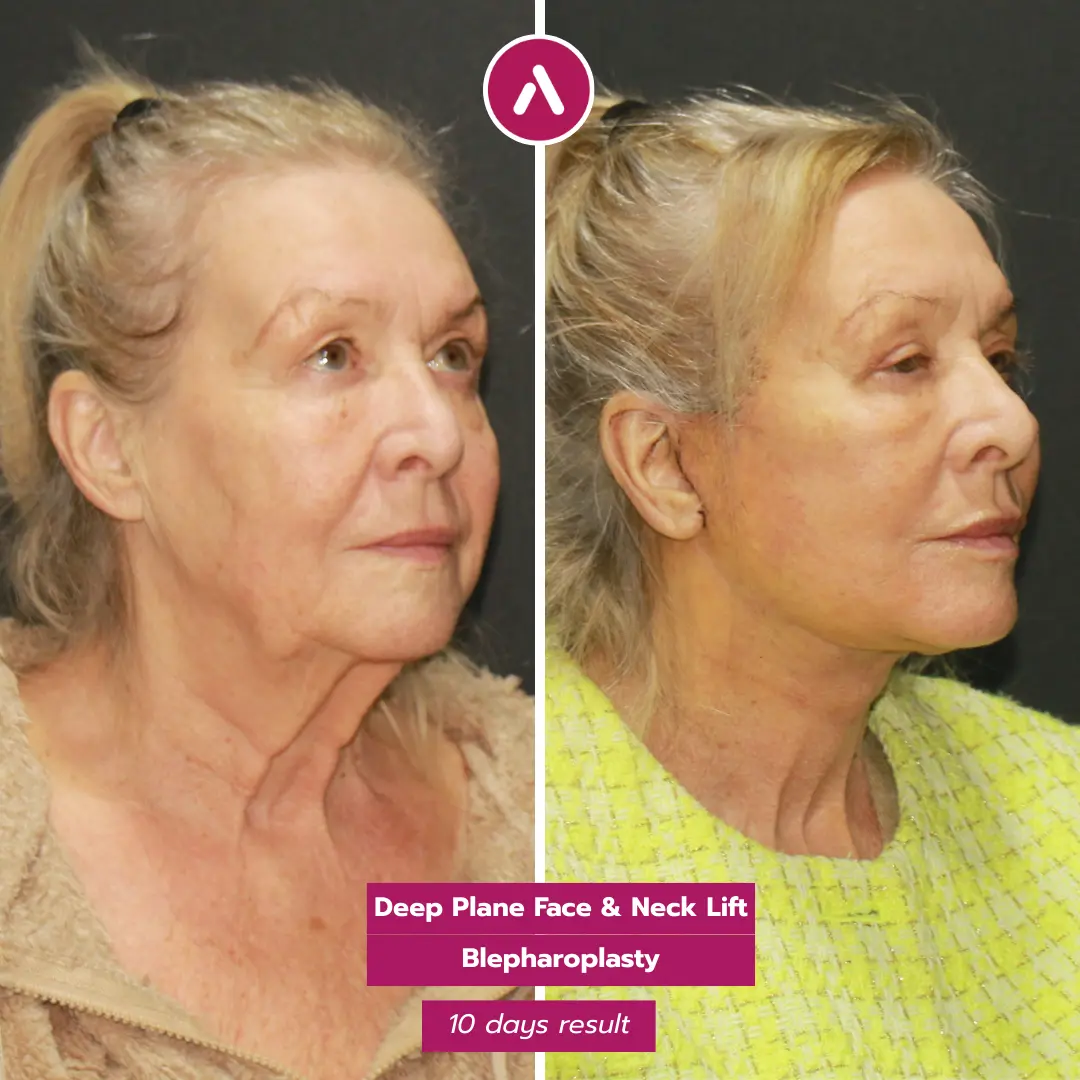
The lower face is where structural descent tends to announce itself: jowls, a blurred jawline, and a heavier look around the mouth. By supporting the deeper layer, we can refine these areas without forcing the skin to do the heavy lifting. The intention is subtle definition. Not tightness.
- A clearer jawline contour in profile and three-quarter view.
- Softening of jowl prominence (especially in certain lighting).
- A smoother transition from cheek to jaw, rather than a “stretched” surface.
Mid-face support and balanced contours
Many patients notice that the mid-face looks flatter or lower over time, even if the main complaint is the jawline. A structural lift can help restore support to descended tissues, which contributes to overall facial balance. It is not the same as adding volume, and it is not a replacement for fat transfer when that is needed. It is support.
- Improved balance between mid-face and lower-face heaviness.
- Less reliance on skin pull to create “lift”.
- A result that can look more consistent across different expressions.
“Rejuvenation, not alteration”: what we prioritise
At AKM Clinic, our results philosophy is deliberate: refine what time has softened, then stop. That means planning for proportion, scar placement, and a closure strategy that avoids unnecessary tension. It also means being transparent about what surgery can and cannot do. The best outcomes are often the ones others cannot immediately identify as surgery.
- Natural-looking outcomes: avoiding over-correction and visible tension.
- Individual planning: aligning vectors and tissue handling to your anatomy.
- Consistency: a strategy designed to look appropriate in motion, not only in photos.
If you would like a clinical opinion on whether a SMAS approach fits your anatomy and goals, we can review your photos and medical history in a structured virtual consultation with our specialists registered with international medical boards.
Am I a Suitable Candidate for SMAS Facelift?
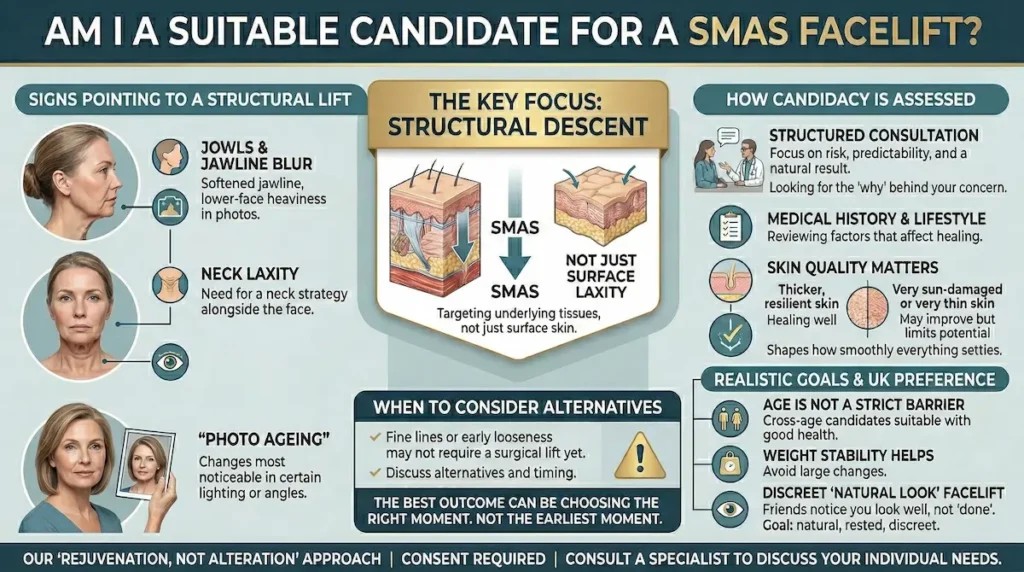
A SMAS Facelift is most effective when the main issue is structural descent rather than surface-only laxity. If your jawline has softened, jowls have appeared, and the lower face looks heavier in photos, you may be in the right category. Suitability is not just about age. It is about anatomy, skin quality, and whether your expectations match what surgery can realistically deliver.
We assess candidacy through a structured consultation that focuses on risk, predictability, and a natural result. Our specialists look for the “why” behind your concern, not just the symptom. We also review medical history and lifestyle factors that affect healing. The goal is simple: safe surgery, sensible planning, and a result that looks like you.
Signs that point to a structural lift
Many UK patients describe the same pattern: “I still look like myself, but I look tired and heavier around the jaw.” That often signals a deeper support issue. When the SMAS and related tissues settle, the surface follows. A SMAS-based approach is built for that problem.
- Jowls and jawline blur: the mandibular border is less defined, especially in side profile.
- Lower-face heaviness: the area beside the mouth looks fuller or droops slightly.
- Neck laxity: loose skin or banding can suggest the need for a neck strategy alongside the face.
- “Photo ageing”: you notice the change most in certain lighting, angles, or video calls.
If your concern is mainly fine lines or early looseness, a surgical lift may be more than you need right now. In those cases, we discuss alternatives and timing rather than rushing to theatre. The best outcome can be choosing the right moment. Not the earliest moment.
Skin quality, age range, and realistic goals
Skin quality matters because it shapes how smoothly everything settles after surgery. Thicker, resilient skin often heals with a calmer finish. Very sun-damaged or very thin skin may still improve, but it can limit how “polished” the surface looks. We talk this through openly during your plan.
- Age is not a strict barrier: we see suitable candidates across a broad range when health and anatomy align.
- Weight stability helps: large weight changes can affect facial volume and longevity of contour.
- Goal clarity matters: “natural, rested, discreet” is a stronger goal than “ten years younger”.
We also discuss how you want to be perceived. Many patients specifically ask for a natural look facelift for UK patients, meaning friends notice you look well, not “done”. That preference guides every decision, from vectors to scar placement. It is part of our “Rejuvenation, Not Alteration” approach.
Who should delay or avoid surgery
A facelift is elective surgery. That means we can be selective and cautious, and we should be. Some factors do not automatically exclude you, but they do change risk and may require medical optimisation first. If the risk is not reasonable, we will say so.
- Smoking or nicotine use: increases the risk of poor wound healing and skin compromise.
- Uncontrolled medical conditions: such as hypertension or diabetes that is not well managed.
- Blood-thinning medication: may need coordination with your prescribing clinician.
- High-risk clotting history: requires careful planning and may change suitability.
- Unrealistic expectations: for example, expecting surgery to fix skin texture or every fine line.
If you are unsure, a proper consultation is the safest first step. We review photos, your health background, and your priorities, then recommend a plan that fits. Sometimes the plan is “not yet”. That is a valid outcome.
“The most important part of a facelift is patient selection. A natural result comes from matching the technique to the anatomy, not forcing a single method onto every face.”
SMAS Facelift Anatomy: what we’re actually lifting
When patients search SMAS facelift anatomy, they are usually trying to answer one question: “What is the surgeon lifting that makes it look natural?” It is a fair question. The SMAS is not a marketing term. It is a real anatomical layer that helps explain why structural facelifts can look calmer and last better than skin-only tightening.
We plan around facial architecture: layers, ligaments, and vectors. That is why two people can have the same label on paper and very different outcomes in real life. A precise plan reduces unwanted tension. It also makes scars easier to conceal and easier to heal.
SMAS, retaining ligaments, and fat pads (facial architecture)
The face is held in position by a combination of soft-tissue layers and retaining ligaments. Over time, these structures allow gradual descent. This descent changes shadows and contours, which the eye reads as ageing. A SMAS approach aims to restore support at the level where that change starts.
- SMAS layer: a supportive layer connected to facial movement and soft tissue position.
- Retaining ligaments: anchoring structures that influence where sagging shows first.
- Fat compartments: shifts in position can create heaviness below and flattening above.
This is also why “tight” is not our goal. Support is. When the deeper layer is repositioned, the skin can follow naturally, with less strain at the incision lines.
Neck anatomy: platysma and why the neck often needs a plan too
Patients often say “it’s my face”, then point to their neck. That makes sense because the face and neck age together. The platysma is a neck muscle layer that can loosen and form bands or blur the jawline. If we ignore it, the face may look improved while the neck still gives the game away.
- Jawline–neck transition: definition depends on both facial support and neck tension patterns.
- Banding: may require a neck-specific strategy, not just more skin removal.
- Profile balance: a cohesive face-and-neck plan is often what makes the result look “finished”.
Vectors and tension: why direction matters
Not all “lift” is the same. The direction of lift (vector) influences whether the result looks refreshed or looks pulled. A thoughtful vector respects your natural anatomy and avoids creating odd tension at the ear or hairline. It is a technical decision with a very visible impact.
- Vector planning: helps maintain natural facial proportions and expression.
- Tension-free closure: supports calmer scars and a more discreet finish.
- Harmony over maximalism: the aim is believable rejuvenation, not maximum tightening.
In the next section, we explain the main technique variations (including plication, imbrication, and SMASectomy) and where terms like “high SMAS” and “deep plane” overlap in real-world practice. That is where many online comparisons become confusing, and where a clear anatomical framework is most valuable.
Surgical Techniques Explained (SMAS variants, not buzzwords)
Facelift terminology can feel like a maze, especially when different clinics use different labels for similar anatomical work. With a SMAS-based plan, the real question is not the headline term. It is what happens to the supportive layer, what is released, and how tension is managed at closure. We explain techniques in plain clinical language, so you can compare them without getting lost in branding. That clarity is a major part of risk mitigation for the “expert patient”.
You may also see names like 9d SMAS facelift online. These labels are not universally standardised. We recommend focusing on the anatomical layer, the lifting vector, and the surgeon’s strategy for natural results.
SMAS plication vs imbrication technique
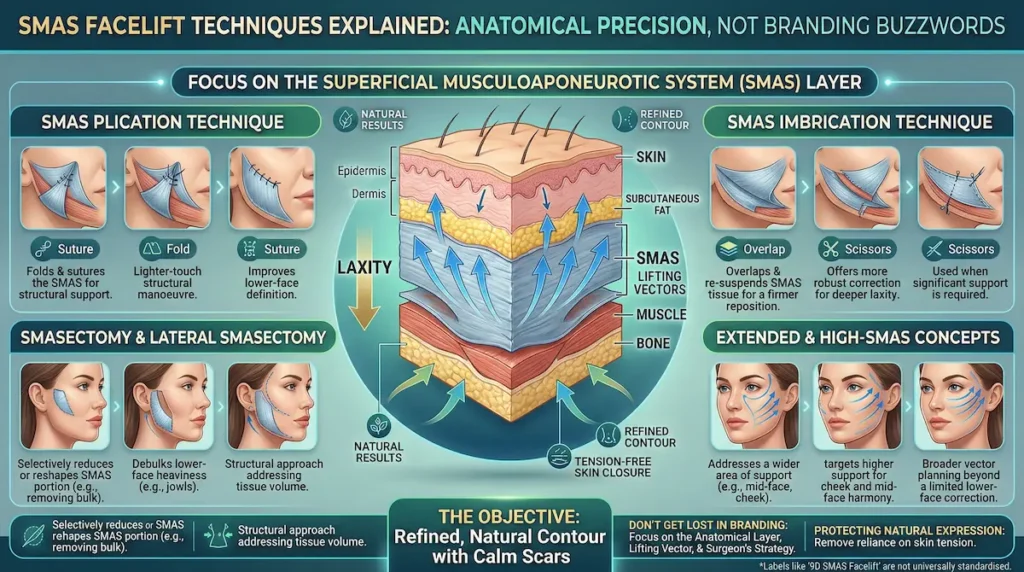
Both approaches aim to improve lower-face definition by working with the SMAS layer rather than stretching skin alone. In simple terms, SMAS plication vs imbrication technique is about how the SMAS is reshaped and supported. Plication typically involves folding and securing the SMAS with sutures. Imbrication usually involves tightening by overlapping and re-suspending the SMAS tissue.
- SMAS plication: suture-based folding for support, often considered a lighter-touch structural manoeuvre.
- SMAS imbrication: overlapping/re-suspension for a firmer reposition, often used when more support is needed.
- Why it matters: the choice affects vector control, tissue handling, and how “tension-free” the skin closure can be.
We decide between these methods based on your anatomy, laxity pattern, and how much structural correction is required. The objective stays the same. A refined, natural contour with calm scars.
SMASectomy and lateral SMASectomy facelift
SMASectomy refers to selectively reducing or reshaping a portion of the SMAS, rather than only folding it. The idea is to debulk and re-support areas contributing to lower-face heaviness. A lateral SMASectomy facelift focuses this work more laterally (towards the side of the face), which can be relevant when jowling and jawline blur are the main issues. It is a structural approach. Skin is re-draped, not yanked.
- Best suited to: patients with a heavier lower face where simple tightening may not be enough.
- Key advantage: it can address bulk and laxity at the level that creates jowls.
- Trade-off to understand: it is more technical than a simple suture fold and requires precise planning.
For UK patients concerned about looking “done”, the principle is reassuring. We aim to remove reliance on skin tension as the “lifting mechanism”. That is how we protect natural expression.
Extended SMAS and high-SMAS concepts (including “extended high SMAS facelift”)
“Extended” usually means the surgeon is addressing a broader area of support rather than focusing on a short segment. This can matter when ageing changes span the jawline and mid-face, not just one focal point. You may also encounter terms like extended high SMAS facelift. “High SMAS” generally refers to a design that targets higher support in the cheek and mid-face region, with vector planning that suits that anatomy.
- Extended SMAS: broader structural support for patients needing more than a limited lower-face correction.
- High SMAS concepts: mid-face aware planning that prioritises natural lift direction and cheek support.
- What to check in any consult: where the lift is anchored, what is released (if anything), and how scars are protected.
Our approach is to match the method to your anatomy and your risk profile, not to force one “hero technique” onto every face. That is how we stay aligned with our philosophy: Rejuvenation, not alteration.
| Technique label | What it usually means (plain English) | Typical focus | Why patients choose it | What to ask your surgeon |
|---|---|---|---|---|
| SMAS plication | Folding and suturing the SMAS for support | Lower face and jawline refinement | Structural support with lighter tissue handling | Where is the lift vector? How do you minimise skin tension? |
| SMAS imbrication | Overlapping/re-suspending the SMAS for a firmer reposition | Lower face support when more lift is needed | More robust correction for deeper laxity patterns | How do you protect the ear contour and hairline? |
| SMASectomy / lateral SMASectomy | Selective SMAS reshaping (sometimes with tissue reduction) | Jowls and lower-face heaviness | Targets bulk and laxity at the structural level | How do you balance debulking with natural softness? |
| Extended SMAS | Broader SMAS support beyond a limited segment | Face-wide structural correction, not just one area | When ageing changes are multi-zone | Which zones are you correcting, and why? |
| High SMAS (concept) | Mid-face aware SMAS design with higher support strategy | Cheek support + lower-face harmony | Patients wanting balanced, natural mid-face positioning | What is your plan for mid-face vs lower-face balance? |
| “9D SMAS facelift” (branding term) | A marketing label that can vary between providers | Varies | Patients seeking “advanced” methods online | What exact anatomical plane and steps are you using? |
“Technique names matter far less than anatomical respect. When we prioritise structural support and tension-free closure, the result looks calm, not operated.”
High SMAS vs Deep Plane Facelift: Why the terms overlap
Online, “High SMAS” and “Deep Plane” are often used interchangeably. That is where confusion starts, especially for UK patients comparing outcomes and safety profiles. We prefer an anatomy-first explanation: what layer is addressed, what structures are released, and how the lift direction is controlled. Clear definitions make it easier to judge competence and avoid being steered by buzzwords.
Where the terms overlap in real-world search intent
In everyday language, patients use “High SMAS” to describe a lift that looks natural in the mid-face and jawline. They use “Deep Plane” to describe a structural lift that avoids skin tension and “wind-swept” distortion. In reality, both terms are usually pointing to the same desire: structural correction, not surface tightening. That overlap is why you may see hybrid searches such as “super high SMAS deep plane facelift”.
- High SMAS is often used as a design concept: higher support and mid-face aware vector planning.
- Deep Plane usually describes working below the SMAS with ligament release to allow a true vertical reposition of descended tissues.
- Both aim to reduce reliance on skin pull, which is a major driver of unnatural-looking results.
When a classic SMAS plan is enough vs when deep-plane logic wins
Not every face needs the most aggressive approach. For some patients, the main issue is lower-face laxity and jowling, and a well-executed SMAS method can provide the correction needed while keeping tissue handling controlled. In other patients, descent involves a stronger mid-face component, and a deep-plane strategy can offer a more direct structural reset by addressing retaining ligaments and allowing a vertical lift. Our job is to match the plan to your anatomy, not to push a single label.
- Classic SMAS can be suitable when: the primary concern is jawline blur and jowls with less mid-face descent.
- Deep-plane logic can be suitable when: mid-face descent and ligament-driven ptosis are central to the ageing pattern.
- In both cases: we prioritise tension-free closure and natural vectors to protect a discreet result.
“Super high SMAS deep plane facelift”: understanding hybrid intent
Hybrid phrasing is usually a signal that you are an “expert patient” doing comparative research. It does not always mean a single universally defined operation. It usually means you want a structural lift, mid-face support, and a result that does not look “operated”. In consultation, we translate that intent into a surgical plan: where we lift, how we manage tension, and whether the neck needs a structural strategy too.
- Common hybrid intent: vertical repositioning, mid-face support, and a clean jawline.
- What we clarify: the actual anatomical plane, the vector plan, and the scar-protection strategy.
- What we avoid: selling a name instead of explaining a method.
If you also have concerns about general anaesthesia, we address that separately. Our clinical USP includes performing advanced facial rejuvenation under awake / twilight approaches in suitable patients, which can make the overall experience feel more controlled and predictable.
“Technique labels should help you understand anatomy, not replace it. When you judge the plan by layers, vectors, and tension management, you can compare surgeons more intelligently.”
Combined Procedures (synergy): maximising harmony, not “doing more”
Facial ageing is rarely confined to one area. That is why patients often ask whether a facelift should include the neck, eyelids, or volume restoration. We approach combined procedures as a harmony decision, not an upsell. The best combined plan is the one that makes the result look consistent across face, neck, and expression.
For UK patients, the practical benefit is often streamlined downtime. One recovery period can be more appealing than multiple staggered procedures. The clinical priority, however, stays the same: safety, balance, and natural outcomes. If combining procedures increases risk beyond a reasonable level, we stage them instead.
Face and neck synergy: why the neck often needs a structural plan
Many patients point to the jawline but mean the jawline–neck transition. Neck laxity and platysmal banding can undermine an otherwise excellent facial result if they are not addressed properly. A structural neck strategy may include platysma repair (platysmaplasty) when bands or deeper laxity are present. This is often the difference between “better” and “complete”.
- Best for: jawline blur, early banding, or a softened cervicomental angle.
- Why it matters: the neck is a major “giveaway” area if it remains untreated.
- Our aim: a cohesive face–neck contour that looks natural in profile and in motion.
Eyelid surgery and brow/temporal lift: refining the “tired” look
Some patients have a strong lower-face concern but also feel their eyes look heavy or tired. Upper and lower blepharoplasty can refine the eye area without changing identity when planned conservatively. A brow or temporal lift may be considered when brow descent is contributing to upper-lid heaviness. We plan these as subtle refinements, not dramatic changes.
- Upper eyelid surgery: can address heaviness and improve a rested appearance.
- Lower eyelid surgery: can reduce tired-looking contours when appropriate for your anatomy.
- Key principle: preserve natural expression and avoid an “over-operated” eye area.
Fat transfer: volume and lift are not the same tool
Volume loss can make the mid-face look flatter even after excellent lifting. Fat transfer can be a useful adjunct when the issue is deflation rather than descent alone. It is not a replacement for a structural lift, and it is not always required. We use it selectively, in small volumes, to support harmony rather than create puffiness.
- Best for: true volume loss in cheeks or temples alongside structural descent.
- How we plan it: conservative placement to avoid overfilled contours.
- Goal: balanced facial architecture that looks natural at rest and in expression.
“Synergy is about consistency. When the face improves but the neck or eyes tell a different story, the result feels incomplete. Our planning aims to keep everything in the same ‘age chapter’.”
SMAS Facelift Anaesthesia: why we prefer awake / twilight sedation
Many patients come to us with a very specific concern: “I want a natural result, but I don’t want general anaesthesia.” That is a sensible question, especially if you have previous anaesthetic anxiety or a demanding work schedule. Our clinical USP is the ability to perform advanced facial rejuvenation under local anaesthesia with awake or twilight sedation in suitable patients. This approach is designed to keep the experience controlled, calm, and medically appropriate.
We are careful with language here. Awake and twilight are not “no anaesthesia”. They are different anaesthesia strategies that can reduce certain burdens associated with being fully asleep, while still keeping you comfortable and closely monitored. Your suitability depends on medical history, procedure length, and anaesthetist assessment.
What “awake” and “twilight” mean in practice
Awake surgery typically means local anaesthesia is used to numb the surgical area while you remain responsive and comfortable. Twilight sedation sits between fully awake and fully asleep, and many UK patients search for it as Twilight anaesthesia cosmetic surgery. You are not “knocked out”, but you are relaxed, drowsy, and usually remember very little. Throughout, we use advanced vitals monitoring and an anaesthesia plan tailored to your medical profile.
- Awake (local anaesthesia): you are comfortable, responsive, and breathing independently.
- Twilight (conscious sedation + local anaesthesia): deeper relaxation, still not general anaesthesia.
- General anaesthesia: fully asleep with airway support; sometimes appropriate, sometimes avoidable.
You may also see searches like deep plane facelift without general anaesthesia. The intent is usually not about a “trend”. It is about risk perception and control. We translate that intent into a plan you can understand.
Why avoiding general anaesthesia can matter
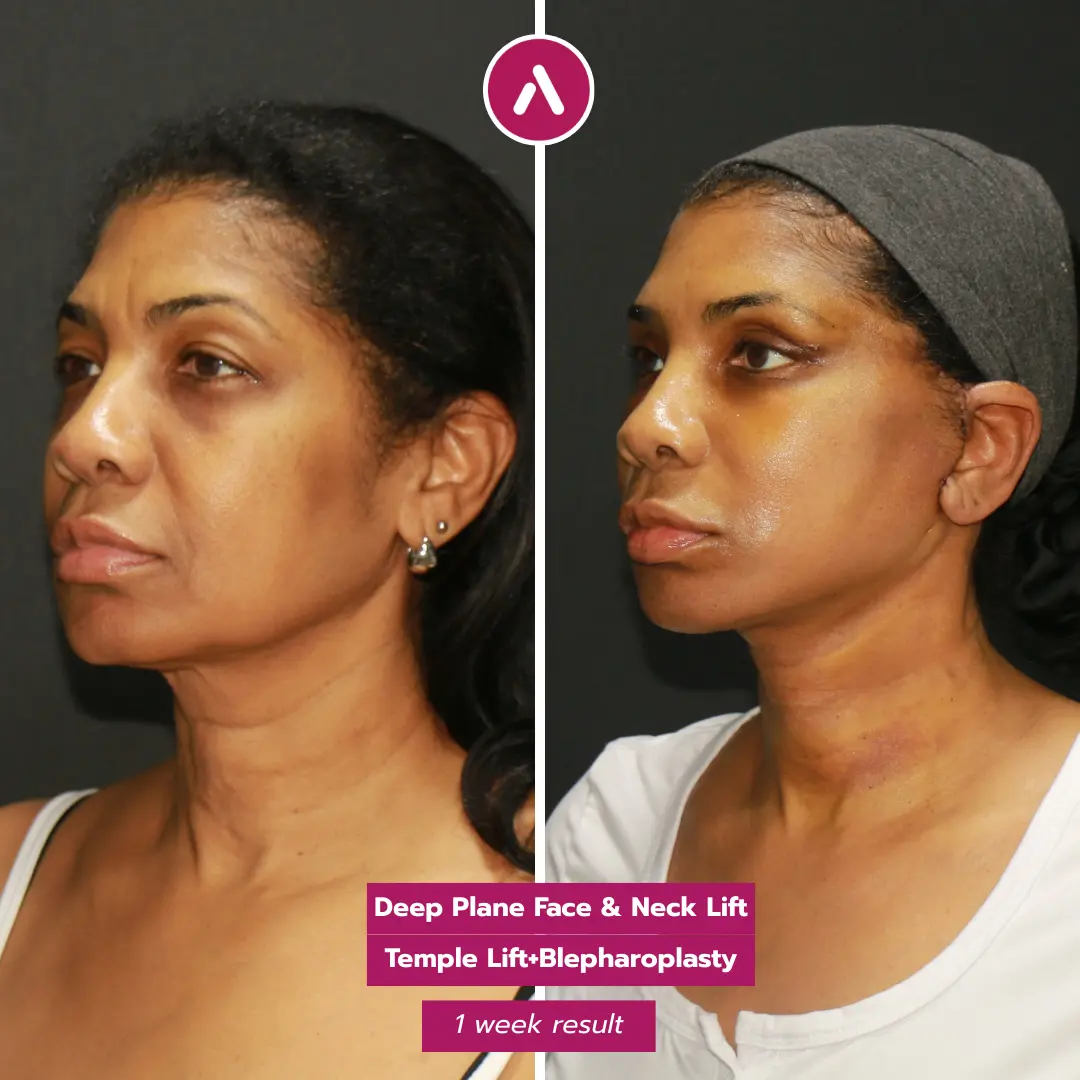
General anaesthesia is common and often very safe, but it is not everyone’s preference. Some patients dislike the grogginess, nausea, or “lost day” feeling afterwards. Others have anxiety about being fully unconscious, even if medically fit. For the right candidate, awake or twilight can be a practical way to reduce those concerns without compromising comfort.
- Comfort and clarity: many patients feel more “present” and settled post-op.
- Recovery experience: reduced post-anaesthetic fog can make the first evening easier.
- Confidence factor: for patients with strong GA anxiety, this removes a major barrier.
Some people describe this online as a walk-in walk-out facelift Turkey experience. The phrase is informal, but the underlying idea is valid: if your surgical plan is suitable, you may not need an extended hospital stay. We still treat it as major surgery. We just manage the pathway carefully.
Who is suitable for awake / twilight — and who isn’t
Suitability is decided with medical screening, not preference alone. We review your health history, medications, and any previous anaesthesia experiences. We also consider procedure length and whether combined procedures are planned. If we believe general anaesthesia is safer for your specific case, we will recommend it.
- Often suitable: healthy patients seeking a controlled recovery experience and avoiding GA where possible.
- May need a different plan: complex medical history, high anaesthetic risk factors, or procedures expected to be very long.
- Always assessed: blood pressure control, medication profile, and realistic comfort expectations.
We frame this as risk management. The goal is not to “prove” a technique. The goal is safe surgery with a calm, predictable experience.
“For many patients, the biggest barrier is not the surgery itself. It is the fear of general anaesthesia. When we can safely use awake or twilight approaches, we remove that barrier without changing our core goal: natural rejuvenation.”
SMAS Facelift Step-By-Step: what happens in theatre?
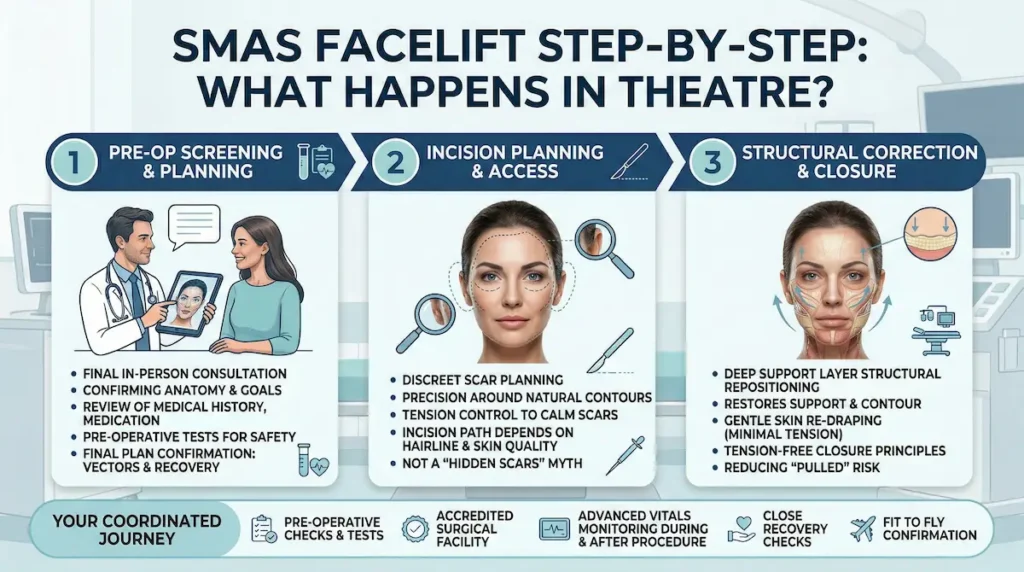
Patients often imagine the procedure as one long unknown. We do the opposite. We break the day into clear steps, so you know what is happening, when it is happening, and why it matters. This is how “expert patients” reduce risk: by understanding the process. It also helps you plan your stay in Istanbul with realistic expectations.
Your day is coordinated by our team, with privacy and flow in mind. We confirm the surgical plan in person, complete pre-operative tests, and then proceed in our fully accredited facility. During and after the procedure, you are monitored closely. Before you travel home, we check your recovery and confirm you are fit to fly.
Pre-op screening and the final surgical plan
We begin with a final in-person consultation to confirm your anatomy, goals, and the agreed plan. Pre-operative tests are then completed to support safe decision-making. If anything changes your risk profile, we adjust the plan. That includes anaesthesia choices, incision strategy, and whether combining procedures remains sensible.
- Review of medical history, medication, and any relevant previous surgery.
- Pre-operative tests to confirm candidacy and safety.
- Final plan confirmation: priorities, vectors, and expected recovery profile.
Incisions and access points (scar planning, not “hidden scars” myths)
A facelift does not mean random cuts. Incisions are planned around natural contours and hair-bearing areas to make scars discreet. We prioritise precision and tension control because that is what keeps scars calm. Your incision plan depends on your hairline, skin quality, and the zones we are correcting.
- Typical locations: around the ear contours and into hair-bearing areas where appropriate.
- Key principle: tension-free closure to avoid widening scars.
- Expectation setting: scars mature over months, not days.
Structural correction and tension-free closure
The core work is structural. We address the deeper support layer, then re-drape the skin without forcing it to do the lifting. This is where a natural look is protected: correct vectors, controlled tension, and careful closure. Throughout the procedure, we maintain advanced vitals monitoring and a safety-first theatre protocol.
- Structural repositioning to restore support and contour harmony.
- Skin re-draping with minimal tension to reduce “pulled” risk.
- Closure principles designed for discreet scars and stable contours.
SMAS Facelift Recovery & Aftercare: how long does healing take?
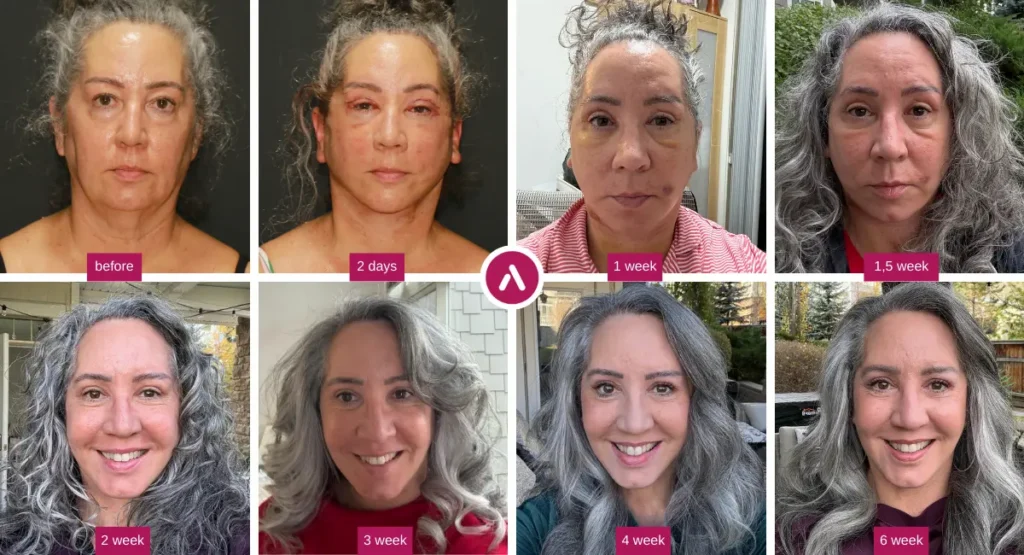
Recovery after a facelift is rarely linear. Some days you look better, then swelling returns, then settles again. That is normal. Our job is to make the process feel predictable, with clear checkpoints and a safety-first aftercare plan.
Most UK patients care about two things: how long they will feel “presentable”, and what reduces risk in the early phase. We plan your aftercare around both. This includes our mandatory Rapid Recovery & Safety Protocol, built around HBOT and LLLT.
First 72 hours: swelling, bruising, and tightness
The first three days are when swelling (oedema) and bruising typically build. Tightness is common. So is a “strange” sensation around the ears because nerves and tissues are settling. We keep your focus on simple priorities: rest, calm monitoring, and protecting the work we have done.
- Common sensations: tightness, numb patches, heaviness, mild asymmetry due to uneven swelling.
- What we monitor: comfort, blood pressure stability, and any signs that need early attention.
- Medication language (UK): many patients use pain relief such as paracetamol when needed, guided by our medical team.
Week 1–2: social downtime and early contour changes
This is the phase patients often search as SMAS facelift recovery day by day. Bruising usually fades in stages rather than disappearing overnight. Swelling reduces, then returns slightly with activity. Your face begins to look more “like you” again, but it is still early.
- Social downtime: often driven more by bruising and swelling than by pain.
- Daily life: light movement helps; strenuous activity waits until we advise it is safe.
- Incision care: we guide cleansing and dressing (plasters if needed) with a tension-free healing focus.
Week 3–6 and beyond: settling, numbness, and scar maturation
By this stage, most patients feel more normal in daily routines. Swelling continues to settle in layers, especially around the jawline and behind the ears. Numbness and firmness can linger. It improves gradually.
- What improves: contour definition becomes clearer as deeper swelling resolves.
- What can persist: patchy numbness, mild tightness, and small areas of firmness.
- Long game: scars mature over months, not weeks.
Our Rapid Recovery & Safety Protocol: HBOT + LLLT
We built our aftercare around two technologies that support recovery at a tissue level. Hyperbaric Oxygen Therapy (HBOT) increases oxygen delivery in a pressurised environment, which supports tissue survival and regeneration when circulation is temporarily disrupted after surgery. It also helps reduce inflammation, supports lymphatic drainage, and strengthens scar quality by stimulating fibroblasts. We position HBOT as our #1 safety promise because it directly targets the complications patients fear most.
Low-Level Laser Therapy (LLLT) is our second pillar. We use medical-grade laser diodes (not basic LEDs) at a precise 650nm “soft laser” wavelength to stimulate cellular repair without heat damage. In practical terms, it supports ATP production, collagen synthesis, and helps reduce swelling and redness. Together, HBOT and LLLT create a cohesive recovery system rather than isolated add-ons.
- HBOT focus: tissue support, inflammation control, scar quality, and infection defence.
- LLLT focus: cellular acceleration, collagen support, and smoother settling in the early weeks.
- What you feel: the process is calm and structured, with clear guidance at each step.
“A natural result is not only about what we do in theatre. It is also about what we protect after surgery: tissue health, swelling control, and a calm scar line.”
Scars & Healing Time: what to expect and how we optimise healing
Scar anxiety is common, and it is reasonable. A facelift scar is not just “a line”. It is the outcome of incision design, tissue handling, and tension management. We plan scars around natural contours, then close without forcing the skin to act as the lifting structure.
Healing is a process with stages. Early redness and firmness do not mean something has gone wrong. They are part of maturation. Our role is to guide you through what is normal and what is not.
Typical incision lines and scar placement
Incisions are designed to sit within natural anatomical boundaries, often around the ear contours and into hair-bearing areas when suitable. The aim is a discreet line that blends as it matures. The most important factor is not “how hidden” it looks on day one. It is how calmly it heals over months.
- Scar strategy: place incisions where natural shadows and contours help conceal them.
- Closure strategy: minimise tension to reduce widening and irritation.
- Expectation: the area can feel tight and look slightly uneven early on.
Scar maturation phases and what is normal
Scars usually look their “worst” before they look their best. Early pinkness, mild thickness, and firmness are common in the first weeks. Over time, colour fades and the line softens. We review your progress at planned checkpoints so you are not guessing.
- Early phase: redness, mild raised texture, and sensitivity can occur.
- Mid phase: the line flattens and becomes less noticeable.
- Long term: maturation continues for months, with gradual refinement.
How we support scar healing with HBOT and LLLT
Our technology protocol is not cosmetic “pampering”. It is designed to support wound biology. HBOT promotes stronger collagen formation by stimulating fibroblasts, which can translate into smoother, less visible scarring. LLLT complements this by accelerating cellular repair and supporting collagen synthesis in a targeted way.
- Why it matters: scar quality influences the final “discreetness” of a facelift more than most people realise.
- What we optimise: oxygen delivery, inflammation control, and controlled collagen production.
- What we avoid: over-promising. Healing is individual, so we focus on risk reduction and best-practice support.
If you have a history of hypertrophic scarring or are particularly anxious about scar visibility, tell us early. We can plan incision design, aftercare, and follow-up intensity around that risk profile.
Safety & Risks: Is a SMAS Facelift Dangerous?
A facelift is elective, but it is still real surgery. The safest approach is to assume that complications are possible, then build a pathway designed to prevent them. We talk about risk openly because informed patients make better decisions. If a clinic only sells reassurance, that is not reassurance at all.
Our stance is practical: a good outcome starts with patient selection, continues with a controlled operating theatre environment, and is protected by structured aftercare. This is also where our “Rapid Recovery & Safety Protocol” (HBOT + LLLT) becomes more than comfort. It is a risk-mitigation system.
The real risks (honest, non-dramatic)
Most concerns after facial surgery are temporary and settle with time. Some complications are more serious and require prompt action. We do not give “zero risk” promises because they are not credible. Instead, we explain the common categories of risk and what we do to reduce them.
- Bleeding / haematoma: swelling and pressure that may require urgent review.
- Infection: uncommon with correct protocols, but always taken seriously.
- Nerve irritation: temporary numbness or weakness can occur as tissues recover.
- Scarring issues: delayed healing, thickening, or widening in higher-risk skin types.
- Asymmetry: usually swelling-related early on, occasionally longer lasting.
How we reduce risk before and during smas facelift surgery
Risk reduction is not one step. It is a chain. We start with strict pre-operative screening to confirm candidacy and identify factors that change the plan. During surgery, we use advanced vitals monitoring and operate within a highly controlled sterile environment. These elements are not “nice to have”. They are non-negotiable.
- Pre-op screening: health checks designed to confirm safety and suitability before proceeding.
- Sterility protocols: multi-stage, internationally aligned hygiene standards as part of a zero-compromise policy.
- Advanced monitoring: continuous vitals monitoring throughout the procedure.
Where appropriate, we also use awake / twilight sedation pathways to address fear of general anaesthesia and support a calmer recovery experience. Suitability is always assessed medically. Preference alone is not enough.
Aftercare and “red flags”: when to contact us urgently
Aftercare is where small issues stay small. We structure follow-up so you are not left guessing at home, and we remain reachable while you recover. If you are in the UK and worried, we prefer you to contact us early rather than “wait and see”. When symptoms are severe or rapidly worsening, you should seek urgent medical attention.
- Call us immediately if swelling increases suddenly on one side, pain escalates sharply, or you feel increasing pressure.
- Seek urgent care if you develop breathing difficulty, chest pain, or signs of a severe allergic reaction.
- Contact us same day for fever, increasing redness, unusual discharge, or concerns about incision healing.
Our goal is a safe result that looks natural. The way we get there is predictable systems, not optimism.
“Safety is not a slogan. It is a sequence of decisions: careful screening, controlled theatres, and structured follow-up. When the system is right, the outcome becomes more predictable.”
Is a SMAS Facelift Safe In Turkey for UK Patients?
This is the question a sceptical patient should ask. Location alone does not determine safety, and neither does price. Safety comes from standards, governance, and the discipline of the team delivering the care. If you compare Turkey to the UK properly, you do it by comparing protocols, not geography.
We built our international pathway to match what UK patients expect: rigorous screening, sterile operating theatres, continuous monitoring, and clear follow-up. We also protect privacy with USA-standard confidentiality and data security protocols. The result is a clinical journey designed to feel structured, not improvised.
Standards that matter (what you should verify)
When patients say “safe”, they usually mean: sterile environments, proper monitoring, and no shortcuts. We operate in JCI-accredited hospitals and use FDA-approved materials, because inputs matter as much as technique. Inside the clinical environment, we adhere to international sterilisation standards (ISO/TÜV) and run strict pre-operative screening. These are the kinds of details that reduce risk in real terms.
- Hospital standards: surgery performed in JCI-accredited hospitals.
- Materials: use of FDA-approved materials as part of quality assurance.
- Environment: rigorous sterilisation standards and continuous monitoring.
Surgeon credentials and “expert-led” practice
For UK patients, credentials are not decoration. They are a risk filter. Our surgeons are described in our documentation as board-certified through a rigorous national system, with many holding European Board Certifications (EBOPRAS). In our general communication, we refer to this as care delivered by European Board Certified Surgeons and specialists registered with international medical boards. It is a simple principle: you should be able to verify expertise without relying on marketing.
- Board certification focus: verifiable, third-party assurance matters more than claims.
- Technique matching: the right method for the anatomy reduces revision risk.
- Consultation quality: we aim for clarity on plan, limitations, and aftercare.
Continuity of care: what happens after you fly home?
One of the biggest worries for international patients is the fear of abandonment after they leave Istanbul. We address this with a structured follow-up model and high-touch communication. Your Patient Host remains available 24/7 via WhatsApp while you are in Istanbul, and we schedule virtual follow-ups at 1, 3, 6, and 12 months. This is how we keep your recovery supported even when you are back in the UK.
- While in Istanbul: monitored post-op recovery and easy access to the team.
- After returning home: scheduled virtual follow-ups to track healing milestones.
- Privacy: USA-standard confidentiality and data security protocols.
If you would like a structured opinion on your candidacy and risk profile, we can review your photos and medical history in a no-obligation virtual consultation. The aim is an informed decision, not a rushed one.
High SMAS Facelift Before and After: Realistic Expectations & Results
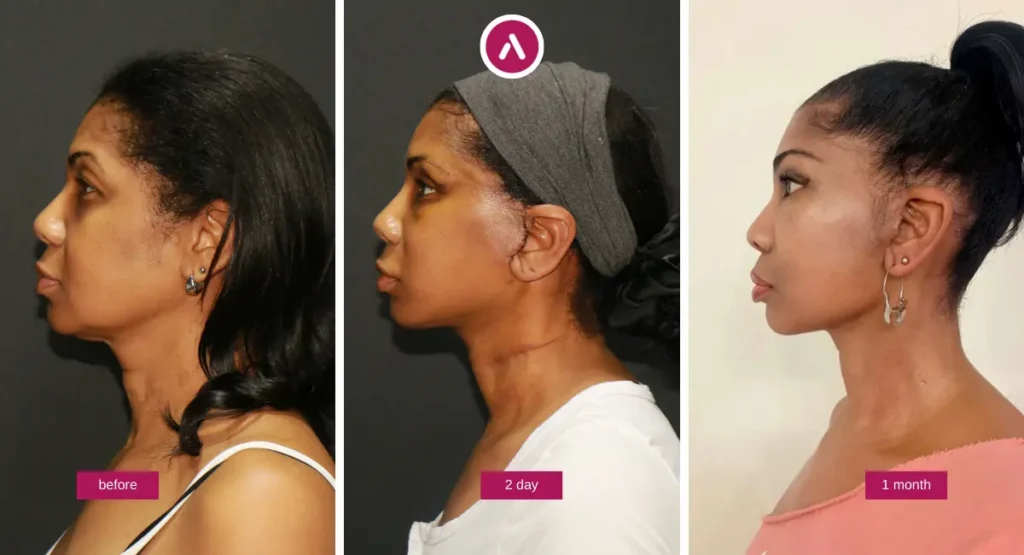
Most UK patients do not want a “new face”. They want a quieter version of ageing: less heaviness, clearer definition, and a rested expression. That is exactly why we lead with our philosophy, Rejuvenation, Not Alteration. A natural result is not an accident. It is built through anatomy-first planning, controlled vectors, and tension-free closure.
We also set expectations early because it reduces anxiety later. Swelling can distort early impressions. Asymmetry in the first weeks is common. Patience is part of the process.
What improves most (and what a facelift does not fix)
A structural facelift is strongest where structural descent is the main driver of ageing. That usually means the jawline, jowls, and the lower-face “shadowing” that appears beside the mouth. When the SMAS layer is addressed properly, the skin can be re-draped with less tension. The result tends to look calmer and more believable in motion.
- Most responsive areas: jawline definition, jowls, and the lower-face contour.
- Often improved with a plan: neck definition when combined with an appropriate neck strategy.
- Not the main target: fine lines and skin texture (these may need skin treatments, not more pulling).
Longevity and ageing after surgery
A facelift does not stop ageing. It resets the structural position of tissues, then your face continues to change naturally over time. Longevity depends on your anatomy, lifestyle, skin quality, and whether weight stays stable. Our goal is to deliver a result that still looks like you years later.
- Think “turning back”, not “freezing”: you will still age, just from a more refreshed baseline.
- Maintenance is sensible: skin health and sun habits often influence the long-term finish.
- Planning matters: over-tightening can look unnatural now and later.
How to read “before and after” correctly
Photos can educate, but they can also mislead if you do not know what to look for. Lighting, head angle, and even facial expression can change how the jawline and neck appear. Early post-op photos can also look “too good” or “too strange” because swelling shifts daily. We encourage you to judge results with a calm, clinical eye.
- Look for expression: natural outcomes still look normal when smiling and speaking.
- Check scar zones: behind-the-ear and hairline areas matter for discreet healing.
- Ask about timing: “two weeks” and “six months” are different chapters of healing.
Typical patient profiles we see (and the feedback we hear most often)
We do not invent stories, and we do not need to. The patterns are consistent. Many patients describe the same fear: looking pulled, wind-swept, or “done”. When we match the technique to anatomy and protect the recovery, the common feedback is simple: “I look rested, not altered.”
- The “expert patient” researcher: compares high SMAS, deep plane, and SMAS techniques and wants rational answers.
- The anaesthesia-anxious patient: prefers awake or twilight pathways for a calmer experience.
- The time-sensitive professional: values structured aftercare and our flight-ready recovery protocols.
“A natural result is the product of restraint. We lift the structure, not the identity.”
Cost Analysis: SMAS Facelift Cost 2026 (Turkey vs UK)
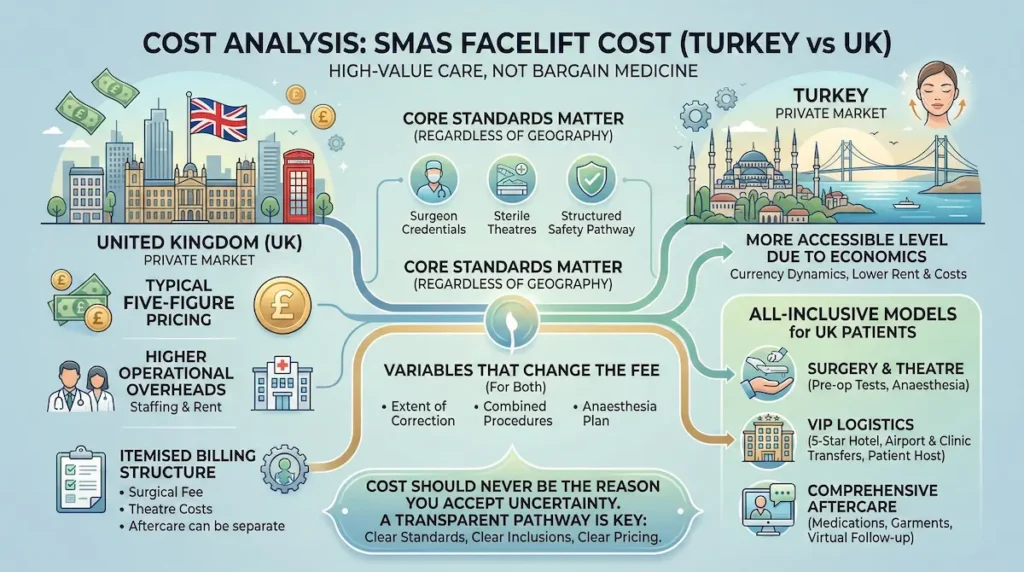
Cost comparisons only help if they are honest. In the UK, facelift surgery is commonly priced in the five figures, and London fees can rise further in premium settings. In Turkey, the same category of procedure is often offered at a more accessible level. The difference is usually driven by macroeconomics and operational costs, not by a “shortcut” in technique. We position this as high-value care, not bargain medicine.
For UK patients, we also remove the stress of fragmented billing. Our model is designed to be all-inclusive where it matters: surgery, theatre fees, and structured aftercare. You receive a transparent quote after your consultation and photo review. No guesswork.
What drives the gap (without turning it into a “cheap” argument)
When patients compare Facelift cost Turkey vs UK, the first instinct is to assume quality must drop. That is not a reliable assumption. Costs differ because rent, staffing, and operational overhead differ by country, and currency dynamics play a role. The right way to compare is standards, protocols, and surgeon credentials.
- Operational costs: facility and staffing costs are typically higher in the UK.
- Hospital pricing structures: theatre and anaesthesia fees vary significantly by region.
- What matters more than geography: sterile theatres, monitoring, and a structured safety pathway.
What is included in our all-inclusive model (designed for UK patients)
UK patients often search All-inclusive cosmetic surgery GBP because hidden costs are a major stressor. Our VIP packages are designed to remove that friction so you can focus on recovery. The inclusions are practical, not flashy. The goal is a smooth, supported pathway from arrival to clearance-to-fly.
- Included: your surgical procedure, anaesthesia & operating theatre fees, and all pre-operative tests.
- Included: 5-star hotel accommodation, VIP airport and clinic transfers, and a 24/7 dedicated Patient Host.
- Included: post-operative medications, required garments, first post-op meal, and long-term virtual follow-up.
What typically changes the fee (and why quotes vary)
No two faces are identical, so no ethical clinic offers a single fixed fee for every patient. Scope matters. Combining procedures changes theatre time and aftercare needs. Technique selection can also change complexity, especially when a full face-and-neck plan is required.
- Extent of correction: lower face only vs face + neck strategy.
- Combined procedures: eyelids, brow, or fat transfer can change cost and recovery design.
- Anaesthesia plan: awake/twilight vs general anaesthesia, based on medical suitability.
| Cost factor | UK private market (typical pattern) | Turkey private market (typical pattern) | How we frame value |
|---|---|---|---|
| Surgeon & theatre fees | Often five-figure pricing; London may be higher | Often more accessible due to lower operational costs | We prioritise verifiable standards and structured safety |
| Aftercare structure | Can be itemised separately depending on provider | Packages may include more elements in one quote | We keep billing simple and support consistent follow-up |
| Accommodation & transfers | Usually separate from surgical fees | Often included in international patient packages | We include logistics to reduce stress and friction |
| Final fee variability | Driven by technique, hospital, and combination procedures | Driven by scope, technique, and combined procedures | We quote after medical review to avoid surprises |
“Cost should never be the reason you accept uncertainty. Our job is to keep the pathway transparent: clear standards, clear inclusions, and a plan matched to your anatomy.”
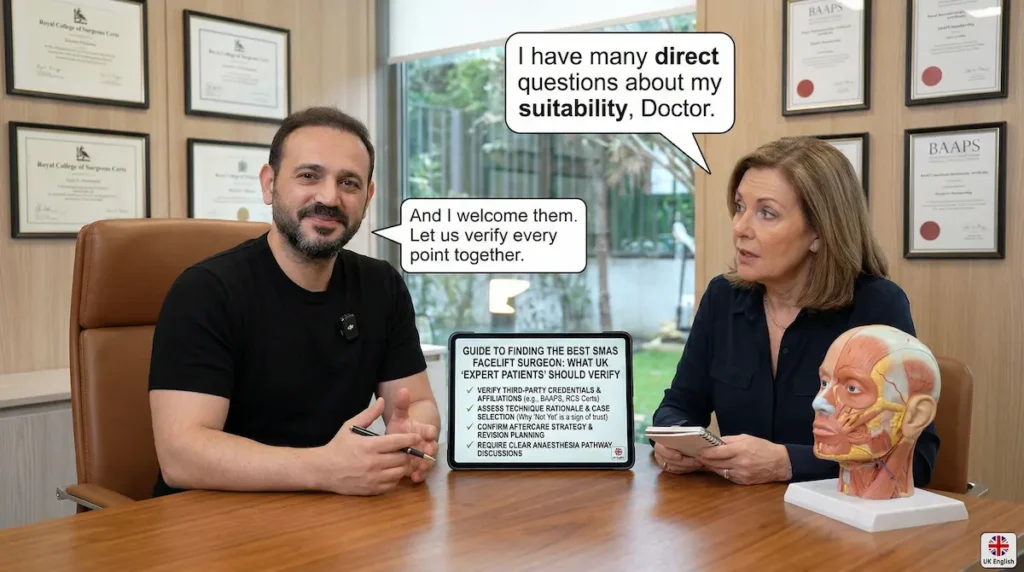
Finding the Best SMAS Facelift Surgeon: what UK “expert patients” should verify
Choosing a facelift surgeon is not about liking a website. It is about reducing uncertainty. For UK patients, the safest approach is to treat this as a verification exercise: credentials, process, and aftercare. We encourage you to ask direct questions and expect direct answers.
Board certification and what “equivalent” actually means
UK patients often search for UK board-certified equivalent surgeons because they want a familiar benchmark. We respect that. In consultation, we explain credentials in a way you can cross-check, without asking you to “take our word for it”. We also avoid relying on doctor names in general content and focus on verifiable standards.
- Look for third-party credentials: board certifications and recognised professional affiliations.
- Ask about who does what: who plans the surgery, who performs it, and who follows you up.
- Check the anaesthesia pathway: if you want awake/twilight options, confirm suitability is medically assessed.
Experience, case selection, and revision thinking
A facelift is not one-size-fits-all. A reliable surgeon shows you how they match technique to anatomy. They also discuss what they will not do, and why. That restraint is a trust signal.
- Case selection: good outcomes start with saying “not yet” or “not suitable” when needed.
- Technique rationale: you should hear a clear plan for layers, vectors, and tension management.
- Revision strategy: ask how the team handles complications and long-term concerns, even if they are uncommon.
The consultation quality test: questions that reveal competence
A strong consultation feels clinical, not sales-led. You should leave with clarity on risks, recovery, and what “natural” means for your face. If you feel rushed, that is data. If you feel educated, that is also data.
| Question to ask | What a good answer includes | Why it matters |
|---|---|---|
| “What is the main anatomical problem in my face?” | SMAS descent, ligament support, fat compartment changes, skin quality | Shows anatomy-first thinking, not generic scripting |
| “How will you avoid a pulled look?” | Vector planning, structural support, tension-free closure, scar strategy | Addresses the UK patient’s top fear directly |
| “What will recovery look like day by day?” | Clear milestones, normal vs abnormal signs, when to call, follow-up cadence | Reduces anxiety and improves safety |
| “What happens after I return to the UK?” | Remote follow-ups, communication pathway, escalation plan if concerns arise | Prevents the fear of abandonment |
“A facelift should feel like a structured medical decision, not a leap of faith. When your surgeon explains the ‘why’ behind each step, your risk drops and your confidence rises.”
Your Medical Journey: what to expect as a UK patient
Travelling for surgery should not feel like navigating a puzzle. We built a six-step pathway so you always know what happens next. It starts with a virtual consultation and ends with structured long-term follow-up after you return home. The aim is simple: reduce friction, protect safety, and keep recovery predictable.
Step 1–2: virtual consultation and planning (before you fly)
Your journey begins with a free, no-obligation virtual consultation. We review your photos, discuss your goals, and build a personalised surgical plan with a transparent all-inclusive quote. If we see risk factors, we address them early. Clear planning is part of safety.
- What we review: your anatomy, goals, medical history, and any previous facial surgery.
- What you receive: a tailored plan and guidance on timing, downtime, and aftercare.
- What we avoid: rushing you into a date before the plan is clinically sound.
Step 3–4: arrival, in-person consultation, and surgery day
Once your date is secured, your dedicated Patient Host coordinates logistics, including partner 5-star hotel accommodation and VIP transfers. On procedure day, we complete pre-operative tests and reconfirm the plan in person. Your surgery is performed in a fully accredited facility with advanced vitals monitoring. Afterwards, we keep the focus on calm recovery and clear checkpoints.
- Arrival support: VIP airport pickup and transfer to your hotel.
- Clinical steps: screening, in-person assessment, and final plan confirmation.
- After surgery: close monitoring and a structured recovery routine.
Step 5–6: recovery in Istanbul, then remote aftercare in the UK
After surgery, our team monitors your recovery and your Patient Host remains available 24/7 via WhatsApp while you are in Istanbul. Before you leave, you have a final in-person check-up so we can confirm your healing is on track and you are fit to fly. Once you are home, we continue with scheduled virtual follow-ups at 1, 3, 6, and 12 months. This is our framework for post-op care in Turkey for British citizens that still works when you are back in the UK.
- In-Istanbul support: daily guidance, practical help, and rapid access to the team.
- Flight planning: we advise timing based on your recovery and checkpoint assessments.
- Long-term follow-up: structured check-ins, healing review, and escalation guidance if concerns arise.
If you want a clearer travel plan, ask us about flight-ready recovery protocols during your consultation. We will explain what is realistic for your procedure scope and how our HBOT/LLLT recovery pathway can support swelling and bruising control. We keep it measured. We keep it clinical.
You may also want to explore related procedures that commonly pair with facelift planning, such as Neck Lift and Upper Eyelid Surgery. If your research includes Deep Plane techniques, our team can also clarify where deep-plane logic and SMAS concepts overlap for your anatomy. The aim is a plan that looks natural, not a label that sounds impressive.
SMAS Facelift Surgery Frequently Asked Questions (FAQ):
This section is written for UK “expert patients” who want clear, practical answers. We keep it direct. If you have medical complexity or a previous facial surgery history, we will tailor guidance to you during consultation. Your anatomy and risk profile matter.
How long does a SMAS facelift last?
A SMAS-based facelift resets structural support, then you continue ageing naturally. Longevity varies with skin quality, anatomy, lifestyle, and weight stability. The goal is not to “freeze” you in time. It is to create a refreshed baseline that still looks like you.
Will I look “pulled” or “wind-swept”?
We plan specifically to avoid that outcome. The risk rises when skin tension becomes the main lifting mechanism. Our approach prioritises structural support, controlled vectors, and tension-free closure, so the skin is re-draped rather than forced.
What is the difference between a SMAS facelift and a MACS lift?
Both are designed to avoid skin-only tightening, but they are not the same plan for every face. A MACS lift is often discussed as a shorter-scar, more limited lift concept, typically focused on certain vectors and zones. A SMAS facelift can be designed in broader variants (plication, imbrication, SMASectomy, extended concepts) depending on what your anatomy needs.
How long is SMAS facelift recovery, day by day?
Most patients feel the first 72 hours are about swelling (oedema), bruising, and rest. Week 1–2 is usually “social downtime”, where you may feel fine but prefer privacy while bruising fades. Weeks 3–6 are about settling and contour refinement. That is why SMAS facelift recovery day by day searches are so common.
When can I fly back to the UK after SMAS facelift surgery?
We advise flight timing based on your procedure scope and your checkpoint assessments in Istanbul. We do not use a one-size rule because safety comes first. If you are anxious about travel, ask us about our flight-ready recovery protocols and how our HBOT/LLLT pathway supports swelling and bruising control. We will give you a realistic plan, not a promise.
How painful is recovery, and what pain relief is typical?
Most patients describe tightness and pressure more than sharp pain. We prescribe medication to keep you comfortable and we guide you clearly on how to use it. UK patients often recognise options such as paracetamol as part of a step-down approach, depending on what you need. Comfort should be managed calmly, not heroically.
What about smas facelift scars and healing time?
This is a high-priority concern, and it should be. SMAS facelift scars and healing time depend on incision design, tissue handling, and tension management at closure. Early redness or firmness can be normal while scars mature. We support scar biology with our LLLT scar healing therapy as part of structured aftercare.
Is it possible to do a deep plane or structural facelift without general anaesthesia?
In suitable patients, yes. This is why searches like deep plane facelift without general anaesthesia exist. We assess suitability medically and recommend the safest pathway, whether that is awake surgery, twilight sedation, or general anaesthesia. Preference matters, but safety decides.
What complications should make me seek urgent help?
If swelling increases rapidly on one side, pain escalates sharply, or you feel increasing pressure, contact us urgently. If you have chest pain, breathing difficulty, or signs of a severe allergic reaction, seek emergency help immediately. For fever, a practical threshold is 38°C (100.4°F), especially if it is paired with increasing redness or discharge. In the UK, that means contacting NHS 111 or attending A&E if symptoms are severe or worsening quickly.
Why do people compare “SMAS facelift before and after UK” results so intensely?
That search is usually about predictability. Patients want to know if a result looks natural in real life, not just “tight”. The right way to judge any provider is the plan: anatomy-first reasoning, technique matching, risk management, and follow-up. If those are strong, the outcome is usually more consistent.
Do you offer a UK contact point or UK-based support line?
We build continuity through structured follow-up and responsive communication. While you are in Istanbul, your dedicated Patient Host is available 24/7 via WhatsApp. After you return home, we schedule virtual follow-ups at 1, 3, 6, and 12 months. If UK-based contact points are relevant to your decision, we can explain the options available during your consultation.
Medical Disclaimer: This information is provided for general education and does not replace a personalised medical consultation, diagnosis, or treatment plan. Every patient’s anatomy, health history, and risk profile are different, so suitability, technique choice, anaesthesia planning, recovery timelines, and outcomes can vary. If you develop urgent symptoms after surgery (such as chest pain, breathing difficulty, sudden one-sided swelling, rapidly increasing pain, or fever), seek immediate medical attention through your local emergency services. For tailored advice, we recommend a structured consultation with our specialists registered with international medical boards.