



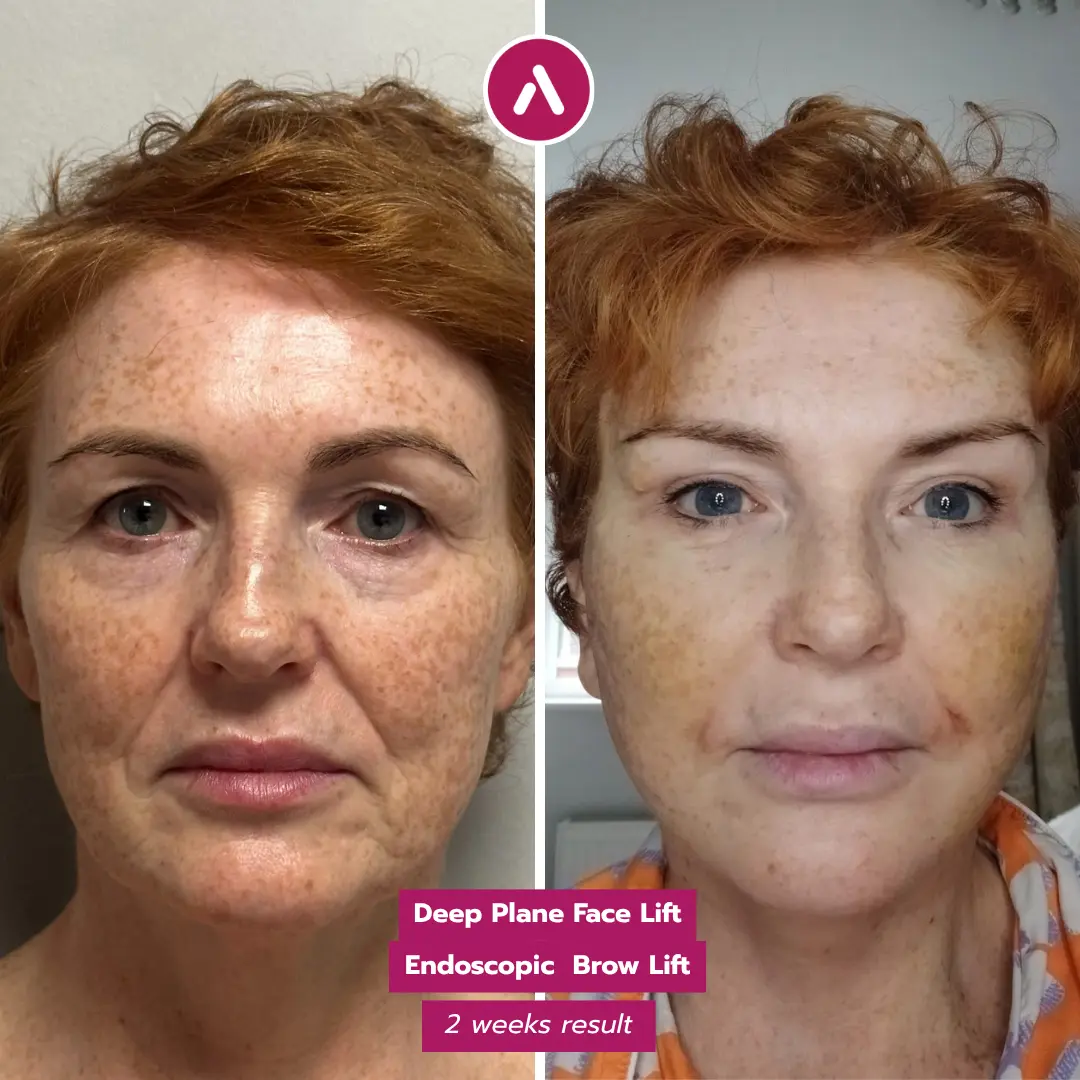
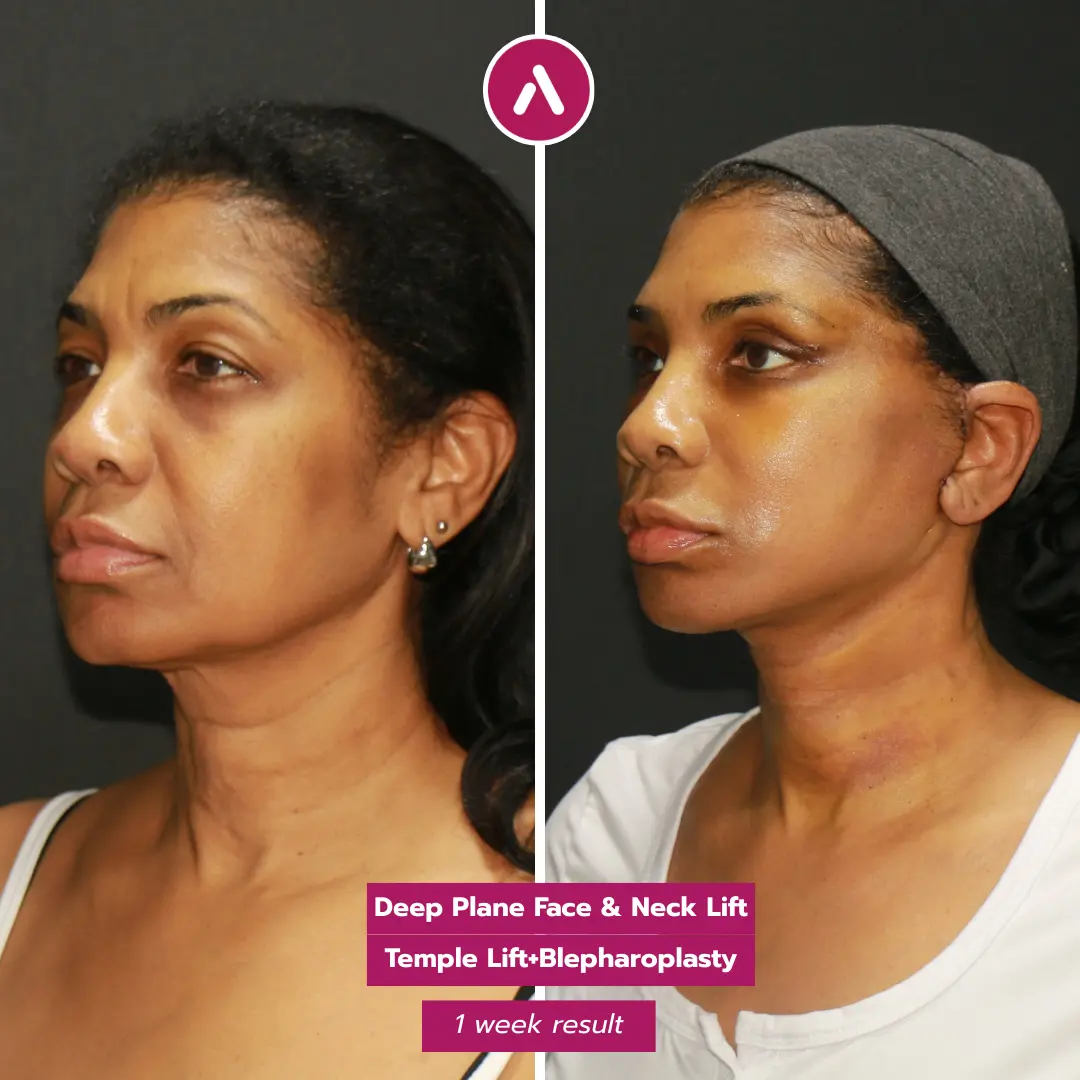
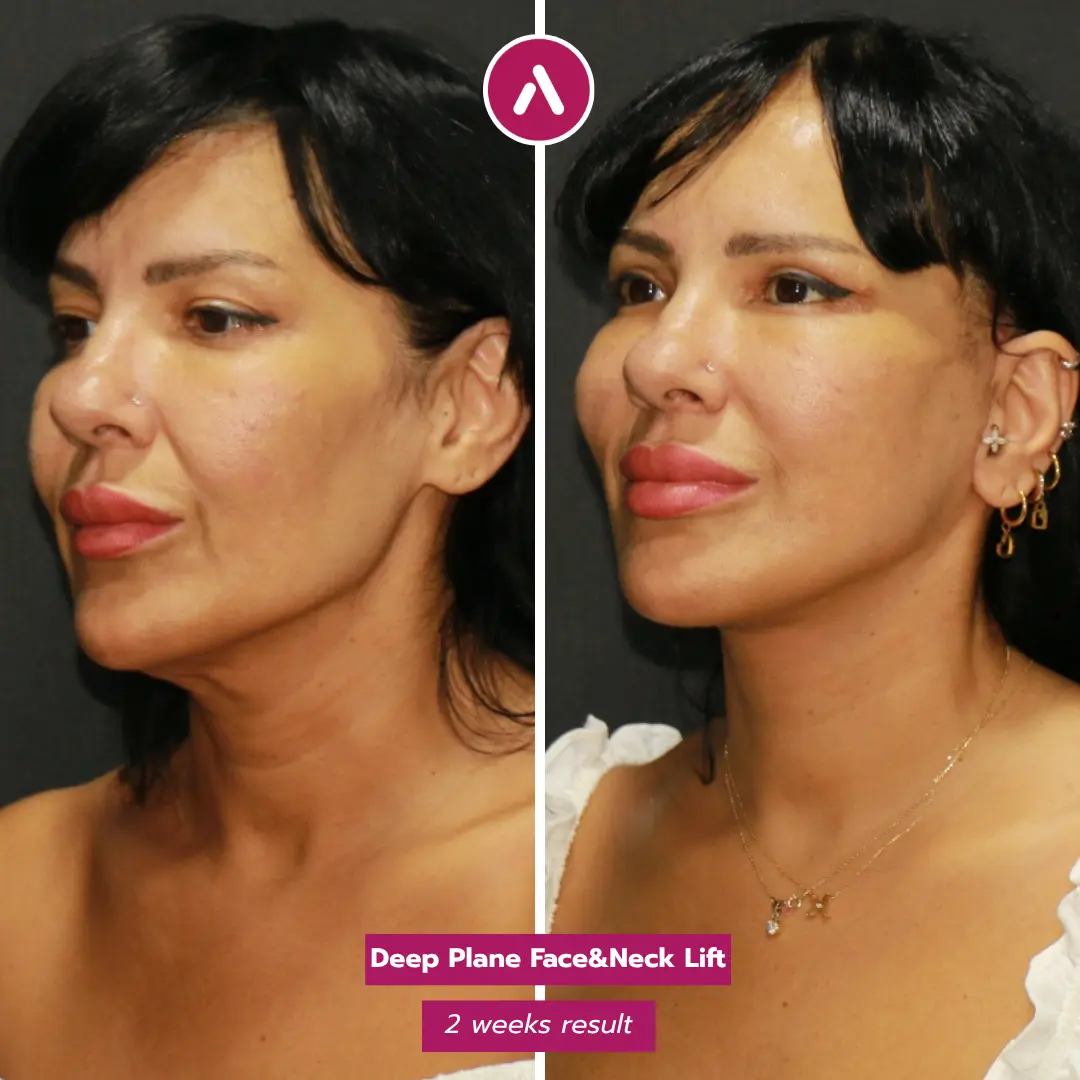
An awake brow lift is a forehead and eyebrow lift performed under local anaesthetic, often with twilight sedation, so you stay comfortable without full general anaesthesia. It repositions the brow to reduce heaviness and lateral hooding, while keeping expression natural. Results are structural and long-lasting.
Table of Contents
What is an Awake Brow Lift?
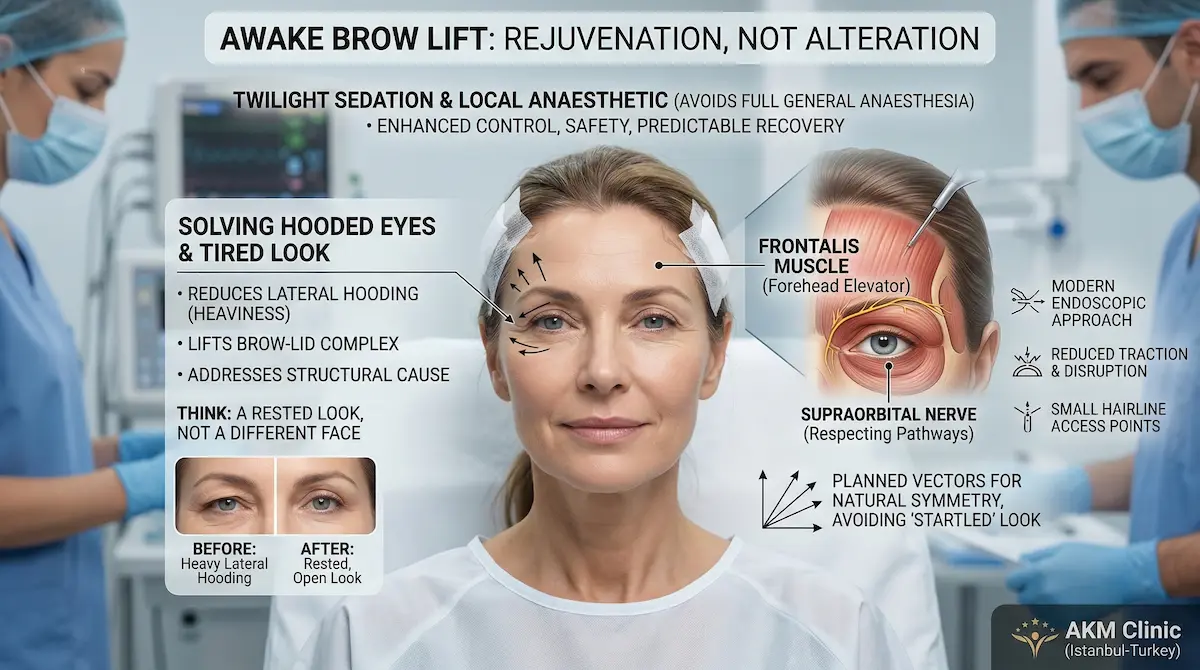
An awake brow lift is a surgical lift of the eyebrow and upper forehead performed with local anaesthetic and light, “twilight” sedation. You stay comfortable. You keep your natural expression. The goal is a rested look, not a different face. Think “rejuvenation, not alteration”.
What problems does it solve?
Many UK patients start with a simple question: What are hooded eyes? In clinic, we see the same pattern again and again. The brow descends and the upper lid looks heavier, even if the eyelid skin itself is not the main issue.
An awake brow lift can be the right answer when you notice:
- A “tired” or “stern” look that does not match how you feel
- Heaviness across the outer upper lid (lateral hooding)
- Make-up transfer onto the lid because the brow-lid complex is lower
- One brow sitting lower than the other (common and usually correctable)
This is why many searches lead to brow lift for hooded eyes. It targets the structural cause, rather than chasing symptoms with repeated injections.
The key anatomy: frontalis muscle and the supraorbital nerve
Brows do not “fall” randomly. They move because skin, soft tissue, and support structures change with time. The frontalis muscle (your forehead elevator) also shapes the brow position and the lines you see when you raise your eyebrows.
For the expert patient, the other key term is anatomy of the supraorbital nerve. This sensory nerve supplies feeling to the forehead and scalp. In modern endoscopic surgery, our planning aims to respect these anatomical pathways and reduce avoidable traction or disruption.
- We plan lift vectors to avoid the “startled” look.
- We work through small, hairline-based access points where appropriate.
- We prioritise natural symmetry over artificial perfection.
What does “awake” actually mean?
“Awake” does not mean you are sitting up, watching surgery, or feeling pain. It means we avoid full general anaesthesia when it is clinically appropriate. We rely on local anaesthetic and carefully controlled twilight sedation, so your body is not pushed through the same recovery burden as a full GA case.
This approach is especially relevant for UK patients comparing twilight sedation vs general anaesthesia. For many people, the deciding factor is not price. It is control, safety transparency, and predictable recovery.
Benefits of an Awake Brow Lift: what changes can you realistically expect?
A brow lift should look quiet. Subtle. A good result reads as better sleep, less heaviness, and a brighter upper face. That is why we frame this as subtle facial rejuvenation Turkey rather than a dramatic “new look”.
In practice, the biggest benefit is alignment: your reflection starts matching your energy again. For many UK professionals, that matters more than chasing a trend.
Aesthetic benefits: lift without the “pulled” look
The most common fear is looking surprised. We take that seriously. Our surgical planning is designed to restore the brow to a natural position and shape, not over-elevate it.
- More open-looking upper eyes
- Smoother transition from forehead to brow
- Improved balance between brows and eyelids
If you are considering “fox eye” style changes, we discuss whether a lateral or temporal approach is a better match than a full lift. Precision matters.
Functional benefits: reducing the sense of heaviness
Some patients feel they are constantly lifting their brows to “see better” in photos or on video calls. While this is not the same as a formal eye disease, the sensation of heaviness is real.
By addressing brow descent, an awake brow lift can reduce that compensated forehead tension and make the upper face feel lighter.
Botox brow lift vs surgical brow lift: why the difference matters
Many patients come to us after a run of injectables. A chemical lift can be useful, but it has limits. This is the core comparison behind Botox brow lift vs surgical brow lift.
- Botox: temporary lift, limited control over anatomy, repeat appointments
- Surgery: structural repositioning, longer-lasting correction, tailored vectors
If lateral hooding is your main complaint, Botox often cannot deliver the clean, stable lift you want. A targeted surgical approach can.
Am I a suitable candidate for an awake brow lift?
Candidacy is less about age and more about anatomy. We look at how your brow position influences the appearance of your upper eyelids and the overall “weight” of the upper face. Some patients assume they need eyelid surgery, when the root cause is brow descent. Others have genuine excess eyelid skin and do better with a combined plan. A proper assessment separates these patterns and protects you from an over-corrected outcome.
During your consultation, we focus on two things: what is structural, and what is skin. That is how we keep results natural and consistent with our “Rejuvenation, Not Alteration” philosophy.
Ideal candidate profile
You may be a strong candidate if you have brow descent that creates heaviness across the upper lid, particularly laterally. This is common in patients who have tried injectables and felt the lift was limited or short-lived. It is also common in professionals who want a predictable timeline and do not want repeated “tweakments”.
- Noticeable lateral hooding or a tired, stern expression at rest
- A brow that sits lower in photographs than you expect
- Asymmetry between brows that bothers you (mild asymmetry is normal)
- Realistic goals: refreshed, not “changed”
Who should avoid or delay surgery?
Safety comes first. We may advise postponing surgery if you have uncontrolled medical conditions, are actively smoking, or cannot pause specific medications safely. We also take previous forehead surgery, scarring tendency, and migraine patterns seriously, because these can influence planning and recovery.
- Uncontrolled high blood pressure or poorly controlled diabetes
- Bleeding disorders or anticoagulants that cannot be managed around surgery
- Active infection, untreated skin conditions, or poor wound-healing history
- Unrealistic expectations or a desire for an extreme “pulled” look
If your main issue is truly excess eyelid skin (rather than brow descent), we may recommend upper eyelid surgery instead of, or alongside, a brow lift. This is where expertise matters.
What we need for a proper consultation
The “expert patient” usually arrives with a detailed set of questions. We welcome that. Your consultation should feel like due diligence, not a sales call. We review photos, your aesthetic goals, and your medical history, including any prior Botox, filler, or thread lifts.
- Front and three-quarter photos at rest (and with brows gently raised)
- A list of medications and supplements
- Any history of reactions to local anaesthetic or sedation
- Your travel window and work commitments (to plan downtime properly)
If you are the type of patient who has researched a facelift under local anaesthetic uk, you will recognise the same principle here: controlled anaesthesia, clear planning, and a recovery pathway designed for real life.
Our target is simple: a brow position that looks like it has always been yours—just lighter, calmer, and more open. No “startled” look. No drama.
Surgical techniques explained: choosing the right lift
There is no single “best” brow lift. There is only the right technique for your anatomy and your aesthetic goals. We choose based on where the heaviness sits (central vs lateral), hairline position, skin quality, and how much lift you actually need. Technique choice also affects scar placement, recovery rhythm, and how natural the result looks. A careful plan reduces revision risk and protects sensory nerves.
Below is how we explain the core options, in plain clinical terms.
Endoscopic approach: precision with minimal access
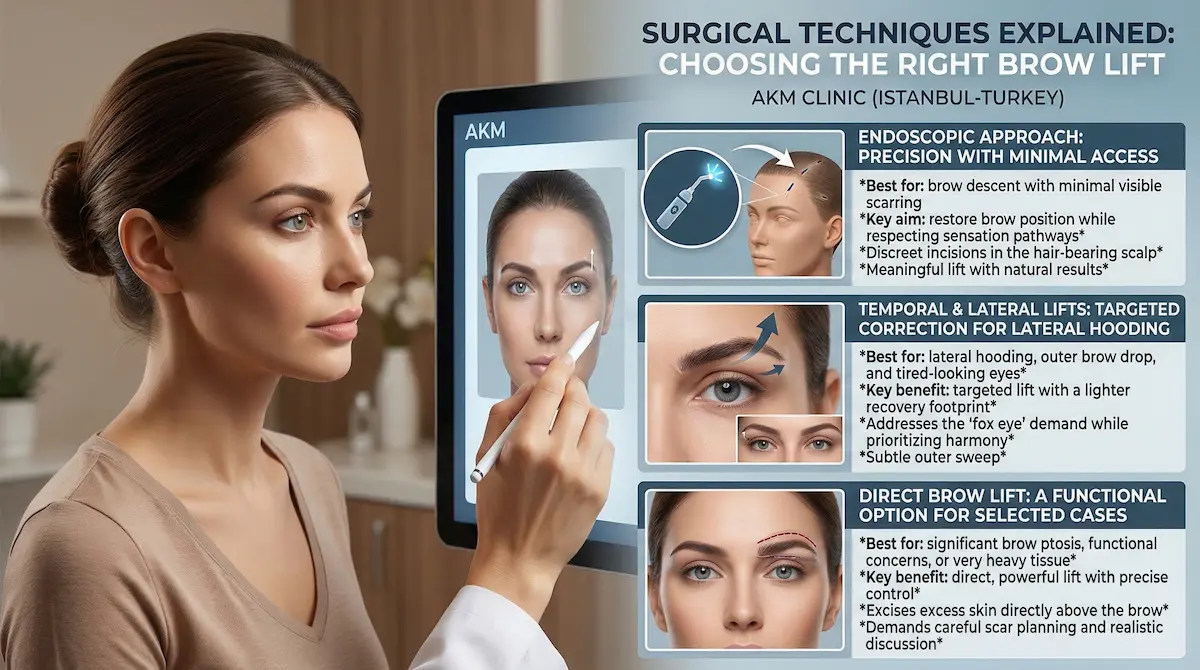
An endoscopic brow lift uses small access points within the hair-bearing scalp. This allows controlled work in the correct anatomical plane with good visualisation, supporting a balanced lift that avoids the “overdone” look. It is often the most appropriate option when you want a meaningful lift with discreet incisions.
- Best for: brow descent with a preference for minimal visible scarring
- Key aim: restore brow position while respecting sensation pathways
- Common add-on: upper eyelid surgery if true lid skin excess exists
Temporal and lateral lifts: targeted correction for lateral hooding
A temporal brow lift focuses on the outer third of the brow. This is often where “hooding” reads most strongly on video calls and in photographs. A lateral brow lift can also be the right tool when the goal is a subtle outer sweep rather than a full forehead change.
Patients sometimes ask for a “fox eye” or “cat eye” effect. We take a measured view. The priority is still harmony and a natural expression that will age well.
- Best for: lateral hooding, outer brow drop, and tired-looking eyes
- Key benefit: targeted lift with a lighter recovery footprint
- Key limitation: does not address central brow descent as strongly
Direct lift: a functional option for selected cases
A direct brow lift involves skin excision placed immediately above the eyebrow. We reserve this for selected patients where skin removal is clinically necessary or where the lift required is significant and highly localised. It can be very effective, but it demands careful scar planning and a realistic discussion about visibility.
- Best for: significant brow ptosis, functional concerns, or very heavy tissue
- Key benefit: direct, powerful lift with precise control
- Key consideration: scar acceptance and skin type
| Technique | Best for | Incision strategy | Key advantage | Main trade-off |
|---|---|---|---|---|
| Endoscopic brow lift | Balanced lift with discreet access | Small scalp incisions in hair-bearing areas | Good visual control and natural vectors | Not ideal for very high hairlines in some cases |
| Temporal / lateral lift | Lateral hooding and outer brow descent | Short incisions in the temple hairline | Targeted correction with subtle change | Limited effect on central brow position |
| Direct brow lift | Significant ptosis or functional need | Just above the eyebrow | Powerful, precise lift | Scar visibility depends on skin type and healing |
If you want a clear recommendation (and whether you should combine this with upper eyelid surgery), we can map your anatomy in a virtual consultation and outline a realistic surgical pathway.
Combined procedures: building a complete plan (not a “single tweak”)
One of the most common mistakes in upper-face surgery is treating the brow and eyelid as separate problems. In reality, they work as one aesthetic unit. A well-planned brow lift can reduce upper-lid heaviness, but it will not remove true excess eyelid skin. Likewise, eyelid surgery alone may not look “complete” if the brow is still low. For UK patients who value efficiency, predictability, and a single recovery window, combination planning can be the most logical route.
Brow lift + upper eyelid surgery (upper blepharoplasty)
If your main concern is “hooded eyes”, the first step is identifying whether the hooding is driven by brow descent, eyelid skin excess, or both. This is exactly why people search brow lift for hooded eyes—because the brow position often creates the illusion of “too much eyelid skin”.
- Best for: patients with both brow descent and genuine upper-lid skin redundancy
- Key advantage: a cleaner, more open upper eye without over-lifting the brow
- Planning note: the most natural results come from correcting structure first, then refining skin conservatively
Brow lift + mini facelift under local anaesthetic
Some patients present with a broader facial ageing pattern: brow descent plus midface heaviness and early jowling. In those cases, the upper face can look refreshed while the lower face remains tired, which feels incomplete in photos and on video calls.
This is where a mini facelift under local anaesthetic may be discussed as a complementary procedure—particularly for UK patients who have researched a facelift under local anaesthetic uk and want controlled anaesthesia with a more integrated surgical outcome.
- Best for: early jowling, mild neck laxity, “face feels heavier” complaints alongside brow descent
- Key advantage: harmonised rejuvenation across the face with a single recovery plan
- Practical benefit: one travel episode, one downtime window, one follow-up sequence
Brow lift + skin resurfacing (texture and lines)
A brow lift repositions tissues. It does not resurface the skin. If your main complaint is fine lines, sun damage, or uneven texture, combining surgery with resurfacing can improve the overall “finish” of the result—provided timing is planned carefully so healing is not compromised.
- Best for: patients seeking both lift and improved skin quality
- Key advantage: better overall polish (shape + texture)
- Planning note: resurfacing may be staged depending on sensitivity, skin type, and lifestyle
Recovery integration: reducing bruising and swelling with structured protocols
Most high-performing UK patients do not fear discomfort as much as they fear unpredictable downtime. That is why we treat recovery as a clinical pathway, not an afterthought. In our practice, protocols such as Hyperbaric Oxygen Therapy (HBOT) and Low-Level Laser Therapy (LLLT) are used strategically to support healing and help reduce visible bruising (ecchymosis) and swelling (oedema) in the early phase.
When patients search terms like rapid recovery brow lift Istanbul, they are rarely asking for “instant healing”. They are asking for a system: monitoring, tissue support, and a plan designed for a professional schedule.
Combination planning is not about “more surgery”. It is about doing the right amount of surgery, once, with a coherent recovery pathway.
Anaesthesia: why we prefer awake and twilight sedation for the right patient
The defining feature of this procedure is the anaesthesia strategy. Many UK patients comparing options are not simply choosing a surgeon—they are choosing a safety philosophy. If you are reading about twilight sedation vs general anesthesia, you are already thinking like an expert patient: understanding systemic risk, recovery burden, and transparency around rare complications.
Twilight sedation vs general anaesthesia: the patient experience
Under twilight sedation, you are relaxed and comfortable, but not exposed to the full physiological load of a deep general anaesthetic in cases where it is not necessary. Patients often prefer this approach because it can be associated with a “lighter” immediate recovery experience. That said, the correct choice is individual and based on medical history, anxiety level, airway considerations, and the surgical plan.
- Twilight sedation: calmer wake-up, less “heavy” recovery for many patients, typically suitable for outpatient-style planning
- General anaesthesia: still appropriate in selected cases, depending on complexity and patient-specific factors
We do not frame this as “one is always better”. We frame it as “the right tool for the right patient”.
Local anaesthetic mechanism of action (what it actually does)
Local anaesthetic works by blocking sodium channels along the nerve membrane, preventing nerve signal transmission. In practical terms, it stops pain signals from travelling. For patients who like pharmacological clarity, this is the core of the local anaesthetic mechanism of action.
We also plan infiltration carefully to provide even coverage and comfort throughout the procedure, while maintaining a predictable total dose profile.
Local anaesthetic with adrenaline: why it matters
For many awake procedures, we use local anaesthetic with adrenaline (epinephrine) because it constricts small blood vessels (vasoconstriction). Clinically, that can reduce bleeding and prolong the numbing effect, supporting a smoother surgical field and a more comfortable experience.
Patients also ask about adrenaline in local anaesthetic side effects. This is a sensible question. Adrenaline can sometimes cause temporary symptoms such as palpitations, tremor, or a feeling of “rush”, especially in sensitive individuals. If you have a history of reacting this way, we discuss options—including dose adjustments or, in selected cases, adrenaline-free local anaesthetic.
Maximum safe dose planning: transparency matters
Expert patients often ask about the maximum safe dose local anaesthetic calculation. They should. Safe dosing is not guesswork. It is planned around your body weight, the chosen agent, and the total volume required for comfort and surgical control. This is one of the reasons patients who value safety transparency see an awake approach as a premium pathway, not a “budget” one.
Safety: nerve considerations and rare toxicity readiness
Two concerns commonly appear in research-driven searches: nerve damage risks in brow surgery and local anaesthetic systemic toxicity symptoms.
On the surgical side, modern technique is designed to respect sensory nerve pathways, including the supraorbital nerve. Temporary altered sensation can occur after brow surgery, and we discuss this openly. The aim is to minimise traction, avoid avoidable injury, and keep tissue handling precise.
On the pharmacology side, Local Anaesthetic Systemic Toxicity (LAST) is rare, but preparedness is non-negotiable. Transparency here is a marker of quality. Readiness includes staff training, monitoring, and immediate access to lipid emulsion therapy—often referred to in patient research as Intralipid for local anaesthetic toxicity.
Common “immediate after” sensations and how we manage them
Some patients worry about feeling faint, shivery, or nauseated after local anaesthetic or sedation. These symptoms are usually short-lived and manageable with proper monitoring and supportive care, but they are still worth discussing upfront. A structured recovery environment matters—especially for UK patients travelling for surgery and expecting a high standard of post-op observation before discharge planning.
Next up, I can continue with: Step-by-step: what happens on surgery day + Recovery timeline and aftercare (including ecchymosis/oedema windows, flying guidance, and the HBOT/LLLT “rapid recovery” pathway), then move into Safety & risks and finally costs in GBP.
Step-by-step: what happens in the operating theatre?
UK patients often want the process, not the poetry. Fair enough. We run your day in a structured way, with clear checkpoints, so you know what is happening and why. Your comfort matters, but so does precision. That is why we plan markings, anaesthesia, and surgical steps as one system.
Our approach is designed for the “expert patient” mindset: transparency, monitoring, and predictable recovery. Nothing is left vague. No surprises.
Before surgery: screening, planning, and marking
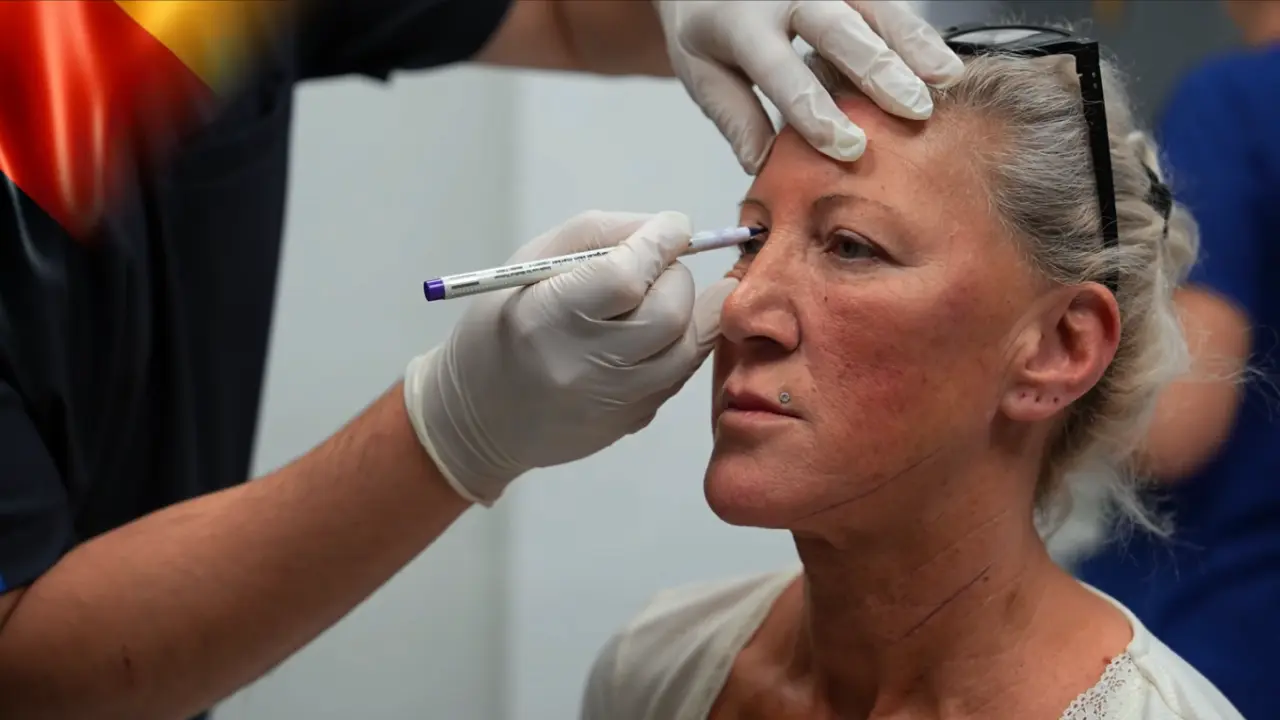
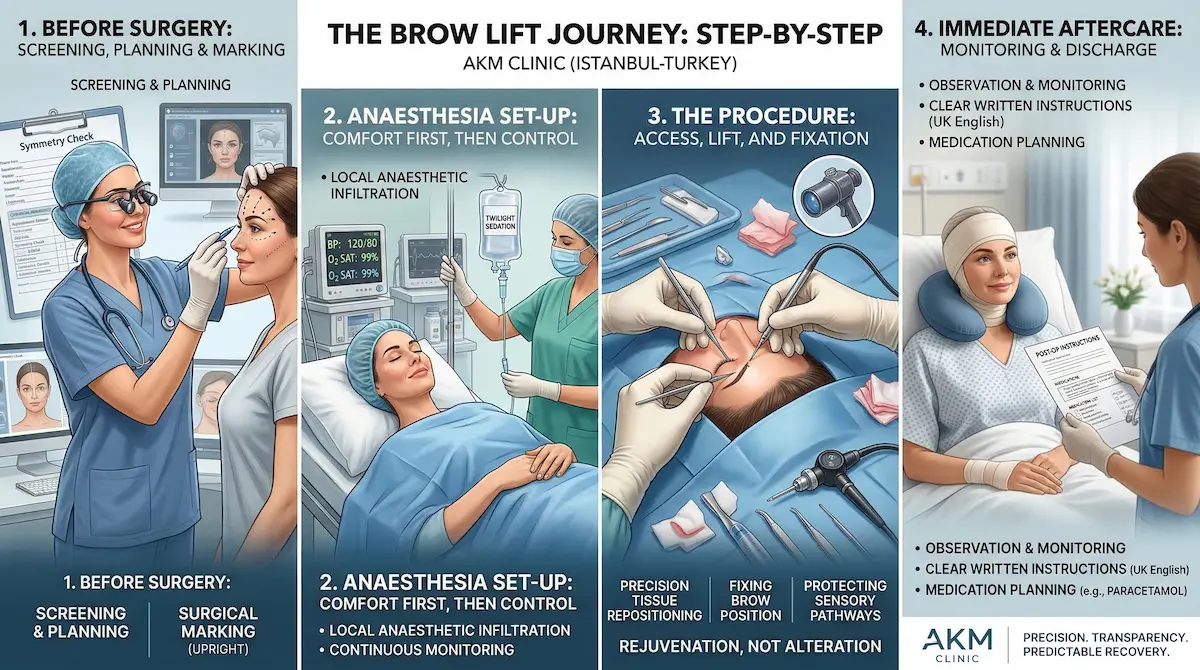
We start with pre-operative checks to confirm you are medically fit for surgery. We also review your goals again in person, because small details matter. Then we mark the brow vectors while you are upright, so we can plan lift direction with gravity taken into account.
- Pre-op tests and safety screening
- Final review of your surgical plan (including any combined procedures)
- Photography and symmetry checks
- Skin and hairline assessment for incision planning
If you are combining procedures, we map the order and timing carefully. The aim is a coherent result. One plan. One recovery window.
Anaesthesia set-up: comfort first, then control
On the day, we focus on calm, controlled sedation and local anaesthesia. You should feel relaxed, not “knocked out”. We monitor you continuously throughout.
- Twilight sedation to reduce anxiety and improve comfort
- Local anaesthetic infiltration for numbness and surgical control
- Blood pressure and oxygen monitoring throughout the procedure
Many patients ask whether they will hear or feel anything. You may notice some pressure. Pain is not expected. If you feel discomfort, we adjust promptly.
The procedure itself: access, lift, and fixation
Technique depends on your plan (endoscopic, temporal/lateral, or direct). In an endoscopic approach, we use small access points in hair-bearing areas to work in the correct anatomical plane. This helps us lift tissues without relying on skin tension alone.
- We release and reposition the tissues with visual control
- We protect sensory pathways where possible, including the supraorbital region
- We fix the brow in a natural position, aiming for calm expression
Our guiding principle stays the same: Rejuvenation, Not Alteration. The goal is a refreshed version of you. Not a new identity.
Immediate aftercare: monitoring, discharge, and your first night
After surgery, we move you into a monitored recovery area. We check pain control, swelling, and general comfort before discharge planning. You are not rushed out.
- Observation and monitoring in the clinic
- Clear written instructions (sleep position, wound care, activity limits)
- Medication planning using UK-familiar language (for example, paracetamol-based pain control when appropriate)
We measure success by two things: a natural brow shape and a recovery that feels predictable, not chaotic.
Recovery & aftercare: how long does healing take?
Recovery is not one moment. It is a sequence. Most UK patients care about two timelines: how you will look in the first 10–14 days, and when the result starts to “settle” into something that feels like you again. Swelling and bruising are normal. The key is managing them early.
We plan recovery with structure, not guesswork. That includes practical guidance for work, travel, and social visibility. It also includes our “Rapid Recovery” pathway, where appropriate.
The first 72 hours: swelling control and positioning
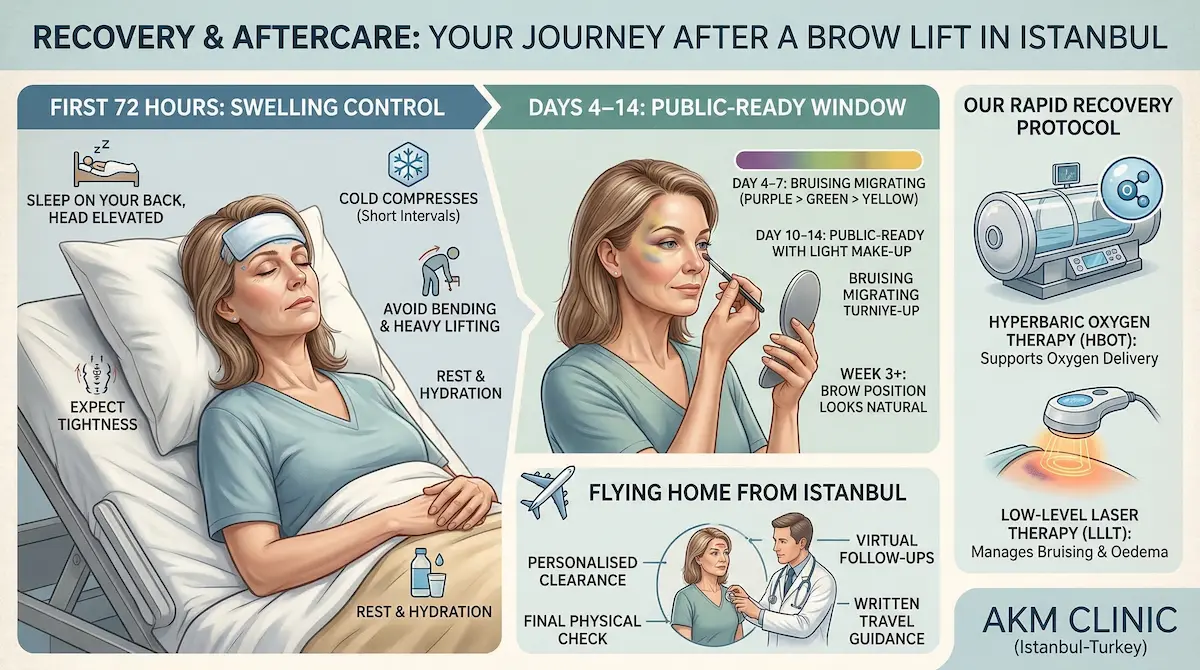
This is the phase where you can influence comfort the most. Head elevation matters. So does hydration and light movement. We keep instructions simple, because you will be tired.
- Sleep on your back with your head elevated
- Use cold compresses as instructed (short intervals, not constant icing)
- Expect tightness and a “heavy” forehead feeling
- Avoid bending, heavy lifting, and intense exercise
Patients sometimes notice mild shivering or feeling a bit faint after sedation. It is usually short-lived. Monitoring and clear aftercare reduce anxiety.
Days 4–14: bruising, ecchymosis, and the “public-ready” window
Most bruising (ecchymosis) and swelling (oedema) peaks early, then improves in stages. Colour changes are normal: purple to green to yellow. That final yellowing is often the last stage before you look “presentable” again.
- Day 5–7: swelling starts to soften, bruising may migrate
- Day 10–14: many patients feel more public-facing with light make-up
- Week 3+: the brow position looks more natural as tissues settle
If you are researching rapid recovery brow lift Istanbul, this is the window you are thinking about. Our job is to help you move through it with fewer unknowns.
Our Rapid Recovery protocol: HBOT and LLLT
When suitable, we utilise Hyperbaric Oxygen Therapy (HBOT) and Low-Level Laser Therapy (LLLT) as part of a structured aftercare pathway. This is not framed as a luxury add-on. It is a practical tool for bruising and swelling management in the early phase, especially for fair skin types that show bruising more visibly.
- HBOT supports oxygen delivery to healing tissues
- LLLT supports calm, low-trauma recovery and scar management
For travelling patients, this supports flight-ready recovery protocols. Not “instant healing”. Just a more controlled trajectory.
Flying home: timing and common-sense rules
Most UK patients want a simple answer: “When can I fly?” We give personalised clearance based on your healing, swelling level, and whether you had combined procedures. Before you leave Istanbul, we examine you in person and confirm your plan.
- We schedule a final check before departure
- We provide written guidance for travel day (hydration, movement, head elevation)
- We keep follow-up structured after you return home
Our support does not stop at the airport. We continue with virtual follow-ups to monitor healing and answer questions as your result settles.
Safety & risks: is an awake brow lift dangerous?
No facial surgery is “risk-free”. The right question is how the risks are identified, reduced, and managed. For UK patients doing proper due diligence, we keep this discussion plain and specific. We explain what is common, what is rare, and what we do about each point. That level of transparency is part of safe surgical practice.
General surgical risks and how we reduce them
Most risks in brow surgery are not unique. They are the standard surgical variables: bleeding, infection, delayed healing, scarring, and asymmetry. The way we reduce them is boring by design. That is a good thing.
- Strict pre-op screening so we do not operate on the wrong candidate
- Continuous vitals monitoring throughout the procedure
- Clear aftercare rules to protect wounds and minimise swelling
- Planned follow-ups, not “see you when you’re done”
Even with strong planning, swelling can briefly exaggerate asymmetry. Early photos can be misleading. Tissue settles.
Sensation changes and nerve-related concerns
A common research query is nerve damage risks in brow surgery. It is sensible to ask. The forehead has sensory nerve pathways, and any brow lift can cause temporary numbness or tingling while tissues recover.
- Temporary altered sensation can happen, especially in the scalp and upper forehead
- Permanent sensory change is uncommon, but it is part of informed consent
- Good technique aims to respect anatomy and reduce avoidable traction
If your job depends on public-facing confidence, tell us. We will plan timing and visibility windows with more precision.
Local anaesthetic safety: dosing, monitoring, and LAST awareness
Because this procedure can be performed under local anaesthetic (with twilight sedation), pharmacology matters. Expert patients often search maximum safe dose local anaesthetic calculation because they want to understand safety margins. We plan dosing based on your profile and the procedure scope, not guesswork. We also monitor you throughout, because early recognition of any problem is part of safe care.
You may also see the term local anaesthetic systemic toxicity symptoms. LAST is rare, but it is real, and it is one reason monitoring matters. Symptoms can include unusual dizziness, ringing in the ears, a metallic taste, confusion, or (in severe cases) seizures and cardiac effects.
In medical literature, emergency management may include lipid emulsion rescue, often discussed as Intralipid for local anaesthetic toxicity. We treat preparedness for rare events as a professional standard, not a marketing point.
Short-lived “after” sensations: what is normal, what is not
Patients sometimes worry about nausea, shaking, or feeling faint after sedation or local anaesthetic. Mild symptoms can happen. They usually pass with rest, hydration, and monitoring.
- Normal: mild shivering, light nausea, tiredness, a “tight” forehead sensation
- Call us promptly: worsening pain on one side, rapidly expanding swelling, fever, or vision changes
Safety is not the absence of risk. It is a system: screening, monitoring, technique, and follow-up.
Is an awake brow lift safe in Turkey for UK patients?
This is where most UK patients want facts, not reassurance. “Safe” is not a country label. It is a standards question. You are comparing surgical environment, monitoring, credentials, and continuity of care against what you expect from private care in the UK. That is exactly how an expert patient should think.
Clinical environment: what “British standards” actually means
If you are researching private cosmetic clinic Istanbul British standards, focus on practical markers: sterile theatres, monitoring, and screening. We operate in an accredited clinical setting with structured pre-operative testing and continuous patient monitoring. We keep protocols consistent because outcomes depend on consistency.
- Sterile theatres and disciplined infection control
- Advanced vitals monitoring throughout your procedure
- Pre-op screening to reduce avoidable complications
Credentials and accountability: the UK mindset
Many UK patients search for a surgeon by regulatory shorthand. That is the logic behind GMC registered surgeon alternatives. When you are outside the UK, the equivalent trust signals are verified board certification, focused experience, and transparent consultation.
- We emphasise board-certified expertise and international medical board registration
- We keep recommendations anatomy-led, not trend-led
- We discuss combined procedures honestly if they are the more complete solution
Continuity of care after you fly home
The biggest fear in cross-border surgery is being “fine until I’m back in the UK”. We build follow-up into the plan. That aligns with what patients look for when they search post-op care in Turkey for British citizens.
- We monitor you in Istanbul before you travel
- We stay reachable after you return home, with structured virtual follow-ups
- We schedule long-term check-ins (1, 3, 6, and 12 months) to track healing properly
For many professionals, this is what makes flight-ready recovery protocols feel realistic rather than optimistic. A plan beats hope.
Related procedures to consider
- Upper eyelid surgery (upper blepharoplasty)
- Endoscopic brow & temporal lift
- Mini facelift under local anaesthetic
If you want a clear answer on whether your hooding is brow-led, lid-led, or both, we can map it in a virtual consultation and build a single, coherent plan.
Awake Brow Lift Costs 2026: what do you actually pay for?
UK patients usually ask the same two questions: “What is the total cost in GBP?” and “What is included?” The honest answer is that fees depend on your anatomy, the chosen technique, and whether you are combining procedures. A transparent quote should reflect clinical reality, not a generic online number.
What affects the fee?
If you have researched terms like endoscopic brow lift Istanbul price, you have probably noticed wide variation. That is usually because people are comparing different procedures under the same label. The fee is influenced by:
- Technique choice: endoscopic vs temporal/lateral vs direct lift
- Complexity: degree of brow descent, asymmetry, hairline considerations
- Combined procedures: upper blepharoplasty, mini facelift under local anaesthetic, or resurfacing
- Anaesthesia plan: twilight sedation strategy and monitoring requirements
- Recovery integration: whether HBOT and/or LLLT are included in your pathway
In other words, a patient needing a targeted temporal lift is not comparable to someone needing an endoscopic lift plus upper eyelid surgery. One label, different surgical reality.
What a UK-friendly “all-in” plan typically includes
For travelling patients, the most useful quote is an “all-in” plan rather than a menu of extras. Where appropriate, a comprehensive plan can include:
- Surgeon assessment and surgical planning
- Theatre fee and clinical team
- Twilight sedation and monitoring
- Medication plan and aftercare instructions
- Post-op checks in Istanbul before travel
- Remote follow-ups after you return to the UK
If you are comparing options in brow lift London clinics or across Manchester and Edinburgh, remember that UK pricing often separates surgeon fee, theatre fee, anaesthetist fee, and aftercare into multiple line items. When you compare, compare like-for-like.
Value comparison: procedure first, location second
High-information UK patients do not travel for a “discount”. They travel for a specific surgical pathway: awake/twilight protocols, high-volume experience, and a recovery environment designed around predictable downtime. If your goal is a premium outcome with structured follow-up, your comparison should be based on infrastructure and standards—not just headline cost.
Requesting a quote: We provide fees in GBP after a clinical review of your photos and goals, including whether you should combine with upper eyelid surgery or a mini facelift under local anaesthetic for a complete result.
A meaningful quote reflects your anatomy, your plan, and your recovery pathway—rather than a generic “price per procedure”.
Results timeline & realistic expectations
Most patients want two realities: when they will look socially presentable, and when the final result truly settles. A brow lift can look “better” early, but refined results are a medium-term process as swelling resolves and tissues stabilise.
Early changes vs settled results
- First 1–2 weeks: visible swelling and bruising are common; the brow may look higher than the final position
- Weeks 3–6: the brow starts to look more natural as tightness reduces
- 3–6 months: a more stable, “this is just my face” result emerges
- Up to 12 months: scar maturation and fine tissue settling continue
If your biggest fear is looking surprised, this timeline matters. Early swelling can temporarily exaggerate lift. Planning and patience protect you from judging too soon.
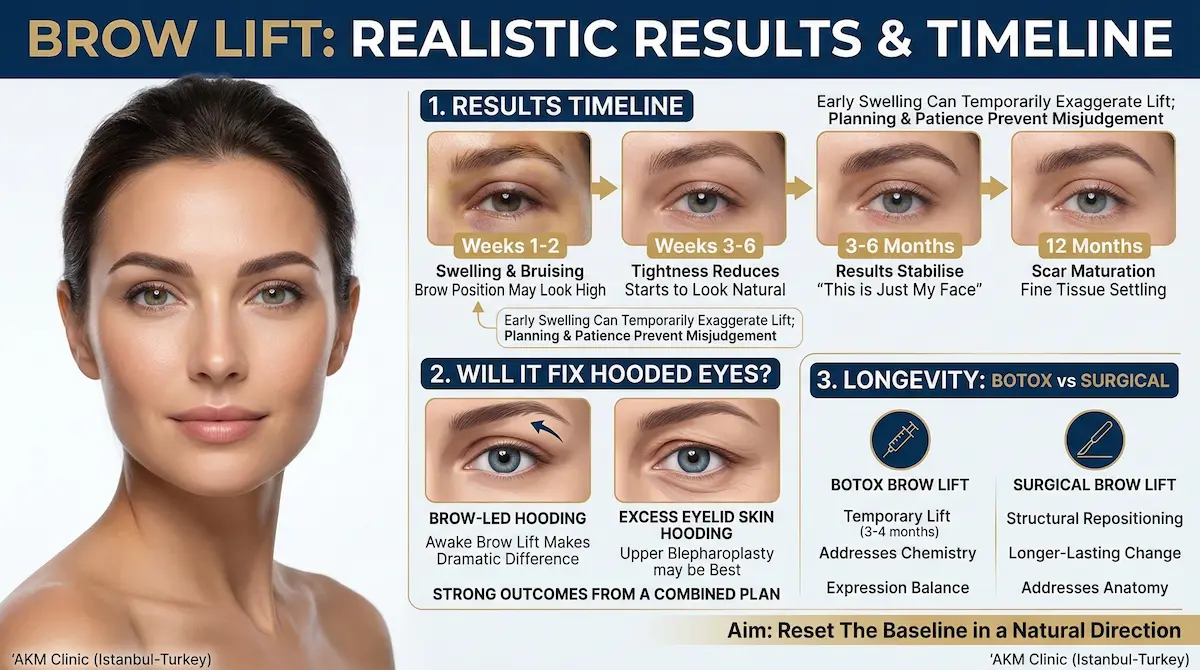
Will it fix hooded eyes?
This depends on what is causing the hooding. If the hooding is brow-led, an awake brow lift can make a dramatic difference. If the hooding is primarily excess eyelid skin, the best solution may be upper blepharoplasty, either alone or combined. The strongest outcomes often come from a combined plan that corrects structure and refines skin conservatively.
Longevity: Botox brow lift vs surgical brow lift
This is the core difference behind Botox brow lift vs surgical brow lift. Botox can be helpful for temporary lift and expression balance, but it does not reposition tissues structurally. Surgery is designed to create a longer-lasting change because it addresses anatomy rather than chemistry alone.
Longevity varies by technique, tissue quality, and lifestyle factors (sun exposure, smoking, skincare, and overall collagen health). The aim is not to freeze ageing. The aim is to reset the baseline in a natural direction.
FAQ: Awake Brow Lift in Turkey (UK patient focus)
Will I feel anything if it’s “awake”?
You should not feel pain. “Awake” means local anaesthetic (often with twilight sedation), not “fully alert and uncomfortable”. You may notice pressure or movement, but discomfort is managed actively throughout.
What about adrenaline in local anaesthetic side effects?
Some patients are sensitive to adrenaline (epinephrine) and may feel a brief “rush”, tremor, or palpitations. If you have experienced this at the dentist or with injections before, tell us. We can adjust dose strategy or discuss adrenaline-free options when clinically appropriate.
How much downtime should I plan?
Many patients feel more socially comfortable around 10–14 days, depending on bruising, swelling, and whether you combine procedures. If you have an important work event, we will plan around it conservatively.
Can I combine it with other procedures?
Yes—when it makes anatomical sense. The most common combinations are brow lift + upper blepharoplasty for true eyelid skin excess, and brow lift + mini facelift under local anaesthetic for a more complete facial rejuvenation plan.
When can I fly back to the UK?
We give personalised clearance after in-person review before you leave Istanbul. Timing depends on swelling, comfort, and whether you had combined procedures. You will receive written guidance for travel day and structured follow-up after you return.
What are the most important risks I should know?
Common risks include bruising, swelling, temporary altered sensation, scarring, and asymmetry during healing. Rare risks exist with any surgery and any anaesthetic approach. The correct standard is screening, dose planning, monitoring, and a clear pathway for follow-up.
How do I choose the right surgeon?
Look for anatomy-led planning, transparency around technique, clear discussion of risks, and a structured aftercare plan. Searches such as best brow lift surgeon Turkey should ultimately lead to the same due diligence: experience, standards, and patient-specific planning.
Medical Disclaimer: This information is provided for educational purposes and does not replace a medical consultation. Suitability, technique choice, anaesthesia plan, recovery timeline, and risk profile must be assessed individually by a qualified clinician.