
Scar Revision Surgery in Turkey: Improving Old Scars
AI Summary
- Scar revision surgery turkey improves old scars through tailored surgical and non-surgical techniques with realistic expectations.
- Safety-first, surgeon-led planning emphasizes credentials, transparent consults, and structured aftercare to reduce regret.
- Recovery is a process with phased healing, tension control, and optional HBOT/LLLT support for optimized scar outcomes.
- Cost varies by complexity—technique, location, and staging—so compare written plans, inclusions, and follow-up.
Summary generated by AI, fact-checked by our medical experts
If you’re searching for scar revision surgery Turkey, you’re likely not looking for hype—you’re looking for credible options, realistic outcomes, and a clinic that takes safety seriously. Scar revision is not about “erasing” the past; it’s about using precise surgical technique and evidence-informed aftercare to make an old scar less noticeable, better aligned with natural skin lines, and more comfortable (less tight, raised, itchy, or irregular).
In this guide, we’ll explain what scar revision can and can’t do, how surgeons assess an “old” scar, and what matters most for a natural-looking result—grounded in medical science and practical decision-making. You’ll also see how patients who care about details (the “expert patient” mindset) evaluate outcomes, safety standards, and recovery support when considering scar revision surgery in Turkey.
Scar revision sits inside a larger conversation patients sometimes skip: how an existing surgical practice approaches outcome design, safety standards, and recovery support across procedure categories. The clinic culture behind scar work usually reflects the clinic culture behind everything else they do.
For the broader context underneath the scar-specific decisions in this article, the broader plastic surgery overview covers the procedure families AKM Clinic operates in, the surgeon-led care model that informs scar planning specifically, and the cross-procedure safety standards that apply whether the patient is in for revision work, primary facial surgery, or body contouring.
The right scar revision plan is shaped as much by the practice philosophy behind it as by the technique chosen on the day.
Key takeaway: The best scar revision plan is individualized. Technique matters—but so do scar biology, skin quality, and disciplined aftercare.
Important: This article is general education and does not replace an in-person medical evaluation.
Table of Contents
What Scar Revision Surgery Can (and Can’t) Do
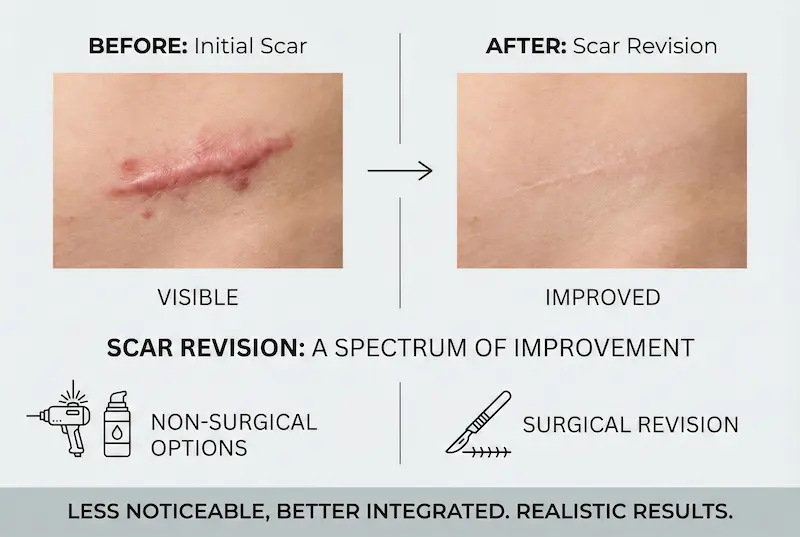
Scar revision is a spectrum—from minor refinements to more complex surgical redesign. The goal is not perfection; the goal is improvement that looks “believable” on your skin, in your lighting, in your daily life. A high-quality plan also reduces risk: choosing the correct technique for your scar type, location, and skin behavior is one of the biggest predictors of satisfaction.
When a scar can be improved vs. when it can’t be “erased”
Even with the best hands, a scar cannot be removed completely—because it is your body’s repair tissue. What can be improved often includes:
- Width: making a stretched scar narrower through excision and refined closure.
- Texture: softening uneven or “ropey” texture with resurfacing or staged therapies.
- Contour: flattening a raised scar or lifting a depressed scar (sometimes via subcision or grafting).
- Color contrast: reducing redness or pigment mismatch over time with appropriate modalities.
What typically cannot be guaranteed is an “invisible line.” The honest promise is: less noticeable, better integrated, and improved comfort.
Scar maturation: why “old scars” still change with the right approach
Many people assume a scar is “final” after a year. In reality, old scars can still respond because the surrounding skin and collagen architecture can be remodeled—especially when you correct the original problem (tension, poor alignment, or irregular closure). A surgeon will evaluate:
- How the scar sits relative to relaxed skin tension lines (RSTL).
- Whether there’s ongoing tension (movement areas like jawline, chest, abdomen).
- Signs of hypertrophic behavior (thickening) versus keloid tendency (growth beyond borders).
This is why a thoughtful consultation matters more than “one-size-fits-all” marketing.
Surgical vs. non-surgical options: how to choose the right path
Not every scar needs surgery. In modern scar care, many plans are staged:
- Non-surgical first (when appropriate): laser-based resurfacing, microneedling, silicone therapy, or injections—especially for texture and redness.
- Surgical revision first (when structural issues exist): wide scars, poor direction, “step-off” edges, or tight scars that distort nearby anatomy.
A clinic offering Turkey scar revision surgery should clearly explain why they recommend one path, how many stages may be needed, and what the realistic endpoint looks like.
Why Some Scars Heal Poorly: The Root Causes Surgeons Look For
Two people can have the same incision and end up with very different scars. That’s not luck—it’s biology + mechanics + aftercare. Understanding the “why” helps you choose the right corrective strategy and avoid repeating the same problem after revision.
Tension, placement, and anatomy: why location matters
Scar widening and visibility often come from mechanical tension during healing. High-movement zones (jawline, shoulders, chest, abdomen) are more likely to stretch. This is especially relevant for procedure-specific concerns like:
- Facelift scar revision (where natural hairline and ear contours must be respected).
The reason facelift scars can be revised well — when revision is actually needed — is that the original anatomy gives the surgeon predictable landmarks: the tragus, the hairline, the temporal recess, the post-auricular crease. Scar correction here is a placement question as much as a closure question.
For the anatomy and incision philosophy behind those landmarks, the facelift procedure walkthrough covers technique families, where standard incisions sit, why hairline preservation matters in primary planning (and how it makes revision easier later), and the closure approach that determines whether facelift scars need revision at all.
Most "bad facelift scars" weren't bad surgery — they were bad placement decisions that the patient inherits years later.
- Tummy tuck scar revision Turkey (where abdominal tension and posture changes affect the line).
When surgeons plan revision, they consider not only the scar—but the forces that created it in the first place.
Abdominal scars behave differently from facial scars because the forces acting on them are different: gravity, posture, breathing, core engagement, weight changes over time. A revision plan that ignores those forces will reproduce the original problem.
For the procedural foundation that determines where abdominal scars sit and how they're managed, the abdominoplasty technique overview covers incision design choices, tension control during primary closure, what muscle repair adds to scar trajectory, and why secondary scar issues often trace back to the primary surgery rather than the patient's healing.
The honest version of "scar revision" for the abdomen often starts with understanding why the original closure produced the result it did.
Hypertrophic scars vs. keloids: risk factors and warning signs
Raised scars aren’t all the same. In simplified terms:
- Hypertrophic scars stay within the original incision borders and may respond well to combined strategies (surgical refinement + injections + disciplined aftercare).
- Keloids can grow beyond the original wound and often require a cautious, multi-step plan (and sometimes non-surgical emphasis).
Your history matters: if you’ve formed thick scars before, your surgeon should discuss prevention strategies from day one after revision.
Skin type, pigmentation, and sun exposure: how these affect outcomes
Scar color and visibility are heavily influenced by skin behavior. Pigmentation risk, prolonged redness, and uneven tone can be more prominent in certain skin types or with early sun exposure. A responsible plan includes:
- Sun strategy (protection and timing) to reduce pigment contrast.
- Topical and procedural support tailored to redness, texture, or tone.
- Aftercare compliance as a major “multiplier” of results.
Practical note: Many disappointments in scar revision happen not because the surgery was “bad,” but because the scar was asked to heal under the same conditions that created the problem originally.
Scar Revision Techniques Used in Modern Practice
"Z-plasty versus W-plasty versus geometric broken line closure" reads like surgical trivia to most patients, but the technique-selection logic underneath those names is what actually determines whether a revision improves a scar or makes it longer-looking.
For the synthesis layer, 2023 World Journal of Otorhinolaryngology review of in-office scar revision and resurfacing techniques (Goslawski, Tranchito, Rabbani et al.) — reviewing Z-plasty (most commonly used for scars at least 30° from relaxed skin tension lines, with limb-angle choices of 30°/45°/60° driving 25-75% scar lengthening to achieve reorientation), W-plasty (small-angle interruption of straight-line scars), GBLC (irregular pattern closure), dermabrasion, laser resurfacing, and chemical peels — reported that technique choice is dictated by scar orientation relative to natural tension lines, scar contracture, and trapdoor anatomy rather than surgeon preference.
Patients who memorize technique names without understanding the selection logic often end up advocating for the wrong technique for their own scar.
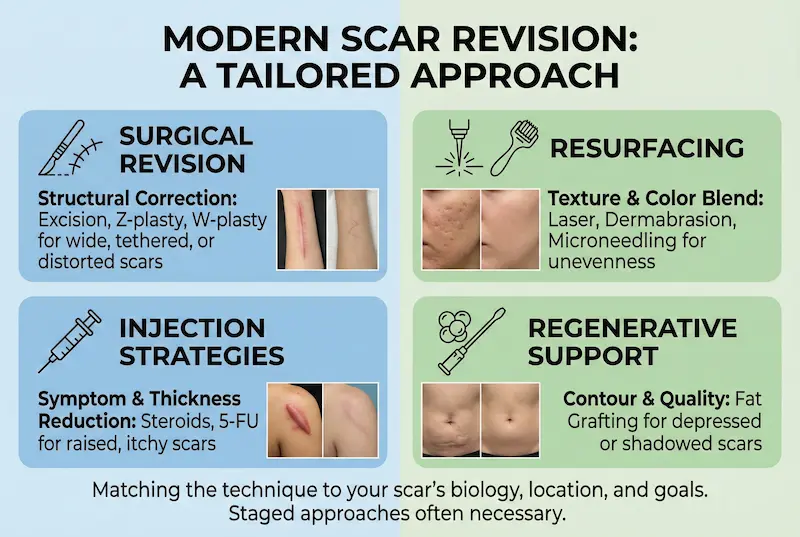
Surgical revision (excision & re-closure): W-plasty, Z-plasty, and linear revision
Surgical scar revision is typically recommended when the problem is structural—meaning the scar is wide, poorly oriented, tethered, or distorting nearby anatomy. Common surgical options include:
- Linear excision & refined re-closure: removing the old scar and re-closing with better alignment and tension control.
- Z-plasty: reorienting the scar to reduce tension and help it blend into natural lines or creases.
- W-plasty: breaking up a straight line scar into small angles to reduce how easily the eye tracks it.
These techniques can be particularly relevant for facelift scar revision, where the goal is not only a fine line—but a scar that sits naturally around the ear/hairline without distortion. For body scars, the principles are similar but tension control becomes even more important—especially in cases like tummy tuck scar revision Turkey, where movement and abdominal tension can widen scars if the closure and aftercare aren’t planned carefully.
"Abdominal tension" in scar revision conversations usually means one specific thing: the underlying muscle wall isn't doing its share of the structural work, which leaves the skin closure doing more than it was designed to do. Scars stretch under conditions like that, and revision alone won't fix the mechanics.
For the structural side of abdominal closure work, the abdominal muscle separation breakdown covers what diastasis recti actually is, how it changes the tension profile across the scar line, when muscle repair is combined with abdominoplasty in primary surgery, and why some scar revision plans need to address the muscle wall — not the scar — to actually hold a result.
Scar revision in the abdomen sometimes turns out to be a structural conversation in disguise.
Resurfacing options: laser, dermabrasion, and microneedling (who benefits most)
When the scar’s main issues are texture (unevenness), surface irregularity, or residual color contrast, resurfacing can be useful—either alone or after surgical refinement. Options may include:
- Laser resurfacing: often used to improve texture and blend edges over time.
- Dermabrasion: a controlled resurfacing technique that can soften sharp transitions.
- Microneedling: can improve texture and stimulate remodeling in select scars.
For patients addressing residual facial scar texture, resurfacing is sometimes used as a finishing step—because even a well-placed facelift scar may benefit from gentle texture blending once the tissue has stabilized.
Injection-based strategies: steroids, 5-FU, and supportive therapies
If a scar is raised, thick, or symptomatic (itchy, tight, tender), injections may be part of the plan. These are typically considered when the scar shows hypertrophic behavior or when a patient has a known tendency to form thicker scars. Depending on the case, clinicians may discuss:
- Corticosteroid injections: to reduce thickness and symptoms in raised scars.
- 5-FU (in select protocols): sometimes used in combination strategies for resistant raised scars.
- Supportive measures: silicone, massage guidance, and strict sun strategy.
Intralesional corticosteroid injection is one of the most repeatedly performed procedures in scar management, but it's also one of the least discussed in pre-treatment conversations. Patients are usually told what it does, rarely told what it feels like — which is a problem for compliance over multi-session protocols.
For the comfort and tolerability layer, 2025 BMJ Open scoping review of pain mitigation strategies for hypertrophic and keloid scar injections (Jaffar, Quraishi, Hassan et al.) — searching ScienceDirect, PubMed, and Web of Science through December 2023 — synthesized 11 studies on pain-reduction approaches including topical analgesia, cryoanaesthesia, mixing triamcinolone with local anesthetic, slow infiltration technique, vibration analgesia, and needle-free injectors.
Pain meaningfully shapes whether a patient completes the multi-session course — and incomplete courses are how keloid recurrence rates climb past where they need to be.
What matters most is not “which drug,” but the correct diagnosis (hypertrophic vs. keloid behavior) and the timing. This is one reason experienced scar-focused evaluation is so important when considering Turkey scar revision surgery.
Regenerative support (when appropriate): fat grafting / skin quality improvement
Some scars are depressed, tethered, or create contour shadows—especially after trauma or certain body procedures. In carefully selected cases, surgeons may discuss methods that improve contour and skin quality (for example, limited fat grafting or other supportive approaches). These decisions should be conservative and individualized, and the surgeon should clearly explain what improvement looks like and what it doesn’t.
The AKM Clinic Approach: Surgeon-Led Planning for Natural-Looking Healing
Patients often focus on the technique—and technique matters—but outcomes are also shaped by planning, closure philosophy, and post-op recovery standards. At AKM Clinic, the care model is framed as surgeon-led and safety-driven, combining a “skin-first” perspective with advanced surgical execution. This is especially relevant for visible or emotionally impactful scars, where patients want improvement without trading one obvious scar for another.
Why scar revision is both “skin science” and “surgical technique”
Scar improvement work succeeds when surgeons respect two realities at once:
- Skin biology: collagen behavior, inflammation control, pigment response, and time.
- Mechanical design: alignment with natural lines, layered closure, and tension reduction.
This blend is why patients often do best with a surgeon who takes skin quality seriously—not only “cut and stitch.” It’s also why realistic planning matters: the best results look natural, not “operated-on.”
Dermatosurgeon involvement + plastic surgery team: optimizing skin quality and closure
AKM Clinic’s surgical leadership includes a Dermatosurgeon & Face Expert (Dr. Akif Mehmetoğlu) alongside facial plastic surgery expertise. In practical terms, this pairing matters because scar outcomes are influenced by:
- Skin quality and healing behavior (a dermatosurgical strength).
- Structural planning and facial aesthetics (a facial plastic surgery strength).
- Closure strategy that prioritizes natural-looking lines and reduced tension.
"Dermatosurgeon" is the specialty label that matters most in scar revision conversations and gets the least attention in patient research. It signals training that bridges surgical structure work and the skin-quality dimensions scar outcomes ultimately get judged on — which is why scar work specifically benefits from this credential mix.
For the full credentials documentation, Dr. Akif's dermatosurgeon credentials profile covers training history, the dermatosurgical specialty fellowship that informs scar-aware closure design, society memberships, and the dual-specialty background that the article above references in the "skin science + surgical technique" framing.
Scar refinement is one of the procedure categories where the dermatosurgeon credential actually changes the outcome equation — not just the marketing brochure.
For patients searching “best scar revision surgeon Turkey,” a useful way to think about “best” is not a marketing claim—it’s a checklist: specialized credentials, a scar-aware closure philosophy, realistic outcome framing, and a post-op plan that protects the result.
Safety standards: sterile protocols, oversight, and disciplined patient selection
For international patients considering scar revision surgery in Turkey, safety standards should be as important as aesthetics. AKM Clinic’s stated safety framework emphasizes:
- Zero-compromise hygiene with protocols explicitly aligned to internationally recognized standards (including references to CDC and WHO-aligned practices).
- Multi-stage sterilization and modern autoclave systems designed to maintain a sterile field.
- Official oversight through licensing/authorization by the Turkish Ministry of Health.
"Elective surgery" is the category where infection control standards deserve the most scrutiny — because the risk tolerance is low and the consequences of a preventable complication outweigh the original benefit. Scar improvement work is squarely in that category.
For the facility-level documentation, the Istanbul clinic facility standards covers the operating room infrastructure, the multi-stage sterilization workflow, autoclave systems and hygiene protocols referenced in the safety framework above, hospital partnerships when inpatient capability is needed, and the licensing oversight under the Turkish Ministry of Health.
Facility documentation is one of the clearest signals a clinic can offer — practices that have these systems usually want to show them; practices that don't usually can't.
This matters because scar correction is elective, and the risk tolerance should be low. A well-run clinic should be transparent about how it reduces infection risk, how it plans aftercare, and how it decides whether a patient is an appropriate candidate.
Recovery and Aftercare: How to Help a New Scar Heal Better
Scar revision outcomes are shaped as much by aftercare as by the procedure itself. From a medical science standpoint, the early phase is about protecting the incision and controlling inflammation; the long phase is about guiding collagen remodeling and minimizing pigment changes. This is where many “good surgeries” fail to look great—because daily behaviors (tension, sun exposure, inconsistent care) quietly widen or darken the scar.
The first 72 hours: swelling, wound care, and what’s normal
In the first three days, your priorities are simple: keep the area clean, minimize tension, and follow your surgeon’s instructions exactly. Depending on location, you may experience mild swelling, tightness, and tenderness. Normal early healing signs can include:
- Localized swelling and mild bruising
- A “tight” sensation around the closure
- Small amounts of clear or lightly blood-tinged drainage (if your surgeon says this is expected)
What should trigger immediate medical contact: increasing redness spreading beyond the incision, fever, worsening pain, foul drainage, or sudden swelling. A reputable provider for scar revision surgery in Turkey should make it easy to reach the team during this period.
Weeks 1–6: activity limits, scar massage, and silicone-based care
Once the surface is stable, the focus shifts to tension management and scar optimization. Many surgeon-led protocols commonly include (when appropriate):
- Activity modification: limiting movements that stretch the scar (especially abdomen, chest, jawline).
- Silicone therapy: silicone gel or sheets to support a flatter, calmer scar environment.
- Scar massage guidance: only when your surgeon approves timing and technique.
The Weeks 1–6 window is where most abdominal scar outcomes are actually decided — not on the surgery day, but in the daily habits during this period. Tension control, silicone discipline, and posture management add up to a result that revision can later refine but never fully rescue if the foundation was wrong.
For the post-op care side specifically (separate from revision surgery itself), the tummy tuck post-op scar care playbook covers silicone gel/sheet protocols, when massage is appropriate and when it's premature, posture and lifting restrictions during the high-tension phase, and the sun-protection strategy that determines color outcomes a year later.
"Treatment" and "revision" are not the same problem — treatment prevents the situation revision later has to fix.
Months 3–12: scar maturation timeline and what “final results” really means
A scar is “active” for months. Color often changes, texture softens, and the line continues to settle. The most realistic expectation is that you’ll see meaningful improvement earlier, but the most refined results are typically judged later.
| Timeframe | What You May Notice | What Matters Most |
|---|---|---|
| Days 1–7 | Swelling, tightness, early redness | Protect closure, keep clean, avoid tension |
| Weeks 2–6 | Red/pink scar, sensitivity; itching possible | Silicone, sun avoidance, controlled activity |
| Months 2–4 | Scar starts to soften; redness gradually reduces | Consistency with aftercare; consider “finishing” modalities if advised |
| Months 6–12 | More stable color and texture; best-read timing | Long-term sun strategy; patience and realistic review |
For facial scars, the goal is not only a fine line but also natural placement—so the scar doesn’t disrupt the hairline or ear anatomy. This is why photo-based evaluation (multiple angles, consistent lighting, appropriate timelines) is crucial when assessing “good results.”
Recovery support at AKM Clinic: HBOT & LLLT and where they fit (and where they don’t)
AKM Clinic highlights two post-operative recovery technologies that are positioned as integral parts of its care standards: Hyperbaric Oxygen Therapy (HBOT) and Low-Level Laser Therapy (LLLT). These modalities are not “magic,” but they can support healing biology in ways that align with the principles of scientific research on tissue recovery—especially by addressing oxygen delivery, inflammation, and cellular energy.
- HBOT (Hyperbaric Oxygen Therapy): involves breathing 100% oxygen in a pressurized chamber to increase oxygen availability in tissues. AKM Clinic frames this as a major safety-focused recovery investment, describing benefits such as reduced swelling/downtime, support for tissue recovery, and improved scar healing through stimulation of collagen-producing cells (fibroblasts), while also noting a hyper-oxygenated environment can be unfavorable for bacteria.
- LLLT (Low-Level Laser Therapy): AKM Clinic describes a medical-grade “soft laser” approach using a precise wavelength (650nm) to stimulate cellular activity without heat damage. The clinic emphasizes ATP (cellular energy) support as a mechanism for repair and recovery.
How to think about it: Good scar outcomes still depend on correct technique, tension control, and disciplined aftercare. Recovery tech can support the process—but it doesn’t replace fundamentals.
Scar Revision Surgery Turkey Cost: What Actually Determines Pricing
Scar correction pricing varies more than most other procedure categories because the work itself varies more — a small linear refinement and a multi-stage Z-plasty plus resurfacing aren't the same operation under the same name.
For the practice-wide cost-comparison architecture (Istanbul versus US markets, what's bundled, what's optional), the broader plastic surgery cost framework covers the line-item structure of all-inclusive packages, what's verifiably included versus what gets billed separately, the comparison methodology for evaluating quotes across geographies, and the questions that turn a number into a plan.
The fastest way to be misled on cost is to ask for a number before defining the work — the practice-wide framework is built to prevent exactly that.
Cost drivers: scar size, location, technique, and number of sessions
The main cost drivers typically include:
- Scar complexity: width, length, contour issues (depressed vs raised), and tethering.
- Location: face/ear/hairline scars require aesthetic precision and may be more technically demanding.
- Technique mix: surgical revision alone vs. staged plan with resurfacing/injections.
- Number of sessions: some scars need more than one phase for optimal blending.
This is why two patients both searching “Turkey scar revision surgery” may receive very different quotes—and why a reputable team will insist on photos and a structured consultation before committing to a plan.
What’s typically included in Istanbul care models (and what you should verify)
International patients often choose Turkey for value and efficiency, but you should verify the details in writing. In many Istanbul care models, you may see bundled elements; however, always confirm:
- Surgeon evaluation and a clear written plan
- Anesthesia type (local vs sedation) and facility standards
- Post-op follow-ups and who monitors the scar over time
- Aftercare guidance (silicone, sun strategy, restrictions)
- Whether supportive recovery technologies are included or optional
A useful “expert patient” question is: “If I need a second-stage refinement, how is that handled?” This is especially relevant for visible areas and for procedure-linked scars like facelift scar revision and tummy tuck scar revision Turkey.
Transparent comparisons: New York vs Los Angeles vs Miami vs Istanbul (AKM Clinic)
Rather than comparing “USA vs Turkey” in vague terms, the meaningful comparison is high-cost US markets vs Istanbul. In cities like New York, Los Angeles, and Miami, surgical facility fees, anesthesia, and surgeon overhead can dramatically raise total cost—even for similar technical work.
What many expert patients value in Istanbul is the ability to access a surgeon-led plan and structured aftercare at a more efficient total cost. The correct way to compare is:
- Plan-to-plan: same technique scope, same follow-up expectations
- Safety-to-safety: sterile standards, licensing, transparency
- Outcome realism: no “invisible scar” promises
Turkey vs other medical tourism destinations (e.g., Mexico, Thailand): value vs standards
Patients sometimes cross-shop Turkey with other destinations. The best filter is not “cheapest”—it’s “most credible plan.” When comparing destinations, evaluate:
- Surgeon qualifications and scar-specific experience
- Facility quality and infection-prevention standards
- Aftercare structure (especially if you travel home early)
- Willingness to say “no” if you’re not a good candidate
If your search includes “best scar revision surgeon Turkey,” treat “best” as verifiable: clear outcomes, realistic timelines, thoughtful staging, and safety transparency—more than branding.
How to Choose the Right Surgeon in Turkey (Avoiding Regret)
When patients search for the best scar revision surgeon Turkey, what they usually mean is: “Who can improve my scar without creating a new problem?” The safest way to choose is to evaluate a surgeon (and clinic) the way an “expert patient” would—through verifiable credentials, realistic planning, consistent before/after evidence, and clear aftercare standards. This matters even more if you’re traveling for scar correction in Turkey, because your early healing period may happen partly at home.

Credentials and specialization: what to look for (and what to ignore)
Start with what’s verifiable and relevant to scar outcomes:
- Clear specialty alignment: Revision work — whether the goal is fixing a scar or fixing a broader aesthetic outcome — needs a different kind of surgeon than primary work.
- Experience with your scar type: raised scars (hypertrophic/keloid tendency) and complex body scars require different planning than a straightforward wide linear scar.
- A surgeon-led plan: you should meet the surgeon who designs the technique and aftercare strategy—not only a coordinator.
The skill set overlaps but isn't identical: revision specialists read scar tissue, anticipate adhesions, and design closures that account for what's already been done to the area.
For the credentials and red-flag checklist specifically for revision selection, the revision-specific surgeon evaluation framework covers fellowship training that signals revision expertise, the consultation questions that separate revision specialists from primary-surgery-only surgeons, and the operative judgment that distinguishes "I can fix this" from "I shouldn't be the one fixing this."
Most regret in revision work isn't from the wrong technique — it's from the wrong surgeon choice for revision specifically.
What to ignore: “guaranteed invisible scar” claims, vague “best clinic” titles without substance, and before/after galleries that lack timing details.
How to evaluate before/after photos for scars (lighting, timing, realism)
Photo evaluation for scars is harder than photo evaluation for other procedures — because lighting, angle, and timing can hide or exaggerate texture in ways that don't show up the same way in a before/after of, say, a tummy tuck silhouette.
For the cross-procedure photo archive that lets you compare conditions consistently, the documented before-and-after gallery covers procedure-specific case sets with timing labels, multi-angle documentation across recovery phases, and the consistency standards (lighting, distance, expression) that the checklist above describes — applied across the practice's archive rather than curated for marketing.
Reading an archive teaches calibration in a way that reading one or two showcase photos never does.
Scar photos can be misleading if taken too early, with flattering lighting, or from angles that hide texture. Use this checklist:
- Timing labels: Ask how many months post-op the “after” photo is (scar maturation continues up to 12 months).
- Consistent conditions: Similar lighting, distance, angle, and facial expression/posture.
- Close-ups: Scar outcomes need close-range images, not only “beauty shots.”
- Comparable scar types: Look for cases like yours (e.g., tummy tuck scar revision Turkey vs. small facial scars are not comparable).
If your focus is facial scar refinement around the ear/hairline, insist on photos around the ear/hairline in multiple angles, because placement and contour matter as much as the thinness of the line.
Red flags: rushed consults, unrealistic promises, unclear aftercare
Most regrets come from mismatched expectations and weak planning—not from the idea of scar revision itself. Red flags include:
- Promises of “no scar” or “scar-free” outcomes
- No discussion of scar biology (keloid/hypertrophic risk, pigmentation, prior healing history)
- Vague technique language (“We’ll fix it”) without explaining how and why
- No written aftercare plan (silicone strategy, sun strategy, activity restrictions, follow-up cadence)
- Price-first selling without clarifying what’s included—especially common when people only ask “scar revision surgery cost Turkey” and are given a number without a plan
In a credible Turkey scar revision surgery pathway, a clinic should be comfortable saying: “This scar can improve by X, but not become invisible,” and explaining what improvement looks like on your skin.
The consultation checklist: questions the “expert patient” should ask
Use these questions to turn a consultation into a decision tool:
- Diagnosis: “Is my scar hypertrophic, keloid-prone, tethered, widened, or pigment-driven?”
- Plan: “What technique do you recommend (linear revision, Z-plasty/W-plasty, resurfacing, injections), and why?”
- Staging: “Do you expect one session or a staged plan? What would trigger a second stage?”
- Risk management: “What steps do we take to reduce widening, thickening, or pigment changes?”
- Aftercare: “What is the written protocol for silicone, massage timing, sun protection, and activity limits?”
- Travel reality: “What follow-up is needed before I fly, and how is remote follow-up handled?”
Frequently Asked Questions (FAQ): Scar Revision Surgery Turkey
Below are the most common, practical questions patients ask when considering scar revision surgery in Turkey. These answers are intentionally concise and realistic—because the safest decisions are based on clarity, not promises.
Can scar revision surgery completely remove a scar?
What’s the best time to revise an old scar?
Will scar revision work for keloids or hypertrophic scars?
Is scar revision painful, and what anesthesia is used?
How many sessions might I need (and why)?
Can I combine scar revision with another procedure?
How long until I see the final result?
Related Treatments



Ready to Start Your Own Transformation Journey?
Join the 2,000+ patients who trusted Dr. Akif Mehmetoğlu and the AKM Clinic team. Your journey to a more confident, revitalized you begins with a simple, no-obligation conversation. Contact us today from the USA for your free virtual consultation.
#1: Get Your Free Personalised Quote
Start with a free, no-obligation online consultation. Share your photos, and our surgical team will provide a fully personalised treatment plan and a transparent, all-inclusive price package. No hidden fees.
#2: Secure Your Date & VIP Booking
Once you're ready, our dedicated patient coordinators will help you secure your procedure date. We'll handle all your bookings, including your 5-star hotel and private VIP airport transfers.
#3: Arrive in Istanbul & Meet Your Surgeon
Arrive at Istanbul Airport (IST) and be greeted by your private driver. Settle into your hotel and prepare for your in-person consultation, where you'll meet your specialist surgeon to finalise the details for your "natural, subtle, and revitalized" new look.