


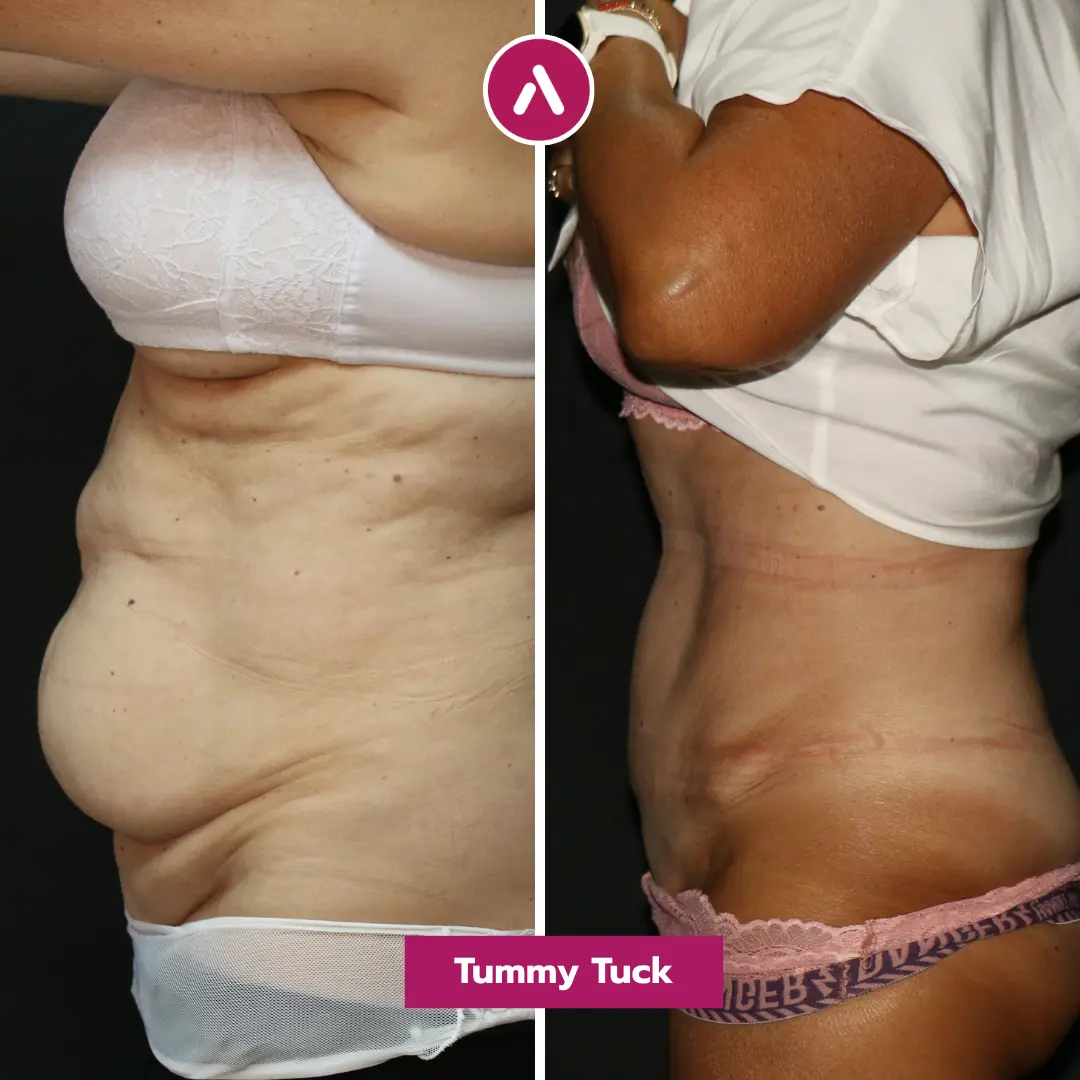
If you are researching abdominoplasty, you are likely comparing technique, safety, recovery time, and long-term results. That is the right order. In this guide, we focus on the procedure first, then the practical decision-making that matters to UK patients.
Table of Contents
What is Tummy Tuck (Abdominoplasty)?
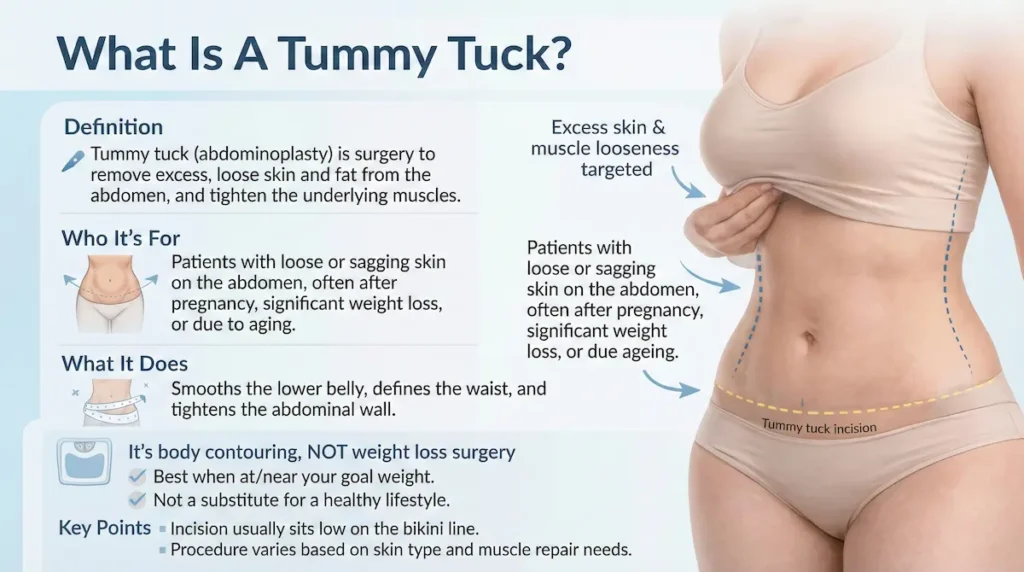
Tummy Tuck (Abdominoplasty) is an evidence-based surgical procedure that removes excess lower-abdominal skin, tightens the abdominal wall when needed, and reshapes the waistline for a flatter, smoother contour. It is not a weight-loss operation. It is designed to address skin laxity and, in selected cases, muscle separation.
The anatomy: skin, fat, fascia and abdominal wall
Most “lower belly” changes come from three layers. First, stretched skin that no longer retracts. Second, fat distribution that affects how the abdomen projects. Third, the abdominal wall (including the fascial layer) which can lose support after pregnancy or major weight changes.
- Skin laxity drives the “apron” look and creasing.
- Fat layer affects thickness and contour, especially at the flanks.
- Abdominal wall support influences bulging and posture in some patients.
Liposuction vs abdominoplasty: what each can and can’t do
Liposuction reduces fat volume, but it cannot remove significant loose skin or reliably correct a lower-belly overhang. Abdominoplasty removes excess skin and can reposition the remaining skin for a cleaner line. When the right candidate needs both, we plan contour and skin management together rather than treating them as separate problems.
Panniculectomy vs abdominoplasty (medical need vs aesthetic contouring)
Patients often search panniculectomy vs abdominoplasty when the concern is mainly a heavy pannus (hanging skin) causing hygiene or irritation. A panniculectomy focuses on removing that excess tissue. Abdominoplasty goes further by shaping the waist, managing scar placement more strategically, and addressing the abdominal wall when appropriate.
Benefits of Tummy Tuck (Abdominoplasty)
The main benefit is structural: a flatter abdominal profile with improved skin drape. The second benefit is proportional: better waist definition when the plan includes flank contouring. The third benefit is practical: clothing fits more predictably, especially around the lower abdomen. Results should look like you, just more refined.
A flatter abdomen and improved waist contour
Removing redundant lower-abdominal skin can reduce the “fold” that shows through fitted clothing. When contouring is part of the plan, the waist can look cleaner from the front and the side. The goal is balance, not tightness. A well-planned tummy tuck should not look “pulled”.
Core stability and posture (when muscle repair is appropriate)
Some patients have diastasis recti (a separation of the rectus muscles) that contributes to a forward bulge, even at a stable weight. In those cases, abdominoplasty with muscle repair can restore a firmer abdominal wall. It is not a substitute for fitness, but it can make core training feel more effective after recovery.
Our priority is a natural line and a stable repair. We tighten what needs tightening, and we avoid creating tension that trades a flatter abdomen for an obvious, over-operated look.— Our Surgical Team
Clothing fit and confidence (natural-looking change)
Most UK patients describe the win in simple terms: trousers, dresses, and swimwear sit better at the lower abdomen. The change is often most noticeable in profile. Many people also report feeling less “held back” by the area in day-to-day movement, especially after weight loss or pregnancy.

Am I a Suitable Candidate for Tummy Tuck?
Candidate selection decides your result. It also decides your risk. We look at skin quality, fat distribution, abdominal wall support, and your overall health in one joined-up plan. If any one piece is ignored, the outcome can look unnatural or the recovery can become harder than it needs to be.
Who tends to benefit most?
A tummy tuck is most effective when the main issue is loose skin and lower-abdominal overhang rather than “stubborn fat” alone. Many patients come to us after pregnancy, weight loss, or both. Typical goals are straightforward: flatter profile, smoother lower abdomen, and a waistline that looks more balanced in clothes.
- Stable weight (ideally steady for several months)
- Noticeable lower-belly skin laxity or a hanging pannus
- A bulge that does not respond to training (often linked to diastasis recti)
- Realistic expectations about scars and recovery
Medical screening: what we assess before you travel
We run strict pre-operative health screenings because abdominoplasty is a major operation. Your consultation is not just about aesthetics. It is about building a plan that is safe for your body, your timeline, and your lifestyle back in the UK.
- Smoking and nicotine (a key factor in wound healing and scar quality)
- Clot risk history (including family history and previous DVT/PE concerns)
- Diabetes and thyroid control
- Current medications and supplements (including blood-thinners)
- Weight and BMI context (e.g., 70 kg (approx. 154 lbs) is different from 95 kg (approx. 209 lbs) in surgical planning)
If you have a UK GP letter, recent blood tests, or imaging, we review those as part of your medical picture. It helps us move faster, and it keeps the decision grounded in facts.
Who should postpone or avoid surgery?
Sometimes the safest plan is “not yet”. If your weight is still changing, if you are planning another pregnancy, or if your health is not stable, we would rather postpone than push forward. That choice protects your result and your wellbeing.
- Active smoking/nicotine use or inability to stop for the required period
- Uncontrolled medical conditions (for example, poorly controlled diabetes)
- Very recent childbirth or major weight changes
- Expectations that a tummy tuck will replace weight loss or treat visceral (internal) fat
Good surgery starts with a calm “yes” or a clear “not yet”. When timing and health are right, the operation becomes simpler, recovery becomes smoother, and results look more natural.— Our European Board Certified Surgeons
Surgical Techniques Explained (and how we choose the right approach)
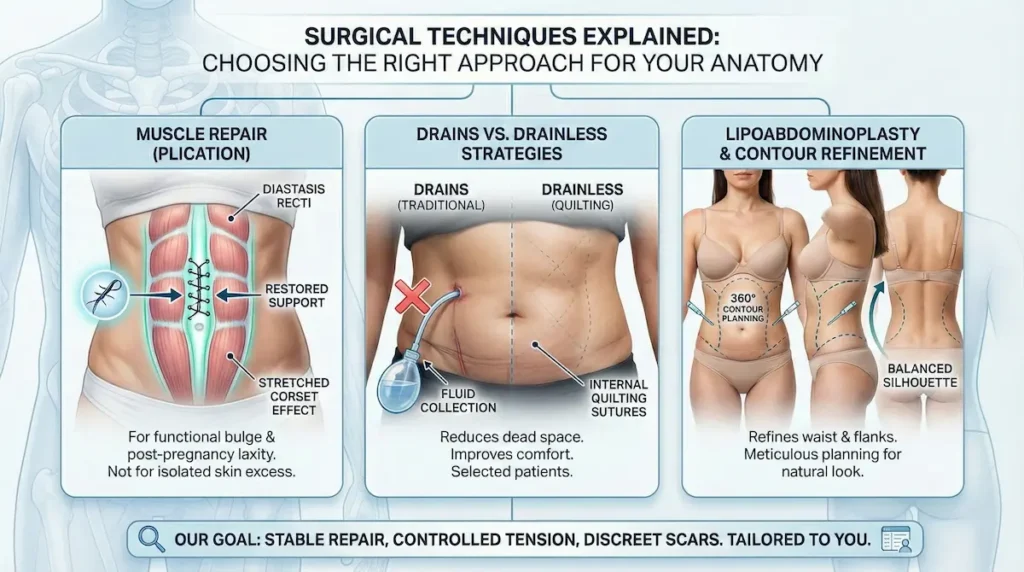
There is no single “best” tummy tuck technique. There is a best technique for your anatomy. We base the plan on what we see in front of us: skin excess direction, abdominal wall laxity, and how your waist and flanks contribute to the final silhouette. The goal stays consistent: a stable repair, controlled tension, and scars that sit as discreetly as possible.
Muscle repair (rectus plication): when it helps and when it doesn’t
Muscle repair is not routine for everyone. We use it when the abdominal wall behaves like a stretched corset, typically with diastasis. Repair can improve abdominal projection and reduce the “dome” effect when you sit or stand.
- When it helps: true diastasis, functional bulge, pregnancy-related laxity
- When it’s not needed: isolated skin laxity with a stable abdominal wall
- What it won’t do: remove internal (visceral) fat or replace core training
Drains vs drainless approaches (seroma control strategies)
Fluid build-up (seroma) is one of the common concerns after abdominoplasty. A drainless abdominoplasty technique uses internal “quilting” sutures and careful space control to reduce dead space and lower seroma risk. In some cases, drains still make sense. We decide based on tissue quality, the extent of dissection, and whether you are combining procedures.
- Drainless approach: can improve comfort and simplify early aftercare
- With drains: may be appropriate for higher-risk seroma profiles
- Always: compression garment planning and mobility guidance matter
| Technique element | What it’s for | Typical best-fit profile | Key trade-off |
|---|---|---|---|
| Skin-only tightening | Remove lower-belly overhang and smooth creasing | Loose skin, minimal abdominal wall laxity | Limited effect on bulge if diastasis is present |
| Muscle repair (plication) | Restore abdominal wall support and reduce forward projection | Diastasis recti, functional bulge, post-pregnancy laxity | Often more post-op tightness in the early weeks |
| Drainless strategy | Reduce dead space and support smoother early recovery | Selected patients with suitable tissue quality | Not appropriate for every anatomy or combined plan |
| Lipoabdominoplasty (contour + skin management) | Refine waist and flanks while managing skin excess | Patients who want a more balanced 360° contour | Requires meticulous planning to keep blood supply safe |
Lipoabdominoplasty and contour refinement (planning harmony)
Many UK patients do not just want a flatter abdomen. They want a waist that makes sense from every angle. That is where contour planning matters: the abdomen, flanks, and lower back work together visually.
- We plan the waistline in proportion, not as an isolated “front-only” operation.
- We aim to keep skin tension controlled, which supports better scars and a more natural look.
- We tailor the plan if you are considering a combined pathway (for example, a Mummy Makeover).

Types Of Tummy Tuck
“Tummy tuck” is an umbrella term. The best option depends on where your excess skin sits (lower vs upper abdomen), how much skin is involved (horizontal only vs horizontal + vertical), and whether your waist and back require circumferential contouring. Below are the most common types UK patients ask about.
Mini tummy tuck
A mini tummy tuck focuses on the area below the belly button. It is most suitable when the main concern is a small lower-abdominal overhang or a mild “C-section shelf” with limited skin laxity above the navel.
- Best for: lower-belly looseness with a relatively firm upper abdomen
- Muscle repair: may be limited (if needed) compared with a full tummy tuck
- Scar: typically shorter and lower, but still a permanent surgical scar
Extended tummy tuck
An extended tummy tuck addresses the lower abdomen and carries the correction further towards the hips. It is often considered when loose skin and fat extend to the sides, affecting the “love handle” area and the outer waistline.
- Best for: patients with skin excess that wraps beyond the front abdomen
- Benefit: improved side silhouette and waist continuity
- Trade-off: a longer scar to match the larger correction
Fleur de lis tummy tuck
A fleur de lis tummy tuck is designed for significant, multi-directional skin excess—commonly after major weight loss—where tightening in one direction is not enough. It uses a horizontal component (similar to a classic tummy tuck) plus a vertical component to address extra width.
- Best for: major weight-loss patients with excess skin both “down” and “in”
- Benefit: stronger reshaping of the abdominal envelope
- Trade-off: an additional vertical scar (balanced against a better contour)
Reverse tummy tuck
A reverse tummy tuck targets laxity in the upper abdomen rather than the lower abdomen. It can be an option when the lower abdomen is acceptable, but the skin above the belly button feels loose or creased.
- Best for: upper-abdominal skin excess with relatively stable lower abdomen
- Approach: tissue is lifted upward rather than pulled down
- Note: scar placement is different from a traditional tummy tuck and must be planned carefully
Circumferential tummy tuck
A circumferential tummy tuck addresses the abdomen, flanks, and back in a 360° approach. This is often discussed alongside “lower body lift” concepts in post-weight-loss body contouring, where the skin excess is not limited to the front.
- Best for: patients with significant laxity around the full waistline
- Benefit: improved waist and back contour continuity
- Trade-off: wider surgical footprint and longer recovery planning
Brazilian tummy tuck
Brazilian tummy tuck is a term often used to describe a more contour-focused approach that combines abdominoplasty principles with more comprehensive liposuction. Because the label is not standardised, what matters is the actual plan: where liposuction is done, how the skin blood supply is protected, and whether muscle repair is indicated.
- Best for: patients seeking a flatter abdomen plus more refined waist definition
- Key point: technique details vary—ask exactly what is included
- Safety focus: controlled tension and tissue perfusion over “aggressive tightening”
Full tummy tuck (traditional abdominoplasty)
A full tummy tuck (traditional abdominoplasty) addresses the lower abdomen more comprehensively and is typically the option when there is significant skin excess below the navel, and/or when muscle repair is required. It is the most recognised form of abdominoplasty and forms the baseline reference for many comparisons.
- Best for: moderate-to-significant lower skin excess and/or diastasis recti
- May include: muscle repair, reshaping, and strategic scar placement
- Expectation: visible improvement, but not “weight-loss surgery” results
The right type is the one that matches your skin pattern and your abdominal wall. We choose the technique to make the result look proportionate, and we accept a scar only when the contour gain is worth it.— Our Surgical Team
Combined Procedures (synergy): maximising your results
Many UK patients consider combining abdominoplasty with additional contour work. When done thoughtfully, combining can create a more harmonious silhouette and reduce the need for a second anaesthetic event. When done without strict safety limits, combining can increase risk and prolong recovery. The plan must be personalised.
360 liposuction and abdominal contouring in one plan
If your goal includes waist refinement, we may discuss contour planning beyond the front abdomen. 360 Liposuction focuses on proportions: front profile, side profile, and how the waist transitions into the hips and back. The strategy is not about doing “more”; it is about doing the right areas in the right intensity while protecting tissue health.
“Mummy Makeover” logic: tummy tuck + breast procedures (case-based)
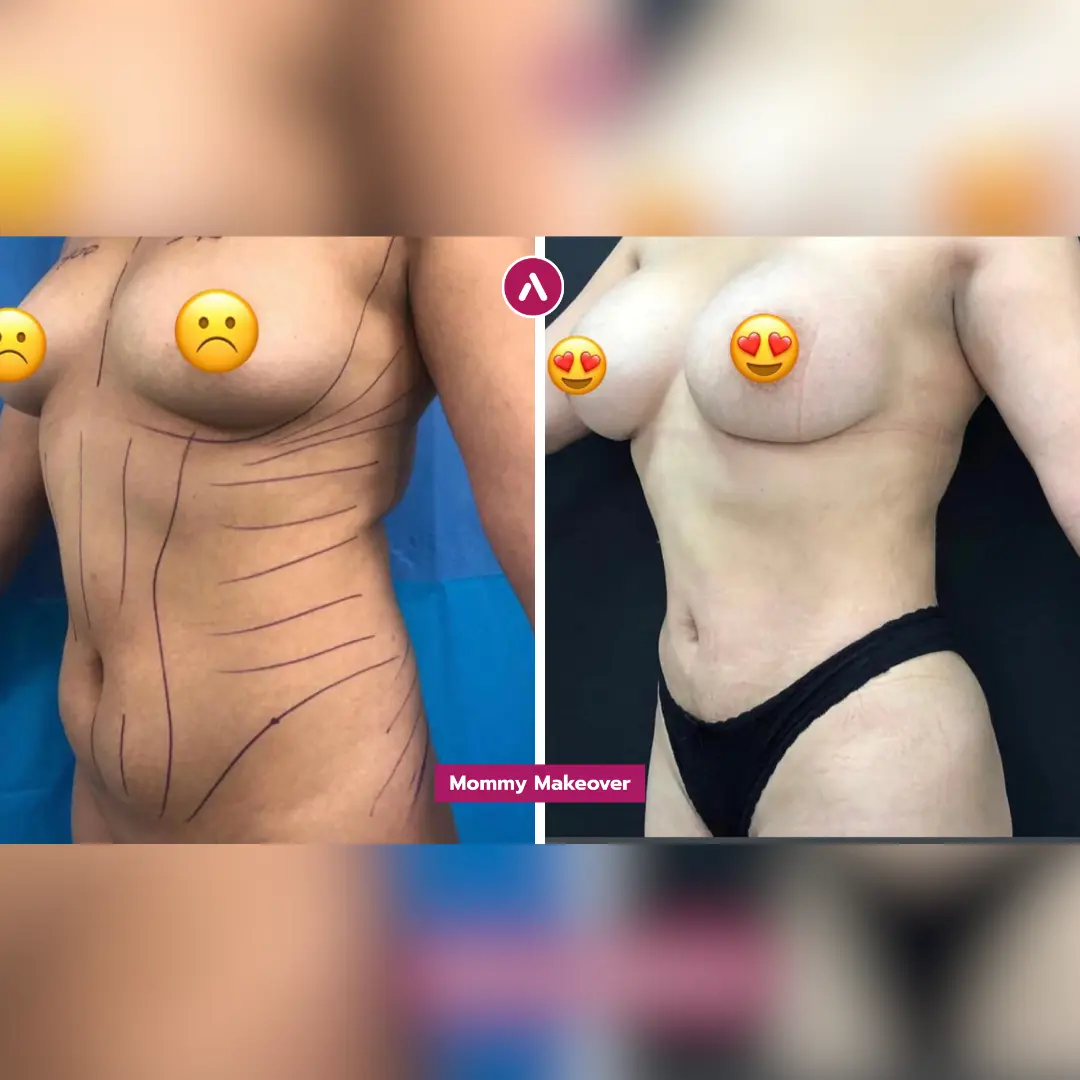
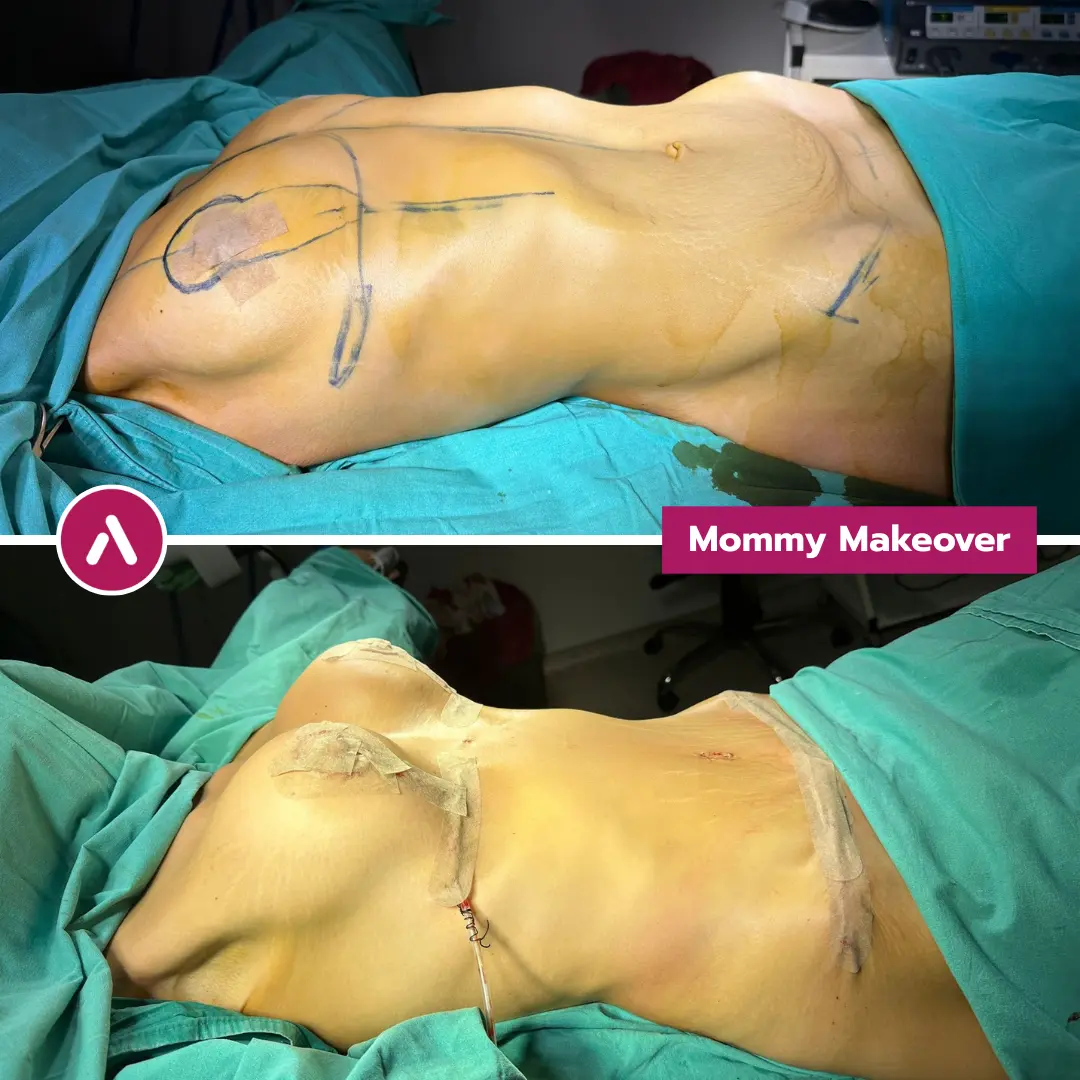
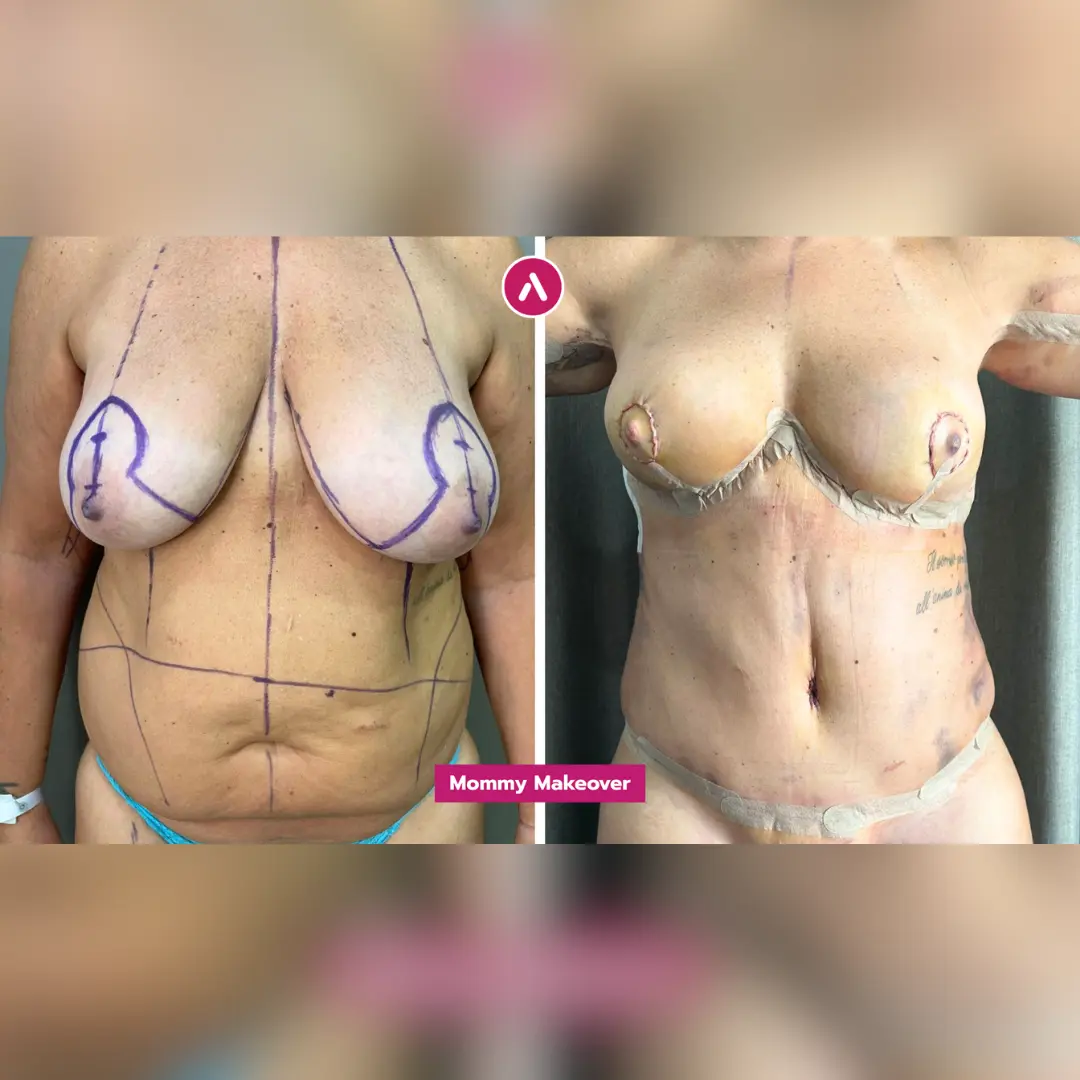
Some patients choose to combine a tummy tuck with breast surgery, thigh lift and labiaplasty as part of a “Mummy Makeover” pathway. Whether combining is sensible depends on procedure length, your medical profile, and how much reshaping is required. In many cases, a staged plan is the safer and more predictable route.
When combining is not wise (safety-first staging)
We recommend staging rather than combining if you have higher clot risk factors, wound-healing risk factors (such as nicotine use), significant medical comorbidities, or if the combined plan would make surgery excessively long. A staged approach can still deliver a premium result—often with a smoother recovery.
Anaesthesia for Tummy Tuck (Abdominoplasty): choosing the safest plan
UK patients often have one core concern: “Will I need a general anaesthetic?” It is a fair question. Abdominoplasty is a substantial operation, and the anaesthesia plan should match the surgical plan, your medical profile, and your comfort level. We do not treat anaesthesia as an afterthought. We plan it early and we explain it plainly.
Our clinical differentiator is our experience with Awake Surgeries and twilight anaesthesia in appropriate procedures. For tummy tuck, the safest option is often a well-managed general anaesthetic. In selected cases, limited-scope body contouring elements may be suitable for lighter sedation. The decision is medical first. Always.
General anaesthesia vs twilight (conscious sedation) anaesthesia: what is realistic for abdominoplasty?
Most full abdominoplasties require a level of muscle relaxation and comfort that typically fits general anaesthesia best. That said, “general” does not have to mean frightening. Modern monitoring, experienced anaesthetic teams, and clear peri-operative planning make the process predictable for most healthy patients.
- General anaesthesia: commonly used for full tummy tucks and longer combined plans.
- Twilight anaesthesia (Conscious Sedation): may be discussed for selected, shorter procedures, depending on scope and patient factors.
- Local anaesthesia: more relevant for smaller interventions, not for standard abdominoplasty.
We decide based on your anatomy, whether muscle repair is required, and the expected surgical footprint. Safety comes before preference. No exceptions.
Managing fear of anaesthesia: how we reduce uncertainty
Anaesthesia anxiety is common. Some patients fear nausea. Others fear “not waking up”. Some simply dislike the idea of losing control. We manage this in a practical way: clear screening, direct answers, and realistic expectations.
- Pre-op assessment: we review your medical history, previous anaesthetic experiences, and current medications.
- Risk planning: clot risk, airway considerations, and healing risks (including nicotine exposure) are discussed openly.
- Communication: you know what will happen, in what order, and who is responsible for each step.
Calm patients recover better. We earn that calm with facts, a clear plan, and anaesthesia choices that fit the surgery—not the other way around.— Our European Board Certified Surgeons
Pain control after tummy tuck: the plan should be layered
Good pain control is not one medication. It is a system. We use a layered approach that aims to keep you comfortable while supporting safe mobilisation and steady breathing. This matters for recovery, especially in the first week.
- We set expectations: tightness is normal, especially after muscle repair.
- We support early movement: small walks reduce stiffness and lower clot risk.
- We give simple guidance for home: what is normal, what is not, and when to contact us.
Step-By-Step: what happens in theatre on surgery day?
Patients do best when they know the sequence. Not every detail needs to be technical, but the milestones matter. We also keep the process structured because international patients need predictability: your transfers, your tests, your surgery, and your early recovery are planned as one pathway. Your final in-person review happens before surgery, after pre-operative tests, and we confirm the exact surgical markings together.
Pre-op markings and the final surgical plan
On the day, we confirm your goals in the mirror, not just on paper. We mark incision lines with your natural underwear line and body proportions in mind. This is where we align the plan with reality: how your skin moves, where creases sit, and what needs to be removed versus preserved.
- We re-check whether muscle repair is indicated.
- We confirm whether any contouring areas are included in the plan.
- We set scar expectations clearly before you enter theatre.
Incisions, repair, contouring, and closure
In theatre, our focus stays the same: controlled tension, protected blood supply, and a stable repair. If muscle repair is part of your plan, we address the abdominal wall first. We then manage the skin envelope, remove the excess, and reshape the contour so it looks proportionate rather than “tight”.
- Muscle repair: performed when diastasis recti contributes to bulging and instability.
- Skin redraping: done to avoid distortion and reduce high-tension closure.
- Closure: layered closure supports strength and scar quality over time.
Dressings, compression garment, and immediate monitoring
Right after surgery, we monitor you closely. This is not a “stand up and leave” procedure. We assess comfort, mobility, and early wound status. We also fit and explain your compression garment plan, because consistent aftercare supports swelling control and a smoother contour.
- We explain how to walk safely in the early days (posture matters).
- We outline what you will feel: tightness, swelling, and fatigue are expected.
- We keep communication open: your Patient Host supports you 24/7 via WhatsApp while you are in Istanbul.

Tummy Tuck Recovery Time & Aftercare: how long does healing take?
Recovery after Tummy Tuck (Abdominoplasty) is not a single moment where you suddenly feel “back to normal”. It is a sequence: early wound stability, swelling control, mobility rebuild, and then gradual softening of tightness and scar maturation. Your timeline depends on the type of tummy tuck, whether muscle repair was performed, and whether any contouring was combined.
Below is a realistic guide. It is not a promise, and it does not replace medical advice, but it helps UK patients plan work, childcare, travel, and expectations with more clarity.
The first 72 hours: posture, mobilisation, and swelling control
The first three days are about protecting the repair and keeping your body calm. You will feel tightness, especially when standing fully upright. That is normal. We encourage gentle mobilisation early because it supports circulation and reduces stiffness.
- Walking: short, frequent walks (even a few minutes at a time) are better than one long walk.
- Posture: you may walk slightly bent at the hips at first; we guide you to straighten gradually.
- Compression garment: worn as instructed to support swelling control and contour stability.
- Hydration and nutrition: consistent fluids and protein-rich meals support healing.
Most patients describe this phase as “tight and tired” rather than sharp pain, especially when pain control is layered and expectations are set correctly.

Days 4–7: getting independent again
As the first week progresses, you typically become more confident with basic movement: walking to the bathroom comfortably, getting in and out of bed with less effort, and standing more upright. Swelling can feel more noticeable because you are moving more, and the abdomen can feel firm or “full”.
- Showering and dressings: we give clear instructions based on your closure and dressing plan.
- Sleep: many patients rest best slightly elevated with support under the knees.
- Energy levels: fatigue is common; plan to rest more than you think you will need.
Recovery is a skill, not just a wait. The patients who do best follow the simple rules consistently: gentle movement, garment discipline, hydration, and no “testing” the incision early.— Our Surgical Team
Weeks 2–3: swelling stages and “feeling tight”
Week two is often the turning point: you feel more mobile, but you may still feel swollen and tight—especially later in the day. This is a normal stage of recovery. Swelling typically comes in waves, and it may be uneven between the lower abdomen, flanks, and suprapubic area.
- Swelling pattern: often worse by evening, better in the morning.
- Sensation changes: numbness or altered sensation around the lower abdomen is common early on.
- Work: desk-based work may be possible for some patients in this window, but it depends on procedure scope and how you feel.
Weeks 4–6: returning to routine (and when exercise makes sense)
Many patients begin to feel more “normal” between weeks four and six, particularly for daily activities. Light exercise is typically introduced gradually, and heavier training is delayed until your surgeon confirms it is safe. If you had muscle repair, the abdominal wall needs protected time to stabilise.
- Walking: usually becomes comfortable and more upright.
- Training: progression is guided—light first, then controlled increase, then more intense activity.
- Confidence: results begin to look smoother as swelling reduces, but refinement continues for months.
Our Rapid Recovery & Safety Protocol: HBOT + LLLT support
UK patients often ask how they can recover well and return to normal life sooner—without compromising safety. Our approach is not about rushing. It is about supporting the biology of healing with structured aftercare and, when appropriate, advanced adjunctive therapies.
- HBOT (Hyperbaric Oxygen Therapy): used to support tissue oxygenation and recovery in selected patients. By increasing the amount of oxygen delivered through the bloodstream, HBOT may support wound healing and reduce certain recovery burdens when integrated appropriately.
- LLLT (Low-Level Laser Therapy): used to support swelling reduction and scar-quality goals in a controlled protocol. LLLT is not a “magic fix”, but it can be a helpful tool within an organised aftercare plan.
These therapies are discussed individually. We recommend them when they match your profile, your procedure, and your recovery priorities—always with a safety-first mindset.
Planning your return to the UK: travel, comfort, and continuity of care
As an international patient, you need two things: a safe early recovery period in Istanbul and a clear follow-up plan once you are home. We provide structured instructions for movement, garment use, and wound care, plus a direct communication pathway for questions after you return.
- Travel comfort: we advise on walking intervals, hydration, and practical positioning to reduce stiffness.
- Follow-up: remote check-ins support continuity while you transition back to daily life in the UK.
- Clarity: you will know what is normal, what is not, and how to reach us quickly if something concerns you.

Scar Strategy: where scars sit and how they mature
Every tummy tuck trades skin excess for a scar. The aim is to place that scar as discreetly as anatomy allows, then support it through the phases of healing so it matures as cleanly as possible. We plan scar placement early—before surgery—and we support scar quality afterwards with structured aftercare.
Incision placement and underwear/bikini line planning
Most traditional abdominoplasty scars sit low on the abdomen, designed to be covered by underwear or swimwear. The exact position depends on your body proportions, the amount of skin to be removed, and whether the plan needs to extend towards the hips. A longer correction often requires a longer scar—our job is to make that trade-off sensible and aesthetically balanced.
- Low placement: planned with your natural crease and typical underwear line in mind.
- Tension control: we prioritise stable closure over “over-tightening”, because excessive tension can worsen scar quality.
- Type-specific scars: for example, fleur de lis involves a vertical component, while circumferential approaches extend around the waistline.
Abdominoplasty scar healing stages (weeks to months)
Scar maturation is a process, not an event. In the first few weeks, scars often look pink and feel firm. Over months, they typically soften and fade. Some patients form thicker scars depending on genetics, skin type, and tension. Our approach is to guide you through each stage with practical, realistic expectations.
- Weeks 1–3: incision settles; mild redness and tightness are common; swelling can make the area feel “raised”.
- Weeks 4–12: scar may look more pink/red as collagen remodelling increases; firmness can peak.
- Months 3–12+: gradual softening and colour fade; scars usually become less noticeable with time.
Scars do not disappear. The goal is a scar that looks clean, lies flat, and sits in a discreet position—so the overall contour improvement is what people notice first.
Practical scar care: what usually helps
Your surgeon will tailor scar care to your closure method and healing pattern, but most patients benefit from the same fundamentals once the incision is safe and sealed.
- Silicone support: silicone gel or silicone sheets are commonly used to support scar maturation.
- Sun protection: UV exposure can darken scars; we advise strict protection while scars mature.
- Gentle massage: introduced only when appropriate to support softening and comfort.
- Consistency: steady routine beats “intense” care done sporadically.
LLLT for scar-quality support (as part of an organised protocol)
Low-Level Laser Therapy (LLLT) may be used as a supportive adjunct in a structured post-operative plan. The intent is not to “erase” scarring, but to support tissue recovery, comfort, and scar-quality goals in a controlled way. If recommended for you, it is integrated alongside core aftercare: wound care, swelling control, and appropriate mobilisation.
Scar quality is rarely about one product. It’s about planning, tension control, and consistent aftercare. When those three align, scars tend to mature more cleanly.— Our Surgical Team
Safety & Risks: Is Abdominoplasty Dangerous?
Abdominoplasty is a major surgical procedure, and it carries real risks. A premium result is not only a beautiful contour—it is also a calm, well-managed recovery with a clear plan for prevention, monitoring, and early intervention if needed. We discuss risks openly because informed patients make better decisions.
Common risks and what they mean in real life
Most risks are manageable when patients are selected properly and aftercare is followed consistently. However, no surgery is risk-free.
- Bleeding/haematoma: may require observation or, rarely, a return to theatre.
- Infection: can range from mild redness to deeper infection requiring antibiotics and close monitoring.
- Seroma (fluid build-up): managed with technique, garments, and occasionally drainage if needed.
- Wound healing delay: more likely with nicotine exposure, certain medical conditions, or high-tension closure.
- Scarring concerns: thickness, widening, pigmentation changes, or asymmetry can occur.
DVT/PE prevention: reducing clot risk matters
Blood clots (DVT) and pulmonary embolism (PE) are rare but serious risks in body contouring surgery. We reduce risk with careful screening, appropriate prevention measures, and early mobilisation guidance. Your individual risk profile matters—history, smoking/nicotine exposure, hormone medications, long travel, and other factors all influence planning.
- Mobilisation: small, frequent walks in the early period are part of prevention.
- Compression: used as advised to support circulation and swelling control.
- Personalised planning: prevention steps are matched to your risk profile and procedure scope.
When to seek urgent help
We give you a clear “what’s normal vs what’s not” checklist. If you are back in the UK and you develop urgent symptoms, do not wait for a message reply—seek immediate medical help.
- Contact us for chest pain, shortness of breath, coughing blood, sudden collapse, or severe dizziness.
- Seek urgent assessment for a hot, painful calf; rapid one-sided leg swelling; a rapidly worsening wound; spreading redness; fever; or uncontrolled pain.
- Contact us promptly for concerns such as increasing swelling, unusual fluid leakage, or changes that feel “not right”.
Is a Tummy Tuck Safe In Turkey?
“Safe” is not a feeling. It is a system. If you are comparing Turkey vs the UK, ignore marketing language and focus on what actually reduces risk: hospital standards, screening discipline, monitoring, and what happens if you need support after you fly home.
We built our pathway for the Expert Patient. You ask the right questions. We answer them with process, not slogans.
What “British standards” look like in practice
UK patients are used to structured care pathways. That structure is exactly what we mirror: strict pre-operative screening, sterile theatres, and continuous monitoring in theatre. It is not optional. It is the baseline.
- Hospital environment: we operate in JCI-accredited hospitals and we follow rigorous sterilisation standards (ISO/TÜV). This is how we keep surgical hygiene and theatre discipline consistent.
- Monitoring: we use advanced vitals monitoring throughout every procedure. Small issues become big issues when they are missed early.
- Screening: we implement strict pre-operative health screenings to confirm candidacy and reduce preventable complications.
Surgeon credentials: what matters (and how we frame it)
Qualifications matter. So does how a surgeon thinks. For tummy tuck, we care about both. You want a stable repair, controlled tension, and a plan that respects blood supply. That is how you get a refined result without trading safety for “aggressive tightening”.
- Board certification: our surgical leadership aligns with rigorous national board systems, and many surgeons in Turkey hold European Board Certifications (EBOPRAS), which are positioned as an equivalent marker of high training standards.
- Decision-making: we do not treat you as a “one-technique” patient. We choose the technique that matches your skin pattern and abdominal wall.
- Expectation control: we explain what is achievable for your anatomy before we talk about dates.
Safety is not one moment in theatre. It is screening, planning, controlled technique, and follow-up. When those four are strong, the entire experience becomes more predictable.— Our European Board Certified Surgeons
Continuity of care: what happens after you return to the UK?
One of the biggest fears in medical travel is abandonment: “What if something worries me once I’m home?” We do not end the relationship when you leave Istanbul. We build a follow-up structure that stays active after your flight.
- On-site support: our Patient Host remains available 24/7 via WhatsApp while you are in Istanbul.
- Clearance to fly: before departure, you have a final in-person check-up to ensure your recovery is progressing appropriately and you are cleared to travel.
- Virtual follow-up plan: we schedule regular virtual follow-ups at 1, 3, 6, and 12 months to monitor healing and long-term satisfaction.
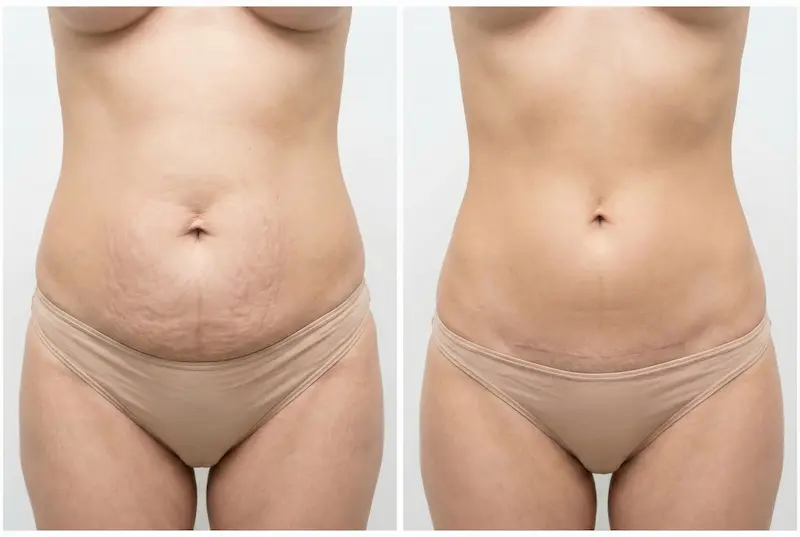
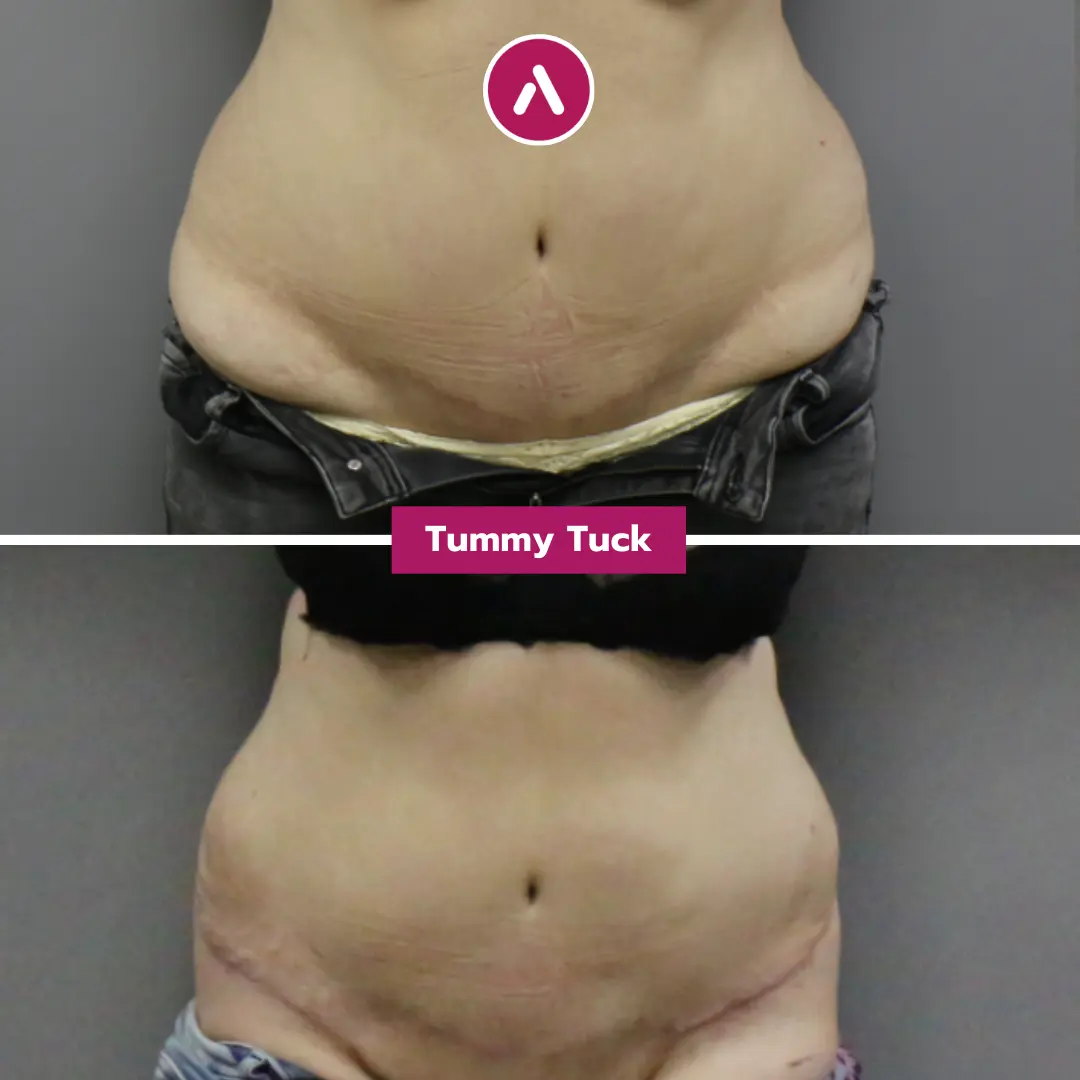
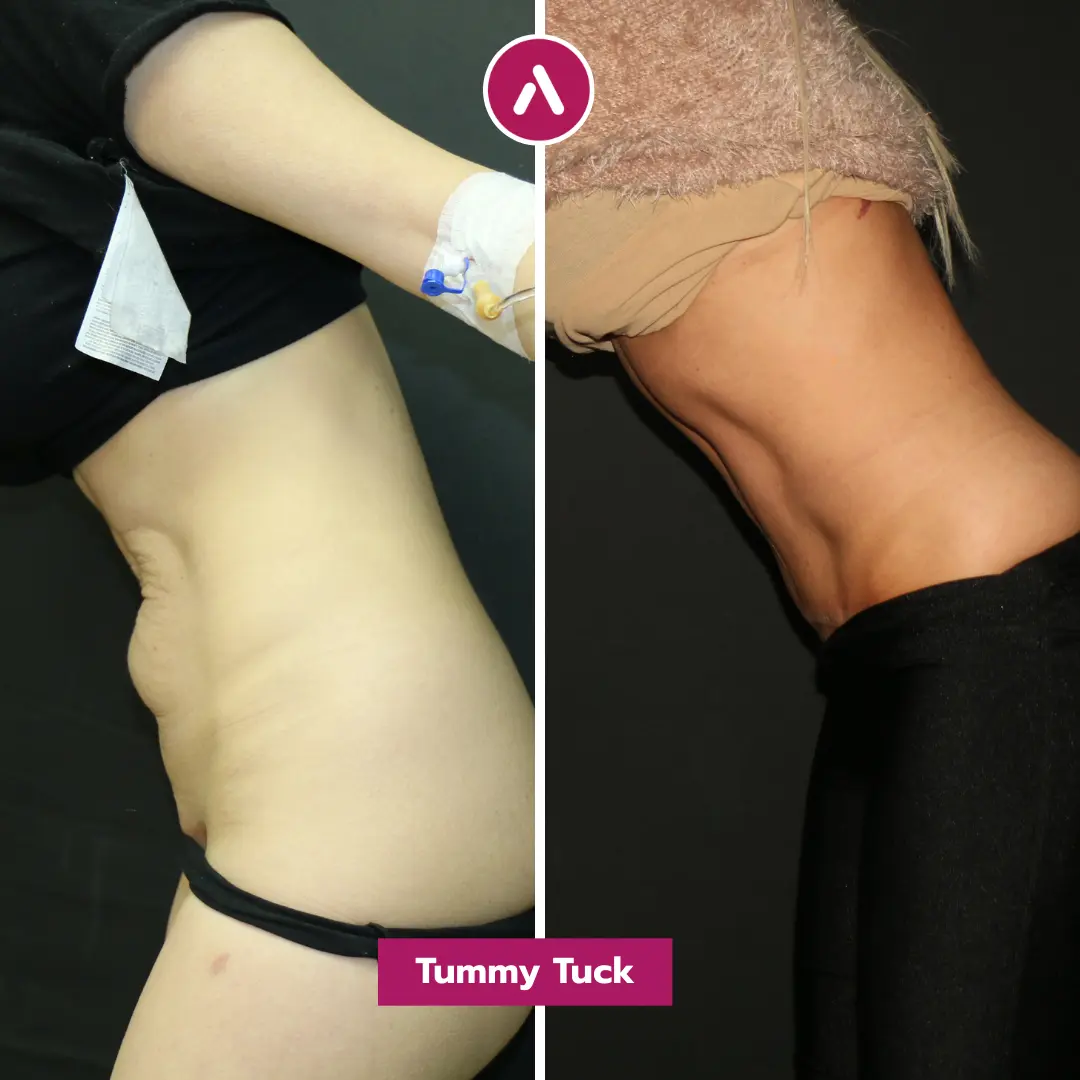
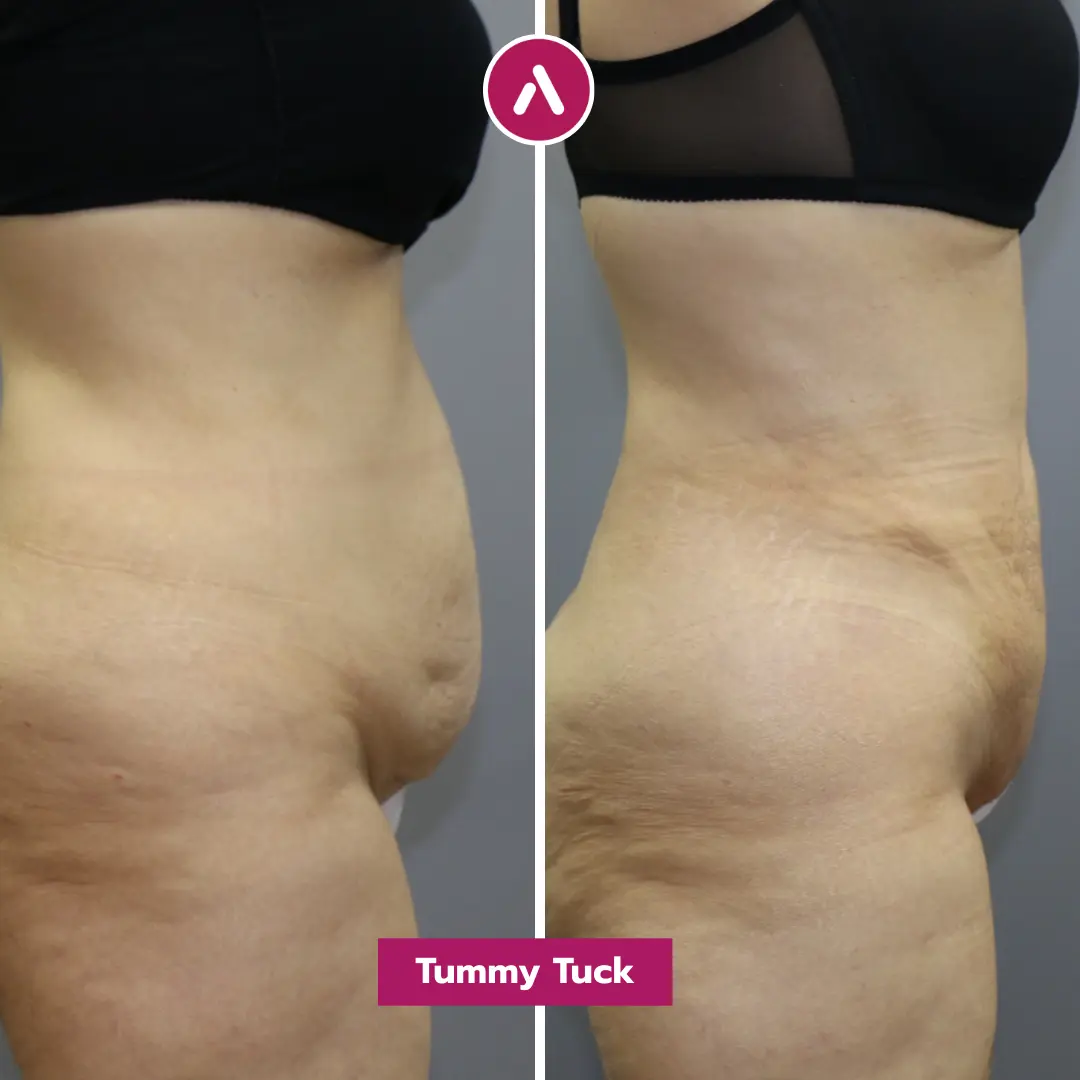
Tummy Tuck Before and After: Realistic expectations & results
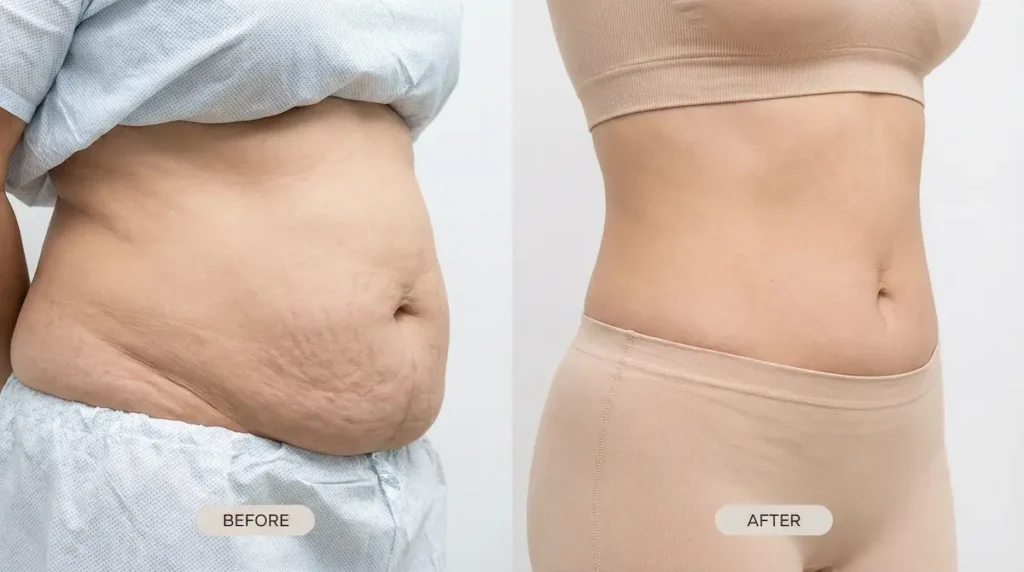
A tummy tuck can be transformative for the right candidate. It can also disappoint if expectations are built on edited photos or vague promises. We keep expectations grounded: your anatomy, your scar pattern, and your recovery capacity drive the outcome.
Our philosophy is simple: refinement over exaggeration. Rejuvenation, not alteration.
Natural result philosophy: shaping, not “over-tightening”
The best outcome is not the tightest outcome. It is the most believable one. We aim for a smooth lower abdomen, a waistline that fits your frame, and a scar position that makes sense for your lifestyle.
- Proportion first: we shape the abdomen with the waist and flanks in mind.
- Tension discipline: less tension usually means better healing and better scar quality.
- Honesty: if your goal requires staging or weight stabilisation, we say so.
Weight changes, future pregnancy, and long-term maintenance
Abdominoplasty is not fragile, but it is not immune to big body changes. Significant weight gain can stretch the skin again. Pregnancy can reintroduce abdominal wall laxity, even after an excellent repair.
- Best timing: stable weight, stable lifestyle, and (ideally) completed pregnancies.
- Long-term stability: gentle strength work after clearance and consistent nutrition help protect results.
- Real-world truth: your result will keep improving as swelling reduces, often over many months.
Typical result milestones (and what “final” really means)
Patients often judge results too early. At a few weeks, swelling can make the abdomen look firm or uneven. Tightness can make you feel “pulled”. It settles. Gradually.
- Early weeks: swelling and tightness dominate the experience.
- Weeks 6–12: contour becomes clearer as swelling reduces and movement normalises.
- Months 3–12+: scar maturation and subtle refinement continue.
Cost Analysis: Tummy Tuck Cost in 2026 (Turkey vs UK)
If you are comparing the UK and Turkey, the most useful question is not “What is the cheapest tummy tuck?” It is: What is included, who is performing the surgery, what systems reduce risk, and what aftercare is built into the price?
Because abdominoplasty is highly individual, a reliable quote comes after a medical review (photos, history, and a surgeon-led plan). Still, you can compare value fairly by understanding the main cost drivers and the typical differences between private UK pathways and premium Istanbul all-inclusive pathways.
What drives the fee in a Tummy Tuck (Abdominoplasty)?
- Type of tummy tuck: mini vs full vs extended vs fleur de lis vs circumferential approaches.
- Muscle repair: adding rectus plication changes complexity and recovery planning.
- Combined contouring: 360 liposuction or multi-area contouring increases operative scope.
- Operating time and theatre resources: longer, more complex plans require more intensive support.
- Hospital standards and monitoring: quality systems cost more, but they also reduce risk.
- Aftercare intensity: structured follow-up, wound management, and recovery support.
UK benchmark logic vs Istanbul value (premium framing)
In the UK, patients commonly benchmark private providers and hospitals (for example, large private hospital groups) and compare surgeon access, theatre time, hospital stay, and the predictability of aftercare. In Istanbul, premium providers often deliver value through an integrated pathway: surgeon-led planning + hospital-based surgery + coordinated accommodation and transfers + structured follow-up.
For an Expert Patient, value is also about speed of access (scheduling), continuity of care, and recovery optimisation. This is why many UK patients choose a premium Turkey pathway not for “low cost”, but for high-value care with a more complete service model.
| Cost element | Private UK pathway (typical structure) | Istanbul premium all-inclusive pathway (typical structure) |
|---|---|---|
| Surgeon & anaesthetist fees | Itemised or included; varies by provider and surgeon seniority | Usually bundled into a single surgical fee within the package |
| Hospital/theatre costs | May be itemised (theatre time, bed nights, consumables) | Typically included as part of the package (with defined length of stay) |
| Pre-op tests | Often arranged locally; may be separate depending on pathway | Usually included and coordinated on arrival (within safe timelines) |
| Compression garment | May be included or charged separately | Commonly included with fitting guidance |
| Medications | Often prescribed separately via pharmacy | Typically included for immediate post-op needs (as appropriate) |
| Aftercare & follow-up | Follow-up visits usually included; long-term may vary | Structured follow-up model including remote reviews after you return to the UK |
| Travel, hotel, transfers | Not relevant (domestic) | Often included: VIP transfers + selected accommodation options |
| Recovery optimisation (HBOT/LLLT) | Not routinely integrated into standard pathways | Typically included as part of the package |
All-inclusive packages: what should be included (and what should be transparent)
“All-inclusive” should never mean “unclear”. A premium package should make it obvious what is included and what might be extra.
- Included (commonly): surgeon + anaesthetist, hospital/theatre, pre-op tests, compression garment, coordinated transfers, planned in-person checks before departure, and structured remote follow-up.
- Ask specifically about: extra bed nights if needed, revision policy, what happens if you need additional wound support, and whether advanced recovery support is included or optional.
If the quote is not transparent, it is not premium. Expert Patients deserve clarity: what is included, who does what, and what support exists if recovery is not perfectly linear.— Our Surgical Team
Finding the Best Tummy Tuck Surgeon
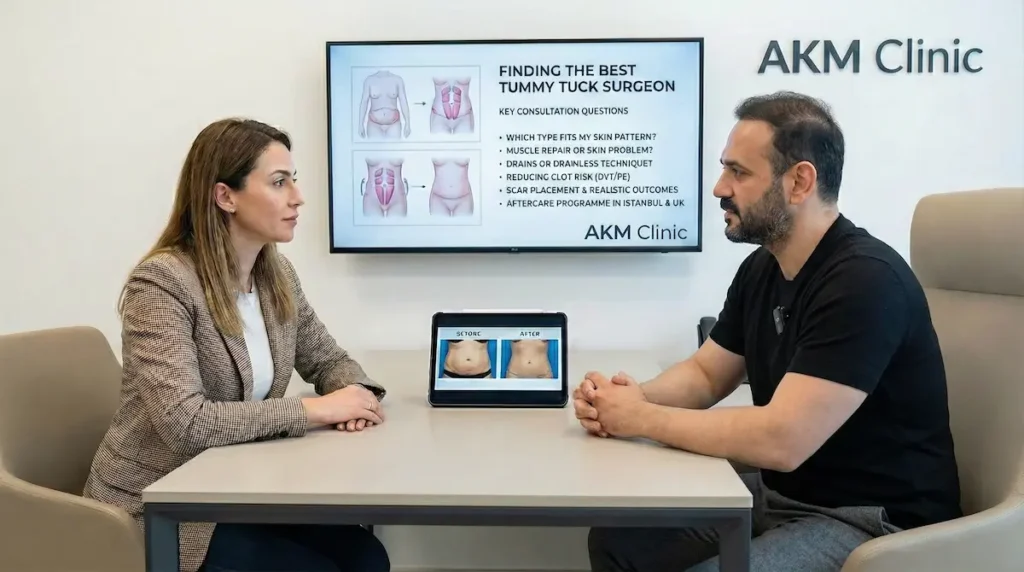
When patients ask “Who is the best tummy tuck surgeon?” the real question is: Who is best for my anatomy and my risk profile? Use your consultation to test clinical thinking, not marketing.
Questions to ask in your consultation
- Which tummy tuck type fits my skin pattern, and why?
- Do I need muscle repair, or is this primarily a skin and contour problem?
- Will you recommend drains or a drainless technique for my profile?
- How do you reduce clot risk (DVT/PE) for international patients?
- Where will my scar sit, and what are realistic scar outcomes for my skin type?
- What is the aftercare plan in Istanbul and after I return to the UK?
How to evaluate results (photo standards and honesty)
- Ask for consistent angles, consistent lighting, and full-length views (front/side/oblique).
- Look for scar placement that makes sense and a contour that looks proportionate.
- Be cautious of heavily edited imagery or “only best-case” galleries.
Your Medical Journey: What to Expect for Tummy Tuck (Abdominoplasty)
When you travel for surgery, the medical plan and the logistics plan are inseparable. You should not be working out transfers, hotel details, and follow-up timings while you are preparing for an operation. We organise your journey as a single pathway, so you can focus on recovery. It is structured, calm, and transparent. No drama.
Below is what a typical UK patient journey looks like. Exact timings vary by procedure type (mini vs full vs extended) and whether you combine surgery. Your plan is always confirmed after a surgeon-led medical review.
1) Before you travel: virtual consultation and surgical planning
Your journey starts at home with a video consultation. This is where we align your goals with what your anatomy can realistically deliver. We also flag risks early, especially clot risk factors and anything that may affect wound healing.
- Photo review: you share clear, unfiltered photos (front/side/oblique) so we can assess skin pattern and contour needs.
- Medical history: we review smoking/nicotine exposure, medications, previous surgery, and any relevant conditions.
- Plan outline: we explain the likely tummy tuck type, whether muscle repair is indicated, and what recovery will require.
- Quote clarity: you receive a personalised plan and a transparent quote based on the proposed scope.
If you have recent blood tests or a GP summary, it helps. It also helps you feel certain. Expert Patients like certainty.
2) Securing your date: VIP planning, hotel, and transfers
Once you decide to proceed, your dedicated Patient Host coordinates the logistics. You book your flights. We organise the rest. Simple.
- Procedure date: we secure your operating date and map your appointment schedule around it.
- Accommodation: we book your 5-star hotel from a curated partner list, close to where you need to be.
- Transfers: we schedule all VIP transfers (airport, hotel, clinic/hospital).
- Communication: you have direct, responsive support for questions as they come up.
3) Arrival in Istanbul: airport welcome and settling in
Arrival day should feel easy. No navigation stress. No guesswork. We meet you at the airport and transfer you to your hotel so you can rest.
- Airport welcome: a private driver greets you at arrivals.
- Private transfer: you travel in a comfortable vehicle to your hotel.
- Rest first: we keep arrival day light where possible, so you are not rushing straight into medical steps.
4) In-person consultation & pre-operative tests: the final medical “green light”
Before any surgery, we confirm the plan in person. We check your body in real time, not only on photos. This is where we finalise markings, incision strategy, and the safest anaesthesia plan.
- Surgeon-led review: you meet your surgeon to confirm technique, scar placement goals, and whether muscle repair is needed.
- Pre-op tests: we complete the required tests to confirm you are fit for surgery.
- Clear expectations: we repeat the non-negotiables: garments, mobilisation, and the early recovery rules.
5) Surgery day: theatre, monitoring, and the first hours after
Abdominoplasty is not a “quick in-and-out” procedure. We treat it with the seriousness it deserves. Your safety is built around screening, sterile theatre discipline, and continuous monitoring.
- Anaesthesia: chosen to match your surgery scope and medical profile (comfort matters, but safety leads).
- Monitoring: we monitor you closely throughout the operation.
- Immediate aftercare: once you are stable, we focus on comfort, hydration, and gentle early movement.
6) Recovery in Istanbul: daily support, aftercare, and optional recovery optimisation
Your early recovery is managed step-by-step. Your Patient Host remains available 24/7 via WhatsApp while you are in Istanbul, and our medical team guides the clinical parts of aftercare. If HBOT and LLLT are recommended for your profile, we integrate them into an organised plan. No improvisation.
- Compression garment guidance: how to wear it, when to adjust it, and what “normal swelling” looks like.
- Mobility plan: short, frequent walks and posture guidance to support circulation and comfort.
- Wound care: clear instructions and checkpoints to reduce anxiety and prevent small issues becoming big ones.
- HBOT + LLLT (when appropriate): used to support healing, swelling reduction, and scar-quality goals within our Rapid Recovery & Safety Protocol.
7) Departure: final check-up and being cleared to fly
Before you leave, you have a final in-person check-up. We confirm your recovery is progressing appropriately and that you are fit to travel. You also leave with written guidance on what is normal, what is not, and how to reach us quickly.
- Final assessment: wound status, swelling pattern, mobility, and general wellbeing.
- Travel advice: movement intervals, hydration, and practical comfort steps for the flight.
- Clarity: red flags are explained plainly, including when to seek urgent care in the UK.
8) After you return to the UK: structured long-term follow-up
We do not disappear once you are home. We schedule regular virtual follow-ups at 1, 3, 6, and 12 months to monitor healing and long-term satisfaction. If something worries you between those points, you contact us. Early reassurance is part of good aftercare.
- Scheduled reviews: planned touchpoints to track scar maturation, swelling resolution, and contour refinement.
- Responsive support: questions are handled promptly, not “when someone is available”.
- Continuity: your journey remains surgeon-led, not handed off to generic messaging.
Tummy Tuck (Abdominoplasty) Frequently Asked Questions (FAQ):
Will a tummy tuck remove stretch marks?
It can remove some stretch marks if they sit on the skin that is excised (usually below the belly button). Stretch marks above the navel typically remain, though the skin may look smoother after tightening.
How long will I be swollen?
Swelling is expected and often comes in waves. Most patients see meaningful improvement by 6–12 weeks, with subtle refinement continuing for months.
When can I return to work?
It depends on your surgery type and whether muscle repair was performed. Desk-based work may be possible earlier than physically demanding work. Plan conservatively and prioritise a smooth recovery.
Is revision ever needed?
Most patients do not need revision, but no surgery has a zero revision rate. Revision decisions depend on healing, scar behaviour, and whether the final contour matches the original plan.
How do I know whether I need a mini tummy tuck or a full tummy tuck?
The simplest guide is where the excess skin sits and whether the abdominal wall needs support. A mini tummy tuck focuses mainly below the belly button and suits limited lower-belly looseness. A full tummy tuck (traditional abdominoplasty) is typically considered when skin excess is more significant and/or when muscle repair (diastasis recti) is needed. Your final plan should be confirmed in person after markings and a surgeon-led assessment.
Will I have a belly button scar or a “belly button change”?
In a full tummy tuck, the skin envelope is repositioned, which usually means the belly button is carefully brought through the tightened skin. This can create a scar around the navel. A well-planned tummy tuck aims for a natural-looking belly button shape and a discreet scar. In a mini tummy tuck, the belly button may not need to be repositioned, depending on the exact technique and your anatomy.
What does “drainless abdominoplasty” actually mean, and is it always better?
“Drainless” usually refers to using internal suturing techniques (often described as quilting/progressive tension sutures) to reduce dead space and lower the chance of fluid collection (seroma). It can improve comfort and simplify early aftercare for selected patients. It is not automatically better for everyone—some anatomies and combined plans may still benefit from drains. The decision should be personalised based on tissue quality, surgical scope, and risk profile.
How long will I need to wear a compression garment?
Compression garment use is part of swelling control and contour stability. The exact duration varies depending on the tummy tuck type and whether liposuction was included. Most patients wear it consistently in the early weeks, then transition based on swelling and surgeon guidance. The key is consistent, correct wear rather than over-tightening or “guessing” the schedule.
When can I stand fully upright again?
Many patients walk slightly bent in the first days to protect the closure and reduce tension. You typically straighten gradually over the first 1–2 weeks, depending on how much skin was removed and whether muscle repair was performed. The goal is a smooth progression—not forcing upright posture too early and not staying hunched longer than needed.
Can I combine a tummy tuck with 360 liposuction safely?
It can be safe when the plan is designed with strict limits: controlled operative time, protected blood supply, and a realistic recovery strategy. Combining can create a more harmonious waistline when you want improvement from multiple angles. However, combining is not wise for everyone—higher clot risk, wound-healing risk factors (including nicotine exposure), or a very extensive combined scope can make staging the safer choice.
What is the biggest mistake patients make during recovery?
The most common mistake is trying to “test” the incision early—doing too much too soon, skipping garment discipline, or ignoring swelling patterns. Recovery is usually smoother when you follow a simple system consistently: gentle mobilisation, hydration, nutrition, proper garment use, and prompt communication if something feels off.
How do HBOT and LLLT fit into recovery, and do I need them?
HBOT (Hyperbaric Oxygen Therapy) and LLLT (Low-Level Laser Therapy) are supportive tools that can be integrated into an organised aftercare plan for selected patients. They are not “magic fixes” and they are not required for everyone. When recommended, the intent is to support tissue recovery, swelling management, and scar-quality goals while keeping the plan structured and safety-led.
What should I do if I notice redness, swelling, or fluid after I return to the UK?
First, do not ignore changes that feel different from your expected recovery pattern. Contact us promptly for guidance. If you develop urgent symptoms—such as chest pain, shortness of breath, coughing blood, sudden collapse, or severe dizziness—seek immediate medical help in the UK (A&E / call 999). For a hot, painful calf or rapid one-sided leg swelling, urgent assessment is important.
How long does it take to see the “final” result?
Most patients see a clear improvement early, but the appearance continues to refine as swelling reduces and tissues soften. Contour typically becomes more reliable around 6–12 weeks, while subtle refinement and scar maturation often continue for months—commonly up to 12 months and beyond. Judging the result too early is one of the most common reasons patients feel unnecessarily worried.
Medical disclaimer: This page is for general information and does not replace a medical consultation. Surgical suitability, technique selection, recovery timelines, and risks vary between individuals. A personalised plan should always be confirmed by a qualified surgeon after a full medical assessment.