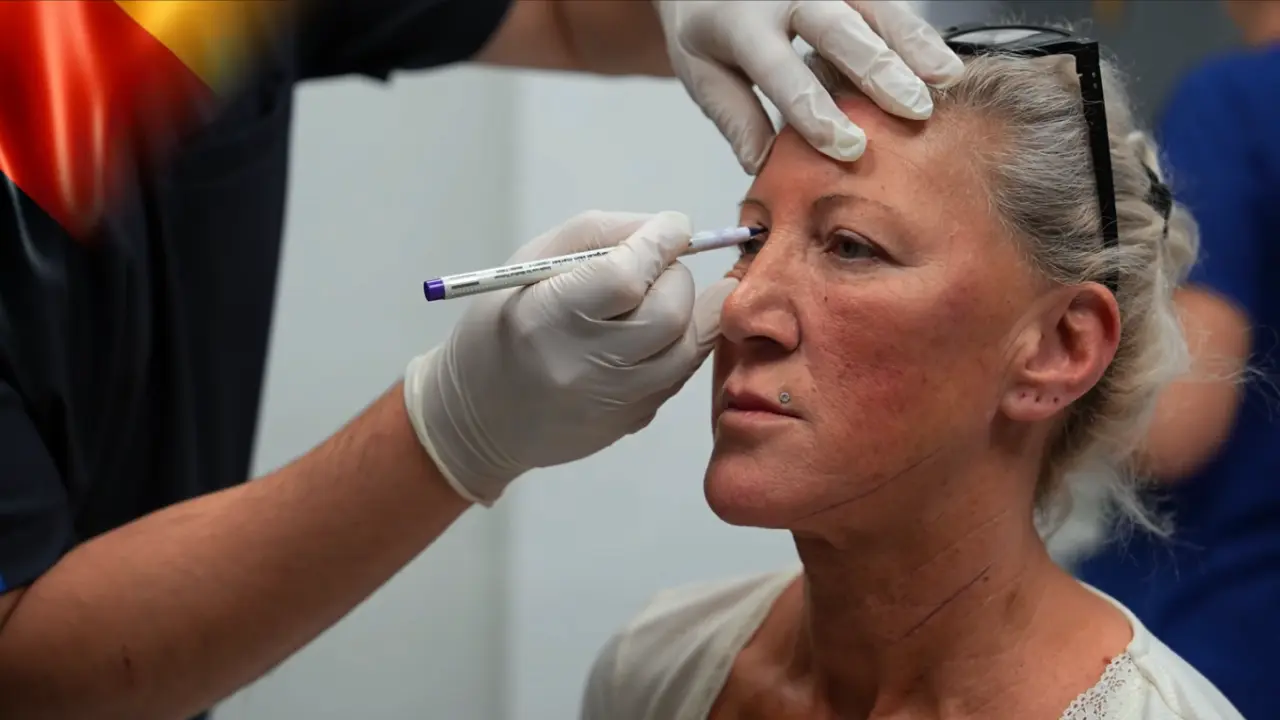





Considering a Lip Lift in Turkey? This guide is written for UK patients who want a natural-looking result and a safety-led experience. A lip lift shortens the philtrum, refines upper-lip definition and can reduce reliance on filler—without chasing an overdone look, with balanced proportions and aftercare.
We explain techniques such as bullhorn, Italian and central lip lift, plus scarring, recovery timelines and anaesthesia options, including awake or twilight sedation where appropriate. You’ll also learn how HBOT and LLLT may support our Rapid Recovery & Safety Protocol, and what to look for when choosing a surgeon and planning travel to Istanbul.
Table of Contents
What Is A Lip Lift?
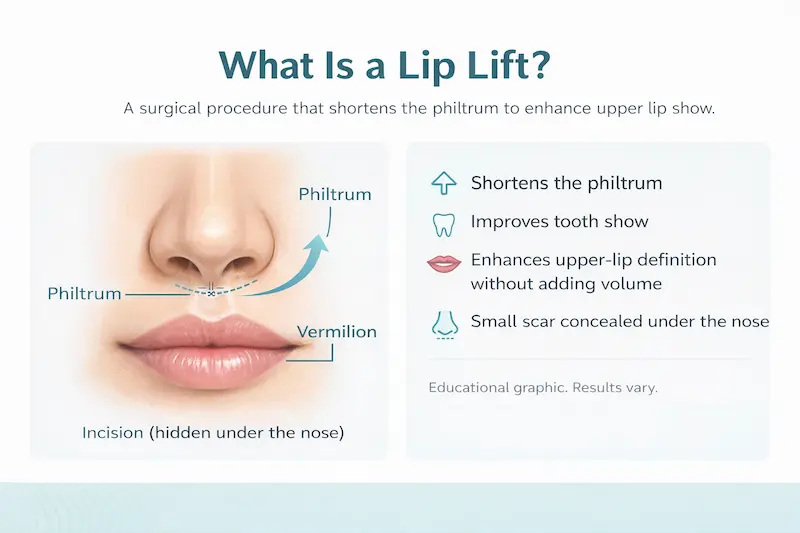
A Lip Lift is a small, targeted facial procedure that shortens the space between the base of the nose and the upper lip (the philtrum). By reducing that distance, the upper lip can appear more defined, with a slightly increased “pink” show (vermillion). The goal is proportion and balance, not an exaggerated change.
For many UK patients researching lip lift surgery, the key question is simple: will it look natural in real life, not just in photos. Our approach is built around that mindset. We plan conservatively, prioritising harmony with your nose, teeth show, and overall facial proportions.
What does a lip lift change anatomically?
A lip lift focuses on the relationship between three things: your philtrum length, your upper lip height, and how much of your upper teeth show at rest and when you smile. Small changes here can shift the “resting expression” of the lower face. Done correctly, it can look like you’ve simply become more refreshed.
- Philtrum length: a shorter philtrum often reads as more youthful.
- Vermillion show: the visible pink portion of the upper lip can look more prominent.
- Tooth show: a subtle increase can soften a “long upper lip” appearance.
Lip lift vs filler: what’s the real difference?
Filler adds volume. A lip lift changes position and proportion. That matters if your concern is a long philtrum, or if filler has started to look heavy around the mouth.
- Filler can improve volume and shape, but it does not shorten the philtrum.
- Lip lift can improve upper lip definition without relying on added volume.
- Some patients use both, but we decide this based on your anatomy and your tolerance for downtime.
How long does a lip lift last?
A lip lift is generally considered a long-lasting structural change because it repositions the upper lip rather than temporarily filling it. Ageing continues, of course. Skin quality, lifestyle factors, and individual healing all influence how the result settles over time.
- The early result can look “tighter” before tissues relax.
- Final refinement is gradual as the scar matures.
- We focus on a plan that still looks appropriate years later.
Surgeon’s insight:
Our guiding principle is “Rejuvenation, Not Alteration.” With lip lift planning, the best result is often the one people can’t quite pinpoint—just a more balanced, rested look.
Benefits of Lip Lift Surgery
A well-planned lip lift can create a subtle shift in facial balance. It is not designed to make the lips “bigger” in the way filler can. Instead, it aims to restore proportions that may have changed with time or genetics.
This is why the procedure often appeals to the “expert patient” mindset in the UK. You are not looking for drama. You are looking for a credible, anatomical solution with a natural finish.
Subtle facial rejuvenation without overfilling
One of the most common motivations is wanting a more youthful upper-lip area without repeatedly increasing filler volume. That “overfilled” look tends to show most around the mouth. A lip lift can reduce reliance on volume and improve definition more structurally.
- More upper-lip definition in profile and in motion.
- A softer transition from nose to lip.
- Better balance with the mid-face and lower face.
Improved tooth show and “resting expression”
As the philtrum lengthens with time, the upper teeth may show less at rest. That can make the face look more closed-off or tired. Carefully improving tooth show can brighten the expression without changing your identity.
- More natural-looking upper teeth show (when appropriate for you).
- A less “long upper lip” appearance.
- A gentler, more open resting look.
A procedure that can complement other facial work
In some cases, a lip lift is most effective when considered as part of overall facial proportions. For example, changes to the nose can alter how the upper lip reads. We therefore assess harmony across the full face, not in isolation.
- It may pair logically with nasal refinement if proportions call for it.
- It can support an overall rejuvenation plan when the mid-face has aged.
- Technique choice later matters as much as the decision to do a lift at all.
If you already know your main concern (long philtrum, low tooth show, or filler fatigue), we can review your photos and outline the most conservative route to a natural result.
Am I a Suitable Candidate?
Choosing a lip lift starts with proportion, not trends. The best candidates are usually aiming to shorten a longer philtrum and refine the upper lip in a natural, balanced way. If your main goal is only more volume, filler may be more appropriate.
During assessment, we look at facial ratios, tooth show, lip shape, and skin quality. We also consider how your nose and upper lip work together in profile and in motion. This is why a personalised plan matters more than picking a technique from a list.
Who typically benefits most?
You may be a strong candidate if the space between your nose and upper lip feels long, or has lengthened over time. A lip lift can be particularly helpful if filler has started to feel “heavy” without solving the underlying proportion. Many patients describe wanting a more open, refreshed upper-lip area rather than a bigger lip.
- Longer philtrum (genetic or age-related) with reduced upper-lip definition.
- Low tooth show at rest, where subtle improvement would suit your face.
- Filler fatigue, where repeated volume no longer looks natural.
- Subtle rejuvenation goals rather than dramatic change.
When a lip lift may not be the right choice
Not everyone is suited to a lip lift, and that is a good thing to discuss early. The biggest “make-or-break” factor is whether you accept that a scar is part of any surgical lift, even when well placed. We also review healing factors that can affect scar quality and recovery.
- Unrealistic expectations (for example, wanting a completely scar-free surgical result).
- High risk for poor healing due to smoking or uncontrolled medical conditions.
- Very short philtrum already, where further shortening could look unnatural.
- Active infection or untreated skin issues around the nose and lip area.
If you are unsure, a photo-based pre-assessment can clarify whether a surgical lift, filler adjustment, or another option fits your anatomy. A responsible plan sometimes means recommending a different route. That is part of building a safe, credible outcome.
What we assess during your consultation
For UK patients considering treatment in Turkey, consultation should feel structured and transparent. We focus on measurable anatomy, plus your lifestyle and travel timeline. The goal is to select the most conservative route that still achieves your objective.
- Facial proportions: philtrum length, lip height, and balance with the nose and chin.
- Smile dynamics: tooth show at rest and when smiling, plus lip movement.
- Skin quality: thickness, elasticity, and how your skin typically heals.
- Scar priorities: your tolerance for a fine-line scar and your aftercare commitment.
- Travel plan: timing for flying, follow-up, and remote check-ins after returning to the UK.
Surgeon’s insight:
The “right” candidate is not defined by wanting a lip lift. It is defined by the anatomy that benefits from shortening the philtrum while still preserving a natural, unforced look.
Types & Surgical Techniques Explained
There are several recognised types of lip lift surgery, and each one targets a slightly different aesthetic problem. Technique choice is not about what is “best” universally. It is about what best matches your anatomy, scar tolerance, and the result you want to live with long term.
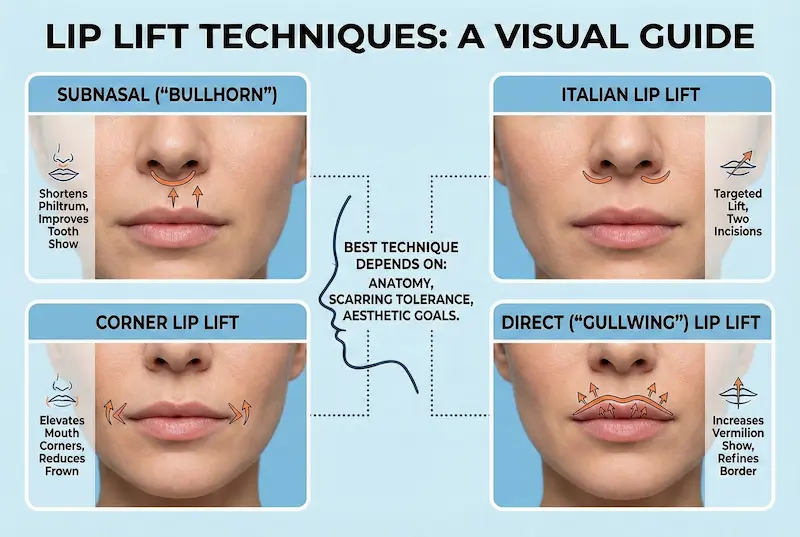
Below is a practical overview of common techniques, including bullhorn lip lift, Italian lip lift, central lip lift, and options like corner lip lift, direct lip lift, and V-to-Y lip lift. Your plan may involve one technique or a combination, depending on what needs refining. A careful, conservative approach usually produces the most believable result.
Bullhorn (Subnasal) Lip Lift
The bullhorn lip lift (also called a subnasal lip lift) is one of the most commonly discussed techniques. The incision sits under the nose along natural contours, which helps keep the scar discreet for many patients. It is designed to shorten the philtrum and increase upper-lip show in a controlled way.
- Targets: long philtrum, reduced upper-lip definition, low tooth show (when appropriate).
- Scar location: under the nose, shaped to follow the base of the nostrils.
- Key advantage: effective proportion change with a well-concealed incision line.
Italian Lip Lift
An Italian lip lift uses two smaller incisions placed beneath the nostrils rather than one continuous line. This can be useful when a patient’s anatomy or scar concerns favour a more limited incision pattern. It still aims to shorten the philtrum, but the approach differs in how the lift is distributed.
- Targets: selective philtrum shortening with a focus on the central upper-lip region.
- Scar location: two incisions under each nostril base.
- Consideration: the lift effect can feel more central, depending on planning.
Central Lip Lift
A central lip lift focuses the lift more directly on the centre of the upper lip. This may suit patients whose main concern is central definition (for example, a flatter cupid’s bow or limited central vermillion show). The aim is precision and balance rather than a broad change across the full upper lip.
- Targets: central upper-lip definition and proportion, especially around the cupid’s bow.
- Best for: patients where the centre needs refinement more than the corners.
- Planning note: subtle adjustments often look the most natural in motion.
Corner, Direct, and V-to-Y Lip Lift: when they are considered
A corner lip lift is designed to elevate downturned mouth corners, which can create a softer resting expression. A direct lip lift sits closer to the lip line and can increase visible lip height, but scar visibility is a key consideration. A V-to-Y lip lift is typically discussed in relation to internal lip advancement and may be considered in specific cases.
- Corner lip lift: focuses on mouth-corner position and resting expression.
- Direct lip lift: can increase lip show near the vermillion border, with higher scar trade-off.
- V-to-Y: selected case-by-case, often based on lip anatomy and movement goals.
| Technique | Ideal candidate | Incision placement | Key benefits | Limitations | Recovery note |
|---|---|---|---|---|---|
| Bullhorn (Subnasal) | Long philtrum; needs overall upper-lip lift | Under nose along the base | Strong proportion change; scar often well concealed | Requires precise planning to avoid over-shortening | Swelling settles gradually; scar matures over weeks |
| Italian | Prefers smaller incision pattern; central emphasis | Two incisions under nostrils | Targeted lift with limited incision segments | Effect distribution depends heavily on anatomy | Similar timeline; careful scar care is important |
| Central | Needs cupid’s bow / central definition refinement | Planned to emphasise centre (case-specific) | Precision for central aesthetics | Not ideal if corners are the primary concern | Subtle changes refine with tissue settling |
| Corner | Downturned corners; “sad” resting expression | At mouth corners | Improves corner position and expression | Scar location requires thoughtful counselling | Shorter procedure; scar care remains essential |
| Direct | Needs increased visible lip height near lip line | Near vermillion border | Can increase upper-lip show | Higher scar visibility trade-off | Scar awareness is key during maturation phase |
| V-to-Y | Selected cases based on lip anatomy and movement | Typically internal advancement (case-specific) | Can support shape goals in certain anatomies | Not a universal substitute for philtrum shortening | Healing depends on technique details and aftercare |
Surgeon’s insight:
Technique selection should follow anatomy. When we plan conservatively and prioritise scar placement, patients tend to feel the result “fits” their face rather than looking done.
If you’d like, we can review your photos and explain which lip lift surgery technique fits your proportions best. This is also where we align expectations on scar care, travel timing, and recovery planning for UK-based patients.
Lip Lift Scars
Every surgical lip lift involves an incision, which means there will be a scar. The real question is not “will there be a scar?”, but “how well can it be placed, closed, and cared for so it matures as discreetly as possible”. With careful planning and disciplined aftercare, most patients find the scar becomes far less noticeable over time.
For UK patients, scar anxiety is one of the most common concerns we hear. That is why we discuss scar placement, expected scar behaviour, and your scar-care plan before you commit to surgery. A transparent conversation reduces the risk of “lip lift regrets” later.
What does a lip lift scar typically look like?
The appearance of a lip lift scar depends on the technique used, your skin quality, and how you heal. Early scars can look pink or slightly raised. This does not mean something has “gone wrong”. Scar maturation takes time, and the early phase is rarely the final story.
- Early phase (weeks): pinkness, mild firmness, and visibility up close are common.
- Settling phase (1–3 months): the scar usually softens and blends gradually.
- Maturation phase (3–12 months): refinement continues as collagen remodelling progresses.
If your goal is a scar that is discreet in normal social distance, technique selection and closure quality matter as much as your aftercare.
How we plan to minimise scar visibility
Scar minimisation is a system, not a single trick. It starts with choosing the right technique for your anatomy, placing the incision where natural contours help camouflage it, and closing with tension control. Then the responsibility shifts to consistent aftercare and sensible lifestyle choices during healing.
- Incision design: planned to sit within natural curves and shadows where possible.
- Tension management: careful closure helps prevent widening and irregularity.
- Aftercare structure: simple, repeatable steps that support predictable healing.
We will also set realistic expectations: even an excellent scar may still be faintly visible in certain lighting, especially in the early months. The aim is refinement and subtlety, not perfection under a magnifying mirror.
Scar care essentials (what matters most)
Good scar care is usually boring. That is a good thing. Simple habits, done consistently, tend to outperform complicated routines that patients abandon after a week.
- Follow wound-care instructions precisely in the first 1–2 weeks.
- Sun protection is essential; UV exposure can darken healing scars.
- Don’t smoke; it reduces blood supply and increases healing risk.
- Use recommended topical care (often silicone-based scar care, where appropriate).
- Avoid picking or “testing” the area; friction delays maturation.
In selected cases, we may discuss supportive therapies such as LLLT (low-level laser therapy) as part of a structured recovery plan. This is positioned as a supportive option, not a guarantee, and it is always guided by your individual healing progress.
Surgeon’s insight:
Most scar disappointment comes from mismatched expectations, not from the scar itself. When patients understand normal healing stages and follow scar care consistently, the scar typically becomes less and less of a focus.
When to consider scar revision (and when not to)
Lip lift scar revision is not an early decision. Scar tissue can look “worse” before it looks better, especially in the first 6–12 weeks. A responsible approach is to allow adequate time for maturation unless there is a specific complication that needs earlier intervention.
- Too early: making decisions in the first few weeks while swelling and redness are still active.
- Reasonable timing: often considered after scar maturation has progressed (commonly months, not weeks).
- What revision can do: refine texture or width in selected cases, not erase all evidence.
If you are worried about a “botched lip lift” or “lip lift gone wrong”, the first step is a calm assessment. Many concerns are related to early swelling, stiffness, or normal scar evolution rather than true failure.
Anaesthesia: Why We Prefer Awake / Twilight Sedation
For many facial procedures, including lip lift surgery, we often favour a comfort-focused approach using local anaesthetic with awake or conscious (twilight) sedation in suitable patients. This aims to keep you comfortable and relaxed while maintaining a controlled, safety-led environment. It is not about being “brave”; it is about choosing an approach that fits the procedure, your health profile, and your recovery priorities.
UK patients frequently ask what this actually feels like. In straightforward terms: you are kept comfortable, closely monitored, and the procedure is performed with careful pain control. Your personalised plan is determined after medical assessment, not by preference alone.
What is twilight sedation (in plain English)?
Twilight sedation is a light-to-moderate sedation approach where you are relaxed and comfortable, and you may have limited memory of the procedure. It is used alongside local anaesthetic at the surgical site. The aim is to reduce anxiety and discomfort while allowing a smoother immediate post-operative experience for many patients.
- Comfort: patients are typically calm and drowsy rather than fully “asleep”.
- Pain control: local anaesthetic addresses the surgical area directly.
- Monitoring: your vital signs are monitored continuously for safety.
Why we use awake / twilight approaches when appropriate
In suitable cases, awake or twilight sedation can support a more efficient recovery experience. It may also reduce some of the downsides that can come with deeper anaesthesia for a short, focused procedure. That said, suitability matters. The safest choice is the one matched to your medical profile.
- Procedure fit: a lip lift is often a targeted operation with a defined treatment area.
- Recovery planning: many patients value a clearer, more stable early post-op period.
- UK travel considerations: a well-structured plan can support practical travel timelines.
When a different anaesthesia plan may be recommended
Not everyone is suited to awake or twilight sedation. Health history, anxiety level, airway considerations, and the scope of your overall surgical plan all matter. If you are combining procedures, or if your medical assessment indicates another approach would be safer, we will recommend that route.
- Medical factors: certain conditions may require a different anaesthesia strategy.
- Procedure scope: combined surgery may change what is most appropriate.
- Comfort and safety: we prioritise safety first, then comfort, not the other way around.
Surgeon’s insight:
Anaesthesia planning is part of surgical planning. The goal is a calm, controlled experience with predictable recovery, guided by your assessment rather than a one-size-fits-all preference.
Next, we’ll walk through what happens step-by-step in the operating theatre, including what to expect on the day and how follow-up is structured for UK-based patients travelling to Istanbul.
Step-By-Step: What Happens in the Operating Theatre?
Knowing what actually happens on the day of your lip lift surgery can make the experience feel far more manageable. The process is structured, calm, and designed around safety, comfort, and precision. For UK patients travelling to Istanbul, we also plan the timeline so you understand what happens before surgery, on the day itself, and during the first follow-up period.
Pre-op checks and planning
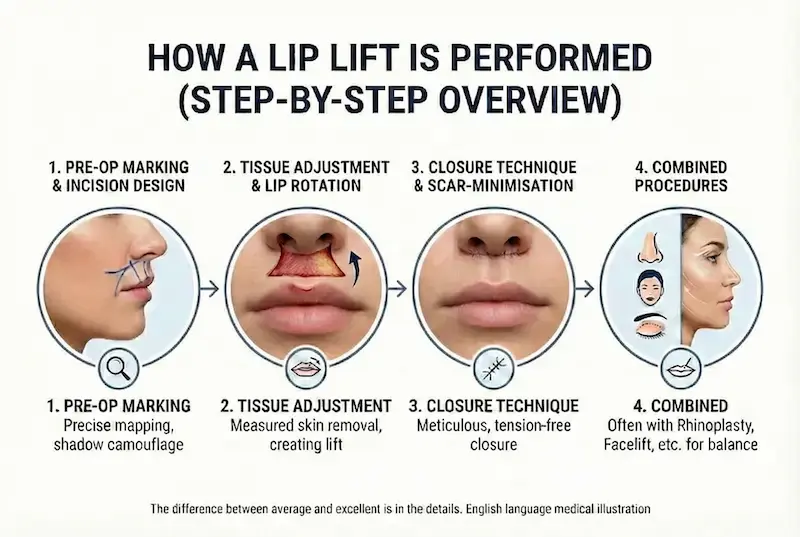
Before you enter the operating theatre, we confirm that your treatment plan still matches your anatomy and your goals. This is also where we re-check your medical information and answer last-minute questions. A well-run pre-op phase helps reduce anxiety and prevents misunderstandings.
- Medical review: health history, medications, allergies, and any recent changes.
- Photography: consistent angles to guide planning and post-op evaluation.
- Marking: precise measurements to avoid over-shortening the philtrum.
- Consent: a clear review of benefits, risks, and scar expectations.
What happens during the procedure
A lip lift is a focused operation, but details matter. The chosen technique guides incision placement and how the lift is distributed across the upper lip. The goal is a refined change that still looks natural in motion.
- Anaesthesia: commonly local anaesthetic with awake or twilight sedation in suitable patients.
- Incision: planned to sit in natural contours where possible (technique-dependent).
- Adjustment: measured tissue change to improve proportion without over-correction.
- Closure: tension-aware suturing to support scar quality.
- Protection: simple dressings and aftercare instructions before discharge.
Surgeon’s insight:
The best lip lift plans are measured, not aggressive. Small, precise adjustments tend to age better and look more believable in real life.
Immediately after surgery: what to expect
Right after the procedure, mild swelling and a “tight” sensation are common. You may also notice that the upper lip looks slightly higher than expected early on. This usually settles as tissues relax and swelling reduces.
- Early swelling: normal and expected; it can look uneven initially.
- Comfort: managed with a structured post-op plan and guidance.
- Activity: rest, gentle movement, and avoiding unnecessary strain.
- Follow-up: scheduled checks to monitor healing and wound care.
If you are travelling from the UK, we will explain your in-country follow-up plan and what remote check-ins look like once you return home.
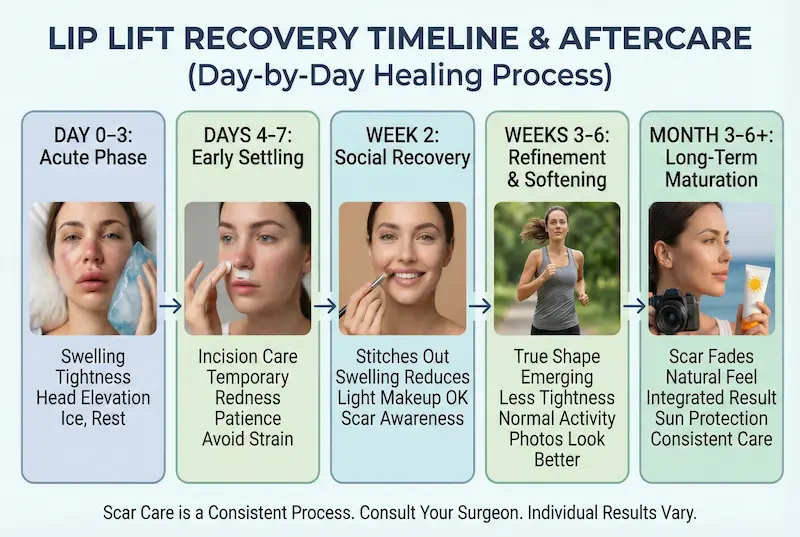
Lip Lift Recovery & Aftercare: How Long Does Healing Take?
Lip lift surgery recovery is usually straightforward, but it is not instant. Most concerns in the first week relate to swelling (oedema), tightness, and learning how to care for the incision properly. Your result refines over time as swelling reduces and the scar matures.
First 72 hours: swelling (oedema) and comfort basics
The first three days are about protecting the incision and keeping swelling controlled. It’s common to feel tightness under the nose and to see mild bruising. The key is consistency: follow the plan, don’t improvise, and avoid anything that increases tension around the upper lip.
- Oedema control: use recommended cold compress timing and head elevation guidance.
- Wound care: keep the area clean and follow instructions exactly.
- Movement: minimise excessive smiling, stretching, and strenuous activity.
- Nutrition: softer foods can help reduce lip strain in the first days.
Week 1–2: social downtime and scar care structure
Many patients feel more socially comfortable after the first week, though the scar can still look pink and “fresh”. This is where good scar habits begin to pay off. If you are flying back to the UK, we plan your timeline around safe follow-up and practical travel comfort.
- Appearance: swelling reduces, but the scar may still be visible up close.
- Aftercare: follow scar-care guidance (often including silicone-based options where appropriate).
- Activities: gradual return to normal routine; avoid heavy exercise until advised.
- Travel planning: structured check-ins and clear instructions for UK-based aftercare.
Weeks 4–12: refinement and scar maturation
This is when the result tends to look more “like you”, rather than like a recent procedure. The scar typically continues to blend, and upper-lip movement feels more natural. It’s also the phase where patience matters most—subtle improvements can continue for months.
- Refinement: tissues relax and the upper lip settles into a more natural position.
- Scar maturation: texture and colour often soften progressively.
- Photos: comparing month-to-month is usually more helpful than day-to-day.
HBOT + LLLT = Rapid Recovery & Safety Protocol
Where clinically appropriate, we may incorporate supportive recovery options to help optimise comfort and healing quality. One structured approach we use is:
- HBOT (hyperbaric oxygen therapy) as a supportive modality in selected cases.
- LLLT (low-level laser therapy) as a supportive modality for healing and scar care in selected cases.
HBOT + LLLT = Rapid Recovery & Safety Protocol is not presented as a guarantee or a substitute for good surgery and disciplined aftercare. It is positioned as an additional support layer, guided by your individual healing progress and suitability.
Safety & Risks: Is Lip Lift Dangerous?
A lip lift is generally a focused facial procedure, but “small” does not mean “risk-free”. Safety comes from three things: correct candidacy, an appropriate technique, and disciplined aftercare. When patients search for botched lip lift or lip lift surgery gone wrong, they are usually describing a mismatch between expectations, planning, and healing realities.
Our goal is to be clear and practical. We discuss what can happen, how likely it is in real-world terms, and what we do to reduce risk. If something concerns you, it should be addressed before surgery, not after.
Common risks (and what they actually mean)
Most risks are manageable when anticipated. The key is early recognition and a structured plan. Many “scares” online are driven by normal early healing that wasn’t explained properly.
- Swelling (oedema) and bruising: common in the first days and weeks; early asymmetry can be normal.
- Infection: uncommon with good protocols, but possible with any incision; requires early treatment if suspected.
- Wound healing issues: delayed healing or minor separation can occur, especially in smokers.
- Scar concerns: redness, thickness, or visibility can be more noticeable early on and usually improves with maturation.
- Sensation changes: temporary numbness or altered sensation may occur as tissues settle.
We explain which symptoms are expected and which require contacting your care team promptly. That clarity reduces anxiety and improves outcomes.
“Botched lip lift”: what usually causes it
“Botched” is a broad label. In practice, the most common issues patients describe are over-shortening, unnatural tension, a visible scar, or an outcome that doesn’t match the face. These problems are most often linked to planning errors, aggressive tissue removal, or poor candidate selection.
- Over-correction: too much shortening can look forced and may affect natural expression.
- Poor scar placement or closure: can lead to a more noticeable line under the nose.
- Technique mismatch: choosing the wrong approach for the anatomy (for example, when corners are the main issue).
- Aftercare non-adherence: stretching, smoking, or sun exposure can worsen scar quality.
If you are worried about “gone wrong” outcomes, ask specifically how the plan prevents over-shortening and how scar quality is managed from day one.
How we reduce risk in a safety-led plan
Risk reduction is not one decision; it is a sequence of correct decisions. We focus on conservative planning and a recovery structure that supports predictable healing. For UK patients travelling to Turkey, the plan also includes practical follow-up and communication after you return home.
- Conservative measurements: prioritising natural proportions over maximum lift.
- Technique selection: matching the method to your anatomy, scar tolerance, and goals.
- Anaesthesia planning: choosing awake/twilight approaches when appropriate, and adapting when not.
- Structured follow-up: scheduled check-ins, clear warning signs, and remote support for UK-based aftercare.
Surgeon’s insight:
Most poor outcomes are preventable. The safest lip lift is the one that is planned conservatively, executed precisely, and supported by disciplined aftercare and follow-up.
What to do if you suspect a complication
If something feels “off”, don’t wait for it to become a bigger problem. Early assessment is usually simpler than late correction. Many concerns can be resolved with reassurance and guidance, but true complications need prompt review.
- Contact your care team if you notice increasing redness, heat, discharge, or worsening pain.
- Don’t self-treat with random creams or antibiotics without guidance.
- Use photos for remote check-ins if you’re back in the UK.
Is Lip Lift Safe in Turkey for UK Patients?
For many UK patients, the core question is not whether Turkey offers lip lift surgery. It is whether the experience can meet UK-level expectations for safety, professionalism, and continuity of care. A safe medical journey depends on standards, transparency, and a follow-up plan that still works once you’re home.
We recommend thinking like an “expert patient”: evaluate the clinic, the surgical plan, the anaesthesia approach, and the aftercare pathway. Value is not the same as a low price. Value means high standards, clear communication, and predictable support.
Safety checklist: what UK patients should look for
If you are comparing lip lift surgery in the UK vs Turkey, use a practical checklist rather than marketing language. You should be able to get clear answers to each point.
- Consultation quality: measured planning, realistic outcomes, and a clear scar discussion.
- Anaesthesia protocol: what is used, who monitors you, and why it fits your case.
- Infection control: operating theatre standards and post-op wound care instructions.
- Aftercare structure: scheduled follow-ups in Istanbul and remote support after returning to the UK.
- Revision policy: how concerns are handled and what the pathway looks like if healing is atypical.
If any of these answers feel vague, that’s a signal to slow down and reassess your options.
Travel planning: flying, follow-up, and comfort
Travel is part of the medical plan. We organise your timeline so your early follow-up happens before you fly, and you return to the UK with a clear set of instructions. The goal is a calm recovery, not a rushed one.
- In-country checks: we schedule early reviews to assess the incision and swelling.
- Flight readiness: guidance on swelling management, comfort, and practical care while travelling.
- Remote follow-up: planned photo check-ins and clear escalation steps if you have concerns.
For patients who want extra recovery support where appropriate, structured options such as HBOT and LLLT may be considered as part of a wider healing and safety approach.
Continuity of care after you return to the UK
One of the biggest UK concerns about treatment abroad is: “What happens if I have questions once I’m home?” A reliable pathway includes scheduled check-ins, clear instructions, and a defined response plan if something changes.
- Planned check-ins: structured follow-up points rather than “message us anytime” with no system.
- Scar guidance: what is normal week-by-week, and what steps support the best scar maturity.
- Problem-solving: early evaluation if healing is not following the expected timeline.
Surgeon’s insight:
For UK patients, safety isn’t just the operation. It’s the full pathway: consultation, anaesthesia, aftercare, and a clear plan for support once you’re back home.
Combined Procedures
A lip lift can be performed as a standalone procedure, but it can also complement other facial treatments when proportions call for it. The key is choosing combinations that improve harmony rather than adding complexity “just because”. If combining procedures increases risk or muddles recovery, we will recommend a staged approach instead.
Lip lift + rhinoplasty (nose refinement)
The nose and upper lip are visually linked. If you are already planning rhinoplasty, it can be sensible to evaluate whether the upper-lip proportions also need subtle adjustment. This is not about doing more surgery, but about avoiding an imbalance after one area is refined.
- Why it can work: profile balance and the nasal base–philtrum relationship.
- Who may benefit: long philtrum with rhinoplasty goals, especially when subtle tooth show is reduced.
- Planning note: conservative measurements help keep results natural and avoid over-shortening.
Lip lift + facelift / endoscopic temporal lift
In some patients, the upper lip looks longer because surrounding facial structures have descended with age. When that is the case, combining or sequencing a facelift with an endoscopic temporal lift can improve overall coherence. The safest plan is the one that respects your recovery capacity and travel timeline.
- Why it can work: coordinated rejuvenation rather than isolated changes.
- Who may benefit: broader facial ageing patterns where the lip is not the only concern.
- Recovery planning: we align swelling and aftercare needs with your schedule for predictable healing.
Lip lift + mid face lift (selected cases)
A mid face lift can be considered when the mid-cheek area has descended and that descent changes how the upper lip reads at rest. In selected cases, pairing or sequencing procedures can restore balance between the mid-face and the mouth region without pushing the lip lift too far.
- Why it can work: improves mid-face support, helping the lip lift look proportionate.
- Who may benefit: patients with mid-face descent and a “tired” lower-mid face appearance.
- Planning note: technique choice should be anatomy-led; staging may be safer for some patients.
Lip lift + chin augmentation for profile harmony
Sometimes, the perception of lip balance is influenced by the chin as much as the upper lip. Where profile proportions indicate it, chin augmentation may be discussed to support overall harmony. This can help the final result feel more balanced rather than “lip-focused”.
- Why it can work: improves profile proportion and facial balance from nose to chin.
- Who may benefit: patients with a weaker chin profile who want a more harmonious lower face.
- Planning note: we prioritise subtle enhancement; not every lip lift patient needs chin augmentation.
When combining is sensible (and when it isn’t)
Combining procedures can reduce the number of trips and consolidate downtime. However, it should never compromise safety or predictability. If the combination would stretch your recovery or increase risk, we plan in stages.
- Sensible: when the procedures support the same aesthetic goal and recovery is realistic.
- Not sensible: when it increases anaesthesia time or complicates aftercare unnecessarily.
- Expert approach: the most “efficient” plan is the one with the best long-term outcome.
Surgeon’s insight:
Combining procedures should improve harmony, not create a “busy” result. If staging produces a safer, cleaner outcome, we stage.
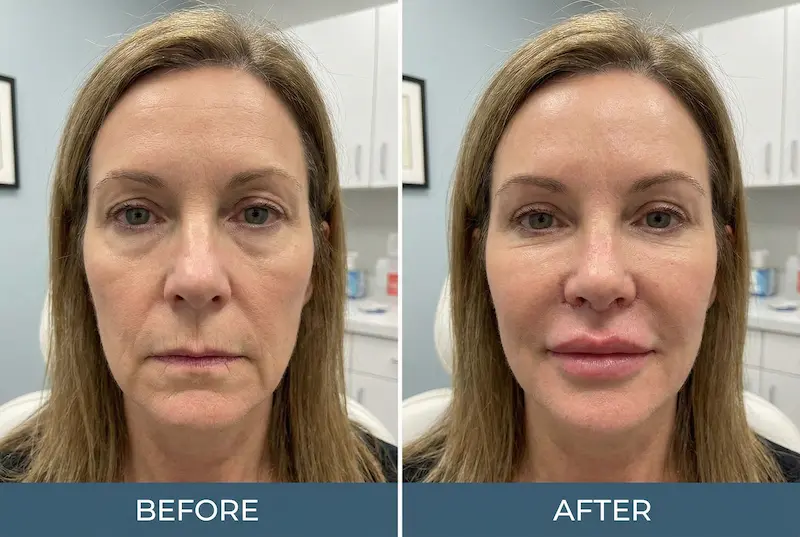
Realistic Expectations & Results: Lip Lift Before and After
The most satisfying lip lift results are typically subtle. You should look like yourself—just more balanced and refreshed. Managing expectations is a safety measure, because it reduces the risk of chasing overly aggressive changes.
Natural results: “rejuvenation, not alteration”
A lip lift is not meant to create an exaggerated, over-elevated upper lip. The best outcomes preserve natural movement and expression. We plan your result to suit your face in motion, not just a single “after photo”.
- Goal: proportion, definition, and a softer resting expression.
- Not the goal: maximal lift or a “done” look.
- What helps: conservative planning and the right technique choice.
Timeline: when you’ll see the “true” result
Early swelling can make the lift look stronger than intended. As tissues relax and oedema reduces, the result becomes more natural. Scar maturation continues for months, which is why patience is part of the process.
- First week: swelling and tightness are common.
- Weeks 2–6: social confidence improves as swelling settles.
- Months 3–12: scar refinement and subtle final settling continue.
How we evaluate results ethically and accurately
Lighting, angles, and facial expression can heavily influence “before and after” comparisons. We use consistent photography and evaluate results in motion, not just static images. The aim is honest assessment and realistic planning.
- Consistent photos: same angles, lighting, and distance.
- Motion matters: smiling and speaking should still look natural.
- Balanced evaluation: month-to-month comparisons are more meaningful than day-to-day.
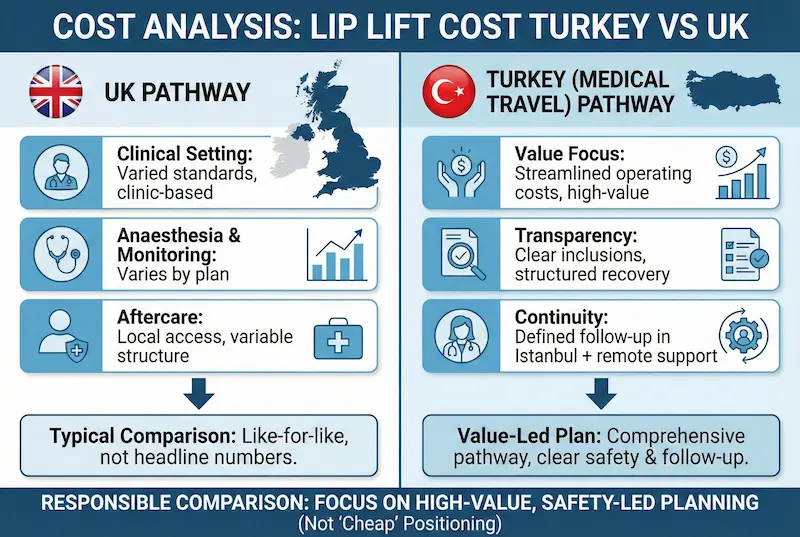
Cost Analysis: Lip Lift Cost 2026 Turkey vs UK
When UK patients search “lip lift surgery cost UK” or “lip lift surgery cost Turkey”, they are often trying to understand value, not just price. A responsible comparison looks at what is included, the safety pathway, and the aftercare structure. We avoid “cheap” positioning and focus on high-value, safety-led planning.
What affects lip lift cost in the UK?
UK pricing can vary significantly based on surgeon experience, clinic setting, anaesthesia approach, and the included follow-up. Location can influence pricing too, which is why searches like “lip lift London” or “lip lift Manchester” often return wide ranges. The best comparison is always like-for-like, not headline numbers.
- Clinical setting: theatre standards, monitoring, and staffing.
- Anaesthesia: type of anaesthesia and monitoring requirements.
- Aftercare: number of reviews, scar support, and access to care.
Why Turkey can be high-value (without lowering standards)
Turkey may offer a different value profile due to operating costs and streamlined medical travel pathways. The correct question is: “How do I access expert-level care with clear safety and follow-up?” That is what a value-led plan is designed to answer.
- Value focus: comprehensive pathway planning rather than a low headline price.
- Transparency: clear inclusions and a structured recovery timeline.
- Continuity: defined follow-up in Istanbul plus remote support for UK return.
What should be included in a fair comparison?
“All-inclusive” only matters if the inclusions are meaningful. You should know exactly what is covered, what is not, and how concerns are handled after you fly home. This is especially relevant if you searched “lip lift surgery near me” and are weighing local convenience against a structured medical journey abroad.
| Comparison area | Typical UK pathway | Typical Turkey (medical travel) pathway |
|---|---|---|
| Consultation | In-person clinic consult, often separate from procedure scheduling | Online pre-assessment + in-person confirmation before surgery |
| Anaesthesia & monitoring | Varies by clinic and anaesthesia plan | Planned around procedure scope; awake/twilight may be used when appropriate |
| Aftercare | Local access, but follow-up structure varies | In-country reviews + remote check-ins after return to the UK |
| Travel & logistics | Usually not applicable | Often structured timeline (transfer/appointments) depending on provider |
| Transparency | Depends on provider; sometimes itemised | Should be clearly defined to avoid hidden-cost anxiety |
If you want a personalised estimate framework, we can outline what is included in your plan after your photo assessment, procedure scope, and recovery preferences are confirmed.
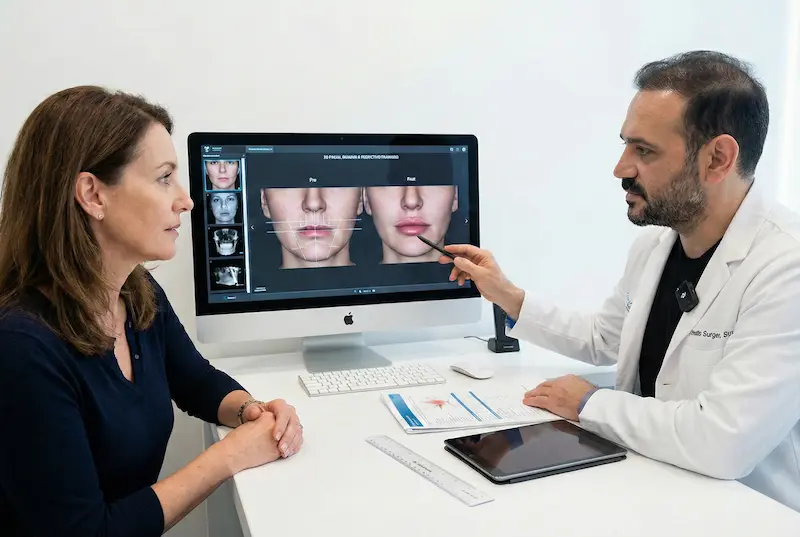
Finding the Best Lip Lift Surgeon
Choosing the right surgeon is one of the strongest predictors of a safe, satisfying outcome. A lip lift is subtle, but technically demanding because millimetres matter. If you are comparing options after searches like “best lip lift surgeon” or “expert lip lift surgery”, focus on planning quality and scar strategy, not hype.
What to look for (beyond marketing)
Look for a structured consultation, conservative planning, and clear discussion of scar trade-offs. You should feel that the surgeon is matching technique to anatomy, not selling a one-size-fits-all method. The best sign is precision and honesty.
- Measured planning: avoids over-shortening and forced-looking results.
- Technique range: the ability to explain why one method suits you better than another.
- Scar strategy: placement, closure, and a realistic scar-care pathway.
Questions to ask in a consultation
Good questions surface good planning. You are entitled to clear answers. If answers feel vague or defensive, consider that a signal.
- Which technique do you recommend for my anatomy, and why?
- How do you prevent over-shortening the philtrum?
- What does the scar-care plan look like week-by-week?
- How do you handle concerns once I return to the UK?
Red flags to avoid
Some signals suggest risk, especially for patients travelling for care. You should never feel pressured. A credible plan invites questions and explains trade-offs.
- Over-promising: “no scar” claims or guaranteed perfection.
- No plan: unclear aftercare, unclear follow-up, unclear anaesthesia explanation.
- One-technique-only messaging: when anatomy clearly varies between patients.
Your Medical Journey: UK → Istanbul
For UK patients, the journey is part of the treatment. A good pathway is organised, calm, and predictable. The goal is to make your experience feel medically structured, not like a rushed trip.
Online assessment and planning
Most planning can begin remotely. You share clear photos and your concerns, and we outline likely technique options and realistic outcomes. This helps you decide with confidence before you travel.
- Photo review: front, profile, smile, and relaxed expression.
- Goal alignment: what you want to change and what you want to preserve.
- Timeline planning: travel dates, follow-up windows, and flight comfort.
In Istanbul: appointment flow and comfort
On arrival, the process typically includes in-person confirmation, pre-op checks, and a clear day-of-surgery plan. We prioritise privacy and a smooth experience. You should always know what happens next.
- In-person review: confirm the plan and measurements.
- Procedure day: structured theatre workflow and post-op guidance.
- Local follow-up: early incision review before you fly.
Back in the UK: follow-up and support
After you return home, we continue follow-up with structured check-ins. You receive clear scar-care steps and escalation guidance. This continuity is essential for UK patients choosing treatment abroad.
- Remote check-ins: planned photo updates at defined intervals.
- Scar guidance: what is normal, and what needs attention.
- Problem-solving: fast assessment if healing deviates from expected timelines.
Lip Lift Frequently Asked Questions (FAQ):
Below are common questions UK patients ask when researching lip lift surgery. If your concern isn’t listed, we can address it during your virtual consultation. Clear answers are part of safe decision-making.
What is a lip lift and how is it different from filler?
Filler adds volume. A lip lift changes position and proportion by shortening the philtrum. If your main issue is a long upper lip, a lift addresses the cause rather than adding more volume.
How long does a lip lift last?
A lip lift is generally considered long-lasting because it repositions tissue rather than temporarily filling it. Ageing continues, but the structural change is designed to remain stable. Final refinement depends on healing and scar maturation.
Is a lip lift reversible?
A lip lift is a surgical change and should be viewed as permanent. Revision is sometimes possible in selected cases, but it is not a simple “undo”. This is why conservative planning and realistic expectations matter.
What is the healing time for lip lift surgery?
Early swelling settles over days and weeks, while scar maturation continues for months. Many patients feel socially comfortable within 1–2 weeks, but refinement continues beyond that. Your timeline depends on technique, skin quality, and aftercare.
How visible is a lip lift scar?
There will be a scar, and visibility varies by technique and healing. Early redness is common and typically improves. A structured scar-care plan and sun protection are key.
What if I’m worried about a botched lip lift?
Ask how your plan prevents over-shortening and how scar quality is managed. Many “gone wrong” concerns online are linked to aggressive planning or unrealistic expectations. A conservative, anatomy-led plan reduces risk significantly.
Is lip lift safe in Turkey for UK patients?
It can be, when standards, anaesthesia planning, and follow-up are structured and transparent. A safe pathway includes in-country reviews and remote check-ins once you return to the UK. You should always have a clear plan for questions and concerns.
Can I combine a lip lift with rhinoplasty or facelift?
Sometimes, yes—when the combination improves facial harmony and your recovery plan remains realistic. In other cases, staging is safer and more predictable. The best plan is the one with the best long-term outcome.
I searched “lip lift surgery near me” (or even “best lip lift surgery Kent”)—how do I decide?
Use a quality checklist: consultation depth, scar strategy, anaesthesia explanation, and aftercare continuity. Local convenience is valuable, but so is a structured safety pathway. Compare like-for-like and prioritise clarity over hype.
Medical Disclaimer: This information is provided for educational purposes only and does not replace a face-to-face medical consultation. Treatment suitability, technique choice, and recovery timelines vary by individual. A personalised plan should be confirmed after medical assessment.