



Fat Transfer To Face (also called facial fat grafting) is a surgical rejuvenation technique that uses your own purified fat to restore soft, natural-looking volume where the face has thinned or hollowed with time. Because the material is autologous (from your own body), it can feel more biologically “like you” than many synthetic options. The aim is not to change your identity, but to rebalance proportion, soften shadows, and improve facial harmony. Results vary from person to person, and a careful plan is essential for both safety and a refined outcome.
Table of Contents
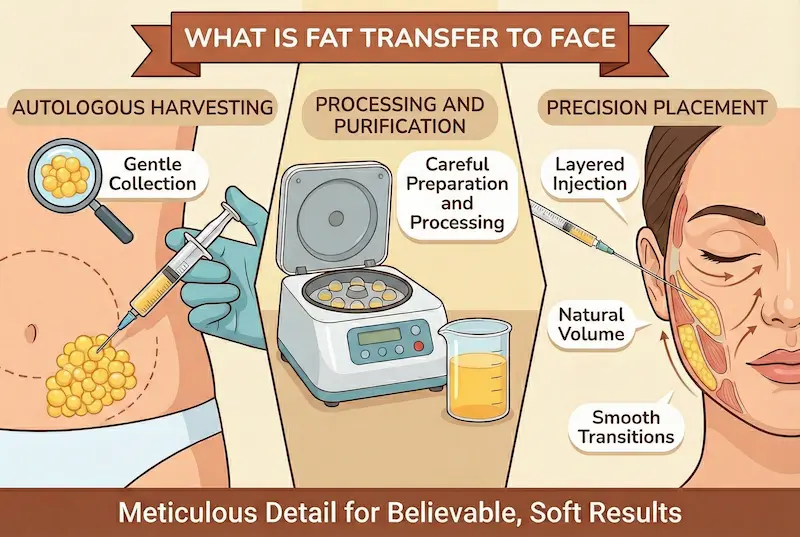
What is Fat Transfer To Face?
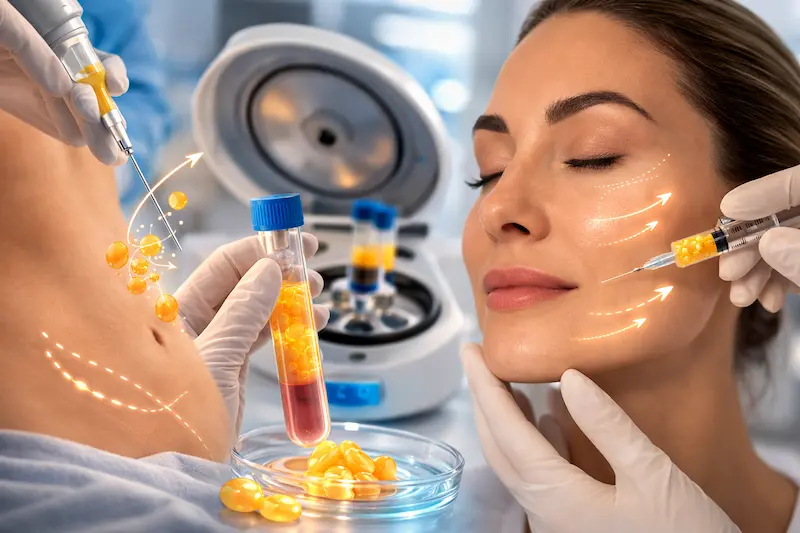
Fat transfer is a three-stage procedure: gentle fat harvest, careful preparation, and precise placement into selected facial planes. The quality of the result depends as much on technique as it does on anatomy, tissue characteristics, and the way your body heals. A tailored approach matters because different areas of the face behave differently—what works beautifully in the mid-face may be too heavy for more delicate zones. Our focus is to create smooth transitions rather than obvious “added volume”. Ultimately, this is a tissue-handling procedure, so meticulous detail is what keeps results natural.
Autologous fat transfer: why “your own tissue” matters
In autologous fat transfer, a small amount of fat is collected from a donor area (commonly the abdomen or flanks) using a gentle, controlled technique designed to protect the fat cells. The fat is then purified so that the portion best suited for transfer can be used for facial grafting. Because the graft is living tissue, it needs a good blood supply to “take” after placement—this is why the injection strategy is typically layered and incremental rather than a single large deposit.
Not all transferred fat survives; a proportion is naturally reabsorbed during healing. The goal is to plan for stability while keeping the face soft and believable, avoiding “overfilling” that can look heavy or distort expression.
Facial fat grafting vs dermal fillers: the practical differences
Both fat grafting and dermal fillers can restore volume, but they differ in material, process, and how outcomes are maintained. Fillers are pre-manufactured gels placed in targeted areas during a clinic appointment; fat transfer is a surgical procedure that involves harvesting, processing, and grafting. Fillers can be adjusted over time and (for certain products) may be dissolvable, while fat grafting relies on tissue integration and healing biology.
In practical terms, fat grafting may be attractive for patients seeking a more “tissue-based” approach and broader volumisation across multiple areas in a single plan. Fillers can be useful for highly specific corrections or as a lower-commitment step. The best choice is individual and depends on anatomy, goals, tolerance for downtime, and the degree of volume loss.
Common treatment areas: where fat transfer can make the biggest difference
Fat can be used to soften hollowing and restore gentle contour in areas such as the mid-face (cheeks), temples, and the transition between the lower lid and cheek. It may also be considered for selected under-eye concerns (tear trough), around the mouth, or the lower face where shadows and volume changes affect facial balance. Each zone has different tissue thickness and movement, so the plan must be area-specific.
During consultation, we assess facial structure, skin quality, symmetry, and how light falls across the face. The aim is to improve proportion and softness—not to create a “done” look that reads as artificial.
Benefits of Fat Transfer To Face (Beyond Volume)
The headline benefit of fat transfer is volume restoration, but expert planning is really about shape, transition, and balance. When done well, facial fat grafting can reduce harsh shadows that make the face look tired, while maintaining your natural expressions. Because the graft is your own tissue, many patients like the idea of a biologically compatible approach that avoids synthetic materials. However, it is still a medical procedure with variability—outcomes depend on technique, healing, and individual biology. A responsible plan focuses on natural proportions and long-term facial harmony.
A natural-first approach: “rejuvenation, not alteration”
Our guiding principle is subtlety: restoring what time has taken rather than creating unfamiliar features. The face should look well-rested and balanced, not inflated or “sculpted”. For many UK patients, that understated result is exactly the point—confidence without obvious change.
We plan for a well-rested face, not an “operated” look—small, precise changes can be more powerful than dramatic volume.
Soft transitions and facial harmony (not just “bigger cheeks”)
Ageing often shows up as flattening, hollowing, and sharper edges between facial zones. Thoughtful fat placement can help reintroduce smoother transitions between the lower eyelid and cheek, soften temple hollowing, and rebalance the mid-face without exaggeration. In some cases, patients also report a more “healthy” softness to the overall facial appearance—though individual response varies and no single outcome can be guaranteed.
One plan, multiple areas: cohesive volumisation
One advantage of fat grafting is the ability to address more than one region in a coordinated way. Rather than chasing isolated “problem spots”, we can design a cohesive strategy that respects your facial proportions and symmetry. When appropriate, fat transfer may also be combined with other procedures to support a broader rejuvenation plan—always with the aim of natural balance and a clear, realistic expectation of recovery.
Am I a Good Candidate for Fat Transfer To Face?
Suitability is not just about wanting more volume—it is about whether your anatomy, skin quality, and healing profile are a good match for fat graft survival and a natural finish. For UK patients who value long-term outcomes, we take a “plan-first” approach: defining what you want to improve, what should remain untouched, and what a realistic result looks like for your face. We also assess lifestyle factors that influence recovery and graft retention, including weight stability and nicotine exposure. The goal is always a refined, believable outcome with an appropriate safety margin.
Who tends to benefit most from facial fat grafting
Fat transfer is often well suited to patients experiencing age-related volume loss—flattening through the cheeks, hollowing at the temples, or deepening shadows that create a tired appearance. It can also be appropriate when facial proportions feel less balanced over time, particularly in the mid-face where small volume changes can have a large impact on how light falls across the face. Patients who prefer an autologous approach (using their own tissue) may also see fat grafting as a more biologically aligned option than synthetic volumisers.
In general, good candidates have stable weight, realistic expectations, and an understanding that healing biology affects how much of the transferred fat remains. If you are looking for an immediate “perfectly predictable” outcome with minimal downtime, we will discuss alternatives or staged planning.

When we may advise caution (or an alternative plan)
There are situations where fat transfer may not be the best first step. If your primary concern is significant skin laxity rather than volume loss, a lifting procedure (or a combined plan) may be more appropriate to address structure before adding volume. Patients with unstable weight may find results less consistent over time, because facial volume naturally fluctuates with overall body weight. We also take nicotine exposure seriously, as it can compromise healing and may reduce the likelihood of a stable graft “take”.
For very delicate zones—particularly the under-eye area—fat grafting can still be considered, but it requires careful technique, conservative planning, and an honest conversation about swelling and refinement. In some cases, a staged approach (or a different modality) may better match your priorities.
Our philosophy is to choose the method that fits your anatomy and lifestyle, not to force a single technique onto every face.
What we assess during consultation (and what you should bring)
We evaluate facial symmetry, proportion, and how volume loss presents in motion as well as in still images. We also look at skin quality, thickness, and the way your tissues respond to pressure—details that influence where fat can be placed safely and subtly. Your medical history and medication list matter, as do practical considerations such as work commitments and travel timing. If you have previous facial treatments (fillers, surgery, skin procedures), we factor those into the plan to reduce unpredictability.
For the most accurate assessment, we encourage clear, well-lit photographs (front and 45° angles), a brief list of your main concerns, and an honest note about your recovery “window”. This helps us advise on a plan that aligns with your schedule and your expectations—without overpromising.
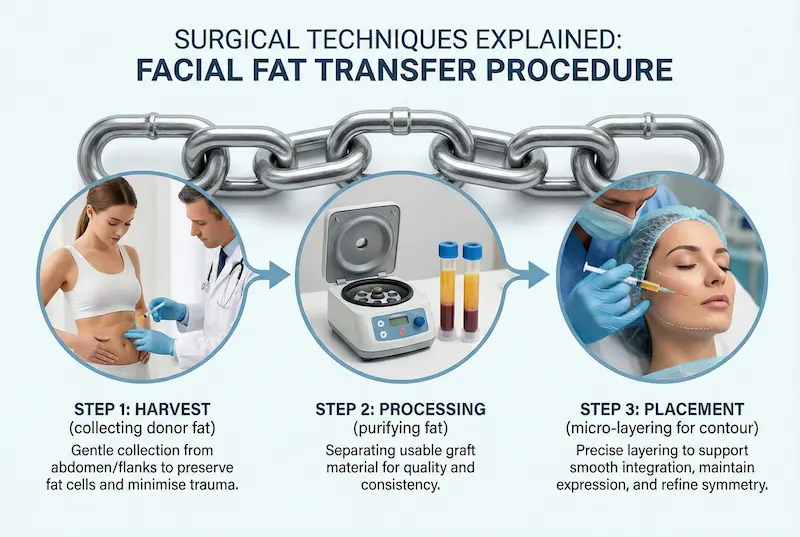
Surgical Techniques Explained: How Facial Fat Transfer Is Performed
Although “fat transfer” sounds simple, outcomes depend on how gently the tissue is handled at every step. The procedure can be thought of as a chain—harvest, preparation, and placement—and the weakest link tends to determine the final result. Our approach prioritises precision and tissue respect to support consistent healing and natural contour. We also plan injection volumes by facial zone, because different areas tolerate and retain grafted fat differently.
Step 1: Harvest (collecting the donor fat)
We collect a small amount of fat from a donor site such as the abdomen or flanks using a controlled, gentle technique. The aim is to preserve fat cell integrity rather than to remove large quantities. Donor-site choice is based on practical access and the amount needed for your facial plan—not on a promise that one area’s fat is “better” than another. The harvest step is also designed to minimise unnecessary trauma, which can support a smoother recovery.
Step 2: Processing (purifying the fat for transfer)
Once collected, the fat is purified to separate usable graft material from excess fluid and non-target components. This step matters because facial fat grafting relies on placing small, healthy parcels of tissue that can integrate with a new blood supply. Processing is therefore about consistency and graft quality, not speed. The goal is to prepare a clean, workable fat graft that can be placed with control and predictability.
Step 3: Placement (micro-layering for smooth contour)
Placement is where artistry meets anatomy. Rather than depositing a large amount in one location, fat is typically placed in fine layers across carefully selected planes to support smooth transitions and reduce irregularity. We plan volumes to maintain expression and avoid heaviness, especially in mobile areas. This is also where symmetry is refined—often through small, deliberate adjustments rather than dramatic “corrections”.
| Approach | Best suited for | Strengths | Considerations |
|---|---|---|---|
| Micro fat grafting | Delicate contour work; subtle softening; refined transitions | Precise layering; natural-looking blend; tailored by zone | Technique-sensitive; requires conservative planning in fragile areas |
| Standard fat grafting | Broader volumisation across mid-face/temples; global balance | Can address multiple areas in one cohesive plan | Some resorption is expected; swelling can be more noticeable early on |
| Dermal fillers (non-surgical) | Targeted corrections; staged adjustments; minimal downtime | Clinic-based treatment; incremental tweaks possible | Material is synthetic; maintenance over time; not ideal for every facial pattern |
If you are deciding between fat transfer and fillers, we look at your facial anatomy, how you heal, and the level of change you want. For many UK patients, the right answer is not ideological—it is practical: the method that achieves a natural result with an acceptable recovery profile and a clear long-term plan.
Special Areas: Under-Eyes, Tear Trough, and the Lower Face
Not every part of the face responds to fat grafting in the same way. The under-eye and tear trough region, for example, is delicate, thin-skinned, and unforgiving of overcorrection—while the lower face is more dynamic and can be affected by movement and gravity. A technically sound plan considers tissue thickness, lymphatic drainage (which influences swelling/oedema), and how the area behaves in expression. This is where “more” does not equal “better”: subtle volume placed in the right plane can look fresher than larger volumes placed aggressively. Our aim is always a soft, natural transition that fits your facial structure.
Fat transfer to the under-eyes: what makes it different
The under-eye area is one of the most requested regions because hollowing can create a tired look even when you feel well. It is also one of the most nuanced areas to treat. Skin here is thinner, swelling can be more noticeable, and the transition between the lower lid and cheek needs to remain smooth and light-reflective. For that reason, under-eye fat grafting is typically planned conservatively, often using micro-layering rather than large deposits.
It is important to understand that early swelling can temporarily make the area look fuller than intended. We explain the recovery pattern in advance, so you can plan your social and work calendar appropriately—particularly if you are travelling back to the UK on a fixed schedule.
In delicate zones like the under-eye, precision and restraint are what keep results elegant—less is often more.
Tear trough fat transfer: treating shadows with a refined plan
The tear trough is the groove that can run from the inner corner of the eye towards the cheek, creating a shadow that photographs strongly and can make the face look fatigued. In suitable candidates, carefully placed fat can soften this shadow by improving the contour transition rather than “filling a line”. The emphasis is on blending: supporting the mid-face and cheek-lid junction so that the overall area looks smoother, not swollen.
If you have previously had fillers in the tear trough, we factor that history into the surgical plan. Prior treatments can influence tissue behaviour and the way swelling presents, so our consultation focuses on achieving predictability and reducing the chance of an “over-treated” appearance.
Lower-face fat transfer: balance, softness, and facial harmony
In the lower face, volume change can influence how the jawline, mouth corners, and nasolabial area appear—especially in motion. A well-designed lower-face plan can help soften harsh angles or shadows while respecting the natural character of your face. We pay close attention to symmetry and expression, because the lower face is highly dynamic.
Patients sometimes ask about “fat transfer from stomach to face” specifically. In practice, the donor site is chosen for safe access and sufficient volume rather than the belief that one area’s fat has a guaranteed advantage. The more important factors are gentle harvest, careful preparation, and precise placement.
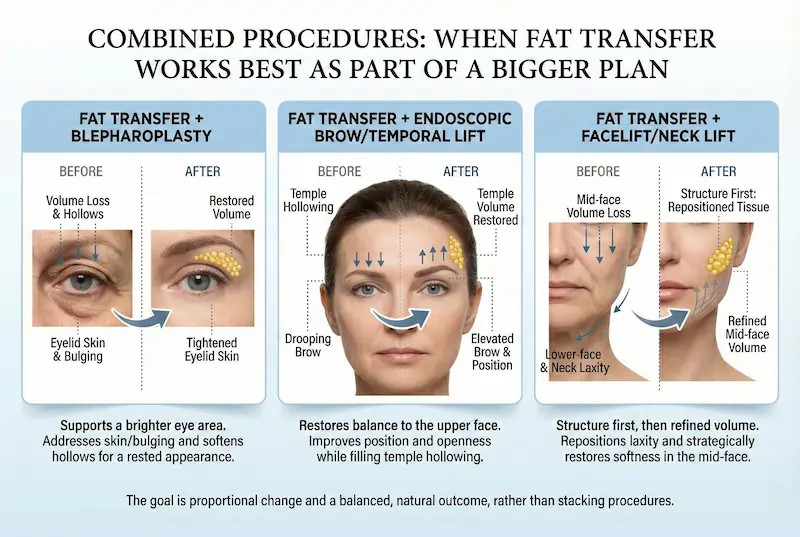
Combined Procedures: When Fat Transfer Works Best as Part of a Bigger Plan
Fat grafting can be powerful on its own, but in some cases the most natural result comes from combining volume restoration with structural improvement. Ageing is rarely a single-issue problem: volume loss, descent, and skin laxity often occur together. When we combine procedures thoughtfully, the outcome can look more balanced—because each technique addresses a different component of facial ageing. The priority is always proportional change and a realistic recovery plan, rather than stacking procedures for the sake of “more”.
Fat transfer + blepharoplasty: supporting a brighter eye area
If the eye area is your main concern, fat grafting may be considered alongside upper or lower blepharoplasty in suitable candidates. Blepharoplasty can address eyelid skin or bulging, while fat transfer can soften hollows and improve the cheek-lid transition. When planned together, the goal is a rested appearance—without creating a tight, hollow, or overly sculpted look.
We discuss whether your concern is primarily skin, fat pads, or true volume deficiency. This helps decide whether fat transfer is the right tool, whether it should be staged, or whether a different approach will achieve a cleaner result.
Fat transfer + endoscopic brow/temporal lift: restoring balance to the upper face
In the upper face, a subtle brow or temporal lift can improve position and openness, while fat transfer can address temple hollowing and soften the surrounding transitions. For some patients, treating temples alone can make the eye area look more youthful without changing identity. When combined with a conservative lift, the aim is a refreshed upper face with natural movement.
We treat the face as a system—position, volume, and proportion must work together for a result to look truly natural.
Fat transfer + facelift/neck lift: structure first, then refined volume
For patients with more significant lower-face or neck laxity, a facelift and neck lift may be the foundation of the plan. In these cases, fat transfer can be used strategically to restore softness in the mid-face or temples after structural repositioning. This “structure first, volume second” logic often creates a more believable outcome than adding volume alone to a face that needs lift support.
During consultation, we map out what should be lifted, what should be volumised, and what should be left untouched. That clarity reduces the risk of a heavy or overfilled look and helps align the plan with the recovery time you can realistically accommodate.
Anaesthesia Options for Fat Transfer To Face: Why Many UK Patients Prefer Awake/Twilight Sedation
Anaesthesia is not a “background detail” in facial surgery—it shapes your comfort on the day, your immediate recovery, and how smoothly the first 24–48 hours may feel. Many UK patients who research deeply are particularly interested in approaches that reduce unnecessary physiological stress while still delivering a controlled, safe operating environment. Where appropriate, we often favour an Awake/Conscious Sedation approach for facial fat grafting, because it can provide a calm experience without the deeper recovery curve that some patients associate with general anaesthesia. The right choice is always individual, based on your health profile, anxiety level, and the scope of your plan.
What is “Awake/Conscious Sedation” in facial surgery?
Twilight sedation is a monitored sedation technique designed to keep you comfortable and relaxed during the procedure. In practical terms, most patients describe it as feeling drowsy and detached from the environment, with reduced awareness of time. Local anaesthetic is used in the treatment areas, and sedation is adjusted according to your needs and response. You are monitored throughout, with the clinical team focused on both comfort and safety.
It is important to understand that “twilight” is not the same as being fully awake, nor is it the same as being fully under general anaesthesia. The aim is a balanced state where you are comfortable, stable, and supported in a controlled clinical setting.
Twilight sedation vs general anaesthesia: how we decide
The decision is based on what is safest and most appropriate for your procedure plan. For a straightforward facial fat transfer, many patients can be suitable for sedation-based approaches. If your plan includes additional procedures, or if there are medical considerations that make one option more appropriate, we tailor the anaesthesia plan accordingly. We also factor in your personal preferences—some patients feel calmer knowing they will be fully asleep, while others strongly prefer avoiding general anaesthesia where clinically reasonable.
During consultation, we discuss your medical history, previous anaesthesia experiences, and how you typically respond to stress. Our goal is an anaesthesia plan that aligns with the procedure scope and provides a smooth peri-operative journey.
Comfort, control, and the “premium recovery” mindset
For high-demand schedules and UK patients who want to minimise disruption, the recovery experience matters. Sedation-based approaches can feel “lighter” for some individuals in the first day, although experiences vary. Regardless of anaesthesia type, your recovery still depends on tissue healing, swelling patterns, and adherence to aftercare.
Comfort is a clinical priority: the best experience is calm, controlled, and tailored—never one-size-fits-all.
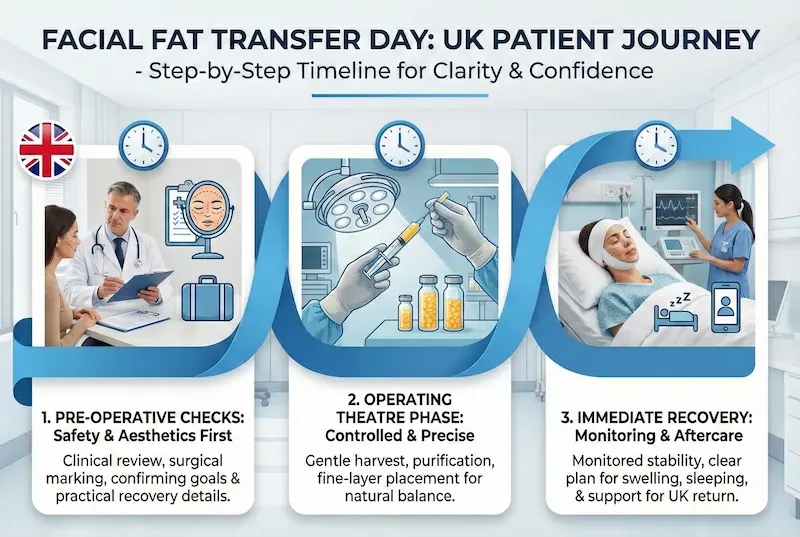
Step-by-Step: What Happens on the Day of Your Fat Transfer To Face Procedure
UK patients travelling for surgery often ask for a clear, non-ambiguous timetable: what happens first, how long each step takes, and what the first hours feel like. We structure your day to be predictable and well-supported, with clear pre-operative checks, a controlled operating theatre environment, and a monitored recovery phase. While exact timings vary depending on the plan and whether procedures are combined, the sequence is consistent. Below is a practical overview of the day, written to help you plan with confidence.
Pre-operative checks: safety first, then aesthetics
Before you enter the operating theatre, we confirm key clinical details: medical history, medication review, and any relevant pre-operative assessments. We also revisit your goals and the surgical plan so that the procedure remains aligned with what you want to achieve. Surgical markings and a final facial assessment help ensure that the plan is precise, symmetrical, and proportionate to your natural features.
This stage is also where we confirm practical recovery details—how swelling may present, what support you’ll have that evening, and how follow-up will work once you return to the UK.
In the operating theatre: controlled, precise, and measured
The procedure itself follows the three-phase structure: harvest, processing, and placement. Once you are comfortable and monitoring is established, fat is gently harvested from the donor site, purified, and then grafted into the pre-planned facial areas using fine, controlled technique. Placement is typically performed in small layers to create smooth contour and avoid visible irregularities.
The aesthetic goal is always “quiet excellence”: natural facial balance, soft transitions, and preservation of expression. We prioritise harmony over dramatic change, because subtle outcomes tend to look better in real life—and in photographs.
Immediate recovery: monitoring, reassurance, and a clear aftercare plan
After the procedure, you move into a monitored recovery area where comfort and stability are assessed. You may notice early swelling and a feeling of tightness or fullness, which is expected in the initial phase. We provide a structured aftercare plan with guidance on sleeping position, gentle activity, and what to avoid in the early days. If you are travelling from the UK, we also focus on practicalities: what to expect day by day, when you may feel “presentable”, and how to keep recovery calm while travelling.
You will have a clear point of contact for questions, because reassurance and timely advice are part of a safe surgical journey—not an optional extra.

Day by Day Fat Transfer To Face Recovery Time
Recovery after facial fat grafting is usually straightforward, but it is not “instant”. In the first days, swelling and bruising are normal, and the face can look fuller than the intended long-term result. This early phase is largely driven by fluid shift and tissue response, not the final volume that will remain. Most UK patients want a clear, realistic timeline—especially when planning travel, work commitments, and social visibility. While everyone heals differently, the framework below helps you understand the typical pattern.
Day 1–3: swelling, bruising, and the “fuller-than-expected” phase
The first 72 hours are often when swelling is most noticeable. You may feel tightness, puffiness, and early bruising around the treated zones, with oedema that can be more pronounced in delicate areas such as the under-eye region. This does not mean the final result will look overfilled; it reflects early healing biology. We usually advise calm activity, good hydration, gentle walking, and sleeping with your head elevated to help reduce swelling.
It is also normal for the donor site (for example, the abdomen) to feel sore or “bruised”, even though the volume removed is small. We provide guidance for donor-site care and comfort measures that support an easier first week.
Day 4–14: visible improvement and gradual settling
Many patients begin to feel more socially comfortable during this period, although mild swelling can persist—especially in the morning. Bruising typically fades in stages, and the face begins to look more natural as fluid reduces and contours soften. You may still notice minor asymmetries from swelling, which is expected during the settling phase. We encourage conservative judgement at this point: it is too early to assess the final outcome.
Returning to desk-based work may be feasible for some patients within this window, but the most sensible timing depends on your role, your comfort with visibility, and whether additional procedures were performed.
Weeks 3–12: refinement and early stability
From week three onwards, the face typically looks more like “you”, with improved softness and less obvious swelling. This is also the period where natural resorption becomes more apparent, because not all transferred fat will integrate. Your long-term result is shaped by technique, tissue handling, and your individual healing response. For that reason, we discuss the possibility of staged planning where appropriate—aiming for a refined result rather than chasing volume too aggressively in a single session.
Premium recovery support: HBOT & LLLT as part of a comfort-first plan
For patients who want to optimise their recovery experience, we can incorporate premium recovery technologies such as Hyperbaric Oxygen Therapy (HBOT) and Low-Level Laser Therapy (LLLT). These modalities are used in some settings to support tissue recovery and reduce the “downtime feel” of the early healing phase. Individual responses vary, and these therapies are not presented as a guarantee—rather as an additional layer of recovery support for patients who prioritise speed, comfort, and structure in their post-operative plan.
Safety, Risks, and “Gone Wrong” Concerns: A Transparent View for UK Patients
UK patients often search terms like “fat transfer to face gone wrong” because they want clarity before committing. That is a sensible mindset. Facial fat grafting is a medical procedure with real variability, and safety depends on appropriate patient selection, careful technique, and robust aftercare. Our role is to explain risks in a practical, non-alarming way—so you can make an informed decision. The most protective factor is a tailored plan that respects your anatomy and avoids unnecessary volume or over-treatment.
Potential risks and side effects (what is common vs what is uncommon)
The most common temporary effects are swelling (oedema), bruising, tenderness, and a short period of visible fullness. You may also experience mild firmness or small areas that feel uneven early on, which often settle as swelling resolves. Less commonly, patients can develop prolonged swelling, contour irregularity, asymmetry that does not fully resolve, or a result that feels under-corrected due to natural resorption.
As with any procedure, infection is a potential risk, although careful sterile technique and aftercare reduce likelihood. In rare situations, revision or refinement may be considered once healing is complete and the result has stabilised.
How we reduce risk: conservative planning, precision placement, and follow-up
Risk reduction begins before surgery. We assess whether your primary issue is volume loss, tissue descent, or skin laxity—and we recommend the method that fits the problem rather than forcing fat transfer as a universal solution. During the procedure, controlled tissue handling and micro-layering are key strategies to support smooth contour and reduce irregularity. We also plan volumes by facial zone, because delicate areas require restraint and precision.
After surgery, structured follow-up matters. We provide clear aftercare instructions and practical recovery milestones, with support that continues even after you return to the UK. If something feels unexpected, we prefer early communication—timely guidance can prevent small issues from becoming bigger concerns.
When to contact us urgently (practical guidance)
We advise contacting our team promptly if you develop signs that could indicate a complication—such as increasing redness, worsening pain that does not respond to normal measures, unusual discharge, or a fever of 38°C or above. Significant shortness of breath, chest pain, or sudden severe symptoms should be treated as an emergency and assessed immediately through local services. This is not about causing alarm; it is about ensuring you know what “normal healing” looks like versus what needs urgent review.
Is Fat Transfer To Face Safe in Turkey? A UK Standards Lens
“Is it safe in Turkey?” is a fair question—especially for UK patients who are used to a highly regulated healthcare environment and want clarity, not marketing. Safety is not a location by itself; it is a system: patient selection, clinical governance, sterile operating theatre standards, anaesthesia monitoring, surgeon experience, and structured aftercare. Our approach is designed to feel familiar to the “expert patient” mindset: transparent planning, clear medical reasoning, and a recovery pathway that continues after you return home. The purpose is to reduce uncertainty and create a calm, well-managed surgical journey.
Clinical environment and operating theatre standards
A safe outcome begins with the fundamentals: an appropriate operating theatre environment, rigorous sterile protocols, and a team trained to manage both routine recovery and unexpected scenarios. Facial fat grafting is technique-sensitive, so consistent processes matter—from tissue handling to monitoring in the immediate post-operative phase. We also build safety into the timetable: avoiding rushed turnover, allowing adequate observation, and ensuring you leave with a clear plan rather than vague instructions.
For UK patients, this often translates to a preference for structure: knowing who is responsible for each phase, what the escalation pathway is if a concern arises, and how follow-up will be managed across borders.
Communication and “British standards” expectations
UK patients tend to value understatement, evidence-based explanations, and realistic outcome framing. We reflect that in our consultations and written guidance: plain-English explanations, clear expectations around swelling and resorption, and an emphasis on what is known versus what is variable. We do not position surgery as a lifestyle accessory; we treat it as a medical procedure that requires planning and informed consent.
This is particularly relevant for patients searching phrases like “private cosmetic clinic Istanbul British standards” or “post-op care in Turkey for British citizens”. The real reassurance comes from process: pre-operative planning, recovery milestones, and continuity of support once you are back in the UK.
Follow-up and continuity once you return to the UK
A key part of safety is what happens after the procedure, not only during it. We provide structured follow-up checkpoints and clear guidance on what is normal in each phase of healing. Because facial fat grafting settles over weeks rather than days, we keep the emphasis on progress tracking and early communication if something feels unusual. Remote support is not an “extra”; for travelling patients, it is part of responsible care.
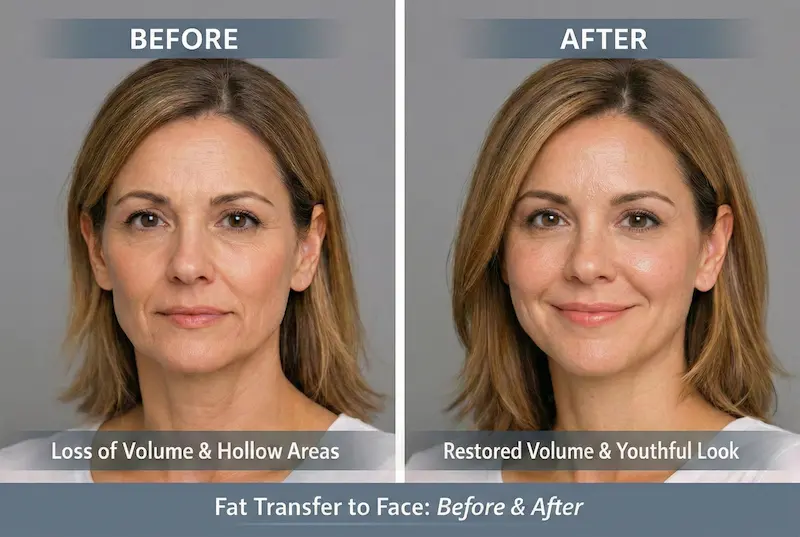
Realistic Results: How Long Does Fat Transfer To Face Last?
Longevity is one of the most researched topics for facial fat grafting, and the honest answer is that it varies. Fat transfer is living tissue placed into a new environment; some of it integrates and remains, and some is naturally reabsorbed during healing. This is why experienced planning focuses on stable, natural contour rather than chasing a dramatic early “post-op” look. UK patients who think long-term typically prefer a refined result that holds up over time and continues to look like them as the face moves and ages.
Fat survival and the biology of “take”
Once grafted, fat needs to develop a robust blood supply to remain. This is one reason we use careful micro-layering: smaller parcels of tissue have a better chance of integrating than large deposits. Your individual biology also matters—circulation, tissue quality, inflammation response, and adherence to aftercare can all influence retention. Even with excellent technique, some resorption is expected; planning accounts for this without resorting to overfilling.
What a “good result” should look like in real life
A strong outcome is subtle: softening of shadows, improved facial balance, and a rested look that does not draw attention to the procedure itself. In high-definition lighting or photographs, the face should still look natural, with smooth transitions rather than visible edges or unnatural fullness. We also prioritise expression—your smile, eye movement, and speech patterns should remain authentically yours.
Touch-ups, staging, and long-term planning
Some patients benefit from staged planning, especially when multiple facial zones are being treated or when a conservative approach is preferred in delicate areas. A staged strategy can support refinement and reduce the risk of heaviness. If a touch-up is considered, it should only be discussed once healing is complete and the result has stabilised—premature decisions during the swelling phase tend to lead to unnecessary interventions.

Cost & Value: Fat Transfer To Face Cost in 2026 (Turkey vs UK)
UK patients often compare “cost” and “value” differently: the question is not only the fee, but what is included, how predictable the process feels, and what level of clinical and logistical support exists around the surgery. In the UK, pricing can be strongly influenced by operational overheads and location-driven costs (for example, central London). In Turkey, high-quality care can be delivered with a different cost structure, which can translate to better overall value—particularly when travel logistics and aftercare are designed into the pathway. The fairest comparison is therefore a scope comparison, not a headline number.
What can influence cost in the UK
UK pricing is commonly affected by clinic location, theatre overheads, staffing costs, and whether the plan is a standalone fat grafting procedure or combined with other facial surgery. The level of anaesthetic support, the complexity of the treated areas (for example under-eye work), and follow-up structure can also influence the overall fee. This is why UK patients can see wide variation even within the same city.
Why Turkey can offer strong value (without making it “cheap”)
Value-driven care is not about cutting corners; it is about a different cost base combined with high surgical volume and dedicated infrastructure. For travelling patients, the experience also matters: a streamlined journey, coordinated transfers, accommodation support, and structured follow-up can reduce stress and make the overall process feel more controlled. For many UK patients, that combination—clinical planning plus a managed pathway—creates a premium experience rather than a bargain purchase.
Scope comparison table: UK vs Turkey pathway (typical inclusions)
| Category | Typical UK pathway (varies by provider) | AKM-style VIP pathway in Istanbul (scope-led) |
|---|---|---|
| Consultation & planning | Separate consultation fee may apply; planning varies | Structured planning with clear recovery milestones and travel timing |
| Anaesthesia & monitoring | Depends on provider and procedure scope | Planned anaesthesia approach with monitored recovery protocol |
| Aftercare & follow-up | Often in-person local follow-ups; frequency varies | Defined follow-up checkpoints with continuity after returning to the UK |
| Travel logistics | Not applicable | Coordinated pathway (transfers and scheduling) designed around recovery needs |
| Accommodation | Not applicable | Partner hotel planning as part of a managed medical journey (where applicable) |
Finding the Right Surgeon for Fat Transfer To Face: What UK Patients Should Look For
Choosing a surgeon is not a branding exercise; it is a risk-management decision. Facial fat grafting is technique-sensitive, and subtle differences in tissue handling can influence contour smoothness, swelling patterns, and how predictably the graft integrates. UK patients who research thoroughly tend to look beyond “before and after” images and ask about training, governance, and complication protocols. We welcome that mindset. Our role is to make the decision process measurable, with clear criteria you can use to compare providers fairly.
Credentials and clinical accountability (beyond marketing claims)
Start with verifiable credentials and professional standards: the surgeon’s training pathway, ongoing education, and the clinical governance structure around their work. In facial surgery, experience is not only about years—it is about case exposure, technical breadth, and a demonstrated ability to plan for different facial anatomies. A reputable provider should be comfortable explaining how decisions are made and why a conservative approach may be preferable in delicate areas.
We encourage patients to ask direct questions about safety processes, escalation pathways, and what happens if refinement is needed after the settling period. Transparent answers are a signal of clinical maturity.
Experience with delicate zones (under-eye, tear trough, and transitions)
Many “gone wrong” concerns relate to fragile areas where the margin for error is smaller. Under-eye and cheek-lid transitions require restraint, careful plane selection, and a micro-layering approach that prioritises smoothness over volume. When comparing surgeons, ask how they plan for thin skin, swelling (oedema), and refinement. A thoughtful surgeon should talk about limits, not only possibilities.
Technical excellence in facial fat grafting is often invisible—what you notice is how natural the result looks in motion.
Consultation quality: a practical checklist
A strong consultation should feel structured. We typically recommend you look for:
- Clear mapping of your facial concerns (volume loss vs descent vs skin laxity).
- A realistic recovery explanation with a timeline you can plan around.
- Honest discussion of variability (including resorption and the possibility of staging).
- A safety plan: how concerns are handled, who you contact, and how follow-up works.
- Photographic planning that prioritises symmetry and proportion rather than dramatic “enhancement”.
If you leave a consultation with vague answers, rushed decisions, or pressure to proceed quickly, that is a useful data point. A premium surgical experience should feel calm, measured, and clinically grounded.
UK patient note: If you are comparing providers, ask each clinic to outline their follow-up schedule (including remote support) and their approach to revision planning if refinement is needed after healing.
Your UK-to-Istanbul Treatment Journey: Planning, Travel, and Aftercare
For UK patients, the success of treatment is not only the operation—it is the whole pathway. Travel introduces timing constraints and a need for predictable support, especially in the first week when swelling and bruising can be most visible. Our process is designed to reduce decision fatigue: clear scheduling, coordinated logistics, and a structured aftercare plan that continues after you return to the UK. The objective is to make the journey feel managed, not improvised.
Before you travel: pre-operative planning and a clear schedule
We begin by defining your goals and mapping the treatment areas, then aligning the plan with your travel window. We advise on practical preparation (medications to disclose, what to avoid, and what to pack), and we set realistic milestones for when you may feel comfortable on camera or in public. This is also where we discuss whether your plan is best as a standalone procedure or part of a combined strategy, and how that affects downtime.
Arrival and treatment-day logistics (designed around recovery)
Travelling patients benefit from a calm, predictable flow: airport pick-up, accommodation planning where applicable, and a timetable that avoids unnecessary rushing. On the day of surgery, we focus on clarity—what happens first, what monitoring looks like, and what you should expect that evening. The aim is to keep your first 24 hours simple: rest, hydration, and recovery support rather than avoidable stress.
Aftercare and remote follow-up once you are back in the UK
Recovery does not end when you fly home. We provide guidance for each phase of healing, including what is normal, what is worth monitoring, and when to contact us. Because settling occurs over weeks, we emphasise progress tracking and measured decision-making rather than early “judgement calls” while swelling is still present. If questions come up once you’re back in the UK, continuity matters: you should feel you have access to advice, not just a discharge note.
A safe journey is a supported journey—good surgery includes good follow-up, especially for international patients.
Conclusion
Fat Transfer To Face can be an excellent option for UK patients seeking a natural, tissue-based approach to facial rejuvenation—provided the plan is conservative, technically precise, and matched to the realities of healing biology. The most refined outcomes come from careful assessment, honest expectation-setting, and a recovery pathway designed for continuity and support. If you are considering treatment, the next step is a personalised consultation focused on anatomy, safety, and a result that still looks like you.
Frequently Asked Questions About Fat Transfer To Face (FAQ):
UK patients often arrive with very specific questions—about longevity, risk management, travel timing, and how predictable results are in real life. Below are the most common FAQs we hear, answered with the same principle we use in consultation: clarity, realism, and a focus on what can be planned versus what depends on healing biology. If your question is not covered, we can address it directly during your assessment.
How long does fat transfer to the face last?
Longevity varies because grafted fat is living tissue: some integrates and remains, and some is naturally reabsorbed during healing. Technique, micro-layer placement, your tissue characteristics, and lifestyle factors such as weight stability all influence retention. The best way to think about longevity is as a long-term improvement in facial contour rather than a perfectly fixed “number of years”. Where appropriate, we discuss staged planning so refinement can be done conservatively and safely.
When will I see the final result?
You will see an early “fuller” look immediately after surgery due to swelling and fluid shift, but that is not the final result. Most visible swelling improves across the first two weeks, with ongoing refinement over the following weeks. A more meaningful assessment typically happens once tissues have settled and early resorption has stabilised. We encourage patients not to judge outcomes too early—especially during the first month.
How much swelling and bruising should I expect?
Some swelling (oedema) and bruising is normal, particularly in delicate areas such as under-eyes. The extent is individual and influenced by the treatment area, how much work is done, and your healing response. Many patients notice swelling is worse in the mornings at first, then improves throughout the day. We provide guidance on sleeping position, activity level, and aftercare measures that support a calmer recovery.
Will I look “overfilled” or unnatural?
Early swelling can create a temporarily fuller appearance, which can be unsettling if you were expecting an immediate “natural” look. Our planning approach is conservative by design, particularly in fragile zones. The objective is subtle facial harmony, not inflated volume. If your priority is minimal visible change in the first 7–10 days, tell us—timing and strategy can be tailored to your social and work commitments.
Can fat transfer to the face go wrong?
Any medical procedure has risks and variability. Concerns typically relate to unevenness, prolonged swelling, asymmetry, under-correction due to resorption, or—in uncommon cases—issues such as infection. The most effective risk control is choosing the right method for your anatomy, planning conservatively, and using precise micro-layer placement. Transparent aftercare and early communication if something feels unusual are also important parts of safety.
Is fat transfer to face better than fillers?
Neither is universally “better”—they are different tools. Fat grafting is surgical and tissue-based, suitable for patients who want a broader, cohesive volumisation plan using their own tissue. Fillers can be useful for targeted corrections, staged adjustments, and minimal downtime. The right choice depends on your goals, the areas involved, your tolerance for recovery, and how much predictability you want in the short term.
Can you treat under-eyes and tear troughs with facial fat grafting?
In suitable candidates, under-eye and tear trough fat grafting can soften shadows and improve the cheek–lid transition. These are delicate zones, so we plan conservatively and discuss swelling patterns and refinement expectations clearly in advance. If you have had previous filler in the area, we factor that into planning because prior treatments can influence tissue behaviour.
What if I’ve had fillers before facial fat transfer?
Prior fillers do not automatically exclude you, but they can affect decision-making—especially around the under-eye region. During consultation we look at your history, assess tissue characteristics, and plan the safest and most predictable approach. The aim is to avoid layering treatments in a way that creates heaviness or irregularity.
What happens if too much fat is reabsorbed?
Some resorption is expected, and planning accounts for that without “overfilling”. If you feel you are under-corrected once healing is complete, we can discuss options—often a staged refinement is the most measured approach. The timing matters: decisions should be made after the result has stabilised rather than in the swelling phase.
Will there be scars, and where is the fat taken from?
Harvest is typically taken from areas such as the abdomen or flanks using small access points, with the aim of leaving minimal visible marks once healed. The donor site is chosen for safe access and adequate volume, not because one area guarantees a superior result. We also provide donor-site aftercare guidance, as that area can feel sore in the early days.
When can I fly back to the UK?
Travel timing depends on your procedure scope, how you are healing, and whether the plan includes additional surgery. We advise on a personalised travel window based on safety and comfort, including swelling management and what to do if you experience unexpected symptoms. The key is not just “can you fly”, but “can you travel calmly with support and clear instructions”.
Is the fat transfer to face procedure painful?
Most patients describe discomfort rather than severe pain, with tenderness in both the face and the donor site. The first few days can feel tight or bruised, and the donor site often feels like a deep bruise. We provide a structured comfort plan and aftercare guidance, and we encourage early contact if discomfort feels outside the expected range.
Can facial fat transfer be combined with other facial surgery?
Yes, and in some cases combining procedures can create a more natural result by addressing both structure and volume. For example, a lift may address descent while fat grafting restores softness. Combination planning is always guided by proportional change, a realistic recovery window, and what will look most natural long-term.
Medical Disclaimer: This page is for general educational purposes only and does not constitute medical advice. Treatment suitability, techniques, risks, recovery, and outcomes vary between individuals and must be assessed by a qualified clinician. If you have urgent symptoms or feel acutely unwell, seek immediate medical attention via local emergency services.