




Considering Buccal Fat Removal in Turkey? This guide is written for United Kingdom patients who want a refined, natural-looking cheek contour—not a hollowed trend. Learn how the buccal fat pad affects facial shape, who is suitable, and why conservative reduction matters for ageing well.
We explain the procedure step by step, including intraoral incision, anaesthesia options such as local with twilight sedation, and a recovery timeline. You’ll also find transparent guidance on side effects, long-term risks, and how to choose a safe, accredited clinic in Istanbul with structured follow-up after you return to the UK, including cost, value and aftercare.
Table of Contents
What Is Buccal Fat Removal?
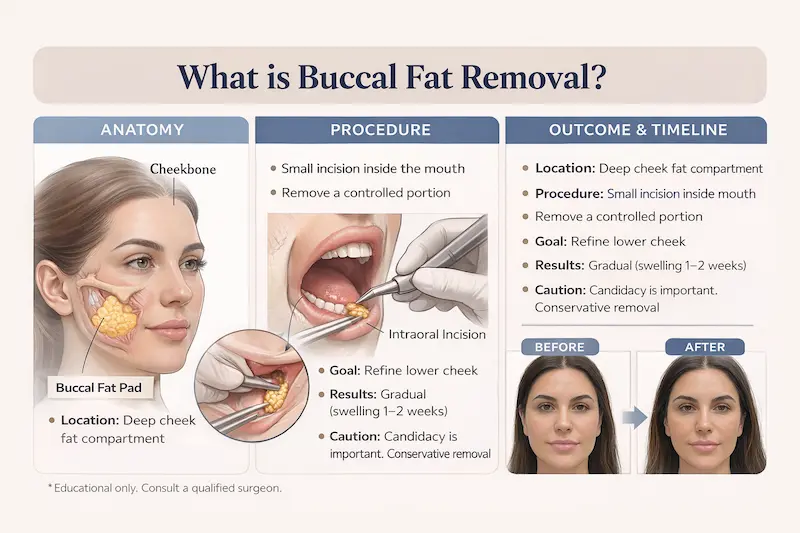
Buccal Fat Removal is a facial contouring procedure designed to reduce fullness in the lower cheeks by removing (or more often, conservatively reducing) the buccal fat pad. The buccal fat pad is a naturally occurring pocket of fat that sits deep within the cheek, beneath the muscles used for chewing and facial expression. In some people—often due to genetics—this fat pad remains prominent even with a healthy weight, creating a rounder or “baby face” look.
The goal is not to make the face look “hollow”, but to create a more refined transition from the cheekbone area to the lower cheek and jawline. Done well, the result should appear subtle and in harmony with your natural features—particularly important for patients who prioritise a long-term, age-appropriate outcome.
Our philosophy: rejuvenation, not alteration. The best results are the ones that look like you—just more defined.
Buccal fat pad anatomy: what is actually being removed?
The buccal fat pad is not the same as surface fat you can “lose” through dieting. It sits deeper in the cheek and is structurally separate from the fat just under the skin. That’s why some people can be slim overall yet still have noticeably full cheeks. Buccal fat contributes to youthful fullness, but when it is disproportionately large, it can soften facial definition and make the mid-to-lower face look wider.
Buccal Fat Removal vs “bichectomy”: are they different?
You’ll often see the term bichectomy used online—especially in international searches. In practice, “bichectomy” and buccal fat removal are commonly used to describe the same operation: addressing the buccal fat pad through an incision inside the mouth. What matters more than the name is the approach: modern facial contouring tends to favour conservative, tailored reduction rather than aggressive removal, because facial volume changes naturally with ageing.
What changes (and what doesn’t) after Buccal Fat Removal
This procedure is best thought of as refinement, not transformation. It may create a slimmer look in the lower cheek area and enhance facial angles, especially in photos. However, it does not change your cheekbones, your bone structure, or your jaw itself. If your fullness is caused by skin laxity, superficial fat, or a wider jaw muscle (masseter), buccal fat reduction alone may not deliver the result you’re hoping for. A careful clinical assessment is essential to identify what’s truly contributing to your facial shape.
What Are The Benefits (and limits) Of Cheek Fat Reduction?
Patients often ask, “Is buccal fat removal worth it?” The answer depends on anatomy, expectations, and long-term planning. When the buccal fat pad is genuinely prominent, a measured reduction can improve facial balance and definition—particularly in the lower third of the face. But because the procedure can’t be “undone” in a simple way, the benefits must be weighed against the risk of over-reduction and the way faces naturally change over time.
Who tends to benefit most?
Buccal fat reduction is typically most suitable for people who:
- Have persistently full lower cheeks despite stable weight and fitness
- Feel their face looks rounder than they want, especially in photos
- Have good skin quality and healthy facial volume in the midface
- Want a subtle, natural-looking contour rather than a dramatic “model hollow” effect
What improvements are realistic?
Commonly, patients notice a more refined lower cheek contour and a cleaner line between the cheek area and jaw. The change is usually most visible once swelling settles and the tissues soften into their new shape. That said, results are rarely instant and are not identical for everyone. Your face shape, skin elasticity, and the size and position of the buccal fat pad all influence the final outcome.
The limits: when Buccal Fat Removal may not be the right tool
Buccal fat reduction is not a universal solution for facial slimming. It may be less helpful—or potentially counterproductive—if:
- Your face is naturally narrow or you already have low facial volume
- Your concern is mainly sagging (skin laxity) rather than cheek fullness
- Fullness comes from jaw muscle bulk rather than the buccal fat pad
- You are seeking a dramatic change that doesn’t match your anatomy
| Potential benefit | Best matched to | Key limitation to consider |
|---|---|---|
| More defined lower cheek contour | Genetically full cheeks | Over-reduction can look hollow over time |
| Improved facial balance in photos | Rounder face shape with good midface volume | Swelling can temporarily disguise results |
| Subtle enhancement of angles | Patients wanting natural refinement | Does not change bone structure or cheekbones |
If you are researching from the UK and comparing options abroad, the most important question is not “how much fat can be removed?”, but how much should be removed for your face. A conservative plan that respects long-term facial ageing is often the difference between a refined result and a regrettable one.
Am I a Good Candidate for Buccal Fat Removal?
Whether Buccal Fat Removal is right for you depends less on trends and more on your underlying facial anatomy. Full cheeks can be caused by several factors—deep buccal fat, superficial fat, muscle bulk, or even the way skin drapes over the midface. The “expert patient” approach is to identify the true cause of fullness first, then choose the most appropriate (and safest) plan for long-term facial balance.
Because facial volume naturally changes with age, suitability is not just about how your cheeks look today. A responsible assessment considers how your face is likely to evolve over the next decade, and whether reducing cheek volume now could lead to an overly hollow appearance later. This is why conservative planning and realistic expectations are central to good outcomes.
Good candidate checklist
You may be a suitable candidate if most of the following apply:
- Your lower cheeks remain noticeably full despite stable weight and a healthy lifestyle
- You have adequate midface volume (so refinement won’t translate into “gauntness”)
- Your skin quality and elasticity are good, with minimal laxity
- Your goal is subtle contouring rather than dramatic hollowing
- You understand that results develop gradually as swelling settles
Who should be cautious (or avoid it altogether)
This procedure is not ideal for everyone. Caution is usually recommended if you:
- Have a naturally narrow or already angular face
- Have significant midface volume loss, or a tendency to look “hollow” when tired
- Are primarily concerned about sagging rather than cheek fullness (a lifting strategy may be more appropriate)
- Expect a celebrity-like transformation that doesn’t reflect your anatomy
In these situations, removing buccal fat may not address the real issue and can increase the risk of an aged or overly sculpted look. A conservative alternative may involve addressing superficial volume, skin support, or overall facial balance rather than focusing solely on buccal fat.
Consultation essentials: what should be assessed?
A high-quality consultation goes beyond a quick “yes/no” answer. It should include an assessment of facial proportions, symmetry, skin quality, and the distribution of volume across the midface and lower face. Clear clinical photographs (and in some cases, additional measurements) help establish what is realistically achievable.
You should also discuss your long-term priorities: do you want a subtle refinement that remains natural as you age, or are you looking for sharper definition at the cost of potentially reduced softness later? The best plan is the one that fits both your anatomy and your future-facing goals.
Surgical Techniques Explained: How do surgeons remove buccal fat?
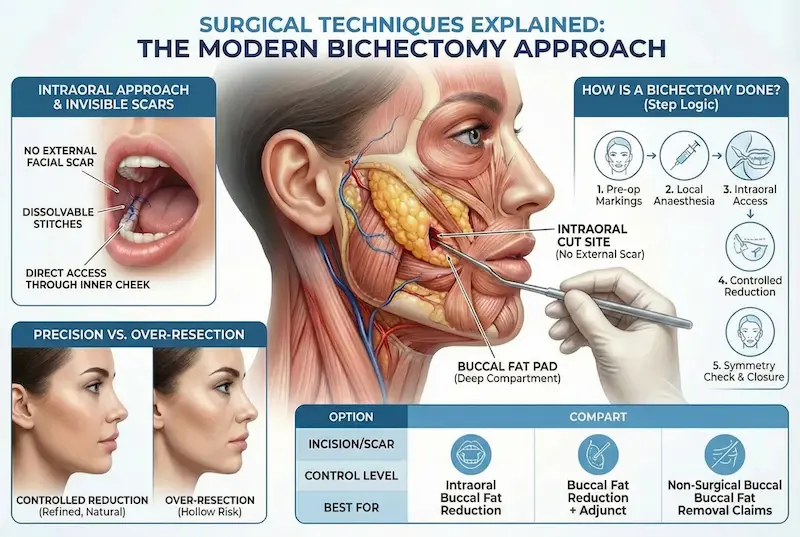
Buccal fat reduction is typically performed through a discreet approach inside the mouth. The emphasis in modern facial contouring is precision and restraint: removing only what is necessary to achieve balance, while preserving the natural volume that supports a healthy, age-appropriate appearance.
Intraoral approach: the standard technique
The most common technique uses a small incision on the inside of the cheek (intraoral), meaning there is no external facial scar. Through this access point, the surgeon gently identifies the buccal fat pad and reduces it in a controlled manner. Because the area involves important anatomical structures, careful handling and a methodical approach are essential.
Conservative reduction vs aggressive removal
One of the biggest long-term concerns patients research is the risk of looking “hollow” or older—especially years later. This is why conservative reduction is often favoured over aggressive removal. The goal is not to eliminate all cheek fullness, but to refine the lower cheek contour while maintaining healthy facial volume and softness.
A tailored approach may involve a partial reduction, different amounts on each side when appropriate, and a plan that respects how facial fat naturally diminishes with age.
Symmetry strategy: planning for balance
Faces are naturally asymmetrical, and buccal volume can differ subtly between sides. A thoughtful plan accounts for this from the start. Rather than chasing perfect “mirror” symmetry, the aim is to achieve a balanced, harmonious look that appears natural in motion and in photographs.
| Technique / approach | Best suited for | Advantages | Limitations | Typical early recovery feel |
|---|---|---|---|---|
| Intraoral buccal fat reduction (standard) | Genetically full lower cheeks with good midface volume | No external scar; targeted contour refinement | Not ideal for narrow faces; results develop gradually | Swelling, mild tenderness, mouth tightness |
| Conservative / partial reduction | Patients prioritising long-term natural ageing | Lowers risk of “overdone” hollowing; preserves support | More subtle change; may not satisfy “dramatic” expectations | Similar swelling, often perceived as easier adaptation |
| Asymmetry-adjusted reduction | Patients with noticeable side-to-side cheek fullness differences | Improves overall balance and harmony | Requires careful planning; perfection is not realistic | Swelling may be uneven initially, then evens out |
Ultimately, the “best technique” is not a one-size-fits-all choice—it’s the one that matches your anatomy, your risk tolerance, and the kind of result you want to live with for years to come.
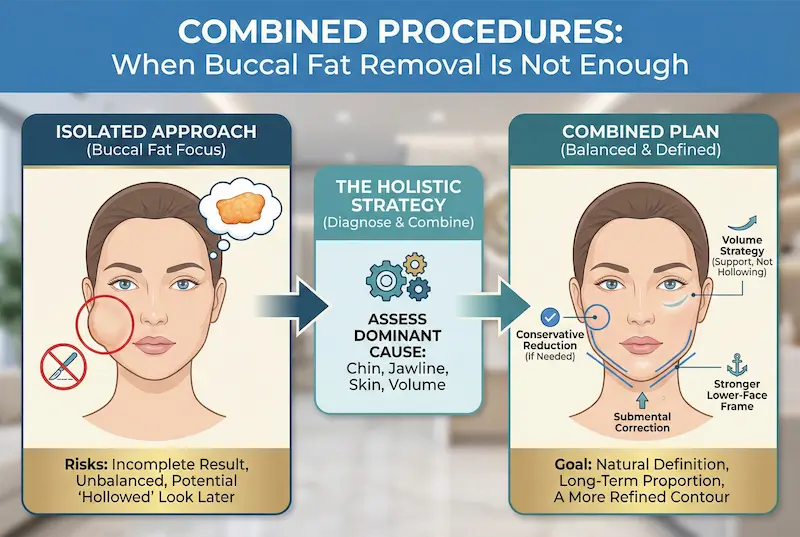
Combined Procedures: When Buccal Fat Removal Is Not Enough
Cheek fullness rarely exists in isolation. For some patients, the “round face” look comes from a combination of deep buccal volume, superficial fat, skin drape, and the way the chin and jawline project. If we focus on one element only, the result can feel incomplete. Worse, it can look unbalanced.
Our approach is to diagnose the dominant cause of fullness first, then decide whether a single procedure is sensible or whether a combined plan would be more predictable. Sometimes the best decision is not to remove buccal fat at all. Sometimes it’s to reduce it conservatively and address another structural factor at the same time.
Jawline and chin balance: creating a stronger lower-face frame
A common reason patients feel their cheeks look “heavy” is that the lower-face framework is under-defined. When the chin is smaller or the jawline transition is softer, the mid-to-lower face can appear wider by comparison. In those cases, reducing cheek volume alone may not deliver the definition you are imagining.
During assessment, we look at:
- Chin projection and how it supports the lower face
- Jawline continuity (from angle to chin)
- Whether cheek fullness is disproportionate, or simply more noticeable due to a weaker frame
If your lower-face frame is the key issue, a combined strategy may be more effective than “more fat removal”. It is also often a safer long-term aesthetic choice. In suitable cases, chin augmentation can help strengthen the lower-face structure, making cheek fullness appear less dominant without over-reducing volume.
Submental fullness and the “double chin” effect
Some patients describe cheek heaviness, but the main driver is actually under the chin. Submental fullness can blur the jawline, making the entire lower face look broader. In these cases, addressing the neck-chin angle can sharpen the profile and improve facial proportions without over-reducing cheek volume.
This is where a holistic plan matters. We aim for a clean jawline and a balanced midface, rather than chasing a single trending look.
Volume strategy: when adding is better than removing
It sounds counterintuitive, but some faces look slimmer when volume is redistributed rather than removed. If the midface is slightly flat or the cheekbone area lacks support, the lower cheek can look heavier by contrast. In carefully selected cases, a volume-support approach (rather than aggressive reduction) can create a more refined contour.
We prioritise natural ageing. That means preserving healthy facial softness where it matters and avoiding a “hollowed” result that may become more apparent years later.
When a facelift may be a better long-term solution
If cheek “fullness” is actually caused by tissue descent and skin drape rather than excess buccal volume, removing cheek fat may not address the root cause. In those situations, a facelift strategy (selected carefully and tailored to your anatomy) can restore support and improve contour by repositioning tissues—often delivering a more age-appropriate, balanced outcome than volume reduction alone.
Profile harmony: how rhinoplasty can change facial balance
Facial contour is not just about the cheeks. In some patients, a profile imbalance can make midface or lower-face fullness feel more prominent. A well-planned rhinoplasty can improve overall facial harmony by refining nasal projection and proportion, which may shift how the cheeks and jawline are perceived in photographs and side views. The right plan depends on what drives the imbalance—not on combining procedures for the sake of it.
Upper-face refinement: blepharoplasty and perceived facial definition
When the eye area looks heavy or tired, patients may feel their entire face looks less defined—even if cheek volume is not the main issue. In selected cases, blepharoplasty (eyelid surgery) can brighten the upper face and improve facial balance. This can make lower-face contouring feel more natural and proportionate, rather than “over-sculpted”.
Ear position and facial framing: where otoplasty fits
Although it does not change cheek volume, otoplasty can subtly improve overall facial framing by adjusting prominent ears. For some patients, this enhances perceived symmetry and balance in front-view photos. If facial harmony is the priority, it can be part of a broader plan—always based on what will look most natural for your features over time.
| Primary concern | What we assess | Why a combined plan may help |
|---|---|---|
| “My face looks round in photos” | Buccal fat prominence vs skin drape vs proportions | Targets the true driver, not just cheek volume |
| “My jawline isn’t defined” | Chin projection, jawline continuity, neck-chin angle | Improves the frame so cheeks look naturally lighter |
| “I’m worried about looking hollow later” | Baseline midface volume, age-related volume trajectory | Supports long-term balance with conservative reduction |
Anaesthesia: Why We Prefer Local Anaesthesia /Conscious Sedation
For many UK patients, the biggest worry is not the incision. It is the anaesthetic. That concern is reasonable. Anaesthesia choices affect comfort, nausea risk, how you feel afterwards, and sometimes the overall recovery experience.
For suitable candidates, we often favour a plan built around local anaesthesia with Twilight Sedation (also known as conscious sedation). It is designed to keep you comfortable and relaxed while avoiding the depth of a full general anaesthetic. The aim is simple: reduce physiological stress where we can, without compromising safety or precision.
“The most successful aesthetic surgery is one that goes unnoticed.”
Local anaesthesia: what it means in practical terms
Local anaesthesia numbs the treatment area so the procedure itself is not felt in the usual sense of pain. You may still notice pressure or movement. That is normal. Our team focuses on managing comfort in a calm, controlled way throughout the procedure.
Local anaesthesia can be an excellent option when the plan is straightforward and the patient is comfortable with a minimally sedated experience.
Conscious Sedation (Twilight Sedation): comfort without the “heavy” feeling
Twilight sedation sits between fully awake and fully asleep. Many patients describe it as feeling drowsy and detached, with limited memory of the procedure. It can be particularly helpful for people who feel anxious about being in theatre, even if the surgery itself is relatively short.
For the “expert patient”, the key question is risk trade-off. With appropriate medical screening, twilight sedation can be a sensible choice for comfort while avoiding the deeper effects associated with general anaesthesia.
When general anaesthesia may be considered
General anaesthesia is not automatically “better”. It is simply a different tool. We may consider it when the surgical plan is more extensive, when multiple procedures are combined, or when there is a clear clinical reason that makes it the safer option.
Whichever approach is used, the decision must be individualised. Your medical history, previous anaesthetic experiences, and the scope of surgery all matter. We discuss the rationale openly so you know exactly why a certain plan is being recommended.
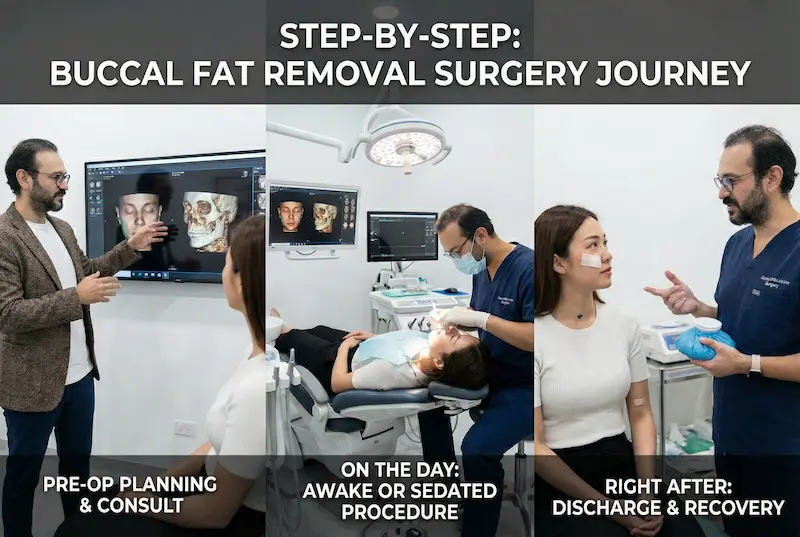
Step-By-Step: What Happens On The Day (In Theatre)
Knowing exactly what to expect can reduce anxiety and help you plan your time in Istanbul—especially if you’re travelling from the UK. While every surgical plan is personalised, buccal fat reduction is typically a streamlined procedure when performed on its own. The key is calm preparation, clear communication, and a controlled, conservative technique.
Pre-op checks and final planning
On the day of treatment, the process usually begins with a final review of your medical history and a confirmation of your goals. Your surgeon will reassess your facial proportions and discuss the planned level of reduction. This is also the moment to ask any “last-mile” questions—about swelling, symmetry, and what a natural result should look like for your face.
- Health screening and a brief check of vital signs
- Discussion of the surgical plan and expected outcome
- Consent review and confirmation of anaesthesia strategy
Comfort and anaesthesia in practical terms
If your plan involves local anaesthesia with twilight sedation, you’ll be kept comfortable and relaxed while the treatment area is fully numbed. The aim is to reduce stress and make the experience feel manageable—without defaulting to general anaesthesia when it isn’t clinically necessary. Your clinical team will monitor you throughout.
The intraoral incision and buccal fat reduction
The incision is placed inside the mouth, so there is no visible facial scar. Through this small access point, the surgeon identifies the buccal fat pad and reduces it in a controlled way. The emphasis is precision and restraint: the goal is refined definition, not hollowing. Both sides are addressed with a balance-focused plan, accounting for natural asymmetry.
Immediate post-op: the first hours
After the procedure, it’s normal to feel tightness, mild discomfort, and swelling beginning to build. You’ll receive instructions for oral hygiene, diet, and activity restrictions. Before discharge, the team will confirm you’re stable, comfortable, and clear on what is normal versus what needs urgent attention.
- Short monitored recovery period
- Aftercare guidance (oral hygiene, diet, sleeping position)
- Medication guidance as clinically appropriate
- Next-day or scheduled follow-up plan
| Stage | What you may notice | What the team focuses on |
|---|---|---|
| Before theatre | Normal nerves; questions about outcome | Final planning, safety checks, clear expectations |
| During treatment | Pressure or movement (not sharp pain) | Comfort, precision, conservative reduction |
| First hours after | Tightness, swelling starting, mild soreness | Stability, aftercare briefing, discharge readiness |
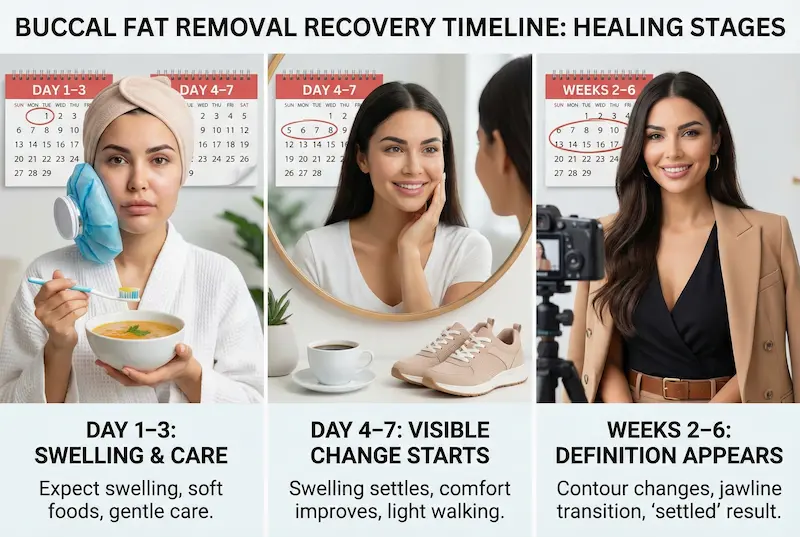
Recovery & Aftercare: Buccal Fat Removal Recovery Time (day-by-day)
Recovery from buccal fat reduction is usually manageable, but it is not “instant”. Swelling, internal healing, and tissue settling all influence how quickly you see definition. Most UK patients want to know two things: how soon they can look presentable and when they can safely travel. While timelines vary, a structured aftercare plan can make the early phase smoother.
Days 1–3: swelling, tightness, and the basics
These are typically the peak swelling days. Your cheeks may feel firm, and the inside of the mouth can feel tender. You may also notice that swelling is not perfectly even side-to-side at first.
- Diet: soft foods that require minimal chewing; adequate hydration
- Oral hygiene: gentle, consistent mouth care (your clinician may recommend an antiseptic mouthwash)
- Comfort: sleep with your head slightly elevated; avoid heavy exertion
- Avoid: smoking/vaping, alcohol, very hot/spicy foods, and anything that irritates the incision area
Days 4–14: swelling settles and routines normalise
Swelling usually begins to reduce, though it can fluctuate during the day. Many patients feel socially comfortable within this window, but the face may still look “puffy” rather than defined. This is normal and does not predict your final result.
- Gradual return to normal diet as advised, while still avoiding excessive chewing early on
- Continue meticulous oral hygiene and follow-up checks
- Light walking is usually fine; strenuous exercise should wait until cleared
Weeks 3–8+: contour development and final settling
Definition becomes more apparent as residual swelling resolves and tissues soften into their new shape. Subtle refinement is the goal; the most natural outcomes often look like “you, just more defined”.
- Expect gradual improvements rather than a sudden change
- Final results vary—your baseline anatomy and skin quality matter
- If your plan was conservative (often the safer choice long-term), the change may be elegant rather than dramatic
AKM Rapid Recovery & Safety Protocol: HBOT and LLLT support
For patients who prioritise recovery quality and safety, our clinic may incorporate supportive technologies into the aftercare programme, depending on your suitability:
- HBOT (Hyperbaric Oxygen Therapy): aims to support healing by improving oxygen delivery to tissues. This may help reduce perceived downtime for some patients and can be used as part of a broader recovery strategy.
- LLLT (Low-Level Laser Therapy): uses low-intensity light intended to support tissue recovery without heat-based damage. It is commonly positioned as a gentle adjunct to promote comfort and healing progress.
These therapies are supportive and not a substitute for surgical technique, medical screening, and appropriate aftercare. Suitability must be determined clinically.
What’s normal vs what needs urgent attention
It’s normal to have swelling, mild discomfort, tightness, and temporary unevenness early on. However, you should contact your clinical team promptly if you experience:
- Worsening pain that doesn’t improve as expected
- Fever, chills, or signs of infection
- Increasing swelling that becomes severe or rapidly worsens on one side
- Persistent bleeding, pus-like discharge, or a foul taste that worsens
- Any symptoms that feel sudden, unusual, or concerning
This information is provided for general education and does not replace personalised medical advice. Always follow your surgeon’s instructions and seek urgent care if you feel unsafe.
| Recovery phase | Typical feel | Focus | Avoid |
|---|---|---|---|
| Days 1–3 | Peak swelling, tightness, tenderness | Soft diet, oral hygiene, rest, elevation | Smoking, alcohol, strenuous activity, irritant foods |
| Days 4–14 | Swelling reducing but fluctuating | Routine aftercare, gentle activity, follow-up | Heavy exercise, aggressive chewing early on |
| Weeks 3–8+ | Contour becomes clearer | Settling, realistic evaluation of results | Rushing judgement too early |
Side Effects & Risks: Is Buccal Fat Removal Dangerous?
Searches like “buccal fat removal side effects” and “buccal fat removal gone wrong” reflect a real concern: you want refinement without unintended long-term consequences. The safest path is a combination of correct patient selection, a conservative surgical plan, and structured aftercare. No surgery is risk-free, but the aim is to reduce avoidable risk and to be transparent about what can happen.
Common short-term effects (what many patients experience)
Most early effects are temporary and relate to normal healing inside the mouth and within the cheek tissues. Common experiences include:
- Swelling (often peaks in the first few days and then gradually settles)
- Tightness or a “firm” feeling in the cheeks
- Mild soreness and sensitivity when chewing early on
- Temporary unevenness (swelling may not be identical on both sides initially)
Because the incision is inside the mouth, meticulous oral hygiene and following dietary guidance are important in the early phase.
Less common risks (what you should understand before deciding)
While less common, potential risks can include:
- Infection (the mouth naturally contains bacteria, which is why aftercare matters)
- Bleeding or a slow-healing intraoral incision
- Asymmetry (some facial asymmetry is normal; the goal is improved balance, not perfection)
- Over-reduction (“hollowing”), which can look unnatural and may become more noticeable with ageing
- Unsatisfactory aesthetic outcome due to mismatched expectations or anatomy
The risk that concerns many “expert patients” is not a short-term bruise—it’s the possibility of looking overly sculpted or prematurely hollow years later. This is why conservative planning is often the most protective strategy.
Our risk-reduction approach: selection, restraint, and follow-up
“Gone wrong” outcomes are often linked to predictable issues: the wrong candidate, too much fat removed, or poor aftercare discipline. A safer pathway typically involves:
- Strict suitability assessment: ensuring you have the right anatomy and enough facial volume to age well
- Conservative reduction: prioritising natural definition over dramatic hollowing
- Balanced planning: accounting for baseline asymmetry and aiming for harmony
- Clear aftercare rules: oral hygiene, diet guidance, and activity restrictions
| Concern patients search | What it usually relates to | How we address it |
|---|---|---|
| “Side effects” | Normal swelling/tightness and mouth sensitivity | Structured recovery plan and realistic timeline education |
| “Gone wrong” | Wrong candidate, over-resection, unrealistic expectations | Strict selection + conservative technique + transparent counselling |
| “Ruined my face / looks terrible” | Overly hollow look or imbalance | Restraint-first planning and balance-based assessment |
Buccal Fat Removal and Ageing: “Will I Regret This 10 Tears Later?”
Questions like “buccal fat removal ageing”, “10 years later”, and “regret” have become common for a reason: facial volume naturally changes over time. Most faces gradually lose fat in key areas with age. If too much volume is removed early, the result can shift from “refined” to “gaunt” as the years pass.
A responsible plan considers not only how you look now, but how your face is likely to evolve. The goal is to avoid a trend-led decision and instead choose a result you’ll still feel comfortable with in future photographs—without feeling “overdone”.
How ageing changes facial volume (in simple terms)
Ageing is not just about skin. It involves changes in the quality of skin, soft tissue support, and fat distribution. Over time, many people develop:
- Gradual volume reduction in parts of the face
- Changes in tissue support, which can influence how fullness sits
- Subtle shifts in facial proportions that alter how “definition” appears
This is why an outcome that looks sharp at 25 may not look as balanced at 40 if the plan was too aggressive.
Who is more at risk of a hollow or “aged” look later?
The long-term risk is typically higher when a patient already has limited facial volume, a naturally narrow face, or signs that volume loss may become noticeable with age. It can also be higher when expectations are strongly driven by a very hollow “model” aesthetic. In these cases, reducing buccal fat may not be the safest route to natural definition.
How we plan conservatively for long-term balance
Long-term satisfaction often comes from a strategy that respects natural ageing rather than fighting it. A conservative plan may include:
- Reducing, not “maximising” removal—aiming for refinement rather than hollowing
- Prioritising facial harmony (midface support and lower-face balance)
- Setting realistic expectations about subtlety and timeline
When patients ask “Is it worth it?”, the most useful question is: is it worth it for my anatomy, in a way that I will still like years from now? If the answer isn’t clearly yes, a different plan—or no surgery—may be the more expert decision.
Is Buccal Fat Removal Safe In Turkey for UK Patients?
If you’re researching buccal fat removal in Turkey from the UK, you’re not just comparing prices. You’re comparing risk. That’s the right mindset.
Safety comes down to three things: who treats you, where you’re treated, and how your care is managed before and after. We build our process around those pillars, because “good surgery” is only part of a safe outcome.
Safety standards: sterilisation, monitoring, and screening
We treat safety as non-negotiable. That starts before surgery, not during it.
- Pre-operative screening: we assess candidacy carefully and do not treat patients who are not suitable.
- Advanced monitoring: we monitor patient vitals throughout every procedure.
- Sterilisation standards: we follow rigorous international sterilisation standards (ISO/TÜV).
These steps don’t make surgery “risk-free”. They reduce avoidable risk. That matters.
Surgeon credentials: what to look for (and what we prioritise)
Many “gone wrong” stories online share the same root cause: the wrong provider for the patient. Credentials and experience are not a vanity detail. They are a safety filter.
When you compare options, look for verifiable markers such as board certification and European-level credentials. In Turkey, many top surgeons hold European Board Certifications (EBOPRAS), which are positioned as the direct equivalent of US boards.
We keep the focus on what protects you: training, consistency, and a conservative aesthetic plan that respects long-term ageing.
Environment and privacy: what “clinical quality” should feel like
A safe outcome also depends on the environment you’re treated in. Our model is built around a fully accredited, state-of-the-art facility and strict protocols for patient confidentiality and data security.
We also invest in advanced diagnostic and surgical tools used for meticulous planning (including 3D imaging systems), because precision reduces uncertainty. You feel that in the consultation. You see it in the plan.
Continuum of care: travel support and follow-up after you return to the UK
One of the biggest fears for international patients is abandonment after they fly home. We solve that by designing the journey as part of the medical service.
- VIP planning: we organise your 5-star hotel and VIP transfers. You handle only your flight.
- Airport welcome: we meet you at Istanbul Airport (IST or SAW) and transfer you privately to your hotel.
- 24/7 support: a dedicated Patient Host stays available via WhatsApp while you are in Istanbul.
- Medical clearance: you have a final in-person check-up before you fly.
- Long-term virtual follow-up: we schedule follow-ups at 1, 3, 6, and 12 months to monitor healing.
| UK patient concern | What it really means | How we address it |
|---|---|---|
| “Is Turkey safe?” | Standards, screening, monitoring | International sterilisation standards, vitals monitoring, strict pre-op screening |
| “What if something happens after I fly home?” | Continuity of care | Structured follow-ups at 1/3/6/12 months + responsive support |
| “Will I be alone managing logistics?” | Travel and coordination anxiety | VIP hotel and transfers + airport welcome + Patient Host guidance |
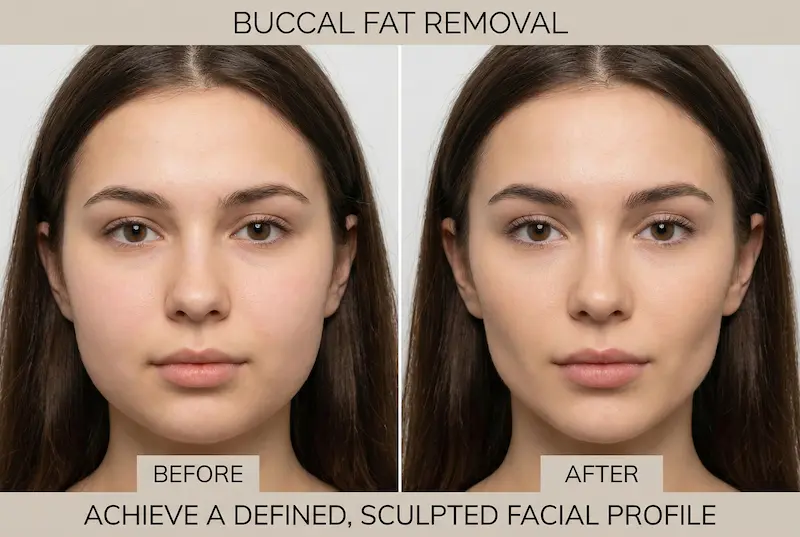
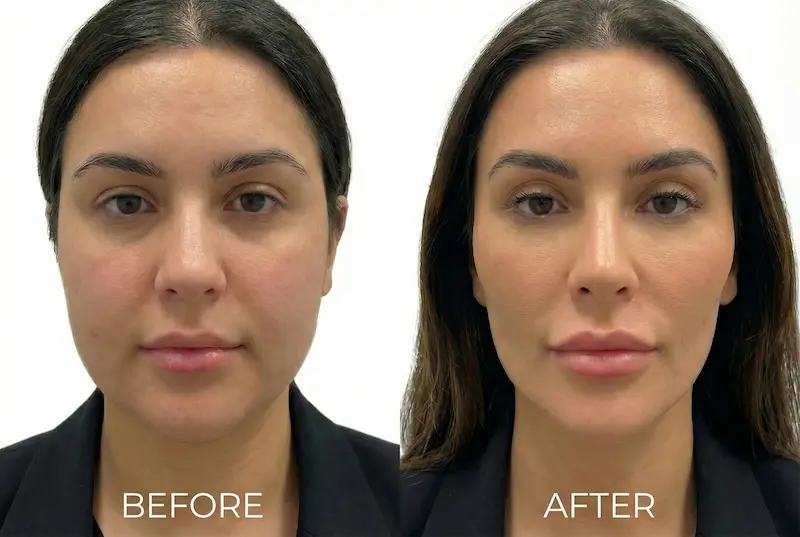
Results & Realistic Expectations: Buccal Fat Removal Before and After
Most people don’t want a dramatic change. They want to look more defined, more balanced, and still like themselves. That’s the difference between trend-chasing and a plan you’ll still like years later.
Our approach is guided by a simple principle: rejuvenation, not alteration. The best outcome is one that looks natural in motion, in daylight, and in everyday photos.
What a “good” result typically looks like
A successful buccal fat reduction is usually subtle. It creates a cleaner lower-cheek contour, not a hollowed midface.
- More refined transition from cheek to jawline
- Less “roundness” in the lower cheek area
- Natural softness preserved (especially important for ageing well)
What can affect your final outcome
Two patients can have the same procedure and different results. Anatomy decides the ceiling.
- Baseline facial volume: very slim faces need extra caution.
- Skin quality: laxity can soften definition, even after fat reduction.
- Age trajectory: facial volume often reduces with time, so over-reduction is a long-term risk.
- Expectation style: aiming for a celebrity-like hollow can lead to regret.
Results timeline: when you can judge the outcome
Early swelling can be misleading. The face may look fuller at first, not slimmer.
- First 2 weeks: swelling and tightness dominate what you see.
- Weeks 3–8: contour begins to refine as tissues settle.
- Later months: the most natural “final look” becomes clearer.
“Celebrity buccal fat removal”: how to think about it safely
It’s normal to be inspired by a look you’ve seen online. It’s not safe to copy-paste it.
Faces don’t age the same way. They don’t carry volume the same way. We focus on your anatomy and a result that won’t look harsh later.
| Expectation | Reality check | Safer target |
|---|---|---|
| “I want sharp hollows.” | Higher risk of looking gaunt over time | Conservative definition with preserved support |
| “I want instant results.” | Swelling hides the change early on | Judge at weeks 6–8+ (not day 7) |
| “I want to look like a celebrity.” | Different anatomy, different ageing pattern | Balanced, natural-looking refinement |
“Turn back the clock, not change the face.”
Cost Analysis: Buccal Fat Removal Cost 2026 (Turkey vs the UK)
Cost is often the first comparison point, but it should not be the only one. For most UK patients, the real question is: what am I paying for, and what does it mean for safety, predictability, and follow-up? Buccal fat reduction is a procedure where the surgeon’s judgement (particularly how conservative the plan is) has a direct impact on long-term satisfaction. That makes “value” more important than the headline fee.
Why UK pricing can vary (and why “London vs elsewhere” matters)
Fees in the UK are influenced by overheads, theatre costs, anaesthesia arrangements, and the structure of aftercare. In higher-cost cities, the same procedure may be priced at a premium due to facility and staffing expenses rather than a fundamentally different technique. When comparing quotes, it helps to look at what is included and what is billed separately.
- Surgeon’s fee: expertise, planning time, and technical precision
- Theatre and staffing: facility fees, nursing, monitoring
- Anaesthesia plan: local, sedation, or general (where clinically indicated)
- Aftercare: follow-up schedule, support access, medications
Why Turkey can offer a high-value model (without being “cheap”)
Many patients explore Turkey because the overall cost structure can allow access to high-spec facilities and experienced teams at a more accessible fee level. The key is to avoid making decisions based on a single number. A high-value plan is one that is transparent, clinically appropriate, and supported by structured follow-up, especially if you are returning home soon after treatment.
What “all-inclusive” should actually include (and what you should confirm)
Package-style pricing can be helpful if it is truly comprehensive and clearly defined. The safest approach is to request an itemised breakdown in writing so you can compare like-for-like.
| Cost area | Often separate in the UK | Often included in a Turkey package | What you should confirm |
|---|---|---|---|
| Consultation & planning | May be billed separately | May be included | Is your plan conservative and tailored to ageing risk? |
| Theatre, monitoring, clinical team | Typically included in procedure fee | Typically included | What monitoring is used, and where is the procedure performed? |
| Anaesthesia / sedation | May increase cost depending on plan | May be included depending on scope | Which anaesthesia option is recommended for your case, and why? |
| Medications & aftercare supplies | Sometimes separate | Often included | Exactly what is provided and what you may need after you return home |
| Follow-up | Usually local follow-ups | Hybrid model (in-person + remote) | How follow-up is handled once you are back in the UK |
| Travel logistics | Not applicable | May include hotel and transfers | Is accommodation included, and how many nights? |
Practical tip: choose the quote that answers the most important questions clearly. If a provider cannot explain how they avoid over-reduction, or cannot define aftercare once you fly home, the lowest fee is rarely the best value.

Choosing The Right Surgeon: What UK Patients Should Check
When patients search for the “best” surgeon, what they usually mean is: who is most likely to deliver a natural, balanced result with the lowest avoidable risk? With buccal fat reduction, the most important skill is not removing fat. It is knowing how much not to remove.
Credentials and accountability (what to verify, not just read)
Look for credentials you can verify independently, and don’t be afraid to ask direct questions. A trustworthy clinic will answer them clearly.
- Training and board-level credentials: confirm the surgeon’s background and scope of practice
- Where surgery is performed: ask about the facility environment, monitoring, and emergency readiness
- Transparency: clear consent, clear risk discussion, and a realistic result narrative
Planning philosophy: conservative, anatomy-led, long-term focused
Many regret stories share a similar theme: a plan driven by trends rather than anatomy. A safer consultation should cover:
- How your midface volume and skin quality affect long-term ageing outcomes
- Whether conservative reduction is more appropriate than aggressive removal
- What alternative or combined options may achieve balance with less long-term risk
Questions worth asking in your consultation
- How do you decide how much buccal fat to reduce for my face?
- What is your strategy to avoid hollowing now and years later?
- What early side effects are most common in your patients, and how are they managed?
- What does follow-up look like after I return to the UK?
- Can I see outcomes in patients with a similar face shape and baseline volume?
| What to look for | Why it matters | What “good” looks like |
|---|---|---|
| Conservative planning | Reduces long-term hollowing risk | Refinement-first goals, not maximal removal |
| Clear safety pathway | Lower avoidable complications | Screening, monitoring, written aftercare |
| Realistic expectation setting | Reduces dissatisfaction and regret | Timeline explained; anatomy limits discussed |
| Follow-up structure | Continuity of care after travel | Defined check-ins and responsive support |
Your Medical Journey: From The UK To Istanbul (VIP pathway)
If you’re travelling from the UK for buccal fat removal, the medical plan and the travel plan should work as one. A smooth journey reduces stress, supports recovery, and helps you feel confident about timing—especially if you need to be back at work or prefer to keep your treatment private.
At AKM Clinic, we structure the process so you know what happens before you fly, what happens while you’re in Istanbul, and how follow-up works once you return to the United Kingdom. This “continuum of care” matters because most questions UK patients have are practical: timing, safety, and what happens if you need advice after you get home.
Virtual consultation and planning (before you travel)
Your planning stage should answer three things clearly: am I suitable, what result is realistic, and what does recovery look like for my schedule. Typically, this includes a review of your goals and photographs, an anatomy-led assessment, and a conservative plan that prioritises long-term balance (particularly around “hollowing” risk).
- Suitability check (including the “ageing and regret” question)
- Discussion of anaesthesia options (local / twilight sedation / general if clinically indicated)
- Clear expectations: what will change, what won’t, and your result timeline
- Travel timing guidance (so you don’t book flights too tightly)
Arrival, transfers, and accommodation (while you’re in Istanbul)
International patients often worry about logistics—especially arriving in a new city and navigating appointments. A well-run pathway removes uncertainty. Depending on your package plan, airport meet-and-greet, private transfers, and hotel accommodation can be arranged so you can focus on recovery rather than coordination.
- Airport welcome and private transfer to your hotel (where included/arranged)
- Clear schedule: consultation, procedure day, and post-op review timing
- Support during your stay via a dedicated patient coordinator (often via WhatsApp)
Post-op checks, flight clearance, and follow-up after you return home
For UK patients, “What if I need help once I’m back?” is a reasonable concern. Your follow-up plan should be structured and predictable. Before you fly, you should have an in-person post-op assessment and clear written instructions. After you return home, remote check-ins help monitor healing progress and answer questions as swelling resolves and results develop.
- In-person review before departure (to confirm you are fit to travel)
- Aftercare guidance (oral hygiene, diet, activity, and warning signs)
- Remote follow-ups at defined milestones (commonly 1, 3, 6, and 12 months)
| Journey phase | Your priority | What “good care” looks like |
|---|---|---|
| Before travel | Suitability + realistic plan | Conservative strategy, clear expectations, anaesthesia rationale |
| In Istanbul | Low-stress logistics + safety | Coordinated schedule, monitored care, clear aftercare instructions |
| After you return | Continuity + reassurance | Defined follow-up milestones and responsive support |
Buccal Fat Removal Frequently Asked Questions (FAQ):
Does Buccal Fat Removal hurt?
During the procedure, comfort is managed with anaesthesia (local, often with twilight sedation where appropriate). Afterwards, most patients describe soreness, tightness, and swelling rather than severe pain. Your clinician will guide you on suitable pain relief.
How long is Buccal Fat Removal recovery time?
Many patients feel socially comfortable within 1–2 weeks, but swelling can continue to settle for several weeks. Contour refinement is typically judged around weeks 6–8+ rather than in the first few days.
When can I fly back to the UK?
Flight timing depends on your healing progress and your clinician’s assessment. A safe pathway includes a post-op review before departure and personalised travel guidance based on your recovery.
Will I look older after Buccal Fat Removal?
The main long-term concern is over-reduction. Ageing naturally changes facial volume, so a conservative plan is often used to preserve support and reduce the risk of a hollow or harsh look later.
Can buccal fat grow back?
Buccal fat reduction targets a specific fat pad. Weight changes can affect overall facial fat, but the goal is a measured reduction that remains balanced over time rather than an aggressive “maximal removal” approach.
What are the most common side effects?
Swelling, tightness, mouth tenderness, and temporary unevenness are common early effects. Following oral hygiene and dietary guidance is important because healing occurs inside the mouth.
What causes “Buccal Fat Removal gone wrong” results?
Unfavourable outcomes are often linked to poor candidate selection, overly aggressive removal, or unrealistic expectations. A conservative plan and clear counselling about long-term aesthetics are key safeguards.
Buccal Fat Removal vs bichectomy—what’s the difference?
“Bichectomy” is often used as an alternative name for buccal fat pad reduction. What matters most is not the label, but how carefully the procedure is planned and how conservative the reduction is for your anatomy.
Is Buccal Fat Removal worth it?
It can be—when the buccal fat pad is genuinely prominent and your goal is subtle refinement. If the main driver of fullness is skin laxity, superficial fat, or jaw muscle bulk, other strategies may be more suitable.
How much does Buccal Fat Removal cost in Turkey vs the UK?
Fees vary depending on what’s included (facility, anaesthesia plan, aftercare, and travel logistics). The most meaningful comparison is an itemised breakdown so you can compare like-for-like, not just a headline number.
How do I choose the right surgeon?
Look for verifiable credentials, a conservative planning philosophy, transparent risk discussion, and a clear follow-up pathway—especially important if you are travelling internationally.
What should I avoid after buccal fat removal surgery?
Common restrictions include smoking/vaping, alcohol early on, strenuous exercise until cleared, and foods that irritate the incision area. Your clinician will provide personalised instructions based on your case.
Medical disclaimer: This page provides general information only and does not replace professional medical advice, diagnosis, or treatment. Suitability, risks, and recovery timelines vary and must be assessed individually.