



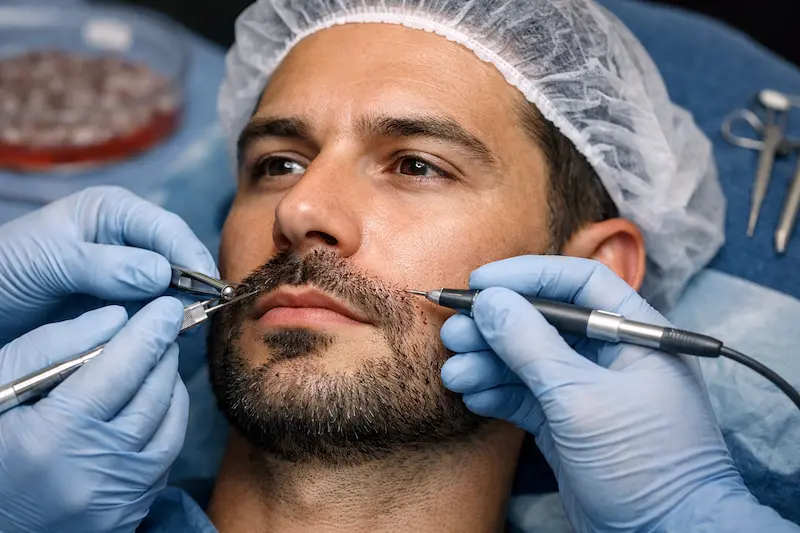
Considering a Beard Moustache Transplant? If patchy growth or an uneven moustache line is affecting your confidence, this guide explains what the procedure involves, how natural angles are designed, and who is a suitable candidate.
Explore technique options (FUE, Sapphire FUE, DHI), recovery milestones, and a clear cost comparison in £ for UK patients weighing London and other cities against Istanbul. Keep reading for a practical checklist and a transparent route to a personalised quote.
Table of Contents
What is a Beard Moustache Transplant?
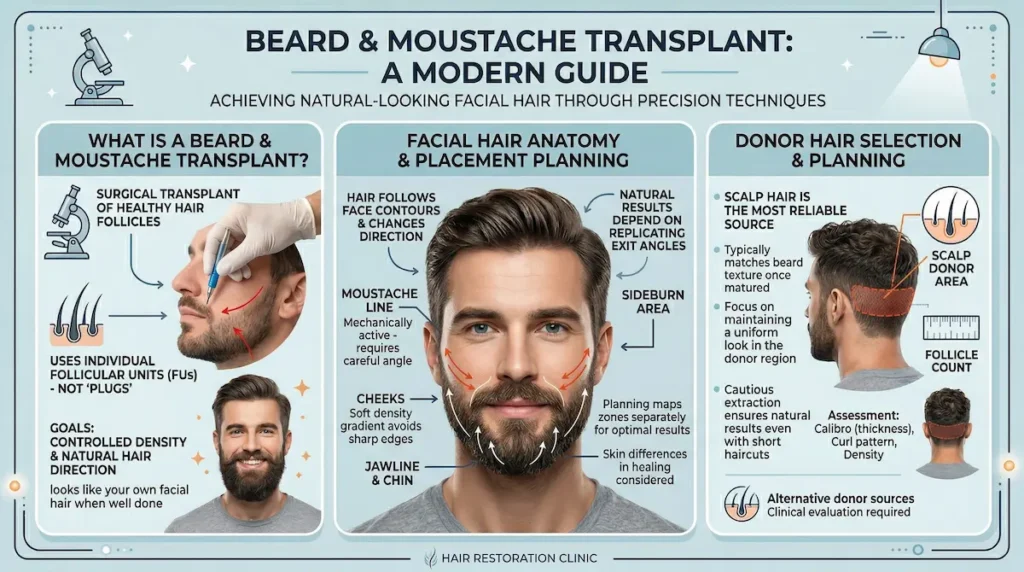
A Beard Moustache Transplant is a surgical method of moving healthy hair follicles from a donor area to the beard and moustache region. We transplant individual follicular units, not “plugs”. The goal is controlled density and natural direction. Done well, it simply looks like your own facial hair.
At AKM Clinic, we treat facial hair restoration as a design-and-precision procedure. The technical details matter. Angle, depth, spacing, and graft selection all influence how the result looks in daylight and at close range. This is why we plan each case around your facial anatomy rather than a one-size template.
Facial hair anatomy: why direction matters
Beard and moustache hair does not grow straight out. It follows the contours of the face and often changes direction across different zones. A natural result depends on replicating those “exit angles” so the hair sits correctly when you trim, shape, or grow it out.
- Facial hair transplant planning typically maps these zones separately: cheeks, jawline, chin, sideburn area, and the moustache line.
- The cheek area often needs a softer density gradient to avoid a sharp, artificial edge.
- The moustache area is mechanically active (talking, eating), so placement depth and direction need extra care.
We also consider skin characteristics. Facial skin can behave differently to scalp skin during healing. That’s one reason why technique and delicate handling are central to predictable graft survival.
Donor hair selection: where the grafts come from
Most patients ask the same question early: “Where will the hair come from?” In many cases, we use scalp donor hair because it is reliable, accessible, and typically matches beard texture well once it matures. The donor area choice is not cosmetic only; it affects how the follicles tolerate extraction and how the donor heals.
- Beard transplant donor planning focuses on maintaining a uniform look in the donor area, not just maximising the graft count.
- We assess donor calibre (thickness), curl pattern, and density to decide how many grafts can be taken safely.
- In select cases, alternative donor sources may be discussed, but suitability is individual and should be assessed clinically.
If you have concerns about donor visibility, we address this upfront during mapping. A cautious extraction plan is part of building a result that still looks natural when you wear shorter haircuts.
What “natural” really means in beard and moustache work
Natural is not a marketing word. It is a technical outcome. The beard and moustache region will expose poor placement quickly, especially when you shave down to stubble and regrow.
- We use a density gradient rather than a flat “wall” of hair.
- We prioritise single-hair follicular units in the visible border areas for a softer transition.
- We plan direction changes across zones so the hair lays correctly, not upright.
- We aim to minimise surface irregularities that can contribute to an uneven texture.
Our approach is simple: rejuvenation, not alteration. The best result is the one that looks like it has always belonged to you.
Why Do Patients Choose a Beard Transplant or Moustache Transplant?
Patients rarely pursue facial hair restoration for a single reason. For many, it’s a mix of genetics, grooming preferences, and confidence in day-to-day interactions. The key is having a clear goal. We plan the design around what looks believable for your face and age, not what looks “maxed out” on a chart.
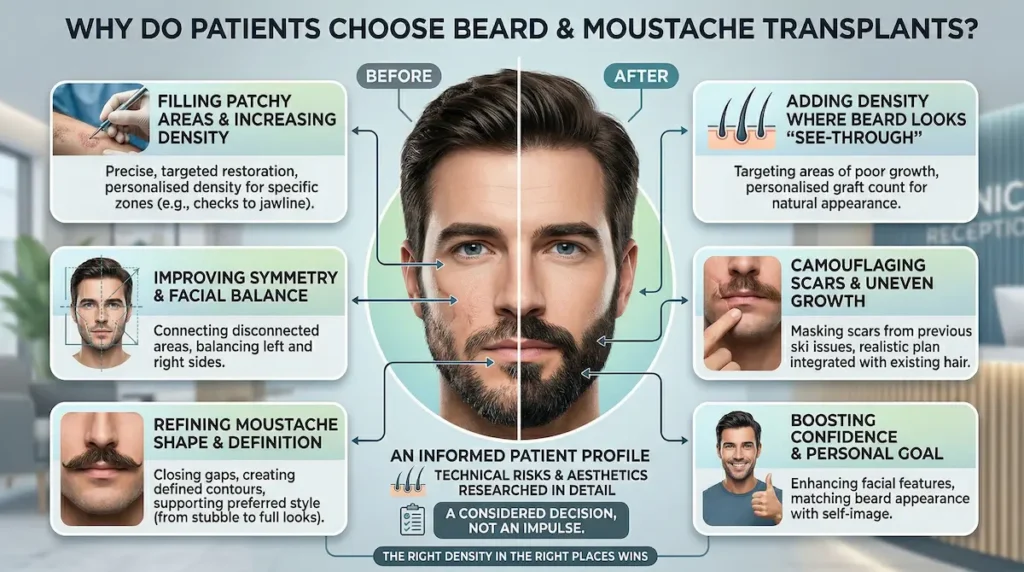
In the UK market, we also see a very informed patient profile. People often arrive having researched technical risks and aesthetics in detail. That is sensible. A beard and moustache transplant should feel like a considered decision, not an impulse.
Filling patchy areas and improving overall density
The most common motivation is uneven growth. Some men develop strong growth on the chin and jaw but sparse cheeks. Others have small gaps that never fill in, even with time and styling. This is where beard restoration can be precise and targeted.
- Improving symmetry between left and right sides
- Connecting disconnected zones (for example, cheek to jawline)
- Adding density where the beard looks “see-through” in harsh light
- Refining a beard line so it looks intentional but not drawn-on
Density is always personalised. More grafts do not automatically mean a better look. The right density in the right places usually wins.
Refining the moustache: shape, balance, and definition
A moustache transplant is often chosen for definition rather than sheer volume. Some patients have a central gap, thin growth at the corners, or asymmetry that becomes obvious when they try to style it. The moustache also frames the face, so small changes can have a noticeable effect.
- Closing gaps while keeping the moustache line soft
- Supporting a preferred style (from subtle to fuller looks)
- Improving density for those who want to keep light stubble without patchiness
Because the upper lip is a high-movement area, design and direction control matter. It is not a place for shortcuts.
Camouflaging scars and supporting a more confident look
Some patients choose transplantation to help camouflage scars or areas of poor growth following previous skin issues. Others simply want their beard to match how they see themselves. We keep the goal grounded: a natural improvement that integrates with your existing facial hair.
If your concern is scar-related, we discuss what transplantation can and cannot do for skin texture. A realistic plan protects you from disappointment. It also helps us choose the right approach for density and placement.
Am I a Suitable Candidate For a Beard Transplant and Moustache Transplant?
Suitability is not just about wanting a fuller beard. It is about whether you have enough donor capacity, realistic expectations, and a stable plan that respects facial anatomy. We assess your skin, hair calibre, growth direction, and any factors that could affect healing. Then we build a plan that aims for a natural result, not an overbuilt one.
Who is usually a good fit?
Most suitable candidates have clear goals and enough donor hair to support them. Some want to fill a patchy beard. Others want definition in the moustache line or improved symmetry on the cheeks. We also see patients who simply want their facial hair to look consistent in harsh light and close-up.
- Good donor availability (usually the scalp donor area)
- Healthy skin in the beard and moustache region
- Realistic expectations on density, direction, and timelines
- A willingness to follow aftercare and return for planned check-ups (in person or virtually)
Who should delay or avoid the procedure?
Sometimes the best decision is “not yet”. Active skin inflammation in the recipient area can compromise healing and comfort. Certain medical conditions and medications can increase risk, especially around bleeding and wound healing. If something looks unstable, we slow down and investigate properly.
- Active skin conditions in the beard/moustache region (for example, persistent irritation or infection)
- Uncontrolled systemic health issues that could affect recovery
- Unrealistic expectations (for example, expecting instant density or a completely uniform texture)
- Insufficient donor capacity for the requested coverage
If you have medical concerns, we may ask for additional information and, where appropriate, advise you to speak with your GP before travel. Clear information reduces risk. It also reduces stress.
How we confirm candidacy: assessment and screening
We treat candidacy as a clinical decision, not a sales one. Our process starts with a detailed history, a donor assessment, and a design discussion that focuses on what will look believable on your face. We also use pre-operative screening to support safety and suitability. When everything aligns, we proceed with a plan that is practical and predictable.
- Donor assessment for density, calibre, and extraction limits
- Recipient assessment for skin quality and zone-by-zone direction planning
- Expectation setting on timelines, trimming, and the maturation of facial hair texture
- Pre-operative checks to support patient safety and suitability
How Many Grafts Are Needed For a Beard Moustache Transplant?
This is one of the most searched questions for a reason. Graft numbers affect everything: density, donor planning, cost, and recovery. The honest answer is that there is no single “full beard number” that suits everyone. We calculate grafts based on your facial structure, current hair pattern, donor capacity, and the style you want to maintain long-term.
Typical graft ranges by goal (guide only)
We plan graft numbers by zones, not by guesswork. A small moustache refinement is different from building cheek density from scratch. The same is true for a defined goatee versus a full lower-face restoration. These ranges are a starting point, then we refine them after mapping.
- Moustache refinement: often a lower graft requirement than cheek work, but higher precision in angle and spacing
- Goatee / chin density: moderate graft requirements, with careful direction changes across the chin contour
- Cheeks and jawline blending: often the largest share of grafts, especially when correcting patchiness
- Full-beard build: typically planned in stages of zones, balancing coverage with donor responsibility
If you are comparing clinics, focus on planning logic rather than a single number. A clinic that promises an extreme graft count without explaining donor impact is not being careful. We prefer careful.
Density planning: why “more” is not always better
Facial hair is unforgiving. Too dense, too quickly, can raise the risk of an unnatural look and make healing less comfortable. Too sparse, and you will still see patchiness at stubble length. Our approach is to create a believable density gradient that blends into your existing growth.
- We build softer transitions at the borders for a natural beard line
- We distribute density in a way that matches typical growth patterns
- We protect donor aesthetics by avoiding overharvesting
Personalised mapping: turning your photos into a plan
We finalise graft numbers after design. That includes mapping your beard zones, measuring the gaps, and deciding where density matters most for your preferred style. We also plan for how you actually wear your facial hair: clean-shaven, short stubble, or a fuller beard. The goal is a result that holds up in real life, not just on day-one drawings.
- Zone-by-zone mapping (cheeks, jawline, chin, moustache line)
- Direction planning to match natural exit angles
- Donor management to keep the donor area looking uniform
- A clear plan for expected growth phases and maturation
Surgical Techniques Explained: FUE, Sapphire FUE and DHI for Facial Hair
A Beard Moustache Transplant is only as good as its execution. Technique matters, but so does judgement. Facial hair restoration demands careful extraction, disciplined graft handling, and precise implantation angles—especially along the moustache line and visible beard borders.
At AKM Clinic, we explain technique in plain terms and match it to your anatomy and goals. For the UK “expert patient”, the important point is this: a technique is not a guarantee. The protocol and the surgeon-led planning are what convert a technique into a natural outcome.
FUE extraction: the foundation of donor safety
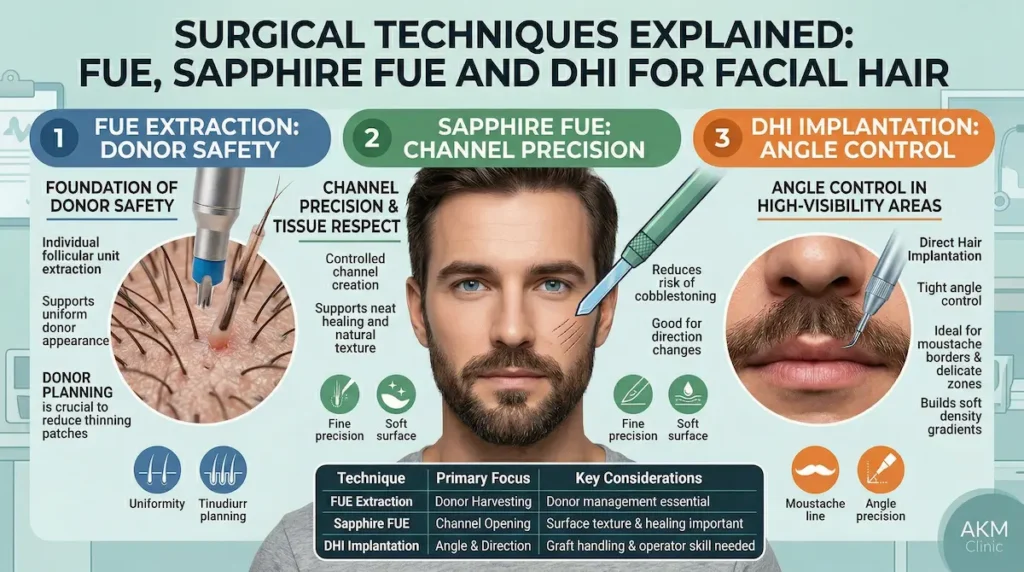
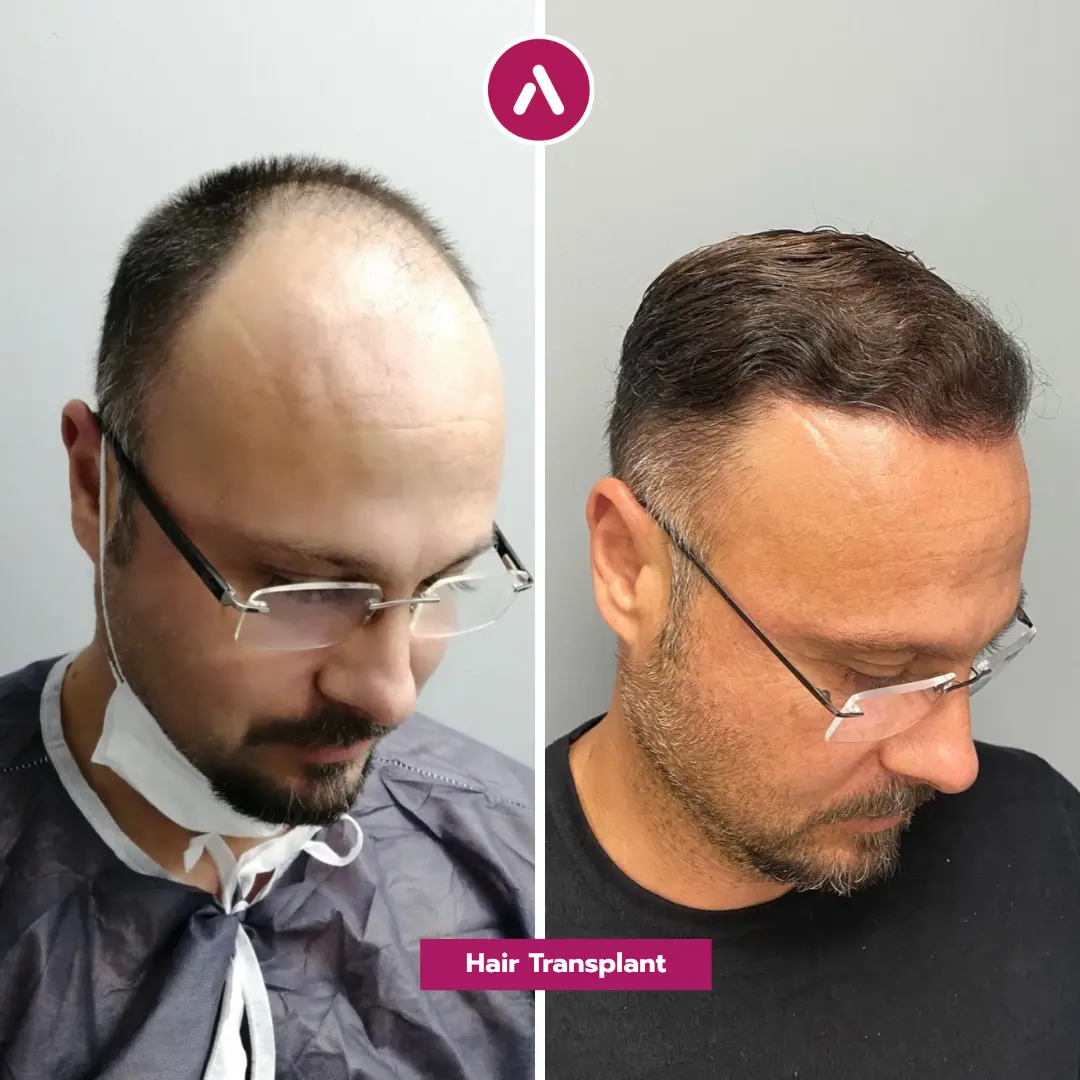
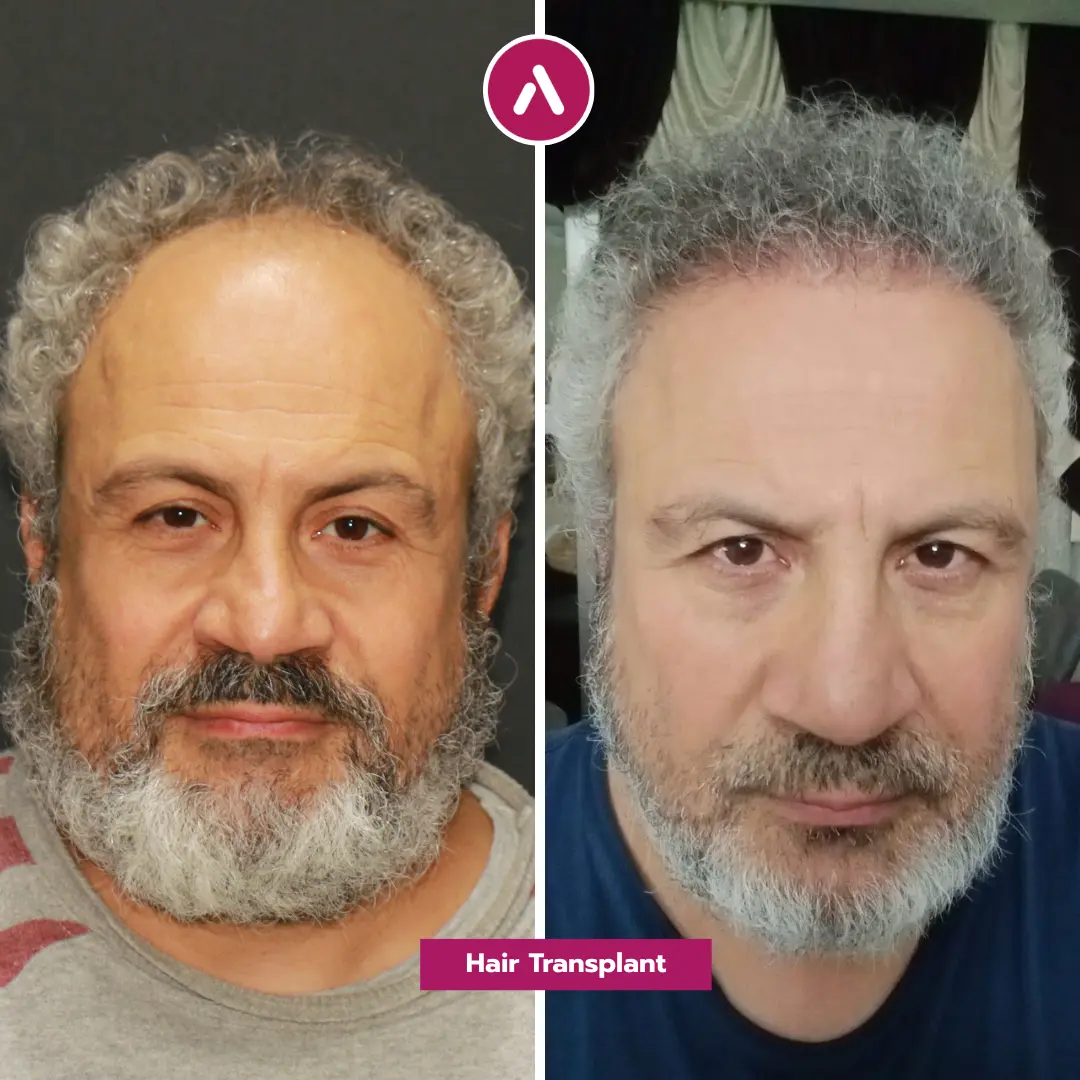
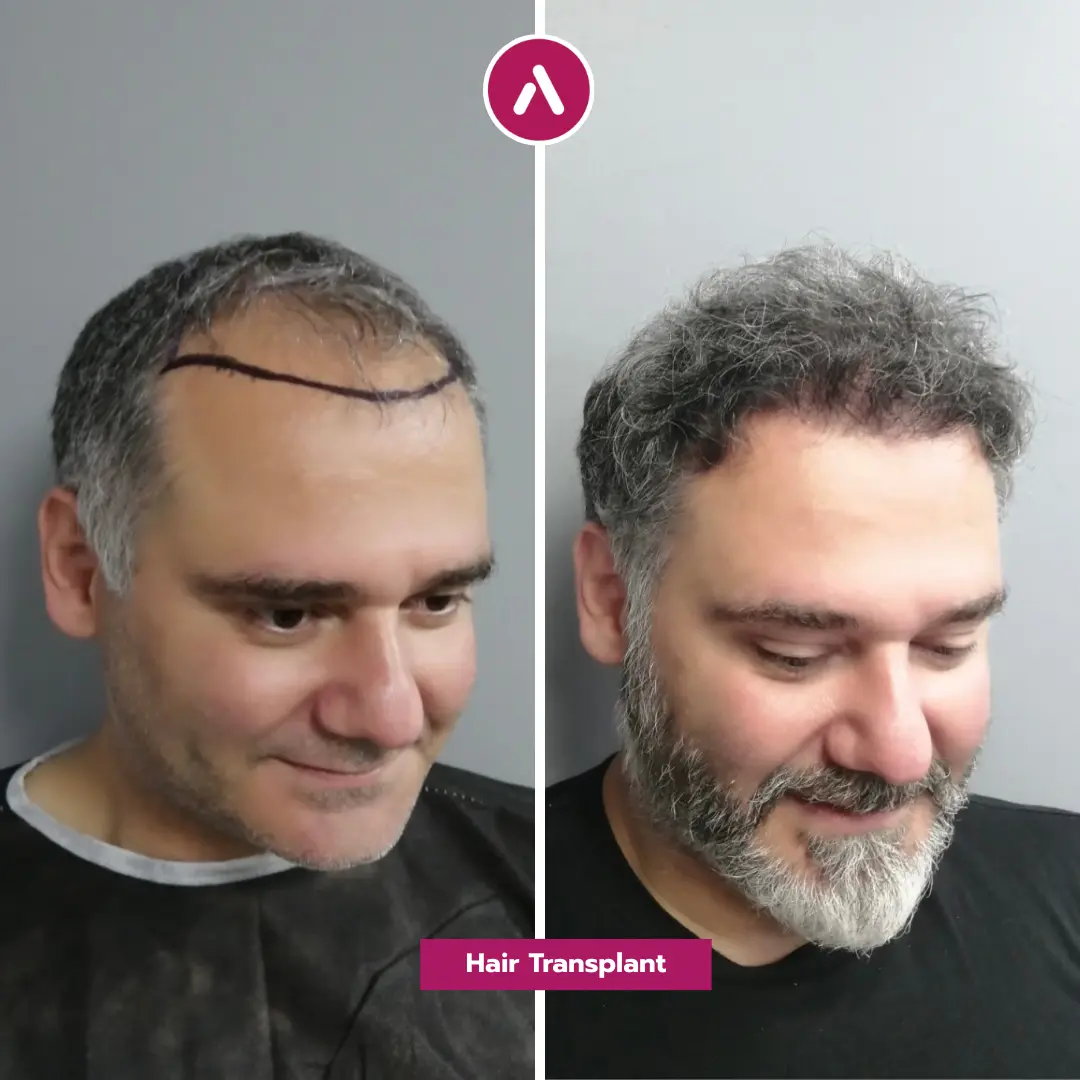
FUE (Follicular Unit Extraction) is the donor harvesting method used in most modern facial hair procedures. Individual follicular units are extracted one by one from the donor area (commonly the scalp) using a fine punch. Done properly, this supports a uniform donor appearance rather than obvious “thinning patches”.
- Donor planning aims to reduce the risk of donor thinning by distributing extractions evenly.
- Extraction technique influences graft integrity, which affects graft survival.
- Graft handling (sorting, hydration, and time out of the body) is a key variable in consistency.
For beard and moustache work, donor responsibility is part of the aesthetic outcome. A strong beard should not come at the cost of a visibly compromised donor area.
Sapphire FUE: channel precision and soft-tissue respect
Sapphire FUE typically refers to using a sapphire blade for channel opening (the tiny incisions that receive grafts). In facial areas, controlled channel creation can support neat healing and a smoother surface finish. This matters because facial skin is more visible than the scalp—particularly at stubble length.
- Fine channel control can help manage texture outcomes and reduce the risk of surface irregularities.
- Blade choice and channel patterning may influence comfort and early healing.
- Good channel planning supports direction changes across zones (cheek to jawline, moustache corners).
When patients worry about issues like cobblestoning (a raised, uneven surface appearance), it is usually a sign that they are thinking in the right direction: outcomes are not only about density. They are about how the hair sits in the skin.
DHI implantation: angle control in high-visibility areas
DHI (Direct Hair Implantation) uses an implanter pen to place grafts. It can be useful in facial hair work where tight angle control is essential—such as the moustache line and border zones that must look soft rather than “drawn on”. DHI is not “better” in every case; it is a tool that can be beneficial for specific design goals.
- May support precise placement and direction in delicate zones.
- Can be helpful when building softer density gradients along visible borders.
- Requires disciplined graft loading and timing to protect graft quality.
| Technique | Where it may be most useful | Potential advantages | Key considerations |
|---|---|---|---|
| FUE | Donor extraction for most beard & moustache cases | Individual graft harvesting; supports donor uniformity when planned well | Donor management is critical to reduce risk of donor thinning |
| Sapphire FUE | Channel opening in visible facial zones | Fine channel precision; aims for tidy healing and natural surface texture | Incision patterning and depth control are essential to avoid texture irregularities |
| DHI | Implantation in moustache line and border areas | High control of angle/direction; supports soft transitions | Technique demands careful graft handling and consistent operator skill |
Design Matters: Creating a natural beard line and moustache
Most “unnatural” results are not caused by one dramatic error. They are caused by design shortcuts: straight borders, flat density, inconsistent angles, and graft choices that ignore how real facial hair behaves. A natural-looking result is built through subtlety—especially in the moustache and cheek borders.
Beard line design: believable, not exaggerated
A convincing beard line is rarely a perfectly straight edge. Natural beards have mild asymmetry, varied density, and soft transitions. We design with those principles in mind, taking into account your age, face shape, and existing growth pattern.
- We map borders with a density gradient to avoid a harsh “marker pen” look.
- We respect natural asymmetry—small differences can look more authentic than forced symmetry.
- We plan direction changes across zones so the hair lays down naturally when trimmed.
Moustache design: high visibility, high precision
The moustache sits at the centre of the face and is under constant movement. That is why it is a high-precision area. Placement must respect the natural pattern of the upper lip, including how hair exits the skin and how it blends at the corners.
- We aim for a soft moustache line that looks natural at stubble length.
- Angle control is prioritised so hair does not stand upright or point unpredictably.
- Density is balanced to support styling without creating a heavy, artificial block.
Natural facial hair restoration is not about maximum density. It is about correct direction, soft transitions, and a design that looks effortless in real life.
Scar camouflage and texture: honest expectations
Transplantation can help camouflage scars and uneven growth, but it cannot “erase” skin texture. If you have a scar in the beard or moustache region, we assess the scar type, thickness, and blood supply, then advise what is realistic. In some cases, a conservative plan produces the most believable outcome.
- We discuss how scars may heal differently and how that can influence density planning.
- We avoid overpacking grafts in areas where the skin may not tolerate heavy density.
- We plan a result that blends with your existing growth rather than fighting it.
Anaesthesia and Comfort: Why we offer Awake/Twilight Sedation options
For many patients, the biggest unknown is not the graft count. It is comfort. A facial hair procedure is detailed work, and you need to stay relaxed while we focus on precision. This is why we plan anaesthesia around safety first, then comfort, rather than treating it as an afterthought.
Local anaesthesia: the standard foundation
Most beard and moustache procedures are performed under local anaesthesia. We numb the donor area and the recipient zones, then work methodically through extraction and implantation. You remain breathing on your own and able to communicate, while we keep you comfortable.
- We use staged numbing to avoid “one big hit” that can feel abrupt.
- We check comfort repeatedly, not just at the start.
- We keep the pace steady, with breaks when needed.
Awake surgery and “twilight”: when patients want an easier experience
Some patients are calm but simply prefer a lighter, more comfortable day. Others are anxious about the idea of a long procedure. In suitable cases, we may offer twilight sedation options to take the edge off without moving straight to a full general anaesthetic.
- It can help reduce procedural anxiety and restlessness.
- It may make time feel shorter for some patients.
- We still prioritise communication and safety checks throughout.
Not everyone needs this. Not everyone should have it. We decide based on your health profile, your comfort needs, and what is clinically appropriate.
Safety and monitoring: what “comfort” should never compromise
Comfort is useful only when it is controlled. We work in a monitored clinical environment and keep the focus on predictable, safe delivery. That includes pre-operative screening, clear documentation of your medical history, and continuous observation during the procedure.
- Pre-op checks and a final review of your plan on the day.
- Ongoing monitoring of how you are feeling throughout the procedure.
- A calm recovery period before you leave the clinic.
Comfort supports precision. When you are relaxed, we can focus on the details that make the result look natural.
Beard Transplant Step-by-Step: What happens in the operating theatre?
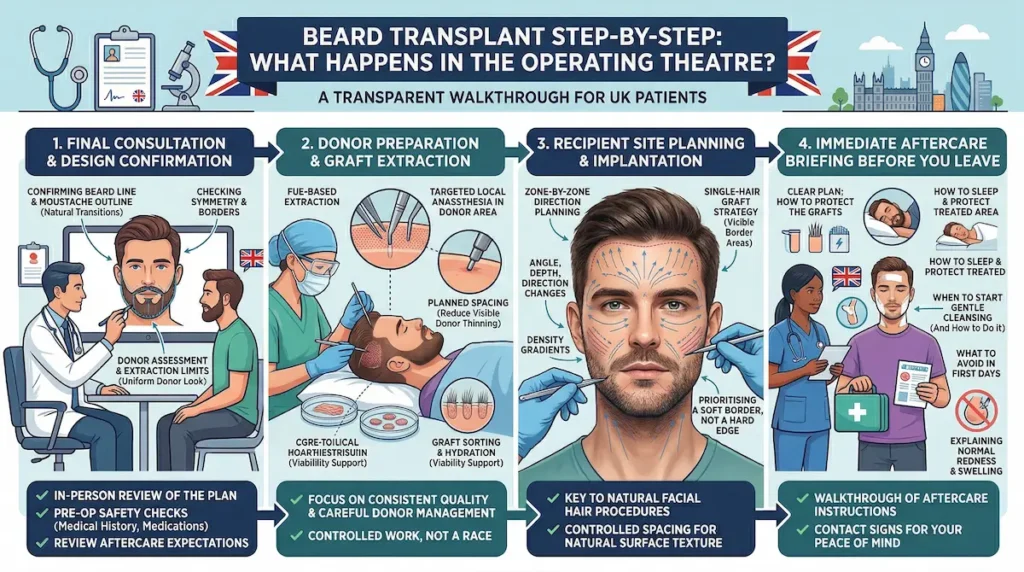
UK patients often ask for a transparent walkthrough. That is reasonable. A beard and moustache transplant is not a “single step” procedure; it is a sequence of controlled stages. We keep the process structured, so you know what is happening and why.
1) Final consultation, design confirmation, and pre-op checks
Your day starts with a final, in-person review of your plan. We confirm the design, check symmetry and borders, and agree on a realistic density strategy. We also complete the necessary pre-op checks to support safety before we begin.
- Confirming the beard line and moustache outline (with natural transitions)
- Donor assessment and extraction limits for a uniform donor look
- Reviewing medical history, medications, and aftercare expectations
2) Donor preparation and graft extraction
Once you are comfortable, we prepare the donor area and begin extraction. The aim is consistent graft quality and careful donor management. Extraction is not a race. It is controlled work.
- Targeted local anaesthesia in the donor area
- FUE-based extraction with planned spacing to reduce visible donor thinning
- Graft sorting and hydration to support viability
3) Recipient site planning and implantation
This is where facial hair procedures are won or lost. We create recipient sites (or implant directly, depending on the method) with attention to angle, depth, and direction changes across facial zones. Then we place grafts with density gradients, prioritising a soft border rather than a hard edge.
- Zone-by-zone direction planning (cheeks, jawline, chin, moustache line)
- Single-hair graft strategy in visible border areas where appropriate
- Controlled spacing to support a natural surface texture
4) Immediate aftercare briefing before you leave
Once implantation is complete, we review your aftercare instructions in practical terms. You leave with a clear plan: how to protect the grafts, how to clean, and what to avoid in the first days. We also explain what “normal” looks like, so you are not surprised by early redness or swelling.
- How to sleep and protect the treated area
- When to start gentle cleansing and how to do it
- What signs should prompt you to contact us
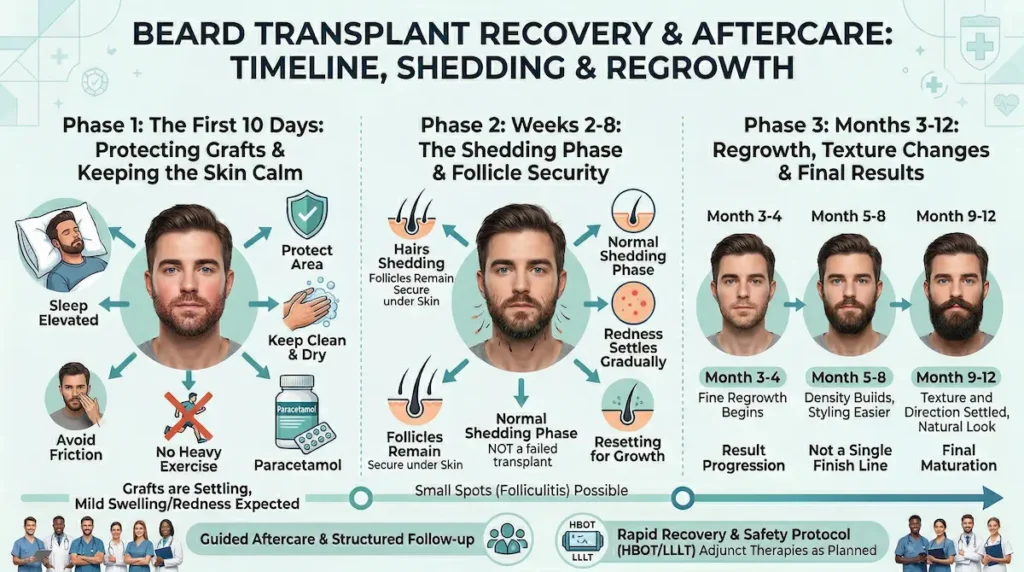
Beard Transplant Recovery and Aftercare: timeline, shedding phase and regrowth
Recovery after a beard and moustache transplant is usually straightforward, but it is not “hands-off”. The first two weeks are about protecting grafts and keeping the skin calm. The next few months are about patience and consistency. We give you clear, practical aftercare so you know what is normal, what is avoidable, and what needs a message to our team.
The first 10 days: protecting grafts and keeping the skin calm
The initial healing phase is mainly about stability. The grafts are settling, the skin is reacting, and mild swelling or redness can be expected. Your job is simple: protect the area, keep it clean, and avoid friction. We will provide a step-by-step washing routine and guidance on sleeping position.
- Sleep slightly elevated, and avoid pressing your face into a pillow.
- Keep the transplanted area clean and dry between washes as advised.
- Avoid heavy exercise, steam rooms, and swimming in the early phase.
- Do not scratch crusts. Let them soften and shed naturally.
If you need pain relief, we guide you on UK-standard options such as paracetamol, based on your medical history. We also explain what “normal discomfort” feels like versus pain that is escalating.
Weeks 2–8: the shedding phase and what it means
The shedding phase can catch people off guard. It is common for transplanted hairs to fall out in the first weeks, while the follicles remain in place under the skin. This is not a “failed transplant”. It is part of how follicles reset before new growth begins. Some patients also notice temporary shock loss around the recipient area, especially if the skin was already sensitive.
- Early shedding is expected. The follicle is what matters.
- Redness usually settles gradually, but timelines vary by skin type.
- Small spots (folliculitis) can occur as new hairs start to emerge.
We plan for real life, not day one. Early shedding is a phase, not a verdict.
Months 3–12: regrowth, texture changes, and “final” results
New hairs often start to appear from around month three, then build gradually. Facial hair can feel different as it matures—thickness, curl pattern, and softness can change over time. This is why we talk about “result progression” rather than a single finish line. Most patients see meaningful improvement by six months, with refinement continuing up to 12 months.
- Month 3–4: early regrowth begins, often fine at first.
- Month 5–8: density becomes more noticeable; styling gets easier.
- Month 9–12: maturation phase; texture and direction look more settled.
We also plan recovery with travel in mind. Our flight-ready recovery protocols focus on keeping the early phase controlled so you can return to the UK with clear instructions and a structured follow-up plan.
Where clinically appropriate, we may integrate our Rapid Recovery & Safety Protocol, including HBOT and LLLT, to support tissue recovery and reduce inflammation. These therapies are not a substitute for careful aftercare. They are an adjunct when a patient’s plan calls for it.
Combined Procedures: can a beard moustache transplant be paired with other treatments?
Some patients want more than one improvement in the same trip. That is understandable. The key question is not “can we do it?”, but “should we do it together?”. We plan combinations around safety, healing, and graft protection rather than convenience.
Beard and scalp restoration: when patients want both
It is common to see overlap between facial hair goals and scalp hair concerns. In selected cases, we can plan beard and scalp restoration as part of a broader strategy. Sometimes that means combining procedures. Other times, it means staging them to keep each zone calm and predictable.
- We prioritise donor responsibility when more than one area needs grafts.
- We plan time in theatre so placement quality does not drop at the end of the day.
- We advise staging if swelling, skin sensitivity, or donor supply make it the safer route.
Eyebrow transplant or other hair procedures: staging often wins
Some patients ask about combining a beard procedure with an eyebrow transplant or another hair restoration treatment. These areas heal differently and need different design rules. For many patients, staging keeps results more controlled and recovery simpler.
- We treat each zone as a separate design problem, not a “bundle”.
- We plan the order based on visibility, healing comfort, and practical downtime.
- We keep expectations realistic for density and maturation timelines.
Can a beard procedure be combined with a DHI hair transplant, rhinoplasty, or liposuction?
Some UK patients ask whether a Beard Moustache Transplant can be planned alongside a DHI hair transplant, rhinoplasty, or liposuction during the same trip. In selected cases it may be possible, but we decide based on safety, anaesthesia considerations, swelling risk, and how each procedure affects healing. Where combining could compromise graft protection or comfort, we recommend staging—so each treatment is performed under calmer, more predictable conditions with clear recovery priorities.
Skin treatments and recovery support: what can be considered
For UK patients, the priority is often a calm recovery and a tidy early healing phase. Where clinically appropriate, we may discuss adjunct support such as our Rapid Recovery & Safety Protocol. The goal is to reduce inflammation and support tissue recovery, not to “rush” biology.
- We do not treat add-ons as compulsory. We match them to need.
- We keep aftercare simple enough to follow once you are back in the UK.
- We decide timing based on skin response and overall comfort.
Risks and Complications: what can go wrong (and how we minimise it)
No responsible clinic should pretend a beard and moustache transplant is “risk-free”. It is a minor surgical procedure, and it comes with predictable post-op effects and occasional complications. The difference is how risks are anticipated, explained, and managed. We minimise risk through careful screening, surgeon-led planning, sterile theatre standards, and structured aftercare.
Common, expected effects: swelling, redness, and tenderness
Some side effects are part of normal healing. You may experience mild swelling, redness, tenderness, and short-term numbness. The moustache area can feel slightly more sensitive because it moves throughout the day. Most of these effects ease gradually with sensible care and time.
- Swelling: usually early and mild, settles over days.
- Redness: variable by skin type; often improves progressively.
- Tenderness: expected, especially in the first week.
We advise you on practical comfort measures and what to avoid, including aggressive washing, heat exposure, and early gym sessions.
Skin and follicle issues: folliculitis, ingrown hairs, and irritation
As new hairs start to grow, small spots can appear. This may be folliculitis or an ingrown hair. It is usually manageable when caught early and treated appropriately. The key is not to self-treat aggressively or pick at the area.
- Keep cleansing gentle and consistent as instructed.
- Avoid harsh exfoliants until we confirm it is safe.
- Contact us early if spots become painful, widespread, or persistent.
We will guide you on the right response based on how the skin looks and how you feel, including whether topical care or medication is appropriate.
Aesthetic and donor risks: direction errors, cobblestoning, and donor thinning
The “expert patient” worries about aesthetics for good reason. Direction, density gradients, and surface texture matter more on the face than almost anywhere else. Potential issues include uneven density, incorrect angles, and surface irregularities such as cobblestoning. Donor risks include visible donor thinning if extraction is not planned responsibly.
- We minimise angle and direction risks through zone-by-zone mapping and controlled implantation.
- We minimise texture risks through precise channel work and measured density planning.
- We minimise donor thinning by distributing extractions evenly and respecting safe limits.
When should you contact us urgently? If you develop increasing pain, spreading redness, discharge, or a fever of 38°C (100.4°F) or above, you should contact our team promptly for guidance. If you are back in the UK and feel unwell, we will also advise you when to speak with your GP or attend A&E.
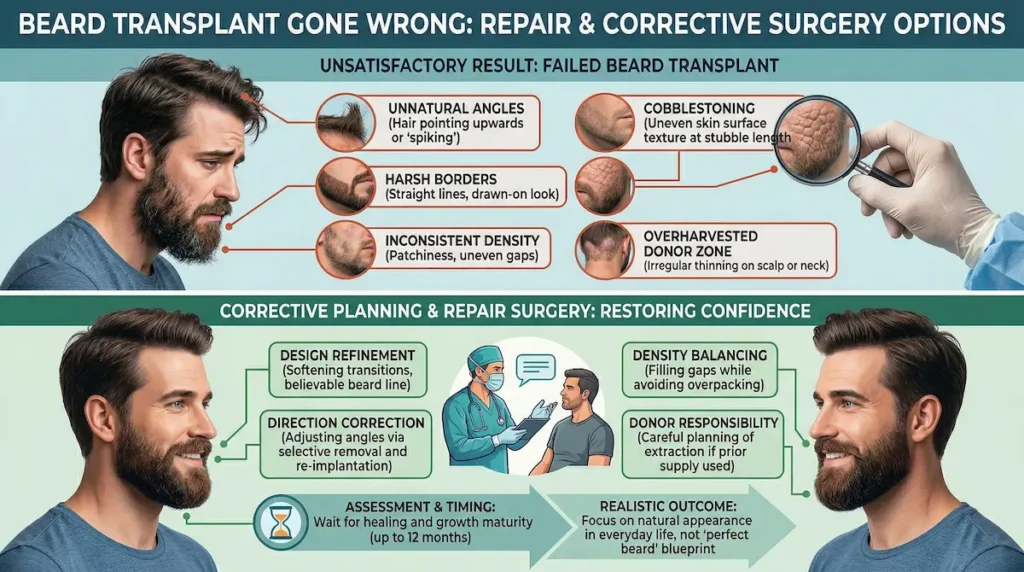
Beard Transplant Gone Wrong: repair and corrective surgery options
If you are searching terms like “beard transplant gone wrong” or “failed beard transplant”, you are not overthinking it. Facial hair work is highly visible, and a poor result can be difficult to live with. The good news is that many issues are correctable — but repair surgery requires careful assessment and a realistic plan, not quick fixes.
Common signs of an unsatisfactory result
Corrective planning starts by identifying the true cause. Sometimes the problem is density. More often, it is direction, border design, or a mismatch between graft type and placement zone. The following concerns are commonly reported by UK patients seeking repair options:
- Unnatural angles (hair pointing upwards or “spiking” when it should lie flatter)
- Harsh, straight borders that look drawn-on rather than blended
- Patchiness caused by inconsistent density distribution
- Cobblestoning or an uneven surface texture, especially visible at stubble length
- Donor thinning that looks irregular or overharvested
It is also worth saying: early redness, temporary shedding, and the “awkward phase” are not the same as a failed transplant. This is why we typically review timelines and photos before making any conclusions.
How corrective planning works (and why timing matters)
Repair surgery is not always immediate. If a previous procedure was recent, the first step may be to let healing and growth settle, then reassess. Facial hair can continue to mature for up to 12 months. Once the baseline is clear, a corrective plan can be designed around what is realistically achievable.
- Design correction: refining borders, softening transitions, and restoring a believable beard line
- Direction correction: adjusting angles through selective removal and re-implantation where appropriate
- Density balancing: filling gaps while avoiding overpacking in sensitive areas
- Donor responsibility: planning extraction carefully if donor supply has already been used
In some cases, the most effective approach is staged. A conservative first step can improve naturalness dramatically, and a second stage can refine density once the skin has settled.
What repair can (and cannot) do
Corrective surgery can often improve direction, borders, and overall believability. What it cannot do is rewrite skin biology. If you have scarring, thickened tissue, or prior trauma, density may need to be planned more cautiously. A responsible repair plan is honest about limitations and focuses on the outcome that looks natural in everyday life.
Repair surgery is about restoring confidence through disciplined design — not chasing an unrealistic “perfect beard” blueprint.
Next steps: If you are considering corrective options, you can share clear, well-lit photos (front, both sides, and under-chin) so we can advise whether a repair plan is appropriate. Related reading: FUE Hair Transplant, DHI Hair Transplant.
Is Beard Moustache Transplant safe in Turkey for UK patients?
Safety is a reasonable concern — especially if you have seen stories online that focus on poor outcomes and limited accountability. A beard and moustache transplant can be safe when it is treated as a medical procedure: with proper screening, sterile standards, surgeon-led planning, and structured aftercare. The destination is not the safety variable. The process is.
Clinical standards: screening, sterility, and documentation
Before we discuss graft numbers, we confirm suitability. That includes reviewing your medical history, medications, and any skin issues in the recipient area. On the day, the procedure is performed in a controlled clinical environment with an emphasis on sterile technique and clear documentation.
- Pre-operative checks and a final review of your plan before starting
- Structured theatre protocols (clean workflow, controlled handling of grafts)
- Clear aftercare instructions that reduce avoidable complications
If you have a complex medical background, it may be appropriate to coordinate with your GP for additional clarity before you travel. The goal is predictability, not rushing.
Surgeon-led planning: the difference between “service” and “medicine”
For the UK “expert patient”, safety and aesthetics overlap. A clinic that cannot explain how it controls angles, density gradients, donor management, and healing timelines is not operating at the level you want. We approach facial hair work as a surgeon-led design problem — because that is how you reduce the risk of unnatural outcomes.
- Zone-by-zone mapping for direction changes across the face
- Measured density planning to avoid harsh borders and surface texture issues
- Donor management that prioritises a uniform donor appearance
This is also where informed consent matters. You should know what is realistic for your donor supply and your skin — and what is not.
Aftercare and follow-up for UK patients
Many complications become “big problems” because patients feel unsupported after they fly home. We treat aftercare as part of the procedure. You will leave with a written plan, practical timelines, and guidance on what is normal versus what needs attention. We also structure follow-up so you are not left guessing at key milestones.
- Clear guidance for the first 10 days (cleansing, sleeping, and activity restrictions)
- Support through the shedding phase so you do not misinterpret normal changes
- Planned check-ins (remote and/or in-person) during the growth and maturation period
If you are back in the UK and develop worsening pain, spreading redness, discharge, or a fever of 38°C or above, you should contact our team promptly for advice. If you feel unwell, we will also guide you on when to speak with your GP or attend A&E.
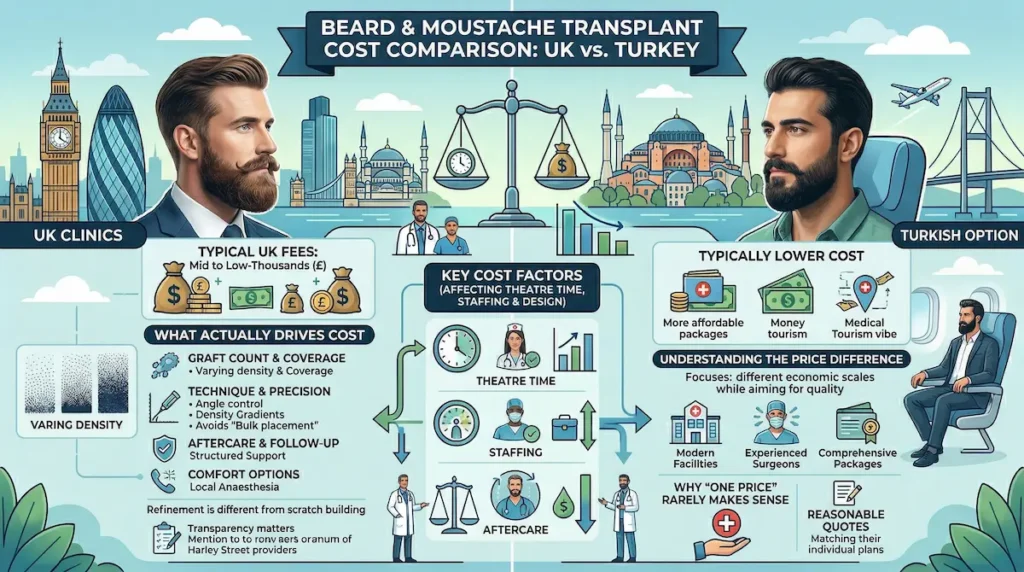
Cost / Fees: Beard Transplant Cost 2026 (Turkey vs UK)
Cost questions are sensible. A Beard Moustache Transplant is planned around graft numbers, design complexity, and the time needed to place follicles at the right angle. That detail affects theatre time, staffing, and aftercare. It also explains why “one price for everyone” rarely makes sense. We prefer a transparent quote that matches your plan, not a headline figure.
What actually drives the cost?
When UK patients compare fees, it helps to compare like with like. A beard line refinement is not the same as building cheek density from scratch. The moustache line is also a high-precision zone, so it can be slower work than expected.
- Graft count and coverage: larger surface area and higher density planning generally increase time and cost.
- Technique and implantation control: angle control and density gradients take longer than “bulk placement”.
- Aftercare and follow-up: structured support reduces uncertainty during the shedding phase and early regrowth.
- Comfort options: local anaesthesia is standard; some patients choose added comfort support where suitable.
UK fees: what clinics typically publish
Many UK clinics publish beard transplant prices in the low-thousands to mid-thousands, depending on the area treated. Harley Street providers commonly list pricing structures tied to the size of the area or graft banding. That transparency is helpful. It also shows why two quotes can differ even when “the graft count sounds similar”.
- Very small areas may start around the £3,000 GBP.
- Medium areas are often quoted in the £5,000–£6,000 GBP range.
- Larger coverage can reach £7,000+ depending on the plan.
Turkey value: why the number can be different without lowering standards
When you see a lower total fee in Turkey, the first question should be “What changed?”. Sometimes, the answer is not clinical. It is macroeconomics and national operating costs. At AKM Clinic, we keep standards high by working within a structured environment and using a transparent, all-inclusive model for international patients.
| Cost Category | Typical UK Clinic Model | Our AKM Model (Istanbul) |
|---|---|---|
| Procedure fee | Usually priced per area or graft band | Personalised plan with a single, transparent quote |
| Anaesthesia & theatre fees | Often itemised or built into the surgical fee | Included within the package structure |
| Pre-operative tests | May be separate or limited | Included as standard |
| Aftercare essentials | Varies by clinic | Included (post-op medications, garments, and guidance) |
| Accommodation & transfers | Usually not included | Included (5-star hotel and VIP airport/clinic transfers) |
| Long-term follow-up | Varies by clinic and location | Included (structured virtual follow-up) |
Value is not a lower number. It is a controlled plan, predictable healing, and follow-up that does not disappear after you fly home.
If you want a quote that is actually comparable, we start with photos and a design discussion. Then we estimate grafts, map the zones, and give you one clear figure—without hidden extras.
Request a free virtual consultation to receive a personalised plan and a transparent, all-inclusive quote.
Your Medical Journey: what to expect from the UK to Istanbul
Travelling for a procedure should feel organised, not improvised. We built our VIP process to remove the practical friction that makes people hesitate: finding a hotel, arranging transfers, and wondering who to contact after surgery. You stay focused on preparation and recovery. We handle the rest. It is a calm, step-by-step pathway from arrival to departure.
Step 1: free virtual consultation and planning
Your journey starts at home. You share clear photos and your goals, then we discuss design, graft estimates, and suitability. We also explain timelines honestly—especially the shedding phase—so expectations stay realistic. If you decide to proceed, we confirm dates and organise the plan.
- Photo review and goal-setting
- Initial graft estimate and zone mapping
- Pre-op guidance (medications, smoking, and practical preparation)
Step 2: VIP arrival, hotel, and transfers
When you land in Istanbul (IST or SAW), we arrange a private airport welcome and transfer to your hotel. We coordinate your clinic transfers as well, so you are not navigating logistics on a recovery day. This is deliberately simple. It reduces stress.
- Airport meet-and-greet and private transfer
- 5-star partner hotel accommodation
- Planned transfers between hotel and clinic
Step 3: procedure day, post-op check, and flight-ready support
On the day, you have a final in-person consultation to confirm the design and the plan. After the procedure, we monitor you, then walk you through aftercare in practical language. Before you leave Istanbul, we complete a final check to ensure your recovery is on track and you are comfortable to travel. Your dedicated patient host remains available via WhatsApp for support.
- Final design confirmation and pre-op checks
- Procedure performed in a structured clinical setting
- Post-op review, aftercare briefing, and clearance before return travel
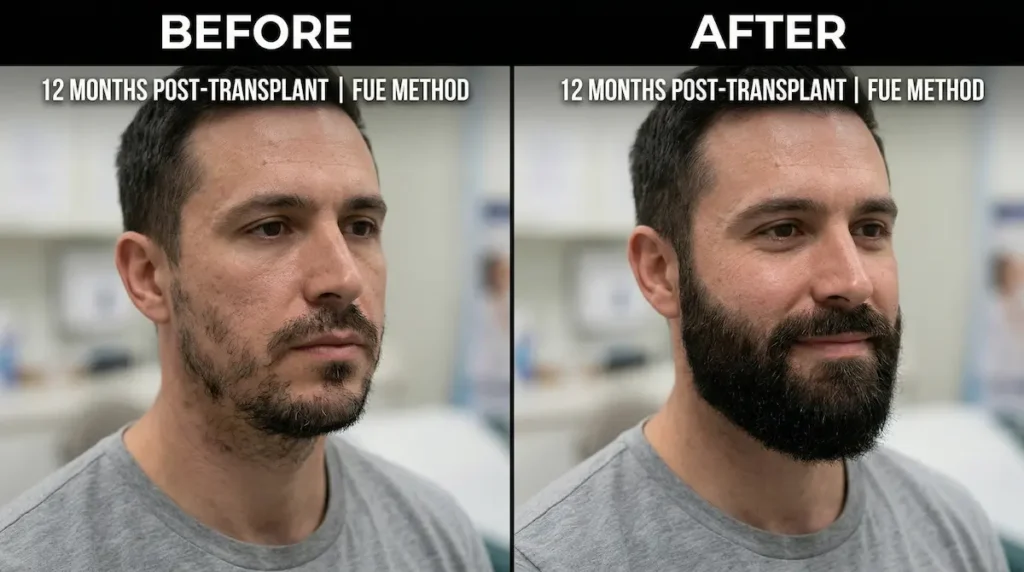
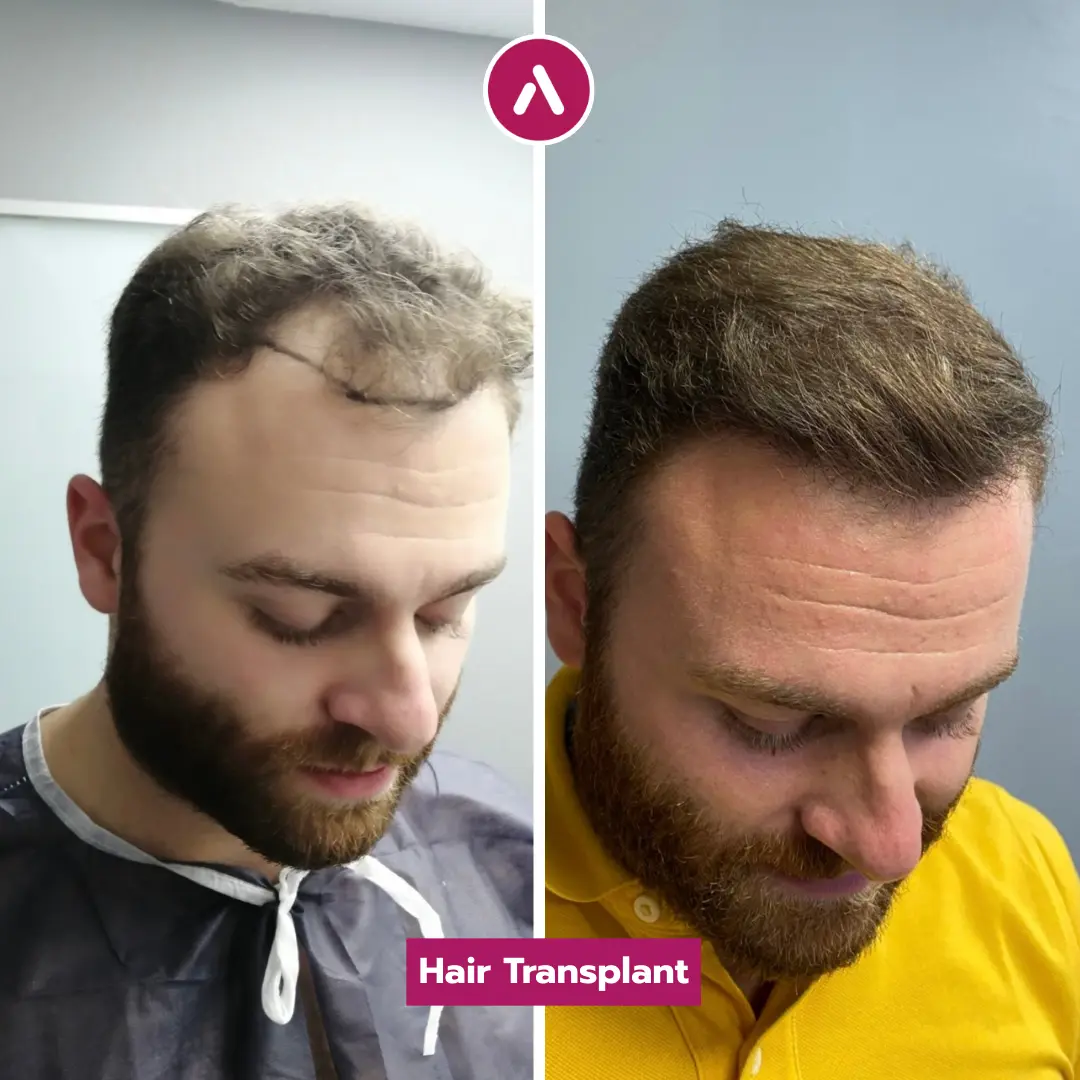
Beard Transplant Before and After: Realistic expectations and results
Facial hair restoration is very rewarding when it is planned with restraint. It is also very easy to misunderstand if you are judging it too early. In the first weeks, your skin is healing and the transplanted hairs often shed. In the following months, the hair returns gradually, then matures in texture and behaviour.
Our philosophy stays consistent throughout: rejuvenation, not alteration. We design results that look believable in normal lighting and at stubble length. That means controlled density, correct angles, and soft transitions. It also means honest limits when your donor supply or skin characteristics set boundaries.
What a “natural result” looks like at stubble length
Most people in the UK judge a beard by how it looks at 0.5–2 mm stubble. That is where direction errors and harsh borders show up quickly. A natural outcome is not a sharp outline with uniform density. It is a gradient.
- Soft borders that blend into your existing growth rather than a straight “drawn-on” line
- Direction that follows facial zones, so the hair lies down naturally when trimmed
- Balanced density that looks consistent in daylight, not only in clinic lighting
- Surface texture that heals smoothly, without an uneven “bumpy” appearance
The best result is the one you do not have to explain. It simply looks like your own facial hair.
Timeline: when you will actually see change
Most patients notice an early “quiet period” after the initial healing. That is normal. Shedding commonly happens first, then regrowth begins later. We plan around this, so you do not feel blindsided by normal phases.
- Weeks 1–2: crusting settles, redness gradually reduces, comfort improves
- Weeks 2–8: shedding phase is common; the follicles remain in place
- Months 3–6: visible regrowth begins and density builds progressively
- Months 6–12: maturation phase; texture and direction look more settled
If you are returning to work quickly, planning matters. We can also integrate our Rapid Recovery & Safety Protocol (HBOT and LLLT) when clinically appropriate, to support tissue recovery and reduce post-op inflammation. It is not a shortcut. It is an adjunct to careful surgery and sensible aftercare.
Permanent results and daily maintenance
Many UK patients ask whether facial hair transplants are permanent. In most cases, transplanted follicles continue to grow long-term. That said, “permanent” does not mean “instant” or “maintenance-free”. You still need to trim, shape, and allow time for the hair to behave naturally.
- Beard and moustache hairs mature over time, often becoming more consistent by month 9–12
- Texture may evolve, especially as the follicles settle into the facial skin environment
- We plan your design for how you actually wear your facial hair: clean-shaven, short stubble, or fuller growth
We also keep expectations grounded. If you want a very high-density “full beard build” but donor supply is limited, we will prioritise the zones that create the biggest visual improvement. That is how you get a result that looks natural and still respects donor safety.
Finding the Best Beard Transplant Surgeon: a UK checklist for safer decisions
If you are an “expert patient”, you already know the risk is not the concept of transplantation. The risk is inconsistent execution. Facial hair work is highly visible and unforgiving, so surgeon choice matters. Credentials matter too, but they are only one part of the picture.
Our advice is simple: judge a clinic by the thinking behind the plan. Ask who designs the beard line, who controls angles, and who takes responsibility for the donor area. Then look at how they support you after you fly home. That is where serious providers separate themselves from high-volume setups.
Credentials and accountability: what to look for
UK patients often search for “GMC registered surgeon alternatives” because they want a familiar trust signal. When you are considering treatment abroad, you should look for equivalent indicators of training and accountability. You should also confirm that your procedure is led by specialists registered with recognised medical boards.
- Clear identification of the surgical lead and their scope of practice
- Transparent pre-operative screening and informed consent
- A clinic that treats facial hair restoration as a surgical procedure, not a cosmetic service
Questions that reveal quality (and protect you)
You do not need a long list of questions. You need the right ones. The answers should be specific and consistent, not vague reassurance.
- How do you plan angles across different beard zones and the moustache line?
- How do you reduce the risk of cobblestoning and surface texture issues?
- How do you manage donor extraction to avoid visible donor thinning?
- What is your approach to graft handling time and graft survival?
- What does follow-up look like once I am back in the UK?
Red flags that UK patients should not ignore
If a clinic cannot explain its planning logic, that is a problem. If the focus is only on a graft number or a “fast booking”, that is also a problem. Facial hair restoration requires patience and precision. Shortcuts show.
- Promising extreme density without discussing donor limits or skin tolerance
- Unclear roles (who actually does the extraction and implantation)
- Minimising risk or calling it “risk-free”
- No structured aftercare plan, especially for international patients
If you want a clear, surgeon-led plan, start with a free virtual consultation. Share well-lit photos (front, both sides, and under-chin), explain your goal, and we will advise what is realistic and how we would stage it safely.
Frequently Asked Questions about Beard Moustache Transplant (FAQ):
Most questions we hear from UK patients are practical. When will it look normal? When can I shave? What if it sheds? These are sensible questions. Below are clear answers based on typical healing patterns and responsible planning.
Are beard implants permanent?
In most cases, transplanted follicles continue to grow long-term. “Permanent” does not mean instant. It means the follicles need time to settle, shed, and then regrow through the normal cycle. We plan results with long-term realism, not short-term hype.
When can I shave or trim after a beard transplant?
Timing depends on healing and how the skin is behaving. We usually advise avoiding shaving over the transplanted area in the early phase to prevent friction and accidental trauma. Once the skin has settled, we guide you on a safe return to trimming and shaving.
Early phase: focus on protection and gentle cleansing.
Next: gradual return to trimming when the skin feels stable.
If in doubt, ask us before you do it. A quick check saves mistakes.
What is the shedding phase, and is it normal?
Shedding is common. Transplanted hairs often fall out in the first weeks while the follicles remain under the skin. This can feel alarming if you are not expecting it. It is usually a normal part of the reset before new growth begins.
Will the donor area thin or leave visible scarring?
Donor planning matters. A careful extraction pattern aims to keep the donor area looking uniform rather than patchy. Tiny extraction points typically fade over time, but healing varies by skin type and haircut choice. We discuss donor visibility in advance so you can make an informed decision.
How many grafts do I need for a full beard or moustache?
There is no single number that fits everyone. We estimate grafts after mapping your zones, measuring gaps, and agreeing on a believable density plan. For many patients, a targeted plan that improves the “weak points” looks more natural than chasing maximum coverage everywhere.
Can a moustache transplant look natural?
Yes, when angle control and softness are prioritised. The moustache is a high-visibility area with constant movement, so placement depth and direction matter. We design for natural transitions at the corners and a believable density at stubble length.
How painful is the procedure, and what can I take afterwards?
Most patients describe the procedure as manageable with local anaesthesia. Afterwards, discomfort is typically mild and short-lived when aftercare is followed properly. If you need pain relief, we guide you on suitable options for UK patients, such as paracetamol, based on your medical history.
Can you fix a failed or unnatural beard transplant?
In many cases, yes. Repair planning depends on what went wrong: angle, density distribution, harsh borders, or surface texture issues. We often advise waiting until growth and healing settle before deciding on corrective work. Then we design a practical repair plan with clear limits.
How long will redness last?
Redness varies by skin type and sensitivity. Some patients settle quickly. Others take longer, especially in the moustache area or if the skin is reactive. If redness worsens, becomes painful, or is associated with discharge, we want to know early.
Can beard hair be used for scalp transplantation (beard-to-scalp)?
In certain cases, beard hair can be discussed as a donor option for scalp restoration. It is not a default choice, and it requires careful matching and planning. If this is your concern, we assess it as a separate design decision.
Beard Moustache Transplant works best when it is planned calmly, executed precisely, and supported properly after you return home. If you want a personalised plan, start with a virtual consultation and a photo review.
Medical Disclaimer: This page is for general information only and does not replace medical advice, diagnosis, or treatment. Every patient’s anatomy, health status, healing response, and results can vary. A formal consultation and medical assessment are required to confirm suitability, risks, and expected outcomes. If you develop urgent symptoms after any procedure (such as worsening pain, spreading redness, discharge, or a fever of 38°C / 100.4°F or above), seek medical attention promptly and contact our team for guidance.