




If you’re in the UK and considering a tummy tuck but feel uneasy about general anaesthesia, this guide is for you. At AKM Clinic in Istanbul, we offer Awake tummy tuck for suitable candidates—designed to deliver meaningful body contouring changes while prioritising comfort, safety, and a calmer overall experience. In the sections below, we explain how the technique works, who it suits, what recovery typically involves, how risks are managed, and how to plan the journey from the UK with clear, GBP-focused expectations.
We’ve written this for the “expert patient”: someone who wants clinical clarity, not marketing claims. You’ll find straightforward explanations of abdominal muscle repair, different tummy tuck techniques, combination options (including liposuction-based contouring), and the practical details that matter—such as timelines, aftercare, and what to ask when comparing providers in London, Manchester, or abroad.
Table of Contents
What is Awake Tummy Tuck?
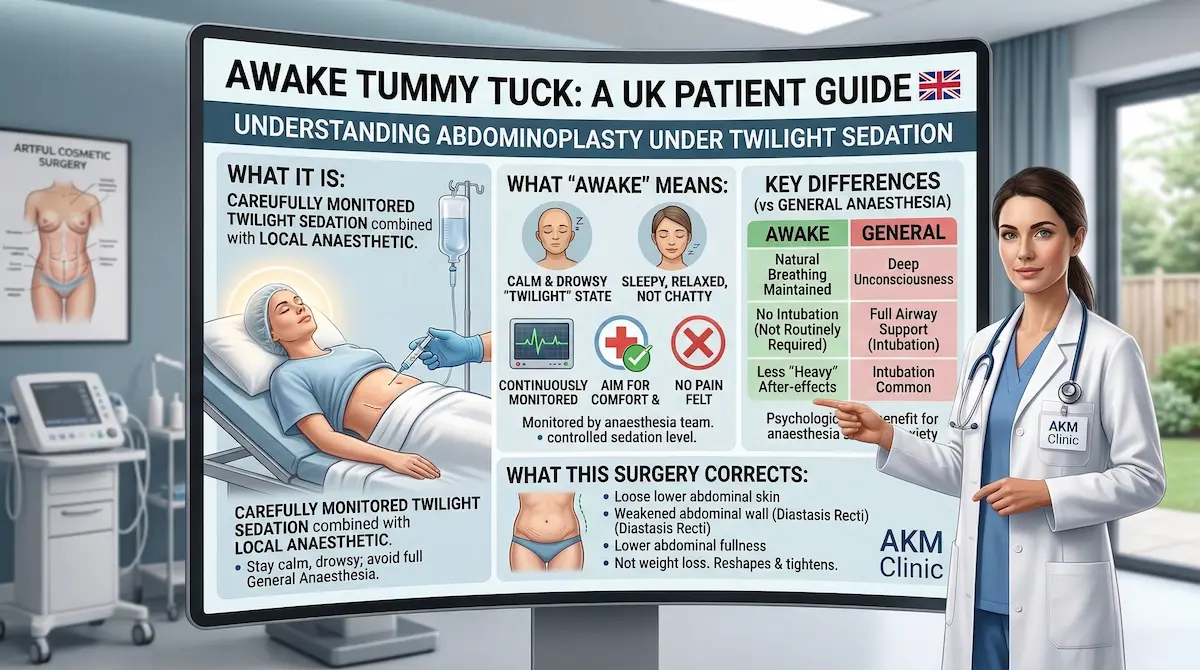
Awake tummy tuck is a form of abdominoplasty performed with carefully monitored twilight sedation, combined with local anaesthetic. You stay in a calm, drowsy “twilight” state rather than being placed into full general anaesthesia. Our aim is simple: a proper surgical result, without the stress many patients associate with being fully “put under”.
What “awake” really means
In UK patient conversations, “awake” often means “I won’t be completely unconscious.” That is broadly true. You are typically sleepy and relaxed, and you may be able to respond to simple cues if needed, but you are not expected to be alert or chatty.
- You are monitored continuously by an anaesthesia team.
- We aim for comfort, safety, and a controlled sedation level.
- You should not feel pain during the procedure.
How it differs from general anaesthesia
Traditional tummy tuck surgery is often performed under general anaesthesia, which commonly involves deeper unconsciousness and airway support. With twilight sedation, the goal is a stable, pain-free state while maintaining natural breathing where appropriate.
- Breathing tube (intubation) is not routinely required in the same way as deep general anaesthesia.
- Many patients report less “heavy” post-anaesthetic after-effects.
- For people with anaesthesia anxiety, the psychological difference can be significant.
What this surgery can correct
A tummy tuck is not a weight-loss procedure. It is contour surgery. We remove excess skin, tighten the abdominal wall when appropriate, and re-shape the midsection to restore balance.
- Loose lower abdominal skin after pregnancy or weight changes
- Stretched or weakened abdominal wall (diastasis recti in suitable cases)
- Lower abdominal fullness that does not respond to training
Our approach is guided by one principle: Rejuvenation, not alteration. The aim is a refined, natural-looking contour that still feels like you.
Benefits of Awake Tummy Tuck
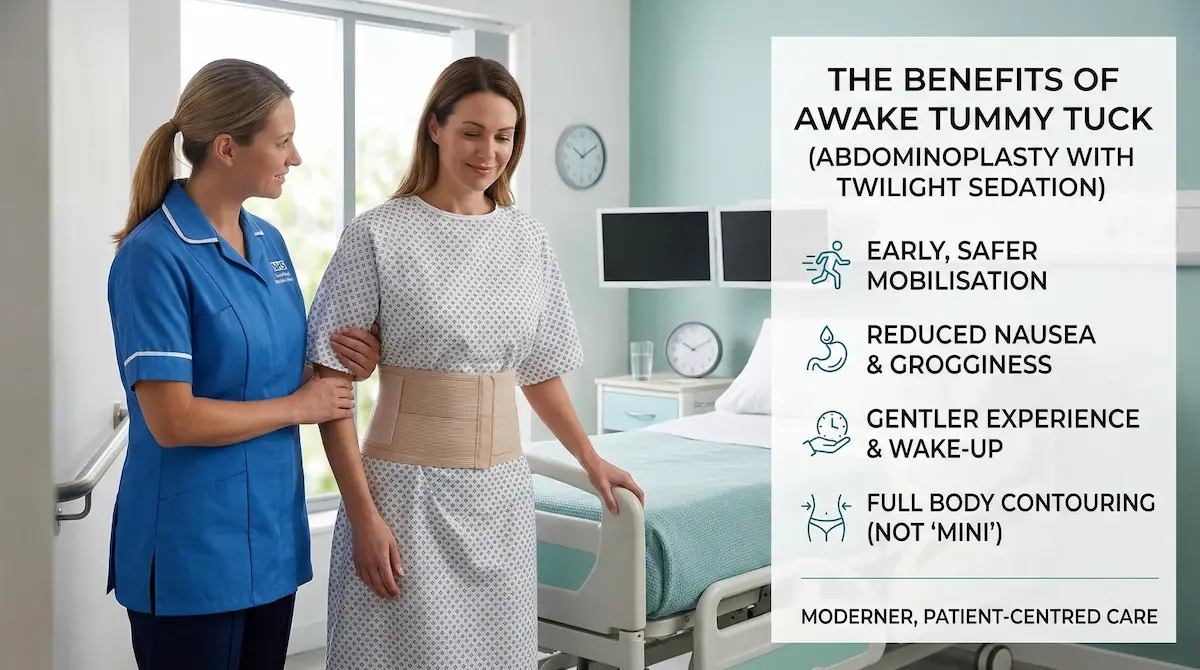
The potential advantages of an awake approach are not about “cutting corners” — they’re about how the anaesthetic plan can shape the first 24–72 hours around surgery. For suitable patients, twilight sedation may feel psychologically easier than full general anaesthesia, with a gentler wake-up and fewer heavy after-effects. It can also support earlier, safer mobilisation (a key part of modern recovery), while still allowing the surgeon to perform a proper contour-focused abdominoplasty where clinically appropriate. As always, the benefits depend on candidacy, a well-structured pain-control plan, and careful monitoring throughout.
A calmer experience for patients with anaesthesia anxiety
Some UK patients want a significant body contouring change, but feel blocked by fear of general anaesthesia. Twilight sedation can remove that barrier for the right candidate. It is often perceived as a gentler path into and out of surgery.
- Less “loss of control” fear for many patients
- A more gradual, steady recovery from sedation
- Clearer expectations when we explain each step in advance
Potentially less post-operative nausea and grogginess
One common concern is Post-Operative Nausea and Vomiting (PONV). While no anaesthetic technique can guarantee zero nausea, a lighter sedation strategy may reduce the likelihood in selected patients. We also plan your anti-nausea approach proactively.
- Reduced exposure to heavier anaesthetic protocols may help some patients
- Hydration and medication planning supports a smoother first 24 hours
- Early fluids and light intake are often easier when nausea is better controlled
Earlier mobilisation as part of a safety-first recovery plan
Getting you moving safely matters. The sooner you can stand, walk gently, and breathe deeply, the better for circulation and general recovery. With a well-managed sedation approach, many patients feel more able to mobilise sooner.
- Short, assisted walks as soon as it is safe
- Better confidence when dizziness and nausea are minimised
- A practical foundation for your overall recovery timeline
No compromise on the fundamentals of a proper tummy tuck
“Awake” does not mean “mini” by default. The surgical plan is still based on your anatomy: skin quality, muscle separation, and how far around the waist we need to contour. The technique must fit the body, not the other way around.
- Skin excision and contour refinement where it is clinically appropriate
- Abdominal wall support (muscle repair) in suitable cases
- Balanced results that look natural in real life, not just in photos
Am I a Suitable Candidate for Awake Tummy Tuck Surgery?
Suitability is the foundation of safety. We screen you carefully, because the best results come from matching the surgical plan to your anatomy and health profile. Most UK patients who explore tummy tuck surgery have tried exercise, diet, and strength training first. Surgery becomes relevant when the limiting factor is skin laxity or abdominal wall separation rather than fitness.
Who tends to do well with this procedure
In practical terms, good candidates usually share a few patterns. They are at a stable weight, understand what surgery can and cannot do, and want a defined, natural-looking contour rather than an extreme change.
- Stable weight for several months (fluctuations can compromise results)
- Loose or overhanging lower abdominal skin after pregnancy or weight loss
- Suspected diastasis recti (abdominal separation) affecting shape or support
- A realistic plan for time off work and help at home during early recovery
Medical criteria we check before approving surgery
We don’t guess. We assess. Our pre-operative screening is designed to confirm candidacy and reduce avoidable risk, especially for patients travelling from the UK.
- Smoking and nicotine use (these can impair wound healing)
- History of blood clots, varicose veins, or clotting disorders
- Previous abdominal surgery and existing scars
- Long-term conditions such as diabetes, heart disease, or respiratory issues
When we may advise against it (or adjust the plan)
Sometimes the safest answer is “not yet”. In other cases, the right answer is a staged plan or a different technique. If a risk factor is modifiable, we’ll tell you exactly what needs to change before surgery becomes sensible.
- Uncontrolled medical conditions
- High risk of wound-healing problems
- Expectations that don’t match what surgery can achieve
- Situations where combining procedures would add unnecessary risk
Safety is non-negotiable. If the plan isn’t right for your body and your risk profile, we change the plan — not the standard.
Surgical Techniques Explained (Types of Tummy Tuck)
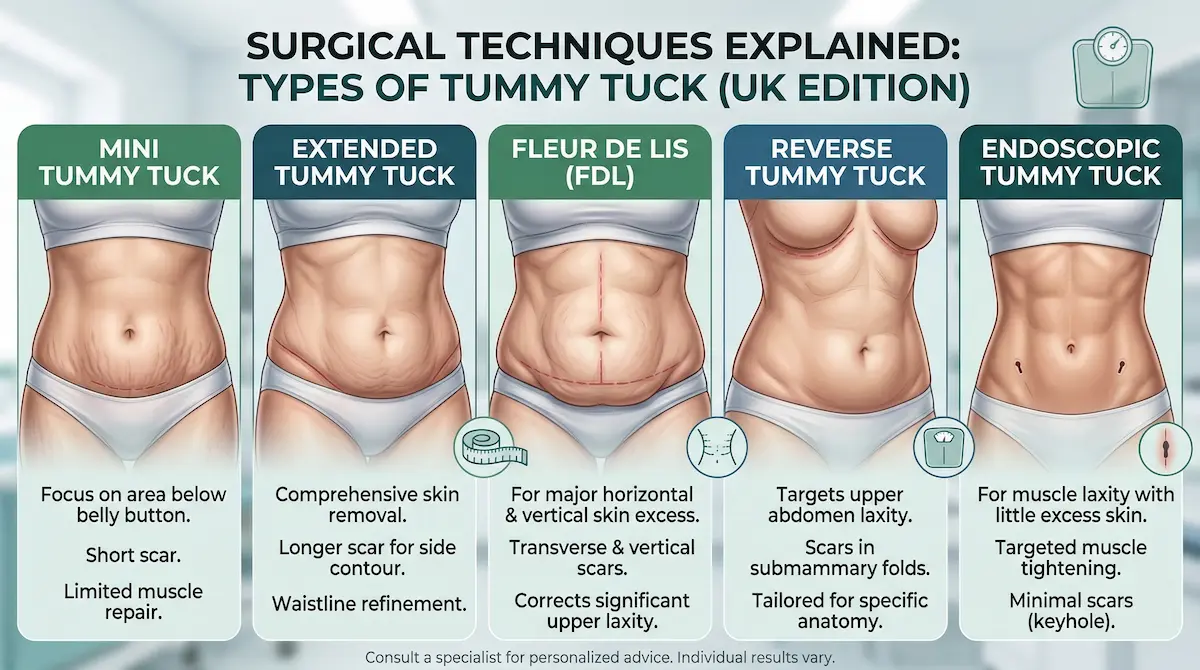
A tummy tuck is not a single procedure. It’s a family of techniques that share the same goal—improving contour by addressing excess skin, soft tissue laxity, and (where appropriate) abdominal wall separation. The “right” approach depends on how much skin needs removing, where the laxity sits, whether you have diastasis, and whether we need to extend contouring around the waist. When an Awake Tummy Tuck is planned, we select the technique that matches your anatomy while keeping safety and comfort at the centre of the anaesthetic plan.
Mini vs extended tummy tuck: what’s the difference?
A mini tummy tuck focuses on the area below the belly button, where loose skin often gathers after pregnancy or weight changes. An extended tummy tuck reaches further along the hips and may offer better waistline refinement when laxity wraps around the sides.
- Mini tummy tuck: best when concerns are mainly below the navel and muscle repair needs are limited.
- Extended tummy tuck: more comprehensive skin tightening and scar extension towards the hips for improved side contour.
- In both cases, the plan is based on skin quality, stretch marks distribution, and how the abdomen sits in movement (standing, sitting, bending).
When a Fleur de Lis approach is considered
Some patients—particularly after major weight loss—have both vertical and horizontal skin excess. In those cases, a Fleur de Lis (FDL) tummy tuck can be the most honest way to address the true direction of laxity. This technique adds a vertical component to the scar in order to remove skin in two planes, rather than simply “pulling down” and hoping it will tighten the upper abdomen.
- Best suited to significant skin redundancy, especially in the upper abdomen.
- Trade-off: an additional vertical scar, balanced against a more complete correction.
- We discuss scar placement, healing expectations, and wardrobe considerations in detail before you commit.
Reverse tummy tuck (upper abdomen focus)
A reverse tummy tuck targets laxity predominantly in the upper abdomen. Instead of removing skin via a lower abdominal incision, the lift is directed upwards. It can be considered in specific anatomies where upper abdominal looseness is the primary complaint.
- Can be helpful when upper abdominal skin is the limiting issue.
- Scar position differs from a standard tummy tuck, so the aesthetic trade-offs must be clear.
- Often considered in tailored plans rather than as a “default” tummy tuck choice.
Muscle repair with tummy tuck: diastasis recti explained
For many post-pregnancy patients, the issue isn’t only skin—it’s support. If you have diastasis recti (separation of the rectus muscles), abdominal wall tightening can improve shape and core stability. This is a surgical repair of the abdominal wall fascia rather than “cutting muscle”, and it is planned according to your examination and imaging where needed.
- Not everyone needs muscle repair; we only include it when it is clinically appropriate.
- When included, it can influence early tightness and the feel of standing upright in the first weeks.
- Your recovery plan (movement, posture, and garment use) is adapted when muscle repair is performed.
What about endoscopic tummy tuck?
You may see the phrase endoscopic tummy tuck online, usually in the context of smaller scars and targeted muscle tightening. Endoscopic approaches can be relevant in carefully selected cases—typically when the main problem is muscle laxity rather than significant skin excess. If loose skin is a major concern, an endoscopic approach alone may not deliver the contour change you’re actually seeking.
- Best considered when skin quality is good and skin removal is minimal.
- Often discussed alongside limited-scar strategies, rather than as a substitute for a full abdominoplasty.
- We advise based on outcomes, not trends—if skin removal is needed, we plan accordingly.
Scar planning: where incisions sit and why it matters
Scar placement is not an afterthought—it’s part of the aesthetic plan. We design incisions to balance concealability (for underwear and swimwear) with the tension required to create a smooth contour. Belly button repositioning (or reshaping) may be recommended when the amount of skin removal would otherwise distort its natural position.
- Lower abdominal scars are typically planned low, within a “bikini line” zone where possible.
- If an extended approach is needed, the scar length increases to achieve better side contour.
- We discuss scar maturation, colour change over time, and realistic timelines for final appearance.
| Technique | Best suited for | Scar pattern | Typical early recovery focus | Combination suitability | “Awake” suitability note |
|---|---|---|---|---|---|
| Mini tummy tuck | Lower abdominal skin laxity with limited upper abdominal concern | Low horizontal scar (shorter) | Comfort, gentle walking, posture awareness | May combine with targeted liposuction where safe | Often suitable in appropriate candidates, depending on extent and pain-control plan |
| Extended tummy tuck | Skin laxity extending towards hips/flanks; broader contour change | Longer low horizontal scar reaching towards hips | Garment compliance, mobility, swelling management | Commonly paired with waist/flank contouring where clinically appropriate | Suitability depends on surgical scope, duration, and individual risk profile |
| Fleur de Lis (FDL) | Significant laxity in both vertical and horizontal directions (often post-weight loss) | Horizontal + vertical scar (“anchor” pattern) | Wound care, swelling control, scar management planning | Can be combined selectively; safety and healing load must be considered | May be suitable for awake planning in selected cases, but requires careful assessment |
| Reverse tummy tuck | Predominant upper abdominal laxity | Upper abdominal scar (technique-dependent) | Upper-torso movement awareness, swelling control | Sometimes combined with other tailored contour procedures | Case-by-case; planned around anatomy and comfort requirements |
The takeaway is simple: technique selection is anatomy-led, not marketing-led. In the next section, we’ll explain how combination planning works—including circumferential approaches such as a 360 tummy tuck concept—so you can understand what’s achievable safely, and what should be staged.
Combined Procedures (Synergy): Maximising Your Results
Many UK patients don’t just want a flatter abdomen. They want proportion. That often means addressing the waist, flanks, and sometimes the breasts or arms in a single, coherent plan. Combining procedures can be efficient, but only when it remains sensible from a safety perspective and your healing “load” stays manageable. Our role is to balance the aesthetic upside of synergy with the realities of surgical time, swelling, and recovery support—especially when you’re travelling home after surgery.
Why combine procedures at all?
A well-designed combination plan can create a more natural-looking overall result, because the body is treated as a whole rather than in isolated segments. It can also mean one recovery window instead of two. Still, it is not a tick-box menu. We only combine when the incremental benefit is clear and the risk profile remains acceptable.
- One recovery period rather than multiple time-offs work
- Better contour harmony (abdomen + waist + flanks)
- More predictable “before and after” balance in clothing
Common combinations UK patients ask for
The most common request is a waist-focused plan alongside abdominoplasty. You may see searches like 360 lipo and tummy tuck uk because patients want waist definition as well as skin tightening. In suitable cases, we can integrate liposuction-based contouring to the flanks and waist to support a smoother silhouette, while still keeping safety parameters tight.
Another frequent request is a mummy makeover—typically a tummy tuck plan combined with breast surgery. For some patients, that means a breast lift, augmentation, or reduction depending on anatomy and goals. The key is that each component must remain clinically justified, not just “possible”.
- Abdomen + flanks/waist contouring (circumferential contour goals)
- Tummy tuck + breast lift / breast augmentation / breast reduction (mummy makeover planning)
- Selected add-ons: arm lift, thigh lift, or mons contouring when appropriate
Safety-first rules: when we stage rather than combine
There is a point where “more” stops being better. Longer operative time, higher tissue trauma, and a heavier recovery burden can increase complication risk. If a combination would push you beyond a sensible safety margin, we recommend staging. It’s a calmer path. Outcomes tend to be cleaner.
- We consider surgical duration, blood loss risk, and overall tissue trauma
- We weigh wound-healing load, especially with larger skin excisions
- We discuss DVT risk as a real consideration and plan prevention measures accordingly
Our guiding principle stays the same: Rejuvenation, Not Alteration. We plan combinations to refine proportion—never to chase an aggressive, unnatural “overdone” look.
How we make combination plans practical for UK travellers
Combination surgery changes logistics. You may need extra support for the first days, a slightly longer hotel stay, and clearer instructions on movement, garments, and medication. We organise your aftercare plan around what you’ll realistically be able to do when you return to the UK. That includes remote follow-ups and straightforward guidance you can share with your GP if needed.
- Clear recovery instructions designed for travel
- Long-term virtual follow-ups after you return home
- Transparent planning so you understand what’s included and what isn’t
Anaesthesia: Why We Prefer Awake/Twilight Sedation
Anaesthesia is not a small detail. For many patients, it is the main barrier to surgery. Our “awake” approach centres on controlled, monitored sedation with robust local anaesthetic techniques, aiming to keep you comfortable without the depth of a traditional general anaesthetic in suitable cases. It is not about bravado, and it is not right for everyone. It is about matching the anaesthetic plan to the patient’s physiology, anxiety profile, and the surgical scope—then monitoring carefully from start to finish.
What is twilight sedation, in plain terms?
What is twilight sedation? It is a form of conscious sedation where you are deeply relaxed and sleepy, with pain controlled through local anaesthetic. You may remain responsive to simple cues, but you are not expected to be alert. The emphasis is comfort and stability.
- Continuous monitoring by the anaesthesia team
- A controlled sedation depth tailored to your needs
- A calmer “wake-up” experience for many suitable patients
How does twilight sedation work during surgery?
How does twilight sedation work? We combine sedation with local anaesthetic to block pain signals at the surgical site while keeping your overall physiology steadier. In many cases, the aim is for you to maintain natural breathing with appropriate airway support as required. This is not a promise that “nothing can happen”. It is a structured, monitored technique designed to reduce avoidable stress for the right patient.
Medication choices: the questions patients actually ask
Patients often come to us after deep research. Two common queries are Is propofol twilight sedation? and Twilight sedation drugs. In practice, our anaesthesia team may use medications such as Propofol and Midazolam as part of a carefully titrated sedation plan, alongside local anaesthetic. The exact selection is personalised and based on your medical history, examination, and safety screening.
- Medication choice is tailored to your health profile and risk factors
- Anti-sickness planning is proactive, not reactive
- The aim is comfort without “heavy” after-effects where possible
Twilight sedation vs general anaesthesia: what UK patients should understand
Many online comparisons simplify the decision into “safer” versus “riskier”. In reality, both approaches can be safe when properly indicated, delivered by an experienced anaesthesia team, and matched to the patient’s health profile. The difference is the depth of anaesthesia and how your body transitions into (and out of) surgery. For some suitable patients, twilight sedation can feel like a gentler experience, partly because it may avoid deeper anaesthetic levels and the routine use of a breathing tube associated with full general anaesthesia.
- If you’ve searched is twilight sedation safer than general, the most honest answer is: it depends on your individual risks, the procedure scope, and the team’s protocols.
- General anaesthesia may be recommended for certain cases where deeper control is clinically appropriate.
- Twilight sedation can be an excellent option for selected patients, but it still requires full monitoring and a proper safety framework.
What about airway support and the “breathing tube” concern?
A common fear is the breathing tube (intubation). With twilight sedation, the intention is often to maintain natural breathing, with airway support as needed. That said, anaesthesia is dynamic: the anaesthesia team’s priority is always your oxygenation and safety. We explain, in advance, what is typical for your plan and what “back-up” measures exist if they’re needed.
Why this matters for the first 24–72 hours
The anaesthetic plan influences how you feel immediately after surgery: alertness, nausea tendency, hydration, and your confidence getting up for gentle walking. These early days are a key part of recovery. Our approach aims to support a smoother transition so you can mobilise safely, breathe comfortably, and start the recovery process with clearer momentum.
Step-by-Step: What Happens in Theatre?
UK patients often feel calmer when they understand the sequence, not just the headline. A tummy tuck is a structured procedure with predictable phases: preparation, marking, anaesthesia, the surgical steps, and post-operative monitoring. While the exact plan differs by technique (mini, extended, FDL, reverse) and whether you’re combining procedures, the overall theatre workflow follows a consistent safety-first pattern. Below is a clear overview of what typically happens on the day of surgery, written with practical expectations in mind.
Pre-op: assessment, marking, and final checks
On the day, we confirm your plan, answer last-minute questions, and make sure nothing has changed medically since your consultation. The surgeon performs skin markings while you are standing, because contour and laxity are best assessed in an upright position. Pre-operative photography is taken under consistent conditions to document your baseline and support transparent aftercare discussions.
- Review of medical history, medications, allergies, and last-minute safety checks
- Skin markings to map excision, tension lines, and (if required) the new umbilical position
- Planning garment sizing and your immediate post-op movement strategy
In theatre: the core surgical phases
Once anaesthesia is established and you are comfortable, we proceed through the planned steps. In broad terms, this includes controlled dissection, abdominal wall support where appropriate, removal of excess skin, and meticulous closure. Drain use (or alternatives) and closure layers are chosen to support predictable healing and to reduce avoidable fluid build-up.
- Anaesthesia and local pain control are established and monitored continuously.
- Tissue work and contour correction are performed according to the selected technique (mini/extended/FDL/reverse).
- Muscle repair is performed if clinically indicated (for diastasis recti) to improve support and shape.
- Skin excision and reshaping are completed, including umbilical work when needed.
- Closure is performed in layers to manage tension and support scar quality over time.
Immediately after surgery: monitoring and early mobilisation
After theatre, you are monitored closely as you wake and stabilise. Our team checks pain control, nausea risk, hydration, and your ability to stand with assistance. Early mobilisation doesn’t mean “pushing through”—it means short, safe movements introduced at the right time to support circulation and confidence. You’ll also be shown how to walk slightly flexed (as advised) to protect the incision line during the early phase.
- Monitoring of vital signs, comfort levels, and nausea control
- Support with safe first standing and short assisted walks
- Clear instructions for garment use, posture, and getting in/out of bed
Your first night: the practical essentials
Most concerns in the first night are normal: tightness, swelling, and a feeling of “pull” when standing fully upright (especially if muscle repair was performed). We focus on comfort, hydration, and gentle movement in short intervals. You’ll be given straightforward, written instructions for medications and positioning so you feel secure rather than guessing.
Recovery & Aftercare: What to Expect
Recovery is not just “time passing”—it’s a sequence of predictable milestones supported by aftercare. Most UK patients want to know two things: how they’ll feel in the first week, and when they can return to work and normal movement. Your recovery depends on your surgical scope (mini vs extended vs FDL), whether muscle repair was performed, and whether you combined procedures. The goal is a calm, organised plan: swelling control, safe mobilisation, incision care, and a clear escalation pathway if you have concerns once you return to the UK.
Awake tummy tuck recovery timeline (realistic milestones)
| Timeframe | What you may feel | Your priorities |
|---|---|---|
| Days 1–2 | Tightness, swelling, fatigue; careful standing and short walks | Hydration, gentle assisted mobilisation, medication routine, posture guidance |
| Days 3–7 | Swelling fluctuates; walking becomes easier; incision feels firm/tight | Consistent gentle walking, garment compliance, incision hygiene, rest balance |
| Weeks 2–3 | Improving mobility; reduced reliance on pain relief; swelling still present | Light daily activity, no heavy lifting, gradual return to desk work (case-dependent) |
| Weeks 4–6 | Stronger posture; more natural movement; scars still immature | Progressive activity as advised, scar care routine, avoid intense core strain |
| Months 3–6 | Contour “settles”; scar colour softens; swelling continues to reduce | Long-term scar management, stable weight, return to fuller exercise when cleared |
Swelling, compression garments, and posture
Swelling is normal, and it can be surprisingly variable—often more noticeable later in the day. Compression garments are used to support comfort and help manage swelling, but they are not a substitute for safe movement and rest. Posture advice is practical: you may be asked to walk slightly flexed at first to reduce tension on the incision. As tissues soften, you gradually return to a more upright stance.
- Wear your garment as advised; avoid overly tight compression that causes numbness or pain
- Expect swelling to come and go, especially after walking or travel
- Protect the incision from sudden stretching, heavy lifting, and aggressive twisting early on
Wound care and scar maturation (what’s normal)
Scars go through phases: early healing, thickening/firmness, then gradual softening and colour change. In the first weeks, firmness and mild pulling sensations can be normal, especially with muscle repair. Scar management (such as silicone-based care) is usually introduced once the incision is fully sealed and you are cleared to begin. Sun protection matters, because UV exposure can worsen scar pigmentation.
- Keep incision care simple and consistent (as instructed)
- Scar colour typically changes over months, not days
- Report increasing redness, heat, spreading swelling, or discharge promptly
Advanced aftercare support: HBOT and LLLT
At AKM Clinic, we integrate supportive recovery options for suitable patients as part of a broader, evidence-informed aftercare strategy. HBOT (Hyperbaric Oxygen Therapy) is used in some settings to support tissue oxygenation and recovery, while LLLT (Low-Level Laser Therapy) is used to support comfort and tissue response during healing. These are not “miracle fixes”, and they don’t replace good surgery or good wound care. They are used as part of a structured protocol, tailored to your needs and your healing progress.
Returning to the UK: travel, support, and follow-up
Because you’ll be travelling home, we plan aftercare with UK realities in mind—how you’ll move through an airport, how to manage swelling on travel days, and what to do if you have a question once you’re back. You’ll be given clear written guidance and a follow-up schedule. If you need to share information with your GP, we ensure you have a simple summary of your procedure and aftercare instructions.
- Travel guidance is personalised; we advise based on your healing progress and procedure scope
- Plan help at home for the first days (especially with shopping, childcare, and lifting)
- Remote follow-ups are organised to keep your recovery on track after you return
Safety & Risks: Is Awake Tummy Tuck Dangerous?
Every surgery has risk. A tummy tuck is no exception, because it involves significant tissue work, tension management, and a meaningful healing phase. What matters is not pretending risks don’t exist, but reducing them through candidacy screening, meticulous technique, and a clear aftercare protocol. We talk about complications plainly, so you can make decisions with confidence rather than guesswork.
Common surgical risks (and what we do to reduce them)
Most risks are manageable when they’re recognised early and treated properly. That starts with good planning and continues with structured follow-up. If you’re travelling from the UK, we build your plan around that reality.
- seroma after tummy tuck (fluid collection): we plan closure and aftercare to reduce fluid build-up, then monitor closely.
- Bleeding or haematoma: we minimise risk with careful haemostasis and sensible post-op activity limits.
- Infection: sterile theatre standards, clear wound-care instructions, and early escalation if symptoms appear.
- Wound healing delays: risk rises with nicotine use and uncontrolled health conditions, so we screen and advise honestly.
- Changes in sensation: numbness or altered feeling can happen and usually improves gradually over time.
Blood clots (DVT/PE): the risk UK patients worry about
Deep vein thrombosis (DVT) and pulmonary embolism (PE) are rare, but they are serious. Risk depends on your history, procedure length, mobility, and individual clotting tendency. We don’t “hope for the best”. We plan prevention.
- Pre-op screening for clot risk factors and medication review
- Early, gentle mobilisation with clear walking targets
- Compression and prevention measures tailored to your risk profile
- Practical travel guidance to reduce prolonged immobility
Sedation safety: addressing the question people search late at night
Some patients ask, “Has anyone died from twilight sedation?” It’s a confronting question, but it deserves a calm, honest answer. Any form of sedation carries risk, including breathing or cardiovascular events, which is why monitoring and patient selection matter so much. What we can say is this: we treat twilight sedation with the same seriousness as any anaesthetic technique, with continuous monitoring and clear safety thresholds.
- We assess your medical history carefully before approving an awake plan.
- Our anaesthesia team monitors you continuously throughout the procedure.
- If your safety requires a different approach, we change the plan.
Safety is a system. It’s screening, technique, and follow-up working together — not a slogan.
Is Awake Tummy Tuck in Turkey Safe for UK Patients?
This is the right question to ask. UK patients are used to regulated systems and want to know what standards look like outside the NHS and private hospitals at home. Safety is not defined by a postcode. It’s defined by theatre protocols, anaesthesia monitoring, surgeon credentials, and what happens after you leave the operating room. We built our international patient pathway to remove uncertainty and make the process predictable.
What “British standards” should mean in real terms
When people say “British standards”, they often mean consistent hygiene, clear consent, and robust monitoring. That’s sensible. We encourage you to judge any clinic by concrete markers rather than promises.
- A dedicated anaesthesia team and continuous intra-operative monitoring
- Sterile theatre protocols and structured infection-prevention routines
- Transparent consent: risks, trade-offs, and realistic recovery timelines
- A defined escalation pathway if you have concerns post-op
Surgeon credentials and the “GMC question”
UK patients sometimes start with a very specific search: “GMC registered surgeon alternatives”. That’s understandable, but it can be misleading when comparing across countries. The smarter approach is to look for surgeons who are specialists registered with recognised international medical boards, who can show consistent experience in body contour surgery, and who can explain their complication management clearly.
- Ask how often they perform tummy tuck surgery and what techniques they use
- Ask how they handle seroma, wound issues, and revisions if needed
- Look for a safety-first mindset, not a “one-size-fits-all” plan
Continuity of care after you return home
The fear many UK patients have is abandonment once they fly back. That’s fair. We structure follow-up so you’re not left to self-diagnose. If you need to involve your GP, we help you communicate what was done and what normal healing looks like.
- Post-op care in Turkey for British citizens includes a defined remote follow-up schedule
- Clear written aftercare guidance you can refer to at home
- Direct contact with our team if something doesn’t look or feel right
Our job doesn’t end when you leave Istanbul. Aftercare is part of the procedure.
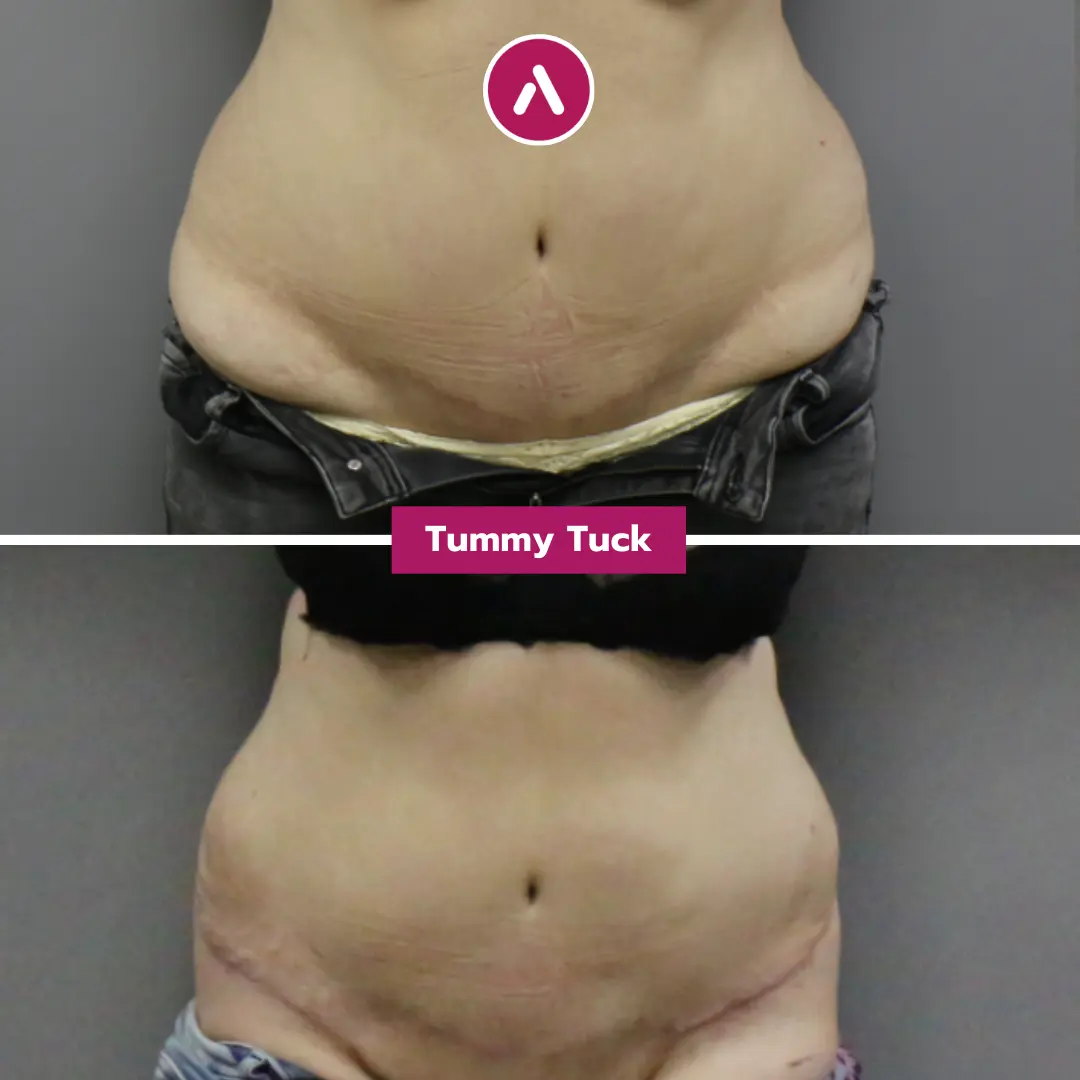
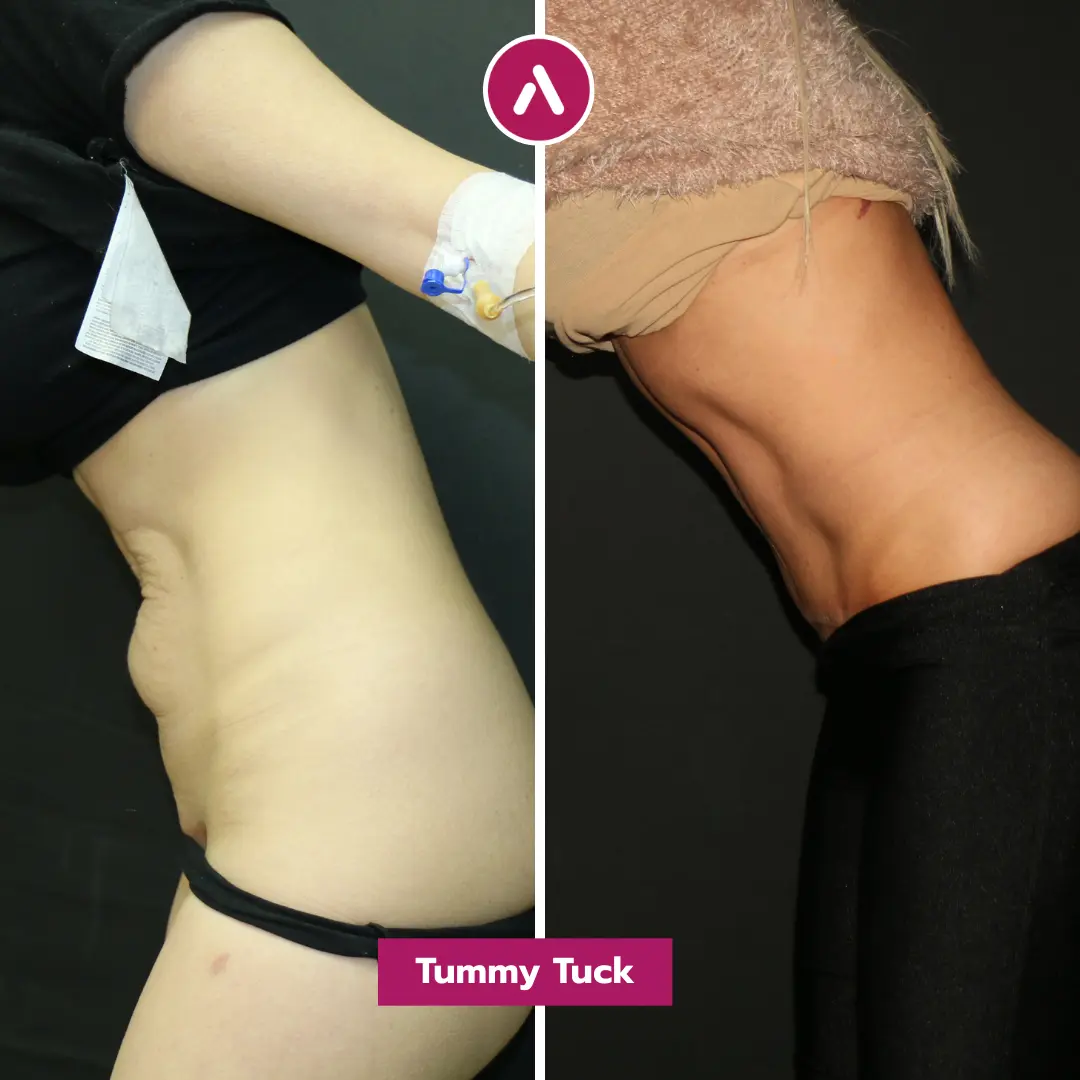
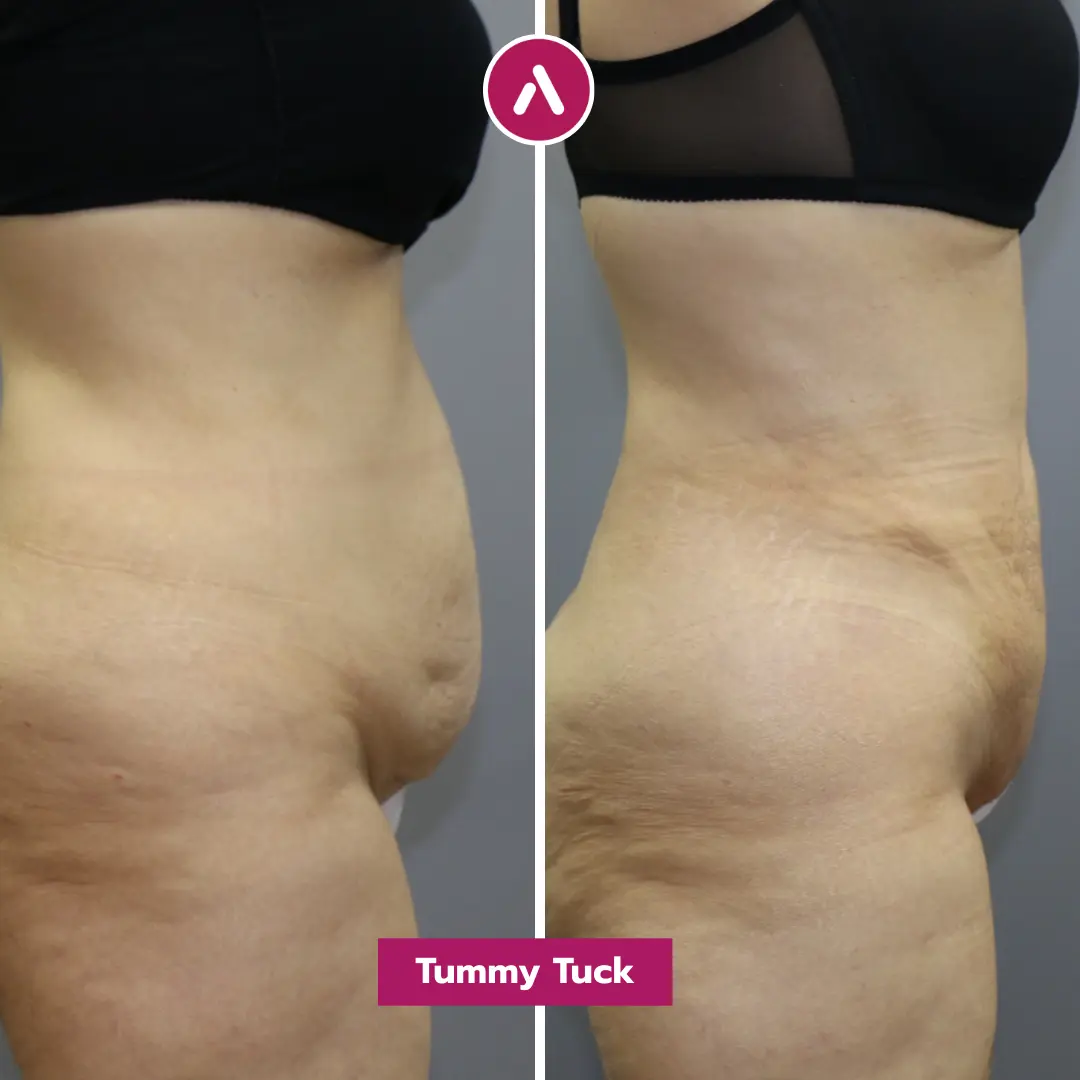
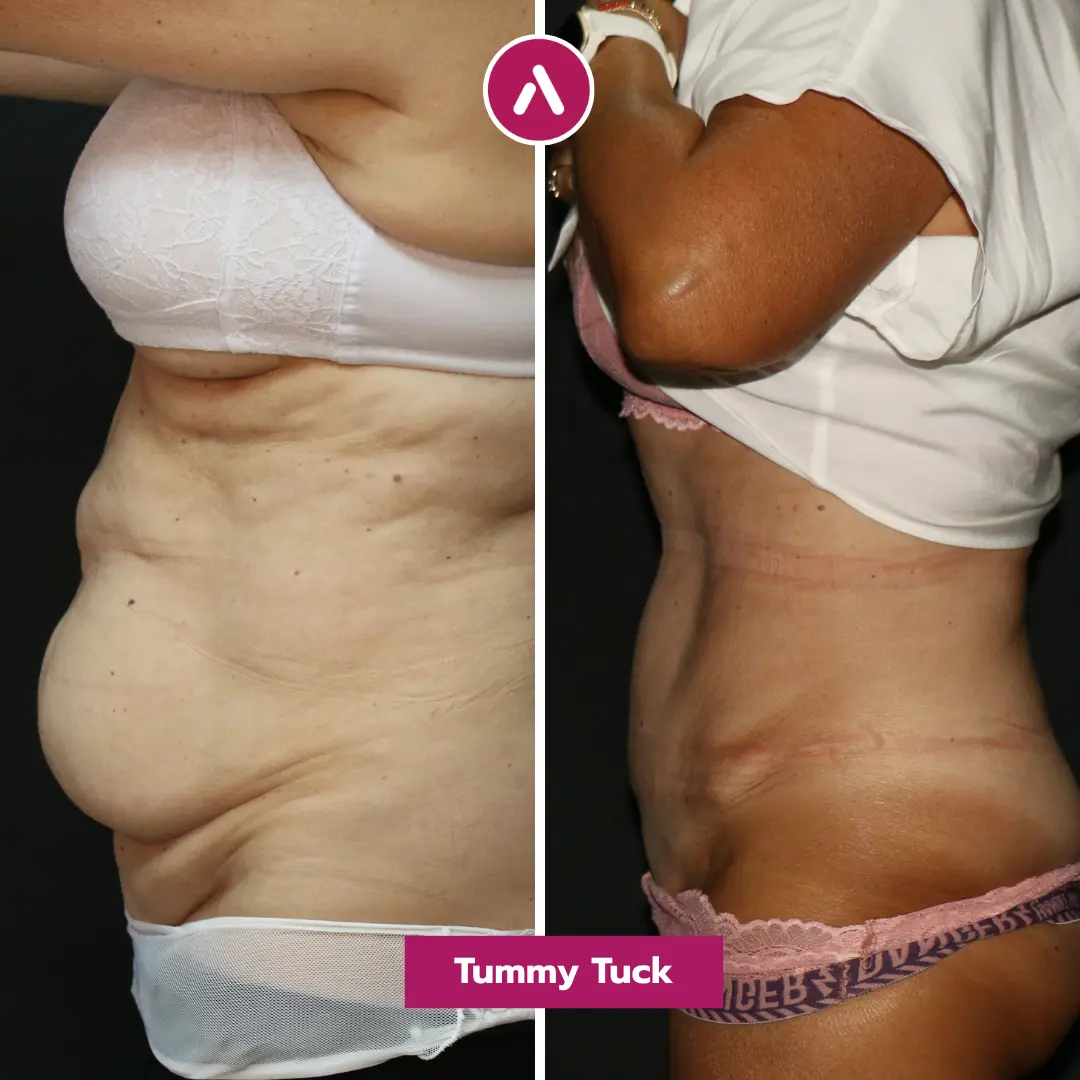
Awake Tummy Tuck Before and After: Realistic Expectations
The best tummy tuck results look “quiet”. You look fitter in clothes, smoother out of them, and proportioned from the side. That doesn’t come from chasing extremes. It comes from addressing the right problem—skin, structure, and contour—in the right order. We’ll help you set expectations that match your anatomy and the technique you actually need.
What a tummy tuck can realistically change
A tummy tuck is strongest at correcting skin excess and restoring a cleaner abdominal line. Based on clinical overview evidence, it can also improve abdominal wall support when muscle repair is clinically indicated. The biggest difference is usually seen in the lower abdomen and the overall waist-to-hip flow.
- Removal of loose or overhanging lower abdominal skin
- Improved waist contour when the plan includes flank shaping
- Flatter abdominal profile when diastasis recti repair is needed and appropriate
What it cannot change (and why that matters)
Some concerns sit outside what surgery can fix. Stretch marks, for example, only improve if they’re located on skin that is removed. Weight fluctuations can also soften results over time. We’ll be direct about limits before you commit.
- Stretch marks above the navel may remain (unless removed with the excised skin)
- Internal fat and visceral fat are not treated by tummy tuck surgery
- Future pregnancy and major weight change can compromise the result
Scar healing: what “normal” looks like over months
Scars don’t settle in weeks. They mature over months. Early on, it is normal for scars to look raised, firm, or more red than expected. Over time, most scars soften and fade, provided you follow a simple scar-care routine and protect the area from sun exposure.
- Early phase: firmness and colour change can be normal
- Mid phase: scars often feel tight, then gradually soften
- Long term: scar colour and texture typically improve over 6–12 months
Before-and-after thinking: how to judge results fairly
Photos can be helpful. They can also be misleading when lighting, posture, or time since surgery isn’t comparable. We prefer consistent, standardised photography and realistic checkpoints. The goal is a stable, natural contour that holds up in real life.
- Compare like with like: same pose, lighting, and time point
- Expect early swelling to mask definition
- Judge results in movement, not only in a single “best angle” photo
Good results don’t announce themselves. They simply look right.
Cost Analysis: Awake Tummy Tuck 2026 Prices (Turkey vs UK)
UK patients usually start cost research by comparing London and Manchester private options, then widen the search to Istanbul. The key is to compare like with like. A quoted “surgery price” can hide anaesthesia fees, theatre costs, aftercare, garments, and follow-up. We use a transparent, all-inclusive structure so you can see the full picture in GBP terms and plan properly.
Why UK prices and Istanbul prices can look very different
Price gaps in international surgery are often driven by macroeconomics, not a shortcut on quality. Operational costs vary by country. Exchange rates matter. What should stay constant is the safety framework—proper screening, sterile theatres, monitored anaesthesia, and structured aftercare.
UK search intent: London, Manchester, and private hospital pricing
Many patients begin with searches such as Harley Street tummy tuck prices or tummy tuck Manchester. Others compare large private providers and search Bupa tummy tuck prices. Those searches are useful for benchmarking, but they rarely show the full “all-in” cost once you include consultations, theatre fees, garments, medications, and follow-up visits.
- UK quotes may be itemised, which can make comparisons harder
- Revision policies and aftercare inclusions vary widely
- Financing can change the monthly cost but not the clinical pathway
Our pricing model: clarity, not surprise costs
We provide a personalised plan with a transparent quote after your virtual consultation. The goal is to remove ambiguity, not to sell you a headline figure. If your plan is more complex (for example, extended technique, muscle repair, or combined contouring), your quote reflects that scope upfront.
| Cost component | UK private care (often itemised) | Our all-inclusive VIP model (clear upfront) | Notes |
|---|---|---|---|
| Surgical procedure | Usually included | Included | Technique and scope drive cost in both settings |
| Anaesthesia & operating theatre fees | May be separate | Included | Important for like-for-like comparisons |
| Pre-operative tests | May be separate | Included | Safety screening should not be optional |
| Hotel accommodation | Not included | Included (5-star partner hotel) | Extra nights may apply if you extend your stay |
| Transfers (airport & clinic) | Not included | Included (VIP transfers) | Designed to reduce friction during early recovery |
| Medications & compression garments | Often separate | Included | Garment compliance is part of good recovery |
| Aftercare & follow-up | Varies by provider | Included (long-term virtual follow-up) | Key for UK patients returning home |
| Hidden costs risk | Medium (depends on itemisation) | Lower (clear inclusions) | Always confirm what’s included before booking |
What’s included (and what isn’t)
If you’re comparing Turkey tummy tuck all-inclusive offers, check the fine print. Our VIP pathway is designed to cover the core clinical and recovery essentials, while keeping the boundaries clear. That clarity is part of trust.
- Included: surgical procedure, anaesthesia & theatre fees, pre-op tests, 5-star hotel, VIP transfers, 24/7 Patient Host support, post-op medications & garments, first post-op meal, long-term virtual follow-up.
- Not included: international flights, personal travel insurance, personal expenses (for example meals outside the provided first post-op meal), visa fees if applicable, extra hotel nights if you extend.
GBP-focused pricing: how to compare intelligently
Some patients search Tummy tuck Istanbul price and stop at the first number they see. Don’t. Compare safety, aftercare, and what you’ll need during recovery. If your UK research includes tummy tuck on finance UK, keep in mind that monthly payments don’t change the clinical variables that matter most.
- Ask for a fully itemised breakdown or a truly all-inclusive package
- Check who monitors anaesthesia and what the safety protocol includes
- Confirm follow-up support after you return to the UK
We position our offering as all-inclusive cosmetic surgery GBP planning with clinical clarity—so you can make a rational decision rather than a rushed one.
Finding the Best Awake Tummy Tuck Surgeon (What UK Patients Should Look For)
Choosing a surgeon for a tummy tuck is not about finding the most confident marketing. It’s about verifying a safety system and a repeatable surgical method. UK patients often compare options in London or Manchester first, then look abroad once they realise how variable standards and aftercare can be. We encourage a simple approach: check credentials, check protocols, check follow-up, then check whether the surgeon’s aesthetic matches yours. That order protects you.
Credentials and accountability: what matters more than a title
Different countries use different professional systems, so the best question is not “Is this the same as the UK?”. The best question is “Is this verifiable, and does it match the work being done?”. Our body contour procedures are led by European Board Certified Surgeons and specialists registered with international medical boards, supported by a structured clinical team and screening process.
- Ask what board certification means in practice, and whether it can be verified.
- Ask how often the surgeon performs tummy tuck surgery (and which techniques).
- Ask who manages post-op issues and how quickly you can be assessed if something changes.
The safety protocol questions you should ask (and expect clear answers to)
Good clinics welcome direct questions. Vague replies are a red flag. When you speak to us, we’ll explain how we reduce common risks, what we monitor in theatre, and how we support you once you’re back in the UK. You don’t need a “perfect” risk profile. You do need honest planning.
- “What is your DVT prevention plan for my risk factors and travel?”
- “How do you reduce fluid collection and manage seroma if it occurs?”
- “What is your revision policy, and how do you handle complications?”
- “Who do I contact after I fly home, and what is the response time?”
How to interpret reviews without being misled
Reviews can help, but they should never replace clinical due diligence. Look for patterns: communication quality, aftercare responsiveness, and whether the experience feels organised and predictable. If you’re searching Istanbul tummy tuck reviews, focus on practical details rather than dramatic language. We also value independent verification; our service quality is supported by a 4.7/5 rating on Trustpilot, a third-party platform.
- Look for consistency: “responsive team”, “clear instructions”, “follow-up after return”.
- Be cautious with anonymous, overly generic praise.
- Trust the boring details. They usually reflect the real system behind the surgery.
Good surgery starts with good judgement. We’d rather answer hard questions now than manage surprises later.
Your Medical Journey (UK → Istanbul)
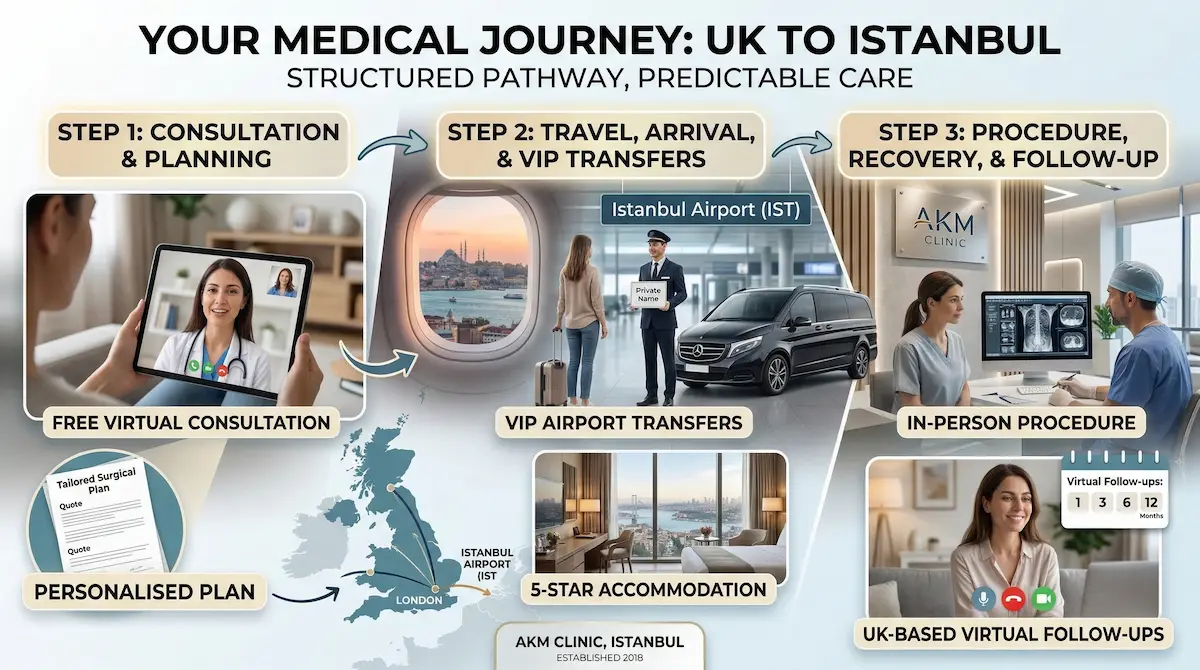
Travelling for surgery should feel structured, not improvised. We designed our pathway to remove friction at each stage, from first contact to long-term follow-up. For UK patients, the core needs are simple: clarity, predictable logistics, and continuity of care once you return home. We handle planning in a way that reduces cognitive load when you’re preparing for surgery. Your job is to focus on your health and your recovery.
Step 1: Free virtual consultation and a personalised plan
Your journey starts with a no-obligation video consultation. You share your goals and photos for review, and we build a tailored surgical plan with a transparent quote. This is where we confirm candidacy, discuss technique options, and decide whether combining procedures is sensible for you. We also outline what your recovery will realistically require once you’re back in the UK.
- Photo review and goal alignment
- Personalised plan with clear inclusions
- Risk-factor screening and travel-aware recovery guidance
Step 2: Flights, arrival, and VIP transfers
Many patients prefer direct flights London to Istanbul for simplicity, but we support arrivals across major UK departure points. When you land at Istanbul Airport (IST) or Sabiha Gökçen (SAW), a private driver meets you at arrivals with a sign showing your name. You’re then transferred in a private vehicle to your 5-star partner hotel so you can settle in calmly before your clinic visit. Your dedicated Patient Host coordinates timings and keeps everything moving smoothly.
- We book 5-star hotel accommodation from curated partners (you book the flight).
- We schedule VIP airport and clinic transfers.
- We keep communication simple, with practical updates rather than noise.
Step 3: Procedure day, recovery in Istanbul, and long-term follow-up
On procedure day, we bring you to the clinic for your final in-person consultation and pre-operative tests. After surgery, our medical team monitors you closely, and your Patient Host stays available 24/7 via WhatsApp for practical support. Before you leave Istanbul, you attend a final check-up to confirm your recovery is progressing well and that you’re cleared to fly home. We then continue with structured virtual follow-ups at 1, 3, 6, and 12 months to support safe, long-term healing.
- In-person review with your surgeon and pre-op testing
- 24/7 Patient Host support during your Istanbul recovery
- Virtual follow-ups scheduled after you return to the UK
Our clinic is located in Levent, a modern district selected for ease of access and proximity to partner hotels. Privacy matters, and we maintain strict confidentiality and data security protocols throughout your journey.
Frequently Asked Questions: Awake Tummy Tuck
UK patients tend to ask the same questions before committing—especially when the plan involves twilight sedation and travel. Below are straightforward answers to the queries we hear most often. If your situation is more complex (previous abdominal surgery, major weight loss, clotting history, or a combination plan), we’ll tailor advice during your virtual consultation.
Will I feel pain during the procedure?
The goal is that you do not feel pain during surgery. Comfort is achieved through a monitored sedation plan combined with local anaesthetic techniques. You may feel pressure or movement at moments, but pain should not be part of the experience. If your comfort level is not where it needs to be, the anaesthesia team adjusts promptly.
Will I be fully “awake” and aware of what’s happening?
Most patients are drowsy and relaxed, with limited awareness of the procedure. “Awake” in this context usually means you are not in deep general anaesthesia. The intended experience is calm and controlled—more like drifting in and out of sleep than being alert.
What medications are used for twilight sedation?
Medication selection is personalised and managed by the anaesthesia team. Many patients recognise names such as Propofol and Midazolam from their own research, but the exact plan depends on your medical history, risk factors, and the scope of surgery. We also plan anti-sickness medication proactively when appropriate.
Is twilight sedation safer than general anaesthesia?
“Safer” depends on the individual. Both can be safe when correctly indicated and delivered by an experienced team with full monitoring. The right comparison is not a headline statement—it’s whether the anaesthetic plan matches your physiology, anxiety profile, and the surgical scope. If your safest option is general anaesthesia, we will tell you.
How long will I need off work?
This depends on your job and the extent of surgery. Many patients with desk-based work plan for around 10–14 days before returning (sometimes sooner with a very gentle schedule), while physically demanding roles often need longer. If muscle repair was performed or procedures were combined, you should expect a more conservative return-to-work plan.
When can I fly back to the UK?
Flight timing is assessed individually based on your healing progress, the procedure scope, and your clot-risk profile. We perform a final in-person check before you leave Istanbul and give you travel guidance designed to reduce prolonged immobility. If you are high-risk for clots or your recovery requires more monitoring, we may recommend a longer stay.
Do I need drains?
Drain use is decided case-by-case. Some techniques and anatomies benefit from drains to reduce fluid build-up, while other strategies focus on closure technique and structured aftercare. We explain your plan upfront, including how drains (if used) are managed and when they are typically removed.
What is seroma and what happens if I get one?
A seroma is a fluid collection that can occur after body contour surgery. It is a recognised risk, not a moral failing or “something you did wrong”. Most are manageable when identified early. We give clear guidance on what to look for, and we maintain follow-up support after you return to the UK so you are not left guessing.
When can I start exercising again?
Gentle walking starts early, but formal exercise returns in phases. Heavy lifting, intense cardio, and core training are typically delayed until you are cleared—especially if abdominal wall repair was performed. We’ll outline a stepwise plan so you rebuild safely without stressing the incision or muscle repair.
What if I have questions after I’m back in the UK?
You will have written aftercare instructions and direct contact routes for support. We also schedule remote follow-ups so you can show your recovery progress and get guidance. If your GP needs information, we can provide a practical summary of your procedure and aftercare plan.
If you’re an “expert patient”, you should feel free to ask expert-level questions. A good clinic welcomes that.
Medical Disclaimer: This information is provided for education only and does not replace a medical consultation. All surgery involves risk, and suitability must be assessed individually. Treatment plans, anaesthesia choices, recovery timelines, and outcomes vary based on anatomy, health status, and procedure scope.