




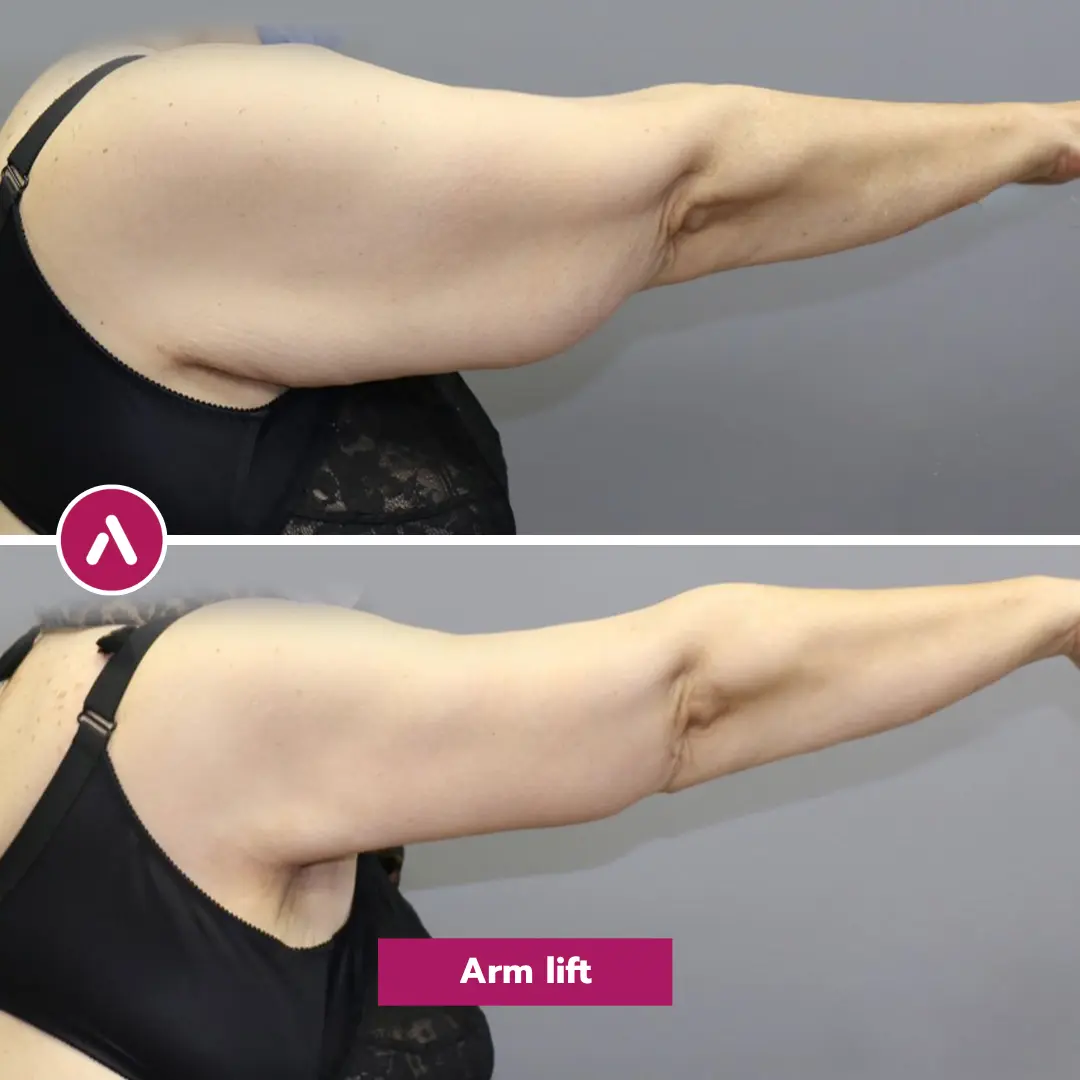
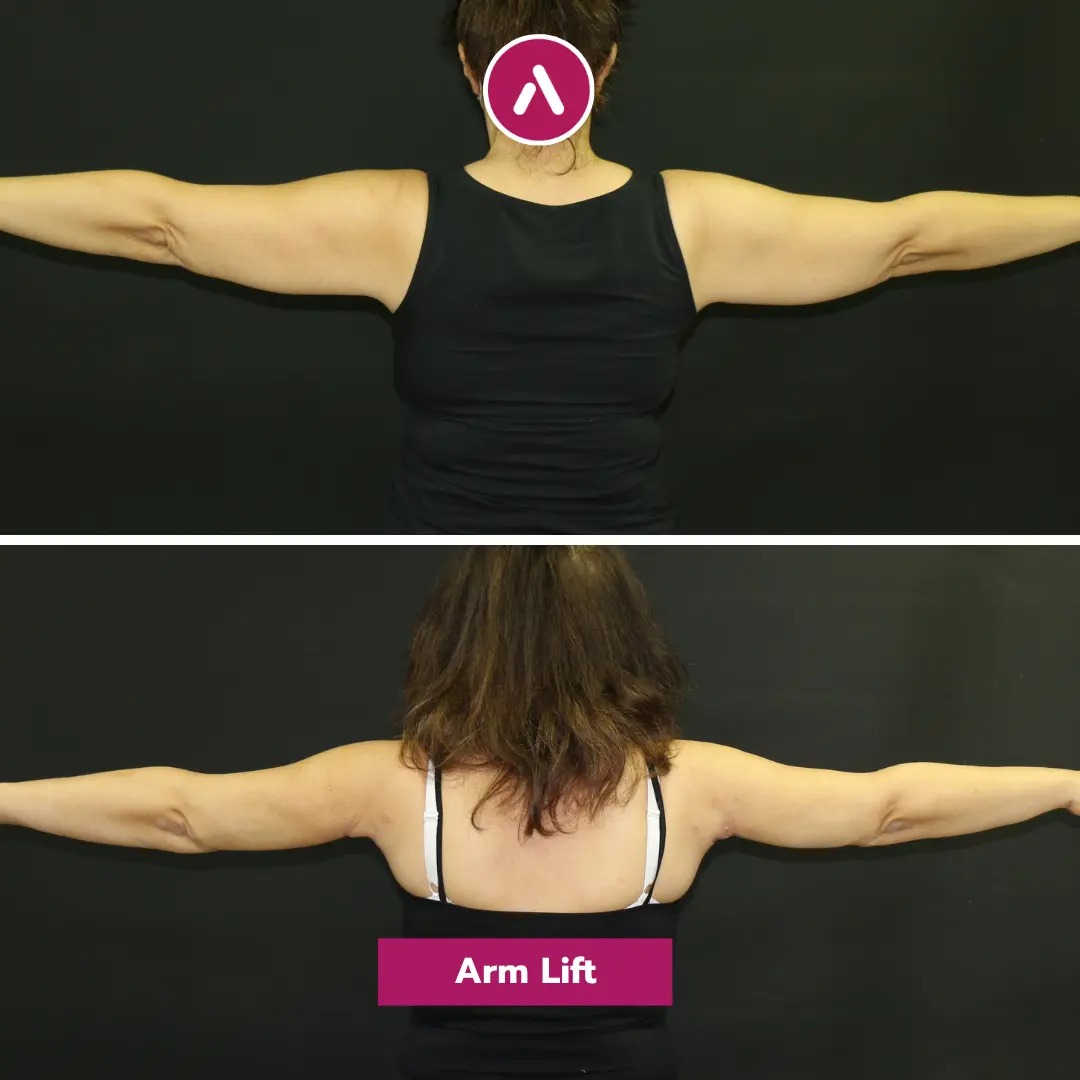
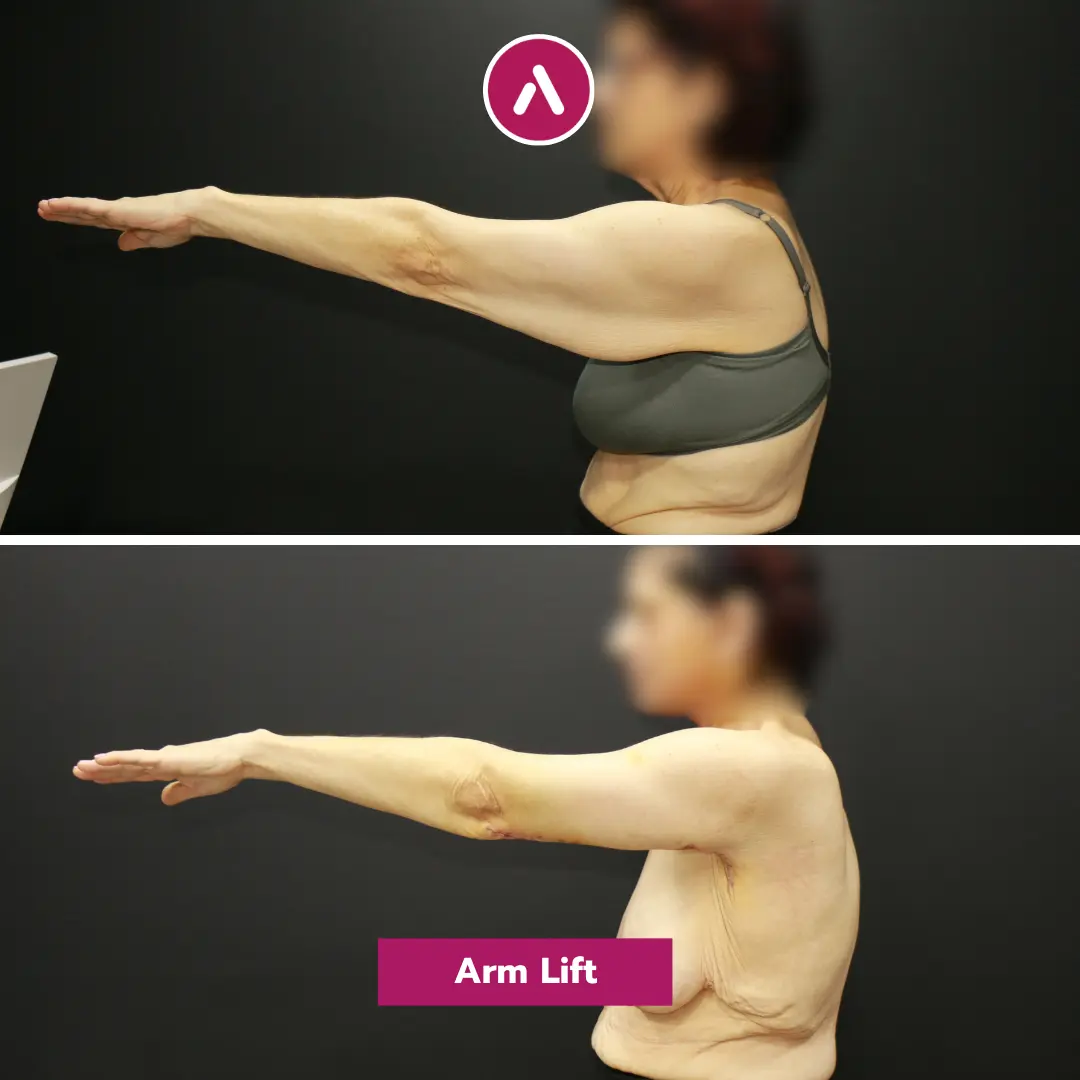
Arm Lift (Brachioplasty) reshapes the upper arm by removing excess skin and refining contour for natural-looking results. This guide explains why “bingo wings” happen, who is suitable, and how mini, standard or extended techniques influence scar placement and outcomes today.
For UK patients travelling to Turkey, we outline safety-first screening, anaesthesia options including twilight sedation, and a realistic recovery timeline. You’ll learn how to manage swelling, return to work, and support scar maturation with disciplined aftercare and optional HBOT/LLLT support.
Table of Contents
What is Arm Lift (Brachioplasty)?
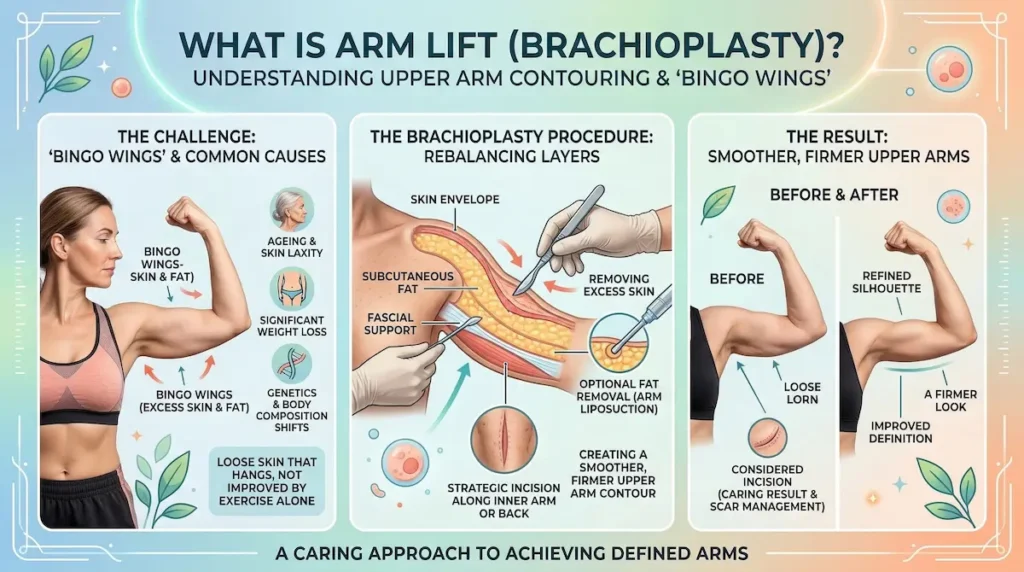
Arm Lift (Brachioplasty) is a surgical procedure that removes excess skin (and, when needed, residual fat) from the upper arm to create a smoother, firmer contour. It is designed for people who cannot improve “loose” upper arms with exercise alone, especially after ageing or significant weight loss.
Why “bingo wings” happen
In the UK, “bingo wings” is a common way to describe upper-arm skin that moves or hangs when you lift your arms. The causes are usually a mix of skin quality and volume changes.
- Age-related skin laxity: collagen and elastin naturally reduce over time.
- Weight loss: the skin may not fully retract after the arm volume decreases.
- Genetics: some people are simply predisposed to upper-arm laxity.
- Body composition shifts: fat distribution can change even without major weight change.
- Sun exposure & lifestyle factors: these can influence long-term skin quality.
Upper-arm anatomy: what we are actually treating
For an expert patient, it helps to think in layers. An arm lift isn’t just “taking skin off”. We plan the result around how skin, fat, and connective tissue behave during healing.
- Skin envelope: the layer that becomes loose and forms the visible “hang”.
- Subcutaneous fat: may be minimal (pure skin laxity) or still present.
- Fascial support: deeper tissues that help define shape and stability.
Our goal is to rebalance these layers so the arm looks refined, not over-tightened. Subtlety matters.
What brachioplasty changes (and what it cannot)
Brachioplasty primarily addresses excess skin and contour irregularities along the upper arm. It is not a weight-loss method, and it cannot change your underlying bone structure.
- Removes loose skin: especially along the inner/back upper arm.
- Refines the arm silhouette: improves definition from shoulder to elbow.
- May combine with arm liposuction: when excess fat contributes to the bulk.
A key trade-off is the scar. We plan incision placement carefully, but any technique that removes meaningful skin requires a line where the skin is closed. The priority is a scar that heals well and a shape that looks natural in motion.
Benefits: What Can An Arm Lift Realistically Improve?
The best outcomes are grounded in realistic expectations. An arm lift can be genuinely transformative for the right candidate, but the “win” is usually a blend of aesthetics, comfort, and confidence rather than a single dramatic change.
A cleaner arm contour in clothes and in real life
Most patients first notice the difference when dressing. Sleeves sit more smoothly, and the upper arm feels less “heavy” in movement.
- Improved fit: tops, jackets, and formalwear often feel easier to wear.
- More consistent shape: less skin bunching when the arm is raised.
- Better definition: the arm looks more proportionate to the torso.
Comfort and function: not just aesthetics
Loose upper-arm skin can cause day-to-day irritation, particularly in warmer weather or during exercise. Addressing excess skin can reduce these practical issues.
- Less rubbing and chafing: especially where skin folds touch.
- Improved comfort during activity: the arm can feel “lighter” and more secure.
- Hygiene ease: fewer deep creases can mean less moisture trapping.
Confidence, proportion, and a “natural” result
In our practice, the ideal result does not draw attention to surgery. It simply makes you look more like yourself—refreshed and balanced.
Our philosophy is simple: Rejuvenation, Not Alteration. We aim for refined arms that look believable in daylight, in motion, and in photographs.
That is why we focus on proportion, scar planning, and a recovery strategy that supports good-quality healing. A well-executed arm lift should look calm and intentional, not “overdone”.
Am I a Good Candidate For An Arm Lift Surgery?
Suitability is not a tick-box exercise. It is a balance of anatomy, lifestyle, and safety. Some patients need a small, targeted correction. Others need a more comprehensive plan, especially after significant weight loss. We assess what is driving your “bingo wings” and what your skin can realistically do after surgery.
Just as importantly, we look at your recovery capacity. Healing is a biological process. Your general health, nicotine exposure, and weight stability all influence the quality of the final scar and contour. That is why we treat candidacy as risk management, not marketing.
Who tends to do well with brachioplasty
Most strong candidates have a clear skin excess that will not improve with training alone. They want a refined arm shape, not a dramatic change. They also understand the scar trade-off and value a plan that prioritises safe healing.
- Stable weight: ideally steady for several months, especially after weight loss.
- Skin laxity that “fails the recoil test”: the skin does not spring back after gentle pinching.
- Realistic expectations: improved contour with a planned scar, not “scar-free” promises.
- Good baseline health: well-managed blood pressure, diabetes, and thyroid function.
- Time for recovery: willingness to pause heavy lifting and high-intensity training as advised.
If you are searching for arm skin reduction options, this is often the point where brachioplasty becomes the most logical solution. Non-surgical tightening can help mild laxity, but it cannot remove true excess skin.
Who should avoid or delay arm lift surgery
Sometimes the safest plan is to wait. When risks are elevated, results are less predictable and complications become more likely. We would rather postpone a procedure than rush a body that is not ready.
- Nicotine use: smoking, vaping, and nicotine replacements can impair blood flow and wound healing.
- Uncontrolled medical conditions: poorly controlled diabetes, significant heart or lung disease, or active infection.
- Blood clot risks: personal history of DVT/PE, certain clotting disorders, or high-risk medication profiles (case-by-case).
- Unstable weight: ongoing weight loss or frequent fluctuations can compromise contour longevity.
- Inability to follow aftercare: limited support, inability to rest, or high physical demands immediately post-op.
If you are unsure about a specific medication, tell us early. We will advise whether you need a GP letter or a plan to adjust medications safely before surgery. We also explain what would warrant urgent review after you return home, including when to use your local GP versus A&E.
How we assess you at AKM Clinic
Our assessment is structured. We focus on anatomy first, then safety, then aesthetics. That order matters. It is how AKM Clinic keep outcomes consistent for international patients.
- Visual assessment: photos and/or a video consult to understand laxity, volume, and scar placement options.
- Medical screening: health history, current medication list, allergies, and previous surgery or healing issues.
- Risk profiling: clot risk, anaesthesia considerations, and lifestyle factors that affect recovery.
- Procedure planning: whether you need a mini, standard, or extended approach (and whether liposuction helps or harms).
- Recovery strategy: compression garment guidance and, where appropriate, our Rapid Recovery & Safety Protocol using HBOT/LLLT.
Our European Board Certified Surgeons plan brachioplasty with one core aim: a calm, natural contour that heals predictably. If the safest answer is “not yet”, that is still the right answer.
Is It Loose Skin, Fat, Or Both?
This question decides everything. Many people assume they need “upper arm fat reduction surgery” when the real issue is skin laxity. Others focus on skin, but still have a pocket of fat that blurs the contour. We separate the problem into components: skin quality, skin quantity, and volume.
Exercise can strengthen the triceps and improve posture. It cannot remove hanging skin. Non-surgical tightening can help mild laxity, but results are limited when the skin is truly excessive. A precise diagnosis protects you from the wrong procedure.
When it is mostly loose skin
Loose skin is the usual driver of “bingo wings” in patients over 50 and after major weight loss. The skin behaves like an overstretched fabric. You can tone the muscle underneath, but the fabric still drapes.
- Key sign: you can pinch a noticeable fold of skin even when your weight is stable.
- Another clue: the “hang” is visible when the arm is raised, even if the arm is not bulky.
- Common scenario: arm lift after massive weight loss, where the skin has lost recoil.
In these cases, brachioplasty is usually the most direct solution because it removes the excess skin rather than trying to “shrink” it.
When it is mostly fat (with decent skin elasticity)
If the upper arm feels full and the skin still has good spring, volume may be the main issue. This is where fat reduction methods can make sense. The nuance is that removing fat without respecting skin quality can reveal laxity that was hidden.
- Best fit: good skin elasticity, mild to moderate fullness, minimal skin redundancy.
- What we watch for: any early signs of sagging that could worsen after volume reduction.
- Plan option: liposuction can be considered, sometimes as a staged plan depending on your skin response.
If your search intent is “upper arm fat reduction surgery”, we translate that into a clinical question: will your skin retract after volume is reduced? If the answer is “unlikely”, an arm lift becomes part of the plan.
When it is both: the common reality
Many patients sit in the middle. There is some fat, and the skin is also loose. In these cases, the right approach is often a combined strategy that targets contour while respecting healing and scar quality.
- Combination planning: selective liposuction to refine bulk, plus skin excision to correct the drape.
- Scar strategy: we prioritise a scar that sits where it is less visible in natural arm positions.
- Outcome goal: a smooth silhouette that looks natural in motion, not just in a posed photo.
If you want clarity fast, we can assess your arms remotely and tell you whether you are looking at fat reduction, skin reduction, or a combined plan. Clear inputs. Clear options.
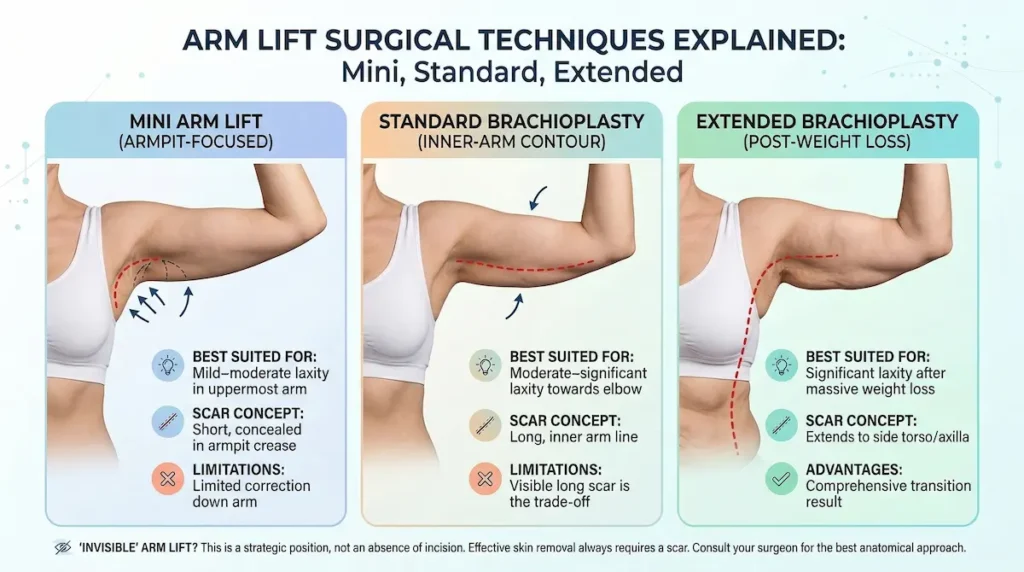
Arm Lift Surgical Techniques Explained: mini, standard, extended
Brachioplasty is not “one operation”. It is a set of techniques selected to match the pattern of laxity, the amount of excess skin, and how you want the scar positioned. In UK searches you may see phrases like “mini arm lift”, “extended brachioplasty”, or even “invisible arm lift”. These labels are helpful—if we use them correctly.
In our planning, we start with one question: where is the excess tissue? If laxity is mainly near the armpit, we can often keep the scar more concealed. If the laxity runs down the arm, a longer scar is usually the trade-off for a smoother contour.
Mini arm lift and “invisible” approaches (armpit-focused correction)
A mini arm lift is designed for patients whose looseness is concentrated high on the arm, close to the axilla (armpit). In these cases, we can often place the incision within or around the natural crease of the armpit, aiming for a more concealed scar position when the arms are at rest.
- Best suited for: mild to moderate laxity, mainly in the uppermost arm.
- Scar concept: shorter, armpit-based placement (more hidden in many daily positions).
- Limitations: it cannot reliably correct long, hanging skin further down the arm.
Some clinics use the term “invisible arm lift”. We treat this as a positioning strategy, not a promise. Any meaningful skin removal requires an incision. What matters is whether you are anatomically suitable for an armpit-focused approach without compromising the final contour.
Standard brachioplasty (inner-arm contouring with predictable correction)
A standard arm lift is typically used when the excess skin extends along the inner (medial) upper arm. The incision is usually planned along the inner arm line so the scar sits in a less front-facing area when your arms are naturally down by your sides.
- Best suited for: moderate to significant laxity extending towards the elbow.
- What it achieves: a more continuous smoothing of the arm silhouette, from upper arm towards mid-arm.
- Key trade-off: a longer scar in exchange for a more comprehensive correction.
For expert patients, the practical reality is this: if the laxity is truly “bingo wings” down the arm, a standard technique is often the most reliable way to produce a balanced, natural contour.
Extended and L-brachioplasty (for post-weight-loss laxity and side-chest extension)
After massive weight loss, laxity can extend beyond the arm and into the lateral chest wall (the area near the armpit and side of the torso). In these cases, a longer, extended approach may be the only way to address the full pattern of loose tissue. An extended brachioplasty lengthens the correction, and an L-brachioplasty adds an additional directional component to treat both arm and adjacent laxity where needed.
- Best suited for: significant laxity after major weight loss, often with tissue extension near the axilla/side chest.
- What it achieves: a more complete “transition zone” result between arm and torso.
- Planning priority: scar placement and tension control to support good-quality healing.
Extended techniques are not about being “more aggressive”; they are about being anatomically honest. If the laxity crosses boundaries, the plan needs to match the anatomy—not the marketing label.
| Technique | Incision / scar placement (typical) | Best for | Advantages | Limitations | Recovery profile (general) |
|---|---|---|---|---|---|
| Mini arm lift (armpit-focused) | Within/around the armpit crease | Mild–moderate laxity high on the arm | More concealed scar position; targeted correction | Cannot fully correct laxity down the arm | Often quicker comfort recovery; still requires scar care |
| Standard brachioplasty | Inner (medial) arm line, may extend towards the elbow | Moderate–significant laxity along the upper arm | Predictable contour improvement across the arm length | Longer scar is the main trade-off | Structured recovery; compression + activity restrictions important |
| Extended / L-brachioplasty | Inner arm with extension towards the axilla/side chest as needed | Post-weight-loss laxity; wider tissue pattern | Addresses arm + transition zone more completely | Largest scar footprint; requires meticulous planning | More involved recovery plan; scar management is critical |
In consultation, we match the technique to your anatomy and your tolerance for scar placement. If you are prioritising a more concealed scar, we will tell you honestly whether that goal is compatible with the amount of skin that needs to be removed.
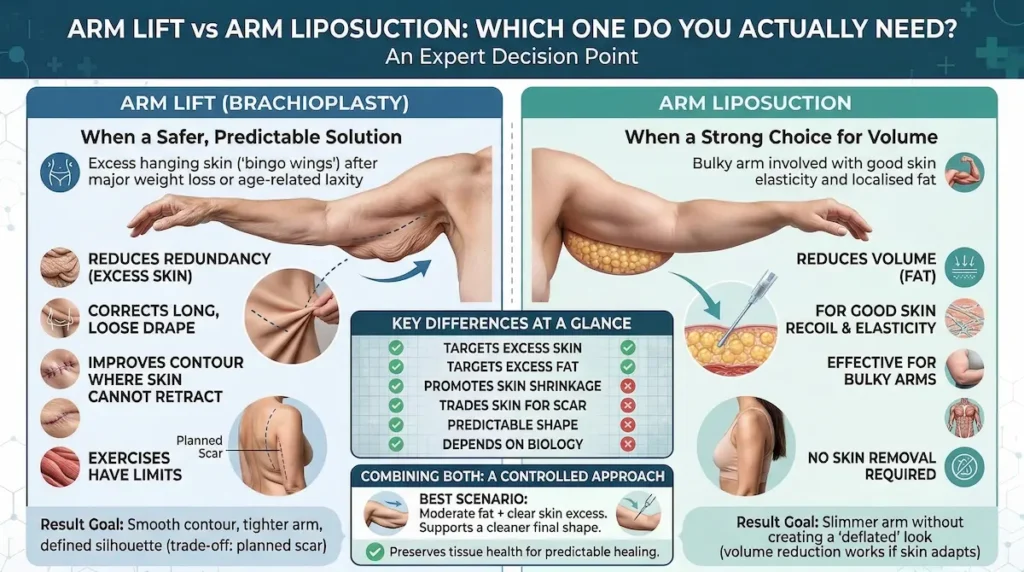
Arm Lift vs Arm Liposuction: which one do you actually need?
This is one of the most important decision points for patients searching “arm lipo vs arm lift” or “upper arm fat reduction surgery”. Liposuction and brachioplasty solve different problems:
- Liposuction reduces volume (fat).
- Brachioplasty reduces redundancy (excess skin) and refines contour where skin cannot retract.
Choosing the wrong procedure can create disappointment: removing fat when the skin cannot retract can leave you with more visible sagging; removing skin when volume is the main driver can leave the arm looking tighter but still bulky. Our role is to select the approach that aligns with your biology.
A simple decision framework we use
We assess three elements—elasticity, skin quantity, and volume. Here is the logic in plain language:
- If skin is tight and elastic and the arm is mainly full: liposuction may be enough.
- If skin is loose and hangs even at a stable weight: an arm lift is usually required.
- If both are present (common): a combined strategy can deliver the most balanced result.
When patients ask for a “non-surgical arm reduction vs brachioplasty” comparison, we make it very clear: devices may help mild laxity, but they cannot remove true excess skin. For genuine “bingo wings”, brachioplasty is usually the definitive option.
When liposuction is a strong choice
Liposuction can be excellent for patients with good skin recoil and a primary issue of volume. It is particularly effective when the arm is bulky but the skin is still behaving like “good quality fabric”.
- Good candidates: mild laxity, good elasticity, localised fat.
- What we watch for: early signs of sagging that may become more visible once fat is removed.
- Outcome target: a slimmer arm without creating a “deflated” look.
We may discuss advanced liposuction approaches when appropriate, but we keep the focus on the principle: volume reduction only works well if the skin can adapt.
When an arm lift is the safer, more predictable solution
If the primary issue is a long, loose drape of skin—particularly after major weight loss or with age-related laxity—an arm lift is typically more reliable. This is where “exercises for bingo wings” hits its limit: you can improve tone, but you cannot remove the extra skin.
- Typical signs: visible hanging skin, creasing and folding, poor recoil on pinch test.
- Core benefit: removes the redundant skin rather than hoping it will shrink.
- Trade-off: a planned scar in exchange for a smoother contour.
For expert patients, the key is understanding the exchange: brachioplasty is a contour-and-scar procedure. The right plan is the one that makes that exchange worthwhile for your goals and lifestyle.
When combining both makes sense (and how we keep it controlled)
A combined plan can refine both bulk and drape, but it must be done carefully. Too much liposuction can compromise blood supply in the skin, which may affect healing and scar quality. That is why we approach “combo” planning with a safety-first mindset.
- Best scenario: moderate fat + clear skin excess, where selective volume reduction supports a cleaner final shape.
- Safety principle: preserve tissue health to support predictable healing.
- Result goal: a smooth silhouette that looks natural in motion, not just in a posed image.
We do not chase the smallest possible scar at the expense of a compromised contour—or chase maximum tightness at the expense of safe healing. The best results come from matching the technique to your anatomy and letting biology guide the plan.
Combined Procedures with Arm Lift Surgery: Maximising Proportion
Upper arms rarely exist in isolation. If you are correcting laxity in one area, you may also notice imbalance elsewhere—particularly after weight loss or pregnancy. That is why we plan Arm Lift (Brachioplasty) as part of a wider proportion strategy when appropriate, so your result looks coherent from every angle.
Combination surgery can be efficient, but it must be chosen carefully. Done well, it can reduce overall downtime by creating one structured recovery window. Done too aggressively, it can increase swelling, fatigue, and aftercare demands. We prioritise safe operative time, predictable healing, and a plan that respects your body’s recovery capacity.
Arm lift + liposuction: refining both drape and bulk
When the arm has both excess skin and residual fullness, combining an arm lift with liposuction can deliver the cleanest silhouette. The key word is selective. We do not treat the upper arm as a place to “over-lipo”, because tissue health and blood supply matter for scar quality and reliable healing.
- Best suited for: moderate fat with clear skin redundancy.
- Why it works: volume reduction can support smoother redraping after skin excision.
- What we protect: tissue viability and tension control to support calmer scars.
If you have searched upper arm fat reduction surgery, this is often the real issue: not just fat, and not just loose skin, but a combined bulk-and-looseness pattern that needs a balanced approach.
Post-weight-loss planning: when arms are part of a bigger contour story
After major weight loss, upper-arm correction often sits alongside laxity in the abdomen, breasts, thighs, and back. In these cases, brachioplasty may be planned with procedures such as a tummy tuck (abdominoplasty), breast lift, thigh lift, or 360 body contouring to create a more proportionate top-to-bottom result.
- Common pairings: arm lift + tummy tuck, arm lift + breast lift, or staged body contouring after weight loss.
- Practical advantage: one travel period, one recovery window, and one coordinated aftercare plan.
- Reality check: combining more procedures can mean more swelling, more fatigue, and greater need for disciplined aftercare.
For some patients, a two-step approach produces calmer healing and a more refined final outcome. We will advise what makes sense to combine and what should be staged by. When procedures are combined thoughtfully—or staged when necessary—patients usually feel more in control of recovery and more confident in the final proportion.
Where a “Mummy Makeover” or face lift may fit into a broader plan
A mummy makeover often focuses on the midsection and breasts, but for some patients, upper-arm laxity is part of the same post-pregnancy body-change pattern. In those cases, brachioplasty may be discussed as either a combined option or a staged follow-on procedure, depending on operative time and recovery bandwidth.
A face lift is not typically combined with an arm lift, as it involves a different anatomical region and healing priorities. However, some patients plan facial rejuvenation as a separate stage once body contouring has settled, especially if they prefer a phased approach with clear recovery milestones.
Safety boundaries: how we decide what can be combined
Combination surgery is not a “yes/no”. It is a risk calculation based on your health profile, operative time, skin quality, and how much support you will have during recovery—particularly once you return home.
- Medical screening first: candidacy and risk factors guide the plan, not convenience.
- Operative time discipline: we avoid excessive surgical load in a single session.
- Recovery bandwidth: your ability to rest, hydrate, and avoid heavy lifting protects the outcome.
Our aim is a result that looks balanced and heals predictably. When procedures are combined thoughtfully—or staged when necessary—patients usually feel more in control of recovery and more confident in the final proportion.
A combined plan should look effortless when healed. The way we get there is not by doing “everything”, but by doing the right things in the right order.
Anaesthesia: Why We Often Prefer Awake / Twilight Sedation
Anaesthesia is not just a comfort choice. It is a safety and recovery decision. Many UK patients tell us the same thing: they are comfortable with surgery, but anxious about being “fully put under”. We take that concern seriously.
For selected candidates, we often favour a local anaesthetic approach with sedation—sometimes described as twilight anaesthesia. You remain comfortable and closely monitored, while avoiding a full general anaesthetic where it is clinically appropriate.
What “awake” and “twilight” actually mean
Terminology can be confusing. “Awake” does not mean you feel everything. It means we use local anaesthetic to numb the area and, if suitable, add sedation to keep you relaxed.
- Local anaesthesia: the surgical area is numbed so you should not feel sharp pain.
- Sedation (twilight): medication helps you feel calm and drowsy; many patients remember very little.
- Continuous monitoring: we monitor vital signs and comfort throughout.
Some patients prefer this for peace of mind. Others simply want a smoother early recovery experience. We tailor the approach to your health profile and the surgical plan.
Why some patients choose to avoid general anaesthesia
General anaesthesia is safe for most healthy people, but it is not always necessary for every case. When local anaesthesia with sedation is suitable, patients may benefit from a more straightforward immediate post-operative period.
- Less “hangover” effect: some patients report feeling more clear-headed sooner.
- Anxiety reduction: it can be a good fit for those with a strong fear of general anaesthesia.
- Earlier mobilisation: gentle movement and hydration can feel easier in the first hours.
We keep the tone practical. No promises. Your experience will depend on your physiology, the procedure scope, and your individual response to medication.
When general anaesthesia may be the better option
There are situations where general anaesthesia is simply the most sensible and controlled choice. If the surgical scope is extensive—particularly with larger combinations—or if your medical profile indicates it, we will recommend it.
- More extensive surgery: longer procedures or wider correction patterns.
- Comfort or positioning needs: where deeper relaxation is required for precision and safety.
- Medical indications: where the anaesthetic team advises general anaesthesia as the safest route.
Our job is to match the anaesthetic plan to the surgical plan. Not the other way around.
What you can expect on the day
We explain your anaesthesia plan in plain English before surgery. You will know what the medications are for, what sensations are normal, and how we manage discomfort.
- Pre-op checks: a final health review, vital signs, and a clear consent process.
- Comfort-first approach: local numbing plus sedation if chosen, adjusted in real time.
- Aftercare basics: we guide pain control using UK-familiar terms (for example, paracetamol-based schedules when appropriate), plus rest and hydration.
If you want a personalised recommendation, we can review your medical history and your goals in a virtual consultation and tell you, candidly, whether an awake/twilight approach is appropriate for your arm lift plan.
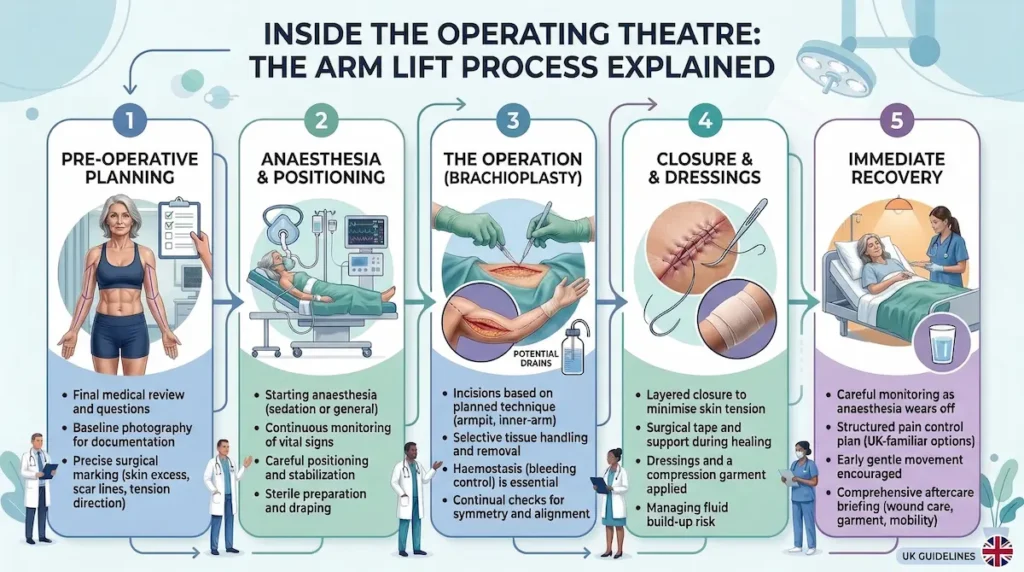
Arm Lift Step-By-Step: what happens in the operating theatre?
For an expert patient, clarity reduces anxiety. A well-planned arm lift is a structured sequence: assessment, precise marking, controlled tissue handling, and a closure strategy designed for both contour and scar quality. While exact details vary by technique (mini, standard, extended), the workflow is consistent.
Before surgery: assessment, planning, and surgical marking
On the day, we confirm the plan and take final safety steps before you enter the operating theatre.
- Final clinical review: we re-check your medical history, medications, allergies, and any last-minute questions.
- Photography and documentation: baseline images help us evaluate symmetry and planned changes.
- Marking (pre-op drawing): this is where precision happens. We map the pattern of skin excess, the intended scar line, and the “tension direction” so the closure supports smooth healing.
If your plan includes liposuction, we also mark where refinement is needed and where we must be conservative to protect tissue health.
Anaesthesia and positioning: comfort, safety, and access
Once your anaesthesia plan begins (local with sedation/twilight where suitable, or general where indicated), we position you to give the surgeon safe, consistent access to the full correction area.
- Monitoring: your vital signs are continuously monitored throughout.
- Positioning: your arms are supported to reduce pressure points and keep the correction zone stable.
- Sterile preparation: antiseptic skin prep and sterile draping are standard for infection control.
Our priority is a controlled environment where the surgical plan can be executed calmly and precisely.
The operation: incision design, tissue refinement, and contour shaping
The core steps of brachioplasty typically include the following:
- Incision placement: based on your technique (armpit-focused, inner-arm, or extended patterns).
- Selective tissue handling: removal of excess skin and, when indicated, conservative contour refinement.
- Haemostasis: careful bleeding control is essential for reducing bruising risk and supporting clean healing.
- Symmetry checks: we continually re-check contours and alignment during the procedure.
Where drains are used, they are placed to reduce fluid build-up risk in selected cases. Not every patient needs them, and we decide based on tissue behaviour and surgical scope.
Closure and dressings: the scar plan begins immediately
Closure is not “just stitching”. It is a structural step designed to minimise tension, support a smooth contour, and optimise scar behaviour.
- Layered closure: deeper layers are secured to reduce pull on the skin line.
- Skin support: surgical tape or dressing support may be used to stabilise the scar in early healing.
- Dressings and compression: you will usually be placed in supportive dressings and a compression garment to help manage swelling and support the new contour.
The scar you see months later is shaped by what happens in the operating theatre and how well early healing is protected. Good planning reduces tension; good aftercare protects the plan.
Immediate recovery: the first hours after surgery
After surgery, you are monitored as the anaesthesia wears off. We focus on comfort, hydration, and safety.
- Pain control: we provide a structured plan using UK-familiar terms (often including paracetamol-based schedules when appropriate), with escalation options if needed.
- Mobility: gentle movement is encouraged as advised; heavy lifting is avoided.
- Aftercare briefing: garment use, sleeping position, arm movement limits, and wound/dressing guidance are explained clearly before discharge.
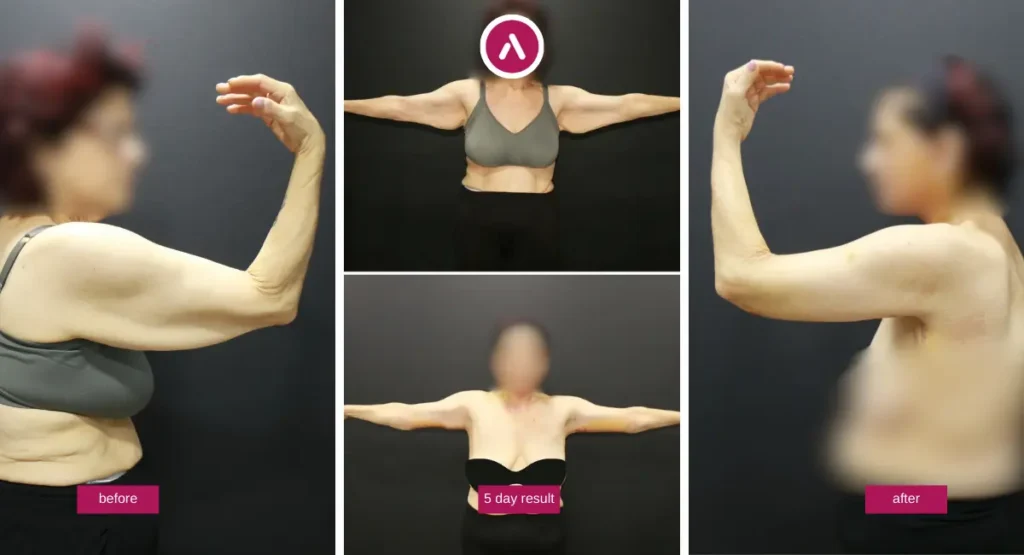
Arm Lift Recovery Timeline: how long does healing take?
Recovery after brachioplasty is predictable when you follow a structured plan—but it is still a process. Swelling, bruising, and temporary tightness are normal. The aim is not to “rush” healing; it is to support it so the contour settles and the scar matures well.
Below is a realistic timeline. Your exact pace depends on technique (mini vs extended), whether liposuction was included, your skin quality, and your adherence to aftercare.
The first 72 hours: swelling control, rest, and protection
This phase is about stabilising the result and preventing avoidable setbacks.
- Swelling and bruising: most noticeable early; arms may feel tight or heavy.
- Discomfort: usually manageable with a structured analgesia plan; avoid “pushing through”.
- Arm movement: gentle, limited range is typically advised—no lifting, pulling, or sudden overhead movements.
- Compression: your garment supports swelling control and contour stability.
It is common to experience temporary numbness or altered sensation near the incision line. This often improves gradually as healing progresses.
Week 1–2: wound care, early mobility, and routine return
In the first two weeks, you will usually start to feel more “yourself”, but your arms are still healing internally.
- Dressings and reviews: we guide you on dressing changes and when to attend scheduled checks.
- Compression compliance: consistent use matters—this is not the time to improvise.
- Daily activity: light walking is encouraged; avoid gym work, heavy lifting, and vigorous household tasks.
- Work: desk-based work may be possible for some patients within this window, depending on comfort and swelling.
If drains were used, they are typically removed based on output and clinical assessment.
Weeks 3–6: contour settling and a controlled return to activity
This is when many patients feel significantly better, but the arm is still remodelling under the skin.
- Swelling reduction: the arm contour begins to look more defined as fluid shifts settle.
- Mobility: range of motion improves; we advise a gradual progression rather than sudden intensity.
- Exercise: lower-body and gentle cardio may resume earlier; upper-body training is usually reintroduced later and in stages, based on your surgeon’s guidance.
- Scar care begins/continues: silicone-based care, sun protection, and consistent routines support better scar outcomes.
This is also a period where “doing too much because you feel better” can create swelling flare-ups. Discipline here pays off later.
Weeks 6–12 and beyond: scar maturation and long-term refinement
By this stage, many patients return to normal routines—with sensible limits—while the scar continues to mature.
- Strength and training: you can typically build back gradually, but avoid sudden maximum effort until cleared.
- Scar maturation: scars often look red/pink before they fade; this is normal. The “final” look takes time.
- Result refinement: subtle contour changes can continue for several months as tissues settle.
If your main concern is “arm lift scars after 1 year”, we address that fully in the scar management section—because scar quality is a long game, not a two-week outcome.
Our Rapid Recovery & Safety Protocol: HBOT and LLLT support
For suitable patients, we can integrate advanced recovery support as part of our boutique care model.
- HBOT (Hyperbaric Oxygen Therapy): may support tissue oxygenation and recovery in selected cases.
- LLLT (Low-Level Laser Therapy): may help manage swelling and support soft-tissue recovery, including scar-focused protocols when appropriate.
- Why it matters for UK patients: many patients value a recovery plan that aims to reduce downtime and support a calmer healing process—especially when returning to a busy professional routine.
We position these technologies as support, not a substitute for good surgery and disciplined aftercare. The fundamentals still matter: compression, rest, hydration, and a structured return to activity.
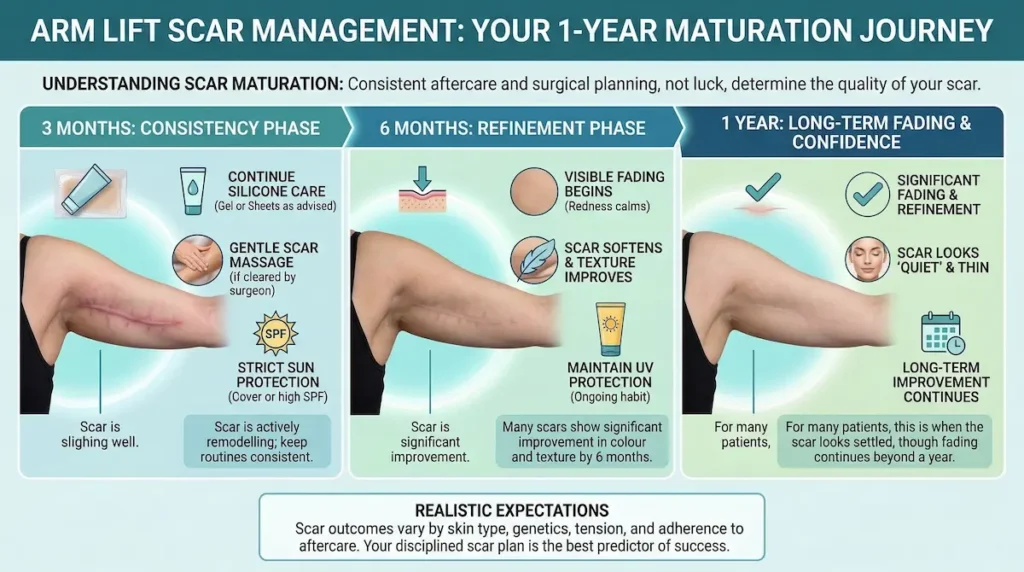
Scar Management: what to expect at 3 months, 6 months, 1 year
Scars are the number-one anxiety point for many UK patients researching brachioplasty—especially searches like “arm lift scars after 1 year”. We address this directly because scar quality is not luck; it is the product of (1) surgical planning and closure, (2) early protection, and (3) consistent aftercare while the scar matures.
First, an honest principle: any procedure that removes meaningful excess skin requires an incision line. The goal is not “no scar”. The goal is a well-positioned scar that heals calmly and fades over time.
How scars mature (and why the first weeks are not the final story)
Scar maturation is a long process. It is common for an arm lift scar to look pink or red for a period before it begins to fade. Texture, firmness, and colour usually improve gradually—provided the scar is protected from tension and sun exposure.
- Weeks 0–6: the incision is closing and strengthening. Protection and compression matter most.
- Weeks 6–12: the scar may look more noticeable (red/pink) as remodelling increases.
- 3–6 months: many scars begin to soften and lighten; unevenness often settles.
- 6–12 months: fading and refinement continue. For many patients, this is when the scar starts to look “quiet”.
When patients ask for “1 year arm lift scar photos”, we explain that scar outcomes vary by skin type, genetics, tension, and adherence to aftercare. The best predictor is not a single photo—it is a disciplined scar plan and realistic expectations.
Early scar care: what we prioritise (and what to avoid)
Scar care is a phased plan. Doing the right thing at the right time is more effective than doing “everything” immediately.
- Keep the area protected: follow dressing instructions exactly. Do not improvise with creams until you are cleared.
- Compression compliance: your garment supports swelling control and reduces pull on the healing line.
- Limit tension: avoid heavy lifting and sudden overhead movements until your surgeon approves progression.
- Sun protection is non-negotiable: once the incision is closed and you are cleared, protect scars from UV exposure to reduce long-term pigmentation risk.
We typically discuss silicone-based scar care (gel or sheets) once the wound is fully closed and stable. We also guide you on when scar massage is appropriate and how to do it without irritating the tissue.
Scar care at 3 months: the “consistency” phase
At around 3 months, many patients feel physically recovered, but the scar is still actively remodelling. This is where consistent, low-drama routines help most.
- Continue silicone care: as advised, with reliable daily use.
- Gentle scar massage: only if cleared—aimed at softening firmness, not “scrubbing”.
- Keep UV exposure low: cover the scar or use high SPF when appropriate and permitted.
If the scar is becoming raised, itchy, or thickened, we want to know early. Early intervention can be simpler than waiting for a scar pattern to “set”.
Scar care at 6–12 months: refinement, fading, and real-world confidence
By 6 months, many scars have softened and the colour has begun to calm. At 12 months, a significant amount of fading has often occurred, although every patient is different.
- Texture changes: firmness usually reduces progressively.
- Colour changes: redness generally fades; some patients may notice longer-lasting pigmentation depending on skin type.
- Long-term behaviour: scars can continue improving beyond a year, especially with good sun habits.
Scar outcomes are not judged at two weeks. We look at the full scar journey—because mature scars tell the real story, not early healing.
How LLLT can support calmer healing (where appropriate)
For suitable patients, we can integrate Low-Level Laser Therapy (LLLT) into the recovery plan to support soft-tissue recovery and scar-focused protocols when appropriate. We use this as an adjunct—it supports healing, but it does not replace the fundamentals of a well-executed operation and disciplined aftercare.
If you are particularly concerned about scarring, we will map a scar strategy in advance: incision planning, tension control, compression guidance, and a structured aftercare pathway that you can follow confidently once you return to the UK.
Safety & Risks: Is An Arm Lift Dangerous?
Any surgery carries risk. The real question is whether risk is appropriately managed through patient selection, surgical technique, anaesthesia planning, and follow-up. Brachioplasty is a well-established procedure, but because it involves long incisions and tissue tension, it demands careful planning and mature aftercare behaviour.
Normal side effects vs complications (what is expected)
Many things that feel “alarming” are actually normal early healing responses. We explain what is expected so you do not panic—and so you can recognise what is not normal.
- Expected: swelling, bruising, tightness, temporary numbness/altered sensation.
- Expected (early): mild to moderate discomfort, improving week by week.
- Not expected: worsening pain day after day, sudden significant swelling on one side, spreading redness, pus-like discharge, or fever.
We provide clear guidance on when to message us, when to see a local GP, and when to go straight to A&E.
Potential risks and complications (transparent, not frightening)
Complications are uncommon when surgery is properly planned and aftercare is followed, but it is essential to understand them.
- Bleeding / haematoma: a collection of blood that may require intervention.
- Infection: treated early with appropriate care; sometimes requires drainage.
- Seroma: fluid build-up under the skin; may need aspiration.
- Delayed wound healing: more likely with nicotine exposure or excessive tension/movement.
- Scarring issues: widened, thickened, or raised scars (risk varies by skin type and tension).
- Asymmetry: natural anatomy differences exist; refinement is sometimes discussed in complex cases.
- Sensation changes: temporary numbness is common; permanent change is less common but possible.
- Blood clots (DVT/PE): rare but serious—risk assessment and prevention matter.
If you are comparing “UK vs Turkey” options, this is exactly where safety culture shows: not in promises, but in structured prevention and clear escalation pathways.
How we reduce risk (our de-risking strategy)
We reduce complications by controlling what we can control—before, during, and after surgery.
- Patient selection: we assess weight stability, nicotine exposure, medical conditions, and recovery capacity.
- Pre-op screening: medical review, medication management planning, and anaesthesia suitability assessment.
- Technique and tension control: incision design and layered closure to protect scar quality.
- Infection prevention: sterile protocols, appropriate wound-care guidance, and early monitoring.
- Clot-risk prevention: risk stratification, mobilisation guidance, and preventive measures where clinically indicated.
- Structured follow-up: clear check-ins and a direct communication route for international patients.
The safest surgery is not the fastest surgery. We plan brachioplasty as a controlled, predictable process—from screening to scar maturation.
Red flags: when to contact us urgently or seek immediate care
This is general guidance, not a diagnosis. If you are worried, we would rather you contact us early than “wait and see”.
- Go to A&E immediately if you have chest pain, shortness of breath, fainting, or sudden leg swelling/pain.
- Contact us urgently if you develop rapidly increasing swelling, spreading redness, fever, severe one-sided pain, or concerning discharge.
- Book a GP review for persistent concerns that are not escalating but do not feel right.
For UK patients travelling back home, we provide practical instructions on garment use, movement, hydration, and what to monitor. Good outcomes are built on good decisions—especially in the first few weeks.
Is An Arm Lift Safe In Turkey for UK Patients?
UK patients often ask this in a very specific way: “Is it safe for me to have brachioplasty abroad?” The safest answer is not a slogan. It is a framework: surgeon competence, clinical systems, anaesthesia governance, and follow-up structure. When these elements are in place, international surgery can be both safe and predictable—provided you follow the recovery plan and travel guidance.
Clinical standards: what matters more than postcode
“Safe” is not a country label. It is the standard of the operating theatre environment and the discipline of the team.
- Sterile operating theatre protocols: rigorous infection-control processes and consistent sterile technique.
- Appropriate monitoring and recovery care: safe anaesthesia monitoring, controlled pain management, and clear discharge criteria.
- Emergency readiness: structured escalation pathways if anything deviates from expected healing.
For expert patients, the right question becomes: What systems are in place to prevent problems—and what happens if one occurs?
Surgeon competence and “de-risking” signals
The strongest reassurance for UK patients is not a discount. It is competence that can be explained and evidenced. In our model, brachioplasty planning is led by European Board Certified surgeons with a safety-first approach to technique selection, tension control, and scar planning.
- Technique selection: mini vs standard vs extended is decided by anatomy, not marketing preference.
- Scar strategy: incision placement and layered closure to reduce tension and support calmer healing.
- Honest suitability filters: if your risk is elevated (for example, nicotine exposure or unstable weight), the plan may be to delay—not to “push through”.
For UK patients, the goal is not “surgery abroad”. The goal is a controlled surgical environment with a team that treats safety as a system, not a statement.
Travel planning: a practical UK patient pathway
International recovery is successful when it is treated like a planned medical journey, not a rushed trip. We organise care so you know what to do at each stage and who to contact if you need support.
- Virtual consultation: remote assessment of your laxity pattern, likely technique, and a personalised recovery plan.
- Structured in-person timeline: pre-op review, surgery, early post-op checks, and clear discharge guidance.
- Return-home planning: compression garment schedule, movement guidance, hydration, and a staged return to normal activity.
We also help you understand what is normal (swelling, tightness, temporary numbness) versus what needs review—so you are not guessing once you are back in the UK.
Follow-up after you return to the UK: what “good aftercare” looks like
One concern UK patients raise is: “What happens after I fly home?” Good aftercare means you are not left alone with uncertainty. We maintain structured communication and clear escalation advice.
- Remote check-ins: planned follow-ups and photo/video reviews as needed.
- Clear escalation rules: when to message us, when to see your GP, and when to go to A&E.
- Scar strategy continuation: silicone care, sun protection, and any clinic-guided supportive protocols (such as LLLT) where appropriate.
If you are comparing UK private options to Turkey, consider the full safety pathway: selection, surgery, early recovery, and long-term scar support. The best providers are strong in all four—not just one.
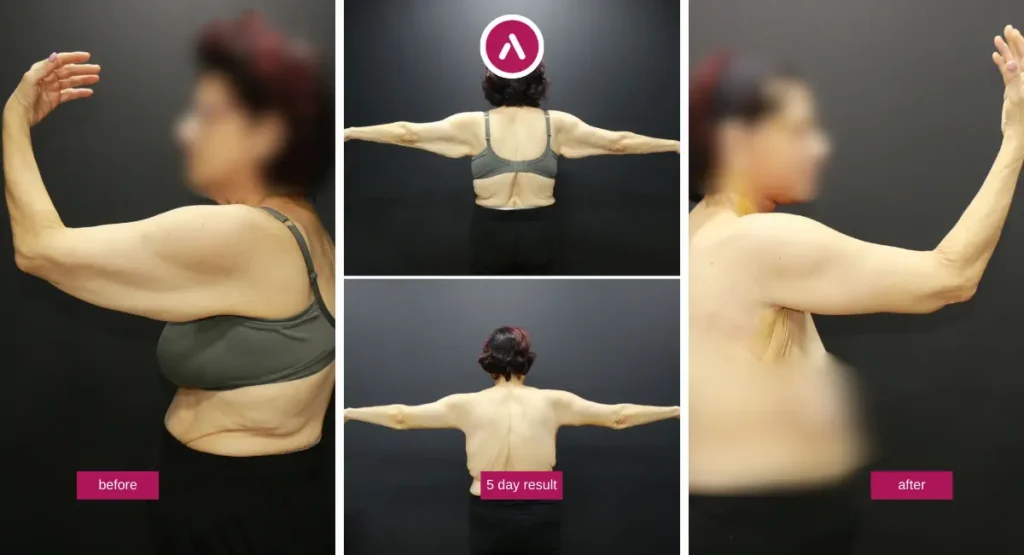
Arm Lift Before and After: Results & Expectations
A successful arm lift should look believable. Not “surgically tight”, not over-pulled, and not shaped for a single pose. Natural-looking outcomes come from proportion, restraint, and precise scar planning.
Most patients notice the biggest change in three places: the way the arm looks with the arms down, the way the arm moves without “swinging” loose skin, and the way clothing fits around the upper arm.
What you can realistically expect (and what you should not)
Here is the honest result profile we discuss with patients:
- You can expect: reduced hanging skin, a smoother contour, and improved arm shape consistency in daily movement.
- You can expect: a visible scar that should soften and fade over time, with disciplined scar care.
- You should not expect: a “scar-free” outcome or an instant final appearance in the first weeks.
- You should not expect: brachioplasty to replace weight loss or strength training.
When your goal is “get rid of bingo wings fast”, we reframe it into a safer, more useful goal: predictable healing with a refined contour.
How long results last (and what affects longevity)
Brachioplasty results are long-lasting, especially when your weight is stable. However, the body continues to age, and skin quality evolves over time.
- Weight stability: major fluctuations can stretch skin and change contour.
- Skin quality: genetics and sun exposure influence long-term firmness.
- Lifestyle: hydration, nutrition, and avoiding nicotine support better tissue quality and scar behaviour.
Many patients maintain their result for years by keeping a stable weight and following sensible long-term scar and skin habits.
Typical patient profiles we treat (UK intent aligned)
Without turning this into a “one-size-fits-all” promise, these are common patterns we see:
- Age-related laxity (often 50+): classic “bingo wings” with minimal bulk but clear skin drape.
- Post-weight-loss laxity: significant loose tissue that may extend beyond the arm and require an extended technique.
- Busy professionals: patients who value a structured recovery pathway and a plan designed to support a calm return to routine.
Natural results come from discipline: the right technique for the right anatomy, a scar plan that respects tension, and a recovery plan that protects healing.
Before-and-after thinking: how to evaluate outcomes intelligently
When reviewing results, we recommend looking beyond “best-case” photos. Assess outcomes like an expert:
- Arm position: compare arms down, arms raised, and natural movement angles.
- Scar location: where does it sit when the arms are relaxed?
- Skin quality: does the result look smooth and proportionate, or over-tightened?
- Timepoint: early photos can show swelling; mature results are typically judged months later.
If you would like, we can advise what results are realistic for your arm anatomy and which technique is most likely to deliver a refined contour with a scar strategy you can accept.
Cost / fees: Brachioplasty Cost 2026 UK vs Turkey
Patients in the UK often begin with one question: “How much does an arm lift cost?” A more useful question is: what drives fees, and what is included? Brachioplasty is not priced like a commodity. The total fee reflects clinical complexity, anaesthesia planning, facility standards, and the aftercare pathway that supports safe healing and scar quality.
We do not position brachioplasty as a “cheap alternative”. For expert patients, the priority is safe systems, surgeon competence, and predictable recovery. The cost conversation should reflect that.
What determines the total fee for brachioplasty
Arm lift fees vary because the procedure varies. A mini approach is different from an extended technique, and combining procedures changes operative time and aftercare needs.
- Technique scope: mini vs standard vs extended / L-brachioplasty (scar footprint and operative complexity differ).
- Whether liposuction is included: selective contouring may be appropriate in some cases.
- Anaesthesia plan: local with sedation (where suitable) versus general anaesthesia.
- Facility level: operating theatre standards, monitoring, and clinical staffing.
- Aftercare structure: reviews, garment guidance, wound care, and support for international patients.
For UK patients comparing clinics, it is important to ask for clarity on the above—not just a headline number.
Why fees can differ between the UK and Turkey (without implying lower quality)
Differences in fees are often driven by broader operational realities rather than “better vs worse”. For example, property costs, staffing costs, insurance structures, and healthcare overheads can vary significantly between countries.
- Operating costs and overheads: facility and staffing costs differ by market.
- Service model: some providers bundle logistics and aftercare into one programme.
- Currency dynamics: exchange rates can affect international pricing, especially for UK-based patients.
The key point: an informed decision should be based on clinical standards and your safety pathway, not on a “deal mindset”.
All-inclusive care: what “value” should actually include
When UK patients compare options, the comparison should be like-for-like. A UK private quote may not include the same logistics or aftercare components that an international programme includes.
In an all-inclusive model, value often comes from a structured pathway rather than a single line item. Typical components may include:
- Clinical pathway: consultations, surgery, early post-op checks, and structured guidance.
- Aftercare essentials: dressings guidance, compression garment planning, and follow-up schedule.
- International logistics: transfers and accommodation coordination (where offered).
- Recovery support options: access to adjunct technologies such as HBOT/LLLT for suitable patients, as part of a broader recovery strategy.
We recommend asking every provider for a written breakdown of what is included and what is not—because that is where true value becomes visible.
UK vs Turkey comparison: focus on transparency (not just headline price)
Below is a practical, non-numeric comparison so you can evaluate what you are actually paying for. Exact inclusions vary by provider.
| Category | UK private (typical model) | Turkey (all-inclusive model, where offered) | What to clarify |
|---|---|---|---|
| Surgeon & anaesthesia | Usually itemised (surgeon, anaesthetist, theatre time) | Often bundled into a single programme | Who is responsible for anaesthesia care? What monitoring is used? |
| Hospital / theatre facility | Included, but varying facility tiers | Included, varying facility tiers | Is the procedure performed in a full operating theatre environment? |
| Post-op reviews | May be limited or scheduled separately | Often structured during the stay + remote follow-up | How many reviews are included, and what happens after you return home? |
| Compression garment | Sometimes additional cost | Often included | Is the garment included, and how long must it be worn? |
| Medications | Often separate prescriptions | May be included or partly included | What is provided, and what must you arrange in the UK? |
| Accommodation & transfers | Not included | Often included in international programmes | What standard of accommodation and what level of support is included? |
| Recovery adjuncts (HBOT/LLLT) | Often separate / not routinely available | May be available in selected programmes | Are these offered, and are they clinically appropriate for your case? |
If you want a personalised estimate, we can only give one after we confirm the likely technique (mini vs standard vs extended), whether liposuction is indicated, and your anaesthesia suitability.
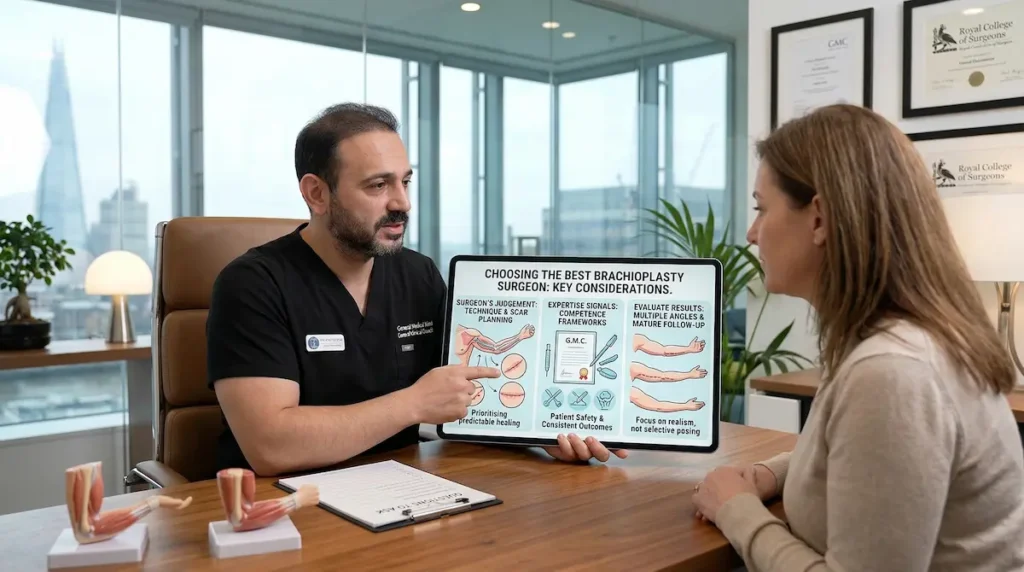
How To Choose The Best Brachioplasty Surgeon
Brachioplasty results are shaped by judgement as much as skill: how the surgeon selects the technique, manages tissue tension, and designs a scar line that heals well. If you are comparing providers, focus on expertise signals that reduce risk—not on marketing claims.
Credentials and competence: what actually matters
For UK patients, the most meaningful signals are competence frameworks that relate directly to patient safety and consistent outcomes.
- Board-level standards: look for recognised, rigorous credentialing and a surgeon who can explain their approach clearly.
- Experience with your anatomy: post-weight-loss arms are not the same as mild age-related laxity.
- Scar planning maturity: the surgeon should discuss scar placement and tension control proactively, not defensively.
The right surgeon does not sell you a technique. They diagnose your anatomy, explain trade-offs honestly, and build a plan that prioritises predictable healing.
Consultation checklist: questions an expert patient should ask
Use your consultation to test clarity, not charisma. These questions reveal whether planning is thoughtful and safety-led.
- Which technique do you recommend for me—and why? (mini vs standard vs extended)
- Where will my scar sit when my arms are relaxed? (not just with arms raised)
- Will you combine liposuction—and how do you protect tissue health?
- What is your plan for swelling control and scar care?
- What are the most common issues you see in recovery—and how are they handled?
- What happens after I return to the UK? (follow-up structure and escalation guidance)
How to evaluate before-and-after results intelligently
Do not judge results by one flattering angle. Look for consistency and realism.
- Timepoint: mature results (months later) are more meaningful than early post-op images.
- Arm positions: arms down, arms raised, and natural movement angles matter.
- Scar visibility: location and quality, not just length.
- Proportion: the arm should look balanced with the torso, not “over-tightened”.
If results look unnaturally tight or if scars are hidden by selective posing, ask for additional angles and later follow-up images.
Safety culture and aftercare: the deciding factors for international patients
For UK patients travelling abroad, aftercare is not a “nice extra”. It is part of safety.
- Clear written aftercare plan: garment schedule, movement limits, wound guidance, and scar care timeline.
- Structured follow-up: planned remote check-ins once you are back in the UK.
- Escalation pathway: when to contact the clinic, when to see your GP, and when to go to A&E.
A provider that cannot explain their follow-up pathway clearly is not the right fit for an international surgical journey.
Your AKM Medical Journey for Arm Lift (Brachioplasty): what to expect
For UK patients, the procedure is only half the equation. The other half is logistics, communication, and follow-up. We run your journey as a structured pathway, so you are not making decisions in the middle of recovery.
It starts with clarity. It ends with continuity. You will always know what happens next, who to contact, and what “normal” healing looks like for your body.
1) Free virtual consultation (from the UK)
Your journey begins at home with a no-obligation video consultation. We review your goals, assess your arm anatomy from photos, and explain which technique is most likely to match your laxity pattern (mini, standard, or extended).
- Clear plan: expected scar placement, recovery timeline, and suitability screening.
- Transparent scope: whether liposuction supports your contour or risks revealing more laxity.
- Practical next steps: what to prepare, what to avoid (especially nicotine), and how to plan time off.
2) Secure your date & VIP planning
Once you decide to proceed, your dedicated Patient Host coordinates the practical details so you can focus on preparation. We plan your schedule around safe timing, not rushed convenience.
- Hotel coordination: we arrange 5-star partner accommodation options.
- Transfers: we schedule VIP transfers so you are not navigating taxis during recovery.
- Simple responsibility: you only need to book your international flights.
3) Arrival in Istanbul: airport welcome and smooth transfer
When you land, we keep it straightforward. You are met at the arrivals gate and transferred in a private vehicle to your hotel so you can settle in and rest before surgery.
- Airport options: Istanbul Airport (IST) or Sabiha Gökçen (SAW).
- Private transfer: discreet, pre-arranged, and timed around your schedule.
- Comfort-first pace: no unnecessary moving around on day one.
4) In-person consultation, pre-op checks, and surgery day
On the procedure day, we confirm details with a final in-person consultation. We review your markings, scar strategy, and anaesthesia plan (twilight/local where appropriate, or general if clinically indicated). Then our surgeons perform your procedure in a fully accredited facility with structured monitoring and recovery standards.
- Final confirmation: technique choice and realistic expectations.
- Safety checks: pre-op tests and an anaesthesia suitability review.
- Aftercare briefing: compression garment schedule, movement limits, and pain control plan.
5) Post-op care in Istanbul + long-term follow-up back in the UK
In the first days, we focus on comfort, swelling control, and protecting your incision line. Your Patient Host remains available 24/7 via WhatsApp for practical support, while our medical team monitors your early healing. Before you fly home, you have a final in-person check to confirm you are progressing safely.
- Early recovery: garment use, hydration, and gentle mobilisation guidance.
- Flight planning: “flight-ready” advice based on your procedure scope and your progress.
- Remote reviews: scheduled virtual follow-ups at 1, 3, 6, and 12 months.
Arm Lift (Brachioplasty) Frequently Asked Questions (FAQ):
These answers reflect common UK patient concerns. They are informational, not a diagnosis. Your safest guidance will always come from an individual assessment based on your anatomy and medical history.
How do I get rid of “bingo wings” fast?
If the issue is mainly loose skin, exercise cannot remove it. Training improves muscle tone, but skin that has lost recoil behaves like stretched fabric. Brachioplasty is the definitive option when excess skin is the primary driver.
Are bingo wings fat or loose skin?
They can be either—or both. If your upper arm feels bulky and your skin is elastic, fat reduction may help. If the arm hangs even at a stable weight, loose skin is usually the driver and an arm lift becomes the more predictable solution.
Mini arm lift vs full brachioplasty: which one do I need?
Mini approaches suit laxity that sits high near the armpit. If the looseness runs down the arm, a standard or extended technique is often needed. We decide based on where the excess tissue actually is—and where the scar can sit most sensibly for you.
What do arm lift scars look like after 1 year?
Most scars continue to soften and fade over many months, with the “quietest” appearance often developing between 6–12 months and beyond. Your scar outcome depends on genetics, skin type, tension, sun exposure, and how consistently you follow scar care guidance.
When can I fly after brachioplasty?
It depends on procedure scope (mini vs extended), your swelling, and your clot-risk profile. We plan your return around safe timing and give you structured movement and hydration guidance for travel. Do not treat flights as “one-size-fits-all”.
Can I get bingo wings surgery on the NHS?
In the UK, access to body-contouring surgery through the NHS is limited and typically depends on strict criteria. Many patients explore private options when they want a clear timeline and a surgeon-led plan focused on aesthetics and scar strategy.
Is it possible under local anaesthetic / twilight sedation?
For selected patients, yes. We often prefer twilight/local approaches where clinically appropriate, because they can reduce anaesthesia anxiety and support a smoother immediate recovery. If your case is extensive or combined, general anaesthesia may be the better-controlled option.
What should I watch for after I return home?
Swelling, bruising, and temporary numbness are common. Seek urgent review if you develop rapidly increasing swelling, spreading redness, fever of 38°C (100.4°F) or higher, chest pain, or shortness of breath.
How long do I need to wear a compression garment after an arm lift (brachioplasty)?
Most patients wear a compression garment continuously in the early phase, then gradually reduce wear as advised. The exact duration depends on whether you had a mini arm lift, standard brachioplasty, or an extended technique, and whether liposuction was included. Compression supports swelling control, helps the skin settle smoothly, and reduces tension on the arm lift scar during early healing.
Will I need drains after Arm Lift (Brachioplasty)?
Not always. Drains may be recommended in selected cases, especially when the procedure is more extensive (for example, extended brachioplasty) or when tissue behaviour suggests a higher seroma (fluid build-up) risk. If drains are used, they are temporary and removed based on clinical assessment and output, with clear aftercare guidance before you leave.
When can I shower after brachioplasty?
Showering timelines vary depending on dressings, incision stability, and your surgeon’s protocol. Many patients can shower once the incision is secure and you are cleared at your post-op review, but soaking (baths, pools, hot tubs) is usually delayed longer. Protecting the incision early supports smoother scar maturation and reduces infection risk.
Is Arm Lift (Brachioplasty) painful?
Most patients describe discomfort, tightness, and heaviness rather than severe pain, particularly in the first few days. Pain is typically managed with a structured plan and improves week by week. Following movement limits, using your compression garment correctly, and prioritising rest and hydration can significantly improve comfort during brachioplasty recovery.
How do I sleep after an arm lift?
Sleeping on your back with your arms gently supported (often slightly elevated) is commonly recommended early on to reduce swelling and avoid tension on the incision line. Side sleeping is usually delayed until you are comfortable and cleared. Good sleep positioning is a simple but powerful way to protect your arm lift scar and support a calmer recovery.
Medical Disclaimer: This page is provided for general information only and does not constitute medical advice, diagnosis, or treatment. Surgical suitability, technique selection, risks, recovery time, and outcomes vary between individuals and require a personalised consultation with a qualified clinician. If you have urgent symptoms or believe you are experiencing a medical emergency, seek immediate medical attention through your local emergency services. Always follow the specific instructions provided by your surgeon and clinical team.