If you’re comparing DHI vs FUE hair transplant, you’re already thinking like an “expert patient” — and that’s a good thing. Both techniques can produce natural-looking outcomes when the plan is correct, the grafts are handled gently, and the hairline is designed with your age, facial proportions, and future hair loss in mind.
This guide is a practical FUE vs DHI hair transplant comparison for UK patients who want clear answers, not hype: what each method actually involves, how they differ, and which type of patient profile tends to suit each approach. We’ll also address the questions people type into Google — such as difference between DHI and FUE and DHI vs FUE which is better — with straightforward, clinical logic.
Important: This article is for education and decision-support, not personal medical advice. A proper recommendation depends on donor quality, hair calibre, scalp characteristics, and your long-term loss pattern.
Table of Contents
DHI vs FUE at a Glance (Key Differences in 60 Seconds)
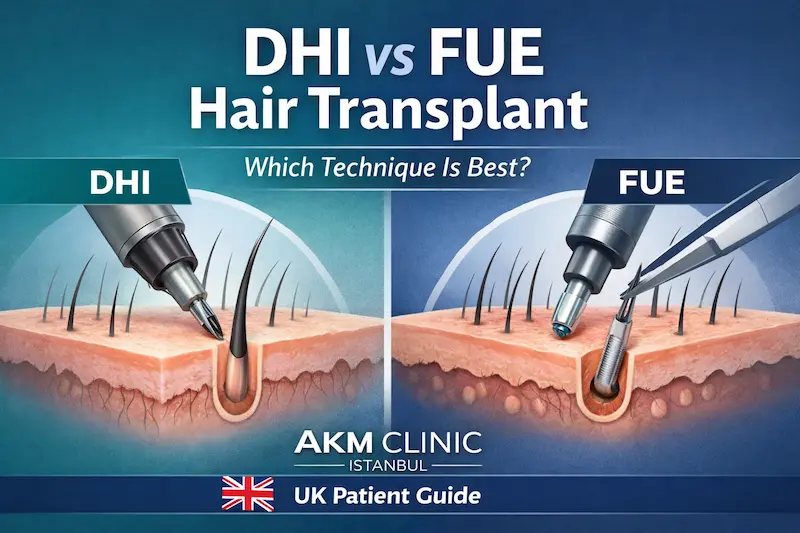
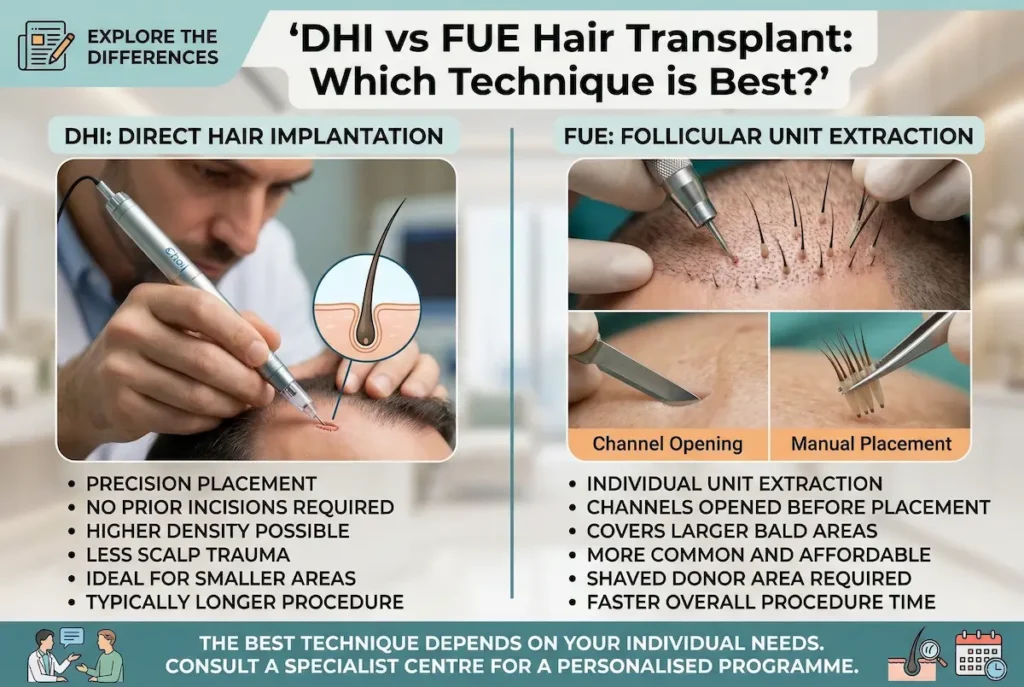
Let’s make the DHI vs FUE hair transplant differences easy to understand. In everyday terms, both techniques involve moving follicles from a donor area (usually the back/sides of the scalp) into thinning areas. The biggest practical difference is how the grafts are implanted into the recipient area.
What “FUE” means (in plain English)
FUE stands for Follicular Unit Extraction. The surgeon removes individual follicular units (grafts) from the donor area and then places them into tiny recipient sites created in the thinning area. Think of it as a two-part process: extract grafts, then create sites and place grafts.
What “DHI” means (in plain English)
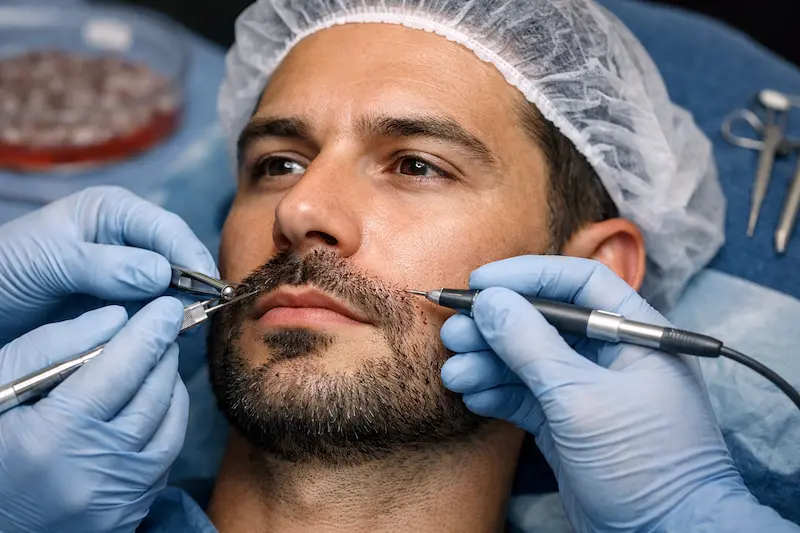
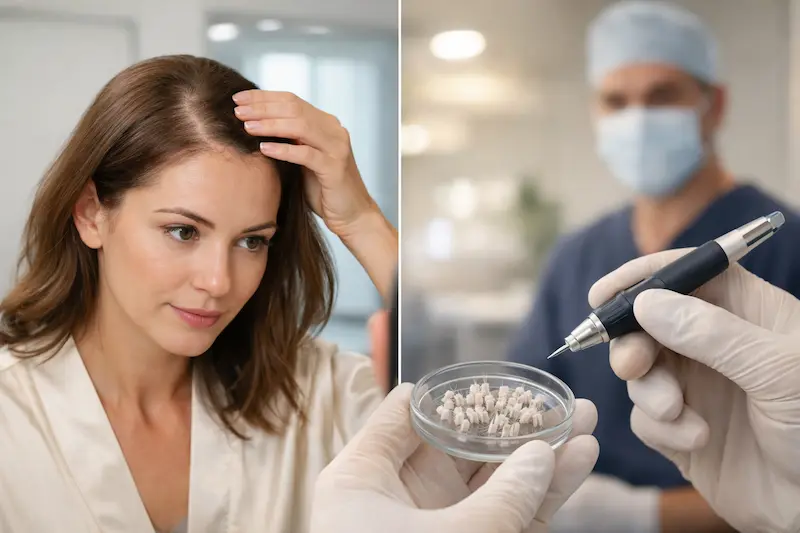
DHI (Direct Hair Implantation) is an implantation approach that typically uses an implanter pen to place grafts. In many clinics, the donor extraction is still FUE-based, but the implantation step is handled differently. This is why you’ll often see people search for hair transplant DHI vs FUE — the debate is really about implantation workflow and suitability, not a “better vs worse” label.
Quick comparison table: steps, tools, scarring, recovery, best-fit cases
| Feature | FUE | DHI | What it can mean for UK patients |
|---|---|---|---|
| Extraction (donor) | Individual graft extraction (punch-based) | Typically the same: individual graft extraction | Donor management matters more than the label — overharvesting is a bigger risk than “choosing the wrong name”. |
| Implantation method | Recipient sites created, then grafts placed | Grafts placed using an implanter pen workflow | Technique choice often affects how the surgeon plans angles, density, and time out of body. |
| Shaving | Often requires shaving (varies by case and clinic) | May allow selective shaving in some cases | If discretion is a priority, ask what “no/partial shave” realistically means for your graft numbers. |
| Scarring | Small dot scars in donor area | Small dot scars in donor area | Both can be compatible with shorter haircuts when extraction is evenly distributed. |
| Procedure pace | Can be efficient for larger sessions | Can be slower due to implantation workflow | If you need high graft counts, session length and team experience become practical factors. |
| “Best for” (general) | Broad suitability; often used for larger coverage | Often chosen for detailed placement (case-dependent) | The “best” answer is personalised: hairline detail, crown swirl, and donor limits change the decision. |
A note from medical science: whichever method you choose, outcomes depend heavily on graft survival — gentle handling, hydration, minimising time out of the body, and precise angle/direction planning. Technique names matter less than the surgeon’s plan and consistency of execution.
So if you’re searching FUE or DHI hair transplant, the more useful question is: Which method fits my hairline goals, graft numbers, donor capacity, and recovery timeline? We’ll unpack that step by step next.
Also popular search: If you’re specifically comparing FUE vs DHI hair transplant in Turkey, you should evaluate safety standards, surgeon involvement, and aftercare continuity — not just the technique name. We’ll cover travel and aftercare in later sections.
How FUE Works Step by Step
To understand the difference between DHI and FUE, you first need to know what a standard FUE workflow looks like. In FUE, the critical success factors are: donor assessment, careful extraction, graft protection, and recipient-site design (angle, direction, and distribution). A well-executed FUE plan can deliver an extremely natural hairline.
Donor area assessment & planning
The surgeon assesses donor density, hair calibre, curl/wave pattern, scalp laxity, and the likely pattern of future loss. For many UK patients, the goal is a subtle, age-appropriate hairline that doesn’t look “too low” or artificial as you get older.
- Defines a safe donor zone: protects long-term appearance and avoids overharvesting.
- Estimates graft budget: how many grafts can be taken without thinning the donor.
- Plans recipient zones: hairline vs mid-scalp vs crown (each behaves differently).
Extraction: how grafts are harvested and protected
In FUE, grafts are harvested individually with tiny punches. The quality of extraction is less about speed and more about consistency and tissue respect.
- Even distribution: taking grafts too close together can thin the donor and create a “moth-eaten” look.
- Graft protection: grafts should be kept hydrated and handled gently to support survival.
- Realistic numbers: higher graft counts are not automatically better if donor quality is limited.
Recipient sites: channel creation + placement basics
Once grafts are harvested, the surgeon creates micro-sites (channels) in the recipient area and then places grafts into those sites. This is where naturalness is built — especially at the hairline.
- Angle and direction: must mimic native hair (critical for hairline and temples).
- Density distribution: prioritises the “frame” (front) while planning responsibly for future loss.
- Hairline micro-irregularity: subtle variation prevents a “straight-line” transplant look.
At this point, you can already see why people ask DHI hair transplant vs FUE: the main distinction is how implantation is done and how that affects workflow, time, and suitability — not whether one method is universally “better”.
How DHI Works Step by Step
When people search DHI vs FUE which is better, they’re often assuming DHI is a completely different transplant from FUE. In reality, in many clinics the donor harvesting is still FUE-based — the major change is how grafts are implanted. Understanding that workflow helps you judge whether DHI is truly the right fit for your goals (hairline detail, density ambition, shaving preferences, and time constraints).
The extraction stage (why DHI is still “FUE-based” at the donor)
With DHI, grafts are typically extracted one by one from the donor area in a similar way to FUE. That means donor safety principles are the same: a safe donor zone, even distribution, and realistic graft budgeting. If you’re comparing hair transplant DHI vs FUE, remember that donor management is often the biggest determinant of whether your result looks good long-term.
- Donor planning still matters most: overharvesting risk doesn’t disappear because a clinic uses an implanter pen.
- Graft handling remains critical: hydration, gentle transfer, and minimising trauma support graft survival.
- Consistency beats “labels”: a well-executed plan is more important than marketing terms.
Implantation with an implanter pen: what changes in the recipient area
The key difference between DHI and FUE sits here. In classic FUE workflows, recipient sites are created first and grafts are then placed. With DHI-style implantation, grafts are loaded into an implanter pen and placed into the scalp with a controlled motion. Practically, this can change how the team approaches angle, direction, and pacing.
- Angle/direction control: can be useful in detailed areas (for example, the frontal hairline and temple transition) depending on the surgeon’s approach.
- Workflow and timing: implantation method may affect “time out of body” and overall session organisation.
- Precision vs scale: DHI implantation may be favoured for certain design goals, while larger coverage cases may prioritise efficiency and graft distribution.
This is why “FUE vs DHI hair transplant comparison” is best framed as a suitability question rather than a winner-takes-all contest.
When DHI is not the best choice (clinical and practical limits)
There are scenarios where DHI may not be the most practical or effective option — and an ethical clinic should say so. For example, extremely large graft sessions, specific scalp characteristics, or donor limitations can influence technique choice. In other words, if you’re asking FUE or DHI hair transplant, the honest answer is: it depends on your anatomy and plan.
- Very high graft counts: session length and fatigue can become limiting factors.
- Complex crown work: the crown swirl demands meticulous angle planning regardless of implantation method.
- Donor constraints: if the donor is limited, the strategy should prioritise long-term appearance, not technique branding.
Scientific research and clinical practice both underline the same principle: graft survival and natural directionality are driven by tissue handling, hydration, and precise placement — not a single device or label. That’s why the phrase “best technique” should always mean “best for your scalp and goals”.
Natural Hairline & Density: Which Technique Helps Most?
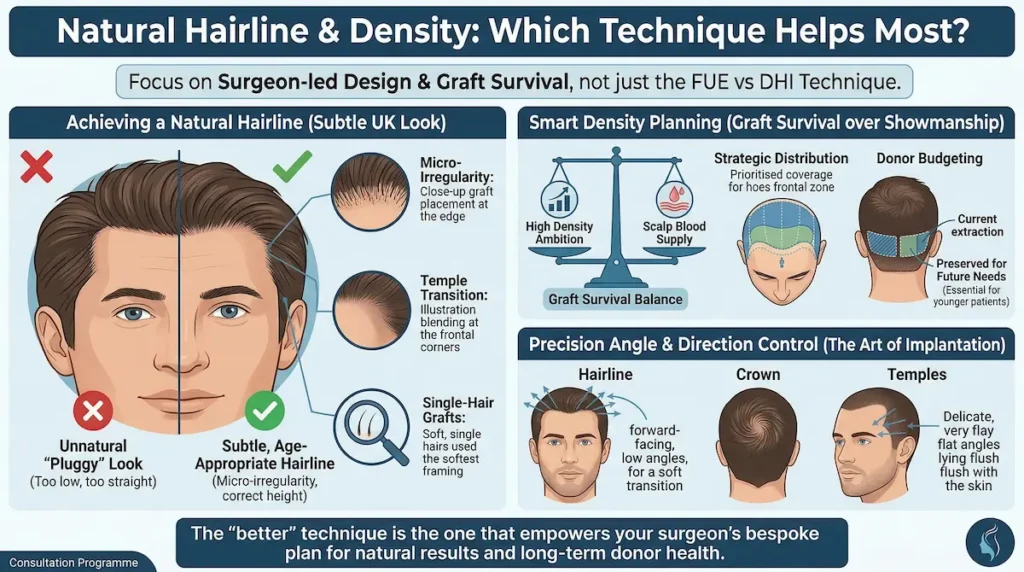
For UK patients, “natural” usually means subtle and believable — not a dramatically low hairline or an overly dense “plugged” look. In a real-world DHI hair transplant vs FUE decision, hairline design principles and density planning matter more than the headline technique. The best outcomes come from a surgeon-led plan that respects facial proportions and likely future hair loss.
Hairline design principles (age-appropriate, subtle UK look)
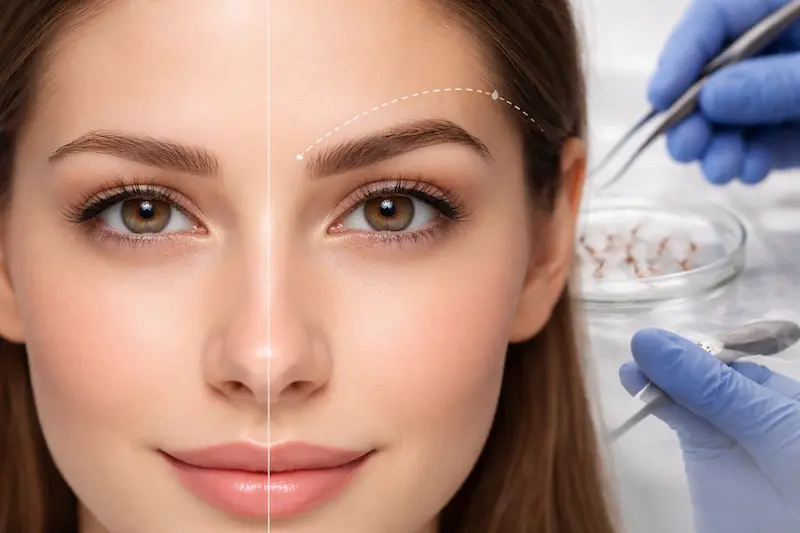
A natural hairline is rarely perfectly straight. It should have micro-irregularity, correct temple transition, and an age-appropriate height. If you’re searching DHI vs FUE hair transplant differences, note that both techniques can deliver an excellent hairline when the design is correct.
- Micro-irregularity: slight variation prevents an artificial “drawn-on” edge.
- Temple transition: careful blending avoids a “helmet” effect at the front corners.
- Single-hair grafts at the front: softer, more natural framing of the face.
Density planning: “packing” realities vs graft survival priorities
Many patients assume “more density is always better”, but there’s a balance between density ambition and graft survival. In any hair transplant DHI vs FUE discussion, density should be planned with blood supply, scalp characteristics, and long-term coverage strategy in mind.
- Strategic distribution: prioritise the hairline and frontal zone to frame the face.
- Donor budgeting: preserve grafts for future loss (especially if you’re young or have a strong family history).
- Survival over showmanship: safe placement and good healing typically outperform risky “overpacking”.
Angle and direction control: hairline vs crown vs temples
The crown swirl and the temple points are technically demanding. The method of implantation can influence workflow, but the surgeon’s experience and planning remain decisive. This is where a practical FUE vs DHI hair transplant comparison should focus: can the clinic show consistent results in hairline work, crown patterns, and temple blending?
- Hairline: forward-facing angles and soft transition zones.
- Crown: swirl pattern planning and realistic density expectations.
- Temples: delicate angles that sit flatter to the skin for a natural look.
If you’re still stuck on DHI vs FUE which is better, this section gives the most clinically useful answer: the “better” method is the one that allows your surgeon to deliver the right design and safe density for your donor limits and long-term plan.
Scarring, Shaving, and “Visible Signs” (UK Patient Concerns)
For many UK patients, the biggest day-to-day worry isn’t the surgery itself — it’s whether colleagues, friends, or family will notice. In a real FUE vs DHI hair transplant comparison, both methods typically create tiny dot scars in the donor area, and the “visible signs” are more about shaving, redness, scabbing, and short-term swelling than the technique name. This section breaks down the practical DHI vs FUE hair transplant differences you’ll actually feel and see.
Donor scarring: what you can expect with short haircuts
Both FUE and DHI approaches generally involve extracting grafts one by one from the donor area, which can leave very small circular scars. With good donor management, these are often difficult to detect once healed — even with shorter haircuts — but results vary based on skin type, healing, punch size, and how evenly extraction is distributed.
- FUE donor scars: tiny dot scars that usually fade over time.
- DHI donor scars: typically the same type of dot scarring, because extraction is commonly FUE-based.
- Key risk to avoid: overharvesting (taking too many grafts too close together), which can create a “thinned” donor look.
Shaving requirements: full shave vs partial/no-shave options
Shaving rules are clinic-dependent and case-dependent. Some patients search FUE or DHI hair transplant hoping one technique always avoids shaving — but it’s not that simple. Partial shaving may be possible in some scenarios, yet it can also limit efficiency and graft numbers.
| Option | What it usually involves | Best suited to | Trade-offs |
|---|---|---|---|
| Full shave | Donor (and sometimes recipient) shaved for access and visibility | Higher graft counts, broader coverage | Most noticeable for the first 1–2 weeks |
| Partial shave | Selective shaving in donor/recipient zones | Smaller sessions or targeted work | May reduce speed and increase complexity |
| “No-shave” claims | Minimal shaving hidden within hair | Very specific cases only | Often not realistic for larger graft numbers |
If your priority is discretion, ask a clinic to explain (in writing) what shaving is required for your estimated graft count — this is especially important when comparing DHI hair transplant vs FUE packages.
Shock loss: why it happens and how it’s managed
Shock loss is temporary shedding of existing hair around the transplanted area. It can happen with either approach and is influenced by your baseline hair miniaturisation, the stress of surgery, and how the recipient sites are created and populated. If you’re Googling difference between DHI and FUE and hoping one method guarantees “no shedding”, be cautious: responsible counselling is part of safe care.
- Temporary vs permanent: most shock loss is temporary, but weak miniaturised hairs may not fully return.
- Expectation management: shedding after transplant can be normal and does not mean the procedure has failed.
- Personalised planning: your existing hair status should influence zone planning and density targets.
Bottom line: the “visibility” period is more about early healing (redness, scabbing, swelling/oedema) and shaving choices than whether you chose DHI vs FUE which is better. Next, let’s talk comfort and how the day feels.
Comfort, Anaesthesia, and Procedure Duration
UK patients often want to know: “Will it hurt?” and “How long will I be there?” In a practical hair transplant DHI vs FUE decision, comfort and procedure duration can differ depending on graft numbers, clinic workflow, and implantation method. The good news is that most patients tolerate the day well with appropriate local anaesthesia and a properly organised surgical team.
Local anaesthesia: what the day typically feels like
Hair transplantation is usually performed under local anaesthesia (UK spelling: anaesthesia). You may feel brief stinging or pressure during the local anaesthetic injections, followed by numbness in the treated areas. Most of the procedure then feels like pressure and movement rather than sharp pain.
- During the procedure: numbness and mild pressure are common; sharp pain should be addressed immediately.
- After the procedure: tightness and tenderness can occur as the anaesthetic wears off.
- Medication language (UK): clinics often recommend simple pain relief such as paracetamol (when appropriate for you medically).
Procedure time and fatigue: what makes sessions longer/shorter
Session length depends mainly on graft count and workflow. Some patients notice that DHI-style implantation can feel more time-intensive, especially for detailed placement — but the right choice still depends on your design goals and graft plan. This is why the best FUE vs DHI hair transplant comparison includes a realistic discussion of duration, breaks, and pacing.
- Graft count: higher graft numbers generally mean a longer day.
- Implantation workflow: DHI implantation can be organised differently from classic FUE site-making + placement.
- Team efficiency and protocol: consistent graft handling, hydration, and well-timed breaks matter for both comfort and graft care.
Post-op discomfort expectations and common recovery symptoms
In the first few days, mild discomfort, tightness, and swelling (oedema) can occur — particularly around the forehead. Redness and scabbing in the recipient area are expected, and the donor area may feel tender. From a medical science perspective, these are typical inflammatory healing responses, and the key is following aftercare instructions to protect grafts during their most vulnerable period.
- Swelling/oedema: can peak in the first few days and then settle.
- Sleeping position: usually involves keeping the head elevated to reduce swelling.
- Return to routine: many people feel “socially presentable” before they feel fully normal — visible healing often drives confidence more than pain does.
Recovery Timeline: When You’ll Look “Work-Ready”
Most UK patients aren’t only asking DHI vs FUE which is better — they’re asking, “How long until I look normal enough for work, video calls, and social plans?” Recovery is broadly similar for both methods because the healing you see is driven by micro-incisions, inflammation, and scab formation rather than the technique name alone. The key difference is usually the extent of work (graft count and zones treated), your skin’s redness response, and how strictly you follow aftercare.
Days 1–7: redness, swelling, sleeping position, scab care
The first week is the most visible. Expect some redness in the recipient area, tenderness in the donor area, and possible swelling (oedema) that can move down the forehead. This is normal healing physiology — in simple terms, your body is repairing micro-injuries and re-establishing blood supply around the grafts.
- Redness: often most noticeable in fair skin; can last longer in some individuals.
- Oedema: may peak around days 2–4; head elevation can help.
- Scab care: scabs should be softened and removed only as instructed — picking can damage grafts.
- Sleeping: usually with the head elevated to reduce swelling and protect the grafts.
Weeks 2–6: shedding phase (normal vs not normal)
Many patients panic during shedding — this is where “before and after” expectations can clash with biology. Shedding is common after both approaches and is part of the follicle cycling process. In a sensible FUE vs DHI hair transplant comparison, no reputable clinic should promise “no shedding”.
- What’s normal: transplanted hairs often shed while follicles remain in place.
- What to watch: increasing pain, spreading redness, discharge, or fever should be assessed clinically.
- How long it lasts: shedding can continue for several weeks before regrowth begins.
Months 3–12: growth milestones and realistic expectations
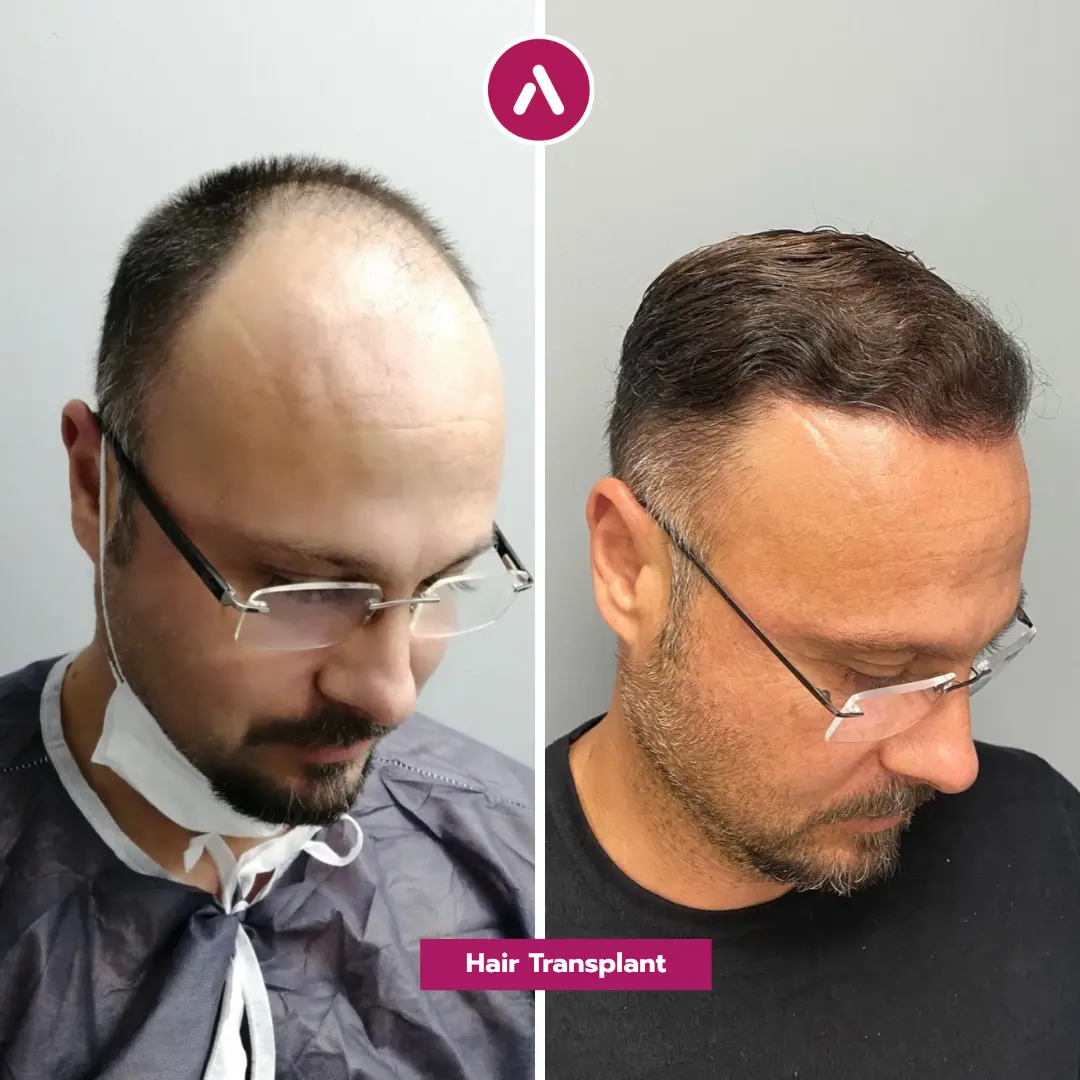
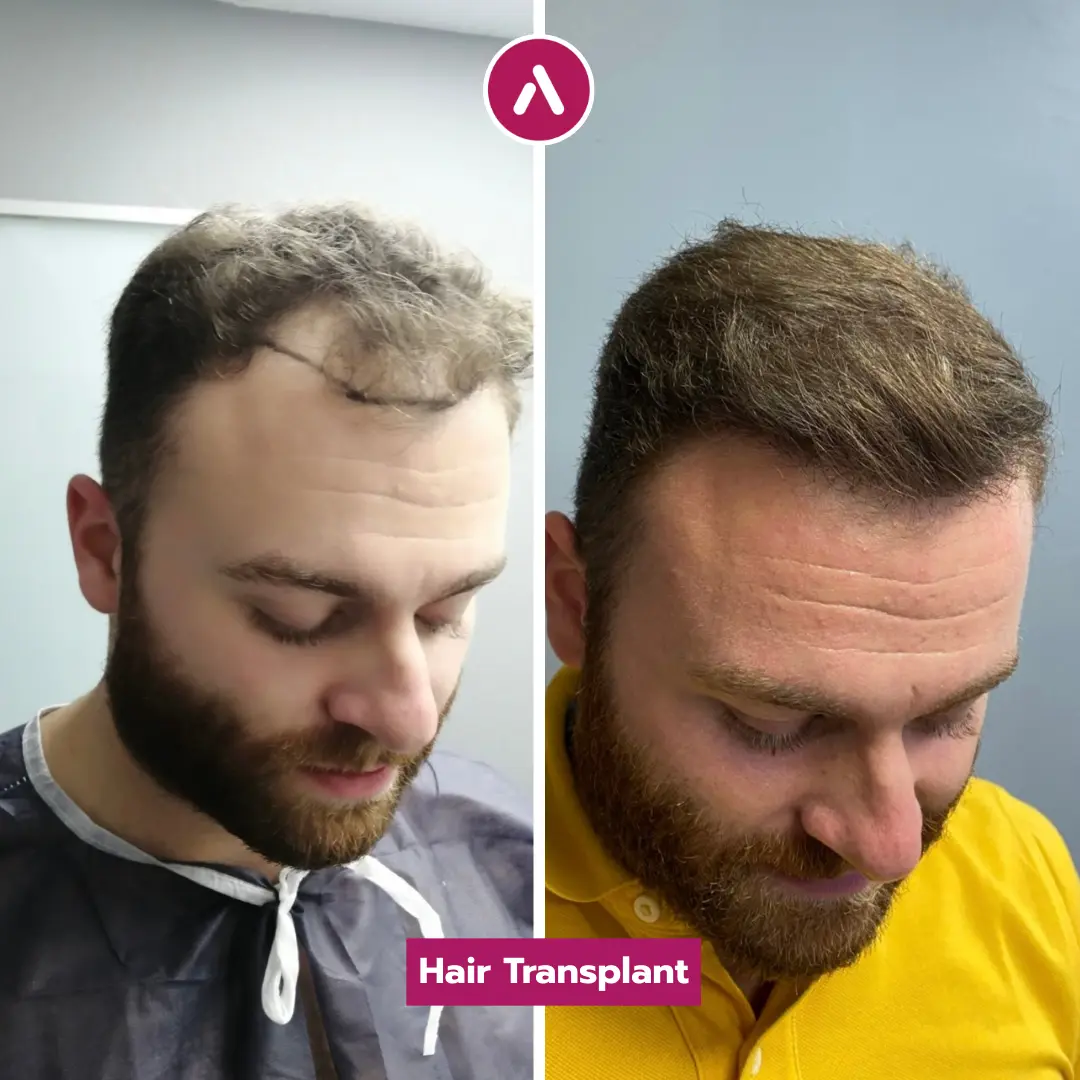
Visible regrowth commonly starts around month 3, with progressive thickening over time. Hair characteristics (texture, curl, calibre) can look different initially and then settle. Scientific research and clinical observation both highlight that maturation takes time — “final” results often require patience.
- Months 3–4: early sprouts; patchiness can be normal.
- Months 6–9: more noticeable coverage and improved styling flexibility.
- Months 9–12: continued thickening and refinement of the hairline appearance.
| Time point | What you may notice | Common UK “work-ready” reality |
|---|---|---|
| Days 1–7 | Redness, scabs, possible oedema | Most people prefer time off or remote work if possible |
| Days 8–14 | Scabs settling/coming away (as advised) | Some feel OK for low-key social plans; hats may be restricted early on |
| Weeks 3–6 | Shedding phase | Often socially “fine” but hair may look thinner temporarily |
| Months 3–6 | Regrowth begins | Noticeable improvement for many; styling gets easier |
| Months 9–12 | Maturation and thickening | Closer to final look for most patients |
If your search is specifically FUE vs DHI hair transplant in Turkey, factor in travel timing: most patients prefer not to fly immediately after very large sessions, and planning should account for swelling, aftercare needs, and comfort for the journey back to the UK. We’ll cover travel and aftercare continuity in a dedicated section later.
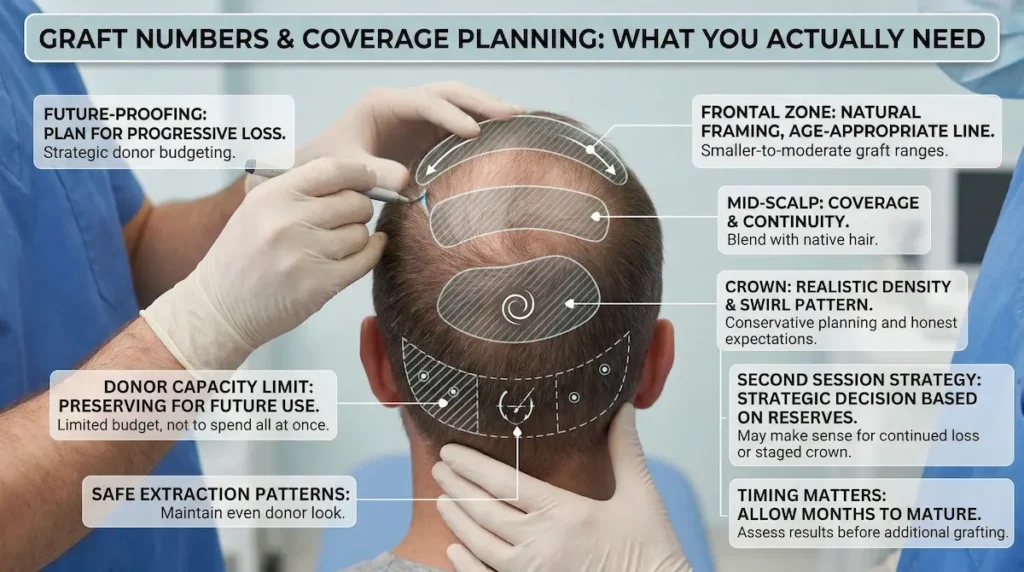
Graft Numbers & Coverage Planning (What You Actually Need)
Technique debates can distract from the real question: how many grafts do you need, where should they go, and what’s safe for your donor? This is where “which is better” becomes the wrong framing. In any honest DHI hair transplant vs FUE consultation, graft planning is based on donor capacity, hair calibre, scalp characteristics, and the long-term strategy for future loss.
Typical graft ranges by zone (hairline vs mid-scalp vs crown)
Graft numbers vary widely, but you can still use typical ranges as a starting point for discussion. Your plan should prioritise the visual “frame” of the face (often the frontal zone) while respecting donor limits. This matters regardless of whether you’re leaning towards FUE or DHI hair transplant.
| Zone | Common goals | Typical discussion range (varies by individual) | Key planning note |
|---|---|---|---|
| Hairline / frontal zone | Natural framing, age-appropriate line | Often smaller-to-moderate graft plans | Design and angle matter more than chasing maximum density |
| Mid-scalp | Coverage and continuity | Variable depending on existing hair | Blend with native hair to avoid a “patchy” look |
| Crown | Swirl pattern, realistic density | Can be graft-hungry | Crown often needs conservative planning and honest expectations |
These ranges are intentionally broad because a safe plan is personal. If a quote seems “too good to be true” without a proper assessment, treat it as a red flag — especially in online FUE vs DHI hair transplant comparison offers.
Donor capacity limits and long-term planning (avoiding overharvesting)
Donor hair is finite. The safest plans treat it like a limited budget, not a resource to spend all at once. The most common long-term regret isn’t “I chose DHI vs FUE” — it’s “I used too much donor too early.” This is a medical science issue: once donor density is reduced beyond a point, it cannot be fully restored.
- Safe extraction patterns: maintain an even look in the donor area.
- Future-proofing: plan for progressive loss (especially if you’re younger or have strong family history).
- Realistic density targets: natural-looking coverage often beats risky overpacking.
When a second session makes sense (and when it doesn’t)
A second session may be appropriate if hair loss progresses, if the crown is addressed later, or if initial goals were intentionally conservative. However, “more sessions” should never be a default plan — it should be a strategic decision based on donor reserves and your long-term pattern. If you’re typing DHI vs FUE which is better, add this question: “Which plan protects my donor for the next 10 years?”
- It may make sense when: progression continues or you staged the crown for later.
- It may not make sense when: donor reserves are limited or the first session already used a large graft budget.
- Timing matters: results typically need months to mature before you judge whether additional grafting is truly necessary.
Cost Considerations for UK Patients (Without Hidden Fees)
If you’re weighing up DHI hair transplant vs FUE, cost is usually part of the decision — but the safest way to compare is to look at what’s included, not just the headline price. UK providers commonly price per graft and may separate out consultations, medications, and follow-up. In Turkey, many clinics present package pricing. Either model can be transparent or misleading, so the goal is to compare like-for-like.
Why DHI can cost more than FUE (time, equipment, labour)
One reason patients ask DHI vs FUE which is better is because DHI is sometimes marketed as the “premium” option. In practice, any cost difference is usually tied to operational factors: implantation workflow, time, staffing, and equipment. That does not automatically mean “better results” — it means a different process that may be more or less suitable depending on your case.
- Labour and time: implantation workflow can be more time-intensive in some DHI-style protocols.
- Equipment: implanter-pen based implantation can add consumable/tooling costs.
- Case suitability: if your plan requires a large graft count, the most sensible option may prioritise safe coverage and donor management rather than the most expensive label.
What “all-inclusive” should include for a UK patient (GBP clarity, no surprises)
For UK patients comparing FUE vs DHI hair transplant comparison offers — especially FUE vs DHI hair transplant in Turkey — “all-inclusive” should be defined clearly in writing. A transparent quote should help you understand the full pathway: medical care, logistics, and follow-up. If anything is vague, treat it as a question to resolve before you pay a deposit.
| Checklist item | What “transparent” looks like | Why it matters |
|---|---|---|
| Technique and plan | Clear statement: FUE vs DHI approach, target zones, estimated graft range | Prevents “bait-and-switch” expectations and protects donor planning |
| Medication and aftercare kit | Itemised or explicitly included; instructions provided in plain English | Supports healing and avoids extra pharmacy costs abroad |
| Transfers and accommodation | Airport-hotel-clinic transfers included; hotel nights stated | Removes the most common hidden cost area in medical travel |
| Follow-up support | Defined follow-up schedule and a clear contact route after you return to the UK | Aftercare continuity is a safety issue, not a luxury |
| What is NOT included | Explicit exclusions listed (so you can budget accurately) | Stops surprises once you’re committed to travel |
From a science and patient-safety perspective, “value” is not the cheapest quote — it’s the quote that protects graft survival, reduces avoidable risk, and gives you reliable follow-up once you’re back in the UK.
“Cheap vs safe”: how to spot risk factors before you book
When people search difference between DHI and FUE, they often overlook the more important difference between safe and risky providers. If the sales process feels rushed or the clinic avoids specifics, that’s a red flag.
- Red flag: guaranteed density promises without assessing donor capacity.
- Red flag: no clear explanation of who performs the critical steps (surgeon vs technician roles).
- Green flag: realistic graft planning, long-term donor strategy, and a written aftercare pathway.
Safety & Aftercare When Travelling from the UK to Istanbul
If you’re researching FUE vs DHI hair transplant in Turkey, safety is understandably your first filter — especially with UK media stories about poor outcomes abroad. The safest way to evaluate is to focus on standards, sterility, clinical governance, and what happens after you fly home. Technique choice matters, but it sits inside a wider system of patient care.
Sterile operating theatre standards and hygiene protocols (what to look for)
Ask how the clinic maintains sterility and infection control. High standards are not just “nice to have”; they’re foundational. Look for clear, confident explanations of protocols and how the team works in a sterile environment (UK term: operating theatre).
- What to ask: “Which hygiene and sterile-field protocols do you follow in the operating theatre?”
- What you want to hear: a “zero-compromise” approach with internationally aligned protocols.
- Why it matters: safe surgery is built on consistent systems, not marketing.
UK support line + London correspondence address as trust signals (aftercare continuity)
Aftercare becomes real once you are back in the UK. This is where many patients feel vulnerable — so continuity matters. A reliable clinic should provide a clear route for ongoing support, including an easy contact channel and a UK-facing point of contact.
- Direct contact: a UK-friendly WhatsApp route and a defined support line for post-op questions.
- UK presence signal: a London correspondence address / UK-based contact point for reassurance and practical continuity.
- What to expect: structured check-ins, guidance for normal healing versus warning signs, and timely clinical responses.
Medical science reminder: the highest-risk period for “avoidable complications” is often not the procedure itself, but poor aftercare and delayed recognition of problems. Choose a pathway that supports you after you return home.
Travel planning basics: direct flights, swelling considerations, return-to-UK preparation
Travel is part of the treatment plan. Swelling (oedema), comfort, and protecting the recipient area are practical concerns for your return journey. Plan your trip so you are not rushing, and ensure you understand your clinic’s “flight-ready” guidance and what to do if you have concerns after landing in the UK.
- Timing: avoid unnecessary pressure to fly “as soon as possible” after treatment, especially after larger sessions.
- Comfort: head elevation and careful movement can reduce swelling and protect the grafts.
- Preparation: have your aftercare instructions, contact details, and a plan for urgent assessment if symptoms are unusual.
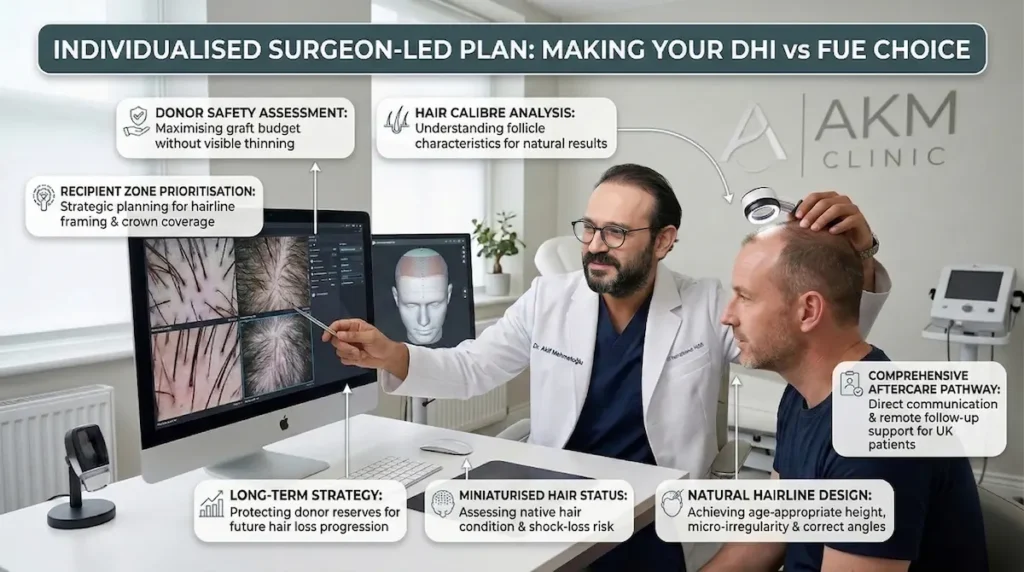
How AKM Clinic Helps You Choose Between DHI and FUE (Surgeon-Led Decision)
By now, you can see why “DHI vs FUE which is better” is rarely a one-size-fits-all answer. A safe decision is surgeon-led and based on your donor capacity, hair calibre, scalp characteristics, and the zones you want to improve. In a true FUE vs DHI hair transplant comparison, the winning choice is the technique that lets your plan be delivered consistently — with natural angles, safe density, and predictable healing.
Consultation logic: matching technique to hair calibre, loss pattern, donor quality
A proper assessment starts with the donor area (your “graft budget”), then moves to the recipient zones (hairline, mid-scalp, crown). This is the part that matters far more than marketing. When you’re comparing DHI hair transplant vs FUE, your consultation should cover:
- Donor safety: how many grafts are safe without visible thinning.
- Zone priorities: hairline framing vs crown coverage (the crown can be graft-hungry).
- Native hair status: whether miniaturised hairs increase shock-loss risk and influence density targets.
- Long-term plan: protecting donor reserves if you’re likely to progress.
Designing a natural hairline with realistic density targets
Most UK patients want a hairline that looks believable in real life — not a dramatic, low line that draws attention. Whether you choose FUE or DHI, the natural look is built through design choices:
- Age-appropriate height: a mature, subtle hairline often looks more natural long-term.
- Micro-irregularity: soft, slightly irregular edges avoid a “straight-line” transplant look.
- Correct angles: especially at the hairline and temples; the crown swirl is a separate technical challenge.
So, when you ask “difference between DHI and FUE”, remember: the design plan is the foundation, and implantation method is the delivery mechanism.
Follow-up and aftercare pathway for UK patients (remote support + continuity)
For anyone searching FUE vs DHI hair transplant in Turkey, aftercare is a serious safety topic — not a nice extra. Your clinic should provide a clear follow-up schedule, practical washing guidance, and a reliable route for advice after you return to the UK.
| What UK patients should look for | Why it matters | What good looks like |
|---|---|---|
| Clear aftercare instructions | Protects grafts in the most vulnerable period | Written instructions, washing plan, “normal vs not normal” guidance |
| Accessible contact route | Reduces anxiety and delays in getting advice | Direct WhatsApp route + structured check-ins |
| Continuity once you’re home | Complications often escalate when follow-up is unclear | Defined remote follow-up pathway for UK patients |
Note on recovery support: Some clinics use adjunct technologies as part of broader rapid-recovery protocols for selected surgeries. Always ask what is appropriate and available for your specific hair restoration plan and health profile.
Frequently Asked Questions (FAQ): DHI vs FUE Hair Transplant
Below are concise answers to the most common UK searches around hair transplant DHI vs FUE, including the practical questions patients ask about shaving, scarring, recovery, and travel.
Is DHI better than FUE for a natural hairline?
Not automatically. Both can create an excellent hairline if the design is correct and the grafts are placed with the right angle and direction. The “better” choice depends on your donor quality, the number of grafts needed, and how your surgeon plans to execute the hairline.
Does DHI hurt more than FUE?
Most patients describe the main discomfort as the local anaesthetic injections (local anaesthesia), followed by pressure rather than pain. The post-op soreness is usually mild and short-lived for many people, regardless of technique. If pain feels severe or escalating, you should contact your clinic promptly.
Do I need to shave my head for DHI or FUE?
Often, some shaving is required — especially for larger graft counts. Partial shaving may be possible in select cases, but it can limit efficiency and graft numbers. Ask your clinic to explain shaving requirements for your estimated graft plan in writing.
How many grafts do I need for my hairline or crown?
It varies widely. Hairline work can require fewer grafts than crown coverage, and the crown can be particularly graft-hungry due to its swirl pattern and surface area. A safe answer can only come after assessing donor density, hair calibre, and your loss pattern.
Which technique leaves less scarring?
Donor scarring is typically similar, because both commonly use FUE-style extraction (tiny dot scars). The biggest determinant is how evenly the grafts are harvested and your personal healing response. Overharvesting is a bigger risk than choosing the “wrong” label.
What’s the difference between DHI and Sapphire FUE?
DHI usually refers to implantation using an implanter-pen workflow. Sapphire FUE typically refers to the blade/material used for creating recipient sites (channels) in some FUE workflows. These are different variables: implantation method vs site-creation tools.
When can I fly back to the UK after a hair transplant?
Many patients travel within a short time frame, but your safest timing depends on swelling (oedema), comfort, and your clinic’s aftercare schedule. Plan so you are not rushing and you can follow the early aftercare instructions properly. If you have any medical risk factors, discuss them in advance.
When can I go back to work, exercise, or wear a hat?
“Work-ready” is often driven by visibility (redness/scabs) rather than pain. Light desk work may be possible earlier than strenuous activity, while intense exercise is typically delayed to protect healing. Hat guidance varies early on — follow your clinic’s instructions to avoid friction or pressure on the grafts.
Can I have a second hair transplant later?
Yes, some patients do — especially if hair loss progresses or if the plan was staged. However, it should be a strategic decision based on donor reserves and long-term loss pattern. A responsible clinic will avoid spending your donor “budget” too aggressively in the first session.
How do I verify clinic safety standards and aftercare before booking abroad?
Ask who performs the critical steps, how sterility is maintained in the operating theatre, and what the follow-up pathway looks like once you’re back in the UK. Look for transparent documentation, realistic graft planning, and accessible aftercare support — not guaranteed-density promises.
Medical Disclaimer: This page is provided for general educational purposes only and does not replace a face-to-face medical consultation, diagnosis, or personalised treatment plan. All surgery carries risks and outcomes vary between individuals. Suitability for a hair transplant surgery, procedure selection, and anaesthesia choice can only be determined after a full clinical assessment by a qualified surgeon. Always follow your clinician’s instructions and seek urgent medical attention if you develop concerning symptoms during recovery.