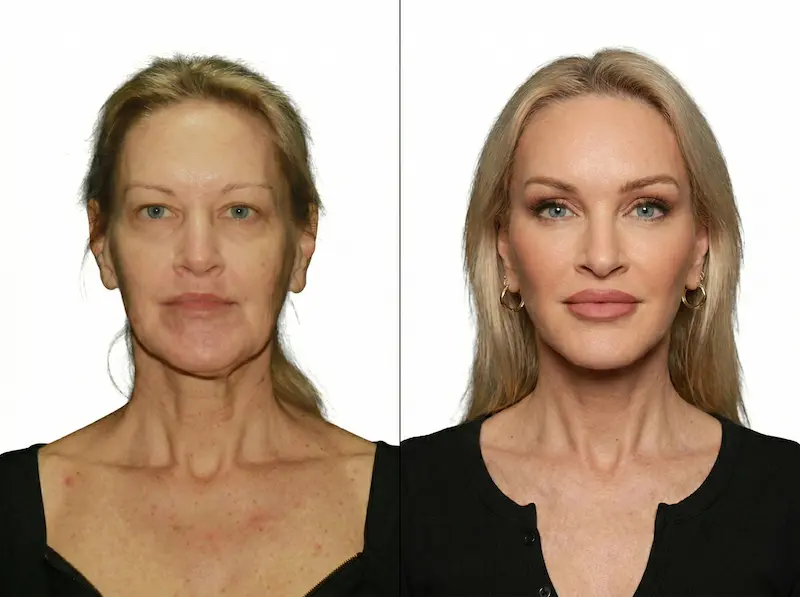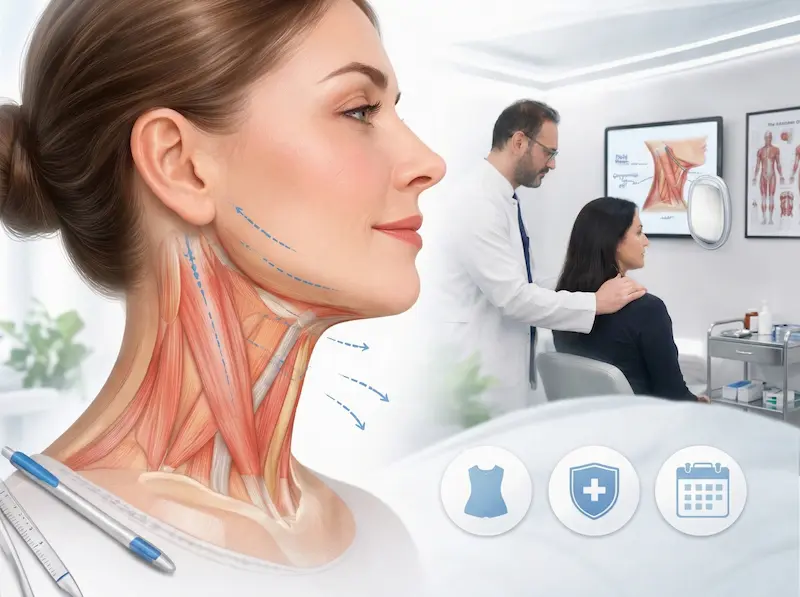
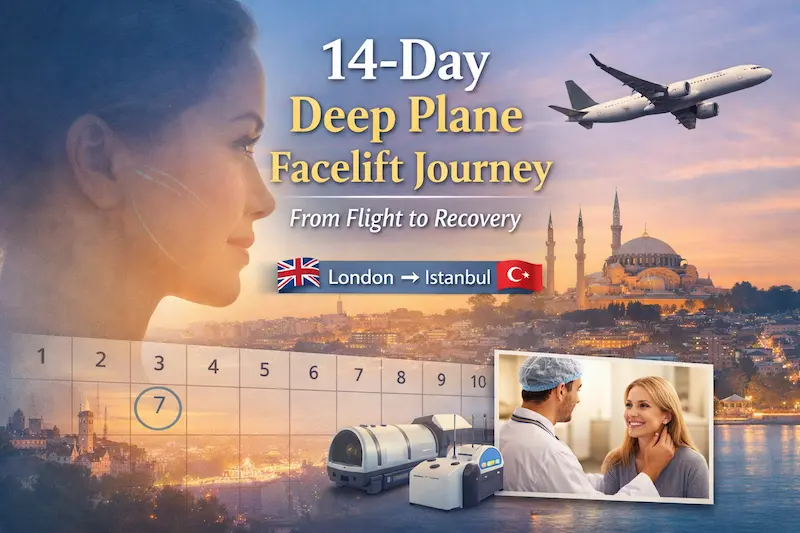
If you are the kind of UK patient who plans everything (flights, hotel, work cover, school run, and the “what ifs”), you are not overthinking it — you are being sensible. A deep plane facelift journey is not just about surgery day. It is a structured travel-and-recovery plan with clear milestones, realistic downtime, and safety checks designed to get you home to the UK feeling confident.
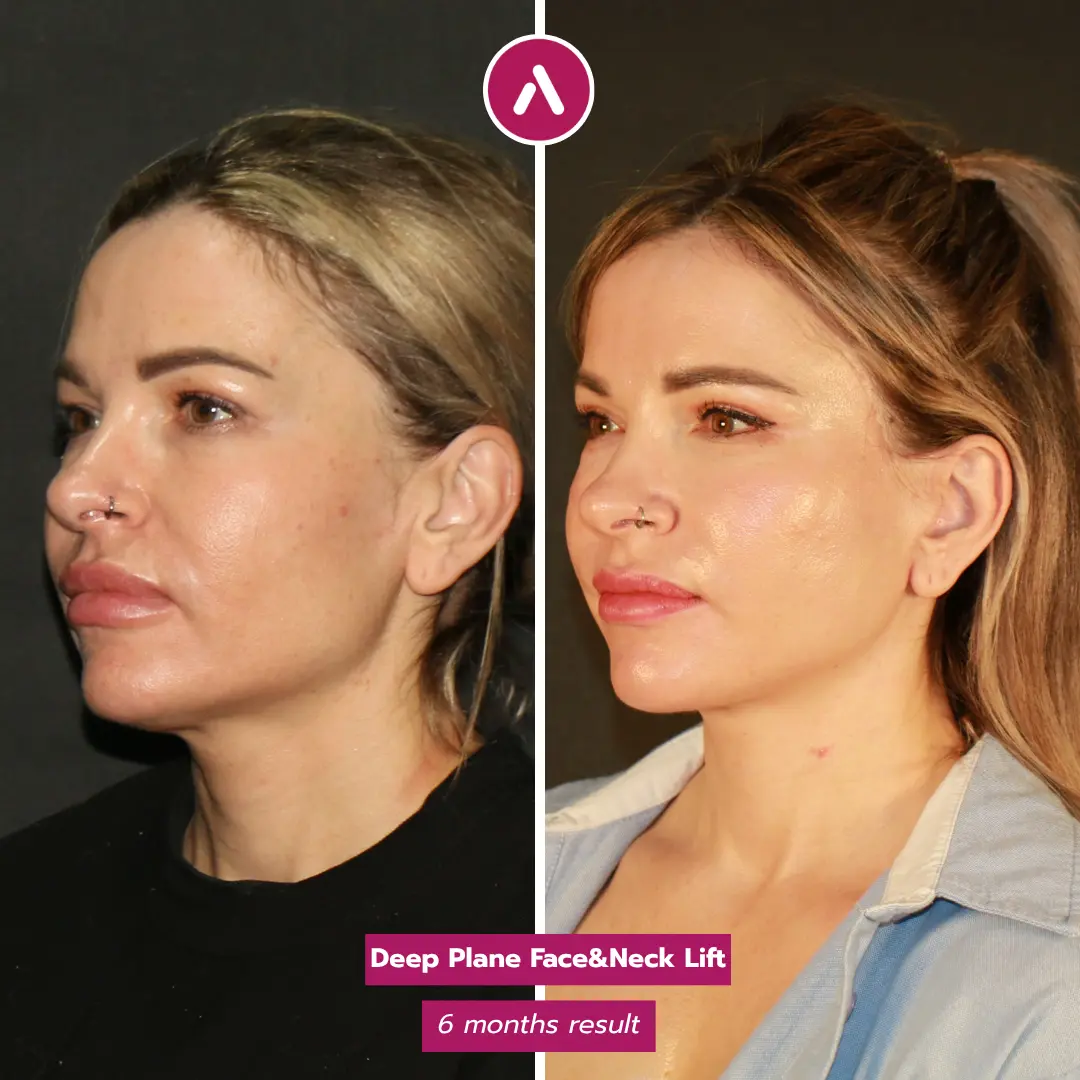
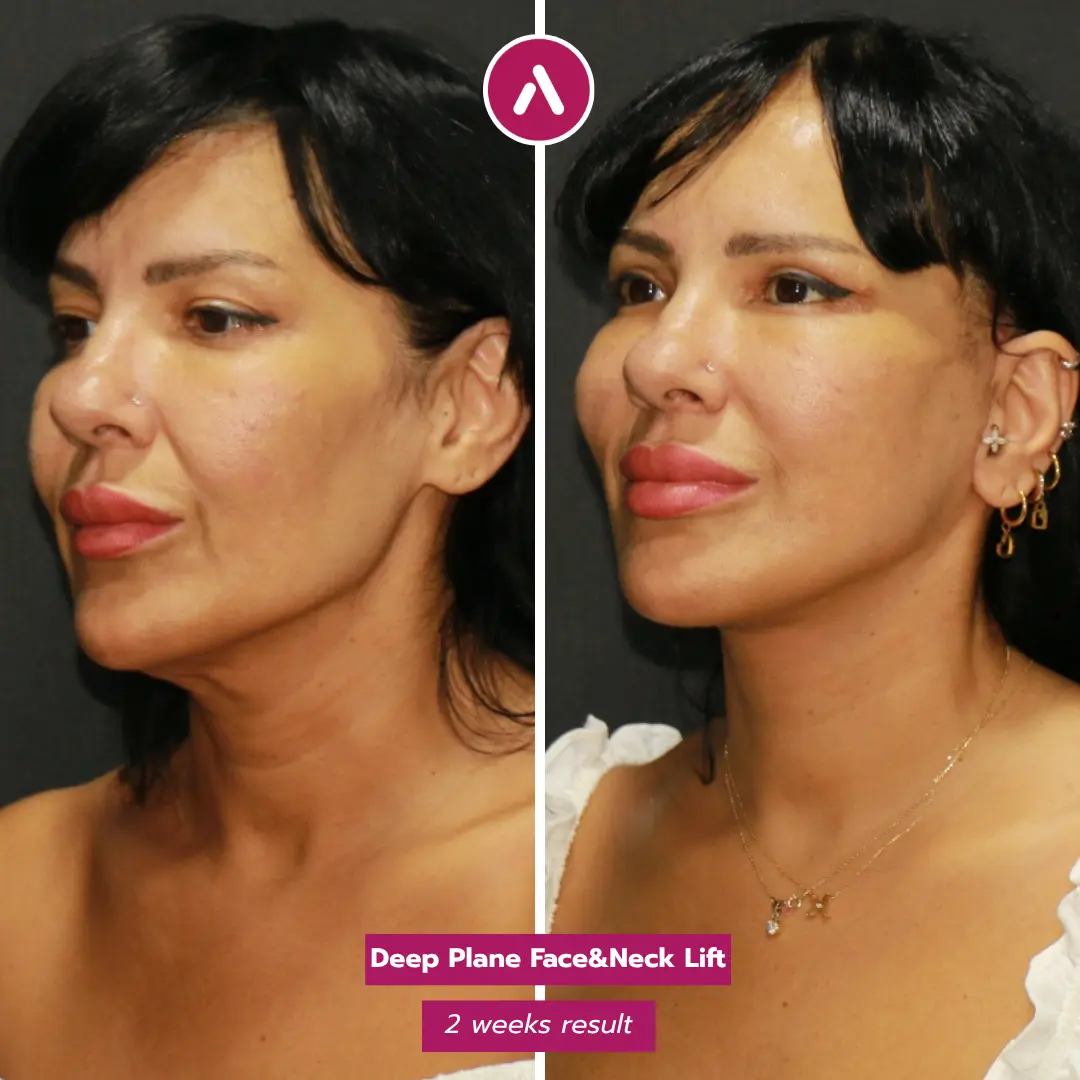
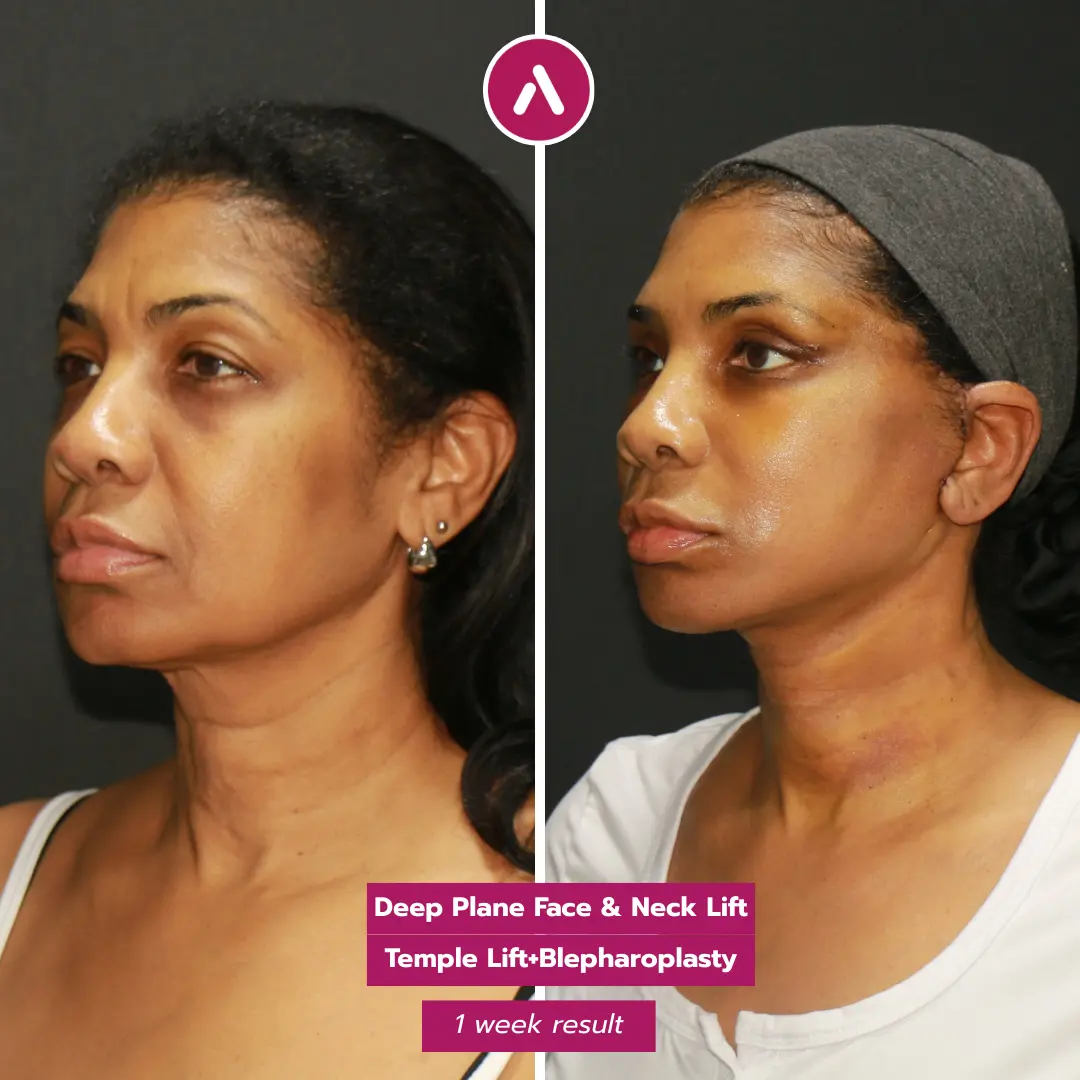
This guide lays out a deep plane facelift day by day approach for an Istanbul deep plane facelift journey, focusing on what matters most to British patients: direct flight logistics, swelling (oedema) expectations, DVT risk reduction, and the “fit-to-fly” question. Where appropriate, we also reference the principles behind our recovery approach — because your decisions should be grounded in medical science, not marketing.
Table of Contents
Day 1–3: Direct Flights from London, Arrival & Surgery
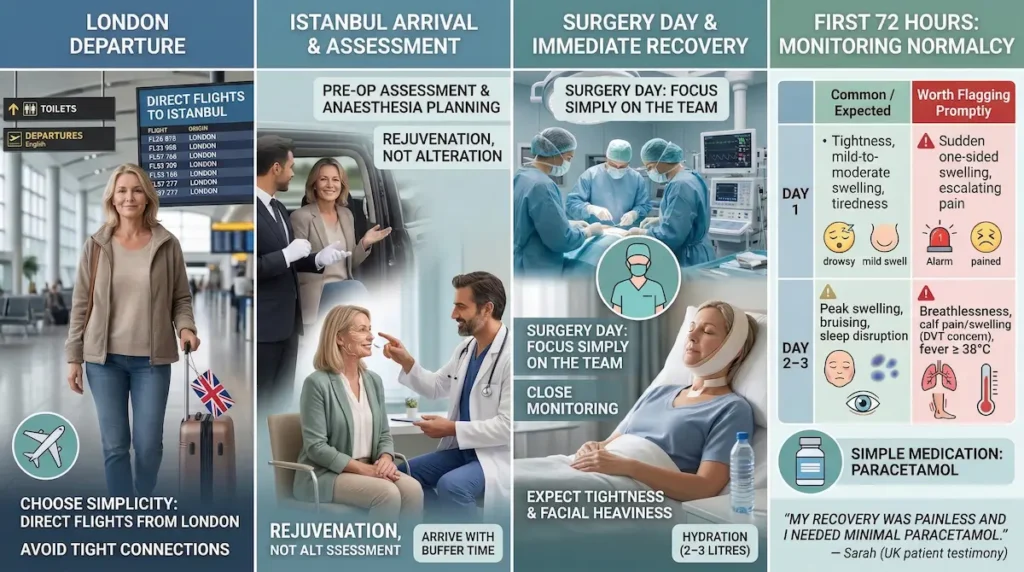
This first phase of the 14-day deep plane facelift journey is about two things: (1) removing uncertainty from travel and admission, and (2) understanding what “normal” looks like in the first 72 hours. For many UK patients, these days feel the most intense — not because of pain, but because everything is new: a new country, a new routine, and a face that is swollen before it starts to settle.
For UK patients considering flying to Turkey for facelift surgery, the key is to treat Days 1–3 as a controlled, clinic-led routine rather than a “medical holiday”. When your itinerary is structured (direct transfer, planned rest, clear medication guidance, and scheduled checks), anxiety drops and recovery feels more predictable. This is also the ideal time to set expectations: swelling and tightness can increase before they improve, and that early fluctuation is part of a normal healing curve.
Booking direct flights London → Istanbul (timing strategy)
- Choose simplicity: if you can, prioritise a direct flight and avoid tight connections. Less rushing means less physical stress.
- Arrive with buffer time: aim to land early enough to hydrate, eat lightly, and sleep before pre-op assessments.
- Plan for DVT awareness: if you are high-risk (history of clots, smoking, certain medications, long-haul travel), discuss this upfront. A good plan is personalised.
Arrival logistics: airport transfer, check-in, and settling in
Arrival day should feel predictable. Most patients benefit from a calm routine: transfer, check-in, a short walk, light food, and early rest. Hydration matters — a sensible target is 2–3 litres of water across the day unless your clinician advises otherwise.
Pre-op assessment in Istanbul: what happens first
Your in-person assessment typically confirms the surgical plan, checks your medical history, and aligns expectations around “rejuvenation, not alteration”. This is also where anaesthesia planning is finalised. If your procedure involves local anaesthesia with light sedation (often referred to as “awake” or “twilight” techniques), this is discussed in clear terms so you understand what you will feel and what you will not.
Surgery day (operating theatre) + immediate post-op monitoring
On surgery day, your focus is simple: arrive, be assessed, and let the team do the thinking. After surgery, your early recovery is monitored closely. Expect a tight feeling, swelling, and a sense of facial “heaviness” — especially around the jawline and cheeks. This is normal in the first 24–48 hours.
First 72 hours: normal vs. not-normal recovery signals
In the first three days, most patients experience swelling (oedema), bruising, and fluctuating comfort. It is common to feel more swollen on day 2–3 than day 1.
| Timeframe | Common / Expected | Worth Flagging Promptly |
|---|---|---|
| Day 1 | Tightness, mild-to-moderate swelling, tiredness | Sudden one-sided swelling, severe escalating pain |
| Day 2–3 | Peak swelling, bruising, sleep disruption | Breathlessness, calf pain/swelling (DVT concern), fever ≥ 38°C |
Pain relief (UK terms): many patients manage with simple medication such as paracetamol, depending on individual needs and surgeon guidance. Avoid self-medicating with anything not approved by your surgical team, especially products that can increase bleeding risk.
“My recovery was painless and I needed minimal paracetamol.” — Sarah (UK patient testimony)
If you want more depth on flight safety and timing, you can link this section internally to your related guide (recommended): When Can You Fly After Facelift or Tummy Tuck?
Day 4–7: Rapid Recovery with HBOT & First Week Milestones
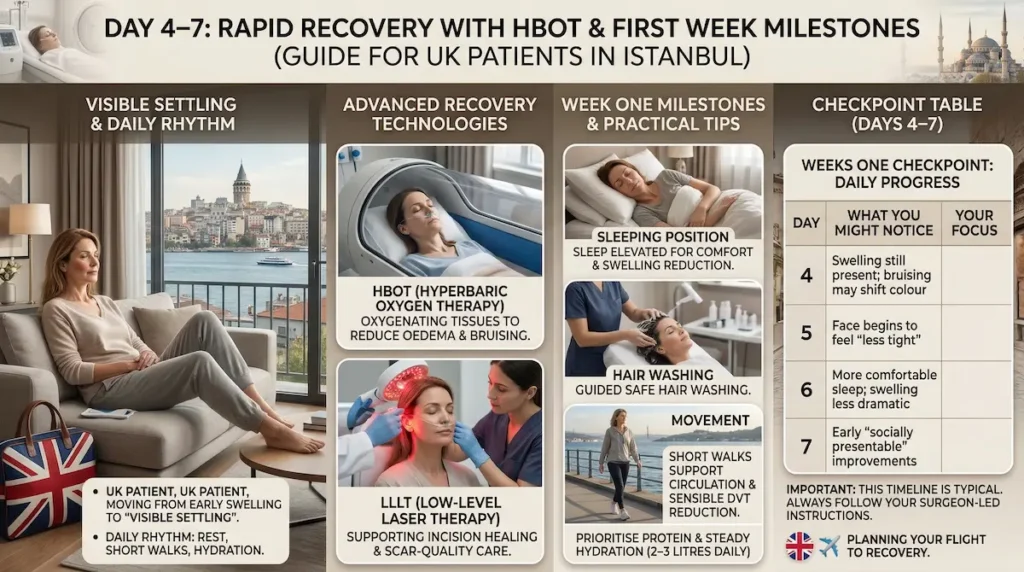
This part of the deep plane facelift recovery journey is where you move from “early swelling management” to “visible settling”. It is also where recovery technologies can make a meaningful difference to how quickly you look socially presentable — an important concern for UK patients who have booked a fixed return flight.
For many UK patients flying to Turkey for facelift surgery, Days 4–7 are when the recovery plan starts to feel “workable” rather than overwhelming. You may still have visible oedema and some bruising, but the changes become more predictable, and you can usually follow a simple daily rhythm: short walks, hydration, rest, and scheduled recovery sessions. This is also the point where reassurance matters most — not chasing a perfect mirror moment, but seeing steady progress that supports your planned return flight.
From a practical standpoint, Day 4–7 is the core of your deep plane facelift travel timeline: short daily routines, planned check-ins, and the start of advanced recovery support.
HBOT in week one: why it’s used and how sessions fit your schedule
Hyperbaric Oxygen Therapy (HBOT) is used as a recovery strategy to support healing and reduce post-operative swelling (oedema). In simple terms, it increases oxygen availability in tissues during a time when your body is repairing itself. The rationale aligns with established recovery principles used across medical settings, and while individual outcomes vary, many patients notice earlier “settling” of bruising and swelling.
In your schedule, HBOT sessions are typically planned around rest and gentle movement — not around sightseeing. This is recovery time, not a holiday.
LLLT support for incision healing and scar-quality focus
Low-Level Laser Therapy (LLLT) is commonly discussed in scientific research for its role in supporting tissue repair. In our protocols, it is used as part of scar-quality care — particularly valuable for UK patients who are concerned about visible incision lines and want an outcome that looks natural up close.
Practical milestones (day-by-day): sleeping position, washing hair, gentle movement
- Sleeping: expect to sleep slightly elevated, focusing on comfort and swelling reduction.
- Hair washing: you will be guided on when and how to wash safely without disturbing incision areas.
- Movement: short walks matter. They support circulation and are part of sensible DVT risk reduction.
Appetite, hydration, and swelling management (what’s realistic)
Swelling rarely drops in a perfectly straight line. You may look better one morning and puffier the next — this is normal. Keep hydration steady (again, many patients aim for 2–3 litres daily), prioritise protein, and avoid alcohol during early healing unless your surgeon advises otherwise.
A simple “Week One” checkpoint table (Days 4–7)
| Day | What you might notice | Your focus |
|---|---|---|
| Day 4 | Swelling still present; bruising may shift colour | Rest + short walks + follow your recovery programme |
| Day 5 | Face begins to feel “less tight” in moments | Hydration, gentle routine, HBOT/LLLT as scheduled |
| Day 6 | More comfortable sleep; swelling becomes less dramatic | Steady movement, careful incision hygiene |
| Day 7 | Early “socially presentable” improvements for many patients | Review appointment planning + questions for your surgeon |
If you’re planning your from flight to recovery facelift journey and want to reduce uncertainty, the most useful next internal link is a travel-safety checklist: Surgery Abroad Safety Checklist: CAA & Medical Guidelines
Important note: This timeline is educational and typical for many patients, but not a promise. Your exact recovery depends on your anatomy, surgical plan, and how your body heals. Always follow your surgeon-led instructions.
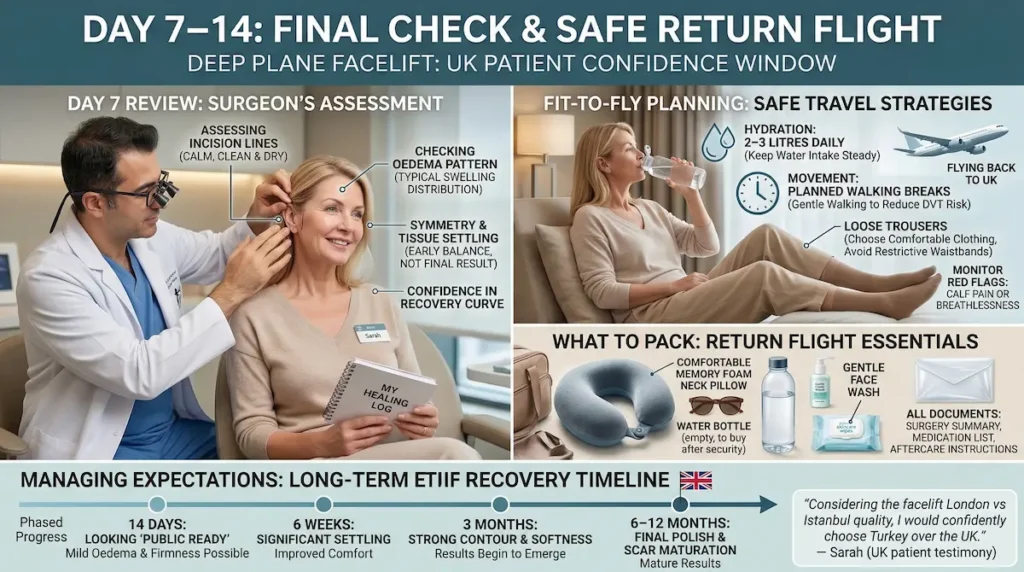
Day 7–14: Final Check & Safe Return Flight
This is the “confidence window” of your deep plane facelift day by day plan. Swelling and bruising are usually improving, your routine becomes easier, and you start preparing to fly back to the UK without feeling like you’re rushing healing. In a well-structured deep plane facelift travel timeline, Day 7–14 is not about perfection — it is about safe progress, clear checks, and a realistic “fit-to-fly” strategy.
By this stage, most UK patients who are flying to Turkey for facelift surgery feel a noticeable shift: recovery becomes less about constant monitoring and more about steady, sensible self-care. You are typically sleeping better, moving more confidently, and seeing your face “calm down” in a way that makes the return journey feel realistic. The aim here is to leave Istanbul with clarity — knowing what is settling normally, what still needs time, and exactly how to travel back comfortably and safely.
Day 7 review: healing assessment and what the surgeon checks
Your Day 7 review is a practical checkpoint. The surgeon typically assesses:
- Incision lines and early scar behaviour (how clean, calm, and dry the area looks)
- Swelling (oedema) pattern (whether it looks typical for your anatomy and technique)
- Symmetry and tissue settling (early balance rather than “final” results)
- Comfort and function (sleep, eating, mobility, and any concerns you’ve logged)
If you are the “spreadsheet planner” type, bring your notes. This is your best moment to ask the questions you’ve been saving.
“Fit-to-fly” planning: timing, walking breaks, hydration, DVT risk reduction
Flying is not just about the aircraft — it is about the hours of sitting, dehydration risk, and how your body responds post-op. Your team should give you personalised guidance, but here is a conservative framework used in many surgical travel plans:
- Hydration: keep water intake steady (many patients aim for 2–3 litres daily unless advised otherwise).
- Movement: gentle walking each day and planned walking breaks on travel day.
- Clothing: choose loose, comfortable clothing (think “loose trousers”, not restrictive waistbands).
- Red flags: calf pain/swelling, chest pain, or breathlessness should be treated as urgent medical concerns.
From a medical science perspective, the logic is simple: circulation and hydration support safer travel. If you want the airline-side context, link out internally to: When Can You Fly After Facelift or Tummy Tuck?
What to pack for the return flight (comfort + aftercare essentials)
Packing well can make the difference between “manageable” and “miserable” on the way home. For a from flight to recovery facelift journey, consider:
- Neck pillow to support a comfortable head position
- Water bottle (buy after security) to keep hydration consistent
- Gentle wipes and basic skincare you’ve already tolerated (avoid introducing new products)
- All documents you’ve been given (surgery summary, medication list, aftercare instructions)
- Sunglasses (not to “hide”, but to reduce light sensitivity and make you feel more confident)
What you’ll look like on return to the UK (social downtime expectations)
By Day 14, many patients look significantly more “public ready”, but it’s important to be honest: you may still have mild oedema, firmness, or a slightly “tight” feel. If your return is straight into work meetings, plan conservatively. A good rule is to expect improvement week-by-week rather than day-by-day from this point onward.
The first 2 weeks are not the final result — managing expectations
Deep Plane results mature over time. Scientific research into post-operative tissue healing repeatedly shows that swelling resolution and scar maturation are phased processes, not overnight events. Expect meaningful improvement over:
- 6 weeks: noticeable settling for many patients
- 3 months: stronger refinement in contour and softness
- 6–12 months: scar maturation and “final polish”
“Considering the facelift London vs Istanbul quality, I would confidently choose Turkey over the UK.” — Sarah (UK patient testimony)
If your next question is, “How do I check credentials properly before I book?”, link internally to: How to Verify Plastic Surgeon Turkey Credentials
Aftercare: Utilizing the London Correspondence Address
For many British patients, the biggest fear isn’t surgery day — it’s the moment they land back in the UK and wonder, “If I’m worried, who do I contact?” This is why aftercare must be designed as a system, not a promise. In an Istanbul deep plane facelift journey, a UK-facing aftercare structure (including a London correspondence address and a UK-based contact pathway) can dramatically reduce anxiety and improve adherence to recovery guidance.
What the London correspondence address is (and how it’s used)
A London correspondence address is a practical trust signal and a logistics tool. It can be used for:
- Secure document handling (sending or receiving relevant paperwork)
- Correspondence when a UK point of reference helps patients feel anchored
- Continuity — reinforcing that your care relationship doesn’t end at the airport
UK based patient contact point: how follow-ups work once you’re home
Follow-ups typically become structured check-ins: you share photos in agreed lighting/angles, report symptoms using a simple checklist, and the clinical team responds with clear next steps. A direct WhatsApp UK number (often +44) can remove the hesitation some patients feel about international calls.
“Knowing there was a UK based patient contact point and a London correspondence address provided immense psychological comfort.” — Mehtap (UK-focused patient story)
The 12-month follow-up rhythm (what we monitor and when)
A realistic aftercare rhythm helps you interpret changes calmly rather than catastrophising. A typical structure might include:
- 2 weeks: early healing and swelling pattern review
- 6 weeks: scar and contour progression
- 3 months: refinement checkpoint
- 6–12 months: maturation of scars and final settling
What can be managed in the UK vs. what needs the surgical team
Not every concern requires travel. Some issues can be managed locally (for example, general wellness checks), while technique-specific questions belong with your operating team. Your aftercare plan should make that boundary clear so you never feel you’re guessing.
Reassurance for worst-case thinking (complication anxiety)
If you are prone to “What if it’s going wrong?” spirals, you’re not alone — and the answer is structured thresholds. For example, if you develop a fever of 38°C (100.4°F) or above, sudden one-sided swelling, breathlessness, or calf pain/swelling, treat it as urgent and seek immediate medical attention. For everything else, use the planned contact pathway and keep communication simple and factual.
For a broader reassurance piece designed for UK sceptics, link internally to: Hospital Accreditation Turkey: JCI Standards Explained and Turkish Plastic Surgery Myths: What UK Patients Get Wrong
Frequently Asked Questions (FAQ): Deep Plane Facelift Journey
These are the questions UK patients most often ask while planning a deep plane facelift recovery journey — especially when they are organising time off work, travel dates, and the “return to normal life” moment.
When can I safely fly after a Deep Plane Facelift?
It depends on your individual healing, surgical plan, and risk profile. Many journeys are designed around a 14-day deep plane facelift journey framework, with a final “fit-to-fly” review before departure.
How do you reduce DVT risk when flying back to the UK?
Hydration, gentle mobility, planned walking breaks, and personalised risk assessment are central. If you have any clotting risk factors, discuss them early so your plan can be tailored.
What swelling (oedema) and bruising is normal by Day 7 vs Day 14?
Day 7 often still includes visible swelling and bruising (sometimes changing colour). By Day 14, many patients look substantially calmer, though mild oedema and firmness can persist.
Can I travel alone for surgery — what support is in place?
Many patients do travel solo, but support systems matter: airport transfers, structured check-ins, and a clear UK contact pathway. (See: Travelling Solo for Surgery in Istanbul: We Support You 24/7.)
What pain relief is typically used (UK terms, e.g., Paracetamol) and what should I avoid?
Many patients use simple options such as paracetamol, depending on surgeon guidance. Avoid adding any over-the-counter products without approval, especially those that may increase bleeding risk.
What happens if I have concerns once I’m back in the UK?
You should have a clear route: a UK support line / WhatsApp pathway, scheduled follow-ups, and defined thresholds for urgent care. This is where a UK-based contact point and structured aftercare reduce anxiety.
What documents should I bring/send (and how does the London correspondence address help)?
Keep your surgery summary, medication list, and aftercare instructions together. A London correspondence address can help with secure document handling and continuity if paperwork needs to be exchanged.
Planning note for UK patients: If you’re mapping your own deep plane facelift travel timeline, the two most helpful companion reads are: Your Pre-Surgery Checklist: Packing for Your Medical Holiday and Surgery Abroad Safety Checklist: CAA & Medical Guidelines.
Medical Disclaimer: This page is provided for general educational purposes only and does not replace a face-to-face medical consultation, diagnosis, or personalised treatment plan. All surgery carries risks and outcomes vary between individuals. Suitability for a deep plane facelift surgery, procedure selection, and anaesthesia choice can only be determined after a full clinical assessment by a qualified surgeon. Always follow your clinician’s instructions and seek urgent medical attention if you develop concerning symptoms during recovery.