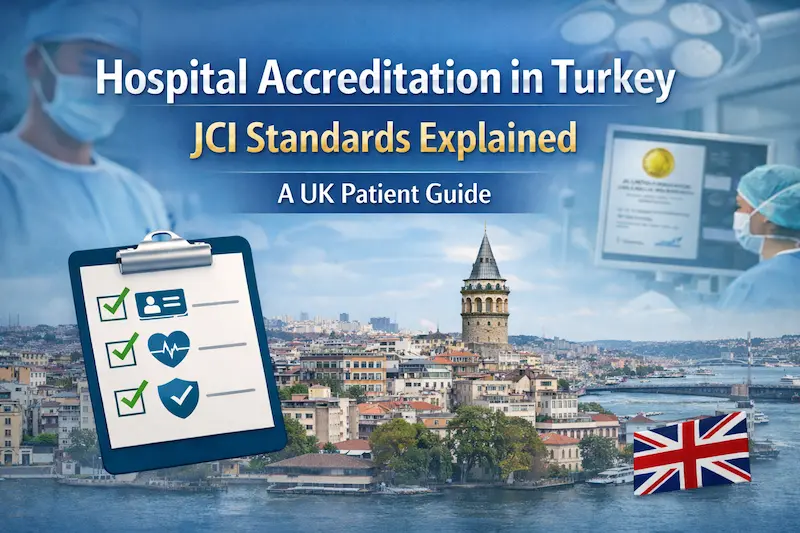
If you are researching hospital accreditation Turkey as part of a plan for cosmetic surgery abroad, you are already doing what a sensible “expert patient” does: checking the systems behind the glossy photos. Accreditation is not a marketing badge; it is meant to be a structured way to assess whether a hospital can consistently deliver safe care — particularly around infection prevention, anaesthesia, medication management, and emergency readiness.
In this guide, I’ll unpack JCI accreditation Turkey in plain English and explain how to interpret it as a British patient. You’ll also learn how to verify a JCI accreditation certificate hospital claim and how to combine accreditation checks with the practical questions that matter for safe cosmetic surgery in Istanbul. Where appropriate, I’ll refer to principles that are well-established in medical science (for example, how healthcare systems reduce risk through standardised processes rather than relying on individual heroics).
Important context: Accreditation is one piece of the safety picture. It can indicate strong governance and processes, but it does not replace surgeon-specific due diligence, a personalised risk assessment, or a realistic aftercare plan for when you return to the UK.
Table of Contents
Why British Patients Ask About Hospital Accreditation (and What It Really Means)
For UK patients, “accreditation” often functions as a trust shortcut: a way to reduce uncertainty when treatment is outside the familiar NHS and CQC-regulated environment. This is especially true if you have seen alarming stories in the media and want a clear, verifiable answer to the question: “Is this hospital genuinely safe?” Understanding what accreditation can and cannot tell you helps you avoid false reassurance — and avoid dismissing a genuinely well-run hospital because of internet noise.
Accreditation can also be a practical way to assess how a hospital supports recovery — not just how it performs surgery. For example, hospitals with stronger governance tend to have clearer post-op monitoring, infection-prevention routines, and structured aftercare instructions, which can make the early days feel more predictable for UK patients. If your priority is to speed up facelift recovery, these “system” details matter because they influence swelling management, wound care consistency, and how quickly concerns are identified and addressed.
The “botched abroad” worry: separating headlines from safety systems
Headlines usually focus on outcomes (a complication, a revision, a poor aesthetic result). Accreditation looks at something different: the systems that reduce the likelihood of avoidable harm. In healthcare quality improvement — supported by decades of scientific research into patient safety — consistent outcomes are strongly linked to repeatable processes: correct patient identification, safe medication administration, infection control, escalation pathways, and incident reporting.
So, when you search for recognised hospital accreditations abroad, you are really asking: “Does this hospital run on robust protocols, or is it improvising?”
Hospital standards vs surgeon skill — why you must check both
A hospital can have excellent governance and still deliver a disappointing result if the surgeon’s technique, judgement, or case selection is not right for you. Equally, a highly skilled surgeon can be limited by a weak hospital environment (poor theatre discipline, inadequate post-anaesthetic monitoring, or inconsistent nursing standards).
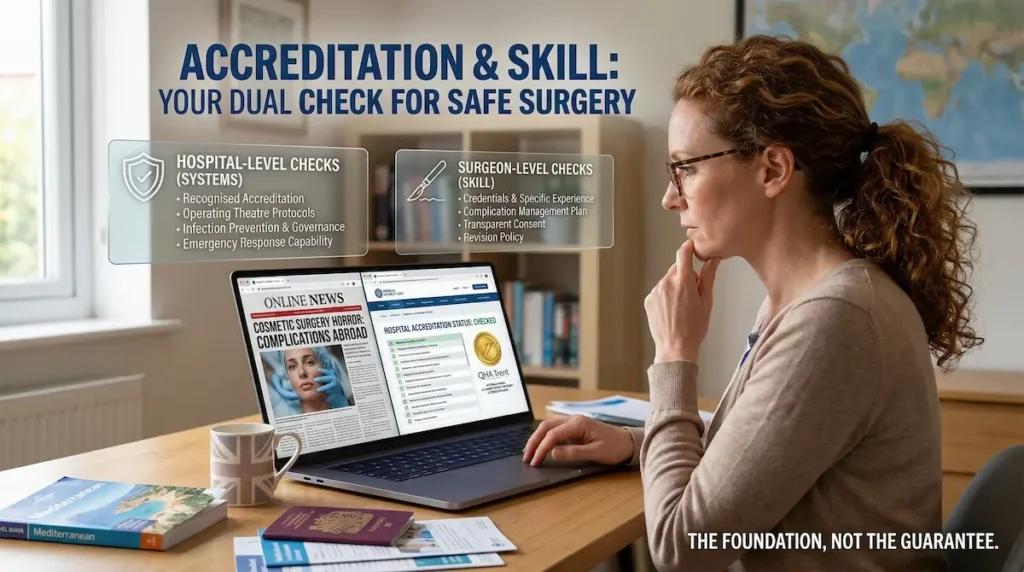
Your safest approach is “AND”, not “OR”:
- Hospital-level checks: accreditation status, operating theatre protocols, infection prevention, emergency response capability.
- Surgeon-level checks: credentials, experience with your specific procedure, complication management plan, revision policy, and transparent consent.
What “accredited” should tell you (and what it shouldn’t)
What it should tell you: the hospital is organised enough to meet a defined external standard across multiple domains (not just one shiny operating theatre), and it can evidence its policies, training, audits, and outcomes monitoring.
What it shouldn’t make you assume:
- That every surgeon working there is equally experienced in your procedure.
- That your individual risk is low (your health profile matters).
- That aftercare will automatically be seamless once you are back in the UK.
This is why the most useful mindset is: accreditation is a foundation, not a guarantee.
What Is JCI? A Plain-English Overview for UK Patients
JCI (Joint Commission International) is one of the best-known international accreditation bodies. When people search JCI accredited hospitals in Turkey, they are usually looking for a hospital that has undergone an external assessment against patient-safety and quality standards. Below is the “JCI standards explained” version — the practical interpretation you can use while shortlisting hospitals.
What JCI assesses in hospitals and why it exists
JCI accreditation is designed to evaluate whether a hospital has reliable systems that support safe care. While the exact framework evolves over time, JCI-style standards typically focus on areas such as:
- Patient identification and safe communication (reducing wrong-patient/wrong-procedure errors).
- Medication management (storage, prescribing, administration, high-alert medicines).
- Anaesthesia safety and monitoring standards before, during, and after surgery.
- Infection prevention and sterilisation processes.
- Emergency readiness and escalation pathways.
- Staff competency, training, and ongoing audits.
For a cosmetic surgery patient, these categories matter because complications (while uncommon in well-selected cases) are managed best by disciplined systems — something emphasised repeatedly across patient-safety research in medical science.
The survey process: how accreditation is earned and reviewed
Accreditation is not simply “bought”; it is typically earned through a structured survey process. In broad terms, hospitals prepare evidence of policies and performance, then external surveyors assess whether real-world practice aligns with documented standards. If accredited, there is usually a defined validity period, and hospitals may be required to demonstrate ongoing compliance.
For you as a patient, the key takeaway is practical: an accreditation claim should be verifiable, current, and specific to the hospital site where your surgery will take place.
JCI vs other frameworks (e.g., ISO) — different scopes, different meaning
Patients often see multiple badges: ISO certificates, national ministry licences, and international accreditation logos. These are not interchangeable.
- ISO-style certifications often focus on quality management systems (how processes are documented and improved) and may not be as clinically specific.
- Clinical accreditation frameworks (such as JCI) tend to place heavier emphasis on patient safety and clinical pathways.
This is why the phrase recognised hospital accreditations abroad matters: you want to understand what the accreditation actually measures — particularly around operating theatre safety standards, anaesthesia processes, and post-operative monitoring.
JCI Standards That Matter Most for Cosmetic Surgery Patients
When people look for JCI accredited hospitals in Turkey, they are often trying to answer a very specific question: “Will the hospital keep me safe before, during, and after surgery?” This is where JCI standards explained becomes practical. Rather than treating accreditation as a logo, use it to structure your due diligence around the highest-impact safety domains for elective surgery.
Infection prevention and sterile operating theatres
In cosmetic surgery, infection prevention is not just “cleanliness” — it is a set of repeatable, audited behaviours: sterilisation pathways, theatre traffic control, hand hygiene compliance, surgical site preparation, and post-op wound protocols. Strong operating theatre safety standards typically include:
- Controlled theatre access (minimising unnecessary entry/exit during cases).
- Sterilisation traceability (knowing which instruments were sterilised, when, and by what validated process).
- Antibiotic stewardship (right antibiotic, right timing, not “just in case” overuse).
- Clear post-op wound care instructions that you can follow once you’re back in the UK.
In medical science, consistent infection prevention outcomes are strongly linked to standardisation and audit. That is exactly the kind of systems thinking that accreditation frameworks aim to enforce.
Safe anaesthesia pathways and medication management
Anaesthesia safety is a major reason patients seek JCI accreditation Turkey. In well-run hospitals, anaesthesia safety is not a single event in theatre; it is a pathway:
- Pre-anaesthetic assessment (medical history, airway evaluation, clot risk, medication review).
- Intra-operative monitoring (appropriate monitoring for your procedure and health status).
- Post-anaesthetic recovery standards (trained staff, monitoring, pain and nausea control, discharge criteria).
- Medication governance (labelling, storage, double-checks for high-risk drugs, allergy documentation).
Ask the hospital to explain their post-anaesthetic monitoring process in plain language: where you will recover, for how long, and what “safe to transfer/discharge” actually means.
Emergency readiness: escalation, intensive care access, critical incidents
Elective cosmetic surgery should have a low complication rate in appropriately selected patients — but “low” is not “never”. The key safety question is: if something unexpected happens, what is the escalation pathway? This includes:
- Rapid response protocols and clear lines of responsibility.
- Access to higher-level care (e.g., critical care support if required).
- Blood availability where clinically appropriate for certain procedures.
- Documented transfer arrangements if escalation beyond the facility is necessary.
Hospitals with mature safety cultures treat near-misses as learning opportunities. That “learning system” approach is a cornerstone of patient-safety science and is often reflected in how incidents are reported and reviewed.
Consent, patient identification, and communication standards
Robust consent is both ethical and protective: it ensures you understand the realistic benefits, limitations, and risks — and that you are choosing surgery for the right reasons. Operationally, you also want to see systematic checks:
- Identity checks (right patient, right procedure).
- Site/procedure verification and “time-out” style checks in theatre.
- Clear documentation of what was agreed, what was done, and what aftercare is required.
For UK patients, this is a key reassurance point: you should feel informed, not rushed.
A practical checklist: questions to ask that map to accreditation
Use the table below as a quick way to translate accreditation into concrete questions. It is particularly useful if you are comparing multiple providers offering safe cosmetic surgery in Istanbul and want to avoid being swayed by marketing language alone.
| Safety domain | What to ask the hospital | What a good answer looks like |
|---|---|---|
| Operating theatre safety standards | How do you control theatre traffic and maintain sterility during cases? | Clear rules, training, audits, and accountability (not “we’re always careful”). |
| Anaesthesia pathway | Where do I recover post-op and what monitoring is in place? | Defined recovery area, trained staff, discharge criteria, escalation plan. |
| Medication safety | How are allergies documented and medicines double-checked? | Structured checks, labelling standards, documentation you can take home. |
| Emergency readiness | What happens if there is a complication overnight? | 24/7 cover, rapid response protocol, access to higher-level care if needed. |
| Infection prevention | What is your surgical site infection prevention protocol? | Specific steps, patient instructions, follow-up plan, and audit approach. |
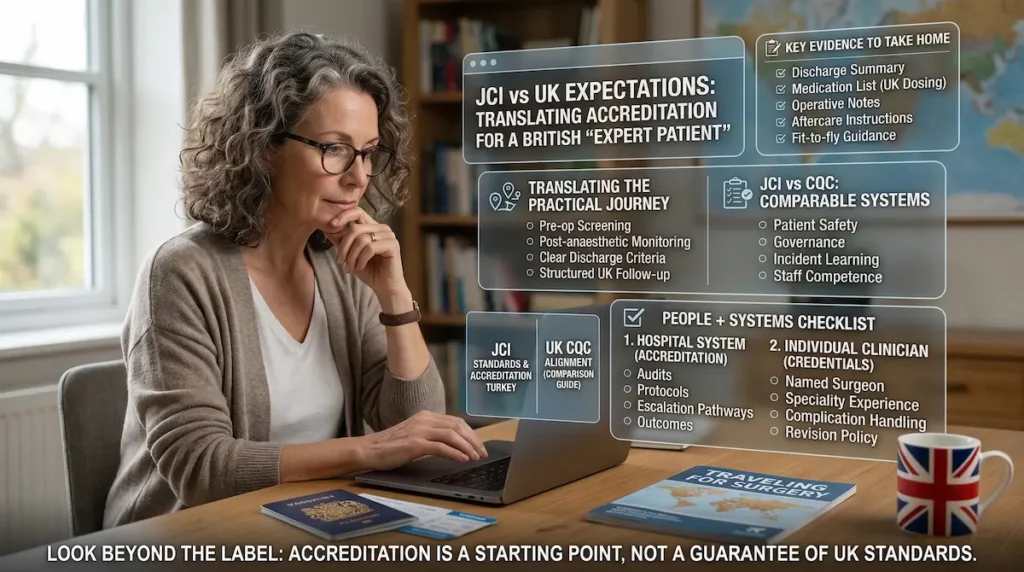
JCI vs UK Expectations: Translating Accreditation for a British “Expert Patient”
British patients often want a “UK equivalent” label when assessing hospitals abroad. While that instinct is understandable, it is important to compare like with like. JCI is an international accreditation framework; in the UK, independent healthcare providers are regulated and inspected by bodies such as the Care Quality Commission (CQC) in England. The point is not to declare them identical, but to translate what JCI accreditation Turkey can indicate into the practical standards UK patients expect.
While a UK-style comparison can’t be one-to-one, it can still guide smarter questions about the patient journey. Ask how the hospital turns standards into day-to-day practice: pre-op screening, post-anaesthetic monitoring, clear discharge criteria, and a structured follow-up plan once you’re back in Britain. These practical details matter just as much as logos when you want predictable healing — and if your goal is to speed up facelift recovery, consistent swelling management, wound-care protocols, and rapid access to clinical advice can make a real difference in the first two weeks.
JCI vs CQC: what’s comparable and what isn’t
Comparable: both focus on patient safety, governance, incident learning, staff competence, and quality systems. If a hospital can show strong performance in these areas, it aligns with what most UK patients intuitively mean by “well regulated”.
Not directly comparable: CQC is a statutory regulator within the UK system, with powers and context specific to UK law and service models. JCI is an accreditation body operating internationally. As an “expert patient”, your job is to look beyond the label and ask for evidence of the underlying behaviours (audits, protocols, monitoring, escalation pathways).
Clinician credentials: how to think about “GMC expectations” abroad
UK patients often search for a clean translation of professional regulation, such as “the GMC but for Turkey”. In practice, you should verify:
- Who will perform the procedure (named surgeon, not a generic team promise).
- Their speciality background and procedure-specific experience (how many cases like yours, complication handling, revision approach).
- Transparent consent practice (risks, alternatives, realistic outcome discussion).
- Accountability pathways (how complaints, complications, and follow-up are handled).
This is the “people + systems” model: accreditation helps you assess the system; credential checks help you assess the individual clinician.
Documentation and transparency: what UK patients should expect to take home
One practical UK-facing standard is paperwork. If you return to the UK and need advice, the quality of your documentation matters. You should expect to leave with:
- Discharge summary with diagnosis and procedure details.
- Medication list (including antibiotics, pain relief, anticoagulation if prescribed), with dosing in clear terms.
- Operative notes (or an equivalent summary of key intra-operative details).
- Aftercare instructions and red-flag symptoms requiring urgent review.
- Fit-to-fly guidance where relevant, especially after longer procedures.
This is also where claims like “we are JCI accredited” become meaningful only if they translate into consistently professional, traceable documentation.
UK-style risk conversation: consent that feels thorough, not transactional
In the UK, many patients are used to a cautious consent culture. You should expect a serious discussion about:
- Your individual risk factors (smoking, clot history, BMI, prior surgery, medications).
- What “normal recovery” looks like versus warning signs.
- Revision scenarios and who pays for what, if further treatment is needed.
If that conversation is missing, a JCI-related claim alone should not reassure you.
How to Verify JCI Accreditation (and Avoid Misleading Claims)
Not every accreditation claim online is clear, current, or even relevant to the facility where your surgery will take place. If you are comparing JCI accredited hospitals in Turkey, treat verification as a simple, repeatable process: ask for evidence, check that it is current, and confirm it matches the exact hospital site (not a sister hospital, a brand group, or a different address). This is the most practical way to use JCI standards explained thinking in real life.
Where to check the hospital’s status (official verification routes)
A hospital that is genuinely accredited should be comfortable directing you to an official listing and providing documentation that matches it. In practice, you can:
- Ask for the hospital’s formal accreditation name and the exact site address where surgery is performed.
- Request the validity period (start/end dates) of the accreditation.
- Confirm that the accreditation is specific to the hospital (not a consultant’s private rooms, a travel agency, or an unregulated facility).
If a provider is vague here, treat it as a signal to slow down. In patient-safety work, transparency is a core marker of mature governance — a principle repeatedly reinforced across scientific research into safe healthcare systems.
What to request: the JCI accreditation certificate hospital details that matter
When you ask for a JCI accreditation certificate hospital document (or equivalent evidence), focus on details you can verify, not just a logo:
- Hospital name (as it appears on the certificate).
- Address / site location (must match where you will have surgery).
- Issue date and expiry date (or accreditation cycle dates).
- Scope (if stated): whether it covers the facility and the services you are using.
You do not need to be confrontational — simply explain you are doing due diligence as a UK patient researching hospital accreditation Turkey and want to ensure the claim is current and relevant.
Red flags: “JCI compliant” language, vague logos, missing dates
Be cautious if you see any of the following:
- “JCI compliant” or “meets JCI standards” without verifiable accreditation status.
- A logo on a website with no hospital name, no dates, no site address.
- Claims that only reference a hospital group, not the exact facility.
- Pushback when you request the JCI accreditation certificate hospital details.
Accreditation should withstand simple verification. If it doesn’t, treat it as marketing rather than a safety indicator.
Practical questions to ask before you book (beyond the badge)
Even with JCI accreditation Turkey, ask questions that reveal real operating practice — especially around operating theatre safety standards and post-anaesthetic monitoring:
- Operating theatre: “How do you maintain a sterile field and control theatre traffic during surgery?”
- Anaesthesia: “Who performs the pre-anaesthetic assessment and who monitors me during recovery?”
- Emergency readiness: “What is the escalation pathway if a complication occurs overnight?”
- Documentation: “What written discharge summary and medication list will I take home to the UK?”
This approach also helps you compare recognised hospital accreditations abroad fairly: you are testing the underlying systems, not just the label.
What JCI Does Not Guarantee: A Balanced Safety Checklist Beyond Accreditation
Accreditation is valuable — but it is not a personal risk assessment and it is not a promise of a specific aesthetic outcome. For British patients planning safe cosmetic surgery in Istanbul, the smartest approach is to use accreditation as a baseline, then add a personal safety checklist that reflects your health profile, your procedure choice, and your aftercare reality once you return home.
Patient selection and risk screening (your health profile still matters)
Even in the best hospitals, risk rises when surgery is performed on the wrong candidate or without adequate preparation. A serious provider should ask about:
- Smoking or vaping (and required stop periods).
- Past clots, family history of clots, or known thrombophilia.
- Medication list (including supplements) and allergy history.
- Previous operations and any prior complications.
- Current health conditions that affect healing (e.g., diabetes).
This is where “systems” meet “individual physiology” — and it is why safe care is built on personalised risk stratification as well as protocols.
The surgeon factor: credentials, judgement, and complication management
JCI relates to the facility. Your outcome and safety also depend heavily on the surgeon performing the procedure. Before committing, ensure you have:
- A named surgeon (not a rotating team).
- Procedure-specific experience (not just “cosmetic surgery” in general).
- A clear explanation of the technique and its limitations.
- A practical plan for complications and revisions (what happens, where, and who is responsible).
Accreditation cannot replace surgeon-level due diligence — the two checks are complementary.
Aftercare reality: what happens once you’re back in the UK
Many UK patients underestimate how much reassurance comes from a structured aftercare pathway. Whether you are choosing between JCI accredited hospitals in Turkey or other providers with recognised hospital accreditations abroad, ask for specifics:
- How follow-up is delivered (scheduled check-ins, photo reviews, symptom triage).
- How long support lasts (days vs weeks vs a longer recovery window).
- Who you contact if you are worried in the UK (named clinician/team route).
- What documents you will have to share with a UK clinician if needed.
Documentation that protects you (and helps if you need advice at home)
Good documentation is one of the most practical safety outputs of a well-run hospital system. You should expect:
- Discharge summary with procedure details and recovery instructions.
- Medication list with doses and timing (including pain relief such as paracetamol, if appropriate).
- Red-flag symptoms that require urgent review (and clear instructions on what to do).
- Fit-to-fly guidance where relevant.
A brief UK patient perspective (what reassurance can look like)
In real patient journeys, reassurance often comes from practical details rather than slogans — clear communication, predictable recovery support, and documentation you can rely on once you are home.
UK patient insight: One UK patient described her recovery as “painless” and said she needed only minimal paracetamol — and felt comfortable comparing London quality expectations with her Istanbul experience.
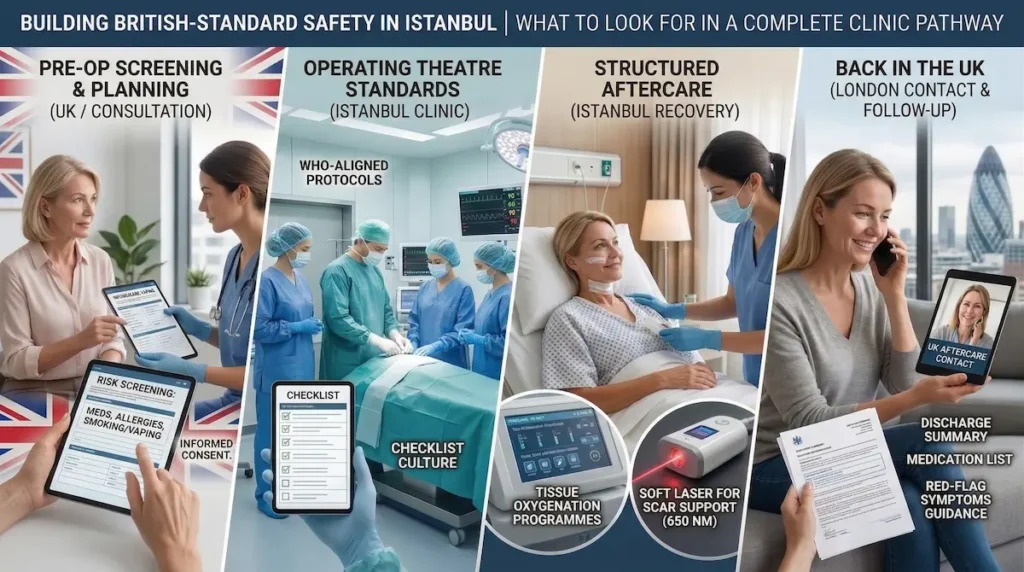
Building “British-Standard” Safety in Istanbul: What to Look for in a Clinic Pathway
If you are choosing safe cosmetic surgery in Istanbul, the most reassuring signal is not a single badge — it is a complete, end-to-end pathway that feels as structured as a top UK private provider. This is where hospital accreditation Turkey and JCI accreditation Turkey can be useful as a baseline, but your final decision should be based on whether the clinic can demonstrate repeatable systems: screening, informed consent, operating theatre safety standards, post-anaesthetic monitoring, and realistic aftercare once you return to the UK.
For many UK patients, that “end-to-end” structure is also what makes recovery feel safer and more manageable once you leave the clinic. When you want to speed up facelift recovery, look for a pathway that standardises the basics: clear swelling-control guidance, consistent wound-care routines, scheduled check-ins, and rapid access to clinical advice if anything feels off. These practical systems don’t just reduce anxiety — they can help you stay on track during the early healing phase and feel more confident about travelling back to the UK at the right time.
Pre-op planning: consent depth, risk screening, and “no” as a safety feature
For a British “expert patient”, the pre-op stage is where you can most easily tell the difference between a safe provider and a sales-led one. A strong clinic pathway should include:
- Structured medical screening (medications, allergies, smoking/vaping, clot risk, previous surgery, and relevant health conditions).
- Clear anaesthetic planning and an explanation of monitoring.
- Informed consent that covers realistic outcomes, limitations, alternatives, and complication scenarios.
- Appropriate refusal when your risk profile is unsuitable (a safe clinic will sometimes say “not yet” or “not recommended”).
This approach aligns with what patient-safety and medical science consistently reinforces: risk reduction comes from selection, preparation, and standardised processes — not from rushing to theatre.
Theatre-to-recovery protocols: what “operating theatre safety standards” should look like in practice
When comparing JCI accredited hospitals in Turkey (or any provider claiming recognised hospital accreditations abroad), ask how theatre safety is operationalised day-to-day. Strong practice typically includes:
- Sterile field discipline (controlled theatre traffic, validated sterilisation, and clear roles).
- Checklist culture (identity checks, procedure confirmation, and “time-out” style verification).
- WHO-aligned hygiene protocols (many high-standard clinics explicitly align with WHO frameworks for infection prevention).
- Post-anaesthetic recovery criteria (monitoring, pain and nausea control, and defined discharge thresholds).
Ask for specifics rather than reassurance. “We’re very careful” is not a protocol. A confident team can explain their standards clearly, including what happens if a patient becomes unwell and needs escalation (and whether an A&E-level response pathway is available if required).
Recovery support that reduces “flight anxiety”: HBOT and LLLT as structured aftercare tools
One reason UK patients worry about surgery abroad is the fear of swelling, bruising, or discomfort affecting travel. Some clinics use additional recovery technologies as part of a structured pathway.
- HBOT (Hyperbaric Oxygen Therapy) is commonly used in recovery protocols to support tissue oxygenation, help manage post-operative oedema, and reduce “social downtime” for patients who need to be back to work in the UK.
- LLLT (Low-Level Laser Therapy) is often used for scar support; some programmes use a soft laser (for example, 650 nm) to support healing and minimise visible incision lines.
These tools do not replace good surgery — but they can be valuable when they are integrated into a clear plan with milestones, rather than offered as vague “extras”. If a clinic offers them, ask how they are scheduled, who supervises them, and what outcomes they are used to target.
UK-facing reassurance: communication, documentation, and a real aftercare route
For Skeptical Sam, the “after I land in the UK, what then?” question is decisive. A clinic pathway that feels British-standard often includes:
- A named point of contact (not a rotating WhatsApp number with no clinical ownership).
- Clear follow-up structure (timed check-ins, photo reviews, and symptom triage).
- UK-friendly accessibility (for example, a UK-based patient contact point and/or a London correspondence address for documentation, depending on the clinic’s set-up).
- Take-home paperwork: discharge summary, medication list, and red-flag symptoms with instructions.
This is where accreditation becomes meaningful: if a clinic claims strong standards, you should see it reflected in calm, professional communication and clear documentation you can share with a UK clinician if needed.
A simple “British-standard” pathway map (use this to compare providers)
| Stage | What you should receive | Why it matters |
|---|---|---|
| Before you travel | Risk screening, procedure plan, consent, clear anaesthesia and recovery explanation | Reduces preventable complications through patient selection and preparation |
| In Istanbul (surgery day) | Identity checks, sterile operating theatre discipline, monitored recovery area, escalation plan | Protects you during the highest-risk window: surgery and immediate recovery |
| First 7–14 days | Scheduled reviews, wound care plan, pain guidance (often including paracetamol where appropriate), travel-readiness advice | Supports safe early healing and reduces “flying too soon” anxiety |
| Back in the UK | Defined follow-up route, documentation, red-flag guidance, a clear contact pathway | Ensures you are not “on your own” once you’ve landed |
A real UK patient perspective (why structure matters)
Sarah (UK) on recovery and quality: She described her recovery as painless, requiring minimal paracetamol, and noted that when comparing facelift London vs Istanbul quality, she would confidently choose Turkey over the UK for value and experience.
Bottom line: If you want the reassurance of recognised hospital accreditations abroad, use them as a baseline — then confirm the full pathway: screening, theatre discipline, anaesthesia and recovery standards, and UK-friendly aftercare.
Frequently Asked Questions (FAQ): Hospital Accreditation Turkey
These quick answers are written for UK patients comparing hospital accreditation Turkey options and trying to interpret JCI standards explained without marketing noise.
Is JCI accreditation mandatory for hospitals in Turkey?
No. JCI is an international accreditation; it is not a legal requirement for every hospital. Some hospitals choose it as an additional external benchmark, while others may follow different recognised frameworks.
Does JCI accreditation mean cosmetic surgery is “risk-free”?
No. JCI accreditation Turkey can indicate strong systems, but individual risk depends on your health profile, the procedure, the surgeon’s judgement, and aftercare. Even in excellent hospitals, complications can occur.
How can I check whether a hospital’s JCI accreditation is current?
Ask for the hospital’s official name and site address and request JCI accreditation certificate hospital details (issue/expiry dates and scope). A genuine claim should be verifiable and specific to the facility where your surgery will take place.
What’s the difference between hospital accreditation and a surgeon’s credentials?
Accreditation assesses the facility’s systems (safety protocols, governance, monitoring). Surgeon credentials relate to the clinician performing your procedure (training, experience, technique, complication management). You need both.
Are “JCI compliant” clinics the same as JCI-accredited hospitals?
Not necessarily. “Compliant” language can be vague. If you are specifically looking for JCI accredited hospitals in Turkey, ask for verifiable accreditation status and dates rather than relying on a logo or wording.
If I return to the UK and have a concern, what aftercare should I expect?
You should expect a clear contact pathway, written instructions, and guidance on red-flag symptoms. Good aftercare includes scheduled check-ins and documentation you can share with a UK clinician if required.
Will my NHS GP help with post-op issues after surgery abroad?
Your GP may offer general support and advise you on next steps, but NHS care pathways vary and cannot replace a structured surgical aftercare plan. Make sure you leave with a discharge summary, medication list, and clear instructions on what to do if you are worried.
What documents should I take home after surgery?
At minimum: a discharge summary, medication list, aftercare instructions, and a clear list of warning signs. For some procedures, fit-to-fly guidance can also be helpful.
If you’d like to go further than hospital accreditation, you may also find our related guides helpful — including how to choose a Plastic Surgeon Turkey with the right credentials, common misunderstandings in Turkish Plastic Surgery Myths, a practical Surgery Abroad Safety Checklist for UK patients, and clear guidance on when you can Fly After Facelift. These articles expand on the safety and planning points discussed above, so you can make decisions with more confidence before you book or travel.
Medical Disclaimer: This page is provided for general educational purposes only and does not replace a face-to-face medical consultation, diagnosis, or personalised treatment plan. All surgery carries risks and outcomes vary between individuals. Suitability for a plastic surgery, procedure selection, and anaesthesia choice can only be determined after a full clinical assessment by a qualified surgeon. Always follow your clinician’s instructions and seek urgent medical attention if you develop concerning symptoms during recovery.