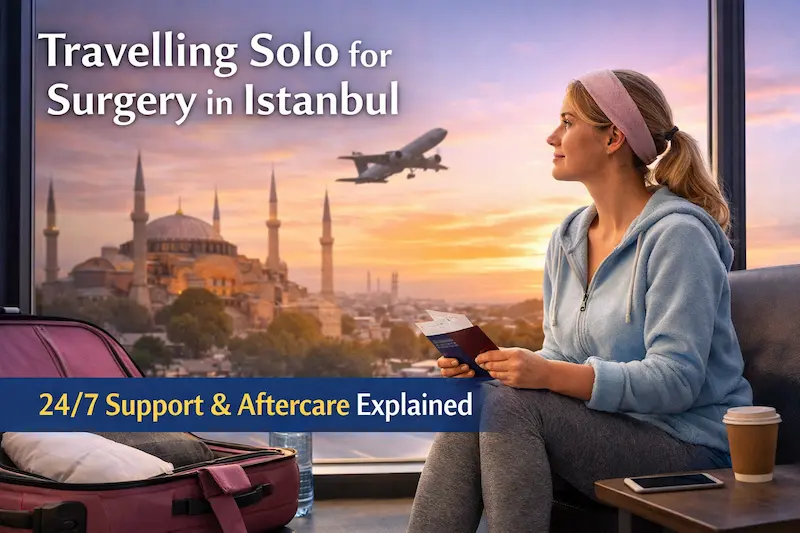
If you’re travelling solo for surgery, it’s normal to have a very British list of concerns: “Will I be safe?”, “Who checks on me after the procedure?”, “What if I need help at 2am?”, and “How do I get from the airport to the hotel and back to the clinic without feeling vulnerable?” This guide is written for UK patients planning travelling alone for surgery in Istanbul, including those searching for solo travel for surgery, going to Turkey for surgery alone, or solo female travel for surgery Istanbul.
At AKM Clinic, our approach is simple: solo patients should never feel “on their own”. We build a safety net around you — from arrival logistics to recovery monitoring — so your experience is calm, structured, and supported. Where relevant, we also explain the “why” behind certain safety steps (for example, movement plans to reduce clot risk), because many UK patients prefer decisions grounded in medical science and good clinical practice rather than vague reassurance.
Clinical note: If a provider’s “24/7 support” is only a generic helpline, that’s not enough for solo travellers. Proper support means clear escalation pathways, clinical triage, and planned check-ins — especially in the first 48–72 hours.
Table of Contents
Is Travelling Solo for Surgery in Istanbul Actually Safe for UK Patients?
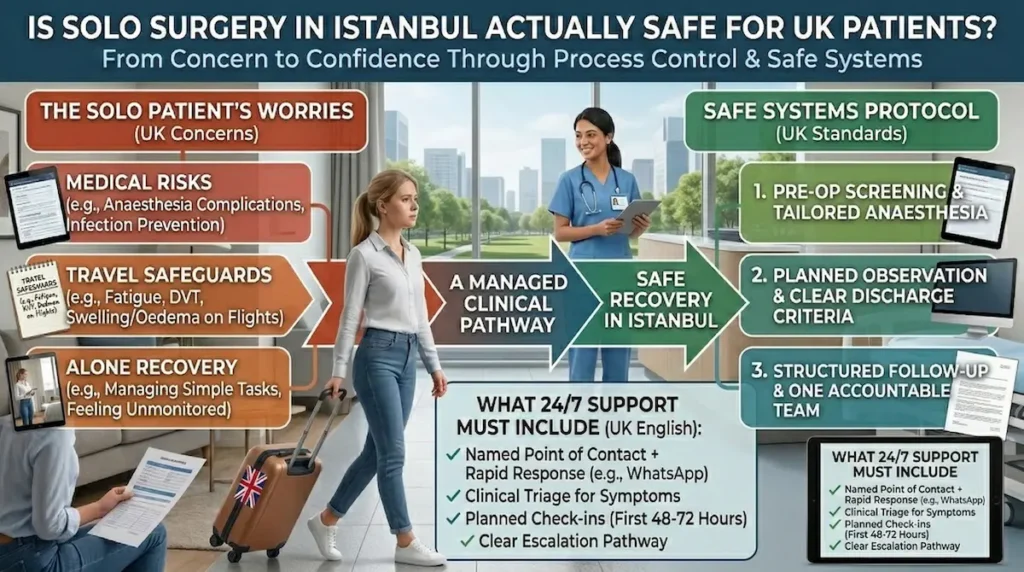
Safety is not about bravado or “being fine on your own” — it’s about systems. If you’re asking “can I travel alone for cosmetic surgery?”, the most useful way to think about it is: “What safeguards are in place before, during, and after surgery — and who is accountable at each step?” Solo patients do well when their provider controls the journey end-to-end (timings, transfers, theatre planning, and recovery support), and when you always know who to contact and what happens next.
For many British patients, the real question behind solo travel is “Is it safe to travel to Turkey for surgery if something unexpected happens?” The safest experiences are built around predictable decision points: clear pre-op screening, an anaesthesia plan tailored to you, defined observation periods, and a support route that doesn’t disappear after discharge. When those elements are documented and communicated in plain English, travelling alone stops feeling like a gamble — and starts feeling like a managed clinical pathway.
The real risks UK patients worry about (and what actually reduces them)
UK patients tend to worry about three things:
- Medical safety: anaesthesia planning, infection prevention, and how complications are managed.
- Travel-related safety: fatigue, dehydration, swelling (oedema), and clot risk on flights.
- Being alone in recovery: “What if I’m light-headed?”, “What if I can’t manage simple tasks?”, “Who checks that I’m recovering normally?”
What reduces risk in practice is not a promise — it’s a protocol. That means appropriate pre-op checks, clear discharge criteria, structured follow-up, and conservative travel planning. For solo patients, we also recommend an “assume you’ll be tired” mindset: choose direct routes, minimise transfers, and plan for rest rather than sightseeing.
Why “process control” matters more than destination
Many people search “safe medical tourism for solo travellers” because the fear isn’t just the surgery — it’s the unpredictability of travelling alone. The safest experiences typically have:
- Planned timings: surgery scheduling that avoids unnecessary rushing and allows proper observation.
- Private transfers: so you are not navigating taxis or public transport while vulnerable.
- One accountable team: a clear chain of responsibility for questions, symptoms, and next steps.
From a patient-safety perspective, this is consistent with what we see across clinical services: standardised pathways reduce avoidable errors. That’s not “marketing”; it’s the logic used in quality improvement and reflected in scientific research on safety systems and human factors.
What “24/7 support” should include (not just a phone number)
For solo travellers, 24/7 support should be specific. At minimum, you should be able to answer “yes” to each of the following:
| What you should have as a solo patient | Why it matters |
|---|---|
| Named point of contact + rapid response route (WhatsApp/phone) | So you’re not explaining your case from scratch while anxious or unwell |
| Clinical triage for symptoms (not just admin) | Helps distinguish “normal recovery” from “needs action now” |
| Planned check-ins within the first 48–72 hours | Early recovery is when solo patients most need reassurance and monitoring |
| Clear escalation pathway | If something changes, you need to know what happens next and who takes responsibility |
This is also where aftercare nursing for solo patients becomes important: practical support (wound checks, mobility guidance, and recovery routines) can make the difference between feeling overwhelmed and feeling safe.
Your Solo Patient Journey — Step-by-Step (From London to Discharge)
If you’re going to Turkey for surgery alone, your biggest comfort comes from knowing exactly what happens at each stage. Below is the structure we use for solo patients so there are no “gaps” where you’re left to figure things out alone. The goal is a predictable pathway: arrive, settle, be assessed, have surgery safely, recover with support, and leave Istanbul feeling stable and confident.
Direct flights London to Istanbul: how we plan timings around surgery
When possible, we recommend direct flights from London to Istanbul to reduce stress and unnecessary walking, standing, and luggage handling. For solo travellers, fewer flight segments also means fewer opportunities for delays and complications in your schedule.
- Arrival buffer: we plan your itinerary so you’re not landing and rushing straight into assessments.
- Rest-first principle: your first night should prioritise hydration, food, and sleep — not errands.
- Conservative return planning: we plan your return in line with your procedure and recovery milestones, not wishful thinking.
Airport meet & greet, private transfers, hotel check-in logistics
Solo travel for surgery should not include negotiating transport or directions while tired or anxious. A structured transfer plan reduces vulnerability and keeps your day calm:
- Meet at the airport and direct private transfer to your accommodation.
- Clear hotel check-in guidance (what documents you need, what to do if your room isn’t ready yet).
- Return transfers arranged for clinic visits, not left to ad-hoc booking.
If you are specifically planning solo female travel for surgery Istanbul, we take the same approach: predictable transport, known drivers, and no unnecessary exposure to risk.
Pre-op day: tests, consent, and what happens if you’re nervous alone
Your pre-op day should feel structured and unhurried. Typically, it includes clinical checks, final discussions, and consent. If you’re travelling alone, it’s also the day to make sure you feel emotionally settled — because anxiety can make everything feel bigger than it is.
- Clinical assessment: checks appropriate to your procedure and medical history.
- Consent and expectations: what’s realistic, what’s not, and what “normal recovery” looks like.
- Comfort plan: what to eat/drink, how to sleep, and who to contact if you’re worried.
Solo-traveller tip: Bring a small notes list of your top 10 questions. When you’re tired, you’ll be glad you wrote them down — and you’ll leave the consultation feeling clear rather than rushed.
What 24/7 Support Means in Practice (UK Support Line + WhatsApp + Safety Net)
If you’re researching travelling alone for surgery or solo travel for surgery, “24/7 support” can sound reassuring — but only if it is operationally real. For solo patients, support must be reachable, clinically meaningful, and actionable. In other words: you should never be left wondering whether a symptom is normal, whether you’re “bothering” someone, or what the next step is.
Direct WhatsApp communication and how escalation works overnight
Solo travellers need quick, low-friction communication. A WhatsApp-first pathway works well because you can message even if you’re tired, sore, or anxious — and you can share a photo if needed (for example, a dressing or swelling pattern). Good support is not just “someone replies”; it’s:
- Response triage: urgent symptoms are handled as urgent, not queued behind admin messages.
- Clear escalation: if a message suggests a clinical concern, it must escalate to the right clinician promptly.
- Plain-English guidance: what to do now, what to monitor, and when to seek immediate assessment.
This sort of escalation framework is aligned with how modern patient pathways are designed — structured decision-making reduces uncertainty and improves safety, which is a principle repeated across scientific research in healthcare systems and patient monitoring.
UK-style reassurance: predictable check-ins (not “message us if you need us”)
If you are going to Turkey for surgery alone, you should not have to initiate every contact. We build planned check-ins into your early recovery, particularly over the first few days when solo patients can feel most vulnerable. This typically includes:
- Day 0–1: monitoring for expected effects of anaesthesia and early swelling.
- Day 2–3: reviewing mobility, hydration, discomfort control, and wound/dressing condition.
- Day 4+: confidence-building: “what’s normal now”, “what changes next”, “what would be a red flag”.
If something feels “off”: symptom triage and when we act immediately
Solo patients often worry about missing warning signs. You don’t need to be a clinician — you just need a clear plan. In practical terms, triage means we separate:
- Expected recovery changes: swelling, bruising, tiredness, appetite changes, mild asymmetry early on.
- Needs same-day review: increasing redness, worsening pain that doesn’t respond to plan, persistent dizziness.
- Needs urgent assessment: chest pain, breathlessness, fainting, sudden leg pain/swelling, or uncontrolled bleeding.
For solo travellers, the key is not to “push through” worry. If your instinct says something has changed, you should have a team who treats that seriously and can guide you immediately.
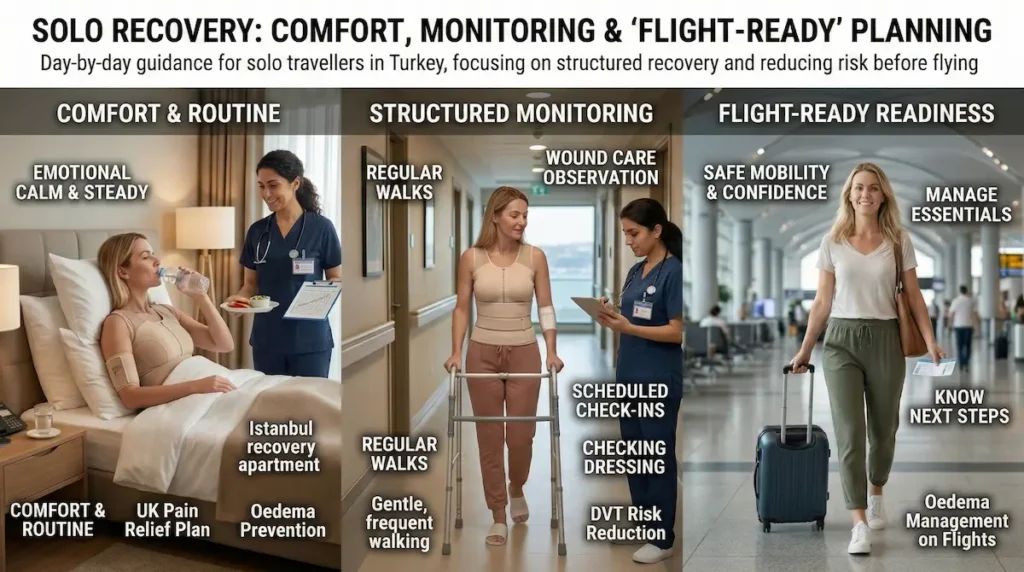
Recovery When You’re Alone — Comfort, Monitoring, and “Flight-Ready” Planning
Recovery can feel emotionally louder when you’re by yourself — even when everything is progressing normally. For patients searching safe medical tourism for solo travellers or can I travel alone for cosmetic surgery, the practical question is: “How will I manage day-to-day needs safely, and how will I know I’m healing as expected?” Our approach focuses on three pillars: comfort, monitoring, and readiness to travel.
When UK patients ask “is it safe to travel to Turkey for surgery” while recovering alone, they’re often really asking whether they’ll feel steady, supervised, and travel-ready — not just “discharged”. That’s why we set expectations early: what discomfort is normal, what changes day-by-day, and which signs mean you should contact us immediately. With scheduled check-ins and clear guidance on mobility, hydration, and rest, solo recovery becomes structured and predictable rather than an anxious guessing game.
Day-by-day recovery checkpoints you can follow without guessing
Solo recovery goes best when you have a simple structure. Your plan should include:
- Movement: gentle, frequent walking (short and regular beats long and exhausting).
- Hydration and food: small, regular meals and adequate fluids (especially after travel).
- Sleep positioning: how to rest to protect swelling and support comfort.
- Wound/dressing care: what “normal” looks like and what changes should be reported.
- Pain relief plan: UK-appropriate terminology and safe adherence to your clinician’s instructions.
This is where aftercare nursing for solo patients is genuinely valuable: it reduces the burden of “self-managing” everything while you’re tired and healing.
DVT, swelling (oedema) and mobility: what we do to reduce travel-related risk
Many UK patients travelling alone worry about clot risk (DVT) and swelling. While individual risk varies, a sensible recovery plan usually focuses on:
- Early gentle mobilisation: movement supports circulation and reduces stiffness.
- Hydration: dehydration increases fatigue and can worsen how you feel after flying.
- Practical pacing: avoiding long periods sitting still during early recovery.
- Clear “red flags”: understanding which symptoms require immediate assessment.
These principles are consistent with core preventative thinking in medical science — reduce avoidable risk factors and monitor changes early rather than late.
Flight-ready recovery protocols: what it means and who it’s for
“Flight-ready” should never be a sales phrase. It should mean you meet sensible recovery criteria before travelling: stable symptoms, controlled discomfort, safe mobility, and a clear aftercare plan. For solo travel for surgery, flight readiness also includes practical confidence:
- You can walk comfortably (without feeling faint or unstable).
- You can manage essentials (food, hydration, medication schedule).
- You know what to do if anything changes once you’re back in the UK.
Solo traveller reality-check: If a clinic encourages you to fly too soon without a structured review, that’s not “efficient” — it’s avoidable stress. A safe plan respects healing time and clinical checkpoints.
What to Pack and Prepare as a Solo Traveller (UK-Friendly Checklist)
When you’re travelling alone for surgery, the difference between “manageable” and “overwhelming” is often your preparation. This checklist is written for UK patients planning solo travel for surgery and especially for those searching solo female travel for surgery Istanbul. The aim is to reduce friction: fewer last-minute errands, fewer surprises, and an easier first 72 hours.
Documents, medications, and simple essentials (UK terminology + practical tips)
Keep your essentials in a small, easy-to-reach bag. When you’re tired, you do not want to be digging through luggage.
- Passport and a printed/digital copy of your travel documents
- Travel insurance documents (if applicable) and emergency contact details
- Your medication list (including any allergies)
- A small notebook or notes app list of your post-op schedule (times, reminders, questions)
- Phone charger + power bank (solo patients should always keep their phone reliably charged)
- Comfort basics: lip balm, tissues, hand sanitiser, and a gentle cleanser
Medication planning should always follow your clinician’s instructions. If you normally use paracetamol in the UK, confirm what is appropriate in your specific post-op plan (dose and timing are individual).
Clothing after surgery: compression garments + loose trousers (not “pants”)
Choose clothing that supports swelling management and comfort, while making it easy to get dressed without strain:
- Loose trousers and tops that do not require overhead pulling if you’re stiff or sore
- Slip-on shoes (avoid bending if it’s uncomfortable)
- Front-fastening garments where possible
- Compression garments if advised (pack at least one spare if your procedure requires it)
For solo travel for surgery, pack as if you’ll have less energy than usual. That assumption makes your recovery calmer.
Hydration, temperature thresholds, and measurements in UK format (°C, cm, litres)
UK patients often appreciate clear, measurable guidance. Keep things simple:
- Fluids: aim for steady hydration across the day (think in litres, not “just a few sips”).
- Temperature: if you have a thermometer, track your temperature in °C and report any concerning rise as advised.
- Swelling notes: if you’re monitoring swelling, simple cm measurements or photographs can help track change over time.
Solo traveller tip: Pack one “easy day” outfit that you can put on without thinking — it reduces stress on your first post-op morning.
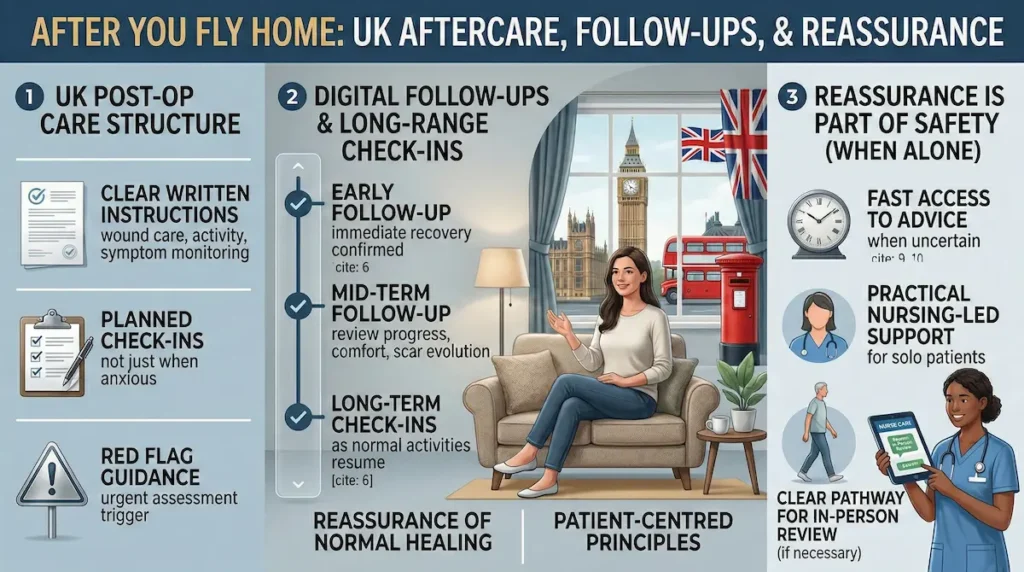
After You Fly Home — UK Aftercare, Follow-Ups, and Reassurance
If you’re going to Turkey for surgery alone, you’re not only planning the procedure — you’re planning what happens when you return to Britain. UK patients are often understandably cautious about aftercare, especially if they’ve read stories online about being “left alone” once they’ve flown home. The right plan is proactive: you should know what follow-ups look like, what normal healing is, and what support route exists if you’re worried.
When UK patients ask “is it safe to travel to Turkey for surgery” if aftercare is mostly remote, the answer depends on how well follow-up is structured once you’re back in Britain. You should have a clear schedule for check-ins, guidance on what’s normal at each stage, and a straightforward way to escalate concerns without delay. When that pathway is planned in advance — rather than improvised after you fly — patients feel supported, informed, and far less likely to worry about every normal sensation.
How UK post-op care should work when you’re back in Britain
Post-op care should be structured and predictable. A sensible UK-aligned approach usually includes:
- Clear written instructions for wound care, activity, and symptom monitoring
- Planned check-ins rather than waiting until you feel anxious
- Red flag guidance that tells you when to seek assessment urgently
This is an important part of safe medical tourism for solo travellers: it’s not only the surgery day — it’s the continuity of care once you’re home.
Digital follow-ups and long-range check-ins (weeks to months)
Healing is a timeline, not a moment. For many procedures, swelling and tissue settling evolve over weeks and months. Follow-ups should reflect that reality:
- Early follow-up: to confirm immediate recovery is on track
- Mid-term follow-up: to review progress, comfort, and scar/wound evolution where relevant
- Longer-term check-ins: to answer questions that arise as you resume normal activities
Many UK patients find it reassuring to understand that the “slow improvements” are normal — and that questions are expected, not inconvenient. This is part of patient-centred care principles frequently discussed in science and clinical quality improvement: predictable support reduces anxiety and helps patients adhere to recovery guidance.
When you’re alone, reassurance is part of safety
Solo recovery can trigger “what if” thinking. That does not mean anything is wrong — it means you’re human. The best aftercare systems recognise this and provide:
- Fast access to advice when you feel uncertain
- Practical nursing-led support for solo patients when needed
- A clear pathway if an in-person review becomes necessary
If your primary question is still “can I travel alone for cosmetic surgery?”, the most honest answer is: yes, many UK patients do — but it should be done with the right safety net and a plan that respects recovery, not a rushed itinerary.
Frequently Asked Questions (FAQ): Travelling Solo for Surgery
These FAQs are written for UK patients researching travelling alone for surgery, travelling alone for surgery in Istanbul, and related searches such as solo travel for surgery, going to Turkey for surgery alone, and can I travel alone for cosmetic surgery. The goal is clarity — not hype.
Can I come to Istanbul for surgery completely alone?
Yes, many UK patients do. The deciding factor is not confidence; it’s the support structure. If you have planned transfers, clear pre-op scheduling, reliable communication, and post-op check-ins, solo travel can be managed safely. If a provider cannot explain their pathway in detail, that’s a warning sign.
What if I feel unwell at night — who answers and what happens next?
You should have a clear 24/7 route to help. “Someone answers” is not enough — you need symptom triage and a clear escalation plan. If you report a concerning change (for example sudden breathlessness, fainting, or uncontrolled bleeding), you should be directed to immediate assessment without delay. If it’s an expected recovery change, you should receive calm guidance on what to do now and what to monitor.
Is solo female travel for surgery in Istanbul common?
Yes. Many women travel alone for procedures and do well when logistics are controlled and recovery support is structured. For solo female travel for surgery Istanbul, patients typically prioritise predictable private transfers, a calm accommodation setup, and a team that checks in proactively rather than leaving you to chase support.
How do you plan direct flights from London around surgery dates?
For solo travellers, direct flights are often preferred because they reduce delays, walking distances, and the stress of connections. Sensible planning includes an arrival buffer (so you can rest before assessments) and a conservative return plan based on recovery milestones. Flying should be planned around your healing, not your calendar.
What should I pack if I’m travelling alone for surgery?
Pack for comfort and low-effort routines: loose trousers, slip-on shoes, chargers/power bank, hydration essentials, and a clear written schedule of your recovery plan. Keep your most important items in an easy-access bag. Use UK measurements when tracking anything (°C, cm, litres), and follow your clinician’s instructions for all medications.
How do you reduce DVT risk and swelling (oedema) for solo travellers?
Risk reduction is individual, but general principles usually include gentle mobilisation, hydration, avoiding long periods of immobility, and clear red-flag guidance. It’s also about timing: rushing travel too soon can increase discomfort and stress. These principles reflect preventative thinking commonly discussed in medical science — reduce avoidable risk factors and monitor early changes appropriately.
What happens after I return to the UK — how does follow-up work?
Follow-up should be structured across the full healing timeline: early check-ins for immediate recovery, mid-term reviews as swelling settles, and longer-term support for questions that arise when you return to normal life. UK patients benefit from clear written instructions and a responsive pathway for reassurance or clinical concerns.
If you’d like to go beyond travelling solo and explore related guidance, we also recommend our Surgery Abroad Safety Checklist and Pre-Surgery Checklist for practical planning before you fly. You can also read our advice on when you can Fly After Facelift, how to verify a Plastic Surgeon Turkey credentials checklist, and a clear breakdown of common misconceptions in Turkish Plastic Surgery Myths — all designed to help UK patients make confident, evidence-based decisions.
Medical Disclaimer: This page is provided for general educational purposes only and does not replace a face-to-face medical consultation, diagnosis, or personalised treatment plan. All surgery carries risks and outcomes vary between individuals. Suitability for a plastic surgery, procedure selection, and anaesthesia choice can only be determined after a full clinical assessment by a qualified surgeon. Always follow your clinician’s instructions and seek urgent medical attention if you develop concerning symptoms during recovery.