If you’re asking “is it safe to travel to Turkey for surgery”, you’re already thinking like an expert patient — and that’s exactly the mindset that reduces risk. UK patients are not only weighing cost and convenience; you’re weighing clinical governance, aftercare, and what happens if something goes wrong once you’re back home.
This guide is written to help you make a safer, evidence-led decision. It does not pretend there are zero risks. Instead, it shows you how to spot avoidable risk, how to compare providers properly, and how to plan your trip in a way that protects your health and your results. Where helpful, we’ll reference principles grounded in medical science — including how complications develop, how infection risk is reduced, and why aftercare matters as much as the operating theatre.
Table of Contents

Why UK Patients Ask “Is It Safe?” (And What Safety Really Means)
When people ask whether travel to Turkey for surgery is safe, they’re often trying to answer two different questions at once: “Is the procedure itself safe?” and “Is the provider I’m choosing safe?” Real safety is a combination of clinical standards, surgeon competence, anaesthesia governance, infection control, and dependable aftercare — before you fly, while you’re in Istanbul, and after you return to the UK.
Separating “medical risk” from “provider risk”
Every surgical procedure carries some inherent medical risk — bleeding, infection, delayed healing, anaesthetic complications, blood clots, scarring, or asymmetry. These risks exist in the UK and abroad. The part you can control most is provider risk: choosing a surgeon and facility that reduce avoidable harm through robust systems.
- Medical risk = risks that exist even with excellent care (reduced by good screening and correct planning).
- Provider risk = risks amplified by poor standards (inadequate assessment, unsafe theatre practice, weak complication pathways, poor aftercare).
So, if you’re wondering is plastic surgery in Turkey safe, the more accurate question is: “Is this specific surgeon + hospital + aftercare pathway safe for me?”
The role of aftercare: the part most clinics underplay
Many UK patients focus on the operation day, but a significant share of complications develop in the days afterwards — which is why aftercare for UK patients in Istanbul should be treated as non-negotiable. In scientific research on surgical outcomes, follow-up and early detection of complications are consistently linked to safer recoveries, because problems are managed earlier rather than “watched and waited” at home.
Good aftercare should include:
- Documented follow-up schedule (not just “message us if needed”).
- Clear wound-care instructions and dressing support.
- 24/7 escalation route if pain, swelling, fever, or bleeding occurs.
- A plan for when you’re back in the UK: who you contact, what to send, and how quickly you’ll get a response.
This is especially relevant for cosmetic surgery abroad safety because the flight home adds another layer of planning around swelling, mobility, hydration, and timing.
Why “cheap” is not the same as “unsafe” (and when it can be)
Lower prices do not automatically mean lower standards. Costs differ between the UK and Turkey for many reasons: staffing overheads, property costs, insurance structures, and market pricing. However, a price that looks “too good to be true” can sometimes signal corners being cut — such as rushed consultations, unclear anaesthesia provision, limited theatre time, or weak aftercare.
For safe surgery abroad from the UK, compare value using clinical inputs (surgeon verification, facility standards, anaesthesia governance, complication pathway, aftercare) — not just the headline figure.
The 6 Non-Negotiables of Safe Surgery Abroad (UK Expert Patient Checklist)
If you’re asking can I travel to Turkey for surgery or can I travel to Turkey for cosmetic surgery, use this checklist before you pay a deposit. These six areas form the foundation of safer care — and they’re also the areas where poor providers tend to be vague. A reputable clinic will answer each point clearly, in writing, and without pressure.
1) Verified surgeon credentials and traceable training
Start with identity verification: full name, speciality, registration details, and traceable training history. Avoid vague titles with no documentation. You should be able to see who will operate on you, what they are trained in, and what their scope of practice is.
- Ask who performs the procedure (not a “team”).
- Ask how many of your procedure they perform per month/year.
- Ask for complication policy and revision approach (in writing).
2) Safe operating theatre standards and infection control
Infection prevention is not “one thing”; it’s a system. High standards include proper theatre workflow, sterile technique, correct antibiotic timing, appropriate skin preparation, and post-operative wound protocols. In medical science, infection risk is reduced most reliably through systems, not promises.
- Ask where the surgery takes place (hospital vs non-hospital setting).
- Ask what infection control protocols are used and who audits them.
- Ask how wounds are reviewed in the first 72 hours and first 14 days.
3) Anaesthesia plan: who delivers it, where, and how it’s monitored
UK patients should expect clear answers about anaesthesia (UK spelling) — including who administers it, your pre-operative assessment, monitoring during surgery, and the recovery unit standard. Anaesthesia safety is highly dependent on appropriate screening, monitoring, and recovery protocols.
- Ask whether an anaesthetist is present throughout.
- Ask what monitoring is used during the procedure.
- Ask how nausea, pain, and airway safety are managed post-operatively.
4) Clear complication pathway (what happens if something goes wrong?)
This is where “cosmetic surgery abroad safety” becomes real. A safe provider can explain the complication pathway step-by-step, including how you’ll be assessed, who will see you, and where you’ll be treated if escalation is needed. “We’ve never had complications” is not reassuring; it’s unrealistic.
- Ask what happens if you develop bleeding, fever, or increasing pain.
- Ask whether there is access to higher-level care if required.
- Ask how quickly you can be reviewed face-to-face after discharge.
5) Documented aftercare schedule (days, weeks, months)
Strong aftercare is a safety feature, not a luxury. If you’re planning travel to Turkey for surgery, you need a written plan for: immediate post-op care, in-clinic reviews, wound checks, and how support continues when you return to the UK. This is the core of aftercare for UK patients in Istanbul and beyond.
- Ask for a day-by-day schedule for the first week.
- Ask what checks happen before you are cleared to fly.
- Ask how follow-ups are done once you are back in Britain (photos, video calls, response time).
6) Transparent pricing in GBP and written inclusions
Safety and transparency go together. You should know exactly what is included, what is excluded, and what costs might arise if your plan changes (for example, extra nights, additional tests, or unexpected aftercare needs). Ask for a written quotation in a format that is easy to compare and understand — ideally also expressed in GBP (£) so you can budget without surprises.
Important note on protection and accountability: If you are concerned about medical negligence protection Turkey, treat this as a structured question — not a vague fear. Ask what documentation you receive (operative report, discharge summary, medication list), what formal complaints pathway exists, and what support is available if you require assessment once back in the UK. We’ll cover this topic in detail later in the guide.
How to Verify a Turkish Surgeon’s Credentials (Without Guesswork)
If you’re weighing up is plastic surgery in Turkey safe, the single most powerful way to reduce uncertainty is to verify your surgeon properly. This is not about distrust — it’s about making a high-stakes health decision with the same rigour you would use in the UK. A reputable surgeon and clinic will welcome verification and provide documentation without defensiveness or pressure.
Which official registries and memberships to ask for
Start by asking for a clear list of credentials and memberships that you can cross-check. You want to see consistency across: the surgeon’s full legal name, speciality, registration details, and where they are authorised to practise. If anything is unclear, ask for clarification in writing.
- Full name + speciality exactly as registered (no “brand name” only).
- Registration / licence details (so you can verify on official channels).
- Hospital admitting privileges (where relevant) and the facility where surgery is performed.
- Professional memberships (ask what they mean in practice, not just logos on a website).
When UK patients plan travel to Turkey for surgery, this step protects you from the most common avoidable risk: booking based on marketing rather than verification.
“GMC equivalent” expectations: what UK patients should look for
UK patients often ask for the “GMC equivalent” in Turkey. The important principle is not a like-for-like label; it is whether the surgeon is properly registered, appropriately specialised, and practising within scope in a facility with the right safeguards. You should expect a process that includes:
- Documented pre-operative assessment (medical history, medications, allergies, previous surgery).
- Clear consent that explains risks, alternatives, and expected recovery.
- A proper anaesthesia assessment, especially if you have BMI considerations, sleep apnoea, asthma, or clotting history.
This aligns with what medical science tells us about risk reduction: complications are far less likely to be “random” when screening, planning, and peri-operative monitoring are done properly.
Red flags: vague titles, missing numbers, pressure tactics
If you are asking can I travel to Turkey for cosmetic surgery, build a short red-flag filter. If you see one red flag, ask questions. If you see several, walk away.
- No named surgeon confirmed before deposit.
- Vague job titles (“aesthetic doctor”, “specialist”) without verifiable registration details.
- Pressure sales tactics: “only today price”, “limited slots”, “pay now or lose it”.
- Unrealistic guarantees: “no risk”, “zero scarring”, “perfect symmetry”.
- Dismissive attitude to complications or refusal to discuss revision policy.
Clinic & Hospital Standards: What “Good” Looks Like (CQC Mindset, Turkey Reality)
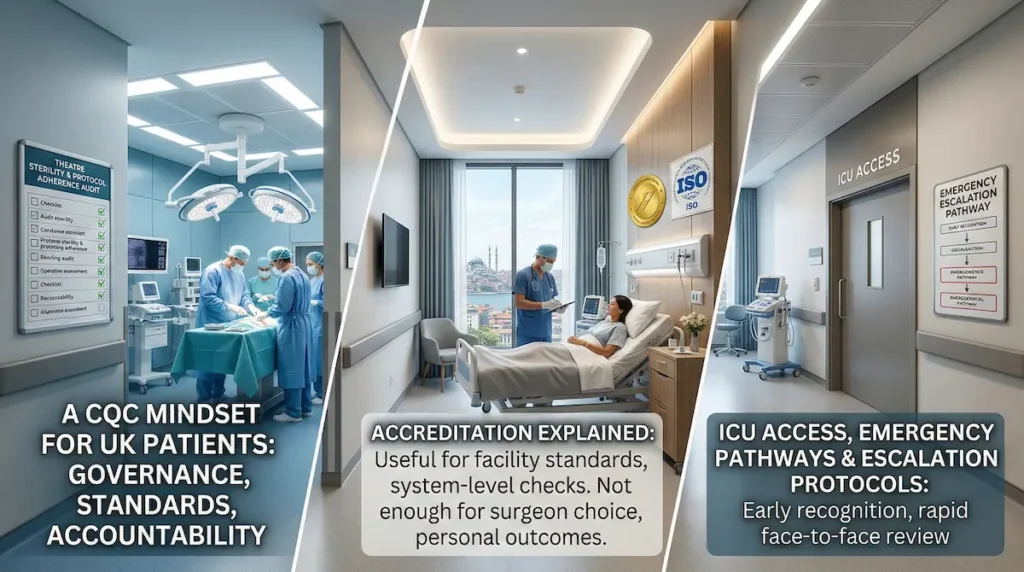
UK patients often think in “CQC terms”: governance, standards, accountability, and measurable safety processes. When considering safe surgery abroad from the UK, you can carry that mindset with you — even if the systems are organised differently. What matters is whether the clinic and hospital demonstrate consistent, documented standards rather than vague reassurance.
Operating theatre sterility protocols and audit culture
A safe surgical pathway depends on repeatable processes: sterile technique, theatre discipline, correct instrument handling, and robust cleaning protocols. In scientific research on surgical site infection, consistent protocol adherence is a major factor in lowering infection rates. You don’t need to be a clinician to ask sensible questions:
- Where exactly will surgery take place: a hospital operating theatre or a non-hospital setting?
- Who is responsible for infection control policies and compliance?
- How are wounds checked in the first 72 hours and during the first 14 days?
If you are planning travel to Turkey for surgery, your goal is a provider who can explain their processes calmly and clearly.
Accreditation explained (what it does and doesn’t prove)
Accreditation can be a helpful signal — but it should not replace surgeon verification and aftercare quality. Accreditation may indicate that systems have been assessed against a standard, but it does not automatically prove that your individual surgeon is the right match for your anatomy, goals, and medical history. Use accreditation as a supporting factor in your decision.
- Useful for: governance signals, facility standards, system-level checks.
- Not enough for: choosing the right surgeon, predicting your specific outcome, ensuring strong aftercare.
ICU access, emergency pathways, and escalation protocols
Even when surgery is elective, safe systems plan for the unexpected. The most reassuring clinics are those that can describe their escalation pathway without drama: who reviews you, where you go if you need additional monitoring, and how quickly that happens. This matters for cosmetic surgery abroad safety because early recognition and escalation can prevent a minor issue from becoming a serious one.
- Ask what happens if you develop significant bleeding, shortness of breath, or fever.
- Ask whether there is access to higher-level monitoring if clinically needed.
- Ask how quickly you can be reviewed face-to-face after discharge.
The Biggest Risks UK Patients Overlook (And How to Reduce Them)
Many people focus on the headline fear — “Will it go wrong?” — but overlook practical risk multipliers such as flight timing, dehydration, reduced mobility, and insufficient follow-up. If your search includes can I travel to Turkey for surgery, the most honest answer is: yes, many do — but safer outcomes come from risk-aware planning.
DVT risk, mobility, hydration, and flight timing
Long flights and reduced movement can increase clot risk, particularly after procedures that limit mobility. Your clinic should give you personalised advice based on your procedure, your health profile, and your travel plan. You can reduce risk by:
- Following mobilisation guidance as soon as it is safe to do so.
- Staying well hydrated and avoiding alcohol around travel time.
- Wearing compression garments if advised (and understanding when they should be worn).
- Not rushing your flight home purely for convenience.
Oedema, bruising, and why “recovery hotels” aren’t clinical care
Swelling (oedema) and bruising are normal parts of recovery — but they can hide early complications if nobody is checking you properly. A “nice hotel” is not aftercare. Aftercare for UK patients in Istanbul should involve structured reviews, not just comfort. Ask who checks wounds, how often, and what triggers an urgent review.
Infection prevention: antibiotics aren’t the whole answer
Antibiotics can be part of prevention, but they are not a substitute for sterile technique, good wound care, and early review. Infection risk is lowered through consistent systems — theatre discipline, clean dressings, correct instructions, and timely follow-ups. This is a practical example of how medical science translates into safer real-world outcomes.
Revision risk: why “fixing it back in the UK” is not straightforward
Some patients assume that if anything goes wrong, they can “sort it out” easily once they return. In reality, revision surgery is complex, and UK-based private revision can be expensive and hard to schedule quickly. NHS support for complications is focused on medical necessity, not cosmetic refinement. This is why safe surgery abroad from the UK means choosing a provider with a clear revision and complication pathway from day one.
Travel Safety for Surgery: Flights, Timing, and Practical UK Planning
For patients planning travel to Turkey for surgery, travel logistics are part of clinical safety. Your trip plan should match the realities of swelling, fatigue, and mobility limitations. A safe clinic will advise against unrealistic timelines and will help you plan a sensible stay in Istanbul.
Direct flights, support, and what to arrange before you travel
Before you fly, you should have:
- A written itinerary including consultation, surgery day, and post-op reviews.
- Named contacts for clinical questions (not only a sales coordinator).
- Your medication list (include allergies), and any relevant GP letters if you have conditions.
- Plans for assistance at the airport if you will be moving slowly or carrying restrictions.
When you can safely fly after different procedures (principles, not promises)
There is no one-size-fits-all answer to “how soon can I fly?” because it depends on your procedure, your medical profile, and how your body heals. What matters is that you are clinically stable, mobile enough to reduce clot risk, and that your wounds and swelling are being reviewed. If a provider gives you a fixed “fly in X days” promise without nuance, treat it as a warning sign.
What to pack for a medically safer return journey
If you are asking can I travel to Turkey for plastic surgery, pack for safety, not just comfort:
- All prescribed medications with labels and a simple schedule.
- Compression garments (if advised) and spare dressings as instructed.
- Water, easy snacks, and a plan for regular gentle movement during travel.
- Your discharge summary and operative notes (digital copies too).

What “Good Aftercare” Looks Like for British Patients (Before You Book)
Aftercare is where many UK patients feel the difference between a high-standard clinic and a high-marketing clinic. If your priority is cosmetic surgery abroad safety, treat aftercare as a core selection criterion. The best providers will show you a structured plan that continues after you return home, with clear response times and escalation routes.
The first 72 hours: what should be monitored and by whom
The first few days are when early bleeding, infection signs, or excessive swelling can appear. You should expect monitored recovery, a clear pain-control plan, wound checks, and easy access to clinical review if symptoms change.
The first 14 days: dressings, drains, follow-ups, and documentation
You should know exactly when dressings are changed, how drains (if used) are managed, and what normal recovery looks like versus warning signs. A safe clinic provides written instructions and demonstrates them (not just verbal advice).
Long-term support (weeks to months): remote checks, response times, continuity
Good aftercare continues after you return to the UK. Look for a clinic that provides remote reviews, clear photo guidance, and timely clinical feedback. This supports safer healing and reduces anxiety — a key concern for British patients.
UK-based patient contact point and why it reduces anxiety
Having a reliable point of contact who understands UK expectations and communication style can make a significant difference, especially if you have concerns once you are back home. This is an important element of aftercare for UK patients in Istanbul and beyond — continuity matters.
Cost vs Safety: What UK Patients Should Compare (Not Just the Headline Price)
Cost is part of the conversation, but it should never be the whole conversation. If you’re comparing the UK to Turkey, compare what drives safety: surgeon verification, theatre standards, anaesthesia governance, aftercare, and the complication pathway. This approach supports safe surgery abroad from the UK without falling into “cheapest wins” thinking.
What “all-inclusive” should include (and common hidden extras)
Ask what is included in writing. Common “extras” that should be clarified include: blood tests, compression garments, extra nights if needed, additional medication, and unforeseen aftercare support.
Why Harley Street prices are higher: overheads vs clinical value
Harley Street pricing often reflects overheads, staffing structures, and insurance models — but that doesn’t mean every lower-cost option is unsafe. The question is whether the provider delivers equivalent clinical governance and aftercare for your specific procedure and health profile.
A simple comparison framework in GBP (£): value without cutting corners
| What to Compare | UK Private (Typical Questions) | Turkey Option (What to Ask for Safety) |
|---|---|---|
| Surgeon verification | Clear registration + speciality | Full name, registration details, scope, procedure volume |
| Facility standard | Governance + audited processes | Hospital/theatre details, infection control, escalation pathway |
| Anaesthesia | Anaesthetist-led plan | Who delivers anaesthesia, monitoring, recovery protocols |
| Aftercare | Local follow-ups | Written schedule in Istanbul + remote UK follow-up plan |
| Documentation | Discharge summary, notes | Operative notes, medication list, wound instructions, contact pathway |

Medical Negligence Protection: What UK Patients Should Think About Before Travelling
It’s reasonable to worry about medical negligence protection Turkey, especially when you are making decisions outside UK systems. Rather than relying on fear or assumptions, ask practical questions that increase accountability and clarity.
Documentation is your first layer of protection
Request and keep digital copies of your:
- Pre-operative assessment summary
- Consent documentation
- Operative report
- Discharge summary
- Medication list and wound-care instructions
Ask for a formal complaints and escalation pathway
A reputable provider should be able to explain how complaints are handled, who reviews them, and what the response timeframe is. Avoid clinics that treat questions about accountability as “negativity”.
Plan for UK-based medical support if needed
If you experience worrying symptoms after returning, you should seek medical assessment in the UK. Good clinics support this by advising you what to look for and providing documentation that helps UK clinicians understand what was done. This is a practical, safety-first approach that supports cosmetic surgery abroad safety.
Frequently Asked Questions (FAQ): Is It Safe to Travel to Turkey for Surgery
These quick answers address common UK searches and concerns about travel to Turkey for surgery and safety.
Is it safe to travel to Turkey for cosmetic surgery as a UK patient?
It can be, provided you choose a properly verified surgeon, a facility with strong theatre standards, a clear anaesthesia plan, and structured aftercare — including support once you are back in the UK.
What are the biggest red flags when choosing a clinic abroad?
No named surgeon, pressure tactics, vague credentials, unrealistic guarantees, unclear anaesthesia provision, and weak aftercare or complication pathways.
How can I verify a surgeon’s credentials in Turkey?
Ask for full legal name, speciality, registration details, and traceable training and memberships, then cross-check via official channels. If documentation is unclear, do not proceed.
Should I prioritise hospital accreditation when booking?
Accreditation can be a helpful signal, but it does not replace surgeon verification and aftercare quality. Treat it as one part of a broader safety assessment.
What questions should I ask about anaesthesia and the anaesthetist?
Who delivers anaesthesia, what pre-assessment is done, what monitoring is used, and what recovery protocols are in place — plus how pain and nausea are managed.
How long should I stay in Istanbul before flying home?
It depends on the procedure and your recovery. Avoid providers who promise a fixed flight date without assessing your individual risks and healing progress.
What are signs of complications I must not ignore?
Worsening pain, fever, increasing redness, foul-smelling discharge, shortness of breath, chest pain, one-sided leg swelling, or sudden bleeding require urgent medical assessment.
What does proper aftercare look like for British patients once I’m back in the UK?
Remote follow-ups with clear response times, guidance on what is normal vs concerning, and the ability to escalate to clinical review quickly if symptoms change.
Can the NHS treat complications if surgery was done abroad?
The NHS prioritises clinically necessary care. If you have concerning symptoms, you should seek assessment promptly. Cosmetic refinements and revisions are a separate issue.
How do I compare UK private clinics vs Turkey safely beyond price?
Compare surgeon verification, facility standards, anaesthesia governance, documented aftercare, escalation pathways, and the quality of documentation you’ll receive.
Medical Disclaimer: This page is provided for general educational purposes only and does not replace a face-to-face medical consultation, diagnosis, or personalised treatment plan. All surgery carries risks and outcomes vary between individuals. Suitability for a plastic surgery, procedure selection, and anaesthesia choice can only be determined after a full clinical assessment by a qualified surgeon. Always follow your clinician’s instructions and seek urgent medical attention if you develop concerning symptoms during recovery.