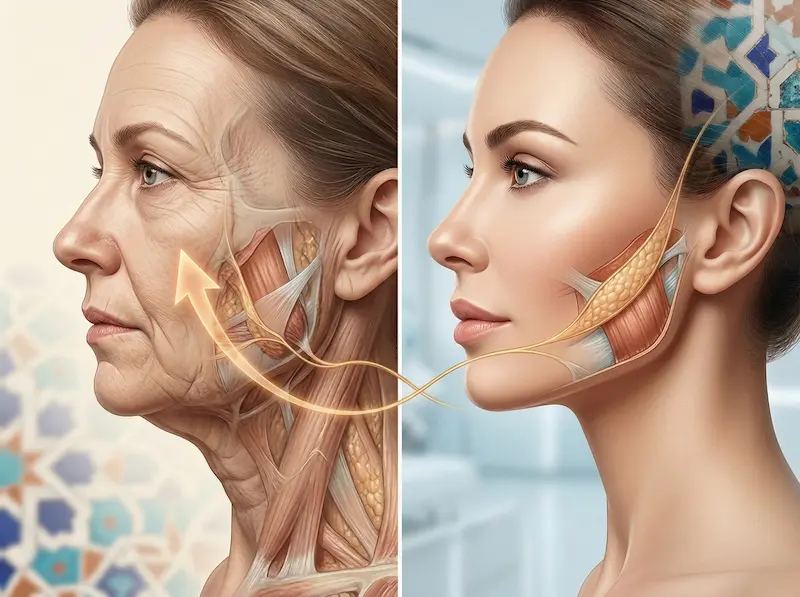
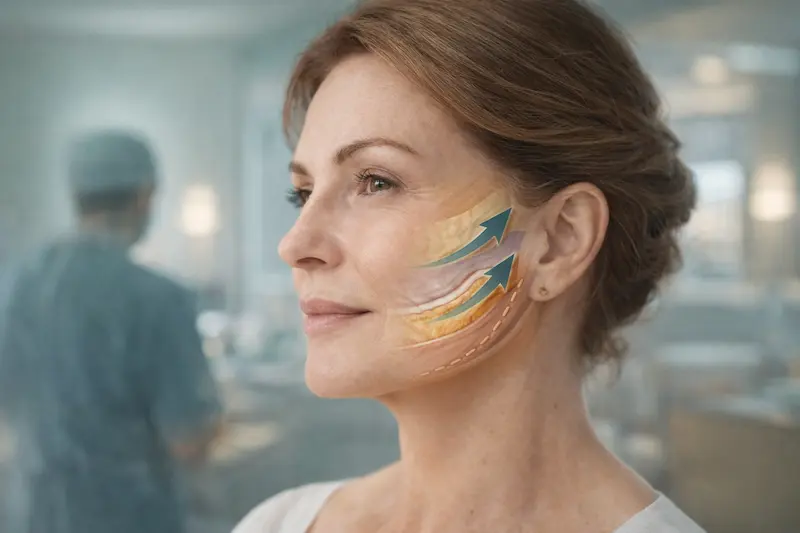
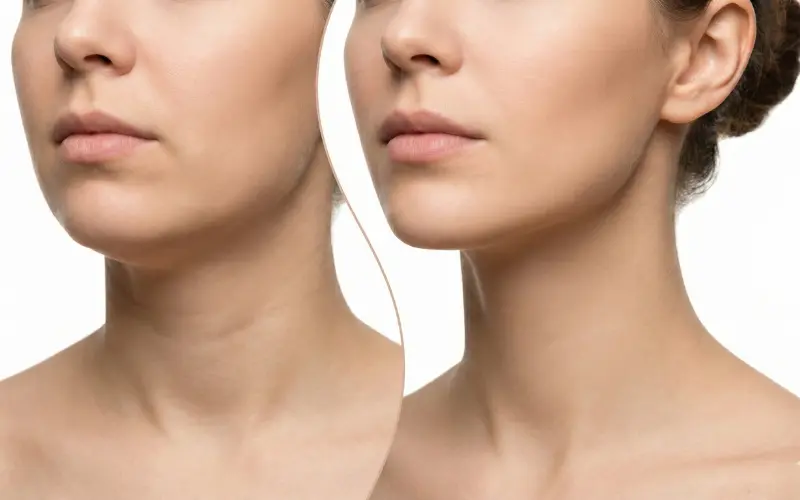
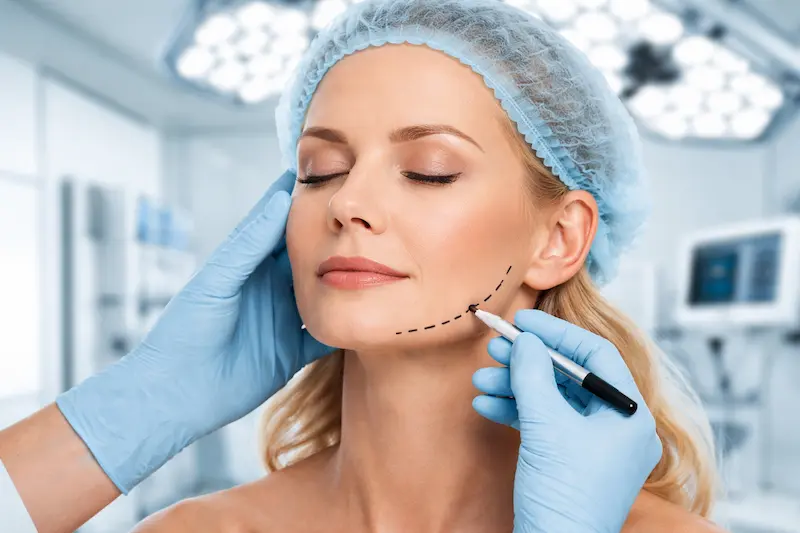
If you are searching deep plane facelift before after, you are likely trying to answer one very British question: “Will I look refreshed… or will it look obvious?” The best deep plane facelift before and after comparisons are not about chasing a different face — they are about restoring shape in a way that still looks like you, just more rested.
In this guide, we’ll break down how to interpret deep plane facelift before and after photos like an “expert patient”, what “natural” versus “dramatic” really means in real life, and how healing stages (especially oedema) can make early images misleading. Where helpful, we’ll reference principles from medical science and the practical realities of recovery that UK patients care about.
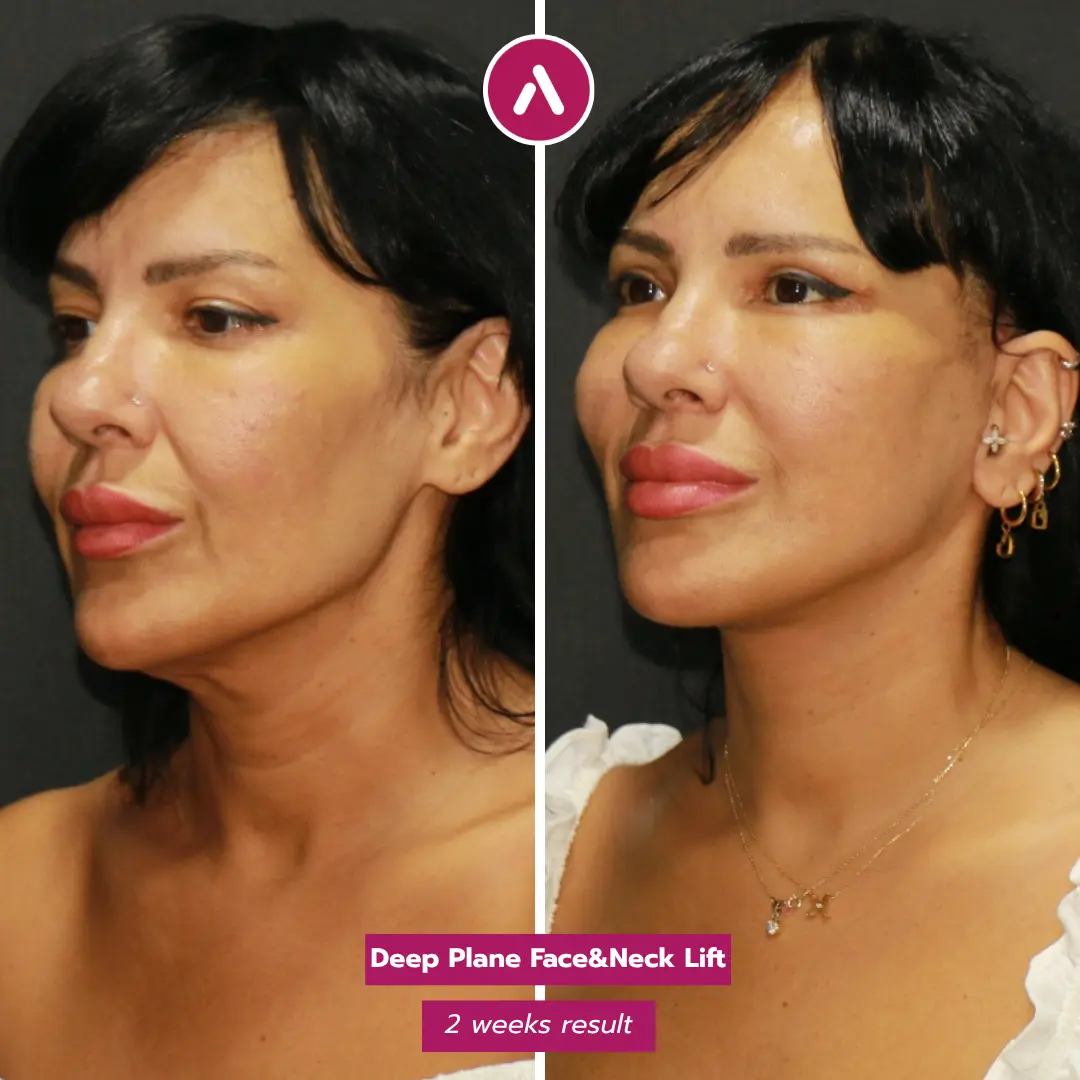
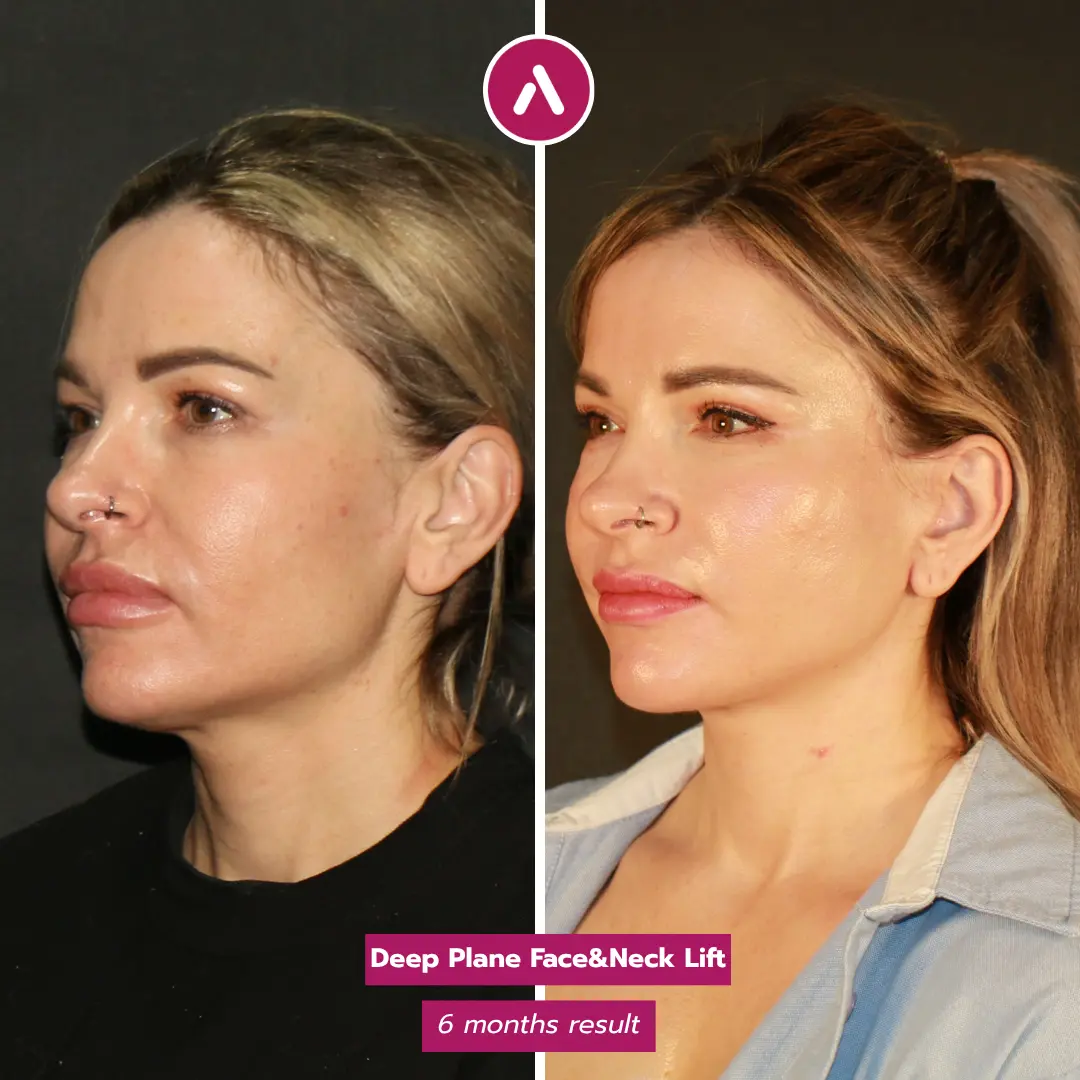
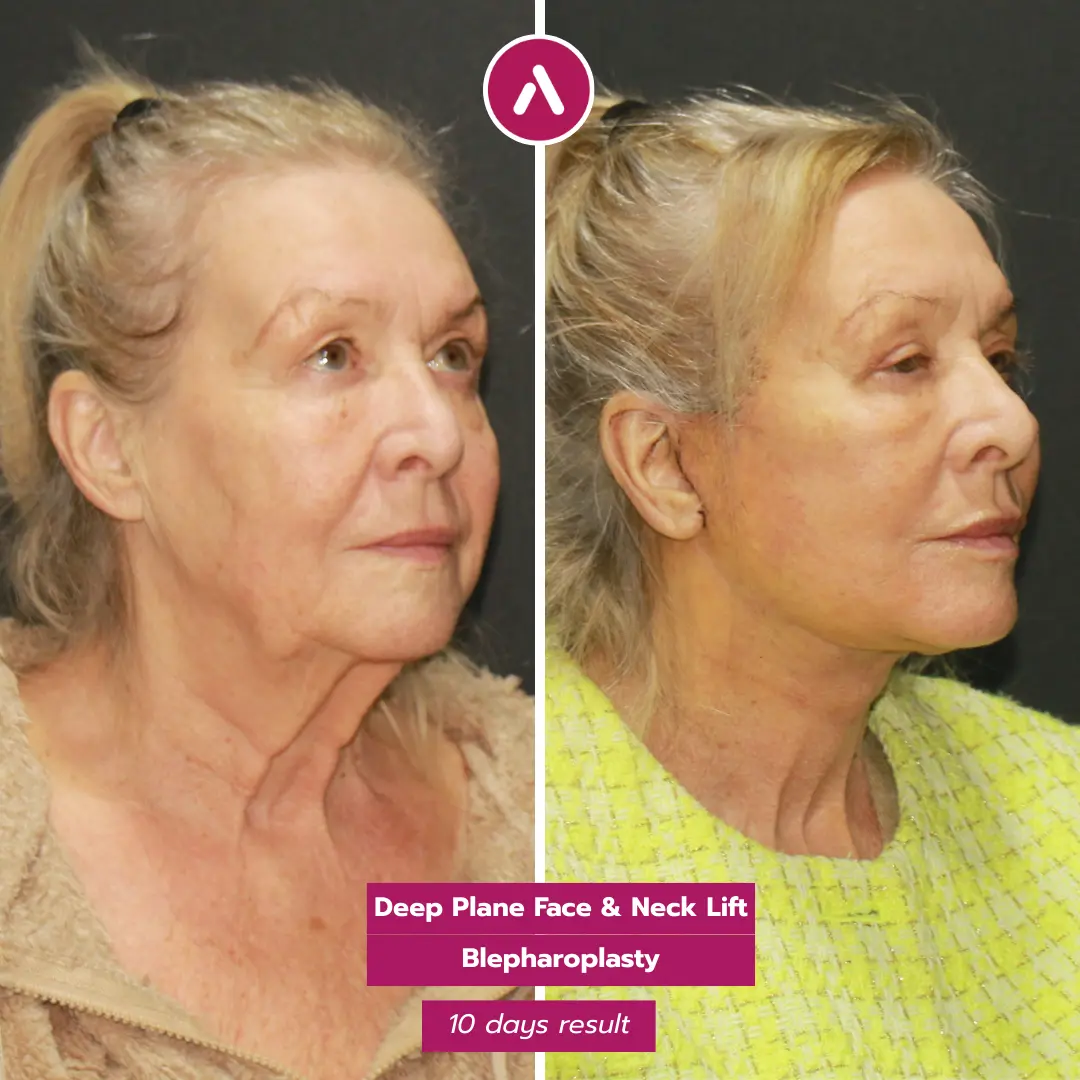
Quick note on galleries: a deep plane facelift before after gallery should show consistent angles and lighting. If you’re comparing before and after deep plane facelift images from different clinics (including deep plane facelift Turkey before after searches), always check whether the photos are taken under the same conditions.
Table of Contents
What a Natural Result Looks Like (The UK Standard)
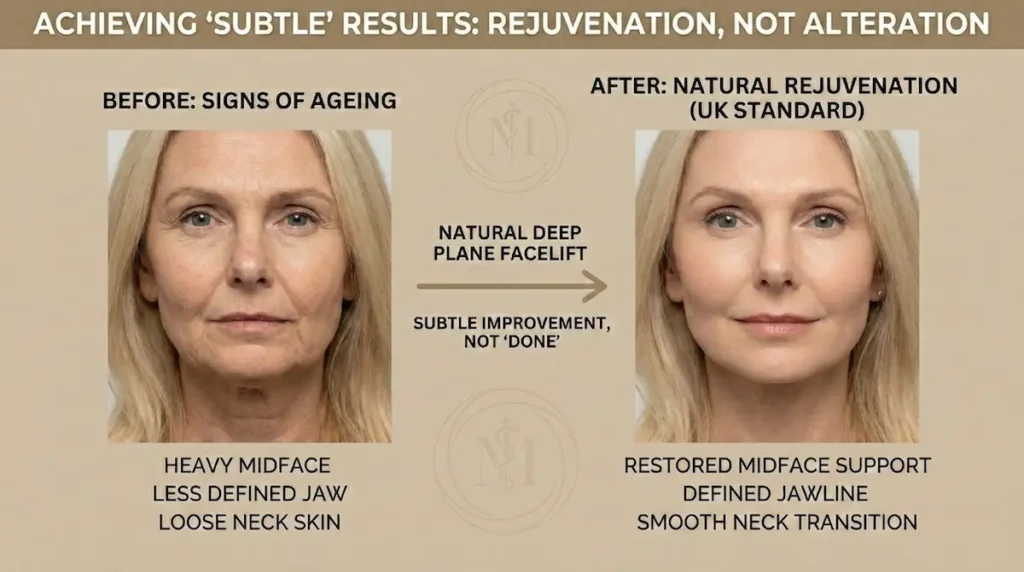
For most UK patients, “natural” means people notice you look well — not “done”. A natural outcome is less about aggressive tightness and more about restoring structure: soft midface support, a cleaner jawline, and a smooth neck transition. In other words, it’s a result that fits your features and your age, without changing your identity.
“Rejuvenation, not alteration” — what UK patients mean by subtle
A subtle result typically improves signs of ageing without creating sharp, artificial lines. The goal is to look like a healthier, better-rested version of yourself. When reviewing deep plane facelift before and after results, look for improvement in contour and heaviness rather than a “pulled-back” look.
Proportions first: midface support, jawline definition, and a smooth neck transition
The most convincing “natural” transformations usually involve balanced changes across the face:
- Midface: a gentle lift that restores where the cheek sits, rather than an overfilled or over-tightened appearance (some patients compare this to a midface lift before after effect).
- Jawline: improved clarity without looking “carved”. The aim is refined, not harsh — think jawline definition before after facelift that still moves naturally.
- Neck-to-jaw transition: a continuous line from the ear to the chin area without abrupt tension.
How to read before-and-after photos: refreshed, not “tight”
When scanning deep plane facelift before and after photos, focus on these practical cues:
- Mouth corners: they should look relaxed, not stretched.
- Ear/cheek junction: no visible distortion around the ear.
- Overall harmony: the face should look consistent from front and 45-degree views — not just in a single “hero angle”.
Signs of an Overdone Facelift and How We Avoid It
“Overdone” results are rarely what a patient asked for — they usually happen when the technique, vector, and skin tension don’t match the individual face. One of the most common UK concerns is the fear of looking “windswept” or surgically obvious. Understanding the warning signs helps you evaluate galleries more safely and ask better questions in consultation.
The “wind-swept/pulled” look — why it happens
An unnatural result often comes from relying too heavily on skin tightening rather than deeper structural support. If the pull is primarily lateral (towards the ears) instead of a balanced lift, it can create that tell-tale “pulled” look. This is exactly why early photo impressions can be misleading: swelling, tight dressings, and oedema can temporarily exaggerate tension.
Hairline distortion and ear-related tell-tales: when photos raise red flags
When reviewing deep plane facelift before and after images, watch for:
- Hairline changes: the sideburn area and hairline should not look displaced.
- Ear shape cues: the ear should sit naturally without visible “tethering”.
- Scar visibility in posed photos: if every image avoids showing the ear/hairline area, ask why.
Planning and vector control: why “skin-only” tightening can look unnatural
From a practical standpoint, a more natural outcome is typically achieved when the plan prioritises support and contour rather than simply making the skin feel tight. In consultation, it’s reasonable to ask how the surgeon plans to preserve a natural hairline, avoid over-tension, and manage swelling so the result settles gradually (a key principle of patient-centred aesthetic planning).
Deep Plane Technique and Result Longevity
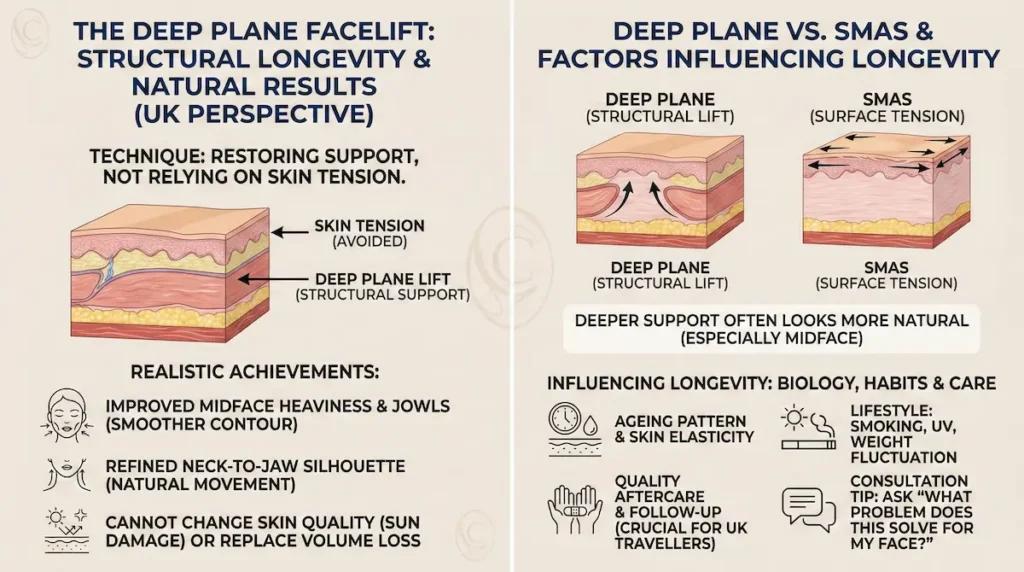
If you are comparing deep plane facelift before and after results, it helps to understand what “deep plane” is aiming to achieve. In simple terms, the technique is designed to restore facial support rather than relying on skin tension alone. That matters because many of the “unnatural” outcomes people worry about are linked to how (and where) tension is applied.
What a deep plane facelift can (and cannot) realistically achieve
A deep plane facelift is commonly associated with improvements in:
- Midface heaviness: a more supported cheek and smoother transition under the eyes (often what patients mean when they search midface lift before after).
- Lower face and jowls: clearer contour without harsh tightness.
- Neck-to-jawline refinement: a cleaner silhouette that still moves naturally.
What it cannot do on its own is change skin quality (sun damage, fine creasing) or replace volume where true volume loss exists. If a gallery suggests it “erases everything”, treat that as marketing rather than reality.
Deep Plane vs SMAS: why deeper support can look more natural in selected faces
Patients often ask whether “deep plane” is always better. The honest answer is: the best option is the one matched to your anatomy and goals. However, when you look at a strong before and after deep plane facelift comparison, you’ll often see that the improvement is “structural” (shape and support) rather than “surface tightness”. This is one reason the result can read as more natural — especially in the midface and around the mouth corners.
Good consultations are grounded in scientific research and clinical judgement, not one-size-fits-all promises. If you want to sanity-check a clinic’s claims, ask what problem the technique is intended to solve for your face, and what trade-offs the surgeon is trying to avoid.
What influences longevity: age, skin quality, lifestyle, and aftercare
Longevity is not just about technique — it is also about biology and habits. The same operation can “last” differently depending on:
- Skin elasticity: higher elasticity typically settles more smoothly.
- Ageing pattern: some faces descend more in the midface; others develop stronger jowling.
- Lifestyle: smoking, major weight fluctuation, and UV exposure can reduce the “fresh” look sooner.
- Aftercare quality: consistent follow-up and scar care can improve the final polish of results.
For UK patients travelling for surgery, aftercare planning matters as much as the operation itself — particularly if you’re trying to coordinate return flights and public-facing commitments.
Before/After Timeline: 1 Week – 3 Months – 1 Year (Oedema Resolution)
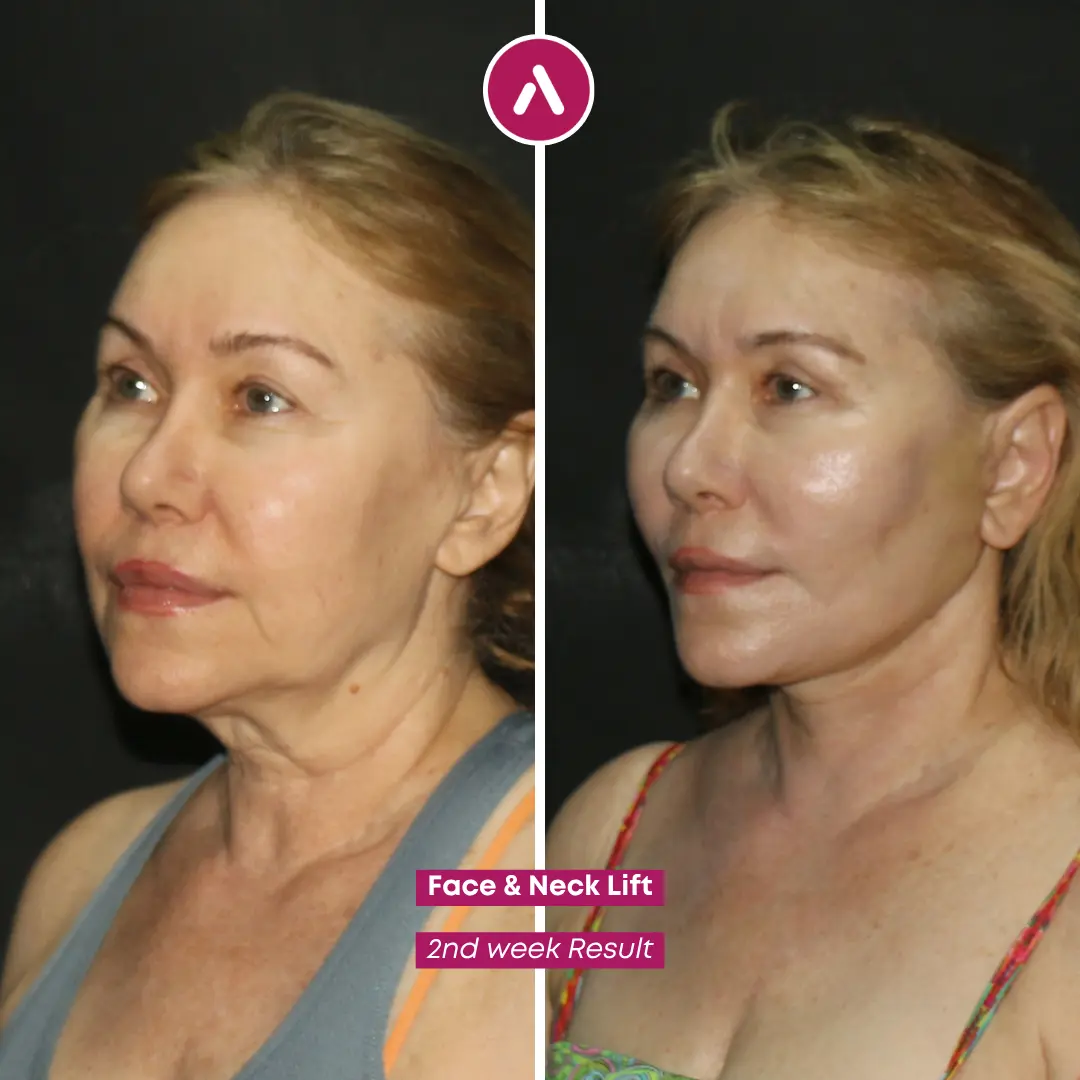
Many “early” photos you see online are taken when swelling (oedema) is still a major factor. That’s why a deep plane facelift before and after photos set should ideally show multiple time points — not just “before” and “two weeks after”. Below is a practical timeline to help you interpret a deep plane facelift before after gallery more accurately.
Week 1: oedema, bruising, and temporary asymmetry — what’s normal
In the first week, swelling and bruising are expected. Photos can look “tight” or uneven, and this can be alarming if you are not prepared for it. A key point from medical science is that early tissue fluid shifts and inflammation can temporarily distort contour — this is not the final result.
- Common: puffiness, tightness, colour changes, uneven swelling side-to-side.
- Not helpful for judging: jawline sharpness or midface “softness” in close-up photos.
Weeks 4–12: when you typically look “presentable” in everyday life
This is when many patients start to feel comfortable in normal social settings. Swelling reduces, the face looks less “operated on”, and improvements become easier to evaluate. If you’re tracking jawline definition before after facelift, this window often gives a more honest impression than very early images.
Supportive recovery approaches may also matter here. Some clinics use adjunctive modalities such as HBOT (Hyperbaric Oxygen Therapy) and LLLT (Low-Level Laser Therapy) as part of a structured aftercare pathway, aiming to support comfort, bruising resolution, and tissue healing.
Months 6–12: scar maturation and the final contour reveal
Between 6 and 12 months, scars typically mature and soften, and the result becomes more stable. This is the stage where “natural vs dramatic” is easiest to judge because the face has settled and movement looks more normal. If a clinic can show longer-term follow-ups in their deep plane facelift Turkey before after galleries, it’s a stronger quality signal than short-term “quick wins”.
How to Judge Before/After Photos Like an Expert Patient (Angle, Lighting, Expression)
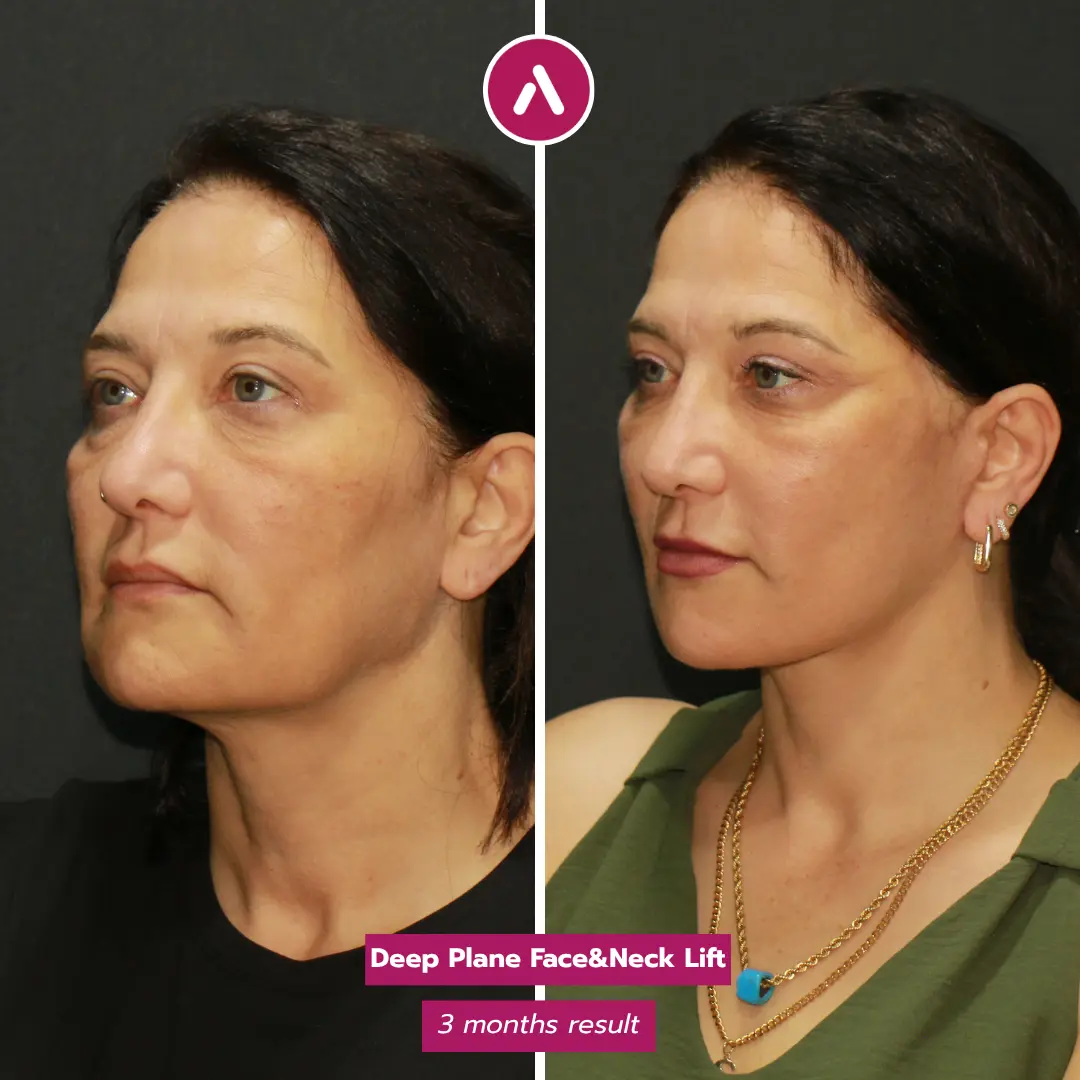
If you are reviewing deep plane facelift before and after photos, your biggest risk is making a judgement from an unfair comparison. The best deep plane facelift before and after galleries are consistent, transparent, and show the same face under the same conditions. Below is a practical checklist to help you read a deep plane facelift before after gallery without being misled by photography choices.
The “fair comparison” rule: same angle, same lighting, same distance
A trustworthy deep plane facelift before and after photos set should follow these basics:
- Angle: front view and the same 45-degree angle on both sides (not one side only).
- Lighting: similar brightness and direction (side lighting can exaggerate jowls pre-op and “flatten” them post-op).
- Distance & lens: close-up wide lenses can distort the midface and jawline; consistent distance matters.
- Time-point labelling: the result should state roughly when the “after” photo was taken (e.g., 6 weeks vs 6 months).
If the “after” is always taken in flattering soft light but the “before” is harshly lit, treat the gallery as advertising rather than evidence-based presentation.
Common photo tricks: chin position, facial expression, hair coverage, and neck posture
Even honest patients can accidentally “pose” their best angle. Clinics can also present images in a way that amplifies change. Watch out for:
- Chin jutting: pushing the chin forward can sharpen the jawline and reduce neck fullness.
- Neck extension: lifting the chin changes the neck contour dramatically in photos.
- Expression changes: a slight smile lifts the midface; a neutral or frowning face can make the “before” look heavier.
- Hair styling: hair can conceal the hairline, temples, and the critical ear–cheek junction where signs of over-tension show.
This is especially important if you are comparing deep plane facelift before and after results across different clinics. The photos should not “do the surgery’s job”.
What to look for beyond the jawline: midface softness, mouth corners, and a natural ear–cheek junction
Many people fixate on jawline definition before after facelift, but naturalness is often decided elsewhere:
- Midface: does the cheek look supported without looking stretched? This is where a subtle midface lift before after effect may be noticeable.
- Mouth corners: should look relaxed, not “pulled back”.
- Ear area: the ear should sit naturally without distortion; the skin around it shouldn’t look tethered.
If possible, ask whether the clinic can show longer-term images. “Dramatic” results can look impressive early on, but the most credible outcomes are those that remain natural once oedema has fully settled.
Who Is a Good Candidate for “Natural” vs “Dramatic” Outcomes? (Goal-Setting for UK Patients)
“Natural” and “dramatic” are not just styles — they reflect your anatomy, your starting point, and your goals. The most satisfied UK patients usually have clear priorities and understand trade-offs. If your search includes deep plane facelift Turkey before after, it’s even more important to set expectations clearly before you travel, because you want your plan confirmed in consultation — not decided on the day of surgery.
Best candidates for subtle outcomes: skin quality, facial shape, and ageing pattern
Subtle results tend to suit patients who want to look like themselves — just less tired — and whose main issues are facial descent rather than major volume loss. Common profiles include:
- Midface descent: heaviness around the cheeks and nasolabial area that benefits from structural support.
- Early-to-moderate jowling: where improved contour looks refined rather than “sharp”.
- Good skin quality: where the skin can re-drape smoothly after deeper support is restored.
In these cases, deep plane facelift before and after comparisons often show a “quiet” improvement — the face looks calmer and lighter, not dramatically different.
When patients ask for dramatic change: the trade-offs and the “overdone” risk
Some patients genuinely want a stronger change — for example, a very defined lower face or a major shift from a heavy neck/jaw profile. However, the more “dramatic” the aim, the more carefully it must be managed to avoid an obvious result. Trade-offs can include:
- Higher risk of visible tension: especially if skin-only tightening is relied upon.
- Photography bias: dramatic early results may be amplified by swelling patterns and “tight” early contours.
- Style mismatch: a very sculpted look can feel out of character for many UK patients who prefer subtlety.
This is where science meets aesthetics: the best plans are those that respect tissue behaviour over time, including how swelling resolves and scars mature.
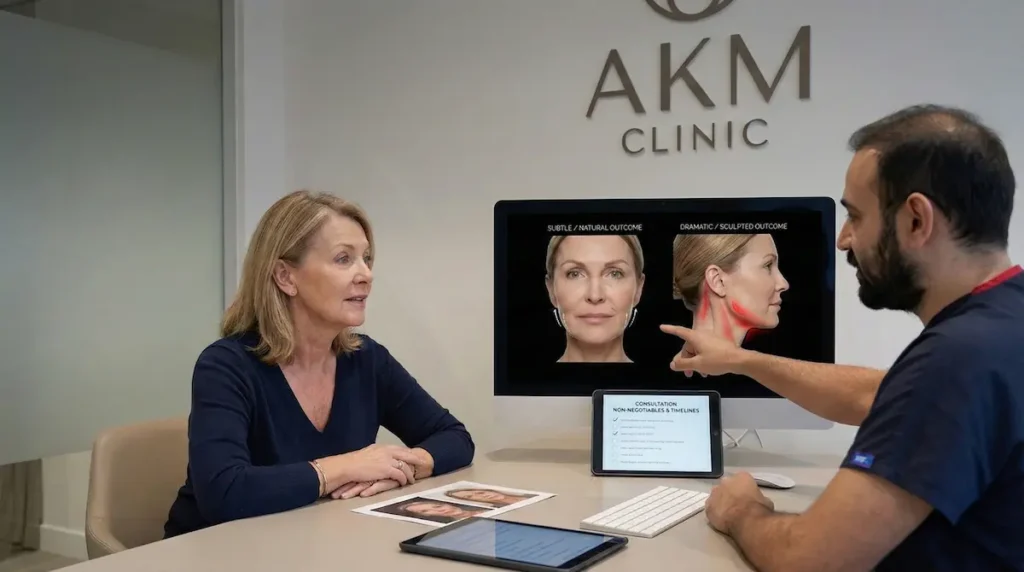
Consultation goal-setting: reference photos, “non-negotiables”, and agreeing a realistic endpoint
To get the result you want — especially when comparing deep plane facelift before and after photos online — arrive at consultation with a simple framework:
- Bring 2–3 reference photos: one you like, one you dislike, and one “close to realistic”.
- Define your non-negotiables: e.g., “no windswept look”, “keep my hairline”, “I still want to look like me”.
- Ask about timelines: when the surgeon expects you to look presentable, and when the result is considered “final”.
- Clarify follow-up: how post-op checks work once you are back in the UK.
A reliable clinic should be comfortable discussing what is achievable, what is risky, and what is simply unrealistic — and should be able to explain their plan in plain English, supported by scientific research and clinical reasoning rather than promises.
Frequently Asked Questions (FAQ): Deep Plane Facelift Before After
Below are concise answers to the most common questions UK patients ask when researching deep plane facelift before and after outcomes and comparing different photo galleries.
What makes a deep plane facelift before/after photo trustworthy?
Consistency: same angles, lighting, distance, neutral expression, and a clearly stated time-point. A reliable deep plane facelift before after gallery shows more than one time-point, not just an early “after”.
What most strongly determines “natural” versus “dramatic” results?
Your starting anatomy, your goals, and how tension/support is managed. Natural results usually prioritise structural support and harmony; dramatic aims increase the need for careful planning to avoid obvious signs.
Which weeks of oedema can make photos misleading?
The first few weeks can be very misleading. Early tightness, swelling and uneven oedema can exaggerate contour and asymmetry, so short-term “after” photos are not a final verdict.
Where are the scars and how visible are they long term?
Scars are typically positioned around natural creases and hair-bearing areas where possible. Visibility varies by skin type and healing; scar maturation continues for months, and long-term photos are the most informative.
How long do results typically look “fresh”?
Longevity varies with age, skin quality, and lifestyle factors (e.g., smoking, weight fluctuation, UV exposure). The aim is a long-term improvement, not a frozen look.
How do UK patients plan recovery and flying home safely?
Plan enough time for early swelling to settle, follow post-op guidance carefully, and ensure you have clear aftercare instructions and a follow-up pathway once you are back in the UK. Your clinic should advise you on timing based on your individual recovery.
What are the 5 most important questions to ask your surgeon?
Which specific concerns in my face are you addressing, and why is this technique suitable?
How will you avoid an overdone or windswept look in my case?
What time-points do you consider “presentable” and “final”, and what swelling is normal?
Where will scars sit, and what is your scar-care plan?
How does aftercare work once I return to the UK?
If you’d like to go beyond the topic covered in this article, you can also explore our related guides on SMAS vs Deep Plane Facelift, How Long Does Deep Plane Facelift Last, and Deep Plane Facelift Recovery to understand technique choices, realistic longevity, and healing milestones. For due diligence and safer decision-making, we also recommend reading about selecting the right Deep Plane Facelift Surgeon, comparing Deep Plane Facelift Cost (UK vs Turkey), and reviewing a step-by-step Deep Plane Facelift Journey so you know what to expect from consultation to flying home. Finally, a real-patient Deep Plane Facelift Story can help you visualise outcomes in everyday life.
Medical Disclaimer: This page is provided for general educational purposes only and does not replace a face-to-face medical consultation, diagnosis, or personalised treatment plan. All surgery carries risks and outcomes vary between individuals. Suitability for a deep plane facelift, procedure selection, and anaesthesia choice can only be determined after a full clinical assessment by a qualified surgeon. Always follow your clinician’s instructions and seek urgent medical attention if you develop concerning symptoms during recovery.