If you’ve found yourself googling is awake facelift painful at 2am, you’re not alone. Many British patients worry about one specific thing before anything else: pain. In this guide, we’ll answer the question in plain English—what you’re likely to feel, what you’re unlikely to feel, and why. We’ll also include what real UK patients commonly report about awake facelift pain level, anxiety, and comfort during recovery.
Because this is a medical procedure, we’ll keep the language evidence-based. Where helpful, we’ll reference how medical science explains pain, swelling (oedema), and why “pressure” can feel very different from “pain”.
Quick reassurance: “Awake” does not mean you feel surgery. An awake (often called “twilight”) facelift is performed with local anaesthesia and light intravenous sedation, aiming for a calm, deeply relaxed experience without the physiological stress of general anaesthesia.
Table of Contents
The Honest Answer: What “Pain” Really Means in an Awake (Twilight) Facelift
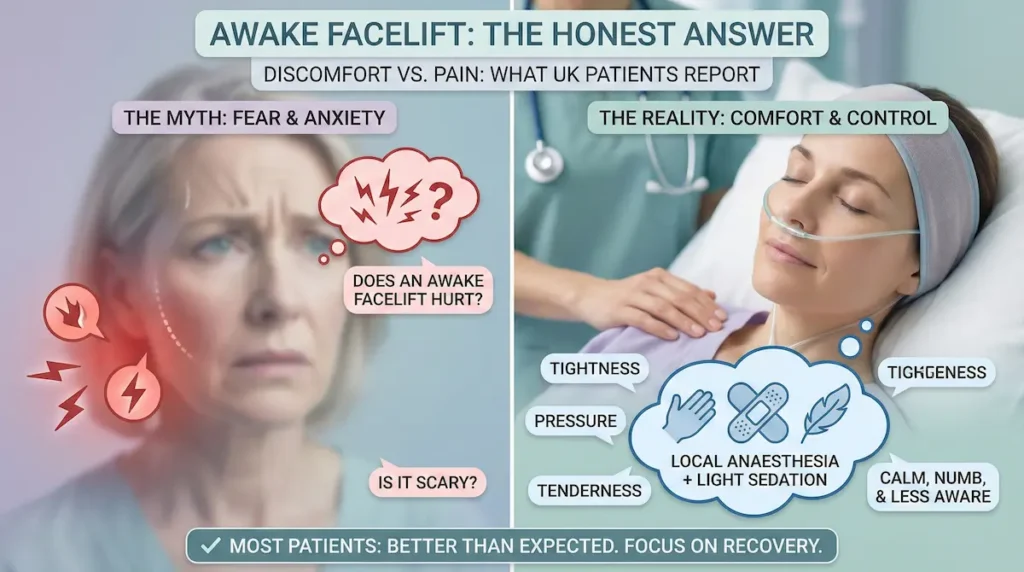
When people ask does an awake facelift hurt, they usually mean one of three things: (1) do you feel anything during the operation, (2) how uncomfortable is the first night, and (3) what is the overall awake facelift recovery pain like day-to-day. The most accurate answer is that most patients describe tightness, pressure, heaviness and tenderness—rather than sharp pain—especially in the early days. Your experience can vary depending on your sensitivity, the extent of surgery, and how your body responds to swelling.
Discomfort vs pain: tightness, pressure, and tenderness explained
After a facelift, the tissues are healing and swelling is expected. From a “pain science” point of view, your nervous system can interpret swelling and bruising as tenderness and pressure. That can feel uncomfortable, but it’s not the same as severe pain. Many patients notice:
- Tightness around the jawline and behind the ears
- Heaviness from oedema (swelling)
- Throbbing or tenderness when moving, bending, or brushing hair
- “Odd sensations” (tingling, numb patches) as nerves settle—usually temporary
Why “awake” doesn’t mean you feel surgery (local anaesthesia + light IV sedation)
In an awake (twilight) facelift, the goal is comfort without full general anaesthesia. Local anaesthetic numbs the surgical area, while light IV sedation helps you feel calm, drowsy, and less aware of time. In practical terms, most people do not “experience” the operation as an event—they remember arriving, feeling relaxed, and then it being over.
What most UK patients report in the first 72 hours (realistic expectations)
The first three days are usually when patients feel the most “aware” of recovery—mainly due to swelling, bruising, and sleep disruption. This is when people most often ask is an awake facelift scary, because anxiety can amplify discomfort. A common UK patient-reported theme is that it felt better than expected once they understood what “normal” feels like.
Sarah (UK patient) noted her recovery was “painless”, requiring minimal paracetamol after facelift care.
How Pain Is Managed During the Procedure (Local Anaesthesia + Twilight Sedation)
This section is designed to reduce uncertainty—because for many patients, “fear of pain” is actually “fear of not being in control”. Understanding the process helps you judge whether the plan matches your personal comfort threshold and what you consider an acceptable awake facelift pain level. In short: pain is prevented (not chased) through local anaesthesia, careful technique, and calm sedation.
Step-by-step: where local anaesthetic is used and what you may notice
Local anaesthetic is used to numb the areas where the facelift is performed. What you may notice (if anything) is usually:
- Initial stinging for a few seconds as the local anaesthetic is introduced
- Pressure or gentle movement (not sharp pain)
- Very limited awareness of detail if sedation is used appropriately
If you are highly anxious, this is important to share in your consultation—so the anaesthesia plan can be tailored for comfort and safety.
Twilight sedation: calm, sleepy, and comfortable—without general anaesthesia
Twilight sedation aims to create a “deeply relaxed” state. Most patients describe it as feeling sleepy and emotionally detached from what’s happening. From a clinical perspective, this can reduce stress responses (which can otherwise worsen perceived discomfort). If you’re asking does an awake facelift hurt “during the operation”, conscious sedation plus local anaesthesia is specifically intended to make the answer “no” for most patients.
Safety and monitoring standards in theatre (what a sceptical UK patient should ask)
A cautious, research-led UK patient should feel comfortable asking about monitoring in the operating theatre, who is responsible for anaesthesia, and what the escalation plan is if you feel anxious or uncomfortable. In any reputable setting, you should expect clear answers about:
- Continuous monitoring (heart rate, oxygen levels, blood pressure)
- Who administers and monitors sedation during the procedure
- How comfort is checked throughout (so adjustments can be made promptly)
Day-by-Day Pain & Comfort Timeline (Day 1 to Day 14)
If you’re trying to work out awake facelift pain level in real life terms, a day-by-day timeline is often more useful than a single “pain score”. In scientific research, pain perception is influenced by swelling, sleep, stress, and expectations—so the same physical recovery can feel very different depending on reassurance and aftercare access. Below is a realistic guide to what many patients describe as “normal” after an awake (twilight) facelift.
Day 1–3: swelling (oedema), bruising, and “heaviness”
These first days are typically the peak for swelling and the period when people most commonly re-check is an awake facelift painful and does an awake facelift hurt. Most patients report discomfort dominated by:
- Heaviness/tightness (more than sharp pain)
- Tenderness around incision areas (often behind/around the ears)
- Bruising and a “stiff” facial feeling
- Sleep disruption (which can make everything feel worse)
What helps: head elevation, calm short walks around your room, hydration, and following your clinical team’s instructions precisely.
Day 4–7: turning the corner—sleep, appetite, and mobility
This is often the “improvement week”. Swelling begins to settle, bruising changes colour, and sleep becomes easier. Many patients say their awake facelift recovery pain becomes more like intermittent tenderness—especially when laughing, yawning, or chewing—rather than constant discomfort.
- Typical feel: occasional tightness, mild soreness, “pulling” sensations
- Common worry: “Is this normal?” as numb patches appear/shift
- Key aim: protect healing tissues (no heavy lifting; follow guidance)
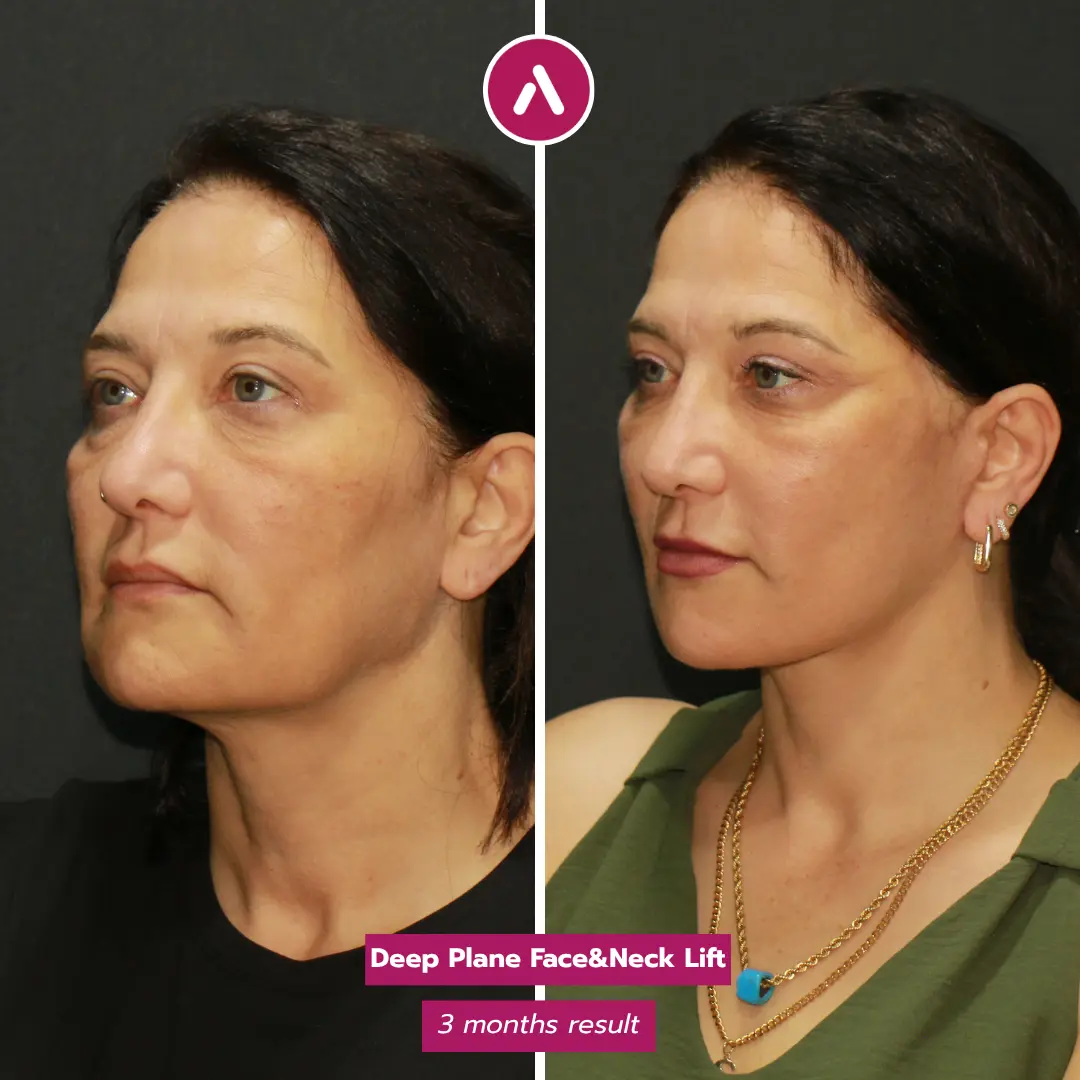
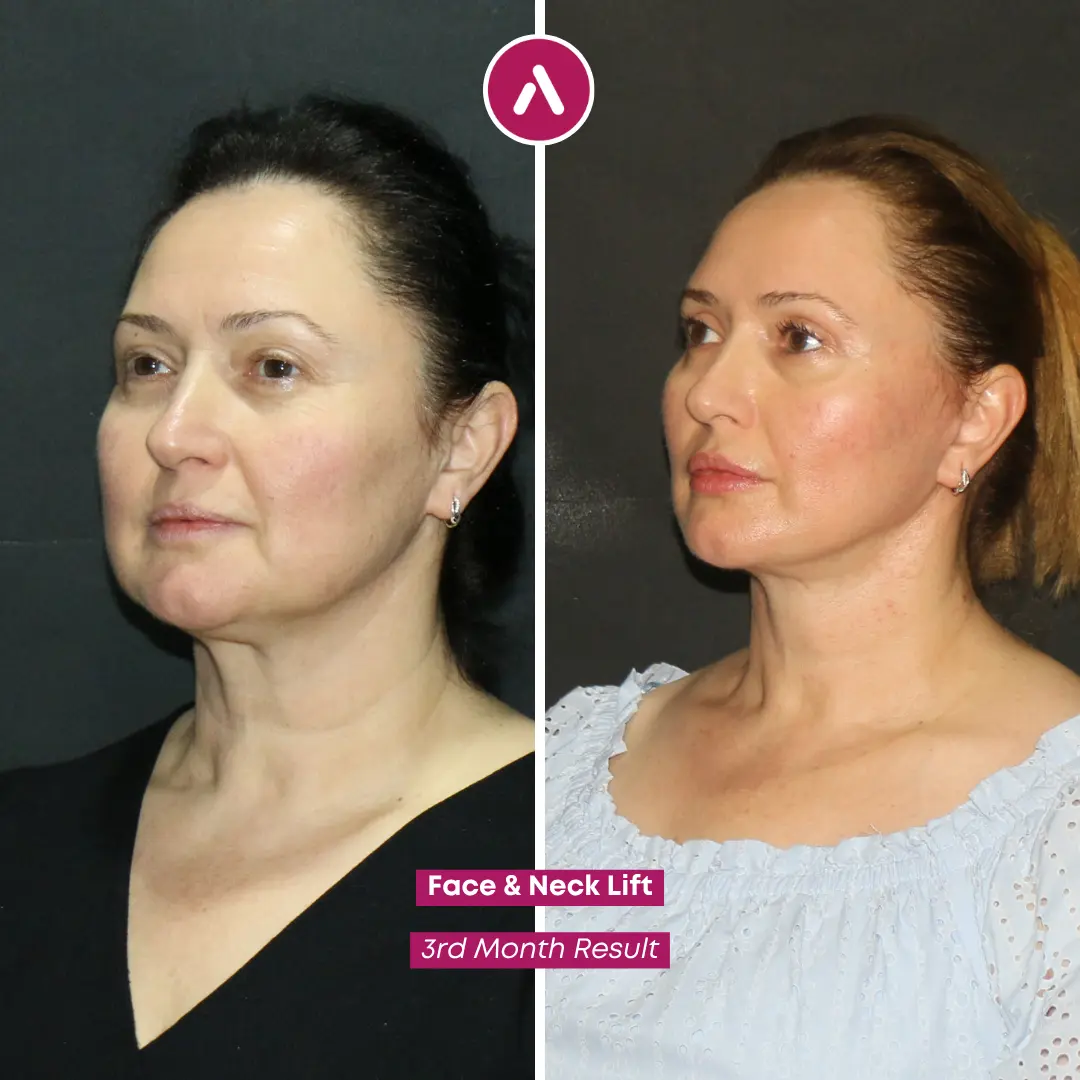
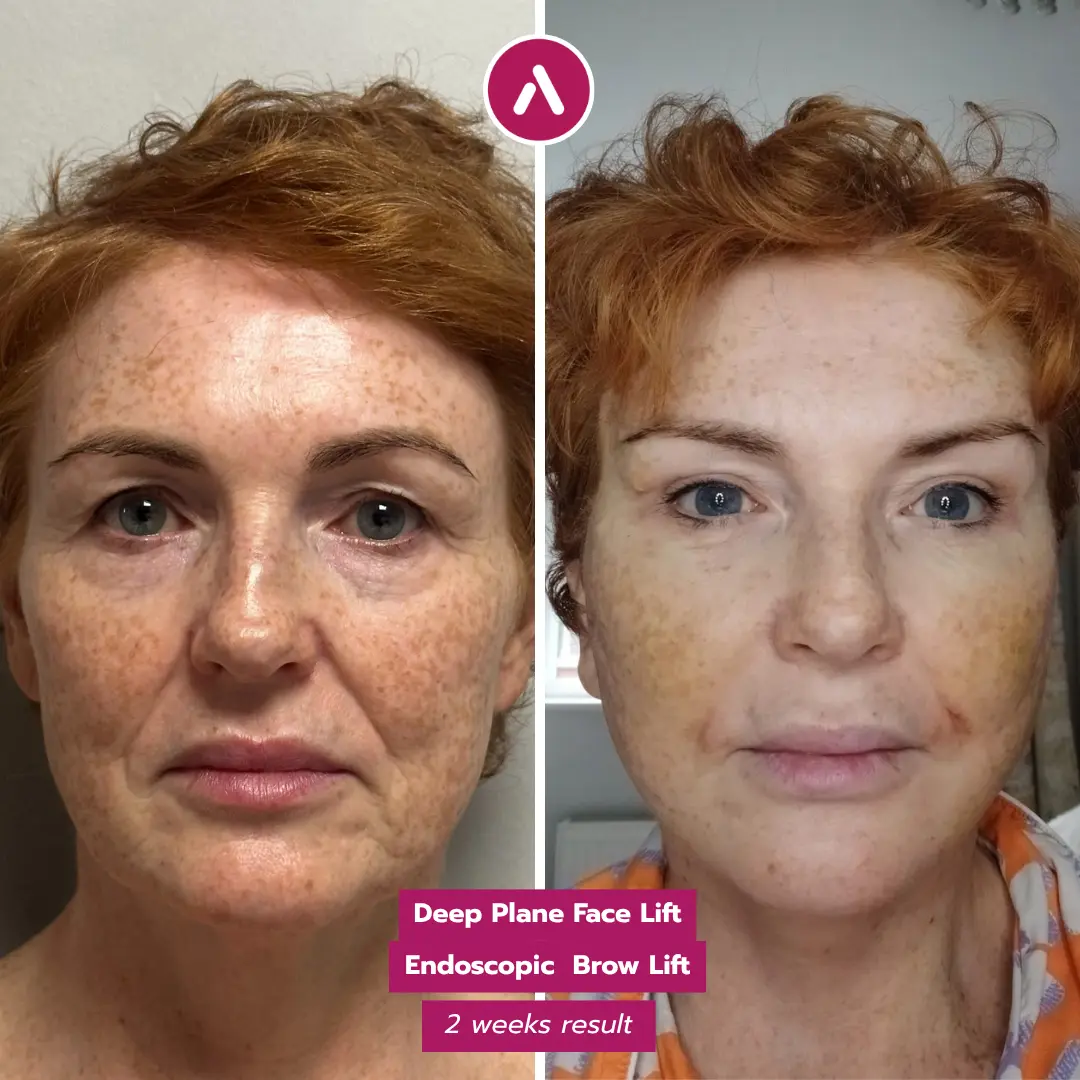
Day 8–14: looking more “public-ready” and managing lingering tenderness
By the second week, many people feel more socially comfortable, although swelling may still be visible in photos and under certain lighting. The dominant sensations tend to be:
- Residual tightness (especially around the jawline/neck)
- Light tenderness when touching or washing hair
- Occasional tingling as nerves settle
For most, the question shifts from “is it painful?” to “how long until it looks natural?”. That’s a healthier framing—and it usually means pain has moved into the background.
| Timepoint | Most common sensations | What typically reassures patients |
|---|---|---|
| Day 1–3 | Heaviness, tightness, bruised tenderness | Understanding that swelling peaks early; good sleep positioning |
| Day 4–7 | Improving comfort, intermittent soreness | Clear aftercare access; normalising “odd” healing sensations |
| Day 8–14 | Lingering tightness; minor tenderness | Visible progress; returning confidence about appearance |
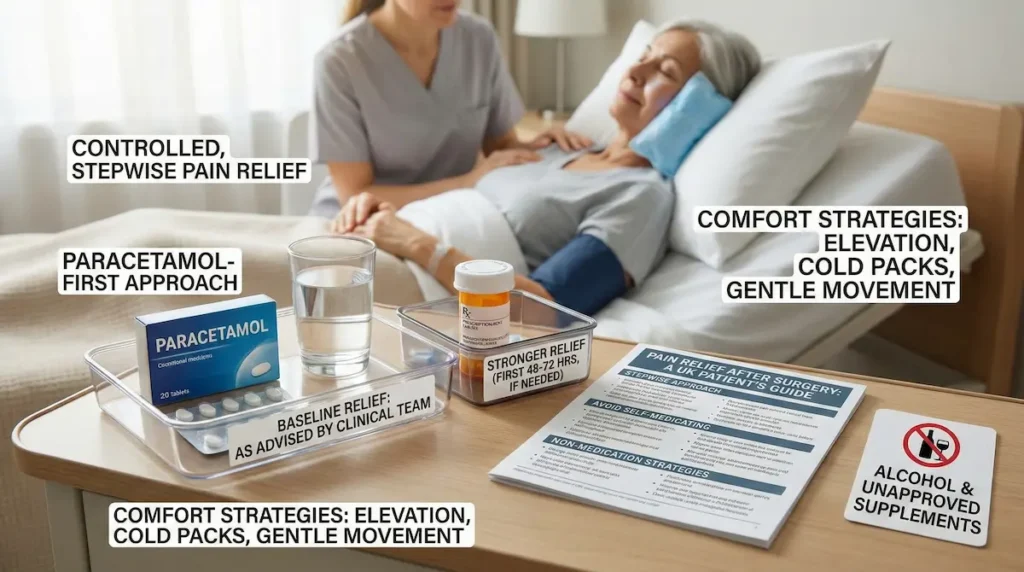
Pain Relief After Surgery: What UK Patients Typically Use
Most British patients want to know exactly what they’ll be taking and for how long—especially if they’re cautious about medication. A sensible approach focuses on controlled, stepwise pain relief rather than overmedication. If you’re searching for paracetamol after facelift, it’s usually because you want a plan that feels “safe and familiar” in UK terms.
Paracetamol-first approach (and when stronger prescriptions are needed)
Many patients manage early discomfort with a straightforward plan that may include paracetamol after facelift care as the baseline, with additional prescription options if clinically appropriate. The goal is comfort that allows you to rest and mobilise gently—because poor sleep can worsen perceived pain.
- Common baseline: paracetamol as advised by your clinical team
- When stronger relief may be used: the first 48–72 hours, if needed
- Important: always follow your surgeon/anaesthesia team’s instructions
Note: Don’t copy “protocols” from forums. Your plan should reflect your medical history, allergies, and the exact procedures performed.
What to avoid (self-medicating, mixing meds, alcohol, “internet protocols”)
A common reason people feel anxious is uncertainty about what they can safely take. To keep things safe and predictable:
- Avoid mixing medicines unless your clinical team has explicitly confirmed it’s safe
- Avoid alcohol during early recovery (it can worsen swelling and sleep)
- Don’t exceed recommended doses (especially with paracetamol-containing combinations)
- Don’t add supplements claiming to “thin blood” or “speed healing” without approval
From a medical science perspective, many “quick fixes” increase bruising risk or interfere with safe recovery—exactly what you’re trying to avoid.
Non-medication comfort strategies: cold packs, positioning, gentle movement
Some of the most powerful comfort strategies aren’t tablets at all. They help control swelling and reduce the “heaviness” that people often interpret as pain:
- Head elevation (especially for sleep)
- Cold compresses if advised (timing and technique matter)
- Short, gentle walks to support circulation and mood
- Calm environment (stress can make discomfort feel stronger)
Many patients who initially ask is an awake facelift scary later say the hardest part was anticipation, not pain—especially once they understood that “tightness and swelling” are expected parts of healing.
Real UK Patient Reviews: What They Say About Pain, Anxiety, and Recovery
When people ask is an awake facelift painful, they often want something more human than clinical descriptions. Reviews from real UK patients tend to focus on three themes: (1) the difference between fear and pain, (2) the relief of avoiding full general anaesthesia, and (3) how aftercare access affects comfort. This section is also where the question is an awake facelift scary comes up most—because anxiety can amplify physical sensations, especially in the first week.
“I expected worse…” common themes from British patients
Across patient feedback, a frequent pattern is that discomfort is described as manageable—often a combination of tightness and swelling—rather than severe pain. In plain UK terms, many patients say it felt “sore” or “tender” rather than “painful”. This aligns with what we see in clinical recovery patterns, where oedema and bruising create pressure sensations that settle with time.
The anxiety factor: why reassurance and access matter as much as medication
If you’ve been worrying does an awake facelift hurt, it’s worth recognising that uncertainty can make normal healing sensations feel alarming. From a pain science and medical science perspective, fear and hypervigilance can increase perceived intensity. That’s why structured aftercare and clear “what’s normal” guidance can reduce awake facelift recovery pain—not by changing your tissues, but by reducing stress and improving sleep.
A short featured quote/story to normalise the experience
Sarah (UK patient) described her recovery as “painless” and noted she needed minimal paracetamol after facelift care.
For many patients, hearing a grounded, non-dramatic account like this helps reset expectations. It doesn’t mean everyone feels nothing—but it suggests that severe pain is not the typical experience when the procedure is well planned and aftercare is strong.
When Pain Is NOT Normal: Red Flags and What to Do (UK Aftercare Focus)
It’s important to be honest: not all pain is “just healing”. A key part of reducing anxiety is knowing which symptoms should trigger a prompt clinical review. If you are asking awake facelift pain level questions because you want to stay safe, this section is for you. When in doubt, you should contact your clinical team rather than waiting it out.
Warning signs: severe one-sided pain, fever, increasing redness, sudden swelling
Seek urgent clinical advice if you experience:
- Sudden, increasing, one-sided swelling with escalating pain
- Severe pain that is not improving or is worsening rapidly
- Fever (or feeling systemically unwell)
- Increasing redness, warmth, or discharge around incision sites
- New asymmetry that appears suddenly alongside pain
These symptoms may indicate complications that require timely assessment. Acting early is a safety behaviour—not “overreacting”.
“Don’t wait it out”: why early clinical review matters
In scientific research on surgical outcomes, timely recognition and treatment of complications is consistently linked with better recovery. Practically, that means: if something feels “wrong” rather than “uncomfortable”, contact your team and get proper advice. This is especially important for patients travelling back to the UK—your peace of mind matters, and so does prompt access to guidance.
UK support pathway: how escalation should work once you’re back home
A reputable clinic should provide a clear pathway for UK patients once they’re home—so you’re not left relying on internet forums. You should expect:
- Clear contact channels for post-op questions
- Structured follow-ups (including photo/video check-ins if needed)
- Escalation guidance if symptoms suggest you need in-person review
This structure reduces anxiety and can also reduce perceived awake facelift recovery pain, because you’re not interpreting symptoms alone.
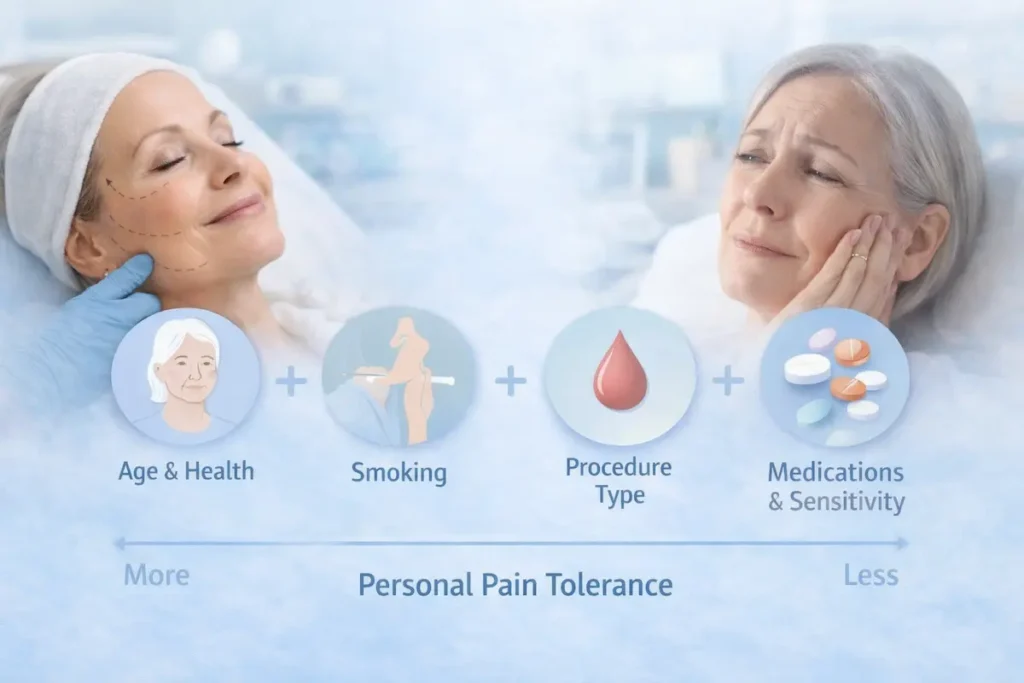
Why Some People Feel More Discomfort Than Others
Two patients can have the same procedure and describe it differently. If you’re comparing stories and wondering why one person says “easy” while another says “tough”, it often comes down to individual factors. Understanding these variables makes the question is an awake facelift painful easier to interpret, because it becomes personalised rather than absolute.
Individual sensitivity, sleep, smoking, alcohol, and stress
Factors that can increase discomfort include poor sleep, high baseline anxiety, smoking (which can affect healing), and alcohol use. Even if swelling is similar, a stressed nervous system can interpret sensations as more intense. This is one reason why “is an awake facelift scary” is a valid question—reducing fear can reduce discomfort.
Extent of surgery (neck work, midface lift, adjunct procedures)
“Awake facelift” can vary in scope. A procedure that includes additional areas may create more swelling and tightness—especially in the neck—so the awake facelift pain level can feel higher simply because more tissues are healing. Your consultation should clarify what’s included and what that means for recovery.
Swelling (oedema) management and why it changes comfort levels
Much of what people call “pain” in early facelift recovery is actually swelling-related pressure. When oedema is reduced, comfort improves. This is why structured swelling management (positioning, appropriate activity, and clinic-led recovery protocols) can make a noticeable difference to awake facelift recovery pain.
Comfort-First Recovery at AKM: HBOT + LLLT and “Flight-Ready” Protocols
For UK patients, recovery isn’t just about comfort—it’s also about being confident when travelling home and returning to normal life. Alongside surgical technique and careful aftercare, some clinics use supportive technologies to help with swelling, bruising, and tissue healing. At AKM, recovery protocols can include HBOT (Hyperbaric Oxygen Therapy) and LLLT (Low-Level Laser Therapy) as part of a comfort-first approach.
HBOT: why it can help bruising/oedema and social downtime
HBOT aims to support oxygen delivery to tissues during healing. Patients often care about what this means practically: potentially less bruising, less oedema, and a smoother early recovery window. While individual results vary, the intention is to help you feel more comfortable sooner—which can matter if you’re aiming for a predictable return to the UK.
LLLT: scar support and tissue healing
LLLT is used in some settings to support healing and comfort. Patients frequently describe it as part of a more “premium” recovery protocol—focused on optimising tissue recovery rather than only reacting to symptoms.
“Flight-ready” recovery logic for UK return travel
If you’re planning travel, your comfort plan matters. The goal is to minimise swelling escalation, keep pain controlled with a sensible regimen (often including paracetamol after facelift guidance), and ensure you have clear instructions for hydration, movement, and communication with your team. This structured approach helps reduce the “what if?” anxiety that makes many people ask again: is an awake facelift painful—or simply unpredictable.
Frequently Asked Questions (FAQ): Is Awake Facelift Painful?
These are the most common UK-style questions we hear from patients researching the procedure—especially those searching “is an awake facelift painful” and “does an awake facelift hurt”.
Is an awake facelift painful during the operation?
Most patients do not report pain during the operation because local anaesthesia numbs the area and twilight sedation helps you stay calm and comfortable. You may notice pressure or movement, but sharp pain is not the aim—tell your team immediately if you feel discomfort so it can be addressed.
How painful is the first night after an awake facelift?
The first night is usually more about tightness, swelling, and sleep disruption than severe pain. A structured plan (often including paracetamol after facelift guidance) and proper head elevation usually makes a big difference.
How long will I need painkillers (paracetamol or stronger meds)?
Many patients use simple pain relief for a few days, then taper as comfort improves. The exact timeline depends on the extent of surgery and your sensitivity—follow your clinician’s instructions rather than online advice.
Does twilight sedation make you feel sick afterwards?
Some patients worry about nausea, but experiences vary. Your anaesthesia plan should be discussed in advance, especially if you have a history of nausea or travel sickness, so it can be managed proactively.
What pain level is “normal” for days 3–7?
For many people, days 3–7 feel like improving tenderness and tightness rather than escalating pain. If pain is rapidly worsening, one-sided, or accompanied by fever/redness, seek clinical advice promptly.
When can I safely fly back to the UK after a facelift?
This depends on your recovery progress and your surgeon’s guidance. Many clinics plan travel with a “flight-ready” approach focused on swelling control and safe mobilisation. Always follow the specific advice given for your case.
What happens if I have concerns once I’m back in the UK? (aftercare pathway)
You should have a clear aftercare pathway with defined contact channels and escalation guidance. This support is crucial for reassurance and safe recovery—especially for patients who feel anxious about interpreting symptoms alone.
If you’d like to go beyond today’s question, you can also explore related guides on Local vs General Anaesthesia Facelift, and a detailed Facelift Recovery Timeline to understand what to expect day by day. We also recommend reading our Pain Management After Facelift overview for practical comfort strategies, plus a Surgery Abroad Safety Checklist to help you compare standards and aftercare planning. Finally, our Awake Facelift Cost resource explains typical UK vs Istanbul pricing factors so you can make a confident, well-informed decision.
Medical Disclaimer: This page is provided for general educational purposes only and does not replace a face-to-face medical consultation, diagnosis, or personalised treatment plan. All surgery carries risks and outcomes vary between individuals. Suitability for an awake facelift, procedure selection, and anaesthesia choice can only be determined after a full clinical assessment by a qualified surgeon. Always follow your clinician’s instructions and seek urgent medical attention if you develop concerning symptoms during recovery.