


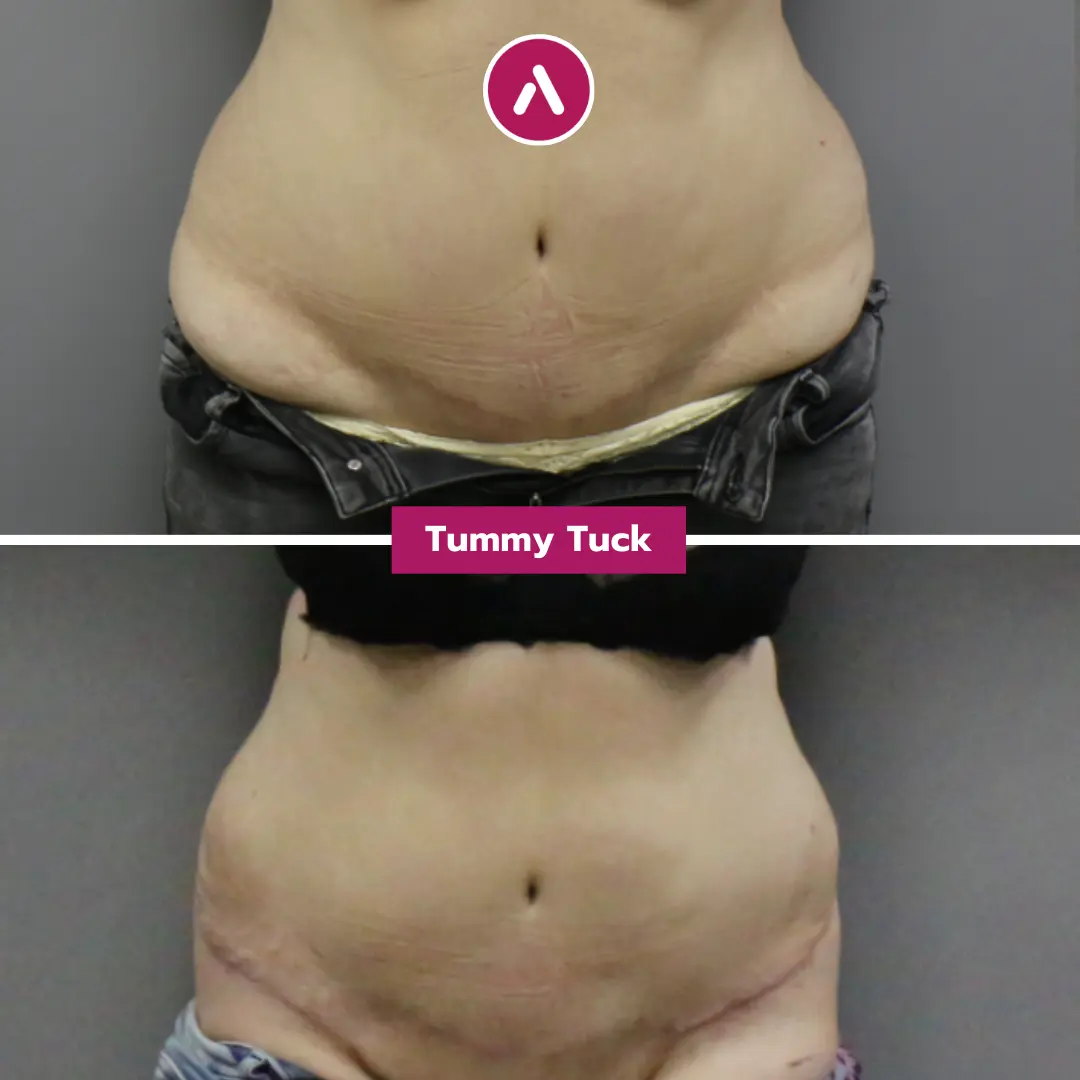
Considering a 360 Body Lift in Turkey? This definitive UK-focused guide explains how circumferential body lift surgery reshapes the waistline from abdomen to lower back and buttock area, especially after major weight loss. You’ll learn what the procedure can and cannot achieve, how scars are planned along the belt line, and which candidates benefit most.
We cover key techniques (FDL, corset and classic circumferential), targeted areas, recovery timelines, and risk reduction with structured aftercare, including HBOT and LLLT where appropriate. Compare Turkey vs UK cost drivers in a value-without-compromise framework, then book a consultation for a personalised plan today online.
Table of Contents
What is 360 Body Lift?
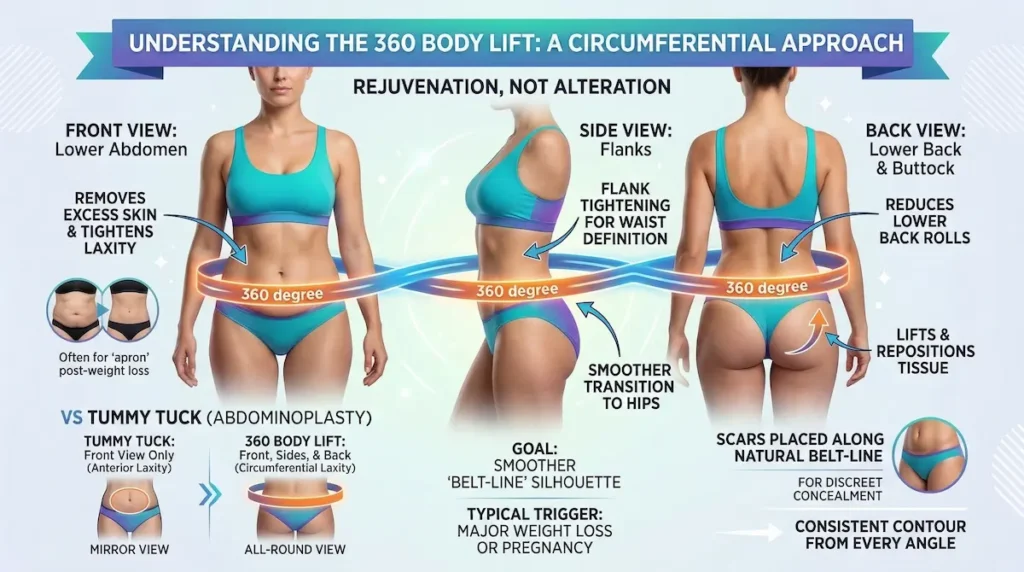
A 360 Body Lift is a circumferential body contouring operation that removes excess skin and tightens tissue around the entire waistline. It treats the abdomen, flanks, lower back and buttock area together. It is often chosen after major weight loss. The goal is a smoother ‘belt-line’ silhouette.
Our guiding principle is simple: Rejuvenation, Not Alteration. We plan for balance and proportion, not an artificial “done” look.
What does “360 degree” actually mean?
“360 degree” describes the surgical concept, not a gimmick. Instead of treating the front of the abdomen only, we treat the waistline as one continuous unit. That matters because skin laxity rarely stops at the tummy; it wraps around to the sides and back.
You may also see this described as a 360 lower body lift or a circumferential lift. The aim is consistent contour from every angle, especially in clothing where the waistband sits.
- Front: excess skin and laxity are addressed across the lower abdomen.
- Sides: the flanks (sides) are tightened to refine the waist transition.
- Back: lower-back laxity is lifted to reduce the “roll” effect.
- Buttock area: tissue is repositioned to improve the seat and drape.
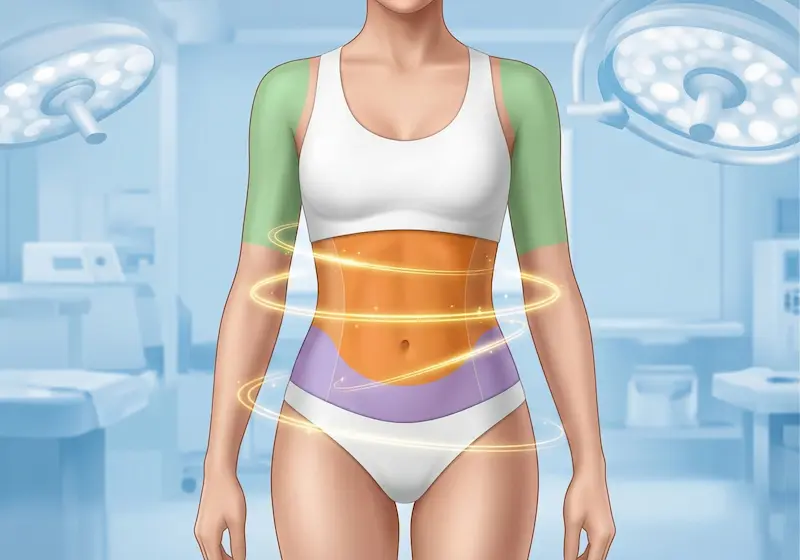
Which areas are typically addressed?
The exact pattern varies by anatomy, skin quality, and the source of laxity. Some patients have a dominant “apron” at the front. Others have more looseness through the flanks and lower back, especially after significant weight loss.
In most cases, we plan the lift around the natural “belt line” so scars sit where underwear or swimwear can cover them. The goal is sensible placement, not surprise scars.
- Lower abdomen (skin excess, laxity, contour break at the waist)
- Flanks / sides (waist definition and smoother transition to hips)
- Lower back (posterior laxity, rolls, and skin drape)
- Buttock region (support and lift through tissue repositioning)
360 Body Lift vs tummy tuck / abdominoplasty: what’s the difference?
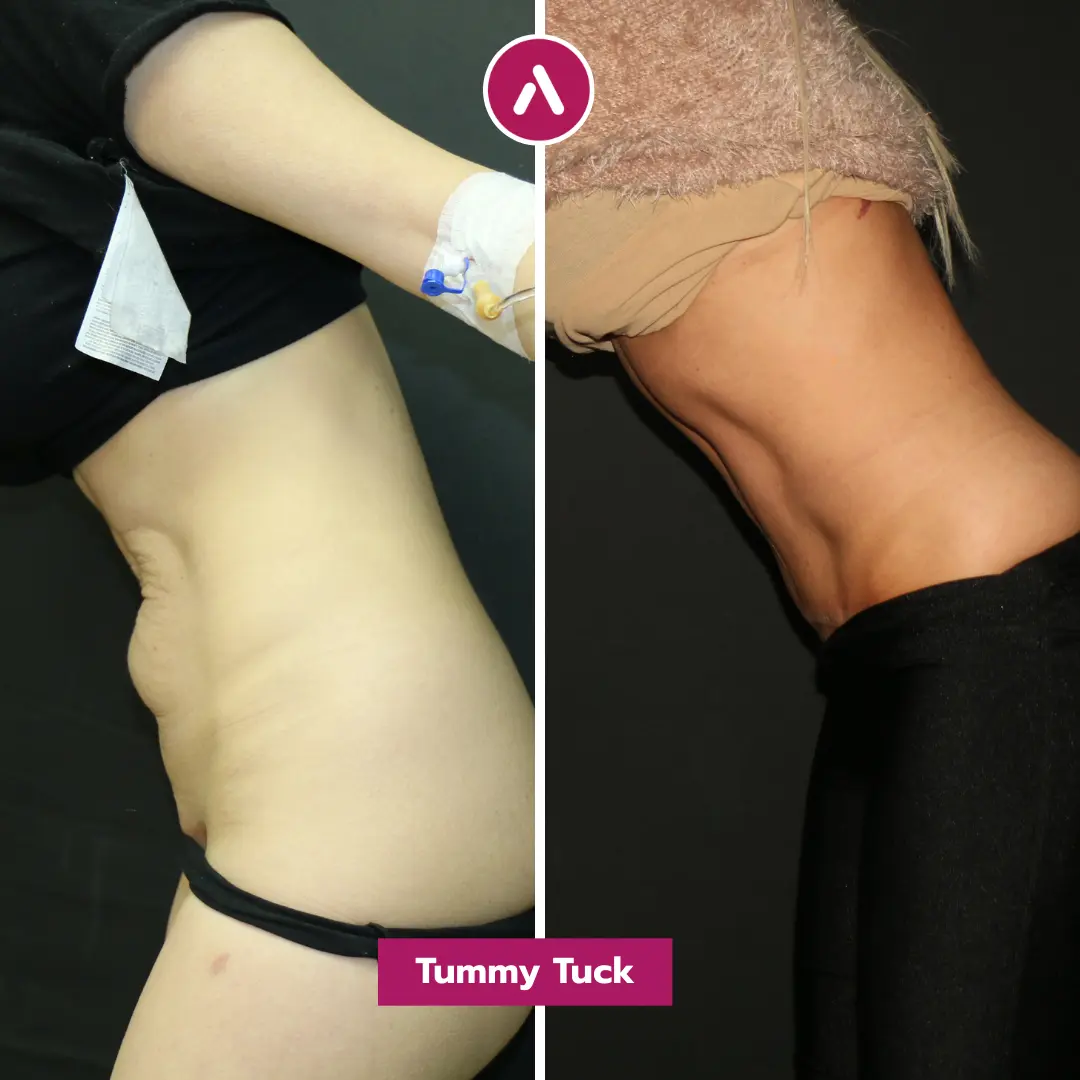
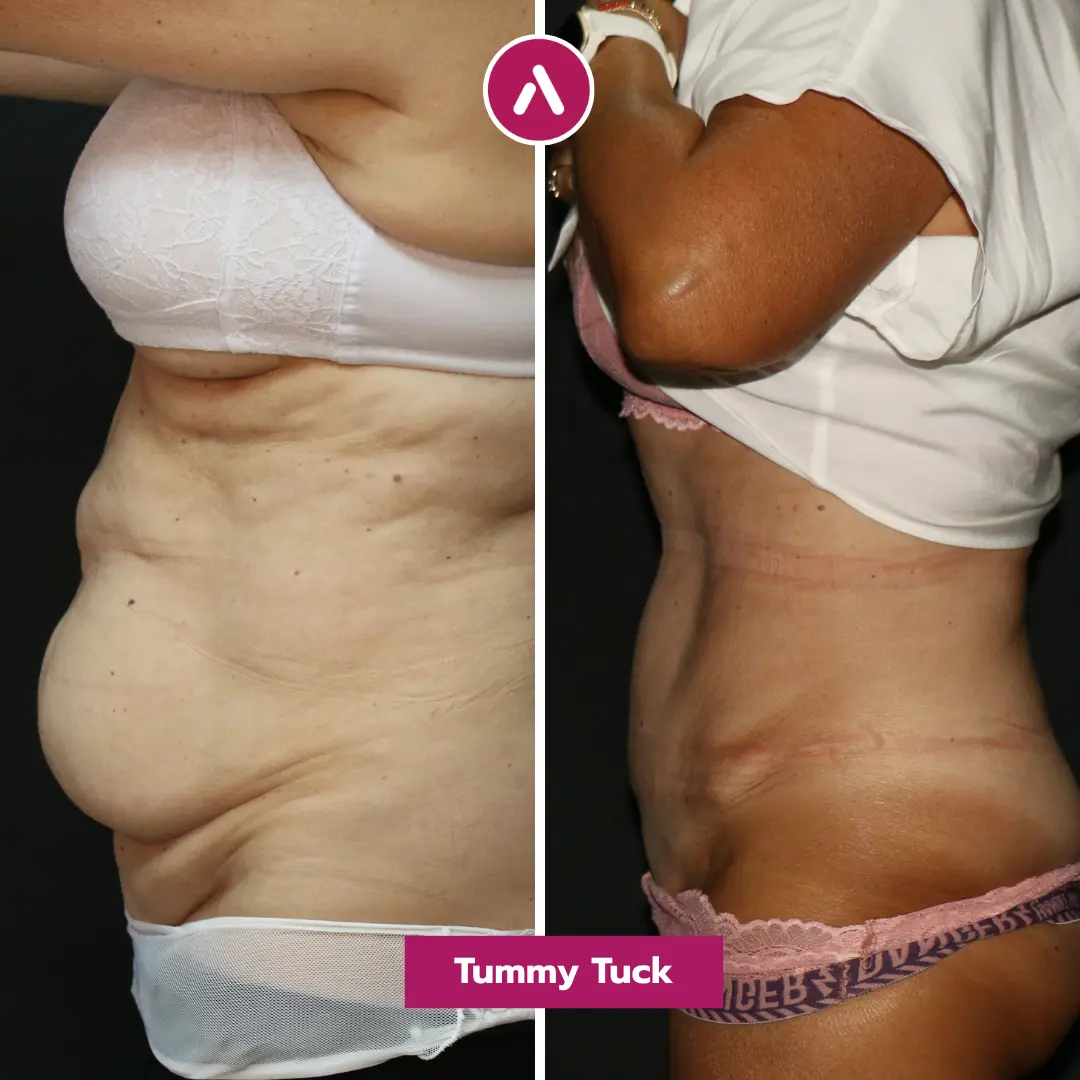
A tummy tuck (also called abdominoplasty) focuses on the front of the abdomen. It is often the right choice when laxity is mostly anterior and the back and flanks are relatively stable. A 360 body lift treats the front, sides, and back together, which can create a more consistent contour.
Think of it this way: an abdominoplasty can improve the mirror view. A 360 approach targets the mirror view and the side/back view in the same surgical plan.
- Best for front-dominant laxity: tummy tuck / abdominoplasty
- Best for circumferential laxity: 360 body lift (front + flanks + back)
- Typical trigger: major body changes such as pregnancy or post-weight loss
Benefits of 360 Body Lift
The main benefit is coherence. When we lift and tighten the tissues around the entire waistline, the silhouette tends to look more “finished” from every angle. Clothing can fit better because the contour is more even. For many patients, it also improves comfort by reducing skin-on-skin friction and folding.
Waistline and “belt-line” contour logic
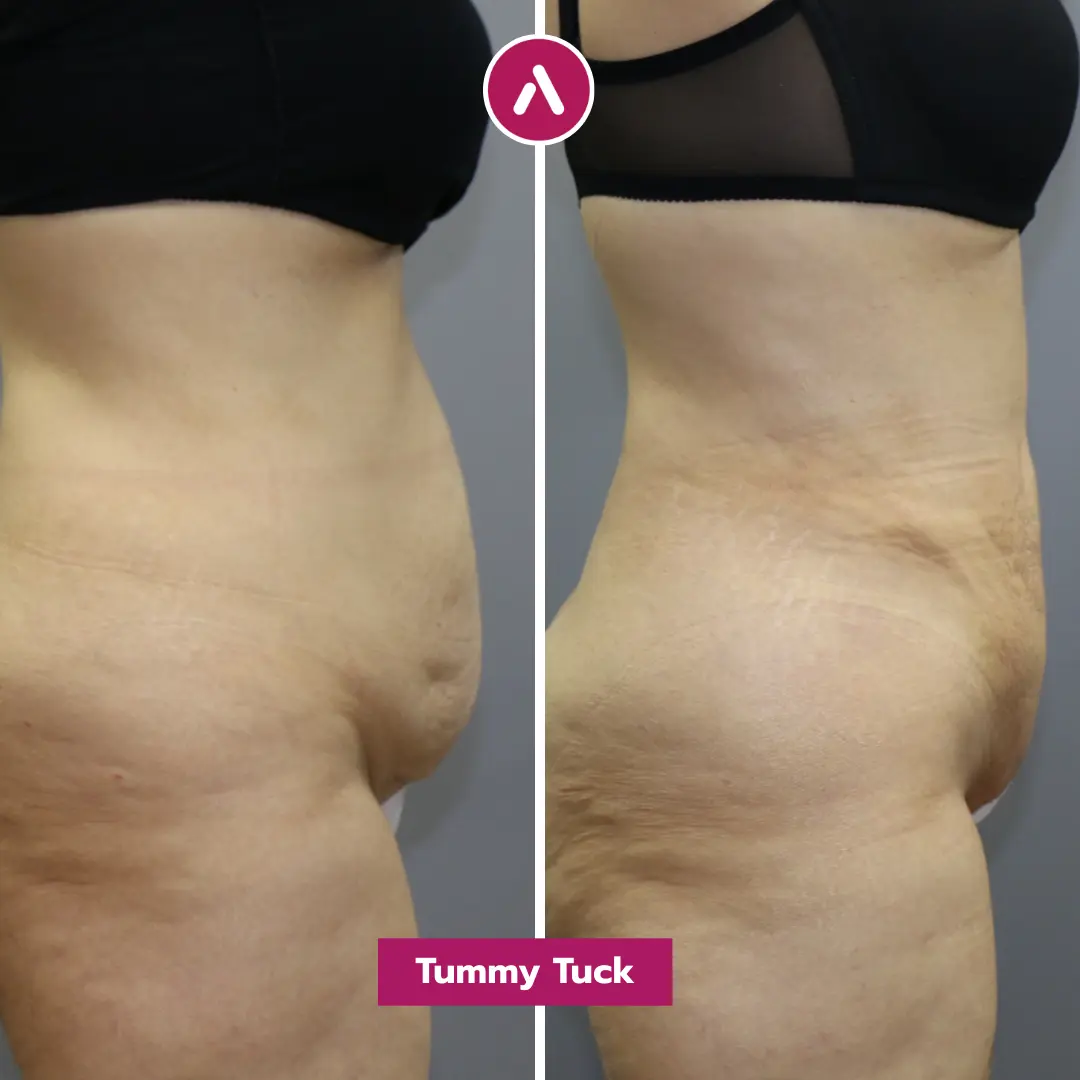
A strong result often comes down to how the waist transitions into the hips and back. If the flanks are left untreated, the front can look improved while the sides still feel heavy. Addressing the belt line as one unit can create a cleaner outline.
- Smoother waist transition into the hips
- Less “step-off” between front correction and side/back laxity
- More consistent contour in fitted clothing
Post-weight loss improvements you can actually measure
Post-weight loss laxity is not just “extra skin”. It can alter where tissue sits, how it folds, and how it moves during daily life. Patients commonly describe the difference in practical terms: easier dressing, fewer folds at the waistline, and a more stable feel when walking.
Our role is to match technique to anatomy. Some bodies need more horizontal tightening. Others need additional vertical control, which is where technique selection (covered next) becomes important.
Male expectations: a different contour goal
Male 360 body lift planning often prioritises a flatter, more athletic waistline rather than an exaggerated curve. The technical principles are the same, but the aesthetic target changes. We plan for a masculine silhouette with clean lines and restrained shaping.
- Focus on a firmer, straighter waist transition
- Control of flank fullness to avoid a “soft” side profile
- Scar placement planned with typical menswear in mind
Am I a Suitable Candidate for 360 Body Lift?
A 360 Body Lift is most often considered when there is looseness around the entire waistline rather than one isolated area. Suitability is not just about the amount of excess skin — it’s about safety, skin quality, and whether your body is in the best possible position to heal well.
Stable weight and skin quality
Patients who get the most predictable outcomes are usually at a stable weight and have reached a point where diet and training can’t correct the skin laxity. This is why post-weight loss patients commonly explore a circumferential approach: the skin envelope may remain loose even after achieving a healthy lifestyle.
- Stable weight: fluctuations can compromise contour and scar quality.
- Skin laxity pattern: true “wrap-around” looseness often points to a 360 plan.
- Realistic expectations: the aim is improved shape and comfort, not perfection.
Smoking, medical conditions, and healing risk
Any surgery that involves long incisions and significant tissue adjustment requires a careful approach to wound healing and circulation. Nicotine exposure (including vaping and patches) is a well-known factor that can increase healing complications. Likewise, uncontrolled medical conditions can raise risk and may need optimisation before surgery is considered.
- Nicotine use: can negatively affect circulation and wound healing.
- Diabetes and vascular issues: may affect healing and infection risk if not controlled.
- Blood clot risk factors: need assessment and a clear prevention plan.
- Previous abdominal surgery: can influence planning and scar strategy.
These points do not automatically exclude you — they highlight why a personalised medical assessment matters. If we believe safety would be compromised, we will recommend the safest alternative pathway rather than forcing a “one-size-fits-all” plan.
Our approach: strict pre-operative health screening
We treat suitability as a safety decision first. A thorough pre-operative review helps define whether a 360 body lift is appropriate, whether technique modifications are needed, and whether timing should be adjusted. The goal is to reduce avoidable risk and set you up for the smoothest possible recovery.
Surgical Techniques Explained (FDL, Circumferential, Corset)
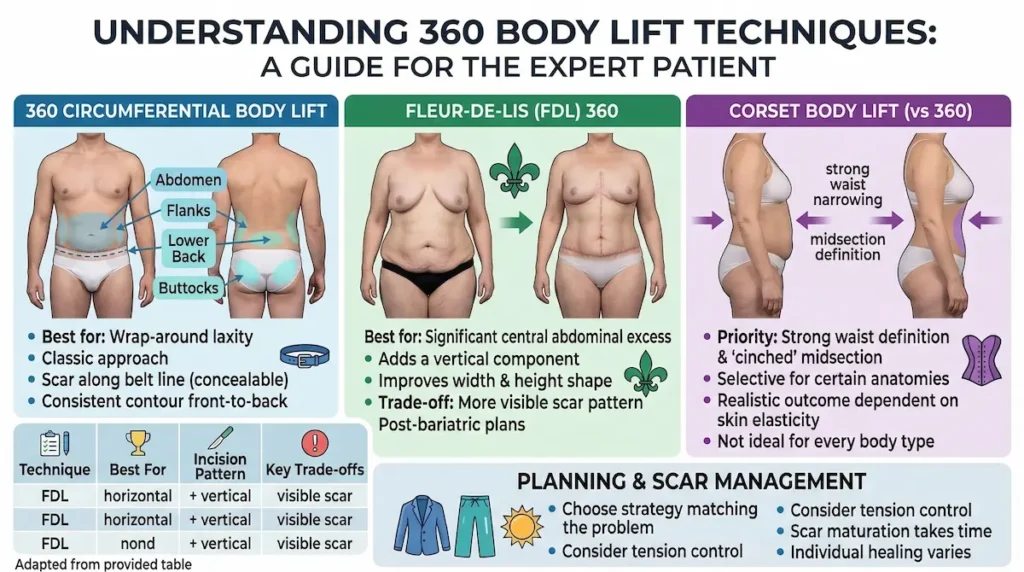
“360 Body Lift” is an umbrella term. The most appropriate technique depends on where the laxity sits, how it behaves when standing and bending, and whether there is significant central abdominal excess. Understanding the differences helps you make an informed decision as an expert patient.
360 Circumferential Body Lift
This is the classic “wrap-around” approach, designed for patients with laxity through the abdomen, flanks, lower back and buttock region. The incision is typically planned along the belt line so scar placement can be concealed by underwear or swimwear. The key advantage is consistent contour from front to back.
Fleur-de-Lis (FDL) variation: who needs it?
Some post-weight loss patients have significant excess in the centre of the abdomen that cannot be fully addressed with a horizontal tightening alone. In these cases, a Fleur-de-Lis pattern may be discussed. It adds a vertical component to better manage central laxity and improve abdominal shape in both width and height.
The trade-off is clear: improved central contour can come with a more visible scar pattern. A good plan is not about “more cutting” — it’s about choosing the scar strategy that best matches the problem.
Corset Body Lift vs 360: when waist narrowing is the priority
Corset-style concepts are discussed when the main aesthetic goal is a stronger waist definition and a “cinched” midsection. Not every body type benefits from this emphasis. The right choice depends on your anatomy, skin elasticity, and whether a more sculpted waistline is realistic without over-tensioning the closure.
Scar placement and belt-line planning
Scar strategy is part of technique selection. We plan incisions with clothing in mind and prioritise tension control to support scar quality. Scar maturation takes time, and individual healing varies, which is why planning and aftercare matter as much as the day of surgery.
| Technique | Best for | Incision pattern | Key trade-offs | Typical combination(s) |
|---|---|---|---|---|
| 360 Circumferential Body Lift | Wrap-around laxity (front + sides + back) | Horizontal belt-line incision | Long circumferential scar; requires careful tension control | Liposuction (selected), thigh lift (selected) |
| Fleur-de-Lis (FDL) 360 | Significant central abdominal excess after major weight loss | Horizontal + vertical component | More visible scar pattern; stronger central tightening | Post-bariatric plans, staged contouring |
| Corset-oriented planning | Waistline definition as a primary goal | Technique-dependent, belt-line based | Not ideal for every anatomy; must avoid over-tightening | Selective liposuction, targeted contour refinement |
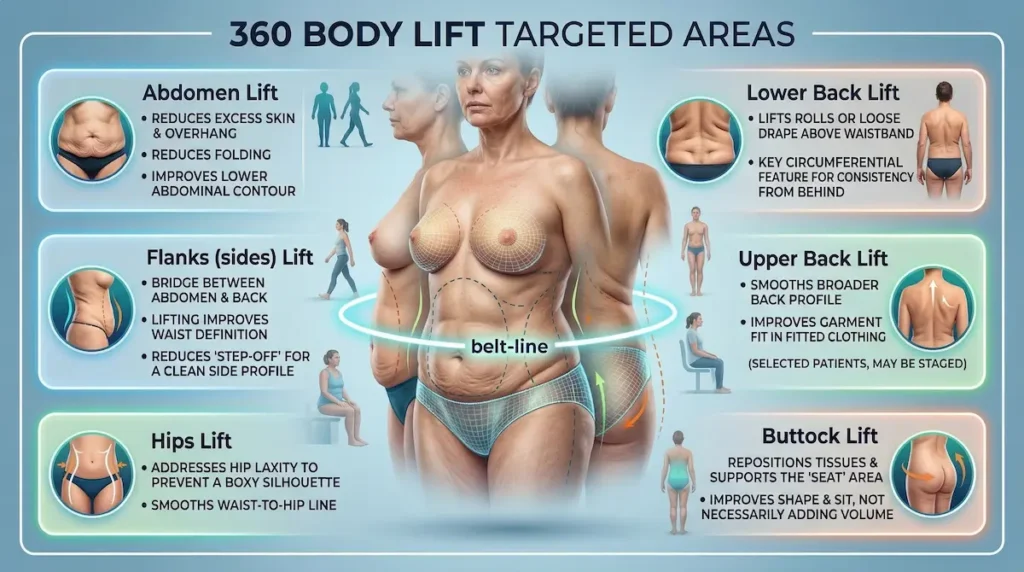
360 Body Lift Targeted Areas
A 360 body lift is designed around how the body looks and moves in real life — standing, sitting, and walking. Below are the core zones we evaluate and how each area contributes to the overall “belt-line” result.
Abdomen Lift
The front of the abdomen is often where patients notice the most practical discomfort: overhang, folding, and clothing fit issues. An abdomen lift focuses on reducing excess skin and improving lower abdominal contour as part of the circumferential plan, rather than treating the front in isolation.
Flanks (sides) Lift
The flanks are the “bridge” between the abdomen and back. Lifting this region can improve waist definition and reduce the step-off that sometimes remains when only the front is addressed. This area is also important for a clean side profile.
Hips Lift
Hip laxity can create a boxy silhouette or uneven transitions into the upper thigh and buttock region. Addressing the hips helps smooth the waist-to-hip line, supporting a more balanced contour from the front and side views.
Lower Back Lift
Lower-back laxity commonly presents as rolls or a loose drape above the waistband. Lifting this area is one of the defining features of a true 360 approach, helping the result look consistent from behind, not just from the mirror view.
Upper Back Lift
In selected patients, laxity extends higher than the belt line. When upper back looseness is significant, it may be considered as part of a broader contour plan (sometimes staged). The goal is a smoother back profile and improved garment fit in fitted clothing.
Buttock Lift
A circumferential lift can improve the buttock region by repositioning tissues and supporting the “seat” area. This is not necessarily the same as adding volume; it is about improving shape and the way tissues sit, especially after weight loss.
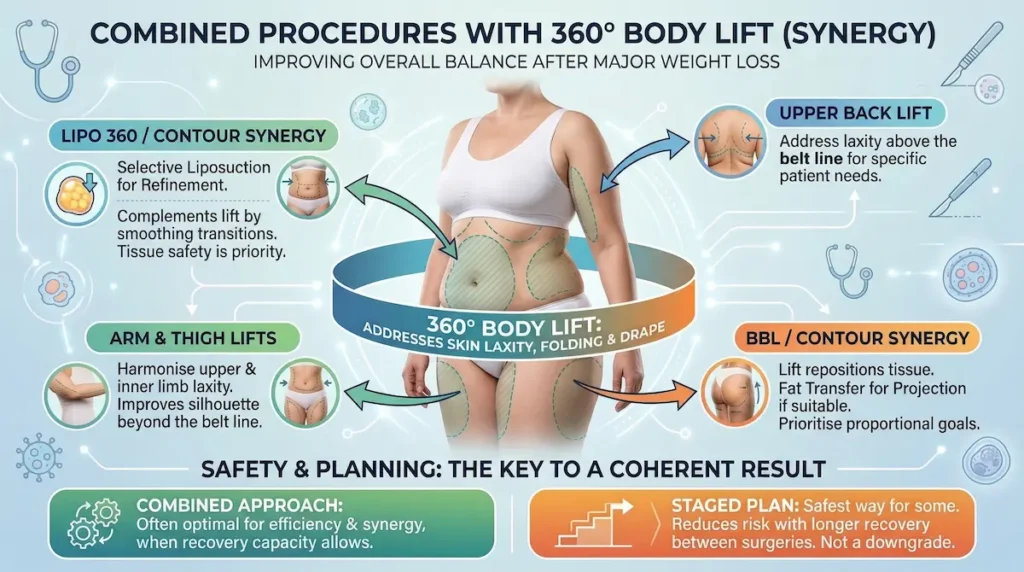
Combined Procedures with 360 Body Lift (Synergy)
A 360 Body Lift can be performed as a standalone operation, but many patients — especially after major weight loss — have laxity patterns that extend beyond the belt line. In those cases, combining procedures can improve overall balance. The key is not “doing more”; it is choosing the safest plan that delivers a coherent result without overloading recovery.
In consultation, we assess which areas are driving the contour problem, how your tissues behave in different positions, and whether a combined plan would meaningfully improve outcome or whether a staged approach would be safer.
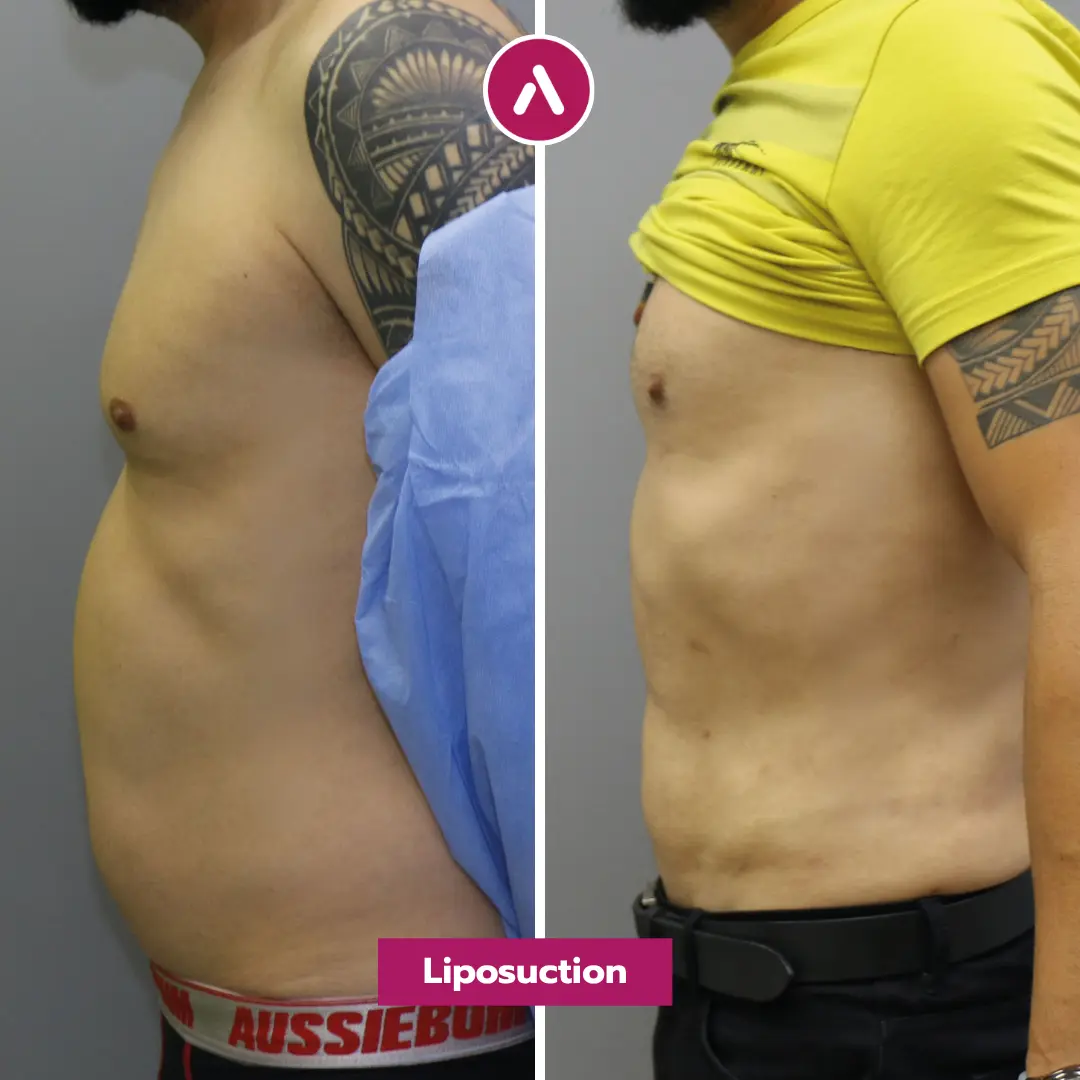
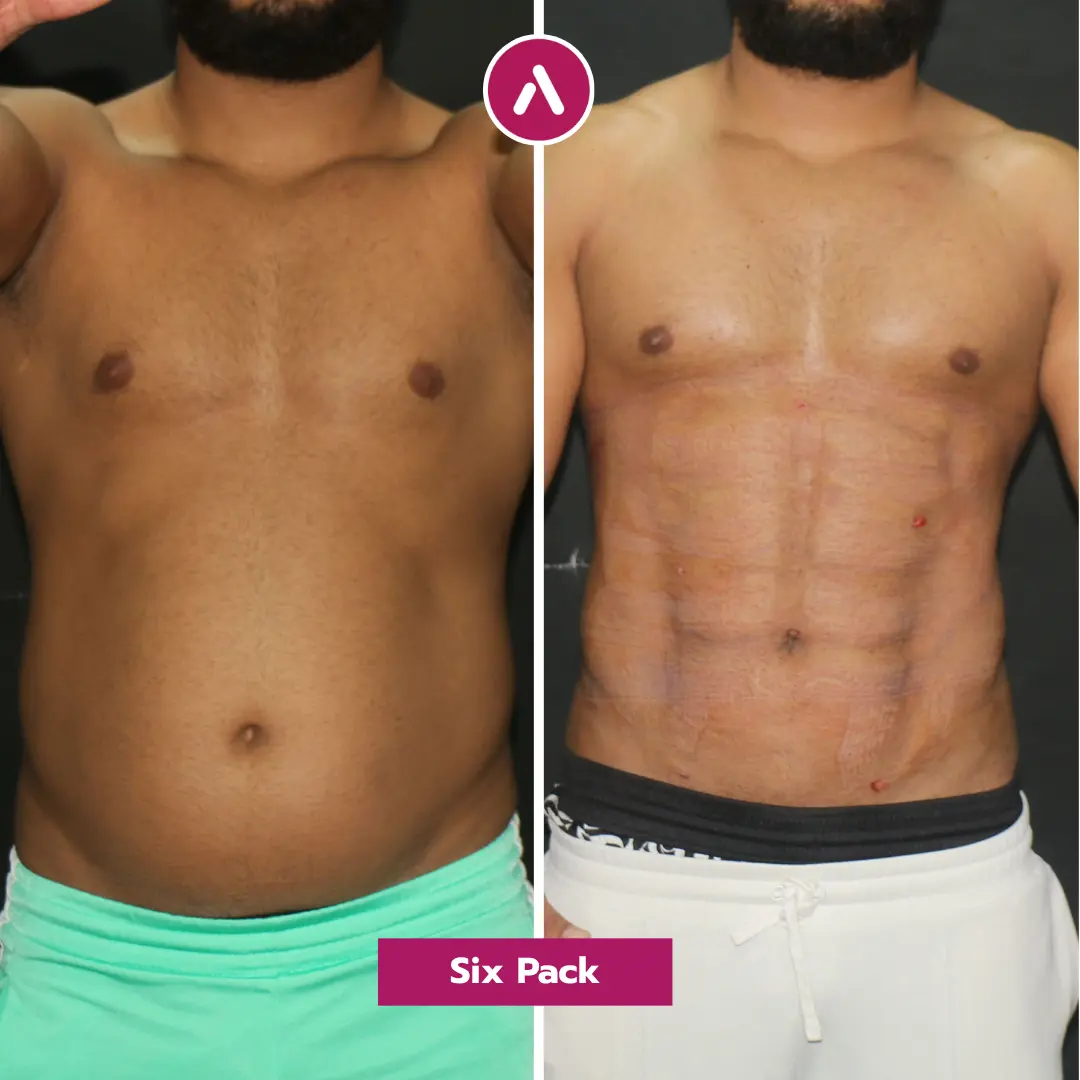
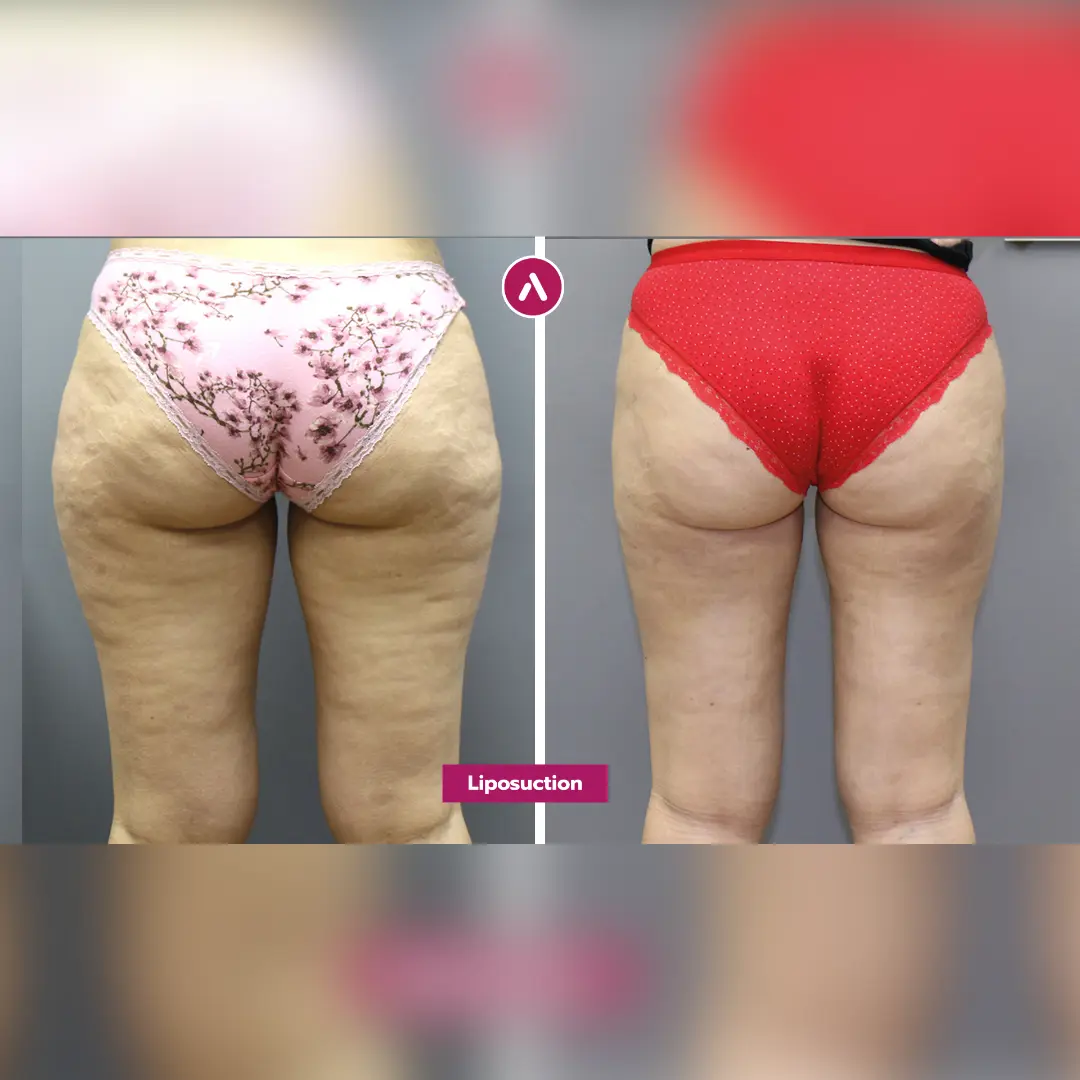
360 Body Lift + liposuction / “Lipo 360 / body contouring” distinction
Liposuction and lifting solve different problems. Lipo 360 focuses on reducing fat to refine shape. A 360 body lift focuses on removing excess skin and tightening the envelope to address laxity. If the main issue is loose skin and “drape”, liposuction alone may not produce the change you want — and in some cases can worsen laxity if the skin does not retract.
That said, selective liposuction can sometimes complement a lift by smoothing transitions (for example, around the flanks). When combined, the priority is tissue safety: maintaining healthy circulation, avoiding excessive trauma, and planning a recovery that supports wound healing and scar quality.
- Best for “skin-first” problems: 360 body lift (skin excess, folding, laxity)
- Best for “fat-first” problems: Lipo 360 (fat reduction where skin elasticity is strong)
- Often optimal: a lift with carefully selected liposuction to refine contour transitions
360 Body Lift + thigh lift / arm lift / upper back lift
After significant weight loss, laxity can appear in multiple zones at once: thighs, upper arms, and sometimes the upper back. A combined approach can improve overall harmony, but it must be planned with recovery capacity in mind. Longer operative time, larger surgical surface area, and multiple incision sites can increase demands on healing.
For this reason, some patients benefit from a staged plan (for example: lower-body contour first, then arms or upper back later). Staging is not a downgrade — it can be the safest way to achieve a high-quality, predictable result while reducing avoidable risk.
- Thigh lift: considered when laxity extends into the upper thigh and inner thigh contour.
- Arm lift: considered when upper-arm looseness affects clothing fit and skin-on-skin friction.
- Upper back lift: considered in selected patients where laxity sits above the belt line.
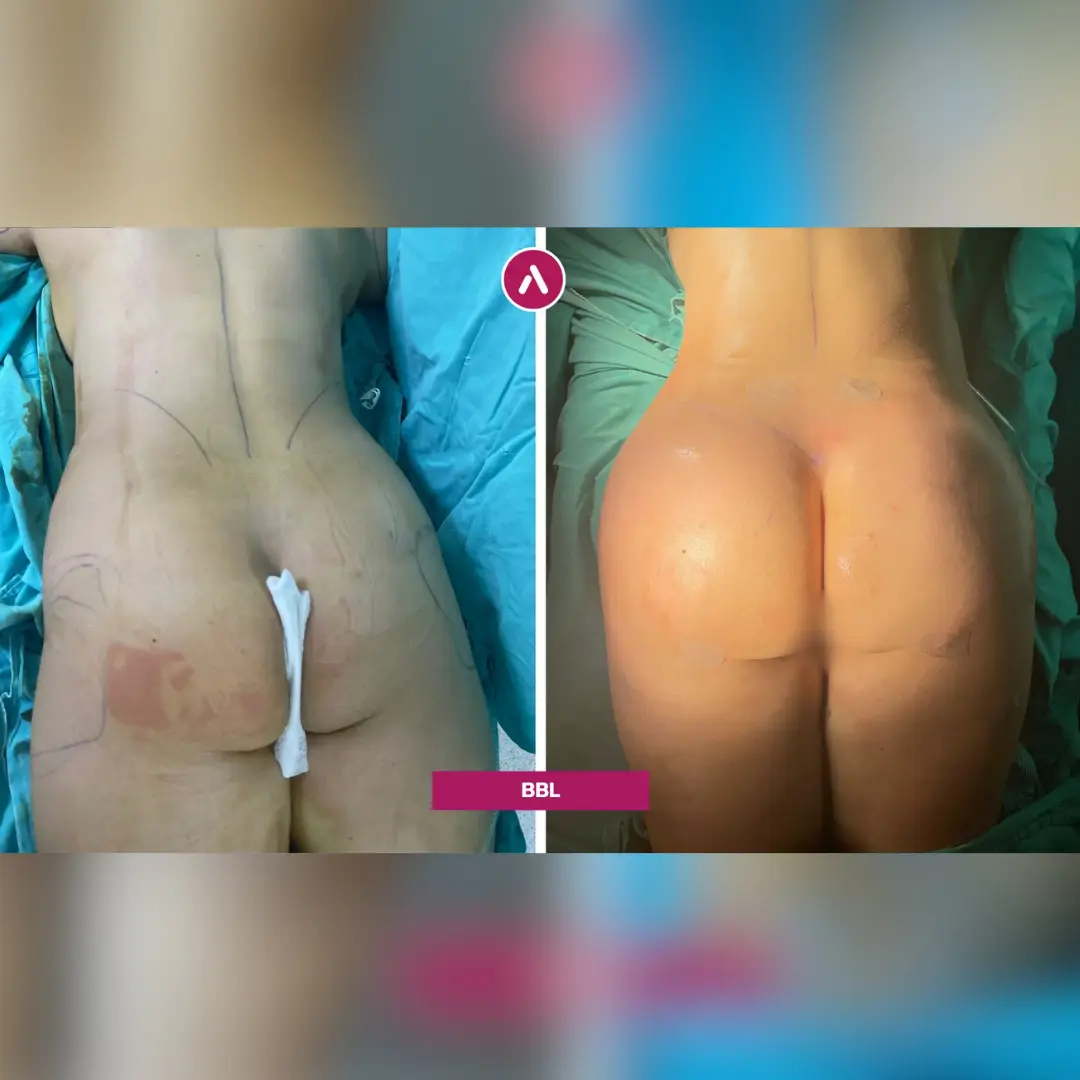
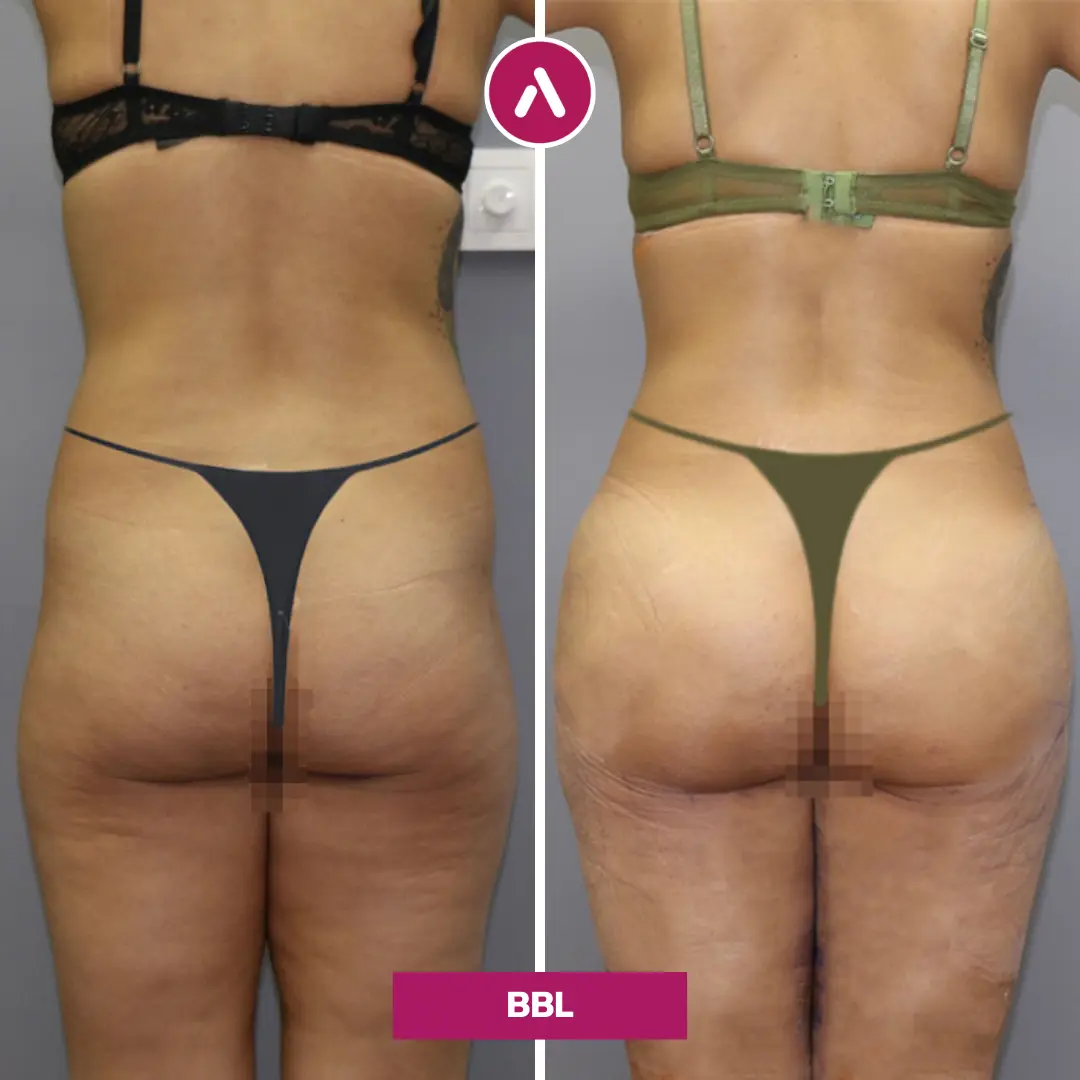
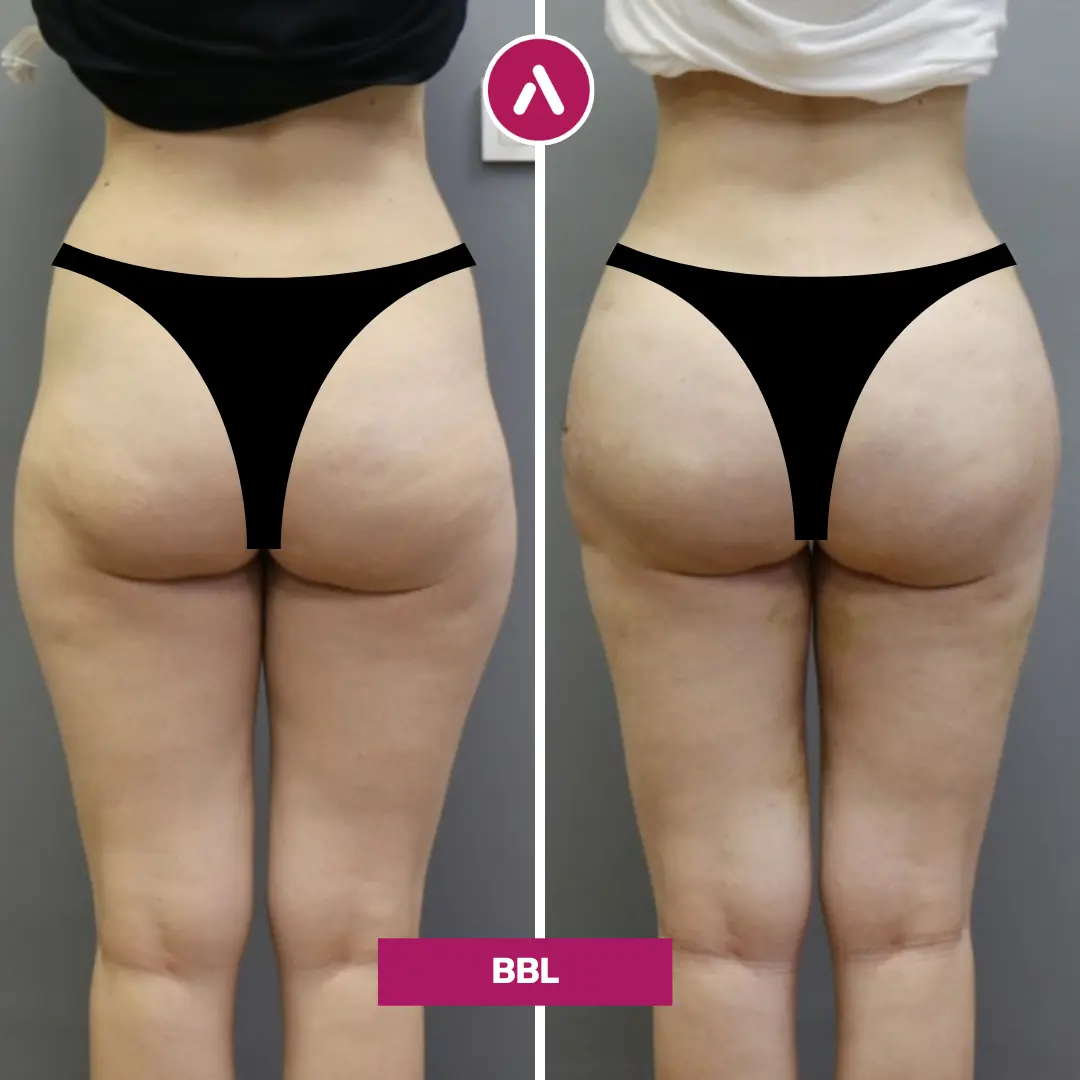
360 Body Lift + BBL (contour synergy, suitability dependent)
A circumferential lift can improve the buttock region by repositioning and supporting tissues, which may create a more lifted appearance without adding volume. Some patients, however, also want improved projection. In those cases, fat transfer (often referred to as a BBL) may be discussed as a separate option.
Suitability matters. Not every patient has enough donor fat, and not every body benefits from added volume. Planning focuses on proportional goals and safety: what will look natural with your frame, how tissues will heal, and whether a combined approach is appropriate or better staged.
- Lift-only result: improves position and drape, often enough after weight loss
- Volume-focused goal: may require fat transfer if suitable and safe
- Best outcomes: achieved when proportion is prioritised over “maximum volume”
Clinic alignment: matching the plan to AKM’s body contouring pathway
Combined surgery should never feel like a menu selection. The right plan comes from a single, integrated assessment: where excess skin is driving the silhouette, where selective contour refinement could help, and how to structure aftercare so that healing stays predictable. If multiple areas require attention, we map out a timeline that respects your safety and recovery — whether that means a single combined operation or a staged pathway.
Anaesthesia Options: Why We Prioritise Safety and Comfort
Anaesthesia is not just a comfort choice — it is part of the safety strategy. The best option depends on the length and complexity of surgery, whether procedures are combined, and your medical profile. Your anaesthetic plan is always decided with patient safety as the first principle.
When general anaesthesia is typically the right choice
For a true 360 body lift, general anaesthesia is commonly used because the operation is circumferential, involves repositioning, and requires stable control of comfort and movement throughout. It also supports a consistent surgical workflow when multiple zones are treated, helping the team maintain precision.
General anaesthesia can be particularly appropriate when:
- the lift is fully circumferential (front + flanks + back)
- additional procedures are combined
- operative time is expected to be longer
- comfort and airway control are best managed in a controlled setting
Twilight anaesthesia (UK terminology): what it is and who it may suit
Twilight anaesthesia (conscious sedation) describes a type of sedation where you are deeply relaxed and comfortable, often with local anaesthetic used in the operative areas. It is not a “one-size-fits-all” solution and is not suitable for every case — especially where surgical scope and duration require full anaesthetic control.
Where appropriate, twilight-style approaches may be discussed for selected contouring procedures or more limited surgical plans. The decision is always clinical: based on what keeps you safest while allowing the surgeon to achieve a high-quality result.
Decision criteria: what an expert patient should understand
If you are comparing options, focus on the decision drivers that genuinely matter: safety profile, the expected duration of surgery, your medical history, and whether you are combining procedures. The “right” anaesthetic plan is the one that supports stable physiology, predictable healing, and a controlled operative environment.
- Safety first: medical history, airway considerations, clot risk assessment
- Procedure scope: circumferential lift versus limited-area contouring
- Recovery planning: pain control strategy and early mobilisation guidance
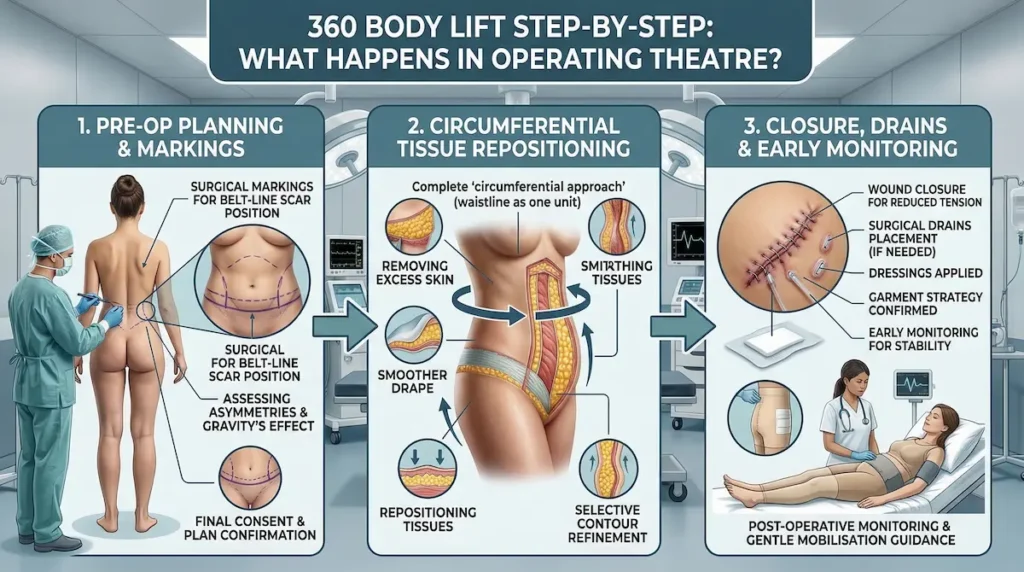
360 Body Lift Step-by-Step: What Happens in Operating Theatre?
A 360 body lift is planned as a single, continuous contour strategy. What happens on the day is structured and methodical, with safety checks at every stage. While details vary from one patient to another, the workflow below reflects what most patients can expect.
Pre-op planning and surgical markings
Markings are usually carried out while you are standing, because gravity shows where tissues truly sit. This step helps define the “belt-line” scar position and clarifies where tightening will create the most natural transition between the abdomen, flanks, and back.
- Review of your planned incision line and scar placement strategy
- Assessment of asymmetries and tissue behaviour in motion
- Final confirmation of the surgical plan and consent
Tissue handling and contour principles
The procedure focuses on removing excess skin and repositioning tissues to restore smoother drape and proportion. A 360 approach treats the waistline as one connected unit, which is why technique selection (circumferential, FDL, corset-oriented planning) matters so much.
When appropriate, selective contour refinement may be used to improve transitions — but the priority remains tissue safety and predictable healing. The aim is a balanced result from every angle rather than an over-tightened look.
Closure, drains, and first-day monitoring
Closure is planned to manage tension and support scar quality. You may have drains depending on your surgical plan and individual needs. After surgery, you are monitored closely as you wake up and begin gentle mobilisation guidance (with support).
- Wound closure designed to reduce unnecessary tension
- Dressings applied and garment strategy confirmed
- Early monitoring for comfort, circulation, and stability
360 Body Lift Recovery & Aftercare: How Long Does Healing Take?
Recovery is a process, not a single milestone. It is normal to experience swelling (oedema), tightness, fatigue, and variable discomfort in the early phase. Your aftercare plan is designed to support wound healing, manage symptoms, and help you return to normal activity safely.
The first 72 hours: movement, oedema, and comfort
The first three days are about stability and gentle progress. You will usually be guided to mobilise early (with support) because movement helps circulation and can reduce the risk of avoidable complications. Swelling is expected and can fluctuate throughout the day.
- Comfort: a structured pain-relief plan may include paracetamol and other prescribed medication where appropriate.
- Mobility: short, supported walks are often encouraged as soon as it is safe.
- Swelling: oedema is normal; expect tightness around the belt line and flanks.
- Rest: plan for fatigue — your body is healing from a major contour procedure.
Weeks 1–2: garment use, wound care, and routine
During the first two weeks, your focus shifts to protecting the incision lines, maintaining hygiene, and keeping activity light but consistent. Most patients wear a compression garment as advised, and follow a wound-care routine tailored to their closure and skin type.
- Garment: supports tissues as swelling changes and helps maintain contour.
- Wound care: keep the area clean and follow instructions for dressings and showering.
- Activity: gentle walking is usually encouraged; strenuous activity is avoided.
- Follow-up: scheduled checks allow the clinical team to guide progress and adjustments.
Weeks 3–6: returning to work and phased exercise
Many patients gradually increase activity through weeks 3–6, but timelines vary depending on your job demands, your healing rate, and whether you combined procedures. The safest approach is progressive: build stamina first, then introduce light exercise, and only later return to higher intensity training when cleared.
- Work: desk-based roles may be possible earlier than physically demanding jobs.
- Exercise: walking first, then light movement, then structured training as advised.
- Body changes: swelling reduces over time; contour becomes clearer in stages.
Our Rapid Recovery & Safety Protocol: HBOT + LLLT
Where clinically appropriate, AKM Clinic may incorporate supportive recovery technologies as part of a structured aftercare pathway.
- HBOT (Hyperbaric Oxygen Therapy): may support tissue oxygenation and recovery in selected cases.
- LLLT (Low-Level Laser Therapy): may help with oedema management and scar support as part of a broader plan.
These protocols are not a replacement for good surgery, good wound care, and good follow-up. They are used as an additional layer within a safety-first recovery strategy, based on individual assessment.
Safety & Risks: Is 360 Body Lift Dangerous?
A 360 body lift is major body contouring surgery. It comes with real risks, and it should be approached with the same seriousness you would expect from a high-standard private setting. Our job is to assess candidacy properly, plan the technique intelligently, and run a safety-first aftercare pathway. Your job is to understand what can happen, what is normal, and what needs urgent review.
Our European Board Certified Surgeons tend to say the same thing: the safest surgery is the one that is planned conservatively and executed consistently. Quiet, controlled work wins.
The risks patients should understand
Every patient’s risk profile is different. The most relevant risks for a circumferential lift usually relate to wound healing, fluid build-up, infection, and clot risk. Scars are inevitable with any lift; the question is how they are positioned, how they mature, and how well they are supported during healing.
- Bleeding and haematoma: uncommon, but possible in any operation.
- Infection: risk increases if wound care is not followed or if healing is compromised.
- Seroma (fluid collection): can occur when larger areas are tightened and reshaped.
- Delayed wound healing: more likely with nicotine exposure, poorly controlled health conditions, or high tension.
- Scarring issues: widening, thickening, or pigmentation changes can happen during maturation.
- Blood clots: risk varies by individual factors and must be actively managed.
How we reduce risk: screening, technique, and structured aftercare
Risk reduction starts before you travel. We use strict pre-operative health screening to confirm suitability and identify red flags early. In theatre, we plan scar placement around the belt line, manage tissue tension carefully, and keep the surgical plan matched to your anatomy rather than forcing a standard template.
- Pre-op screening: to confirm candidacy and optimise medical factors.
- Technique selection: circumferential vs FDL vs corset-oriented planning based on laxity pattern.
- Tension control: closure strategy designed to support scar quality and healing.
- Recovery protocol: structured guidance on mobilisation, garments, and follow-up checkpoints.
Where clinically appropriate, we also integrate supportive technologies into our Rapid Recovery & Safety Protocol. This can include HBOT and LLLT as part of an overall plan for swelling (oedema) control and scar support.
When to seek urgent help (UK: A&E guidance)
Most post-op symptoms are expected: swelling, tightness, bruising, and fatigue. Some symptoms are not “wait and see”. If you are back in the UK and something feels wrong, act quickly and use local urgent care routes, including A&E (Accident and Emergency) when needed.
- Sudden shortness of breath, chest pain, or fainting
- One-sided leg swelling or severe calf pain
- Rapidly increasing swelling, severe pain, or a firm expanding area
- High fever, worsening redness, or foul-smelling wound drainage
- New confusion, persistent vomiting, or inability to keep fluids down
Is 360 Body Lift Safe in Turkey for UK Patients?
UK patients often ask the same practical question: “Will the standards feel familiar?” That is a reasonable concern. Safety is not a slogan; it is the combination of proper screening, qualified surgeons, controlled environments, and follow-up that continues after you fly home. We focus on creating a pathway that aligns with the expectations of a British private-care mindset.
We do not position surgery as a holiday purchase. We treat it as planned medical care, with clear steps, clear responsibility, and clear follow-up.
Clinical environment and sterilisation standards
A safe operation needs a safe setting. We organise your care in fully accredited facilities with sterile theatres, appropriate monitoring, and structured post-operative oversight. The point is consistency: protocols that reduce avoidable variability and support predictable healing.
- Sterile theatres: controlled operating environments, not improvised settings.
- Pre-operative tests: used to confirm fitness for surgery before the procedure day.
- Post-op monitoring: clear criteria for discharge and travel readiness.
Surgeon credentials: what “GMC registered surgeon alternatives” really means
Some UK patients search for “GMC registered surgeon alternatives” because they want an objective marker of competence. In our case, we frame surgeon authority through internationally recognised credentials and standards. In general body copy, we refer to our team as European Board Certified Surgeons or specialists registered with international medical boards.
- Board certification as a third-party signal of training and ongoing standards
- Evidence-based decision making: candidacy first, aesthetics second
- Clear, non-theatrical communication: risks and trade-offs explained plainly
Continuum of care: post-op support after you return to the UK
Distance should not mean abandonment. We build our aftercare pathway to support “post-op care in Turkey for British citizens” concerns in a practical way: consistent communication, scheduled check-ins, and a clear escalation route if something changes. Our follow-up structure includes virtual checkpoints at set milestones to monitor healing over time.
- Remote follow-up schedule: virtual check-ins at 1, 3, 6, and 12 months.
- Access: responsive support for day-to-day questions during recovery.
- Escalation clarity: guidance on when to seek local UK urgent care if required.
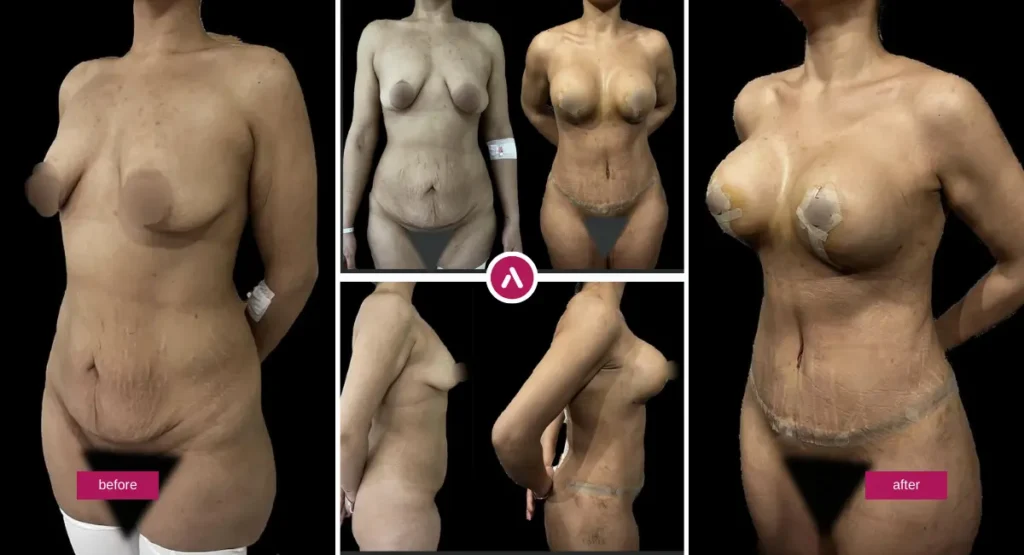
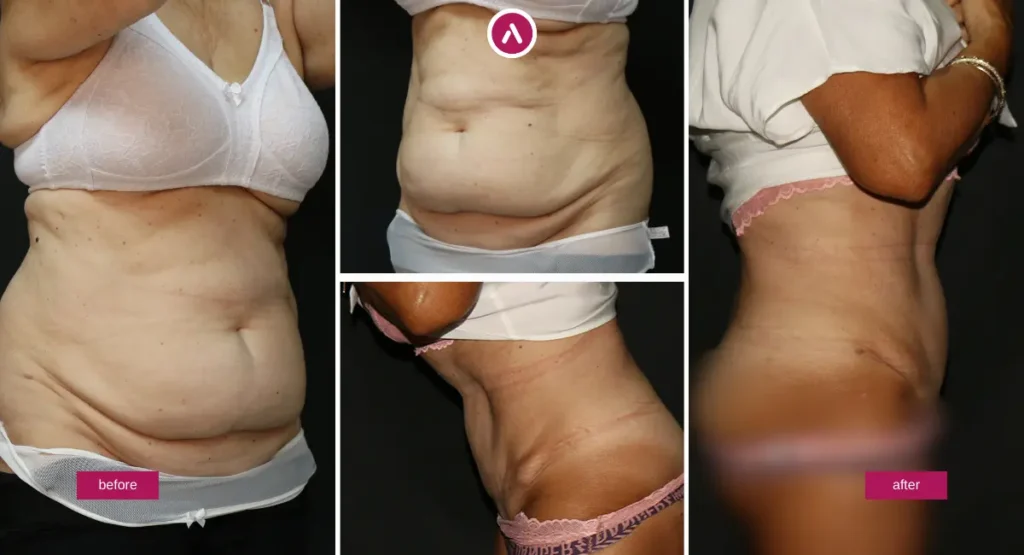
360 Body Lift Before and After: Realistic Expectations & Results
A 360 Body Lift can be transformative for the right candidate, but it is not instant, and it is not “magic.” Results develop over time as swelling settles and tissues adapt. The most satisfied patients are those who understand the trade-offs clearly: improved contour and comfort in exchange for scars and a structured recovery.
Our principle remains: Rejuvenation, Not Alteration. The goal is a natural-looking waistline and balanced proportions, not an artificial silhouette.
Why results take time to “settle”
Early results can look encouraging, but the body continues to change for weeks and months. Swelling (oedema) is normal and may fluctuate throughout the day. Tightness can persist, particularly around the belt line, because the tissues have been repositioned and the skin envelope is adjusting.
- Weeks 1–2: swelling, bruising, and fatigue are common; shape can look uneven as oedema shifts.
- Weeks 3–6: gradual improvement in comfort and mobility; contour becomes clearer in stages.
- Months 3–6+: scar maturation progresses; tissues soften and the final silhouette becomes more stable.
Progress is rarely linear. A “good week” can be followed by a few days of increased swelling, especially if activity increases. This is usually part of normal healing, but your follow-up plan is there to guide you if anything feels unusual.
Scars: honest expectations and scar management strategy
A lift requires incisions — there is no scar-free body lift. The aim is sensible placement and tension control so scars can mature as well as possible. We plan the belt-line scar with underwear and swimwear in mind, but scar quality still depends on your biology, aftercare, and lifestyle factors such as nicotine exposure.
- Scar placement: designed around the belt line to be as discreet as anatomy allows.
- Scar maturation: can take many months; early redness and firmness are common.
- Supportive care: compression, wound care guidance, and (where appropriate) adjunct options such as LLLT.
We do not promise “invisible scars”. We promise thoughtful planning, clear aftercare guidance, and realistic communication about what scar evolution typically looks like.
Typical patient profiles and common outcome themes
While every body is different, patients commonly report improvements in how clothing fits, how the waistline looks from side and back angles, and how comfortable they feel during day-to-day movement. Post-weight loss patients often describe less folding and less skin-on-skin friction. Male patients often prioritise a firmer, cleaner waist transition rather than a pronounced curve.
What we aim for is a coherent result: a contour that looks consistent from the front, side, and back — and feels more “stable” in everyday life.
360 Body Lift Cost 2026 (Turkey vs UK) – Value Without Compromise
Patients in the UK often compare Turkey and private UK care as part of a rational decision. The key is to compare like with like: surgeon credentials, facility standards, anaesthesia care, aftercare, and what is genuinely included. A lower headline figure can be misleading if essential components (or follow-up) are not part of the package.
UK (Harley Street) vs Turkey: why costs differ
Cost differences are often driven by broader economic factors and operating costs rather than “quality shortcuts.” UK private fees typically reflect higher facility overheads, staffing costs, insurance structures, and wider cost-of-living pressures. In Turkey, operating costs can be different, which may allow a more comprehensive, all-inclusive model — as long as clinical standards remain the priority.
- UK cost drivers: facility overheads, staffing, insurance, and high operating costs.
- Turkey cost drivers: different operating costs and service models, enabling bundled pathways.
All-inclusive model: what is usually included (and what to check)
When patients travel, clarity matters. An all-inclusive approach typically bundles logistics and care steps so you are not left coordinating essentials during recovery. However, inclusions can vary significantly between clinics, so it is important to confirm details in writing.
- Common inclusions: hospital fees, anaesthesia, surgeon fee, initial aftercare, accommodation and transfers.
- Often variable: compression garments, medications, lab tests, and extended follow-up support.
- Always ask: what happens if additional care is needed (for example, extra dressings or extended monitoring).
A high-value decision framework (technology, follow-up, environment)
Value is not just the figure you pay; it is what reduces risk and supports predictable healing. For expert patients, decision drivers often include surgeon authority, facility standards, recovery protocols, and a clear follow-up structure — including support after returning to the UK.
- Clinical standards: accredited facilities and structured safety checks.
- Recovery support: guidance, monitoring, and access to the team when questions arise.
- Adjunct options: where appropriate, supportive protocols such as HBOT/LLLT may be integrated.
| UK private care cost drivers | Turkey cost drivers | What’s included | Questions to ask any clinic |
|---|---|---|---|
| Higher facility overheads, staffing costs, insurance structures | Different operating costs and bundled care pathways | Hospital, anaesthesia, surgeon fee (varies by provider) | Who provides anaesthesia and what monitoring is used? |
| Itemised billing is common (fees separated) | Packages often combine clinical care + logistics | Accommodation and transfers (varies by package) | What is excluded (garments, medication, tests, revisions)? |
| Follow-up may be local but may incur separate visits | Remote follow-up is often structured for travel patients | Aftercare pathway and scheduled check-ins (confirm details) | What is the follow-up plan after I return to the UK? |
| Costs can increase with complexity and combined procedures | Costs vary by scope, facility, and recovery services | Scope of surgery and staged planning (should be explicit) | Is a staged plan safer for my profile, and why? |
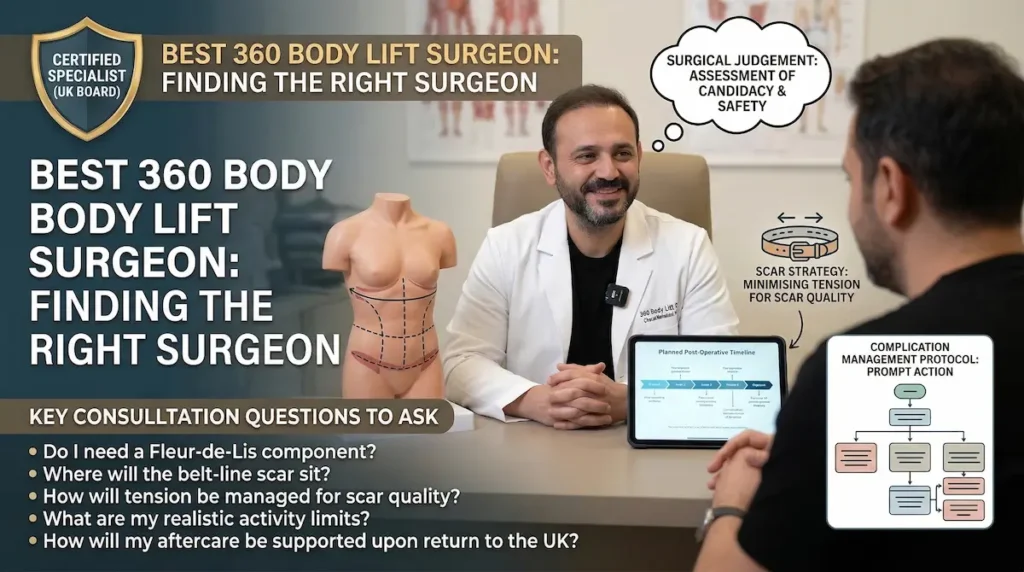
Best 360 Body Lift Surgeon: Finding the Right Surgeon
Choosing where to have a 360 Body Lift is not just a price comparison. It is a decision about judgement, planning, and safety. The right surgeon will explain trade-offs clearly, assess candidacy honestly, and recommend the safest pathway — even when that means staging procedures or advising against surgery until risk factors are optimised.
Why board certification and experience matter
A 360 body lift is technically demanding because it treats the waistline as one continuous unit. Small planning errors can show up as contour irregularities, tension-related healing issues, or scars placed in difficult positions. This is why credentials and experience matter: they are signals of structured training, standards, and consistent surgical decision-making.
- Technique judgement: choosing circumferential vs FDL vs waist-definition-focused planning based on anatomy.
- Safety mindset: screening, clot-risk strategy, and conservative planning when needed.
- Scar strategy: understanding how to place and close incisions to support scar quality.
- Complication management: recognising early signs and acting promptly with a clear protocol.
If a consultation feels rushed, or if risks are minimised with vague reassurance, treat that as a red flag. A high-quality provider will be calm, specific, and transparent.
Questions to ask in consultation (FDL need, scar plan, and combinations)
As an expert patient, you should leave consultation with a clear plan you can repeat back: what will be done, where scars will sit, what your recovery milestones are, and what can realistically be achieved. Useful questions include:
- Technique: “Do I need a standard circumferential lift, or is a Fleur-de-Lis (FDL) component likely — and why?”
- Scar placement: “Where will the belt-line scar sit relative to underwear and swimwear?”
- Tension control: “How do you plan to minimise tension to support healing and scar quality?”
- Combinations: “Would liposuction, thigh lift, or another procedure improve balance — or would staging be safer?”
- Recovery: “What are my activity limits week-by-week, and when is flying typically considered safe for me?”
- Follow-up: “How will you support me after I return to the UK, and what is the escalation route if something changes?”
Good answers will be specific to your anatomy and health profile — not generic promises.
For UK searches like “GMC registered surgeon alternatives”: what to focus on
Many UK patients use “GMC registered” as shorthand for accountability and standards. When you are choosing care abroad, the practical equivalent is to look for objective quality signals: internationally recognised certification, a documented safety pathway, accredited operating facilities, and a structured follow-up system.
- Credentials: board certification and specialist registration with recognised medical boards.
- Facility standards: sterile theatres, appropriate monitoring, and clear discharge criteria.
- Aftercare: a defined pathway, not “message us if you need anything”.
Your Medical Journey: What to Expect (Arrival to Departure)
Travelling for surgery should feel organised and clinical — not improvised. A clear pathway reduces stress, supports healing, and makes your experience more predictable. Below is what most UK patients can expect from the process, from first enquiry to long-term follow-up.
Free virtual consultation → planning (photos and medical documents)
Many patients begin with a remote consultation so the clinical team can understand your goals, review your anatomy, and assess whether a 360 body lift is appropriate. You may be asked for photos and relevant medical information so the plan is based on facts rather than assumptions.
- Review of your goals and your laxity pattern (front, flanks, lower back, buttock region)
- Discussion of technique options (circumferential, FDL, corset-oriented planning)
- Guidance on pre-op preparation, including risk factors that may need optimisation
If you are a post-weight loss patient, the consultation typically focuses on skin behaviour, scar strategy, and whether staging would produce a safer, more coherent result.
Airport meet & greet, transfers, hotel, and patient support
Once your plan is agreed, the journey should be simple. UK patients often value logistics that remove unnecessary decision-making during recovery. A structured pathway typically includes airport pick-up, transfers, and accommodation planning so you can focus on healing.
- Arrival support: airport meet & greet and planned transfers
- Accommodation: hotel arrangements aligned with recovery comfort
- Communication: clear points of contact for practical and medical questions
Support should feel responsive and calm. You should always know who to contact, what is normal, and what requires review.
Long-term virtual follow-up: 1 / 3 / 6 / 12 months (continuum of care)
Healing continues long after you fly home. A reliable provider plans for that reality with structured follow-up checkpoints. These reviews help track scar maturation, swelling resolution, and how the contour is settling over time.
- Scheduled milestones: remote check-ins at 1, 3, 6, and 12 months.
- Guidance: scar care, garment progression, and return-to-exercise planning.
- Escalation route: clear advice on when to seek in-person assessment locally in the UK if needed.
A good continuum of care is proactive. It reduces uncertainty and helps you navigate the normal ups and downs of recovery with confidence.
360 Body Lift Frequently Asked Questions (FAQ):
How painful is a 360 body lift?
Discomfort is expected, particularly around the belt line where tissues have been tightened and repositioned. Most patients describe a feeling of tightness and soreness rather than sharp pain. Your comfort plan is individual and typically includes a structured medication approach alongside practical guidance such as positioning, gentle mobilisation, and garment use.
When can I fly after 360 body lift surgery?
Flying is not just a “date on a calendar” decision — it depends on your recovery progress, swelling, mobility, and individual clot-risk profile. In general, the safest approach is to travel only when you are clinically stable, comfortable walking, and your early wound checks are satisfactory.
Do I need FDL?
Not every post-weight loss patient needs a Fleur-de-Lis (FDL) component. FDL is usually discussed when there is substantial central abdominal excess that a horizontal tightening alone cannot correct. The trade-off is a more visible scar pattern in exchange for stronger central contour improvement.
360 body lift vs tummy tuck: which is better?
Neither is universally “better” — they address different patterns. A tummy tuck (abdominoplasty) focuses on the front of the abdomen. A 360 body lift is circumferential, treating the abdomen, flanks and lower back together to improve contour from all angles. The right choice depends on where your laxity sits and how much the back and sides contribute to the silhouette.
Male 360 body lift: what’s different?
The technique principles are similar, but the aesthetic target often differs. Many male patients prioritise a firmer, straighter waist transition and a clean side profile rather than an exaggerated curve. Planning focuses on proportion, scar placement with typical menswear in mind, and controlling flank fullness while keeping the result natural.
How long will the scars take to fade?
Scar maturation takes time. It is common for scars to look pink or red early on, then gradually soften and settle over months. Individual factors matter: genetics, skin type, tension, aftercare, and lifestyle (particularly nicotine exposure).
How long do I need to wear a compression garment after a 360 Body Lift?
Most patients wear a compression garment for several weeks after a 360 Body Lift, because it supports tissues as swelling (oedema) changes and helps the contour settle. Your exact timeline depends on the technique used (circumferential vs FDL), how your skin responds, and whether procedures were combined. We advise a staged reduction rather than stopping suddenly, guided by your follow-up checks.
When can I sleep on my side or stomach after a 360 Body Lift?
In the early phase, sleeping position matters because it reduces tension on the belt-line incision and supports wound healing. Many patients start on their back with positioning support, then transition gradually as comfort improves and swelling settles. The “right” time varies by your closure, scar placement and healing rate, so we give personalised guidance during your recovery checkpoints after your 360 body lift surgery.
Will a 360 Body Lift remove stretch marks?
A 360 Body Lift can remove some stretch marks if they are located in the skin that is excised, typically in the lower abdomen and along areas of significant excess. Stretch marks outside the removed skin will remain, although their position may shift as tissues are tightened. In consultation we explain what is realistically removable based on your laxity pattern and the planned incision line.
How do I know if I need a staged plan instead of one combined operation?
A staged plan is considered when combining procedures would increase operative time, surgical surface area, or healing demands beyond what is safe for your profile. This is common in post-weight loss patients who need multiple areas addressed (for example, a 360 body lift plus arms or thighs). Staging can improve safety and scar quality by giving your body time to recover properly between steps.
Medical disclaimer: This page is for general information only and does not replace medical advice. Suitability, results, and recovery timelines vary between individuals. A clinical assessment is required to determine the safest and most appropriate treatment plan.