




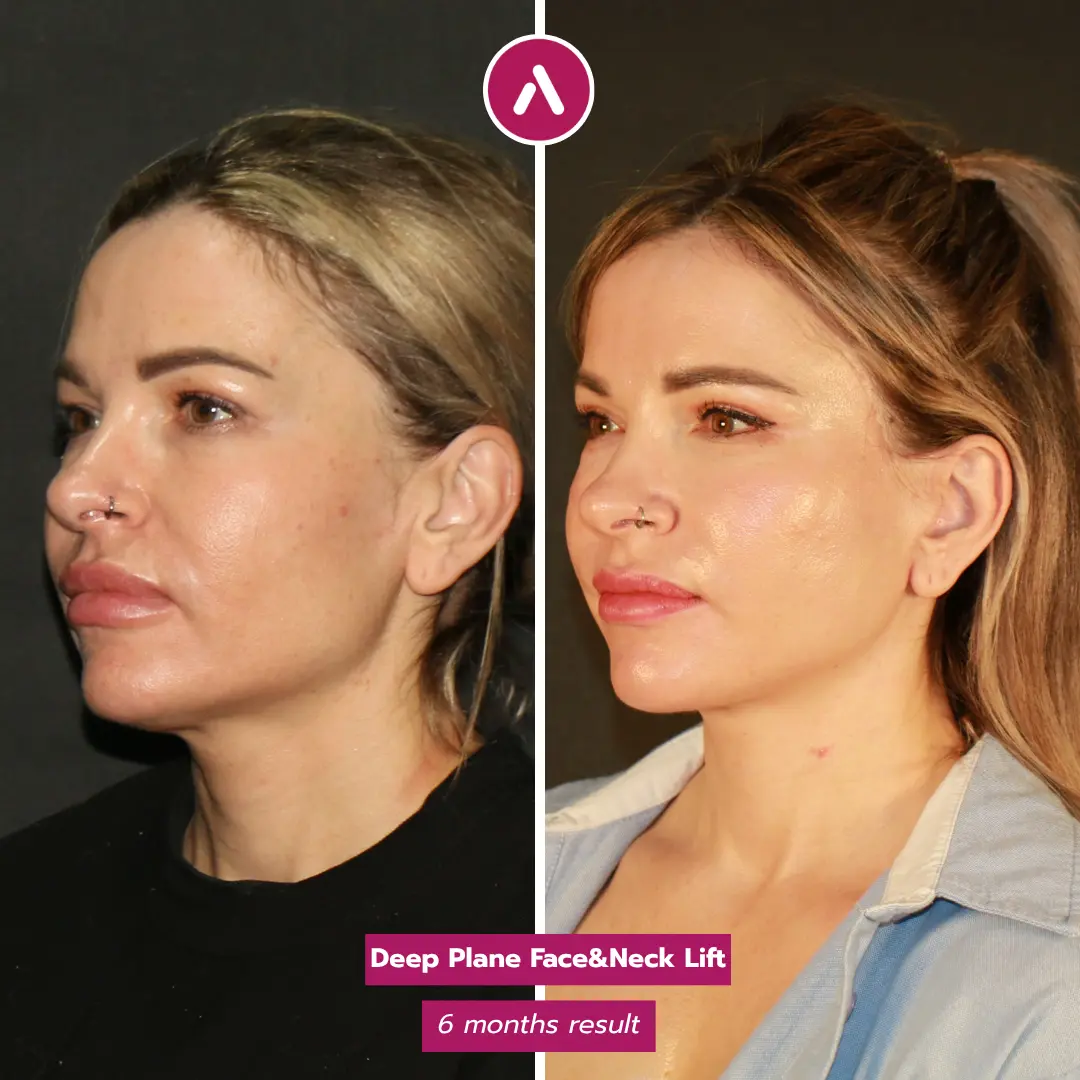
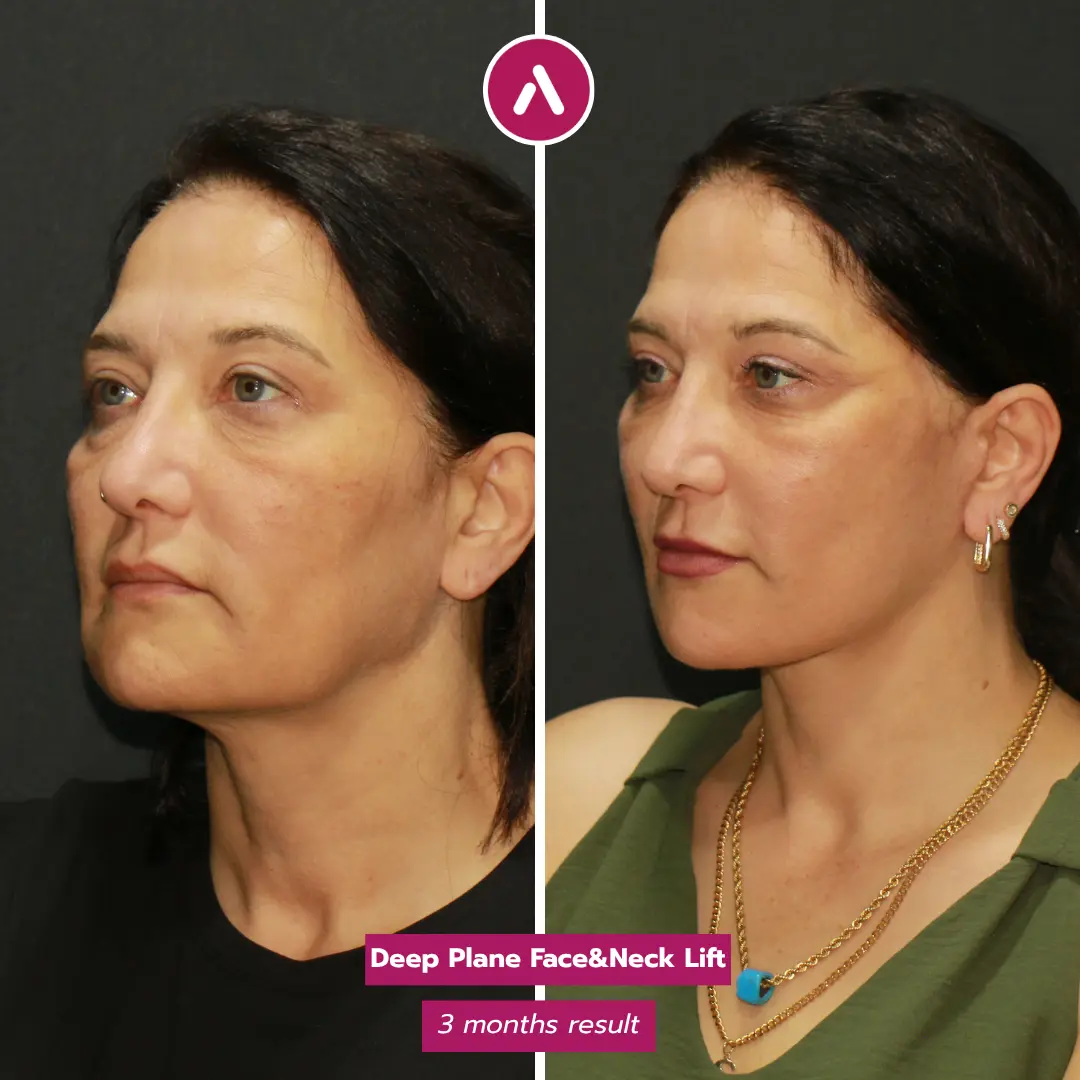
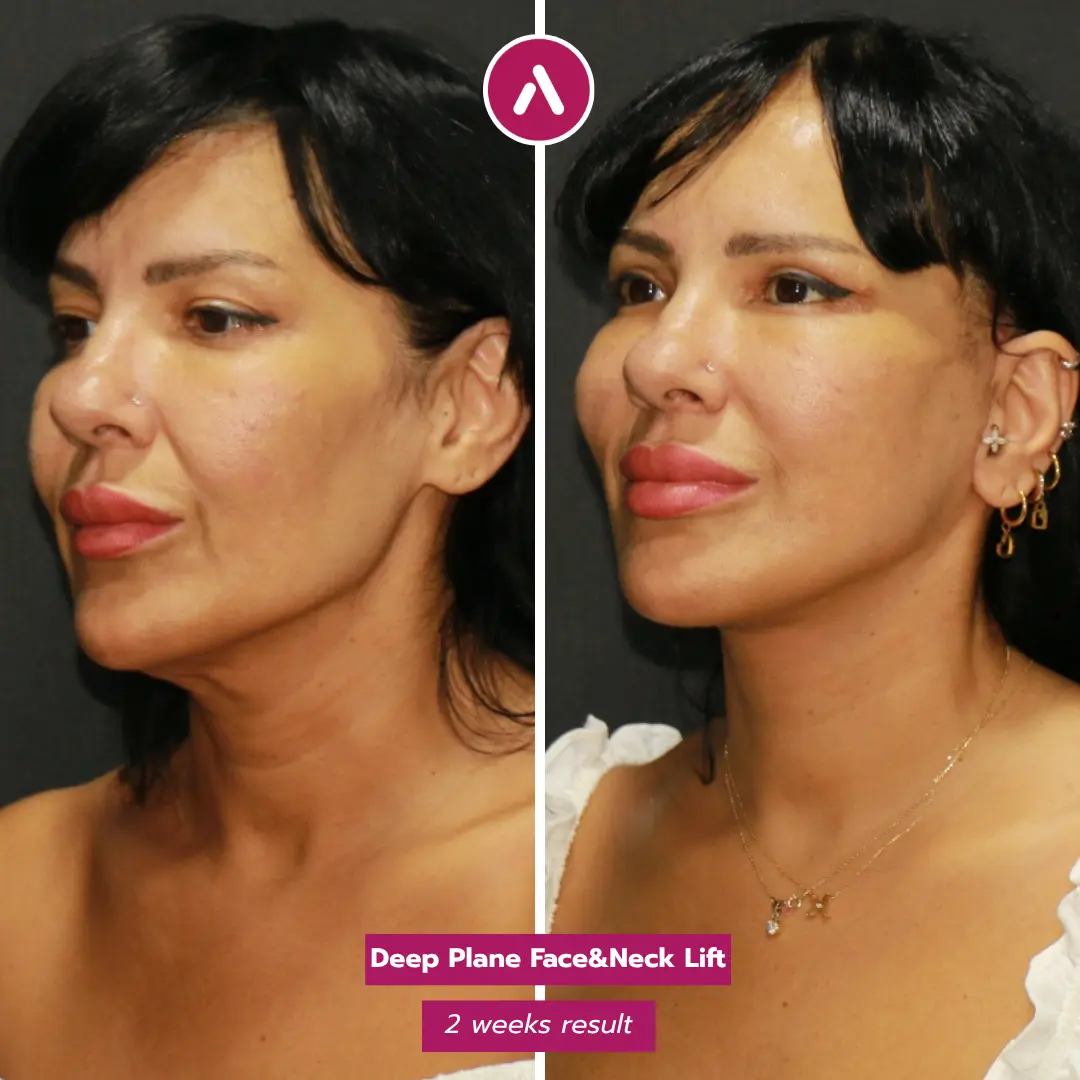
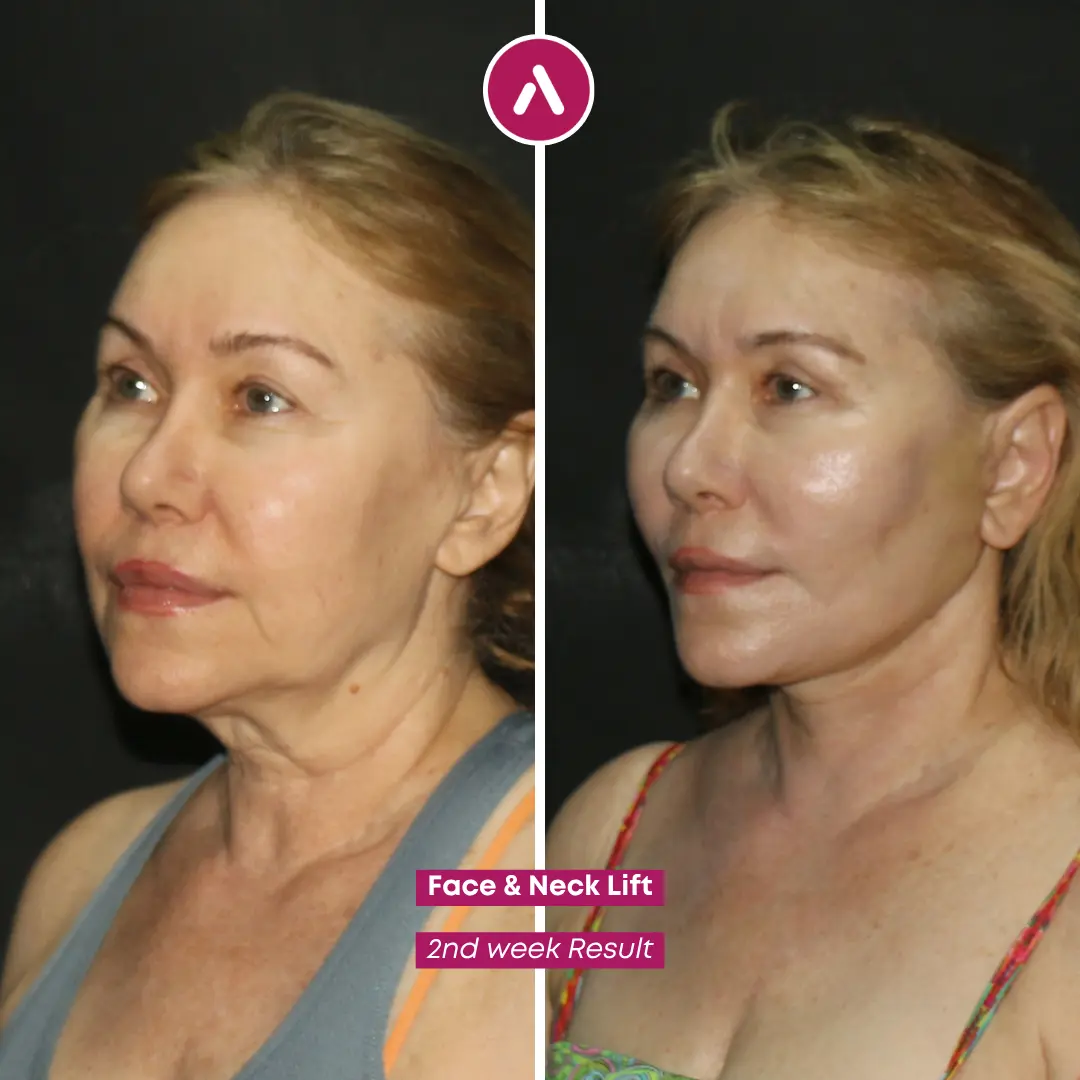
If you are researching a Facelift, you are likely looking for a result that reads as natural, not “done”. That is exactly how we frame this procedure at AKM Clinic. We focus on structural correction rather than simply tightening skin. The aim is measured: a refreshed, rested version of you.
Rejuvenation, Not Alteration.
Table of Contents

What is a Facelift?
A facelift is a surgical procedure that lifts and repositions the deeper facial tissues that have descended with age, with the goal of restoring jawline definition and reducing jowls. It is designed to address structural change, not just surface skin laxity. Done well, it can refresh the face without changing your identity.
Ageing tends to show in patterns, not in one single “problem area”. The lower face can look heavier, the mid-face can drop, and the neck can lose its crisp angle. Modern facelift surgery is planned around these deeper shifts. That is why technique matters more than slogans.
The anatomy of facial ageing (SMAS, retaining ligaments, fat pads)
To understand what a facelift targets, it helps to think in layers. The skin is only the cover. The real changes often happen in the support system underneath, particularly the SMAS and the retaining ligaments that act like anchoring points.
- SMAS (Superficial Musculoaponeurotic System): a supportive layer that influences facial shape and “drop”.
- Retaining ligaments: tether points that can contribute to fixed folds as tissues descend.
- Fat pads: volume can shift downwards, creating a heavier lower face and a tired expression.
For many patients, the most natural correction comes from lifting these deeper structures in a vertical direction, rather than pulling the skin sideways. This is the logic behind modern approaches such as a deep plane facelift, where ligament release under the SMAS allows a true structural repositioning.
What a facelift does vs what it cannot do
A facelift is excellent for repositioning and contour. It is not a skin-quality treatment on its own. When expectations are realistic, satisfaction rises.
- Can help: jowls, a softened jawline, mid-face descent, and certain neck changes (depending on technique).
- May help indirectly: the “tired” look created by heaviness and shadowing in the lower face.
- Does not replace: skin resurfacing for fine lines, pigment, or texture issues.
In practice, the plan is often layered. Structural lift first. Skin quality, when needed, is managed with adjunctive treatments rather than over-tensioning the skin.
Face vs neck: why the jawline/neck often need a combined plan
Patients commonly describe two connected concerns: jowls and the neck. That makes sense anatomically because the lower face and neck age together. If the neck is ignored, the result can look incomplete, even if the face is lifted well.
In many cases, we combine facial lifting with targeted neck work, such as a platysma repair (platysmaplasty), to restore a cleaner neck angle. This focuses on the deeper muscular component of neck ageing, not just surface skin. The goal is harmony from cheek to jawline to neck.
Benefits of a Facelift: what can it realistically achieve?
The best outcomes are often the least obvious. You should not look “operated on”. You should look lighter in the lower face, cleaner at the jawline, and more rested around the mouth and cheeks. That is why we prioritise a natural vector of lift and a tension-aware closure.
Turn back the clock, not change the face.
Natural, “well-rested” rejuvenation (avoiding the overdone look)
UK patients tend to be wary of a pulled or wind-swept appearance. That concern is valid, and it usually comes from over-reliance on skin tension. Modern facelift planning aims to move the deeper composite unit, then let the skin redrape naturally.
- Less “tightness”, more true repositioning.
- Restored cheek position without an artificial, stretched look.
- A jawline that looks defined, not “snatched”.
When technique respects anatomy, subtlety becomes the marker of quality. The face reads as familiar. It simply looks better rested.
Jawline definition, jowls, mid-face descent: targeted improvements
Most facelift consultations start with one phrase: “I’ve lost my jawline.” The structural reasons are usually jowling and deeper tissue descent. A well-planned lift can re-sculpt the lower face by repositioning tissue rather than excising skin alone.
- Jawline: improved definition by addressing jowls and deeper laxity.
- Mid-face: vertical repositioning can reduce the look of heaviness and soften certain folds.
- Neck: when needed, muscular tightening supports a smoother transition from face to neck.
The key is matching the method to the pattern of ageing. That is why one “standard facelift” does not fit every face.
Confidence and alignment with self-image
Many patients describe a mismatch between how they feel and what they see in the mirror. The goal is not perfection. It is alignment.
When the lower face no longer looks heavy and the neck angle is cleaner, the whole expression can look calmer. This can change how you photograph, how you present, and how you feel day-to-day. It is a practical kind of confidence.
Am I a Suitable Candidate For a Facelift?
A facelift is most effective when it is chosen for the right reasons, at the right time, and with a clear understanding of what surgery can and cannot improve. In consultation, we focus on your facial anatomy, how your tissues have descended, your skin quality, and the result you consider “natural”.
Ideal candidacy: skin quality, tissue descent patterns, expectations
You may be a good candidate if you are noticing jowls, loss of jawline definition, or a heavier lower face that does not respond to non-surgical treatments. The best surgical plans are built around the pattern of ageing rather than a single feature. For example, some patients have mainly lower-face laxity, while others have a combined mid-face and neck change that benefits from a more comprehensive lift.
Equally important is the “why” behind your decision. Patients who do well tend to have realistic, specific goals (such as restoring a cleaner jawline or reducing jowling) rather than chasing a completely different face. A natural-looking facelift should make you look refreshed and well-rested, not dramatically altered.
Medical screening & safety gates (pre-op health screenings)
Safety starts before surgery day. Your medical history, medications and supplements, smoking status, and any conditions that can influence healing are reviewed carefully. This is followed by pre-operative checks to make sure your plan is appropriate and your recovery risk is minimised. If anything raises concern, we adjust the plan, request further evaluation, or advise postponing until it is safe to proceed.
From a practical standpoint, we also plan for recovery: who will support you, how you will sleep, and how your early healing will be monitored. A well-prepared patient typically has a smoother first week.
Who should avoid or postpone surgery
There are times when a facelift is not the right choice—at least not yet. Uncontrolled medical conditions, active infections, and factors that significantly compromise healing may mean surgery should be delayed or avoided. Smoking and nicotine products are particularly important, as they can reduce blood supply and increase the risk of wound-healing problems. Certain medications can also affect bleeding risk and must be discussed in advance.
If your primary concern is skin texture, fine lines, or pigmentation rather than structural descent, you may benefit more from skin-focused treatments (or a staged approach). The right plan is the one that matches your anatomy and goals, not the most aggressive option.
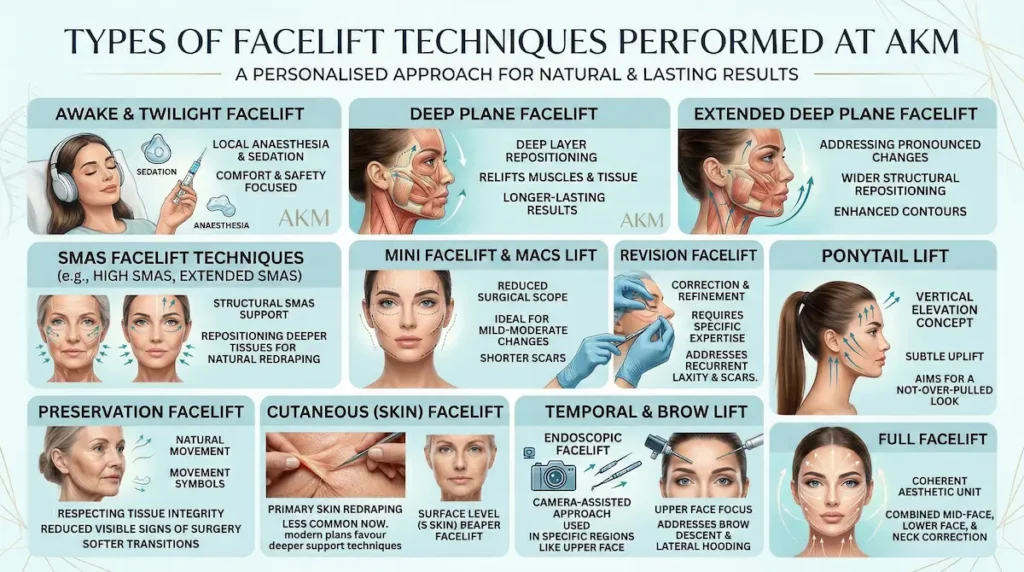
Types of Facelift We Perform at AKM
There is no single “one-size-fits-all” facelift. Technique selection depends on what has changed anatomically, the degree of laxity, scar considerations, and how you define a natural result. Below is an overview of the facelift approaches we may discuss during consultation.
Awake Facelift & Twilight Facelift (signature approach)
For suitable patients, facelift surgery can be performed with local anaesthesia and sedation. This approach is designed to prioritise comfort and safety while avoiding general anaesthesia when it is not required. Suitability depends on your medical profile, anxiety levels, and the expected surgical scope.
Deep Plane Facelift, SMAS Facelift, Extended/High SMAS, MACS, Mini Facelift
These techniques differ in how they address deeper support layers and how the lift is achieved. Broadly, deep-plane and SMAS-based approaches focus on repositioning deeper tissues so the skin can redrape without excessive tension. Mini and MACS-style lifts may be appropriate when changes are mild to moderate and a shorter scar or reduced surgical scope is preferred.
Revision facelift: who is it for and why it requires specific expertise
Revision facelift surgery is considered when a patient has had a previous facelift and now needs refinement—whether due to recurrent laxity, scar-related concerns, or an unnatural vector from an earlier technique. Revision cases require careful planning because tissue planes may be altered and scar tissue can affect both safety and predictability.
Preservation Facelift
“Preservation” concepts aim to respect tissue integrity and reduce visible signs of surgery by working with anatomical planes in a way that supports natural movement and a softer transition in key areas. The exact plan depends on your anatomy and goals, and may be paired with other lifting methods.
Extended Deep Plane Facelift
An extended deep-plane approach may be discussed when the mid-face, lower face, and neck changes are more pronounced, or when a wider structural repositioning is needed for balance. It is planned to improve contour while keeping the result natural rather than tight.
Cutaneous (Skin) Facelift
A skin-only lift focuses primarily on redraping skin. While it can offer improvement in selected patients, modern planning often favours deeper support techniques when appropriate, as they can reduce the need for skin tension—an important factor for scar quality and naturalness.
Ponytail Facelift
The term “ponytail facelift” is often used to describe a more vertical, upper-face-oriented lift concept that aims for subtle elevation without a heavy or pulled look. Suitability depends on where your ageing changes are concentrated and whether deeper support needs to be addressed.
Endoscopic Facelift
Endoscopic techniques can be used in specific regions—most commonly the upper face—using small incisions and a camera-assisted approach. When appropriate, this can help lift tissue with reduced incision length, although it is not the best fit for every pattern of ageing.
Temporal and Brow Lift
For patients whose main concern sits in the upper third of the face (brow descent, lateral hooding, or a tired upper-eye frame), a temporal or brow lift may be recommended either alone or combined with a lower-face lift. The goal is a rested, open look rather than a surprised expression.
Full Facelift
A full facelift plan typically addresses the mid-face, lower face, and (when indicated) the neck as one coherent aesthetic unit. This is usually recommended when ageing changes are more global, and when a harmonious correction will look more natural than treating areas in isolation.
In consultation, we will explain which approach matches your anatomy and why—focusing on natural vectors, scar planning, and an aftercare pathway that supports safe healing.
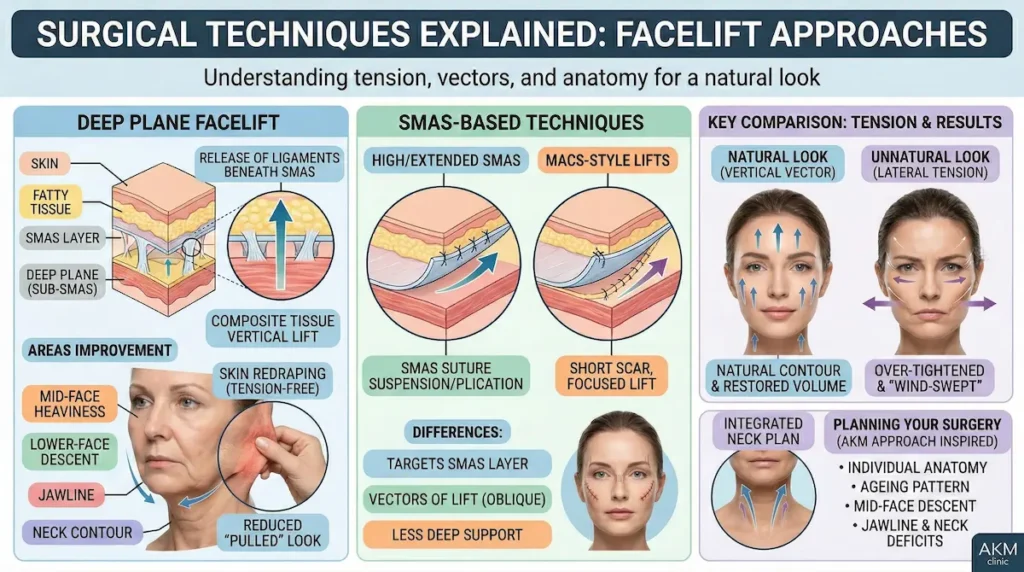
Face Lift Surgical Techniques Explained: Deep Plane vs SMAS vs other Facelift approaches
When patients talk about wanting a “natural” result, they are usually describing two things: the direction of lift and how tension is managed. The technique chosen matters because it determines whether the result is driven by deeper structural repositioning or by skin tension. At AKM, we plan around your anatomy, your pattern of ageing, and the areas you want improved (mid-face, jawline, and/or neck).
Tension-free closure, not skin pull.
Deep Plane: ligament release + vertical lift for a tension-aware result
A deep plane approach works beneath the SMAS layer, allowing the surgeon to release specific retaining ligaments and reposition the facial tissues as a composite unit. In practical terms, this can improve mid-face heaviness and lower-face descent while supporting a more vertical, natural vector of lift.
Because the deeper tissues are repositioned, the skin can be re-draped rather than forcibly tightened. This matters for two reasons: it helps reduce the “pulled” appearance some patients fear, and it supports scar quality by minimising skin tension at incision lines.
High/Extended SMAS and MACS: what they target and who they suit
SMAS-based techniques focus on lifting and securing the supportive layer beneath the skin. A high or extended SMAS plan may be considered when the lower face and jawline need meaningful improvement, and when deeper support is required to avoid relying on skin tightening alone.
MACS-style lifts can be suitable for mild to moderate changes, often with a shorter scar pattern and a focused lift. In some patients, it can provide a refined improvement with less surgical scope. The right choice depends on how much descent is present and whether the mid-face and neck also need structural correction.
Vertical vector vs a “pulled” look: how planning prevents over-tight results
A common concern—especially for UK patients—is looking “tight” or wind-swept. This is less about geography and more about mechanics. Over-lateral pulling and skin-dependent tightening increase the risk of an unnatural look. Planning a vertical or oblique-vertical vector, and securing deeper tissues appropriately, helps the face read as refreshed rather than altered.
It is also why we discuss the neck as part of the overall plan. If jawline improvement is achieved but the neck is left behind (or treated superficially), the result can feel incomplete. A balanced approach avoids that mismatch.
| Technique | Best suited for | Key advantages | Considerations |
|---|---|---|---|
| Deep Plane | Moderate to significant mid-face and lower-face descent; patients prioritising natural movement | Composite tissue repositioning; supports a natural vector; reduces reliance on skin tension | Highly technique-dependent; requires careful anatomical planning |
| High/Extended SMAS | Lower-face/jawline laxity with need for strong structural support | Addresses deeper support layer; can improve contour without over-tight skin | Plan varies by anatomy; may be combined with neck work for best harmony |
| MACS / Mini lift | Mild to moderate ageing changes; patients seeking a more limited lift | Often less extensive; focused improvement; can suit selected candidates | May be insufficient for significant neck or mid-face descent |
| Cutaneous (Skin-only) | Selected patients where skin redraping is the main goal | Simpler concept; can offer improvement in carefully chosen cases | Higher risk of tension-related look/scar issues if used for structural problems |
| Preservation concepts | Patients prioritising soft transitions and minimal “surgical signs” | Emphasis on respecting tissue planes and natural movement | Not a single universal method; best defined through individual surgical planning |
In consultation, we explain the “why” behind the technique recommendation. The goal is not to sell a label. It is to match the method to your facial structure, your scar preferences, and the outcome you consider convincingly natural.
Incisions, Scars, and “Pixie Ear” Prevention in Facelift Surgery
Scar planning is not an afterthought—it is part of the surgical design. A refined result depends on incision placement, tension management, and closure technique. Most concerns patients search for online (visible scars, uneven contouring, or ear changes) are linked to these fundamentals.
Incision placement: behind the tragus and behind the ear
Incisions are typically designed to sit within natural creases and around the ear contours so they are discreet once healed. Depending on your anatomy and the chosen approach, this may include an incision that sits in front of or within the tragal area, then continues around the ear and into the hair-bearing region behind it.
The intention is twofold: allow precise access to the deeper tissues and keep the scar as inconspicuous as possible. Hairline preservation, symmetry, and how your skin naturally folds are all considered in where (and how) an incision is placed.
Scar maturation timeline: what to expect at 1 week, 4 weeks, and beyond
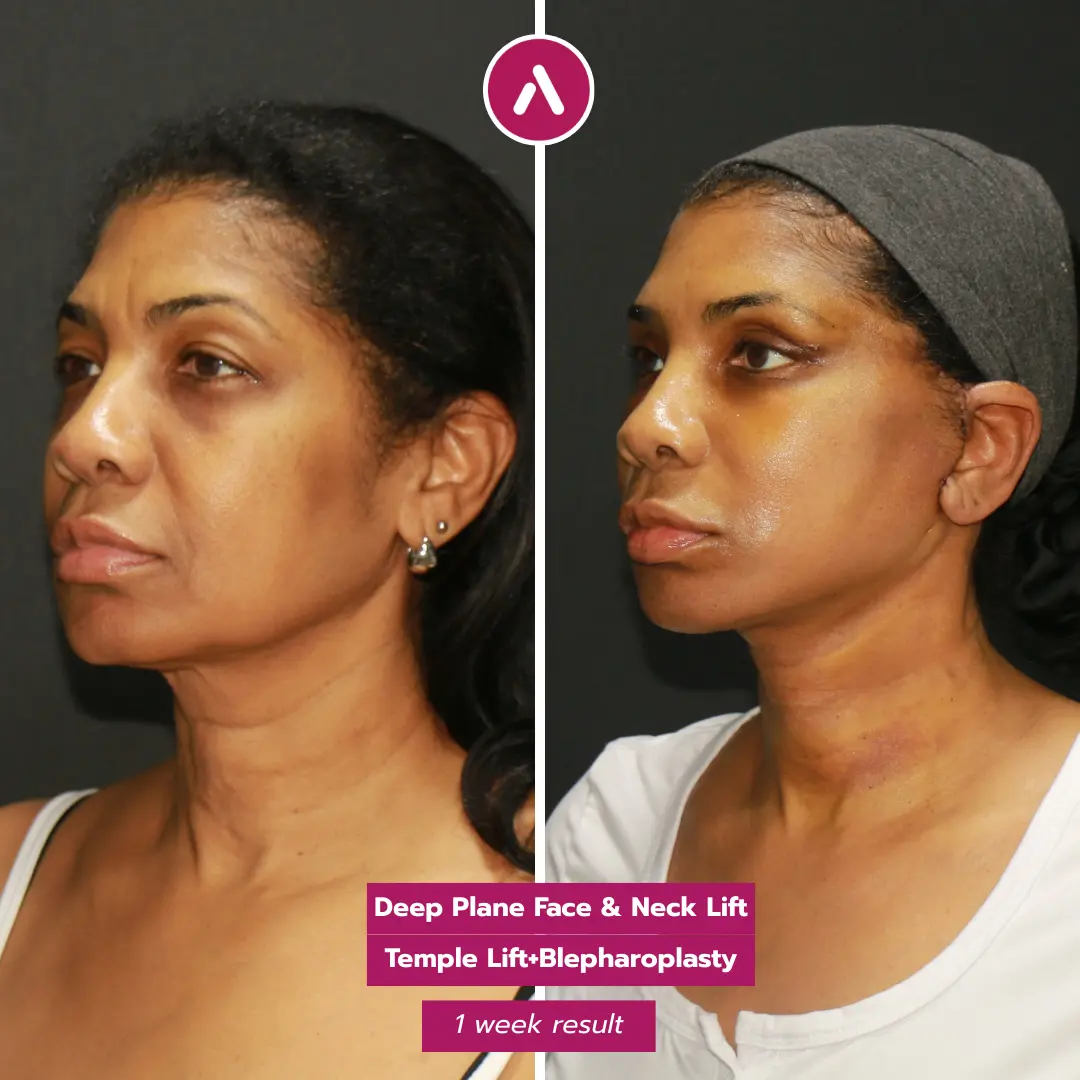
Early healing can look confronting if you do not know what is normal. At around one week, incision lines may appear pink, slightly raised, or crusted, and there can be visible swelling and bruising. At four weeks, many patients look socially presentable, but it is still common to have residual swelling—particularly in the lower face and neck.
Scar maturation is a longer process. Over the following months, incision lines typically soften and fade. The exact timeline varies with your skin type, individual healing biology, and aftercare consistency. We guide you through practical scar care such as gentle cleansing, avoiding unnecessary tension, sun protection, and (when appropriate) silicone-based scar support.
Pixie ear deformity: why it happens and how it is prevented
“Pixie ear” describes a pulled or elongated look of the earlobe that can occur when closure tension is placed on the skin rather than supported by deeper tissues. Prevention is rooted in technique: planning the vector of lift, anchoring deeper layers appropriately, and closing without dragging the earlobe downwards.
We also pay attention to earlobe shape and attachment as part of the pre-operative assessment, because individual anatomy matters. The goal is that the ear looks unchanged—simply as it always has—while the jawline and neck look cleaner and more defined.
If you have specific concerns (for example, you have seen photos of visible scars behind the ear or you are worried about ear shape changes), bring them to consultation. These details are exactly where a careful plan makes the difference.
Anaesthesia: why we prefer Awake / Twilight Sedation for a Facelift
For many UK patients, the biggest concern is not only the result, but the safety profile of surgery itself. Anaesthesia choice is a major part of that conversation. At AKM, we often plan suitable facelift cases using local anaesthesia with sedation (commonly described as “twilight sedation”), rather than defaulting to general anaesthesia for everyone.
Major facial rejuvenation doesn’t always require general anaesthesia.
Awake surgery vs general anaesthesia: comfort, control, and safety logic
General anaesthesia can be appropriate and necessary in certain cases. However, it is not the only option. In selected patients, sedation with local anaesthesia can provide a calm, comfortable experience while avoiding some of the downsides associated with a deeper anaesthetic.
From a patient point of view, the priorities tend to be simple: comfort during the procedure, stable monitoring, and a smoother immediate recovery period. “Awake” in this context does not mean fully alert or distressed—it means you are not under a full general anaesthetic. The sedation plan is designed to keep you relaxed and comfortable while the surgical team works in a controlled, monitored environment.
Local / tumescent anaesthesia and conscious sedation
Local anaesthesia is used to numb the surgical area, and tumescent techniques may be used to support comfort and reduce bleeding. Sedation is then tailored to your needs, with continuous monitoring throughout. The goal is straightforward: keep you comfortable while maintaining a stable and predictable anaesthetic course.
We explain the plan in plain terms before surgery day—what you are likely to feel (pressure rather than pain), what you will not feel, and how we manage comfort if anxiety rises. Clear expectations reduce stress, and lower stress supports better early recovery behaviours (hydration, sleep positioning, and consistent aftercare).
Who is suitable for Awake / Twilight Sedation?
Suitability depends on your health profile, the expected scope of surgery, and how you cope with medical environments. During consultation, we assess factors such as:
- Your medical history and any conditions that affect anaesthetic risk.
- Your comfort level with sedation-based procedures.
- Whether the planned surgical extent is appropriate for a sedation approach.
If you are not a candidate for sedation-based surgery, we will say so. The point is not to force a method—it is to match the anaesthesia plan to the safest, most comfortable route for you.
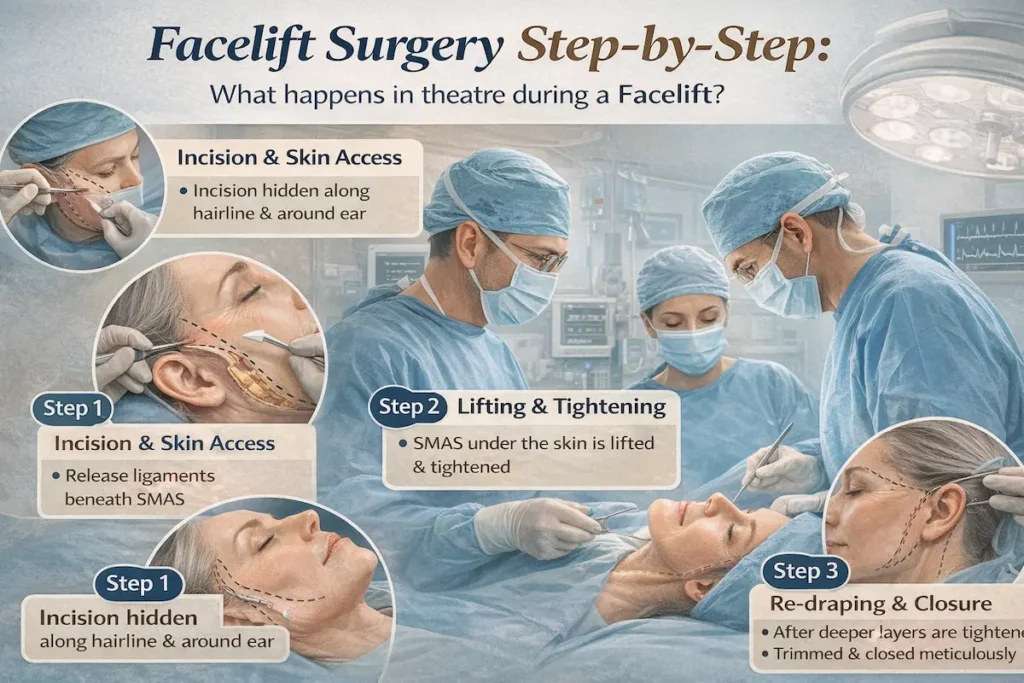
Facelift Surgery Step-by-Step: what happens in theatre during a Facelift?
Patients often feel calmer when they understand the flow of the day. While every plan is personalised, the structure is consistent: assessment, preparation, careful execution, and monitored recovery. Below is a high-level overview of what to expect.
Pre-op day: checks, planning, markings
Before theatre, we confirm your surgical plan and review key details: your medical history, medications and supplements, allergies, and any last-minute questions. Pre-operative checks are completed, and your surgeon will perform markings to guide incision placement and lifting vectors. This is also the time we align expectations—what you want improved, how we keep the result natural, and what a normal early recovery looks like.
Consent is not treated as paperwork. It is a conversation. You should feel clear on the plan, the rationale behind the chosen technique, and how aftercare will be structured.
In theatre: the procedure flow (high-level)
Once the anaesthesia plan is in place and you are comfortable, the surgical field is prepared. Incisions are made according to the agreed scar plan, and the chosen technique is performed—whether that involves deep structural repositioning, SMAS work, or a more limited lift for selected candidates. The goal is always the same: address the deeper changes responsibly, then allow the skin to redrape without excessive tension.
Closure is performed with scar quality and ear/tragus aesthetics in mind. Dressings are applied as needed, and you are moved into a monitored recovery area.
Immediate post-op: monitoring, discharge plan, the first days
After surgery, you will be observed as the sedation wears off, with attention to comfort, swelling, and early safety checks. You will receive clear instructions on positioning, activity, and basic incision care. The first week is typically about protecting the result: rest, gentle movement, and avoiding unnecessary strain.
It is also normal to have questions in the first days—about swelling patterns, bruising colour changes, and what is “within range” versus what should be flagged. Our aftercare pathway is designed to guide you through those early milestones so you do not have to guess.
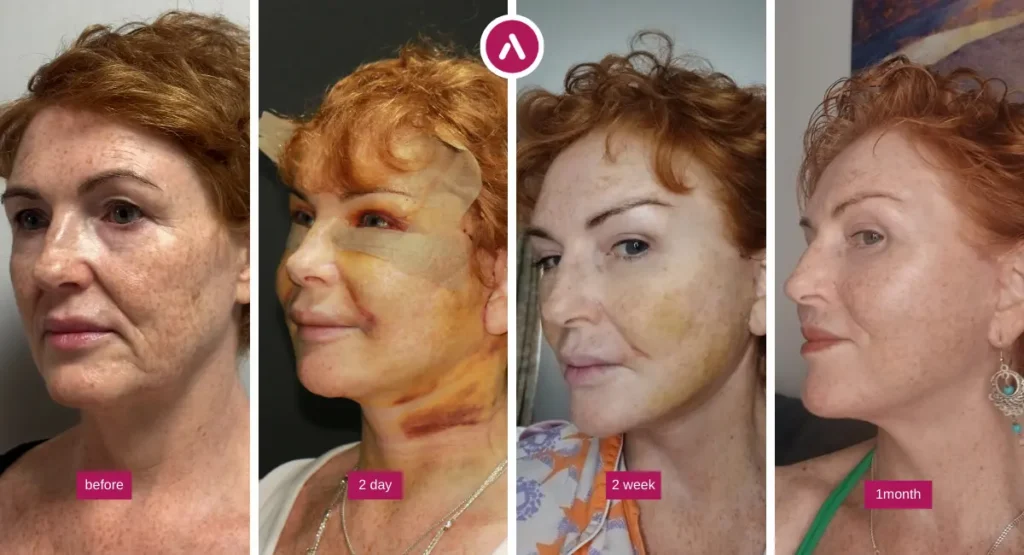
Facelift Recovery & Aftercare: how long does healing take after a Facelift?
Recovery is a process, not a single milestone. Most patients look presentable before they feel fully “back to normal”, and that gap can be reassuring when you understand it. Your timeline depends on the extent of lifting, whether the neck is addressed, your healing biology, and how consistently you follow aftercare guidance.
Day-by-day: what to expect in the first week
The first week is usually about protection and stability. Swelling and bruising are common, and your face may feel tight or “full” due to normal post-operative inflammation. You may also notice asymmetry in swelling from side to side—this is common early on and usually settles gradually.
- Days 1–3: swelling and bruising typically build; rest, hydration, and head elevation matter.
- Days 4–7: bruising often changes colour and starts to fade; swelling remains but becomes more predictable.
- At ~1 week: incision lines can look pink or slightly raised; this is part of normal early healing.
Most early recovery success comes from simple habits: sleeping with your head elevated, avoiding sudden neck movements, not lifting heavy items, and following incision-care instructions exactly as given.
Weeks 2–6: “I feel better, but I’m still swollen” (including 4-week swelling)
This is the phase where expectations need to be realistic. Many patients are socially comfortable within a few weeks, but residual swelling—particularly around the jawline and neck—can persist longer than people expect. If you are thinking, “I’m 4 weeks post-op and still swollen,” that can still fall within a normal healing range.
Swelling tends to resolve in layers. The visible puffiness often improves first, while deeper firmness can take longer. The face also needs time to “settle” into its new position. That is why early photos can look good, but later photos often look even more natural.
“Rapid Recovery & Safety Protocol”: HBOT and LLLT as supportive care
At AKM, we may incorporate supportive recovery technologies into your aftercare plan when appropriate. These are not positioned as magic shortcuts, but as tools that can support comfort and tissue recovery as part of a structured protocol:
- HBOT (Hyperbaric Oxygen Therapy): may be used to support tissue oxygenation and recovery in selected patients.
- LLLT (Low-Level Laser Therapy): may be used as part of a plan to support healing and reduce the “recovery burden” in the early phase.
Whether these are recommended depends on your individual plan, your healing response, and clinical assessment. The goal is a safer, smoother recovery—not unrealistic speed.
Travel readiness: returning to the UK and “flight-ready” planning
If you are travelling from the UK, we plan recovery with travel in mind. “Flight-ready” is not a single date—it is a set of safety checkpoints: stable swelling, controlled discomfort, no concerning signs around incisions, and confidence in your aftercare instructions.
Before you fly, we review your progress and confirm the basics: how to sleep, what to avoid, how to protect scars from sun exposure, and what to do if you have questions once you are back home. Follow-ups are also structured so you are not left unsupported after you return.
Safety & Risks: Is a Facelift Dangerous?
Any surgery has risks. The question is how those risks are reduced through patient selection, surgical planning, and post-operative monitoring. A safe facelift pathway is built on preparation and transparency, not promises.
Common risks (and why they are discussed openly)
Facelift risks vary by technique, patient anatomy, and medical factors. Some risks are uncommon but important; others are temporary and expected. In consultation, we explain what matters for your profile rather than overwhelming you with generic lists.
- Bleeding/haematoma: requires prompt recognition and management.
- Infection: uncommon with proper protocols but always monitored.
- Nerve irritation or temporary weakness: can occur due to swelling or tissue handling; most issues are temporary, but careful technique is essential.
- Scarring concerns: usually improve with time; scar planning and tension management are key.
- Skin-healing issues: risk increases with smoking/nicotine and certain medical factors.
“Anxious searches”: ridges in cheeks, prolonged swelling, asymmetry
Many patients search for highly specific concerns after surgery—often late at night—because they do not know what is normal. Some examples include firmness or ridging, uneven swelling, and bruising that lasts longer than expected. These can be within the range of normal healing, especially in the early weeks, but context matters.
We guide you on what to watch for, what can wait for a routine check-in, and what should be escalated immediately. Having a clear framework reduces anxiety and prevents both overreaction and underreaction.
Risk reduction: the three pillars (selection, technique, monitoring)
Risk reduction starts with choosing the right candidate and the right scope of surgery. Pre-operative screening helps identify factors that increase risk and allows the plan to be adjusted accordingly. Technique then matters: anatomical respect, appropriate vectors of lift, and tension-aware closure all reduce avoidable complications.
Finally, monitoring and aftercare complete the safety cycle. Early questions are normal, and early intervention (when required) is always better than waiting. If you have concerns during recovery, you should contact your clinical team rather than relying on online anecdotes.
Is a Facelift Safe In Turkey For UK Patients?
UK patients tend to approach surgery abroad with a specific question: “Will the standards match what I expect at home?” That is a reasonable concern. Safety is not a marketing claim—it is a system: patient selection, controlled clinical pathways, consistent monitoring, and structured aftercare. When those elements are in place, travelling for surgery can be a calm, well-managed process rather than an unknown.
“British standards” expectations: what matters in real terms
When people say “British standards”, they usually mean predictable protocols and professional accountability. In practical terms, this translates into careful pre-operative screening, a clean and controlled clinical setting, clear consent and risk discussions, and a recovery plan that does not stop at discharge.
In consultation, we focus on the details that actually reduce risk: your medical profile, the suitability of the surgical scope, anaesthesia planning, and realistic recovery behaviour. For example, nicotine use, certain medications, and unmanaged health conditions can increase complication risk regardless of where surgery is performed. Addressing these factors early is one of the most important safety decisions you can make.
Clinic environment and location: why logistics are part of safety
Safety is also influenced by logistics. A smooth experience reduces stress, and lower stress supports better recovery decisions (resting properly, taking medicines as directed, and not rushing the early phase). Our clinic is located in Istanbul (Levent), and patient journeys are planned around controlled transfers and a clear schedule of clinic visits.
Rather than leaving you to coordinate everything alone, the pathway is designed to reduce friction: arrival planning, clinic access, and a predictable timetable for review appointments. This matters because early healing is not the time to improvise.
Continuity of care: follow-up after you return to the UK
One of the biggest worries for UK patients is aftercare once they are home. A safe pathway includes continuity, not just an operation. Follow-up is structured, and remote check-ins are built into the plan so you are not left relying on online anecdotes to interpret normal healing signs.
From a patient perspective, this is often what turns an overseas option into a comfortable decision: knowing you can ask questions as swelling settles, scars mature, and the result refines over time. A facelift result is a journey—support should be, too.
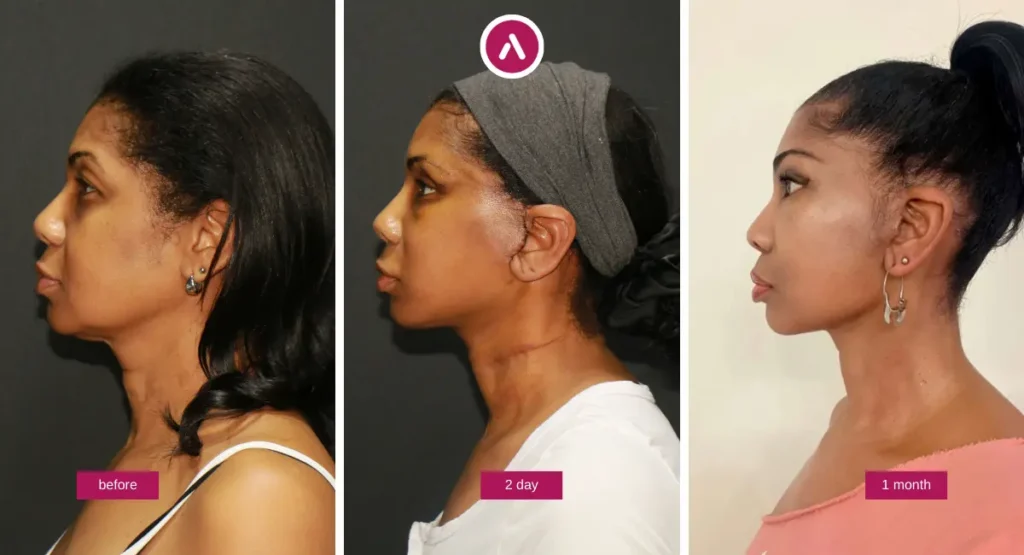
Facelift Before and After: Realistic expectations and results after a Facelift
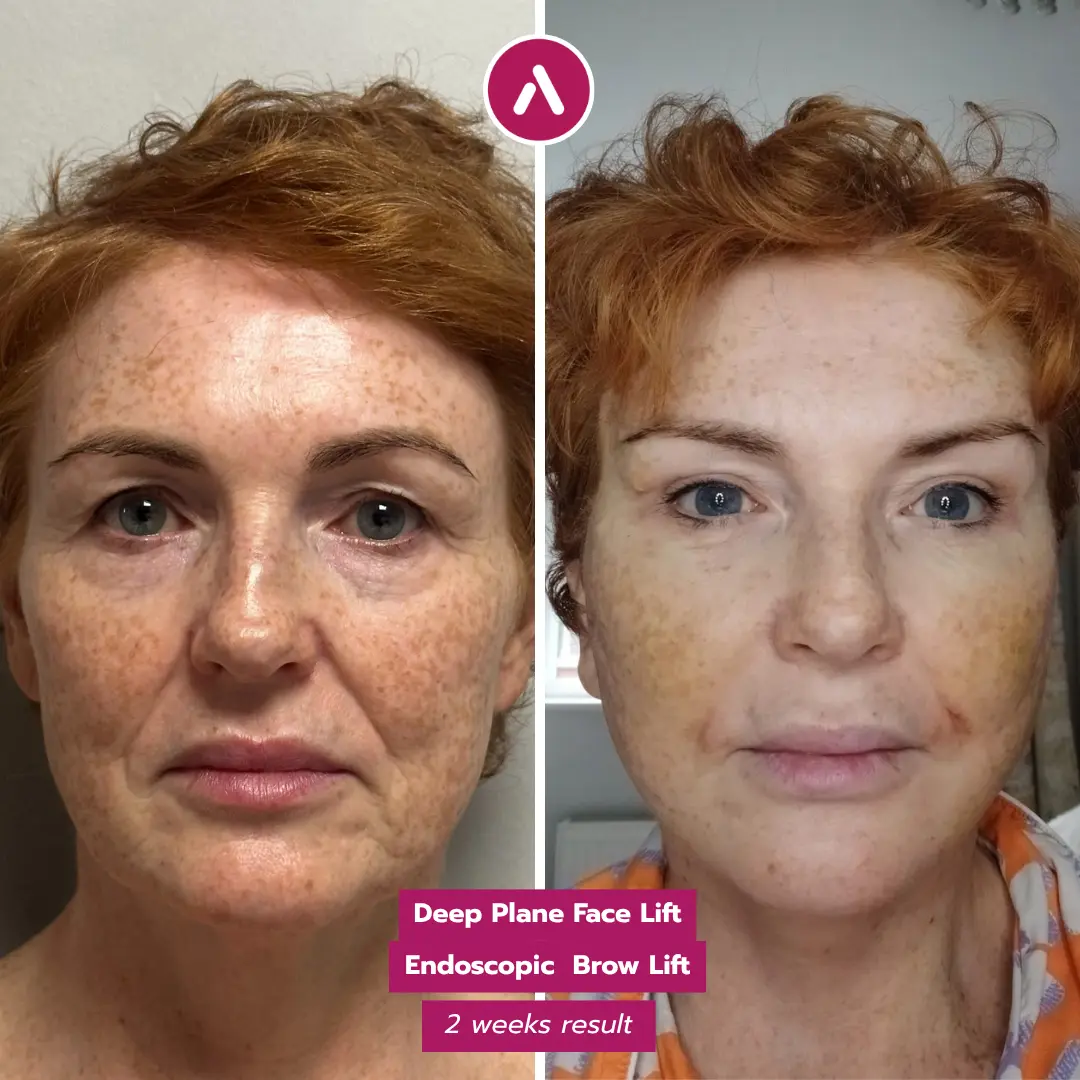
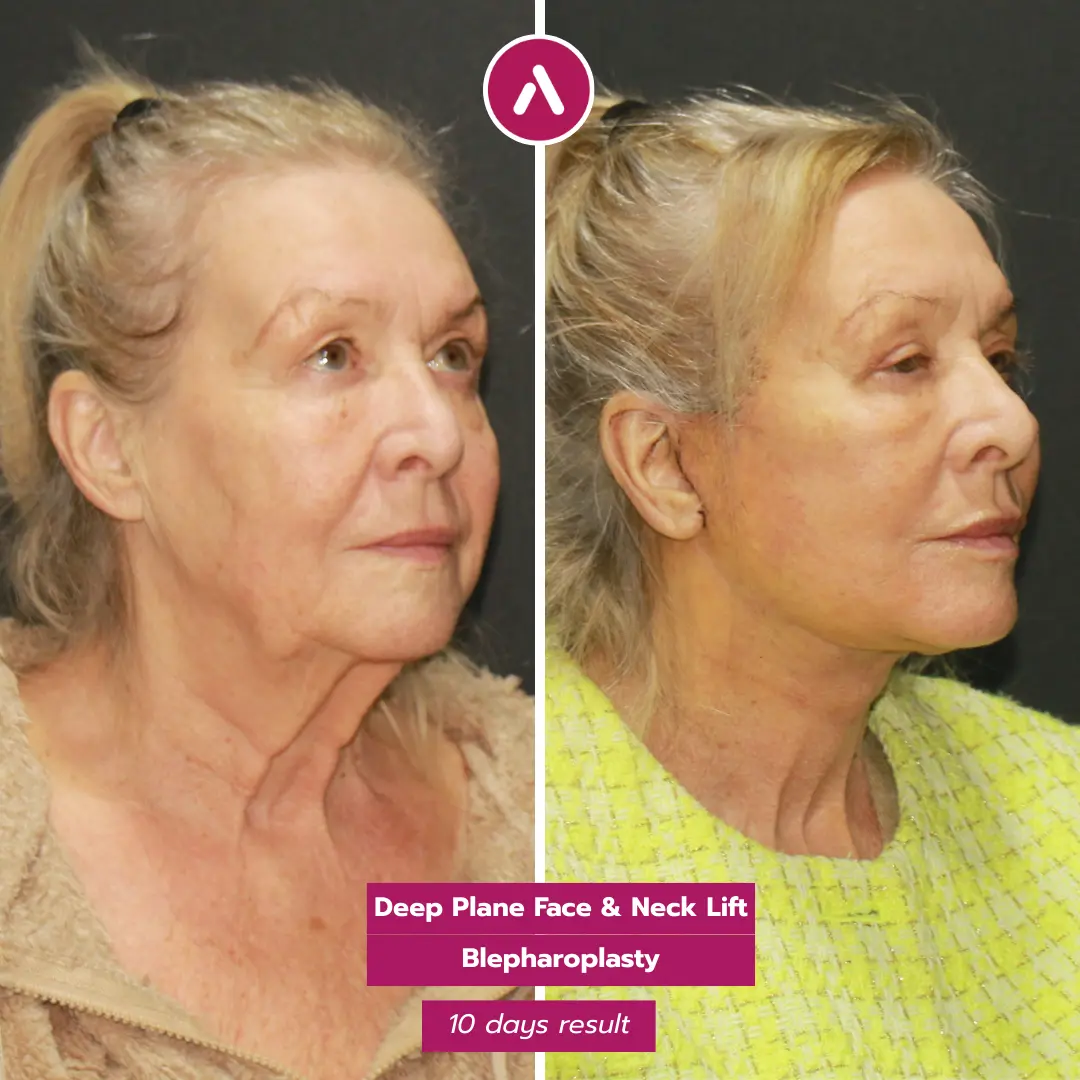
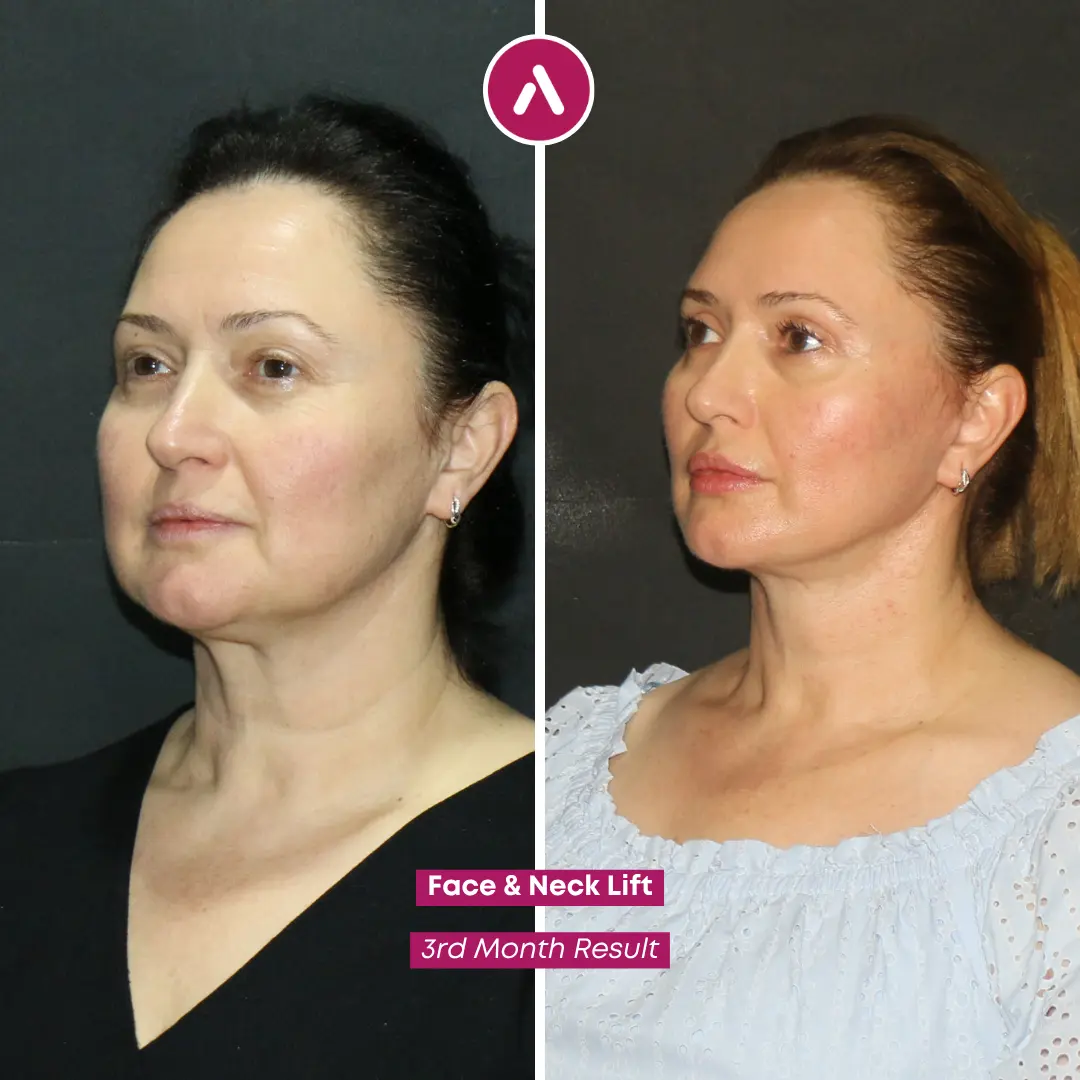
The most satisfying results tend to be the most believable. The aim is not to create a different face—it is to restore structure and reduce the heaviness that can make you look tired or older than you feel. Understanding the timeline and what “normal” looks like at each stage helps you judge your result fairly.
Our aim is to restore structure, not create a new face.
When will I see my “final” result?
You will see improvement early, but refinement continues for months. In the first few weeks, swelling can change the way your face reads—sometimes day to day. By around four to six weeks, many patients feel socially comfortable, but subtle swelling and firmness can still be present, especially along the jawline and neck.
Over the following months, the tissues settle, scars soften, and the result becomes more “you”. This is why early photos can look encouraging, while later photos often look even more natural. It is also why comparing yourself to someone else’s timeline online is rarely helpful. Healing is individual.
How long do facelift results last?
A facelift does not stop ageing, but it can reset the baseline by repositioning descended tissues. Longevity depends on several factors:
- Your starting anatomy and the degree of tissue descent corrected.
- The technique chosen and how well it matches your ageing pattern.
- Skin quality and lifestyle factors such as sun exposure and smoking/nicotine.
The more the plan relies on structural support (rather than skin tension), the more natural the result tends to read over time. A good facelift should age with you, not fight your face.
What does “natural” actually mean in a facelift?
Patients often say they want to look “refreshed”, but that can be vague. In facelift terms, “natural” usually means:
- The face still looks like you—just less heavy in the lower third.
- The jawline is cleaner without looking artificially tight.
- The neck transition looks smoother without a stretched or strained appearance.
Natural also means balance. If the lower face is improved but the neck is ignored (or treated superficially), the result can feel incomplete. If the upper face is dominant but the lower face is left behind, it can feel mismatched. The best plans look at the face as a whole, then choose the most conservative approach that achieves a meaningful change.
Combined procedures: maximising your result
Facial ageing rarely happens in a single zone. That is why, for selected patients, combining procedures can create a more balanced, believable outcome than treating one area in isolation. The guiding principle is proportionality: we look for the smallest combination that delivers harmony across the face and neck.
Neck lift / platysmaplasty: when the neck needs structural support
Many patients describe “jowls” and “neck laxity” as one problem, because the jawline and neck visually merge as the tissues descend. If the neck is not addressed when it needs to be, the result can look incomplete even if the lower face has improved. In suitable cases, a neck lift plan may include platysma work to improve banding and to restore a cleaner cervico-mental angle (the neck-to-chin definition).
The aim is not to create an unnaturally tight neck, but to restore clarity: a smoother transition from jawline to neck, and a profile that looks sharper in a relaxed, natural way.
Blepharoplasty and brow/temporal lift: framing the eyes without a “surprised” look
In some patients, the lower face ages first; in others, the upper third (brow position and eyelid heaviness) contributes most to looking tired. When upper-face descent is a dominant factor, procedures such as blepharoplasty (eyelid surgery) or a brow/temporal lift can be discussed. The objective is subtle elevation and a rested eye frame—without an over-lifted, startled expression.
These options can be performed on their own or combined with a lower-face plan, depending on your anatomy and priorities. The key is to keep the face coherent: treating the eyes while ignoring the lower face (or vice versa) can sometimes create imbalance.
Fat transfer, lip lift, and skin-quality treatments: finishing touches when appropriate
Structural lift addresses descent. Volume and skin quality are separate considerations. If volume loss is a major part of the ageing pattern, fat transfer can be considered to restore softness in selected regions. If the concern is mostly around the upper lip length or perioral proportion, a lip lift may be discussed for the right candidate.
For skin texture and fine lines, resurfacing-style treatments may be considered as staged adjuncts rather than trying to “solve” skin quality by pulling the skin tighter. This approach supports naturalness and helps protect scar quality by avoiding unnecessary tension.
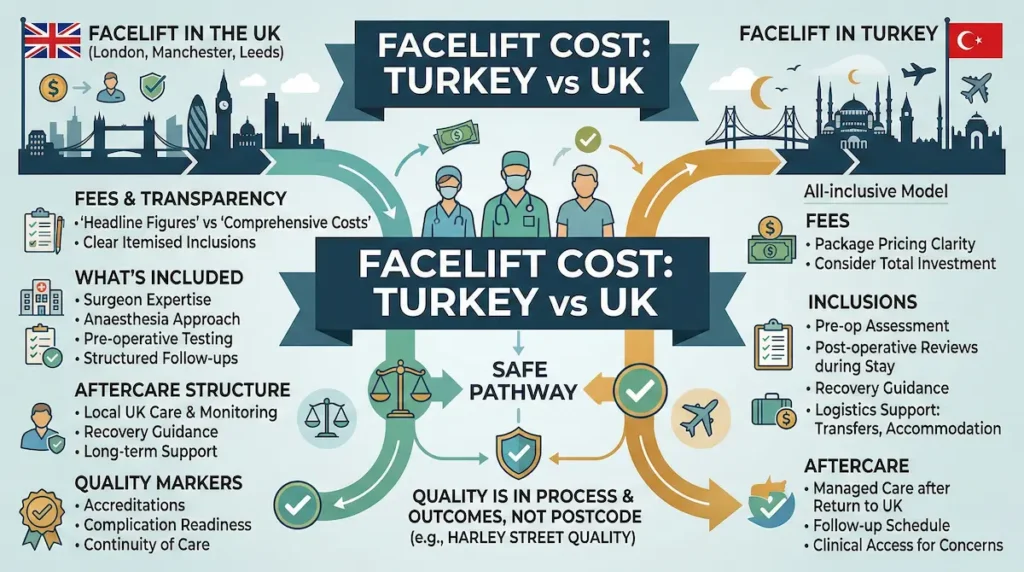
Facelift Cost 2026: Turkey vs UK (fees, value, transparency)
When UK patients compare a facelift in Turkey with options in the UK (often London, Manchester, or Leeds), the decision is rarely only about price. The more informed the patient, the more the question becomes: “What is included, how is safety managed, and how consistent is the aftercare?” We frame the discussion around transparency and clinical value rather than headline figures.
Facelift cost UK vs Turkey: value is more than a number
Costs vary widely in both countries depending on surgeon experience, technique complexity (for example, deep-plane or revision surgery), anaesthesia requirements, and whether the neck is treated. Comparing purely on a single “starting from” number can be misleading because it often excludes essential elements of a safe pathway (pre-operative testing, structured follow-ups, and recovery support).
For that reason, we encourage patients to compare like-for-like: clinical setting, anaesthesia approach, surgeon expertise, revision capability, aftercare structure, and what happens if you have questions during recovery.
All-inclusive model: what is typically included (and what to check)
Many UK patients prefer an all-inclusive structure because it reduces uncertainty and makes planning easier. When reviewing any package—whether in Turkey or elsewhere—clarity matters. Ask what is included, what is excluded, and how aftercare is managed once you return home.
- Pre-operative assessment and required tests
- Planned post-operative reviews during your stay
- Recovery guidance and structured follow-up schedule
- Logistics support (for example, transfers and accommodation planning)
- Access to the clinical team if concerns arise during healing
“Harley Street quality” comparison: the quality markers that matter
“Quality” is not a postcode. It is demonstrated through process and outcomes: appropriate patient selection, technique choice based on anatomy, scar planning, complication readiness, and continuity of care. When comparing providers, focus on the elements that materially affect your safety and your result rather than being swayed by branding alone.
| Comparison point | What to verify in the UK | What to verify in Turkey | Why it matters |
|---|---|---|---|
| Technique options | Deep-plane / SMAS capability; revision experience | Deep-plane / SMAS capability; revision experience | Technique should match anatomy, not marketing labels |
| Anaesthesia plan | General vs sedation options; monitoring standards | General vs sedation options; monitoring standards | Comfort and safety depend on suitability and monitoring |
| Pre-op screening | Medical checks; medication/nicotine guidance | Medical checks; medication/nicotine guidance | Risk reduction begins before surgery day |
| Aftercare structure | In-person reviews; escalation pathway | In-person reviews during stay; remote follow-up after return | Healing is a process—support should continue |
| What’s included | Facility fees, reviews, prescriptions, add-ons | Facility fees, reviews, logistics, recovery support | “Cheaper” can be misleading if essentials are excluded |
| Recovery optimisation | Adjuncts available (varies by provider) | Adjuncts available (varies by provider) | Supportive protocols can ease the recovery burden |
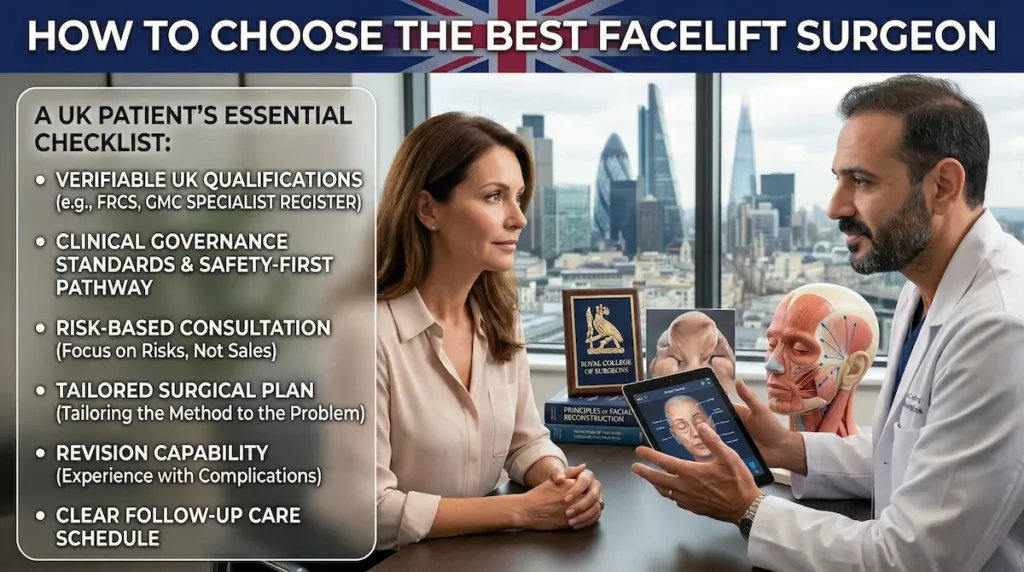
How To Choose The Best Facelift Surgeon
Choosing a surgeon is not about finding the most confident marketing. It is about finding the right blend of technical capability, judgement, and a safety-first pathway that matches your risk profile. If you are an “expert patient”, you already know the key is not the label (deep plane, SMAS, etc.)—it is whether the surgeon can justify the plan for your anatomy and deliver a natural result consistently.
Credentials and standards: what to look for as a UK patient
Start with verifiable qualifications and professional accountability. Look for recognised surgical training, board-level certification where applicable, and a practice that can clearly explain its clinical governance. If you are comparing UK and overseas options, focus on what is equivalent in real terms: training pathway, scope of practice, and the team and facility standards that support safe surgery.
In consultation, you should feel that your surgeon is comfortable discussing risks, not avoiding them. A surgeon who can explain what can go wrong—and how those risks are reduced—usually reflects a mature, safety-led practice.
Technique selection: the surgeon should explain the “why”, not just the “what”
A strong consultation sounds like a clinical discussion, not a sales pitch. You should expect a clear explanation of:
- Your ageing pattern (mid-face descent, jowling, neck changes, skin quality).
- The lift vector (how the direction of lifting prevents an over-tight look).
- Scar planning (incision placement, tragus/ear considerations, tension management).
If you are told “everyone gets the same facelift”, treat that as a red flag. The best outcomes come from tailoring the method to the problem rather than forcing the problem into a standard method.
Revision capability and complication readiness
Even if you are having your first surgery, it is wise to ask about revision experience and complication management. Not because you expect problems, but because a surgeon who is comfortable with revision work often demonstrates deeper technical confidence and a more cautious approach to tension, closure, and tissue handling.
Ask practical questions:
- How do you minimise haematoma risk, and what is your protocol if it happens?
- How do you prevent pixie ear deformity and visible scarring around the ear?
- What follow-up schedule do you use, and how do you handle concerns after I return to the UK?
The right surgeon should be able to answer these without defensiveness and without overpromising.
Your Medical Journey: UK → Istanbul (arrival to departure)
Travelling for surgery feels much easier when the pathway is structured. The goal is to remove uncertainty: clear scheduling, clear communication, and clear aftercare. Below is a typical framework for how UK patients plan a facelift journey at AKM, with timing and details tailored to your case.
Virtual consultation and personalised planning
The process usually begins with a remote consultation. This is where we focus on your concerns, your goals for a natural result, and your medical history. You will also be guided on what information is needed to plan safely (current medications, health conditions, smoking/nicotine status, and any previous facial procedures).
A good virtual consultation should result in clarity, not pressure. You should understand the proposed technique range, what may be combined (for example, neck work), what recovery looks like, and what the realistic “social timeline” might be for you.
Arrival, transfers, accommodation, and clinic schedule
Once dates are agreed, logistics are planned so you can focus on recovery rather than coordination. UK patients typically value three things here: reliability, privacy, and a timetable that includes enough review appointments during the stay.
Your schedule is organised around key touchpoints:
- Pre-operative assessment and final planning
- Surgery day with monitored recovery
- Post-operative checks before you travel home
Travel planning is also discussed in clinical terms: not only “when can I fly?”, but what you should do to protect your early healing during the journey.
Aftercare and continuity once you return to the UK
Aftercare should not end at the airport. Healing continues for months, and questions are normal—especially around swelling patterns, scar changes, and when the face starts to look fully “settled”. We structure follow-up so you have a clear route to ask questions and share progress once you are back home.
You will also be given practical guidance on:
- Sleep positioning and activity progression
- Scar support and sun protection
- What is normal vs what should be escalated
Frequently Asked Questions About Facelift Surgery (FAQ):
Below are the questions we hear most often from UK patients—especially those doing “expert patient” research into technique, scarring, swelling patterns, and safety planning.
Deep Plane Facelift vs SMAS: which is more durable for the mid-face and neck?
Durability depends on matching the technique to your anatomy and ageing pattern. Deep-plane approaches often focus on repositioning tissues as a composite unit, which can be particularly helpful when mid-face descent is a key concern. SMAS-based techniques can also provide strong structural support, especially for lower-face and jawline changes. The right choice is the one that addresses the deeper issue without relying on skin tension.
What should scars look like at 1 week post-op?
At around one week, incision lines can look pink, slightly raised, or crusted, and the surrounding area may still be swollen. This is normal early healing. What matters most is that the incisions are kept clean as instructed, you avoid unnecessary tension, and you follow guidance on sleep position and activity.
I’m 4 weeks after a facelift and still swollen—is that normal?
It can be. Many patients look socially comfortable by 4–6 weeks, but residual swelling—especially along the jawline and neck—may persist longer. Swelling tends to resolve gradually and unevenly. Your clinical team should guide you on what is within a normal range for your specific procedure and what signs should be escalated.
What causes “pixie ear” and how do you prevent it?
Pixie ear deformity is usually linked to closure tension and vector planning—when the earlobe is pulled downward by skin tension rather than supported by deeper anchoring. Prevention is technique-led: correct lift direction, secure deep support, and tension-aware closure around the ear so the earlobe remains natural in shape and position.
What are “ridges in cheeks” after facelift surgery?
Patients sometimes notice firmness, folds, or uneven contouring during early healing. These can be related to swelling patterns, tissue settling, or temporary changes in how the skin redrapes. In many cases, they soften as healing progresses. Because there are also less common causes that may need review, it is important to share photos and concerns with your clinical team rather than relying on forum comparisons.
Can I have a facelift without general anaesthesia?
In selected patients, yes. Local anaesthesia with sedation (often described as twilight sedation) can be suitable depending on your medical profile, comfort level, and the surgical scope planned. Suitability is assessed in consultation—safety and predictability come first.
When can I fly back to the UK?
Flying readiness depends on stability rather than a single calendar date. We look for controlled swelling, acceptable comfort levels, no concerning signs around incisions, and confidence that you understand aftercare steps. Your surgeon will advise based on your procedure scope and recovery progress.
What does an all-inclusive plan typically include?
In general, patients should expect clarity on what is included and excluded. Important items to confirm include pre-operative assessment, planned post-operative reviews during your stay, recovery guidance, and how follow-up is handled once you return to the UK. If logistics support (such as transfers and accommodation planning) is offered, it should be detailed clearly.
Can a revision facelift be done if I’ve had surgery before?
Revision surgery may be possible, but it requires careful assessment. Prior surgery can change tissue planes and create scar tissue, which can affect safety and predictability. A revision plan should be based on anatomy, scar quality, and your specific concern (recurrent laxity, contour issues, scarring, or an unnatural previous vector).
When can I return to work and social events?
Many patients feel socially comfortable within a few weeks, but this varies based on swelling, bruising tendency, and procedure scope. If your work is public-facing, you may prefer a longer buffer. A realistic plan considers how you want to look—not just what is medically possible.
How should I prepare before surgery?
Preparation is largely about risk reduction: disclose medications and supplements, follow nicotine guidance strictly, plan your early recovery environment (sleep position, help with meals/errands), and ensure you understand aftercare instructions before surgery day. A well-prepared patient typically experiences a calmer first week.
Is it painful?
Most patients describe discomfort and tightness more than sharp pain. Sensations vary depending on technique and whether the neck is addressed. You will be guided on how to manage comfort, what sensations are expected, and what would be unusual enough to warrant immediate contact.
Medical Disclaimer: This page is provided for general educational purposes only and does not replace a face-to-face medical consultation, diagnosis, or personalised treatment plan. All surgery carries risks and outcomes vary between individuals. Suitability for a facelift surgery, procedure selection, and anaesthesia choice can only be determined after a full clinical assessment by a qualified surgeon. Always follow your clinician’s instructions and seek urgent medical attention if you develop concerning symptoms during recovery.