



If you’re researching an awake neck lift, you’re probably looking for a way to achieve a sharper jawline and a cleaner neck angle without the depth and systemic burden of a full general anaesthetic. This guide is written for UK patients who want clear, clinically grounded answers—how local anaesthesia (with optional twilight sedation) works, what platysmaplasty actually does, what scars and recovery typically involve, and how to assess safety and value in GBP using a “procedure first, location second” mindset.
Table of Contents
What is an Awake neck lift?
Awake neck lift is a surgical neck rejuvenation performed under local anaesthesia (often with light twilight sedation) rather than a full general anaesthetic. Our surgeons tighten the platysma, refine under-chin fullness, and redrape skin with controlled precision, while you remain comfortably responsive.
For many UK patients, the question is not “Can a neck lift work?” It’s “Can it be done with less physiological stress?” That is exactly where awake techniques matter. We designed this page for the Expert Patient who wants to understand anatomy, technique, and recovery before choosing a provider.
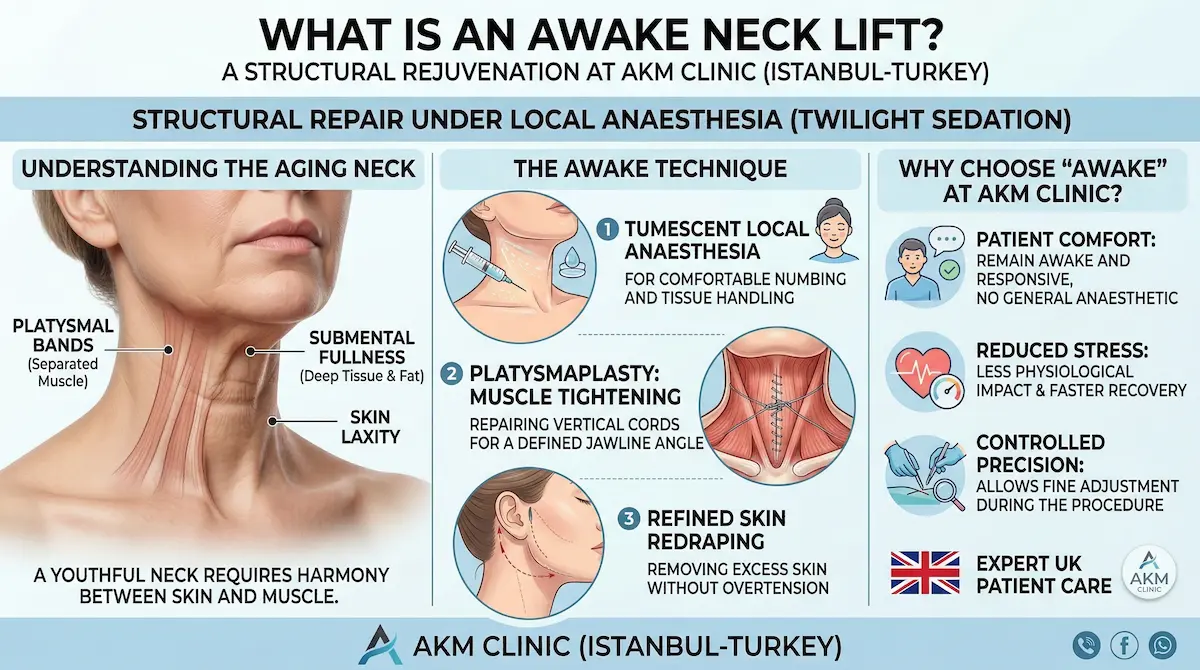
The anatomy behind a younger-looking neck
A youthful neck is not only about skin. The visible change usually comes from a combination of skin laxity, separation in the neck muscle, and deep tissue fullness under the chin. When these layers age together, the jawline softens and the neck angle becomes less defined. A reliable plan starts with identifying which layer is actually responsible.
- Platysmal bands: vertical “cords” created when the platysma muscle separates and becomes more visible.
- Submental fullness: deep fat or lax tissue under the chin that can blunt the neck angle.
- Skin quality: the surface layer that must be redraped without excessive tension.
What is platysmaplasty, in plain terms?
Platysmaplasty is the muscle-tightening element of a neck lift. If the platysma has separated, simply trimming skin can leave the root cause untouched. Our approach is structural: we repair the underlying muscle layer first, then refine contour and skin drape. This is how we protect a natural finish and avoid the “overdone” look that many patients fear.
Some patients ask whether platysmaplasty is “necessary”. If bands are present, it is often the difference between a modest improvement and a proper reset of the neckline.
Awake techniques: local anaesthesia and comfort control
“Awake” does not mean you feel everything. It means we rely on a controlled local anaesthetic blockade, sometimes supported by Twilight anaesthesia, so you are calm and comfortable without the depth of a full general anaesthetic. We typically use tumescent local anaesthesia to provide broad, even numbing while also supporting precise tissue handling. For the safety-focused patient, this approach can feel more measured and predictable.
We will cover the practical questions—like how long local anaesthesia lasts, and what “loopy” actually means—in the dedicated anaesthesia section later in this guide.
What does an Awake neck lift actually fix?
A neck lift is not a single “tighten and done” manoeuvre. It is a targeted correction of the specific ageing changes that blur the jawline and create heaviness under the chin. The best results come from matching the technique to your anatomy, not from applying the same lift to everyone. Our philosophy is simple: rejuvenation, not alteration.
“A good neck lift should read as rest and definition, not surgery. We focus on structure first, then skin—so the result looks like you, just less tired.”
Jawline definition and neck angle
When the neck angle softens, the face and neck can look heavier even if your weight has not changed. A surgical neck lift re-establishes the transition from jawline to neck by tightening the muscle layer, refining deep fullness, and smoothing the surface. Patients often describe the goal as “cleaner lines” rather than a different face. That is the right mindset.
- Sharper jawline contour (without a pulled look)
- Smoother transition from chin to neck
- Reduced banding and “cording” when the platysma is addressed
“Turkey neck”, banding, and under-chin fullness
The phrase “turkey neck” usually refers to loose skin plus underlying banding. The banding component is commonly driven by the platysma, which is why platysmaplasty matters. Under-chin fullness can be superficial, deep, or mixed, and it changes how we plan the lift. In selected cases, a targeted Submental lipectomy is used to refine fullness beneath the chin as part of a more comprehensive contouring plan.
It is also worth saying what an awake neck lift does not do. It does not replace skin quality. If you have very thin, sun-damaged skin, we plan for that reality rather than promising a “filter” effect.
Deep structural correction, not skin tension
Skin-only pulling can create short-lived improvement and a higher risk of an operated look. Our European Board Certified Surgeons prioritise deep structural correction to support a tension-minimised closure. In neck rejuvenation, that often aligns with the principles used in a Deep plane neck lift: repositioning and securing deeper layers so the skin can sit naturally. This is one of the most important concepts for achieving a discreet, long-term result.
Next, we will move from “what it is” to “who it is for” and outline suitability, contraindications, and the decision points that matter for UK patients.
Am I a suitable candidate for an Awake neck lift?
Suitability is less about age and more about anatomy, tissue quality, and your expectations. A well-planned Awake neck lift is designed for patients who want a definitive, structural improvement (not a short-term “tweakment”) and who value the measured safety profile of local anaesthesia. For UK patients, the most important step is a consultation that evaluates the neck in layers—skin, fat, and platysma—so the plan matches the real cause of ageing.
Who tends to benefit most?
You may be a strong candidate if one or more of the following are true:
- You have visible platysmal bands or neck “cording” that becomes more obvious when you speak or smile.
- Your jawline has softened and the neck angle is less defined, even if your weight is stable.
- You have under-chin fullness (submental heaviness) that blunts definition.
- You want an approach that prioritises structural correction (muscle and deeper tissues), not skin tension.
- You prefer local anaesthesia with optional twilight sedation rather than a full general anaesthetic, where clinically appropriate.
During assessment, we look closely at your neck from multiple angles, often asking you to contract the platysma to reveal banding patterns. This helps determine whether platysmaplasty (including more advanced corset-style tightening) is likely to be part of your plan.
When an awake approach may not be ideal
Not every patient is best served by an awake technique. Certain medical factors, complex revision needs, or a level of discomfort intolerance may make an alternative anaesthesia plan more appropriate. In some cases, the extent of surgical work required can also influence the recommendation.
We also set clear expectations around skin quality: if skin is very thin, heavily sun-damaged, or significantly crepey, a lift can improve contour and tightness, but it will not create “airbrushed” texture. Honest planning is what keeps results natural and satisfaction high.
What we assess before surgery (and why it matters for UK patients)
Before proposing an Awake neck lift plan, we review health history, medications and supplements, and any prior facial/neck procedures. For international patients, this risk-checking is not a formality—it is a core safety step.
- Anatomical diagnosis: the balance of skin laxity, submental fullness, and platysma separation.
- Procedure planning: whether you are best suited to a mini approach or a more comprehensive neck lift.
- Anaesthesia suitability: comfort profile and any factors that affect the choice of local anaesthesia and twilight support.
- Safety protocols: pre-op screening and monitoring standards aligned with British expectations.
AKM Clinic’s approach is designed for the “Expert Patient”: our surgeons’ European Board Certification and commitment to GMC Equivalent Standards are central to how we plan, perform, and follow up neck rejuvenation—especially for UK patients travelling for care.
Next step: If you’d like an initial suitability opinion, a remote consultation can be started with a clear set of photos (front, both profiles, and three-quarter angles) and your medical history summary.
Surgical techniques explained: mini vs full neck lift and deep structural work
Neck lifting is often described as one procedure, but in practice it is a toolbox. The right plan depends on whether the main issue is banding, under-chin fullness, or skin laxity—and how advanced those changes are. In awake surgery, technique selection is even more important because we aim for efficient, controlled correction under local anaesthesia without compromising outcome quality.
Corset platysmaplasty: what it is and why it’s powerful
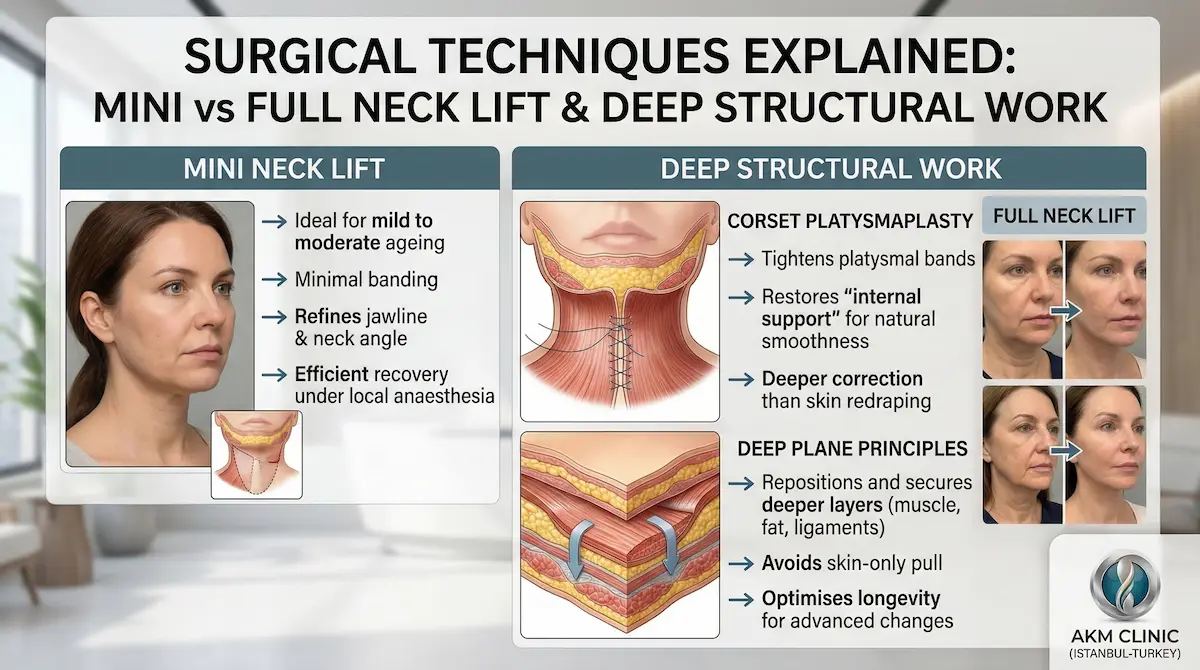
When platysmal bands are a key driver of ageing, tightening the platysma can be the most transformative part of a neck lift. Corset platysmaplasty is a structured muscle-tightening method designed to re-approximate and stabilise the platysma in the midline—think of it as restoring the “internal support” that helps the neck look smoother and more defined.
This is a deeper correction than skin redraping. By addressing the muscle layer, we can reduce the likelihood of early band recurrence and improve the neck angle with a more natural-looking finish.
Deep plane principles: why “structure first” matters
Many patients researching a Deep plane neck lift are trying to avoid the pitfalls of skin-only tightening. Deep plane principles focus on repositioning and securing deeper layers so the skin can settle without being pulled tight. In real-world terms, this supports a more discreet result and can improve longevity—particularly when neck laxity is more advanced.
Not every neck lift is labelled “deep plane”, but the underlying concept—structural correction before skin closure—is a key quality marker. It is also one of the reasons Expert Patients look beyond generic “neck tightening” claims and ask what is being done to the platysma and deeper tissues.
Mini neck lift: when a lighter approach is enough
A mini approach can be appropriate when changes are mild to moderate, banding is minimal, and the main concern is early laxity or subtle contour blunting. Many UK patients search for terms like mini neck lift Istanbul because they want meaningful improvement with a shorter recovery window. The important point is this: “mini” should describe the scope of ageing, not the ambition of the result.
In suitable candidates, a well-chosen mini plan can refine the neckline and jawline with efficient recovery. If the problem is deeper (significant banding, heavy submental fullness, or pronounced laxity), a mini technique may under-deliver—and we will say that upfront.
| Approach | Best for | Key advantage | Main limitation | Recovery expectations (general) |
|---|---|---|---|---|
| Mini neck lift | Mild–moderate laxity, early contour blunting | Efficient correction with a lighter surgical footprint | May not adequately treat significant platysmal bands or heavy submental fullness | Often quicker social recovery, depending on individual healing |
| Full neck lift (with platysmaplasty) | Moderate–advanced ageing changes, visible banding | More comprehensive contouring and structural correction | Longer recovery than mini approaches | More swelling/bruising expected initially; defined milestones are discussed pre-op |
| Deep structural neck work (deep plane principles + corset platysmaplasty) | Pronounced banding, deeper laxity, need for long-term stability | Structure-first correction for a more natural and durable finish | Requires high technical precision and meticulous planning | Recovery depends on scope; planned to support safe, steady healing |
Next, we’ll move into the anaesthesia discussion—local vs general anaesthesia, what “twilight” really means, and the practical questions UK patients commonly ask (including whether local anaesthesia can make you feel loopy, how long it lasts, and why nausea is often different compared with general anaesthesia).
Anaesthesia: why we prefer awake techniques and twilight sedation
For many UK patients, anaesthesia is the deciding factor. Not because you doubt the result, but because you want a safer, more controlled experience. Our approach centres on awake techniques: a carefully planned local anaesthetic blockade, with twilight sedation when appropriate. This allows precise surgical work whilst reducing the depth and systemic load that comes with a full general anaesthetic. It also supports a calmer immediate recovery, which matters if you are travelling internationally.

Local vs general anaesthesia: the real trade-offs
General anaesthesia can be the right choice for some patients and some operations. But it is not the only path to meaningful neck rejuvenation. Under a local anaesthetic blockade, you remain comfortably responsive, your airway is not managed in the same way as under a full general anaesthetic, and the recovery profile can feel more straightforward for many people.
- Local anaesthesia (awake): numbness targeted to the surgical area, often with light sedation for comfort.
- General anaesthesia: deeper unconsciousness with full-body effects and a different monitoring and recovery pathway.
- Twilight sedation: a middle ground that supports relaxation without necessarily requiring full general anaesthesia.
We decide what is appropriate after reviewing your medical history, medications, and the scope of surgical work planned. Safety first. Always.
How we deliver local anaesthesia: tumescent technique and comfort control
Patients often search for “technique to produce local anaesthesia” because they want to know how comfort is actually achieved. We commonly use a tumescent approach to spread local anaesthetic evenly through the tissues. This supports reliable numbness and can help the surgeon work with controlled, careful tissue handling. If twilight sedation is used, it is aimed at relaxation, not deep unconsciousness.
We also plan for practical comfort. That includes keeping you warm, positioning you correctly, and communicating in simple steps so you know what to expect at each stage.
“The goal is calm control. You should feel cared for, not ‘out of it’. We keep the plan measured and tailored to you.”
Common questions: “loopy”, nausea, and how long it lasts
Does local anaesthesia make you loopy? It can, if sedation is part of your plan. Some patients feel pleasantly drowsy or a little foggy for a short period. Others feel clear-headed but relaxed. We set expectations in advance so the experience does not feel uncertain on the day.
Is it normal to feel sick after local anaesthesia? Mild nausea can happen for several reasons (anxiety, fasting, medications), but many patients report less post-operative nausea and vomiting compared with their prior experiences under general anaesthesia. We still plan proactively: hydration, gentle re-feeding, and anti-nausea medication when appropriate.
How long for local anaesthesia to wear off? It varies by the exact medicines used and your individual metabolism. You should expect numbness to gradually reduce over hours, with sensation returning in stages rather than all at once. We guide you on what is normal, and what would warrant a call.
- Driving after local anaesthesia: plan not to drive on the day of surgery, especially if any sedation was used. Arrange a driver and follow our written advice.
- First night: you may feel tightness and swelling more than “pain”, and we tailor your medication plan accordingly.
Step-by-step: what happens in the operating theatre?
Knowing the sequence lowers anxiety. It also helps you judge whether a clinic is structured and safety-led. Our process is designed to be calm, private, and methodical from the moment you arrive. You will have a final in-person review with your surgeon, and we confirm the plan you agreed during consultation. Then we move into a monitored operating theatre environment with modern safety systems and a team that does this daily.
Pre-op checks and marking: the blueprint stage
Before we begin, we carry out pre-operative checks and confirm your health screening results. Your surgeon marks key anatomical landmarks to guide precision and symmetry. This is also the moment we revisit your priorities: sharper jawline, band reduction, under-chin contour, or a combination. Clear agreement here prevents “surprises” afterwards.
- Vitals baseline and monitoring plan
- Final review of medications and allergies
- Surgical marking for a tailored approach
During the procedure: numbness, monitoring, and steady progress
Once local anaesthesia is established, we proceed step-by-step rather than rushing. You may feel pressure, movement, or gentle tugging, but you should not feel sharp pain. If anything feels uncomfortable, you tell us, and we adjust. Throughout the procedure, we monitor your vitals and keep the experience measured and controlled.
If under-chin fullness is part of your plan, contouring is performed conservatively. If platysmal banding is a major driver, we focus on muscle correction first, then refine the overlying layers so the neckline settles naturally.
Closing and immediate aftercare: setting up an easier recovery
Closure is not just “stitching”. It is where we protect the final look. We aim for a tension-minimised closure so scars settle more discreetly. Once dressings are applied, you are monitored by our medical team. We then provide simple, written instructions for the first 48 hours, including sleeping position, garment use, and what sensations are expected.
- Clear medication schedule (including guidance on paracetamol where appropriate)
- Swelling and bruising expectations, with practical comfort tips
- How to contact us if something feels off
Next, we’ll map out recovery in a practical, day-by-day way, including how we use HBOT and LLLT as part of a structured aftercare programme for international patients.
Recovery & aftercare: how long does healing take?
Recovery is usually the part UK patients plan most carefully. You want to know when you’ll look “public-ready”, when it’s sensible to fly, and what sensations are normal. Our approach is structured and calm: we give you a clear timeline, we monitor you properly, and we support healing with a defined aftercare programme. Most importantly, we plan recovery around real physiology—swelling (oedema), bruising, and tissue settling—rather than optimistic promises.
Every patient heals at a slightly different pace. Your baseline skin quality, the extent of platysma work, and whether under-chin contouring was part of your plan all influence the curve. Still, the milestones below are a reliable guide for most patients having an awake approach with local anaesthesia and optional twilight sedation.
Day-by-day timeline: what to expect
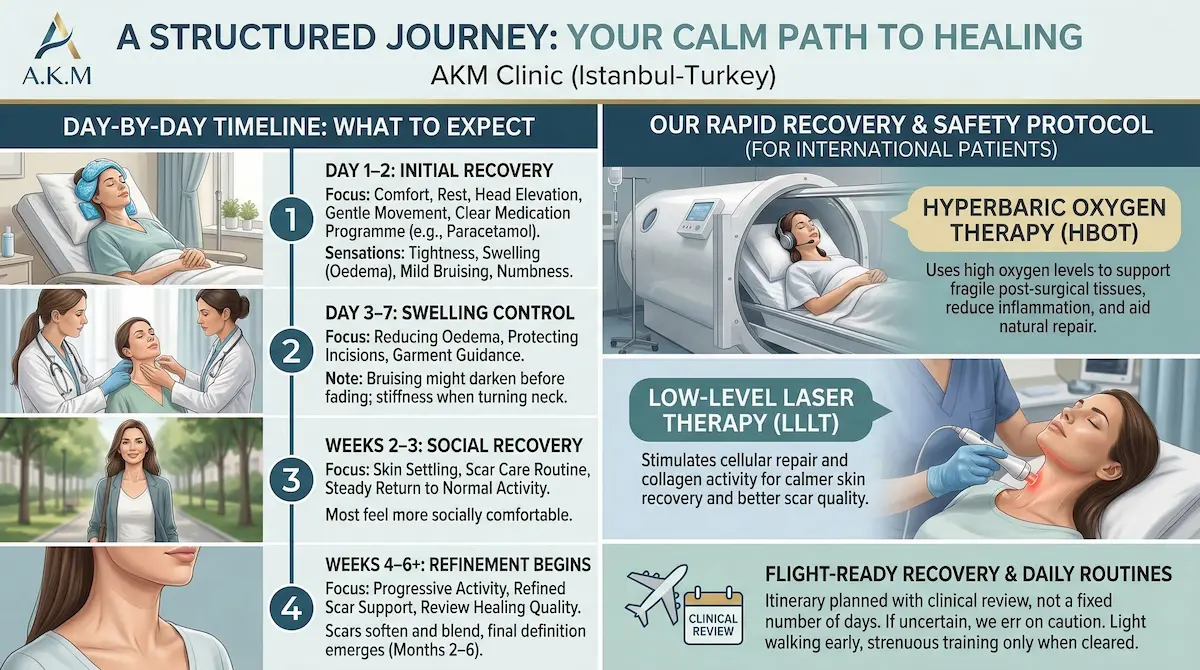
Think in stages. The first week is about swelling control and protecting the tissues. Weeks two to four are about social recovery and comfort. Months two to six are when the refinement becomes more obvious.
| Timeframe | What you may notice | What we focus on |
|---|---|---|
| Day 1–2 | Tightness, swelling, mild bruising; numbness gradually easing | Comfort, rest, head elevation, gentle movement, clear medication plan |
| Days 3–7 | Bruising can look darker before it fades; stiffness when turning your neck | Reducing oedema, protecting incisions, garment guidance if prescribed |
| Weeks 2–3 | Most people feel more socially comfortable; residual swelling remains | Skin settling, scar care routine, steady return to normal activity |
| Weeks 4–6 | Neck contour looks cleaner; occasional tightness is common | Progressive activity, refined scar support, review of healing quality |
| Months 2–6 | Ongoing refinement; scars soften and blend | Long-term tissue maturation and final definition |
Our Rapid Recovery & Safety Protocol: HBOT and LLLT
We treat recovery as part of the procedure, not an afterthought. For international patients, we integrate Hyperbaric Oxygen Therapy (HBOT) and Low-Level Laser Therapy (LLLT) into a deliberate recovery programme. The goal is simple: better tissue support, less swelling, and cleaner healing, especially in the early “visible” phase of recovery.
- HBOT (Hyperbaric Oxygen Therapy): We use a pressurised environment with high oxygen levels to support fragile post-surgical tissues, reduce inflammation, and help the body’s natural repair systems work more efficiently.
- LLLT: We use medical-grade “soft laser” energy to stimulate cellular repair and collagen activity, supporting calmer skin recovery and scar quality as tissues settle.
If you’re comparing UK providers, this is often a key difference. Many clinics focus on surgery alone. We focus on surgical outcome plus recovery infrastructure, because that is what determines how quickly you look like yourself again.
Flying, daily routines, and “when can I get back to normal?”
UK patients commonly ask about flight-ready recovery protocols. The responsible answer depends on your individual swelling, comfort, and clinical review, not a fixed number. We plan your itinerary so you have appropriate early aftercare and a sensible window for travel. If you’re uncertain, we err on the side of caution.
- Work and social plans: Many patients prefer to keep the first 10–14 days flexible, then resume most normal routines as swelling settles.
- Exercise: Light walking is encouraged early. Strenuous training waits until you are cleared, because spikes in blood pressure can increase swelling.
- Medication: We provide a clear schedule and UK-friendly terms (for example, paracetamol-based comfort options where appropriate).
We also explain what is not normal. Sudden expanding swelling, increasing redness, or significant asymmetry needs immediate clinical advice. You should never feel you’re “bothering” us by checking.
Safety & risks: is this approach dangerous?
No surgery is “risk-free”. A neck lift is still a surgical procedure, even when performed under local anaesthesia. The safety advantage of an awake approach is not magic; it is control. We reduce physiological load by avoiding deep general anaesthesia where appropriate, we monitor you closely, and we use a structured plan to prevent and manage common post-operative issues.
For the Expert Patient, the right question is: “What can go wrong, how often is it seen, and what is the mitigation strategy?” That’s how we think too. Below is a clear, honest overview of the risks we discuss during consultation.
Common, expected effects (not complications)
Most early symptoms are part of normal healing. They can feel unfamiliar, but they are usually temporary and manageable with clear guidance.
- Swelling (oedema) and bruising, especially in the first 7–14 days
- Tightness or a “firm” feeling under the chin and along the neck
- Temporary numbness or altered sensation as nerves recover
- Mild asymmetry early on, often due to uneven swelling rather than the result itself
Less common surgical risks (and how we reduce them)
More significant complications are uncommon, but they matter. We mitigate risk through candidate selection, meticulous haemostasis, sterile theatre protocols, and structured follow-up.
- Haematoma: a collection of blood under the skin that may require prompt assessment and, occasionally, treatment.
- Infection: uncommon with good sterile technique and aftercare, but always taken seriously.
- Delayed wound healing: more likely in smokers or patients with certain medical conditions.
- Contour irregularity or persistent asymmetry: usually preventable with correct planning, occasionally requires refinement.
We also discuss scarring openly. Incisions typically mature over months, not weeks. Scar support is a programme, not a quick fix.
Local anaesthesia side effects: what matters in real life
Local anaesthesia and twilight sedation have their own set of considerations. The experience is usually smoother than many patients expect, but you may still feel drowsy, “spaced out”, or mildly nauseous for a short period, depending on your personal sensitivity and the medicines used.
- Feeling loopy: usually temporary and linked to sedation rather than the local anaesthetic itself.
- Nausea: can occur, often manageable with hydration and medication when needed.
- Safety planning: you should not drive on the day of surgery, and we advise you clearly about activity restrictions.
If you ever feel unwell after you return home, we guide you on what is urgent and what is simply part of healing. If you need emergency assessment, we tell you when to attend A&E. Clear pathways reduce anxiety.
Is an Awake neck lift safe in Turkey for UK patients?
Safety abroad is rarely about geography. It is about standards, screening, and what happens after you leave the operating theatre. UK patients are right to ask direct questions, because “private” can mean very different things depending on the clinic.
Our job is to remove ambiguity. We do that by aligning our processes with what a safety-conscious patient would expect from a high-performing UK private environment, then strengthening the recovery layer with structured protocols. This is how we neutralise the usual “Turkey surgery” anxiety without turning this page into a medical tourism advert.
Standards and accountability: what “UK-level” should look like
When you compare providers, focus on objective markers. Credentials matter, but so does the way a team thinks: measured planning, careful execution, and conservative decision-making. We position our surgeons as European Board Certified specialists and frame our approach around GMC-equivalent expectations, because that is the language UK patients use to judge safety.
- Clear pre-operative screening and candidacy rules, not “everyone qualifies”.
- A structured anaesthesia plan that prioritises local anaesthesia and calm comfort control.
- Conservative surgical judgement, especially around skin tension and scar placement.
Facility, monitoring, and pre-op screening
In an awake procedure, comfort and monitoring must be flawless. We work in a fully structured theatre environment with vitals monitoring and a deliberate workflow, because “awake” should feel controlled, not improvised. If you are travelling from the UK, we also treat screening as non-negotiable.
We confirm medical history, medications, and risk factors before surgery day. If something does not look right, we pause. That single decision is one of the strongest safety signals a clinic can offer.
- Vitals monitoring throughout the procedure and in the immediate post-op period.
- Clear discharge criteria, not rushed handovers.
- Written aftercare instructions designed for real life, not perfect conditions.
Continuity of care: avoiding the “post-op abandonment” fear
Many UK patients worry about what happens once they fly home. It is a fair concern. The solution is a defined follow-up system with clear access, not vague reassurance.
We build follow-up into the pathway. That includes planned check-ins and responsive communication if you have a question about swelling, bruising, or scar healing. You should never feel you are managing recovery alone.
- Planned post-op check-ups before you are cleared to fly.
- Remote follow-up points over the months after surgery to monitor settling and scars.
- Clear escalation guidance if you ever need assessment back in the UK.
Realistic expectations and results: what “natural” actually means
A neck lift can create a sharper jawline and a cleaner neck angle, but it is not a filter. Tissue has memory. Swelling settles in phases, scars mature slowly, and the final refinement is measured in months.
We set expectations early because it protects your outcome and your confidence. The goal is not to look “done”. It is to look like you, simply better supported anatomically. That principle is central to how we plan and how we assess success.
“We aim for the kind of result that feels familiar in the mirror. Defined, rested, and quietly natural.”
What you should see after a successful neck lift
Good results look calm. The jawline is clearer, the neck angle reads cleaner, and banding is reduced without creating a tight, over-pulled surface. If you can spot surgery from across a room, something has usually been over-tensioned.
- Better definition at the jawline without a harsh, stretched finish.
- Smoother neckline when the platysma has been properly supported.
- Improved under-chin contour where fullness was genuinely part of the issue.
Timeline of results: when you’ll look “public-ready”
Most patients feel more socially comfortable as bruising fades and swelling becomes less obvious. Still, early improvement is not the final result. The neck continues to refine as oedema resolves and deeper tissues settle into their new support.
Expect visible change early, then quiet progress. That is normal. We plan your recovery around this reality, especially if you are coordinating time off work and travel from the UK.
- First 1–2 weeks: visible healing phase (bruising/swelling most noticeable).
- Weeks 3–6: social confidence improves, contour looks cleaner.
- Months 2–6: refinement phase, scar maturation, final definition.
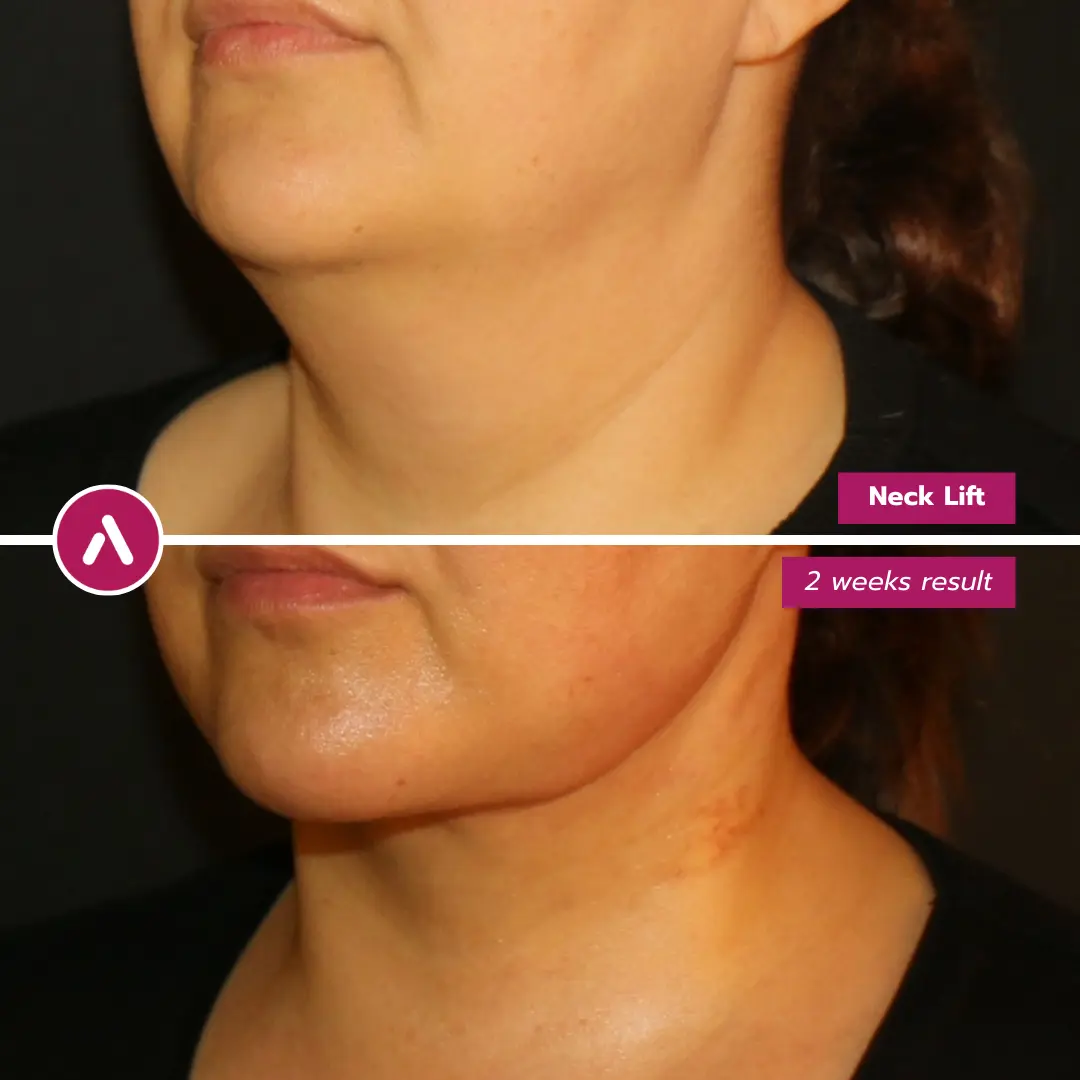
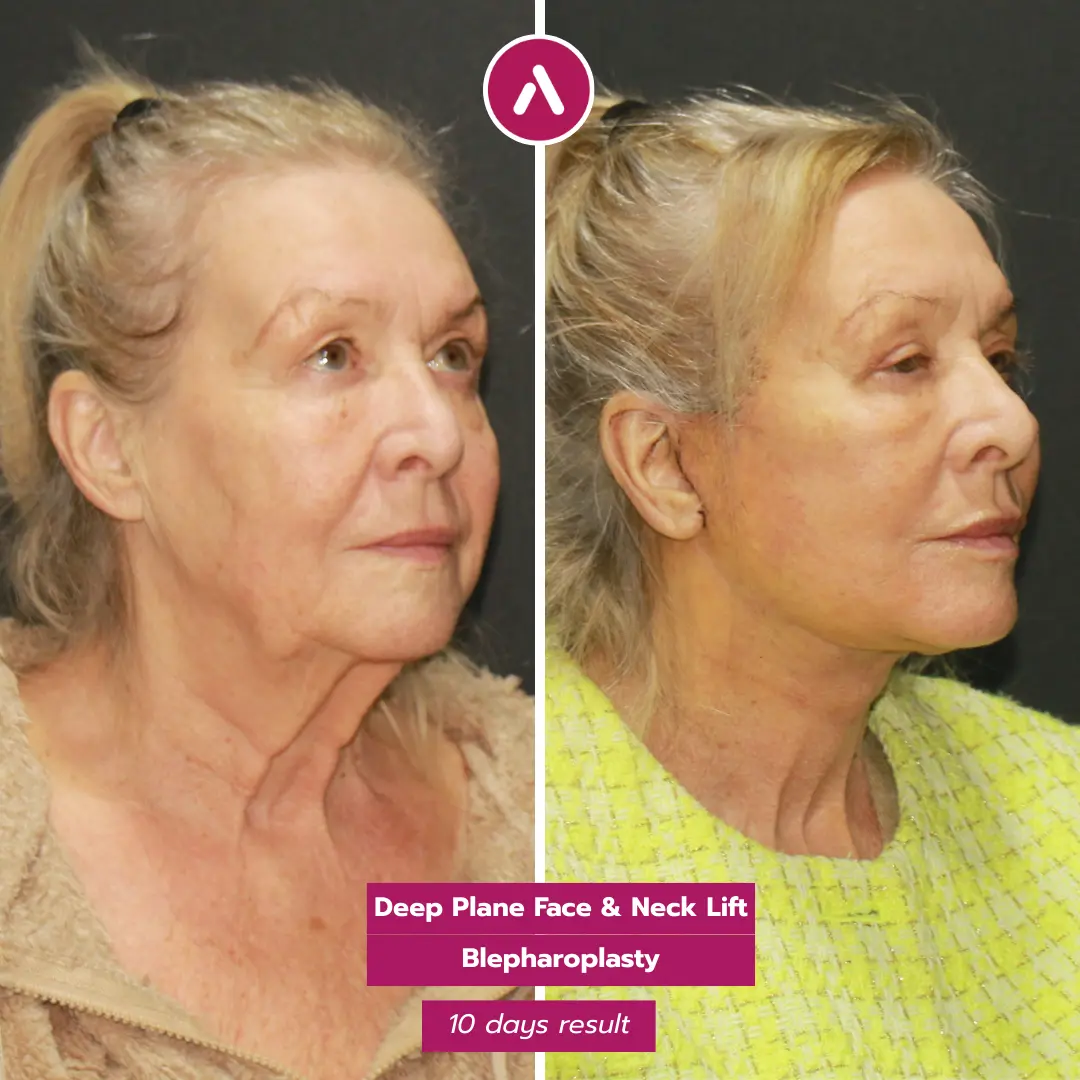
How to evaluate before-and-after photos like an Expert Patient
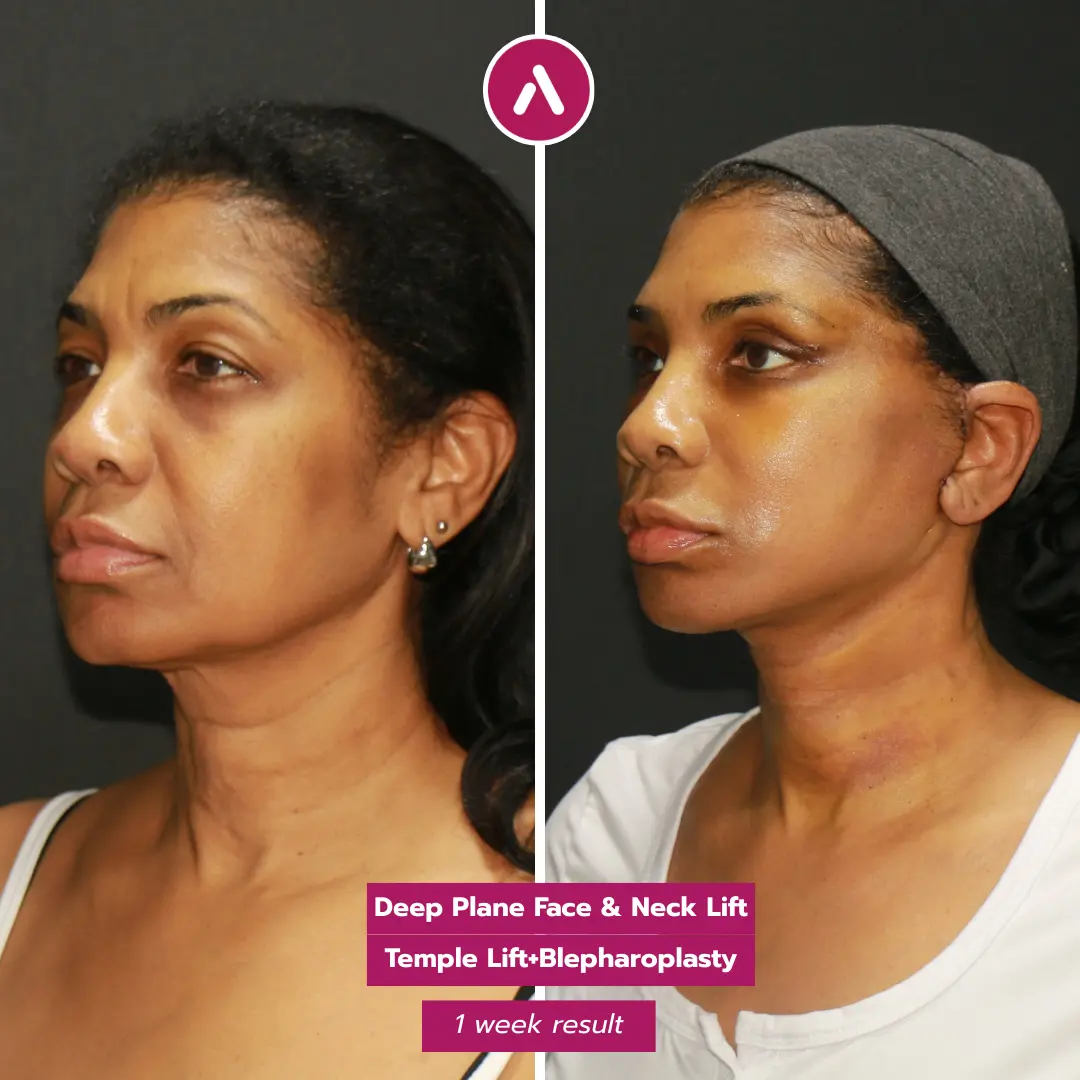
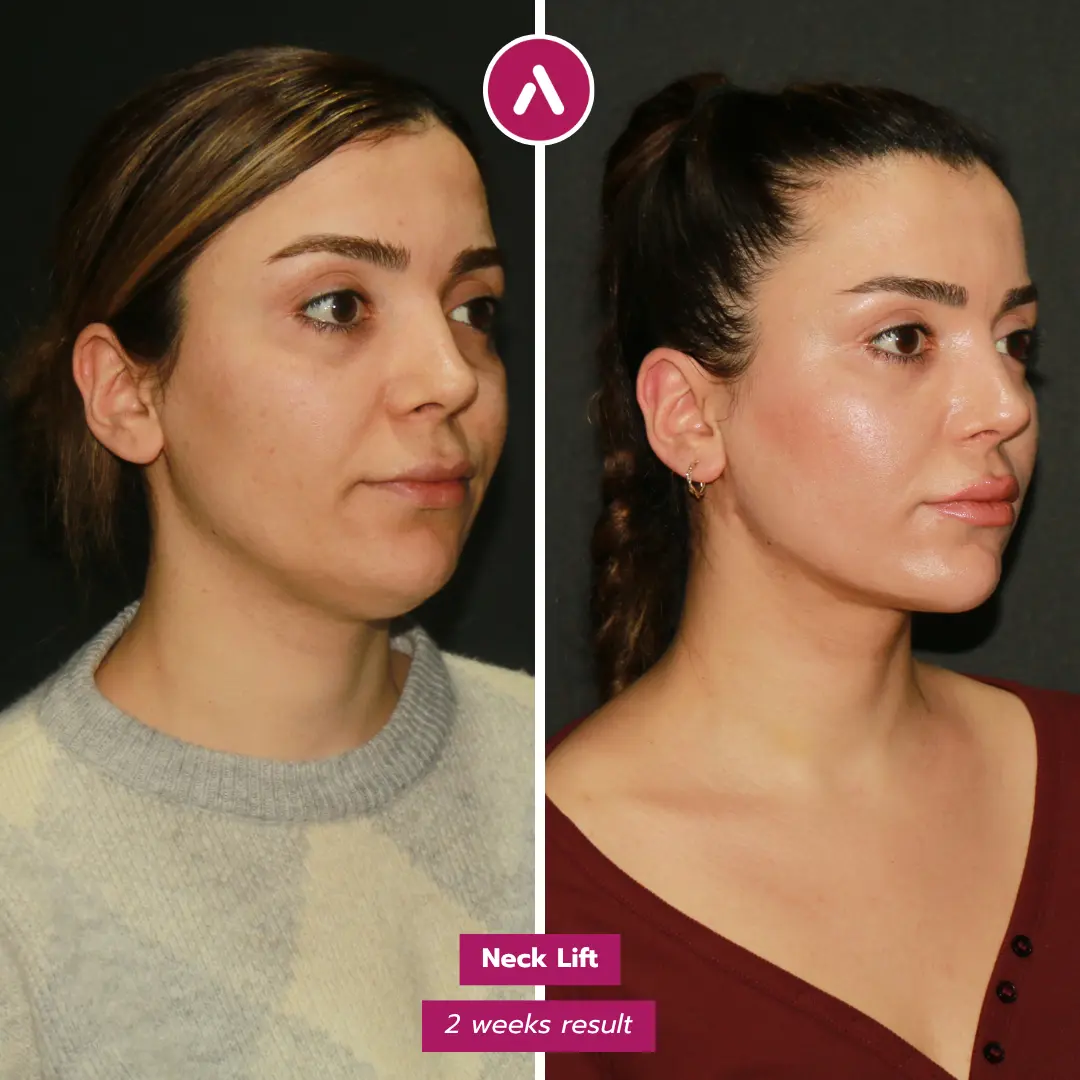
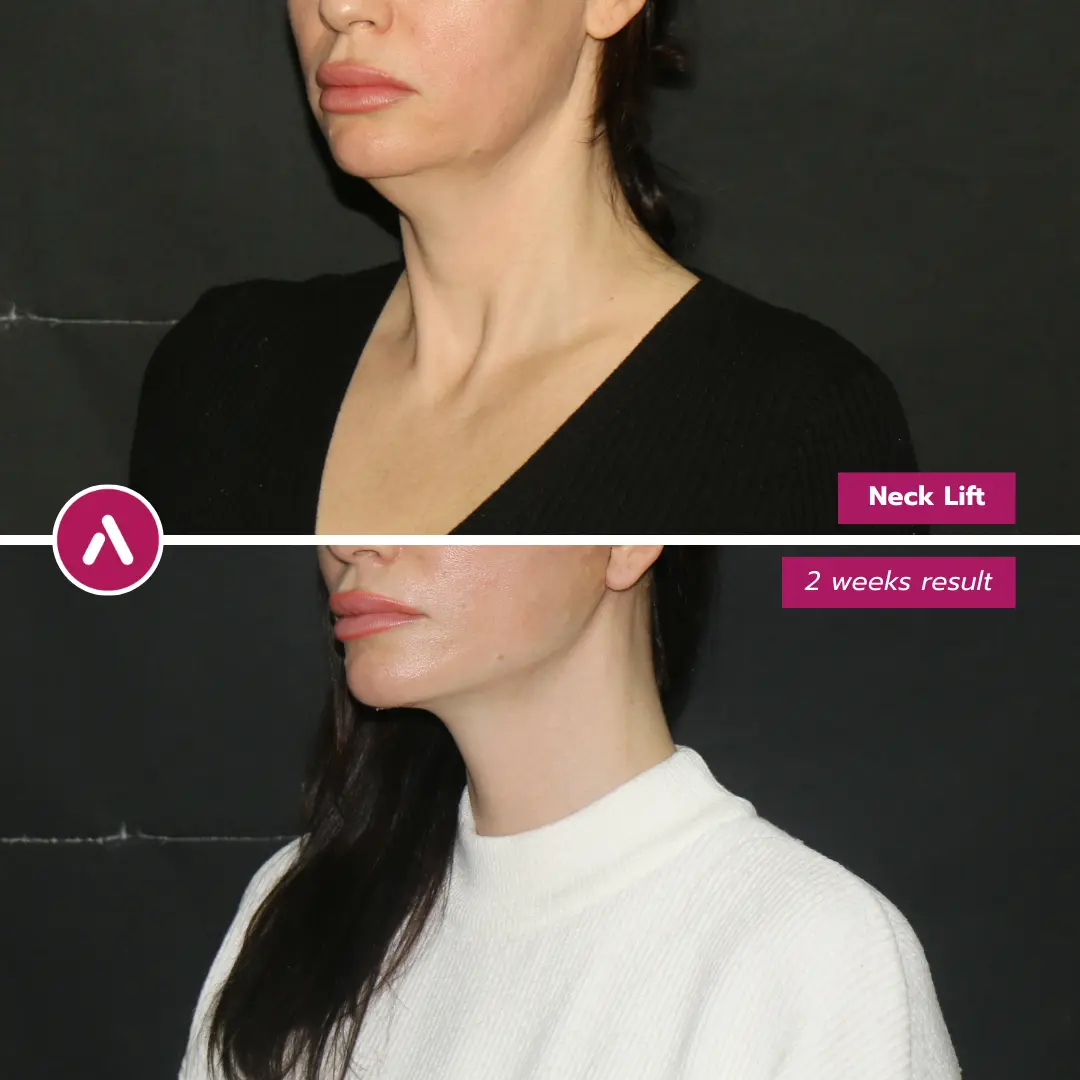
Before-and-after galleries can be helpful, but only if you read them correctly. Look for consistent lighting, matching angles, and results that feel anatomically plausible. Be cautious with dramatic shadows and extreme head positions, because they can exaggerate neck definition.
We encourage UK patients to judge outcomes on subtle markers: jawline continuity, smoothness under the chin, and the absence of a “pulled” appearance. Those are the signals of structural work done properly.
- Same angle, same lighting, similar facial expression.
- Natural skin drape rather than aggressively tightened skin.
- Neck angle improvement that matches the patient’s baseline anatomy.
Non-surgical alternatives: CACI, Nefertiti, HIFU and thread lifts
It’s sensible to look at non-surgical options before committing to surgery. Many UK patients do. The key is understanding what these treatments can realistically change, and what they cannot. Non-surgical devices can improve skin quality and give mild tightening, but they do not repair separated platysma or reliably reset a heavy neck contour. If your main issue is structural—banding, deeper laxity, or under-chin heaviness—a surgical plan is usually the definitive route.
CACI “jowl lift” and the Nefertiti lift: where they help (and where they don’t)
CACI is often marketed as a way to “lift” the jawline using microcurrent. In practice, it may offer a short-term firming effect in mild cases, particularly when early laxity is the main concern. The Nefertiti lift (typically neuromodulator injections) can soften prominent platysmal pull and subtly improve the neck-to-jawline transition in selected patients. These treatments can be reasonable if your goal is a modest refresh and you accept that results are temporary.
- Best for: early changes, minor definition loss, skin quality support.
- Not ideal for: significant platysmal bands, heavier submental fullness, advanced laxity.
- Reality check: maintenance sessions are part of the “cost” over time.
HIFU: modest tightening, limited control
HIFU aims to stimulate collagen and create mild tightening by delivering focused energy beneath the skin. Some patients see a small improvement in firmness. Others see little change. The challenge is predictability and degree. HIFU does not precisely reposition deeper tissues or repair muscle separation, so it cannot replicate a surgical lift when the neck has truly descended.
- Best for: mild laxity and patients who want a non-surgical first step.
- Watch-outs: results vary and can take weeks to emerge.
- Expectation: “subtle improvement”, not a reshaped neckline.
Thread lifts: temporary support, not a structural reset
Thread lifts can create short-lived lift by mechanically supporting tissues with barbed sutures. For the neck, threads are often less convincing than for small facial areas because the neck moves constantly and the skin is thinner. Threads do not rebuild deeper anatomy. They also do not address under-chin fullness in a meaningful way if that fullness is driving the contour problem.
- Best for: very mild changes and patients who accept a temporary effect.
- Limitations: short duration, variable symmetry, and limited impact on bands.
- Key point: threads cannot replace platysma correction.
When non-surgical makes sense, and when surgery is simply the right tool
We are not anti non-surgical. We use it when the anatomy supports it. If you have early laxity and your primary aim is to delay surgery, non-surgical tightening can be a sensible holding strategy. If you have visible banding, deeper descent, or a blunted neck angle that has progressed, a surgical plan is typically the more rational investment. It’s not about “more” treatment. It’s about the correct treatment.
“If the issue is structural, we treat structure. Devices can improve skin quality, but they can’t reliably rebuild neck anatomy.”
Combined procedures: maximising results with one recovery window
Many patients don’t age in “one zone”. The jawline, neck, mid-face and eyes often change together, which is why combining procedures can be a smart, efficient strategy—when it’s clinically appropriate. The goal is not to do more surgery; it is to achieve a more harmonious result with one recovery window, one anaesthesia plan, and one structured aftercare pathway.
For UK patients travelling internationally, a combined approach can also reduce the logistical burden of separate trips and staged downtime. However, combining procedures must never compromise safety. The decision is based on your anatomy, medical history, and the scope of correction needed.
Awake facelift + Awake neck lift: harmony between face and neck
If you improve the neck but leave mid-face descent unaddressed (or vice versa), the result can look unbalanced. In suitable candidates, combining an Awake neck lift with an awake facelift approach helps the jawline and neck read as one continuous, natural contour. This can be particularly relevant when jowling and neck laxity appear together.
Where deep structural work is required, your surgeon may apply deep plane principles to support a natural, non-pulled outcome. The aim is structural repositioning rather than skin-only tightening, so both the face and neck settle quietly and predictably.
- Best suited for: patients with jawline softening plus neck banding/laxity.
- Key benefit: a cohesive result across the lower face and neck, with one period of swelling and bruising.
- Planning focus: precise tissue handling and tension-minimised closure for discreet scarring.
Submental contouring: refining the under-chin area in the same setting
Under-chin fullness is a common contributor to a blurred neck angle. If the assessment shows that submental fullness is driving the contour problem, targeted contouring can be combined with neck lifting. In selected cases, this may involve conservative fat refinement or a more defined approach such as Submental lipectomy as part of a comprehensive plan.
The important point is restraint. Over-resection can look unnatural. A responsible plan aims for a cleaner neck angle that still looks like you—just better supported.
- Best suited for: patients with submental heaviness alongside platysmal bands or skin laxity.
- Key benefit: sharper definition without needing separate downtime for under-chin correction.
- Planning focus: balancing contour refinement with skin redraping to avoid irregularities.
Eye and skin adjuncts: when “small additions” create a more complete result
Sometimes, a neck and jawline improvement makes the eye area or skin texture feel more noticeable by contrast. For the right candidate, carefully chosen adjunct procedures can be combined to create a more complete rejuvenation—without turning the plan into an overly aggressive makeover.
Common examples include upper or lower eyelid surgery (blepharoplasty) or carefully timed skin-supporting treatments. The priority is always: maintain a natural identity, protect healing, and avoid stacking too many variables in one recovery.
“Combination surgery should feel like one coherent plan—not a checklist. The best add-ons are the ones that quietly complete the picture.”
- Best suited for: patients whose ageing pattern involves multiple adjacent areas.
- Key benefit: improved overall harmony with one recovery timeline and coordinated aftercare.
- Planning focus: choosing adjuncts that do not meaningfully increase risk or recovery burden.
Safety-first decision-making: when we recommend staging instead
There are times when the smartest medical choice is to stage procedures rather than combine them. Longer operative time, broader tissue manipulation, or certain health factors can increase swelling, slow recovery, or raise risk. For some patients—especially those with more complex medical histories—staging may deliver a safer and more predictable outcome.
We also consider the “international patient reality”: you want a plan that is safe, comfortable, and travel-appropriate. A combined approach should never be used to force too much into a short itinerary. If we believe staging is safer, we will recommend it clearly.
- We may advise staging if: the scope becomes too extensive for a calm recovery profile.
- We may advise staging if: medical factors increase risk or reduce tolerance for swelling/bruising.
- We may advise staging if: predictability is improved by separating corrections into distinct phases.
When combination surgery is appropriate, aftercare becomes even more important. That is why we coordinate a structured recovery plan, and where clinically suitable, integrate supportive recovery protocols such as HBOT and LLLT to promote calmer healing and earlier social confidence—especially for UK patients planning travel.
Cost analysis: Awake neck lift fees in 2026 (UK vs Turkey, GBP)
For UK patients, cost questions are rarely just about the headline number. You want to understand what you are paying for, what is included, and what lowers risk. A neck lift quote can look similar on paper while representing very different levels of planning, monitoring, and aftercare. Our approach is to frame value as investment efficiency: the right surgeon, the right anaesthesia strategy, and a recovery pathway that is properly resourced. That is the standard you should compare against, whether you stay in the UK or travel.
What drives fees in the UK private sector?
UK pricing often reflects overheads as much as it reflects surgical complexity. Theatre time, anaesthesia staffing, facility fees, and post-op reviews add up quickly, particularly in major centres such as London. Many private providers also charge separately for revisions, extended follow-up, and “extras” that patients only discover after the initial quote. That is why comparing like-for-like matters.
- Surgeon fees and experience level.
- Theatre, nursing, and monitoring costs.
- Anaesthesia model (general vs local with sedation) and the associated pathway.
What’s different in an all-inclusive model (and what you should check)
We give UK patients a clear, all-inclusive quotation in GBP because predictability reduces stress. Transparency is part of safety. A responsible all-inclusive model should not be vague; it should specify exactly what is covered and what is not. The only “unknowns” should be genuine medical variables, not hidden administrative add-ons.
- Pre-op tests and in-person surgeon review.
- Medication and immediate aftercare support.
- Accommodation and private transfers (if included in the plan you choose).
How we position value: anaesthesia choice and recovery infrastructure
An awake approach under local anaesthesia with twilight support can change the experience for patients who are anxious about being “put under”. It also supports a calmer immediate recovery for many people. We then strengthen that with our recovery infrastructure, including our structured Rapid Recovery & Safety Protocol using HBOT and LLLT, where clinically appropriate. This is not presented as a luxury add-on. It is part of how we protect tissue health and reduce social downtime.
A practical comparison table (GBP): how to compare quotes fairly
| Cost / service item | Typical UK private pathway | AKM Clinic pathway (Istanbul) | Why it matters |
|---|---|---|---|
| Surgeon fees | Quoted separately or bundled | Quoted transparently as part of the plan | Experience and judgement drive outcomes |
| Theatre and monitoring | High facility overheads | Structured theatre workflow and monitoring | Safety is process-driven |
| Anaesthesia model | Often general anaesthetic for major lifting | Local anaesthesia with twilight support when appropriate | Different physiological load and recovery feel |
| Medication and aftercare | Usually itemised | Included and clearly written | Prevents “surprise” costs and confusion |
| Recovery support | Basic follow-up; therapies often extra | Structured protocol, including HBOT/LLLT where appropriate | Supports tissue health and social recovery |
| Logistics | Self-managed | Can be arranged as part of an all-inclusive plan | Reduces travel stress for international patients |
Next, we’ll cover how to choose the right surgeon and what an Expert Patient should ask during consultation, including how to judge credentials, technique planning, and follow-up structure.
Finding the Best Awake Neck Lift Surgeon: a UK Patient Checklist
If you’re comparing options for a Awake neck lift, the smartest approach is to think like an Expert Patient. Don’t start with marketing. Start with standards, surgical judgement, and the clinic’s ability to support safe healing. Whether you’re searching “best neck lift surgeon Turkey” or comparing a London quote to an Istanbul pathway, the checklist below will help you make a decision that is clinically rational—not emotionally pressured.
Credentials and standards: what to look for (and what to ignore)
Credentials are not the whole story, but they are a baseline. Look for surgeons who can demonstrate consistent work, clear planning, and a safety-led process. For UK patients, it also helps when a clinic uses the language of British and European expectations—because it shows they understand how you evaluate risk.
- European Board Certification and evidence of ongoing professional development.
- A clinic culture aligned with GMC Equivalent Standards: screening, documentation, and clear consent.
- Consistent outcomes in neck anatomy similar to yours (banding, submental fullness, skin laxity).
Be cautious with vague claims like “scarless”, “no downtime”, or “guaranteed results”. A responsible surgeon does not sell certainty. They explain probabilities, trade-offs, and what can realistically be achieved.
Questions to ask in a consultation (especially if you want an awake approach)
Most consultations are judged by how reassuring they feel. Instead, judge them by how specific the answers are. These questions reveal whether the plan is truly personalised and whether the team is comfortable working under local anaesthesia with optional twilight sedation.
- Which layer is driving my ageing: skin, fat, or the platysma? What is your plan for each layer?
- Will I need platysmaplasty (and if so, what type)? How do you address platysmal bands?
- Do you plan any under-chin contouring such as targeted Submental lipectomy, and why?
- How do you deliver local anaesthesia (for example, tumescent local anaesthesia) and how do you keep patients comfortable?
- What is your complication plan—specifically for haematoma, infection, or delayed healing?
- What does follow-up look like after I return to the UK?
How to spot quality in before-and-after photos
Photos can educate or mislead. Look for clinical consistency rather than dramatic change. Quality neck results often look “quiet”: cleaner definition, reduced banding, and natural skin drape without an obvious surgical signature.
- Consistent lighting, angle, and neck position (no chin-lift tricks).
- Results that look anatomically believable rather than overly sharp or “snatched”.
- Evidence of structural improvement, not just skin tension.
Red flags that should make you pause
- Pressure to book quickly, or discounts used as the main persuasion tool.
- No clear explanation of anaesthesia plan, monitoring, or candidacy screening.
- Unrealistic promises about scars, downtime, or “permanent” results.
- Vague aftercare: if follow-up feels improvised, treat that as a safety concern.
Your medical journey from the UK: consultation to long-term follow-up
When UK patients search for neck lift surgery in Turkey, the biggest concern is usually not the flight—it’s continuity of care. A well-designed international pathway should feel structured, not chaotic. The goal is to make the experience clinically safe, logistically simple, and psychologically calm.
Remote consultation: how we assess you properly before you travel
A remote consultation should be more than a quick quote. We use it to diagnose the neck in layers and determine whether you’re a better fit for a mini plan or a comprehensive structural approach. For an awake procedure, we also assess comfort suitability and medical history carefully.
- Photo set: front, both profiles, and three-quarter angles in neutral lighting.
- Medical history review: medications, supplements, allergies, and any prior procedures.
- Goal alignment: jawline definition, band reduction, under-chin contour, or combined aims.
Travel and scheduling: planning around healing, not just convenience
Most patients prefer a plan that includes time for early check-ups before flying home. We structure your in-person review, procedure day, and early aftercare so you’re not rushed through the highest-swelling period. Your timeline is always personalised, but the principle is consistent: safety and stability first.
- Pre-op in-person assessment and final marking with your surgeon.
- Post-op reviews before clearance to travel.
- Written guidance for swelling control, scar care, and activity restrictions.
Follow-up once you’re back in the UK
Long-term outcome quality depends on follow-up. We provide a structured remote check-in schedule so we can monitor swelling resolution, scar maturation, and contour refinement. If you ever need assessment in the UK, we give clear escalation guidance rather than leaving you to guess.
- Early remote check-ins to confirm normal healing patterns.
- Medium-term follow-up focused on scar quality and tissue settling.
- Long-term review points to ensure your result is maturing as expected.
Frequently asked questions (FAQ): Awake Neck Lift in Turkey
Does local anaesthesia make you loopy?
Local anaesthesia itself is designed to numb the surgical area. Feeling “loopy” is more commonly linked to sedation. If twilight sedation is part of your plan, you may feel pleasantly drowsy or mildly foggy for a short period. We set expectations in advance and tailor the approach to your comfort and medical profile.
Is it normal to feel sick after local anaesthesia?
Mild nausea can happen, often due to fasting, anxiety, or sensitivity to medications. Many patients experience less post-operative nausea compared with their past experiences under a full general anaesthetic, but we still manage the risk proactively with hydration advice and anti-nausea medication when appropriate.
How long for local anaesthesia to wear off?
It varies depending on the medicines used and individual metabolism. Numbness usually fades gradually over several hours. We guide you on what sensations are expected and what would require a call.
Can I drive after local anaesthesia?
Plan not to drive on the day of surgery—especially if any sedation was used. Arrange for transport and follow the written guidance we provide.
What is the awake neck lift price in GBP?
Pricing depends on the scope of work: mini vs full neck lift, the extent of platysma correction, and whether under-chin contouring is part of the plan. We provide a transparent, all-inclusive quotation in GBP so you can compare value fairly against UK private care and understand exactly what is included.
How do I compare neck lift cost UK vs Turkey fairly?
Compare like-for-like: surgeon expertise, anaesthesia model, theatre standards, monitoring, aftercare, and recovery support. The headline figure is less important than what it represents clinically. The most meaningful comparison is investment efficiency—not “cheap vs expensive”.
Medical disclaimer: This information is for education only and does not replace a personalised consultation or medical advice. Suitability, risks, recovery, and results vary by individual.