




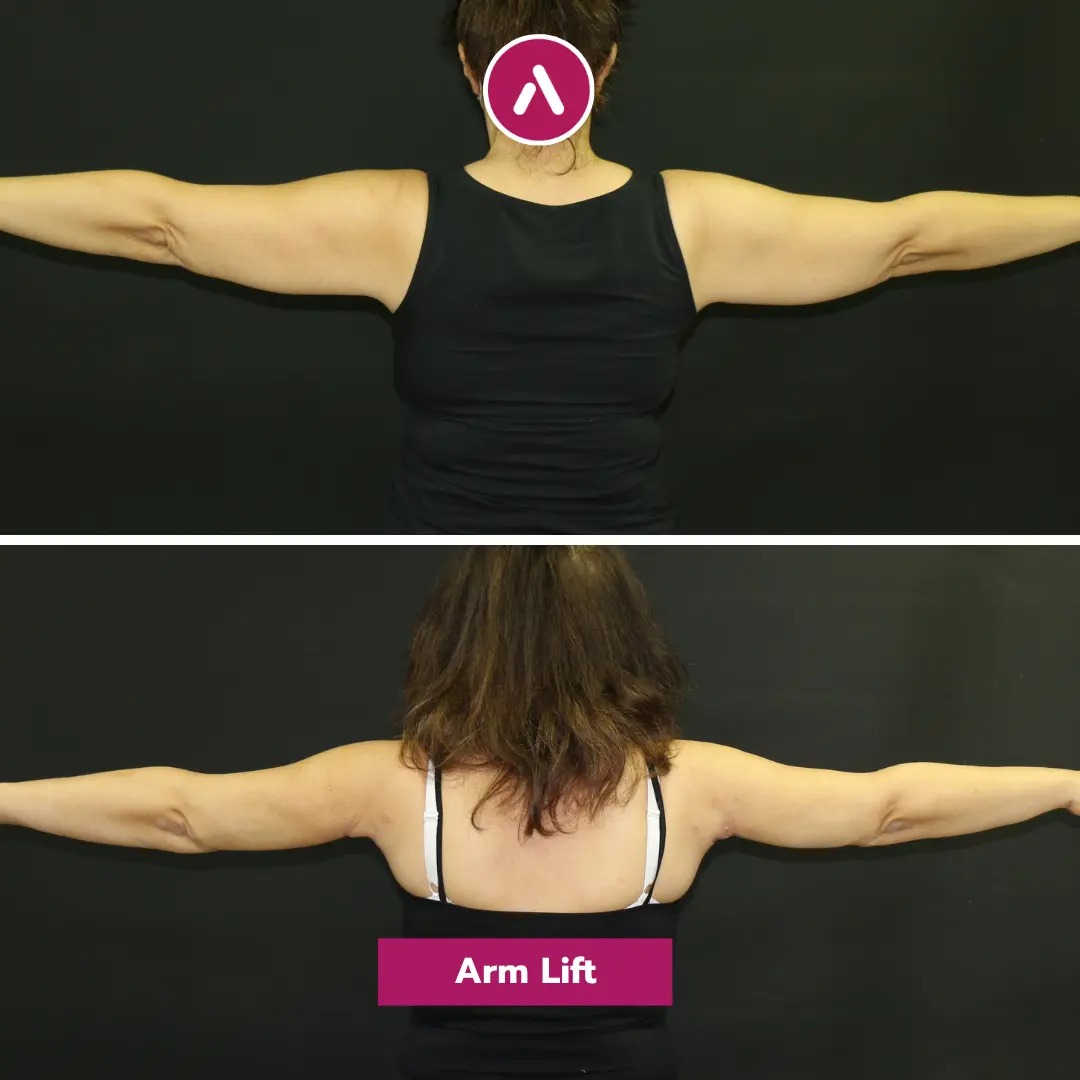
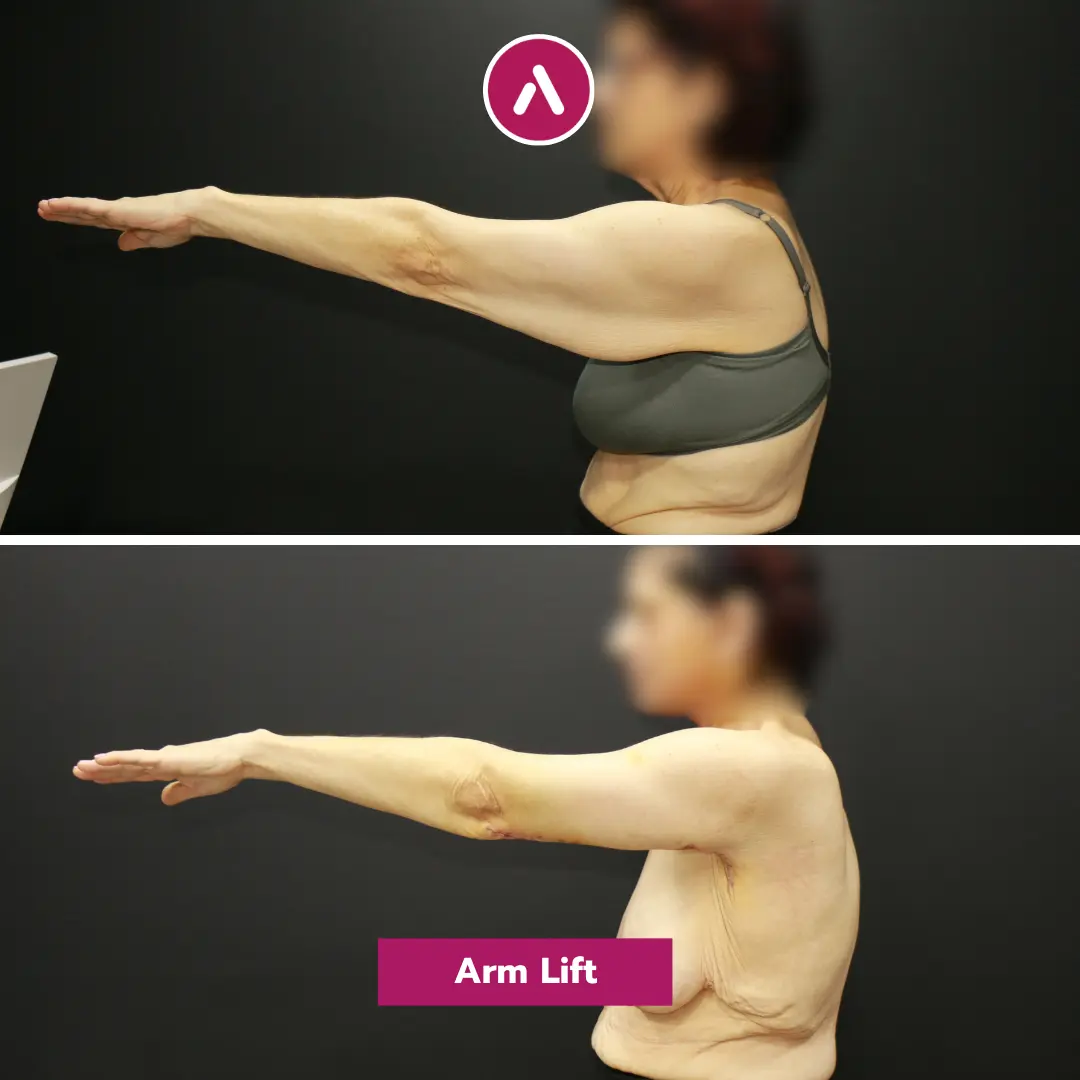
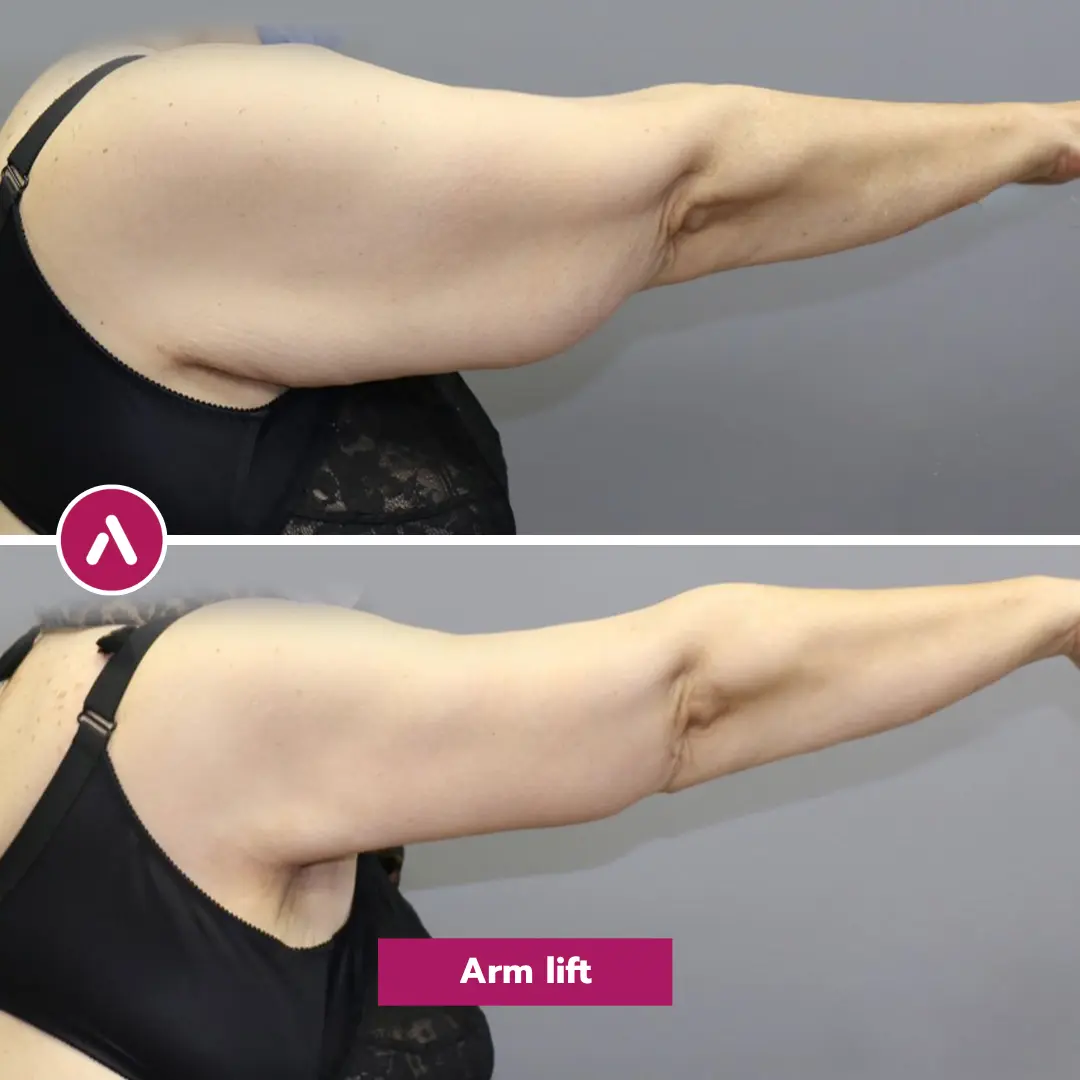
If you’re in the UK and bothered by “bingo wings”, you’ve probably noticed how quickly the conversation turns from workouts to surgery — and then stops dead at one big fear: a general anaesthetic. An awake arm lift is designed for people who want a firmer, more refined upper-arm contour while avoiding full general anaesthesia where clinically appropriate. At AKM Clinic, we centre the experience around tumescent local anaesthesia with carefully monitored twilight sedation, so your treatment feels controlled, calm, and safety-led.
This guide is written specifically for UK patients and focuses on what makes an awake approach different from a standard arm lift page: how the technique works, what you may feel, how recovery typically unfolds, what to expect from scarring over time, and how to evaluate value in GBP (£) when comparing options in London/Harley Street, Manchester, or Istanbul.
Table of Contents
What is an awake arm lift (brachioplasty)?
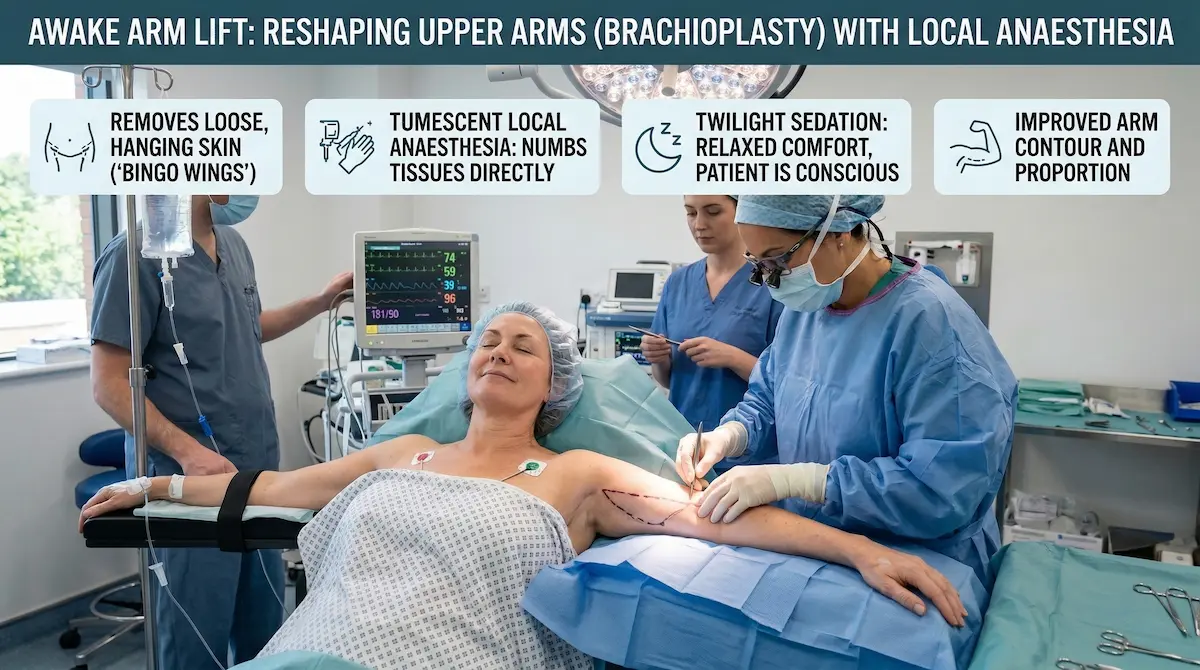
Awake arm lift is a form of brachioplasty that reshapes the upper arms by removing excess skin and, when needed, refining fat. We do it using tumescent local anaesthesia and carefully controlled sedation, rather than full general anaesthesia. You stay comfortable. You can still breathe on your own. The aim is simpler: smoother arms, without looking “done”.
Definition: from “bingo wings” to brachioplasty
In the UK, many people start with a very normal search: how to get rid of bingo wings. It usually means loose, hanging skin along the underside of the upper arm, often most obvious when you lift your arm or wave. Once skin elasticity has been lost, creams and toning exercises have limits.
Clinically, the procedure is called brachioplasty. If you’ve ever typed what is brachioplasty surgery, the short answer is this: we remove the extra skin, reshape the contour, and place the incision where it can be concealed as much as anatomy allows.
- Goal: improve contour and proportion of the upper arm.
- What it treats: skin laxity, mild-to-moderate “crepey” texture, and (in selected cases) residual fat.
- What it does not do: replace strength training or fix skin quality everywhere on the body.
The anatomy behind upper-arm laxity
The upper arm changes for a few reasons. Fat distribution shifts with age. Collagen and elastin fibres lose resilience. After weight loss, the “envelope” of skin can simply be too large for the new volume underneath.
From a surgical perspective, an arm lift is less about chasing a perfect line, and more about managing tension. Too much tension can widen scars. Too little correction leaves a persistent “hang”. We plan the lift to balance shape, scar position, and long-term settling.
What makes it “awake”? (tumescent local anaesthesia + twilight sedation)
A common question is, “are you awake during surgery?” Another is, “can you be awake for surgery?” With our awake protocols, you are not “wide awake” in the everyday sense, but you are not fully unconscious either. We use tumescent local anaesthesia to numb the area thoroughly, then add light, monitored sedation (often called conscious sedation or “twilight sleep”).
People describe it in different ways, which is why “what does twilight sedation feel like?” is such a frequent search. Most patients report a time-compressed experience, relaxed awareness, and limited memory of fine detail. You should still expect a clinical environment: monitoring, sterile drapes, and a calm team focused on safety.
- Local anaesthesia: targets the arm tissues directly, reducing pain signals at the source.
- Twilight sedation: supports comfort and reduces anxiety while keeping protective reflexes intact.
- Communication: you can respond if we need you to adjust position briefly.
And yes, some patients worry: does local anaesthesia make you loopy? Mild grogginess can happen from the sedative element, not the numbing itself. We plan this in advance, tailor dosing, and keep you monitored throughout.
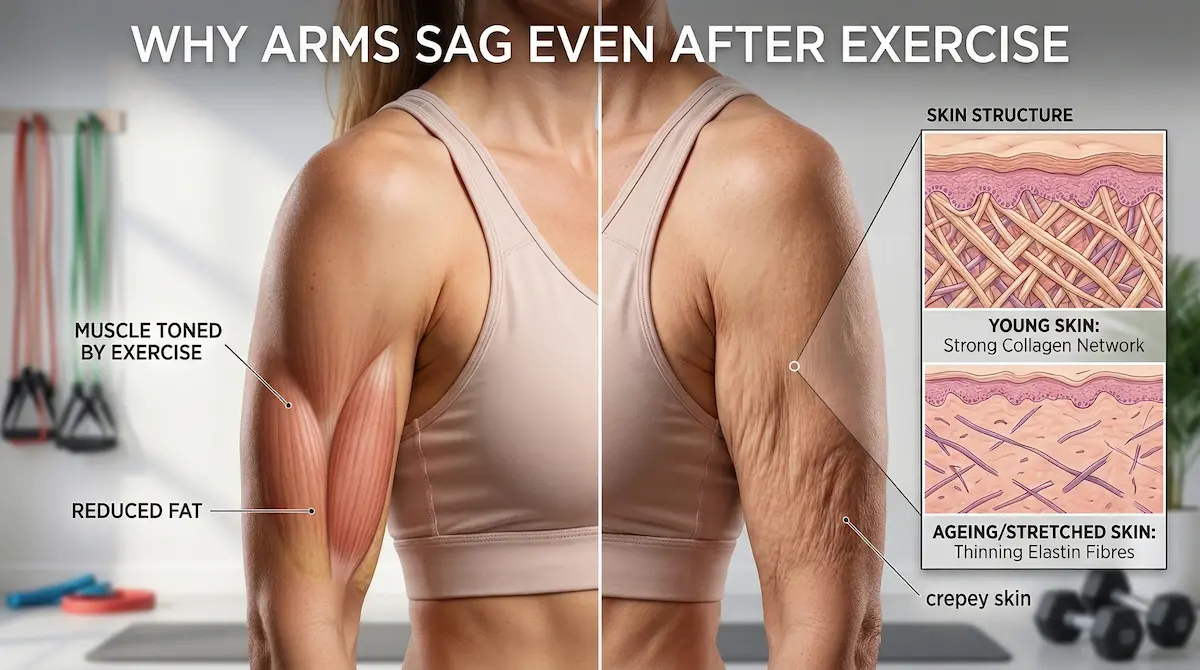
Why do arms sag even if you exercise?
This is the frustrating part. You can do the work, lose weight, and still see loose skin. That does not mean you “failed”. It means the skin is behaving like skin, not muscle.
Exercise improves tone and can reduce fat. It cannot reliably shrink stretched skin once elasticity has been lost. For many UK patients, this is the moment the conversation shifts from fitness to body contouring.
Skin elasticity changes with age
Skin has a support network made of collagen and elastin. Over time, that network thins and becomes less springy. Gravity then does what it always does, particularly in areas with softer tissue, like the inner upper arm.
You may notice a “crepey” look first, then a more obvious fold. This is common after 40, but it can appear earlier depending on genetics and sun exposure.
Weight loss and genetics can leave “empty skin”
After weight loss, the arm can look smaller, but the skin may not contract enough to match the new shape. Genetics also matters. Some people naturally store more tissue in the upper arm or have thinner skin that shows laxity sooner.
- After significant weight loss: the skin envelope can be disproportionately large.
- After pregnancy or hormonal changes: fat distribution may shift to the arms.
- Family tendency: if close relatives develop upper-arm laxity, you may too.
When exercise helps — and when it cannot
If your concern is mainly soft fat with minimal loose skin, strength training and nutrition can make a visible difference. If the issue is excess skin that bunches or hangs, no amount of tricep work can “lift” skin back to where it used to sit.
In our consultations, we separate these two patterns quickly. It keeps expectations realistic. It also guides the technique we recommend in later sections, including whether a smaller-scar approach is possible.
Benefits of an awake arm lift: what changes (and what stays natural)
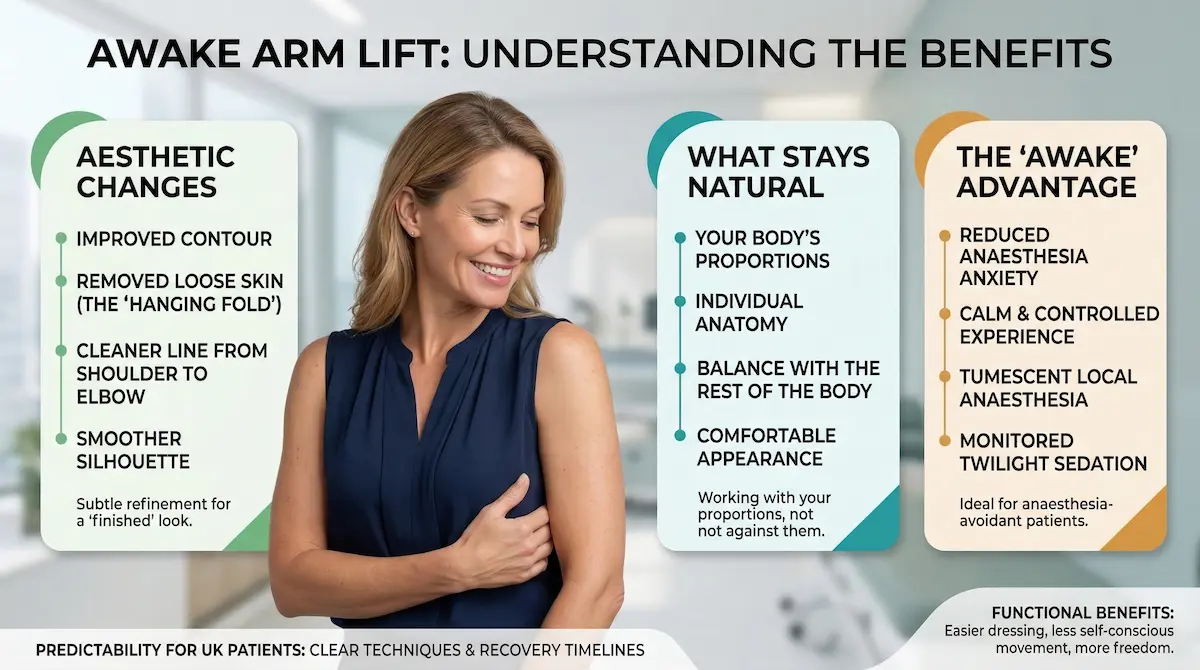
Most people do not want “different arms”. They want their arms back. The benefit of an awake approach is that we can focus on shape and proportion while keeping the overall experience calm and controlled, which matters for patients who feel anxious about a full general anaesthetic.
In practical terms, brachioplasty aims to remove the excess skin that creates a hanging fold and to refine the contour so the arm looks smoother in motion. Based on our clinical overview and wider scientific research into skin laxity and tension management, the goal is subtle. It should sit comfortably with the rest of your body, not compete with it.
For UK patients, the other benefit is predictability. When the plan is clear — technique, scar placement, recovery timeline — decision-making becomes more rational and less emotional. That is the point.
Aesthetic improvements: contour, proportion, and a more “finished” arm line
The most visible change is along the underside of the upper arm, where looseness tends to gather. We remove the redundant skin and reshape the tissues so the arm looks firmer when you lift it, wave, or wear short sleeves.
We plan the result around your natural anatomy. That means working with your proportions, not against them.
- Better definition: the arm looks cleaner from shoulder to elbow.
- Smoother drape: clothing sits more predictably, especially fitted sleeves.
- Balanced shape: the arm can look slimmer without an “over-tight” appearance.
Functional benefits: comfort in clothes, movement, and everyday confidence
It is not only about photos. Many patients describe day-to-day annoyances: fabric catching, irritation in warm weather, or feeling the need to keep arms covered even in summer.
After healing, the practical benefits often include easier dressing and less self-conscious movement. Small changes. Real impact.
- More comfort in T-shirts, blouses, and tailored jackets.
- Less “arm cling” sensation during walking or exercise.
- More freedom with social situations — beaches, holidays, events.
“The most successful aesthetic surgery is one that goes unnoticed.”
The “awake” advantage: a calmer experience for anaesthesia-avoidant patients
Some patients are less worried about scars than they are about going fully under. That fear is legitimate. It is also common. Our awake protocols are designed to reduce that psychological barrier where clinically appropriate.
With tumescent local anaesthesia and monitored twilight sedation, many patients find the overall experience feels more manageable. You are supported. You are monitored. You are not left guessing what will happen next.
- Comfort-led approach: numbing is targeted to the treatment area.
- Reduced “loss of control” anxiety: sedation can be light and tailored.
- Recovery mindset: when fear is lower, patients often cope better with early healing.
Am I a suitable candidate for brachioplasty under twilight sedation?
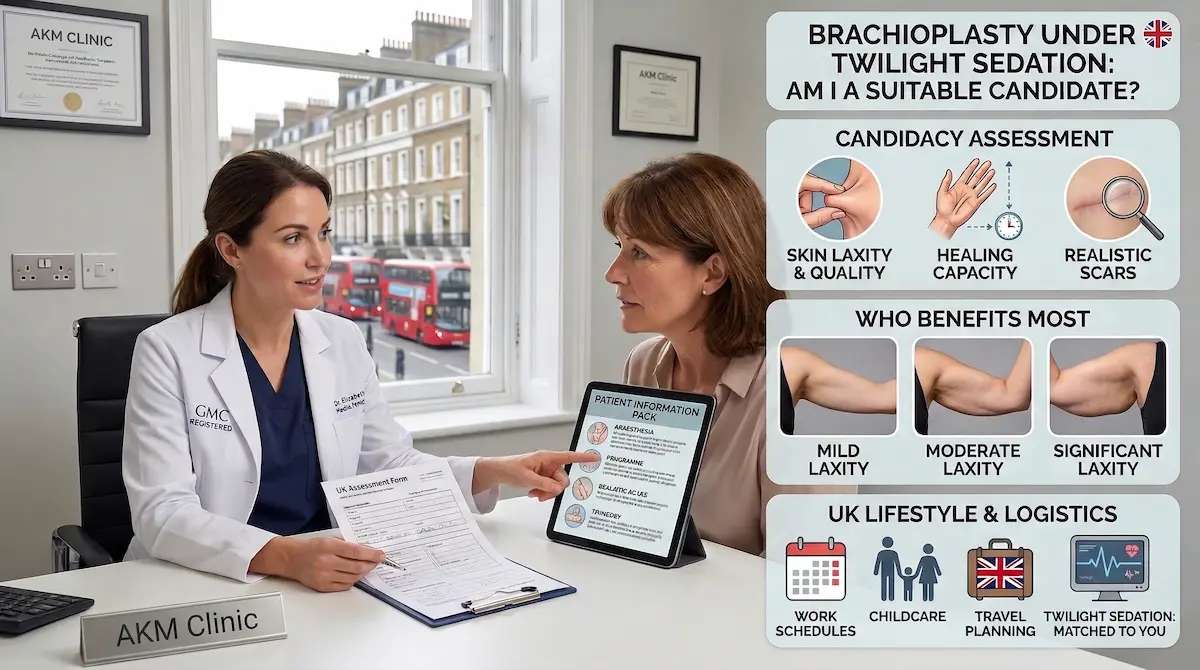
This is the part that serious researchers care about most: candidacy. A good result starts before surgery. It starts with honest assessment of skin quality, tissue laxity, healing capacity, and the reality of scars.
For many UK patients, suitability is also about lifestyle and timing. Work commitments. childcare. travel planning. We factor that in because recovery is not just biology — it is logistics.
We also take anaesthesia preferences seriously. Not everyone is suitable for twilight sedation, and not every arm requires the same technique. Our job is to match the plan to your body and your risk profile, not to force a one-size approach.
Who tends to benefit most from an arm lift
You may be a strong candidate if your main issue is loose skin that hangs or bunches, particularly after weight loss or with age-related laxity. Exercise can improve tone, but it rarely corrects an oversized skin envelope.
In consultation, we look at how the skin behaves when lifted and how much correction is needed to achieve a meaningful change.
- Mild laxity: early looseness, some “creased” texture, limited overhang.
- Moderate laxity: visible hanging fold, clothing discomfort, strong preference for coverage.
- More significant laxity: pronounced overhang that affects confidence and silhouette.
Who should avoid or delay brachioplasty (contraindications)
Safety comes first. There are situations where surgery should be delayed, adapted, or avoided. We run pre-operative health screenings to make sure we are not pushing you into a plan that does not suit your medical background.
If you have complex health concerns, we may ask for input from your UK GP or specialist. That is normal. It is also a good sign.
- Uncontrolled medical conditions (for example, poorly controlled diabetes or blood pressure).
- Current smoking or vaping when you cannot pause — it can compromise healing.
- Blood-thinning medication that cannot be adjusted safely (your prescriber must guide this).
- Unstable weight, or plans for major weight loss that could “re-stretch” the result.
Your pre-op checklist: how to prepare like an “expert patient”
Preparation is where outcomes become more predictable. We keep it structured and practical. No drama.
Before travel, we confirm your plan, set expectations around scarring, and agree the recovery timeline that makes sense for your return to the UK.
- Medication review: bring a full list, including supplements.
- Smoking pause: if you smoke, we will advise a clear stop window.
- Recovery planning: book light duties, organise childcare, and plan sleep set-up.
- Travel comfort: choose loose layers and consider how you will manage luggage.
If you are unsure where you sit on the candidacy spectrum, we can review photos and your medical background during a virtual consultation. UK patients typically value clarity. We agree.
Surgical techniques explained: mini vs extended brachioplasty
There is no single “best” arm lift technique. There is only the right match for your anatomy, your scar tolerance, and the quality of your skin. We choose the method by measuring where the excess sits (near the armpit, along the inner arm, or extending towards the side of the chest) and how much tightening is needed to create a stable contour. Scar placement is planned first, then the lift is designed around it. That sounds blunt. It is also how you avoid disappointment.
Most UK patients come in asking for the smallest scar possible. Reasonable. The key is understanding the trade-off: shorter scars usually mean a more modest improvement, while more significant laxity often needs a longer incision to achieve a smooth result that lasts. We will always prioritise a natural line and safe healing over aggressive tightening.
Mini brachioplasty and the short scar arm lift
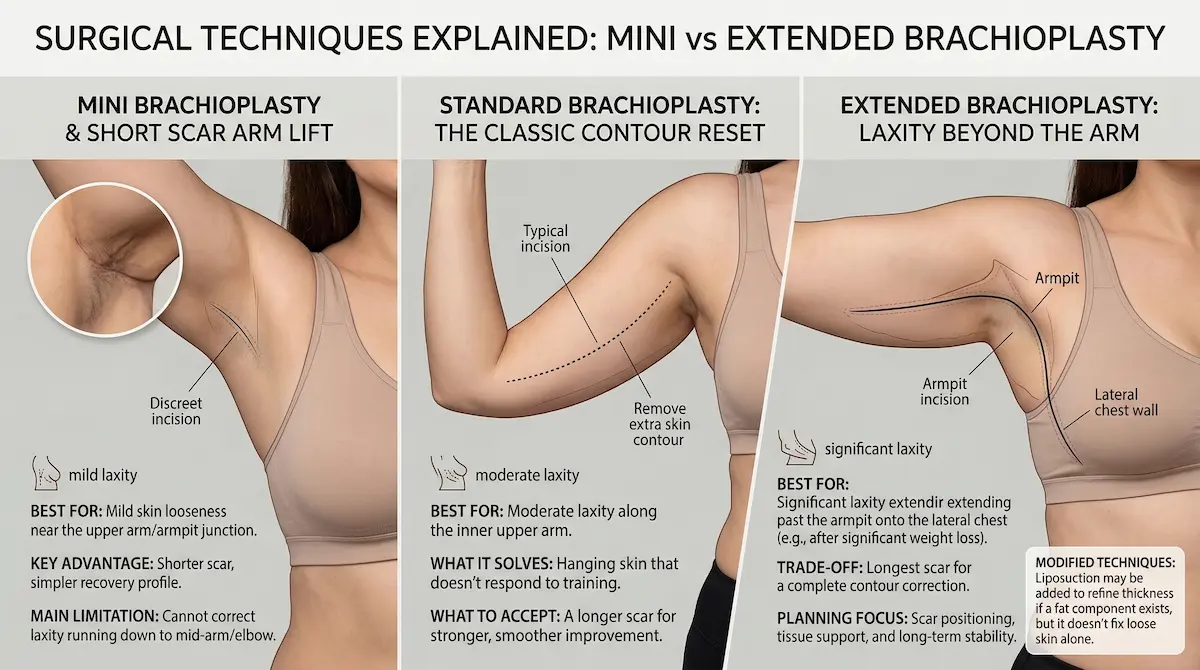
A mini arm lift is designed for mild laxity, where the main excess is close to the armpit. The incision is typically placed within the natural crease of the underarm, aiming to keep it discreet. This approach can be a good “entry point” for patients who are scar cautious and do not need full-length tightening. It is not a loophole. It is simply a smaller correction.
- Best for: mild skin looseness near the upper arm/armpit junction.
- Key advantage: shorter scar and a simpler recovery profile for suitable candidates.
- Main limitation: it cannot reliably correct laxity that runs down to the mid-arm or elbow.
Standard brachioplasty: the classic contour reset
When skin laxity extends beyond the armpit area, a standard brachioplasty is usually the most reliable option. The incision runs along the inner arm so we can remove the extra skin and reshape the contour in a controlled way. Done properly, it is not about “pulling skin tight”. It is about tension management, symmetry, and a clean arm line that settles well over time.
- Best for: moderate laxity along the inner upper arm.
- What it solves: hanging skin that does not respond to training or weight stability.
- What to accept: a longer scar in exchange for a stronger, smoother improvement.
Extended brachioplasty and when laxity travels beyond the arm
Some patients have laxity that continues from the upper arm onto the side of the chest, particularly after significant weight loss. In that scenario, stopping the correction at the arm can leave a “step” or residual fold. An extended approach allows us to address the full zone of looseness, aiming for a more continuous contour. It is a bigger decision, but it can be the most honest one.
- Best for: significant laxity that extends past the armpit onto the lateral chest.
- Trade-off: a longer scar for a more complete contour correction.
- Planning focus: scar positioning, tissue support, and long-term stability.
Modified brachioplasty techniques: when liposuction is (and isn’t) helpful
Some arms have a fat component as well as loose skin. In selected cases, we may add targeted liposuction to refine thickness and improve definition. But here is the rule: liposuction does not fix loose skin on its own. If the skin envelope is too large, it needs surgical reshaping to avoid waviness or lingering “hang”.
“Technique is not about the smallest scar. It is about the right tension, in the right place, for a result that settles naturally.”
| Technique | Best for | Typical incision focus | Strength of tightening | Scar trade-off |
|---|---|---|---|---|
| Mini brachioplasty | Mild laxity near the armpit | Underarm crease | Moderate | Shortest scar, limited reach |
| Standard brachioplasty | Moderate inner-arm laxity | Inner upper arm | Strong | Longer scar, stronger correction |
| Extended brachioplasty | Significant laxity extending beyond the arm | Arm + lateral chest zone | Strongest | Longest scar, most complete contour |
Combined procedures: maximising results in one visit
UK patients often ask the practical question: “If I’m travelling, can we do more than one thing?” Sometimes, yes. Combining procedures can be efficient, especially when your goals are connected (for example, overall contouring after weight loss). But it is never a default. Our approach is simple: we combine treatments only when it remains clinically sensible for your health profile, healing capacity, and recovery support.
There are two parts to the decision. First, surgical logic: will doing them together improve harmony and reduce the need for a second anaesthetic plan later? Second, recovery logic: will the combined healing load still allow you to move comfortably, sleep well, and travel safely back to the UK? If the answer is “not confidently”, we stage. We do not gamble with outcomes.
Arm lift + liposuction: refining volume and shape
When excess volume is part of the concern, combining an arm lift with targeted liposuction can improve definition. This is also where some patients search for minimally invasive liposuction Istanbul, hoping liposuction alone will “lift” the arm. It won’t. Liposuction can refine. The lift is what reshapes the skin envelope.
- Good fit: skin laxity plus a clear fat component.
- Not a fit: loose skin without enough elasticity to retract.
- Planning detail: we prioritise smoothness and symmetry over aggressive fat removal.
Body contouring combinations: when arms are part of a bigger plan
Some patients do not see “arms” as an isolated issue. They see a post-pregnancy or post-weight-loss body that needs a coordinated approach. In those cases, we may discuss pairing arm work with wider body contouring options that we already offer, such as a mummy makeover plan, tummy tuck, or breast surgery, where appropriate. The goal is proportion. Not maximum change.
- Best for: patients seeking balanced contouring across multiple areas.
- Key requirement: stable weight and realistic recovery time.
- Decision driver: safety, not speed.
Safety-first decision rules for combining procedures
Combining procedures is not just about time in theatre. It is about your physiology. We use structured pre-operative screening and continuous monitoring to keep risk controlled, and we plan the sequence so swelling and mobility remain manageable. For some patients, doing less in one trip produces a better result. That is the uncomfortable truth. It is also how we protect the long-term outcome.
“One trip should never mean one compromise. If staging gives you a cleaner result and safer healing, we stage.”
Twilight anaesthesia for cosmetic surgery: can it be safer than general?
UK patients often ask a direct question: is twilight sedation safer than general? There is no universal “safer” option for everyone. There is the safest option for you, based on your health profile, airway assessment, procedure length, and comfort level.
Our approach is straightforward. Where clinically appropriate, we build the plan around tumescent local anaesthesia and monitored sedation, rather than defaulting to full general anaesthesia.
What we mean by “twilight” (and what we do not)
When people search twilight anaesthesia cosmetic surgery, they usually mean light-to-moderate sedation with local anaesthetic. You are comfortable. You are monitored. You are not placed into a deep, fully unconscious state as you would be under general anaesthesia.
- Local anaesthesia: numbs the arm tissues directly.
- Conscious sedation: reduces anxiety and makes time feel shorter for many patients.
- Monitoring: we track vital signs continuously in the operating theatre.
Why tumescent local anaesthesia matters in an arm lift
Tumescent local anaesthesia is not simply “a bit of numbing”. It is a structured technique where the solution is delivered through the planned treatment area to create thorough, even anaesthesia. This supports comfort during the procedure and can reduce the need for deeper sedation in suitable patients.
We also plan the surgery to avoid unnecessary tissue trauma. Less trauma helps. It is not glamorous. It is just good practice.
When general anaesthesia may still be the right choice
Some patients are not suitable for an awake approach. Others may technically be suitable, but feel too anxious to tolerate the environment even with sedation. We do not force it.
- Complex medical history that increases risk under sedation.
- Airway considerations identified during assessment.
- Very long combined procedures where deeper anaesthesia is clinically preferable.
- Severe anxiety that cannot be managed safely with sedation alone.
Our role is to recommend what is safest and most predictable, not what sounds most appealing online.
What happens in the operating theatre: step-by-step
“What will the day actually look like?” is a fair question. A clear plan reduces fear. It also reduces surprises.
Below is the practical flow we use for UK patients travelling to Istanbul for an arm lift, including the final checks before you return to your hotel.
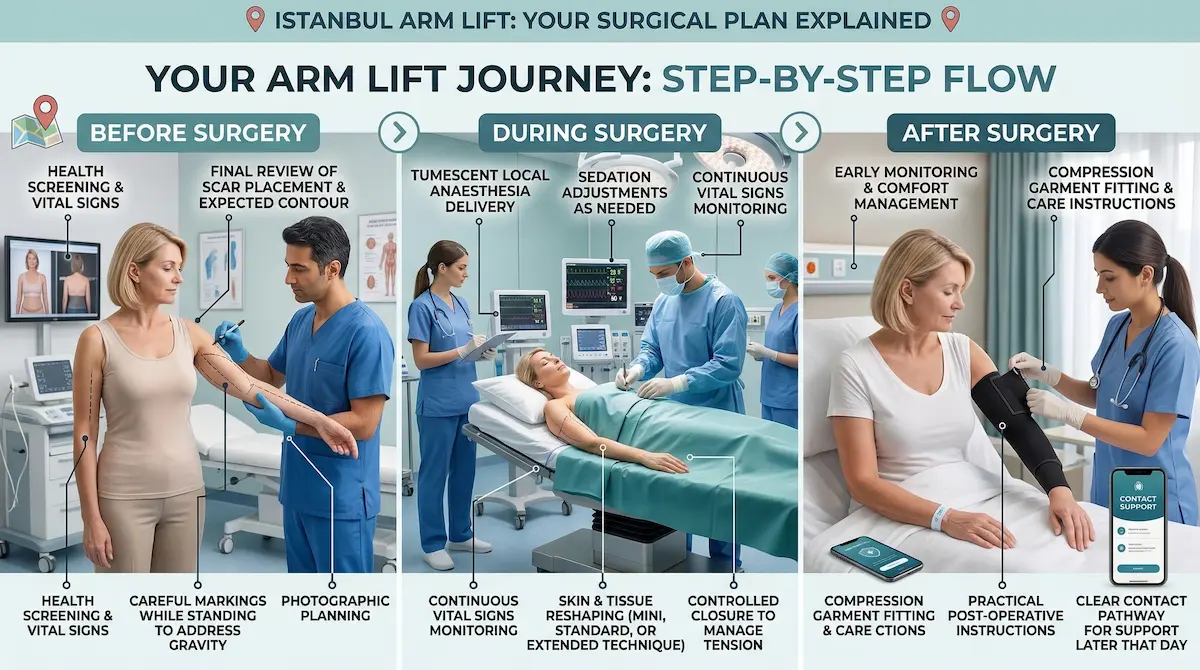
Before surgery: screening, markings, and a final surgical plan
We start with pre-operative tests and a focused health review. Our surgeons confirm the technique choice, scar positioning, and symmetry plan with you in person. Markings are done carefully, while you are standing, because gravity changes the tissue behaviour.
- Health screening and baseline vital signs.
- Photographic planning where appropriate.
- Final review of scar placement and expected contour change.
During surgery: comfort, monitoring, and controlled technique
In the operating theatre, we keep the environment calm and structured. We apply tumescent local anaesthesia, then adjust sedation to your needs. Our team monitors your vital signs continuously and keeps communication simple.
- Local anaesthetic delivery to the planned treatment area.
- Skin and tissue reshaping based on the agreed technique (mini, standard, or extended).
- Closure designed to manage tension and support long-term scar quality.
After surgery: immediate recovery and discharge planning
After the procedure, we observe you closely before discharge. Many patients prefer the comfort of their hotel rather than an overnight stay, where clinically appropriate. Your first post-operative instructions are practical: how to rest, how to move, and what to watch for.
- Early monitoring and comfort management.
- Compression garment fitting and care instructions.
- Clear contact pathway if you need support later that day.
Rapid Recovery & Safety Protocol: HBOT and LLLT for aftercare support
“Fast recovery” is a phrase that gets misused online. We keep it grounded. Healing still takes time, and scars mature over months, not days.
What we can do is support your recovery with structured protocols that reduce avoidable setbacks and improve the quality of healing conditions.
HBOT: supporting tissue oxygenation after surgery
We utilise Hyperbaric Oxygen Therapy (HBOT) as part of our recovery support for suitable patients. HBOT involves breathing 100% oxygen in a pressurised environment, with the goal of increasing oxygen delivery to healing tissues. In clinical terms, oxygen supports tissue recovery, inflammation control, and infection defence.
- Recovery support: may help reduce inflammation and “social downtime”.
- Safety logic: supports tissue health during the early healing phase.
- Scar quality: oxygen-driven collagen activity is part of how scars mature.
LLLT: scar support and cellular-level healing
For patients concerned about scars, we also integrate Low-Level Laser Therapy (LLLT) within aftercare planning where appropriate. Many people search for LLLT scar healing therapy Turkey because they want something practical beyond creams. LLLT aims to stimulate cellular repair and collagen activity without heat damage.
- Targets redness and swelling in a controlled way.
- Supports collagen-building processes linked to scar maturation.
- Works as an adjunct to other aftercare measures, not a replacement for them.
How we use these tools in a sensible way (not as “magic”)
Technology only matters when it is integrated into a system of care. We use HBOT and LLLT alongside fundamentals: sensible movement, clean wound care, compression, and structured follow-up. That combination is what keeps recovery predictable.
If a patient is not a good fit for these therapies, we say so. No theatre. No pressure. Just a plan that matches your biology and your timeline.
Recovery & aftercare: how long does healing take after brachioplasty?
Recovery is not a single moment. It is a sequence. The first week is about comfort and wound care, the next few weeks are about swelling management and steady mobility, and the following months are about scar maturation. If you are travelling from the UK, we also plan recovery around your flight home and your ability to manage day-to-day tasks. Calm planning beats optimism.
Patients often search for brachioplasty recovery day by day because they want something practical, not vague reassurance. That is how we structure it: day-by-day priorities, then week-by-week milestones. Your exact timeline depends on technique (mini vs extended), your skin quality, and how well you follow compression and activity guidance.
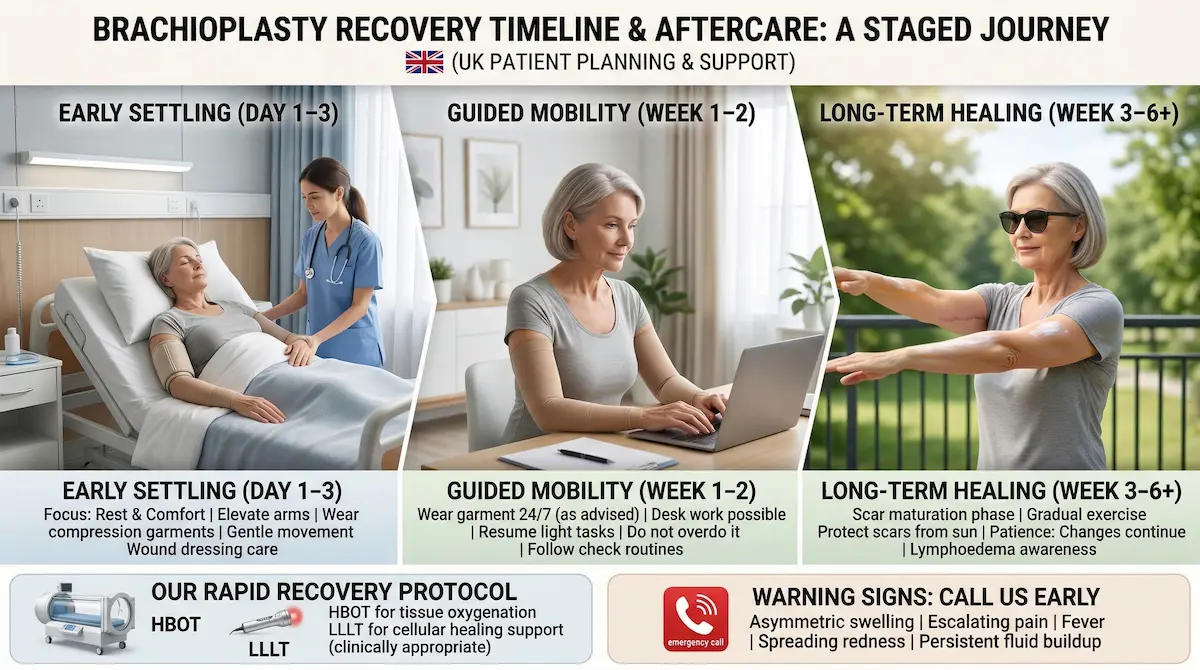
Day 1–3: settling, swelling control, and safe movement
The first 72 hours are usually the “tight” phase. The arms can feel firm, heavy, and unfamiliar. That is normal. Your job is to rest, keep movements gentle, and avoid any sudden stretching.
- Swelling: expect swelling and tightness post-op to be most noticeable here.
- Sleep: back-sleeping with pillows can reduce pressure and swelling.
- Movement: short, frequent walks help circulation. No lifting. No reaching overhead.
- Wound care: keep dressings clean and follow our instructions exactly.
Week 1–2: compression, checks, and a return to routine
This is the phase where patients start to feel more “normal”, but the arms can still look puffy. Many people feel well enough to do light tasks, then overdo it. Don’t. Controlled recovery is faster recovery.
We fit and guide you on compression garments, including arm compression sleeves, because they support swelling control and help the tissues settle smoothly. Compression is not about discomfort. It is about stability.
- Compression: wear as advised. Consistency matters.
- Hygiene: follow the washing and dressing-change routine we set.
- Work: desk-based work may be possible for some patients, depending on swelling and comfort.
Week 3–6 and beyond: scar maturation and strength timelines
By weeks 3–6, swelling typically reduces in a more noticeable way. Scars can look pink or raised before they start to soften. That is part of the normal maturation curve. The long-term goal is a scar that becomes quieter with time, not a “perfect line” overnight.
- Exercise: we typically reintroduce activity gradually. Timing depends on your healing.
- Sun: scar protection matters. UV exposure can darken scars.
- Patience: scar changes continue for months. This is expected.
Complication awareness: lymphatic swelling and what to watch for
Most healing changes are expected. Some need attention. One common worry is lymphoedema after brachioplasty. True lymphoedema is not the same as routine swelling, but patients often use the term to describe any puffiness.
We give you clear warning signs and a direct pathway to contact us. If something feels wrong, we would rather hear early than late.
- Call us if: one arm becomes significantly more swollen than the other, pain escalates suddenly, or you develop fever symptoms.
- Also report: unusual redness spreading beyond the incision area or persistent fluid build-up.
- Do not self-diagnose: photos and a review are more reliable than guesswork.
Our Rapid Recovery & Safety Protocol (HBOT + LLLT)
We use a structured aftercare system rather than leaving recovery to chance. Our Rapid Recovery & Safety Protocol integrates HBOT for systemic recovery support and LLLT for targeted cellular-level healing support, where clinically appropriate. It is not a replacement for compression, movement guidance, or wound care. It is a layer of support.
- HBOT: supports tissue oxygenation and helps create favourable conditions for healing.
- LLLT: supports collagen activity and can help with redness and swelling patterns as healing settles.
| Timeline | What you may notice | What we prioritise |
|---|---|---|
| Day 1–3 | Tightness, swelling, fatigue | Rest, gentle walking, careful wound care |
| Week 1–2 | Bruising reduces, swelling fluctuates | Compression consistency, check-ups, routine building |
| Week 3–6 | Shape settles, scars can look pink | Graduated activity, scar protection, steady progress |
| Months 3–12 | Scar softening and fading | Long-term scar care habits and realistic expectations |
If your key concern is flying home safely and comfortably, we plan recovery with flight-ready recovery protocols in mind. That means clear milestones, a sensible garment plan, and no “heroics” in the final 48 hours before travel.
Safety & risks: is brachioplasty dangerous?
Every surgery has risk. An honest clinic says that plainly. The real question is not whether risk exists, but how we assess it, reduce it, and respond if something deviates from the expected recovery course. We do that through structured screening, controlled technique, and clear aftercare protocols.
UK patients are understandably cautious about travelling for surgery. We take that seriously. We operate with a safety-first mindset and a conservative approach to candidacy. If you are not a good fit, we tell you. If a staged plan is safer than a combined one, we stage.
Common risks (and why they happen)
Most risks are manageable when identified early. Some are simply part of how the body heals. We discuss these clearly before surgery so you are not surprised by normal healing phases.
- Swelling and bruising: expected to some degree after tissue reshaping.
- Infection: uncommon, but possible with any incision. Good wound care reduces risk.
- Fluid collection (seroma): can occur in spaces created during reshaping.
- Scarring issues: scars can widen or thicken depending on tension and skin biology.
Less common risks: sensation changes and asymmetry
Numbness or altered sensation can happen because small sensory nerves are affected during surgery. Most changes improve over time, but we do not over-promise. Asymmetry can also exist naturally and may be noticed more during healing when swelling differs between sides.
- Sensation changes: often temporary, occasionally longer-lasting.
- Asymmetry: usually improves as swelling settles, but perfect symmetry is not realistic.
- Delayed healing: more likely if you smoke or have poorly controlled medical conditions.
How we reduce risk: screening, technique, and aftercare discipline
Risk reduction starts before theatre. We review your health history, medications, and healing risk factors. Our European Board Certified Surgeons then plan the technique to manage tension and reduce unnecessary trauma.
After surgery, discipline matters. Compression, wound care, and activity limits are not optional extras. They are part of the treatment.
- Pre-op screening: identifies avoidable risk factors early.
- Controlled closure: aims to reduce tension, supporting scar quality.
- Structured follow-up: we keep communication open, especially for UK patients travelling home.
“Safety is not a slogan. It is a system — before, during, and after surgery.”
Is an arm lift in Turkey safe for UK patients?
For many UK patients, the real decision is not “Turkey or the UK”. It is “do I trust the system behind the surgeon?” That is a sensible way to think. Safety comes from standards, screening, monitoring, and aftercare discipline. We build our process around those pillars so you are not relying on hope.
What the “UK trust gap” really is (and how we close it)
Most concerns about travelling for surgery are predictable: credentials, hygiene, and what happens once you fly home. We treat those as practical problems, not marketing objections. Our approach is to make the clinical pathway visible and verifiable. If something cannot be explained clearly, it is not robust.
- Credentials: you should know who is operating and what boards they are accountable to.
- Facility standards: sterile protocols, monitoring, and pre-op screening should be non-negotiable.
- Aftercare: support must continue after you return to the UK.
Standards in practice: sterile protocols, monitoring, and screening
When patients look for a Private cosmetic clinic Istanbul British standards, they are usually asking about the basics done well. We agree. We operate with structured pre-operative health screenings, and we monitor vital signs throughout your procedure. We also work within internationally benchmarked frameworks for sterilisation and safety protocols.
- Pre-op screening: candidacy is assessed before we commit to a plan.
- Monitoring: vital signs are tracked throughout surgery, not “checked now and then”.
- Materials and environment: we aim for internationally recognised quality controls, not shortcuts.
Credentials and accountability: what UK patients should look for
Many UK patients search for UK board-certified equivalent surgeons because they want a clean comparison against local expectations. That is fair. In our general procedure content, we refer to our team as European Board Certified Surgeons and specialists registered with international medical boards, rather than turning the page into a list of names. If you are checking GMC registered surgeon alternatives, the correct move is to verify the surgeon’s board pathway and training, then verify the facility and follow-up system around them.
“A good outcome is rarely ‘talent alone’. It is technique, standards, and aftercare working together.”
If you want a suitability answer without travelling, we can start with a virtual consultation and a structured review of your goals, your skin quality, and your medical history.
Realistic expectations: Awake Arm Lift Before and After
Most disappointment comes from vague expectations. We avoid that by keeping the goal specific: a smoother upper arm contour that still looks like you. Our philosophy is “Rejuvenation, Not Alteration.” That matters for arms because over-tightening can create unnatural tension, and under-correction leaves lingering looseness. A good plan balances improvement, scar placement, and long-term settling.
What improves (and what does not)
Arm lift surgery improves contour. It does not “change skin quality everywhere” or replace training. If you have a skin overhang, we can remove and reshape that envelope. If the issue is mainly texture, we may improve it modestly by removing excess, but we will not claim a perfect surface.
- Improves: the hanging fold, arm silhouette, and clothing fit.
- May improve: mild crepey appearance where excess skin is removed.
- Does not do: create a gym-built arm without exercise, or erase every skin line.
Timeline: when you “see” the result
Early results can look encouraging, then swelling fluctuates and the arms feel tight. That is normal. Shape typically settles in stages: the first few weeks are about swelling control, then the tissues soften, then scars mature. We plan your recovery with that reality in mind, especially if you are travelling back to the UK.
- Weeks 1–2: swelling and tightness are expected; compression matters.
- Weeks 3–6: contours become clearer; activity returns gradually.
- Months 3–12: scars soften and fade; final refinement becomes obvious.
Scars and concealment: an honest trade-off
Scars are part of brachioplasty. The question is where we place them, how we manage tension, and how you care for them. Many people research brachioplasty scars after 1 year because they want reassurance that scars typically calm with time. That is reasonable, and we will talk you through what “normal maturation” looks like for your skin type.
You may also see searches like Michelle Obama brachioplasty. In most cases, that search is not about a confirmed procedure. It is about a visual benchmark for toned arms and a “finished” upper-arm line. We keep that grounded and personal: your anatomy sets the plan, and your scar tolerance shapes the technique choice.
“Natural results are not ‘less’. They are simply better planned.”
If scar anxiety is your biggest barrier, we will discuss realistic concealment, long-term scar care, and where supportive aftercare technologies may fit into your recovery plan.
Cost & fees: arm lift surgery in Turkey vs the UK (GBP focus)
UK patients usually start with a simple comparison: what does it cost locally, and what does it cost in Istanbul. The honest answer is that fees vary widely based on technique (mini vs extended), operating time, and the level of aftercare built into the plan. The smarter question is what your quote actually includes, and what you would pay separately. We keep our pricing model transparent so you can compare like-for-like in GBP (£), not guesswork.
Why UK prices differ (and why that doesn’t automatically mean “better”)
When people search “brachioplasty cost London / Harley Street” or “brachioplasty surgery Manchester”, they’re usually benchmarking prestige and convenience. UK private fees reflect the local operating costs of staff, theatre time, insurance frameworks, and clinic overheads. International price differences are often driven by macroeconomic factors and national operating costs rather than a single “quality” variable. That is why we encourage you to compare the system around the surgery, not just the headline figure.
- Technique: mini procedures typically price differently from extended lifts due to time and complexity.
- Aftercare model: follow-up intensity changes the overall value equation.
- Transparency: “cheap-looking” quotes often hide separate fees; we avoid that structure.
What our all-inclusive model covers (so you can compare properly)
Many UK patients specifically look for All-inclusive cosmetic surgery GBP because hidden extras are a common frustration in private care. Our VIP package is designed to remove uncertainty and keep your planning clean. We combine medical essentials with logistics support so the journey feels managed rather than improvised. The only major item you organise yourself is your international flight ticket.
- Your complete surgical procedure
- Anaesthesia and operating theatre fees
- All pre-operative tests
- 5-star hotel accommodation (from our curated partners)
- All VIP airport and clinic transfers
- Your 24/7 dedicated Patient Host (WhatsApp support)
- All post-operative medications and garments
- First post-op meal
- Long-term virtual follow-up care
What to budget for separately (no surprises)
When you calculate “private arm lift surgery price”, it’s easy to miss the practical extras that sit outside any clinic’s package. We prefer to state these clearly upfront. That way, your “Turkey vs UK” comparison stays fair. It also helps if you are discussing options like “brachioplasty patient finance” on the UK side, where budgeting often works differently.
- International flight tickets
- Personal travel insurance
- Personal expenses (meals beyond the first post-op meal)
- Additional hotel nights (if you extend your stay)
- Visa fees (if applicable)
| Comparison point | Typical UK private pathway | Our Istanbul VIP pathway |
|---|---|---|
| Fee structure | Often itemised (surgeon, theatre, anaesthesia, garments, follow-up) | All-inclusive package designed for clarity |
| Logistics | Patient-managed (travel, hotel, transfers) | We arrange hotel and transfers; you book the flight |
| Aftercare support | Local follow-up varies by clinic | 24/7 WhatsApp support + scheduled virtual follow-ups |
How to Choose the Best Awake Brachioplasty Surgeon
“Best brachioplasty surgeon” searches are usually driven by one thing: fear of regret. That fear is healthy when it makes you verify credentials, standards, and aftercare systems. It becomes unhelpful when it pushes you towards slogans instead of evidence. We suggest a simple framework: confirm the surgeon, confirm the facility, confirm the follow-up. Then decide.
Credentials that actually matter
UK patients often look for UK board-certified equivalent surgeons or “GMC registered surgeon alternatives” because they want a familiar trust signal. We respect that. In our general procedure pages, we refer to our operating clinicians as European Board Certified Surgeons and specialists registered with international medical boards. What matters is verifiable training, an appropriate scope of practice, and a track record of consistent outcomes.
- Clear credentials and professional board alignment
- Surgeon-led consultation (not a sales-only conversation)
- Realistic scar and outcome planning (no over-promising)
Facility standards: screening, monitoring, and materials
A safe arm lift is not only about the incision. It is about pre-operative screening, intra-operative monitoring, and sterile discipline. Our approach is built around strict pre-operative health screenings and continuous vitals monitoring during procedures. We also operate within internationally benchmarked environments, using recognised materials and established quality controls.
- Screening: candidacy checks before we confirm a plan
- Monitoring: structured vitals monitoring throughout the procedure
- Standards: sterile protocols engineered for international patient expectations
Evidence: outcomes, transparency, and independent reviews
Many people search for Safe plastic surgery in Istanbul reviews UK because they want proof that goes beyond a clinic’s own website. We agree with that instinct. Independent platforms and consistent patient feedback are useful when interpreted calmly. In our wider clinic summary, our Trustpilot rating is presented as one objective trust marker alongside real patient testimonials and documented results.
- Independent review signals (where available)
- Before-and-after consistency (not just one standout case)
- A clear aftercare plan that continues after you fly home
Planning your journey from the UK: from virtual consultation to flying home
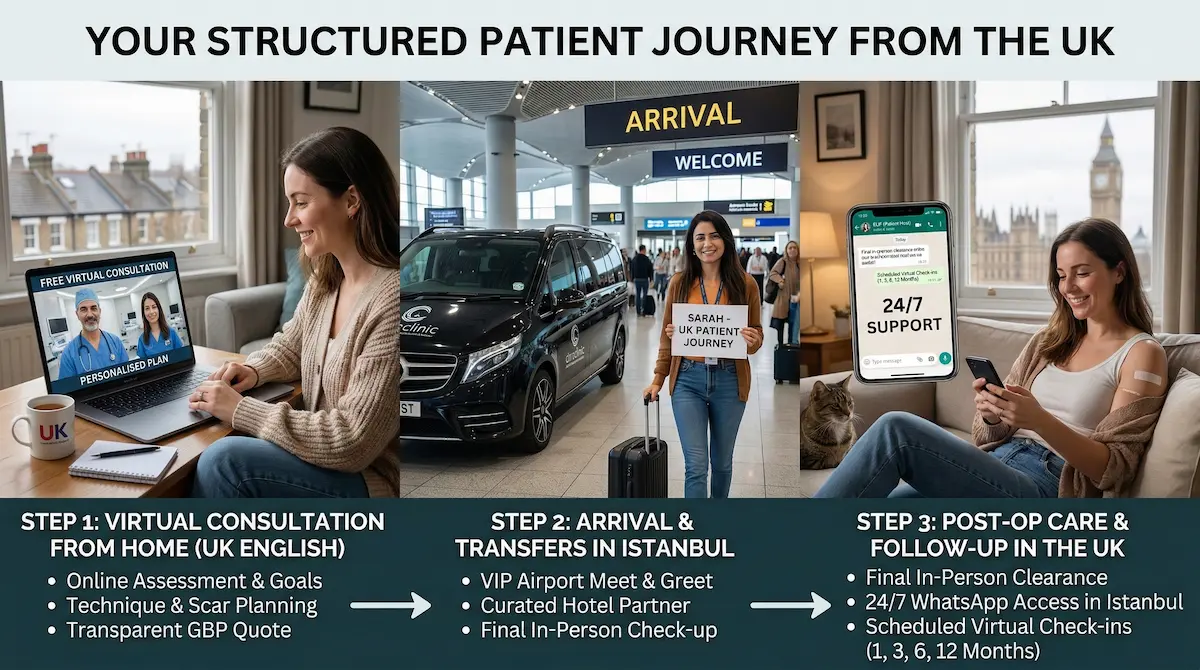
Travel becomes easier when the pathway is structured. That is why we run a defined, step-by-step journey designed for international patients, including those travelling from the UK. It begins with a virtual consultation and ends with planned long-term follow-up. In between, we take the logistics off your plate so you can focus on preparation and recovery.
Step 1: virtual consultation and a personalised plan
Your first step is a free virtual consultation from home. You share photos for review, discuss your goals, and receive a personalised treatment plan with a transparent quote. This stage is where we confirm whether an awake protocol is appropriate for you and whether you are better suited to a mini, standard, or extended approach. If you are searching “awake brachioplasty near me”, this is also the moment to decide whether staying local truly gives you the best system of care.
- Photo review and goal setting
- Technique recommendation with realistic scar planning
- Clear quote to support your GBP budgeting
Step 2: arrival, transfers, and a calm in-person review
Once you secure your date, your Patient Host coordinates hotel and VIP transfers. On arrival at Istanbul Airport (IST or SAW), you are met by a private driver and transferred to your hotel. On procedure day, you come to the clinic for final checks, pre-op tests, and an in-person consultation with your surgeon. This is also where we confirm you are fit to proceed and refine any last detail.
- Hotel booking via curated partners
- VIP airport and clinic transfers
- Final in-person consultation and pre-op testing
Step 3: post-op support, flying home, and long-term follow-up
UK patients often worry about being “left alone” after they return home. We build against that fear with an organised follow-up pathway. Your Patient Host remains available 24/7 via WhatsApp during your stay, and you have a final in-person check-up before being cleared to fly. After you return home, we schedule virtual follow-ups at set milestones to track healing.
- Post-op care in Turkey for British citizens is structured around support and continuity
- 24/7 WhatsApp access while you are in Istanbul
- Scheduled virtual check-ins at 1, 3, 6, and 12 months
Scars after an awake arm lift: what to expect at 6 weeks, 6 months, and 1 year
Scars are part of brachioplasty. That is the honest trade-off. The goal is not “no scar”. The goal is a well-placed, well-managed scar that becomes quieter as months pass.
Many patients search for brachioplasty scars after 1 year because they want a realistic picture of how a fresh incision settles. That is exactly the right mindset. Scar quality is a mix of technique, tension control, and your biology.
Where we place the incision (and why “short scar” isn’t always honest)
We plan scar placement based on where your excess skin actually sits. If laxity runs down the inner arm, a very short incision cannot correct it reliably. A “short scar arm lift” can be appropriate for mild laxity near the underarm. It is not a universal solution.
We would rather be precise than optimistic. If you need a stronger lift, we plan a longer incision with tension management, so the final contour looks natural and stable.
- Mini brachioplasty: scar typically sits in the underarm crease for mild laxity.
- Standard brachioplasty: scar usually follows the inner arm line to allow meaningful reshaping.
- Extended brachioplasty: scar planning may continue beyond the arm if laxity extends onto the side of the chest.
Brachioplasty scar photos and healing: what changes over time
Early scars often look more dramatic than the final outcome. That is normal. In the first weeks, the line can appear pink, raised, or slightly firm because the body is actively rebuilding collagen.
Then it settles. Slowly. The scar usually softens and fades over months, not days. That is why judging a scar at week two is meaningless.
- Weeks 1–6: swelling reduces, bruising fades, scars can look pink and “new”.
- Months 2–6: scars often flatten and start to lighten; tightness gradually reduces.
- Months 6–12: scar maturation continues; the line typically becomes less noticeable.
Your role matters here. Sun protection, consistent scar care, and not over-stretching the arms too early can make a meaningful difference to how the scar matures.
Scar support options: protection, consistency, and camouflage when appropriate
We keep scar care practical. Start with the fundamentals and stay consistent. Most scar problems come from two things: tension and impatience.
- Protect the scar from UV: sun can darken a new scar. Cover it or use high SPF once your skin is ready.
- Keep tension low: avoid heavy lifting and aggressive stretching until we clear you.
- Follow a simple routine: we guide you on what to use and when, based on your healing stage.
For UK patients who want additional support, we also integrate our “Rapid Recovery & Safety Protocol”. This combines HBOT and LLLT where clinically appropriate. The intent is not to “promise perfect scars”. It is to support the healing environment and scar maturation process as part of a structured system of aftercare.
- HBOT: supports oxygen delivery to healing tissues and is positioned as a safety-led recovery tool, with benefits that include improved scar healing conditions.
- LLLT: uses low-level laser energy (without heat damage) to support cellular repair and collagen activity as recovery settles.
Finally, some patients ask about camouflage. Searches like brachioplasty scar camouflage tattoo or tattoo cover up for arm lift scars are common. A tattoo can be an option after full scar maturation, not during the early healing phase. We treat it as a last step, not a quick fix.
“A good scar outcome is planned twice: once in theatre, and again in the months after.”
Conclusion: how UK patients make the decision with confidence
If you are considering an upper-arm procedure, your decision should be based on three things: anatomy, safety, and aftercare. That is it. The “awake” approach exists to remove a major barrier for many people: anxiety about full general anaesthesia. For suitable patients, an awake arm lift can be a calm, controlled way to achieve a cleaner arm contour without chasing an unnatural look.
Our role is to give you clarity before you book anything. We assess your skin laxity, recommend the most honest technique (mini, standard, or extended), and set expectations around scars and recovery. No drama. Just a plan.
- Ask the right question: “What technique fits my anatomy?”
- Check the system: screening, monitoring, and follow-up are non-negotiable.
- Plan recovery: compression, movement rules, and travel timing matter.
Frequently asked questions: Awake Arm Lift
UK patients tend to research thoroughly before committing. We like that. These are the questions we hear most, including the ones people type into Google late at night. The answers below are practical and conservative, because that is what protects outcomes. For anything specific to your health history, we cover it properly in consultation.
How to get rid of bingo wings?
If the issue is mainly fat, weight stability and strength training can help. If the issue is loose skin that hangs or bunches, exercise cannot reliably “shrink” the skin envelope. In that scenario, brachioplasty is the procedure designed to remove excess skin and reshape the contour.
Are you awake during surgery? Can you be awake for surgery?
With our awake protocols, you are not fully unconscious. We use tumescent local anaesthesia to numb the arms thoroughly and monitored sedation to keep you calm and comfortable. You continue breathing on your own, and the team monitors vital signs throughout.
What does twilight sedation feel like?
Most patients describe it as a relaxed, time-compressed experience. You may feel drowsy and less aware of detail, but you are not “knocked out” in the same way as general anaesthesia. The exact feel depends on dosing and your sensitivity to sedatives.
Does local anaesthesia make you loopy?
Local anaesthetic numbs tissue. The “loopy” feeling, if it happens, is usually linked to the sedative element rather than the numbing itself. Mild grogginess can be normal on the day. We tailor sedation to keep it controlled.
Is brachioplasty dangerous?
All surgery carries risk. Common risks include swelling, bruising, infection, fluid collection (seroma), and scarring issues. Less common risks include prolonged numbness or delayed healing. We reduce risk through strict screening, controlled technique, and structured aftercare.
Brachioplasty recovery day by day: when can I drive and return to work?
Many patients can return to desk-based work in 7–14 days, depending on swelling and comfort. Driving depends on your mobility, comfort, and whether you are taking any medication that makes driving unsafe. We give you clear, individual guidance at your post-op reviews.
When should I contact you urgently during recovery?
Contact us if pain increases sharply, redness spreads, one arm becomes significantly more swollen than the other, or you feel unwell. If you develop a fever, treat it seriously. In UK terms, 38°C (100.4°F) or above is a useful threshold for escalation.
Brachioplasty scar camouflage tattoo: when is it appropriate?
Tattoo camouflage is a late-stage option, not an early fix. Scars need time to mature and stabilise, which commonly takes many months. We only discuss camouflage after healing is complete and the scar has settled.
Brachioplasty cost UK NHS: is it ever covered?
Most patients find that brachioplasty is not routinely available on the NHS when the main driver is aesthetic. Some cases may be considered where there are documented functional problems, but eligibility is not straightforward. If you are trying to skip NHS waiting list timelines, private surgery is typically the route patients explore.
Awake brachioplasty near me: should I stay in the UK or travel?
“Near me” often means “I want reassurance”. That is sensible. The better comparison is the clinical pathway: technique, anaesthesia plan, facility standards, and aftercare. If those are stronger in one setting than another, distance becomes secondary.
Direct flights London to Istanbul surgery: how long should I stay?
Most patients stay long enough for early checks and to feel stable before flying. Your exact timing depends on the technique used and how you are healing. We plan the timeline around safe mobility, compression, and a final in-person review before you travel.
Brachioplasty patient finance: what are the options?
If you need to spread the cost, tell us early. Payment structures can vary depending on your circumstances and where you are based. Your Patient Host can explain what is available and what is not, clearly, before you commit.
Medical Disclaimer: This page is for general information only and does not replace medical advice, diagnosis, or treatment. Every patient’s anatomy, medical history, and healing response is different. A consultation and pre-operative assessment are required to confirm suitability, risks, and the safest anaesthesia plan. No outcome can be guaranteed.