



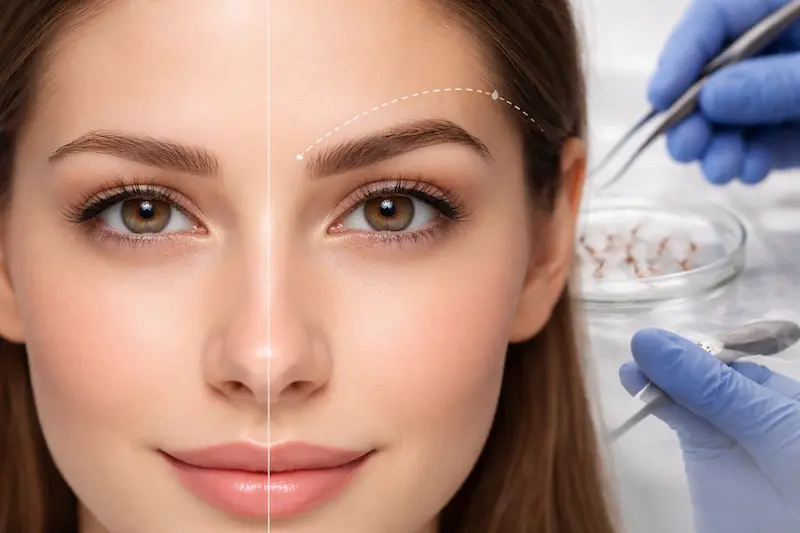
Considering an Eyebrow Transplant but want surgeon-level detail before you decide? This UK-focused guide explains how brows are designed, where donor hair comes from, and what to expect from healing to long-term grooming.
We also break down 2026 fees, comparing Turkey vs UK costs, and the safety systems that protect natural results. Read on to see whether you’re a suitable candidate and how to plan your next step with confidence.
Table of Contents
What is an Eyebrow Transplant?
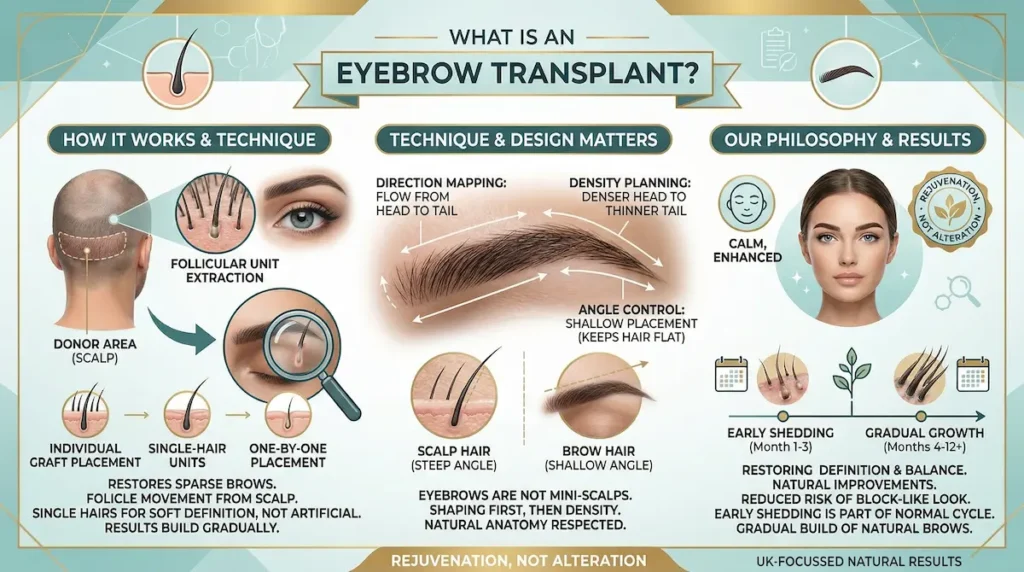
An Eyebrow Transplant restores sparse or missing brow hair by relocating follicular units from a donor area, usually the scalp. Each graft is placed one by one, matching natural angles and direction. The aim is soft definition, not an artificial brow. Results build gradually over several months.
The basics: follicles, grafts, and why eyebrows are different
Eyebrows are not “mini-scalps”. The hair sits at a shallow angle, the direction changes across the brow, and the eye area leaves little margin for error. That is why technique and design matter as much as graft survival.
In practical terms, we focus on three controllable variables during eyebrow restoration: graft selection, placement angle, and placement direction. Get those right, and the brow reads as yours. Get them wrong, and it can look obvious.
- Graft selection: eyebrows typically need single-hair follicular units for a softer finish.
- Angle control: shallow placement helps the hair lie flat, rather than projecting forwards.
- Direction mapping: the “flow” changes from the head of the brow to the tail.
Eyebrow mapping: shape first, then density
Most UK patients do not want a “new face”. They want their features restored with restraint. That is the same logic behind our philosophy: natural improvements that do not announce themselves.
Our guiding principle is simple: Rejuvenation, Not Alteration. The goal is to restore definition and balance, not to impose a different identity.
We design the brow around your existing anatomy and facial proportions. Then we plan density in a way that respects how eyebrows naturally thin towards the tail. This is also how we reduce the risk of a heavy, block-like look.
Hair growth cycle: what happens after the grafts are placed
Transplanted follicles behave like follicles. That sounds obvious, but it matters for expectations. Early shedding is common, and it is part of the normal cycle rather than a “failed” procedure.
Over time, follicles enter a new growth phase and you start to see meaningful change. This is also where the question does eyebrow transplant hair grow long usually comes up. Because donor hair often comes from the scalp, long-term grooming can be part of the plan.
Why Do Eyebrows Thin or Stop Growing?
Eyebrow thinning is rarely one single cause. It is often a blend of habit, skin health, and biology. For some people it is gradual; for others it follows a specific event such as over-plucking, injury, or a scar. Before recommending surgery, we look for a pattern that actually explains the loss.
Over-plucking, waxing, and everyday trauma
Repeated traction can damage follicles over time. Some people recover fully once they stop. Others do not, especially after years of aggressive shaping.
- Long-term over-plucking or waxing with reduced regrowth
- Trichotillomania (hair-pulling) or chronic rubbing
- Skin irritation from harsh products or repeated friction
Ageing also plays a role. Hair diameter can reduce and follicles can miniaturise, which softens the brow even if you never touched a tweezer.
Medical and hormonal factors worth taking seriously
Some eyebrow loss is a sign, not just a cosmetic concern. Thyroid conditions, nutritional deficiencies, inflammatory skin disease, and certain autoimmune patterns can affect brow density. Medication side effects can also contribute.
If your eyebrow loss is new, patchy, or accompanied by scalp shedding, we may advise you to speak with your GP and stabilise the underlying issue first. Surgery works best when the cause of loss is stable.
- Hormonal/thyroid: changes can affect multiple hair-bearing areas.
- Dermatitis/inflammation: persistent inflammation can disrupt follicles.
- Autoimmune patterns: patchy loss needs careful assessment before any transplant.
Scars, burns, and structural loss of follicles
When follicles are physically destroyed, “waiting it out” rarely helps. This is common after injuries, burns, or previous surgery in the area. The challenge is that scar tissue behaves differently from normal skin.
A dedicated eyebrow scar hair transplant plan often requires conservative density targets, staged work, and careful attention to blood supply. The priority is a believable brow and a safe healing process. For UK patients comparing options, this is also where eyebrow transplant vs microblading becomes a meaningful discussion, because scars may respond differently to pigment than to hair.
Benefits: What Can the Procedure Realistically Improve?
The biggest benefit is clarity. When the brow frame is rebuilt with the right direction and density, the whole eye area looks more balanced. The aim is not a “perfect” brow that looks done, but a brow that looks like it has always been yours. We plan for realism, which means we build density where it matters and let it taper where it should.
Natural definition without an “overdone” finish
Most patients come to us with the same request: a brow that looks present on close-up, but not obvious across the room. That outcome depends on subtle density planning and single-hair graft selection. Small decisions create a big difference.
- Permanent eyebrow hair transplant results can restore a clearer outline where makeup used to do the heavy lifting.
- We can rebuild gaps from past over-plucking while keeping the front of the brow soft.
- We can improve symmetry, but we do not chase “perfect twins”. Natural brows are not identical.
A good result should feel boring. If people notice your face looks fresher but cannot name why, the brow work is doing its job.
Scar camouflage: when hair loss is structural
Scars and burns can interrupt blood supply and change how the skin behaves. That does not automatically rule you out, but it changes the plan. We usually keep expectations conservative, prioritising believable coverage and safe healing over aggressive density.
- We assess the scar’s texture, thickness, and flexibility during planning.
- We may recommend staged work in higher-risk scar tissue, rather than forcing density in one sitting.
- We focus on direction control so the hair lies flat and blends into the surrounding brow.
Day-to-day convenience: less reliance on pigment and pencils
Many UK patients come to us after years of filling their brows every morning. A transplant can reduce that daily maintenance, especially in the tail where gaps show first. It is also a different proposition to pigment-based solutions, which is why eyebrow transplant vs microblading is such a common comparison.
Microblading can be a sensible choice for some patients, especially when they want a non-surgical option. A transplant is worth considering when you want real hair, 3D texture, and a result that does not fade in the same way. We discuss both openly, because the right answer depends on your skin, your goals, and your tolerance for ongoing top-ups.
Am I a Suitable Candidate for Eyebrow Transplant?
Suitability is not a sales question. It is a clinical one. We look at why your brows thinned, whether that cause is stable, and whether you have a donor area that can provide the right calibre of hair. We also assess whether you can commit to the practical realities: healing, patience, and long-term grooming.
Who tends to be a good candidate?
In general, the best candidates have stable eyebrow loss and a clear aesthetic goal. You do not need “no brows” to qualify. Many patients simply want to rebuild the tail, soften gaps, or restore density after years of shaping.
- Stable thinning from over-plucking, ageing, or naturally sparse brows.
- Congenital gaps or asymmetry where you have always had lower density.
- Small scars or localised loss where a targeted plan can blend the area.
- A good donor profile with hair that can be matched to brow texture and colour.
We usually start with a photo and medical questionnaire, then move to a surgeon-led assessment. If there is any concern about an underlying condition, we may advise you to speak with your GP before we proceed.
Who should delay, or avoid, an eyebrow transplant?
Some situations need caution. If hair loss is active, patchy, or inflammatory, surgery may be the wrong first step. We would rather stabilise the underlying issue than create avoidable disappointment.
- Uncontrolled skin inflammation in the brow area (persistent dermatitis, active infection, frequent folliculitis).
- Unstable autoimmune patterns affecting hair (where the risk of ongoing loss is high).
- Situations where wound healing is likely to be compromised, based on your medical history.
- Patients who cannot pause smoking or vaping around surgery, where healing risk rises.
We also have a frank conversation about expectations. A large share of eyebrow transplant regret content online comes from unrealistic goals, not from the procedure itself. That is why we set density targets and brow shape with restraint.
The “expert patient” checklist: are you practically ready?
Technical suitability is only half of it. The other half is readiness. Brow hair takes time to settle, and early shedding can be normal, so patience matters.
- Downtime: you should expect visible healing in the first 7–14 days, then a gradual return to normal.
- Long-term grooming: donor hair may grow longer than native brow hair, so trimming and training can be part of the routine.
- Aftercare discipline: avoiding friction, following washing guidance, and responding quickly if anything feels unusual.
- Comfort planning: we typically use local anaesthesia, and we can discuss twilight sedation for patients with higher anxiety.
If you are the type of person who wants a clear plan, you will like this process. We outline what happens, what can vary, and what you should do if you have concerns after you return to the UK.
Where Does Eyebrow Transplant Hair Come From?
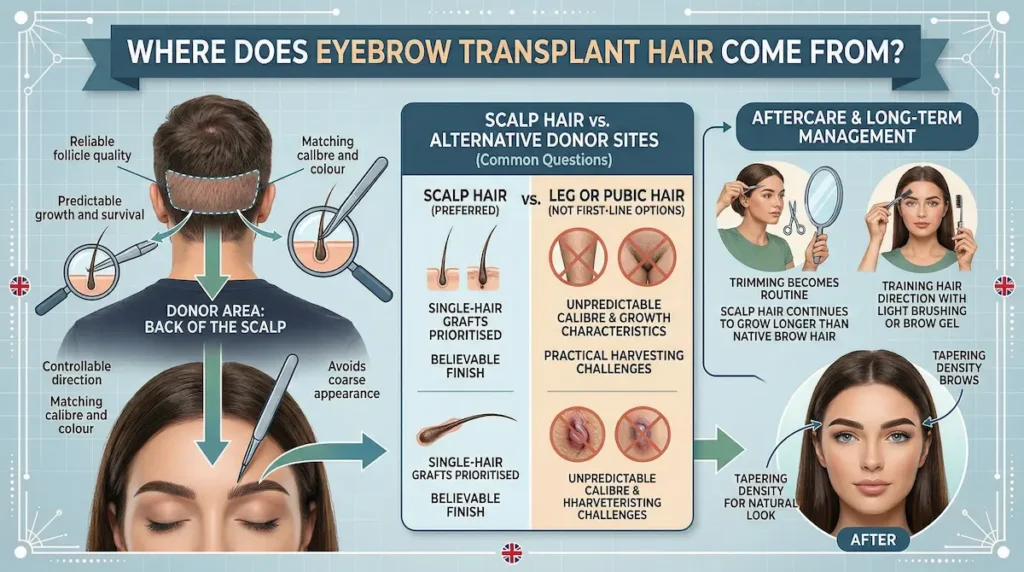
This is usually the first technical question we get from UK patients, and it is a fair one. The donor choice affects texture, grooming, and how “native” the brow looks once it settles. In most cases, we source hair from the scalp because it offers reliable follicle quality and predictable survival. The priority is not just growth, but controllable direction and a believable finish.
The most common donor area: scalp hair (and why we select it)
For most patients, the donor hair comes from the back of the scalp, where follicles tend to be more stable over time. We choose grafts that are fine enough to sit naturally in the brow, then refine selection during preparation. This helps avoid a coarse, heavy look. It also lets us work with consistent follicular units, which matters when we are placing hairs one by one.
- Predictable graft quality: scalp follicles are typically the most reliable for survival and handling.
- Better control: consistent graft structure supports cleaner placement and direction.
- Better planning: we can match calibre and colour more precisely with careful selection.
“Where does eyebrow transplant hair come from” is really about long-term management
The donor source influences what life looks like after the procedure. Scalp hair can continue to grow longer than native eyebrow hair. That is why we plan for a simple grooming routine from the start. Most patients find it manageable once they know what to expect.
- Trimming becomes part of maintenance for many patients.
- Some patients also “train” the hair direction with light brushing or brow gel.
- We build the brow with tapering density so routine grooming looks natural, not rigid.
What about pubic hair or leg hair for an eyebrow transplant?
People ask about pubic hair eyebrow transplant or leg hair eyebrow transplant because they are trying to solve one problem: hair that behaves more like brow hair. In real clinical planning, these donor sources are not first-line options. Hair calibre, growth characteristics, and harvesting practicality all matter. If a patient brings this up, we address it directly and explain why scalp donor hair is usually the safest and most predictable choice for the brow area.
Graft selection: why single-hair units matter
In eyebrow work, refinement matters more than volume. We typically prioritise single-hair grafts for a softer finish, especially at the front of the brow and along the edges. Density is then built carefully through placement strategy, not by forcing multi-hair grafts into a delicate area. This is how we protect the “natural-first” result.
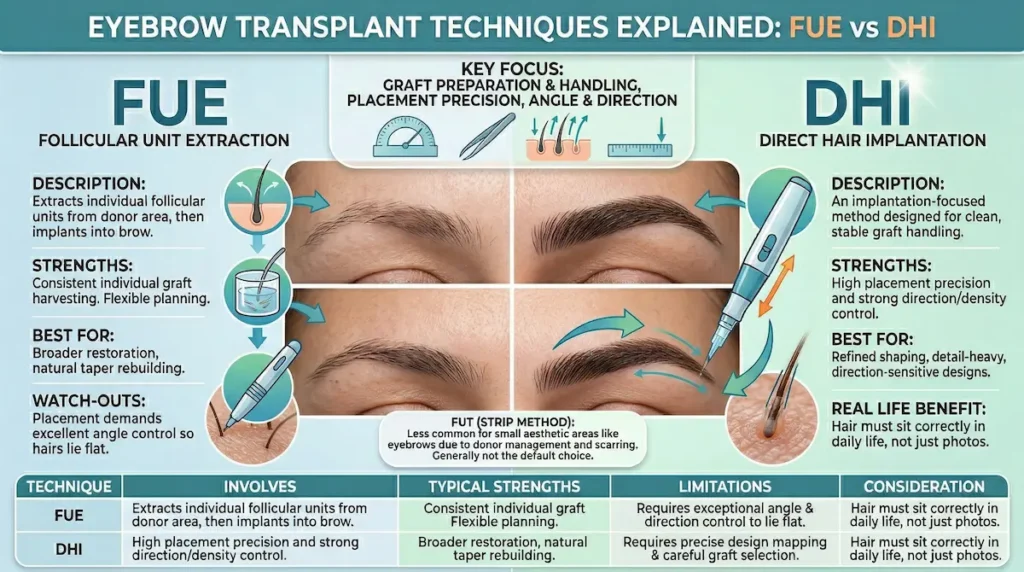
Eyebrow Transplant Surgical Techniques Explained: FUE vs DHI
The technique is not a branding exercise. It is a set of tools we use to control graft handling, placement precision, and overall trauma to the area. For eyebrow restoration, the critical variable is how accurately we can place each follicle at a shallow angle with the correct direction. That is why modern approaches such as FUE and DHI are typically preferred. We decide based on your anatomy, donor characteristics, and the level of precision needed for your design.
FUE for eyebrows: reliable harvesting, careful placement
FUE eyebrow transplant means we extract individual follicular units from the donor area, then place them into the brow according to the mapped design. This can be a strong option when we want controlled harvesting and flexibility during implantation. The key is not speed. It is discipline—graft hydration, gentle handling, and direction control in the recipient area.
- Strength: consistent, individual graft harvesting with controlled preparation.
- Best for: patients needing broader restoration or tail rebuilding with a natural taper.
- Watch-outs: placement must be meticulous to keep the hairs lying flat.
DHI for eyebrows: precision placement and direction control
DHI eyebrow transplant focuses heavily on implantation control. The goal is stable graft handling and clean, consistent placement in a tight anatomical zone. When we use DHI principles, we are aiming for refined angulation and direction that blends seamlessly across the brow. For the “expert patient”, this is often the part that matters most: the hair must sit correctly in real life, not just in a photo.
Why FUT is uncommon for eyebrow work
FUT involves removing a strip of donor tissue, which is then dissected into grafts. In modern practice, it is generally less favoured for small, highly aesthetic areas like eyebrows because donor management and scarring considerations can be less appealing for many patients. It may still have a role in select situations, but it is not the default approach for a refined brow plan. We prioritise methods that align with minimal disruption and predictable graft handling.
| Method | What it involves | Typical strengths | Typical limitations | When we may consider it for brows |
|---|---|---|---|---|
| FUE | Individual follicular unit extraction, then implantation | Flexible harvesting, reliable graft selection, versatile planning | Implantation demands excellent angle and direction control | Most standard eyebrow restoration plans |
| DHI | Implantation-focused method designed for controlled placement | High placement precision, strong control of direction and density | Still requires disciplined mapping and graft selection to avoid harshness | Refined shaping, direction-sensitive designs, detail-heavy cases |
| FUT | Strip harvesting with graft dissection | Can yield grafts efficiently in selected donor profiles | Less aligned with modern minimal-scar donor preferences; not first-line for brows | Selected cases only, after surgeon assessment |
Technique matters, but artistry matters more. Our goal is not maximum density. It is correct direction, soft transitions, and a brow that looks unforced.
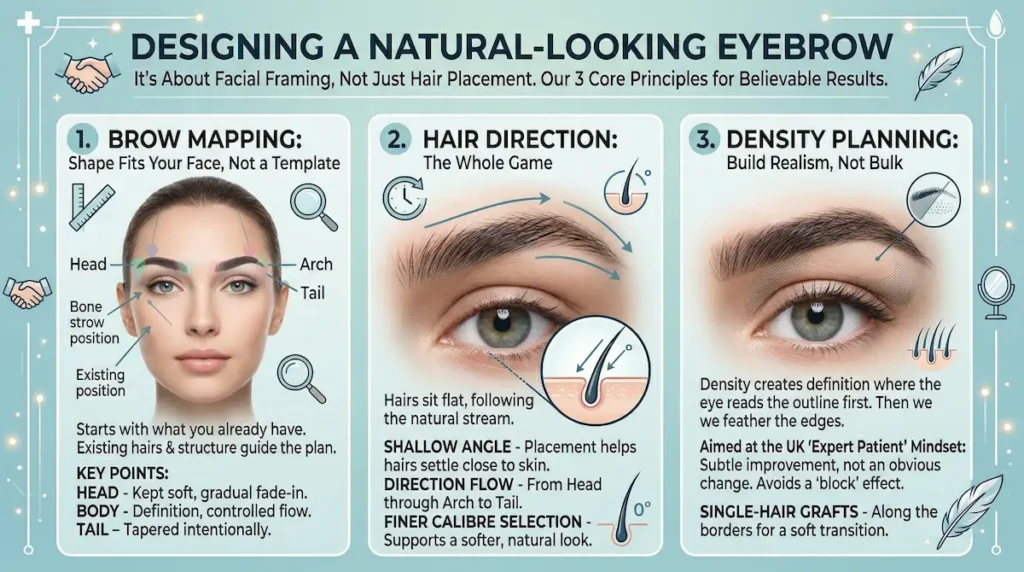
How Do We Design a Natural-Looking Eyebrow?
In eyebrow work, the “surgery” is the easy part to describe. The harder part is the design. We treat this as facial framing, not hair placement. That means we map, place, and refine with the same goal throughout: a result that looks believable in real light, from normal conversation distance.
Brow mapping: shape that fits your face, not a template
We start with what you already have. Existing hairs, bone structure, and your natural brow position guide the plan. We then map the key points (head, arch, tail) and check symmetry without trying to force perfect mirrors. Real eyebrows have small differences.
- Front (head): kept soft, with a gradual fade-in rather than a hard edge.
- Body: designed for definition, with controlled density and flow.
- Tail: tapered on purpose, because a dense tail often reads as artificial.
Hair direction is the whole game
Eyebrow hairs sit flat. They also change direction across the brow, sometimes within millimetres. We place grafts at a shallow angle and follow the natural “stream” so the hairs lie down, not up. This is where experience shows.
- Angle: shallow placement helps hairs settle close to the skin.
- Direction: we follow the natural flow from the inner brow through the arch to the tail.
- Calibre control: finer graft selection supports a softer, less “hairy” look.
In eyebrows, precision is aesthetic safety. When the direction is right, everything looks calmer, softer, and more natural.
Density planning: build realism, not bulk
Density is a design choice, not a flex. We create definition by placing grafts where the eye reads the outline first, then we feather the edges. This approach suits the UK “expert patient” mindset: subtle improvement, not an obvious change.
- We often use single-hair grafts along the borders for a softer transition.
- We avoid overloading the front of the brow to reduce the “block” effect.
- We plan for the way you actually wear your brow day to day, including grooming habits.
What if you already have microblading or a tattoo?
We see this often. Pigment can change how you judge shape and symmetry, and it can affect how you perceive density during the early months. We plan around what is there, then set expectations clearly about how hair and pigment interact. Sometimes the best result is achieved with a staged approach.
- We map based on your anatomy, not the pigment alone.
- We discuss whether the existing shape supports a natural hair pattern.
- We keep the design conservative when the goal is “undetectable”.
Do You Need General Anaesthesia For an Eyebrow Transplant?
Most eyebrow transplants do not require general anaesthesia. The procedure is typically well suited to local anaesthesia, with comfort measures tailored to the individual. Some patients still feel anxious, and we take that seriously. Our approach is simple: keep you comfortable, keep you safe, and keep the experience controlled from start to finish.
Local anaesthesia: what you feel (and what you usually do not)
Local anaesthesia numbs the donor and recipient areas so we can work precisely. You stay awake, but the goal is to keep discomfort low and predictable. You may feel pressure or gentle movement rather than sharp pain. After the procedure, we guide you on simple pain control, often with medication such as paracetamol when appropriate.
- During: numbness, pressure, minimal sharp sensation.
- After: mild tenderness is common, usually manageable with straightforward medication.
- Practical benefit: you can eat, drink, and move around normally soon after.
Twilight anaesthesia: a calm middle ground for anxious patients
Some people do not fear the procedure. They fear the feeling of being in a clinical environment. For those patients, twilight options can reduce anxiety while keeping you breathing independently and maintaining a smoother recovery profile than full general anaesthesia in many cases. Suitability depends on your medical history, medications, and a pre-operative assessment.
- Who it helps: higher anxiety, low tolerance for dental-style local injections, or previous difficult experiences.
- What it is not: a “knockout”. You are relaxed, not fully unconscious.
- How we decide: we screen carefully and tailor the plan rather than offering one default.
Why we avoid general anaesthesia when it is not needed
General anaesthesia has a role in medicine. It also carries its own set of considerations. For a procedure like an eyebrow transplant, local or twilight approaches are often sufficient, and they can simplify the day for the patient. Many UK patients prefer that logic: minimal intervention, maximum control.
Comfort is not a luxury add-on. A calm, well-managed patient experience supports safer, more consistent surgery.
What “safe and controlled” looks like in our theatres
We work in sterile operating theatres and follow structured pre-operative checks. We monitor you throughout, keep communication clear, and adjust comfort measures if needed. This is where planning matters as much as technique. It also sets the tone for recovery, which we will break down in detail later in this guide.
- Pre-operative screening to confirm candidacy and reduce avoidable risks.
- Clear intraoperative monitoring and a measured pace in theatre.
- A written aftercare plan before you leave, so you are not guessing later.
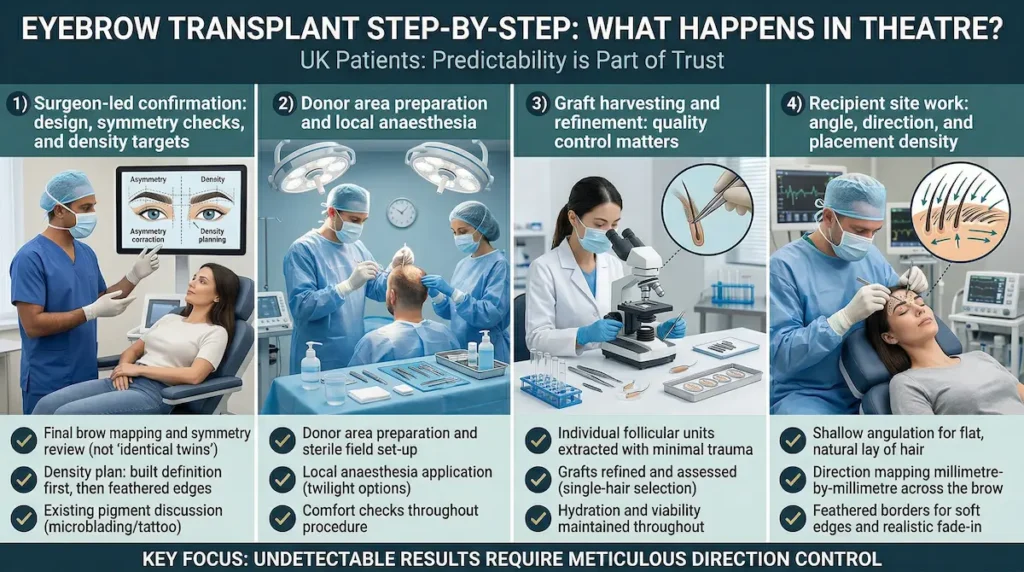
Eyebrow Transplant Step-by-Step: what happens in theatre?
For UK patients, predictability is part of trust. An eyebrow transplant is a precision procedure, and the day runs best when it is structured. While each plan is tailored, the sequence is consistent: confirm the design, prepare the donor, harvest and refine grafts, then place them with meticulous control of angle and direction.
1) Surgeon-led confirmation: design, symmetry checks, and density targets
Before we begin, we re-check the mapped brow shape with you. This is where we confirm the front softness, the arch position, and the tail taper. We also agree on realistic density targets so the result is natural in real life, not just dense on paper.
- Final brow mapping and symmetry review (without forcing identical “twins”).
- Density plan: where definition is built first, and where edges are feathered.
- Discussion of any existing pigment (microblading/tattoo) and how it affects perception during early months.
2) Donor area preparation and local anaesthesia
The donor area is typically the back of the scalp. We prepare the area in a way that protects hygiene and graft quality. Local anaesthesia is then applied so harvesting and placement can be performed comfortably and with control.
- Donor area preparation and sterile field set-up.
- Local anaesthesia for donor and recipient areas (twilight options discussed where appropriate).
- Comfort checks throughout, with communication kept clear and calm.
3) Graft harvesting and refinement: quality control matters
Harvesting is not a volume game in eyebrows. We focus on selecting follicles that support a softer brow finish. Grafts are kept hydrated and handled gently to maintain viability. This is also where we prioritise single-hair follicular units for natural transitions, especially at the brow head and borders.
- Individual follicular units extracted with minimal trauma.
- Grafts refined and assessed (single-hair selection where needed).
- Hydration and careful handling maintained throughout.
4) Recipient site work: angle, direction, and placement density
This is the defining stage of an Eyebrow Transplant. The recipient area is designed for shallow placement so hairs lie flat. Direction is adjusted across the brow to match natural flow. Density is built with restraint to avoid a harsh or “block” look.
- Shallow angulation to support a flat, natural lay of hair.
- Direction mapping followed millimetre-by-millimetre across the brow.
- Feathered borders for soft edges and a realistic fade-in.
In eyebrows, the difference between “good” and “undetectable” is usually direction control. We place for real life: daylight, movement, and close conversation distance.
How long does the procedure take?
Timing depends on the amount of work required (for example, tail-only restoration versus full brow rebuilding, or scar cases requiring a conservative staged approach). We prioritise precision and graft care over speed. You can usually expect a same-day plan with structured aftercare guidance before you leave.
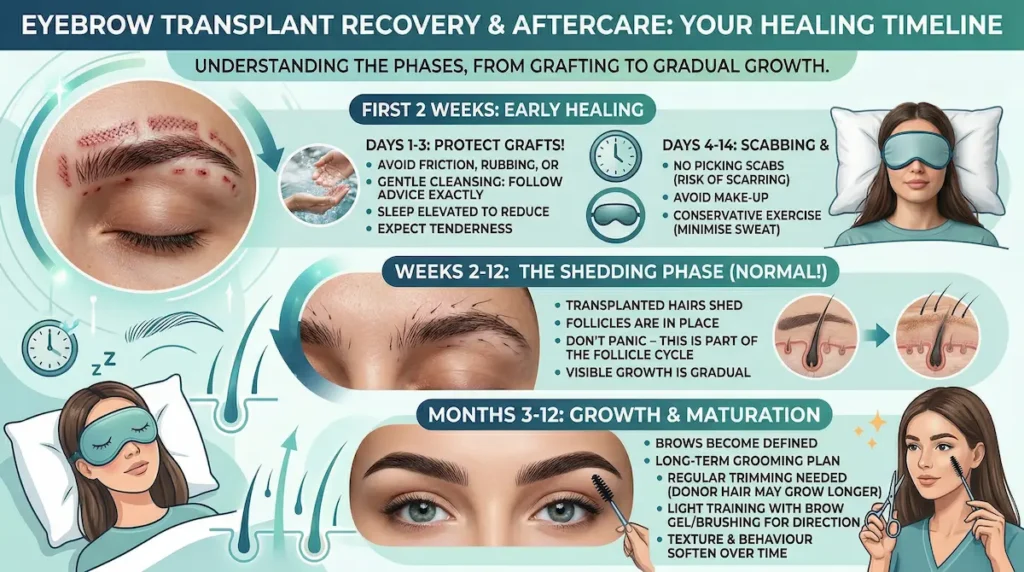
Eyebrow Transplant Recovery & Aftercare: how long does healing take?
Recovery is not just “waiting for hair”. It is a series of predictable phases: early healing, a settling period, and then gradual growth. The first two weeks are about protecting grafts and reducing avoidable irritation. The months after that are about patience, gentle grooming, and realistic milestones.
The first 72 hours: protect the grafts and reduce swelling
In the early window, your priority is to avoid friction and keep the area clean. Mild swelling can occur, and you may feel tightness or tenderness around the donor and brow area. We provide specific guidance on positioning, cleansing, and what to avoid.
- Avoid rubbing, pressing, or brushing the brow area.
- Follow washing guidance exactly (gentle cleansing, no aggressive scrubbing).
- Sleep position advice to reduce swelling and protect the grafts.
Days 4–14: scabbing, redness, and social downtime
Light scabbing is common in the recipient area. Redness can persist for a short period, especially in fair or sensitive skin. Most patients can return to normal daily activity quickly, but you should plan for visible healing during this stage.
- Scabs typically loosen naturally; picking increases risk.
- Make-up should be avoided until you are cleared, to reduce irritation and contamination risk.
- Exercise guidance is usually conservative early on to minimise sweat and friction.
Weeks 2–12: the “shedding phase” and why it is normal
Many transplanted hairs shed after the initial healing phase. This can look alarming if you are not prepared, but it is usually part of the normal follicle cycle. The follicles remain in place, and the new growth phase follows gradually.
- Early shedding is common and not automatically a sign of failure.
- Visible improvement is typically gradual, not immediate.
- We keep expectations anchored in timelines, not daily mirror checks.
Months 3–12: growth, maturation, and the long-term grooming plan
As growth returns, the brow starts to look more defined. This is also when many patients notice that donor hair may grow longer than native eyebrow hair. That is the origin of the question: does eyebrow transplant hair grow long? Often, yes—and it is manageable with a simple routine.
- Regular trimming may be needed to keep the brow looking natural.
- Light “training” with brow gel or brushing can help direction settle.
- Texture and behaviour can soften over time as hairs mature.
Supportive recovery protocols: HBOT and LLLT (when appropriate)
For patients who want an enhanced recovery framework, we may discuss supportive options such as HBOT (Hyperbaric Oxygen Therapy) and LLLT (Low-Level Laser Therapy). These are positioned as adjuncts that may support healing and comfort as part of a structured post-operative plan, depending on your profile and surgeon assessment.
Good recovery is rarely about “doing everything”. It is about doing the right things consistently: clean care, low friction, sensible activity, and a clear plan for each stage.
When should you contact the clinic?
We provide a direct aftercare pathway, including guidance on what is expected and what is not. If you experience increasing pain, spreading redness, unusual discharge, fever, or any concern that feels out of proportion to normal healing, you should contact us promptly for assessment and advice.
Can an Eyebrow Transplant Be Combined With Other Treatments?
Sometimes, yes. The right combination can reduce total downtime and create a more coherent result. The wrong combination can dilute focus in a procedure where millimetres matter. Our rule is simple: we combine only when it protects precision and recovery.
When combining makes sense
Combination planning works best when the “extra” treatment is supportive rather than distracting. If you are already undergoing a hair restoration plan, we can sometimes align timing so you complete one recovery window instead of two. We decide case by case, based on graft targets, theatre time, and your medical history.
- Hair restoration synergy: if you are planning scalp hair restoration, we may structure your timeline so donor management stays consistent.
- Skin-led support: if brow-area skin is reactive, we may recommend a staged plan that prioritises calm healing first.
- Revision planning: if you have existing pigment or previous work, we may separate steps to keep outcomes predictable.
When we prefer to separate procedures
Eyebrow work demands concentration. Direction changes across the brow, and shallow angulation needs steady control. If we add too many variables in one day, quality can drift. For that reason, we often separate brow transplantation from longer, multi-step aesthetic surgery days such as rhinoplasty, liposuction, or a breast lift.
- Complex scar cases: we may stage work to respect blood supply and reduce risk.
- High-anxiety patients: shorter sessions can feel more manageable, even with twilight anaesthesia available.
- Higher graft counts: when placement time rises, we protect focus by keeping the plan streamlined.
Our recovery support options: HBOT and LLLT
Some patients want a more structured recovery framework. We integrate Hyperbaric Oxygen Therapy (HBOT) and Low-Level Laser Therapy (LLLT) as our Rapid Recovery & Safety Protocol, where clinically appropriate. The aim is practical: calmer healing, reduced inflammation, and support for graft settlement. We discuss suitability during your surgeon-led assessment rather than treating it as a blanket add-on.
Precision creates the brow. Recovery protects it. We plan both with the same discipline.
Safety & Risks: Is an Eyebrow Transplant Dangerous?
No procedure is risk-free. An eyebrow transplant is usually low-risk when it is planned well, performed in sterile operating theatres, and followed with disciplined aftercare. The eye area is unforgiving, though. Small mistakes in direction, angle, or hygiene can look bigger than they are.
Our approach is simple: talk about the risks plainly, then show how we reduce them. This is also how we prevent the scenarios people search for under eyebrow transplant gone wrong or botched eyebrow transplant. Most poor outcomes are preventable when the fundamentals are respected.
Common risks (and what they usually look like)
Most issues are minor and short-term, but they still deserve clear explanations. The early phase can involve redness, temporary sensitivity, or small spots of folliculitis. In rare cases, there can be infection or a weaker-than-expected graft yield.
- Folliculitis: small inflamed bumps as new hairs begin to emerge. Often manageable when addressed early.
- Infection: uncommon, but more serious. This is why hygiene and early reporting matter.
- Poor direction / lift: hair that sits up or points the wrong way if mapping and angulation are not meticulous.
- Asymmetry: some asymmetry is natural; obvious imbalance usually reflects planning issues.
- Suboptimal growth: sometimes linked to biology, aftercare friction, or overly aggressive density targets.
How we reduce risk: the controllables
We control what can be controlled. That starts with conservative design, single-hair graft selection where it matters, and strict theatre discipline. It continues with a written aftercare plan and a clear route back to us if anything feels off.
- Candidate screening: we look for stability (especially in inflammatory or autoimmune patterns).
- Surgical precision: shallow angulation and direction mapping across the brow to keep hairs lying flat.
- Sterile standards: controlled theatre workflow and infection prevention basics that never change.
- Graft protection: low-friction aftercare guidance to protect follicles in the highest-risk early days.
We do not “sell” safety. We build it—through conservative planning, clear communication, and a recovery plan that continues after you fly home.
When results fall short: revision planning and realistic solutions
Some patients worry about eyebrow transplant regret because they have seen over-dense, harsh, or poorly directed brows online. The solution is not panic. It is diagnosis. We first work out whether the issue is early-stage healing, grooming behaviour, or a true technical problem.
If a revision is needed, we plan it cautiously. In eyebrow work, patience is part of the strategy. We wait for maturation, reassess direction and density in real life, then correct in a measured way.
Is an Eyebrow Transplant Safe in Turkey?
For many UK patients, this question is really about standards. You want to know whether the operating environment, clinician credentials, and aftercare access match what you expect at home. That is a rational concern. It is also why we structure our service like a medical pathway, not a travel product.
When you compare options—whether it is a local Harley Street eyebrow restoration clinic or an international centre—the safest decision is the one backed by clear processes: screening, sterile theatres, disciplined technique, and reliable follow-up.
Standards and operating environment: what “safe” looks like on the day
Safety is mostly invisible. It is the boring checklist work that happens before the first graft is placed. We use structured pre-operative screening, monitor vitals throughout, and keep the environment controlled and sterile.
- Pre-op checks to confirm candidacy and reduce avoidable risk.
- Continuous monitoring during the procedure.
- Sterile operating theatres and controlled patient flow.
Surgeon credibility: the UK question about “GMC alternatives”
Many UK patients search for GMC registered surgeon alternatives because they want an equivalent trust signal. In our general medical content, we do not rely on names. We rely on verifiable standards. Our surgical work is performed by European Board Certified Surgeons and specialists registered with international medical boards.
More importantly, we match credentials with systems: surgeon-led planning, conservative design, and direction control that protects natural appearance.
Aftercare across borders: continuity, not abandonment
The fear most patients do not say out loud is simple: “What happens when I’m back in the UK?” We plan for that. Our aftercare is structured and responsive, because most complications are easier to manage early.
- Clear written guidance for each healing phase.
- A direct contact pathway if symptoms change or concerns arise.
- Long-term follow-up checkpoints so you are not left guessing.
This is also where our technology pathway fits in. We integrate our Rapid Recovery & Safety Protocol—Hyperbaric Oxygen Therapy (HBOT) and Low-Level Laser Therapy (LLLT)—to support healing and reduce avoidable downtime as part of a structured plan.
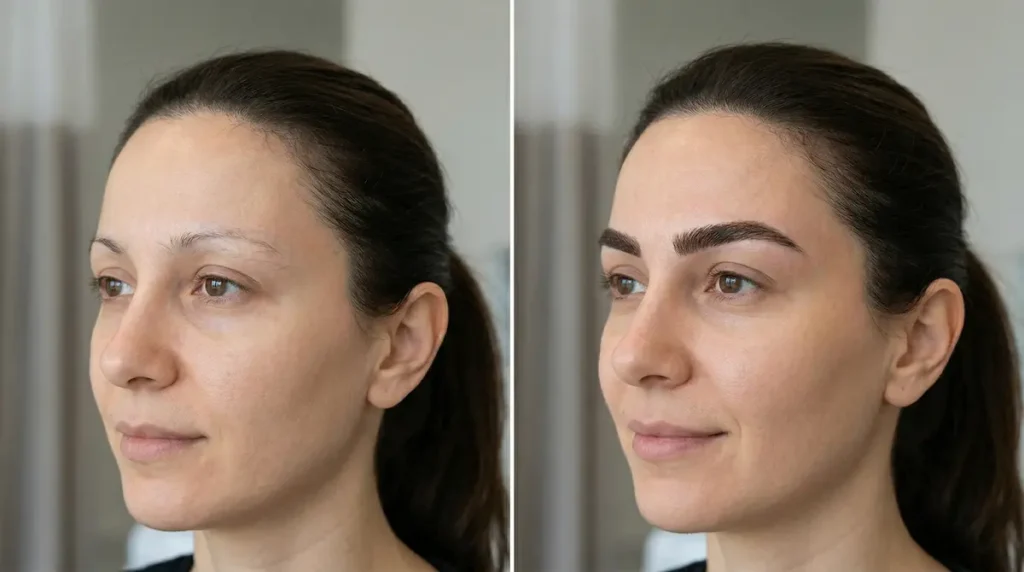
Eyebrow Transplant Before and After: Realistic Expectations & Results
Most disappointment comes from one gap: expectations that do not match biology. A transplant is not an instant cosmetic cover-up. It is a staged process where healing, shedding, and regrowth follow a predictable rhythm. We plan your brow for realism in everyday light, not “maximum density” on day one. That measured approach protects the natural look.
What results can look like (and why “subtle” is often the goal)
The best results rarely shout. They quietly restore facial balance. You should expect improved definition, cleaner symmetry, and better coverage of gaps, especially through the tail. You should not expect a heavy, painted-on effect, because we avoid designs that look forced.
- Shape: clearer outline with softer edges at the front of the brow.
- Density: built where the eye reads structure first, then feathered towards borders.
- Texture: real hair that moves and catches light naturally.
Our philosophy stays consistent: Rejuvenation, Not Alteration. We restore what suits your face, then stop before it looks “done”.
Timelines: when you will (and will not) see change
Early healing is visible. Growth is slower. Many transplanted hairs shed in the first weeks, then regrow over the following months. That cycle is normal. We set milestones so you are not judging progress too early.
- Days 1–14: visible healing with light scabbing and redness.
- Weeks 2–12: shedding is common; this is where patience matters.
- Months 3–12: gradual regrowth, thickening, and maturation.
Does eyebrow transplant hair grow long?
This is one of the most practical questions we answer. Because donor hair often comes from the scalp, it can keep growing longer than native eyebrow hair. That does not mean the result is unnatural. It means you will manage it like a hairstyle: light trimming and direction training.
- Most patients trim every 1–2 weeks once growth is established.
- Direction can be “trained” gently with a brow brush or a small amount of brow gel.
- We design tapered density so grooming looks soft, not rigid.
What drives “eyebrow transplant regret” (and how we prevent it)
Regret stories usually cluster around three issues: unrealistic density goals, poor direction control, or weak aftercare discipline. We reduce these risks with conservative planning, meticulous angulation, and a clear aftercare pathway. If something feels off after you return to the UK, we want to hear about it early. Small issues are easier to manage when caught quickly.
- Planning: natural density targets and a brow shape that suits your anatomy.
- Execution: shallow placement so hairs lie flat and follow the brow’s natural flow.
- Aftercare: low-friction routines and clear instructions for each healing phase.
Eyebrow Transplant vs Microblading (and other options)
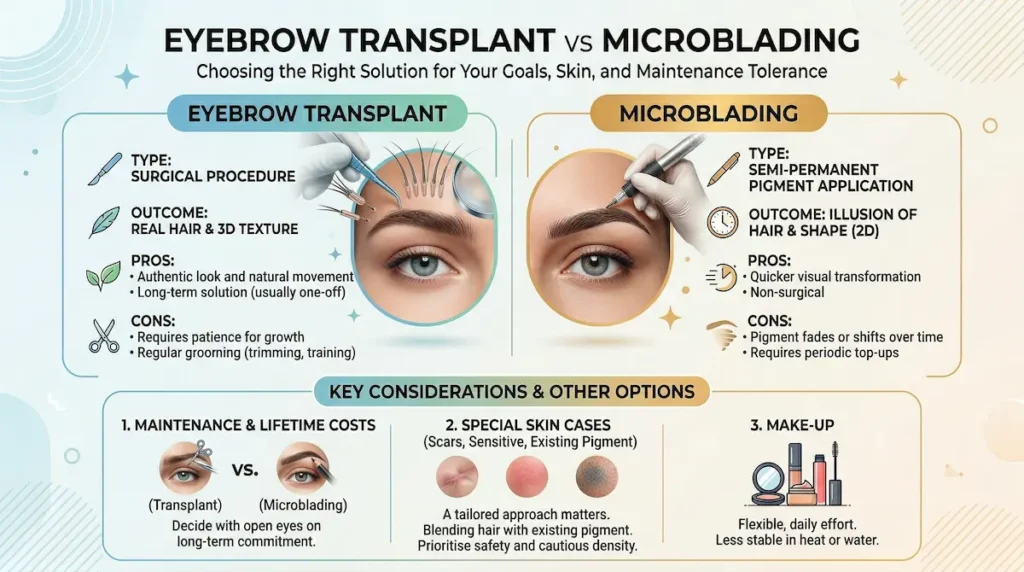
There is no single “best” choice. There is the choice that fits your skin, your goals, and your tolerance for maintenance. Microblading can create the appearance of fuller brows without surgery, but it is pigment, not hair. A transplant is surgery, but it gives 3D texture and real hair movement. We talk through both options clinically and without defensiveness, because the right answer depends on the person in front of us.
How the outcomes differ: hair vs pigment
A transplant creates hair. Microblading creates an illusion of hair using fine pigment strokes. Both can look good in the right hands. They also fail in different ways.
- Transplant: real hair texture and movement; requires patience and grooming.
- Microblading: quicker visual change; often requires top-ups as pigment fades or shifts.
- Make-up: flexible and reversible; daily effort and less stable in heat or water.
Maintenance and “lifetime costs”
People often compare only the first appointment fee. That misses the point. Microblading typically involves periodic refresh sessions. A transplant is usually a one-off surgical plan, but it comes with ongoing grooming. We lay that out clearly so you can decide with open eyes.
- Microblading: maintenance is usually planned in cycles (top-ups).
- Transplant: grooming is routine (trimming and light training).
- Either way: the best results come from a measured design, not extremes.
What if you have a scar, sensitive skin, or existing pigment?
Scars and skin conditions can change the calculus. Pigment may behave unpredictably in scar tissue or very oily skin. Hair can sometimes provide a better 3D camouflage, but density targets may need to be conservative. If you already have microblading, we plan around it rather than pretending it is not there.
- Scar cases: we may prioritise staged work and safer density targets.
- Sensitive skin: we discuss irritation risk and aftercare discipline in detail.
- Existing microblading: we map to anatomy first, then assess how hair and pigment will blend.
When a transplant is usually the better fit
If you want real hair, 3D texture, and a result that does not rely on pigment staying stable, surgery is often the more logical route. It is also the more technical route. That is why surgeon-led planning matters. If you want a tailored assessment, we can review photos and medical history remotely and tell you plainly what we would—and would not—recommend.
Cost / Fees: Eyebrow Transplant Cost 2026 Turkey vs UK?
UK patients rarely want a number without context. They want to know what they are paying for, what drives variation, and what “value” actually means in a surgical setting. We explain fees as a clinical equation: planning time, theatre standards, surgeon involvement, graft count, and the aftercare framework that protects results.
In the UK, eyebrow transplantation is usually accessed privately, often in premium settings such as Harley Street. In Turkey, the same procedure can be delivered as a high-value option because operational costs differ. The key is not the postcode. It is the system behind the surgery.
The main factors that influence fees
Two patients can both ask for “an eyebrow transplant” and still require very different work. A tail-only rebuild is not the same as full restoration. Scar tissue cases also require a different strategy and often a more conservative density target.
- Graft requirement: small gap repairs vs full brow reconstruction.
- Complexity: scar tissue, burns, or revision planning.
- Technique and time: implantation precision, direction-sensitive mapping, theatre time.
- Aftercare intensity: structured follow-up and access to support.
Turkey vs UK: what you are really comparing
We encourage patients to compare like with like. The right comparison is not a headline price. It is surgeon-led planning, sterile operating theatres, a disciplined workflow, and a predictable aftercare pathway once you are back in the UK.
That is where UK patients searching for Harley Street eyebrow restoration quality tend to land. They want premium standards, without paying purely for a London address.
| Cost driver | UK private pathway (typical) | Our Turkey pathway (how we frame value) | Why it matters |
|---|---|---|---|
| Surgeon-led planning | Often billed into consultation and theatre fees | We keep the plan surgeon-led from mapping to placement strategy | Direction control and conservative design prevent “overdone” results |
| Sterile operating theatre standards | Reflected in premium facility overheads | We operate in sterile theatres with structured pre-op checks | Reduces avoidable risks and supports predictable healing |
| Aftercare access | Local access, but often fragmented across providers | We structure follow-up and provide UK-friendly support routes | Most issues are easiest to resolve early |
| Anaesthesia approach | Varies by clinic | We prioritise local and, when appropriate, twilight anaesthesia | Comfort and control, without unnecessary intervention |
| Supportive recovery framework | Often add-on, varies widely | We integrate HBOT and LLLT as our Rapid Recovery & Safety Protocol | Supports healing and reduces downtime in a structured way |
| Operational costs | High overheads reflected in fees (often quoted in £) | Different cost base allows a more competitive, high-value package | Value comes from systems, not from cutting corners |
“On NHS?” and why most patients choose the private route
We are asked about eyebrow transplant on NHS because patients want a clear route. In practice, most eyebrow restoration is pursued privately, especially when the goal is aesthetic refinement rather than a strict reconstructive indication. If your case is medically complex, we advise discussing the underlying diagnosis with your GP first, then planning surgery when the situation is stable.
Finding The Best Eyebrow Transplant Surgeon
In eyebrows, surgeon judgement matters as much as technique. This is a design-led procedure with a narrow margin for error. The safest choice is usually the team that can explain direction, density, and long-term grooming without overselling.
Many UK patients also look for regulatory reassurance. Searches like GMC registered surgeon alternatives reflect a simple need: a credible, verifiable trust signal. We address that directly by focusing on board-level standards, surgeon-led planning, and a clinical system designed for international follow-up.
What UK “expert patients” should look for
We suggest judging a provider by the quality of their thinking, not by their marketing. Ask for a clear explanation of graft selection, direction strategy, and how they prevent harsh density at the brow head. A confident team will welcome those questions.
- Direction strategy: how they place hairs to lie flat and follow the brow’s natural flow.
- Graft selection: whether they prioritise single-hair units where softness matters.
- Risk management: how they handle folliculitis, infection prevention, and revision planning.
- Evidence of restraint: natural taper, soft front edges, and realistic density targets.
Our standards: credentials, theatre discipline, and understated outcomes
Our planning is performed by European Board Certified Surgeons and specialists registered with international medical boards. We keep the tone measured because this is medicine, not theatre. The goal stays consistent: “Rejuvenation, Not Alteration.”
For UK patients who value structure, we also emphasise that we are a private cosmetic clinic Istanbul British standards patients expect: sterile theatres, systematic screening, and clear aftercare instructions before you leave.
What the journey looks like from the UK
We keep logistics simple, because simplicity reduces anxiety. Most patients start with a remote assessment, then arrive in Istanbul with a clear plan for timing, aftercare, and follow-up checkpoints.
- Remote planning: photo review, medical questionnaire, and a surgeon-led outline of options.
- Clear access: a UK-friendly support pathway, including WhatsApp contact where appropriate.
- Travel readiness: guidance built around flight-ready recovery protocols so you know what is normal before you fly.
- Aftercare continuity: structured check-ins and responsive support once you are back home.
If you want a surgeon-led assessment, we can review your photos and medical history remotely and tell you plainly what we recommend, what we would avoid, and what outcomes are realistic.
Preparing For Your Procedure: a practical checklist for UK patients
Preparation is not glamorous, but it matters. It reduces avoidable risk and keeps healing calmer. We guide you through the details in plain language, including what to pause and what to continue. If something is unclear, we would rather you ask than guess.
Medication and supplements: what to tell us
Bring a complete list. Include prescriptions, over-the-counter medication, and supplements. Some products can increase bruising or change how you heal. If you are unsure about anything, tell us and we will advise you on timing.
- Blood-thinning medication: never stop it on your own; we coordinate safety decisions properly.
- Supplements: some “natural” products still affect bleeding and inflammation.
- Allergies and sensitivities: adhesives, antiseptics, and antibiotics matter here.
Smoking, alcohol, and skin routines
Smoking and vaping can compromise circulation. That is not a judgement; it is physiology. Alcohol can also increase swelling and interfere with sleep quality in the early recovery window. We will give you a clear timeline for what to avoid and for how long.
- Smoking/vaping: pause as advised to support oxygen delivery and healing.
- Alcohol: avoid around surgery to reduce swelling and improve rest.
- Skin care: keep the brow area calm; avoid irritating actives if your skin reacts easily.
Travel planning and “flying home” confidence
Most UK patients want one thing: a clean, low-stress return home. We structure your discharge guidance around swelling control, hygiene, and graft protection. If you are flying, we will advise you on timing based on your procedure and how you are healing. We also explain what is normal, so you do not interpret expected recovery as a problem.
- Direct flights: Istanbul is typically reachable from major UK airports without complex routing, which simplifies planning.
- Hotel recovery: keep friction low and rest well in the first nights; small habits protect grafts.
- When to contact us: increasing pain, spreading redness, discharge, or fever should be reported promptly.
Eyebrow Transplant Frequently Asked Questions (FAQ):
How many grafts do I need for an Eyebrow Transplant?
It depends on your starting point and your goal. Some patients need targeted work (for example, rebuilding the tail), while others need broader restoration. Scar cases may require more conservative density targets, and sometimes staged planning. We confirm graft estimates after reviewing photos and your brow anatomy.
Will it hurt?
Most patients tolerate the procedure well under local anaesthesia. You may feel pressure and movement rather than sharp pain. Mild tenderness afterwards is common and is usually manageable with straightforward pain relief guidance.
When can I wash my face and eyebrows?
We provide a structured washing plan that protects grafts in the early days. The principle is gentle cleansing and low friction. Avoid rubbing, scrubbing, and direct pressure until you are cleared.
When can I wear make-up again?
Make-up can introduce irritation and contamination risk during early healing. We advise a make-up pause until the recipient area is settled and you have been cleared. If you are unsure, ask—this is a common cause of unnecessary inflammation.
When can I exercise?
We usually recommend a short period of reduced activity early on to minimise sweat, swelling, and friction. Your timeline depends on how you heal and the extent of the work. We will give you practical guidance based on your plan.
I already have microblading or a brow tattoo — can I still have a transplant?
Often, yes. We assess how pigment shape relates to your anatomy and how hair and pigment may blend over time. In some cases, a staged strategy is best to keep the outcome natural and predictable.
Can an eyebrow transplant cover a scar?
Many scars can be improved, but the approach is different to normal skin. Scar tissue may need conservative density targets and sometimes staged work. The goal is believable camouflage and safe healing, rather than forcing density.
Does eyebrow transplant hair grow long?
It can. Because donor hair often comes from the scalp, trimming may become part of long-term maintenance. Most patients find this simple once they know what to expect. Light “training” with a brush or brow gel can also help direction settle.
What if I get small bumps or spots during recovery?
Mild folliculitis can occur as new hairs begin to emerge. The key is not to pick or aggressively scrub. Contact us early so we can advise you properly—small issues are easier to manage when addressed promptly.
Are results permanent?
Transplanted follicles are intended to be long-lasting, but outcomes still depend on surgical planning, healing, and long-term grooming. If you have an underlying medical cause of hair loss, stabilising that condition matters for long-term satisfaction.
Will I need a second procedure?
Many patients do well with a single procedure. A second stage can be considered in complex scar cases, in revisions, or when a patient wants a further refinement after full maturation. We only discuss this after the result has had time to settle.
How soon can I fly back to the UK?
Most patients can travel with a structured plan for swelling control and graft protection. We advise you on timing based on your procedure and how you are healing, and we make sure you understand what is normal before you fly.
Medical Disclaimer: This page provides general information and does not replace a personal medical consultation. Suitability and outcomes vary between individuals and depend on clinical assessment, medical history, and healing response.