



Planning a Thigh Lift (thighplasty) in Turkey? This guide explains who benefits, how techniques such as medial, extended or spiral lifts address patterns of laxity, and what scar placement realistically looks like over time—especially for UK patients travelling to Istanbul.
Explore anaesthesia options, including twilight sedation when clinically suitable, plus a recovery timeline for work, travel and exercise. We also outline our HBOT + LLLT Rapid Recovery & Safety Protocol to support healing and long-term scar quality at AKM Clinic.
Table of Contents
What is a Thigh Lift?
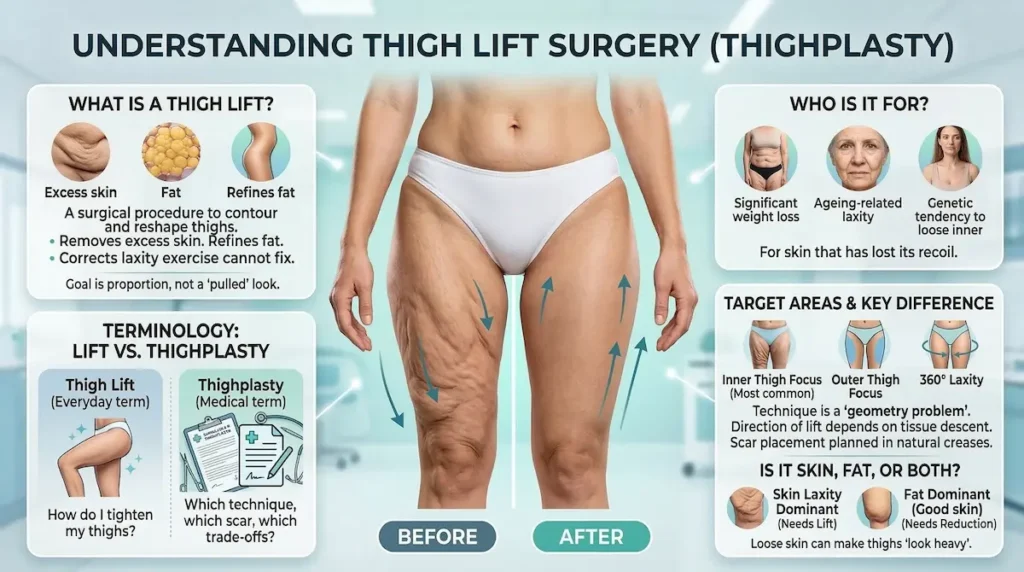
A Thigh Lift is a surgical body-contouring procedure that removes excess skin and, when needed, refines fat to reshape the thigh. It targets laxity that exercise cannot correct. The goal is proportion, not a ‘pulled’ look. Scar placement is planned from the start.
Most patients consider a thigh lift after significant weight loss, ageing-related skin laxity, or a long-standing genetic tendency to loose skin in the inner thigh area. In practical terms, this is surgery for skin that has lost its recoil. Creams and gym work can improve tone, but they cannot remove redundant skin.
Thighplasty vs “thigh lift”: are they the same?
Yes, they refer to the same operation. “Thigh lift” is the everyday term. Thighplasty is the medical term you will see in surgical literature and on consent forms.
At AKM Clinic, we use both terms because they signal slightly different patient intent. Some patients search broadly for “thigh lift” to understand the concept. Others search for thighplasty because they want technical clarity on incision design, scar management, and long-term stability.
- Thigh lift usually means: “How do I tighten my thighs?”
- Thighplasty often means: “Which technique, which scar, which trade-offs?”
Which part of the thigh does the surgery target?
A thigh lift can be designed to address different zones. The most common concern is the inner thigh, where skin laxity can create rubbing, irritation, and a less defined contour. Some patients also have looseness that extends towards the outer thigh, hip, or buttock crease.
The technique choice is not a marketing label. It is a geometry problem. We plan the direction of lift based on where the tissue has descended and where a scar can be positioned so it sits in a natural crease or along a line that can be disguised over time.
- Inner thigh focus: targets laxity between the groin and knee, most often with a concealed groin-crease scar and, in selected cases, an additional vertical component.
- Outer thigh focus:
- 360° laxity:
Is it skin, fat, or both?
This is the question that determines whether you need lifting, fat reduction, or a combined approach. Many “heavy” thighs are not heavy because of fat. They look heavy because loose skin folds and catches light in a way that blurs the natural outline.
We typically see three patterns. Each has a different solution and a different scar-to-benefit balance.
- Skin laxity dominant:
- Fat dominant (good skin quality):
- Mixed laxity:
What Are The Benefits Of a Thigh Lift Surgery?
The benefits of a thigh lift are both aesthetic and functional. Aesthetic benefit is about shape and proportion, not dramatic over-tightening. Functional benefit is about comfort, clothing fit, and confidence in day-to-day movement.
In our philosophy, results should look calm. We aim for a thigh contour that matches the rest of your body, with scars placed deliberately and aftercare planned early. A good result is one that holds up in real life, not just in a single post-op photo.
Improved contour and proportion (without an “operated” look)
Loose thigh skin often creates a visual mismatch: the upper body may look leaner after weight loss, while the thigh area still reads as heavy or undefined. A thigh lift removes the redundancy so the natural outline can return.
- A smoother inner thigh line in fitted clothing.
- Better definition between the thigh and groin crease.
- More consistent proportions when viewed from the front and side.
Subtlety matters. Over-tension can look unnatural and can also place more load on the scar. Thoughtful planning is part of both aesthetics and long-term scar quality.
Less friction, easier movement, and improved comfort
Many patients describe the same practical problems: rubbing during walking, irritation in warm weather, and difficulty finding trousers that sit well. These are not minor issues if they affect your routine.
- Reduced inner-thigh chafing during daily activities and exercise.
- Less skin folding, which can reduce irritation in the groin crease.
- Clothes that fit more predictably, especially tailored trousers and dresses.
Comfort is also about recovery planning. The earlier we define the right procedure for your tissue type, the more predictable the post-operative phase becomes.
Confidence after weight loss or ageing-related changes
For many patients, the emotional impact of loose thigh skin is underestimated. You may have achieved a healthier weight, yet still avoid certain clothes because the contour does not reflect your effort. That mismatch can feel frustrating.
A thigh lift can close that gap. Not by changing who you are, but by aligning your body shape with your current lifestyle and identity.
- More freedom in clothing choices, including swimwear.
- Less self-consciousness in social settings and holidays.
- A sense of “finished” body contouring after major weight loss.
Am I a Suitable Candidate For a Thigh Lift Surgery?
Suitability is not a single box-tick. It is a balance between skin quality, tissue weight, and how safely we can place tension without compromising the scar. We look at what is truly driving the problem: loose skin, residual fat, or both. We also look beyond the thigh itself, because recovery depends on your overall health and how well your body heals.
Common reasons patients choose this surgery
Most people consider a thigh lift for one of three reasons. The theme is the same: skin has lost its recoil, and the contour no longer matches the rest of the body. If that sounds familiar, you are not alone.
- After major weight loss: the thigh skin does not ‘snap back’, particularly on the inner thigh and around the groin crease.
- Age-related laxity: collagen and elastin reduce with time, and the inner thigh often shows it early.
- Genetic tendency: some patients have had inner-thigh looseness since their 20s and 30s, regardless of weight.
Clinical criteria we assess during consultation
Our goal is a stable, predictable result. That starts with careful selection. We assess your skin redundancy in standing position, your tissue thickness, and how much lift is realistically achievable without forcing an aggressive scar.
- Weight stability: your weight should be stable for several months, especially after significant weight loss.
- Skin quality: thin, fragile skin behaves differently from thicker skin; it affects incision design and closure strategy.
- Overall health: we review medical history, current medications, and any conditions that affect wound healing or clot risk.
For UK patients, we also discuss practical planning: time off work, mobility in the first week, and how you will manage compression garments when travelling home.
Who should avoid surgery (or delay it)
Sometimes the safest decision is “not yet”. If the risk profile is too high, we advise delaying or choosing a different approach. That is part of responsible body contouring.
- Active smoking or nicotine use: this increases wound-healing problems and can worsen scar quality.
- Uncontrolled medical conditions: for example, poorly controlled diabetes or untreated anaemia.
- Unstable weight: ongoing loss or gain can undermine the result and change scar tension over time.
If you are unsure, we can coordinate a structured medical clearance plan and guide you on what needs to be optimised before surgery.
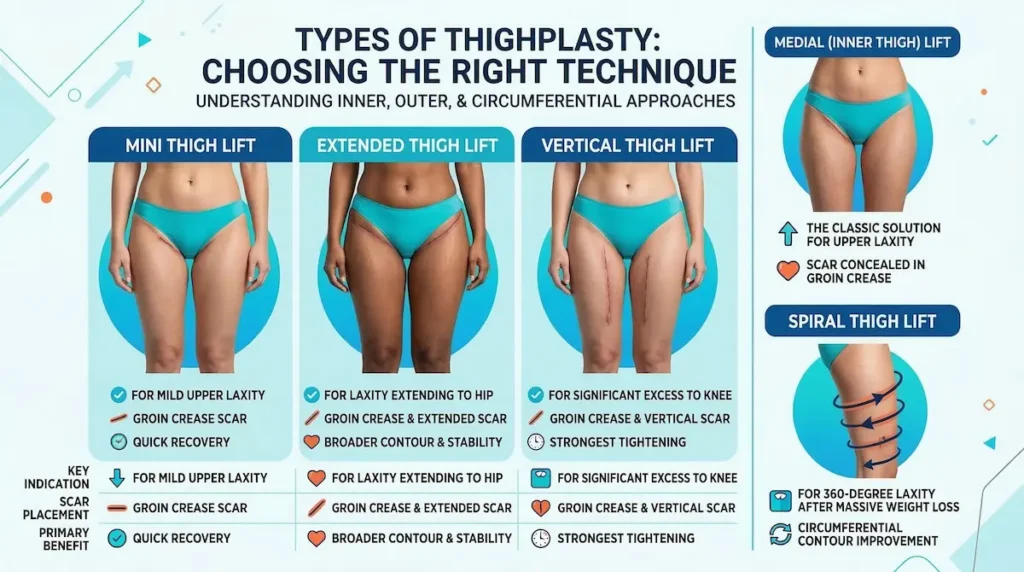
Types of Thighplasty: Choosing The Right Technique
There is no single “best” thigh lift technique. There is only the best match for your anatomy. The right plan depends on where the laxity sits, how far it extends, and what scar placement is acceptable for you. We treat scar design as part of the procedure, not an afterthought.
Medial (inner thigh) lift: the classic solution for inner-thigh laxity
Medial Thighplasty targets the inner thigh, typically using an incision placed in the groin crease to hide the scar in a natural fold. It works best when the laxity is concentrated high on the inner thigh. If looseness extends down towards the knee, a purely groin-crease scar may not be enough.
- Best for: upper inner-thigh laxity and localised excess skin.
- Trade-off: scar concealment is strong, but lift power is limited for lower-thigh skin.
- Key principle: tension control to protect scar quality and reduce widening.
Spiral Thigh lift: addressing 360-degree laxity after major weight loss
Spiral Thigh Lift is designed for patients whose looseness wraps around the thigh. This pattern is common after massive weight loss, where tissue descent is not only “inwards” but also “around”. The surgical plan prioritises circumferential contour improvement, while balancing scar position and closure stability.
- Best for: circumferential laxity and broader contour change.
- Trade-off: more extensive surgery can mean a longer recovery curve.
- Key principle: strategic vector planning so the lift follows the real direction of tissue descent.
Mini Thigh Lift
Mini Thigh Lift suits mild upper inner-thigh laxity when skin excess is limited and the scar can sit within the groin crease. It refines contour, reduces rubbing, and offers quicker recovery than thighplasty, but cannot correct looseness near the knee.
Extended Thigh Lift
Extended Thigh Lift is designed for laxity that continues from the inner thigh into the outer thigh and hip. By lengthening the incision, it improves contour and fit. Recovery varies, yet stability and shape can be better for weight-loss patients.
Vertical Thigh Lift
Vertical Thigh Lift addresses significant inner-thigh skin excess extending towards the knee, where a groin-only scar would under-correct. It adds a vertical incision to achieve stronger tightening and smoother lines. The trade-off is a more visible scar needing careful management.
Mini Thigh Lift vs Extended vs Vertical approaches: how we decide
Some patients need a lighter-touch approach. Others require a more comprehensive excision to achieve a meaningful change. We decide based on your skin redundancy, not on a preference for “bigger” surgery.
- Mini thigh lift: suitable for mild laxity high in the inner thigh with minimal skin excess.
- Extended thigh lift: used when laxity continues into the outer thigh/hip region and needs wider contour control.
- Vertical thighplasty: considered when excess skin extends down the inner thigh towards the knee and a vertical scar is the honest trade-off for a stronger lift.
During consultation, we show you the scar logic of each option and explain why one approach will hold its shape better than another over time.
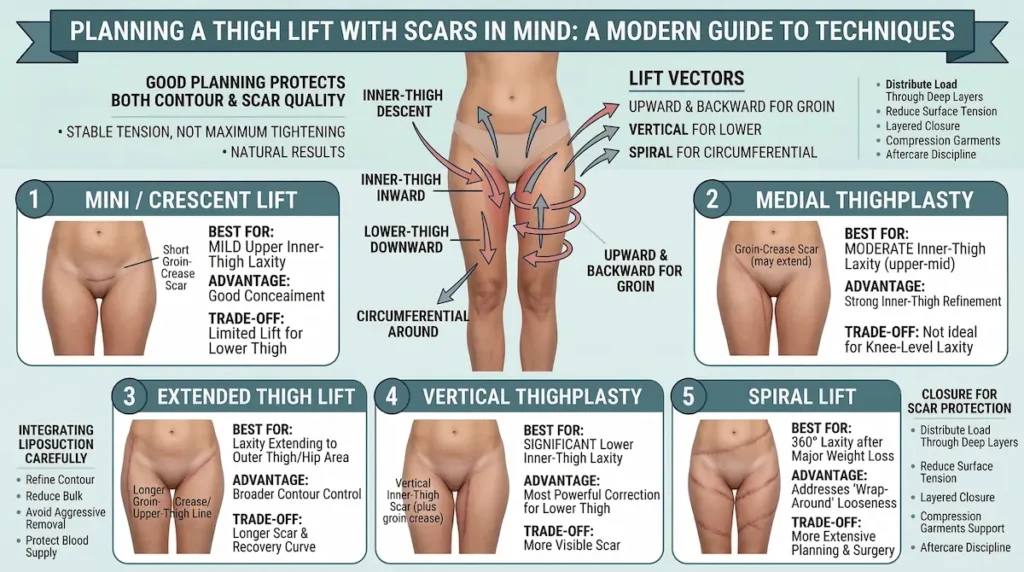
Surgical techniques explained: planning a Thigh Lift with scars in mind
Technique matters because a thigh lift is not a single operation. It is a set of design decisions: where to lift, how much to remove, and where a scar can sit with the least visual and functional impact. Good planning protects two things at once: contour and scar quality. We focus on stable tension, not maximum tightening. That is how results stay natural.
We plan the scar first, then we plan the lift. When tension is controlled, the outcome looks calmer and the scar tends to behave better over time.
How we choose the “vector” of lift (and why it changes everything)
Skin does not fall in one direction. After weight loss, it can descend inward, downward, and around the thigh. A lift works best when the pull follows the true direction of tissue descent.
- Inner-thigh laxity: we prioritise an upward and slightly backward lift to restore definition near the groin crease.
- Lower-thigh laxity: we discuss whether a vertical component is the honest trade-off for a stronger correction.
- Circumferential laxity: we consider a broader plan, including the logic behind a Spiral Thigh Lift approach when appropriate.
Incision design: concealment, stability, and scar behaviour
Scar placement is not just about hiding a line. It is also about keeping the closure stable during movement, swelling, and daily life. The groin crease can conceal a scar well, but it cannot always deliver enough lift for laxity that extends towards the knee.
- Groin-crease (crescent) incision: useful for mild laxity high on the inner thigh, with a scar designed to sit in a natural fold.
- Extended incision: considered when laxity runs wider into the outer thigh or hip contour and needs a longer line for control.
- Vertical incision: used when lower-thigh excess is significant; the scar is more visible, but the lift can be more powerful and predictable.
Liposuction + lift: when it improves shape, and when it can backfire
Some patients ask whether liposuction alone can solve the problem. If skin recoil is poor, fat reduction without lifting can worsen looseness. When used carefully, liposuction can refine contour and reduce “bulk”, but it must not compromise the blood supply of the skin we plan to tighten.
- We use liposuction selectively, based on skin quality and tissue thickness.
- We avoid aggressive fat removal where it would increase laxity or add stress to the incision line.
- We aim for smooth transitions, not hollowing or over-definition.
Closure strategy: reducing tension to protect the scar
Scar quality is influenced by biology, but it is also influenced by mechanics. When closure tension is concentrated on the skin, scars can widen. Our approach is to distribute load through deeper layers where possible, so the skin closure is not carrying the full force of movement.
- Layered closure: supports the lift while reducing stress on the surface line.
- Compression garment planning: helps manage swelling and supports the tissues early on.
- Aftercare discipline: walking is encouraged, but stretching and heavy activity are timed carefully.
| Technique | Best for | Typical scar pattern | Main advantage | Trade-off |
|---|---|---|---|---|
| Mini / Crescent lift | Mild upper inner-thigh laxity | Short groin-crease scar | Good concealment | Limited lift for lower thigh |
| Medial thighplasty | Moderate inner-thigh laxity (upper-mid) | Groin-crease scar (may extend) | Strong inner-thigh refinement | Not ideal for knee-level laxity |
| Extended thigh lift | Laxity extending to outer thigh/hip area | Longer groin-crease/upper-thigh line | Broader contour control | Longer scar and recovery curve |
| Vertical thighplasty | Significant lower inner-thigh laxity | Vertical inner-thigh scar (plus groin crease) | Most powerful correction for lower thigh | More visible scar |
| Spiral lift | 360° laxity after major weight loss | Pattern tailored to circumferential descent | Addresses “wrap-around” looseness | More extensive planning and surgery |
Combined Procedures: Maximising Results Safely
Many patients need more than one adjustment to achieve a balanced lower-body contour. The key is synergy, not stacking procedures for the sake of it. Combining surgeries can reduce total downtime, but it also increases operative time and recovery demands. We only combine procedures when the safety profile remains sound. That means the plan must fit your health, your tissue quality, and your travel timeline.
Thigh lift with liposuction: refining contour without compromising skin
When there is both skin laxity and residual fat, a combined plan can create a cleaner line. The sequencing and restraint matter. We focus on contour harmony and stable healing, not maximum volume reduction.
- We use liposuction to smooth transitions and reduce heaviness where the skin can tolerate it.
- We avoid over-treatment that would increase swelling, bruising, or scar tension.
- We tailor compression garments to support both the lift and the lipo-treated areas.
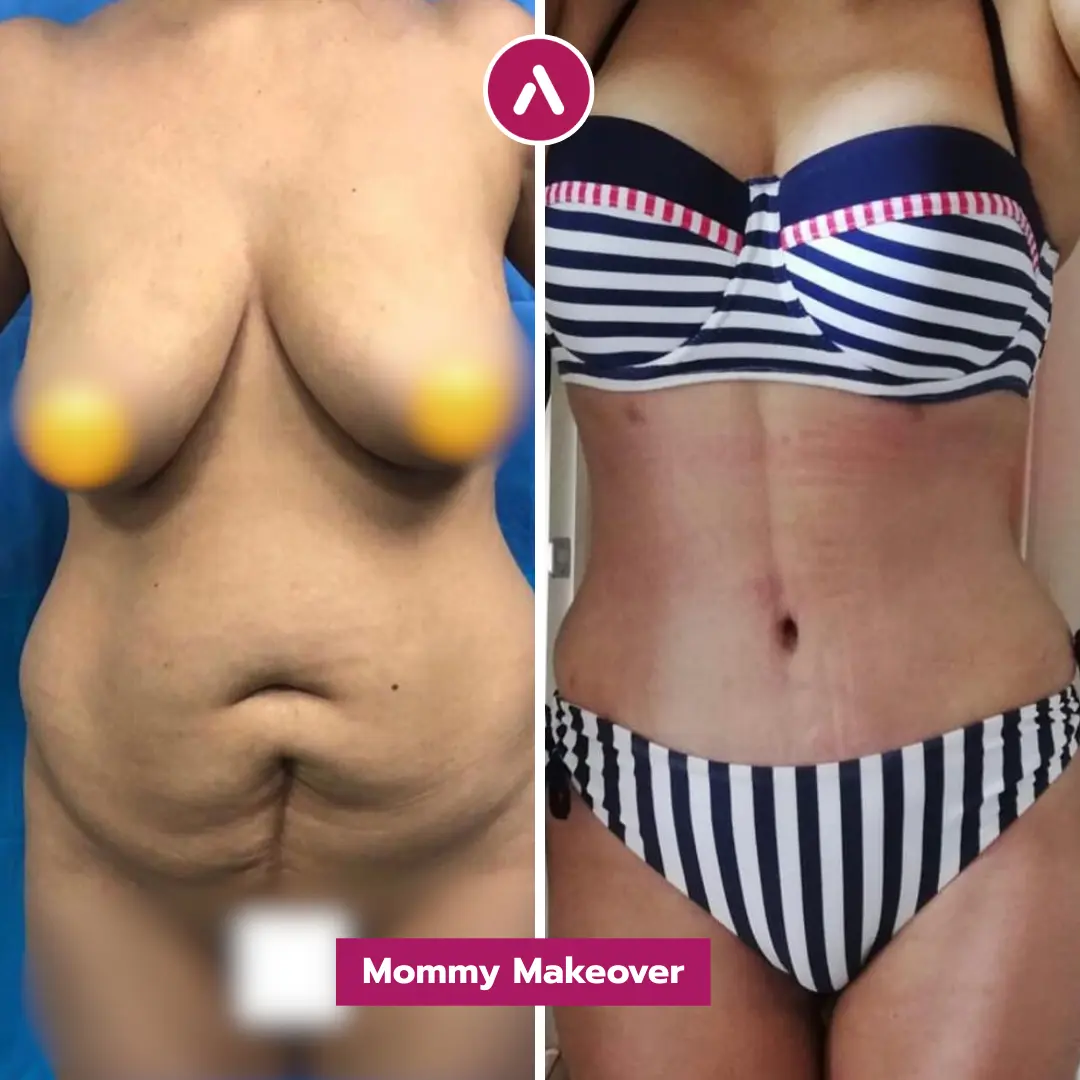
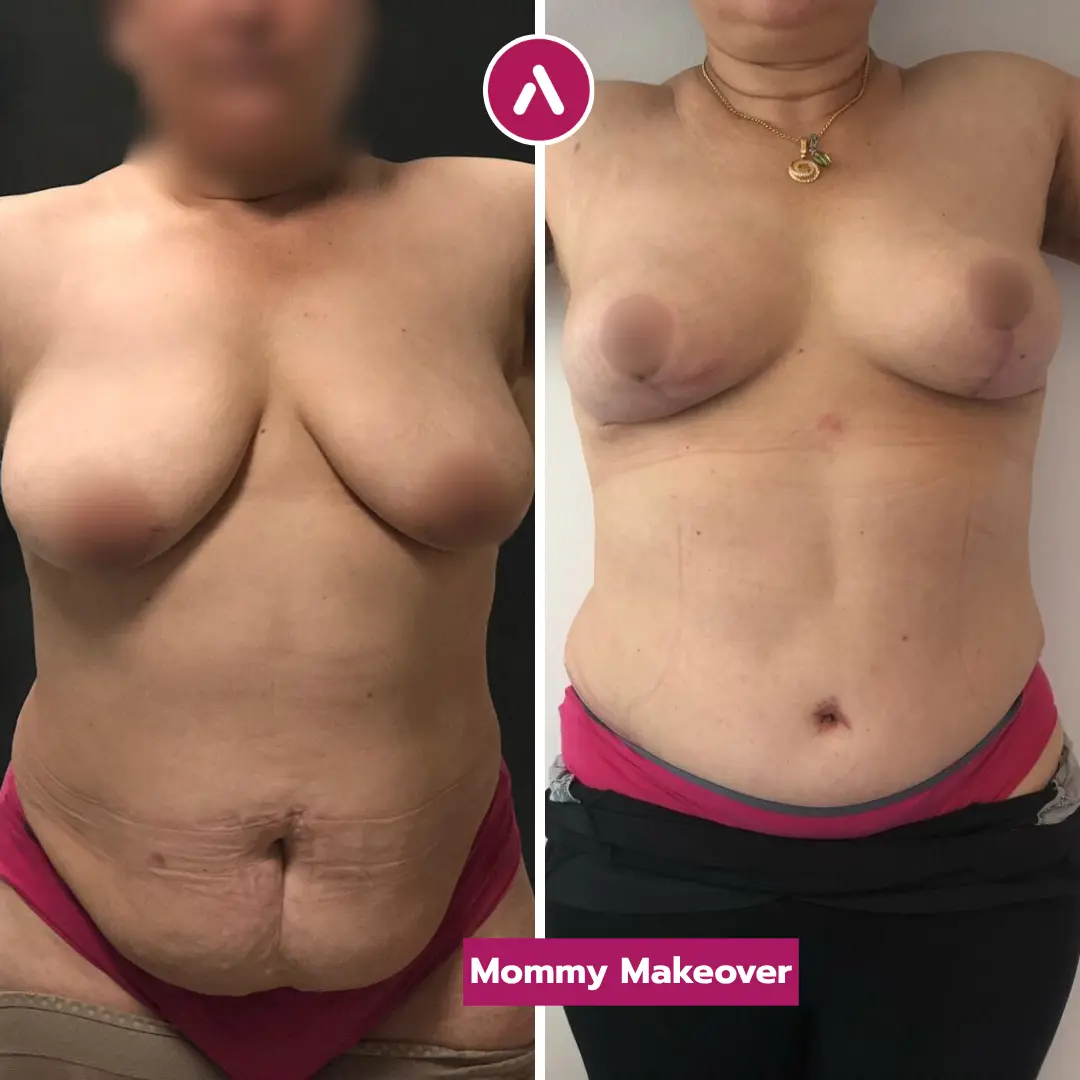
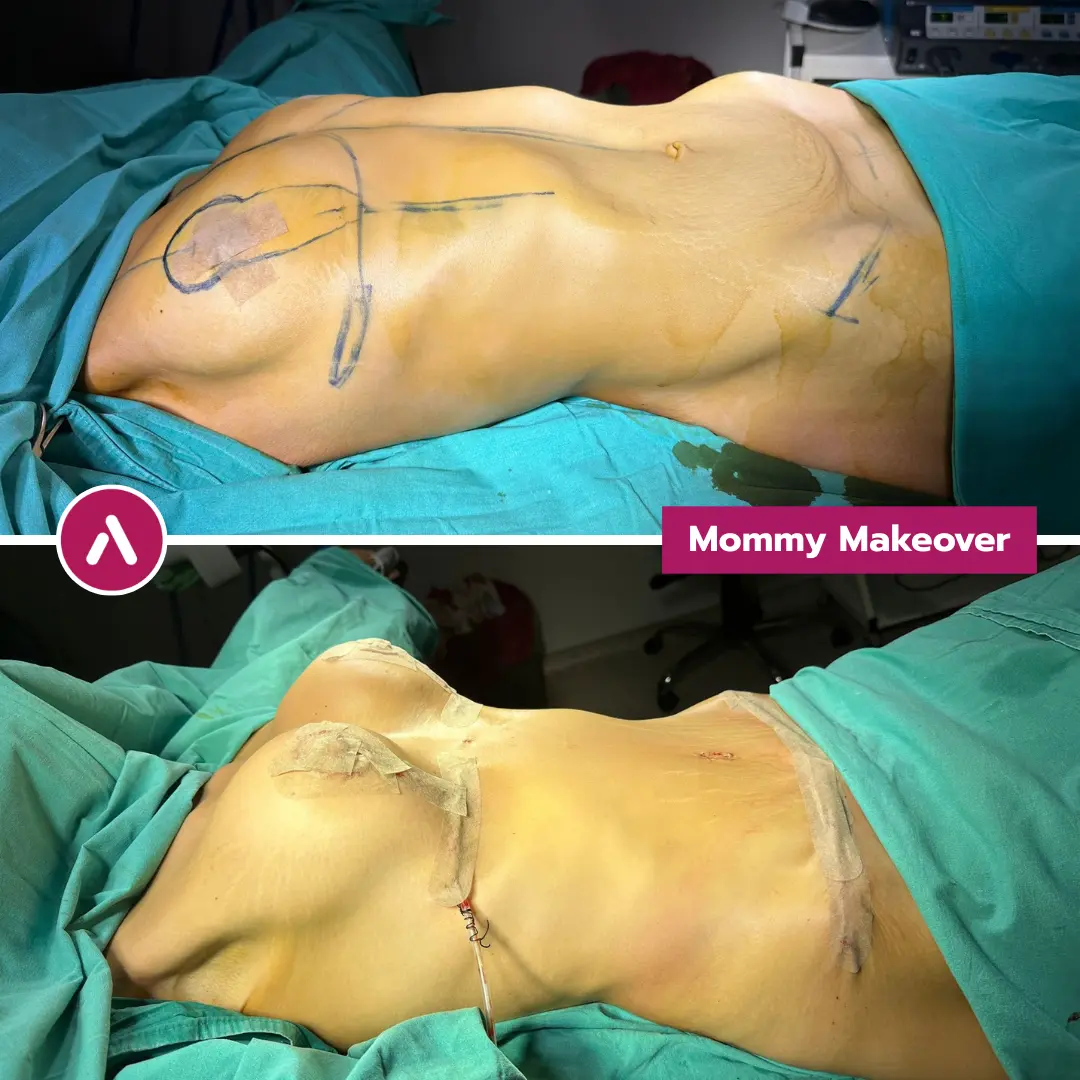
Thigh lift as part of a Mummy Makeover or wider body contouring
After pregnancy or major weight change, thigh concerns often sit alongside the abdomen, waist, and arms. In selected patients, combining a thigh lift with procedures such as a tummy tuck (abdominoplasty) or high-definition liposuction (mummy makeover) can restore overall proportion more effectively than treating one area in isolation.
- Tummy Tuck + thighs: useful when lower-body laxity is part of a wider “apron” and hip contour issue.
- Arm lift + thighs: considered after weight loss when skin redundancy appears in multiple limb areas.
- Staged planning: sometimes the safest “combo” is two well-timed surgeries rather than one long session.
One stage or two? How we make the decision
Some patients prefer “one trip, one recovery”. Others benefit from staging, especially if they have extensive laxity or higher medical risk. This is where an expert consultation matters. We explain the trade-offs plainly, including what it means for scarring, swelling, and travel comfort.
- Single stage: can reduce total downtime, but requires a conservative, safety-led scope.
- Two stages: can improve comfort and healing predictability, especially for extensive weight-loss cases.
- Travel planning: we build a plan around mobility, garment management, and safe timing for your flight home.
If you want a precise recommendation: we can review your photos, skin quality, and goals in a virtual consultation and tell you which technique (and which scar) is the most rational match.
Anaesthesia Options: why we often recommend Awake / Twilight Sedation (when appropriate)
For many UK patients, the first question is not the scar or the hotel plan — it is anaesthesia. A thigh lift can be performed under different anaesthetic approaches, and the “best” choice depends on your health profile, the extent of surgery, and how safely we can manage comfort and monitoring throughout the procedure.
At AKM Clinic, we routinely discuss both general anaesthesia and twilight sedation (also called conscious sedation). Where clinically suitable, we often prefer a sedation-led approach because it can offer a calmer recovery profile and a more controlled post-operative experience. The decision is always made with an anaesthetist and tailored to you.
General anaesthesia vs twilight sedation: what’s the real difference?
General anaesthesia means you are fully asleep with airway support. It is a well-established option and may be appropriate for more extensive surgery or certain medical profiles.
Twilight sedation is different. You are not “fully asleep” in the same way; instead, you are deeply relaxed and drowsy, with local anaesthetic used in the surgical area. Many patients remember little of the procedure. The aim is controlled comfort, stable monitoring, and a smoother early recovery for suitable candidates.
- General anaesthesia: fully asleep; may be preferred for longer or more extensive cases.
- Conscious sedation: deeply relaxed with local anaesthesia; often used for carefully selected cases.
- Key point: suitability depends on your medical history, procedure scope, and anaesthetist assessment.
Who may be suitable for Awake / Twilight (Conscious) Sedation?
Twilight sedation is not a “one-size-fits-all” option. We consider it when the planned technique, expected operative time, and your health profile align. During your consultation, we evaluate factors such as anxiety level, previous anaesthetic experiences, and how extensive the lift needs to be (mini vs extended vs vertical components).
- Patients having a more focused inner-thigh procedure, where a sedation-led approach can be appropriate.
- Patients who prefer to avoid the “heavy” feel that can follow general anaesthesia, where clinically reasonable.
- Patients with a stable health profile after appropriate pre-operative assessment.
If twilight sedation is not the safest fit, we will recommend general anaesthesia without hesitation. The goal is never to force a preference — it is to choose the safest, most predictable route for your specific plan.
Comfort and anxiety: the goal is a calm, controlled experience
Many patients worry about being “awake”. In practice, twilight sedation is designed to reduce awareness and anxiety while maintaining close monitoring. The operating theatre environment is structured, controlled, and led by an anaesthetist focused on your safety and comfort throughout.
Our aim is not bravado — it is calm control. The best anaesthesia plan is the one that supports safety, comfort, and predictable recovery.
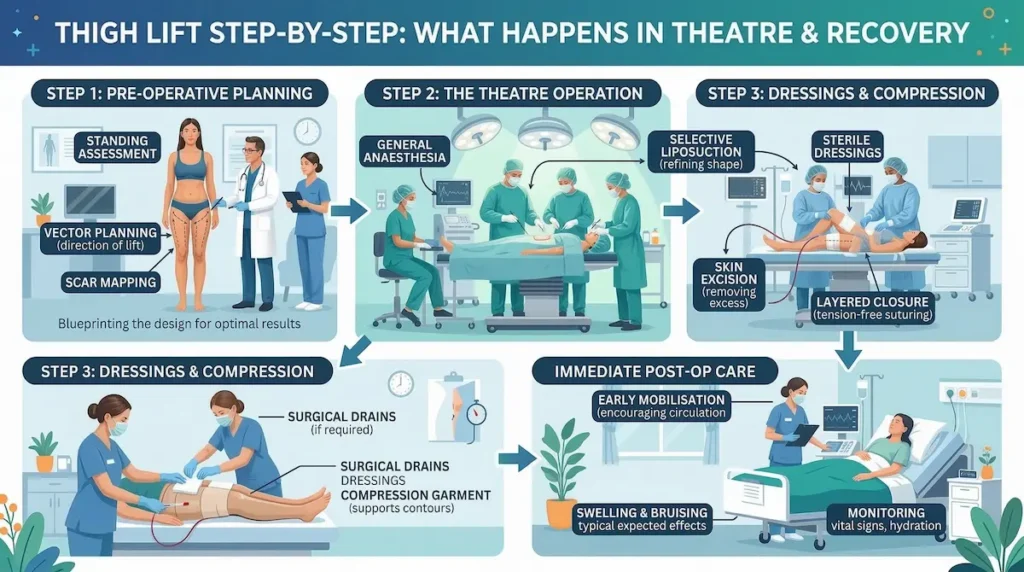
Thigh Lift Step-By-Step: what happens in theatre for a Thigh Lift?
A thigh lift is methodical. The best results come from disciplined planning: markings, vectors, tissue handling, and closure strategy. While technique varies by type (medial, extended, vertical, spiral), the core workflow follows the same safety-led structure.
Pre-op preparation: markings, measurements, and a “scar-first” plan
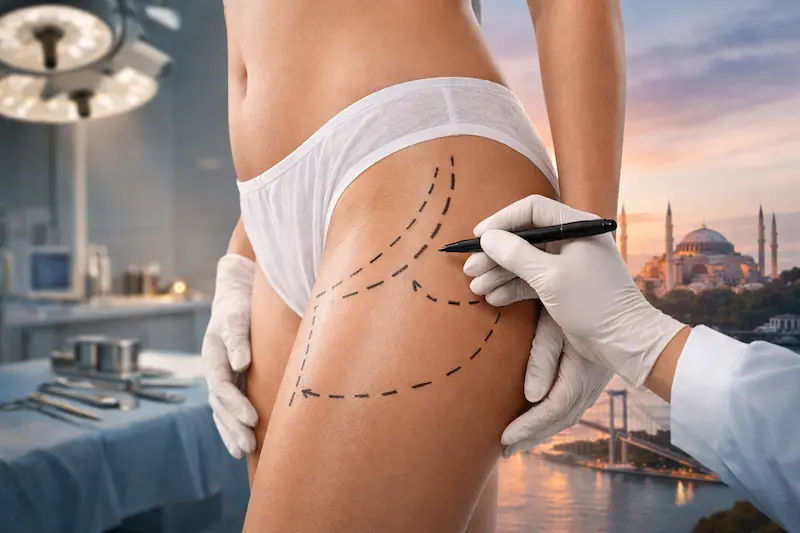
Before you enter theatre, we confirm the agreed surgical design in a standing position. This is where we map the direction of lift and the intended scar placement. Markings are not cosmetic doodles — they are the blueprint that reduces guesswork once you are on the table.
- Standing assessment:
- Vector planning:
- Scar mapping:
The operation itself: tissue refinement and controlled lifting
Once anaesthesia is established (general anaesthesia or twilight sedation, depending on your plan), the surgery proceeds in a structured sequence. Excess skin is removed in a way that prioritises contour balance and closure stability. Where liposuction is included, it is done selectively to refine shape without compromising tissue health.
- Skin excision:
- Contour shaping:
- Layered closure:
We aim for stability over aggressiveness. Over-tightening can increase tension, which can affect scar behaviour and comfort during movement in early recovery.
Dressings, drains, and compression garments: what you may need (and why)
After closure, we apply dressings and plan your compression garment strategy. Some patients require drains; others do not. This is not “routine” — it depends on the extent of undermining, the technique used, and your tissue characteristics.
- Dressings:
- Drains (if used):
- Compression garment:
Immediate post-op: what the first hours are typically like
In the first hours after surgery, we prioritise comfort, hydration, and safe mobilisation. You will be encouraged to move carefully (with support) to promote circulation. Swelling is expected; bruising varies by individual and by whether liposuction was part of your plan.
- Mobility:
- Swelling:
- Monitoring:
Thigh Lift Recovery & Aftercare: What To Expect After a Thigh Lift
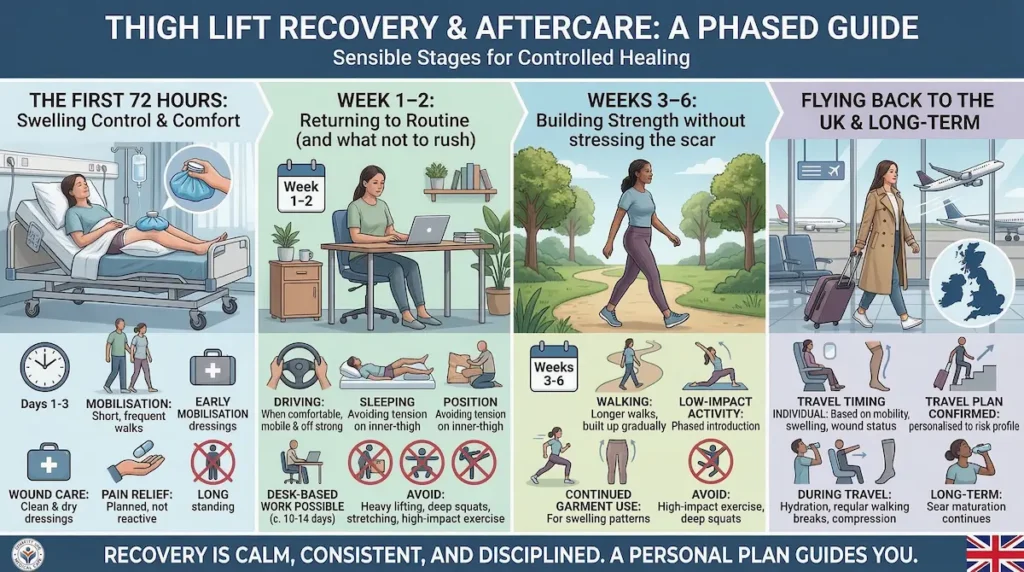
Recovery after a thigh lift is a process of controlled healing. Swelling (oedema), tightness and temporary changes in sensation are normal early on. What matters is not “toughing it out”, but following a structured plan that protects the incision line, supports circulation, and guides you back to normal movement in sensible stages.
The best recoveries are rarely dramatic. They are calm, consistent, and disciplined — especially in the first two weeks.
The first 72 hours: swelling control, comfort, and safe mobilisation
The first three days are about stabilising. You will be walking gently (with support) as soon as it is safe, because circulation matters. Most patients feel tightness and tenderness along the incision, with swelling building over the first few days before it gradually improves.
- Mobility: short, frequent walks are encouraged; long standing and sudden stretching are avoided.
- Compression garment: worn as advised to support tissues and manage swelling.
- Wound care: dressings are kept clean and dry; we explain when showering is appropriate for your specific closure.
- Comfort: pain relief is planned, not reactive; we aim for controlled comfort so you can move safely.
Week 1–2: returning to routine (and what not to rush)
This is the phase UK patients care about most, because it affects travel planning and time off work. You will typically feel more mobile, but the tissues are still fragile. Overdoing it can increase swelling and place unnecessary tension on the scar.
- Work: desk-based work may be possible for some patients after around 10–14 days, depending on the extent of the lift and your comfort.
- Activity: gentle walking is ideal; heavy lifting, deep squats, stretching and high-impact exercise are avoided.
- Driving: usually once you are comfortable, moving freely, and no longer requiring strong pain relief.
- Sleeping: we often recommend a position that avoids pulling on the inner-thigh incision line in the early phase.
Weeks 3–6: building strength without stressing the scar
Swelling typically starts to settle more noticeably in this window, but it can fluctuate — particularly after long days, warm weather, or too much activity. We gradually increase movement while keeping incision stress low.
- Walking: longer walks are usually fine, built up gradually.
- Exercise: low-impact activity may be introduced in a phased way; we time this based on healing quality.
- Garments: continued use is common; we tailor timing to your swelling pattern and comfort.
When can I fly back to the UK?
Flying is not just about comfort; it is about circulation. The safest timing depends on your procedure scope (mini vs extended/vertical), your mobility, and your individual risk profile. Many patients travel once early healing is stable and they can walk comfortably, but we give you a personalised plan rather than a generic promise.
- Before travel: we confirm wound status, swelling control, and mobility.
- During travel: regular walking breaks, hydration, and compression are commonly advised.
- Risk reduction: where indicated, we discuss clot-risk strategies in line with your medical profile.
Enhanced recovery support: HBOT + LLLT (where appropriate)
In selected patients, we can integrate supportive recovery modalities as part of a structured aftercare approach:
- Hyperbaric Oxygen Therapy (HBOT): may support tissue oxygenation in the early healing phase for appropriate candidates.
- Low-Level Light Therapy (LLLT): may be used as part of a broader scar and comfort strategy.
These are not “magic shortcuts”. They are adjuncts used thoughtfully, where they fit your medical profile and surgical plan, to support a more comfortable, controlled recovery.
| Timeframe | What you may feel | Typical focus |
|---|---|---|
| Days 1–3 | Tightness, tenderness, rising swelling | Rest, short walks, swelling control, wound protection |
| Week 1–2 | Variable swelling, improved mobility | Routine walking, garment discipline, avoiding stretch/tension |
| Weeks 3–6 | Gradual contour definition, swelling fluctuations | Phased return to activity, scar support, comfort optimisation |
| Months 2–3 | More stable movement, improving contour | Progressive exercise (guided), continued scar maturation support |
Thigh Lift Scars After 1 Year: what “matured” scars realistically look like
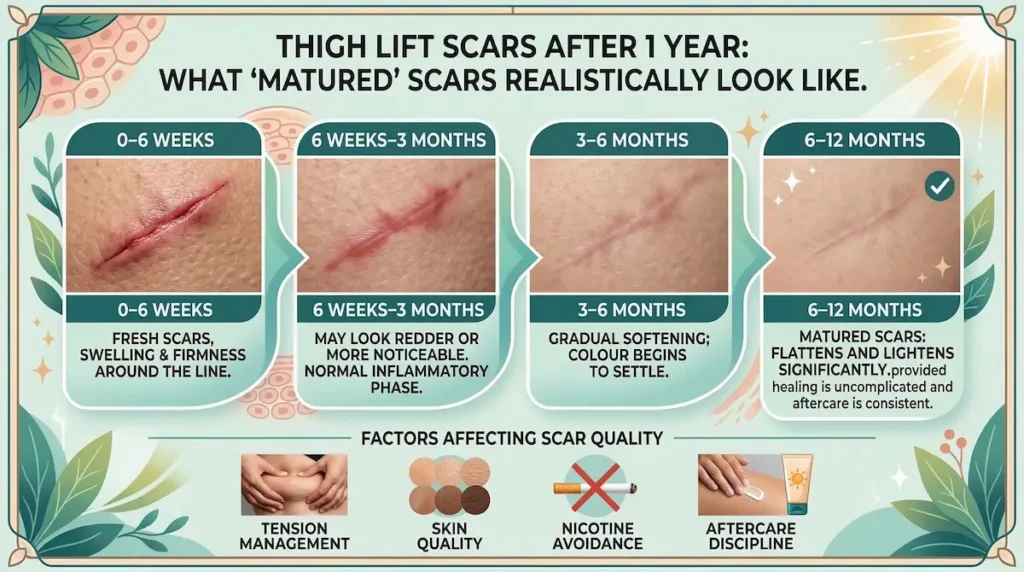
Scars are the trade-off for removing excess skin. The most important thing to know is that scar appearance changes over time. Early scars are not “final scars”. By around 12 months, most scars have matured significantly, becoming flatter and lighter — provided healing is uncomplicated and aftercare is consistent.
The scar maturation timeline: what changes and when
While every patient heals differently, scar behaviour tends to follow a pattern. Understanding it helps you judge progress accurately — and avoid unnecessary worry early on.
- 0–6 weeks: scars are fresh; swelling and firmness around the line is common.
- 6 weeks–3 months: scars may look redder or more noticeable; this is often a normal inflammatory phase.
- 3–6 months: gradual softening; colour typically begins to settle.
- 6–12 months: the scar often flattens and lightens further as it matures.
What determines scar quality?
Scar quality is a combination of biology and mechanics. Some factors are personal (skin type, genetic tendency). Others are controllable (tension management, nicotine avoidance, aftercare discipline).
- Tension:
- Skin quality:
- Nicotine:
- Aftercare:
Scar management: what we typically recommend
Scar care starts early, but it is paced. We only introduce topical scar products once the incision is appropriately sealed and your surgeon advises it. The aim is not perfection; it is the best scar your body can produce under the right conditions.
- Silicone (gel or sheets):
- Sun protection:
- Massage (when advised):
- LLLT (where appropriate):
When scars don’t behave as expected: what we do
Occasionally, scars can widen, become raised, or remain more noticeable than expected. If that happens, the response is structured. We assess the cause (tension, healing pattern, skin reaction) and choose the most rational intervention, starting conservatively.
- Review and optimisation:
- Targeted treatments:
- Scar revision:
Most importantly, we follow you through the full maturation curve. A scar at 8 weeks is a work in progress — not a verdict.
Safety & Risks: Is a Thigh Lift Dangerous?
A thigh lift is a major operation. It is generally safe when you are properly selected, properly prepared, and properly followed up. It is not “risk-free”. We prefer to be direct about that.
Safety is never a slogan. It is a system: patient selection, sterile practice, vigilant monitoring, and structured follow-up.
The main risks you should understand (before you book anything)
Most complications are manageable when recognised early. The key is knowing what can happen and how it is prevented.
- Fluid build-up (seroma): a pocket of fluid that can require drainage or closer monitoring.
- Infection: uncommon with good protocols, but possible with any incision.
- Wound healing problems: delayed healing or wound separation, especially where movement and moisture are higher.
- Scarring issues: widening, pigmentation, raised scars, or asymmetry in scar position.
- Bleeding/haematoma: can occur early and may need assessment.
- Changes in sensation: numbness or altered sensitivity can happen and usually improves over time.
- Clot risk (DVT/PE): a serious but preventable risk that influences our mobilisation and travel guidance.
How we reduce risk before surgery
Good outcomes start with honest screening. We use pre-operative health checks to confirm candidacy and reduce avoidable complications.
- Medical screening: we review your health history, medications, and any clotting or healing risk factors.
- Nicotine policy: smoking/vaping/nicotine increases wound-healing problems. We will ask you to stop well in advance.
- Weight stability: stable weight supports predictable contour and stable scar tension.
- Procedure scope: we keep the plan proportional to your healing capacity, especially if you are combining procedures.
If a thigh lift is not the safest step right now, we will say so. Sometimes the best plan is optimisation first.
How we reduce risk during and after surgery
Risk reduction is procedural. It lives in the theatre environment, the monitoring, and the aftercare structure.
- Rigorous sterilisation standards (ISO/TÜV): reduces infection risk through controlled protocols.
- Advanced vitals monitoring: continuous monitoring throughout your procedure.
- Planned mobilisation: early, safe walking supports circulation and reduces clot risk.
- Compression strategy: supports swelling control and tissue stability.
- Clear follow-up checkpoints: we prefer structured reviews over “see how you feel”.
We also make sure you know what is normal and what is not. That clarity prevents small issues becoming bigger ones.
When to contact us urgently
Some symptoms should never be “waited out”. If any of the following occur, you should seek urgent medical advice and contact us immediately.
- Sudden shortness of breath, chest pain, or fainting.
- One-sided calf swelling, redness, or severe pain.
- Rapidly increasing swelling, severe pain not controlled by medication, or a rapidly expanding bruise.
- Fever, worsening redness, foul-smelling discharge, or wound separation.
Is a Thigh Lift Safe in Turkey (for UK patients)?
It can be safe. The more useful question is: “What should I verify to feel confident?” UK patients tend to evaluate safety through standards, credentials, and continuity of care. We agree with that approach.
What to compare when assessing safety abroad
Location alone does not guarantee safety. Systems do. When you compare providers, we suggest focusing on these practical criteria.
- Pre-operative screening: do they actively refuse unsuitable candidates?
- Anaesthesia options: is an anaesthetist-led plan discussed, including twilight sedation where appropriate?
- Sterile protocols and monitoring: what standards do they follow in theatre?
- Surgeon credentials: look for specialists registered with international medical boards and European Board-level certification.
- Aftercare structure: who answers when you are back in the UK?
Our safety framework in Istanbul
We built our model around international patient expectations: clinical discipline, privacy, and predictable follow-up. Our safety framework includes strict pre-operative screenings, rigorous sterilisation standards (ISO/TÜV), and advanced patient vitals monitoring throughout every procedure.
- Credential-led care: your surgery is performed by specialists registered with international medical boards, with European Board-level credentials where applicable.
- Materials and standards: we use FDA-approved materials and operate in JCI-accredited hospitals that meet or exceed Western standards.
- Confidentiality: we maintain USA-standard patient confidentiality and data security protocols.
These points matter because they are verifiable. They reduce “unknowns”, which is usually the real barrier for UK patients.
Our approach is deliberately understated: we prioritise safety, proportion, and scar strategy — not dramatic promises.
Continuum of care: from the UK to Istanbul and back home
Safety is not only what happens in theatre. It is also what happens before you arrive and after you fly home.
- Virtual consultation: we start with a no-obligation video call, photo review, and a personalised plan with transparent all-inclusive pricing.
- In-Istanbul support: your dedicated Patient Host coordinates logistics and remains available 24/7 via WhatsApp during your stay.
- Fit-to-fly check: we perform a final in-person check-up before you travel, so your departure is medically structured, not guesswork.
- Long-term follow-up: we schedule virtual reviews at 1, 3, 6, and 12 months to monitor healing and scar maturation.
If you want a safety-first recommendation, we can assess your photos and medical history and tell you which technique is the safest match — and which option is not worth the risk.
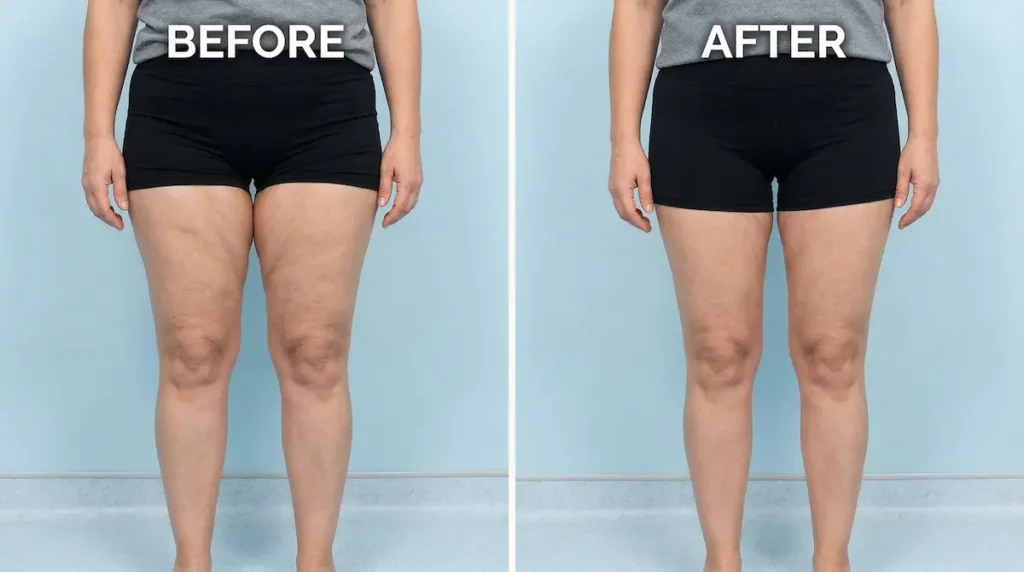
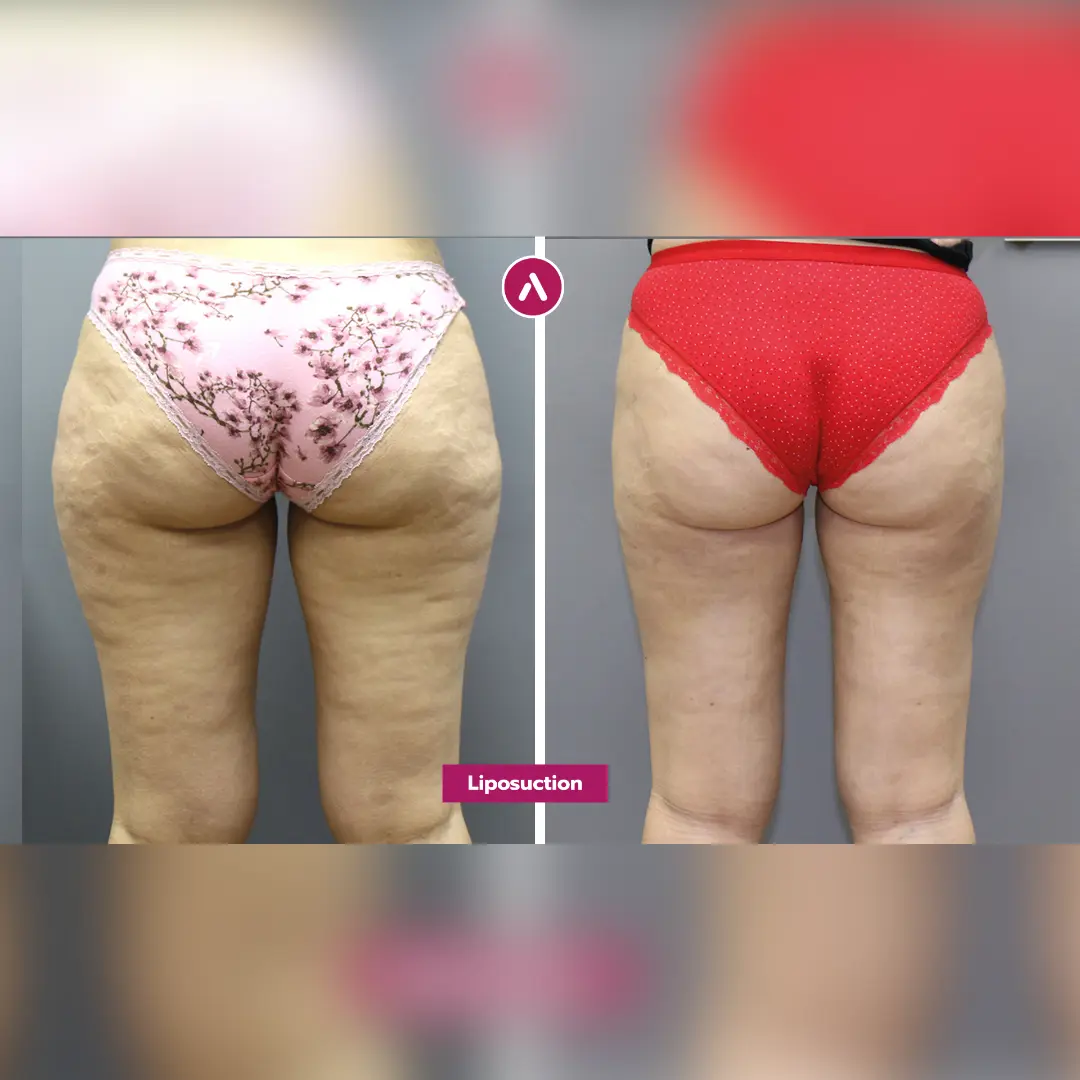
Thigh Lift Before and After: Realistic Expectations & Results
A thigh lift can create a cleaner contour, but it cannot change your underlying anatomy. It also cannot “freeze” future ageing. What it can do is remove redundant skin and restore proportion in a way that feels coherent with the rest of your body.
Our benchmark is simple: you should look refined, not “operated on”. The goal is rejuvenation, not alteration.
What a thigh lift can realistically improve
When the problem is excess skin, a lift is the most direct solution. You are not relying on skin recoil. You are removing redundancy and re-shaping the envelope.
- Better inner-thigh definition: less folding and a smoother line in clothing.
- Improved comfort: reduced rubbing and irritation for many patients.
- More stable contour after weight loss: the shape matches your effort more closely.
For patients searching for thigh lift Istanbul, the clinical question stays the same. Where is the laxity, and what scar trade-off makes sense?
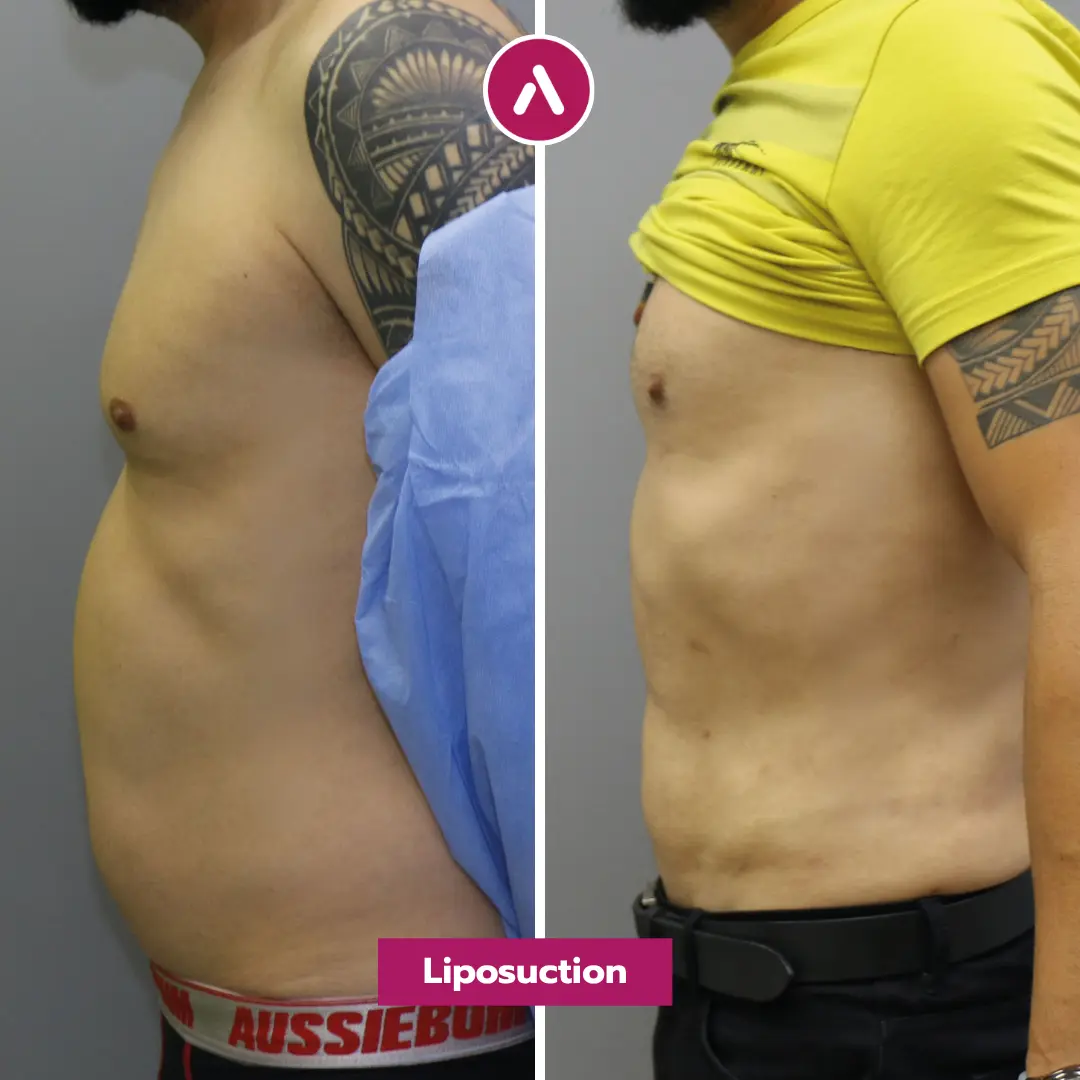
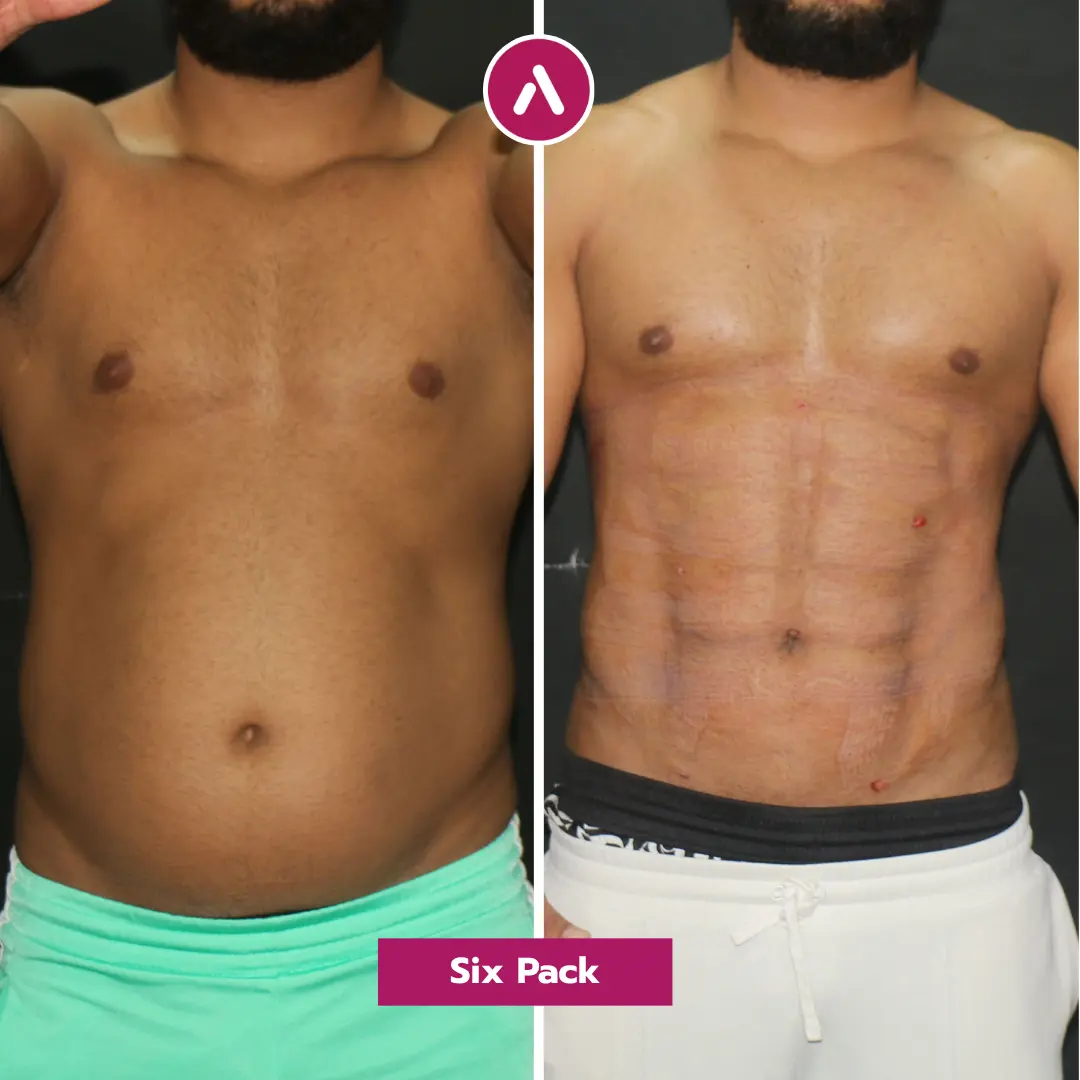
What a thigh lift cannot do (and what tends to disappoint people)
Some expectations are better corrected before surgery. That is part of safe, responsible planning.
- It cannot replace weight loss: the aim is contour, not a number on the scale.
- It cannot erase cellulite: cellulite is a surface texture issue and behaves differently.
- It cannot guarantee “invisible” scars: scars can be well-managed, but they are still scars.
If you are choosing between liposuction alone and a lift, we explain the boundaries clearly. Loose skin rarely improves with fat removal alone.
When do results look “final”?
Early results can look encouraging, but swelling shifts. Tightness can also make the contour feel different from how it looks. Patience helps.
- First 2–3 weeks: swelling and bruising dominate the picture.
- Weeks 6–12: your shape becomes clearer as oedema settles.
- Months 6–12: scars mature and the contour tends to stabilise.
We use structured follow-up to keep the process predictable. That includes planned digital reviews at 1, 3, 6, and 12 months for international patients.
Our Rapid Recovery & Safety Protocol: HBOT + LLLT (selected pathways)
When your plan prioritises lower “social downtime”, we can integrate our technology-led recovery pathway. It is designed to support healing and reduce risk, not to promise instant recovery.
- HBOT: supports tissue oxygenation, helps reduce inflammation, and is positioned in our model as a key safety promise.
- LLLT: supports cellular repair and collagen activity, and can be used as an adjunct for swelling and scar quality.
- Travel reassurance: for many UK patients, this sits within “flight-ready” recovery planning alongside mobilisation and compression discipline.
Thigh Lift Cost in Turkey 2026: Turkey vs UK value
If you are searching for thigh lift surgery cost turkey, it helps to separate two questions. First: what is included? Second: what is the clinical scope? A mini lift and an extended/vertical plan are not the same operation, and they should not be priced as if they are.
What determines the total cost of a thigh lift?
Cost is driven by clinical complexity and the infrastructure around the surgery. We itemise your plan during your virtual consultation so you understand what you are paying for.
- Technique: mini vs medial vs extended/vertical vs spiral planning.
- Combination surgery: adding liposuction or wider body contouring changes operative time and recovery demands.
- Anaesthesia plan: twilight sedation vs general anaesthesia depends on suitability and scope.
- Aftercare structure: garments, medication, follow-up, and optional recovery technologies.
Patients also search for thigh lift Turkey price because UK private pricing can be prohibitive. The rational comparison is value, not bargain hunting.
Why can Istanbul be more cost-effective than the UK?
The price differential is typically explained by macroeconomics, not reduced standards. Exchange rate dynamics and lower national operational costs can change the headline figure significantly.
- Operational costs: staffing and facility costs are structurally different.
- Exchange rate:
- Bundled logistics:
Value is clarity. If you cannot see what is included, you cannot compare safely.
What’s included in our all-inclusive plan (and what isn’t)
We run a transparent package model because it reduces friction for international patients. It also makes comparison with UK providers more honest.
| Category | Typical UK Private Clinic | Our Istanbul Plan |
|---|---|---|
| Surgery & facility fees | Often itemised separately | Your complete procedure + anaesthesia & operating theatre fees included |
| Pre-op tests | May be separate | All pre-operative tests included |
| Hotel & transfers | Not included | 5-star hotel accommodation + VIP airport/clinic transfers included |
| Aftercare essentials | Varies | Post-operative medications & garments + first post-op meal included |
| Support & follow-up | In-person local follow-up | 24/7 dedicated Patient Host + long-term virtual follow-up care included |
| Not included | Varies | International flights, personal travel insurance, personal expenses, visa fees, and additional hotel nights (if extending) |
If you want a precise quote, we provide a fully personalised plan after reviewing your photos and medical history in a free virtual consultation.
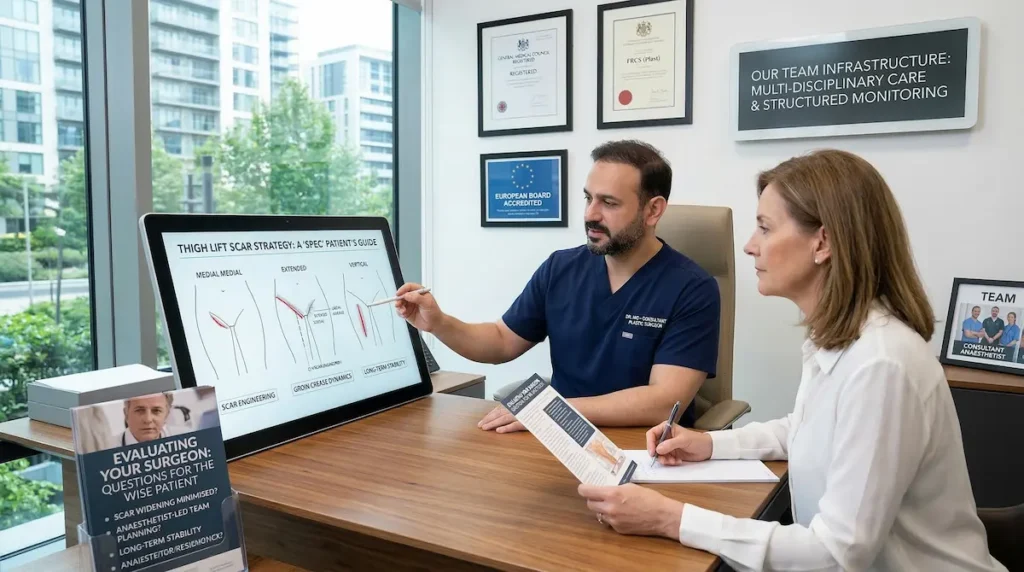
Finding The Best Thigh Lift Surgeon: how an “expert patient” should evaluate a Thigh Lift
Choosing a surgeon for a thigh lift is not about charisma. It is about repeatable judgement under pressure. You want someone who can plan scars honestly, control tension, and manage risk without drama. The safest outcomes usually come from calm decision-making, not aggressive promises.
Why board-level credentials and international registration matter
Credentials are not a decoration. They indicate training pathways, audit culture, and professional accountability. For international patients, they also reduce uncertainty because they are verifiable. We position our surgical authority through specialists registered with international medical boards and European Board-level credentials where applicable.
- Training depth: look for surgeons with formal specialist pathways, not “cosmetic-only” branding.
- Board-level signals: European Board credentials and recognised professional memberships are meaningful trust anchors.
- Team infrastructure: safe surgery is supported by anaesthetist-led planning and structured post-op monitoring.
Experience that actually matters in thighplasty
Thighplasty is scar engineering as much as it is contouring. A surgeon can be excellent at one body area and less experienced in another. For the thigh, the “hard parts” are tissue behaviour, groin-crease dynamics, and long-term scar stability. This is where experience shows.
- Scar strategy: where the line sits, how tension is distributed, and how widening is minimised.
- Case selection: knowing when liposuction alone is not enough, and when vertical scars are the honest trade-off.
- Complication handling: seroma prevention, wound support, and early intervention protocols.
Questions worth asking in your consultation
If you are searching for best thighplasty surgeons, the fastest filter is the quality of answers you receive. A confident surgeon can explain trade-offs plainly. A sales-led consultation tends to dodge scar conversations. We prefer the former.
- “Which technique fits my pattern of laxity: medial, extended, vertical, or spiral — and why?”
- “Where will my scar sit in normal underwear, and what do you do to protect scar quality?”
- “What is your plan if I develop a seroma or delayed healing?”
- “How will we manage anaesthesia — would twilight sedation be suitable for my scope?”
If you want a rational second opinion, we can review your photos and medical history in a no-obligation virtual consultation and tell you which approach is the safest match — and which approach we would avoid.
Good surgery is not a “tightening contest”. It is controlled tension, stable healing, and natural long-term balance.
Your Medical Journey: what to expect from first message to flying home
For UK patients, logistics are part of safety. The best surgical plan can still feel stressful if travel and communication are vague. Our pathway is structured so you know what happens, when it happens, and who to contact at each stage. It is designed to reduce uncertainty without over-promising.
Step 1: free virtual consultation and a clear surgical plan
Your journey begins at home. We start with a video call and a focused review of your goals, medical history, and photos. You receive a personalised treatment plan with a transparent, all-inclusive quote and a clear outline of what is included and what is not. If you are not a suitable candidate yet, we tell you.
- Photo review: assessment of laxity pattern, likely scar design, and whether a lift is necessary.
- Anaesthesia discussion: general anaesthesia vs twilight sedation, based on procedure scope and suitability.
- Planning tools: where appropriate, we use advanced imaging and structured pre-op planning to reduce guesswork.
Step 2: arrival, pre-op tests, and procedure day
Once you confirm your date, your Patient Host coordinates the practical details. That includes 5-star partner hotel accommodation and VIP transfers, so you can focus on preparation and recovery. On procedure day, you have an in-person consultation to confirm the plan. We perform all required pre-operative tests before proceeding.
- VIP airport welcome: private driver meets you at IST or SAW for transfer to your hotel.
- Final surgeon review: markings, scar logic, and scope confirmation.
- Safety first: anaesthetist-led monitoring and a structured theatre workflow.
Step 3: recovery support in Istanbul and long-term follow-up back in the UK
After surgery, we monitor you closely and guide mobilisation, garments, and wound care with clear checkpoints. Your Patient Host remains available 24/7 via WhatsApp while you are in Istanbul. Before you travel, we complete a final in-person check and confirm you are fit to fly. After you return home, we continue with scheduled virtual follow-ups at 1, 3, 6, and 12 months to support healing and scar maturation.
- In-Istanbul support: coordinated reviews, recovery guidance, and practical help.
- Flight-ready planning:
- Continuity of care:
For international patients, continuity matters: support in Istanbul is only half the story. Follow-up back in the UK completes it.
Thigh Lift (Thighplasty) Frequently Asked Questions (FAQ):
Below are the questions we hear most from UK patients considering a thigh lift in Istanbul. If your question is not covered, you can ask it during a free virtual consultation and we’ll answer it in the context of your anatomy, skin quality, and planned technique.
How painful is a thigh lift?
Most patients describe tightness and soreness rather than sharp pain. Discomfort is usually most noticeable in the first few days and then improves steadily. We plan pain relief proactively so you can mobilise safely, because gentle walking supports circulation and recovery.
Will I have drains?
Some patients do, some do not. Drain use depends on the extent of tissue dissection, your technique (mini vs extended/vertical/spiral), and your individual fluid-risk profile. If drains are used, we explain the typical removal timing and the practicalities of care.
How long will I need to wear a compression garment?
Most patients wear a compression garment for several weeks, but the timeline is personalised. The garment supports swelling control and comfort, and it also helps the tissues “settle” more predictably. We give you a clear plan and adjust it based on swelling and healing.
When can I return to work?
For desk-based roles, some patients return after around 10–14 days, depending on the extent of surgery and comfort. For active jobs that involve long standing, lifting, or walking, you may need longer. We advise based on your procedure scope and recovery response.
When can I exercise again?
Gentle walking starts early. Structured exercise returns in stages. Low-impact activity may be introduced once healing is stable, while high-impact exercise and heavy lower-body training are usually delayed longer to protect the incision line and scar quality.
Is liposuction enough, or do I need a lift?
If skin recoil is poor, liposuction alone can worsen looseness. If the issue is mainly fat with good skin elasticity, liposuction may be enough. During consultation, we assess your “skin envelope” honestly and explain the most rational approach — including the scar trade-off where a lift is needed.
What does a thigh lift scar look like after 12 months?
By around one year, most scars are flatter and lighter than in the early months, assuming uncomplicated healing and consistent scar care. Exact appearance varies with skin type, tension, and aftercare discipline. We plan scars to sit in natural creases where possible and prioritise tension control to reduce widening.
How soon can I fly back to the UK?
Flying depends on your mobility, swelling control, wound status, and clot-risk profile. We do not give one-size-fits-all promises. Instead, we structure your plan around safe mobilisation, compression strategy, and a fit-to-fly check before departure.
Can a thigh lift fix cellulite?
A thigh lift targets redundant skin and contour. Cellulite is a surface-texture issue and may not change significantly. Some patients see modest improvement where loose skin was exaggerating dimpling, but cellulite correction is not the primary goal of thighplasty.
How long do results last?
Results are designed to be long-lasting, particularly when weight remains stable. Ageing continues, and tissue can change over time, but a well-planned lift removes redundancy and restores proportion in a way that typically holds up well with sensible lifestyle stability.
What if I’m looking for the “best thigh lift surgeon” in Turkey?
It’s a fair search — and the best way to evaluate it is to look for calm competence: board-level credentials, case selection discipline, transparent scar planning, and a clear protocol for managing complications and follow-up. We encourage you to ask direct technical questions and compare the quality of answers, not just marketing claims.
What should I bring to Istanbul?
Comfortable loose clothing, slip-on shoes, and any regular medications (with prescriptions). We provide guidance on garments and essentials, and your Patient Host helps coordinate practical details so you can focus on recovery.
Medical disclaimer: This page is for general information only and does not replace a consultation with a qualified surgeon. All surgery carries risks and results vary between individuals. A personalised assessment is required to determine suitability, the safest technique, and expected outcomes.