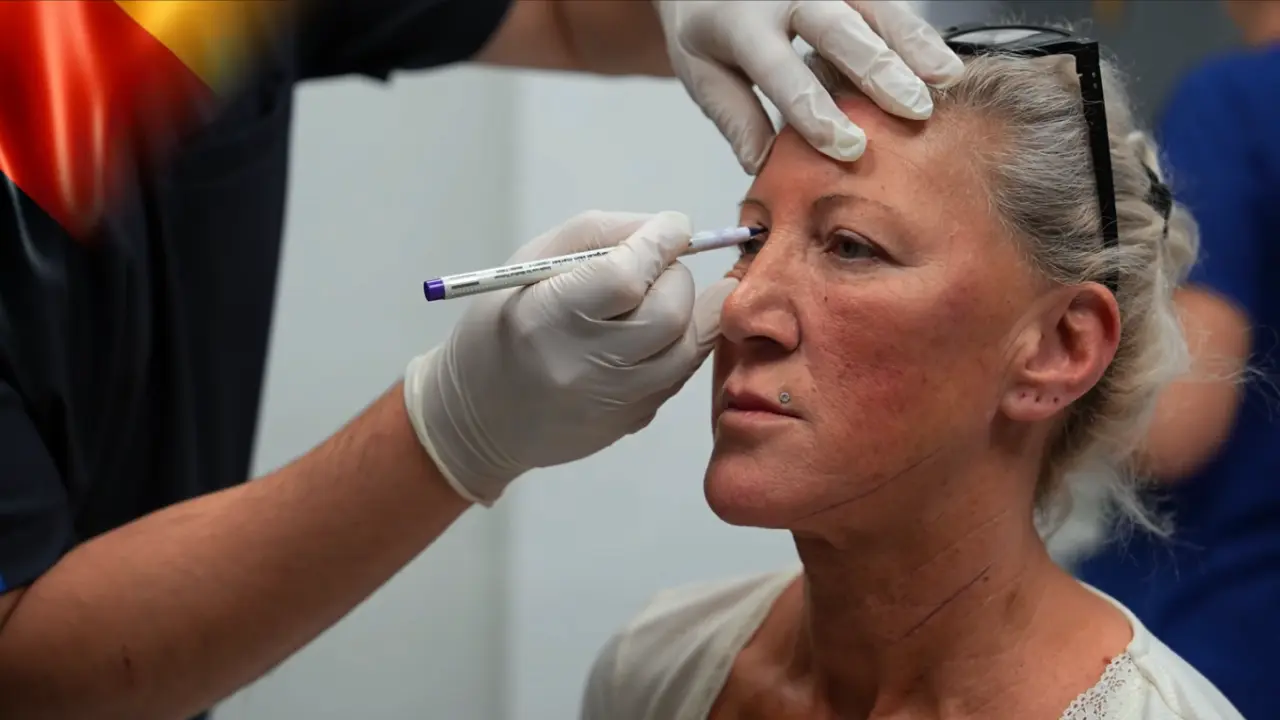





Rhinoplasty (Nose Job) is one of the most nuanced procedures in facial aesthetics. It sits at the intersection of structure, airflow, and proportion. Done well, it looks unremarkable—in the best possible way. That is why we approach every plan with a simple principle: Rejuvenation, Not Alteration.
Table of Contents
What is Rhinoplasty (Nose Job)?
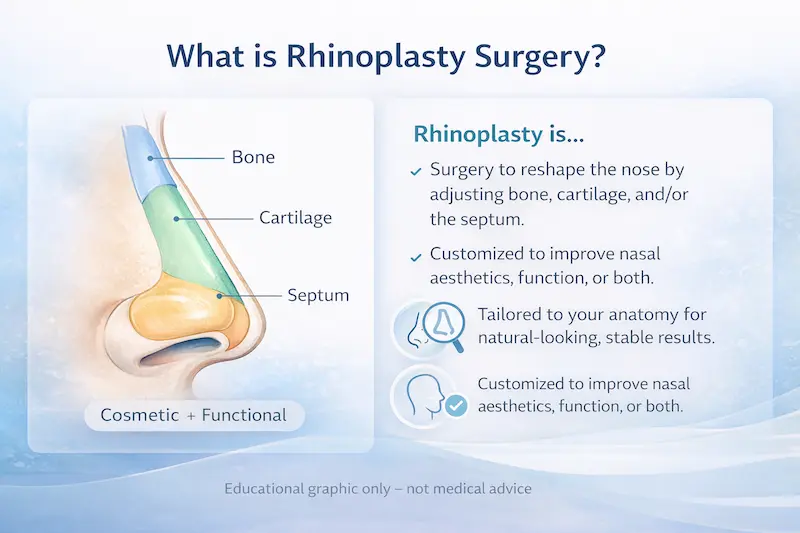
Rhinoplasty is a surgical procedure that reshapes the nose. People also call it a nose surgery or a nose reshaping procedure. It can refine the bridge, the tip, or the overall balance. It can also address internal structure linked to breathing. The goal is harmony, not a “new nose”.
Definition: what rhinoplasty actually changes
Rhinoplasty changes the nose’s outer framework (bone, cartilage, skin) and, when needed, the internal support structures. That can mean a softer bridge, a more defined tip, or a straighter profile. It can also mean restoring support if the nose has been weakened by trauma or previous surgery.
In practical terms, we plan around three outcomes:
- Shape: the bridge, tip, nostrils, and overall symmetry
- Support: how the cartilage framework holds its position over time
- Function: how comfortably you breathe through the nose
Nasal anatomy: why “small changes” can look big
The nose is built from bone (upper third) and cartilage (middle and tip). Skin thickness varies widely. A strong bridge with a soft tip behaves differently from a delicate bridge with thick skin. That is why two people can request the same “look” and need completely different techniques.
When we assess anatomy, we look at:
- The nasal bones and their width
- The cartilage framework in the middle third
- Tip support, rotation, and definition
- The septum and internal airflow dynamics
- Skin thickness and how it will drape during healing
What rhinoplasty can (and can’t) do
Rhinoplasty can improve proportion and correct specific structural issues. It can straighten a crooked nose, reduce a hump, refine the tip, or adjust nostril shape. When appropriate, it can also improve breathing by restoring internal support.
It cannot guarantee perfection. Faces are not perfectly symmetrical, and neither are noses. Healing also has its own timetable, especially at the tip.
- Can: refine contour, improve balance, strengthen support, address selected functional issues
- Can’t: promise an identical result to an edited photo, erase every minor asymmetry, bypass normal swelling
Benefits of Rhinoplasty (Nose Job) — Aesthetics & Breathing
Most UK patients come to rhinoplasty with two priorities: a natural look and a sense of control. They want to understand the “how,” not just the “before and after”. That is sensible. Rhinoplasty is a structural procedure, and small decisions can affect both appearance and airflow.
Our planning always starts with your face, not a trend. The aim is to look like you—just more balanced. Quiet changes. Clear intent.
Aesthetic benefits: proportion, not a template
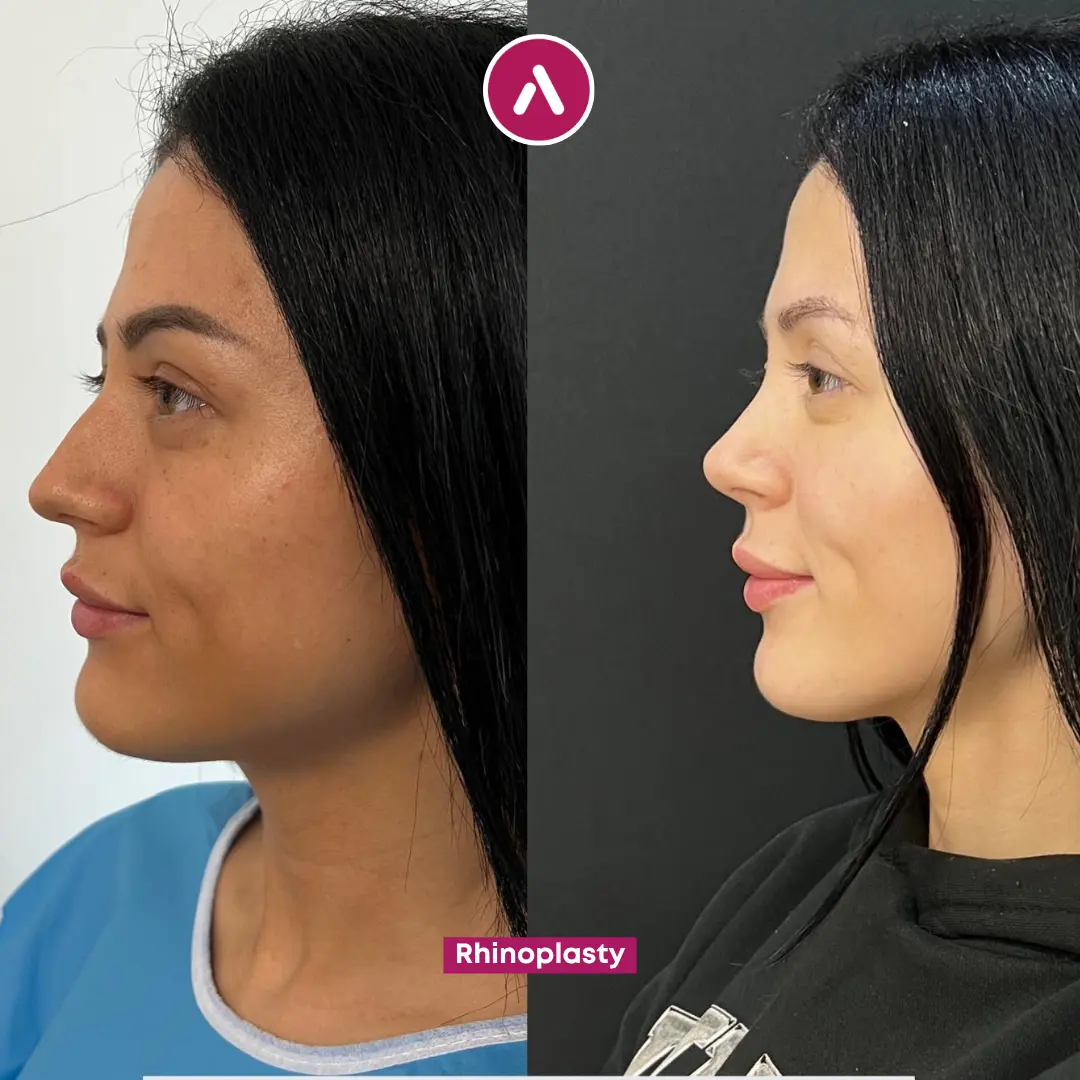
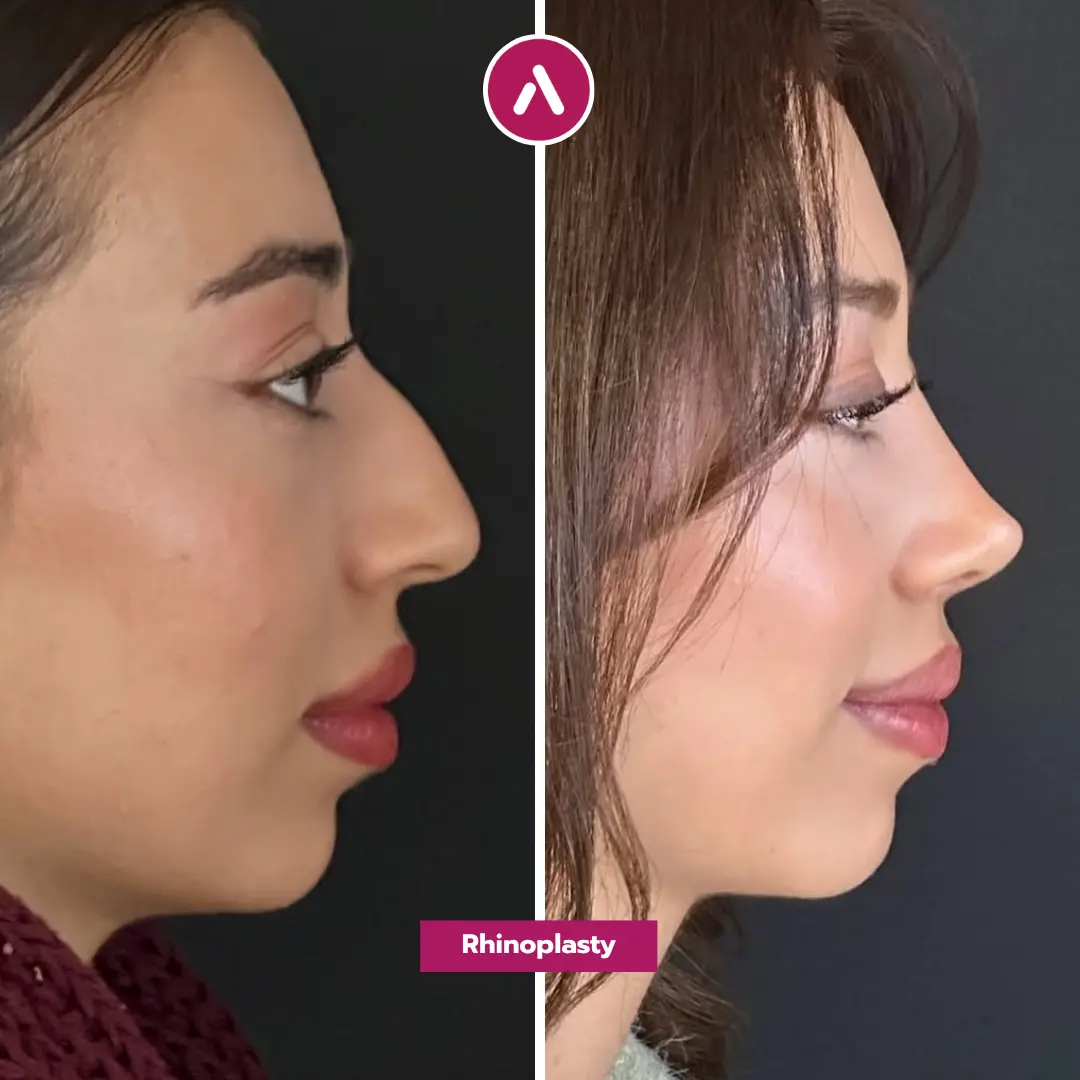
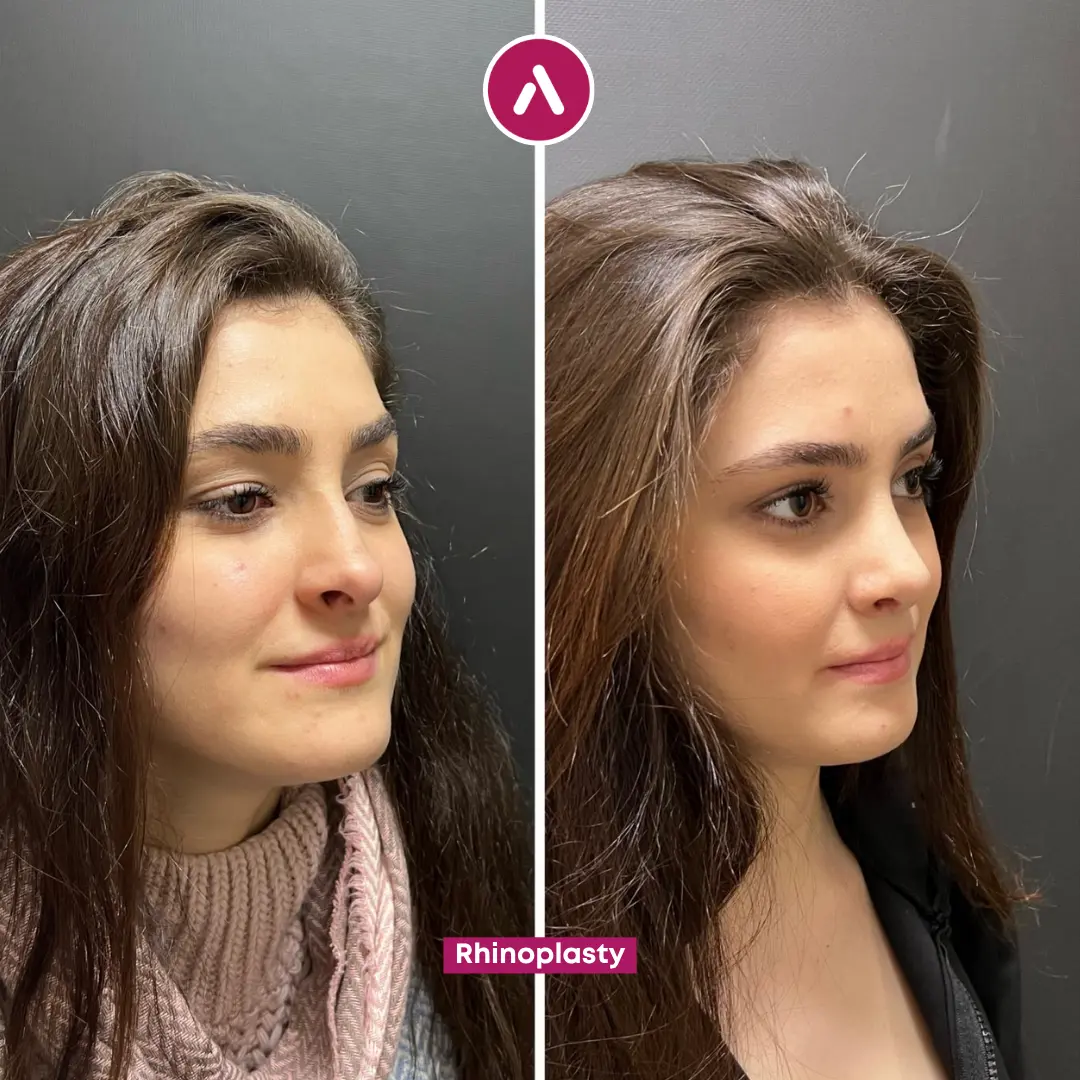
Aesthetic rhinoplasty is not about making the nose “small”. It is about making it fit. That can mean softening a hump, narrowing a wide bridge, or refining a tip that feels heavy in photos.
Common aesthetic goals include:
- Improving profile balance (bridge and tip relationship)
- Refining tip definition without an over-rotated look
- Straightening a crooked nose for frontal symmetry
- Adjusting nostril shape to sit more evenly
Functional benefits: breathing comfort matters
For many patients, the question is not only “How will it look?” but “Will I breathe well?”. The internal nasal framework plays a major role in airflow. If support is weak, the airway can feel narrow or collapse during exercise and sleep.
This is where functional rhinoplasty considerations come in. It is not a separate “style” of nose. It is the same operation, planned with breathing in mind.
The “Natural Look” principle: Rejuvenation, Not Alteration
We build results around restraint. A nose that looks “done” rarely ages well. A nose that looks like it belongs to your face tends to remain believable for years.
Our goal is simple: your result should make you look refreshed, not recognisably operated on.
That philosophy also shapes how we talk about outcomes. We focus on structure, stability, and proportion. Not hype. Not extremes.
Am I a Good Candidate for Rhinoplasty Surgery?
Rhinoplasty is not a “one size fits all” operation. The right plan depends on your anatomy, your health, and how your nose functions day to day. We look at proportions, skin thickness, internal support, and how the nose sits within your overall facial balance. We also assess whether your goals are realistic and stable over time. That combination helps us advise on what is achievable, and what is better left unchanged.
Who tends to be a good candidate?
Most suitable candidates are in good general health and have a clear, specific reason for surgery. Sometimes the motivation is aesthetic. Sometimes it is functional, such as persistent blockage or collapse during exercise.
- A stable nasal structure (or a clear structural issue we can address)
- Healthy skin quality and reasonable healing capacity
- Goals that focus on harmony rather than “perfect symmetry”
- Time and patience for a measured recovery process
Who should avoid or postpone surgery?
Safety comes first. If something increases surgical risk or affects healing, we may advise waiting. That does not mean “no”. It often means “not yet”.
- Uncontrolled medical conditions that increase anaesthetic or healing risk
- Active infection or untreated nasal/sinus issues
- Smoking or vaping when you cannot pause around the operation
- Very recent nasal trauma where swelling is still evolving
We also take a cautious approach if expectations are driven by a single edited image or a trend. Rhinoplasty works best when the plan is built around your own structure.
Setting realistic expectations
Rhinoplasty can be transformative, but not instantly. Swelling changes the early appearance, and the tip often settles last. We plan for stability and natural proportion rather than an extreme “after” that may not age well. If you have had previous nasal surgery, we discuss complexity early, because revision rhinoplasty typically involves different constraints. Clear expectations protect both results and confidence.
If you are unsure, a structured consultation is the simplest way to get clarity. We can review your photos, discuss priorities, and explain which changes are realistic for your anatomy.
Surgical Techniques Explained — Choosing the Right Approach
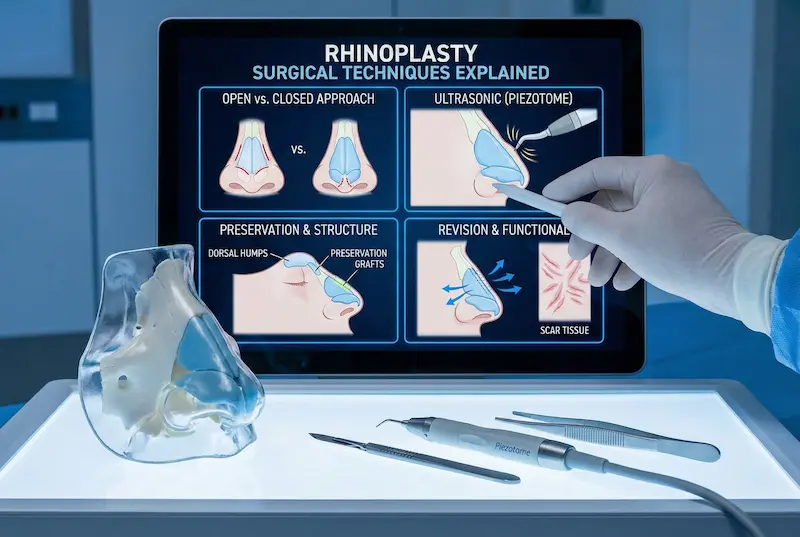
Technique matters in rhinoplasty because the nose is both visible and structural. Two patients can request the same aesthetic change and still require different surgical strategies. We select techniques based on bone shape, cartilage strength, skin thickness, and whether breathing support is part of the plan. The goal is a stable framework that heals predictably. Quiet precision. No unnecessary trauma.
Open vs closed: what the approach actually means
The terms describe how we access the nasal framework, not the style of result. Open rhinoplasty uses a small external incision at the columella to lift the skin and allow direct visibility of the structures. Closed rhinoplasty (also called an endonasal approach) uses incisions inside the nostrils, which can reduce visible scarring and may suit selected cases.
- Open approach: higher visibility and control for complex reshaping and structural work
- Closed approach: internal access, often suitable for specific refinements where full exposure is not required
We choose the approach based on what needs to change and how much structural support is required for long-term stability.
Why structure comes first: cartilage support and grafting
Many “aesthetic” problems are actually structural. A tip that droops, a bridge that looks narrow from the front, or an airway that feels tight can all relate to support. In those cases, we may use grafting techniques to reinforce or reshape cartilage in a controlled way. The aim is strength with subtlety, so the nose holds its position as swelling resolves.
When breathing support is part of the plan, structural decisions become even more important. A well-supported framework can improve comfort and reduce the risk of late changes.
Where ultrasonic rhinoplasty (Piezotome) fits
Traditional bone work can be effective, but it may create more soft tissue impact. Ultrasonic rhinoplasty uses specialised ultrasonic instruments to shape nasal bone with precision and minimal collateral trauma. That can be helpful when we want controlled refinement of the bony vault and a smoother contour. It also supports our broader philosophy: measured changes, predictable healing.
Not every case needs an ultrasonic approach. We use it when it meaningfully improves precision and reduces unnecessary tissue stress.
Preservation rhinoplasty
Preservation rhinoplasty focuses on maintaining key structural elements of the nose where appropriate, rather than extensively dismantling and rebuilding the framework. The aim is to refine shape while respecting natural anatomy and stability. This approach can be suitable in selected cases depending on dorsal structure, septal anatomy, and the specific changes required. Suitability is always determined by individual anatomy and surgical goals.
Revision rhinoplasty
Revision rhinoplasty refers to surgery performed after a previous rhinoplasty. It is often more technically demanding because scar tissue, altered anatomy, and reduced cartilage availability can limit options. Revision planning typically prioritises structural stability and may involve reinforcement techniques to restore support. Goals are defined carefully, with realistic expectations based on the existing framework and healing history.
Functional rhinoplasty
Functional rhinoplasty is planned with breathing support in mind. It addresses structural factors that can contribute to airflow limitation, such as internal valve support or framework weakness, while still respecting aesthetic balance. It is not a separate “look”, but a focus within the same procedure: preserving or restoring support so the nose functions comfortably as it heals and settles.
Ethnic rhinoplasty
Ethnic rhinoplasty is an approach that respects individual anatomy and preserves identity. It considers skin thickness, cartilage strength, and the natural proportions associated with different ethnic backgrounds. The goal is refinement without over-reduction—maintaining harmony with the rest of the face while achieving the patient’s priorities in a way that remains believable and stable over time.
Tip rhinoplasty
Tip rhinoplasty focuses primarily on the nasal tip: definition, projection, rotation, and symmetry. Because the tip can hold swelling longer than other areas, planning emphasises stability and subtle control rather than aggressive tissue removal. Tip work may involve structural refinement techniques to support long-term shape as swelling resolves and the skin redrapes.
If you would like a clear recommendation, we can map your goals to the technique options during a no-obligation virtual consultation. We will explain the “why” behind the plan, not just the name of the technique.

Rhinoplasty Surgery Approaches
“Approach” in rhinoplasty refers to how the surgeon accesses, reshapes, and supports the nasal framework. There is no single best technique for every patient. The correct approach depends on your anatomy, the stability of your cartilage, the thickness of your skin, and whether breathing support is part of the plan. A measured approach prioritises structural integrity so the result remains natural as swelling resolves.
Surgical Approach Techniques
This section refers to how we access the nasal structures to perform the required changes. The approach is selected based on the level of visibility and structural work needed.
- Open Technique
- Involves a small incision at the columella (the strip of tissue between the nostrils) plus internal incisions.
- Provides direct visibility and fine control for complex reshaping, significant tip work, or structural reinforcement.
- Often chosen for cases where precision and stability are prioritised over minimal access.
- Closed Technique (Endonasal Approach)
- All incisions are placed inside the nostrils, with no external incision.
- May be suitable for selected refinements where full exposure is not required.
- Can reduce external scarring visibility and may support faster early social recovery in appropriate cases.
Both approaches can deliver natural outcomes. The key is not “open vs closed” as a trend, but whether the chosen approach allows the surgeon to achieve your goals safely and predictably.
Structural Approach Techniques
Long-term success in rhinoplasty is built on structure. The nose must look balanced, but it must also remain supported as swelling settles and tissues remodel. Structural techniques are used when we need to strengthen, reshape, or stabilise the nasal framework.
- Grafting Techniques
- Grafts are small pieces of cartilage used to reinforce or reshape the nose with precision.
- They can support the bridge, refine contour lines, strengthen tip support, and improve internal stability.
- Grafting is especially relevant in revision cases, in weaker cartilage frameworks, or when breathing support is part of the plan.
- Osteotomy (Bone Fracturing)
- An osteotomy is a controlled bone cut used to reposition nasal bones.
- It may be used after hump reduction or when narrowing and straightening the bony vault is required.
- The goal is a smoother, more stable contour—not aggressive “breaking”, but careful repositioning.
Nasal Tip Approach Techniques
The nasal tip is one of the most delicate parts of rhinoplasty. It is highly visible, it holds swelling longer than other areas, and small adjustments can change how the entire nose reads from the front and profile. Tip work is therefore planned conservatively, with stability and long-term definition in mind.
- Cephalic Trim
- A conservative refinement of the upper portion of the lower lateral cartilages.
- Used to reduce heaviness and improve definition while preserving support.
- Over-resection can weaken the tip, so modern planning focuses on balance and stability.
- Suture Techniques
- Fine sutures can reshape and stabilise cartilage without over-removing tissue.
- Used to refine tip definition, projection, and symmetry while maintaining strength.
- Often combined with selective grafting when additional support is required.
Nasal Hump Reduction Approach Techniques
A dorsal hump can be bone, cartilage, or a combination of both. Reduction is not simply “taking it down”. The bridge must remain stable, smooth, and functionally supported. The approach is tailored to your anatomy and the look you want to achieve—subtle softening versus more defined profile change.
- Dorsal Hump Reduction
- Carefully reshapes the bridge to improve profile balance.
- May be combined with controlled bone repositioning to maintain straight dorsal lines.
- The aim is a smooth contour that suits your face—never an over-reduced, artificial slope.
- Spreader Grafts
- Cartilage grafts placed to support the middle third of the nose.
- Helpful for maintaining smooth dorsal aesthetic lines and internal stability after bridge changes.
- Can also support airflow dynamics by reinforcing the internal nasal valve region in appropriate cases.
Preservation Rhinoplasty Approach Techniques
Preservation concepts aim to maintain key structural elements where appropriate, rather than relying on extensive dismantling and reconstruction. This approach can be advantageous in selected anatomies, particularly when we can achieve refinement while preserving supportive architecture. The suitability depends on your bridge shape, septal structure, and overall goals.
Preservation is not a shortcut. It is a strategy—used when it improves predictability, stability, and the natural feel of the result.
Advanced Ultrasonic Approach Technique
Advanced ultrasonic techniques use specialised ultrasonic instruments to shape nasal bone with high precision and reduced collateral trauma. This can be particularly useful when refining the bony vault, smoothing contours, and performing controlled changes to bone structure.
Ultrasonic methods are not necessary for every case, but when indicated, they support a key objective in modern rhinoplasty: precision with minimal unnecessary tissue stress. The technique choice is always guided by anatomy, safety, and long-term stability.
Nose Shapes
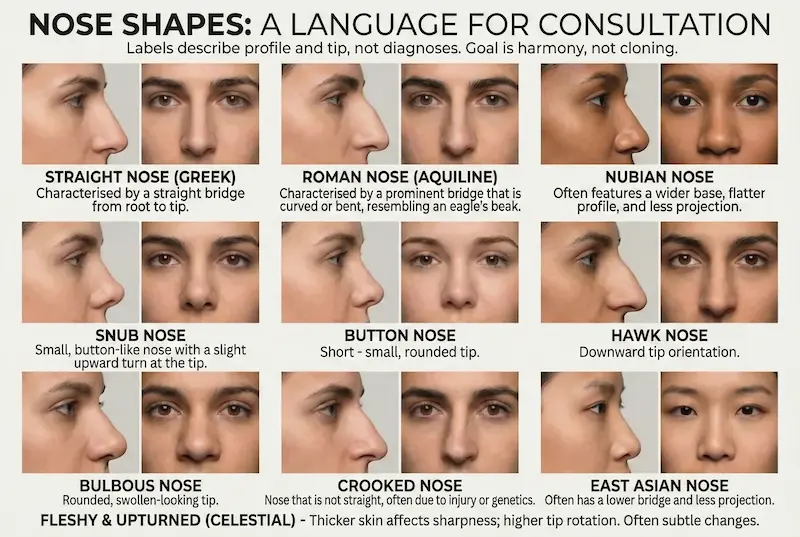
People often describe their nose shape using familiar terms. These labels can be useful for communication, but they are not strict medical categories. Real noses are three-dimensional, and most people have a blend of features rather than fitting a single “type”. In consultation, we focus less on labels and more on your unique anatomy—bridge lines, tip support, skin thickness, and breathing dynamics.
- Straight Nose (Greek Nose)
- Roman Nose (Aquiline Nose)
- Nubian Nose
- Snub Nose
- Button Nose
- Hawk Nose
- Bulbous Nose
- Fleshy Nose
- Crooked Nose
- Upturned Nose (Celestial Nose)
- East Asian Nose
Whatever your starting point, the planning principle remains the same: create a result that fits your face and respects your natural structure. The most successful rhinoplasty outcomes look unforced—balanced from the front, refined in profile, and stable in function.
Septoplasty
Septoplasty is a functional nasal operation designed to straighten the septum (the wall of cartilage and bone between the nostrils). When the septum is deviated, airflow can be restricted on one or both sides. That can affect sleep, exercise, and day-to-day comfort. Our aim is simple: improve breathing while protecting the nose’s internal support.
What is septoplasty?
Septoplasty reshapes and repositions the septum to open the nasal airway. We work through incisions inside the nostrils, so there is usually no external scar. The focus is function, not appearance. If your main goal is better breathing, septoplasty is often the correct starting point.
What symptoms can septoplasty help with?
A deviated septum can feel like a “permanent blocked nose”. It can also trigger compensations that make breathing feel worse at night.
- Ongoing nasal blockage on one side
- Reduced airflow during exercise
- Snoring linked to nasal obstruction (in selected cases)
- Recurrent congestion that does not respond well to typical treatments
- Nasal dryness or crusting caused by turbulent airflow
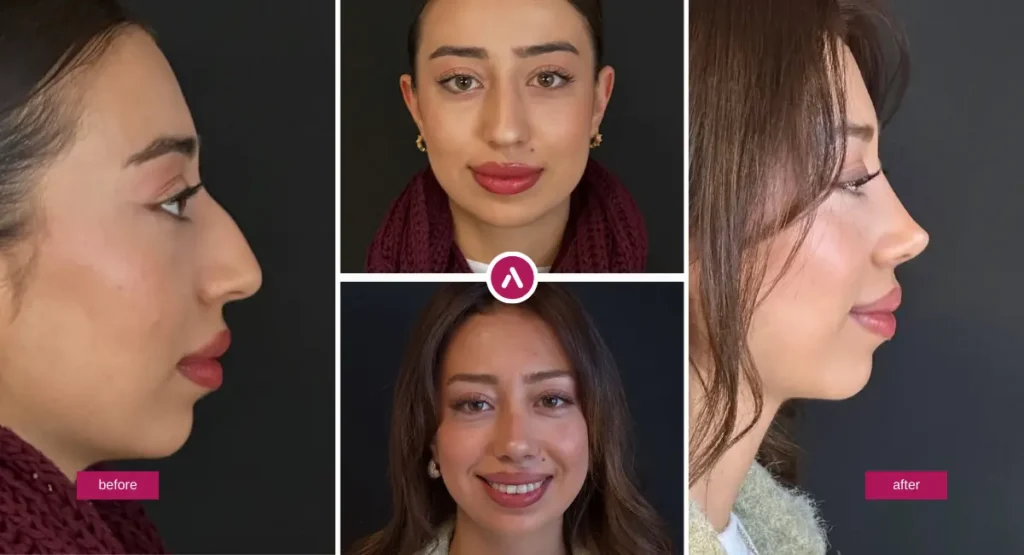
Septoplasty vs rhinoplasty: what’s the difference?
Septoplasty treats the internal partition of the nose to improve breathing. Rhinoplasty is a nose surgery focused on external shape (often called nose reshaping in the UK). One is primarily functional. The other is primarily aesthetic, although it can include functional support too. If you want breathing improvement and a change in shape, septorhinoplasty is usually the more logical discussion.
How septoplasty is performed
We perform septoplasty in a sterile operating theatre with appropriate anaesthesia and monitoring. The surgeon works through the nostrils, lifts the lining, then reshapes or repositions the deviated portions of cartilage and bone. The goal is a straighter, more stable septum. We finish by supporting the tissues so healing is controlled.
- Pre-operative screening and anaesthesia assessment
- Internal incisions (no external cut in most cases)
- Precise correction of deviation while preserving support
- Protection of the airway during the early healing phase
Septoplasty recovery timeline and aftercare
Early recovery is usually about congestion rather than sharp pain. Expect swelling inside the nose. That swelling settles gradually. Most patients return to desk work within days, but full internal healing takes longer.
- Days 1–3: congestion, mild bleeding/oozing, pressure sensation
- Week 1: airflow begins to improve as swelling reduces
- Weeks 2–6: steady improvement in breathing comfort
- After 6 weeks: deeper internal healing continues
Aftercare is practical. Use medication as advised (UK-friendly choices such as paracetamol may be recommended when appropriate), keep the nose clean with saline guidance, and avoid nose blowing early on. Protect your sleep. Stay patient.
Septorhinoplasty (Septo-rhinoplasty)
Septorhinoplasty combines septal correction with external nasal reshaping in one operation. It is the “function + aesthetics” option. We use it when breathing support and appearance are linked to the same structural framework. Done properly, it delivers a stable airway and a natural-looking nose that fits your face. No gimmicks. Just anatomy-led planning.
What is septorhinoplasty?
Septorhinoplasty corrects the internal septum and reshapes the external nose in a single procedure. That can include straightening a crooked nose after trauma, refining a dorsal hump, improving tip definition, and reinforcing internal support for airflow. It is both a nose surgery and a functional reconstruction. The plan is personalised to your cartilage strength, bone shape, and skin thickness.
When septorhinoplasty is recommended
We usually discuss septorhinoplasty when “breathing-only” treatment would leave key structural issues unaddressed. It is often the right choice when shape and airflow share the same root cause.
- Deviated septum plus visible deviation (crooked nose)
- Bridge or mid-vault weakness affecting airflow
- Post-trauma changes with both aesthetic and functional concerns
- Previous nasal surgery with instability (in selected revision cases)
Functional goals: breathing support and internal stability
Breathing improvement is not just “making space”. Support matters. If the nasal valves are weak, airflow can still feel restricted even after septal straightening. We may use structural techniques to reinforce the internal framework so the airway remains stable as swelling settles.
- Septal straightening to reduce obstruction
- Support of the internal nasal valve region (when indicated)
- Structural reinforcement to reduce late collapse risk
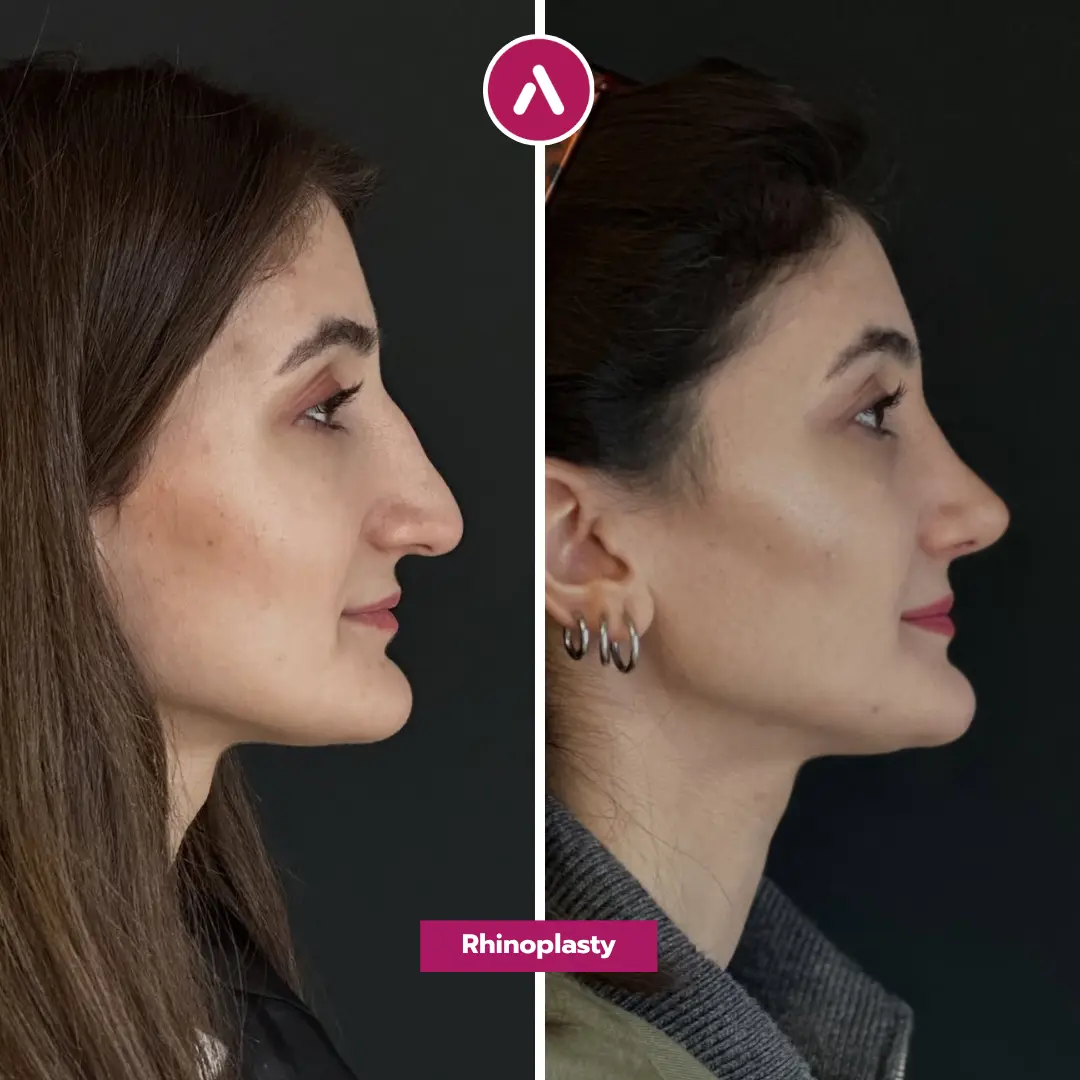
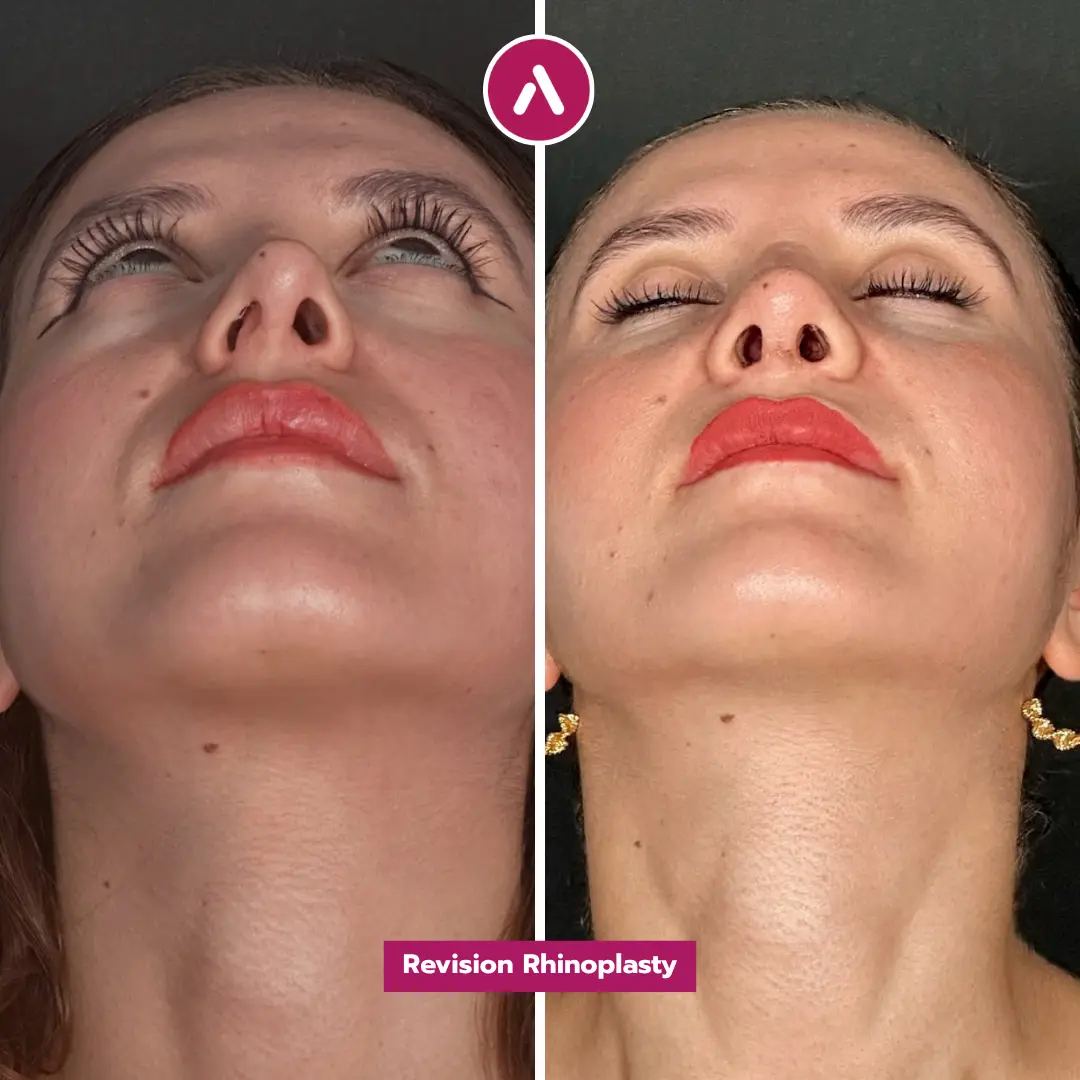
Aesthetic goals: shape refinement with structural integrity
Aesthetic refinements should never compromise function. We plan for balanced dorsal lines, a natural tip, and proportion to the rest of the face. Subtlety is a strength. The best results rarely look dramatic.
- Bridge refinement (including dorsal hump reduction where appropriate)
- Tip definition and support-focused shaping
- Straightening for frontal symmetry and calmer profile lines
Techniques used in septorhinoplasty
Technique selection depends on what needs to change. We may use an open or closed approach, structural grafting, controlled bone work, and—when beneficial—ultrasonic rhinoplasty (Piezotome) for precise bone shaping with reduced soft tissue impact. In selected anatomies, preservation concepts may be considered. We explain the “why” behind every choice.
- Open vs closed access based on complexity and visibility needs
- Cartilage grafting when support, contour, or airflow stability requires it
- Osteotomy when bone repositioning is needed for straightness or narrowing
- Ultrasonic tools (Piezotome) when precision benefits the bony vault
Septorhinoplasty recovery and swelling timeline
Recovery follows typical rhinoplasty recovery time patterns. Early swelling is expected. The bridge often settles sooner than the tip.
- Days 1–7: congestion, swelling, bruising; splint in place
- Week 1–2: early reveal after splint removal; swelling persists
- Weeks 3–6: steady improvement; gradual return to routine
- Months 3–12: refinement phase; tip swelling stages resolve last
Aftercare is structured. We guide you on rhinoplasty aftercare, including activity limits, hygiene, and when taping is appropriate. In suitable cases, we can integrate our Rapid Recovery & Safety Protocol (HBOT and low-level laser therapy) to support swelling control and tissue healing.
Combined Procedures — Maximising Harmony
In rhinoplasty planning, “harmony” often involves more than the nose alone. The nose is central, but the way it reads can change depending on the chin, lips, and overall midface balance. For some patients, combining procedures can create a more proportionate result than making larger changes to the nose itself. The priority is always safety and surgical logic: the right combination, for the right anatomy, at the right time.
When combining makes sense
Combination planning is most useful when a secondary feature is driving the perception of the nose. For example, a retrusive chin can make the nose appear more prominent, even when the nasal proportions are reasonable. In those cases, minor nasal refinement plus chin augmentation can look more natural than aggressive nasal reduction. We consider facial balance from the front, profile, and three-quarter angles—then choose the least invasive path to a harmonious outcome.
Common pairings
Examples of procedures that are sometimes combined (or staged) with rhinoplasty include:
- Chin augmentation to improve lower-face projection and profile balance
- Upper eyelid or under-eye procedures to refresh the periorbital area
- Selected facial contouring procedures where clinically appropriate
Not every patient benefits from combining. If your goals are nasal-only, a focused rhinoplasty plan may be the best choice.
Face and neck refinement options
In selected patients, broader facial rejuvenation can be part of the discussion—particularly when the goal is overall balance rather than isolated nasal change. Depending on anatomy and ageing patterns, this may include procedures such as a facelift, an endoscopic temporal lift, or a mid face lift, alongside rhinoplasty planning. These options are not routine add-ons; they are considered only when they support a coherent, proportionate outcome.
Body contouring considerations
Where clinically appropriate, some patients also ask about combining facial procedures with body contouring in a staged pathway. For example, liposuction may be discussed as a separate, carefully timed procedure depending on overall surgical load, recovery priorities, and safety assessment.
Safety, timing, and when to stage procedures
Combining surgeries can increase operating time and the demands on recovery. We take a conservative approach: if the safest plan is to stage procedures, we will recommend that. The decision depends on your health, the complexity of the rhinoplasty, and the overall surgical load. A premium outcome is not about doing “more”—it is about doing what is medically appropriate, with predictable healing.
Anaesthesia Options — Comfort, Safety, and Control
Rhinoplasty is typically performed under general anaesthesia, allowing the surgeon to work with precision while you are fully asleep and comfortable. In selected cases and depending on clinical suitability, alternative anaesthesia strategies may be discussed (tumescent anaesthesia, conscious sedation). The right approach is always decided with your anaesthetist and surgical team, based on safety, your medical history, and the planned complexity of surgery.
General anaesthesia and what to expect
General anaesthesia means you are asleep throughout the procedure. Your vital signs are continuously monitored, and the airway is managed in a controlled clinical setting. This is the most common approach for rhinoplasty because it provides stability and allows meticulous structural work—especially when bone shaping, grafting, or detailed tip refinement is required.
Pre-operative screening and preparation
Before surgery, we review your medical history, medications, and any prior nasal trauma or surgery. You may be asked about allergies, bleeding tendencies, previous anaesthetic reactions, and lifestyle factors that affect healing. You will also receive clear instructions on fasting and medication management (including what to pause and what to continue).
Comfort after surgery
Early discomfort is usually manageable with an appropriate pain relief plan. Many patients describe pressure and congestion more than sharp pain. You will also receive aftercare guidance on rest, head elevation, hydration, and the safest way to manage swelling and bruising during the first days.
Step-by-Step — What Happens in the Operating Theatre?
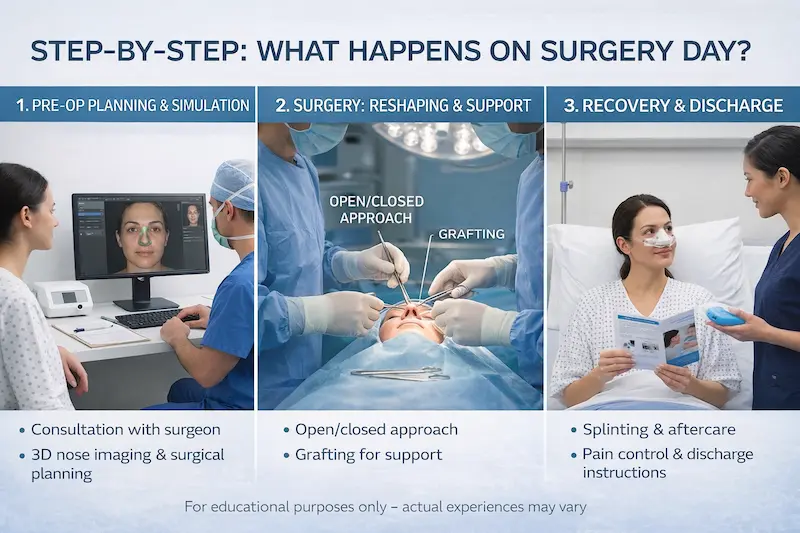
Knowing what to expect can reduce anxiety and help you plan properly—especially when travelling from the UK. The rhinoplasty journey usually involves three phases: pre-operative planning, the day of surgery, and structured aftercare. While every patient plan is personalised, the overall pathway follows clear clinical steps designed for safety, precision, and predictable healing.
Pre-operative planning and imaging
Planning starts with understanding your goals and your anatomy. We assess facial proportions, nasal structure, skin thickness, and (when relevant) breathing dynamics. Clinical photography is used to evaluate angles and symmetry. Where appropriate, 3D imaging can support more detailed planning discussions, helping you understand what is achievable and what would compromise stability.
The day of surgery
On the day of surgery, you will be prepared for theatre with a final clinical review and surgical markings. After anaesthesia, the surgeon performs the planned approach (open or closed), then reshapes bone and cartilage as required. If structural support is needed, grafting or reinforcement techniques may be used. The goal is not only an improved shape, but a stable framework that heals well.
Immediately after surgery
After the procedure, you will be monitored during recovery until you are fully stable and comfortable. A nasal splint (often a plaster/splint combination) is typically placed to protect the new shape during the early healing phase. You will receive written aftercare instructions and a clear follow-up schedule. In the first days, swelling and congestion are expected—this is normal and temporary.
Rhinoplasty Recovery & Aftercare — How Long Does Healing Take?
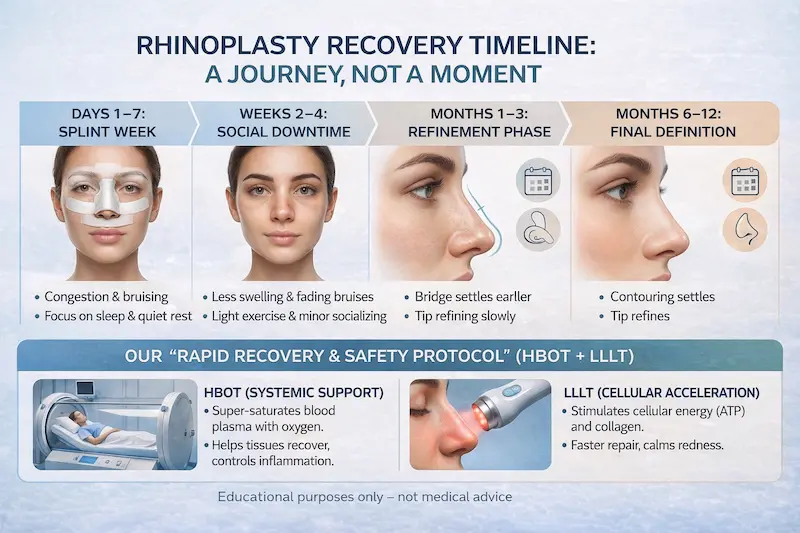
Recovery is a process, not an event. The early phase is about swelling control and protection; the later phase is about refinement as tissues settle and remodel. Most patients feel socially presentable within the first couple of weeks, but the nose continues to mature for many months—especially at the tip. Understanding the timeline helps set realistic expectations and protects your result.
Rhinoplasty recovery time: a realistic timeline
- Days 1–7: swelling, congestion, bruising; rest is prioritised and the splint remains in place
- Week 1–2: splint removal and early shape emerges; swelling persists, especially at the tip
- Weeks 3–6: steady improvement; many return to light exercise with guidance
- Months 3–12: refinement phase; tip definition gradually improves and the final result settles
Rhinoplasty swelling stages: what is “normal”?
Swelling is expected and can fluctuate—especially in the mornings, after activity, or during travel. The bridge often settles earlier than the tip. Skin thickness can influence how long swelling lasts. Bruising patterns also vary; some patients bruise minimally, while others experience more visible bruising around the eyes in the first week.
Taping nose after rhinoplasty and splint care
Taping can be recommended in selected cases to help manage swelling and support the skin as it redrapes. If taping is part of your plan, you will be shown exactly how to do it and how long to continue. Splint care is equally important—protecting the nose from accidental knocks, avoiding pressure, and following washing instructions for the early healing window.
Rhinoplasty aftercare: practical guidance
- Sleep with your head elevated in the first week to reduce swelling
- Avoid heavy lifting and strenuous exercise until you are cleared
- Do not blow your nose early on; follow the guidance for saline sprays and hygiene
- Avoid glasses resting on the bridge until advised it is safe
- Limit sun exposure while bruising and swelling settle; protect your skin
- Avoid smoking and vaping, as they can impair healing and increase complication risk
Advanced recovery support: HBOT and low-level laser therapy
Some clinics offer adjunctive recovery options that aim to support tissue oxygenation and reduce inflammation. Where clinically appropriate, hyperbaric oxygen therapy (HBOT) and low-level laser therapy may be used as part of a structured recovery programme. These options are not a substitute for good surgical technique, but in selected patients they can complement standard aftercare by supporting comfort and recovery quality.
Planning your return to the UK
For UK patients travelling for surgery, we typically recommend planning enough time in Istanbul for early reviews and initial aftercare. Your exact timing depends on your procedure plan, how you are healing, and clinical checks. We advise building flexibility into travel plans so you are not rushed during the most important early recovery window.
Safety & Risks — Is Rhinoplasty Dangerous?
Rhinoplasty is a commonly performed procedure, but it is still surgery. Safety depends on appropriate patient selection, a controlled surgical environment, careful technique, and structured follow-up. A transparent discussion of risks is part of quality care—particularly for UK patients comparing options and prioritising value over price.
Common side effects
Most post-operative effects are temporary and expected. These may include swelling, bruising, congestion, mild bleeding, and a sense of pressure. Some numbness at the tip or upper lip can occur early on and typically improves as healing progresses.
Potential risks and complications
As with any surgery, complications are possible. These can include infection, bleeding, delayed healing, visible asymmetry, breathing changes, scar issues, or dissatisfaction with aesthetic outcome. In some cases, a secondary procedure (revision rhinoplasty) may be required to refine or correct changes after healing.
How risks are reduced
- Comprehensive pre-operative assessment and appropriate screening
- Clear technique selection based on anatomy and stability
- Structured aftercare, including guidance on activity, hygiene, and follow-ups
- Early response to warning signs such as increasing pain, fever, unusual swelling, or persistent bleeding
If you are evaluating rhinoplasty options from the UK, the most important question is not “How quickly can it be done?” but “How safely and predictably can it be done?”. A safe plan is a premium plan.
Is Rhinoplasty Safe in Turkey for UK Patients?
For UK patients considering rhinoplasty abroad, “safe” is not about geography—it is about standards, clinical governance, and follow-up. Turkey is a major destination for nasal surgery, but outcomes vary widely between providers. The safest choice is the one that can demonstrate consistent clinical processes: appropriate pre-operative assessment, a controlled operating environment, qualified anaesthesia care, and structured aftercare.
What “safety” should look like in practice
- Pre-operative screening: medical history review, medications, relevant tests, and an anaesthesia assessment.
- Controlled operating environment: proper theatre protocols, sterile technique, and monitored recovery.
- Clear surgical plan: explanation of the approach, likely limitations, and how stability will be protected.
- Aftercare pathway: written instructions, local follow-up before travel, and remote check-ins once you return to the UK.
Questions UK patients should ask any clinic
- Who will be responsible for my anaesthesia, and what monitoring is used during surgery?
- Where will the operation take place (hospital / surgical centre), and what are the infection-control protocols?
- How are complications handled, and what is the escalation pathway if I need urgent advice after returning home?
- What does the follow-up schedule look like (in person and remote), and who provides continuity of care?
If a provider cannot answer these clearly, that is a useful signal. In rhinoplasty, confidence should come from systems, not sales language.
Realistic Expectations & Results — Natural, Not “Done”
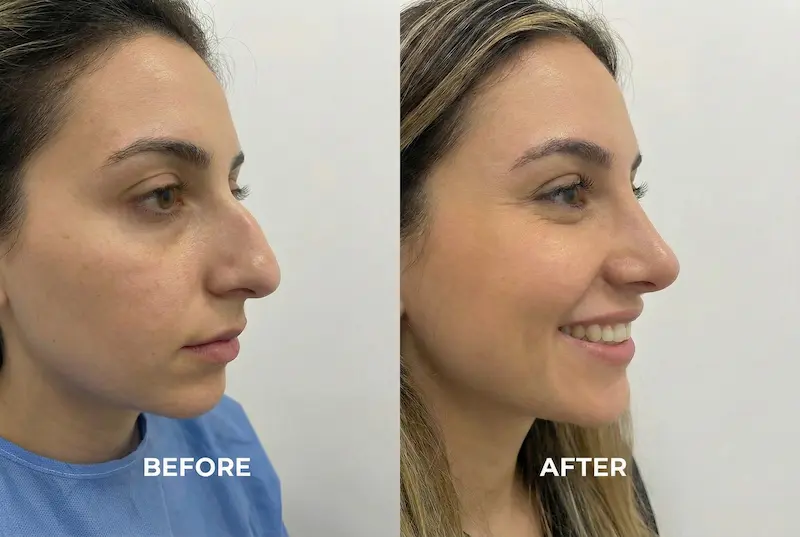
A high-quality rhinoplasty result tends to be subtle. Friends may notice you look refreshed, but they should not instantly identify “nose surgery”. This is especially important for UK patients who often prioritise understated results. A natural outcome comes from proportion, stable support, and a plan that respects your anatomy.
What “natural” means in rhinoplasty
Natural does not mean “no change”. It means the nose matches the rest of the face. The bridge lines look smooth and believable. The tip is refined without being pinched or over-rotated. From the front, the nose sits calmly within the facial midline; from profile, the changes feel intentional but not exaggerated.
When you will see the final result
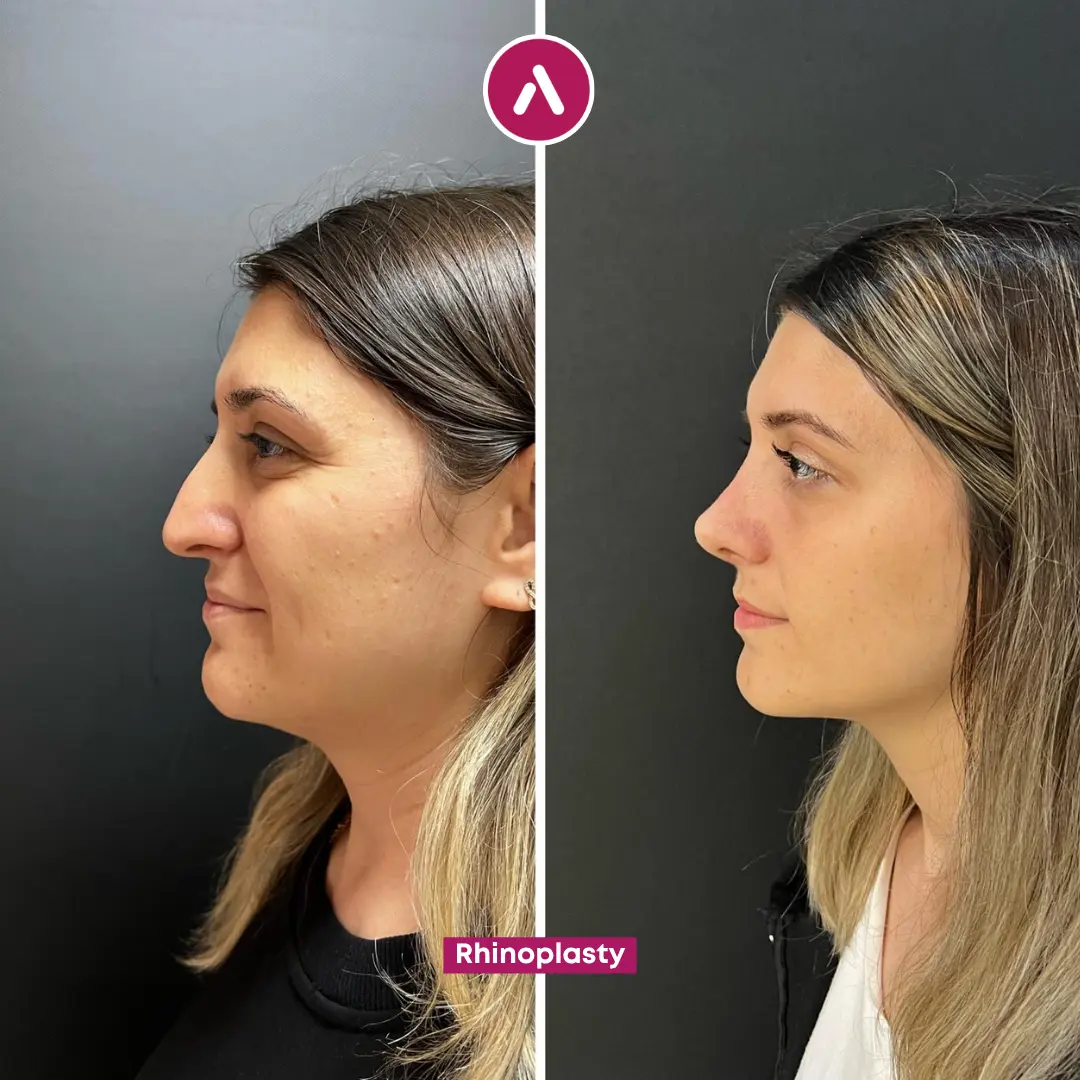
The first reveal after splint removal is not the final result. Swelling can make the tip appear rounder and the bridge less defined early on. The bridge often settles sooner; the tip typically takes longer—especially in thicker skin. Most refinement happens over months, and the final outcome can continue to mature up to 12 months (sometimes longer at the tip).
Typical UK patient concerns
- “I don’t want it to look obvious.” We plan for restraint and stable structure rather than extreme reduction.
- “I’m worried about breathing.” Internal support is assessed and protected as part of a safe plan.
- “I’ve seen mixed results online.” Rhinoplasty varies widely by anatomy and technique—predictability comes from planning and structural integrity.
What results tend to look like when planned well
Well-planned rhinoplasty looks balanced from multiple angles, and it continues to look balanced as swelling resolves. The best compliment is often, “You look great—have you changed something?” rather than “Where did you get your nose done?”.
Cost Analysis — Rhinoplasty Cost 2026 (Turkey vs UK)
UK patients comparing rhinoplasty options often start with price, but the more meaningful comparison is value: what is included, what level of surgical and anaesthetic care is provided, what technology supports planning and recovery, and what follow-up looks like once you return home. Fees vary significantly depending on complexity, surgeon experience, facility standards, and whether functional support is included.
Why fees differ (without assuming “cheap” equals “lower quality”)
UK private fees reflect local operating costs, staffing, insurance overheads, and facility pricing. Turkey can offer a different cost structure. The key is to ensure the lower fee is not achieved by removing safety steps, limiting aftercare, or reducing surgical time where it matters.
What should be included (and what is often excluded)
When comparing, focus on clarity. Ask for a breakdown of what is included: surgeon fee, anaesthesia, theatre, tests, post-operative appointments, medications, and any travel logistics support. A transparent plan reduces surprises and helps you make a rational decision.
UK vs Turkey Cost & Value Table
| Cost / Value Element | Typical UK Private Pathway | Turkey “Value Package” Pathway |
|---|---|---|
| Surgeon fee | Usually itemised; varies by surgeon reputation and complexity | Often bundled within the overall package |
| Anaesthesia & anaesthetist | May be separate line items | Often included (confirm anaesthesia team and monitoring) |
| Operating theatre / facility fee | Typically charged separately | Often included (confirm facility standards and recovery monitoring) |
| Pre-op tests & assessment | Sometimes additional fees | Often included (confirm scope of screening) |
| Post-op reviews | Usually limited in-person follow-ups | In-person early reviews + remote follow-up options (confirm schedule) |
| Medications / aftercare supplies | May be prescribed separately | Often included or organised as part of the pathway |
| Accommodation & transfers | Not applicable / arranged by patient | Often included (hotel and transfers; flights typically arranged by the patient) |
| Recovery optimisation options | Variable availability | May include adjunctive recovery support (confirm clinical suitability) |
The conclusion is not “UK is better” or “Turkey is better”. The best choice is the one with the clearest safety steps, the most stable surgical planning, and the most reliable follow-up—at a fee that matches the value delivered.
Finding the Best Rhinoplasty Surgeon — A UK Patient Checklist
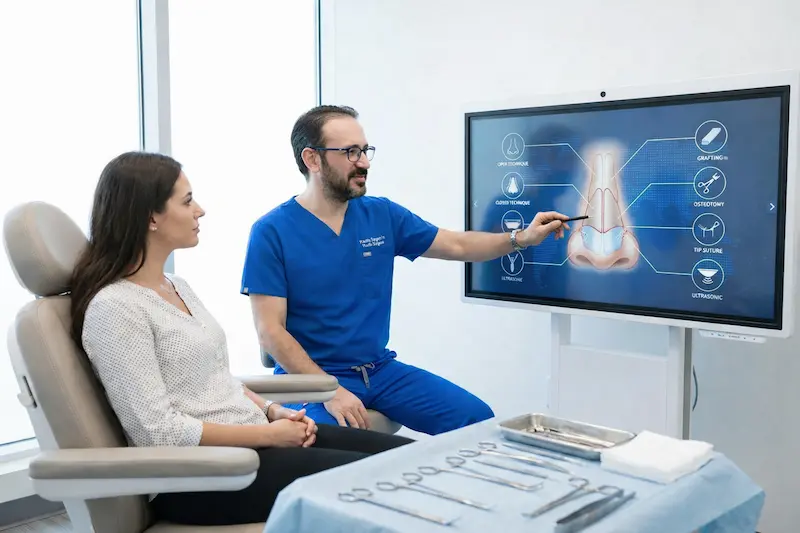
Choosing a rhinoplasty surgeon is less about marketing and more about evidence of expertise. A responsible surgeon welcomes detailed questions, explains risks without minimising them, and can clearly justify the technique choices recommended for your anatomy.
Credentials, scope, and experience
- Relevant surgical background and a clear focus in rhinoplasty
- Experience across primary and revision rhinoplasty (revision is a different level of complexity)
- Comfort with structural planning (support and long-term stability, not just early “shape”)
How to assess quality during consultation
- They ask about breathing, not only aesthetics
- They discuss limitations and trade-offs clearly
- They explain the approach (open/closed/ultrasonic) and why it fits your case
- They provide a realistic timeline for healing, including tip swelling
Signals to be cautious about
- Guaranteed outcomes or “perfect symmetry” promises
- Pressure to book quickly or discount-driven urgency
- Vague answers about facility standards, anaesthesia, or follow-up
Your Medical Journey in Istanbul — From Consultation to Return Home
Travelling from the UK for rhinoplasty should feel structured and predictable. A well-designed pathway reduces uncertainty: you know what happens before you fly, what happens on arrival, how aftercare is handled, and what support exists once you are back home.
Free virtual consultation
The process typically begins with a remote consultation where you share your goals, your medical history, and photos. This allows the team to advise on suitability, likely techniques, and what a realistic outcome looks like for your anatomy.
Planning and logistics
- Scheduling to allow adequate pre-op assessment and post-op reviews before travel home
- Hotel and transfer planning (flights are usually arranged by the patient)
- Clear written instructions for pre-op preparation and medications
In-clinic steps in Istanbul
- Pre-operative assessment and final surgical planning
- Surgery day pathway (theatre, monitored recovery, initial aftercare)
- Early follow-up review(s) to confirm healing is on track
Follow-up after you return to the UK
Quality rhinoplasty care includes follow-up beyond the first week. Remote check-ins and accessible communication channels help address normal concerns (swelling fluctuations, taping questions, travel-related dryness) and identify any warning signs early.
Rhinoplasty Nose Job Frequently Asked Questions (FAQ):
Open vs closed rhinoplasty: which is better?
Neither approach is “better” in general. Open provides more visibility and can be ideal for complex or structural work; closed can suit selected refinements. The best choice is the one that allows safe, stable changes for your anatomy.
How long is rhinoplasty recovery time?
Most patients feel socially presentable within 1–2 weeks, but swelling continues to settle for months. The bridge often refines earlier; the tip typically takes longer, with ongoing maturation up to 12 months.
What are the rhinoplasty swelling stages?
Swelling is most noticeable in the first week, improves steadily over the first month, and then refines gradually. Tip swelling can fluctuate and commonly settles last.
Do I need taping after rhinoplasty?
Not always. Taping is recommended in selected cases to support swelling control and skin redraping. If it is part of your plan, you will be shown exactly how to do it and for how long.
When can I fly back to the UK after surgery?
Timing depends on your procedure plan and early healing checks. A safe plan includes enough time in Istanbul for early follow-up before you travel, and flexibility in case additional review is needed.
Can rhinoplasty improve breathing?
It can, when breathing issues relate to structural support or airway dynamics. If breathing is a priority, it should be discussed from the start so the plan protects both function and aesthetics.
Is revision rhinoplasty more difficult?
Often, yes. Revision cases can involve scar tissue and altered anatomy, which may require more structural reinforcement. A careful consultation is essential to define what is realistically achievable.
How do consultations work for UK patients?
Many patients start with a virtual consultation, followed by an in-person assessment in Istanbul prior to surgery. A structured pathway includes pre-op screening, clear aftercare guidance, and follow-up once you return home.
Will septoplasty change the way my nose looks?
Septoplasty is designed to improve airflow by correcting the septum. It does not aim to change the external shape of the nose. If the appearance is a concern as well, septorhinoplasty is usually the more appropriate discussion.
Will I need nasal packing after surgery?
Not always. Whether packing (or internal supports) are used depends on the surgical plan and your anatomy. If any internal support is required, you will be informed in advance and given clear instructions for care.
When can I return to the gym or sports?
Light activity can often resume earlier, but strenuous exercise and contact sports usually need a longer pause to protect healing tissues and reduce bleeding risk. Your timeline depends on the extent of surgery and how you are healing during follow-up checks.
Can septorhinoplasty help if I have a crooked nose after an injury?
Yes—septorhinoplasty is commonly considered when trauma has affected both breathing and external alignment. The plan typically addresses internal deviation and external straightness together, aiming for a stable framework and natural-looking symmetry.
When can I wear glasses or sunglasses after rhinoplasty?
Glasses can place pressure on the nasal bridge while the bones and soft tissues are still healing. Your surgeon will advise a timeline based on your technique and stability. In the early phase, you may be asked to avoid resting glasses on the bridge or use an alternative support method until it is safe.
Will rhinoplasty change my voice?
Most patients do not experience a permanent voice change. In the short term, congestion and swelling inside the nose can make your voice sound different. As internal swelling settles and airflow normalises, this typically resolves.
How do I choose a “goal photo” without setting unrealistic expectations?
Goal photos can be helpful if they communicate the style you like (softer bridge, refined tip, straighter profile), but they should not be treated as a template. The most reliable approach is to discuss which elements are achievable for your bone structure, cartilage strength, and skin thickness—then shape the plan around your own anatomy.
What should I avoid during early healing to protect my result?
The early phase is about protecting the nose from pressure and impact. Common restrictions include avoiding heavy lifting, strenuous activity, steam/saunas, sleeping flat, and any situation where the nose could be bumped. You’ll also be advised on safe hygiene routines and what to do if swelling fluctuates.
Is it normal to feel emotionally “up and down” after surgery?
Yes. Swelling, bruising, congestion, and temporary changes in appearance can affect confidence in the early weeks. This is a normal part of the healing journey. Most patients feel more reassured as swelling reduces, the nose refines, and breathing comfort improves.
Medical disclaimer: This page is for general information and does not replace an in-person medical assessment. Suitability, technique choice, recovery, and outcomes vary by individual anatomy and health factors. A personalised consultation is required for medical advice and a definitive treatment plan.