



Chin Augmentation can refine your profile, strengthen the jawline, and restore facial harmony—when the technique matches your anatomy. This guide explains the three main options for UK patients: chin implant, genioplasty (including sliding/osseous approaches), and non-surgical chin augmentation with filler. You’ll learn what each method can achieve, who it suits best, and how results evolve as swelling settles.
We also cover what expert patients care about most: safety standards, anaesthesia choices (including twilight sedation), realistic recovery timelines, and the truth about risks and revisions. Finally, you’ll find a UK-focused checklist for choosing the right surgeon and comparing UK vs Turkey fees based on value—not just price—so you can plan your journey with clarity and confidence.
Table of Contents
What is Chin Augmentation?
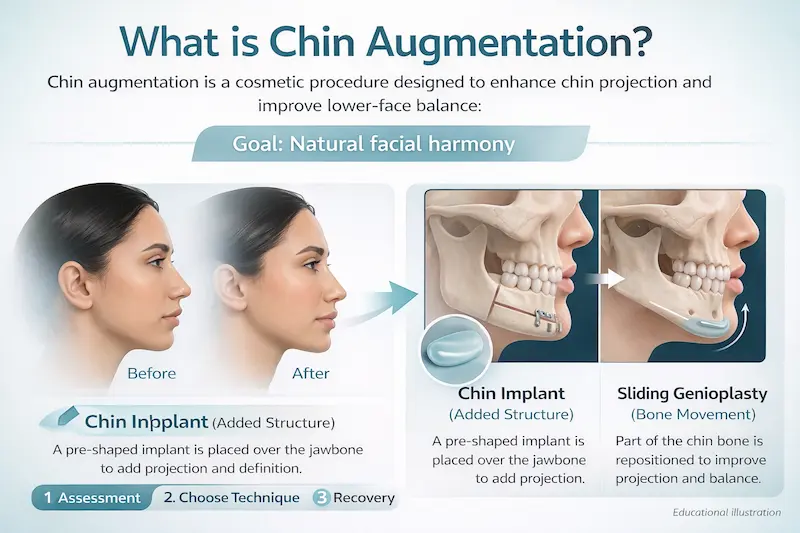
Chin Augmentation is an aesthetic procedure that increases chin projection or improves chin shape to balance your facial profile. We can do this by adding volume (most commonly with a chin implant) or by repositioning your own bone with genioplasty. The goal is simple: a more harmonious lower face that still looks like you.
In real life, “chin strength” is less about size and more about proportion. A small change can make the nose look more balanced, sharpen the jawline, and improve the neck-to-chin angle. That is why we plan chin work as part of the whole face, not as an isolated tweak. Our approach is always guided by one principle: rejuvenation, not alteration.
Chin anatomy 101: bone, soft tissue, and projection
Your chin is a combination of hard structure and soft cover. The bone (mandible) gives the foundational shape, while skin, fat, and muscle influence how sharp or soft your contour appears. Two people can have the same bone projection and still look different because their soft tissue thickness differs. That is why photos alone are not enough; assessment needs structure and tissue in context.
- Projection: how far the chin sits forward in profile.
- Height: the vertical length of the chin from lip to chin point.
- Width: how wide the chin appears from the front.
- Soft tissue: thickness and how it drapes over the bone.
When we plan chin augmentation surgery, we consider all four. A projection-only change can look great in profile but feel “off” from the front if width or height is ignored. Balance wins. Every time.

What makes a “weak chin” (microgenia) and why it affects the jawline
A weak chin is often described as microgenia, meaning the chin is under-projected relative to the rest of the face. Sometimes it is purely genetic. Sometimes it becomes more noticeable with age as skin laxity and jowling soften the jawline. Either way, the visual effect can be bigger than you’d expect.
- The lower face can look “shorter” or less defined.
- The neck can appear fuller because the chin does not support the contour.
- The nose can appear more prominent, even if the nose is normal-sized.
For many UK patients, the concern is not “I want a bigger chin.” It is “I want my profile to make sense.” That’s a healthier way to frame it.
What chin augmentation can and can’t achieve (proportion, balance, harmony)
Chin augmentation is excellent for improving definition and balance. It can strengthen a weak profile, refine the chin point, and enhance the jawline silhouette. It can also support a more attractive lower-face proportion when the chin is recessed. Done properly, it should not read as “surgery”.
There are limits. Chin augmentation does not correct significant bite problems, major jaw asymmetry, or functional issues on its own. In those cases, we may need a different plan or we may advise you to speak with a specialist who focuses on occlusion and jaw function. The safest results come from matching the technique to the anatomy, not forcing an outcome.
Why Does The Chin Matter So Much In Facial Balance?
The chin is a visual anchor for the lower third of your face. When it is under-projected, the whole profile can look softer, even if your skin is firm and your body weight is stable. When it is over-projected, it can look heavy and distract from your natural features. Precision matters.
We treat chin enhancement as a proportion problem, not a “bigger is better” problem. This is where expert planning shows up: a millimetre-level change can shift how people perceive your nose, your neck, and your jawline. The right result looks inevitable, not engineered.
The profile view: how the chin supports the lower face
In profile, the chin creates the endpoint of the facial line from forehead to nose to lips. If the chin sits too far back, the lower face can appear less structured. That can also make the submental area (under the chin) look fuller, even without excess fat. Support changes perception.
- A stronger chin can sharpen the jawline outline.
- It can improve the neck-to-chin transition by giving the soft tissue a better “framework”.
- It often creates a more balanced side profile without changing the nose at all.
Chin–nose harmony (why it’s often considered together)
Many patients discover chin augmentation while researching rhinoplasty. That’s not a coincidence. A nose can look larger if the chin is recessed, and a chin can look more prominent if the nose is reduced. Balance is a two-way street.
In consultation, we often map out your profile in simple terms: where the nose tip sits, where the lips sit, and where the chin point should ideally sit for your facial type. This does not mean everyone needs two procedures. It means we plan with the whole face in mind, so you do not “fix” one feature and feel something else is still off.
Men vs women: typical aesthetic goals and subtle differences
Men and women often want different chin shapes, even when the concern is the same (a weak profile). Many male patients prefer a broader, squarer chin that supports a stronger jawline. Many female patients prefer a softer taper with definition but not heaviness. Both can look natural when the proportions fit the face.
“We believe the most successful aesthetic surgery is one that goes unnoticed.”
That quote reflects how we plan chin work: subtle changes, strong structure, and a result that still feels like you. If you are an “expert patient” who values realism over drama, this mindset matters as much as the technique.
Am I a Good Candidate For Chin Enhancement?
Most people considering chin enhancement are not looking for a dramatic change. They want balance. They want the lower face to look more defined and “finished” in photos and in profile. In our consultations, we focus on whether a change will look natural on your face, not whether it matches a template. That candidate-first mindset is one of the biggest safety tools you have.
Who benefits most (common concerns: profile, definition, proportions)
You may be a good candidate if the chin sits back relative to the lips and nose, or if the jawline lacks definition despite a healthy weight. Some patients also notice that their chin looks “lost” as they age, because soft tissue changes make a recessed chin more obvious. A well-planned enhancement can restore structure without shouting “surgery”.
- Under-projected chin (microgenia) that softens the profile.
- Weak jawline outline where the chin doesn’t provide a clear endpoint.
- Neck-to-chin angle concerns where added support improves the silhouette.
- Asymmetry (mild) where contouring can improve harmony.
At this stage, many UK patients are still deciding between options. That is normal. We keep the conversation practical, including whether you actually need chin augmentation surgery or whether a non-surgical approach would meet your goal.
“The right result looks like you—just better balanced.”
When to pause or rethink (health factors, expectations, bite/occlusion issues)
Chin procedures are generally straightforward, but they are not “one-size-fits-all”. A careful plan starts by checking the foundations. If your concern is driven by a bite issue or jaw position, adding projection alone may not be the right fix. In those cases, we may advise a functional assessment first, or a different type of surgical plan.
- Significant bite problems (occlusion issues), jaw pain, or known jaw joint symptoms.
- Unrealistic expectations (wanting a completely different face or celebrity copying).
- Uncontrolled medical conditions that increase surgical risk.
- Active infection or untreated dental issues that should be resolved first.
Safety also includes psychology. If your main fear is “what if a chin implant goes wrong?”, we do not brush that off. We walk through risks, how they are reduced, and what revision pathways look like if needed. Calm decisions beat rushed ones.
What we assess in consultation (photos, goals, medical history, planning)
A high-quality consultation is structured. We start with your goals, then we match them to anatomy, not the other way round. We review your facial proportions from multiple angles and talk through how change in one area can influence the rest of the face. If we suspect a functional or bite-related driver, we flag it early.
- Profile and front balance: projection, height, and width of the chin.
- Soft tissue thickness: how sharp or soft your final contour is likely to appear.
- Symmetry and midline: subtle offsets that affect the “straight-on” view.
- Medical history: healing factors, medications, smoking, and previous procedures.
From there, we discuss options in plain language: implant, genioplasty, or filler. If an implant is on the table, patients often ask, is chin implant safe? The honest answer is that safety depends on correct indication, sterile technique, stable placement, and strong follow-up. We treat all four as non-negotiable.
“Good planning is a safety feature, not a luxury.”

Combined Procedures: Maximising Your Result Safely
Some of the best aesthetic outcomes come from a smart combination rather than a bigger single change. The key word is smart. Combining procedures can improve overall harmony, reduce the “one feature looks done” effect, and streamline recovery into a single downtime window. It can also increase complexity, which is why a structured plan matters. We only recommend combinations when they make anatomical sense and when the safety profile remains strong.
Common combinations (chin + rhinoplasty, chin + jawline contouring, chin + neck)
Combination planning often starts with profile balance. If the nose and chin are out of proportion, adjusting one may highlight the other. That is why chin enhancement is frequently assessed alongside rhinoplasty, even when the patient originally searched only for a nose procedure.
- Chin + rhinoplasty: one integrated plan for overall profile harmony.
- Chin + jawline definition: for patients aiming for a clearer lower-face outline.
- Chin + neck refinement: when the neck-to-chin transition is a key concern.
Non-surgical combinations exist too. For some patients, a measured approach using filler can be a stepping stone before committing to surgery. The decision should be based on longevity, predictability, and your tolerance for ongoing maintenance.
When a neck lift supports chin enhancement
If your main concern is the neck-to-chin angle, a neck lift may be considered alongside chin enhancement to improve definition and create a more refined contour. The goal is not “more surgery”, but a better structural balance—especially when soft tissue laxity is part of the picture.
Facial rejuvenation combinations: facelift, endoscopic temporal lift, and mid face lift
In some patients, chin enhancement is part of a wider facial rejuvenation plan. When ageing changes affect the cheeks, jawline, and neck together, combining procedures can create a more consistent result—so the face looks refreshed as a whole rather than “treated” in one area.
- Facelift: may be considered when lower-face laxity and jowling are key concerns.
- Endoscopic temporal lift: may be considered for brow/temple support to maintain upper-face harmony.
- Mid face lift: may be considered when midface descent affects cheek contour and overall balance.
These combinations are only recommended when the benefit is clear and the recovery plan remains realistic for you.
Safety-first sequencing: why “one plan” matters more than “more surgery”
Combining procedures should never be an upsell. It should be a logic test. We look at which change drives the biggest improvement in harmony, then we decide whether a second procedure adds meaningful value or simply adds risk. If a combination increases anaesthesia time without a clear aesthetic gain, we step back.
- Primary driver first: fix the core imbalance before adding refinements.
- Risk stacking check: swelling, infection risk, and healing demands must stay reasonable.
- Single integrated plan: one recovery strategy, one aftercare pathway, one set of priorities.
This is also where technique choice becomes critical. For example, pairing rhinoplasty with a carefully planned chin implant can create a very natural profile change. In other cases, a sliding genioplasty is the more stable structural solution. The best combination is the one that still looks like you.
“Our Natural-First approach applies even more when you combine procedures.”
Recovery planning: downtime, swelling, and how combined procedures change timelines
Recovery is not just biology. It’s scheduling. Combining procedures can mean one consolidated downtime period, but it can also mean swelling is more noticeable for longer. We map this out before you commit so you can plan work, social events, and travel realistically.
- Expect more swelling early on, especially when multiple areas are treated.
- Plan your “public-ready” window conservatively, not optimistically.
- Follow-up matters: combined plans need structured check-ins to keep healing on track.
If your priority is minimal downtime, we discuss that upfront and build the plan around it. Sometimes that means staging procedures rather than doing everything at once—because the safest result is the one you can heal from calmly.

Chin Implant vs Genioplasty vs Filler — which option fits you best?
There are three main ways to enhance a recessed or under-defined chin: an implant, a bone-based procedure (genioplasty), or injectable filler. Each option can look natural when it matches the anatomy. Each can also look “off” when it is chosen for the wrong reason. That is why the best question is not “Which is best?” It’s “Which is best for me?”
In our consultations, we focus on your structure, your soft tissue thickness, and your long-term preferences. Some patients want a permanent solution and accept a surgical recovery. Others want a reversible trial first. Both approaches can be valid. The key is choosing with your eyes open.
Chin implant vs genioplasty: core differences (structure, permanence, recovery)
A chin implant adds projection by placing a medical-grade implant over the chin bone. A genioplasty changes your own bone position, most commonly by moving it forward (often called sliding genioplasty). Both can improve profile balance. The difference is how the change is created. One adds volume; the other repositions structure.
- Chin implant: predictable projection, often a shorter operation, and a straightforward recovery for many patients.
- Genioplasty: your bone does the work, which can be ideal for certain shapes, asymmetries, or when vertical changes are needed.
- Decision driver: anatomy and goals (projection only vs projection + height/shape control).
Implants come in different shapes and sizes. The most important detail is not the marketing name. It’s the fit. A well-sized implant should support the chin without looking heavy from the front. Our European Board Certified Surgeons plan this as a proportion problem, not a “bigger is better” problem.
Non surgical chin augmentation: filler basics and what it can’t do
Filler can be a smart way to test a change before surgery. It is also useful when the goal is small—mild projection, smoothing a crease, or refining the chin point. This is often described as chin contouring filler. The upside is speed. The trade-off is longevity and limits.
- Best for: subtle enhancement, “try before you commit”, and short-to-medium term goals.
- Limit: filler cannot replicate the structural support of bone or an implant in more recessed chins.
- Maintenance: results fade over time and require repeat treatments to keep the look.
Filler is not a shortcut to a “surgical-level” change. Pushing it beyond its role can create width or heaviness, especially from the front. Natural results come from restraint.
Choosing rationally: goals, anatomy, risk tolerance, and longevity
Here is the practical way to decide. First, define your goal in one sentence: “I want a stronger profile,” or “I want a more defined lower third.” Next, decide how you feel about permanence. Then consider downtime. Finally, consider how you handle risk and uncertainty. Simple framework. Clear choices.
| Option | Best for | What it changes | Longevity | Downtime | Key considerations |
|---|---|---|---|---|---|
| Chin Implant | Under-projected chin needing added projection and definition | Adds volume/structure on top of bone | Long-term / permanent (unless removed) | Usually days to a couple of weeks for “public-ready” swelling | Needs correct sizing, stable placement, and strong infection control |
| Genioplasty (Bone-Based) | Patients needing structural reshaping, projection, or more control of chin height/shape | Repositions your own bone (commonly forward) | Permanent | Often longer swelling timeline than implant | Requires meticulous planning; numbness/swelling can last longer |
| Filler (Non-Surgical) | Subtle enhancement or “trial” before surgery | Adds soft volume and contour | Temporary | Minimal | Overfilling can look wide/heavy; maintenance is ongoing |
If you are still unsure, that’s normal. Many UK patients start with a comparison question, then realise the real decision is about anatomy and lifestyle. We guide you through that logic step by step. No pressure. Just clarity.
What Is Genioplasty?
Genioplasty is a surgical procedure that reshapes or repositions the chin bone to improve facial balance. In most cases, patients are researching it because they want a more defined profile, better chin projection, or a chin shape that looks more harmonious from both the side and the front. Unlike an implant, genioplasty uses your own bone as the structural solution.
If you have searched what is genioplasty, you’ll often see it described as “chin surgery”. That’s true, but it’s not one single technique. The details matter, because different genioplasty approaches can influence projection, height, and symmetry in different ways. Your anatomy and your goals determine which version is appropriate.
What is genioplasty in plain English (bone reshaping vs adding volume)
In simple terms, genioplasty changes the position or shape of the bony chin. The most common goal is to move the chin forward to improve projection. In other situations, we may change vertical height (a longer or shorter chin appearance) or refine asymmetry. Because it is your own tissue, the change is structural and long-lasting.
- Best for: patients who need true structural change, not just added volume.
- Why it appeals: uses your own bone and can offer precise control for certain shapes.
- Key trade-off: recovery and swelling can feel more “surgical” than an implant for some patients.
Importantly, genioplasty is not a substitute for treating major bite problems. If your concern is driven by jaw position or occlusion, your safest path may include a wider functional assessment. A responsible plan never ignores that.
Sliding genioplasty and osseous genioplasty explained
Sliding genioplasty is the term most patients encounter first. It typically involves making a controlled cut in the chin portion of the mandible and moving that segment into a more ideal position—most commonly forward. The bone is then stabilised so it can heal in the new position.
You may also see the phrase osseous genioplasty. “Osseous” simply means “bone-based”. In practical terms, it signals that the solution is created by reshaping/repositioning bone rather than inserting an implant.
- Projection control: forward movement can strengthen a recessed profile.
- Potential shape control: depending on anatomy, it can help refine contour and symmetry.
- Planning priority: nerve awareness, symmetry, and stable fixation are central to safety.
For UK patients comparing options, the decision often comes down to whether you need “added structure” (implant) or “structural repositioning” (genioplasty). Both can look natural. The best choice is the one that matches your facial architecture.
Reduction genioplasty: when “less chin” is the right answer
Not everyone needs a bigger chin. Some patients have a chin that is too prominent, too long, or disproportionate to the rest of the face. Reduction genioplasty focuses on refinement—reducing height, adjusting shape, or improving balance so the chin looks more harmonious.
- Common goals: soften an overly strong chin, shorten vertical height, refine shape.
- Natural-first approach: the aim is proportion, not an obvious “done” look.
- Consultation focus: front view balance is as important as the side profile.
If you are considering any form of genioplasty, your consultation should include a plain-language explanation of the technique proposed, what it will change, what it won’t, and what the realistic recovery experience looks like. Clarity is part of safety.
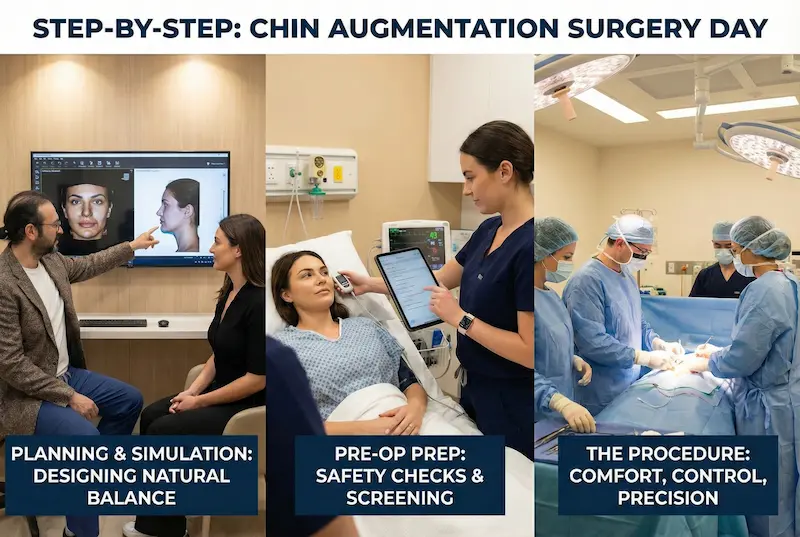
Chin Augmentation Surgery Step-By-Step — What Happens During Chin Implant Surgery?
A chin implant procedure increases chin projection by placing a shaped implant over the chin bone. When planned correctly, it can create a strong but natural-looking improvement in profile and jawline definition. Most importantly, implant surgery is not about “the biggest implant”. It’s about the right implant—size, shape, and positioning that fit your face.
If you’re weighing chin augmentation surgery options, this section helps you understand the typical steps, what decisions matter most, and how the surgical plan is designed to reduce avoidable risks such as malposition or asymmetry.
Pre-op planning: sizing, symmetry goals, and realistic outcomes
High-quality outcomes start before you enter theatre. Planning focuses on how much projection you need, whether width or height needs subtle support, and how to keep the result balanced from all angles. A common mistake in chin work is planning only for the side profile and forgetting the front view. We don’t do that.
- Goal definition: profile balance, chin point definition, jawline harmony.
- Proportion check: chin–lip–nose relationship, not “one feature at a time”.
- Expectation alignment: what changes immediately vs what improves as swelling settles.
Patients often ask, “Will it look natural?” The safest way to answer is: it looks natural when the plan respects your proportions. That’s why conservative, millimetre-level decisions matter.
Incisions and placement: where scars hide and how we protect nerves
Chin implants can be placed through a discreet incision either inside the mouth or under the chin, depending on the surgical plan and anatomy. The goal is to position the implant accurately, protect key structures, and create a stable pocket that reduces the chance of shifting.
- Discreet access: incisions are chosen to prioritise safety and aesthetics.
- Precision placement: midline alignment and symmetry checks are critical.
- Nerve awareness: planning and technique focus on protecting sensation pathways.
“Is a chin implant safe?” becomes a more meaningful question when you translate it into specifics: sterile technique, stable placement, correct sizing, and an aftercare pathway that catches problems early. That is what safety looks like in practice.
Fixation, stability, and immediate aftercare basics
Stability is one of the most important predictors of a calm recovery. The implant must sit securely and symmetrically so swelling settles into a predictable contour. Immediate aftercare focuses on protecting the area while tissues begin to heal.
- Early phase: swelling and tightness are common; expect gradual improvement.
- Protection: avoid pressure, trauma, and activities that risk displacement.
- Follow-up: structured check-ins help confirm healing is on track.
As with any surgery, risk can’t be reduced to zero. What matters is choosing the correct technique for your anatomy and having a team that plans proactively—especially around infection prevention, positioning, and aftercare continuity.
Anaesthesia Choices And Safety — Do You Always Need General Anaesthesia?
Anaesthesia is one of the first things UK patients ask about, and rightly so. The safest plan is the one that fits the procedure and your health profile, not a one-size rule. Some chin procedures can be done with local anaesthetic and sedation, while others are better suited to general anaesthesia for precision and comfort. We walk you through the reasoning, so you know exactly why a specific approach is recommended for you.
Local anaesthetic, sedation, and when general anaesthesia is used
Chin enhancement can range from straightforward to technically demanding, depending on whether we are placing an implant or repositioning bone. That range influences the best anaesthetic choice. Comfort matters. So does control.
- Local anaesthetic: numbs the area so you feel minimal discomfort during the procedure.
- Sedation: helps you feel calm and relaxed; often used alongside local anaesthetic for suitable cases.
- General anaesthesia: you are fully asleep; often preferred for longer or more complex surgery where stillness is essential.
If you have anxiety about being “put to sleep”, we talk about it directly. We also factor in your medical history and any previous anaesthetic experiences. No guessing. No rushing.
The “Awake Surgery” mindset: reducing anaesthesia anxiety where appropriate
Many patients don’t fear the chin procedure itself. They fear anaesthesia. We get it. When it is clinically appropriate, we utilise our Awake Surgery / Twilight Sedation approach to reduce that fear while keeping you comfortable and monitored.
- Twilight sedation aims for calm, not distress. You may feel drowsy and relaxed.
- Communication stays clear: we explain what you may feel and what is normal.
- Safety first: if a case needs general anaesthesia for control or complexity, we say so.
This is not about “avoiding” anaesthesia at all costs. It’s about choosing the right level of support for your body and the surgical plan. That’s what expert patients respect.
Safety layers: screening, monitoring, and sterile theatre standards
Safety is built from layers. The foundation is pre-operative screening to confirm you are a suitable candidate. In theatre, continuous monitoring is non-negotiable. Sterile technique is not a marketing point; it’s the baseline.
- Pre-op tests: we use them to reduce avoidable risk and plan intelligently.
- Vitals monitoring: we continuously track key parameters throughout your procedure.
- Infection control: structured protocols, sterile field discipline, and clear aftercare steps.
If your key question is is chin implant safe, this is where the answer lives. Safety is a system. It’s planning, technique, and follow-up working together.
“Safety isn’t a promise. It’s a process we repeat, step by step, for every patient.”

Chin Augmentation Recovery Timeline
Recovery is where expectations can make or break your experience. Swelling is normal. Tightness is normal. The goal is not “zero swelling”; the goal is predictable healing with clear milestones. We plan your recovery around real life—work, travel, and how quickly you want to feel socially confident again.
Chin implant recovery time: typical milestones (72 hours → 2 weeks → 6 weeks)
The first few days are usually the peak swelling phase. It can feel tight. It can feel odd. That settles steadily, not instantly.
- First 72 hours: swelling and bruising are most noticeable; focus on rest and protection.
- Days 4–14: swelling reduces; many patients feel “public-ready” as bruising fades.
- Weeks 3–6: refinement phase; the contour looks clearer as tissues settle.
You do not need to “push through” recovery. You need to protect the result. That means avoiding pressure on the chin, following cleaning instructions if an internal incision is used, and keeping follow-up appointments.
Genioplasty recovery time and the genioplasty swelling timeline (what’s normal)
Bone-based procedures can have a longer swelling timeline because the change is structural and healing is deeper. Early swelling can mask your true result. That’s expected. Patience is part of the plan.
- Early phase: swelling and temporary numbness can happen; it usually improves gradually.
- Weeks 2–6: you’ll see clearer definition as swelling reduces.
- Longer settling: subtle refinement can continue as healing progresses.
Patients often ask how long does it take to recover from genioplasty. The honest answer is: there’s “functional recovery” and there’s “final refinement”. Most people feel steadily better week by week, while the last details settle over time.
Return to work, exercise, and eating: practical do’s and don’ts
We give you a personalised plan, but the principles are consistent. Protect the area. Keep hygiene high. Don’t rush heavy activity. Simple rules. Strong results.
- Work: many patients plan around 7–14 days depending on swelling and the type of procedure.
- Exercise: gentle walking is usually fine early on; heavier training typically waits until your surgeon clears you.
- Eating: choose soft, easy foods initially if you feel tightness; hydrate well.
We also plan pain control using UK-friendly terminology and sensible expectations. Discomfort is normal. Severe, escalating pain is not. If something feels wrong, we want to hear from you quickly.
“The best recovery is calm, protected, and well-supervised.”
Risks, Side Effects, and “Chin Implant Gone Wrong” — How To Think About It Safely
Every surgical procedure has risk. The difference between a calm experience and a stressful one is usually not luck — it’s decision quality, planning, and follow-up. If you’ve searched phrases like chin implant risks or chin implant gone wrong, you’re not being negative. You’re being responsible. Expert patients ask hard questions before they commit.
The safest mindset is this: understand the realistic risks, understand how they are reduced, and understand what a clear “action plan” looks like if something doesn’t feel right. Transparency is part of safety.
Chin implant risks: infection, malposition, asymmetry, nerve symptoms
Most chin implant recoveries are straightforward, but implants are still medical devices and require strict standards. The most discussed risks include infection, shifting (malposition), visible asymmetry, and temporary changes in sensation. These are not “internet horror stories” — they are known risks that are actively managed through technique and aftercare.
- Infection: reduced through sterile theatre discipline, appropriate aftercare, and early response if symptoms appear.
- Malposition / shifting: reduced through correct sizing, accurate pocket creation, and stability-focused technique.
- Asymmetry: reduced through careful planning and midline checks; mild natural asymmetry can still exist.
- Nerve symptoms: temporary numbness or altered sensation can occur; the goal is minimising risk through anatomical awareness.
A key point: “safe” is not a word we use casually. It means you understand what can happen, how likely it is in general terms, and how your clinic responds if it happens.
Genioplasty side effects: numbness, swelling, bone healing, bite considerations
Because genioplasty is bone-based, the healing process can feel more “surgical”. Swelling can last longer than with an implant, and temporary numbness can be part of the recovery journey. Bone healing also means you must respect timelines — rushing heavy activity or ignoring instructions can increase complications.
- Swelling: often more pronounced early on; refinement can take time.
- Temporary numbness: can happen due to the anatomy of sensation pathways; it typically improves gradually.
- Bone healing: stability and protection are crucial during the early weeks.
- Bite/occlusion relevance: if the underlying issue is functional, genioplasty alone may not address the root cause.
If you’re comparing chin implant vs genioplasty, it’s worth thinking in terms of “device-based” risks versus “bone-healing” risks. Neither is automatically “better”. The best choice is the one whose risk profile fits your anatomy and preferences.
Red flags and revision planning: what to watch for and when to act
Most recovery symptoms are normal and improve steadily. The time to act is when something worsens rather than improves, or when symptoms feel outside what you were told to expect. Having a clear follow-up pathway matters as much as the operation itself.
- Seek urgent advice if you develop escalating pain, fever, spreading redness, or unusual discharge.
- Contact your team if swelling suddenly increases on one side, or if the chin looks progressively more asymmetrical.
- Don’t self-treat suspected complications with random antibiotics or “wait it out” advice from the internet.
Revision is not a failure word. It’s a planning word. Reputable clinics acknowledge that a small percentage of patients may need adjustment. What matters is whether there is a sensible, ethical plan for it — including timelines, assessment, and support.
“A safe journey includes a clear plan for what happens if healing doesn’t follow the average timeline.”
Is Chin Augmentation Safe In Turkey? UK Patients’ Checklist For Standards
The honest answer is: it can be safe when standards are high, patient selection is responsible, and aftercare is properly structured. It can be risky when patients choose purely on price, skip credential checks, or travel without a realistic follow-up plan. This section is designed as a practical UK-patient checklist — a way to evaluate safety without relying on marketing.
Hospital and theatre standards: what “safe infrastructure” looks like
Start with the setting. Chin augmentation is not something you want performed in a low-standard environment. You are looking for a system that treats infection control and monitoring as baseline, not optional extras.
- Accredited hospital environment with proper operating theatre standards.
- Anaesthesia monitoring with continuous vital sign tracking throughout the procedure.
- Sterile protocol clarity: a team that can explain infection-prevention steps confidently and consistently.
- Emergency readiness: the facility should be equipped for unexpected situations, even if they are rare.
As an expert patient, you’re allowed to ask direct questions. If answers are vague, that’s a signal — not reassurance.
Surgeon and team credentials: what to verify (without marketing hype)
Credentials matter, but so does specialisation. Chin work is millimetre-level surgery. You want a surgeon who understands facial balance and who can explain their plan in plain English — including why one technique is safer for you than another.
- Relevant surgical training and a clear focus on facial aesthetics.
- Ability to explain technique choice: implant vs genioplasty vs filler, with pros/cons for your anatomy.
- Realistic consent discussion: risks, side effects, and what “normal recovery” truly looks like.
- Before/after consistency: not just best-case photos — look for results that align with your facial type.
It’s also reasonable to ask who will be with you on the day: the anaesthesia team, the nursing team, and who is responsible for follow-up decisions.
Aftercare and continuity: why follow-up systems are part of safety
Travelling for surgery changes one thing: distance. That means your follow-up system must be stronger, not weaker. A safe clinic will have structured check-ins and clear guidance on what to do if you have concerns after you return to the UK.
- Written aftercare plan (not just verbal advice) including hygiene, diet, activity, and warning signs.
- Planned follow-ups: scheduled check-ins rather than “message us if you need us”.
- Clear escalation pathway: who you contact, how quickly you can be assessed, and what happens next.
- Long-term continuity: support at key milestones (for example, early healing and later refinement stages).
When UK patients ask whether chin augmentation in Turkey is safe, the best response is not a promise — it’s a checklist. If the standards, credentials, and aftercare structure are strong, you can make a confident decision based on value and quality rather than fear.
“Safety is what remains after the excitement of the ‘deal’ disappears.”
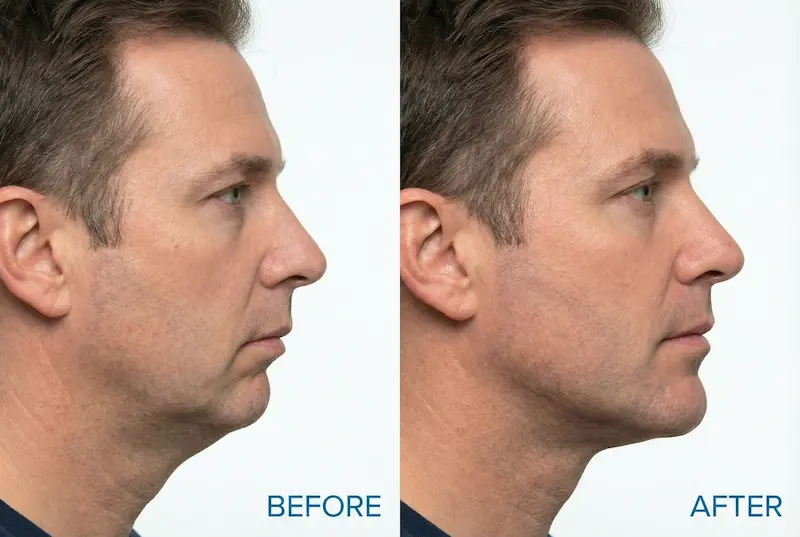
Results — When Will You See The Final Outcome, And How Long Does It Last?
One of the most common worries with Chin Augmentation is, “Will I look natural?” The second is, “When will I see the final result?” Both are valid. Chin work can look transformative in profile, yet still feel subtle day-to-day when it’s planned for proportion rather than “maximum projection”.
What you see immediately after surgery is not your final result. Early swelling changes the contours, especially around the chin point and lower lip area. Your result becomes clearer in stages as tissues settle, which is why a calm, well-protected recovery matters as much as the operation itself.
Early vs final results: swelling vs true shape and definition
Think of the result in three phases: early change, settling, and refinement. You’ll usually notice improved projection quickly, but the “crispness” of your jawline and the final harmony take longer.
- Early change (first 1–2 weeks): swelling is the main story. Shape is visible, but edges can look soft.
- Settling (weeks 3–6): definition improves as swelling reduces. The chin begins to look more “yours”.
- Refinement (after 6 weeks): subtle settling continues. The result looks more natural in movement and in photos.
If you’ve had a bone-based procedure, the refinement phase may feel longer because deeper tissues and bone healing contribute to the timeline. That doesn’t mean something is wrong. It means your body is doing its job.
Longevity: implant permanence vs filler maintenance cycles
Longevity depends on the technique you choose:
- Chin implant: designed as a long-term solution. Your result is considered durable, provided healing is stable and placement remains secure.
- Genioplasty: a structural, permanent change because it uses your own bone.
- Filler: temporary. It is best seen as maintenance-based, with repeat treatments needed to sustain the look.
When patients ask, “What lasts longest?”, surgery is the clear answer. The more useful question is, “What matches my goals and lifestyle?” Some patients prefer a temporary step first. Others want a one-time surgical solution. Both can be rational decisions.
Natural look principle: proportion, not “over-projection”
The most natural results come from restraint and proportion. A chin that is pushed too far forward can look heavy or masculine on a face where it doesn’t belong. Equally, a tiny change can disappoint if the chin is significantly recessed. The goal is not “bigger”. The goal is balanced.
In practice, a natural outcome is usually defined by:
- Harmony in profile: chin, lips, and nose working together.
- Front-view credibility: the chin doesn’t look wide, bulky, or artificial.
- Movement: the result looks normal when you speak and smile.
If you want a strong jawline but still want to look like yourself, this is exactly the planning philosophy we follow.
“The best compliment isn’t ‘What did you have done?’ It’s ‘You look great.’”
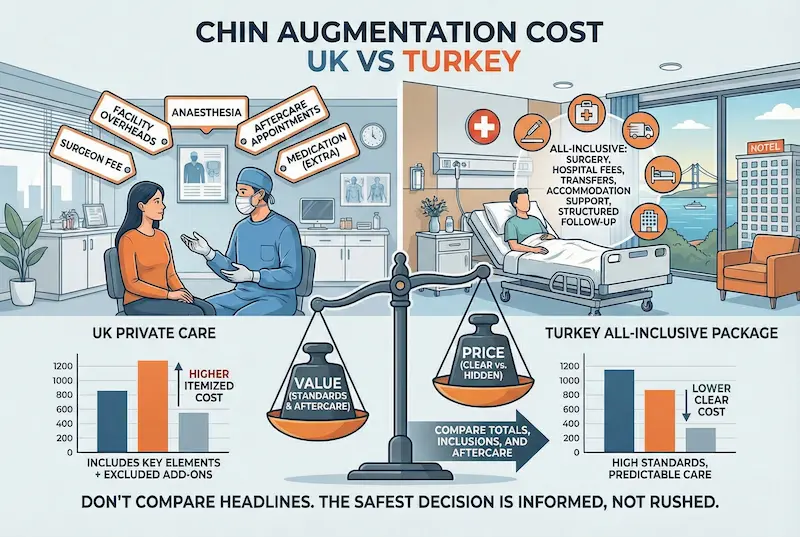
Cost / Fees — Chin Augmentation Cost 2026 UK vs Turkey
Cost is part of the decision, but it shouldn’t be the whole decision. UK patients often compare chin augmentation cost UK with options abroad and wonder why the numbers can be so different. The real answer is that you’re not just paying for “a procedure”. You’re paying for infrastructure, anaesthesia, surgeon time, facility standards, and the aftercare system that supports your recovery.
Below is a sensible way to think about cost: what usually influences price, what is often included (or not), and how to compare like-for-like when reviewing chin implant cost UK versus chin implant cost Turkey, or genioplasty cost UK versus genioplasty Turkey cost.
What influences chin augmentation cost UK (facility, anaesthesia, aftercare)
UK private fees typically reflect local operating costs, insurance structures, facility overheads, and staffing. Prices can vary significantly between regions (for example, London vs outside London) and between clinics based on what is included.
- Facility and theatre fees: the environment you’re treated in matters.
- Anaesthesia fees: type of anaesthesia and time in theatre affect cost.
- Surgeon experience and complexity: implant sizing, symmetry work, and revision complexity change planning time.
- Aftercare structure: follow-up appointments, medications, and support can be included or separate.
When comparing costs, always ask for an itemised view. “Affordable” can become expensive if key elements are excluded and added later.
Genioplasty cost UK vs genioplasty Turkey cost: what you’re paying for (value, not “cheap”)
Genioplasty is usually more technically involved than filler and can be more involved than an implant depending on the plan. Bone-based surgery may include additional planning, operating time, and a different recovery pathway. This can affect fees in any country.
When patients look at genioplasty cost UK compared with Turkey, it’s helpful to frame the comparison around value:
- Technique suitability: the right technique reduces revision risk.
- Hospital standards: safe infrastructure is part of what you pay for.
- Follow-up system: especially important if you travel.
Low pricing without clear standards is not value. True value is high standards with predictable care.
Chin implant cost UK vs chin implant cost Turkey: how an all-inclusive model changes “hidden costs”
In Turkey, many clinics offer packaged models that may include hospital fees, transfers, accommodation support, and structured follow-up. This can make the total cost feel clearer compared with UK pricing that may appear lower at first but grows as separate charges are added.
| Cost factor | Often seen in UK private pricing | Often seen in Turkey all-inclusive models | What to clarify (your checklist) |
|---|---|---|---|
| Surgeon fee | Usually itemised | Often bundled | Who performs the surgery? What is included for revisions/adjustments? |
| Hospital & theatre fees | May be separate | Often bundled | What facility is used? What standards/accreditation apply? |
| Anaesthesia fee | Often separate | Often bundled | Type of anaesthesia? Who provides it? Monitoring standards? |
| Medications & aftercare | Varies (sometimes extra) | Often included | Written aftercare plan? Scheduled follow-ups? Emergency contact pathway? |
| Travel logistics | Not applicable | May include transfers / accommodation support | What is actually included? How many nights? What happens if dates change? |
Bottom line: don’t compare headlines. Compare totals, inclusions, and aftercare. If two quotes aren’t structured the same way, they’re not comparable. The safest decision is informed, not rushed.
Our Rapid Recovery & Safety Protocol: HBOT + LLLT
Recovery isn’t just about “waiting it out”. It’s about creating the right conditions for your body to heal calmly and predictably. That matters even more for international patients who want to feel confident travelling home and returning to daily life without extended social downtime. This is where our technology-led pathway comes in.
We utilise a structured Rapid Recovery & Safety Protocol combining Hyperbaric Oxygen Therapy (HBOT) and Low-Level Laser Therapy (LLLT) to support healing for patients who prioritise minimal visible bruising and swelling.
HBOT: why oxygenation matters after surgery
HBOT is designed to increase the amount of oxygen available to tissues during the early recovery window. For facial procedures, that support can be especially valuable when your goal is to reduce the “public-facing” signs of surgery. Less visible bruising. Less stubborn swelling. A steadier healing curve.
- Swelling support: the protocol is structured to help reduce persistent puffiness in the early phase.
- Bruising management: it may help shorten the time bruising looks intense or obvious.
- Comfort: many patients simply feel “more normal” sooner when inflammation is controlled.
We don’t present HBOT as magic. We use it as a tool. A practical one.
LLLT: light-based support for comfort and healing pathways
LLLT is a non-invasive therapy that uses specific wavelengths of light to support the recovery process. It’s often used to help with comfort and to calm superficial inflammation. For patients tracking their chin implant recovery time or overall genioplasty recovery, that calmer surface response can make the early days feel easier to manage.
- Inflammation control: supports a smoother early healing phase.
- Skin-level recovery: helpful when bruising and redness are your main concerns.
- Complementary effect: works alongside HBOT as part of a combined strategy.
How we structure the protocol around your downtime goals
Not every patient has the same calendar. Some can take their time. Others need to be camera-ready quickly. We tailor the protocol around your procedure plan, your skin type, and your personal downtime target.
- “Minimal social downtime” track: used when you want the fastest visible recovery possible.
- Patient-specific planning: fair skin, bruising tendency, and swelling pattern influence the schedule.
- Reality check: swelling still happens. The goal is to reduce intensity and duration, not pretend it doesn’t exist.
In our internal case reviews, patients supported with HBOT + LLLT have been documented with clearer early results around the two-week mark, helping cut social downtime meaningfully for the right candidates.
“A great result is more than surgery. It’s how you heal.”
Your Medical Journey In Istanbul — What To Expect From Arrival To Departure
Travelling for surgery should feel structured, not stressful. UK patients usually have the same two worries: “What happens when I land?” and “What if I need support after I fly home?” We built our process around those fears. Simple. Predictable. Human.
Our goal is to remove logistical friction so you can focus on preparation and recovery, not admin.
Free virtual consultation → personalised plan and clear next steps
Your journey starts at home with a no-obligation virtual consultation. You share photos, explain your goals, and we map the safest options for your facial balance. We also talk through the rational comparison: implant vs genioplasty vs filler, with honest trade-offs. No hype.
- Goal-first planning: we plan for facial harmony, not “maximum projection”.
- Suitability checks: we screen health factors and expectations early.
- Clarity on technique: you understand what will change, what won’t, and why.
VIP planning: transfers, 5-star hotel coordination, and a 24/7 Patient Host
Once you proceed, your dedicated Patient Host coordinates the operational side. That includes arranging your procedure date, organising 5-star hotel accommodation through our partner network, and scheduling VIP transfers. Your airport welcome is designed to be calm and direct: private driver, clear meet-point, comfortable vehicle, hotel check-in. No confusion.
- Airport-to-hotel support: personal welcome and private transfer.
- Clinic transfers: reliable transport to appointments and check-ups.
- 24/7 communication: your host remains available throughout your stay.
Our clinic is located in Levent, one of Istanbul’s most modern and accessible districts, chosen to keep travel between hotel and clinic simple.
Procedure day, aftercare, and long-term follow-up back in the UK
On procedure day, you have a final in-person consultation with your surgeon to confirm the plan. We complete pre-operative tests, then your procedure is performed in a fully accredited facility with continuous monitoring. After surgery, you’re closely observed and guided through your early aftercare steps, including medications and practical recovery rules.
- Safety structure: strict pre-op screening, sterile protocols, continuous monitoring.
- Included essentials: pre-operative tests, post-op medications, and required garments where applicable.
- Before you fly: a final in-person check-up to confirm you’re safe to travel.
Support doesn’t end when you leave Istanbul. We schedule long-term virtual follow-ups at 1, 3, 6, and 12 months to monitor healing and answer questions as your result refines over time.
“Confidence comes from knowing you won’t be left alone once you’re back home.”
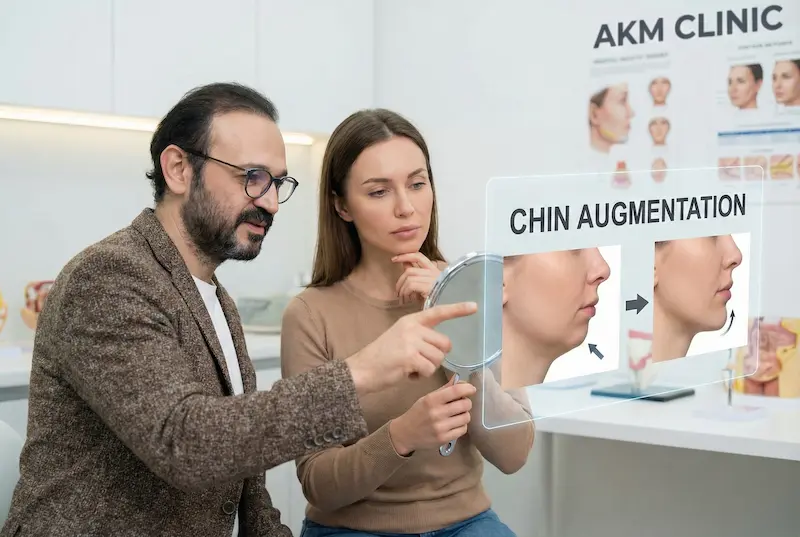
How To Choose The Right Surgeon For Chin Augmentation
If you are travelling from the UK for Chin Augmentation, your surgeon choice matters even more than usual. Not because Turkey is “unsafe” by default, but because distance changes how you manage follow-up and how quickly you can be assessed if you have concerns. The safest decisions come from choosing expertise, infrastructure, and continuity — not simply a low headline price.
This section is designed to help you evaluate quality without getting lost in marketing language.
Credentials and specialisation: what to look for (and what to ignore)
Credentials matter, but they only mean something when they connect to real competence and consistent results. Chin work is millimetre-level surgery. It requires an eye for facial balance and a disciplined approach to symmetry.
- Relevant specialist training in facial aesthetic surgery, with a clear track record in chin procedures.
- Transparent consent: a surgeon who explains risks, not just benefits.
- Technique fluency: they can explain implant vs genioplasty vs filler in plain English, including who should not have each option.
- Consistency over “wow” photos: look for natural-looking outcomes across different face types, not a handful of dramatic transformations.
What to ignore? Over-confident promises, “scar-free” claims, and vague slogans. If a clinic cannot explain the plan clearly, it’s not a safe match for an expert patient.
The best consultation questions (plan, risks, revisions, aftercare)
A good consultation feels structured. You should leave knowing exactly what is being recommended, why it fits your anatomy, what recovery will likely feel like, and what the clinic will do if healing isn’t perfectly linear.
- Technique rationale: “Why is an implant/genioplasty/filler the best match for my face?”
- Natural result planning: “How will you avoid width or heaviness from the front view?”
- Risk management: “What are the most common issues you see, and how do you reduce them?”
- Revision policy: “If something shifts or heals unpredictably, what is the assessment and support process?”
- Aftercare structure: “What follow-up schedule do you use, and how do you handle concerns after I return to the UK?”
These questions are not “difficult”. They are normal. The right team will welcome them.
Safety proof-points: facilities, monitoring, and aftercare continuity
Because chin augmentation surgery is performed in a medical setting, you want evidence of safe infrastructure — not vague reassurance.
- Hospital and theatre standards: ask where the procedure is performed and what safety protocols are used.
- Anaesthesia team and monitoring: who provides anaesthesia and how you are monitored throughout.
- Infection prevention pathway: what is done before, during, and after surgery to reduce infection risk.
- Structured follow-up: scheduled check-ins and a clear escalation pathway if you have concerns back home.
In short: choose a system, not a discount.
“The best clinic is the one that can explain your plan like a professional — and support you like a partner.”
Chin Augmentation Frequently Asked Questions (FAQ):
Is a chin implant safe?
A chin implant can be safe when it is correctly indicated, properly sized, placed with sterile technique, and supported by structured aftercare. The key risk categories are infection, shifting (malposition), asymmetry, and temporary changes in sensation. A quality clinic explains these risks clearly and shows you how they reduce them in practice.
What is genioplasty?
Genioplasty is a bone-based chin procedure that reshapes or repositions your own chin bone. The most common type is sliding genioplasty, where the bony chin segment is moved (often forward) to improve projection and balance. It is permanent and can be ideal when you need structural change rather than added volume.
How long does it take to recover from genioplasty?
Most patients improve steadily week by week, but swelling refinement can take longer than with an implant. There is a difference between feeling “back to normal” in daily life and seeing the final refined contour. Your surgeon should give you a realistic timeline based on the exact technique and your anatomy.
What is the typical chin implant recovery time?
Swelling is usually most noticeable in the first 72 hours, then improves gradually. Many patients feel more socially comfortable within 1–2 weeks, with continued refinement over the following weeks. Following aftercare guidance (avoiding pressure on the chin, good hygiene, and attending follow-ups) is essential for a smooth recovery.
Chin filler vs implant — which looks more natural?
Either can look natural when chosen correctly. Filler is best for subtle enhancement or as a “trial” before surgery, but it is temporary and can look wide/heavy if overused. An implant is typically more stable and structural for a recessed chin. The most natural option is the one that matches your anatomy and the degree of change you need.
What are the main chin implant risks?
The main risks include infection, implant shifting, asymmetry, and temporary nerve-related symptoms such as numbness. These risks are managed through sterile technique, accurate placement, correct sizing, and strong follow-up. If you see terms like chin implant gone wrong online, remember: the responsible question is how a clinic prevents problems and how they respond if one occurs.
How much does chin augmentation cost in the UK vs Turkey?
Costs vary widely in both countries. The safest way to compare is to compare like-for-like: surgeon fees, hospital/theatre fees, anaesthesia, medications, aftercare, and follow-up. In Turkey, packages may bundle logistics and follow-up into one figure, while UK pricing can be more itemised. Focus on total value and safety standards, not the cheapest headline.
Can I search for “chin implant surgery near me” and still choose Turkey?
Yes. Many patients start with “near me” searches, then decide based on value, surgeon expertise, and aftercare structure. If you travel, prioritise a clinic with a clear long-distance follow-up plan and an escalation pathway for concerns once you are back in the UK.
Will a chin implant look obvious from the front?
It shouldn’t. A natural result depends on correct sizing and positioning, plus planning for the front view (width and chin point shape), not just the side profile. If you’re naturally narrow-chinned, over-sizing can create heaviness. The right plan aims for balanced definition rather than “maximum projection”.
Can Chin Augmentation improve the appearance of a double chin?
In some patients, yes. If the chin is recessed, adding projection can improve the neck-to-chin angle and make the area under the chin look more defined. However, if fullness is mainly due to fat or skin laxity, you may need an additional approach (for example, neck contouring) to achieve the result you want.
Will Chin Augmentation affect my smile or speech?
In the early recovery phase, swelling and tightness can make movement feel unusual, and some patients experience temporary numbness. This typically improves as swelling settles. Long-term issues with speech or smiling are not expected when the procedure is appropriately planned and performed, and when aftercare instructions are followed.
How long should I stay in Turkey after Chin Augmentation?
Most patients plan 3-4 days for early monitoring and a final in-person check before flying home. The exact timing depends on whether you have a chin implant or genioplasty, and whether you’ve combined procedures. Your surgeon should give you a travel-safe timeline and a clear follow-up plan for once you’re back in the UK.
Medical Disclaimer: This page is provided for general educational purposes only and does not replace a face-to-face medical consultation, diagnosis, or personalised treatment plan. All surgery carries risks and outcomes vary between individuals. Suitability for a chin augmentation, procedure selection, and anaesthesia choice can only be determined after a full clinical assessment by a qualified surgeon. Always follow your clinician’s instructions and seek urgent medical attention if you develop concerning symptoms during recovery.