
Revision Facelift Specialist: Fixing Bad Results
AI Summary
- Revision facelift specialist care corrects bad facelift results by addressing scar tissue, deep support, and natural facial balance.
- Safety depends on timing—waiting for swelling to settle and scars to mature improves revision planning and outcomes.
- Recovery support matters, with HBOT and LLLT helping optimize healing, swelling control, and tissue quality after revision.
- Transparent surgeon-led planning builds trust through realistic goals, revision expertise, and clear guidance on cost, risks, and recovery.
Summary generated by AI, fact-checked by our medical experts
If you're searching for a revision facelift specialist, you're not looking for "more tightening." You're looking for a safe, realistic way to correct an unnatural result — without repeating the same mistakes. Revision cases can involve scar tissue, altered anatomy, and emotional fatigue from a disappointing outcome. The complete corrective surgical methodology — including diagnostic framework, scar tissue mapping, plane re-selection criteria, and the safety protocols specific to operating on previously dissected tissues — is documented on our revision facelift surgery hub.
This guide is written for the expert patient: someone who wants clarity, not hype. We’ll break down why facelifts fail, what makes revision surgery more complex, and how a deep plane facelift revision specialist evaluates risk, technique, and timing. We’ll also cover practical topics like revision facelift recovery time and the difference between deep plane facelift revision, corrective facelift surgery, and SMAS revision techniques. Where the evidence is limited (as it sometimes is in aesthetic surgery), we’ll say so—because trust is built on transparency and medical science, not certainty theater.
Key takeaway: Revision facelift surgery is not “a redo.” It is reconstructive problem-solving—often requiring a secondary facelift specialist with specific revision experience and a plan tailored to your anatomy, scars, and goals.
Table of Contents
Why Facelifts Fail: Anatomy of a Bad Result
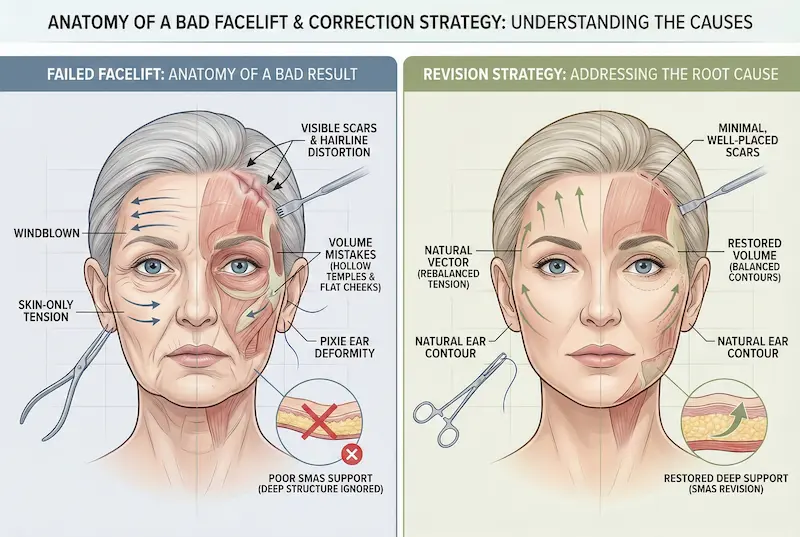
A “bad facelift” isn’t one single problem—it’s usually a pattern: tension placed in the wrong direction, deeper support structures ignored, or skin treated as the main lifting tool. Understanding the root cause matters because a revision facelift specialist doesn’t just “tighten again.” They diagnose why the first result looks off, then rebuild the correction strategy around anatomy and biology (healing, scarring, blood supply), informed by clinical experience and scientific research in facial aging and wound healing.
The "Windblown" Look and Pixie Ears Explained
The “windblown” look typically comes from over-tensioning the skin—especially when the pull is horizontal rather than following natural vectors. Over time, this can create a stretched, tight appearance that reads as surgical. “Pixie ear” deformity (where the earlobe looks tethered or pulled down) often happens when skin tension is transferred to the ear instead of being distributed through deeper structural support.
- What a revision focuses on: releasing tethering, rebalancing tension, and restoring natural contours rather than simply pulling tighter.
- What to ask: “How do you prevent pixie ear in revision?” and “Where will tension be placed—skin, SMAS, or deep plane?”
Failure to Address Deep Structures (SMAS)
Many unnatural results trace back to insufficient support in the deeper layer (often discussed as the SMAS—the superficial musculoaponeurotic system). If the deeper structures aren’t properly repositioned, the skin ends up doing too much work. That can lead to early relapse, visible tension lines, and a “pulled” look.
In revision planning, SMAS revision techniques may be used to restore structural lift and reduce skin tension. For some patients, a surgeon may consider approaches described as deep plane facelift revision — but the decision depends on scar tissue, prior planes of dissection, and safety considerations. The full deep plane technique foundation — including the sub-SMAS dissection sequence, retaining ligament release sequence, and why deep-plane work matters in revision contexts — is documented on our deep plane facelift technique manual.
Skin-Only Tension Problems: Visible Scars, Hairline Distortion, and “Pulled” Features
When skin is the primary lifting mechanism, several issues can appear: widened or visible scars due to tension at incision lines, hairline distortion (temple recession or "step-off" at the sideburn area), and flattened, over-smooth surfaces that don't match how faces naturally age. A peer-reviewed June 2025 publication on rhytidectomy complications and prevention trends analyzed studies from 2000 through 2024 and found that hematoma represented 27% of all reported complications, unfavorable scarring 24%, and neurapraxia 22% — with unfavorable scarring and neurapraxia reports doubling in the 2013–2024 period compared with the prior decade, providing the evidence base behind why scar quality and nerve risk matter so much in revision planning.
A revision facelift specialist evaluates scar quality, incision placement options, and how to shift load-bearing from skin to deeper support—while respecting blood supply and healing biology (a key point in medical science for revision surgery).
Volume Mistakes: Hollow Temples, Flat Cheeks, and Unnatural Contours
Not every “bad result” is about tightness. Some outcomes look older because volume was removed or not restored—leading to hollow temples, flattened cheeks, or harsh transitions under the eyes. A thoughtful revision plan may combine lifting with volume restoration (when appropriate) to avoid the “tight but tired” look.
Important: Volume correction is not automatically the answer. The best secondary facelift specialist will explain why they recommend (or avoid) fat transfer, fillers, or other adjuncts—based on your anatomy, skin quality, and scar behavior.
The Complexity of Revision: Scar Tissue and Nerves
Revision facelift surgery is more complex than a primary lift because your anatomy has already been altered. Planes of dissection may be scarred, blood supply patterns can change, and normal tissue “landmarks” can be distorted. A true facelift revision specialist approaches this like corrective facial reconstruction: identify what was done, assess what healed well (and what didn’t), and choose the safest plane and technique for your specific case. In many situations, patients specifically seek a deep plane facelift revision specialist or revision deep plane facelift specialist—but the “best” approach is the one that solves your problem with the lowest risk, guided by medical science and real-world revision experience.
Why You Need a Super-Specialist, Not a General Plastic Surgeon
Not all facelift surgeons are revision surgeons. Revision work demands pattern recognition, technical flexibility across multiple approaches, and safety-first judgment that knows when not to chase perfection if it increases nerve or skin-compromise risk. For context on what a primary facelift involves — including incision pattern decisions, vector planning, and recovery timeline — and how revision differs from a first-time procedure, see our complete primary facelift technique reference.
If you’re interviewing a secondary facelift specialist, ask revision-specific questions, not generic ones:
- “How many revision facelifts do you perform per month/year?”
- “What’s your strategy when you encounter dense scar tissue?”
- “How do you reduce facial nerve risk in revision cases?”
- “Can you show cases similar to mine (pixie ear, windblown, neck relapse, scar widening)?”
Scar Tissue Mapping: Choosing the Right Surgical Plane for a Safer Revision
Scar tissue is not just “tough tissue.” It can behave unpredictably: it can tether skin, limit mobility of deeper layers, and change how tissues respond to traction. That’s why a revision surgeon’s first job is often scar tissue mapping—mentally and surgically identifying where the prior surgeon dissected and where the scarring is most dense.
Depending on what is found, a revision facelift specialist may:
- Release tethering: carefully freeing scar bands that create distortion (for example, traction lines or earlobe pull-down).
- Re-establishing a stable lifting layer is one of the most important goals of revision: when the SMAS is accessible and viable in revision, surgeons may use SMAS revision techniques to redistribute tension away from the skin and back into the deep support layer. The complete SMAS technique foundation — including plication, imbrication, SMASectomy variations, and how each maps to specific revision scenarios — is documented on our SMAS facelift surgical hub.
- Consider a deep-plane strategy: when appropriate, a deep plane facelift revision specialist may use a deep-plane approach to address midface/neck support—but only if prior planes, scarring, and safety allow it.
Clinical reality: “Deep plane” is not a magic word. In revision, the safest and most natural result comes from choosing the right plane for your tissue condition—not forcing a technique because it sounds advanced.
Facial Nerve Safety: Risk Reduction Strategies and What Patients Should Ask
Nerve protection is one of the biggest concerns in corrective facelift surgery. In revision cases, scarring can blur normal tissue planes, which can raise the technical difficulty of dissection around facial nerve branches. An experienced facelift revision specialist reduces risk with a structured approach:
- Conservative dissection where needed: minimizing unnecessary undermining in high-risk zones.
- Plane selection based on prior surgery: choosing the least traumatic route to achieve correction.
- Vector control: applying lift in a way that avoids creating new traction deformities.
- Meticulous hemostasis: reducing hematoma risk, which can compromise healing.
Patient-facing questions that matter:
- “What is my specific nerve-risk profile given my first surgery?”
- “How do you handle areas with dense scar tissue near nerve branches?”
- “If we prioritize safety, what trade-offs might we accept aesthetically?”
Skin Quality Matters: Dermatosurgeon-Led Assessment for More Natural Outcomes
In revision, skin is often the “final messenger” of what’s happening underneath. Thin, sun-damaged, poorly vascularized, or previously over-stretched skin may not tolerate aggressive re-tensioning. This is where a dermatosurgeon-led perspective can elevate outcomes: improving naturalness by treating not only the lift mechanics but also the skin envelope quality.
A dermatosurgeon-focused evaluation can help determine:
- Whether scar biology suggests a higher risk of widening or pigmentation issues.
- How much tension the skin can safely tolerate after deeper support is rebuilt.
- Which adjunctive protocols support recovery and skin resilience.
This "skin + structure" approach is especially valuable for patients seeking a revision facelift specialist who can deliver natural-looking results while staying conservative around compromised tissues. The dermatosurgeon-led philosophy at AKM Clinic — including how skin biology assessment integrates with structural lifting decisions, and the surgeon-led continuity from consultation through 12-month follow-up — is documented on our clinic philosophy page.
Timing: When Is It Safe to Operate Again?
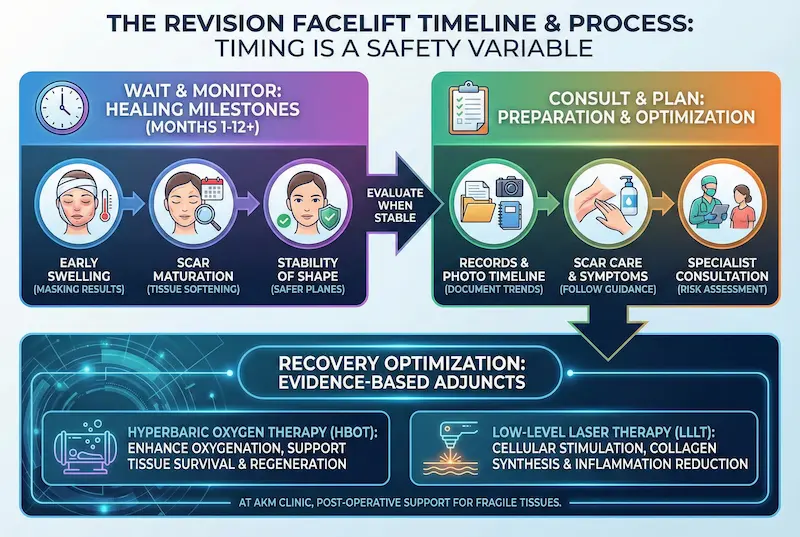
One of the most common mistakes after a disappointing facelift is rushing into a second operation too soon. In revision work, timing is not “a preference”—it’s a safety variable. A revision facelift specialist evaluates timing based on tissue biology: swelling patterns, scar maturation, blood supply, and how the first surgery changed the surgical planes. If you’re researching revision facelift recovery time, it’s equally important to understand the “pre-revision timeline” (how long you should wait before revision) because that decision can directly affect nerve safety, scar quality, and the likelihood of a natural result—principles grounded in medical science and wound-healing science.
Healing Milestones: Swelling vs. Scar Maturation and Why Timing Changes Results
After a facelift, early swelling can mask the true shape of the jawline, neck, and midface. But swelling is only part of the story. Scar tissue continues to remodel for months—sometimes longer—changing how tissues move, how incisions settle, and how “tightness” feels. A facelift revision specialist typically looks for:
- Stability of shape: your result is no longer changing dramatically week to week.
- Softening of tissues: firm bands and hard swelling have eased, making planes safer to work in.
- Scar maturation signs: scars are less inflamed and less reactive, reducing the risk of widening or pigment changes after revision.
In practical terms, the earliest months are often the least reliable for judging final contour—especially in the neck and along the incision lines.
When Waiting Is Non-Negotiable vs. When Early Action Is Necessary
Most aesthetic concerns (tightness, mild asymmetry, subtle contour irregularities) benefit from waiting until healing stabilizes. However, there are exceptions where earlier assessment—or intervention—may be medically necessary. Examples include:
- Complications that threaten tissue health (for example, significant wound breakdown or compromised skin areas).
- Severe deformities caused by tethering that materially worsen function or cause progressive distortion.
- Persistent, concerning symptoms that require prompt evaluation (e.g., unusual pain, expanding swelling, fever, drainage).
A responsible secondary facelift specialist will clearly separate what is a “healing-phase artifact” from what is a true structural problem—and will explain the risk trade-offs of early corrective facelift surgery versus waiting.
What to Do While You Wait: Scar Care, Records, and Non-Surgical Support
Waiting doesn’t mean doing nothing. If revision is likely, use the time to prepare a clean clinical picture for your next consultation. This helps a deep plane facelift revision specialist (or any revision surgeon) plan more accurately and safely.
- Create a photo timeline: consistent lighting/angles at set intervals can reveal trends that memory misses.
- Collect your surgical records: operative notes, implant/graft details (if any), anesthesia records, and post-op complication notes.
- Document symptoms: numbness patterns, tight bands, pain triggers, and scar behavior (itching, redness, thickening).
- Support scar quality: follow evidence-based scar care guidance from your treating team (and avoid aggressive DIY treatments).
This is especially important for international patients considering a revision facelift specialist Turkey, because having a complete record set improves the quality of remote assessments and in-person planning.
Optimizing Recovery: Evidence-Based Adjuncts Like HBOT and LLLT
Revision surgery asks tissues to heal again — sometimes in areas where blood supply and elasticity are already stressed. Some clinics integrate supportive recovery technologies to reduce swelling and support tissue quality. Hyperbaric Oxygen Therapy (HBOT) is positioned as a major safety-focused recovery support, aiming to enhance tissue oxygenation and support tissue survival in fragile post-surgical areas. The complete HBOT recovery acceleration protocol — including session schedule, oxygen partial pressure data, and how it integrates with revision aftercare — is detailed in our HBOT recovery acceleration protocol.
Low-Level Laser Therapy (LLLT) is used as a non-heat, cellular-stimulation approach to support healing. For revision facelift patients, LLLT is described as supporting recovery via collagen synthesis support and inflammation reduction — working alongside HBOT to help decrease swelling and redness. The full LLLT mechanism breakdown — including photobiomodulation parameters, scar maturation impact, and clinical session timing — is documented in our LLLT scar minimization guide.
Practical perspective: These adjuncts don’t replace surgical skill. They’re best viewed as recovery support—particularly valuable when tissues are delicate, as can be the case in revision and deep plane facelift revision scenarios.
Correcting Neck Bands and Midface Sagging
After a disappointing facelift, the two areas patients most often want “fixed” are the neck and the midface. Neck bands can look worse than before surgery, and midface sagging can persist despite a “tight” jawline—creating that confusing mismatch where some areas look over-pulled while others still look heavy. A revision facelift specialist approaches these concerns by identifying the true cause (skin laxity vs. platysma separation vs. inadequate deep support) and selecting the safest corrective plan. In revision, the goal is not maximum tightness—it’s stable support, natural contours, and minimized risk. That’s why patients often seek a deep plane facelift revision specialist or revision deep plane facelift specialist for complex midface/neck problems, but the technique choice must always be individualized.
Neck Issues After a Bad Facelift: Platysma Bands, Skin Laxity, and What’s Fixable
“Neck bands” are not all the same. Some are true platysma bands (muscle edges that separate or become visible), while others are skin folds, scar tethering, or a combination. A facelift revision specialist will assess:
- Is it muscle banding or skin laxity? This determines whether the correction is primarily structural, skin-focused, or both.
- Is there scar tethering? Scar bands can create grooves or “cords” that mimic platysma banding.
- Was the neck actually addressed in the first surgery? Some primary facelifts do minimal neck work, leading to quick “relapse.”
What’s realistically fixable? Many neck concerns can improve substantially, especially when the plan includes structural support rather than skin tension alone. However, extremely thin skin, heavy sun damage, or multiple prior surgeries can limit how far the neck can be “polished” without adding risk.
Midface Revision Options: Deep Plane Revision, Fat Grafting/Nanofat, and Structural Support
Persistent midface heaviness—or a flat, “operated” cheek—can happen when deeper support wasn’t repositioned, or when volume balance wasn’t handled thoughtfully. Depending on your anatomy and prior surgical planes, revision options may include:
- Structural repositioning: techniques that restore support in a stable layer (often discussed through SMAS revision techniques).
- Deep plane facelift revision: in selected cases, a deep plane facelift revision specialist may consider a deep-plane strategy to address midface descent more effectively—but only if scar patterns and safety permit.
- Volume refinement: conservative fat grafting or related approaches (when appropriate) to soften hollowing or harsh transitions—especially if “tightness” is present but the face reads older due to volume loss.
Important nuance: Midface “fixes” aren’t one-size-fits-all. Some patients need more structural support; others need subtle volume restoration; many need a carefully balanced combination.
Restoring Natural Proportions: Avoiding “Over-Tight” vs. “Under-Corrected” Results
Revision is often a balancing act between two extremes:
- Over-tightening: can worsen the windblown look, create traction scars, and distort the ear/hairline.
- Under-correction: can leave you feeling like you “went through it again” with minimal improvement.
A skilled facelift revision specialist sets a plan that prioritizes natural vectors, stable deep support, and realistic targets for improvement. This is also where surgeon communication matters: you should leave the consultation understanding what can be improved dramatically, what can be improved modestly, and what is risky to chase. That transparency is part of good medical science practice—aligning expectations with biology and surgical limits.
Realistic Expectations: Asymmetry, Skin Quality, Smoking, Weight Changes, and Ageing
Even the best corrective facelift surgery has constraints. Revision results depend on variables that no surgeon controls completely:
- Skin quality: thin, sun-damaged skin may not “snap” the way thicker skin does.
- Scar behavior: some patients form thicker or more pigmented scars.
- Smoking and nicotine exposure: increases healing risk and can compromise results.
- Weight changes: fluctuations can affect neck and jawline definition.
- Natural asymmetry: faces are not perfectly symmetric; revision aims for harmony, not mathematical symmetry.
If you’re considering a revision facelift specialist Turkey (or anywhere internationally), be especially strict about pre-op optimization guidance and follow-up planning. A strong plan reduces surprises and supports safer healing—particularly important for revision patients who have already had a difficult first experience.
The Emotional Journey: Rebuilding Trust
A bad facelift result is not just an aesthetic issue—it can shake your confidence in your own judgment and your willingness to trust a surgeon again. Many patients describe avoiding mirrors, photos, social events, or even feeling disconnected from their reflection. A skilled revision facelift specialist understands that “fixing bad results” is both technical and human: you need a plan that respects scar biology and nerve safety, but also a consultation process that restores your sense of control. This is where the right secondary facelift specialist stands out—by being transparent, methodical, and grounded in medical science rather than promising perfection.

The Psychological Impact of a Bad Result: Anxiety, Regret, and Loss of Confidence
Patients often arrive at revision consults with a mix of fear and urgency: fear of being “botched again,” and urgency to stop feeling stuck in an outcome they didn’t choose. You may also feel pressure because friends/family notice something looks “off,” or because your scars or neck/jawline don’t match what you expected.
What helps most is a surgeon who validates the experience without exaggerating, explains the mechanism of what went wrong in clear anatomical terms, and sets realistic goals that prioritize safety and naturalness. The patient perspective "the whole of me simply fits again" reflects what revision is really aiming for: not an obvious "new face," but a face that feels like you again. For real revision testimonial stories — including 3-month, 6-month, and 12-month patient narratives across multiple revision scenarios — see our complete verified patient reviews hub.
Patient perspective: “The whole of me simply fits again.”
This kind of statement matters because it reflects what revision is really aiming for: not an obvious “new face,” but a face that feels like you again.
How to Vet Your Next Surgeon: Transparency, Case Volume, and Revision-Specific Proof
Revision is a subspecialty. When you're screening a facelift revision specialist — whether locally or as a Turkey option — focus on evidence of revision competence, not generic facelift marketing. Ask for revision-specific examples (cases similar to your issue: pixie ear, windblown, scar widening, neck relapse, midface heaviness), confirm the surgeon's revision volume, and look for honest trade-offs in their consultation framework. The complete credential verification framework — including TPCD/EBOPRAS/ISAPS public registries, fellowship pedigree, and the specific markers that distinguish a deep-plane-experienced revision surgeon — is detailed in our surgeon evaluation guide.
If you’re specifically seeking a revision deep plane facelift specialist or deep plane facelift revision specialist, don’t stop at the label. Ask how they decide between deep plane facelift revision and SMAS revision techniques based on your prior surgical planes and scar tissue—because in revision, safety and plane choice are everything.
Consultation Framework: Aligning Goals, Avoiding Unrealistic Promises, Getting a Second Opinion
A high-quality revision consultation should feel like a medical evaluation. You should leave with a clear understanding of:
- Your primary problem list: e.g., scar tethering, vector issues, inadequate deep support, volume imbalance.
- Your surgical options: what may be corrected via corrective facelift surgery, what might need staged correction, and what should be left alone for safety.
- Risk profile: nerve risk discussion should be specific to your history, not generic reassurance.
- Outcome targets: “natural,” “softer,” “less pulled,” “improved neck contour”—not “perfect.”
A strong revision surgeon will also support you if you want a second opinion. In fact, many expert patients do this—especially when considering travel for a revision facelift specialist Turkey pathway—because comparing two structured surgical plans can reveal who is truly thinking through your case.
Preparing Your Revision “File”: Operative Notes, Timeline Photos, and Medical History
Revision planning improves dramatically when you bring organized data. Create a “revision file” before you meet your surgeon:
- Operative report from your primary facelift (ask your previous clinic/hospital for it).
- Timeline photos (front/45°/profile) at consistent intervals: 2 weeks, 6 weeks, 3 months, 6 months, 9–12 months.
- Complication history (hematoma, infection, wound issues, prolonged swelling, abnormal scarring).
- Medication/supplement list and nicotine exposure (including patches or vaping).
- Your “priority list” (top 3 concerns) so the consult stays focused.
This preparation helps a secondary facelift specialist quickly identify whether your case is best served by SMAS revision techniques, a deep plane facelift revision approach, scar-focused correction, volume refinement, or a combination—without guesswork.
Expert-patient style metric: If a surgeon can explain your problem in anatomy terms and outline a staged plan with risks, you’re in the right room.
Cost Factors in Revision Surgery
Cost is a practical concern—but in corrective facelift surgery, “cheapest” is rarely the safest path. Revision work typically requires more operating time, more technical planning (often involving SMAS revision techniques or a deep plane facelift revision strategy), and closer post-op monitoring because tissues may be scarred or biologically stressed. A reputable revision facelift specialist will explain exactly what drives the quote and what’s included, so you can compare options honestly—especially if you’re considering a revision facelift specialist Turkey for a surgeon-led, value-focused approach.
What Drives Revision Costs: Complexity, OR Time, Anesthesia, Grafts, and Hospital Standards
Revision facelift pricing varies widely because the work varies widely. These are the most common drivers:
- Case complexity: scar tissue release, correction of pixie ear/windblown vectors, neck rework, and midface support all increase time and difficulty.
- Technique selection: a plan that includes SMAS revision techniques or a deep plane facelift revision may require longer OR time than a limited skin revision.
- Anesthesia plan: local with sedation vs. general anesthesia impacts facility and anesthesia fees.
- Adjuncts: fat grafting, scar revision, or staged procedures can add cost.
- Facility safety standards: accredited hospital settings and robust post-op monitoring affect pricing.
You're not paying for "minutes." You're paying for problem-solving, safety margin, and a plan designed to reduce the chance you'll need a third procedure. The complete pricing transparency framework — including all-inclusive package breakdown, hidden-cost analysis, and the revision-versus-primary cost differential — is documented on our surgery pricing transparency page.
Why “Cheap Revision” Is a Red Flag: Safety, Surgeon Expertise, and Hidden Costs
Many patients arrive at revision consults after choosing the first surgery based on price. The lesson is painful: when something goes wrong, the emotional cost is high—and the financial cost often increases.
- Revision is higher-stakes: scarred planes can raise the technical difficulty and the risk profile (including nerve risk).
- Under-quoting can mean under-including: some low prices omit anesthesia, facility fees, medications, aftercare, or management of complications.
- Travel amplifies the need for planning: if you're pursuing a Turkey revision option, you need clarity on the full package and follow-up schedule before booking flights. The complete step-by-step international patient pathway — including pre-arrival WhatsApp coordination, day-of-surgery briefing, post-discharge follow-up cadence, and remote complication management protocol — is documented on our international patient pathway guide.
Expert-patient rule: The most trustworthy quote is the one that explains what it includes, what it excludes, and what could change if the surgeon finds more scar tissue than expected.
Price Transparency Checklist: What Should Be Included vs. What’s Often Excluded
Use this checklist to compare quotes apples-to-apples (especially for international options):
- Included (you want this in writing):
- Surgeon fee + revision-specific plan (what exactly is being corrected)
- Anesthesia fees (type specified)
- Facility/hospital fees + overnight monitoring if needed
- Medications and compression/support garments (if applicable)
- Post-op visits + emergency access protocol
- Scar care guidance + wound care supplies (if the clinic provides them)
- Often excluded (ask directly):
- Pre-op labs/medical clearance
- Revision of additional areas discovered intra-op (scope changes)
- Extended hospital stay if complications occur
- Travel/hotel and caregiver costs
- Return-visit costs if you require in-person follow-up after flying home
Suggested Table: New York vs. Los Angeles vs. Miami vs. Istanbul (AKM) + Mexico + Thailand
The numbers below are illustrative market ranges reported by clinics and medical-travel platforms. Your personal quote can be higher or lower depending on whether you need limited scar correction vs. full structural revision (e.g., deep plane facelift revision and/or SMAS revision techniques), anesthesia type, and facility standards.
| Location | What Patients Commonly See Quoted | What Typically Drives Cost Up | Value Considerations |
|---|---|---|---|
| New York City | High variance for facelift pricing; revisions can be higher due to complexity | Elite surgeon fees, facility costs, extensive revision scope | Strong access to top-tier specialists; highest budget environment |
| Los Angeles | Wide variance for facelift pricing; revision-specific pricing depends on scar complexity | Deep-plane/structural work, brand-name surgeons, OR time | Large specialist market; carefully vet revision case volume |
| Miami | Broad pricing range; revision quotes vary heavily by technique and surgeon experience | Complex neck/midface correction, facility level, anesthesia | Large market; quality varies—use the revision checklist strictly |
| Istanbul (AKM Clinic) | Turkey is widely marketed at lower ranges; revision quotes depend on scope and standards | True structural revision, hospital-grade monitoring, complex scar release | For many patients, the value equation is strong when surgeon-led planning and safety standards are prioritized |
| Mexico | Revision facelift commonly marketed in mid ranges compared with US cities | Case complexity, facility standards, aftercare planning | Proximity can help; verify revision expertise and emergency planning |
| Thailand | Revision facelift commonly marketed in mid-to-higher medical tourism ranges | Complex scope, longer stay planning, facility standards | Often strong facilities; travel distance increases follow-up planning importance |
How Cost Relates to Revision Facelift Recovery Time
Budgeting isn’t just about the surgical fee. Revision facelift recovery time can involve longer swelling resolution and more follow-up considerations than a first-time procedure—especially if you need extensive scar release or deeper structural work. A realistic plan should include:
- Time off work and social downtime
- Caregiver support for the first days
- Follow-up structure (in-person and remote)
- Contingency planning if healing is slower than expected
This is where the “science” of recovery meets real life: swelling biology and scar maturation timelines don’t follow airline schedules—so the best plan is the one that respects healing physiology and builds in support.
Frequently Asked Questions (FAQ): Revision Facelift Specialist
These are the most common questions we hear from patients looking for a revision facelift specialist—especially those comparing a facelift revision specialist, a deep plane facelift revision specialist, or a revision deep plane facelift specialist. Answers are intentionally concise and grounded in practical surgical realities and medical science.
How do I know if I truly need a revision facelift?
How do I know if I truly need a revision facelift?
Can revision surgery fix pixie ears and the “windblown” look?
How long should I wait after my first facelift before revision?
What are the nerve risks in revision facelift surgery?
Will my scars improve with revision—or can they get worse?
Is recovery from a revision facelift harder than the first surgery?
Can revision facelift be done with awake/twilight anesthesia?
How many times can a facelift be revised safely?
What documents and photos should I bring to the consultation?
What does a realistic revision facelift recovery timeline look like?
Medical Disclaimer: This content is for informational purposes only and does not constitute medical advice. Results and recovery vary by individual. Always consult a qualified, board-certified surgeon to evaluate your specific condition, risks, and treatment options before undergoing any procedure.
Related Treatments




Ready to Start Your Own Transformation Journey?
Join the 2,000+ patients who trusted Dr. Akif Mehmetoğlu and the AKM Clinic team. Your journey to a more confident, revitalized you begins with a simple, no-obligation conversation. Contact us today from the USA for your free virtual consultation.
#1: Get Your Free Personalised Quote
Start with a free, no-obligation online consultation. Share your photos, and our surgical team will provide a fully personalised treatment plan and a transparent, all-inclusive price package. No hidden fees.
#2: Secure Your Date & VIP Booking
Once you're ready, our dedicated patient coordinators will help you secure your procedure date. We'll handle all your bookings, including your 5-star hotel and private VIP airport transfers.
#3: Arrive in Istanbul & Meet Your Surgeon
Arrive at Istanbul Airport (IST) and be greeted by your private driver. Settle into your hotel and prepare for your in-person consultation, where you'll meet your specialist surgeon to finalise the details for your "natural, subtle, and revitalized" new look.