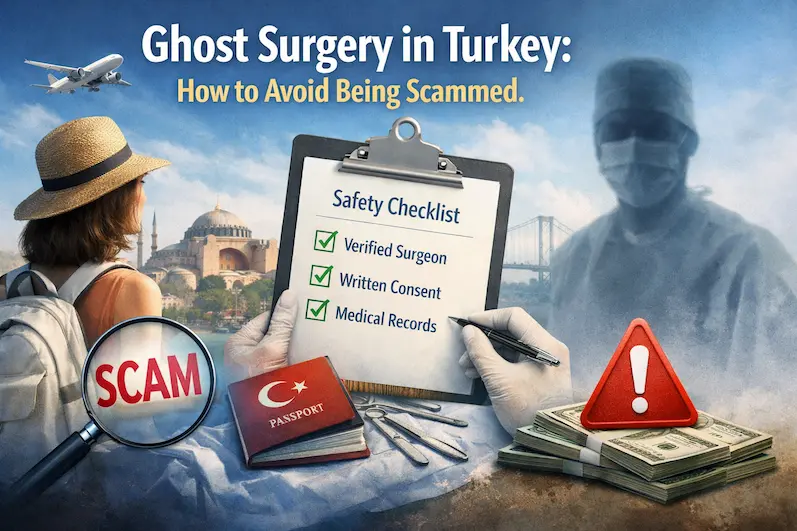
If you’re researching ghost surgery in Turkey, you’re already doing something smart: you’re protecting yourself before you ever get on a plane. “Ghost surgery” is a real patient-safety concern in global healthcare—and not just in one country. The good news is that you can reduce your risk dramatically with a structured verification process grounded in medical science, proper documentation, and clear informed consent.
In this guide, you’ll learn how to recognize red flags, what to demand in writing, and how to confirm who will actually operate on you—so you can avoid scenarios described online as Turkey ghost surgery, ghost surgery Turkey, or Turkish ghost surgery.
Key takeaway: The safest path is transparent, surgeon-led care where the operating surgeon is named, verified, and documented—before, during, and after surgery.
Table of Contents
What “Ghost Surgery” Really Means (And What It’s Not)
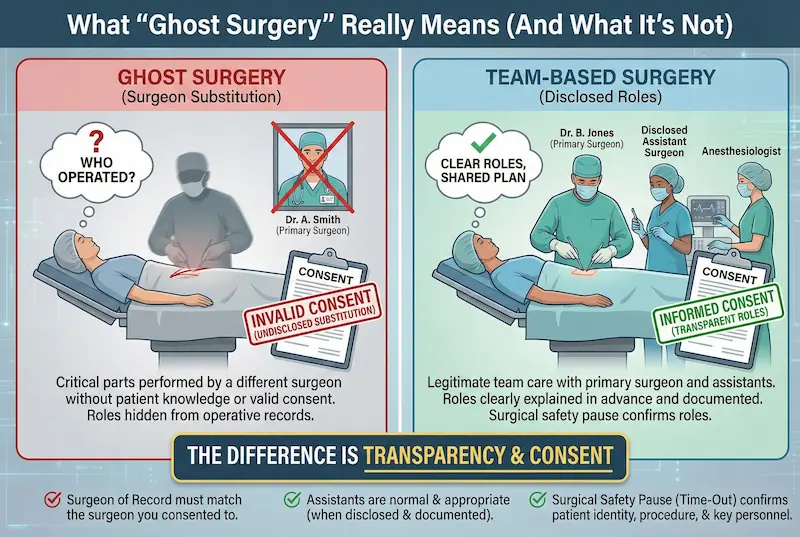
Before you can protect yourself, you need a precise definition. The phrase “ghost surgery” is often used loosely on social media, which creates confusion and fear. In clinical terms, the core problem is surgeon substitution: a patient consents to one surgeon, but a different surgeon performs key parts—or all—of the procedure without the patient’s knowledge or valid consent. That is fundamentally different from legitimate, disclosed team-based care where assistants have clearly defined roles.
A clear definition: “surgeon substitution” vs. normal team-based surgery
Many safe plastic surgery operations involve a team: a primary surgeon, an assistant surgeon, scrub nurses, and an anesthesiologist. Team-based care can be normal and appropriate—if it’s disclosed and documented. Ghost surgery is when the person doing the critical steps is not the surgeon you agreed to.
| Scenario | What you consented to | What happens in the OR | Is it a “ghost” risk? |
|---|---|---|---|
| Transparent team-based surgery | Named surgeon + clearly described assistant roles | Named surgeon performs critical steps; assistants help as disclosed | Low |
| Teaching/training setting (properly disclosed) | Named surgeon + disclosure of supervised trainee involvement | Trainee may perform limited steps under direct supervision, documented | Variable (depends on disclosure + documentation) |
| Surgeon substitution | Surgeon A | Surgeon B performs critical steps without valid consent | High |
The clinical and medicolegal definition of ghost surgery isn’t anecdotal — it’s documented in surgical literature. The Epstein 2019 medicolegal review of surgeon substitution in Surgical Neurology International remains the most cited modern reference, defining ghost surgery as substitution “without the patient’s knowledge, regardless of whether the surgeon who obtained the consent was scrubbed in or not.”
How informed consent should work (the surgeon-of-record concept)
Proper informed consent is not just a signature—it’s a process. It should state the planned procedure, material risks, anesthesia plan, and critically, who will perform the operation. The “surgeon of record” (or equivalent documentation) should match the surgeon you met, verified, and agreed to. If you’re worried about ghost plastic surgery or ghost doctor plastic surgery Turkey stories, consent clarity is the first technical safeguard.
Why the term is confusing: teaching hospitals, assistants, and anesthesia teams
Patients sometimes hear “assistant” and assume the worst. But assistants can be legitimate. The differentiator is transparency: roles are explained in advance, and operative records reflect reality. In many countries, clinical governance standards emphasize a “time-out” (surgical safety pause) where the team confirms patient identity, procedure, and key personnel. These safety steps are part of broader patient-safety practices backed by scientific research into surgical checklists and error prevention.
Why Patients Are Vulnerable in Medical Tourism Settings
Medical travel can be safe and highly structured—but it also creates vulnerabilities. Distance, time pressure, unfamiliar systems, and overreliance on non-clinical intermediaries can widen the gap between what you think you’re buying and what you’re actually consenting to. This is where online concerns about ghost surgery Turkey tend to concentrate: not because every clinic is unsafe, but because accountability can get blurry when the process isn’t surgeon-led.
The “sales consultant vs. surgeon” gap
One of the biggest risk factors is when most communication is handled by a coordinator who cannot answer medical questions, avoids putting the surgeon’s name in writing, or discourages direct surgeon consultation. If you cannot speak with the operating surgeon before paying a deposit, you should treat that as a serious red flag. Surgeon-led planning is a hallmark of responsible care—especially for complex aesthetic procedures where outcomes depend on technique, anatomy, and judgment.
Language barriers and rushed decision-making
Even fluent English-speaking patients can feel rushed when navigating travel logistics. When the process is rushed, patients may skim consent forms, miss role disclosures, or accept vague assurances like “our team will take care of you.” Clear translation support and unambiguous documentation matter. If the clinic cannot provide consistent answers about who operates, the risk profile rises—regardless of destination.
Package deals and outsourcing: where accountability can break
“All-inclusive” packages can be convenient, but they can also obscure responsibility. Sometimes marketing, scheduling, and clinical care are handled by different entities. If your contract or invoice doesn’t clearly identify the operating surgeon and the licensed facility, you may have less clarity if something goes wrong. A safer model is one where the clinic and surgeon are clearly identified, your records are accessible, and perioperative accountability is traceable.
The Real Consequences: Safety, Results, and Legal Exposure
Concerns about Turkey ghost surgery aren’t just about ethics—they’re about measurable outcomes. When the operating surgeon is not the person you vetted, you lose the predictability that comes from a known skill set, a known technique, and a known complication-management style. In practical terms, that can affect your safety during surgery, the quality of your aesthetic result, and the clarity of your medical documentation if you need follow-up care later.
Safety risk: anesthesia, complications, and continuity of care
Surgical safety relies on planning and coordination between the surgeon and anesthesia team. If the surgeon performing key steps is different from the one who evaluated you, critical details can be missed: medical history nuances, bleeding risk, tissue handling preferences, and intraoperative decision-making. Even when anesthesia is managed appropriately, a mismatch in technique or intraoperative judgment can increase the chance of complications.
One principle from medical science is that complex outcomes improve with standardized systems: clear checklists, verified identities, and documented roles. When a clinic is transparent and structured, the chain of responsibility is intact. When it’s vague, the chain breaks.
Aesthetic risk: scars, asymmetry, nerve injury, and revision needs
Aesthetic surgery outcomes can look “fine” in the first week and still deteriorate later as swelling resolves and tissues settle. Technique matters: incision placement, tension management, hemostasis, tissue dissection planes, and closure strategy. If you consented to a surgeon based on their consistent portfolio but someone else operated, you’ve lost the ability to predict your result.
This is especially relevant in procedures often mentioned alongside ghost plastic surgery concerns — and facelifts top the list because deep-plane technique consistency is exceptionally surgeon-dependent. Two surgeons trained in the same school can produce visibly different results based on tissue-handling judgment alone.
The technique-specific quality markers for deep plane facelifts — and how to evaluate them in a surgeon’s portfolio before booking — are detailed in our deep plane facelift quality markers.
Documentation and legal recourse: why records matter more abroad
If you suspect ghost surgery Turkey scenarios, your medical records become the anchor of truth. The most important documents include:
- Operative note (op note): states what was done, key steps, and who performed them.
- Anesthesia record: timeline, medications, monitoring, and personnel.
- Consent forms: procedure details and named surgeon (and any disclosed assistants).
- Hospital/clinic admission record from your accredited facility documentation system: the surgeon-of-record/attending physician.
Without clear records, it becomes harder to coordinate follow-up care in your home country and harder to establish accountability if you need to escalate a complaint. This is why an ethical clinic should never treat records as optional.
Practical rule: If a clinic resists giving you complete records (or says “we’ll send later” without a clear policy), treat it as a major warning sign.
Red Flags: How to Spot a Clinic at Risk for “Ghost Surgeons”
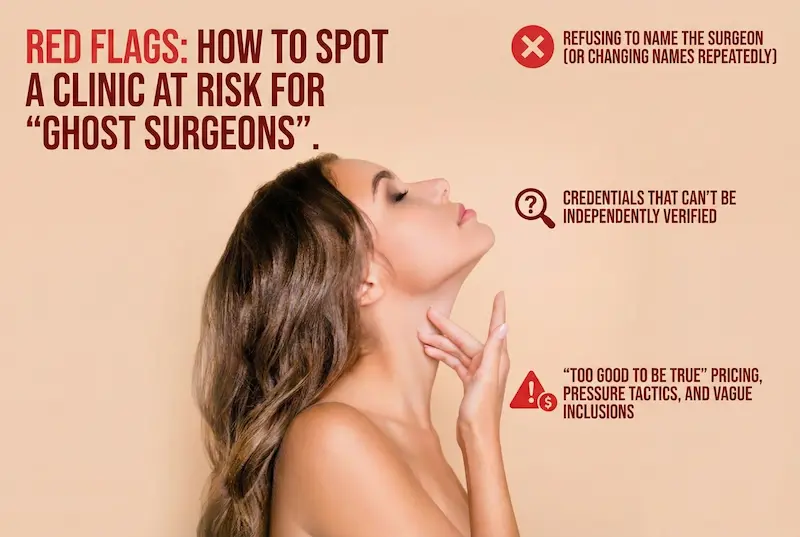
Not every “bad feeling” is proof of wrongdoing—but patterns matter. Patients who describe Turkish ghost surgery experiences often report a similar sequence: unclear surgeon identity, pressure to pay quickly, shifting names, and vague promises. Below are the most meaningful red flags that correlate with higher risk.
Refusing to name the surgeon (or changing names repeatedly)
If you ask, “Who exactly will operate on me?” and you don’t get a full name, credentials, and a direct surgeon consultation, that’s a problem. Another red flag is when the surgeon name changes after you pay a deposit, or you’re told the surgeon will be confirmed “after you arrive.” Your surgeon should be known and verified before you travel.
Credentials that can’t be independently verified
Marketing claims are not credentials. A clinic should be able to provide the surgeon’s full legal name, medical registration details, and professional memberships that you can check independently. Beware of vague phrasing like “internationally certified” without naming the certifying body. This is where patients searching “ghost doctor plastic surgery Turkey” often feel trapped: they realize too late that the credentials were never verifiable.
The deeper diagnostic question isn’t just “are these credentials real” but “does this clinic operate within a system that makes substitution structurally difficult.” Vetting frameworks differ; some hide substitution opportunities, others architect them out. The structural framework for evaluating Turkish clinics — including which operational signals reliably correlate with surgeon-led care — is covered in our clinic-selection diagnostic framework.
“Too good to be true” pricing, pressure tactics, and vague inclusions
Low price alone doesn’t prove anything, but extreme undercutting combined with pressure (“limited slots,” “today-only discount”) is a risk signal. Vague package language—without surgeon name, facility name, anesthesia plan, and aftercare structure—can hide substitutions. A credible provider will put details in writing and won’t punish you for asking careful questions.
The Verification Checklist (Before You Book Anything)
This section is your protection framework. If you follow these steps, you can drastically reduce the risk of surgeon substitution and feel confident you are not walking into a Turkey ghost surgery situation. Think of it as a pre-operative due diligence checklist based on how high-trust medical systems validate identity, documentation, and accountability.
Identity verification: who exactly will operate on you?
- Get the surgeon’s full name (as it appears on medical registration) and request a video consultation with that surgeon.
- Ask directly: “Will you perform the critical steps of my procedure?”
- Request written confirmation that the named surgeon is the operating surgeon (not just “part of the team”).
The “who will operate” question is the single highest-yield verification step — but most patients don’t know which follow-up questions to ask when the answer is vague. Generic queries like “are you board-certified” rarely surface substitution risk. The surgeon-vetting question protocol designed specifically for international consultations — including red-flag follow-ups when initial answers are evasive — is in our surgeon vetting question protocol.
Credential verification: board certification, memberships, hospital privileges
Ask for credentials you can confirm independently. Examples of what you want to verify:
- Medical license / registration status
- Relevant specialty training and scope of practice
- Hospital or accredited facility operating privileges (where applicable)
If a clinic cannot support verification with concrete information, that’s not a “minor inconvenience”—it’s a meaningful risk indicator.
Independent credential verification has become substantially harder for international patients in the last decade — registries fragmented across jurisdictions, varying transparency standards, and intentional opacity from non-compliant clinics. A structured workflow is the only reliable approach. The cross-border verification workflow — Turkish Medical Association registry, EBOPRAS, ISAPS lookup, and hospital privilege confirmation — is broken down in our cross-border credential verification workflow.
The “board-certified” label has international equivalency challenges that consumer-facing marketing rarely addresses honestly. ABPS vs EBOPRAS vs Royal College equivalence — and what counts as legitimate certification across jurisdictions — is the unresolved gap in most patient guides. A jurisdictional comparison of plastic surgery board certification standards, including equivalence frameworks for US patients evaluating Turkish surgeons, is in our board certification equivalence framework.
Proof of expertise: consistent before/after, long-term follow-ups, case volume signals
Before/after photos should be consistent in lighting and angles and reflect cases similar to yours. Ask for:
- Examples close to your age range and anatomy
- Evidence of healed results (not only immediate post-op)
- A clear explanation of the technique and expected trade-offs
In aesthetic surgery, consistency is a quality marker. When patients talk about ghost surgery Turkey, one repeating theme is inconsistency: the portfolio they saw did not match the outcome they received.
What to Get in Writing: The Non-Negotiables
If you’re trying to avoid Turkish ghost surgery risk, verbal promises are not enough. Your protection comes from documentation that ties the surgeon’s identity to the procedure and to the facility’s records. Legitimate providers won’t be offended by this—they’ll recognize it as an informed, safety-first mindset rooted in patient rights and medical governance.
Written confirmation of the named surgeon on consent and admission documents
Before you travel, ask for a written statement (email is fine, but official documents are better) confirming:
- The operating surgeon’s full name (as registered/licensed)
- The procedure name (exact wording matters)
- The facility name where surgery will occur
On the day of surgery, your consent form and/or admission record should reflect the same surgeon. If a clinic says, “We can’t put the surgeon’s name in writing,” treat that as a serious red flag for ghost surgery Turkey concerns.
Who will be in the OR: assistant roles, anesthesiologist, nurse team
To reduce the chance of “surprise personnel,” ask for a clear breakdown of the operating room roles:
- Primary surgeon: who performs the critical steps
- Assistant surgeon(s): what tasks they perform
- Anesthesia provider: anesthesiologist or anesthesia specialist and who monitors you
- Scrub/circulating nurses: typical staffing and safety checks
This level of clarity is normal in high-trust systems. It also makes it harder for a clinic to blur roles in a way that feeds “Turkey ghost surgery” fears.
“Day-of-surgery” safeguards: marking, time-out protocol, matching IDs
Ask the clinic to confirm they follow a formal surgical safety “time-out” process (a standard concept supported by scientific research on reducing preventable errors). On the day:
- Ensure your surgeon meets you before you’re taken to the OR.
- Confirm your name, procedure, and surgical plan verbally with the team.
- Ask, calmly and directly: “Please confirm the operating surgeon’s name.”
If you feel pressured not to ask, or if answers become evasive, don’t ignore that instinct.
Patient-safe script: “For my own peace of mind, I need the operating surgeon’s full name confirmed and documented on my consent paperwork.”
What Ethical, Surgeon-Led Clinics Do Differently
Here’s the reassuring part: safe, ethical clinics already have systems that make ghost plastic surgery scenarios unlikely. Transparency isn’t a marketing line—it’s visible in how they consult, document, and deliver continuity of care. If you’re comparing providers and worried about ghost doctor plastic surgery Turkey stories, use these markers to identify a safer culture.

Surgeon-led consultation and planning (not coordinator-led medicine)
In a surgeon-led model, you speak directly with the surgeon who will operate. They take your history, evaluate anatomy, explain options, and outline risks and recovery realistically. Coordinators can help with logistics, but they shouldn’t replace the surgeon in clinical decisions. If the “medical” answers feel scripted or evasive, pause.
Transparent operating room accountability and documentation
Ethical clinics can tell you exactly where your procedure happens, who provides anesthesia, and how roles are structured. They don’t resist giving you records. They also explain how they handle “plan changes” (for example, if a surgeon is unexpectedly unavailable). The correct answer is never “we’ll figure it out when you arrive.”
Operating room accountability isn’t just culture — it’s structurally enforced by accreditation bodies that audit surgical safety protocols, identity verification timeouts, and documentation completeness. A clinic’s accreditation profile is the systemic answer to ghost surgery risk. Which Istanbul hospitals hold JCI accreditation, what JCI specifically audits regarding surgeon-of-record protocols, and how to verify accreditation independently is detailed in our JCI accreditation audit standards.
The structural separation between “marketing-level transparency” and “operational-level transparency” matters: the latter requires touring OR specifications, sterilization protocols, and patient flow architecture before booking. The operational walkthrough — OR specifications, recovery suites, post-op monitoring areas, and patient flow architecture — for our facility is documented in our surgical facility operational profile.
Structured aftercare and continuity once the patient returns home
Responsible providers plan aftercare as carefully as surgery. That includes post-op checks, clear wound-care instructions, and an escalation path if you develop swelling, bleeding, fever, or a wound issue once you’re back home. Clinics that take continuity seriously will also provide a complete medical summary for your local doctor if needed.
If You Suspect Ghost Surgery: What to Do Immediately
If you believe you may have experienced surgeon substitution—or you’re seeing inconsistencies that make you worry about Turkey ghost surgery—act quickly but methodically. The goal is to protect your health first and preserve documentation second. Avoid emotional confrontation in the immediate post-op window; focus on records and safe medical follow-up.
Request your medical records: op note, anesthesia record, implants/stickers
Ask for a complete set of records in writing, including:
- Operative note (op note)
- Anesthesia record
- Consent forms
- Medication chart and discharge summary
- Implant stickers/serial numbers (if any implants were used)
These records are the most objective way to confirm what happened and who was responsible.
Escalation steps: patient relations, hospital administration, official reporting
If you’re in a hospital or an accredited facility, ask to speak with patient relations or administration. Keep communications factual: dates, procedure, names provided, and what you are requesting. If you’re back home, continue via email so there is a written trail.
Medical next steps: second opinion, complication screening, and documentation trail
Your health comes first. If you have concerning symptoms—worsening pain, fever, shortness of breath, sudden swelling, bleeding, wound separation—seek urgent medical care locally. Even if your main concern is ethical or legal, complications require immediate attention. Ask your local clinician to document findings clearly and keep copies of everything.
Frequently Asked Questions (FAQ): Ghost Surgery in Turkey
This FAQ addresses the exact questions patients ask when they search phrases like Turkey ghost surgery, ghost surgery Turkey, Turkish ghost surgery, ghost plastic surgery, or ghost doctor plastic surgery Turkey. Use these answers as a practical checklist—not as fear content.
Is “ghost surgery” illegal in Turkey?
“Ghost surgery” is essentially a problem of informed consent and misrepresentation. In most jurisdictions, performing a procedure (or critical parts of it) by someone other than the surgeon you consented to—without valid consent—can trigger serious professional, ethical, and legal consequences. The most important practical point: regardless of country, you protect yourself by ensuring the named surgeon is documented on your consent and operative records.
What documents prove who actually operated on me?
The strongest documents are:
Operative note (op note): who performed the key steps, what was done, and why.
Anesthesia record: includes timelines and personnel involved in your care.
Consent forms: should list the operating surgeon and disclosed assistants.
Admission/discharge summary: often lists the attending surgeon/surgeon-of-record.
If there’s a mismatch across these documents, ask for clarification in writing.
Can I demand the surgeon’s name in writing before I travel?
Yes. In fact, if you’re concerned about ghost surgery in Turkey, you should consider it non-negotiable. Ask for the surgeon’s full legal name and written confirmation that the named surgeon will perform the critical steps of your procedure. Ethical, surgeon-led clinics are typically comfortable providing this clarity.
How is a teaching hospital scenario different from “ghost surgery”?
Teaching settings can involve trainees or assistants—but the difference is disclosure and supervision. In an ethical teaching scenario, you are informed in advance about who does what, supervision is direct, and documentation reflects reality. In a “ghost” scenario, substitution happens without your knowledge or consent. From a patient-safety perspective, transparency is the dividing line.
How can I verify a Turkish surgeon’s credentials from abroad?
Ask for the surgeon’s full name as registered, their medical registration details, and professional memberships that can be checked independently. Verification is a standard risk-reduction step in medical travel and aligns with principles supported by scientific research on improving patient decision-making through clear provider information.
What should be included in an all-inclusive quote to prevent bait-and-switch?
A quote should specify:
Operating surgeon’s full name
Facility name where surgery occurs
Anesthesia type and who provides it
What’s included (tests, garments, medications, follow-ups)
What’s excluded (possible revision policies, unexpected hospital stays, extra imaging/labs)
Vague packages can increase confusion and contribute to “ghost surgery Turkey” anxiety—clarity lowers risk.
What are my options if I’m afraid of general anesthesia?
For some procedures, alternatives like sedation (“twilight”) or local anesthesia may be appropriate, depending on your anatomy, procedure complexity, and safety profile. Discuss anesthesia options directly with the surgeon and an anesthesia professional. The safest choice is the one that matches your procedure requirements and your medical history—not the one marketed as “easier.”
Medical disclaimer: This article is for educational purposes and does not replace individualized medical advice. Always discuss your plan with a qualified surgeon and anesthesiologist.