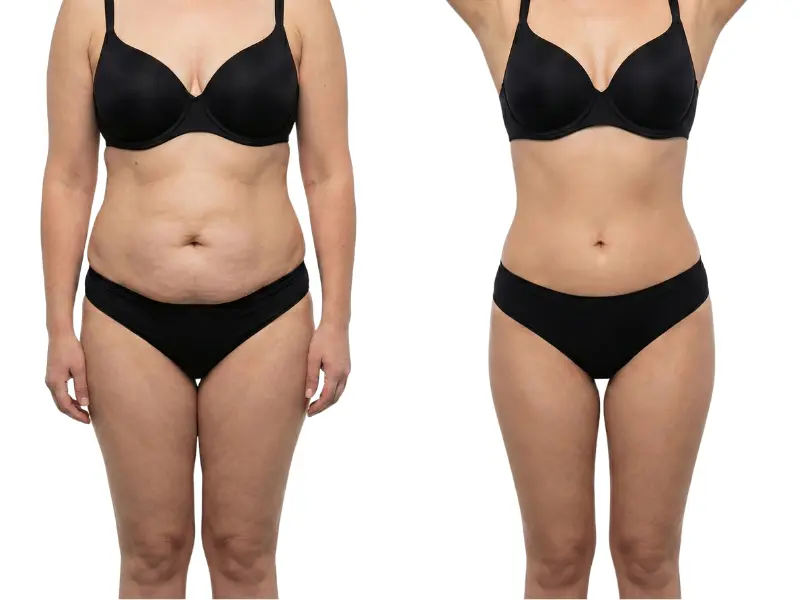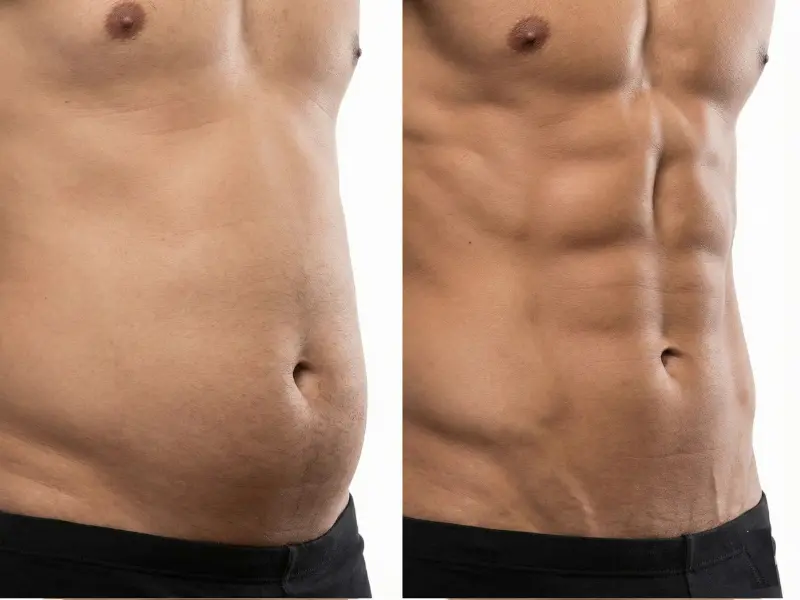
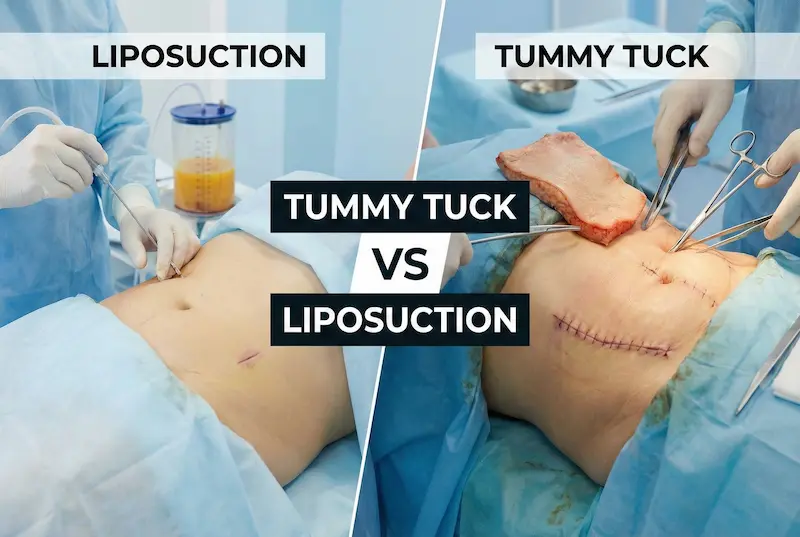
If you’ve been Googling tummy tuck vs liposuction, you’re not alone. Most “flat stomach” frustrations come from one of three things: fat, loose skin, or muscle separation. And here’s the honest truth: liposuction vs tummy tuck isn’t a “which is better?” debate—it’s a diagnosis question.
This guide is written for the expert patient who wants clear criteria (not hype), realistic expectations, and a plan that makes anatomical sense—especially for postpartum bodies where a mommy makeover may be part of the conversation.
At AKM Clinic, body contouring is planned surgeon-led—procedure selection comes from anatomy, not from a price sheet. The full breakdown of who’s a candidate, recovery realities, and the different abdominoplasty types (mini, full, extended, fleur-de-lis, reverse) lives on a separate page. If you’ve already decided that excess skin or muscle separation is your dominant issue, this is your next stop: our abdominoplasty decision hub.
If your dominant issue turns out to be fat distribution rather than skin or muscle, the matching reference is the liposuction side of the same conversation. Ultrasound-assisted (VASER) liposuction has its own candidacy logic, contour goals, and recovery profile—worth reading on its own terms before assuming any single device is “the answer.” Here’s where you can review that procedure in depth: VASER liposuction technique reference.
Key takeaway: If the problem is fat, abdominal liposuction may be enough. If the problem is skin and/or muscle separation, a tummy tuck is usually the only procedure that truly fixes it.
Table of Contents
The Decision Tree: Tummy Tuck or Liposuction?
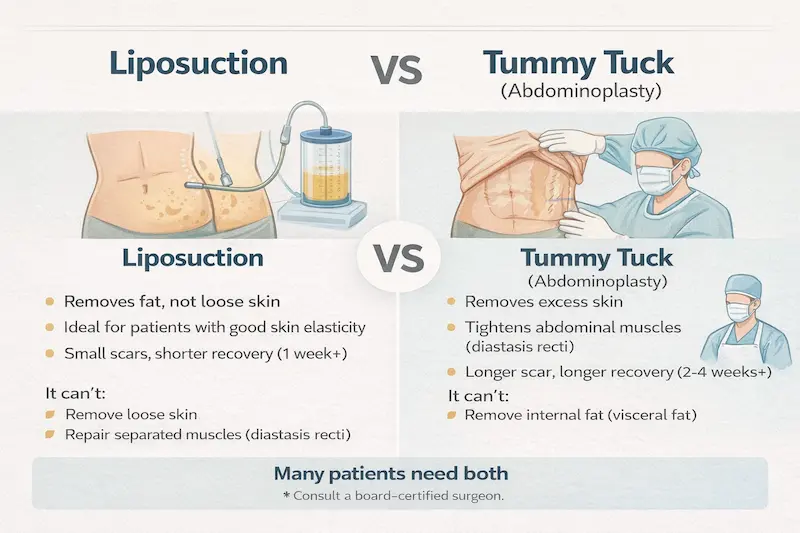
Don’t guess based on photos. Follow this simple medical logic tree to find out which procedure fits your anatomy. Where does your body lead you?
Step 1: The Skin Quality Test
Pinch the skin below your belly button. Is it mostly firm, thick tissue, or is it thin, folding, and loose?
- 👉 It’s firm, and my skin snaps back: You have good elasticity. Proceed to Step 2.
- 👉 It’s loose, thin, or folds over my waist: Liposuction cannot remove skin. You are a strong candidate for a Tummy Tuck.
Step 2: The Core / Muscle Test
When you do a gentle sit-up or plank, do you notice a bulge down the middle of your stomach, or do you have a “pooch” that never goes away despite exercise?
- 👉 Yes, I have a persistent bulge/pooch (especially after pregnancy): This indicates muscle separation (diastasis recti). You need a Tummy Tuck with Muscle Repair.
- 👉 No, my core feels strong, I just have localized fat: Proceed to Step 3.
If that bulge persists when you brace your core—especially after pregnancy—it’s usually not “stubborn fat” you’re looking at. It’s a structural issue: the rectus muscles haven’t returned to their pre-pregnancy midline. Liposuction can’t address that, because removing fat doesn’t change muscle position. How diastasis is diagnosed, how plication actually works during a tummy tuck, and what changes for postpartum bodies—all covered in our diastasis repair walkthrough.
Step 3: The Target Zone
Where is the stubborn tissue located?
- 👉 Just stubborn fat on the belly and flanks, but my skin is tight: You are the ideal candidate for High-Def Liposuction.
- 👉 I have loose skin AND stubborn fat around the waist: You need a combination approach. A Tummy Tuck with selective Liposuction (Lipoabdominoplasty) will give the best result.
What Liposuction Can (and Can’t) Do for the Abdomen
To understand liposuction vs tummy tuck (and the real liposuction vs tummy tuck differences), you need one key concept: liposuction is a fat-removal tool. It reshapes by reducing volume under the skin. It does not remove loose skin, and it does not repair separated abdominal muscles. That’s why the “best” procedure depends on what tissue is actually causing the problem—and why liposuction vs tummy tuck results can look wildly different even in patients with the same weight.
| Liposuction CAN do | Liposuction CAN’T do |
|---|---|
| Remove localized fat from the abdomen/flanks to improve contour | Remove loose or hanging skin (skin excess) |
| Improve waist definition and reduce “thickness” under clothing | Repair diastasis recti (muscle separation) or tighten the abdominal wall |
| Create smoother transitions between abdomen and hips when planned well | Guarantee a “flat stomach” if the main driver is skin laxity or muscle laxity |
What liposuction removes: fat cells—not skin, not muscle
When patients ask “what is a tummy tuck vs liposuction,” the simplest answer is this: liposuction targets fat. During abdominal liposuction, the goal is controlled, proportional fat reduction—not extreme removal. Done well, it can improve the silhouette and make the abdomen look slimmer and more defined.
But if your biggest complaint is “my stomach looks stretched,” “my belly button area looks wrinkled,” or “my lower belly hangs,” that is usually a skin problem, not a fat problem. In those situations, comparing tummy tuck vs liposuction abdomen outcomes is like comparing two different tools for two different materials.
- Best lipo candidates tend to have localized fat + reasonably firm skin.
- Most disappointed lipo-only patients tend to have loose skin, significant stretch marks below the belly button, or a postpartum abdominal “apron.”
The skin-elasticity rule: when lipo can look great vs. when it backfires
Here’s the part that explains why liposuction vs tummy tuck pictures can be confusing: skin has to “shrink-wrap” to the new contour after fat is removed. If your skin has good recoil, lipo can look clean and athletic. If your skin is thin, overstretched, or already lax, lipo can leave you with more visible wrinkling or a “deflated” look—because you’ve removed the volume that was partially filling the extra skin.
If you’re trying to self-screen, ask yourself these two questions:
- When I pinch, is most of what I’m grabbing fat thickness—or is it mostly loose skin?
- Does my skin bounce back quickly, or does it stay “creased”?
Practical takeaway: If you already have obvious loose skin, liposuction alone usually isn’t the “better” option—because it cannot remove skin. That’s when stomach liposuction vs tummy tuck typically points toward a tummy tuck evaluation.
Modern lipo options: high-definition/energy-assisted methods and when skin tightening is added
Not all liposuction is identical. Technique and planning matter—especially around the abdomen where smoothness and symmetry are critical. Many clinics now offer “definition-focused” approaches (often described as high-definition) and may pair liposuction with adjunctive skin-tightening technologies in select candidates.
At AKM Clinic’s body contouring menu, you’ll see options such as High-Def VASER Liposuction, Awake Liposuction, and Liposuction & Skin Tightening. The clinic also lists J-Plasma Skin Tightening as an option—these are typically considered when the goal is contour plus some degree of tightening support (candidate-dependent, not guaranteed).
Two “expert patient” notes before you get excited about any device:
- Energy-assisted or skin-tightening add-ons can help in mild-to-moderate laxity, but they are not a substitute for removing excess skin when laxity is significant.
- Surgeon judgment is the safety lever. The plan should prioritize predictable blood supply, conservative fat removal in risk zones, and realistic expectations—especially when patients are postpartum or considering a mommy makeover.
Finally, remember that liposuction is still surgery. In any clinic, your risk profile depends on sterile technique, operating standards, and the team’s experience—not just the device name.
What a Tummy Tuck (Abdominoplasty) Actually Fixes
If you’re stuck in the “tummy tuck vs liposuction” loop, this section is the reset: a tummy tuck (abdominoplasty) is not “stronger liposuction.” It’s a different operation with different goals. In the liposuction vs tummy tuck differences, the biggest one is simple: a tummy tuck removes excess skin and can repair abdominal wall separation, while liposuction removes fat volume.
This matters most for postpartum patients—especially the “mommy makeover” audience—because the problem often isn’t fat at all. It’s loose skin, stretch-marked lower abdomen skin, and sometimes muscle separation. That’s why abdominal liposuction vs tummy tuck is really about identifying what tissue is driving your silhouette.
Postpartum bodies often present a stack of issues, not one: lower-belly skin laxity, diastasis, residual breast changes, sometimes flank fat. Treating only one of those leaves the rest untouched—which is why mommy makeover planning is fundamentally a sequencing question, not a single-procedure decision. The “right combination” is highly individual. What matters is the surgeon’s logic in matching procedures to *your* dominant tissue issues.
Full combination logic, candidacy, and travel planning live here: postpartum makeover hub.
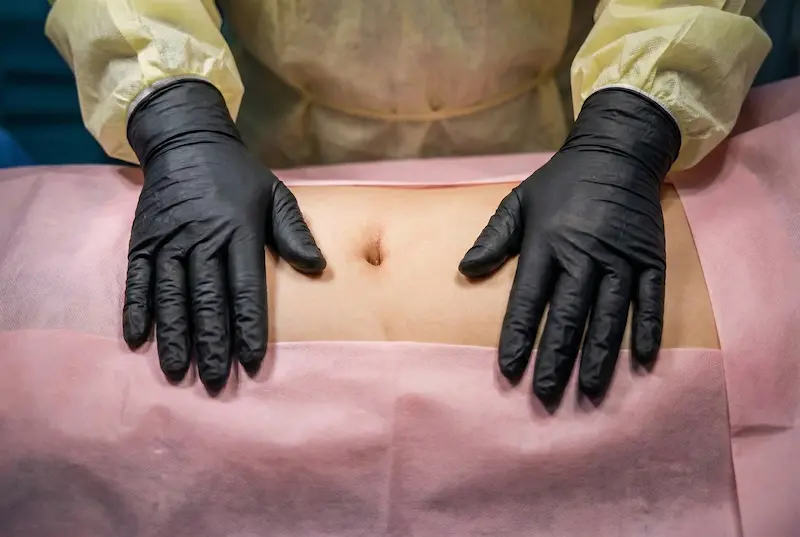
The real target: excess skin removal + reshaping the lower abdomen
In plain English, a tummy tuck is designed to address what liposuction can’t: extra skin. When people search for tummy tuck vs liposuction pictures or liposuction vs tummy tuck pictures, the most dramatic “wow” transformations usually happen when there’s a true skin problem—because removing skin changes the silhouette in a way fat-removal alone can’t.
- What improves most: the lower abdomen (below the belly button), the “apron,” and skin laxity that folds in clothing.
- What doesn’t automatically improve: overall body weight or visceral (internal) fat—those aren’t tummy tuck targets.
- What happens to the belly button: in many full tummy tucks, the surgeon preserves your belly button but brings it through the tightened skin in a natural position (this is one reason surgeon technique matters when comparing “results”).
Expert-patient reality check: If your main complaint is loose, stretched skin, asking “tummy tuck vs liposuction which is better?” is usually the wrong question. The better question is: “Do I have a skin problem, a fat problem, or both?”
Muscle repair (diastasis recti): why it changes contour and core stability
Many patients describe the issue as a “pooch” that doesn’t respond to workouts. If that pooch is driven by abdominal wall laxity (commonly discussed as diastasis recti), liposuction won’t fix it—because liposuction doesn’t change muscle position. That’s one of the key reasons stomach liposuction vs tummy tuck outcomes diverge so much in postpartum bodies.
In the right candidates, a tummy tuck can include abdominal wall tightening as part of the reshaping—so the contour becomes flatter not just because skin is removed, but because the underlying structure is supported.
Important: Only an in-person exam can confirm whether muscle separation is present and clinically meaningful. Use this article to become informed—then let your surgeon verify anatomy before choosing between tummy tuck vs. liposuction.
Types of tummy tuck: mini vs. full vs. extended vs. fleur-de-lis—who each is for
Not every tummy tuck is the same. A major reason patients get confused comparing mini tummy tuck vs liposuction (or comparing different “pictures”) is that the type of tummy tuck determines how much skin can be removed and where the tightening happens.
AKM Clinic lists tummy tuck within its body contouring portfolio and explicitly outlines multiple types of tummy tuck, including mini, extended, fleur-de-lis, and reverse tummy tuck.
| Type | Best for | Key limitation |
|---|---|---|
| Mini tummy tuck | Mild lower-abdomen skin laxity (mostly below the belly button) | Limited correction if you have significant loose skin above the belly button |
| Full tummy tuck | Moderate-to-significant skin laxity, often postpartum; may include muscle tightening | Longer scar and recovery than mini; requires careful planning for natural belly button aesthetics |
| Extended tummy tuck | Loose skin that extends toward the hips/flanks | Longer incision/scar footprint (trade-off for broader tightening) |
| Fleur-de-lis tummy tuck | Major skin excess after significant weight loss (including horizontal + vertical laxity) | More visible scarring pattern (chosen when contour benefit outweighs scar trade-off) |
| Reverse tummy tuck | Upper abdominal laxity in select cases | Not appropriate for most classic postpartum “lower apron” concerns |
The mini-versus-full distinction confuses more patients than almost any other body-contouring decision—because the scar length, candidacy criteria, and what each procedure can actually fix differ in ways the names don’t quite reveal. If you’re flipping between “would a mini be enough for me?” and “do I really need a full?”, that side-by-side deserves its own breakdown. Full comparison with candidacy criteria and visual outcome examples sits here: tummy tuck type breakdown.
Because Transformation Tina cares deeply about scar management and realistic visuals, this is the right moment to be blunt: the “best” tummy tuck vs liposuction results aren’t the most extreme—they’re the most anatomically appropriate, with scar placement and recovery support designed from day one.
At AKM Clinic, recovery support is positioned as part of the overall care standard, including advanced technologies such as HBOT and LLLT that the clinic describes as integral to its post-op protocol and beneficial for swelling reduction and scar-healing support. (These technologies are prominently discussed in the context of facelift recovery, but the mechanisms described—reduced inflammation, collagen support, and infection-risk mitigation—reflect the clinic’s broader recovery philosophy.)
Finally, if you’re traveling internationally, safety isn’t a “nice-to-have.” AKM Clinic states its hygiene protocols are aligned with CDC/WHO standards and that it is licensed by the Turkish Ministry of Health—details an expert patient should expect to be transparent and verifiable.
How to Tell Which Procedure You Need (A Practical Self-Check + Surgeon Check)
If you’re overwhelmed by tummy tuck vs liposuction searches (or the endless “tummy tuck vs liposuction which is better” threads), here’s the most useful mindset shift: you’re not choosing a brand—you’re matching a procedure to your anatomy.
This section gives you a practical self-check (so you can interpret liposuction vs tummy tuck pictures and “results” more intelligently), followed by what a high-quality surgeon consultation should confirm—because the final decision between abdominal liposuction vs tummy tuck should be made with a real exam, not a mirror and hope.
Photos are the most misread piece of evidence in body contouring. The same patient at 6 weeks vs 6 months looks like two different cases—because swelling distortion, scar maturation, and skin retraction unfold on a long timeline. What you should be reading in any “before-after” comparison: scar position relative to the swimsuit line, belly button placement, and whether the abdomen looks naturally proportioned (not over-flattened).
Curated outcomes with timeline annotations: abdominoplasty visual outcomes.
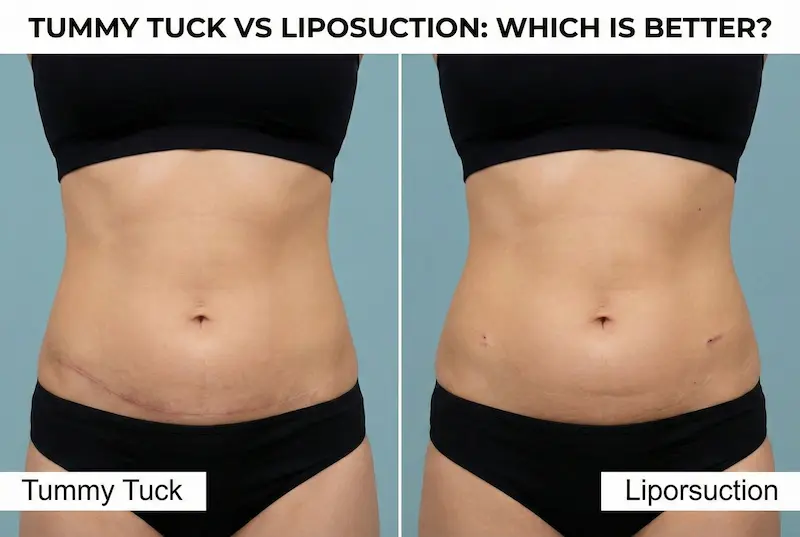
Key takeaway: Your decision is usually determined by the dominant issue: fat (lipo), skin (tummy tuck), muscle separation (tummy tuck with repair), or a combination (often both).
The “pinch test,” what it can suggest, and what it can’t diagnose
The pinch test is simple: gently pinch the tissue below your belly button (and then above it). Notice whether what you’re pinching feels like thick fat, thin loose skin, or a mix.
- If it’s mostly thickness (fat) and your skin feels firm: the “liposuction vs. tummy tuck” decision often leans toward lipo.
- If it’s mostly loose skin that creases easily: lipo alone may not help—and can even make the looseness look more obvious.
- If you have a persistent lower-belly “pooch” even when lean: that can be a sign you need evaluation for abdominal wall laxity/muscle separation—something lipo does not treat.
What this test cannot do: It can’t confirm diastasis recti, hernias, or how your skin will retract after fat removal. It’s a starting point, not a diagnosis.
| What you notice at home | What it often suggests | What a surgeon must confirm |
|---|---|---|
| Skin snaps back quickly; pinch feels mostly “padding” | Lipo may be enough | Skin quality + safe fat-removal plan + risk profile |
| Loose folds, “crepey” texture, lower-abdomen apron | Tummy tuck evaluation | How much skin must be removed; best incision/scar placement |
| Bulge that feels “structural” (not pinchable), especially postpartum | Possible muscle separation | Abdominal wall exam; whether muscle repair is indicated |
| Loose skin + love handles/waist fat | Combination plan | Whether lipo should be added (and where) for safe, proportional shaping |
Stretch marks, C-section scars, and where your loose skin actually sits
One reason patients struggle with tummy tuck vs liposuction pictures is that the “problem area” isn’t always where they think it is. Postpartum bodies are a perfect example.
- Stretch marks below the belly button: these are often located in the portion of skin that can be removed in a full tummy tuck (so many marks may improve, depending on how high they sit).
- Stretch marks above the belly button: these may shift lower and become less noticeable, but they are not always “removed.”
- C-section scars: scar location and skin laxity patterns matter. A well-planned incision can often incorporate or improve the appearance of a prior lower-abdominal scar—but that is highly individual.
Scars are biological events, not just surgical decisions. A well-placed incision can sit hidden in underwear—but how it matures over the next 12 to 18 months depends on tension, sun exposure, silicone discipline, and your individual healing biology. Worth flagging: most “bad scar” outcomes online aren’t really surgical errors—they’re aftercare gaps that compound silently in the first 6 months.
The full silicone-and-laser protocol, plus what AKM’s HBOT and LLLT add to scar quality, is documented separately: scar minimization deep-dive.
This is also the moment to be honest about the “mini tummy tuck vs liposuction” question: a mini tummy tuck is usually limited to the lower abdomen. If most of your loose skin is above the belly button, a mini is often not enough—no matter how appealing the smaller scar sounds.
What a proper consultation should include: measurements, skin quality, diastasis assessment, and safety planning
A high-quality consultation should feel like a clinical evaluation, not a sales call. The surgeon should identify whether your primary issue is fat, skin, muscle separation, or a combination—then explain what that means for expected results, scars, and recovery.
If you’re traveling for surgery, this typically happens in two stages:
- Virtual photo review / preliminary plan: to understand your goals and estimate what’s feasible.
- In-person exam: to finalize the surgical plan safely (this is where muscle separation, skin elasticity, and scar strategy are confirmed).
Bring (or send) the right information so your surgeon can plan accurately:
- Front/side/oblique photos in good lighting (relaxed posture)
- Your height, weight, recent weight stability (and whether you plan future pregnancy)
- Prior abdominal surgeries (C-section, hernia repair, etc.)
- Your “must-haves” (flatter lower abdomen, tighter waist, minimizing scar visibility)
Questions expert patients should ask (and expect clear answers to):
- “In my case, what is the primary issue—fat, skin, muscle separation, or all three?”
- “If we do liposuction only, what is the realistic best-case outcome—and what’s the risk of loose-skin worsening?”
- “If we do a tummy tuck, what type (mini/full/extended) fits my anatomy—and where will the scar sit in underwear?”
- “Do you recommend combining lipo + tummy tuck for my waist/abdomen—why, and how do you keep it safe?”
- “What’s your plan for recovery support, swelling control, and scar management?”
Bottom line: The best “liposuction vs tummy tuck differences” decision is the one that your surgeon can explain in one sentence: “We’re treating fat / skin / muscle (or a combination), and here’s why that matches your body.”
When You Need Both: Lipo + Tummy Tuck (and Why It’s Not “Overkill”)
Combined lipoabdominoplasty has been one of the most scrutinized body-contouring questions in plastic surgery for two decades, and the evidence base has matured—especially for ultrasound-assisted (VASER) variants and energy-based skin-tightening adjuncts.
A March 2025 retrospective analysis of 77 patients in Aesthetic Surgery Journal Open Forum evaluated UAL-VASER lipoabdominoplasty with and without helium-plasma radiofrequency adjuncts: VASER lipoabdominoplasty safety analysis. The investigators found no significant difference in serious adverse-event rates between the two approaches—suggesting that, in appropriately selected patients with surgeon-led planning, modern combined protocols can preserve flap perfusion safely.
Important caveat: this is a single-center, single-surgeon retrospective with 77 patients—useful for safety signal, not the final word on combined-procedure decision-making across all surgical settings. Larger multi-center prospective data remains the gold standard your in-person evaluation should reference.
This is where the conversation shifts from tummy tuck vs liposuction which is better to “How do we design the safest plan that delivers the most natural contour?” A combined approach is often called lipoabdominoplasty (or simply “tummy tuck with liposuction”), and it’s common in mommy makeover planning.
When adding lipo improves results (waist definition, flanks, upper abdomen)
A tummy tuck is excellent at removing excess lower-abdominal skin and improving the abdominal wall profile, but it doesn’t automatically create a defined waist. That definition often comes from carefully placed liposuction—especially in the flanks (“love handles”) and sometimes the upper abdomen.
- Best “both-procedure” candidates often have: loose lower-belly skin + stubborn waist/flank fat.
- Typical goal: a flatter front and a smoother, more tapered transition from abdomen to hips.
- Realistic expectation: the combined plan is usually about proportion and contour—not chasing an unrealistic “zero body fat” look.
How to interpret “liposuction vs tummy tuck results” online: If someone’s waist looks dramatically more defined and their lower belly skin looks tighter, you’re often seeing a combined plan—whether the caption says so or not.
Safety-first sequencing: preserving blood supply, minimizing complications, reducing risk
This is the expert-patient part: combining procedures can be safe in appropriate candidates—but it’s not something you want done aggressively or casually. Why? Because a tummy tuck involves lifting and re-draping abdominal skin, and that skin needs a healthy blood supply to heal well. Overly aggressive liposuction in the wrong areas can compromise circulation and increase complication risk.
In a safety-first approach, your surgeon should be able to explain:
- Where lipo will be done (and where it will not be done) to protect tissue perfusion.
- Whether your case should be combined or staged (two separate surgeries) based on anatomy and risk factors.
- How risk is reduced: operative time management, careful fluid strategy, mobility plans, compression strategy, and close follow-up—especially for medical travelers.
Green-flag language from a surgeon sounds like: “We’re going to treat fat here, remove skin here, and support structure here—without pushing the tissues past safe limits.”
Typical recovery expectations when combining procedures (downtime, garments, follow-ups)
Recovery varies by individual and by surgical extent (mini vs full vs extended tummy tuck, how much lipo is added, and your baseline health). But in general, combining procedures means you should plan for a more “structured” recovery than lipo alone—because the tummy tuck component drives most of the downtime.
| Recovery window | What you typically feel/see | What matters most |
|---|---|---|
| Days 1–3 | Tightness, swelling, fatigue; walking is slow and supported | Short walks, hydration, compression as instructed, pain control plan |
| Week 1 | Swelling peaks; posture may be slightly bent; energy is limited | Follow-up checks, drain/garment guidance if applicable, rest + gentle movement |
| Weeks 2–3 | Many patients feel “more human,” but swelling is still significant | Consistency with compression, scar care plan starts (timing is surgeon-specific) |
| Weeks 4–6 | Shape improves; swelling gradually decreases; comfort increases | Gradual return to normal activity (surgeon-guided) |
| Weeks 6–12 | Contours continue to refine; scars start evolving (not “final” yet) | Progressive exercise clearance + long-term scar strategy |
That timeline tells you what to expect, not how to optimize through it. Recovery quality—how much swelling you tolerate, how your scar matures, when your “shape day” actually arrives—comes down to the daily decisions: nutrition, mobility, garment compliance, sleep position, when to add gentle movement. None of that is in the operating room. If you want a practical, day-by-day playbook that addresses those decisions specifically, read our abdominoplasty aftercare playbook.
One detail that often gets buried: the swelling curve in lipoabdominoplasty is partially driven by lymphatic load, not just inflammation. That’s why manual lymphatic drainage isn’t a “spa add-on”—it’s a tool that, when properly timed, can reduce fluid retention and accelerate the visible-result window. Most patients underestimate how much MLD compliance shapes their week-2 to week-6 progress. Timing, frequency, and how to continue MLD after returning home: post-lipo MLD walkthrough.
If you’re traveling for surgery, expert patients plan enough time for early monitoring—because the first days are when swelling, mobility, and aftercare instructions matter most. And if a clinic offers advanced recovery support (like oxygen- and laser-based therapies), your surgeon should explain what’s included, what’s optional, and what outcomes those tools realistically support.
Ready to See Prices and Recovery Details?
Now that you’ve determined whether your body needs skin removal or fat reduction, explore the full surgical journey. Read about day-by-day recovery timelines, safety protocols, and all-inclusive package costs in Istanbul.
- 👉 If you need skin tightening & muscle repair: Read our Tummy Tuck Guide.
- 👉 If you only need fat contouring: Read our Liposuction Guide.
Tummy Tuck vs Liposuction Frequently Asked Questions (FAQ):
Below are the most common questions behind searches like liposuction vs tummy tuck, tummy tuck vs liposuction which is better, and “which one do I actually need?”
Can liposuction tighten loose belly skin?
Liposuction removes fat volume—it does not remove loose skin. If you have mild laxity and good skin elasticity, your skin may contract somewhat as swelling resolves. But if you already have obvious loose skin (folding, crepey texture, an apron), liposuction alone usually won’t create a tight abdomen, and it can sometimes make looseness look more noticeable.
Will a tummy tuck remove stretch marks?
Sometimes. Stretch marks located on the lower abdomen (below the belly button) may be removed if they are on skin that is excised during a full tummy tuck. Stretch marks above the belly button generally aren’t “removed,” but they may shift position and appear less prominent. Your surgeon should explain what’s realistic based on where your marks sit and how much skin can safely be removed.
Can lipo fix diastasis recti (ab separation)?
No. If your main issue is a postpartum “pooch” driven by abdominal wall laxity/muscle separation, liposuction won’t correct it because it doesn’t repair muscle. That’s when the conversation usually shifts toward tummy tuck (often with muscle repair), not abdominal liposuction vs tummy tuck as a “fat removal” debate.
Is it safe to combine tummy tuck and liposuction?
It can be safe in appropriate candidates when planned conservatively and performed in a proper hospital setting. The key is protecting blood supply to the abdominal skin and managing overall surgical stress (time, fluid balance, mobility plan, aftercare). If a clinic recommends “aggressive lipo everywhere” alongside a tummy tuck without explaining safety limits, that’s a red flag.
How long will I be out of work (and when can I exercise again)?
Downtime depends on what you’re having done. Liposuction alone is typically a shorter recovery than a tummy tuck; a tummy tuck (especially with muscle repair) usually requires a more structured healing period. Your surgeon should give you a personalized timeline based on: procedure type (mini vs full vs extended), whether you’re combining lipo, and your job’s physical demands.
When can I fly after liposuction or a tummy tuck?
This is individualized and should be cleared by your surgeon—especially because flying too early can overlap with the higher-risk window for swelling and clot prevention. If you’re traveling for surgery, plan your trip so you can complete early post-op checks and receive clear “fit-to-fly” guidance before departure. (AKM Clinic also describes long-term virtual follow-ups at 1, 3, 6 months and 1 year, which can help support international patients after they return home.)
What actually helps minimize tummy tuck scars?
Scar quality is influenced by surgical technique (tension management and incision placement), your biology, and consistent aftercare (including silicone-based scar protocols when cleared). AKM Clinic emphasizes advanced recovery technologies—HBOT and LLLT—as part of its stated post-op care protocol, describing benefits such as reduced swelling/downtime and improved scar-healing support.
What’s the “liposuction vs tummy tuck cost” difference?
Costs vary widely based on surgical extent and what’s included: facility and anesthesia fees, whether muscle repair is performed, whether lipo is added, surgeon expertise, and the level of aftercare and monitoring. If you’re comparing destinations or clinics, compare all-in cost (not just the surgeon fee) and insist on transparency.
AKM Clinic describes a “no hidden fees” all-inclusive quote model provided in USD, with typical inclusions such as procedure/hospital/anesthesiologist fees, hotel, VIP transfers, a dedicated patient host, and post-op medications/garments (flights and personal spending excluded).
The cost question rarely has one number. What you actually pay depends on whether muscle repair is performed, how much liposuction is added, surgeon expertise, hospital tier, and aftercare scope. Transparent clinics list components rather than a single headline figure—facility fee, anesthesia, surgeon, hospital stay, garments, follow-ups. For the abdominoplasty side specifically (with all-inclusive USD pricing, scope variations, and what's covered): abdominoplasty cost reference.
And for the liposuction side, the price drivers are different—donor area scope, technology used (suction-assisted vs ultrasound-assisted vs laser-assisted), and whether skin-tightening adjuncts are added. Comparing the two cost structures side-by-side often clarifies which procedure your dominant issue actually warrants—skin and muscle work scales the bill differently than fat removal alone. Liposuction-side cost breakdown: liposuction pricing reference.