There is no breast reduction size chart that can guarantee your final cup size. As a rough planning guide, removing about 100–300 grams of tissue per breast may reduce the breast by approximately one cup size, but your result depends on band size, breast density, body frame, healing, and surgical safety limits.
A breast reduction size chart can be useful, but only if you treat it as a conversation tool rather than a promise. The goal is not to chase a letter on a bra tag. The goal is to create a smaller, lighter, proportional breast shape that fits your body and can be achieved safely.
That is why the first step in how AKM plans a breast reduction is not simply asking, “Do you want to be a C cup?” A board-certified plastic surgery team looks at your chest width, breast base, shoulder frame, skin quality, tissue density, nipple position, symptoms, and personal goals before estimating a realistic size range.
For many women, the most helpful way to think about breast reduction is this: your surgeon can often estimate a range of change, but not a guaranteed cup letter. A 36G to 36D goal may be realistic for one patient and unsafe for another. A 34F to 34C result may look balanced on one body and too small on another. The “right” result is personal.
This guide breaks down the gram-to-cup relationship, why cup sizes are so inconsistent, how sister sizes can confuse your expectations, and what to ask during consultation so you can describe your target clearly.
Table of Contents
Why There’s No Exact “Size Chart”?
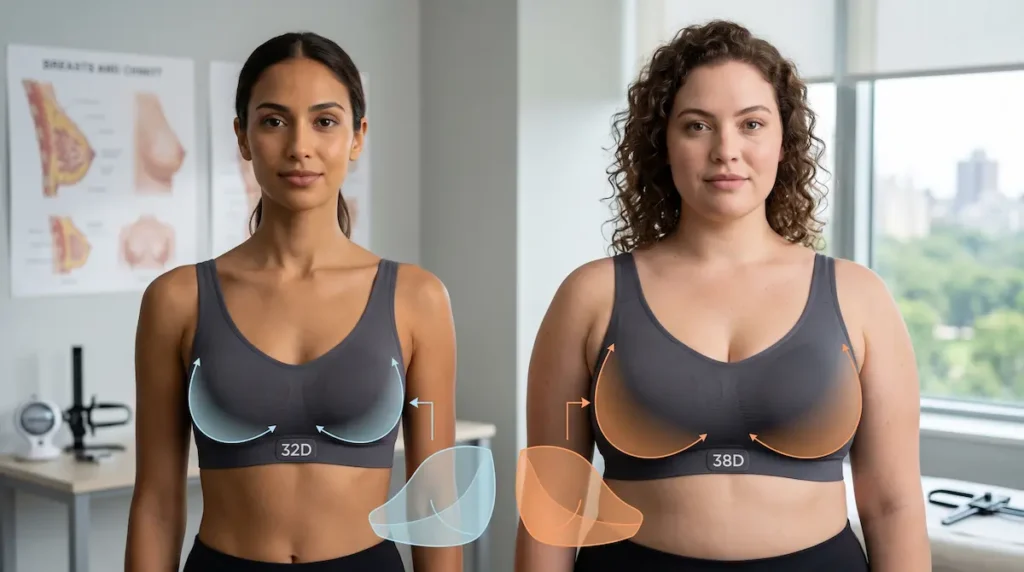
Breast size sounds simple until you try to measure it precisely. Cup letters are not fixed volumes. A D cup on a 32 band is not the same breast volume as a D cup on a 38 band, and two bras with the same label can fit differently depending on the brand, style, padding, and stretch.
Cup Size Is Not a Fixed Volume
A cup size is a relationship between the bust measurement and the band measurement. That means the letter changes when the band changes. A 34D and a 36C can hold a similar volume, even though the labels look different. These are called sister sizes.
This is one reason a surgeon cannot simply say, “I will remove 500 grams and you will be a C cup.” The same amount of tissue removed from two patients can create very different changes in shape, projection, and bra size.
Breast tissue is also not identical from person to person. Some breasts contain more dense glandular tissue. Others contain more fatty tissue. Dense tissue weighs more for the same visible volume, so two patients can have similar-looking breasts but require different gram removals to reach a similar visual change.
Band Size Changes the Cup Letter
In US bra sizing, the cup letter is tied to the band. A 32DD is not the same volume as a 38DD. This matters because breast reduction changes the breast volume, but it usually does not change the ribcage measurement beneath the breasts.
After surgery, swelling, surgical bras, and early healing can make sizing feel confusing. A patient may think she “didn’t go down enough” because her early bra label looks larger than expected. Often, the final size cannot be judged until swelling settles and the breast shape softens.
That is why measuring too early can lead to unnecessary anxiety. Your early post-op bra is usually chosen for support and swelling control, not fashion sizing.
Why Two Patients Can Have Different Results From the Same Gram Removal
Imagine two patients each have 500 grams removed per breast. One starts at a 34H with dense tissue and a narrow chest. The other starts at a 38DDD with softer tissue and a wider chest. The same gram removal will not create the same cup-size change.
Several factors shape the outcome:
- Starting breast size: Larger breasts may require more tissue removal to create a visible cup change.
- Band size: The same breast volume reads differently across different band sizes.
- Breast density: Dense glandular tissue weighs more than fatty tissue.
- Breast base width: A wider breast base may still look full after a significant reduction.
- Skin elasticity: Skin quality affects the final contour and projection.
- Safety limits: The nipple and areola need a healthy blood supply, which can limit how small the breast can safely go.
So, a size chart should never be read like a clothing-size conversion chart. It is a starting point for planning.
The Gram-to-Cup Relationship
Surgeons often talk about breast reduction in grams because removed tissue is weighed during surgery. Patients, however, think in cup sizes because that is how they shop for bras and visualize their body. The challenge is translating one language into the other without creating a false promise.
The 100–300 Grams Per Cup Rule of Thumb
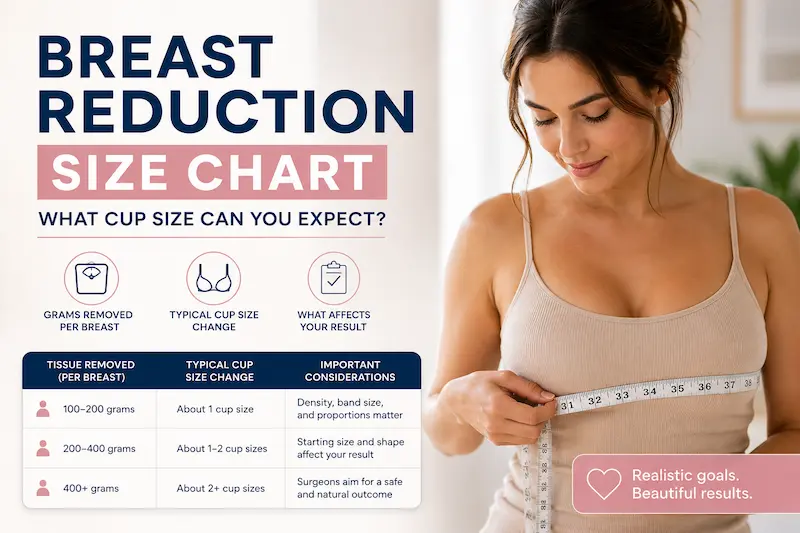
The American Society of Plastic Surgeons notes that cup size cannot be predicted exactly before surgery, but a commonly used estimate is that every 100–300 grams of tissue removed may reduce the breast by about one bra cup size. This is a helpful benchmark, not a guarantee.
Here is a practical way to read that estimate:
| Approx. Tissue Removed Per Breast | Possible Cup-Size Change | Why This Is Only an Estimate |
|---|---|---|
| 100–300 g | About 1 cup size in many patients | May look more or less dramatic depending on band size and tissue density |
| 300–600 g | Often around 1–2 cup sizes | Breast base width and starting size can change how visible the reduction looks |
| 600–900 g | Often around 2–3 cup sizes | Safety, nipple blood supply, and skin quality may limit how small the surgeon can go |
| 900 g+ | Usually a larger reduction | Final cup size still cannot be guaranteed because cup labels are inconsistent |
This table should be read as a planning guide. It does not replace an in-person or virtual assessment. It also does not mean the relationship is perfectly linear. Removing 600 grams does not automatically mean “exactly two cups down” for every patient.
Why It’s a Range, Not a Promise
Breast reduction is not simple subtraction. A surgeon is not only removing tissue; they are reshaping the breast, lifting the nipple-areola complex, tightening the skin envelope, and creating a breast mound that sits better on the chest.
That reshaping can make your breasts look smaller, perkier, and lighter even if the final bra label does not drop as many letters as you expected. The opposite can happen too: swelling may make the early result look fuller than the final size.
A good consultation should separate three goals:
- Symptom relief: less weight, less pulling, easier movement.
- Visual proportion: a breast size that fits your shoulders, waist, and frame.
- Bra-size goal: a preferred range, such as “small D to full C,” rather than one fixed letter.
Surgeon-led planning note: A safe breast reduction aims for a realistic size range, not a guaranteed cup letter. The best result is one that reduces weight, protects blood supply, and looks proportional on your body.
How Breast Density Changes the Calculation
Research on predicting cup size after reduction mammaplasty has shown why the gram-to-cup question is so difficult: cup volume, band size, tissue density, and surgical planning all interact. A dense breast can weigh more than a softer breast of similar visible size.
This is why two women may both remove 500 grams but describe different changes afterward. One may feel she dropped two cups. Another may feel she dropped closer to one. Neither is necessarily wrong; the starting anatomy was different.
For an expert patient, the practical takeaway is simple: do not ask only, “How many grams will you remove?” Ask, “What size range is realistic for my frame, and what would make it unsafe to go smaller?” That question gives your surgeon room to protect both your result and your safety.
How Surgeons Set Your Target Range?
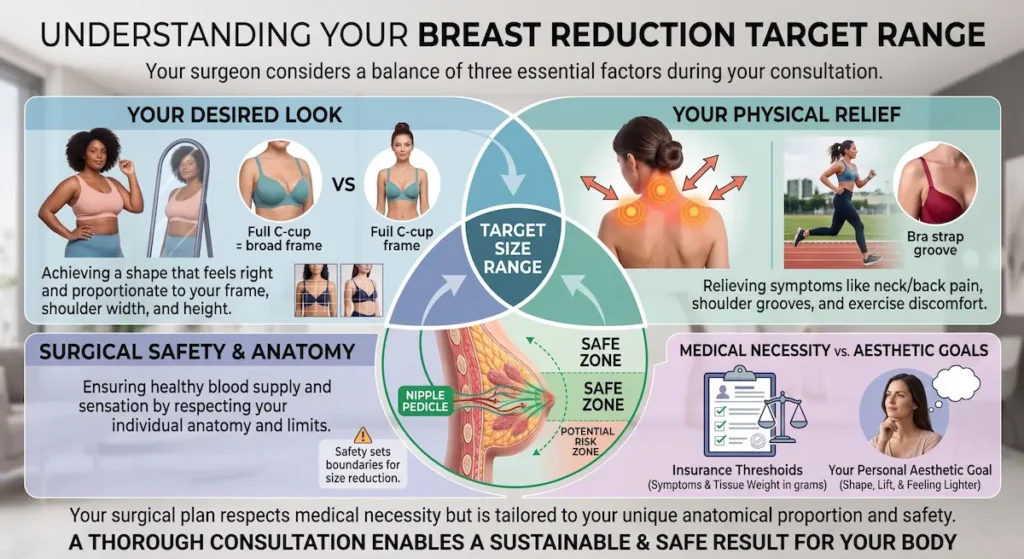
Your target size is not chosen from a chart alone. A breast reduction plan has to balance three things at once: your desired look, your physical relief, and what can be achieved safely with your anatomy.
Proportion to Your Frame and Shoulders
A proportional result starts with your body frame. A full C cup can look moderate on a broad ribcage and quite full on a narrow ribcage. Shoulder width, chest wall shape, breast base width, waist-to-hip balance, and height all affect what “small enough” looks like.
This is why reference photos can help, but only if they are used carefully. A photo of someone with a similar starting size, torso length, and frame is more useful than a celebrity image with completely different anatomy.
During consultation, your surgeon may ask what bothers you most:
- Heavy pulling on the neck, shoulders, or upper back
- Grooves from bra straps
- Difficulty exercising comfortably
- Clothing fit issues
- Feeling visually top-heavy
- Wanting a smaller but still feminine shape
Your answer helps shape the target range. A patient who wants relief from pain may need a more substantial reduction than someone who mainly wants a lighter, lifted shape.
Nipple Blood Supply Sets a Safety Limit
Breast reduction also has a biological limit: the nipple-areola complex must maintain healthy blood supply and sensation as much as possible. The surgeon keeps the nipple attached to living tissue, called a pedicle, in most reductions. That tissue carries blood flow.
If too much tissue is removed, or if the nipple has to travel a long distance, the surgical plan becomes more complex. In some very large reductions, the safest plan may involve different techniques, and the final size may need to stay larger than the patient originally imagined.
This is one reason “make me as small as possible” is not always a safe request. Going smaller can sometimes increase tension, compromise shape, or raise the risk of healing problems. The goal is a size that is smaller, lighter, and sustainable.
If your surgeon says a certain cup goal is not safe, that should not feel like a dismissal. It usually means your anatomy is setting a boundary. A careful surgeon respects that boundary.
Medical-Necessity Thresholds Are Not the Same as Aesthetic Goals
In the United States, breast reduction is sometimes discussed in the context of medical necessity. Some insurance policies look at symptoms, documentation, body surface area, and estimated grams of tissue removed. These criteria can influence coverage conversations, but they should not be confused with your ideal cosmetic size.
A medical-necessity threshold may ask whether enough tissue is being removed to relieve symptoms. Your personal goal may be more nuanced: you may want to feel lighter, reduce pain, fit clothes better, and still keep a breast shape that feels like you.
So, if you are using insurance at home, ask your US provider what documentation they require. If you are considering surgery abroad, keep that process separate from surgical planning. Your surgeon should still plan around safety, proportion, and anatomy—not just a number on a form.
This is also where expectation-setting matters. Going too small, choosing a goal based on a single bra label, or misunderstanding the trade-offs can affect satisfaction later. For a deeper look at the emotional side of the decision, read setting expectations to avoid regret.
Sister Sizes and Reading Your Result
After surgery, your bra label may not tell the full story. Sister sizing, swelling, brand differences, and changes in breast shape can all make the final result feel confusing at first.
What Sister Sizing Means
Sister sizes are bra sizes with similar cup volumes but different band sizes. For example, a 34DD, 36D, and 38C may hold similar cup volume, even though the letters look different. This matters because patients often focus on the letter and forget the band.
After breast reduction, you may end up with a cup letter that sounds larger than expected but looks and feels much smaller. A patient who hoped for a C cup might feel disappointed by a D label until she realizes the new D is on a smaller, better-fitting band and holds much less volume than before.
That is why your consultation should use descriptive goals as well as cup goals. For example:
- “I want to look balanced in fitted tops.”
- “I want enough reduction to exercise without heavy bounce.”
- “I want a smaller breast but not a flat chest.”
- “I would prefer the smallest size you can safely achieve while preserving shape.”
These statements give your surgeon better information than “I want to be a C,” because they explain the lifestyle and visual result behind the cup letter.
Why Your Bra Label May Change From Brand to Brand
US bra sizing is not perfectly standardized across brands. One brand’s 36D may fit like another brand’s 36DD. Molded cups, balconette shapes, sports bras, wireless bras, and compression garments all fit differently.
Early after surgery, the issue is even more noticeable. Swelling can make the breasts feel firm or high. Surgical bras may compress differently than everyday bras. Incisions and tenderness can also change what feels comfortable.
For this reason, do not judge your final size from your first post-op bra. Your first bra is there to support healing. It is not a final measurement.
When to Measure After Full Healing
Most patients can see a meaningful size change early, but the final bra size takes longer. Swelling gradually decreases. The breast shape softens. The lower pole relaxes. Scars mature. The breast settles into a more natural position.
A more realistic time to start assessing bra size is often around three to six months, with final refinement continuing beyond that. Some patients continue to notice subtle softening for up to a year.
That waiting period can be frustrating. Still, it protects you from making false conclusions too early. A breast that looks slightly full at six weeks may look much closer to your target at six months.
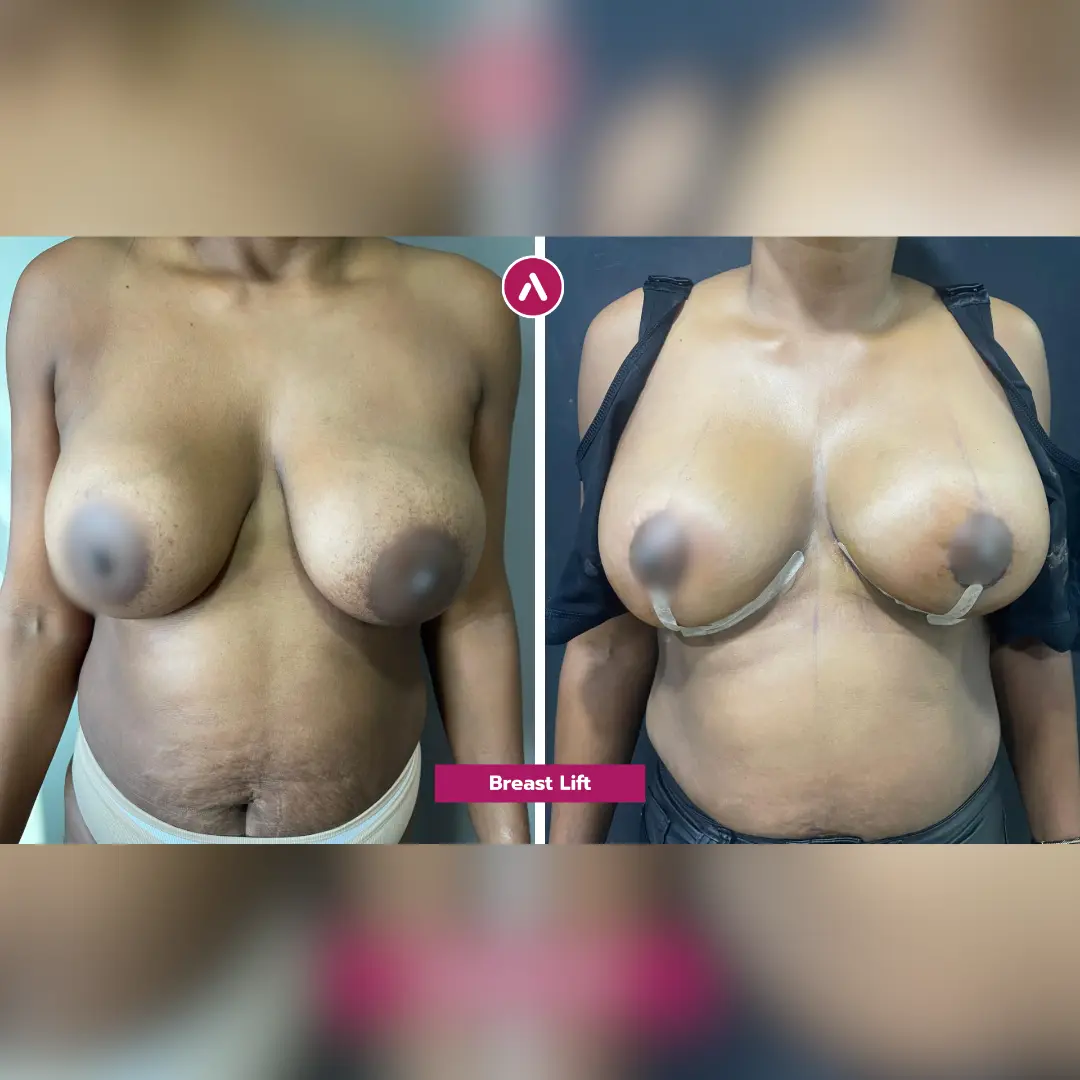
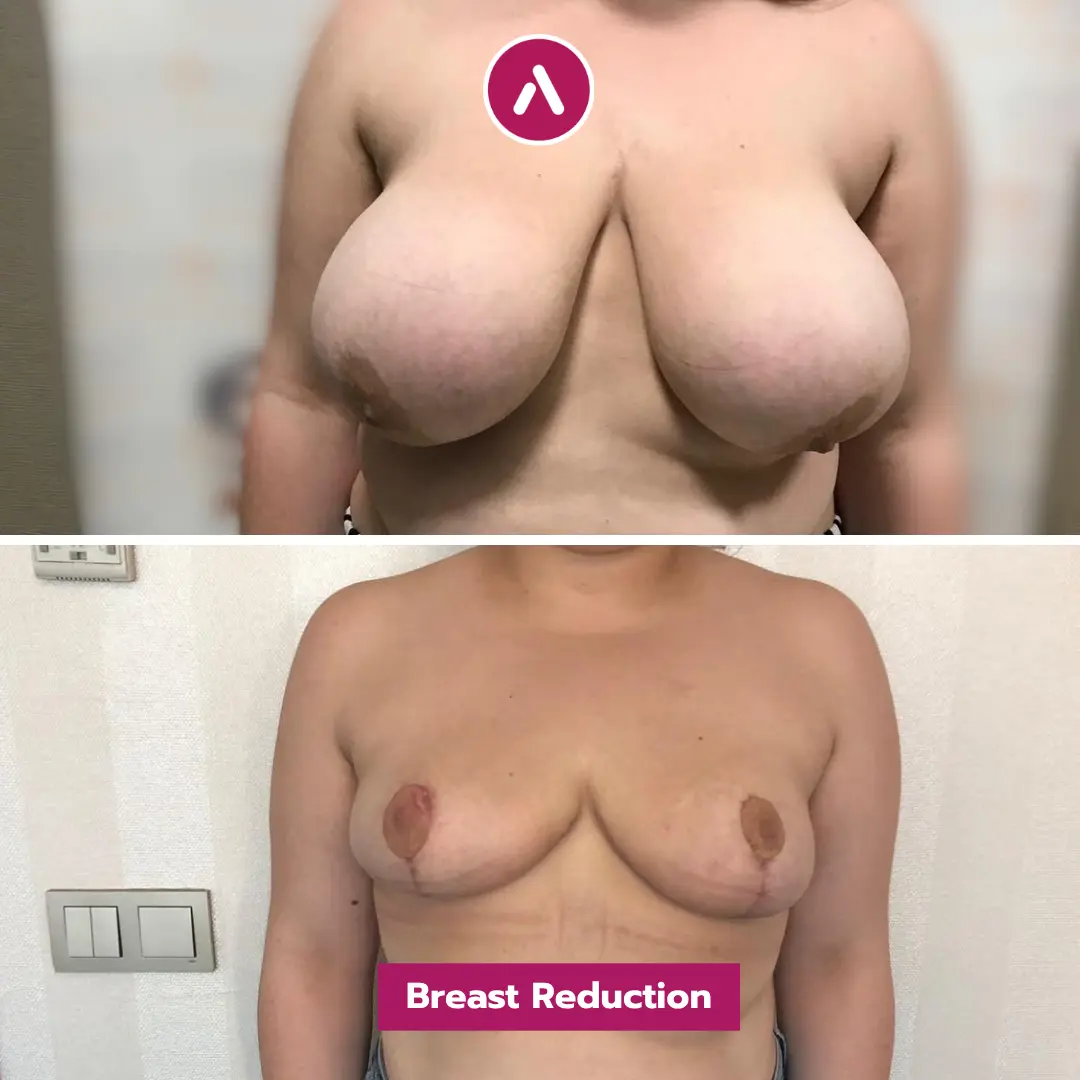
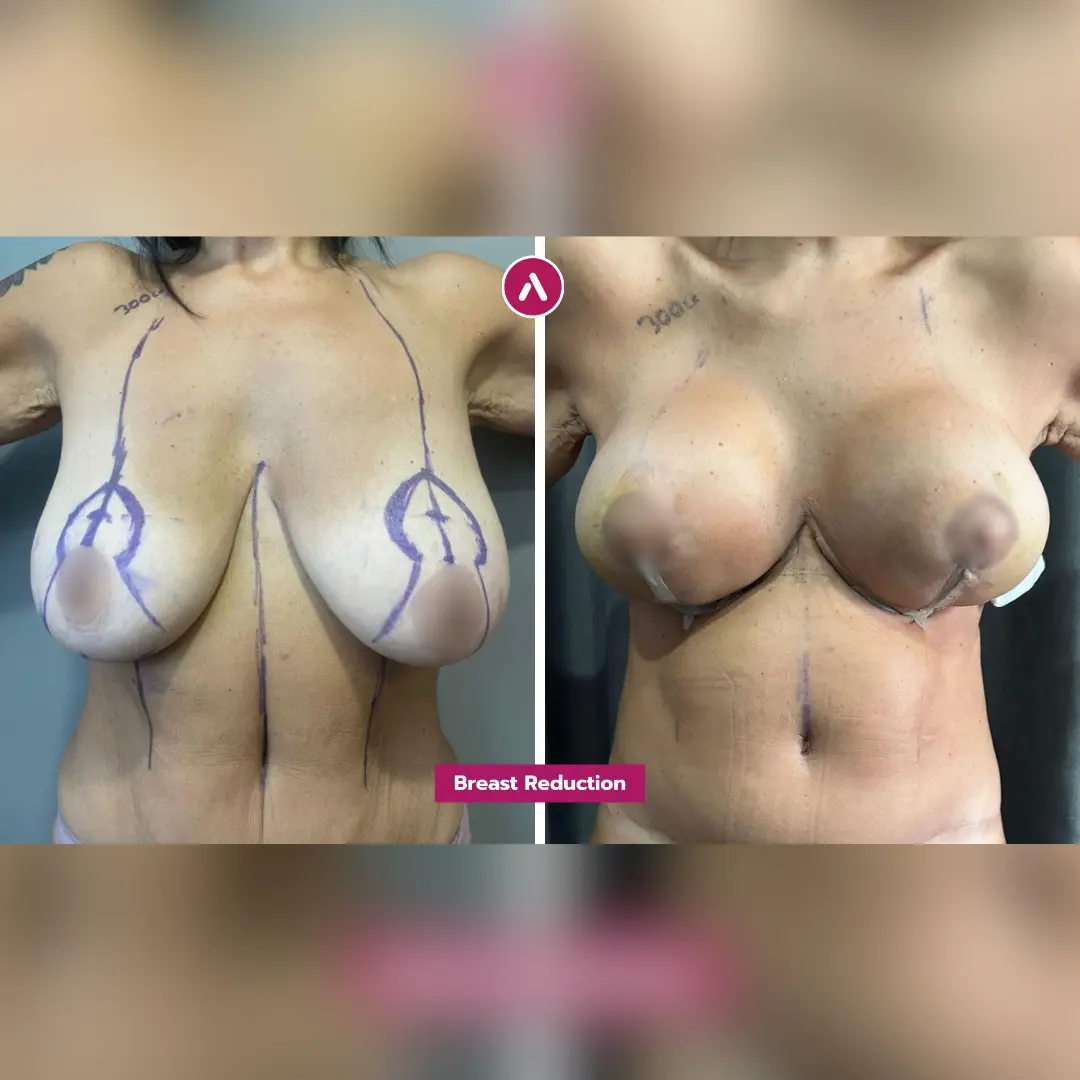
If you want to compare visual changes rather than bra labels alone, review before-and-after size results with attention to starting frame, breast base width, and final proportion—not only the stated cup size.
Setting Size Goals in Consultation
The best consultation is specific, honest, and flexible. You should be able to explain the size you want, but you should also understand what might make that target unrealistic or unsafe.
Bring Reference Goals, Not Just a Cup Letter
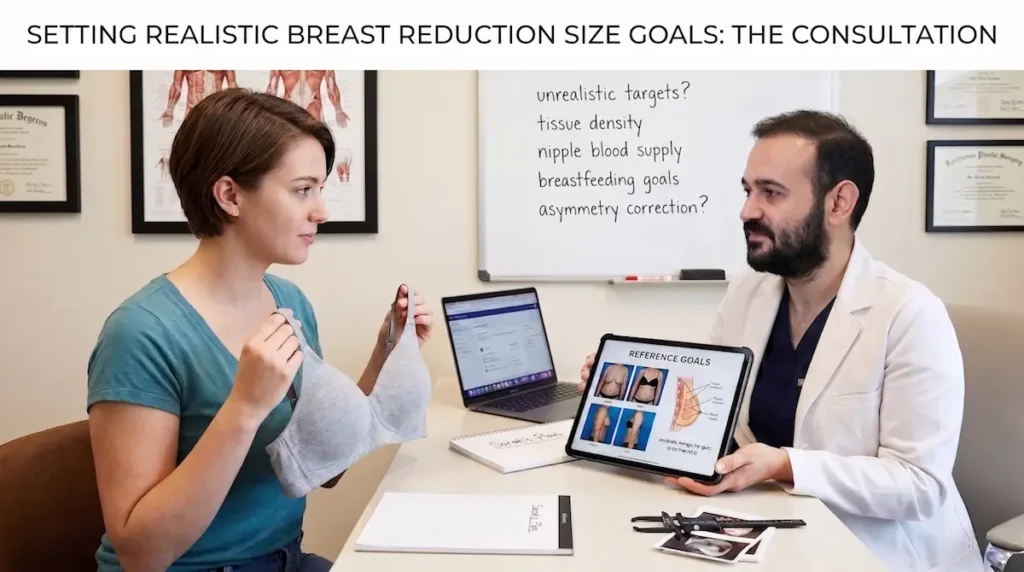
Bring a small set of reference images if they help you communicate. Choose bodies that resemble your height, ribcage width, shoulder width, and starting breast shape. Avoid using only “after” photos from patients who started at a completely different size.
You can also bring bras that represent the kind of size you imagine. A soft, unpadded bra is often more useful than a molded push-up bra because it shows volume more honestly.
Useful consultation questions include:
- “Based on my anatomy, what cup-size range seems realistic?”
- “How many grams do you estimate removing per breast?”
- “What would make it unsafe to go smaller?”
- “How will breast density affect the visible change?”
- “Will my nipple position or blood supply limit the reduction?”
- “How much asymmetry correction is realistic?”
These questions help shift the conversation from wishful sizing to surgical planning.
Discuss the Trade-Off of Going Very Small
Some patients want the smallest possible size because they are tired of pain, sweating, unwanted attention, or feeling restricted. That feeling is valid. Large breasts can affect daily life in a way that is hard to explain to someone who has never experienced it.
Still, going very small can involve trade-offs. It may affect shape, projection, nipple position, blood supply, sensation, and scarring tension. It may also increase the chance that your final shape feels less natural on your frame.
This does not mean you cannot have a major reduction. It means the size goal should be planned carefully. The safest result is usually the smallest size that still preserves healthy tissue, balanced shape, and a natural breast footprint.
If your plan also involves future pregnancy or nursing goals, discuss that before deciding how much tissue to remove. Tissue removal and nipple-areola repositioning can affect lactation potential, so it is worth understanding the breastfeeding trade-off before surgery.
Build a Realistic Expectation Range
Instead of asking your surgeon to promise a single size, ask for a target range. A realistic answer might sound like: “Based on your frame and tissue, we can likely aim for a full C to small D appearance, but I would not promise an exact C cup.”
That type of answer is more trustworthy than a guaranteed letter. It leaves room for swelling, tissue quality, healing, and safety decisions made during surgery.
It also reduces disappointment. When you know the expected range, you are less likely to panic if your early size looks fuller than planned or if your final bra label differs from the number in your head.
Planning should also include what could limit the result. Scar tension, delayed healing, asymmetry, nipple blood supply, or tissue quality can all affect how much tissue can be removed safely. For a separate safety-focused discussion, read about the complications that shape how much is removed.
Cost should not drive the size decision, but many patients do want to understand the financial side before traveling. You can review what a breast reduction costs in Turkey separately without turning this size-planning conversation into a pricing comparison.
US planning note: Before traveling for surgery, ask your surgeon how they estimate grams removed, how they discuss cup-size range, and how they protect nipple blood supply. A board-certified plastic surgery team should be able to explain the plan in plain language.
For patients who want a research-based benchmark, research predicting cup size from tissue removed can help explain why surgeons use grams as a planning tool, but not as a final bra-size guarantee. The American Society of Plastic Surgeons also notes that ASPS on grams of tissue per cup size should be understood as an estimate, not a fixed rule.
Frequently Asked Questions: Breast Reduction Size Chart
These are the questions patients most often ask when they are trying to turn a breast reduction size chart into a real surgical goal. The best answers are honest: your surgeon can estimate a range, but your exact cup size depends on your anatomy and healing.
How much smaller will I go after breast reduction?
Many patients go down one to three cup sizes, but the exact change varies. A smaller reduction may remove enough tissue to relieve symptoms while keeping a fuller shape. A larger reduction may create a more dramatic change, but it still has to respect blood supply, skin quality, and breast shape.
The most useful answer comes from your own consultation. Ask what size range is realistic for your frame, not just how many grams will be removed.
How many grams equal one cup size?
A common estimate is about 100–300 grams per breast for one cup-size change. This range is wide because cup size is not a fixed volume. Band size, breast density, breast base width, and bra brand all change how that tissue removal looks after surgery.
For example, 300 grams may create a noticeable change in one patient and a more modest change in another. That does not mean the surgery failed. It means their starting anatomy was different.
Can my surgeon promise a cup size?
No. A responsible surgeon should not guarantee an exact cup letter. They can discuss a target range, show likely proportions, estimate tissue removal, and explain safety limits. But swelling, tissue behavior, healing, and bra sizing differences make an exact cup promise unreliable.
A better consultation goal is: “I would like to be around a C or small D if that is safe for my body.” That gives the surgeon direction without forcing an unsafe or unrealistic promise.
What is a sister size?
A sister size is a bra size with a similar cup volume but a different band size. For example, 34DD, 36D, and 38C can be related in volume. The letters look different, but the cup capacity may be closer than you think.
This is why a patient may look much smaller after breast reduction but still wear a cup letter that sounds larger than expected. The visual result, comfort, and proportional shape matter more than the letter alone.
Will both breasts match after reduction?
Surgeons usually improve asymmetry during breast reduction, but perfect symmetry is not realistic. Most people naturally have one breast that is larger, lower, wider, or shaped differently. Surgery can bring the breasts closer together in size and position, but small differences often remain.
Ask your surgeon what asymmetry they see before surgery. That gives you a more realistic expectation of what can be corrected.
When is my final size set?
You may see a clear size change right away, but your final size takes time. Swelling, firmness, scar tension, and breast settling can continue to change the result for months. Many patients get a better sense of their bra size around three to six months, with subtle refinement continuing for up to a year.
Do not buy a full new bra wardrobe too early. Start with supportive post-op garments and transition into fitted bras once your surgeon clears you and swelling has settled.
Discuss Your Target Size Range With AKM
If you are comparing cup sizes, grams, and before-and-after photos, the next step is a personalized assessment. AKM Clinic’s board-certified plastic surgery team can review your photos, symptoms, body frame, and preferred size range to explain what is realistic for your anatomy.
Our US office handles patient support and mailing; your procedure is performed at AKM Clinic’s JCI-accredited hospital in Istanbul.
Medical disclaimer: This article is for educational purposes only and is not a substitute for medical advice, diagnosis, or treatment. Breast reduction results vary by anatomy, surgical plan, healing, and individual health factors. Always consult a qualified surgeon before making decisions about surgery.