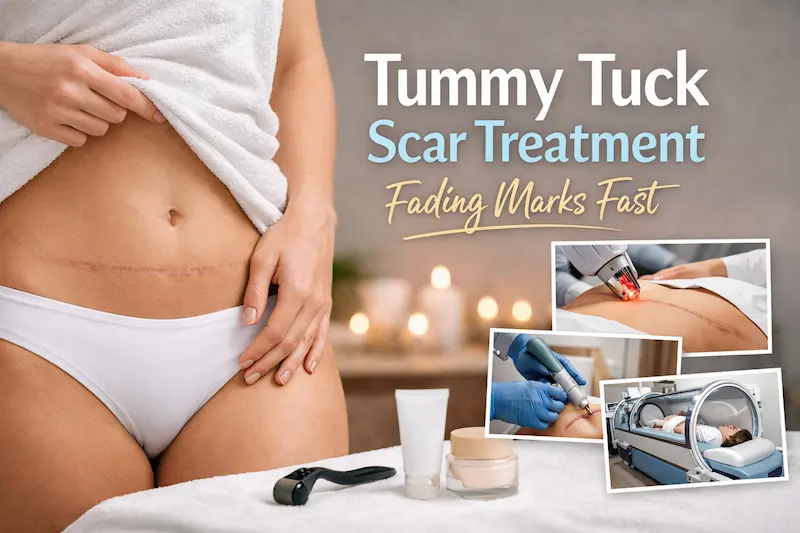
If you’re reading this, you probably have one clear goal: you want your incision line to look as faint, flat, and “forgettable” as possible—without doing anything that could actually make it worse. This guide to tummy tuck scar treatment is written for the patient who wants clear expectations, practical steps, and a plan rooted in medical science—not hype.
According to scientific research on wound healing, tummy tuck scars do not completely disappear; instead, they gradually mature, flatten, and fade over time with proper scar care. But with the right strategy, tummy tuck scars can become significantly less visible over time, especially when tummy tuck patients start the correct interventions at the correct phase of healing.
Key takeaway: The “fastest” results come from doing the right things early (silicone + sun protection + proper tension control), and choosing professional treatments only when timing is appropriate.
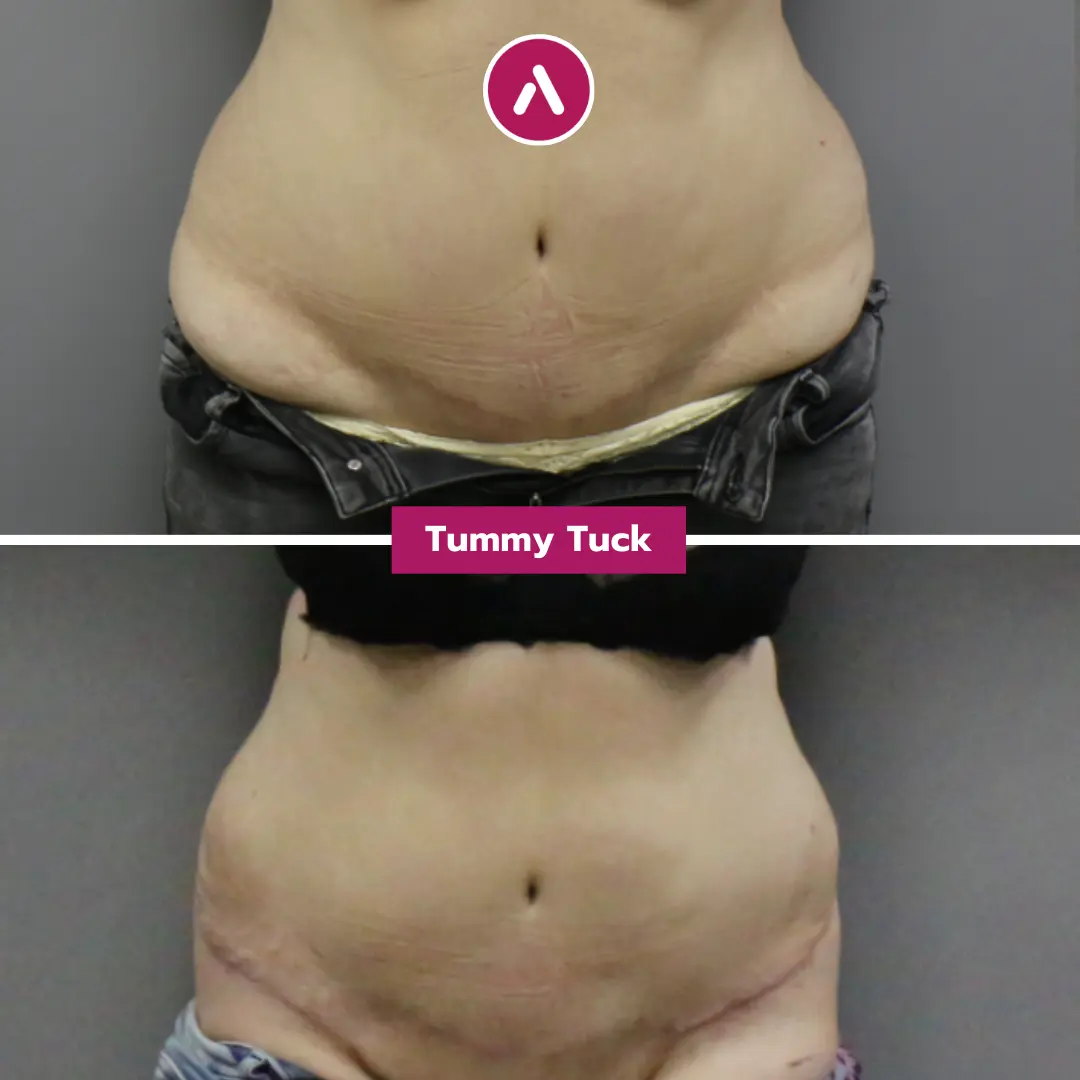
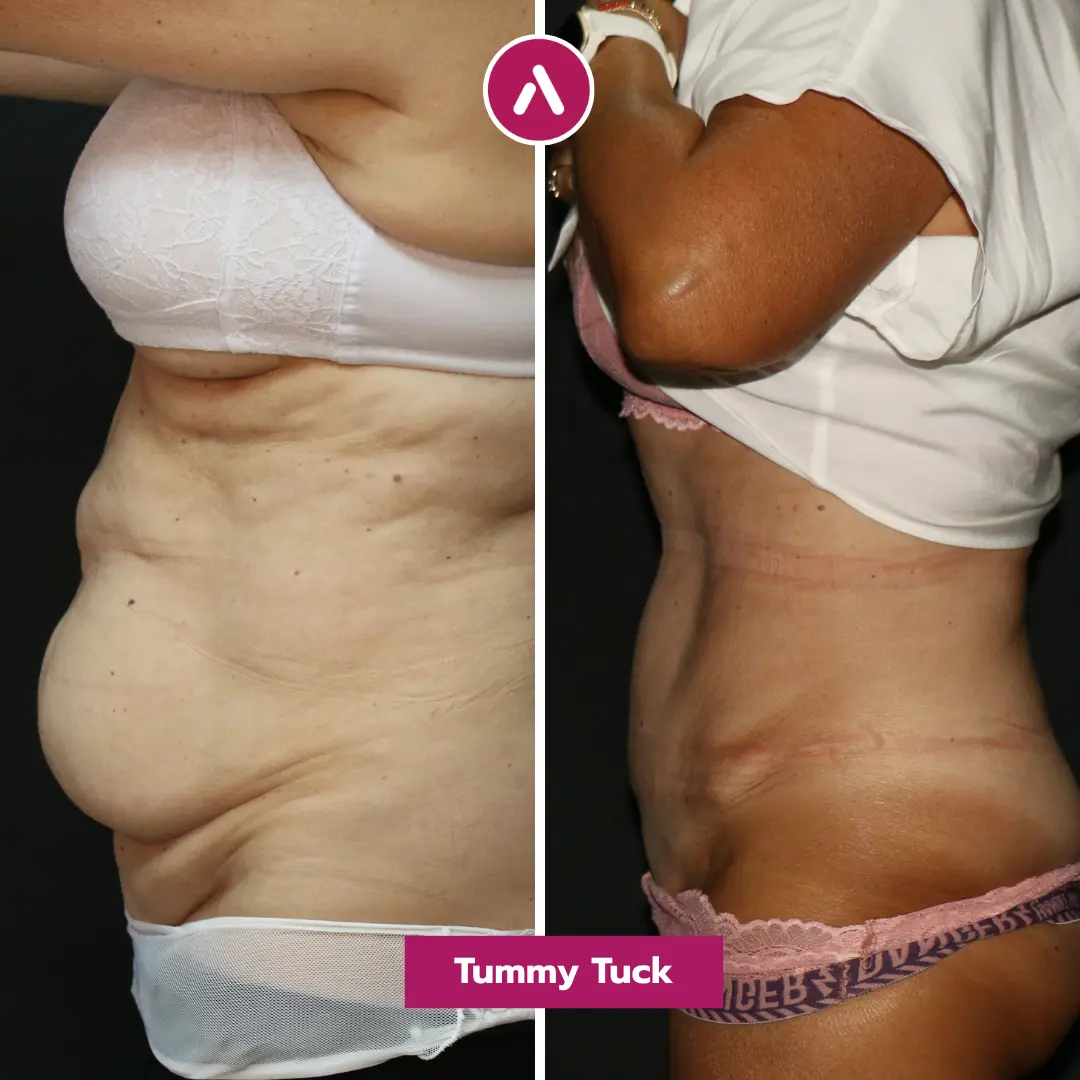
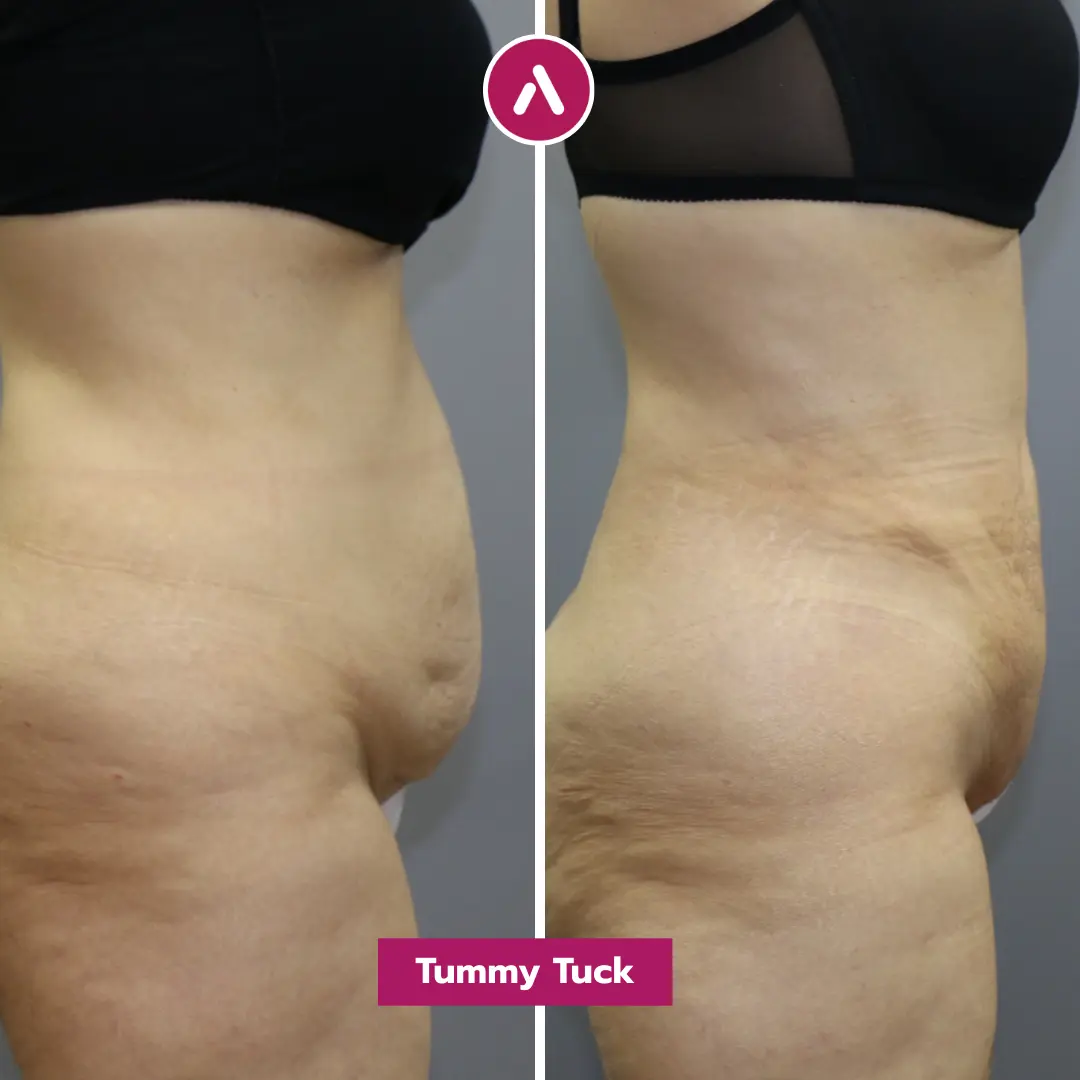
Table of Contents
What a “Normal” Tummy Tuck Scar Looks Like (And What Doesn’t)
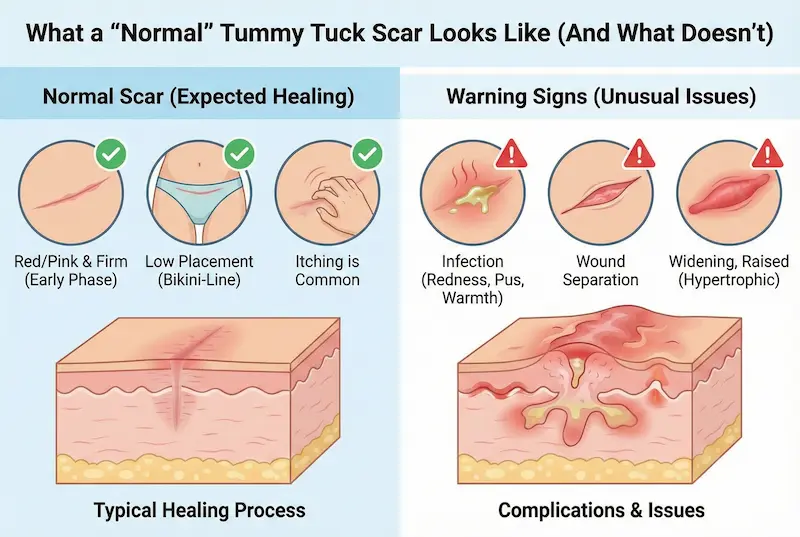
A tummy tuck scar is usually placed low on the abdomen, often designed to sit under underwear or bikini lines. In the early months, a scar may look red, feel firm, or seem more noticeable than you expected—this can still be normal. The goal of the best tummy tuck scar treatment approach is not “instant fading,” but guiding the scar through each healing phase so it matures flatter, softer, and lighter.
Scar placement 101: why the bikini-line location matters
- Low placement helps conceal the line in most clothing.
- Incision length varies with skin excess and whether muscle repair is needed.
- Tension across the incision is one of the biggest drivers of widening—this is why surgeon technique and aftercare matter.
Color, texture, and thickness changes you can expect
- Red/pink in early months can be normal (inflammatory healing phase).
- Firmness or mild “rope-like” texture can happen as collagen remodels.
- Itching is common as nerves regenerate and the scar matures.
Warning signs: infection, separation, widening, and raised scars
- Increasing warmth, pus-like drainage, fever or spreading redness can signal infection.
- Wound separation (edges pulling apart) needs prompt medical review.
- Rapid widening may mean excessive tension or early overactivity.
- Rising, thickening, intense itch could suggest a hypertrophic scar (or, less commonly, keloid tendency).
Scar Healing Timeline After a Tummy Tuck (Week-by-Week Expectations)
If you want the best scar treatment for tummy tuck, timing is everything. Many mistakes happen when patients start aggressive products too early or book procedures at the wrong phase after abdominoplasty surgery. Below is a realistic timeline used in post-op scar management, aligned with how scar biology works in medical science.
Weeks 1–2: incision closure & early inflammation
- Your priority is safe closure: follow wound care instructions exactly.
- Expect swelling and tenderness; the scar may look “fresh” and uneven.
- Do not start strong acids, retinoids, harsh scrubs, or unsupervised “scar creams” on an unhealed incision.
Weeks 3–8: the “angry scar” phase (red/pink, firm, itchy)
- This is often when patients panic—but it’s a common phase of normal maturation.
- This is typically when evidence-based scar treatment after tummy tuck begins (e.g., silicone), if the incision is fully closed and your surgeon clears it.
- Texture may feel thicker before it gets flatter—collagen remodeling is active here.
Months 3–12+: maturation (flattening + fading) and realistic outcomes
- Color usually starts shifting from red/pink toward lighter tones as blood vessels calm down.
- Many patients see the biggest improvements between 6–12 months.
- This is the phase where professional options (like laser treatment for tummy tuck scar) may be considered, depending on scar type and skin tone.
| Time After Surgery | What You May See | Smart Focus |
|---|---|---|
| Weeks 1–2 | Fresh line, swelling, sensitivity | Protect closure, avoid irritation |
| Weeks 3–8 | Red/pink, firm, itchy (“angry scar”) | Start silicone (if cleared), gentle care |
| Months 3–12+ | Gradual flattening + fading | Consistency + consider targeted procedures |
Coming next: the safest at-home options, how to choose the best treatment for tummy tuck scar, and when tummy tuck scar laser treatment actually makes sense—plus what “tummy tuck scar treatment before and after” photos can and can’t prove.
The Fastest Safe At-Home Scar Treatments (Evidence-Based)
If you’re aiming for the best scar treatment for tummy tuck, the most reliable “speed” comes from consistency—not aggressive products. In medical science, scar improvement is largely about guiding collagen remodeling, controlling inflammation, and preventing pigment changes. The at-home steps below are widely used in post-surgical care because they support the biology of healing instead of fighting it.
Silicone gel vs silicone sheets: which is better and how to use them
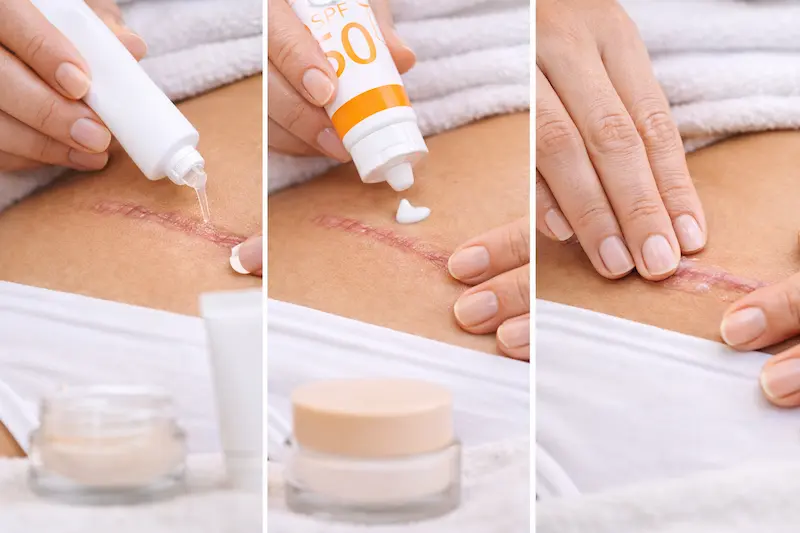
Silicone is one of the most evidence-supported options for scar treatment after tummy tuck when your incision is fully closed and your surgeon has cleared you to begin. It works by maintaining an optimal hydrated environment over the scar, which can help reduce thickening and improve texture over time.
| Option | Best For | Pros | Watch Outs |
|---|---|---|---|
| Silicone Sheets | Flat coverage over a long incision | Continuous contact, good for raised/firm scars | Can irritate sensitive skin, may lift with sweat/heat |
| Silicone Gel | Convenience, mobility, hot climates | Easy to apply, dries clear, fits active schedules | Needs consistent reapplication, must dry fully |
- When to start: Only when the incision is fully closed (no open areas, oozing, or scabs) and your surgeon approves.
- How long: Most patients benefit from using silicone daily for 8–12+ weeks (sometimes longer for thicker scars).
- How to choose: If sheets slip or irritate, gel is often easier. If your scar is getting thick/raised, sheets may provide steadier contact.
Practical rule: The “best tummy tuck scar treatment” is often the one you will actually use every day for months.
Scar massage & mobility: when to start and how to avoid damage
Once your surgeon confirms the incision is stable, gentle massage can support pliability and soften firmness. In the language of scientific research, controlled mechanical stimulation may help reorganize collagen fibers as the scar matures.
- Start only with clearance: Too early can increase irritation or widen the scar.
- Technique matters: Use clean hands and a bland moisturizer or approved product; apply gentle pressure in small circles and short strokes.
- Frequency: A few minutes, 1–2 times daily, is more valuable than one long, aggressive session.
- Stop if: You see redness spikes, burning pain, skin breakdown, or swelling that worsens after massage.
Sun protection (SPF) and pigmentation control: the #1 mistake patients make
If your scar is exposed to UV light during healing, it can darken and stay discolored longer. This is one of the most overlooked factors in scar treatment for tummy tuck, especially for patients who heal with more pigmentation.
- Use SPF daily if the area may be exposed (even brief exposure counts).
- Cover when possible: Clothing is your best “physical sunscreen.”
- Avoid tanning: Early tanning can lock in uneven color for months.
Professional Scar Treatments That Actually Move the Needle
If you’ve been searching for tummy tuck scar laser treatment or the best treatment for tummy tuck scar, here’s the honest framework: professional treatments can help, but the “right” option depends on whether your scar’s main issue is color (red/brown), texture (raised/ropey), or width (stretched). Timing matters just as much as the device.
Laser options (e.g., fractional lasers): who benefits and when to start
Laser treatment for tummy tuck scar is often considered for persistent redness, pigment changes, or texture irregularities after the scar has had time to stabilize. Different lasers target different scar features, so “laser” is not one single treatment.
- Best for: Improving texture, refining scar edges, and reducing redness or discoloration in appropriate candidates.
- When: Typically after early healing—your surgeon/dermatology team will advise based on closure quality and scar behavior.
- How many sessions: Often multiple sessions are needed; improvement is gradual.
- Important: Skin tone and pigment risk should be assessed carefully to avoid unwanted darkening/lightening.
Microneedling / RF microneedling: texture improvement for mature scars
For texture-related concerns after an extended tummy tuck, such as unevenness or firmness, microneedling approaches may be used once the scar is mature enough. The goal is controlled stimulation that encourages remodeling, again rooted in medical science principles of collagen turnover.
- Best for: Texture refinement in more stable, mature scars.
- Not ideal for: Actively inflamed, recently opened, or infected areas.
- Expectations: Subtle-to-moderate improvement per session; cumulative results over time.
Injections and medical options: steroids, 5-FU combos, and when they’re appropriate
If a scar is becoming raised, thick, and itchy (often hypertrophic), injections can be considered by qualified clinicians. These are targeted medical treatments—not “cosmetic add-ons”—and are usually reserved for scars that are behaving aggressively.
- Steroid injections: Can help flatten overly thick scars and reduce symptoms like itch.
- Combination approaches: In some protocols, clinicians may combine agents to improve response (case-dependent).
- Risks: Over-treatment can thin skin or cause color changes—this is why careful dosing and spacing matter.
Reality check: The best outcomes usually come from combining the basics (silicone + SPF + proper timing) with one targeted in-office treatment—rather than chasing “quick fixes.”
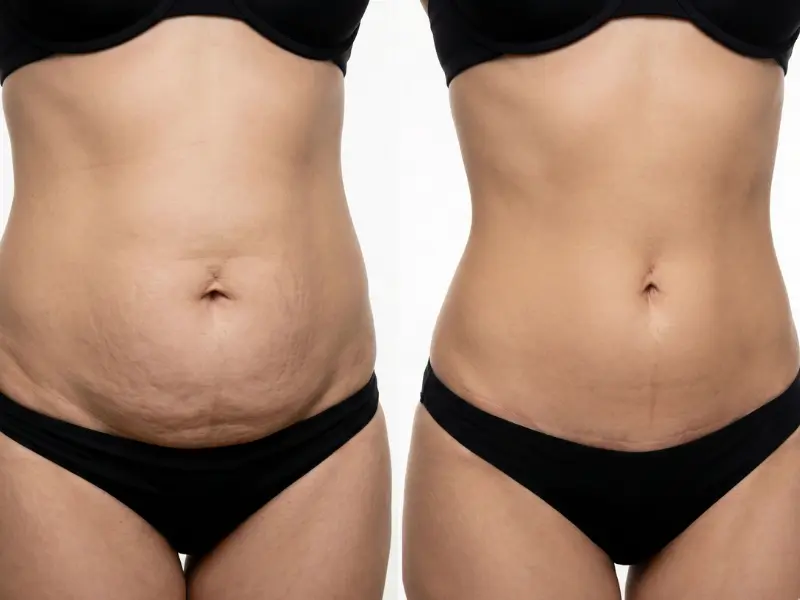
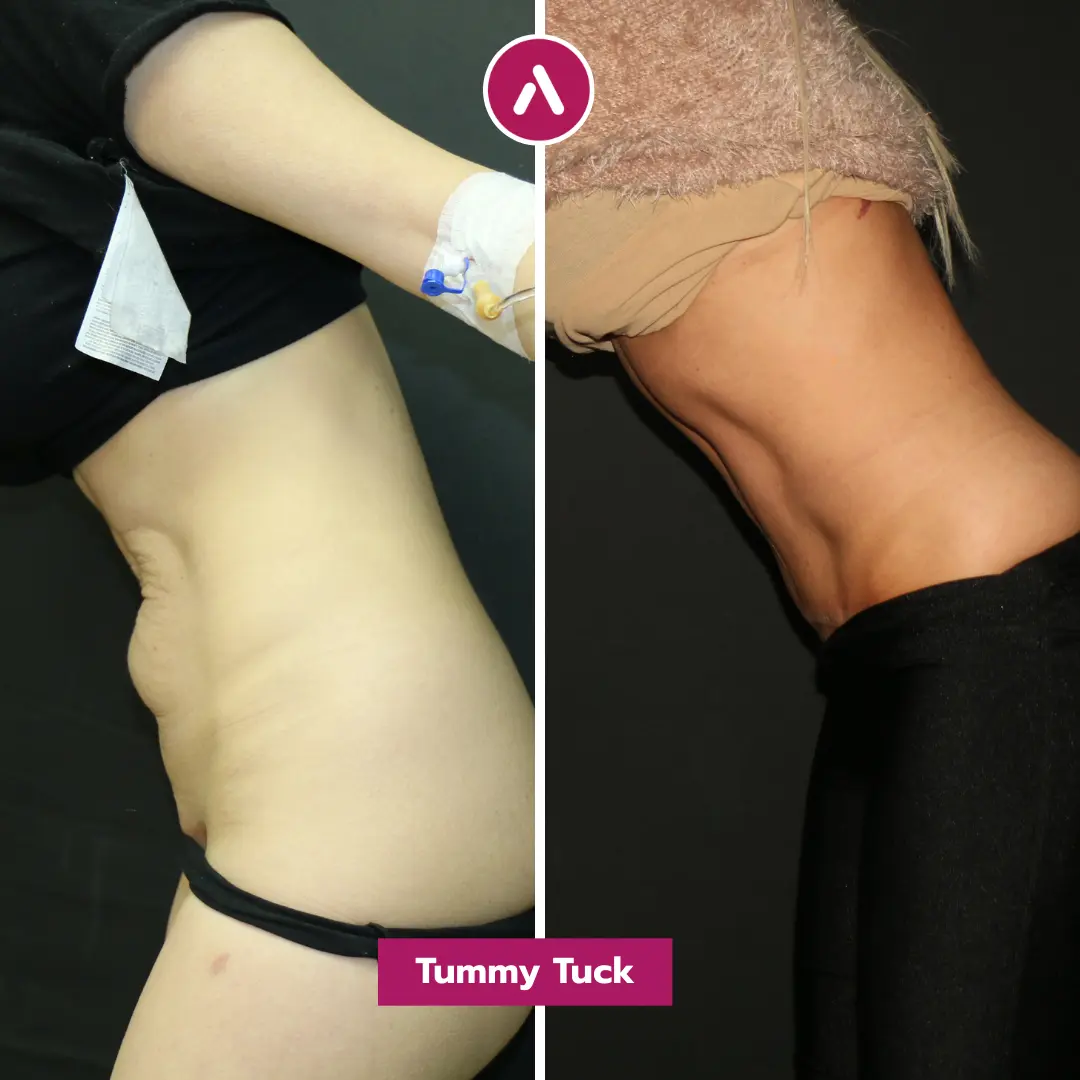
About “tummy tuck scar treatment before and after” photos: They can be helpful, but they’re not proof of what you will experience. Lighting, angles, time since surgery, and even tanning can dramatically change how a scar looks in photos. The most trustworthy comparisons show the same lighting, the same angle, and clearly state the time point (e.g., 3 months vs 12 months).
AKM Clinic Scar-Care Protocol: How We Support “Faster Fading” Without Risky Shortcuts
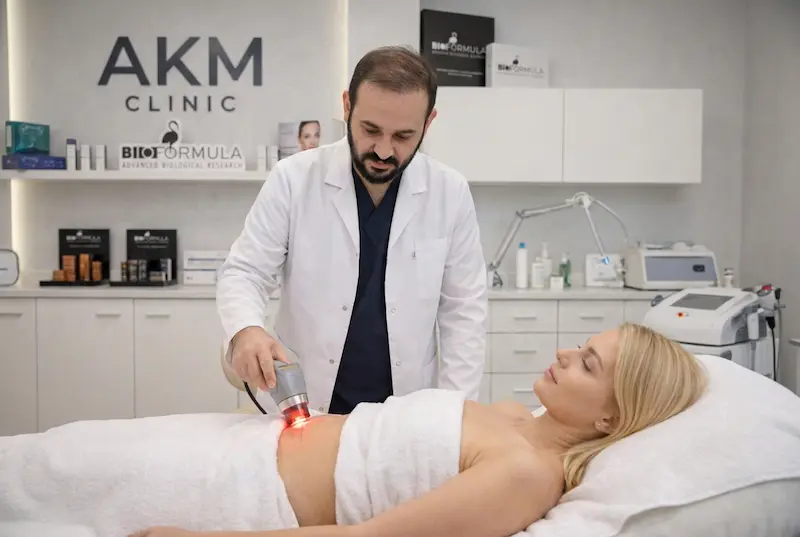
When patients search for the best tummy tuck scar treatment, they’re often really asking: “How do I reduce the chances of a thick, dark, or widened scar—and feel safer during recovery?” At AKM Clinic, the scar plan starts before any device or cream. It begins with surgical technique (tension control, precise closure) and continues with structured aftercare. When appropriate, we also support recovery using clinic technologies like LLLT and HBOT, which are integrated into patient care standards to promote comfort and healing—without pushing unsafe “fast results” claims.
Surgical technique & tension management: the foundation of a better scar
No topical product can fully compensate for an incision closed under excessive tension. One of the most meaningful factors in scar treatment for tummy tuck and abdominoplasty is actually how the scar is created: incision planning, layered closure, and minimizing tension across the healing line. This foundation matters because it can reduce the likelihood of scar widening and a “stretched” appearance as swelling resolves and you return to movement.
- Why it matters: High tension can contribute to widened scars and uneven edges.
- What patients can control: Following compression/garment guidance and activity restrictions to avoid pulling forces early on.
- When to escalate: If you see rapid widening or persistent thickening, it may be time to discuss targeted interventions.
LLLT (Low-Level Laser Therapy) for recovery support and comfort
AKM Clinic uses Low-Level Laser Therapy (LLLT) as part of its advanced dermatological laser approach in post-surgical care. In the context of medical science, LLLT is commonly discussed as a supportive modality that may help with inflammation control and tissue recovery. Practically, patients often care about what that means day-to-day: reduced swelling, calmer-looking skin, and a smoother recovery experience—factors that indirectly support a healthier scar environment.
- How it may help: Supporting recovery by addressing swelling/redness and overall tissue calmness.
- How it fits the plan: It complements core scar care (silicone + sun protection + appropriate massage timing), rather than replacing it.
- Important note: “Laser” in this context is different from laser treatment for tummy tuck scar aimed at resurfacing a mature scar. The timing and purpose are not the same.
HBOT (Hyperbaric Oxygen Therapy): where it may help in healing optimization
AKM Clinic presents Hyperbaric Oxygen Therapy (HBOT) as a major patient-safety and healing-support technology. In wound-healing discussions and scientific research, oxygen availability is a key variable in tissue recovery. HBOT is framed by the clinic as a supportive tool for tissue survival/regeneration and for improved scar healing—especially relevant in complex recoveries where optimizing tissue conditions matters.
- How it may help: Supporting tissue recovery conditions and helping the body move through healing phases more efficiently.
- Why patients value it: It’s a “support system” approach—aimed at de-risking recovery, not promising instant scar erasure.
- How to think about it: HBOT is not a substitute for good wound care; it’s a clinic-level support layer.
Patient perspective (real story theme): One US patient, Barbara, described her overall experience as “fabulous,” highlighting “no pain” and minimal bruising—reflecting how supportive recovery can feel with structured care.
Special Case: Tummy Tuck Scar + C-Section Scar (Can They Be Combined or Improved Together?)
This is one of the most emotionally loaded scenarios—because a C-section scar is often tied to life milestones, and patients may feel frustrated that the area still looks “damaged” years later. The good news: in selected cases, a tummy tuck incision can be planned to address prior scarring. The realistic goal is improvement in position, contour, and appearance—not a guarantee of “no scar.” This section also matters for readers comparing best treatment for tummy tuck scar options, because “best” may actually mean correcting old scar tissue during the surgery rather than chasing stronger creams afterward.
When surgeons can “incorporate” a C-section scar into the new incision
Depending on scar location, tissue laxity, and surgical plan, a prior C-section scar may be removed or incorporated within the lower tummy tuck incision line. Conceptually, it’s a “reset” of the scar position and shape—while still respecting the fact that every incision heals uniquely.
- Most likely when: The C-section scar sits within the skin that will be excised in a tummy tuck surgery.
- Potential benefit: A single, lower, more consistent scar line instead of multiple lines or irregular edges.
- Limit: If the C-section scar sits outside the excision zone, improvement may be partial.
Managing uneven scars, dog-ears, and old scar tissue safely
Old scar tissue can behave differently than fresh tissue. If there are contour issues (like “dog-ears”) or irregular thickness from previous healing, the plan may include targeted correction and a careful aftercare schedule. This is also where patients often search for tummy tuck scar treatment before and after examples—because they want to know if unevenness can truly improve. It often can, but “how much” depends on anatomy, tissue quality, and scar biology.
- Dog-ears: Small puckers at incision ends that may improve as swelling drops, or may need minor revision.
- Scar thickness or firmness: May respond to silicone + massage timing, and selected medical treatments if hypertrophic behavior appears.
- Old scar tissue: Requires realistic expectations—improvement is common; perfection is not guaranteed.
What outcomes are realistic (and what’s marketing hype)
If you want the best scar treatment for tummy tuck, your most realistic win is a scar that becomes flatter, lighter, and easier to ignore—typically sitting low under clothing. Claims of “scar-free tummy tuck” are marketing, not medical science. Even with the best tummy tuck scar treatment plan, the scar is still a scar—it just becomes less visible.
- Realistic: Fading over 6–12+ months, improved texture, better placement.
- Sometimes possible: Significant improvement with combined at-home care + targeted procedures (including laser treatment for tummy tuck scar when appropriate).
- Hype: Instant removal, guaranteed invisibility, or “one session fixes all.”
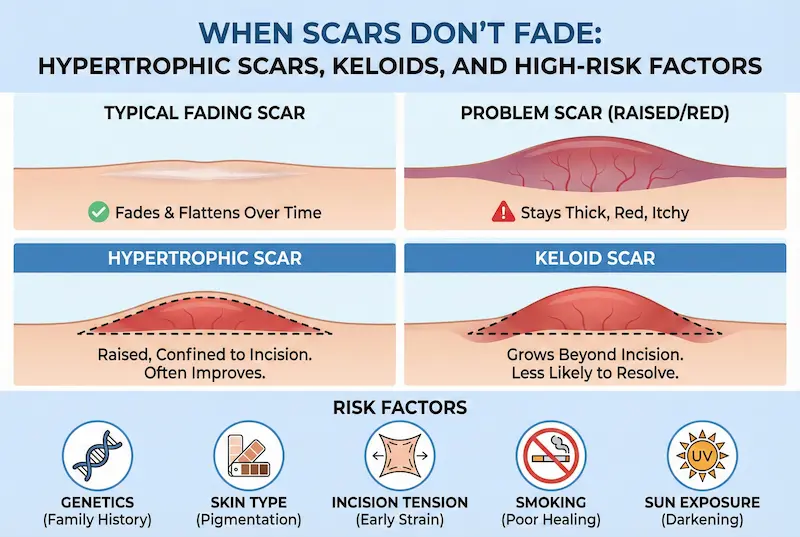
When Scars Don’t Fade: Hypertrophic Scars, Keloids, and High-Risk Factors
Most tummy tuck scars gradually calm down with consistent scar treatment after tummy tuck. But sometimes a scar stays thick, itchy, raised, or dark for longer than expected. If you’re looking for the best treatment for tummy tuck scar in this situation, the first step is identifying what type of scar behavior you’re seeing—because the best plan for redness is not the same as the best plan for a raised scar. According to PubMed-indexed medical science on wound healing, different tummy tuck scar patterns may reflect different healing pathways, tissue responses, and scar maturation processes.
Hypertrophic vs keloid: how to tell the difference
These terms get mixed up online, and that leads to wrong expectations about tummy tuck scar treatment. While only a qualified clinician can diagnose your scar type, here are helpful distinctions:
- Hypertrophic scar: Raised and thick, but typically stays within the boundaries of the original incision line. It may improve over time, especially with early management.
- Keloid scar: Grows beyond the original incision borders. Some people have a strong genetic tendency toward keloids.
| Feature | Hypertrophic Scar | Keloid Scar |
|---|---|---|
| Growth pattern | Within the incision line | Extends beyond the incision line |
| Symptoms | Often itchy, firm, raised | May be very itchy/tender, thicker growth |
| Natural course | Can improve over time | Less likely to self-resolve without treatment |
| Common approach | Silicone + timing + sometimes injections/laser | Specialist-guided protocols; recurrence risk matters |
Risk factors: genetics, skin type, incision tension, smoking, sun
If you’re trying to choose the best scar treatment for tummy tuck, it helps to know what makes scars more likely to stay visible. Some risks are biological, and some are behavioral:
- Genetic tendency: Family history of raised scars or keloids.
- Skin tone and pigmentation tendency: Some patients are more prone to long-lasting darkening (post-inflammatory hyperpigmentation).
- High incision tension: A major driver of widening or thickening.
- Smoking / nicotine: Associated with poorer wound healing—oxygen delivery matters in tissue repair (a core concept in scientific research).
- Sun exposure: Can darken scars and prolong discoloration.
- Early strain: Returning to intense activity too quickly can stretch the scar.
What to do early (and what NOT to do) if a scar is getting raised or widening
When a scar is trending raised or wide, early action can be the difference between “manageable” and “persistent.” The best approach is structured, not aggressive.
- Do: Use silicone consistently (gel or sheets), if cleared by your surgeon.
- Do: Prioritize sun protection and avoid tanning.
- Do: Ask about early targeted interventions if the scar is thickening (this may include medical options such as injections, or later laser treatment for tummy tuck scar depending on the case).
- Don’t: Over-scrub, use strong acids/peels, or apply irritating “scar removal” products—irritation can worsen redness and pigment.
- Don’t: Start intense massage too early or press hard enough to cause redness spikes.
- Don’t: Assume a single device is the “best tummy tuck scar treatment” for every scar type—treatment must match the scar’s behavior.
Smart next step: If your scar is raised, itchy, and getting thicker after the early healing phase, ask for a scar-specific evaluation rather than switching creams repeatedly.
Frequently Asked Questions (FAQ): Tummy Tuck Scar Treatment
This FAQ is built around the most common real-world questions patients ask when searching for scar treatment for tummy tuck, including whether tummy tuck scar laser treatment is “worth it,” and what tummy tuck scar treatment before and after results are realistic.
How long does a tummy tuck scar take to fade?
Many scars look their most noticeable in the early months, then gradually fade and soften over 6–12+ months. Some patients see continued subtle improvement beyond a year. Consistent tummy tuck scar treatment during the right phase supports better maturation.
What is the best scar gel or silicone treatment after a tummy tuck?
For many patients, silicone (gel or sheets) is a strong first-line option in scar treatment after tummy tuck, assuming the incision is fully closed and your surgeon approves. The “best” choice is often the one you can use consistently without irritation.
When can I start silicone sheets and scar massage?
Start only after your surgeon confirms the incision is fully closed. Silicone often begins once there are no open areas or scabs. Massage is usually introduced later and gently—too early or too aggressive can worsen irritation or contribute to widening.
Do lasers remove tummy tuck scars completely?
Lasers usually do not remove scars completely. Laser treatment for tummy tuck scar can improve color and texture in the right candidates, but results vary and typically require multiple sessions. Think “improvement,” not “erasure.”
Why is my scar still red or dark months later—and is it normal?
Redness can be part of the normal “active” scar phase. Darkening may happen with sun exposure or pigmentation tendency. This is why SPF and protection are central to best treatment for tummy tuck scar strategies, especially early on.
Can my C-section scar be improved during a tummy tuck?
In selected cases, yes—if the prior C-section scar sits within the tissue that will be removed or can be incorporated into the new incision plan. This can create a single lower scar line, but outcomes depend on anatomy and scar biology.
What should I do if my scar is thick, itchy, or raised?
That pattern may suggest hypertrophic behavior. Continue consistent silicone (if approved), protect from sun, and seek a scar-specific evaluation. Medical options (like injections) may be considered, and later tummy tuck scar laser treatment may be appropriate depending on the case.
Medical Disclaimer: This page is provided for general educational purposes only and does not replace a face-to-face medical consultation, diagnosis, or personalized treatment plan. All surgery carries risks and outcomes vary between individuals. Suitability for a tummy tuck, procedure selection, and anesthesia choice can only be determined after a full clinical assessment by a qualified surgeon. Always follow your clinician’s instructions and seek urgent medical attention if you develop concerning symptoms during recovery.