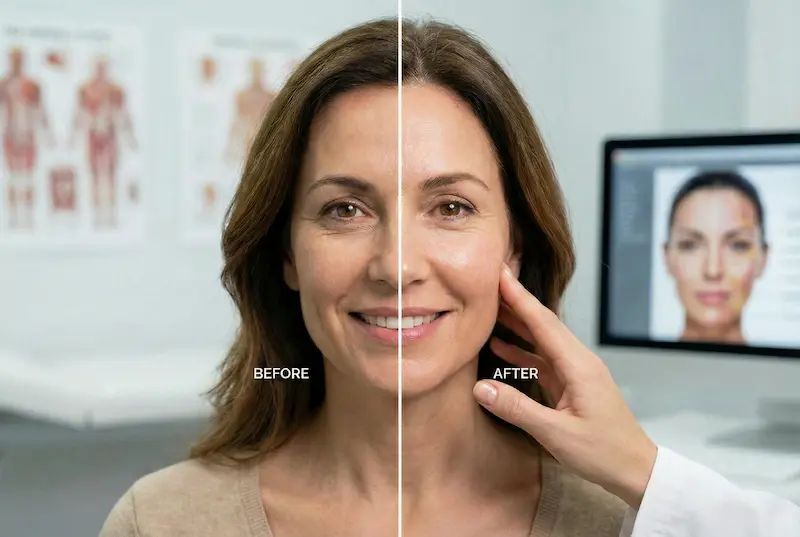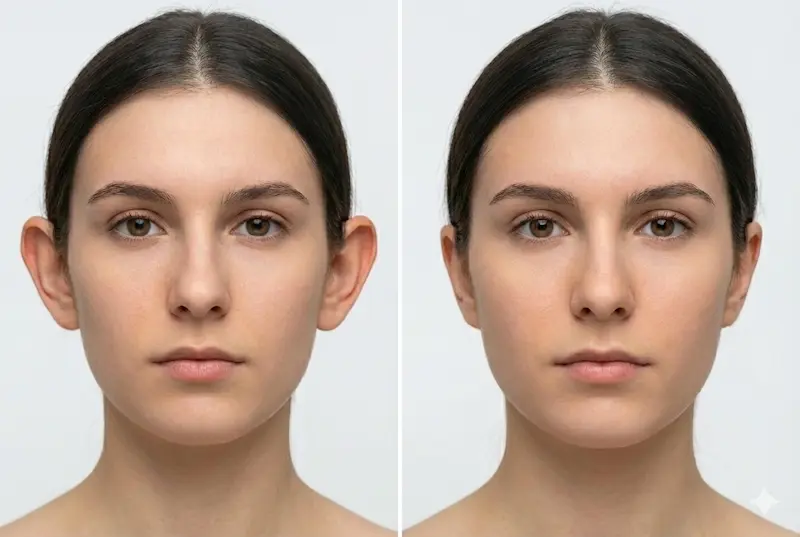
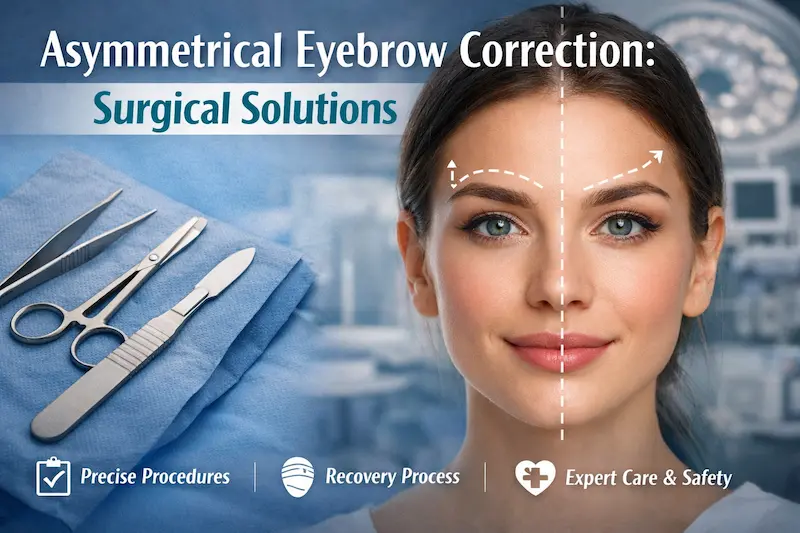
If you’ve ever looked in the mirror and thought one brow sits higher, arches differently, or “pulls” more in photos, you’re not imagining it. Brow asymmetry can be approached in a structured, anatomy-first way — especially when the imbalance is caused by predictable factors like muscle dominance, soft-tissue descent, or differences in brow support. The complete endoscopic temporal-and-brow lift technique foundation — including incision pattern, fixation strategy, side-specific elevation customization, and natural-result limits — is documented on our endoscopic brow lift treatment hub.
This guide is written for patients who want a clear, surgical-level explanation (not vague beauty advice): how to fix asymmetrical eyebrow concerns, which cases are truly correctable, what surgeons measure, and what a realistic “balanced” result looks like. Where helpful, we’ll reference principles from medical science—because brow symmetry isn’t just aesthetics; it’s anatomy + movement.
Important note: absolute “perfect symmetry” is rarely achievable in any human face. The goal of eyebrow asymmetrical correction is typically a natural, more harmonious balance that holds up both at rest and during facial expression.
Table of Contents
Understanding Eyebrow Asymmetry (When It’s Normal vs. When It’s Fixable)
Before discussing any surgical solution, the most important step is defining what is actually asymmetric. Many people assume it’s “the eyebrow,” but the visible difference may come from the forehead, eyelid skin, brow fat pad position, or even how the frontalis and corrugator muscles fire. In other words, the best correction for asymmetrical eyebrow depends on the true source of the imbalance.
Common causes: genetics, aging, muscle dominance, prior Botox, trauma
Eyebrow position is influenced by both structure (bone/soft tissue support) and function (muscle activity). Common contributors include:
- Natural facial asymmetry (genetics): small differences in brow height and arch are extremely common.
- Aging and soft-tissue descent: the lateral brow often drops over time, and it may drop more on one side.
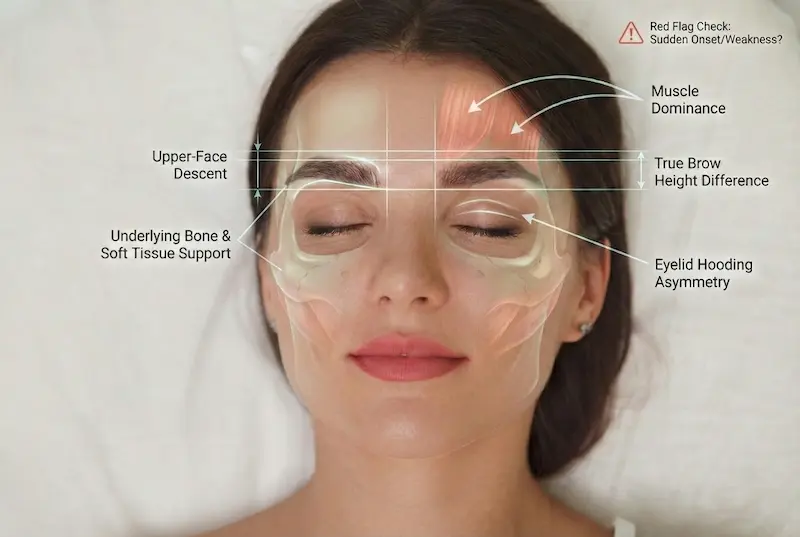
- Muscle dominance: one side may “lift” more with frontalis activation, especially during conversation or photos.
- Prior Botox/Dysport dosing or uneven diffusion can temporarily change brow height and shape — and when filler is also part of the picture (forehead volumization, temple filler, or peri-orbital filler that has migrated), the perceived asymmetry may be partly correctable through filler dissolution and product reassessment rather than through immediate surgery. A staged approach often clarifies the true underlying anatomical pattern before any incision is planned. The complete filler-and-rejuvenation decision framework — including hyaluronidase staging, eye rejuvenation sequencing, and when surgical lift becomes the right next step — is detailed in our filler removal specialist guide.
- Trauma or scarring: past injury can alter tissue glide and brow movement.
In a surgical consult, these factors help determine whether a procedure for asymmetrical eyebrow correction should address lift, support, or both.
“Brow position” vs. “eyelid skin” vs. “upper-face descent” — what’s actually asymmetric?
What patients call “brow asymmetry” may be one of several patterns:
- True brow height difference: one brow sits higher at rest.
- Arch-shape asymmetry: both brows have similar height, but different peak position or tail drop.
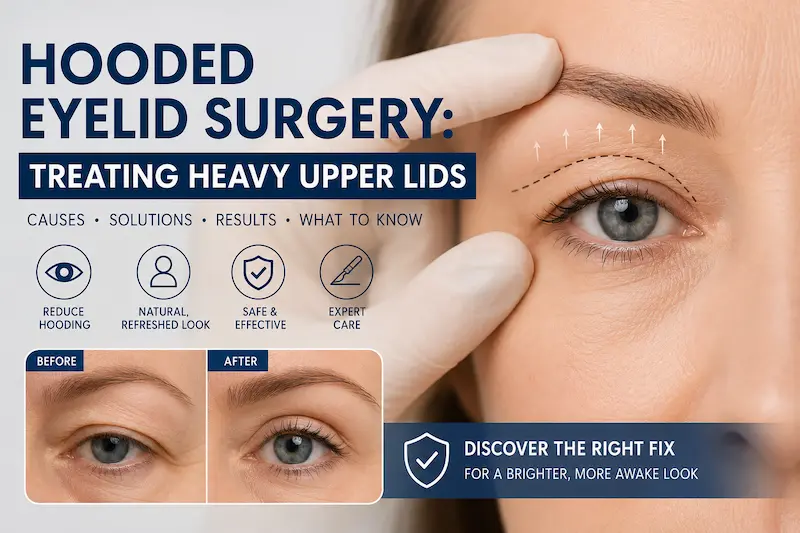
- Upper eyelid hooding asymmetry creates the optical illusion of brow imbalance even when the brow itself sits at the same height — extra skin or eyelid position on one side makes that side look “lower” regardless of true brow position. Importantly, anatomical research has shown that compensatory eyebrow asymmetry can resolve when the underlying eyelid ptosis is treated, because the frontalis muscle stops over-recruiting on the affected side once the visual axis is cleared. The complete upper-eyelid surgical technique reference — including skin excision pattern, levator function evaluation, and how the procedure integrates with brow-position decisions — is documented on our upper eyelid surgery page.
- Upper-face descent: brow + temple tissues descend together, changing the lateral frame of the eye.
Forehead and temple contour matter because soft-tissue support and fat distribution can change perceived brow position — what looks like “uneven brows” may actually be uneven temple/midface support pulling tissue differently on each side. When the asymmetry pattern includes midface descent (heavy lower lids, malar fat pad displacement, asymmetric tear trough shadowing), addressing only the brow can leave the eye area looking unbalanced. The complete midface technique reference — including malar fat repositioning vector, suborbicularis oculi fat suspension, and the eyelid-cheek transition restoration — is documented on our midface lift procedure page.
This distinction matters because the “right fix” may be a targeted brow lift technique, eyelid surgery, or a combined plan—rather than a single, generic approach.
Red flags: when asymmetry signals a medical issue that needs evaluation first
Most eyebrow asymmetry is benign. However, sudden onset or progressive asymmetry can occasionally reflect a medical problem rather than a purely aesthetic one. Seek medical evaluation before elective correction if you have:
- New weakness on one side of the face, drooping, or changes in speech
- Recent trauma with numbness or impaired brow movement
- Progressively worsening eyelid droop (ptosis) or visual changes
A responsible surgical plan starts with safety and appropriate triage—then moves into aesthetics.
Consultation & Surgical Planning (How Surgeons Measure and Predict Symmetry)
High-quality results come from measurement, not guessing. In modern facial aesthetics, many planning steps reflect what you’d expect in scientific research: standard photos, consistent reference points, and evaluating the face both still and in motion. This is especially important for asymmetry, because “equal at rest” may not be “equal in expression.”
Key measurements: brow height, arch peak, tail position, eyelid show, forehead shape
During assessment, surgeons typically look at:
- Medial brow height (near the inner corner of the eye)
- Peak of the arch (where the brow reaches its highest point)
- Lateral tail position (outer brow; often the first area to drop with age)
- Upper eyelid show (how much lid is visible and whether hooding differs by side)
- Forehead/temple contour (support and soft-tissue distribution can change perceived brow position)
These details guide the most precise asymmetrical eyebrow correction strategy.
Photography and dynamic assessment (smile, frown, eyebrow raise)
Static photos are useful—but they’re not enough. A thorough plan evaluates how your brows behave when you:
- Raise your eyebrows (frontalis activation)
- Frown (corrugator/procerus activity)
- Smile and squint (changes around the lateral eye and temple)
This dynamic assessment helps predict whether correcting “height” alone will still look balanced during daily expression.
Setting realistic goals: “improved balance” vs. “perfect symmetry”
One of the most important parts of pre-op planning is expectation-setting. Even with well-executed surgery, faces heal differently side-to-side, and natural asymmetry remains. The goal is noticeably improved balance, natural expression with no “surprised” or over-lifted look, and stable framing of the eyes. When a previous brow lift or facelift has produced over-elevation, asymmetric over-pull, or visible scar issues, correction requires specialized revision expertise rather than another standard lift. The complete revision technique foundation — including how to soften an over-elevated brow, restore natural shape, and address windblown or pixie-ear outcomes — is documented on our revision facelift treatment page.
How to Choose the Right Asymmetrical Eyebrow Correction Plan
Not every brow imbalance needs the same solution. The most reliable asymmetrical eyebrow correction starts by identifying whether the issue is true brow position, upper-eyelid hooding, or upper-face descent. From there, your surgeon can explain which eyebrow asymmetry correction methods best match your anatomy and goals. The aim is improved balance that looks natural in photos and in motion—not a “perfectly identical” result that can look artificial. A structured consultation (measurements, photos, and dynamic facial assessment) is what turns uncertainty into a clear, safe plan.
When Surgery Is the Most Predictable Option
If your asymmetry is structural—such as one brow consistently sitting lower, lateral droop from aging, or stable differences that don’t improve with time—surgery may provide the most dependable correction. In these cases, uneven eyebrow surgery can be planned with side-specific adjustments to elevate or support the lower side while protecting a natural expression. The best candidates are patients with realistic expectations, stable health, and a preference for longer-lasting change over temporary fixes.
Endoscopic vs. Targeted Techniques: What to Clarify
Ask your surgeon whether the correction should be lateral-only, full upper-face repositioning, or a focused stabilization approach. If an endoscopic technique is recommended, discuss how they address asymmetry during planning — especially how much lift is proposed on each side and how fixation is designed to minimize relapse. The mechanical and aesthetic differences between purely lateral approaches and broader upper-face techniques become especially relevant when one side has more lateral descent than the other. The complete decision framework — including symptom-based diagnostic logic, side-by-side technique comparison, and the “neither” option (when eyelid surgery is the better answer) — is detailed in our temporal versus brow lift comparison.
For patients whose primary goal is a lateral elevation aesthetic (rather than restoration of an earlier brow position), the surgical conversation shifts from “correcting asymmetry” to “creating a specific lateral shape” — which carries different naturalness and longevity considerations. Understanding which side of that spectrum fits your goal is part of preventing an over-elevated outcome on the side that didn’t need as much lift. The complete lateral-elevation aesthetic comparison — including thread-based versus surgical approaches, candidacy criteria, and naturalness boundaries — is detailed in our fox eye procedure guide.
A Patient-Centric Consultation Checklist
- Confirm what is asymmetric: brow height, arch shape, eyelid hooding, or temple descent.
- Review realistic recovery milestones and “normal vs. not normal” warning signs.
- Ask how results are evaluated in motion (smiling, frowning, raising brows).
Above all, verify that the surgeon you choose has documented experience with side-specific brow planning rather than a one-size-fits-all approach. The complete credential verification framework — including TPCD/EBOPRAS/ISAPS public registries, fellowship pedigree, and the specific markers that distinguish an asymmetry-experienced specialist from a generalist — is detailed in our surgeon evaluation guide.
Surgical Options for Asymmetrical Eyebrow Correction
When patients search how to fix asymmetrical eyebrow concerns, they often find a mix of makeup tips, Botox discussions, and generic “brow lift” explanations. Surgical planning is more specific. The right procedure for asymmetrical eyebrow correction depends on where the imbalance originates (medial vs. lateral brow, arch peak vs. tail), whether the issue is static or dynamic, and how much lift is needed to look natural.
Below are the main surgical approaches used in modern facial aesthetics for eyebrow asymmetrical correction, along with the “best fit” situations for each. (Exact candidacy always requires an in-person examination.)
Endoscopic brow lift (ideal for upper-face descent; hidden incisions)
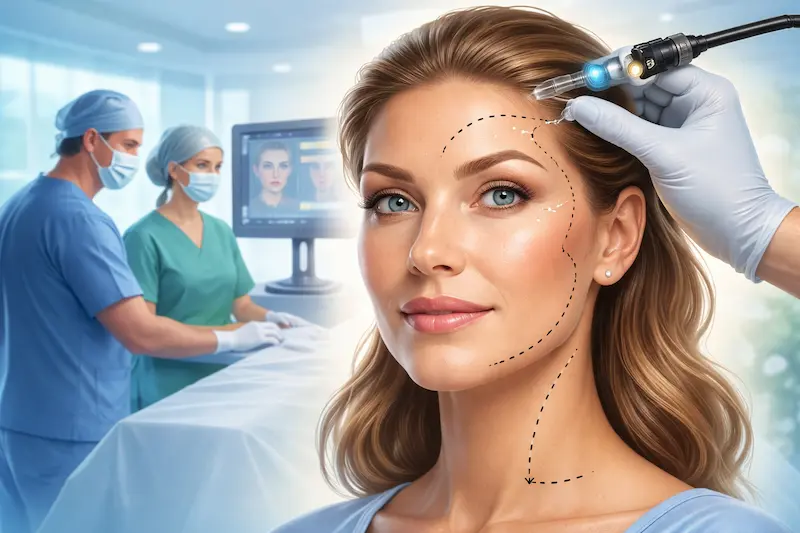
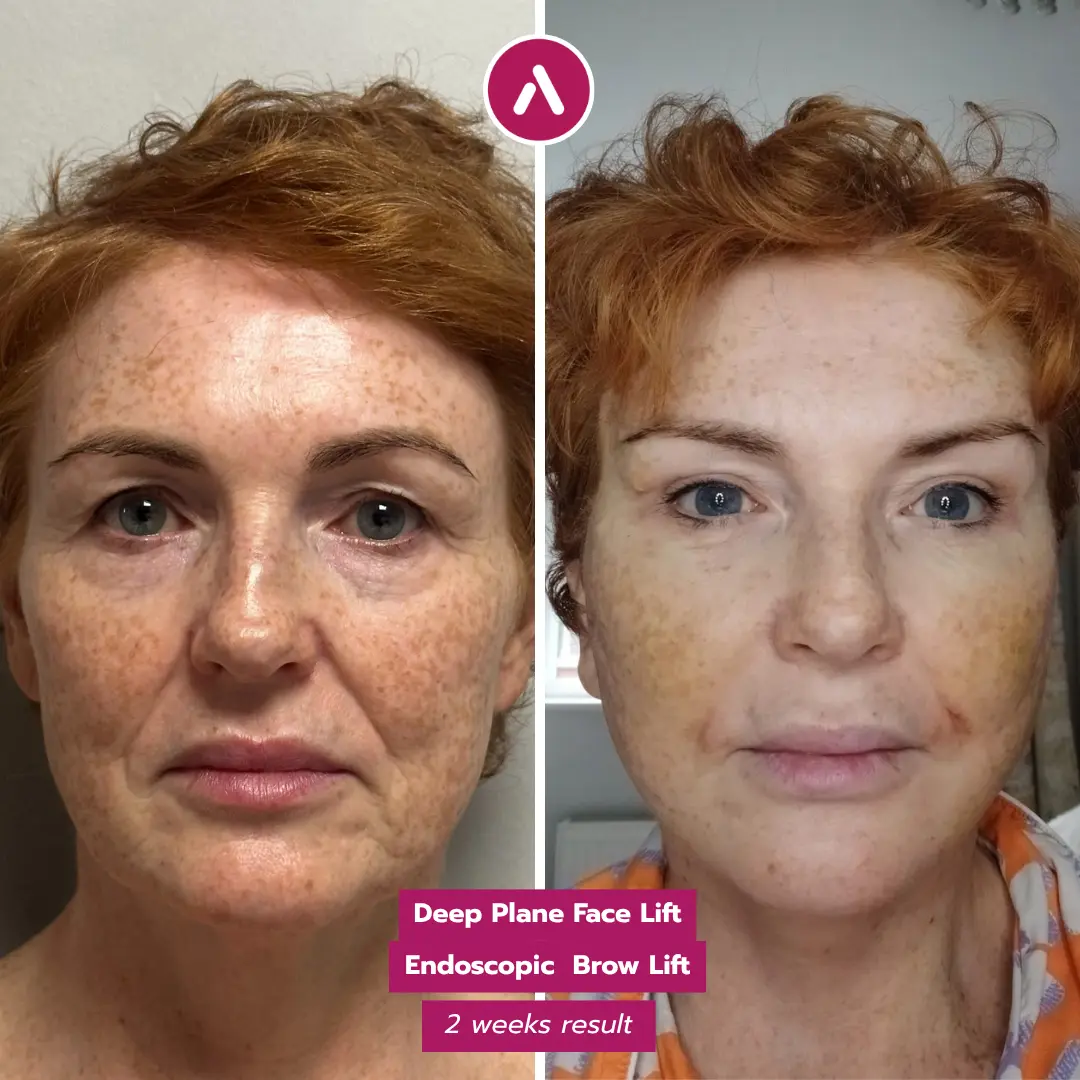
An endoscopic brow lift is often chosen when brow asymmetry is part of broader upper-face descent. Using small, concealed incisions within the hair-bearing scalp, a surgeon repositions the brow and stabilizes it in a more balanced, youthful frame. A peer-reviewed August 2025 lateral pretrichial brow lift combined study from Istanbul Aydın University, published in *Scientific Reports*, evaluated 28 patients undergoing combined lateral temporal subcutaneous brow lift with upper blepharoplasty over an 11-month follow-up — quantifying a 50% improvement in lateral brow position and 45% improvement at the brow apex, providing the evidence base for why side-specific lift planning combined with eyelid refinement is often safer and more reliable than treating either area in isolation.
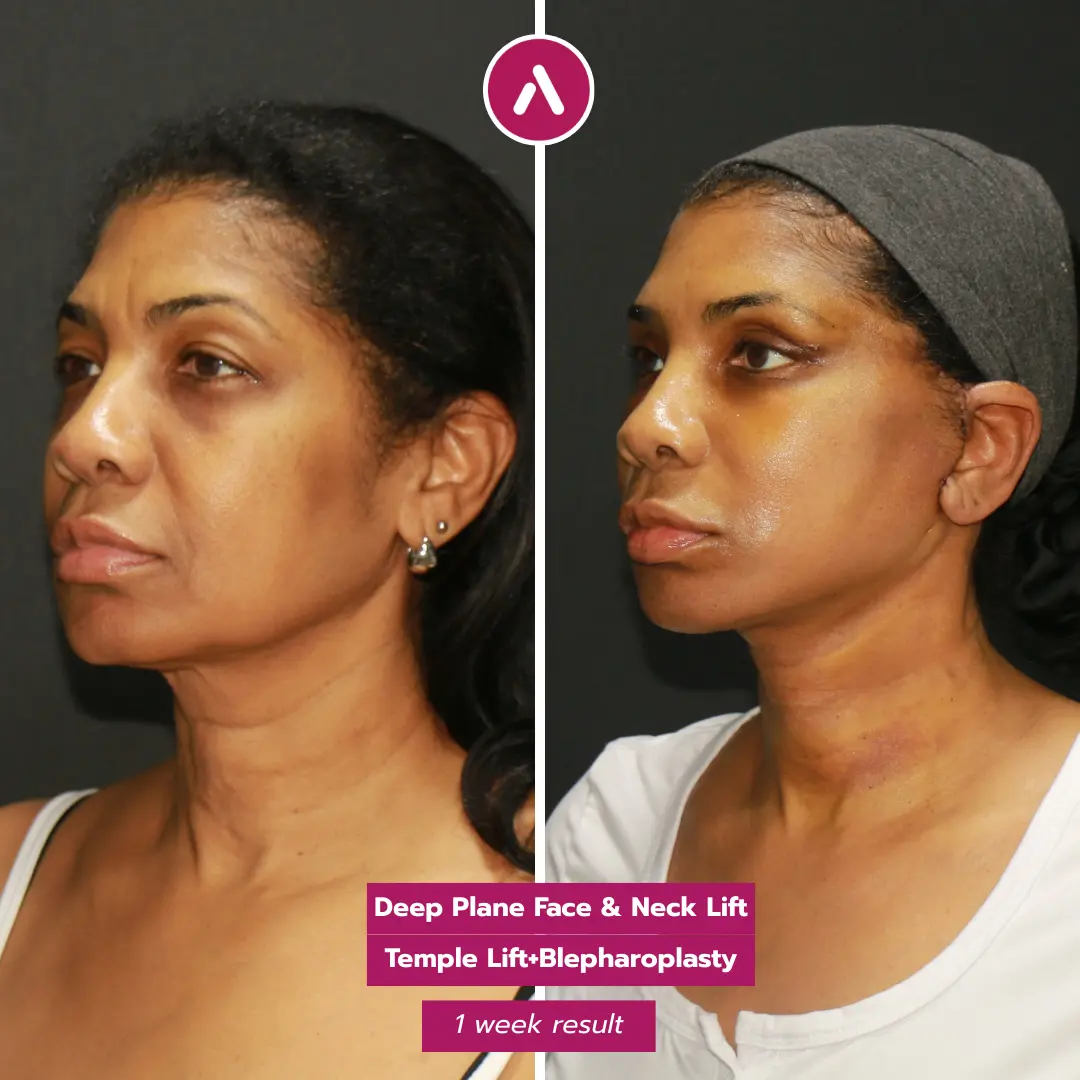
From a medical science standpoint, this technique is also about respecting vectors: lifting and securing tissue in a direction that restores support without creating an “over-pulled” look. When asymmetric brow descent is part of broader lower-and-mid-face descent — as seen in the 49-year-old USA combo case shown above where temple lift was paired with deep plane repositioning — addressing the upper face alone can produce visual mismatch with the rest of the face. The complete deep plane technique foundation — including sub-SMAS dissection, retaining ligament release, and how it pairs with simultaneous brow elevation for global facial harmony — is documented on our deep plane facelift technique reference.
Temporal lift vs. full brow lift (targeted lateral correction)
A temporal lift (often called a lateral brow lift) focuses primarily on the outer brow and temple area. It can be useful when the main asymmetry is the brow tail sitting lower on one side—especially if the inner brow position is already acceptable.
- Why it helps asymmetry: it targets the most common “drop zone” (the lateral brow) with precision.
- Where it works best: mild-to-moderate lateral brow asymmetry; patients seeking subtle, natural improvement.
- When it may not be enough: if the asymmetry is mainly medial (near the nose) or involves significant forehead descent.
This is often a “less is more” solution—useful for a natural-looking correction for asymmetrical eyebrow when only the lateral frame needs adjustment.
Direct brow lift / internal browpexy (when a precise, side-specific adjustment is needed)
For certain asymmetry patterns, surgeons may consider a direct brow lift (a more targeted approach that can create a strong, side-specific correction) or an internal browpexy (supporting and stabilizing the brow from within, often through an eyelid incision in appropriately selected patients).
- Why it helps asymmetry: it can be highly customized for one side—useful when one brow truly needs more support or elevation.
- Where it works best: defined, localized asymmetry; cases where subtle endoscopic or temporal lift may under-correct.
- Critical consideration: scar strategy and incision planning must be meticulous, especially with a direct approach.
If you’re researching asymmetrical eyebrow correction because one side “just won’t match” no matter what, this is often the category of techniques that can offer the most precise leveling—when chosen for the right anatomy.

Choosing the Right Technique (A Customized Plan, Not a One-Size-Fits-All Lift)
The biggest mistake in treating brow asymmetry is assuming there’s a single universal fix. In practice, surgeons choose between endoscopic, temporal, and targeted stabilization techniques based on anatomy, expression patterns, scar tolerance, and the degree of imbalance. This is why two patients with “similar-looking” asymmetry may receive very different surgical plans.
Unilateral vs. bilateral lift strategy (why “lifting only one side” can be correct)
Many patients are surprised to learn that lifting only one side can be a valid plan—especially when the “higher” brow is already in a natural position and the lower brow needs to be brought up to match.
- When unilateral correction makes sense: true one-sided brow descent, or a stable high side that should not be over-elevated.
- When bilateral balancing makes sense: both brows have descended, but one side more than the other.
In other words, good eyebrow asymmetrical correction is often about bringing the “low side up” rather than forcing the high side higher.
Combining lift + soft tissue refinement (fat grafting, scar-tissue management when needed)
Sometimes brow position is only part of the problem. Differences in temple volume, brow fat pad thickness, or scar adhesions can change how symmetrical the brow appears—even after repositioning. In selected cases, a surgeon may recommend combining:
- Lift + subtle volume refinement (to correct hollowing or imbalance in the temple/brow region)
- Lift + scar-tissue release (when past trauma or surgery altered tissue movement)
This is where “looks equal on paper” becomes “looks equal in real life.” A tailored combination can make the correction for asymmetrical eyebrow more stable and natural-looking.
Preventing an “overdone” or surprised look: vectors, tension-free closure, anatomy-first approach
One fear with any brow lift is looking permanently surprised or “pulled.” Avoiding that outcome depends on technique and planning—especially the direction of lift (vector), the amount of elevation, and how tissues are stabilized. In many approaches informed by scientific research on facial anatomy and healing, surgeons prioritize:
- Natural vector selection (lifting in the direction that restores support rather than creating tension)
- Conservative, measured elevation (aiming for balance, not exaggeration)
- Stable fixation + tension control (to reduce relapse and minimize distortion)
This is the “quiet” part of aesthetic surgery: done well, the result doesn’t look like a procedure—it looks like you, just more balanced.
The Procedure Day (What Actually Happens in Surgery)
Once a surgeon confirms candidacy and finalizes a plan, the procedure day is usually more structured (and less dramatic) than many patients expect. A good asymmetrical eyebrow correction approach is planned in advance with measured targets, then executed with careful incision placement, controlled elevation, and stable fixation—aiming for improved balance without an “overdone” look.
Anesthesia options and comfort planning
The anesthesia plan depends on the technique and your comfort needs. For an endoscopic brow lift or broader upper-face work, many patients undergo surgery with anesthesia support to ensure comfort and immobility during precise repositioning. For more limited corrections (in select candidates), shorter approaches may be performed with lighter anesthesia strategies.
Regardless of the approach, the goal is the same: a controlled environment that allows the surgeon to adjust brow position accurately—because a millimeter-level difference can matter in eyebrow asymmetrical correction.
Incision placement and scar-minimizing tactics (hairline design, concealment)
Incision strategy is one of the main reasons surgical solutions can look natural and “invisible” to others. In many modern brow lift techniques, incisions are concealed within the hair-bearing scalp or placed where they can heal discreetly.
- Endoscopic approaches: typically use small incisions hidden in the scalp.
- Temporal/lateral approaches: focus incisions around the temple region in hair-bearing areas.
- Targeted support approaches: may use internal fixation strategies that avoid visible forehead incisions in appropriately selected patients.
This is a key point for anyone researching how to fix asymmetrical eyebrow surgically: the “lift” is only half the story; scar planning and tissue handling are what keep the result looking refined.
Post-op support plan: dressings, early checks, and follow-up milestones
Immediately after surgery, you’ll typically have protective dressings and a clear follow-up plan. Early checks matter because they help your team identify swelling patterns, address comfort, and ensure healing stays on track.
- First days: swelling management, gentle activity, head elevation, and incision care.
- Early follow-up: checks for expected bruising/swelling vs. signs that need attention.
- Ongoing milestones: progressive return to exercise, social events, and final result assessment.
A well-designed plan reduces anxiety and makes the recovery experience feel predictable—especially for patients pursuing correction for asymmetrical eyebrow due to photo-related confidence concerns.
Recovery Timeline & Results (What You’ll Look Like Week by Week)
Recovery is one of the biggest drivers of patient satisfaction. Most concerns are not about pain—they’re about appearance: “When will I look normal?” and “When will I see the final balance?” The truth is that early swelling can temporarily exaggerate asymmetry before it improves. This is normal healing physiology and a consistent theme in medical science and post-op recovery patterns across facial procedures.

Typical swelling/bruising pattern + what’s normal vs. not normal
Recovery from asymmetric brow correction follows a predictable pattern: peak swelling in days 1-3, bruise transition through days 4-10, and refinement continuing through weeks 6-12+. Because brow asymmetry corrections often involve side-specific surgical adjustment, swelling itself can transiently mask whether the correction is settling evenly — which is why patient adherence to clinic-approved swelling control protocols matters more here than in symmetric procedures. The complete recovery acceleration protocol — including HBOT session timing, oxygenation parameters, and how it integrates with peri-orbital healing — is detailed in our recovery acceleration protocol guide.
Usually normal: mild asymmetry during early swelling, temporary numbness, tightness, and sensitivity around incision areas.
Not normal (seek immediate medical attention): sudden, rapidly increasing swelling on one side; severe pain out of proportion; significant bleeding; fever; vision changes.
Return to work/social life: realistic timing for “camera-ready” appearance
Many patients can return to desk work within roughly 7–14 days, depending on bruising and comfort. However, “camera-ready” can take longer—especially if your goal is a subtle, natural asymmetrical eyebrow correction that doesn’t look like you “did something.”
- Work (non-physical): often within 1–2 weeks (varies).
- Social events/photos: many patients feel more confident around weeks 2–4.
- Exercise: gradual return based on surgeon guidance; avoid early strain that increases swelling.
If your main concern is “I have a big event,” discuss that timeline at consult—this is a common and reasonable planning goal for anyone seeking how to fix asymmetrical eyebrow concerns surgically.
Final results & longevity: what lasts, what can shift with time
Final results are not judged at one week. Brow position settles over time as swelling resolves and tissues stabilize. Most patients see a meaningful improvement in balance well before the final stage, but the refined outcome continues to evolve for weeks to months.
- What lasts: structural repositioning and improved support typically provide lasting benefit.
- What can change: natural aging continues; muscle activity and skin quality influence long-term appearance.
This is why the best procedure for asymmetrical eyebrow correction is the one that balances immediate improvement with long-term natural anatomy.
Risks, Safety, and How to Avoid a Bad Outcome
Patients considering asymmetrical eyebrow correction often share one fear: “What if it looks worse?” That’s a valid concern. Surgical outcomes are most reliable when the plan is honest (about what can and cannot be corrected), the technique matches your anatomy, and post-op guidance is followed carefully.
Key risks: numbness, hematoma, hairline changes, asymmetry persistence, nerve-related concerns
All surgery carries risk. Key risks discussed in brow procedures may include:
- Temporary numbness or altered sensation around incision areas
- Hematoma (a collection of blood) and swelling complications
- Hairline or scalp changes depending on incision placement and healing
- Asymmetry persistence (improvement is typical, perfection is not guaranteed)
- Nerve-related concerns (rare, but important to discuss)
For patients researching eyebrow asymmetrical correction, the most important takeaway is that careful patient selection and precise technique significantly reduce risk.
Safety checklist: facility standards, surgeon experience, transparent planning
To reduce the chance of disappointment, use a practical checklist when evaluating any clinic or surgeon:
- Clear diagnosis: they explain what’s actually causing your asymmetry (brow vs. eyelid vs. upper-face descent).
- Customized plan: they can justify why the proposed technique fits your anatomy.
- Transparent expectations: they discuss realistic outcomes and common healing phases.
- Safety-first approach: they give you warning signs and a structured follow-up schedule.
This “process clarity” is what many patients mean when they say they want a clinic that feels grounded in medical science rather than marketing.
Revision considerations: when to wait, when to intervene, and what is realistically correctable
Because swelling and settling can mimic asymmetry early on, revision decisions are rarely made immediately. In many cases, the safest strategy is patience until tissues stabilize. A surgeon may discuss:
- When to wait: early post-op asymmetry can improve as swelling resolves.
- When to investigate: if imbalance is significant, worsening, or paired with concerning symptoms.
- What is correctable: small refinements may be possible; large changes depend on anatomy and scar tissue.
If you’re pursuing correction for asymmetrical eyebrow mainly to feel confident in photos, the best protection against revision anxiety is a plan that’s realistic from day one.
For international patients pursuing asymmetric brow correction in Istanbul, the planning structure matters as much as the surgical technique itself — pre-arrival photo documentation, in-person measurement validation, day-of-surgery vector confirmation, and post-discharge follow-up cadence specifically structured to monitor side-by-side healing differences. The complete step-by-step pathway — including pre-arrival WhatsApp coordination, hairline shave protocol, and remote photo-monitoring schedule for combined upper-face procedures — is documented on our patient journey pathway.
Frequently Asked Questions (FAQ): Asymmetrical Eyebrow Correction
Below are the questions patients most commonly ask when exploring asymmetrical eyebrow correction. These answers are intentionally practical and grounded—because the “best” solution depends on anatomy, healing biology, and realistic outcomes (the basics of medical science in facial surgery).
Can surgery make my brows perfectly symmetrical?
Usually not “perfectly.” Most faces have natural, measurable asymmetry. Surgical treatment aims for meaningful improvement and better balance—especially in photos and at-rest appearance. Many patients are very happy with the result even when tiny differences remain.
Is brow asymmetry better treated with a brow lift or eyelid surgery?
It depends on what’s truly causing the imbalance:
If the brow position is different (especially the outer brow), a brow lift or targeted brow support may be more appropriate.
If the issue is mainly upper eyelid skin/hooding or eyelid position, upper blepharoplasty (eyelid surgery) may address what looks like brow asymmetry.
In some patients, a combined approach is the most natural-looking correction for asymmetrical eyebrow.
Can you correct asymmetry on just one side?
Yes—sometimes a unilateral adjustment is the most logical plan, especially if one brow is already in a natural position and only the lower side needs elevation/support. The surgeon’s goal is balance, not unnecessary lifting of the “better” side. This is a common approach in eyebrow asymmetrical correction.
Will my hairline change after an endoscopic brow lift?
Endoscopic techniques typically use small incisions in the scalp and are often designed to be hairline-friendly. That said, individual factors like forehead height, hair density, and incision strategy matter. During consultation, your surgeon should explain the plan for concealment and how they minimize any risk of visible change.
How long does swelling last, and when will I look “normal”?
Many patients see noticeable improvement within 2–4 weeks, but subtle swelling can take longer to fully settle. Early swelling can temporarily make asymmetry look worse before it looks better—this is a common healing pattern. Your “normal” timeline depends on your baseline anatomy, the technique used, and how your body heals.
What’s the difference between a temporal lift and a full brow lift?
Temporal (lateral) lift: focuses on the outer brow/tail and temple area—often great for lateral heaviness or tail droop.
Full brow lift (often endoscopic): addresses broader upper-face descent and can reposition more of the brow complex.
If your main concern is outer-brow imbalance, a temporal lift can be a very elegant procedure for asymmetrical eyebrow correction.
What if I had Botox or prior surgery—can asymmetry still be corrected?
Often, yes—but evaluation is more nuanced. Prior Botox can change brow dynamics temporarily, and prior surgery or trauma can create scar tissue that affects movement. A surgeon may recommend waiting for neuromodulators to fully wear off before final measurements, and they may consider scar-tissue release or stabilization strategies if needed.
Why is one of my eyebrows higher than the other?
In most cases, it’s due to natural facial asymmetry, muscle dominance (one side of the forehead lifts more), or age-related tissue descent that happens unevenly. Prior Botox, past injury, and differences in eyelid hooding can also make one brow appear higher. A surgical consultation typically checks your brows both at rest and in motion to identify the true source of the imbalance.
Is it normal to have uneven eyebrows?
Yes. Most people have some degree of brow asymmetry, and it often becomes more noticeable in photos or with aging. What matters is whether the difference is stable and simply aesthetic, or if it appeared suddenly. If unevenness is new or comes with facial weakness, seek medical evaluation before pursuing cosmetic treatment.
Can one eyebrow be higher than the other?
Absolutely. It’s common for one brow to sit slightly higher because the underlying bone structure, soft-tissue support, and muscle activity are not perfectly identical on both sides. When the difference is bothersome, asymmetrical eyebrow correction can be planned to improve balance—typically aiming for a natural, harmonious look rather than “perfect symmetry.”
Why one eyebrow is higher than the other?
This usually happens for the same reasons: genetics, habitual facial expressions, and differences in frontalis muscle activation can lift one side more. Aging can further increase the contrast if one lateral brow drops faster than the other. If you’re considering correction, the most reliable first step is a professional assessment to determine whether the issue is primarily brow position, eyelid skin/hooding, or upper-face descent.
Medical Disclaimer: This page is provided for general educational purposes only and does not replace a face-to-face medical consultation, diagnosis, or personalised treatment plan. All surgery carries risks and outcomes vary between individuals. Suitability for a eyebrow correction, procedure selection, and anesthesia choice can only be determined after a full clinical assessment by a qualified surgeon. Always follow your clinician’s instructions and seek urgent medical attention if you develop concerning symptoms during recovery.