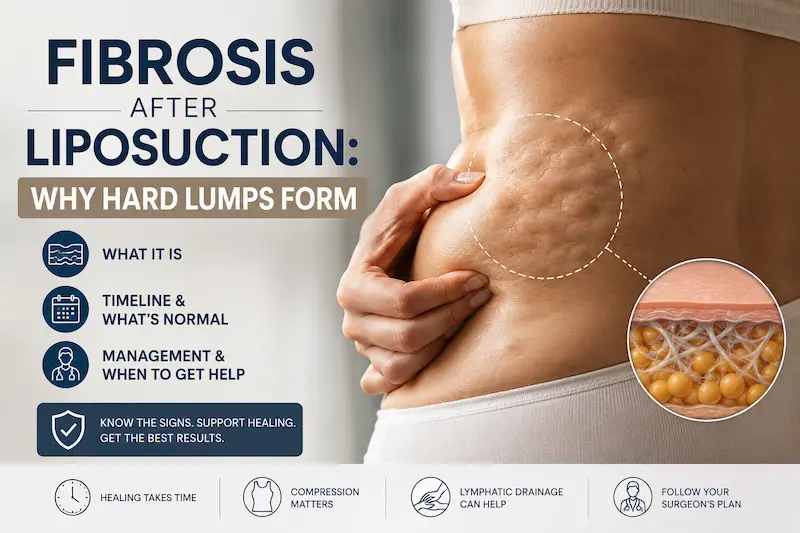
Fibrosis after liposuction means firm, lumpy, or tight areas that develop as the treated fat layer heals. In many patients, these hard spots are part of normal collagen remodeling and soften over months. But painful, growing, hot, red, or one-sided lumps should be reviewed by your surgeon.
Hardness after lipo can feel unsettling. One week you expected swelling; by week three or four, you may feel ridges, knots, or a firm “board-like” patch under the skin. That does not automatically mean something went wrong. Liposuction works inside a living layer of tissue, and that layer needs time to repair.
This guide explains why hard lumps form, how fibrosis differs from swelling or loose skin, and which signs deserve a surgeon’s attention. It is written for US patients comparing aftercare standards, travel planning, and evidence-based recovery support after AKM’s liposuction technique.
At AKM Clinic in Istanbul, liposuction planning is built around precise contouring, tissue respect, and structured postoperative support. The goal is not just fat removal. It is a smoother recovery path with clear instructions on compression, follow-up, and early warning signs.
Table of Contents
What Fibrosis After Liposuction Is?
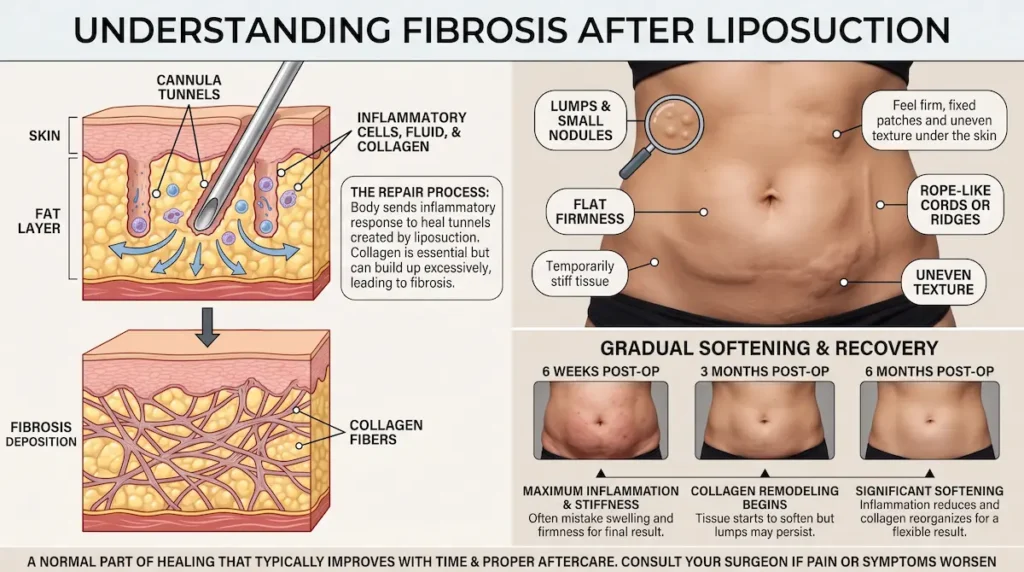
Fibrosis is the body’s repair response inside the treated fat layer. After liposuction, the cannula creates controlled tunnels through fat. Your body then sends inflammatory cells, fluid, and collagen into that space to heal it. Collagen is useful; it helps tissue knit back together. Too much or uneven collagen can feel like lumps, cords, or firm patches.
Think of it less as a “new mass” and more as healing tissue that has become temporarily stiff. Early on, swelling and fluid can make it feel even firmer than it really is. Over time, many fibrotic areas soften as inflammation settles and collagen remodels.
That said, “common” does not mean “ignore it.” Fibrosis can overlap with swelling, seroma, contour irregularity, or skin laxity. The key is learning the difference.
Collagen and Healing Basics
Any surgical procedure creates a repair cycle. First comes inflammation, then tissue rebuilding, then remodeling. In liposuction, that remodeling happens beneath the skin, so you feel the process before you see the final contour.
Collagen fibers are laid down as part of the repair. At first, those fibers can feel thick, firm, or rope-like. As healing progresses, the tissue usually becomes more flexible. This is why a lumpy area at six weeks may not represent the final result.
US patients often expect swelling to fade quickly because the incisions are small. Liposuction is different. The access points may be tiny, but the treated area underneath can be broad. The American Society of Plastic Surgeons describes liposuction recovery as a staged process, with swelling and bruising monitored early and swelling continuing to improve over the following weeks. ASPS guidance on liposuction recovery is a useful benchmark for setting expectations.
Why the Treated Layer Feels Firm
The fat layer after lipo is not empty space. It is a healing network of tissue, fluid, blood vessels, lymphatic channels, and collagen. When those structures are irritated, compressed, or slow to drain, the area can feel hard.
Patients usually describe this in a few ways:
- Small knots: pea-sized or marble-like areas under the skin.
- Flat firmness: a broad, stiff patch that feels tight when you move.
- Ridges or bands: rope-like lines along the treated area.
- Uneven texture: a lumpy surface that changes as swelling shifts.
Fibrosis often feels more obvious when you stand, stretch, or press along the treated area. It may also feel different throughout the day, especially if swelling increases after activity.
Fibrosis vs Swelling vs Loose Skin
Fibrosis, swelling, and loose skin can look similar from the outside. They are not the same problem.
Swelling feels puffy, full, and sometimes tender. It may fluctuate from morning to evening. Fibrosis feels firmer, more fixed, and sometimes nodular. Loose skin feels soft, crepey, or folded, especially when the skin does not retract well after fat removal.
This distinction matters because each issue is managed differently. Compression and time may help swelling. Early professional aftercare may support fibrosis. Skin laxity depends more on skin quality, age, weight change, and whether skin-tightening or excisional surgery is needed. For that separate issue, see how loose skin differs from fibrosis.
Surgeon’s note: A firm area after liposuction is not automatically a complication. The question is whether it is improving, stable, or getting worse. Healing tissue should gradually soften; worsening pain, redness, heat, drainage, or a growing lump deserves prompt medical review.
Why Hard Lumps Form?
Hard lumps after liposuction usually form because healing is not perfectly uniform. Some areas receive more tissue trauma, hold more swelling, or experience more tension under the compression garment. The body responds by laying down collagen. That collagen can collect in thicker patches before it softens.
This is one reason two patients can have the same procedure and feel very different during recovery. Anatomy matters. Technique matters. Aftercare matters. So does the treated area.
Normal Collagen Remodeling
The most common reason for post-lipo firmness is normal collagen remodeling. During the first several weeks, the body is actively sealing the tiny internal pathways created by the cannula. That repair process can feel bumpy.
Early fibrosis is often more noticeable once the first wave of swelling begins to move. Patients sometimes say, “It felt smoother at week one, then lumpier at week three.” That can happen because swelling initially hides texture. As the fluid shifts, the firmer healing bands become easier to feel.
Most early firmness is not permanent. Collagen continues to reorganize for months. The goal during this phase is to support drainage, avoid unnecessary inflammation, and follow the surgeon’s compression plan.
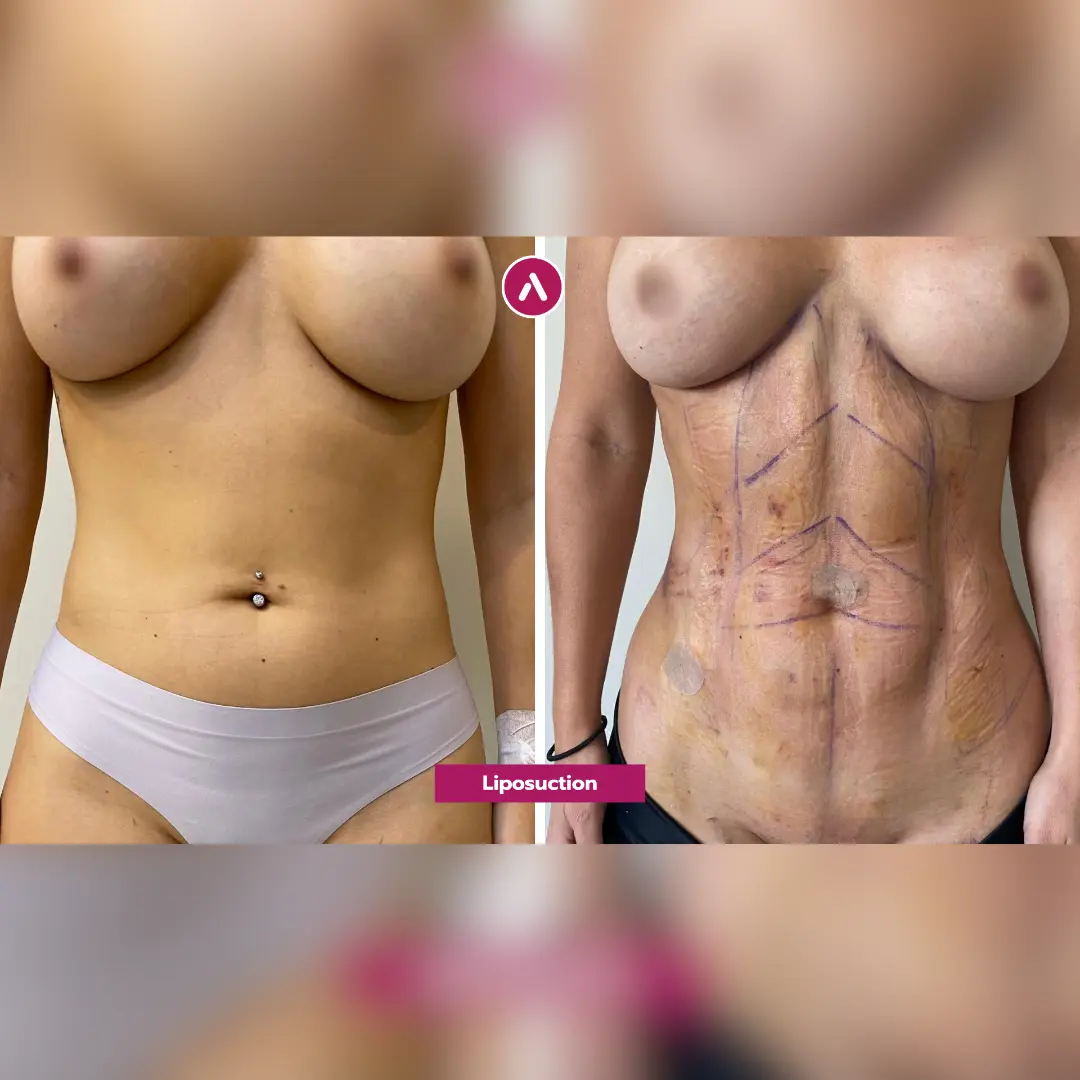
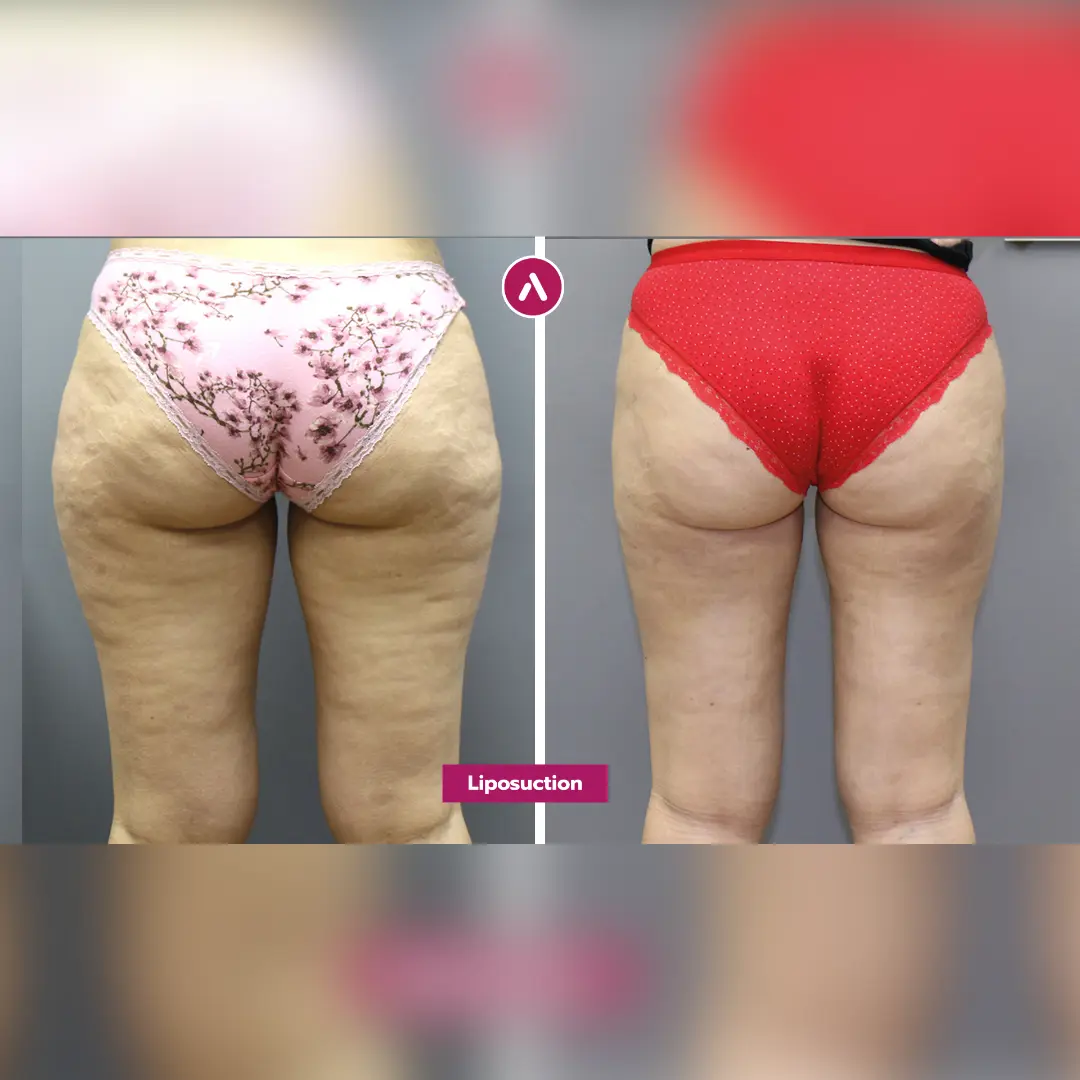

Technique, Aftercare, and Compression
Post-lipo fibrosis is not caused by one factor alone. It often reflects a combination of surgical and recovery variables.
- Cannula movement: More extensive contouring can create more internal healing surface.
- Dense fat: Fibrous areas may require more work, which can increase temporary firmness.
- Compression fit: A garment that is too loose may not support swelling; one that digs in can create ridges.
- Delayed drainage support: Fluid that lingers may contribute to stiffness and uneven texture.
- Activity too soon: Overexertion can worsen inflammation and swelling.
- Individual healing: Some patients simply produce firmer scar tissue than others.
For this reason, AKM does not treat aftercare as an afterthought. US patients traveling for surgery should ask about compression duration, when to start manual lymphatic drainage, what is normal by week, and how virtual follow-up is handled after returning home.
Why Some Areas Are More Prone
Fibrosis can happen after liposuction in almost any area, but some zones make firmness more noticeable. The arms, lower abdomen, flanks, inner thighs, and mons pubis can all reveal texture changes because the skin is thinner, the area moves often, or swelling collects easily.
Arms are a good example. They have less room to hide unevenness, and patients often notice tight bands when raising the arm. For a separate look at results in that zone, read area-specific liposuction results.
The mons pubis is another delicate region. Even mild swelling can feel exaggerated there because the tissue is compact and sensitive. Fibrosis in this area needs careful assessment rather than aggressive self-massage. For that anatomy-specific discussion, see fibrosis in delicate areas.
Location also affects how patients perceive lumps. A small firm spot on the abdomen may be easy to ignore. The same degree of firmness under the chin, on the arm, or near the pubic area may feel more concerning because it is easier to touch or see.
The Typical Timeline
Fibrosis after liposuction does not appear and disappear on the same schedule for everyone. Still, most patients follow a recognizable pattern: swelling first, firmness next, then gradual softening. The important point is direction. Tissue that is slowly softening is usually more reassuring than tissue that is becoming more painful, red, hot, or enlarged.
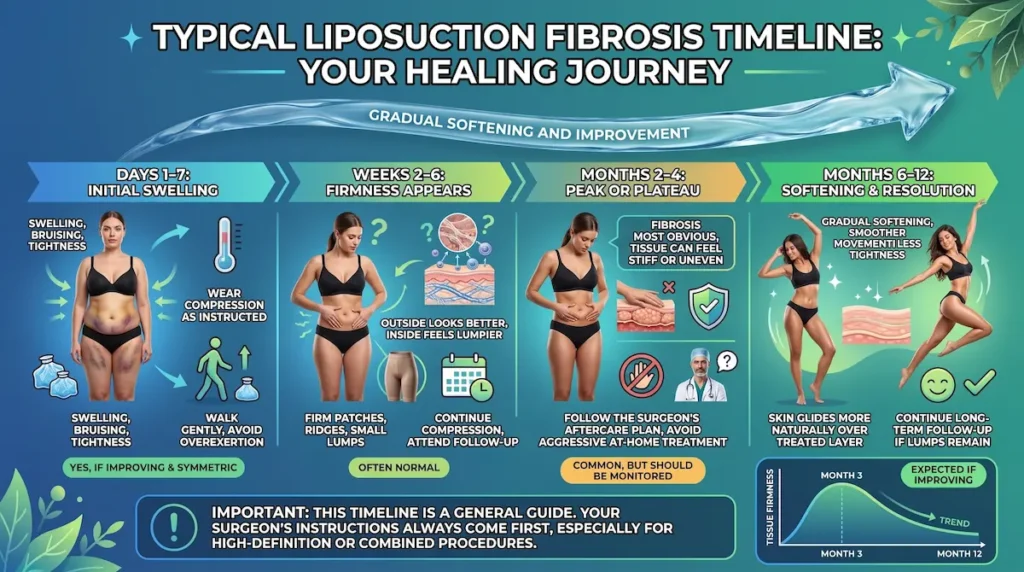
The timeline below is a general guide, not a diagnosis. Your surgeon’s instructions always come first, especially if you had high-definition contouring, multiple areas treated, revision liposuction, or a combined procedure.
| Stage | Typical Firmness | Usually Normal? | Supportive Action |
|---|---|---|---|
| Days 1–7 | Swelling, bruising, tightness, tenderness | Yes, if improving and symmetric | Wear compression as instructed, walk gently, avoid overexertion |
| Weeks 2–6 | Firm patches, ridges, small lumps becoming easier to feel | Often normal | Continue compression, attend follow-up, ask when to begin professional drainage |
| Months 2–4 | Fibrosis may peak or plateau; tissue can feel stiff or uneven | Common, but should be monitored | Follow the surgeon’s aftercare plan; avoid aggressive self-treatment |
| Months 6–12 | Gradual softening, smoother movement, less tightness | Expected if improving | Continue long-term follow-up if lumps remain visible or uncomfortable |
Weeks 1–6: Firmness Appears
During the first week, swelling usually dominates the picture. The treated area may feel tight, bruised, and tender. You may not yet be able to tell what is swelling and what is early firmness.
By weeks two through six, patients often begin noticing harder areas. This can be frustrating because it may happen just as bruising starts to fade. The outside looks better, but the inside feels lumpier.
That mismatch is common. It happens because swelling is shifting, collagen is forming, and the tissue is still organizing itself beneath the skin. A firm area that is mildly tender but gradually improving is usually less concerning than a lump that grows, becomes hot, or develops spreading redness.
Months 2–4: Peak or Plateau
Fibrosis often feels most obvious between months two and four. The tissue may feel less swollen than before, yet still stiff. Some patients describe this phase as a plateau: the area is no longer changing quickly, but it has not softened enough to feel normal.
This is also the stage when patients may become anxious about final results. That anxiety is understandable. But liposuction results are not judged at eight weeks. The internal repair process continues far beyond the point when the incisions have closed.
During this window, the safest approach is not to panic and not to become aggressive with at-home massage tools. Too much pressure can irritate tissue that is already inflamed. Professional guidance matters.
Months 6–12: Softening and Resolution
By six months, many fibrotic areas feel softer, flatter, and less noticeable. The skin may glide more naturally over the treated layer. Tightness during stretching or exercise may also decrease.
Some residual firmness can continue to improve up to a year. That does not mean every lump should be ignored for twelve months. It means the final contour takes time, and the trend matters more than a single day’s texture.
If a firm area is still visible, painful, or sharply defined at this stage, your surgeon may want to examine it more closely. Sometimes the issue is not fibrosis alone. It may be contour irregularity, residual fat, scar tethering, or another post-lipo concern that needs a different plan.
What’s Normal vs Worth Flagging?
The hardest part for many patients is deciding whether a lump is “normal healing” or a reason to worry. A helpful rule is to look for progression. Normal healing usually moves in the direction of less pain, less heat, less swelling, and more flexibility. Concerning healing often moves the other way.
Because US patients may be recovering far from their surgical team after returning home, this section matters. You should know what can be monitored, what should be photographed and reported, and what deserves urgent medical attention.
Normal Firmness and Unevenness
Some firmness after liposuction is expected. It is especially common in the first two to four months, when collagen is active and swelling is still resolving. Mild asymmetry can also happen early because one side may swell more than the other.
These signs are usually more reassuring:
- The firm area is slowly getting softer.
- The lump changes slightly with swelling or activity.
- There is no spreading redness or heat.
- Pain is mild and improving.
- The skin color is stable.
- Your surgeon has already examined it and is monitoring it.
Normal does not mean pleasant. A healing area can feel tight, itchy, numb, or tender. Sensation may also return unevenly, which can make one patch feel strange while the surrounding area feels normal.
Signs to Raise With Your Surgeon
Contact your surgeon if a lump is not improving, feels sharply different from the surrounding tissue, or appears with symptoms that suggest infection, fluid collection, or impaired healing. It is better to ask early than to wait and guess.
Signs worth reporting include:
- Increasing pain instead of gradual improvement.
- Spreading redness around the firm area.
- Warmth or heat that feels different from nearby skin.
- Drainage, pus, or odor from an incision or nearby area.
- A rapidly growing lump or one-sided swelling.
- Fever, chills, or feeling unwell with local symptoms.
- Skin color changes such as darkening, blistering, or dusky patches.
These symptoms do not automatically mean a serious complication has occurred. They do mean a qualified clinician should assess you. Photos, short videos, and a clear timeline can help your surgical team understand what is changing.
How Fibrosis Differs From a Seroma or Contour Irregularity
Fibrosis is firm healing tissue. A seroma is a collection of fluid. A contour irregularity is a shape issue, such as a dent, ridge, wave, or uneven fat removal pattern. They can overlap, but they are not the same thing.
A seroma may feel more like a fluid pocket or swelling that shifts. It can feel soft, squishy, or fluctuant rather than firm and rope-like. It may also appear as a localized bulge. A contour irregularity, by contrast, may be visible even when swelling has gone down and may not feel painful.
Fibrosis usually has a denser, tighter feel. It may be tender when pressed, especially early. It may also improve with time and appropriate aftercare, while other problems may need different evaluation.
This is why self-diagnosis is risky. If you are unsure whether you are feeling fibrosis, fluid, scar tethering, or contour change, ask your surgeon. A short follow-up can prevent weeks of worry.
Recovery perspective: Hard lumps after lipo are often part of the repair process, but they should not be dismissed automatically. The safest mindset is calm observation plus clear escalation: track what is improving, report what is worsening, and never treat pain, heat, redness, or drainage as “just fibrosis.”
How Fibrosis Is Managed?
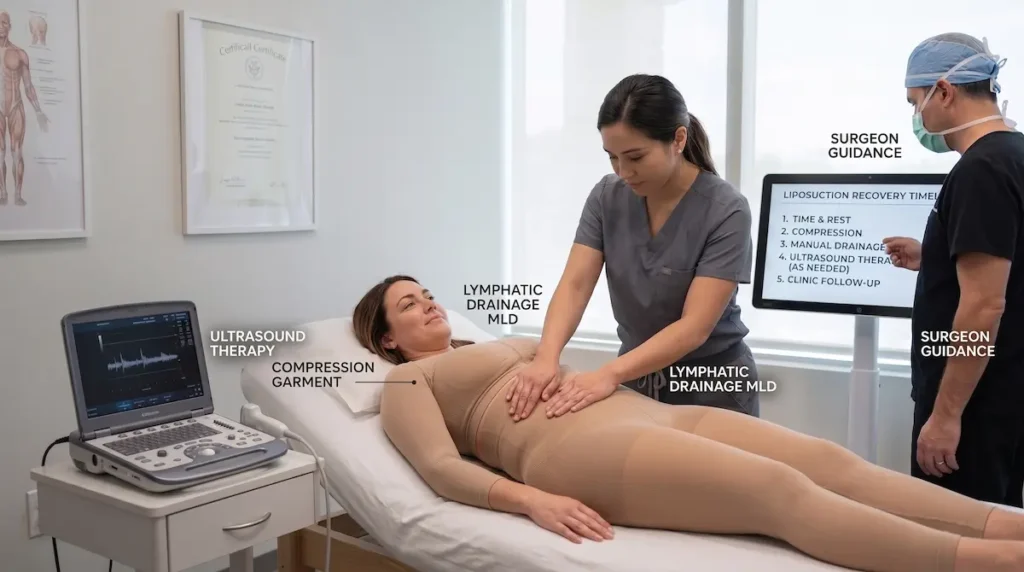
Managing fibrosis after liposuction is usually not about one dramatic intervention. It is a layered plan: time, compression, careful monitoring, professional drainage support when appropriate, and surgeon-led escalation if the tissue does not soften as expected.
The key is timing. Early healing tissue is sensitive. Too little support can allow swelling to linger, but too much pressure or aggressive self-massage can irritate the area and worsen inflammation. Your surgical team should guide the plan.
Manual Lymphatic Drainage and Ultrasound
Manual lymphatic drainage, often shortened to MLD, is a gentle technique used to encourage fluid movement after surgery. Some clinicians also use therapeutic ultrasound as part of post-lipo fibrosis management. A clinical study published on PubMed reported that combining manual lymphatic drainage with therapeutic ultrasound reduced swelling and tissue fibrosis during the postoperative period after liposuction and lipoabdominoplasty.
This article will not turn into a massage tutorial, because fibrosis treatment should be personalized. Pressure, timing, and technique matter. For the dedicated recovery resource, read lymphatic drainage massage and how it helps.
One caution: do not use deep tissue massage, massage guns, hard rollers, or aggressive scraping unless your surgeon specifically clears it. Firm healing tissue is not something to “break up” at home with force.
Compression and Time
Compression garments help reduce swelling and support tissue as it settles. The American Society of Plastic Surgeons notes that patients are commonly instructed to wear an elastic bandage or compression garment after liposuction to minimize swelling and support healing. Your exact schedule should come from your surgeon, because garment type and duration vary by area treated and technique used.
A good garment should feel supportive, not punishing. It should not create deep grooves, sharp folds, numbness, or skin irritation. If it digs into one area, it can create uneven pressure that makes ridges and firmness feel worse.
Time also matters. Fibrosis is part of the remodeling phase, and remodeling is slow. Many patients see meaningful softening between months three and six, with further refinement up to twelve months.
When a Clinician Escalates Care
If a firm area remains painful, sharply raised, tethered, or visibly irregular despite appropriate aftercare, your surgeon may reassess. That does not always mean another procedure. It may mean a physical exam, ultrasound imaging, garment adjustment, supervised therapy, or a longer observation period.
Escalation depends on the cause. Persistent swelling, seroma, contour irregularity, scar tethering, and residual fat are not managed the same way. This is why a surgeon-led diagnosis matters before any treatment plan.
At AKM Clinic, US patients are guided through virtual follow-up at 1, 3, 6, and 12 months after surgery. For international patients, that continuity is part of safer recovery planning. It gives you a structured way to ask, “Is this normal for my stage?” instead of trying to interpret every lump alone.
Planning Ahead Before You Travel
The right time to discuss fibrosis is before surgery, not after you feel a lump. During consultation, ask how your surgeon prevents and manages post-lipo firmness. Ask about compression, MLD timing, warning signs, photo follow-up, and who reviews concerns once you are back in the US.
You should also confirm credentials accurately. For AKM’s US-facing content, the correct framework is European Board-Certified Surgeons, ABPS-equivalent. That means you can evaluate training and standards without making the incorrect claim that a surgeon is certified by a US board.
AKM performs surgery in Istanbul at a JCI-accredited facility and provides coordinated aftercare, including hotel recovery support, patient hosts, and long-term virtual follow-up. The clinic’s Natural-First philosophy applies to body contouring as well: smooth, proportionate contouring is the goal, not an over-operated look.
Cost questions belong on the dedicated cost page rather than inside a recovery article. For pricing context, see what liposuction costs in Turkey.
Frequently Asked Questions: Fibrosis After Liposuction
These answers are designed to clarify common concerns about lipo fibrosis without replacing your surgeon’s advice. If your symptoms are worsening, painful, hot, red, draining, or associated with fever, contact your surgical team promptly.
Why do I have hard lumps after lipo?
Hard lumps after lipo often form because the treated fat layer is healing. The body lays down collagen to repair the internal tunnels created by the cannula. That collagen, combined with swelling and fluid changes, can feel firm, bumpy, or uneven for weeks to months.
Is fibrosis after liposuction normal?
Mild to moderate firmness can be normal after liposuction, especially in the first few months. It should gradually soften. Fibrosis is more concerning when it becomes increasingly painful, red, hot, enlarged, one-sided, or associated with drainage or fever.
How long does lipo fibrosis last?
Many patients notice firmness during weeks two through six, with a peak or plateau around months two to four. Softening often continues between months six and twelve. The exact timeline depends on the treated area, technique, compression, aftercare, and individual healing.
Will fibrosis go away on its own?
Some early fibrosis softens with time, compression, and normal remodeling. Other cases benefit from professional aftercare such as manual lymphatic drainage or therapeutic ultrasound when appropriate. Persistent, painful, or visible lumps should be assessed by your surgeon before you assume they will resolve on their own.
Can massage help fibrosis after liposuction?
Gentle, properly timed manual lymphatic drainage may help postoperative swelling and tissue firmness. It should not be confused with aggressive deep massage. Ask your surgeon when to start, how often to attend, and what level of pressure is safe for your stage of healing.
When should I worry about hard lumps after liposuction?
You should contact your surgeon if a lump is getting larger, more painful, hot, red, or associated with drainage, odor, fever, chills, skin darkening, or sudden one-sided swelling. Those signs can point to issues beyond routine fibrosis and deserve medical review.
Is fibrosis the same as loose skin?
No. Fibrosis feels firm, tight, or nodular under the skin. Loose skin feels soft, folded, crepey, or lax. They can appear together, but they are different concerns and need different evaluation.
Does VASER liposuction prevent fibrosis?
No technique can promise zero fibrosis. VASER liposuction uses ultrasound energy to help emulsify fat before removal, which may support precise contouring in selected patients. Still, healing response, compression, aftercare, and individual collagen production all affect firmness after surgery.
Can fibrosis ruin liposuction results?
Most early firmness does not ruin results. Many hard areas soften as swelling resolves and collagen remodels. Persistent fibrosis, contour irregularity, or scar tethering may affect the final look, which is why follow-up matters.
What should I ask during consultation?
Ask how your surgeon reduces tissue trauma, what compression plan they use, when MLD can start, how hard lumps are monitored, and what follow-up is available after you return home. US patients should also ask how urgent concerns are handled across time zones.
Medical disclaimer: This article is for informational purposes only and does not replace medical advice, diagnosis, or treatment. Liposuction recovery varies by anatomy, technique, treated area, health history, and aftercare. If you have pain, redness, heat, drainage, fever, sudden swelling, skin color change, or a lump that is worsening, contact your surgeon or seek qualified medical care.