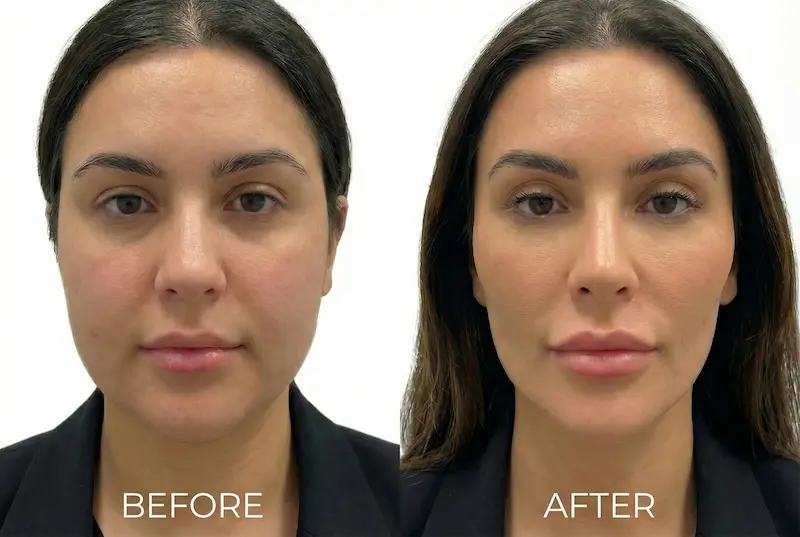

“I want a sharper jawline, but I’m not ready for a facelift.” That sentence sends most people searching for neck liposuction—and for many it’s the right answer. For others, it’s the start of an expensive mistake, because liposuction and a neck lift solve two completely different problems.
This guide is a decision tree, not a sales page. By the end, you’ll know which problem you actually have—fat, loose skin, muscle banding, or weak chin projection—and which procedure (or combination) fits your case. We’ll start with a self-assessment you can do at home, then walk through exactly when liposuction alone works, when you need a lift instead, and when combining procedures makes sense.
Table of Contents
The Core Decision: Fat Removal vs Skin Tightening
Almost every “I want a sharper jawline” conversation comes down to one question: is the problem fat, or is it skin? Liposuction removes fat. It does not tighten skin. Confusing the two is the single most expensive mistake in neck contouring — because a patient with loose skin who gets liposuction ends up worse, not better.
This guide is a decision tree, not a procedure pitch. The goal is to help you figure out which problem you actually have before you choose a procedure.
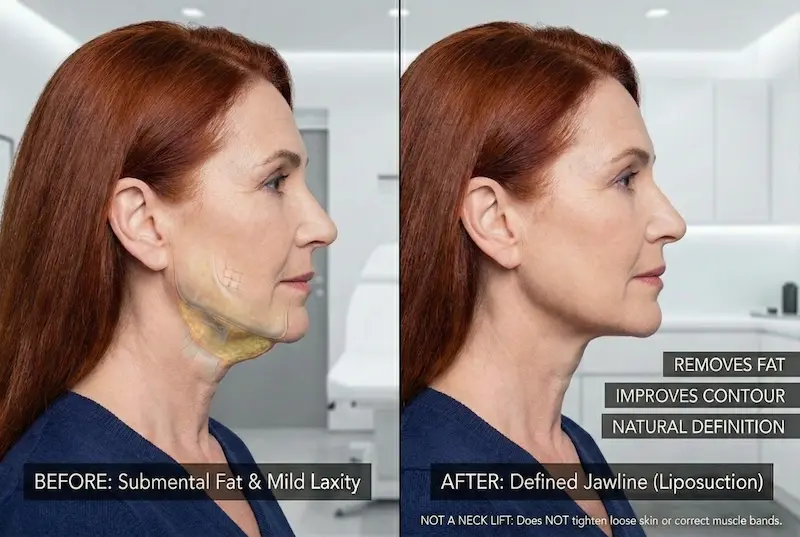
Submental fat vs loose skin: how to tell which is your issue
Submental fat sits below the chin as a soft, pinchable pad — it’s a volume problem. Loose skin is a laxity problem: the skin no longer retracts tightly over the neck structures. Many people have some of both, and the dominant one decides the procedure.
Jawline definition actually depends on four separate factors: fat (liposuction’s job), skin elasticity (a lift’s job), muscle banding (platysmaplasty’s job), and chin projection (chin augmentation’s job). Most “undefined jawline” complaints involve more than one of these — which is why single-procedure thinking so often disappoints.
For the male-contouring angle specifically, where a strong jawline depends heavily on getting the fat-removal judgment right without over-sculpting, the male liposuction contouring guide covers how fat distribution differs in the male neck and jawline, the over-resection risks that produce a hollowed or feminized result, and the technique judgment that keeps a male jawline looking strong rather than etched.
Pinch test self-assessment
The pinch test is the fastest at-home triage. Gently pinch the skin under your chin and release it. If it snaps back quickly, your skin elasticity is good — liposuction-alone candidacy is more likely. If it sits, folds, or returns slowly, elasticity is reduced, and fat removal alone will probably leave loose skin behind.
This isn’t a diagnosis — it’s a screening step. But it predicts the surgeon’s assessment surprisingly well, and it reframes the conversation from “which procedure do I want” to “which procedure does my skin allow.”
Skin elasticity quick check
Beyond the pinch test, three signals point toward reduced elasticity: visible vertical bands when you tense your neck (platysmal banding), a neck angle that stays soft even when you tilt your head up, and age-related thinning (elasticity typically declines past the mid-40s). The more of these you have, the less likely liposuction alone will satisfy.
The “skin elasticity quick check” maps directly onto how surgeons formally assess candidacy. The clinical literature is explicit that minimally invasive neck procedures work for specific laxity grades and fail outside them — which is exactly what the at-home check is approximating.
For the clinical-candidacy framework, 2023 multicenter retrospective study of minimally invasive neck rejuvenation candidacy across 391 patients with platysmal banding and subcutaneous laxity (Aesthetic Surgery Journal) — pooling outcomes from five surgeons across four aesthetic practices — reported that minimally invasive neck procedures suit patients with mild-to-moderate laxity and good skin elasticity, that excess submental fat requires added liposuction and extensive skin laxity requires more than minimally invasive techniques, and documented low complication rates (infection 1%, recurrent platysmal banding 4.6%, residual loose skin 1.8%) in appropriately selected patients.
The gatekeeper is elasticity. Good elasticity opens minimally invasive options; poor elasticity closes them and points toward lifting.
Decision Tree: Which Procedure Fits Your Case?
This is the heart of the guide. Find the row that matches your situation, and the right starting procedure becomes clear. This is a screening framework, not a substitute for an in-person assessment — but it will tell you which conversation to have.
| If you have… | The likely answer is… | Why |
|---|---|---|
| Submental fat + good skin snap-back + under ~45 | Neck liposuction alone | Elastic skin retracts over the de-bulked neck on its own |
| Fat + mild banding + borderline elasticity | Lipo + energy tightening or mild platysma work | Fat removal plus a tightening assist bridges the gap |
| Loose skin that doesn’t snap back + visible bands | Neck lift (not liposuction) | Removing fat without skin management leaves hanging skin |
| Neck laxity + jowls + lower-face descent | Deep plane neck/face lift | The neck is part of a larger structural problem |
| Round lower face + buccal fullness + thin neck | Neck lipo + buccal fat removal | Width comes from cheeks, not just the neck |
| Undefined jawline despite being thin | Chin augmentation (± neck lipo) | The issue is projection, not fat |
The rows that say “not liposuction” are the ones that prevent the most regret. If you’re in a loose-skin or structural-descent row, liposuction won’t get you there — and a clinic that sells it to you anyway is optimizing for its booking, not your result.
When Neck Liposuction Alone Works
This is the best-case scenario—the one where a single, minimally invasive procedure delivers the result. But it only applies to a specific candidate profile. Here’s exactly who fits it, and what to realistically expect.
Ideal candidate criteria
Neck liposuction “working alone” depends on one anatomical reality: good skin elasticity. The ideal candidate is typically younger, has localized submental fat as the primary problem, and has no significant platysmal banding or skin laxity. For this profile, liposuction produces a clean, sharper jawline.
For the full procedural context beyond the neck-specific decision, the complete liposuction techniques overview covers the cannula approaches, the difference between traditional and energy-assisted liposuction, the recovery framework, and the technique principles that apply across all liposuction procedures including submental contouring.
Realistic expectations: what changes, what doesn’t
Liposuction removes fat and lets elastic skin retract — it does not tighten skin, lift muscle, or fix banding. The honest version: you get a sharper cervicomental angle and a more defined jawline if you match the candidacy, and disappointment if you don’t.
“What changes, what doesn’t” deserves evidence rather than reassurance. The submental-liposuction literature is consistent on a narrow but real point: in appropriately selected patients, fat removal improves cervical aesthetics safely — but candidacy selection is the variable that determines success.
For the synthesis layer, 2024 PRISMA systematic review of submental liposuction safety and cervical aesthetic outcomes across seven databases (Annals of Plastic Surgery) — pooling studies through a structured multi-database search with formal risk-of-bias assessment — reported that submental liposuction improves cervical aesthetics with a low complication rate when applied to appropriate candidates, while noting the evidence base remains limited and standardized outcome measurement is still developing.
The procedure is safe and effective for the right candidate. The entire decision rests on honest candidacy assessment rather than on the procedure itself.
When You Actually Need a Neck Lift Instead
This is the section that prevents the most regret. If your skin won’t retract over a de-bulked neck, liposuction alone makes things worse, not better. Here’s how to recognize when lifting—not just fat removal—is the honest answer.
Loose skin signs
“Loose skin signs” is the decision point where neck liposuction stops being the answer. When skin lacks the elasticity to retract over a newly de-bulked neck, removing fat alone produces a deflated, hanging result — worse than the starting point.
The signs that point toward lifting: skin that doesn’t snap back on the pinch test, visible platysmal banding, an obtuse cervicomental angle that persists when you tilt your head, and age-related elastosis (typically more pronounced past the mid-40s).
For the surgical-lift side of the decision, the neck lift procedure guide covers what neck lift surgery actually repositions and tightens, the candidacy criteria that distinguish lift candidates from liposuction candidates, the recovery profile, and the combined lipo-plus-lift approach for patients who have both excess fat and loose skin.
Combined approach: lipo + neck lift
Many patients aren’t purely one or the other — they have both excess fat and loose skin. For them, the answer isn’t choosing between lipo and lift; it’s combining them, removing fat and managing skin in one procedure.
When neck laxity is accompanied by jowl formation and lower-face descent, the more durable solution often involves deeper structural repositioning rather than isolated neck work.
For the deeper structural option, the deep plane neck and face lift covers what the deep-plane technique repositions, the candidacy threshold where isolated neck work becomes insufficient, the longevity advantage over more superficial techniques, and the framework for treating the neck alone versus the neck-and-lower-face as a connected structural problem.
Combined V-Shape Jawline Plans
A defined “V-shape” lower face rarely comes from one procedure. The jawline is shaped from below (neck fat), from the sides (cheek fullness), and from the front (chin projection). When fullness or weakness sits in more than one of these zones, combining procedures outperforms treating the neck alone.
Neck lipo + buccal fat removal
The “V-shape” goal often requires addressing two areas: the neck (where submental fat blunts the jawline from below) and the cheeks (where buccal fat fullness widens the lower face). Treating only the neck can leave the face still looking round from the front, even with a sharper profile.
The candidacy is specific: this works for patients with genuine buccal fat excess, not for patients whose fullness is structural or who would look gaunt with buccal reduction.
For the cheek side of the V-shape plan, the buccal fat removal procedure covers the candidacy assessment that distinguishes genuine buccal excess from structural fullness, the long-term considerations (buccal removal is permanent and can age unfavorably if overdone), and the combination planning that sequences cheek and neck contouring.
Neck lipo + chin filler/implant
An undefined jawline isn’t always a fat problem — sometimes it’s a projection problem. A weak or recessed chin makes the submental area look fuller and the jawline look softer, even in thin patients.
The chin projection creates the “shelf” that a defined jawline drapes over; without adequate projection, even a fat-free neck looks undefined.
For the projection side, the chin augmentation options cover the difference between filler-based and implant-based enhancement, the candidacy for skeletal projection deficiency, the combination planning with neck contouring, and the framework for patients whose “undefined jawline” is actually a chin-projection issue.
Recovery and Realistic Timeline
Neck liposuction recovery is faster than most patients expect — the swelling and bruising are real but short-lived, and the compression-garment phase is the main commitment. Final contour typically becomes visible at the 2-6 month mark as residual swelling resolves.
One recovery step matters more for the neck than people realize: lymphatic drainage support, which reduces swelling and helps the contour settle evenly. For the detail, the post-lipo lymphatic drainage guide covers the timing, technique, and why it matters most in the early weeks after contouring procedures.
How to Choose a Safe Clinic
Neck contouring is unforgiving of poor technique — over-resection produces a “cobra neck” deformity, uneven resection produces contour irregularities, and both are difficult to correct. The clinic-selection decision carries more weight here than for many procedures.
The lipo-versus-lift decision is exactly the kind of question that separates a surgeon-led consultation from a sales-led one. A surgeon with no incentive to upsell will tell a loose-skin patient that liposuction alone will disappoint.
For the question set that surfaces honest answers, the consultation question framework covers the candidacy questions that reveal whether a clinic is assessing your anatomy or selling a procedure, the technique questions that matter for neck contouring, and the red-flag responses that should prompt a second opinion.
For the structured evaluation approach, the clinic evaluation framework covers the credentials and case-documentation signals that indicate genuine neck-contouring expertise, the before-and-after review methodology that reveals consistent results versus cherry-picked outcomes, and the verification steps that separate qualified surgeons from high-volume operations.
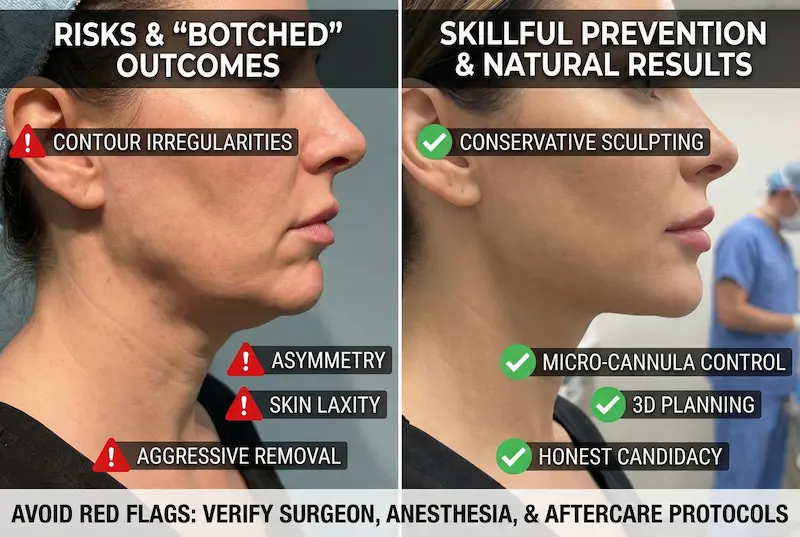
Common risks (irregularities, asymmetry, skin issues) and why they happen
- Contour irregularities (lumps/dents): can occur with uneven fat removal, aggressive suctioning, or poor blending zones.
- Asymmetry: may reflect natural baseline differences, uneven swelling early on, or true contour imbalance.
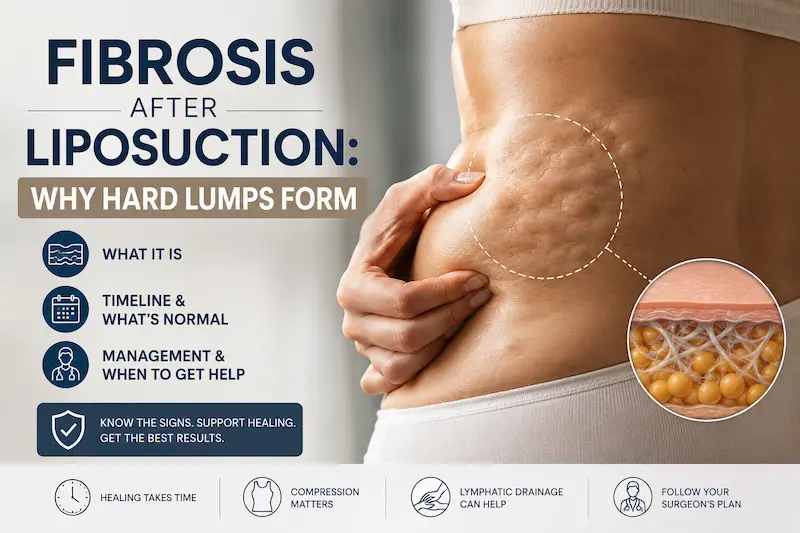
- Prolonged swelling/fibrosis (firmness): internal healing can create temporary firmness that gradually softens.
- Skin laxity appearance: if elasticity is limited, removing fat may reveal looseness rather than tighten it.
- Infection/seroma (fluid collection): uncommon but important—requires prompt medical attention.
The surgeon skill factors that prevent contour problems
If you’re trying to avoid a “botched” look, the surgeon’s approach matters more than any single device. Key skill factors include:
- Conservative, sculpting mindset: removing enough fat to define, not so much that it hollows.
- Micro-cannula control: precise passes that smooth transitions rather than create steps.
- Three-dimensional planning: shaping for movement and real-world lighting, not one “perfect” angle.
- Honest candidacy screening: recommending alternatives when laxity/bands will limit results.
Expert-patient warning: If a clinic promises a “lift-like” result from neck lipo alone for clearly loose skin, that’s a realism problem—and realism is a safety issue.
Red flags in clinics (and questions to ask before booking)
Whether you’re considering neck liposuction Turkey or a local option, use a structured checklist. The goal is to verify standards, not rely on marketing.
- Red flags: pressure to book quickly, vague answers about who performs the procedure, unclear anesthesia/monitoring details, inconsistent before/after galleries.
- Ask directly: “Who is the operating surgeon?” “What anesthesia and monitoring are used?” “What is the complication management plan?”
- Before/after integrity: request similar lighting, similar angles, and realistic timelines (true final results aren’t day-10 photos).
- Scar plan: ask where incisions are placed and what scar care is recommended to optimize neck liposuction scars.
Cost Considerations
Neck liposuction and neck lift sit at very different price points, and combined plans (lipo plus buccal fat, lipo plus chin augmentation, lipo plus neck lift) change the math further. Rather than duplicate the full pricing methodology here, the dedicated resource handles cross-procedure and cross-market comparison on consistent terms.
For the complete pricing framework, the plastic surgery cost breakdown covers procedure-by-procedure pricing, what’s included in all-inclusive packages versus billed separately, the combined-procedure pricing logic, and the Istanbul-versus-other-markets comparison on like-for-like terms.
Frequently Asked Questions (FAQ): Neck Liposuction
These are the most common questions we hear from patients researching neck liposuction, including those specifically searching for neck liposuction cost, neck liposuction scars, and realistic recovery expectations.
Will neck liposuction tighten skin or only remove fat?
It primarily removes fat. Skin can retract to some degree if elasticity is good, but neck lipo is not a lift and doesn’t reliably correct significant laxity or banding.
How long do results last if I gain/lose weight later?
Fat cells removed don’t “come back,” but remaining fat cells can enlarge with weight gain. Stable weight supports long-term definition.
How soon can I fly back to the US after surgery?
Travel timing depends on your surgeon’s protocol, swelling, and your health profile. Many patients travel within days to a week, but the safest timeline is individualized.
Can I combine chin and neck liposuction for stronger definition?
Yes—chin and neck liposuction planning can improve harmony when chin projection and submental fullness interact. The decision should be anatomy-driven.
How do I judge before–after photos to spot “overdone” results?
Look for consistent angles and lighting, multiple timepoints (not just “early wow” shots), and natural transitions rather than a sharply “etched” edge. True final results take months.
I have a double chin but my skin is firm — lipo or lift?
Firm skin plus localized fat is the textbook liposuction-alone profile. If the pinch test shows good snap-back and you have no visible banding, liposuction can remove the fat and let your elastic skin retract over the sharper contour. A lift would be over-treatment for this profile.
I'm 55 with loose neck skin — can lipo alone help?
Usually no, and this is the most important "no" in the guide. At 55 with loose skin, removing fat without managing skin typically produces a deflated, hanging result. Your profile points toward a lift (or lipo combined with skin tightening or a lift), not liposuction alone. A clinic that offers you isolated liposuction here is the wrong clinic.
My jawline is undefined despite being thin — what's the issue?
When you're thin but the jawline still looks soft, the issue usually isn't fat — it's chin projection, muscle banding, or both. Liposuction has little to remove and won't help. The honest assessment often points toward chin augmentation (to build the projection a defined jawline drapes over) rather than fat removal.