
Online Plastic Surgery Consultation Accuracy: What Virtual Consults Can (and Can't) Tell
AI Summary
Online plastic surgery consultations work well for procedural plans and ranges, but cannot replace the in-person physical exam that confirms tissue laxity, skin quality, and final safety clearance. Standardized photos, surgeon-led video evaluation (not AI-driven intake bots), and red-flag awareness (generic plans, rushed calls, unrealistic promises, pressure tactics) separate trustworthy virtual consultations from marketing-driven funnels. Reliable virtual quotes require itemized inclusion lists, not just headline numbers. The strongest virtual consultations follow surgeon-led workflows — not AI-generated outputs.
Summary generated by AI, fact-checked by our medical experts
If you’re considering surgery abroad (or even in your own city), an online plastic surgery consultation can feel like the fastest way to get clarity on candidacy, options, and cost. But how accurate is it really—especially when decisions may involve travel, time off work, and your face or body?
The short, evidence-based answer from clinical practice is this: online consultations can be highly useful and often surprisingly accurate for planning—but they have clear limits for final confirmation. The accuracy depends on the quality of your inputs (photos, video, health history) and the quality of the clinical process (clinical-decision-led assessment, risk screening, and a transparent “what we can/can’t confirm yet” approach).
The remote consultation's quality depends less on the technology behind it and more on the practice structure behind that technology. A clinic with surgeon-led decision-making produces a different video consultation experience from a clinic where coordinators run the intake and route to surgeons later.
Two clinics can use the same video platform and deliver completely different consultations. The variable is who makes the decisions: a surgeon who reviews your case before the call, or a coordinator who collects information and forwards it. The the AKM Clinic care model overview sets out how planning, the in-Istanbul phase and post-return follow-up are staffed for international patients.
In this guide, you’ll learn what a remote surgical consultation can reliably tell you, what it cannot, and how to get a more dependable plan and a more realistic pre-travel pricing estimate—especially if you’re exploring remote consultation with Turkey-based surgeons.
How an Online Plastic Surgery Inquiry Usually Works, Step by Step
Most virtual plastic surgery consultations follow the same four-stage sequence, whether the clinic sits in Texas or Istanbul. Knowing the sequence makes it easy to spot where a clinic is cutting corners.
- 1. Written inquiry: you describe the area you want treated, your goals and your rough timeline through a form, email or messaging channel.
- 2. Photo and history submission: a standardized photo set plus medical history (medications, nicotine use, prior surgery, chronic conditions). This is the stage that decides how accurate everything downstream will be.
- 3. Surgeon-led video consultation: a live telehealth call where the surgeon reviews your photos with you, asks the follow-up questions, states candidacy and explains technique options. A cosmetic surgery virtual consultation that stops at written replies skips the part that carries clinical judgement.
- 4. Written provisional plan and price range: recommended approach, alternatives, what still needs in-person confirmation, and an itemized quote with conditions for change.
Telemedicine consultations in plastic surgery are a screening and planning tool by design. They shorten the path to a decision; they do not replace the physical exam that happens on arrival.
Table of Contents
What an Online Plastic Surgery Consultation Can (and Can’t) Tell You
Think of a plastic surgery consultation online as a two-stage clinical process. Stage one is remote: the surgeon evaluates visible anatomy, your goals, and safety factors based on what can be seen and reported. Stage two is in-person: the surgeon confirms what can’t be safely judged through screens—like tissue quality, degree of laxity, and certain structural details. When clinics treat the online step as “final,” accuracy drops. When they treat it as “provisional but precise,” it becomes a strong decision tool grounded in science and careful clinical reasoning.
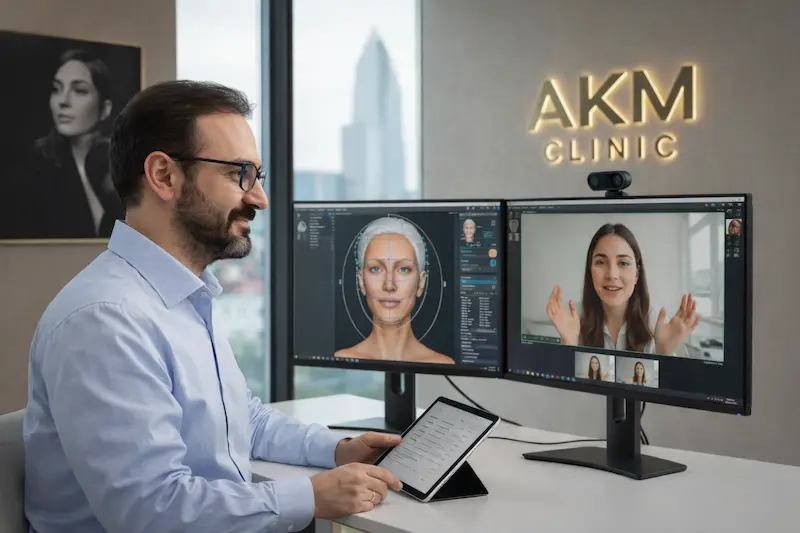
What surgeons can accurately assess from photos (proportions, asymmetry, aging pattern)
With standardized photos (right angles, consistent lighting, no filters), surgeons can often evaluate:
- Proportions and balance (e.g., facial thirds, jawline definition, neck-chin angle, breast/torso proportions).
- Visible asymmetry (differences in brows, eyelids, cheeks, nostrils, jawline, or body contours).
- Aging patterns (where volume loss vs. skin descent appears to be the main driver).
- Scar placement concerns if prior scars are visible and photographed clearly.
This is why many patients get a meaningful plan remotely—even on the first call. For facial work especially, a surgeon (and when applicable, a dermatosurgeon focused on skin and soft-tissue quality) can interpret visual signs that correlate with technique choices and expected refinement.
What cannot be confirmed online (tissue laxity “feel,” scar texture, certain anatomical findings)
Even the best remote evaluation for plastic surgery cannot replace the tactile and three-dimensional information of a physical exam. Key limitations include:
- Tissue laxity and “snap”: How skin and underlying tissues behave under gentle traction is not fully measurable on camera.
- Scar quality and thickness: Texture, adherence, and subtle contour irregularities often require palpation and close inspection.
- Some anatomical details: For example, certain nasal cartilage characteristics or deeper structural nuances may not be reliably assessed with standard photos.
- Safety-critical findings: Some risk factors only become clear through in-person exam, vitals, and (when indicated) lab work.
In other words, remote consults can be excellent for “directionally correct” planning, but they should not be framed as an irreversible promise. The most ethical approach is to explain what is confirmed versus what remains to be verified on arrival.
Why online consults usually produce a plan + a range, not a final guarantee
The "plan + range" framing isn't a hedge — it's a reflection of what the telemedicine literature actually documents about online evaluations in plastic surgery. The recent synthesis evidence is more developed than most patients realize, and the patterns are worth knowing before evaluating any clinic's virtual workflow.
For one synthesis layer, 2026 Aesthetic Plastic Surgery systematic review and meta-analysis of telemedicine utilization and outcomes across 72 studies and 9,435 subjects (Springer Nature) — synthesizing pre- and post-pandemic telemedicine adoption in plastic surgery — reported that 89.3% of patients expressed willingness to reuse telemedicine and pooled satisfaction reached 83.9%, alongside meaningful reductions in travel burden (mean 120 minutes saved, 187 km distance reduced per consultation).
The takeaway: remote evaluations are validated for many use cases — but the validation comes with caveats about what they can finalize versus what still needs in-person confirmation.
Patients sometimes expect a single definitive answer—one exact technique, one exact price, one exact recovery timeline. In real clinical practice, the surgeon’s responsibility is to give you a plan that’s accurate within the known variables. That’s why most reputable clinics provide:
- A preliminary surgical plan (recommended approach + alternatives).
- A candidacy statement (good candidate / possible candidate / not recommended), based on your photos and medical history.
- A realistic range for both outcomes and cost, rather than a “too-good-to-be-true” guarantee.
This also affects pricing: a plastic surgery quote online is most reliable when it clearly defines what’s included, what could change after in-person evaluation, and what would trigger a revised plan (e.g., safety considerations, complexity, or combined procedures).
Red Flags in Online Plastic Surgery Consultations
Most video consultations are useful, structured, and patient-friendly. Some are not. The patterns below are the ones that consistently separate well-run remote evaluations from the ones that should make a patient pause — and they're worth knowing before the first call, not after.
Generic plans that don't reference your specific case
An online evaluation that produces a plan that could apply to anyone with your procedure type is a consultation that hasn't actually evaluated you. The first signal of surgeon engagement is whether the recommendation references your specific photos, asymmetries, skin quality observations, or anatomy notes — versus delivering boilerplate procedure descriptions that any patient could receive.
Rushed calls and skipped questions
The video consultation should run a structured agenda: review your photos with you, ask about medical history, discuss aesthetic goals, explain candidacy assessment, and outline what the provisional plan includes. Calls that finish in under 15 minutes, skip the medical history conversation, or move straight to pricing without a clinical evaluation are red flags — even if the language and platform feel professional.
Unrealistic promises and "guaranteed" outcomes
No surgeon can guarantee a specific result. A remote evaluation that promises "10 years younger," "exact match" to a reference photo, or "no scars" is operating outside ethical bounds — and the marketing layer is doing the talking, not the surgical evaluation. Ethical surgeons describe ranges, candidacy fit, and realistic recovery trajectories — not guarantees.
Pressure tactics and time-limited offers
Surgery decisions are not retail transactions. Video consultations that close with "this price is only valid this week" or "we only have one OR slot left this month" are using sales pressure to bypass the considered-decision pathway. Legitimate clinics offer pricing transparency without artificial urgency, and they expect patients to take days or weeks to consider before committing.
Privacy and consent red flags
The photos and medical information shared during an online evaluation are sensitive health data. Clinics that don't explain their data handling, that ask for photos through unsecured channels (open WhatsApp without encryption, public email), or that don't have a written privacy/consent framework before you upload anything are operating below the privacy baseline international patients should expect.
AI Intake vs Surgeon-Led Virtual Consultation: Where the Difference Actually Sits
One of the fastest-growing 2026 trends in medical tourism marketing is the AI-powered consultation chatbot — and the distinction between AI-driven intake and surgeon-led evaluation matters more than the marketing usually admits.
An AI-powered tool can collect intake data, generate procedure summaries, suggest candidacy categories, and produce preliminary cost ranges — these are useful operational layers. What AI cannot do is conduct the surgical evaluation itself: reviewing your specific photos with clinical judgment, asking the follow-up questions that change the recommendation, applying surgical experience to your anatomy, and taking medical-legal responsibility for the plan that emerges.
A surgeon-driven video consultation is structurally different. The surgeon — not a representative reading scripted text — reviews your case, examines your photos in real time, asks the medical-history follow-ups, explains technique selection in their own clinical voice, and signs off on the provisional plan personally. The video consultation is where the clinical decision-making actually happens.
Ask directly: "Will I speak with the surgeon during the video consultation, or with a coordinator who relays my case to the surgeon afterward?" A clinic that uses AI for intake and physician-conducted evaluation for the consultation is using AI appropriately. A clinic that uses AI to replace the surgeon evaluation — even with a final "surgeon approval" signoff — has substituted automation for the part that needs clinical judgment most.
The 2026 question isn't "Does this clinic use AI?" — it's "Where does AI stop and where does the surgeon start?" That boundary is the difference between operational efficiency and clinical risk.
Accuracy Depends on Inputs: Your Photos, Video, and Medical History
The accuracy of a virtual surgical consultation is only as strong as the information the surgeon receives. In clinical practice, remote assessment becomes far more reliable when your materials are standardized—meaning consistent angles, neutral lighting, and a complete health history. This is where many “inaccurate” experiences come from: not because online consults are inherently flawed, but because the inputs are incomplete, overly filtered, or missing key medical context. A clinical-decision-led process—supported by a structured intake form—aligns the consultation with what clinical literature consistently emphasizes: better data leads to better decisions.
The “good photo” protocol: angles, lighting, distance, no filters, hair/neck visibility
If you want your plastic surgery consultation online to be truly useful, photos must be “diagnostic,” not flattering. Here is a practical photo protocol that improves accuracy dramatically:
- Lighting: Bright, even lighting from the front (avoid overhead shadows and warm “mood” lights).
- Background: Plain wall, no visual distractions.
- Distance & camera: Step back and use 1x lens (avoid wide-angle distortion); if possible, have someone else take the photo.
- No filters, no beauty mode: Filters erase texture and change contours—this can mislead the evaluation.
- Hair & neck visibility: Pull hair back; show hairline/ears/neck when assessing facial and neck concerns.
- Angles to include (face/neck): front (neutral), right profile, left profile, right 45°, left 45°, and (if requested) neck extended slightly upward.
- Angles to include (body): front, back, both sides, and 45° angles with neutral posture.
These steps reduce “guesswork” and help the surgeon estimate what can be achieved—and what must be confirmed later in person.
Why video matters: movement, expressions, neck dynamics, real-time Q&A
A high-quality online plastic surgery consultation becomes substantially more accurate when a video call is included. Photos are static; video adds real-time clinical context:
- Movement and expression: How tissues behave when you smile, speak, or turn your head can influence technique selection.
- Neck dynamics: Certain concerns (banding, posture-related tension, movement-related contour changes) are more visible on video.
- Instant clarification: The surgeon can ask you to adjust angle/lighting, or demonstrate specific motions for better assessment.
- Expectation alignment: Video conversation helps confirm what you mean by “natural” and what you want to avoid.
If a clinic offers only text-based responses or a quick quote without a surgeon-led video step, it often signals a lower-quality process—even if the marketing is polished.
Medical context that changes everything: smoking, medications, weight changes, past procedures
Two patients can look similar in photos yet have very different surgical candidacy and risk profiles. A responsible video consultation should always ask about:
- Smoking / nicotine use: A major variable for wound healing and complication risk.
- Medications & supplements: Especially blood thinners, certain anti-inflammatories, and supplements that affect bleeding.
- Medical conditions: Thyroid issues, diabetes, autoimmune conditions, clotting history, and cardiac concerns.
- Weight stability: Recent weight loss/gain can change tissue behavior and outcome longevity.
- Past procedures: Previous facelift, rhinoplasty, liposuction, fillers, or energy-based skin treatments can alter anatomy and planning.
When this information is included, surgeons can give a far more dependable preliminary plan and identify when in-person evaluation or additional clearance is needed before proceeding.
How Surgeons Build a Remote Plan: From Goals to the Right Technique
A reliable plastic surgery online consultation is not just “looking at photos and naming a procedure.” It’s a structured clinical conversation: defining your goals, understanding your anatomy, identifying risk factors, and mapping options with realistic trade-offs. The best consults also educate you—so you can make decisions with the mindset of a discerning patient, grounded in science rather than hype.
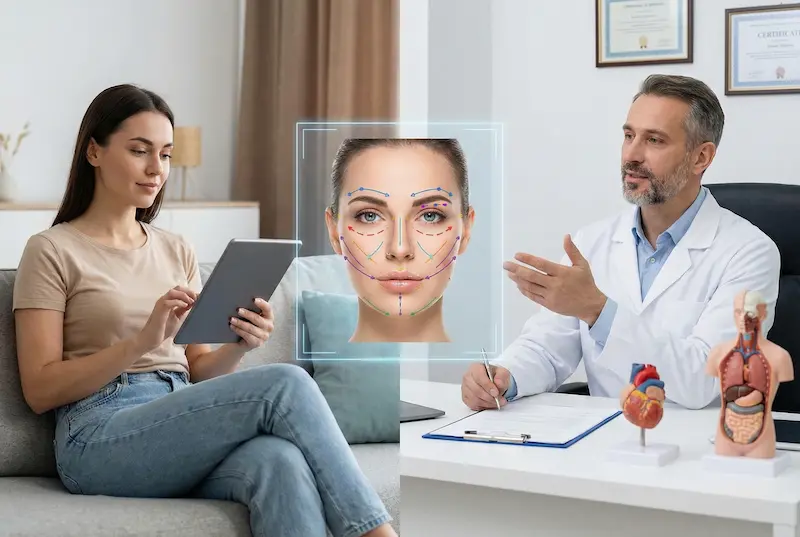
Turning your aesthetic goals into a surgical strategy (what “natural” means clinically)
"Aesthetic goals" only become actionable when they get anchored to documented outcomes — what surgical reality actually looks like across patient profiles, procedures, and recovery timepoints. Virtual consultations that operate without that anchor risk producing plans calibrated to expectations rather than to surgical biology.
For the outcome-documentation anchor that aesthetic-goal conversations should reference, the documented procedure outcome archive covers cross-procedure before-and-after case sets with documented timing, multi-angle documentation across recovery phases, and the consistency standards (lighting, distance, posture) that separate diagnostic outcome documentation from curated marketing photos.
Reading an outcome archive teaches expectation calibration in a way that any single consultation conversation never does.
“Natural” is a common goal—but clinically, it must be translated into concrete surgical priorities. In a surgeon-led consultation, “natural” usually means:
- Preserving your identity: Avoiding over-tightened vectors, over-reduction, or exaggerated changes.
- Harmony: Improving one area without creating imbalance elsewhere.
- Skin quality + structure: Results look more natural when the plan addresses both the foundation and the surface.
For facial procedures, the involvement of a dermatosurgeon alongside a plastic surgery team can be a meaningful advantage: it supports a plan that considers not only lifting and contour, but also skin quality and how it heals—key factors in a refined, “not-operated” look.
Understanding technique differences at a high level (what changes outcomes and longevity)
Online, the surgeon may discuss technique families rather than promising one exact method before in-person exam. The purpose is to explain what drives outcomes and longevity:
- Where support comes from: Skin-only tightening vs. deeper support strategies can change durability and naturalness.
- Scar planning: Incision placement and tension management can impact visibility and healing.
- Safety choices: Anesthesia approach and procedure duration influence recovery, especially for medical tourists.
In other words, the remote plan should focus on principles and likely pathways—then finalize details after physical evaluation.
When surgeons recommend combination approaches (e.g., lifting + skin quality/supportive treatments)
One reason online consultations can feel “inaccurate” is that patients expect a single magic procedure. In reality, surgeons often recommend combination planning to achieve a more natural result:
- Structural correction + refinement: Addressing the main issue (lift/contour) plus a secondary element (skin quality or volume strategy).
- Staged planning: For some patients, dividing the plan into phases improves safety and predictability.
- Adjunct recovery support: Evidence-informed supportive care can reduce downtime and improve early healing appearance.
This is also where “process quality” matters. A clinic that integrates structured aftercare and recovery support tends to deliver a more consistent patient experience—especially for those traveling for Turkey virtual evaluation.
Pricing Accuracy: Why Quotes Vary and How to Get a Reliable Estimate
One of the biggest reasons patients request a plastic surgery online consultation is to understand cost. But pricing accuracy depends on how transparent and standardized the clinic’s quoting method is. A plastic surgery quote online should be interpreted as a structured estimate based on current information—not a “blank check” and not an unrealistic fixed number produced without clinical detail. The best approach is to demand clarity on scope, inclusions, exclusions, and the exact conditions under which a quote could change.
What a quote should include (surgery, anesthesia, facility, aftercare, follow-ups)
Quote accuracy isn't only about whether the number is right — it's about whether the line items the number is built from are visible. A quote without an itemized inclusion list is a quote that can change at any point along the journey without any "violation" being technically committed.
For the line-item structure that virtual quotes should be built on, the all-inclusive package architecture covers the package-level methodology used by AKM, the inclusion list that defines what's covered versus what's billable separately, the airport-and-transfer and accommodation line items, and the comparison framework for evaluating virtual quotes from different clinics on like-for-like terms before booking travel.
The cleanest virtual quotes come from clinics that publish their package architecture transparently. The fuzziest virtual quotes come from clinics that don't.
A trustworthy plastic surgery consultation online should provide a quote that clearly lists what’s included. At minimum, you should see:
- Surgeon fee (and confirmation of who operates).
- Anesthesia fee (type of anesthesia and who provides it).
- Facility/operating room costs.
- Standard medications (as applicable) and immediate post-op supplies.
- Aftercare plan and follow-up schedule.
- Contingency clarity: what happens if an additional safety step is needed.
If you’re exploring international virtual consult with Istanbul clinic, insist that the quote distinguishes medical costs from travel/hotel arrangements (if any) so you can compare like-for-like across clinics.
Common reasons quotes change after arrival (complexity, add-on needs, safety considerations)
Three quotes for the same procedure can differ by a wide margin without any of them being dishonest. The difference is usually definitional: one includes anesthesia, facility and follow-ups, the second prices the surgeon fee alone, the third bundles hotel and transfers into the headline number. Ask each clinic to send the same line items in the same order before you compare anything.
In ethical practice, quote changes should be uncommon—and when they happen, they should be clearly justified. Common legitimate reasons include:
- In-person findings that change the surgical plan (e.g., more significant laxity than photos suggested).
- Safety-driven modifications (e.g., changing anesthesia approach, adjusting surgical time, staging procedures).
- Revision complexity: prior surgery can create scar tissue or anatomical changes that aren’t visible on photos.
- Patient-requested upgrades after understanding options more clearly (adding a complementary procedure).
What is not acceptable: a clinic that offers an attractive number early, then pressures you with a sudden “must-pay” increase upon arrival without documented clinical rationale.
How to reduce surprises: “must-ask” pricing questions and what documentation to request
To make the consultation pricing as accurate as possible, ask these questions:
- “Is this quote all-inclusive for the medical portion?” If not, what is excluded?
- “Under what exact conditions can the quote change?” Ask for examples in writing.
- “Who is performing the surgery?” (Name, role, and credentials.)
- “What aftercare is included?” (Follow-ups, dressing changes, supportive care.)
- “If the plan changes in person, how do you document consent and pricing updates?”
Request a written summary of the plan and quote after the consult. A documented process signals maturity and accountability.
A Best-Practice Remote Consultation Workflow (AKM-Style Model)
The most accurate plastic surgery online consultation is not a single event—it’s a structured workflow. High-quality clinics treat remote evaluation as a clinical intake system: standardized photos, detailed medical history, surgeon-driven video assessment, and then an in-person confirmation step that finalizes the plan. This is how an online plastic surgery consultation becomes both practical and aligned with scientific thinking: you reduce uncertainty by controlling variables and documenting decisions.
The remote consultation is the first block of a longer sequence that runs through booking, arrival, surgery day, hotel recovery and follow-up after you fly home. If you want to see where the video call sits inside that timeline, the step-by-step patient journey for international patients maps each stage and who is responsible for it.
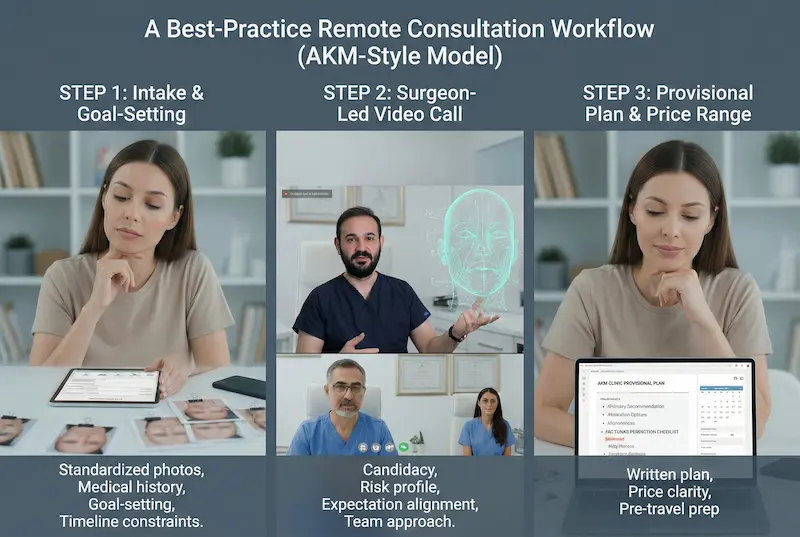
Step 1: Intake + standardized photos + goal-setting questionnaire
The intake step is where the virtual consultation's quality gets set. A poorly structured intake produces an underspecified surgeon evaluation later; a structured intake gives the surgeon enough material to enter the video consultation already informed about your case.
For the operational entry point into the structured intake process, the structured AKM intake pathway covers the goal-setting questionnaire, the standardized photo protocol that informs the physician-conducted video consultation, the medical-history documentation upload, and the timeline expectations from first contact through provisional plan delivery.
The strongest virtual consultations start with the strongest intake — not with the most polished platform.
A strong plastic surgery online consultation begins with a systematic intake rather than casual messaging. This step typically includes:
- Standardized photo set (as described earlier) to reduce angle/lighting distortion.
- Goal-setting questionnaire: what you want to improve, what you fear (overdone look, visible scars), and what “natural” means to you.
- Medical history checklist: smoking/nicotine, medications, allergies, prior surgeries, and relevant conditions.
- Timeline constraints: travel dates, ability to rest, time off work, and recovery expectations.
This step makes later recommendations more precise and helps prevent “quote-first, medicine-second” behavior.
Step 2: Surgeon-led video consultation + candidacy decision + risk screening
The "surgeon-led video consultation" step is the inflection point in the workflow — it's where the virtual model either earns its credibility or loses it. The published literature has tightened on what a high-functioning virtual surgical consultation actually looks like, and what diagnostic accuracy levels patients can reasonably expect.
For the synthesis evidence layer specifically, 2026 PRS Global Open systematic review of telemedicine satisfaction, safety, and usability across 21 plastic surgery studies (Khalaf et al., Wolters Kluwer Lippincott) — analyzing patient and provider experience from January 2017 through April 2025 — reported patient satisfaction between 72% and 98%, provider satisfaction at 74%, and diagnostic reliability reaching 94.4% in studies where surgeon-driven video assessment was used with standardized photo protocols.
That 94.4% reliability figure is the upper bound — and it requires both clinical decision-making evaluation and the standardized photo protocol to produce. Either piece missing degrades the accuracy meaningfully.
The core of a reliable plastic surgery consultation online is the physician-conducted video call. The purpose is not only to suggest a procedure, but to confirm:
- Candidacy: whether surgery is appropriate given anatomy and health context.
- Risk profile: factors that could increase complication risk or slow recovery.
- Expectation alignment: what results are realistic, what trade-offs exist, and what outcomes are unlikely.
For facial surgery, a team approach can matter. When a dermatosurgeon contributes to planning (especially where skin quality, scarring behavior, and healing refinement are central), it supports a more comprehensive strategy—structure and surface—aiming for natural-looking results.
Step 3: Provisional plan + transparent scope/price range + pre-travel preparation checklist
The written plan should also state what you need to prepare before you fly: medication adjustments, nicotine cessation, any lab work, and the compression garment or support items your procedure requires.
A credible outcome of a remote evaluation is a written, provisional plan. It should include:
- Primary recommendation and at least one alternative option.
- What is confirmed vs. what must be verified in person (e.g., degree of laxity, scar quality).
- A clear scope and price range (your plastic surgery quote online), with conditions for any changes.
- Pre-travel preparation: medication guidance, smoking cessation requirements, and any suggested labs/clearance.
This written clarity is especially important for virtual evaluation for Turkey-based surgery because it reduces ambiguity before travel.
Credentials and role clarity: who evaluates you, who operates, and who follows you post-op
During a plastic surgery online consultation, you should be able to confirm:
- Who reviews your photos and medical history (surgeon vs. coordinator).
- Who performs the operation (name and role).
- Who manages post-op care (surgeon availability, nursing support, follow-up schedule).
Verify the names before the call, not after. Each surgeon on the AKM Clinic surgical team page lists their specialty focus, training background and the procedures they perform, so you can confirm that the person on your video call is the person who will be in the operating room. If safety standards for operating abroad are your main concern, the breakdown of what determines safety for plastic surgery in Turkey covers licensing, anesthesia staffing and hospital arrangements.
For facial aesthetics, it’s also reasonable to ask whether a dermatosurgeon is involved in planning or execution when skin quality, scarring risk, and healing refinement are central to achieving a natural outcome.
What Happens When You Arrive: The In-Person Assessment That Finalizes the Plan
No matter how strong a remote surgical evaluation is, the in-person exam is the safety checkpoint that turns a remote plan into a final surgical decision. Think of this as the “verification phase”: the surgeon checks what screens can’t fully capture, confirms your candidacy under real clinical conditions, and ensures the plan is medically appropriate on that exact day. In surgical safety literature terms, this is where the consultation shifts from a high-quality hypothesis to a verified treatment plan.
The arrival-and-finalization phase is when the virtual consultation translates into operational decisions: physical exam, safety clearance, plan updates if needed, and the start of the on-the-ground recovery sequence. One operational decision that virtual consultations consistently underaddress is whether to travel with a companion — and that decision shapes hotel, transfer, and first-72-hour logistics.
For the companion-decision side specifically, the surgery companion planning framework covers the solo-versus-companion decision framework, the procedure-specific factors that lean toward companion travel, the visa requirements for US companion travelers, and the logistical layer that determines whether arrival day feels managed or improvised.
Virtual consultations finalize the surgical plan. Companion decisions finalize the operational plan that surrounds it.
The physical exam components that refine the plan (skin, laxity, anatomy, scars)
In-person evaluation typically includes:
- Skin quality assessment: elasticity, thickness, and how skin responds to repositioning.
- Laxity confirmation: how much lift is needed and which support approach best fits.
- Anatomical evaluation: subtle asymmetries and structural factors that may alter technique choice.
- Scar and tissue review (for revision cases): palpation and close inspection to plan safely.
This is the step that makes the overall journey safer and improves predictability—especially for complex cases or prior-surgery patients.
Safety clearance on-site (labs, anesthesia evaluation, risk management)
"Safety clearance on-site" is one of those phrases that means specific things or means nothing — depending on which facility is doing the clearance. The infrastructure underneath the physical exam, lab work, and anesthesia evaluation determines what level of safety verification is actually possible before you walk into the operating room.
For the facility-level documentation specifically, the Istanbul clinic facility infrastructure covers operating room standards, sterilization protocols, hospital partnerships for inpatient cases, the on-site lab and anesthesia evaluation pathway, and the licensing oversight under the Turkish Ministry of Health that elective surgical procedures depend on for safety baselines.
Facility-level safety standards are one of the few aspects of plastic surgery travel that genuinely can't be evaluated virtually. The right time to clarify the documentation is before arrival, not after.
Depending on procedure type and medical history, an on-site clearance may include:
- Vital signs assessment and a focused medical review.
- Pre-op lab tests as indicated.
- Anesthesia evaluation: ensuring the safest plan for your health profile.
If you’re choosing plastic surgery consultation online pathways for medical tourism, this in-person clearance is non-negotiable. A clinic that minimizes or skips it is not prioritizing safety.
How plan changes are handled ethically (patient consent, updated options, updated pricing)
Sometimes the in-person exam confirms everything exactly—great. Other times, adjustments are medically appropriate. Ethical handling means:
- Clear explanation of what changed and why (with clinical reasoning, not pressure).
- Updated options: the surgeon should present alternatives and trade-offs.
- Informed consent: you should have time to consider changes without coercion.
- Transparent pricing update (if applicable), documented in writing—never as a surprise tactic.
This is where high standards matter most: the clinic’s process should protect you, not corner you.
How Long Is the Gap Between the Online Consultation and Surgery?
For international patients the gap is usually a few weeks, not a few days. Three things set the pace: how quickly you return the photo set and medical history, whether any pre-op clearance or lab work is requested, and operating room availability for the technique planned.
- Same week: realistic only for the intake and the video consultation itself.
- Before booking a date: time to read the written plan, compare quotes on like-for-like inclusions and ask follow-up questions without pressure.
- Before flying: nicotine cessation and medication adjustments as instructed, plus any clearance your history requires.
- On arrival: physical exam and safety clearance, typically a day or two before the operating date.
A clinic that offers surgery within days of a first video call, with no clearance step in between, is compressing the part of the process that protects you.
Frequently Asked Questions (FAQ): Online Plastic Surgery Consultation
The questions below focus specifically on virtual consultation accuracy and what to expect from a remote-evaluation process. International patients usually carry a longer tail of operational questions (visa, payment, documentation, hospital arrangements, post-return follow-up scheduling) that don't fit a consultation-specific FAQ.
For the cross-topic operational answers, the broader patient FAQ archive covers logistics, payment structures, prescription continuity for international patients, hospital-stay specifics, post-return communication, and the operational layer that surfaces once the consultation decision is settled.
Virtual-consult questions get researched first. Broader operational questions usually decide whether the trip happens on schedule.
Below are the most common “expert patient” questions about online plastic surgery consultation accuracy, safety, and what to expect from a remote pricing quote. If you’re comparing options internationally—especially for plastic surgery online consultation in Turkey—these answers will help you separate a clinical-decision-led medical process from a simple sales quote.
| Topic | Often Accurate Online | Best Confirmed In-Person |
|---|---|---|
| Visible anatomy & proportions | Yes (with standardized photos/video) | Refined measurements & nuanced asymmetry |
| Procedure direction (likely approach) | Yes (preliminary plan + alternatives) | Final technique choice after physical exam |
| Skin/tissue laxity & “feel” | Limited | Yes (palpation + dynamic assessment) |
| Revision complexity | Sometimes (if scars/anatomy visible) | Yes (scar tissue quality + structure) |
| Safety clearance | Initial screening | Final clearance (exam, labs as indicated) |
| Pricing | Most reliable as a range with inclusions | Finalized once plan is confirmed |
“I actually look like nothing happened but probably 20 years younger.”
— Barbara (USA), deep plane facelift + neck lift experience
Can an online consult accurately determine if I’m a candidate for surgery?
How close is the online plan to what I’ll actually get after the in-person exam?
Are online price quotes reliable—or should I expect changes?
Given without surgeon review
Offered without a video evaluation
Missing a clear list of what’s included (anesthesia, facility, aftercare)
Framed as “guaranteed” before an in-person exam
Ethical clinics minimize changes by using a structured remote intake, then finalizing pricing after the on-site assessment.
What photos should I send for the most accurate evaluation?
What questions should I ask to confirm the consult is surgeon-led?
Who reviewed my photos and history? (Name and title)
Who will perform the surgery? (Name and role)
Will I have a surgeon video call before booking?
How do you document my plan and quote after the consult?
What happens if the in-person exam changes the plan? (Consent + pricing transparency)
Is it safe to share my photos and medical information online?
When should I insist on an in-person consultation before committing?
How much does an online plastic surgery consultation cost?
Do plastic surgeons give free consultations for cosmetic procedures?
Is there an app that can visualize plastic surgery results?
Related Treatments

Ready to Start Your Own Transformation Journey?
Join the 2,000+ patients who trusted Dr. Akif Mehmetoğlu and the AKM Clinic team. Your journey to a more confident, revitalized you begins with a simple, no-obligation conversation. Contact us today from the USA for your free virtual consultation.
#1: Get Your Free Personalised Quote
Start with a free, no-obligation online consultation. Share your photos, and our surgical team will provide a fully personalised treatment plan and a transparent, all-inclusive price package. No hidden fees.
#2: Secure Your Date & VIP Booking
Once you're ready, our dedicated patient coordinators will help you secure your procedure date. We'll handle all your bookings, including your 5-star hotel and private VIP airport transfers.
#3: Arrive in Istanbul & Meet Your Surgeon
Arrive at Istanbul Airport (IST) and be greeted by your private driver. Settle into your hotel and prepare for your in-person consultation, where you'll meet your specialist surgeon to finalise the details for your "natural, subtle, and revitalized" new look.