
If you’re weighing a facelift in Beverly Hills versus traveling abroad, you’re not just comparing prices—you’re comparing risk, predictability, trust, and the likelihood of looking like yourself after surgery. This article is built around real, decision-level facelift Turkey vs USA stories shared by US patients who seriously considered high-end options in California and ultimately chose Turkey.
To keep this practical (and not “marketing-ish”), we’ll focus on what these patients actually cared about: surgeon access, safety standards, the realism of before/after photos, what “all-in pricing” really meant, and how recovery support worked once they flew home. Along the way, we’ll address the exact questions people search for—like facelift in Turkey reviews, facelift Turkey reviews from USA, Turkey vs USA facelift, and plastic surgery in Turkey vs USA cost—but through the lens of real patient decision-making rather than internet noise.
Key takeaway: The “why Turkey?” decision was rarely about chasing the lowest price. It was about finding a surgeon-led process, clear safety standards, and a plan for recovery—without feeling rushed.
Important note: Patient experiences vary. The goal here is to help you build a smarter evaluation framework—so if you’re searching for why choose Turkey for facelift or US patient facelift Turkey, you can separate genuine quality signals from hype.
Table of Contents
Motivation to Travel
When US patients describe why they chose Turkey instead of Beverly Hills, the story usually starts with a moment of clarity: they wanted a result that looked natural, a process that felt medically structured, and direct accountability from the surgical team. Many had already read dozens of facelift in Turkey reviews and facelift Turkey reviews from USA, but what pushed them forward was not a single review—it was a pattern of trust signals: surgeon accessibility, transparent planning, and a recovery protocol that felt organized.
“I didn’t want an agency—I wanted a surgeon-led team.”
A common theme in these facelift Turkey vs USA stories is that patients didn’t want to feel like they were being “handled” by a broker. They wanted to speak with a surgeon, understand the plan, and feel confident that the person operating would be the person guiding decisions—not a coordinator reading from a script.
For facelift candidates in particular, this matters because “natural” is not a generic promise—it’s a surgical philosophy. Patients often asked questions like:
- “Is this approach focused on deep structural support (not just tightening skin)?”
- “How do you prevent an over-pulled look?”
- “What technique fits my facial anatomy and skin quality?”
Many US patients researching best facelift surgeons in Turkey for US patients said the deciding factor was the ability to evaluate medical judgment directly—especially when the plan included a structure-focused facelift strategy and skin-quality considerations (a key reason some patients value a team approach that includes dermatosurgical expertise alongside plastic surgery).
What made Beverly Hills feel out of reach (beyond price)
Yes, cost came up—especially for patients comparing plastic surgery in Turkey vs USA cost—but “out of reach” also meant something else: limited time with the surgeon, long waitlists, and uncertainty about what was included in the quote. Several patients said they were quoted high numbers in Beverly Hills, but still felt unclear about:
- Facility and anesthesia fees (and whether they were bundled)
- Post-op care structure (who checks you, how often, and for how long)
- Revision policies and follow-up availability
In other words, the comparison wasn’t just Turkey vs USA facelift—it was “which system gives me the most predictable experience from consult to recovery?”
How they did due diligence: credentials, before/after realism, and direct communication
Patients who search facelift in Turkey reviews often worry: “How do I know what’s real?” The most cautious US patients used a repeatable checklist that went beyond testimonials:
- Consistency in results: not just one amazing transformation—multiple cases with natural-looking outcomes.
- Comparable patients: similar age, skin quality, and facial structure (not just “best-case” examples).
- Clear surgical logic: the surgeon can explain why a technique is chosen—especially when discussing options like deep-plane strategies (which is why people also search deep plane facelift Turkey price).
- Communication quality: direct answers to risk questions (nerve safety, hematoma risk, scarring, anesthesia planning), not vague reassurance.
This due diligence step is where many “I’m considering Beverly Hills” patients either gained confidence—or walked away. The ones who moved forward said the process felt like an informed medical decision, not a leap of faith.
The “I need to feel safe” checklist that convinced them to board a plane
Even patients strongly leaning toward Turkey admitted they had a final emotional hurdle: “What if something goes wrong far from home?” The turning point was usually a safety narrative they could understand—hospital standards, structured aftercare, and documented planning for travel timing and recovery milestones.
Most described choosing Turkey only after they felt they had answers to:
- Where surgery happens (hospital environment and monitoring standards)
- How pain control, swelling, and early checks are managed
- What the team does to support healing (some clinics use recovery-support technologies like adjunct light-based therapy or oxygen-based protocols)
- How follow-up works once they return to the US
Cost Differences They Experienced
When patients compare Turkey vs USA facelift, the conversation often starts with cost—but quickly turns into “What am I actually paying for, and what does that buy me in terms of safety and predictability?” In many facelift Turkey vs USA stories, the biggest frustration wasn’t the number itself. It was the lack of clarity about what was included, what was “extra,” and how post-op support was structured—especially for patients comparing Beverly Hills with other high-cost US markets like New York City and Miami.
This section is written for people searching terms like plastic surgery in Turkey vs USA cost, deep plane facelift Turkey price, and why choose turkey for facelift—but we’ll keep it grounded in patient logic: line items, inclusions, and how they judged value without compromising safety.
Key takeaway: Patients didn’t describe the decision as “cheap vs expensive.” They described it as unclear, piecemeal pricing versus structured, transparent planning—plus a recovery plan they could trust.
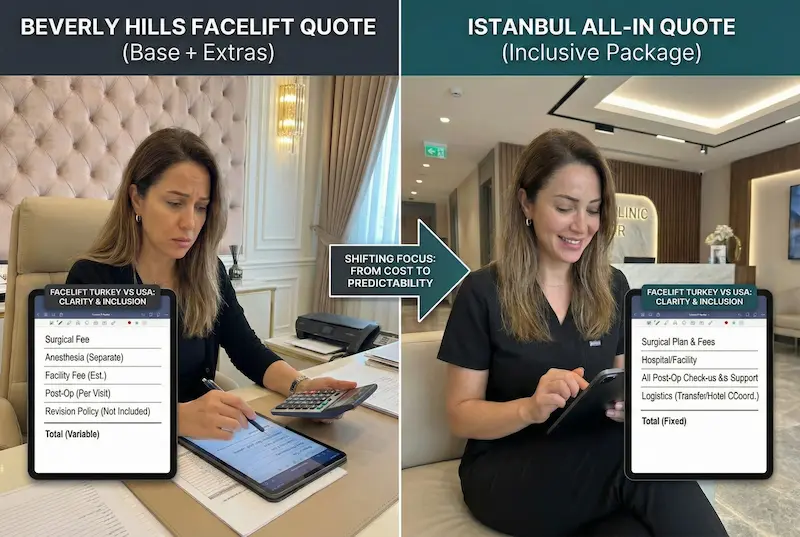
The Beverly Hills quote: what was included vs. what was extra
In multiple facelift Turkey reviews from USA, patients say their Beverly Hills quotes often came with a base surgical fee—then additional costs that could shift depending on facility, anesthesia, and whether other refinements were added (like eyelids, fat transfer, or skin resurfacing). What made some patients uncomfortable wasn’t that extras existed (that’s normal in surgery). It was that they felt they couldn’t forecast the “true total” until late in the process.
Common add-ons patients said they had to clarify:
- Anesthesia fee: separate billing vs. bundled
- Facility/hospital or accredited surgery center fee
- Post-op garment / dressings / medications
- Follow-up structure: who sees you and how often
- Revision policy: what is and isn’t covered
That’s why some patients broadened their comparison beyond Beverly Hills and looked at New York City and Miami as well—only to find similar patterns of high fees and add-on variability, depending on practice style and facility type.
The Istanbul “all-in” quote: what patients said felt clearer
When patients describe choosing Istanbul, they often say the clearest difference was scope: a single quote that spelled out the care pathway. This is one reason people searching facelift in Turkey reviews sometimes report feeling less anxious once they saw a written plan that included logistics (airport transfers, hotel coordination), scheduled check-ups, and a defined timeline for recovery milestones.
What “all-in” typically meant to patients (in their words) was:
- A defined surgical plan (what’s being done, and what isn’t)
- Clear facility setting (hospital-based vs. clinic-based)
- Planned post-op check-ups during the stay
- Coordination for early recovery support (so they weren’t making decisions while swollen and stressed)
Important: “All-in” should still be verified in writing. Patients who felt most confident said they asked for a detailed breakdown—not because they distrusted the team, but because they wanted surgeon-level transparency.
Value vs. “cheap”: how patients judged quality (hospital setting, surgeon credentials, aftercare)
People researching US patient facelift Turkey are often worried about one thing: “If it costs less, what’s the catch?” The most analytical patients didn’t assume lower price meant lower quality. Instead, they used quality signals—especially those that affect complications and outcomes in facelift surgery:
- Who is leading the surgical plan: surgeon-led decision-making (not sales-led)
- Facility and monitoring: where surgery is performed and how recovery is observed early on
- Natural result strategy: emphasis on avoiding an over-tight or “operated” look
- Aftercare structure: scheduled checks and clear escalation steps if a concern arises
This is also where technique matters. Patients searching deep plane facelift Turkey price are usually trying to understand whether deeper structural work costs more—and why. In patient interviews, the “value” conversation often sounded like this: “If a technique is selected for long-term support and natural movement, I want to understand the rationale, the surgeon’s experience, and how risks are managed.”
Mini comparison table: Beverly Hills vs. other US cities vs. Istanbul (patient-reported takeaways)
Below is a practical comparison framework based on how patients described their experience evaluating plastic surgery in Turkey vs USA cost. This is not a promise of pricing; it’s a checklist of what patients said differed in structure and clarity.
| What Patients Compared | Beverly Hills | New York City | Miami | Istanbul (Turkey) |
|---|---|---|---|---|
| Pricing structure | Often base fee + add-ons | Often base fee + add-ons | Varies widely by practice | Often packaged / “all-in” style |
| Facility & anesthesia | May be itemized separately | May be itemized separately | May be itemized separately | Often clearly stated in package (verify) |
| Time with surgeon | Can be limited in early stages | Can be limited in early stages | Practice-dependent | Patients often report more “guided” process |
| Early recovery plan | Follow-up schedule varies | Follow-up schedule varies | Follow-up schedule varies | Often structured while patient is in-country |
| Best for | Patients prioritizing local convenience | Patients wanting local access | Patients with wide provider choice | Patients wanting structured medical travel pathway |
Many US patients also compared Turkey with other medical-tourism destinations—especially Mexico and Thailand. The deciding factors they mentioned were not just price, but the sense of medical structure, surgeon accessibility, and how “premium facelift planning” was communicated. For readers searching best facelift surgeons in Turkey for US patients, the lesson is simple: compare systems, not slogans.
What Surprised Them Most
After patients book—especially those who spent months reading facelift in Turkey reviews and facelift Turkey reviews from USA—they often expect the “surprises” to be negative: language barriers, disorganization, or a lower standard of care than they’d see in the US. But in many facelift Turkey vs USA stories, the surprise was the opposite: the process felt more structured than they anticipated, and the recovery plan felt intentionally designed to reduce anxiety.
This section is for anyone still stuck between Turkey vs USA facelift comparisons and wondering, “Okay—but what does it actually feel like once I arrive?”
Key takeaway: The most positive “surprises” were not luxury details. They were medical-process details: clarity, monitoring, and a recovery framework that made patients feel safe.
“The hospital standards felt more ‘US-level’ than I expected.”
Several patients described arriving with skepticism—especially those comparing against high-end practices in California. Then they noticed what matters in real life: where the procedure happens, how post-op observation is handled, and how the team manages the first 24–72 hours (the time window patients fear the most).
One US patient, Laura (55), described being reassured by the structure and inclusions of care, noting that “the nurses, the doctors, the medications, everything is included.” That “included” feeling reduced stress because it removed guesswork at the exact moment patients are most vulnerable—right after surgery.
For readers focused on plastic surgery in Turkey vs USA cost, this is a helpful reframe: patients weren’t only comparing dollars. They were comparing how the system supports them through the high-stress parts of recovery.
Communication in English and the feeling of being “guided” (not rushed)
A common fear in US patient facelift Turkey searches is: “What if I can’t communicate clearly when I’m scared?” In the interviews, patients repeatedly highlighted how much their stress dropped when communication felt consistent, specific, and calm—especially in pre-op planning and immediate post-op instructions.
Patients also said they cared about whether the plan sounded like a medical plan—clear, step-by-step, and realistic. That mattered even more when discussing advanced options people Google heavily, like deep plane facelift Turkey price. The technique itself wasn’t the only concern; it was whether the surgeon could explain the “why” behind the plan in plain language.
And this is where a surgeon-led pathway makes a practical difference: patients reported more confidence when their questions were answered with clinical reasoning rather than reassurance alone.
The recovery support structure that removed anxiety (daily check-ins / planned follow-ups)
In many facelift in Turkey reviews, patients say the worst part of surgery isn’t pain—it’s uncertainty. What surprised patients most was how much anxiety disappeared when follow-ups were planned and predictable.
Patients described feeling safer when there was:
- Proactive monitoring (rather than “call us if something goes wrong”)
- Clear wound-care and swelling guidance with normal/abnormal signs explained
- A defined in-country timeline (so travel decisions weren’t made emotionally)
- Continuity after returning home (so the “distance” didn’t feel like abandonment)
One reason this matters in the Turkey vs USA facelift decision is that US patients may have great surgeons locally—but still experience a fragmented follow-up experience depending on how their practice runs. In contrast, many medical-travel patients described their Turkey experience as “one coordinated pathway,” which reduced decision fatigue.
The unexpected “human touches” that changed their stress level
Patients often hesitate to say this out loud because it sounds non-medical, but it mattered: being treated warmly changed their physiological stress response. A calmer patient sleeps better, follows instructions better, and tends to have a smoother emotional recovery.
For example, Barbara (60, USA)—an “expert patient” with extensive prior procedure experience—called her surgery “fabulous,” highlighting “no pain” and a result that looked like “probably 20 years younger” while still natural. That theme—refreshed, not obvious—was a recurring reason patients searched for best facelift surgeons in Turkey for US patients and ultimately chose to travel.
Another US patient, Lisa (65), came specifically because she had anxiety about general anesthesia and wanted an “awake” option. She described feeling “treated like royalty” and feeling “fantastic” just days into recovery—an example of how patient experience includes both medical planning and emotional safety.
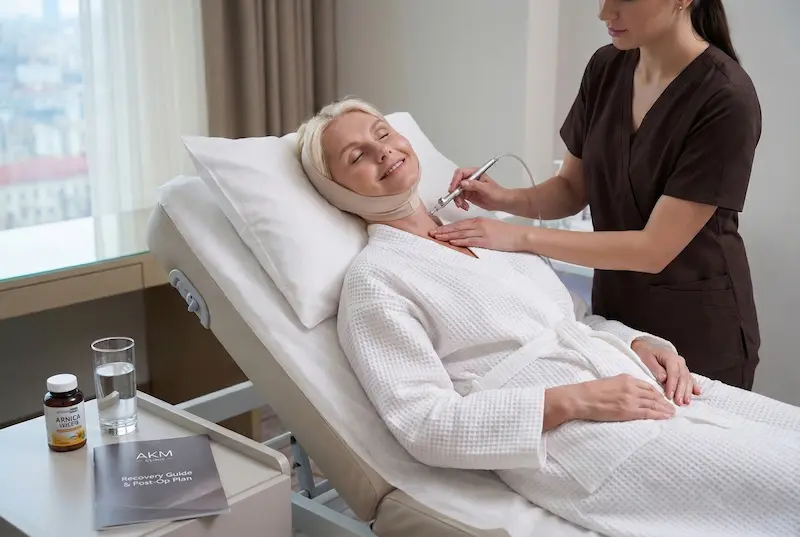
Patients also mentioned being surprised by modern recovery support tools. In AKM Clinic’s care model, two technologies are emphasized for post-op healing support:
- HBOT (Hyperbaric Oxygen Therapy): used to support tissue oxygenation and healing, with the clinic framing it as a major safety-focused recovery support step.
- LLLT (Low-Level Laser Therapy): used as a non-invasive support modality for skin healing (and in other contexts, hair restoration support).
These tools don’t replace surgical skill—but patients often found reassurance in the idea that recovery was treated as a structured medical phase, not an afterthought.
Finally, many “why choose Turkey for facelift” decisions came down to surgical philosophy. Patients said they felt more confident when the plan focused on deep structural support (for natural contours) and also considered skin quality—one reason AKM’s dermatosurgeon-led facial expertise, alongside a plastic surgery team approach, can resonate with patients who fear an “operated” look.
Their Honest Recovery Experience
Recovery is where internet research turns into real life. People can read a hundred facelift in Turkey reviews (including facelift Turkey reviews from USA) and still feel unprepared for the first week—because swelling, tightness, and emotional ups-and-downs are hard to visualize until you’re living them. In the most useful facelift Turkey vs USA stories, US patients were surprisingly consistent: the physical recovery had predictable phases, and what mattered most was having a clear plan, proactive check-ins, and realistic expectations—regardless of whether they were comparing a Beverly Hills option or a US patient facelift Turkey pathway.
Key takeaway: Patients who reported the smoothest recoveries didn’t “tough it out.” They followed a structured plan, asked questions early, and treated recovery like a phase of care—not an afterthought.
Day 1–2: what felt hard (swelling, tightness, sleep)
The first 48 hours are usually the most mentally intense. Patients described feeling “puffy,” tight around the jaw/neck, and awkward with sleep positioning. Even those pursuing advanced options (like what people search as deep plane facelift Turkey price) said the hardest part was not necessarily pain—it was the unfamiliar sensation of tightness and the fear that “this is what I’ll look like forever.”
Common Day 1–2 realities patients mentioned:
- Swelling peaks early (especially around the lower face and neck)
- Sleep disruption due to elevation and positioning
- Emotional wavering (normal anxiety when you’re swollen and tired)
- Dryness/tightness that can feel “strange” even if pain is controlled
In interviews, some patients highlighted minimal pain and limited need for painkillers—one USA patient (Sarah) noted she “only took painkillers for probably one day,” which helped normalize the idea that discomfort can be manageable with the right plan.
Day 3–7: the turning point patients consistently mention
Many patients described days 3–7 as the “turning point.” Swelling begins to shift, bruising changes color and becomes easier to conceal, and patients start to feel more in control. This is the week where medical structure matters most—because patients need clear guidance on what’s normal, what’s not, and what to do if something worries them.
Patients comparing Turkey vs USA facelift often said the biggest advantage of traveling wasn’t the flight—it was having a concentrated recovery window with planned check-ups during the stay. That reduced decision fatigue because they weren’t trying to coordinate care while swollen and stressed.
Some AKM Clinic patients also highlighted recovery-support technologies as part of their post-op plan:
- HBOT (Hyperbaric Oxygen Therapy): presented by the clinic as a key recovery-support modality to help tissue oxygenation, swelling reduction, scar support, and infection-risk mitigation.
- LLLT (Low-Level Laser Therapy): used to support post-facelift skin healing via cellular repair support, collagen stimulation, and inflammation reduction (often described as working alongside HBOT).
These tools don’t replace surgical skill—but patients often found reassurance in the idea that recovery was actively managed, not passive.
What they wish they packed / planned differently
Even the most prepared “expert patient” types (the ones searching best facelift surgeons in Turkey for US patients) often shared small planning mistakes. Here’s what patients consistently wished they’d done differently—useful whether you’re comparing plastic surgery in Turkey vs USA cost or simply trying to avoid avoidable stress:
- Pack for swelling variability: button-up tops, a soft scarf for privacy, and comfortable travel layers
- Plan low-effort nutrition: easy-to-eat foods and hydration support (swelling management is easier when you’re well-hydrated)
- Bring a “sleep kit”: neck pillow + anything that helps you stay elevated comfortably
- Don’t over-schedule Istanbul: patients who planned “tourist days” too early said it increased fatigue
- Book flights with flexibility: less rushing = lower stress (especially if swelling feels unpredictable)
One of the strongest “why choose Turkey for facelift” arguments patients gave had nothing to do with sightseeing—it was that they could focus on healing in a structured way, then return home with a clear plan.
Going home: how follow-up works once you’re back in the US
This is the question behind almost every facelift Turkey reviews from USA search: “What if I need help after I’m back?” Patients said they felt safest when they had clear escalation steps: who to message, what photos to send, and how quickly they could expect a response.
One patient story (Mehtap, Germany) described aftercare as a “lifeline of support,” saying that when she had a question later, she reached out and “they answered me.” That kind of responsiveness is exactly what US patients are trying to confirm when they search US patient facelift Turkey—because distance feels manageable when continuity of care is explicit.
To make this tangible, here’s a realistic recovery snapshot patients often used to plan travel (timelines vary by procedure and individual):
| Timeframe | What Patients Commonly Felt | What Helped Most |
|---|---|---|
| Days 1–2 | Peak swelling, tightness, sleep challenges | Elevation, hydration, clear instructions, proactive check-ins |
| Days 3–7 | Swelling shifts, bruising evolves, confidence improves | Scheduled follow-ups, reassurance on “normal vs not normal” |
| Weeks 2–4 | Noticeable refinement, still some firmness/numbness | Patience, scar care guidance, steady routine |
| Months 2–6 | Ongoing settling and naturalization of results | Long-distance follow-up, photo check-ins if needed |
Frequently Asked Questions (FAQ): Facelift Turkey vs. USA stories
This FAQ is built for readers who are deep in research—typing searches like facelift in Turkey reviews, facelift Turkey reviews from USA, Turkey vs USA facelift, and plastic surgery in Turkey vs USA cost—and want clear, decision-level answers. The goal here isn’t to “convince” you; it’s to help you ask better questions, spot real quality signals, and reduce the risk of regret.
Is it actually safe to travel to Turkey for facial surgery?
It can be safe, but “Turkey” isn’t a safety standard—the system you choose is. Safety depends on where the procedure is performed (hospital vs. clinic setting), anesthesia planning, infection control standards, surgeon experience, and how early recovery is monitored. In many facelift Turkey vs USA stories, patients felt safer once they verified the facility setting, saw a structured post-op plan, and understood who was medically responsible if a concern arose.
How do I verify surgeon credentials and avoid “medical tourism brokers”?
Start by ensuring you can speak directly with the surgeon (or have surgeon-level medical input in consultation), not only a coordinator. Then verify:
Specialty and scope: facelift-focused experience and consistency in facial outcomes
Before/after realism: multiple cases, not one “highlight reel”
Transparent plan: technique rationale, scar placement, risk explanation, and recovery timeline
Aftercare pathway: scheduled follow-ups and clear escalation steps
If your research goal is “best facelift surgeons in Turkey for US patients,” the strongest signal is not a slogan—it’s the surgeon’s ability to explain why a plan fits your anatomy, and how they avoid an overdone look.
How long should I stay in Istanbul for a facelift-type procedure?
Length of stay depends on the exact procedure (and whether you’re combining surgeries), but the principle is stable: you want to remain in-country long enough for early checks and for swelling/bruising to be evaluated before flying. Patients comparing Turkey vs USA facelift often said the most reassuring part of traveling was having a concentrated recovery period with planned check-ups while they were still near the surgical team.
When can I fly back after facial surgery?
Flying timing should be decided by your surgeon based on your procedure, your health profile, and how your early recovery looks. Patients who felt most confident said they avoided rigid travel planning and instead built flexibility into return flights. If you’re reading facelift Turkey reviews from USA, you’ll notice a trend: the smoothest experiences usually include a clearly defined “safe-to-fly” checkpoint.
What happens if I need help after I return to the US?
This is one of the most important questions to ask before booking. You want a written follow-up plan that includes:
Who you contact (name/role) and how (WhatsApp/email/portal)
What constitutes “normal” vs. “urgent”
How you’ll share photos and how quickly you can expect a response
Whether they coordinate with a local physician if needed
Readers searching US patient facelift Turkey are often worried about being “left alone” once they’re home. The best reassurance is not promises—it’s a clear, documented process.
How do you avoid an “overdone” or “wind-swept” look?
Patients often assume an overdone look is inevitable, but it’s usually a result of technique selection, tension vectors, and an overemphasis on skin tightening instead of structural support. Many patients researching deep plane facelift Turkey price are implicitly asking: “Is deeper structural work part of the plan, and does the surgeon know how to do it safely?”
A natural outcome typically comes from:
Structure-first planning (supporting deeper tissues where appropriate, not just pulling skin)
Conservative, anatomy-matched tension to protect facial expression
Skin quality considerations (texture, elasticity, and scar behavior)
In a surgeon-led model that includes dermatosurgeon facial expertise alongside plastic surgery planning, patients often find it easier to discuss not only “lift,” but also skin quality and long-term naturalness—two issues that can make or break whether you look refreshed or “operated.”
What should I ask in a virtual consultation before booking?
If you’re comparing plastic surgery in Turkey vs USA cost, you want to ask questions that reveal quality—without getting lost in buzzwords. Here are high-signal questions patients used in real facelift Turkey vs USA stories:
Technique rationale: “Why is this approach right for my face and neck?”
Risk planning: “What are the most common complications you see, and how do you manage them?”
Scars and hairline: “Where will scars be placed, and how do you protect the hairline/sideburn area?”
Naturalness goal: “How do you prevent an over-pulled look?”
Recovery structure: “What does day 1–7 look like and who checks me?”
Cost clarity: “What is included, what is excluded, and what could change the price?”
Healing support: “Do you use any adjunct recovery support like HBOT or LLLT, and what is the goal?”
If you’d like to go beyond the topic covered here, you can also explore related guides on Deep Plane Facelift Cost, Plastic Surgery Cost Usa vs. Turkey, and Awake Facelift Cost—plus visual result resources like Awake Facelift Before After. For deeper decision support, you may find it helpful to read Deep Plane Facelift Reviews Turkey and learn what defines a Natural Looking Facelift Turkey outcome. And if safety standards are your top priority, we also recommend reviewing how JCI Accredited Hospitals Turkey factor into hospital selection for international patients.