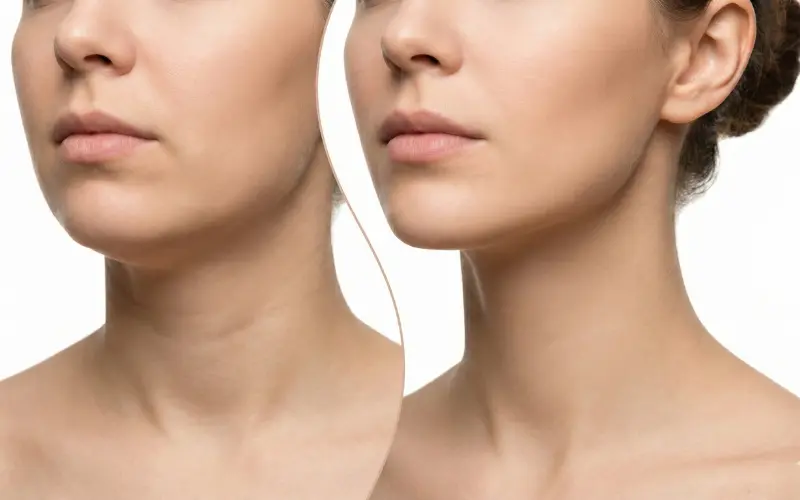
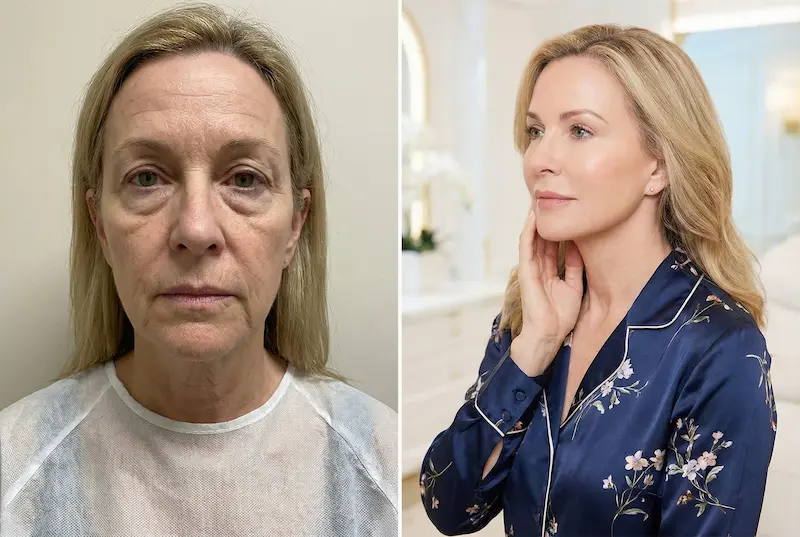
If you’re the kind of patient who reads scientific research before booking a consultation, you’ve probably noticed a surge in searches like stem cell facelift, what is stem cell facelift, and even location-specific queries such as stem cell facelift Beverly Hills. The interest makes sense: a modern facelift can reposition deeper facial structures for a natural-looking lift, but many patients also want better skin quality—less “crepey” texture, more glow, and improved elasticity. That’s where stem cell assisted facelift surgery comes in: a surgical lift combined with regenerative techniques designed to support healing and enhance skin quality.
In this guide, we’ll explain what “stem cell” typically means in facelift surgery, how the medical science behind regenerative fat works, what outcomes are realistic, and how to evaluate safety, results, and surgeon expertise like an “expert patient.”
Table of Contents
What Is a Stem Cell Assisted Facelift?
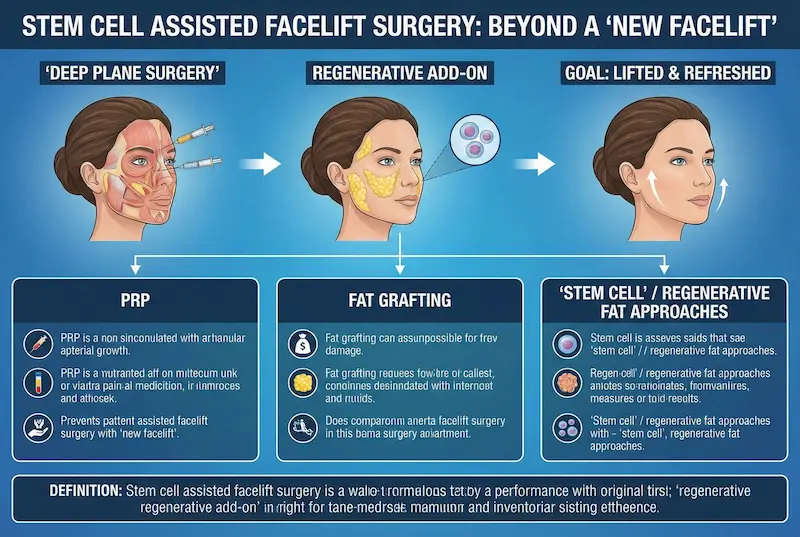
A stem cell assisted facelift is not a “new facelift” that replaces established techniques. Instead, it’s a facelift (often a deeper-plane lift for natural contours) plus a regenerative add-on—most commonly the use of a patient’s own purified fat and cell-rich fractions (often described online as “stem cells”) to support skin quality and recovery. In practice, many “stem cell facelift surgery” approaches rely on processing your own tissue to concentrate regenerative components that can be reintroduced to areas that look depleted or fragile.
Combining Deep Plane Surgery with Regenerative Medicine
A high-quality facelift focuses on structure: repositioning descended tissues and restoring youthful facial lines without an “overpulled” look. Regenerative techniques focus on surface and quality: improving skin texture, hydration, and overall vitality. When combined appropriately, the goal is a result that looks lifted and naturally refreshed—rather than simply “tight.”
How Your Own Fat Cells Turn into “Youth Serum”
When people say “stem cell facelift,” they are often referring to the regenerative potential found in your own fat tissue. Fat contains supportive cells and growth-factor signaling that can be used in carefully selected areas to improve the appearance of thin, crepey, or dull skin. The key is how the tissue is harvested, processed, and placed—because precision affects both safety and the quality of the final result.
Stem Cells vs. PRP vs. Fat Grafting: What’s Actually Different?
- PRP (Platelet-Rich Plasma): Derived from blood; often used to support healing and skin quality, but typically provides subtler volume change.
- Fat grafting: Transfers volume; can restore fullness (midface, temples), but results depend heavily on technique and survival of the graft.
- “Stem cell” / regenerative fat approaches: Usually refers to processed fat (often “nanofat” or cell-rich fractions) aimed more at skin quality and regenerative signaling than pure volume.
Many patients researching stem cell facelift procedure are actually looking for a strategy that improves both lift + skin quality with their own tissue—rather than relying on synthetic fillers alone.
What “Stem Cell” Means in Aesthetic Surgery (and What It Does Not Mean)
It’s important to be precise. In aesthetic marketing, “stem cell facelift” can be used loosely. In reputable clinical settings, it generally means autologous (your own) tissue processing and reintroduction—rather than anything embryonic or experimental. A trustworthy clinic will explain exactly what is being used, how it’s prepared, and what outcomes are supported by medical science versus what is hype.
Expert patient takeaway: Ask your surgeon to define “stem cell” in plain language: What tissue is harvested? How is it processed? Where is it injected—and why?
The Science: How Stem Cells Regenerate Skin Quality
The “regenerative” promise of a stem cell facelift rests on how cell-rich tissue communicates with skin and healing pathways. While outcomes vary by patient, the best scientific research suggests these approaches may support the quality of healing and improve visible markers of aging—particularly in patients with thin skin, texture irregularities, or volume depletion.
Increasing Collagen and Elastin Production Naturally
Healthy, youthful skin depends on collagen organization and elastin integrity. Regenerative tissue signaling can support fibroblast activity (the cells involved in collagen production) and may help skin look more resilient over time. This is one reason patients often describe their stem cell facelift results as more than “just tighter”—they may also see improved tone and a healthier-looking surface.
The Difference Between Synthetic Fillers and Nanofat
Dermal fillers can be excellent tools for targeted volume, but they do not “rebuild” tissue in the same way regenerative fat techniques aim to. Nanofat is typically used more for skin quality than for structural volume. For the right candidate, it can complement surgical lifting by addressing the “paper-thin” or crepey look that surgery alone may not fully resolve.
How Regenerative Cells Interact with Inflammation and Wound Healing
All surgery triggers inflammation—some of it is necessary for healing, but excessive inflammation can prolong swelling and delay refinement. Regenerative approaches are often positioned as supportive for recovery by modulating healing pathways. At AKM Clinic, we also integrate recovery optimization technologies such as HBOT (Hyperbaric Oxygen Therapy) and LLLT (Low-Level Laser Therapy) as part of post-op care planning to help manage swelling and support tissue recovery in appropriate patients.
What the Evidence Suggests: Realistic Outcomes vs. Marketing Claims
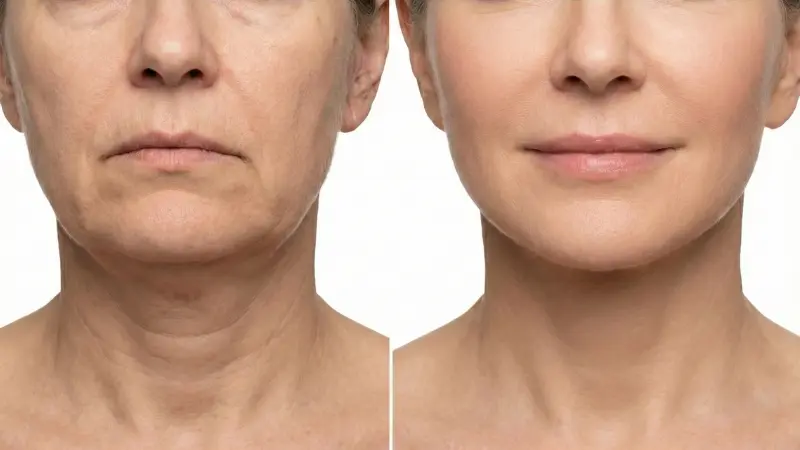
Responsible counseling matters. A stem cell assisted facelift may improve skin quality and recovery experience, but it is not a guarantee of “perfect skin” or an instant decade reversal. The most ethical way to evaluate stem cell facelift before and after photos is to ask: Was the lift technique comparable? Was volume restored? Was skin resurfacing also performed? And are the images taken in consistent lighting and time points?
Expert patient takeaway: The best “stem cell facelift reviews” focus on naturalness, healing trajectory, and surgeon transparency—not miracle claims.
Benefits of Adding Stem Cells to Your Facelift
When patients search for stem cell facelift results or compare stem cell facelift before and after galleries, they’re usually looking for two things at once: (1) a natural, long-lasting lift, and (2) skin that looks healthier—less dull, less crepey, more resilient. A stem cell facelift approach (most often using your own regenerative fat fractions) is designed to complement the structural correction of a facelift by supporting skin quality and recovery. In other words, it’s not meant to “replace” surgical technique—it’s meant to refine what surgery can achieve.
Accelerated Healing and Reduced Scarring
One of the most discussed advantages in medical science and clinical practice is the potential for improved healing dynamics—less prolonged swelling, better tissue recovery, and a more favorable scar-maturation pathway. While no clinic can ethically guarantee a “zero swelling” experience, the goal is to support a smoother recovery curve and reduce the “long tail” of inflammation that can delay final refinement.
Restoring the “Glow” That Surgery Alone Cannot Fix
A facelift repositions and tightens; it does not automatically rebuild skin quality. That’s why patients who want to look “refreshed” rather than “done” often ask, what is stem cell facelift and whether regenerative add-ons can improve texture, tone, and that subtle “glow.” In well-selected candidates, regenerative tissue support may improve how the skin looks and behaves—especially if thin skin or crepey texture is part of the aging picture.
Better Texture, Pores, and “Crepey” Skin: Where Patients Notice the Difference
Texture concerns tend to be the reason people pursue a stem cell facelift procedure rather than a facelift alone. Patients frequently report that the “surface” improvements (how makeup sits, how light reflects on the skin, how the cheeks and lower face look in daylight) become more noticeable as swelling resolves. This is also why honest consultation matters: texture improvement is gradual and should be assessed over months, not days.
Natural Volume Restoration in Key Areas (Midface, Temples, Under-Eyes)
Many “stem cell facelift surgery” plans include some form of fat-based support. The aim isn’t to create a “filled” face; it’s to restore youthful transitions where aging causes deflation. Strategic placement can soften harsh shadows and help the face read as healthier—while the lift corrects descent. This is one reason a well-executed plan can outperform a “filler-only” strategy over time.
| What patients want | What a facelift does best | What regenerative add-ons may support |
|---|---|---|
| Lift + jawline definition | Repositions descended tissues | Does not replace surgical lift |
| Healthier skin quality | Limited direct effect on texture | May support tone/texture over time |
| More youthful “light reflection” | Improves contours | May reduce “flat/dull” look in select candidates |
| Shorter-feeling recovery | Depends on technique + patient factors | May support smoother recovery when paired with optimized aftercare |
Real-world “expert patient” insight: Barbara (USA) described her outcome as “natural-looking” and said she looked “probably 20 years younger.”
The Procedure Step-by-Step at AKM Clinic
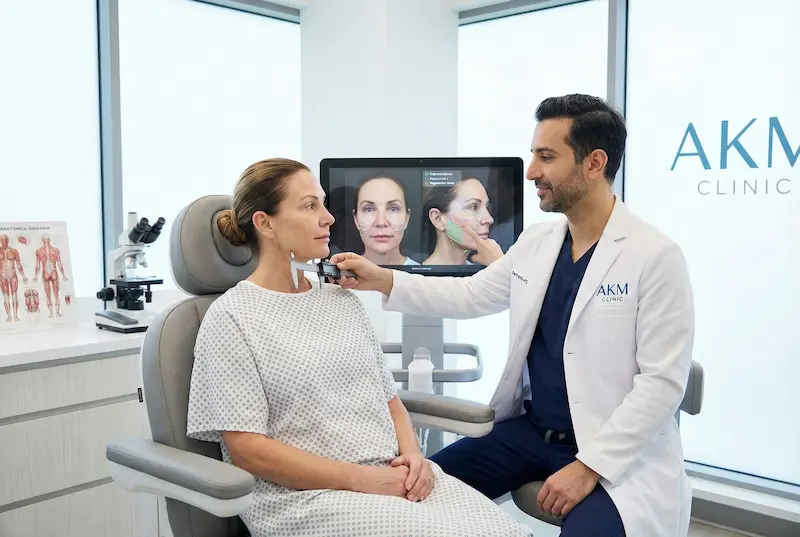
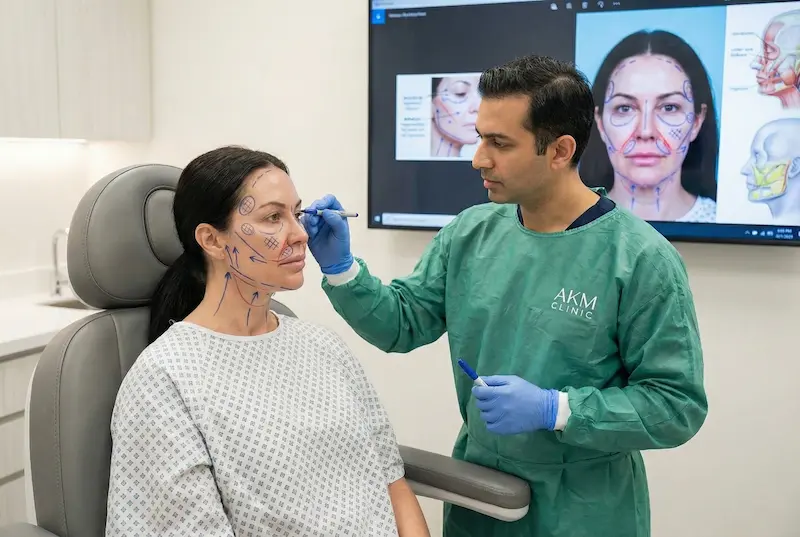
Patients considering a stem cell facelift often assume the “stem cell” part is the main event. In reality, the foundation is still the facelift technique and the surgical judgment behind it. At AKM Clinic, facial rejuvenation is led by a Dermatosurgeon & Face Expert working with the clinic’s surgical team—an approach that matters because natural results depend on both structural repositioning and skin-quality planning. The regenerative component is then layered in a precise, safety-first way as part of the overall surgical design.
Harvesting, Filtering, and Injection Process
Most “stem cell” facelift approaches use your own tissue. A small amount of fat is harvested, then processed to prepare a regenerative fraction (often discussed online as “nanofat” or cell-rich tissue support). The goal is to prepare a material appropriate for the target: some areas need volume, while others need skin-quality support. A careful plan distinguishes these—because overfilling is a common cause of unnatural outcomes.
Where Stem Cell-Rich Nanofat Is Placed for the Most Natural Effect
Placement is individualized. Patients researching stem cell facelift before and after images should remember: the best outcomes typically reflect conservative, strategic placement—often in areas where skin looks thin, crepey, or depleted, and where subtle improvement can make the face look healthier without changing identity. When done well, people notice you look “well-rested,” not “different.”
Safety Protocols: Sterility, Cell Handling, and Patient Selection Criteria
If you’re reading stem cell facelift reviews, prioritize the ones that mention surgeon communication about safety—not just excitement about results. Key safety themes include: sterile technique, conservative volumes, correct plane of injection, and strict patient selection. This is also where discussing stem cell facelift risks becomes essential: risks can include infection, irregularity, prolonged swelling, bruising, asymmetry, and (rarely) vascular complications with any injection-based technique. A reputable clinic explains how risks are mitigated and what warning signs require immediate contact.
Post-Op Recovery Optimization: HBOT & LLLT as Part of Aftercare
Beyond technique, recovery quality influences satisfaction. AKM Clinic integrates supportive aftercare technologies such as HBOT (Hyperbaric Oxygen Therapy) and LLLT (Low-Level Laser Therapy) as part of its recovery optimization strategy in appropriate patients. HBOT is used to support oxygenation and healing physiology, while LLLT can be used to support cellular-level recovery and tissue calm. These are not “magic fixes,” but they can be meaningful in improving the recovery experience—especially for international patients who want a well-structured, medically supervised plan.
Expert patient takeaway: Your result depends on the facelift technique first, then the regenerative layer, then disciplined aftercare.
Because many readers also want practical details like stem cell facelift cost (including comparisons people make to stem cell facelift Beverly Hills pricing), the next section will address longevity, what “lasting longer” really means, and how to think about value without falling for marketing.
Longevity: Does It Really Last Longer?
This is the question behind many searches for stem cell facelift results. And the honest answer is: it depends what you mean by “last.” A facelift’s longevity is primarily determined by the lift technique (how deep structures are repositioned) and patient factors (skin quality, lifestyle, genetics). The regenerative layer—often marketed as a stem cell facelift—is best understood as a way to support skin quality and recovery, rather than a guarantee that the structural lift will last “twice as long.”
What “Longer-Lasting” Means: Lift Longevity vs. Skin Quality Longevity
- Lift longevity: How long the jawline/neck/midface positioning stays improved. This depends on surgical technique, tissue quality, and aging pace.
- Skin-quality longevity: How long the skin looks healthier—tone, texture, “crepey” appearance, and overall vitality. This is where regenerative support may contribute the most.
In practical terms, patients who love their stem cell facelift before and after photos often describe the benefit as “I look like myself—just healthier.” That “healthy skin” look is what some patients attribute to the regenerative component.
Factors That Determine Durability (Age, Skin Quality, Smoking, Weight Changes)
Even the best stem cell facelift surgery plan can’t outwork biology if major risk factors aren’t addressed. Common durability drivers include:
- Skin quality at baseline: Thin, sun-damaged, or very lax skin can limit how long a result looks “fresh.”
- Smoking/vaping: Compromises microcirculation and healing—this can impact scarring, swelling duration, and long-term skin quality.
- Significant weight changes: Can alter facial volume and make results look less stable over time.
- Chronic inflammation: Poor sleep, uncontrolled medical conditions, and high stress can slow healing.
Maintenance Strategy: When Non-Surgical Treatments Still Help (and When They Don’t)
A common misunderstanding in stem cell facelift reviews is the idea that once you do a facelift, you’ll never need anything else. In reality, a smart plan can include maintenance—especially for skin quality. Depending on your skin and goals, your surgeon may discuss medical-grade skincare, energy-based treatments, or conservative injectables over time. These don’t “replace” the lift; they help preserve the skin-quality side of the result.
Patient perspective: Barbara (USA) described her outcome as natural—“actually look like nothing happened but probably 20 years younger.”
Candidate Profile: Do You Need Volume or Lifting?
Many people type what is stem cell facelift because they’re unsure whether they need a true lift, volume restoration, or both. The most reliable way to think about candidacy is a two-layer diagnosis: structural descent (tissues dropping) and deflation (volume loss). A “stem cell facelift” approach can be a strong option when a patient needs a high-quality lift and wants skin-quality support—especially when thin skin, texture change, or hollowing is part of the aging pattern.
The 2-Layer Diagnosis: Structural Descent vs. “Deflation” (Volume Loss)
- Descent: Jowls, neck banding/looseness, lower-face heaviness, a “pulled down” midface.
- Deflation: Temples flattening, under-eye hollowing, midface volume loss, skin that looks thin or crepey.
If your main issue is descent, you typically need a lift-focused plan first. If deflation is significant, regenerative fat strategies (often discussed as stem cell facelift procedure or “nanofat”) may be considered as a complementary layer—done conservatively to avoid an overfilled look.
Ideal Candidates by Concern: Jowls, Nasolabial Folds, Under-Eye Hollowing, Skin Texture
In many “expert patient” evaluations of stem cell facelift results, the most satisfied candidates tend to be those who want:
- Natural lifting (jawline/neck definition) without looking tight or “operated.”
- Improved skin quality (tone/texture/crepiness) in addition to contour correction.
- Subtle volume refinement in areas like the temples or midface—without filler heaviness.
Who Should Not Have It: Contraindications and When Another Plan Fits Better
Responsible counseling includes discussing stem cell facelift risks and who is not an ideal candidate. While your own tissue is generally well-tolerated, risks still exist—especially if expectations are unrealistic or if health factors complicate healing. You may need a different plan if:
- You are an active smoker/vaper or unable to stop for the required pre- and post-op period.
- You have uncontrolled medical conditions that increase surgical or healing risk.
- You want dramatic skin resurfacing changes that require a different technology strategy (not just regenerative support).
- You are seeking a “non-surgical facelift” outcome from injections alone.
Also, remember: “stem cell facelift” is sometimes used online for non-surgical treatments. A reputable consultation clarifies exactly what is surgical vs. non-surgical—and why that matters.
How We Personalize: Combining Deep Plane Lift + Regenerative Add-Ons for Natural Results
At AKM Clinic, facial rejuvenation is approached with the precision of a Dermatosurgeon & Face Expert working with the clinic’s surgical team—because natural results require both structural artistry and skin-focused planning. The facelift technique creates the foundation; the regenerative layer is then used selectively to support skin quality and refined volume where appropriate.
Post-op recovery is also treated as part of the medical plan. AKM Clinic integrates supportive recovery technologies such as HBOT and LLLT in appropriate patients to help optimize healing dynamics and comfort.
| Your primary concern | What usually helps most | How “stem cell” methods may fit |
|---|---|---|
| Jowls / neck laxity / tissue descent | Facelift technique (structural lift) | Adjunct for recovery/skin quality (not a replacement for lift) |
| Hollowing / deflation (temples, midface) | Conservative fat-based volume strategy | May improve transitions and “tired shadows” naturally |
| Crepey texture / thin skin / dull tone | Skin-quality planning + recovery optimization | Often the main reason patients seek stem cell-assisted approaches |
Cost Reality Check: Why “Stem Cell Facelift Cost” Varies So Much
People often compare stem cell facelift cost searches to high-visibility markets like stem cell facelift Beverly Hills. The reality is that pricing reflects a bundle of variables: surgeon expertise, anesthesia, facility standards, extent of lift (mini vs. deep plane), whether neck lift/eyelids are included, how regenerative tissue is processed, and the intensity of post-op care.
| Market (examples) | Commonly reported facelift cost ranges | Why ranges are wide |
|---|---|---|
| Beverly Hills / Los Angeles | $18,000–$30,000+ (LA), and $30,000–$100,000+ (Beverly Hills deep plane cited by some surgeons) | Elite-surgeon demand, facility fees, technique complexity |
| New York City (Manhattan) | $18,000–$30,000+ (commonly cited ranges) | High overhead, premium surgeon fees |
| Miami | $15000–$20,000+ (varies by type and provider) | Large market variance, mini vs. full lift differences |
| Istanbul (medical travel context) | Often advertised as substantially lower than major US hubs | Package structures, inclusions, surgeon/hospital variability |
| Other medical tourism markets (Mexico, Thailand) | Often lower than top US hubs, but varies greatly | Standards, aftercare logistics, surgeon selection |
How an “expert patient” should interpret cost: Don’t compare price alone—compare surgeon credentials, safety protocols, sterility standards, transparency of what’s included, and aftercare (including recovery optimization). This is especially important when evaluating any stem cell facelift offering, because “stem cell” can mean very different things depending on how the tissue is processed and handled.
Expert patient takeaway: The best value is the plan that minimizes avoidable risk, protects natural identity, and supports safe healing—not the cheapest quote.
Frequently Asked Questions (FAQ): Stem Cell Assisted Facelift Surgery
Below are the most common “expert patient” questions we hear from people researching stem cell facelift options—especially those comparing stem cell facelift Beverly Hills content to international clinics, reviewing stem cell facelift before and after photos, and trying to understand the real-world safety profile and value.
Is a “stem cell facelift” the same as a facelift with fat transfer?
Not always. Many “stem cell facelift” terms online refer to a facelift paired with fat-based regenerative techniques (such as processed fat fractions often called “nanofat”) rather than traditional fat transfer for volume alone. Fat transfer is primarily about restoring volume; regenerative fractions are often used more for skin quality support. The exact meaning depends on how the tissue is processed and what the surgeon intends to achieve.
Are the stem cells taken from my own body?
In most reputable aesthetic settings, yes—this is typically autologous (your own) tissue. The surgeon harvests a small amount of fat, processes it under sterile conditions, and uses it as part of the plan. A trustworthy provider will clearly explain what is harvested, how it is prepared, and where it will be placed.
Is it safe—what are the real risks and how are they mitigated?
Any stem cell facelift surgery plan carries surgical and injection-related risks. Common risks include infection, bruising, swelling, asymmetry, contour irregularity, scarring, and delayed healing. When tissue is injected, a key safety concern (rare but serious) is vascular compromise—this is why surgeon technique, correct plane, conservative volumes, and strict protocols matter. Risk is mitigated through meticulous sterility, careful patient selection, precise placement, and clear post-op monitoring instructions.
How long does the regenerative effect take to show?
Most patients see early changes related to swelling settling over weeks, but skin-quality improvements often evolve over months. When patients evaluate stem cell facelift results, it’s best to look at time points like 3, 6, and 12 months rather than a “week 2” photo.
Will it change the lift, or mainly improve skin quality?
The lift is primarily determined by the facelift technique and how deeper tissues are repositioned. The regenerative layer most commonly supports skin quality (tone/texture/crepiness) and recovery comfort. In other words: it complements the lift; it doesn’t replace the structural work.
How is nanofat different from dermal fillers?
Fillers are manufactured gels designed to add shape and hydration; they can be excellent for targeted volume. Nanofat/regenerative fat fractions are derived from your own tissue and are often used with the goal of improving skin quality signaling rather than creating strong structural volume. The best approach depends on your anatomy, goals, and risk tolerance—an “expert patient” consult should clarify why one (or a combination) is recommended.
Can stem cell-assisted techniques help with scars and thin skin?
They may help support skin quality in select patients—especially when thin, crepey skin is part of the aging pattern. However, they are not a guaranteed “scar eraser.” This is where science and clinical judgment matter: your surgeon should explain what the technique can realistically improve and what might require other therapies (for example, resurfacing treatments) once healing is complete.
What is the downtime compared to a traditional facelift?
Downtime is driven mostly by the facelift itself (extent of lift, whether a neck lift or eyelid surgery is added, patient healing factors). The regenerative component may support a smoother recovery experience for some patients, but it does not eliminate the normal healing timeline. Many patients feel socially comfortable somewhere in the weeks-to-months range depending on swelling and bruising patterns.
Does adding stem cells increase the cost, and is it “worth it”?
Yes, it can increase cost because it adds time, processing steps, and technical nuance to the procedure. When evaluating stem cell facelift cost, don’t compare price alone—compare what’s included (technique, facility standards, anesthesia, aftercare, recovery support). People often use stem cell facelift Beverly Hills as a reference point because of high surgeon fees and overhead, but “worth it” should be based on safety, naturalness, and the plan’s fit for your anatomy—not marketing.
Can I combine this with eyelid surgery, brow lift, or neck lift?
Often, yes. Many patients seeking a more complete rejuvenation combine a facelift with a neck lift and/or eyelid surgery depending on anatomy. The key is staging and planning: your surgeon should explain how combined procedures affect swelling, recovery, and risk. At AKM Clinic, facial planning is approached with Dermatosurgeon-led facial expertise working with the surgical team to prioritize natural results and safe technique selection, with recovery optimization tools like HBOT and LLLT used when appropriate.