If you’re comparing destinations, clinics, and treatment types, the first question is usually the most practical one: regenerative medicine cost in Turkey—and whether the outcome is truly worth the total spend (including travel, recovery time, and risk).
This guide is written for “expert patients” who want clarity, not hype. We’ll break down what clinics mean by “regenerative medicine,” what actually drives pricing, how to compare quotes ethically, and how to think in terms of value. Along the way, we’ll reference what scientific research and medical science generally supports (and what it does not) so you can set expectations realistically.
We’ll also naturally include the secondary keyword variations you may see online—cost of regenerative medicine in Turkey, Turkey regenerative medicine cost, and regenerative medicine cost in Istanbul—because they often reflect how real patients search before making a decision.
Table of Contents
What “Regenerative Medicine” Means in Aesthetic Medicine (and What It Doesn’t)
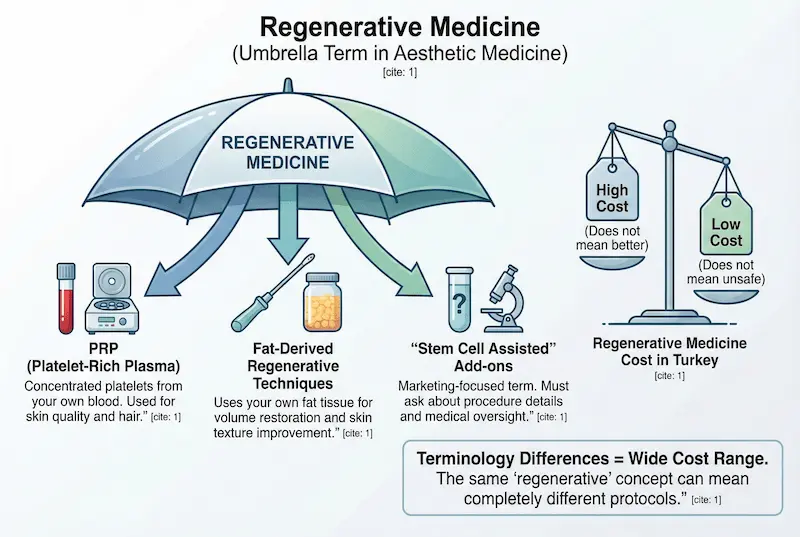
In cosmetic and aesthetic settings, “regenerative medicine” is often used as an umbrella term for techniques intended to support tissue quality, healing, and skin vitality. It’s important to understand what a clinic is actually offering—because the label alone doesn’t tell you the method, the processing standards, or who performs each step. That difference directly affects the Turkey regenerative medicine cost you’re quoted.
The umbrella term: PRP, fat-derived regenerative techniques, “stem cell assisted” add-ons
In many aesthetic clinics, regenerative options may include:
- PRP (Platelet-Rich Plasma): Concentrated platelets from your own blood, typically used for skin quality support and sometimes hair-related protocols.
- Fat-derived regenerative techniques: Procedures that use your own fat tissue for volume restoration, sometimes described as “regenerative” when the aim includes improving skin texture or supporting healing.
- “Stem cell assisted” add-ons: A marketing-heavy phrase that can mean different things depending on the clinic. The key is to ask exactly what is processed, how, where, and under whose medical oversight.
Because terminology varies, two clinics may advertise the same “regenerative” concept while offering completely different protocols—so the cost of regenerative medicine in Turkey can vary widely without the higher price automatically meaning “better,” or the lower price meaning “unsafe.”
What you’re actually paying for: processing, technique, expertise—not “magic cells”
In a well-run clinical setting, cost is usually driven by the process, not the buzzword. From a patient perspective, the quote often reflects:
- Processing method (how material is prepared, sterility controls, whether it’s a closed system).
- Clinical time and skill (how the technique is applied and by whom).
- Medical oversight (pre-assessment, suitability screening, and complication readiness).
- Documentation and traceability (clear charting, consent, and aftercare plan).
This is why comparing two “regenerative” offers by price alone is risky. The most useful question is: What exactly is included, what standards are followed, and who is responsible for each step?
Realistic outcomes: skin quality + recovery support vs “10 years younger overnight” claims
In aesthetic medicine, regenerative techniques are most often positioned for:
- Skin quality support (texture, glow, elasticity-related appearance).
- Adjunct recovery support when used alongside surgery (aiming to support healing and comfort).
- Subtle improvement over time, rather than instant transformation.
It’s worth noting that outcomes depend on many variables (baseline skin quality, lifestyle, age, technique, and aftercare). While scientific research in related areas supports the plausibility of certain mechanisms (e.g., signaling factors in PRP), marketing claims can leap far beyond what the evidence can reliably guarantee for an individual patient. A clinic that frames results in realistic, measurable terms is usually a safer bet.
| Common Term Used | What It Often Refers To | Typical Goal in Aesthetics | What to Ask Before Comparing Cost |
|---|---|---|---|
| PRP | Platelet concentration from your blood | Skin quality support; sometimes adjunct protocols | How is PRP prepared? Who administers it? What’s included in aftercare? |
| Fat-derived regenerative technique | Your fat used for volume and tissue quality aims | Natural volume + potential skin texture support | What processing method? What technique? Who performs each step? |
| “Stem cell assisted” add-on | Variable; may be a loosely used label | Usually described as “enhanced healing/quality” | Exact definition, oversight, processing standards, and documentation |
Regenerative Medicine Cost in Turkey — The Main Factors That Change the Price
When patients search “regenerative medicine cost in Istanbul” or “cost of regenerative medicine in Turkey,” they often see a wide spread of numbers. That range is not random. Pricing usually reflects a combination of: the procedure design (stand-alone vs add-on), the processing standards, the medical environment, and the expertise of the team performing and supervising the protocol.
Procedure type: stand-alone treatment vs add-on to surgery (e.g., facelift)
A regenerative protocol can be offered as a stand-alone session (e.g., PRP-based treatments) or as an add-on integrated into a surgical plan. Add-ons may appear more expensive because they are priced within a broader framework of:
- Operating room time and sterile workflow
- Additional medical staff coordination
- Integrated follow-up schedule during the recovery window
When you compare quotes, make sure you’re comparing like-for-like: a stand-alone clinic session is not the same cost structure as an add-on delivered in a surgical-grade environment.
Lab/processing standards: closed systems, sterility, traceability, quality control
One of the most overlooked drivers of Turkey regenerative medicine cost is how material is processed and documented. Higher-quality clinical workflows often emphasize:
- Sterility controls and clear chain-of-custody handling
- Closed or standardized processing systems (where applicable)
- Traceability: documentation of what was done, when, and under which protocol
If a clinic cannot explain its processing steps in plain language—or avoids specifics—treat that as a red flag. A transparent clinic should be able to describe the method without leaning on buzzwords.
Surgeon expertise & team structure: why experience (and who performs what) matters
In aesthetic medicine, the “who” is as important as the “what.” Cost may reflect:
- Who evaluates your suitability (medical history, medications, healing risk)
- Who performs the injections/application or integrates the technique into surgery
- Whether there is consistent senior oversight for decision-making
For expert patients, a useful approach is to ask the clinic to clarify roles: Which parts are performed by the surgeon, which by a physician, and which by a technician? This helps you judge value beyond the headline number.
Hospital, anesthesia, and safety infrastructure (cost drivers patients don’t see)
Even if your regenerative treatment is minimally invasive, safety infrastructure matters—especially if it’s combined with surgery or sedation. Costs can reflect access to:
- Hospital-grade monitoring and emergency readiness
- Anesthesia/sedation standards (where relevant)
- Post-procedure observation and clear discharge criteria
This is where “cheap” can become expensive later. A lower price may omit safety layers that reduce complication risk—something that expert patients factor into whether the treatment is truly “worth it.”
Typical Price Ranges in Turkey (And What Should Be Included)
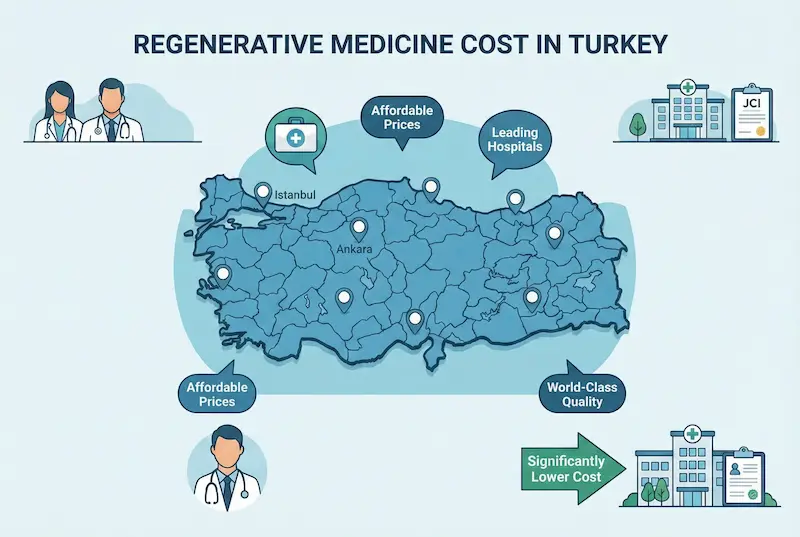
When patients search cost of regenerative medicine in Turkey, they often find wildly different numbers—because “regenerative medicine” can mean anything from an office-based microneedling + PRP session to a more complex, medically supervised package. So instead of chasing the lowest headline price, the safer approach is to compare what the quote actually includes and what standards are being used. That’s how you judge whether the regenerative medicine cost in Istanbul is truly “worth it.”
What a transparent quote looks like (itemized vs “all-in” without details)
A transparent clinic quote should clearly answer these questions in writing:
- What exactly is the treatment? (PRP, microneedling + PRP, fat-derived technique, etc.)
- How many sessions are recommended? (and why that number is clinically reasonable)
- Who performs each step? (surgeon/physician vs technician)
- What setting is used? (clinic room vs hospital-grade environment)
- What aftercare is included? (follow-ups, dressings, medications if relevant)
Be cautious with quotes that say “everything included” but don’t specify what “everything” actually is. Expert patients don’t just compare prices—they compare protocols.
Practical rule: If you can’t clearly explain the protocol back to yourself after reading the quote, you don’t have enough information to compare cost safely.
Publicly advertised “market ranges” in Turkey (why these ranges vary)
Below are publicly advertised ranges you may see online for common aesthetic-adjacent regenerative treatments in Turkey. These are not a substitute for a medical quote (your plan depends on candidacy, goals, and whether the treatment is stand-alone or combined with surgery), but they help you sanity-check whether a number is realistic.
| Treatment Type (Common Aesthetic Use) | Publicly Advertised Range (Turkey) | What Usually Drives the Difference | What You Should Confirm |
|---|---|---|---|
| Microneedling (face) | ~100–200 USD (average); “from” ~$200 reported on some listings | Clinic level, city, device type, session count | Device + needle depth protocol, who performs it, post-care |
| Microneedling + PRP | “From” ~$250 (some listings show up to ~$350) | PRP prep method, sterility workflow, combined protocol design | PRP preparation details, session plan, contraindications |
| PRP (general aesthetic use) | ~$200–$300 (range often depends on area + session design) | Area treated, PRP density, number of sessions | Number of sessions recommended and why, aftercare plan |
| PRP add-on in packaged care (example from published clinic pricing) | ~$100 as an add-on in some packages | Bundling inside a package vs stand-alone pricing | Whether add-on price includes the full protocol or a single step |
| “Stem cell therapy” packages (non-aesthetic indications often priced as packages) | Commonly quoted in the mid four-figures to low five-figures (USD) | Indication (knee/eye/etc.), facility, anesthesia, hospitalization | Exact indication, regulation/oversight, what is included & excluded |
Important context: In medical science, the term “stem cell therapy” is broad and can refer to very different medical pathways. If a clinic markets a “stem cell” add-on for aesthetics, you should ask for a precise definition, the processing method, the medical oversight model, and what evidence they use to support the specific claim they’re making.
What’s commonly included (and what should be included if you’re paying for “value”)
A fair quote for Turkey regenerative medicine cost often includes more than the procedure itself. Depending on the setting (office vs surgical add-on), look for:
- Pre-assessment: medical history review, medication guidance, candidacy screening
- Clear session plan: number of sessions + spacing + expected timeline
- Procedure costs: consumables, processing steps (where relevant), clinician time
- Aftercare: written instructions + follow-up touchpoints
- Complication readiness: what happens if swelling, bruising, infection risk, or unexpected symptoms occur
For international patients, “value” also includes communication clarity. You should receive a written plan you can share with your primary doctor at home if needed.
Hidden-cost checklist: what patients overlook when comparing quotes
This is where the regenerative medicine cost in Turkey conversation becomes practical. Ask directly whether the quote includes:
- Number of sessions (or only one session)
- Follow-up appointments (in-person while in Istanbul + remote follow-up after you return)
- Medications / topical products (if relevant)
- Extra clinic visits (dressings, checks, additional imaging where relevant)
- Revision / corrective policy if the plan is combined with a procedure
- Travel-related items: extra hotel nights due to swelling, upgraded transfers, companion costs
| Line Item | Often Included? | Why It Matters for “Worth It” |
|---|---|---|
| Session count (e.g., 3 sessions vs 1) | Sometimes unclear | Single-session pricing can look “cheap” but becomes expensive when you add the real plan. |
| Clinician performing the protocol | Often not specified | Expertise and oversight impact safety, consistency, and outcomes. |
| Aftercare + follow-up schedule | Varies | Good follow-up reduces anxiety and helps catch issues early. |
| Processing/sterility standards (where relevant) | Rarely detailed | This is a core “quality” lever—especially with anything marketed as “regenerative.” |
| Extra stay costs if recovery needs more time | Usually not included | Total cost, not sticker price, is what determines value for international patients. |
Turkey vs High-Cost US Cities (NYC, LA, Miami): A Real Value Comparison
When US-based patients compare regenerative medicine cost in Turkey with pricing in New York, Los Angeles, or Miami, the difference often feels dramatic—but “worth it” is not just about a lower number. The real comparison is: Are you getting the same level of medical oversight, sterility standards, and follow-up planning for the total cost you pay? That’s the only fair way to evaluate the cost of regenerative medicine in Turkey against major US markets.
Why US pricing is higher: facility fees, malpractice costs, overhead, billing structure
In high-cost US cities, pricing is frequently driven by structural costs rather than the “science” of the treatment itself. Even for office-based regenerative protocols, clinics may need to account for:
- Higher facility overhead (rent, staffing, compliance costs)
- Professional liability and insurance costs (which can be significant in major metro areas)
- Billing and administrative layers that increase operating expenses
- Market positioning (luxury-location premium is real in NYC/LA/Miami)
This is why two clinics can deliver a superficially similar treatment while having very different pricing. The key is that higher cost does not automatically equal better technique—and lower cost does not automatically equal lower standards.
Like-for-like comparison: matching technique + safety standards (not “cheapest wins”)
To compare Turkey regenerative medicine cost with NYC/LA/Miami ethically, match these variables first:
- Same treatment definition: PRP vs microneedling + PRP vs a fat-derived regenerative technique
- Same session plan: one session vs a clinically reasonable series
- Same level of oversight: who designs the plan and who performs the steps
- Same safety environment: sterile workflow, documentation, complication pathway
- Same aftercare support: written instructions + follow-up schedule
If you do this, the comparison becomes clearer. In medical science terms, the outcome is influenced by process control (how consistently the protocol is performed), not just the location.
What “worth it” means for a US patient: total cost, downtime, and revision risk
“Worth it” is rarely about the procedure fee alone. Expert patients evaluate value by adding three practical dimensions:
- Total spend: treatment + travel + accommodation + companion costs + contingency nights
- Downtime cost: days away from work, social commitments, and travel comfort
- Risk cost: the financial and emotional cost of managing complications or needing corrective care
So even if the regenerative medicine cost in Istanbul looks lower, you still want to ensure the plan reduces risk (clear medical screening, realistic expectations, proper aftercare). That’s what protects your “ROI.”
| Comparison Dimension | NYC / LA / Miami (Typical Considerations) | Istanbul (Typical Considerations) | What to Ask So It’s Fair |
|---|---|---|---|
| Pricing drivers | High overhead, facility premiums, admin layers | Often more cost-efficient operations | What portion is facility vs clinician vs processing? |
| Protocol definition | Can vary widely by clinic | Can vary widely by clinic | Exact treatment name + steps + session count |
| Medical oversight | Varies by practice model | Varies by clinic model | Who evaluates candidacy and performs each step? |
| Aftercare | Local follow-up is easier | Needs a plan for remote follow-up | What happens after I return home? |
| Total cost reality | Higher treatment fees, minimal travel costs | Lower treatment fees, added travel costs | What is the realistic all-in budget? |
Turkey vs Other Medical Tourism Destinations (Mexico, Thailand): Where the “Value” Really Comes From
Patients comparing regenerative medicine cost in Turkey often also consider Mexico or Thailand—especially if they’ve already looked at cosmetic tourism options. But value isn’t just geography; it’s the reliability of standards, the practicality of follow-up, and the clinic’s ability to manage risk transparently. A lower headline cost of regenerative medicine in Turkey only matters if the overall journey is medically sound.
How to compare safely: accreditation, anesthesia standards, ICU access, infection control
Even when regenerative treatments are minimally invasive, the “clinical ecosystem” matters—particularly when treatments are packaged with surgery, sedation, or recovery programs. Use a safety-first checklist:
- Where is the treatment performed? (clinic vs hospital-grade environment)
- What infection-control standards are described? (sterile workflow, single-use supplies, documented protocols)
- Who is medically responsible? (named physician/surgeon oversight)
- If sedation/anesthesia is involved: what are the monitoring standards and emergency readiness?
Scientific research is helpful for understanding mechanisms, but your personal outcome depends heavily on real-world execution: consistency, hygiene, training, and documentation.
Travel time, follow-up practicality, and complication management
Here’s the often-underestimated factor: follow-up. If you’re assessing Turkey regenerative medicine cost versus another destination, ask how the clinic supports you when you’re no longer physically there.
- Remote follow-up schedule (timed check-ins, photo guidance, symptom triage)
- Complication pathway (who to contact, response times, what triggers an urgent evaluation)
- Coordination with your doctor at home (written summary of treatment and aftercare)
A plan that looks “cheaper” but leaves you unsupported after you fly home is rarely worth it.
Patient experience differences: language, coordination, continuity of care
For international patients, value includes smooth logistics and continuity—not just the clinical step. Consider:
- Clarity of communication (medical explanations, consent, risks, realistic outcomes)
- Coordinator support (appointments, timing, post-procedure checks)
- Continuity: do you have one team responsible end-to-end, or are you passed around?
When patients search regenerative medicine cost in Istanbul, they’re often implicitly searching for predictability. Predictability comes from systems, not marketing.
How to Decide If It’s Worth It — A Practical ROI Framework for Patients
The phrase “worth it” can feel vague—especially when you’re comparing regenerative medicine cost in Turkey across clinics that describe their services differently. The most reliable way to decide is to use a simple ROI framework that weighs outcome quality, safety predictability, and recovery efficiency against your total spend. This approach is aligned with how evidence-based medicine and scientific research are typically interpreted in real-world clinical decision-making: you evaluate expected benefit, uncertainty, and risk—not marketing promises.
Outcome quality: natural results, longevity, skin quality improvements
In aesthetic applications, regenerative protocols are most “worth it” when the expected benefits match the right goal. For example:
- Skin quality support (texture, hydration appearance, refined look)
- Adjunct support when paired with procedures that reshape or lift (supporting overall “finish”)
- Subtle, progressive change rather than immediate dramatic transformation
Ask the clinic to define success in measurable terms: What changes are realistic, when do they appear, and how do we assess them? If a provider can’t describe outcomes clearly, it becomes difficult to justify the cost of regenerative medicine in Turkey—even if it is low.
Safety & predictability: protocols that reduce complications and “botched” outcomes
Many patients pursue medical travel because they want value—but they fear a “botched” experience even more than they want a bargain. Safety predictability typically comes from:
- Proper candidacy screening (medical history, medications, bleeding/clotting risks, autoimmune considerations where relevant)
- Clear sterile workflow and documented protocols
- Defined responsibility: one medical team accountable end-to-end
- Contingency planning: a plan for swelling, bruising, infection signs, unexpected pain, or travel-related issues
Worth-it test: If the clinic can’t explain how they reduce risk in a structured way, the Turkey regenerative medicine cost is not truly comparable—because you’re not comparing the same level of safety.
Recovery speed: what actually helps you get back to normal sooner
“Recovery” isn’t just about how you look in photos. For international patients, recovery determines your ability to travel comfortably and return to daily life. To evaluate whether a higher regenerative medicine cost in Istanbul is justified, ask:
- What is the expected downtime for this protocol?
- What are the common short-term side effects (redness, swelling, bruising), and how long do they typically last?
- What does the clinic do to support comfort and recovery during your stay?
In medical science terms, recovery support is largely about reducing inflammation burden, supporting tissue healing conditions, and preventing avoidable setbacks through good aftercare.
The long-game cost: revisions, corrective procedures, and opportunity cost
A low sticker price can become expensive if you need corrective care later—or if you lose time and confidence due to a poor experience. Consider the “long-game” costs:
- Corrective procedures (financial + emotional cost)
- Extra travel for follow-up if problems occur after you return home
- Opportunity cost: time away from work, disrupted plans, prolonged stress
This is why expert patients evaluate value as total outcome certainty per dollar, not “cheapest available.”
| Decision Factor | Questions to Ask | What a “Good Answer” Sounds Like | Why It Impacts Cost |
|---|---|---|---|
| Protocol clarity | What exactly is included? How many sessions? | Written plan, itemized inclusions, clear timeline | Transparent plans often reflect structured care |
| Safety model | Who is medically responsible? What are the standards? | Named oversight, sterile workflow explained, contingency plan | Safety infrastructure costs money—but reduces risk |
| Outcome realism | What results are realistic for my baseline? | Measured expectations, no guarantees, individualized assessment | Ethical counseling prevents disappointment-driven “extra spending” |
| Follow-up practicality | What happens after I return home? | Remote follow-up schedule + written aftercare + contact pathway | Good follow-up is part of value, not an “extra” |
Red Flags That Usually Mean You’ll Pay More Later
One of the fastest ways to decide whether the regenerative medicine cost in Turkey is worth it is to identify red flags early. These warning signs often correlate with higher downstream costs—either because the protocol is unclear, the aftercare is weak, or expectations are being manipulated. Expert patients treat these as non-negotiables.
“Stem cells” with no explanation of processing method or medical oversight
If a clinic markets “stem cells” but cannot explain:
- What they mean by the term in your case
- How material is processed (in plain language)
- What safety and documentation standards are used
- Who is medically responsible and present
…then you don’t have enough information to justify the price—whether it’s high or low. In scientific research, precise definitions matter. Clinics should be able to describe the protocol precisely without hiding behind buzzwords.
No itemized quote, no written plan, vague aftercare
A vague quote is not just inconvenient—it’s a risk. If your quote does not specify session count, follow-up, or what is included, it becomes easy to face “surprise” costs. This is especially common when people compare Turkey regenerative medicine cost across providers who aren’t offering the same scope.
Before/after photos that don’t prove consistency (angles, lighting, timelines)
Photos can be useful, but only if they are consistent and honest. Be cautious if:
- Lighting and angles change dramatically
- There is no clear timeline (e.g., “2 weeks” vs “6 months”)
- The “after” looks heavily filtered or professionally staged
Ask for standardized examples and realistic timelines. A clinic that is confident in its outcomes typically has consistent documentation.
Pressure tactics and unrealistic guarantees
Any clinic that pressures you with urgency (“book today or lose the price”) or guarantees dramatic outcomes is undermining trust. In real clinical practice, responsible teams emphasize candidacy, realistic outcomes, and informed consent—not emotional pressure.
Simple filter: If you feel rushed, you’re not being treated like a medical patient—you’re being treated like a transaction.
What AKM Clinic Patients Typically Value Most (Beyond the Price Tag)
When someone asks whether the regenerative medicine cost in Turkey is “worth it,” they’re often trying to solve a deeper problem: How do I reduce risk and increase the odds of a natural, predictable result—without overpaying for branding? In real-world care, value is created by the team’s structure, the clarity of the treatment plan, and the quality of recovery support—not by the label “regenerative” alone. This is especially important for international patients comparing regenerative medicine cost in Istanbul across clinics that may package very different standards under the same name.
Surgeon-led planning: dermatosurgeon perspective + plastic surgery structure for natural results
One of AKM Clinic’s defining strengths is the way facial planning is positioned as a surgeon-led process—with the added advantage of dermatosurgical expertise. According to AKM Clinic’s surgeon profiles, Dr. Akif Mehmetoğlu (MD) is the clinic’s Founder & Lead Doctor and is identified as a Dermatosurgeon & Face Expert. His background includes Dermatology and Venereal Diseases residency at Istanbul University (2012–2016), and he is described as focusing on facial aesthetics and dermatosurgery.
Why does this matter for “worth it”?
- Natural-looking results are not only about lifting or repositioning—skin quality, healing behavior, and scar visibility can influence whether a result looks refined.
- A dermatosurgeon’s perspective complements a plastic surgery approach by focusing on both skin and structure, which can be especially relevant when regenerative or recovery-support methods are considered.
- In practice, this means the conversation isn’t just “What procedure?” but also “How do we optimize tissue quality and recovery so the result looks like you—just refreshed?”
AKM’s surgeon materials also profile Dr. Göknil Gültekin (MD), emphasizing her surgical background and academic involvement, and describing a complementary team structure. For an expert patient comparing the cost of regenerative medicine in Turkey, this type of team transparency matters because it helps you understand who is responsible for decisions and execution.
Expert-patient filter: Ask any clinic to clarify exactly who designs your plan, who performs each step, and who is accountable for follow-up. The best “value” clinics answer this without hesitation.
Recovery support technologies (HBOT & LLLT) and why they matter for perceived “value”
AKM Clinic’s patient-care standards document highlights two non-invasive recovery-support systems that are positioned as part of their post-procedure support strategy: Hyperbaric Oxygen Therapy (HBOT) and Low-Level Laser Therapy (LLLT).
- HBOT is described as a recovery-support technology where the patient breathes 100% oxygen in a specialized pressurized chamber, with the aim of supporting healing conditions (the document frames it as a safety-focused investment).
- LLLT is described as a non-invasive laser-based system used to support post-surgical skin healing, with the document referencing mechanisms such as supporting cellular energy processes and collagen-related activity (and it is also noted in the context of hair restoration support).
Why mention this in a cost article?
- Because what patients experience as “value” often comes from recovery predictability: less anxiety, clearer milestones, and proactive support.
- In the language of medical science, supportive care aims to improve the recovery environment—helping patients progress through early swelling and sensitivity phases more confidently.
- For international patients, smoother recovery can reduce the risk of extra nights, additional clinic visits, or post-travel stress—hidden costs that can quietly change the real Turkey regenerative medicine cost equation.
Care coordination for international patients: transparency, follow-up rhythm, safety mindset
International patients evaluating regenerative medicine cost in Istanbul are often less worried about the procedure itself than what happens around it: communication, planning, and follow-up after returning home. AKM’s testimonial summaries repeatedly emphasize themes that matter to “expert patients,” such as responsiveness, clear coordination, and continuity of support.
From a practical standpoint, “worth it” care coordination usually includes:
- Pre-travel clarity: a written plan, realistic timelines, and candidacy screening
- On-site structure: predictable check-ins, a clear recovery routine, and accessible medical communication
- Remote follow-up: a defined pathway for questions after you fly home
This is the difference between a low sticker price and true value. A clinic can offer a lower number, but if you’re left guessing during recovery, the emotional and logistical costs add up fast.
Social proof: what “expert patients” actually praise (not just “nice hotel” details)
Patient stories are most useful when they reflect decision-making and outcomes—especially from patients who have done extensive comparison shopping. In AKM’s testimonials:
- Barbara (USA), described as an “expert patient” with many prior procedures, emphasized extensive global research and reported a “fabulous” surgery experience with “no pain” and minimal bruising—summarizing her outcome as looking like “nothing happened but probably 20 years younger.”
- Sarah (UK), who had previous surgery in the UK, referenced choosing AKM based on comparative evaluation and noted the surgeons are “board certified,” later describing her outcome as “over the moon,” looking “refreshed,” like herself from “probably about 10 years ago.”
- Dilek (Germany) described feeling comfortable quickly, giving a “100 percent” recommendation and saying she was “super, super, super satisfied.”
These are the kinds of signals expert patients look for when weighing cost of regenerative medicine in Turkey: not just satisfaction, but why they trusted the team and how the outcome matched a natural-result goal.
Frequently Asked Questions (FAQ): Regenerative Medicine Cost In Turkey
If you’re still deciding whether the regenerative medicine cost in Turkey is worth it, these are the most common questions expert patients ask before booking. The best clinics answer them clearly—in writing—because informed consent and realistic expectations are part of ethical care (and a cornerstone of medical science).
How much does regenerative medicine cost in Turkey on average?
There isn’t one single “average” because “regenerative medicine” can refer to very different protocols (PRP, microneedling + PRP, fat-derived regenerative techniques, or add-ons bundled into surgery). The most accurate way to compare cost of regenerative medicine in Turkey is to compare the same protocol (same steps + same session count + same oversight + same aftercare) across clinics.
What’s the difference between PRP, fat-derived regenerative techniques, and “stem cell assisted” options?
PRP typically uses concentrated platelets from your own blood for skin-quality support and recovery-adjacent goals. Fat-derived techniques use your own fat tissue (often for natural volume restoration, sometimes described as “regenerative” when the aim includes tissue-quality support). “Stem cell assisted” is a broad label that can mean very different things depending on the clinic—so you should ask for a precise definition, the processing method, and who medically supervises the protocol.
Is regenerative medicine in Turkey regulated and safe for international patients?
Safety depends less on the destination and more on the clinic’s standards: candidacy screening, sterile workflow, documentation, and a clear complication pathway. When comparing Turkey regenerative medicine cost, don’t separate price from safety—ask how the clinic reduces risk, what setting is used, and who is accountable for follow-up (including after you return home).
How do I verify what’s included in my quote (and avoid hidden costs)?
Request a written, itemized plan that states:
The exact protocol name and steps
Session count and spacing
Who performs each step (surgeon/physician/technician)
Aftercare and follow-up schedule (on-site + remote)
What is excluded (medications, extra nights, additional checks, etc.)
If a quote is vague, it’s not comparable—no matter how attractive the number looks.
How long do results last, and do I need repeat sessions?
In aesthetics, many regenerative-adjacent treatments are designed for gradual improvement and maintenance, rather than a single permanent change. Some protocols are structured as a series (e.g., a few sessions spaced out), followed by occasional maintenance depending on your goals and baseline. A reputable provider should explain timelines realistically and avoid guarantees that go beyond what scientific research can reliably support for every individual.
What should I ask the surgeon before booking (must-ask questions list)?
What exactly is the protocol, step-by-step—and why is it appropriate for me?
How many sessions do you recommend, and what is the expected timeline?
Who performs each step, and who is medically responsible overall?
What are the most common side effects, and what are the warning signs?
What does follow-up look like after I return home?
What is included in the quote, and what could increase the total cost?
What happens if I have a complication after I return home?
A responsible clinic should provide a clear remote follow-up pathway (how to contact the team, what response times to expect, and what symptoms require urgent evaluation). You should also receive written aftercare instructions and a treatment summary you can share with your local doctor if needed. When judging regenerative medicine cost in Istanbul, this follow-up structure is part of value—not an optional extra.
If you’d like to go beyond the topic covered here, you can also explore related guides such as Plastic Surgery Packages Turkey (what’s included in all-in packages), Financing Plastic Surgery In Turkey (payment and planning options), and Questions To Ask Plastic Surgeon (a practical checklist before booking). For safety and credentials, review Plastic Surgeon Board Certification, and if facial rejuvenation is on your shortlist, see our Best Deep Plane Facelift Clinic In Turkey resource. Finally, if you’re comparing approaches, Stem Cell Facelift vs Traditional Facelift can help you understand the differences and decide what fits your goals.