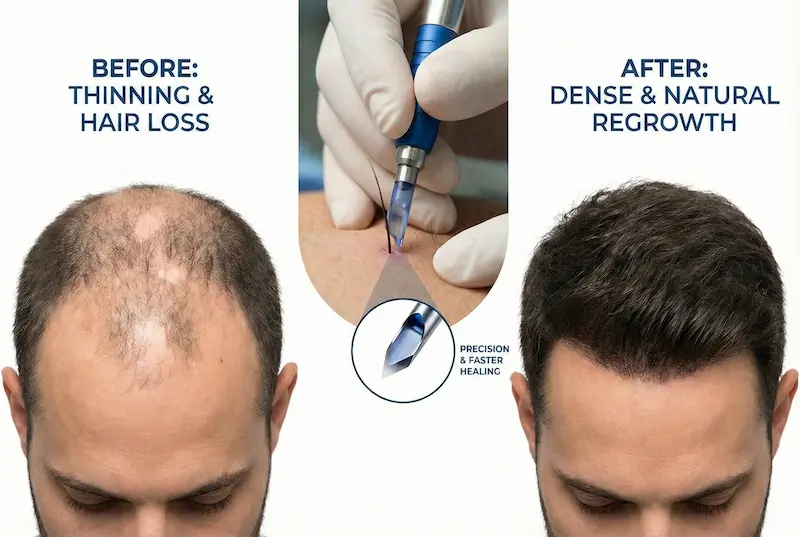

For most men considering a hair transplant, the real fear is not the surgery itself – it’s ending up with an obvious “hair transplant look.” What separates a believable result from a fake one is not just the number of grafts, but the natural hairline design behind the surgery. When a surgeon plans your frontal hairline design carefully – thinking about age, facial shape, donor capacity, and future hair loss – the result is a natural looking hairline that frames your face rather than screaming, “I had surgery.”
In this guide, we’ll walk you through how experienced surgeons approach hairline design, how they plan a natural hairline transplant, and what you should be looking for during your consultation. You’ll see how factors like male vs female hairline design, temple hairline design, graft direction, and density all work together to create a natural hairline restoration that still fits you 10–20 years from now.
Whether you are early in your research or already comparing clinics in Istanbul, Los Angeles, New York, or beyond, understanding hairline planning will help you evaluate surgeons more critically. Instead of just asking, “How many grafts can you do?”, you’ll be able to ask, “How will you design my hairline so that it looks natural today and still makes sense as I age?”
Table of Contents
Ideal Male vs Female Hairlines
A crucial part of achieving a truly natural hairline is recognizing that there is no single “perfect” hairline. The ideal shape, height, and contour are different for men and women, and even among men, they vary according to age, ethnicity, and facial proportions. An experienced surgeon will never copy-paste the same drawing onto every patient. Instead, they design an individualized frontal hairline design and, when necessary, a tailored hairline reconstruction that respects your anatomy and long-term pattern of hair loss.
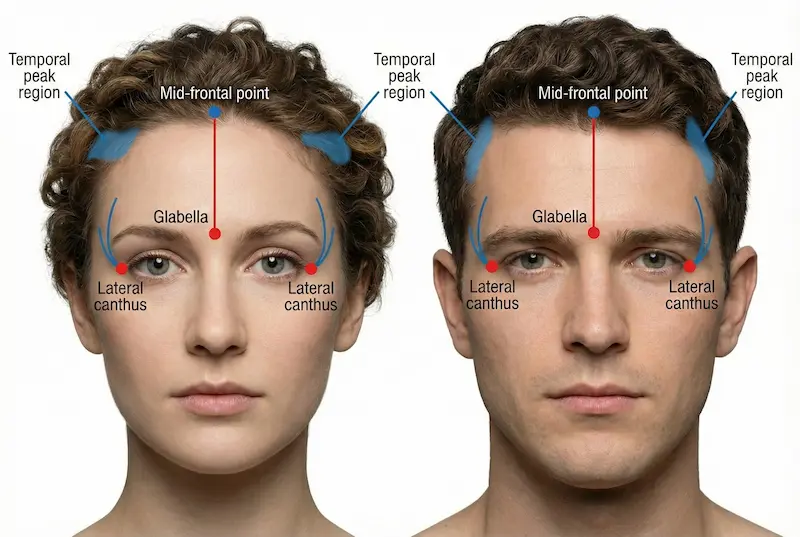
Key anatomical landmarks in hairline planning
When surgeons plan a natural hairline design, they do not simply “draw where you want hair.” They start with anatomical landmarks that are constant and measurable, then adapt them to your unique facial structure. Some of the most important reference points include:
- Glabella: the small area between your eyebrows, often used as a central vertical reference line.
- Mid-frontal point: the central point of the future hairline, usually aligned with the midline of your face.
- Lateral canthus: the outer corners of the eyes, used to estimate where the hairline should transition toward the temples.
- Temporal peak region: the area where the frontal hairline meets the temple hairline design and creates a smooth, natural frame.
By using these fixed points, surgeons can avoid placing the hairline too low or too high and ensure symmetry. This is particularly important in complex cases such as hairline reconstruction after previous surgery, or when deciding between hairline lowering vs transplant for patients with naturally high foreheads.
Typical male hairline patterns vs female hairline patterns
One of the biggest red flags in bad hair transplants is confusing male hairline design with female hairline design. A male hairline generally has a more receded, M-shaped or slightly rounded pattern at the temples, especially as a man ages. A female hairline, by contrast, tends to be:
- More rounded and continuous, with less recession at the temple areas,
- Lower and often closer to the eyebrows,
- Denser at the frontal zone, especially along the central third.
If a surgeon designs a male hairline too low, too straight, or too rounded at the corners, it can look feminine or artificial. On the other hand, if a woman is given a hairline with deep recessions that mimic male balding, the result will look harsh and unnatural. This is why true natural hairline design is not only about density – it’s about respecting gender-specific patterns and expectations.
During consultation, an expert will analyze your existing pattern of loss and discuss whether you want to restore a more youthful version of your current hairline or slightly adjust it. The goal of a natural hairline transplant is not to give you someone else’s hairline, but to restore a version of your own that fits your face and your gender identity.
Adapting hairline design to age, ethnicity, and facial shape
A mature, natural looking hairline for a 25-year-old is not the same as for a 50-year-old, even if they have similar bone structure. Surgeons must consider:
- Age: Younger patients may want a very aggressive, low hairline. A conservative surgeon will explain why that can backfire as hair loss progresses, and instead design a more sustainable, natural hairline restoration.
- Ethnicity: Different ethnic groups have different typical hairline shapes, hair textures, and growth directions. Honoring these patterns is key to achieving a believable result.
- Facial shape: Long, narrow faces, round faces, and square jawlines each benefit from slightly different frontal hairline design and temple positioning to keep the overall frame balanced.
For example, in a patient with a long forehead and high temples, the surgeon may slightly lower the central frontal point while carefully rebuilding the temple hairline design to bring balance without exhausting the donor area. In a round face, a slightly higher and gently curved hairline might prevent the face from looking too small or crowded.
Balancing density, donor capacity, and future hair loss risk
Even the most elegant drawing on the forehead is meaningless if it cannot be executed sustainably. A responsible surgeon will always match your desired hairline design with realistic donor capacity and an honest discussion about future hair loss. This is especially important in male pattern baldness, where frontal loss is often followed by thinning at the crown and mid-scalp.
If too many grafts are used to create an ultra-dense hairline at a very low position, there may not be enough donor hair left for future hairline restoration or crown work. That’s how patients end up with a “wall of hair” in the front and a bald or overharvested back. A truly natural hairline transplant is planned with the long game in mind: enough density at the front for a natural looking hairline, but not so extreme that it jeopardizes the rest of the scalp.
This is why the best clinics speak openly about graft budgeting, long-term strategy, and how they will adapt the frontal hairline design over time if your loss progresses. When this conversation is missing, you are not getting serious hairline planning – you are simply being sold a procedure.
Micro & Macro Hairline Angles
Even with a perfect drawing on the skin, a natural hairline design can still fail if the angles and directions of the grafts are wrong. This is where micro and macro design come into play. Macro design is the big-picture outline – how the frontal hairline design and temple hairline design frame the face. Micro design focuses on the tiny variations in angle, direction, spacing, and irregularity that your eye subconsciously reads as a natural looking hairline. Both levels must work together if you want a truly natural hairline transplant.
Macro design – the overall frontal frame and temple lines
Macro hairline design is what most patients see first at consultation: the general shape of the hairline and temples that the surgeon sketches with a pen. At this stage of hairline planning, the surgeon decides:
- How low or high the central frontal point will be,
- How the hairline will curve or angle toward the temples,
- Whether the temple points will be rebuilt aggressively or kept more conservative,
- How the new frame will balance with your forehead height and facial proportions.
A thoughtful macro design is what prevents the “helmet” or “wig” look. Instead of a perfectly straight line, the surgeon usually creates a slightly irregular, gently curved outline that mimics how natural hairlines soften and break up at the edges. When macro design is done correctly, the overall frame already looks believable, even before a single graft is placed.
In patients who need hairline reconstruction after poor work elsewhere, macro design may involve completely rethinking the previous outline, including raising an unnaturally low hairline or softening overly sharp temple angles. In some cases, a combination of hairline lowering vs transplant discussions may be needed to decide whether to surgically move the hairline or rebuild it with grafts.
Micro design – irregularities, zig-zags, and “baby hairs”
Micro design is where a natural hairline transplant is won or lost. Natural hairlines are not made of a single dense row of identical hairs. They are irregular, with tiny “islands,” thin areas, and fine “baby hairs” at the leading edge. Experienced surgeons and their teams replicate this by:
- Placing single-hair grafts at the very front to create a soft, feathered border,
- Using subtle zig-zag patterns instead of a straight line,
- Leaving micro-irregularities and small variations in height along the frontal edge,
- Gradually transitioning to two- and three-hair grafts a few millimeters behind for volume.
These micro choices are what your brain interprets as a natural hairline. When they are missing, the hairline may still be technically “dense,” but it will look harsh, blocky, and obviously transplanted. When micro design is done properly, your new hairline blends with your skin and existing hair, delivering a natural hairline restoration that looks soft from every angle.
Graft direction, angle, and exit pattern in the hairline zone
Hair does not grow straight up from the scalp; it emerges at a specific angle and direction that depends on the region of the head. In the hairline and temple areas, this can be extremely acute – in some zones the hairs almost lie flat against the skin. If a surgeon ignores these patterns, even a carefully planned hairline design will look strange and unnatural.
In the frontal hairline zone, grafts are typically placed at shallow angles pointing slightly forward and to the side, following your natural growth pattern. In the temple hairline design, the angle often becomes even more acute and directed backward, mirroring how temple hairs naturally sweep away from the face. Matching this “exit pattern” is crucial for a natural looking hairline that moves and styles like real hair.
The best surgeons not only understand these patterns theoretically, but also study your remaining native hair under magnification during hairline planning. They use this information to guide graft angle and direction, so that transplanted hairs blend seamlessly with what you already have.
FUE vs DHI for hairline refinement and density control
Both FUE and DHI can be used to build a natural hairline, but they differ in how grafts are handled and implanted. In a carefully executed natural hairline transplant, the technique is chosen according to your needs, donor quality, and the surgeon’s expertise, not just marketing language.
- FUE with implanters or forceps: Allows precise control of angle and depth when performed by an experienced team, ideal for creating a refined frontal hairline design.
- DHI (Direct Hair Implantation): Often used to increase control over spacing and angle in high-visibility zones, which can be helpful when targeting a very soft, natural hairline.
The key point is not the brand name of the technique, but the surgeon’s ability to use it as a tool for artistic, controlled work. Technique alone cannot guarantee a natural hairline design; it must be combined with sound planning, realistic expectations, and a trained eye for what will still look balanced as you age.

Technical Mistakes That Ruin Results
Understanding what can go wrong is just as important as knowing what a good result looks like. Many patients who come for hairline reconstruction after a disappointing surgery elsewhere do not suffer from a lack of grafts – they suffer from design and technique errors. Here are the most common mistakes that sabotage a natural hairline transplant and lead to the obvious “transplant look.”
The “too low, too straight” hairline problem
One of the classic signs of poor hairline design is a hairline that is placed too low and drawn almost ruler-straight. This can look tempting in the clinic mirror immediately after surgery, especially for younger patients who want to “get their teenage hairline back.” But in reality, it creates several problems:
- Unnatural aesthetics: Most adult men, even with no hair loss, do not have a perfectly straight, low hairline.
- Age mismatch: As you age, a child-like hairline on a mature face looks artificial.
- Graft waste: A very low line requires a high number of grafts, which may be needed later elsewhere.
A mature, natural looking hairline should sit slightly higher and have gentle irregularity and micro-recession appropriate for your age. If the surgeon insists on an ultra-low design without discussing the long-term implications, it is a warning sign that true hairline planning may be missing.
Pluggy, doll-like results from wrong graft choice and spacing
Older hair transplant techniques used large grafts (“plugs”) that created round, unnatural groupings of hair. A modern version of this mistake occurs when multi-hair grafts are placed too close together in the very front row of the hairline. Even with FUE technique, if the wrong follicles are used in the wrong zone, the hairline can appear:
- Blocky and dense at the very edge,
- “Painted on” rather than feathered,
- Lacking the fine, soft transition that characterizes a natural hairline.
To avoid this, skilled surgeons use single-hair grafts at the front edge and gradually blend in doubles and triples farther back. Spacing is also critical: a slightly irregular distribution creates a more organic appearance. If these principles are ignored, you may need future hairline reconstruction to break up and soften the unnatural rows.
Ignoring future hair loss patterns and donor limitations
Another common error is focusing only on the immediate “wow” factor and ignoring how your hair loss will likely progress. A hairline that looks acceptable today can become very strange when the surrounding native hair continues to fall. Classic examples include:
- A dense, low hairline with a completely bald crown,
- A rebuilt frontal area but thinning mid-scalp, creating a “patchy” look,
- Visible overharvesting at the back of the head from using too many grafts upstream.
Good hairline planning means asking, “What will this look like in five, ten, or twenty years?” and reserving enough donor hair to address future needs. The long-term goal of natural hairline restoration is to maintain a believable look at every stage, not just right after the operation.
Overharvesting the donor area just to chase a dense hairline
It can be tempting for both patient and clinic to chase very high graft numbers for marketing or short-term satisfaction. However, if the donor area is aggressively overharvested to build a super dense hairline, several risks arise:
- Patchy or “moth-eaten” appearance at the back and sides of the head,
- Limited options for future surgeries or hairline reconstruction,
- Inability to address further loss at the crown or mid-scalp.
A responsible surgeon will often recommend a slightly more conservative density at the front, especially in younger men with strong family histories of hair loss. This may sound less exciting at first, but it is the foundation of a sustainable, natural hairline design that can be maintained over decades.
When evaluating clinics, pay attention not only to “before and after” photos of the hairline, but also to how the donor area looks and how realistic the long-term plan is. A truly expert hairline design respects the entire scalp, not just the front few centimeters.

How Experts Create a Natural Hairline Design
When you look at a result photo and think, “That looks like he never lost his hair,” you are seeing the outcome of careful, methodical hairline planning, not luck. Expert surgeons treat natural hairline design as a step-by-step process that starts long before you lie down in the operating room. From digital simulations to the use of advanced healing technologies, every decision is made to support a believable, long-lasting natural hairline restoration.
Step-by-step consultation and digital hairline design
A serious clinic will never rush the consultation phase. Instead, your journey toward a natural looking hairline begins with a detailed discussion and visual planning session. Typical steps include:
- Medical and hair loss history: Family pattern, medications, previous procedures, and current stability of your hair loss.
- High-resolution photos and video: Front, profile, and top views are analyzed to understand your current hairline design.
- Digital sketching or simulation: The surgeon draws a proposed frontal hairline design on your scalp and may use software to show how different options would look.
- Discussion of options: For some patients, this may include whether to consider hairline lowering vs transplant, or a staged approach over several years.
International patients often complete an initial assessment remotely, sending clear photos for a preliminary plan. However, the final natural hairline transplant plan is always confirmed in person, with you sitting upright, so the surgeon can see how your facial muscles move and how your hairline interacts with your expressions.
Designing in harmony with facial proportions and facial muscles
A believable natural hairline is not only about where the hair starts, but how it moves when you talk, smile, or raise your brows. If the hairline is drawn without considering facial proportions and underlying muscles, it can look “stuck on” rather than integrated.
Experienced surgeons evaluate:
- Facial thirds and fifths: The vertical and horizontal proportions of your face help determine the ideal height and width of your hairline.
- Forehead shape and brow movement: The hairline should not interfere with your natural expressions or sit too close to the brows.
- Temple and side profile: The temple hairline design must gently wrap around the sides of your face, contributing to a smooth, masculine or feminine frame.
For male hairline design, this often means maintaining subtle recession at the temples while reinforcing the central area. For female hairline design, the approach is usually a softer, more rounded contour with careful attention to preserving or restoring density along the entire frontal band. In both cases, the goal is to achieve natural hairline restoration that still matches your bone structure and facial dynamics.
Strategic use of single vs multi-hair grafts at the frontal edge
The frontal few millimeters of the hairline are the most unforgiving. This is where the difference between a natural hairline transplant and an obvious transplant becomes impossible to hide. To build a soft but convincing transition, surgeons use a very specific graft strategy:
- Single-hair grafts: Placed at the very front to create delicate “baby hairs” and an irregular, feathered edge.
- Two-hair grafts: Positioned slightly behind the front row to begin building volume while maintaining a soft outline.
- Three- and four-hair grafts: Reserved for the interior zones behind the hairline, where density matters more than subtlety.
In addition to graft selection, spacing is deliberately varied to avoid straight, uniform rows. Micro-irregularities—tiny breaks, small clusters, and slight changes in direction—are what your eye reads as a natural looking hairline. This micro-level work cannot be rushed; it relies on a trained, consistent surgical team and a clear hairline planning map that everyone follows.
Why AKM Clinic’s protocol is different (HBOT & LLLT-supported healing)
Even the best-planned hairline design needs healthy healing to reach its full potential. At AKM Clinic in Istanbul, the same “USA-level” safety standards used for facial surgery are applied to hair restoration, with a particular focus on technologies that support graft survival and long-term growth.
One of the core tools is Low-Level Laser Therapy (LLLT), a medical-grade “soft laser” system used as part of the routine protocol after hair transplantation. LLLT is designed to:
- Stimulate dormant follicles: Targeted light energy can help move follicles from a resting phase into active growth.
- Boost scalp microcirculation: Improved blood flow increases oxygen and nutrient delivery to the hair bulb.
- Accelerate graft healing: By supporting cellular repair, LLLT helps transplanted grafts settle in more quickly and securely.
Alongside this, the clinic operates with a “zero-compromise” approach to hygiene, using multi-stage sterilization, strict Ministry of Health licensing, and hospital-grade environments for procedures. For international patients comparing options between Istanbul, New York, Los Angeles, or London, this combination of advanced technology and strict oversight is a key reassurance that their natural hairline design is supported by robust medical standards, not just marketing promises.
The result for patients is not only a carefully engineered frontal hairline design, but a complete natural hairline restoration pathway—from planning to healing—that is designed to minimize risk, maximize graft survival, and support a natural, durable outcome.
Frequently Asked Questions (FAQ): Natural Hairline Design
If you are still in the research phase, you probably have very specific questions about what your future hairline will look like, how long it will last, and how it will age with you. Below are answers to some of the most common questions patients ask when considering a natural hairline transplant in Istanbul or at home.
Is my new hairline permanent or will it change over time?
Transplanted hairs are taken from the permanent donor zone, so they are generally resistant to the hormones that cause male pattern baldness. That means your new hairline is designed to be long-lasting. However, a truly natural hairline design assumes that your native, non-transplanted hair may continue to thin. This is why conservative placement and realistic density are so important. With proper planning and ongoing medical therapy where appropriate, your natural looking hairline should remain stable and believable for many years.
Can I choose my own hairline shape, or does the surgeon decide?
You are always part of the decision. During consultation, you and your surgeon will review reference photos, sketches, and possible variations in frontal hairline design. However, the final plan must respect anatomy, donor capacity, and long-term hair loss patterns. A responsible surgeon will explain when an idea—even if you like how it looks in the mirror—is not sustainable. The goal is a compromise between your aesthetic preferences and what will remain a natural hairline as you age.
How do you avoid the obvious “hair transplant look”?
Avoiding a “pluggy” or “painted-on” look requires attention to both design and execution:
Using single-hair grafts at the front edge to mimic “baby hairs,”
Creating subtle irregularities instead of a straight line,
Matching graft angle and direction to your natural growth pattern,
Respecting typical male hairline design or female hairline design patterns, rather than forcing a one-size-fits-all shape.
When all these element
What is the best age for hairline restoration?
There is no single “best” age. Many patients seek natural hairline restoration in their late 20s to 40s, but the more important factor is the stability of your hair loss. Surgeons are usually more cautious with very young patients, because aggressive procedures at 20–25 can lead to problems if the hairline is placed too low or too dense and future loss continues aggressively behind it.
Instead of focusing on a number, a better question is: “Has my pattern stabilized, and do I have a clear family history to guide planning?” If the answer is yes, your surgeon can design a hairline design that respects future loss while still giving a significant improvement now.
Will my hairline still look natural as I get older?
A well-executed natural hairline design is purposely “age-proofed.” This means:
The hairline is not placed at a child-like height,
A small degree of temple recession is usually maintained in men,
Density is strong but not unnaturally thick at the very front,
The temple hairline design and frontal frame are kept in proportion to your facial structure.
As your face changes with age, a conservative and well-thought-out frontal hairline design continues to make sense. This is one of the main advantages of choosing a surgeon who specializes in hairline planning rather than simply “moving grafts.”
How long does it take to see the final hairline result?
Most patients see early signs of growth around 3–4 months after surgery, with major cosmetic improvement by 6–9 months. The full, mature appearance of your natural looking hairline typically appears around 12–18 months. During this period, treatments like LLLT can help support graft growth, improve microcirculation, and promote healthier hair shafts, contributing to a thicker and more refined final result.
Why do hairline designs in Turkey often look more natural than in my home country?
Many hair transplant centers in Turkey perform a very high volume of procedures, which creates a deep pool of experience specifically in natural hairline design, hairline reconstruction, and advanced techniques like FUE and DHI. Clinics that focus on international patients also tend to invest heavily in technologies such as LLLT and strict hygiene protocols, aligning their standards with or above those in major US centers.
For patients traveling from cities like New York, Miami, or Los Angeles, this often means they can access surgeon-led, detail-oriented hairline planning and comprehensive aftercare at a more accessible cost—without compromising on safety or aesthetic quality. The key is not “Turkey” alone, but choosing a medically led clinic that prioritizes natural hairline restoration over aggressive, short-term density.
If you’re planning your aesthetic journey in stages, you may also want to explore topics connected to what you’ve just read. Patients interested in Natural Hairline Design are often planning other procedures in the same trip and have questions about when it is safe to fly. For that reason, we also provide clear guides on Fly After Facelift and Flight Safety After Surgery, covering swelling, clot prevention, cabin pressure changes, and realistic timelines for long-haul travel. Reviewing these resources together can help you coordinate your treatment plan and choose travel dates that protect both your health and your final aesthetic result.