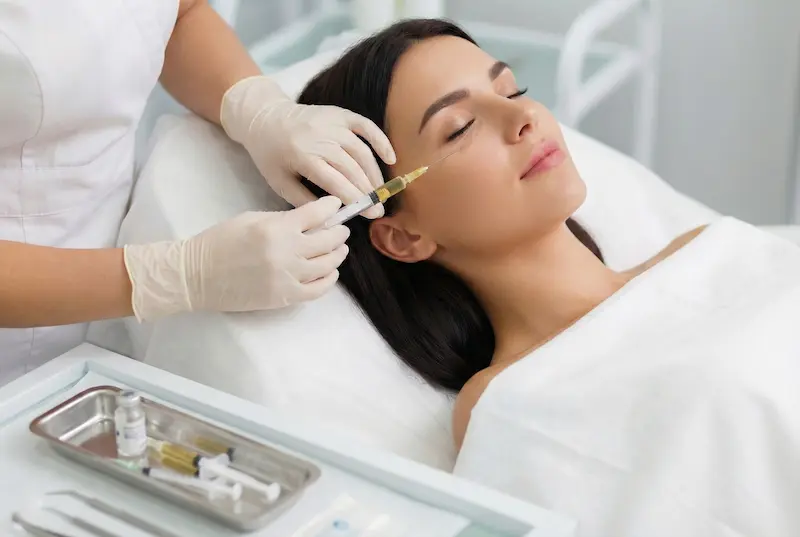
If you’ve been researching nanofat grafting Turkey as an alternative to synthetic fillers, you’re likely looking for one thing: a natural way to restore a fresher look—without the “overfilled” effect. This guide explains Turkey nanofat grafting from an expert-patient perspective: what it is, how it works, what results are realistic, and how to evaluate safety and technique like a clinician would.
Surgeon-led principle at AKM Clinic: The goal is a result that looks refreshed and naturally younger—never “obviously done.”
Table of Contents
What Is Nanofat Grafting?
What is nanofat grafting? It’s a refined form of fat transfer where a small amount of your own fat is gently harvested, processed, and then transformed into an ultra-fine emulsion (“nanofat”). Unlike traditional fat grafting that primarily aims to add bulk volume, nanofat is often used to support skin quality—especially in delicate zones (like under-eyes) where heavy volume can look unnatural. In modern medical science, clinicians increasingly use nanofat for “biologic” rejuvenation: improving the look of crepey texture, fine lines, and overall skin vitality while maintaining a natural facial shape.
Nanofat vs “Regular” Fat Transfer: What’s the Difference?
Traditional fat transfer uses purified fat parcels that can physically “fill” areas like cheeks or temples. Nanofat grafting techniques further process that fat into a much finer product designed to pass through very small cannulas and spread more evenly in superficial tissue layers. This matters because the face doesn’t just age by “deflating”—it also changes in skin thickness, elasticity, and microcirculation. Nanofat is selected when the goal is refinement and skin improvement, not dramatic bulk.
| Option | Main Goal | Best Use Areas | Typical “Look” Risk |
|---|---|---|---|
| Nanofat grafting | Skin quality support + subtle softening | Under-eyes, fine lines, crepey skin zones | Low (when done correctly) |
| Traditional fat grafting | Volume restoration (structural filling) | Cheeks, temples, midface, jawline contour | Moderate (if overfilled or uneven) |
| Dermal fillers | Immediate volumizing / contour | Tear trough, cheeks, lips, folds (case-dependent) | Moderate–High (migration/overfilling in some patients) |
What Nanofat Can (and Can’t) Do for Facial Volume
Can nanofat restore volume? Yes—but typically in a subtle way. If your main issue is significant midface hollowing, you may need structural fat grafting or a carefully planned hybrid approach. Nanofat is often chosen when your priority is to soften shadows and improve the “tired” look without changing your facial identity.
- Can do: soften under-eye hollows, reduce the appearance of fine creases, improve “thin” looking skin, support a more rested look.
- Can’t do (alone): reliably replace major volume loss in cheeks/temples in one step, or guarantee permanent fullness (some resorption is normal).
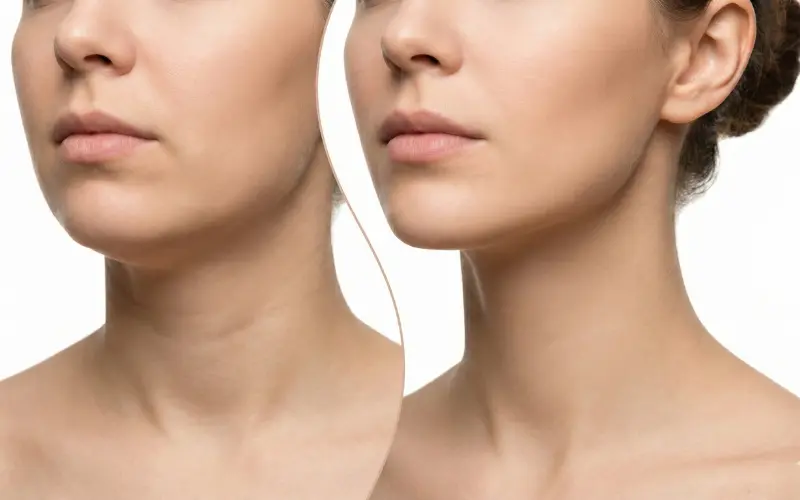
When patients search nanofat grafting before and after, the most trustworthy cases show subtle but meaningful changes: less shadowing, smoother texture, and a more even transition between facial zones—rather than dramatic enlargement.
Skin Quality Benefits: Texture, Glow, and Fine Lines
One reason nanofat has gained attention in science and scientific research circles is its potential role in supporting healthier-looking skin. Clinically, many surgeons use it to improve the appearance of:
- Crepey under-eye texture
- Fine lines and superficial wrinkling
- Uneven skin quality after sun exposure or aging
Importantly, these benefits depend on precise technique and appropriate patient selection. The “secret” isn’t hype—it’s controlled harvesting, careful processing, and micro-placement that respects delicate anatomy. Done well, nanofat can complement other facial rejuvenation plans by improving the “canvas” (skin) rather than only changing the “structure” (volume).
Nanofat vs Fillers vs Traditional Fat Grafting
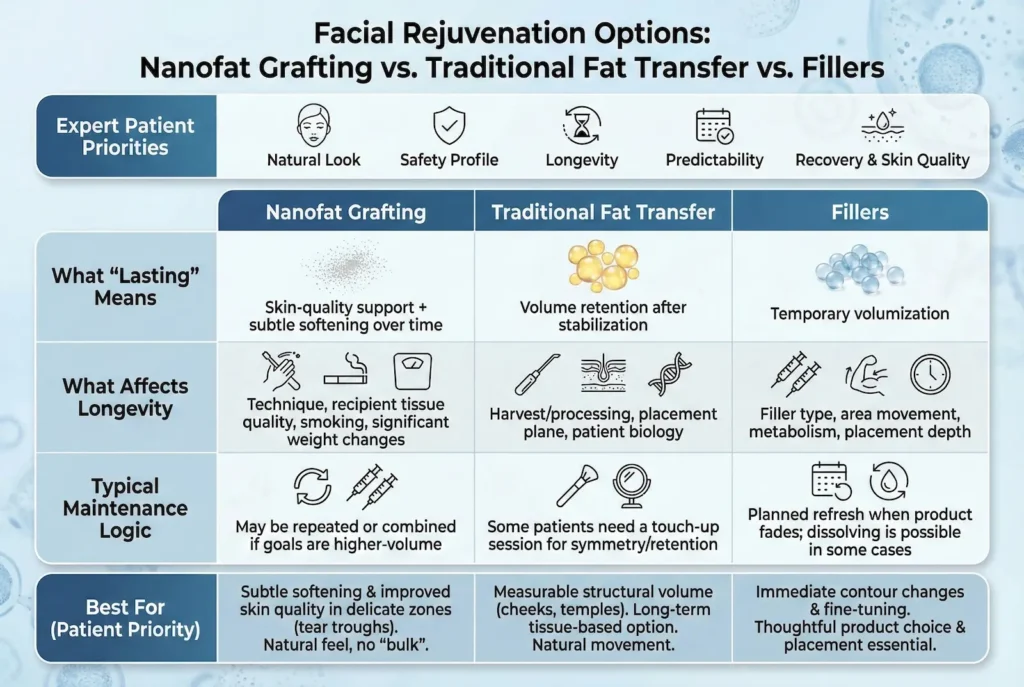
Choosing between nanofat grafting, fillers, or traditional fat transfer is less about “which is best” and more about which matches your anatomy and priorities. Expert patients typically care about five things: natural look, safety profile, longevity, predictability, recovery, and how well the option addresses both volume loss and skin quality. Below is a practical, decision-oriented comparison—based on how these treatments are used in contemporary facial aesthetics and what scientific research generally tries to optimize: controlled outcomes with minimal complications.
Natural Feel & Look: Why Patients Prefer Autologous Options
Many patients exploring Turkey nanofat grafting are doing so because they want rejuvenation that doesn’t read as “injected.” When your own tissue is used (fat-based treatments), the result can feel and move more naturally—especially when micro-placed carefully in the right planes. Fillers can be excellent in experienced hands, but in certain faces and zones (particularly tear troughs and midface), they may look puffy or migrate over time.
- Nanofat grafting: best for subtle softening and improved skin quality, especially in delicate areas where “bulk” looks unnatural.
- Traditional fat grafting: better when you need measurable structural volume (cheeks/temples) and want a long-term tissue-based option.
- Fillers: can be ideal for immediate contour changes and fine-tuning, but require thoughtful product choice, placement, and follow-up.
Expert-patient insight: If your main concern is “I look tired even when I’m rested,” nanofat often targets the quality and transition (shadowing/texture) rather than simply adding fullness.
Longevity Comparison: What Typically Lasts Longer (and Why)
Longevity is the most misunderstood topic in nanofat grafting. With any fat-based approach, some degree of resorption is normal—and the “final” result is usually assessed months later, not weeks later. Fillers have a more predictable early change, but they are temporary by nature and vary widely depending on product type, area treated, and individual metabolism.
| Treatment | What “Lasting” Means | What Affects Longevity | Typical Maintenance Logic |
|---|---|---|---|
| Nanofat grafting | Skin-quality support + subtle softening over time | Technique, recipient tissue quality, smoking, significant weight changes | May be repeated or combined if goals are higher-volume |
| Traditional fat grafting | Volume retention after stabilization | Harvest/processing, placement plane, patient biology | Some patients need a touch-up session for symmetry/retention |
| Fillers | Temporary volumization | Filler type, area movement, metabolism, placement depth | Planned refresh when product fades; dissolving is possible in some cases |
When you review nanofat grafting before and after galleries, interpret them with this timeline in mind: early swelling can exaggerate fullness, while true stabilization happens later. This is why serious clinics photograph outcomes at standardized intervals.
Best Treatment Areas for Each Option (Under-Eye, Cheeks, Temples, Hands)
Not all areas behave the same. The under-eye region is delicate and unforgiving; the cheek and temple areas can accept structural volume more safely when planned well. Hands are often a separate discussion because texture and “thin skin” can be more prominent than pure volume loss.
- Under-eye (tear trough): nanofat grafting techniques may be preferred when the goal is to soften crepey texture and shadowing without adding heavy volume.
- Cheeks/midface: traditional fat grafting or a hybrid approach can address structural deflation more effectively than nanofat alone.
- Temples: often respond well to structural volume planning; technique and symmetry are critical.
- Hands: nanofat can be used for refinement and skin quality support; some patients need a combination for visible fullness.
Benchmarking note for US readers: If you’re comparing what you’ve been quoted for nanofat grafting beverly hills versus options abroad, focus less on the city name and more on standards: surgeon credentials, sterility protocols, anesthesia planning, and post-op monitoring. Location alone doesn’t guarantee safety—process does.
Who Is a Good Candidate for Nanofat?
Most people who search what is nanofat grafting are trying to solve a very specific problem: they don’t necessarily want a “bigger” face—they want their face to look less tired, smoother, and more evenly transitioned between areas (under-eye to cheek, cheek to midface, etc.). The best candidates for nanofat grafting are those with mild-to-moderate hollowing and/or visible skin quality changes, who want subtle, natural restoration rather than a dramatic reshaping. Your consultation should focus on diagnosing the dominant issue: volume loss, skin quality, or both—because that determines whether nanofat alone is enough.
Common Signs: “Hollowing,” Under-Eye Shadows, and Midface Flattening
If you relate to the following, you’re often in the “good candidate” zone for Turkey nanofat grafting—especially when you want a biological, tissue-based approach:
- Under-eye shadowing that makes you look tired even with good sleep
- Fine creases or crepey under-eye texture (often worsens with concealer)
- Mild midface deflation where the cheek looks flatter and the transition to the lower lid looks harsher
- Thin-looking skin (face or hands) where “quality” is as much the issue as “volume”
When reviewing nanofat grafting before and after images, the most reliable improvements for these signs look like: softer shadows, smoother texture, and a more rested facial expression—without obvious “inflation.”
Ideal Age Range and Skin Profiles (Realistic Expectations)
There is no “perfect age,” but there is a perfect expectation. Nanofat is typically best for patients who want:
- Natural-looking refinement rather than a major lift or major structural re-volumization
- Skin quality support in delicate areas where aggressive filling can look unnatural
- Gradual, stabilizing results (with a realistic understanding that swelling ≠ final outcome)
Where expectations can become unrealistic:
- Expecting nanofat to replace a full structural cheek augmentation in a single session
- Expecting “permanent” fullness with zero resorption (some change is normal)
- Trying to correct advanced laxity (skin looseness) with volume alone
Expert-patient mindset: If your main complaint is “sagging” rather than “hollowing,” you may need a lift-focused strategy first—then use nanofat as a refinement tool.
When Nanofat Works Best as an Add-On (Facelift, Blepharoplasty, Skin Rejuvenation)
One of the most strategic uses of nanofat grafting techniques is as an adjunct to procedures that address structure and laxity—because it can improve the “skin layer” and overall harmony of the result. In practice, nanofat may be combined with:
- Facelift approaches (for patients who need repositioning/lifting and also want softer transitions)
- Lower eyelid procedures (when the issue is both contour and skin quality)
- Comprehensive rejuvenation plans that aim for naturalness rather than dramatic “done” changes
This is also where cost discussions can become confusing: a standalone nanofat session is different from nanofat used as part of a broader surgical plan. Later in this guide, we’ll break down nanofat grafting cost drivers so you can compare quotes logically—including the “headline” comparisons patients often make, such as nanofat grafting beverly hills versus an Istanbul plan, without overlooking what’s included (and what isn’t).
Nanofat Grafting Procedure Step-by-Step in Turkey (AKM Clinic Approach)
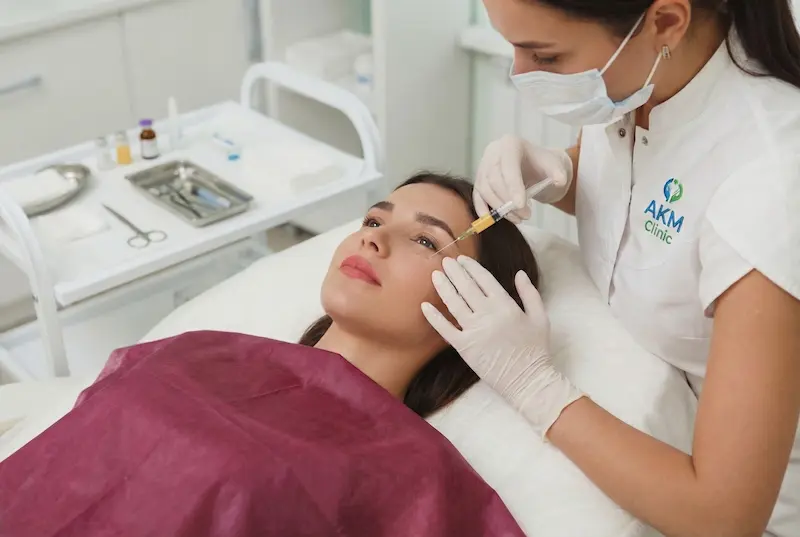
For expert patients, the real difference between a “nice improvement” and a disappointing outcome is rarely the headline claim—it’s the process: how the fat is harvested, how it is processed, and how it is placed. Nanofat grafting techniques are precision-dependent because the target zones are delicate (especially under-eyes). In other words, the procedure is not just “fat transfer in a different country.” It is a sequence of controlled steps designed to reduce trauma, improve predictability, and prioritize safety—principles aligned with modern medical science and the way evidence-based teams aim to minimize complication risk.
Consultation & Planning: Mapping Volume Loss and Skin Needs
A high-quality consultation should feel like a diagnostic appointment—not a sales pitch. The surgeon should evaluate:
- Where the problem truly is: volume loss vs skin quality vs laxity (often a combination)
- Facial balance: under-eye to cheek transition, midface support, temple contour, and symmetry
- Skin characteristics: thickness, elasticity, texture, and any history of scarring or pigmentation concerns
- Risk factors: smoking, blood-thinning supplements/meds, uncontrolled medical conditions, and prior filler history
For many patients, the best plan is not “nanofat everywhere.” It’s targeted nanofat for refinement, plus other modalities if structure or laxity is the dominant issue. This is also when you should ask to see nanofat grafting before and after cases that match your anatomy (not just the clinic’s best-looking gallery images).
Expert-patient checkpoint: Ask how your under-eye area will be evaluated (skin quality vs true hollowing) and what the surgeon will do to prevent irregularities in thin tissue.
Harvesting & Processing: Purification, Emulsification, and Sterile Handling
Even though “it’s your own fat,” the outcome depends on how gently and cleanly that tissue is handled. In simplified terms, the process includes:
- Harvesting: a small amount of fat is collected from a donor area (commonly abdomen or thighs) using a technique designed to minimize trauma.
- Purification: the fat is cleaned of excess fluids and impurities.
- Emulsification/Filtering: the fat is transformed into a finer product (nanofat) suitable for superficial placement and delicate areas.
- Sterile technique: maintaining strict sterility throughout is non-negotiable, because infection prevention is foundational.
Why does this matter? Because when patients compare nanofat grafting beverly hills quotes to international options, the meaningful comparison is not the zip code—it’s whether the clinic’s processing and sterile protocols are consistently controlled and documented. In practical terms, safer outcomes correlate with disciplined technique, careful patient selection, and robust post-op instructions—not marketing claims.
Injection Technique & Safety: Micro-Placement for Natural Results
The injection phase is where artistry and safety meet. Proper nanofat grafting techniques generally emphasize:
- Micro-aliquots (tiny amounts): to avoid lumps and improve smooth blending
- Layer-appropriate placement: especially under the eyes where overfilling can look puffy
- Symmetry control: gradual balancing rather than “chasing perfection” in one session
- Conservative approach: it’s often safer to plan a touch-up than to overcorrect
Because the under-eye region is complex, safety-first injection strategy is essential. This is why surgeon-led planning is crucial—especially for patients worried about a “botched” look. If your goal is natural restoration, the best results often look almost “invisible” to others: people notice you look rested, not “treated.”
| Step | What You Should Hear in a Serious Consult | Why It Matters |
|---|---|---|
| Planning | Zones, goals, and what nanofat can/can’t achieve | Prevents unrealistic expectations and overfilling |
| Processing | How nanofat is purified/emulsified under sterile handling | Quality + safety depend on controlled preparation |
| Placement | Micro-placement strategy, plane selection, conservative volumes | Reduces irregularities and improves natural blending |
Recovery Timeline, Results, and Longevity
One of the biggest reasons patients feel uncertain after nanofat grafting is timing. The early “after” can be misleading because swelling temporarily changes contour. A realistic recovery plan helps you judge progress correctly and reduces anxiety—especially if you’re traveling for nanofat grafting Turkey. Below is what expert patients typically track: swelling patterns, bruising, when skin quality changes become noticeable, and when results stabilize enough to evaluate fairly.
Day-by-Day Healing: Swelling, Bruising, and What’s Normal
Most people experience some degree of swelling and possible bruising—particularly if the under-eye area was treated. The donor area (where fat was harvested) can also feel sore, similar to post-workout tenderness.
| Timeframe | What You May Notice | What’s Typically Normal |
|---|---|---|
| Days 1–3 | Swelling peaks, mild tightness, possible bruising | Face looks “puffier” than final; discomfort is usually manageable |
| Days 4–10 | Swelling begins to settle, bruising fades | Contours start looking more natural; asymmetry can still happen |
| Weeks 2–4 | More stable appearance, less sensitivity | Many patients feel socially comfortable in this window |
| Months 2–3+ | Result stabilizes; skin quality changes become clearer | This is when “true” evaluation is more reliable |
Practical tip: If you’re assessing nanofat grafting before and after examples online, look for clinics that show outcomes at consistent time points (not just “immediately after”). Swelling is not a result—it’s a phase.
When You’ll See Results: Early Changes vs Final Outcome
With fillers, change can look immediate and relatively predictable. With nanofat grafting techniques, the early “fullness” is partly swelling—and some early volume will reduce as healing progresses. This is normal and doesn’t mean the procedure “failed.”
- Early phase (first 2 weeks): swelling-driven changes, shifting contour, occasional unevenness.
- Mid phase (weeks 3–6): swelling decreases; more realistic contour emerges.
- Stabilization (2–3+ months): best window to judge texture and under-eye transition.
Expert-patient mindset: Judge the result when your tissues are calm—months later—not when swelling is deciding the shape.
How Long Does Nanofat Last? Factors That Affect Retention
“How long will it last?” is the key question behind nanofat grafting cost comparisons. The most honest answer is: retention varies, and it’s influenced by both technique and biology. In scientific research and clinical practice, fat-based outcomes are known to be affected by tissue handling, placement strategy, and patient factors.
Common factors that can influence longevity:
- Smoking: can impair healing and tissue quality.
- Large weight fluctuations: may affect fat cells and facial volume.
- Skin/tissue quality: thin or damaged tissue can be more challenging.
- Technique details: gentle harvesting, controlled processing, and micro-placement.
It’s also important to separate two expectations:
- Volume expectation: nanofat can offer subtle softening, but may not behave like a structural cheek augmentation.
- Skin-quality expectation: improvements can appear gradually and may be one of the more meaningful benefits for the right candidate.
Safety, Risks, and How to Avoid a “Botched” Result
If you’re comparing nanofat grafting options—whether that’s nanofat grafting beverly hills quotes or nanofat grafting Turkey plans—the safest way to think is process-first, not price-first. A “botched” outcome in fat-based facial work usually comes from predictable issues: poor candidate selection, overly aggressive volumes, inconsistent processing, or imprecise placement in delicate anatomy (especially under-eyes). The good news is that these risks can be meaningfully reduced when the plan is surgeon-led, conservative, and supported by strict sterile technique and standardized aftercare.
Key Risks (Irregularities, Fat Resorption, Infection) and How They’re Prevented
Below is a practical risk map—what can go wrong, and what serious clinics do to reduce the odds. This is the same “checklist thinking” you’ll see in quality-focused medical science environments: identify failure points, then build safeguards.
| Potential Issue | What It Can Look/Feel Like | How It’s Typically Prevented |
|---|---|---|
| Irregularities / lumpiness | Uneven contour, small bumps (often noticeable in thin skin) | Micro-placement, correct plane selection, conservative volumes, meticulous technique |
| Resorption / under-correction | Result looks subtle or fades more than expected | Realistic planning, stabilization timeline education, possible staged/touch-up approach |
| Overcorrection | Puffiness (especially under-eye), unnatural “full” look | Conservative dosing, avoid chasing perfection in one session |
| Infection | Increasing redness, warmth, pain, discharge, fever | Sterile field discipline and clear post-op instructions; rapid clinical response if symptoms appear |
Expert-patient red flag: Any clinic that promises “zero swelling,” “instant final results,” or “permanent volume” is not describing reality.
Credentials That Matter: Surgeon-Led Planning, Team Approach, and Case Selection
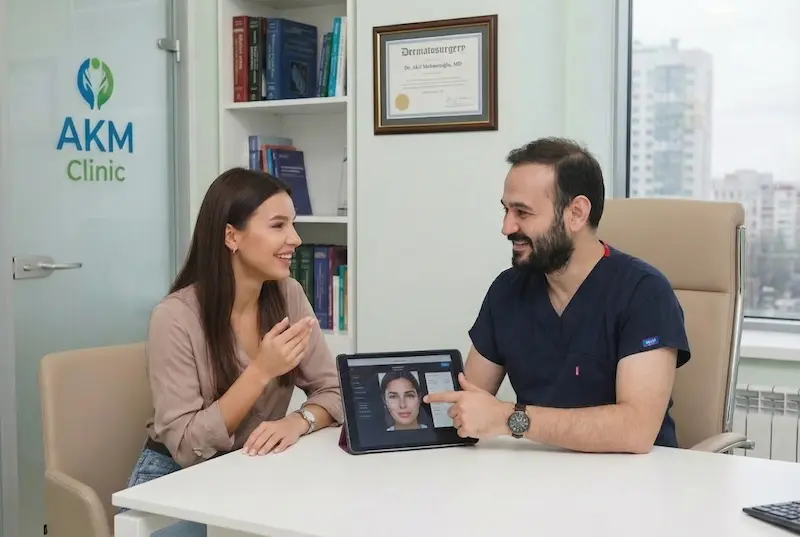
For facial rejuvenation, credentials matter—but so does the surgeon’s specific focus. At AKM Clinic, the founder and lead physician is a Dermatosurgeon & Face Expert (Dr. Akif Mehmetoğlu, MD), with a stated philosophy centered on a refreshed appearance rather than an obvious surgical look. This matters for nanofat because dermatosurgical expertise emphasizes both skin quality and structural harmony—two pillars of natural results.
From a patient-safety perspective, AKM Clinic also highlights structured recovery support technologies, including:
- Hyperbaric Oxygen Therapy (HBOT), which the clinic frames as its “#1 safety promise” for supporting healing (notably in procedures that can temporarily disrupt blood flow).
- Low-Level Laser Therapy (LLLT) used in post-facial surgery recovery, with specifications described around 650nm light and a multi-LED system to support cellular activity and collagen-related recovery pathways.
These tools don’t replace surgical skill—but they can support a more comfortable, more controlled recovery experience when applied appropriately and consistently.
How to Evaluate Before/After Photos Like an Expert Patient
If you’re searching nanofat grafting before and after images, look beyond “wow” and assess quality signals. Strong galleries usually include consistent lighting, standardized angles, and realistic timelines (months later—not just immediate swelling).
- Look for consistency: same lighting, same head position, neutral facial expression.
- Look for natural transitions: under-eye to cheek should look smooth, not “filled.”
- Look for restraint: the best results rarely look dramatic—just rested.
- Ask for timepoints: 2–3+ month photos are more meaningful for fat-based work.
As one experienced US “expert patient” (Barbara) described her outcome: “literally look like nothing happened but probably 20 years younger.”
That quote matters because it reflects the core goal of high-quality nanofat grafting techniques: improvement without an obvious signature. It also aligns with what many US patients report valuing—naturalness and comfort. For example, Sarah noted a “painless” recovery needing only one day of painkillers, and Angelika (Germany) described a “zero pain” recovery and said “the whole of me simply fits again.”
Cost & Value: What Influences Nanofat Grafting Pricing in Turkey?
When patients search nanofat grafting cost, they often want a simple number—but the honest answer is that pricing depends on scope, safety infrastructure, and what’s bundled into the plan. This is why comparing “a quote in Beverly Hills” to “a quote in Istanbul” can be misleading unless you compare like-for-like (surgeon involvement, operating environment, post-op monitoring, and follow-up). In evidence-based care—what good medical science tries to standardize—value means predictable outcomes with controlled risk, not the lowest headline price.
Standalone vs Combined Procedures: What Changes the Price
Nanofat grafting can be performed as a standalone rejuvenation procedure or combined with other facial surgeries. That choice strongly affects total cost because it changes:
- Operating time and clinical resources (longer procedures typically require more staff time and monitoring)
- Anesthesia/sedation planning (varies by patient and the combined plan)
- Complexity of technique (e.g., under-eye micro-placement vs broader structural augmentation)
- Aftercare intensity (more structured post-op support for combined surgeries)
So if you’re comparing Turkey nanofat grafting to nanofat grafting beverly hills, first clarify whether each quote is:
- Nanofat alone (typically smaller scope)
- Nanofat + traditional fat grafting (dual-purpose plan)
- Nanofat added to a facelift/blepharoplasty (comprehensive rejuvenation)
What Should Be Included (Facility Standards, Aftercare, Follow-Up, Tech Support)
For an expert patient, “cost” should be translated into a checklist of inclusions. A safe plan usually includes:
- Surgeon-led evaluation and a documented plan (areas, goals, limitations)
- Sterile operating standards and consistent processing protocols (critical for nanofat grafting techniques)
- Clear medication and recovery instructions (especially for bruising/swelling management)
- In-person follow-ups during your stay, plus structured remote follow-up after you fly home
- Complication pathway: who you contact, response times, and how concerns are handled
- Recovery support options when relevant (for AKM Clinic, this may include HBOT & LLLT as part of their recovery-oriented approach)
| Inclusion | Why It Matters | Expert-Patient Question to Ask |
|---|---|---|
| Technique transparency | Nanofat outcomes are technique-dependent | “Which planes will you inject, and how do you avoid irregularities under the eyes?” |
| Standardized photo protocol | Helps you evaluate true changes | “Do you show nanofat grafting before and after at 2–3+ months?” |
| Aftercare + follow-up | Travel patients need structure | “What follow-ups happen in Istanbul, and what happens once I’m home?” |
| Contingency planning | Reduces risk anxiety | “If swelling or asymmetry worries me, what is the step-by-step response plan?” |
Value Perspective for US Patients: Why “Cheap” Isn’t the Goal—Predictable Safety Is
US patients commonly compare high-cost markets like New York, Los Angeles, and Miami with Istanbul—and also consider other medical tourism destinations such as Mexico or Thailand. A rational comparison isn’t “Which is cheapest?” but:
- Who leads the plan? (surgeon-led vs delegated decisions)
- What safety and sterility standards are documented?
- What is the recovery and follow-up structure for international patients?
- Do they show realistic, time-based results? (not only immediate swelling photos)
Below is a decision-style framework (not a price list) to help you compare value across locations without relying on marketing:
| Comparison Point | New York / Los Angeles / Miami | Istanbul (AKM Clinic approach) | Mexico / Thailand (common medical tourism options) |
|---|---|---|---|
| Total system cost | Often highest due to overhead | Often lower overall while still enabling comprehensive care planning | Varies widely by clinic and region |
| Plan transparency | Can be excellent (clinic-dependent) | Should be evaluated by protocol clarity + surgeon involvement | Highly variable; due diligence is essential |
| Travel logistics | Minimal for US residents | Requires structured scheduling + follow-up planning | Also requires travel planning; distance may affect follow-up practicality |
| Aftercare structure | Convenient access for local follow-ups | Important to confirm in-person checks + remote follow-up pathway | Varies widely; confirm follow-up systems clearly |
Bottom line: The smartest “cost” question is: “What am I actually paying for?” If your priority is a natural result with minimized risk, value means a surgeon-led plan, consistent nanofat grafting techniques, and structured aftercare—regardless of whether the quote comes from Istanbul or Beverly Hills.
Frequently Asked Questions (FAQ): Nanofat Grafting Turkey
This FAQ is written for the expert patient who wants clear, reality-based answers—especially if you’re comparing nanofat grafting Turkey with quotes from high-cost markets like nanofat grafting beverly hills. Keep in mind that your best next step is always a surgeon-led evaluation, because candidacy and technique choices are highly individualized.
Does nanofat actually restore volume, or is it mainly for skin quality?
Nanofat grafting can provide subtle volume softening, but it’s most commonly valued for supporting skin quality—especially in delicate areas like under-eyes. If your primary problem is major midface hollowing, you may need traditional fat grafting (structural volume) or a hybrid plan. This is why “what is nanofat grafting” should be answered as: it’s a refinement tool for natural-looking rejuvenation, not a one-size-fits-all volumizer.
Is nanofat the same as “stem cell” treatment?
No. Marketing sometimes blurs terminology. Nanofat grafting techniques involve processing your own fat into an ultra-fine product for superficial placement. While fat tissue contains various biologic components that are discussed in scientific research, nanofat in clinical aesthetics should be understood as a surgeon-controlled tissue-based approach—not a guaranteed “stem cell cure.” Ask your clinic to explain exactly what is being done and what outcomes are realistic.
How many sessions are usually needed?
Some patients are satisfied after one session, especially when goals are subtle (under-eye softening, texture support). Others may need a second session depending on anatomy, degree of volume loss, and natural resorption variability. A conservative, staged plan is often safer than trying to “get everything” in one aggressive treatment.
Can nanofat be combined with an awake facelift or deep plane facelift?
Yes—often strategically. When a lift addresses laxity/position and nanofat supports the skin layer and transitions, the result can look more natural and cohesive. Combination planning should be surgeon-led, with clear rationale for what each component is solving. If you’re pursuing an “awake” approach, confirm anesthesia planning and whether nanofat is being used for refinement rather than overfilling.
Will it leave scars at the donor site?
Harvesting typically uses very small entry points. Most patients heal with minimal marks that fade over time, but scarring tendency varies by individual skin biology. Your surgeon should explain donor-site care and what to expect based on your skin type and history.
How long should I stay in Istanbul for treatment and check-ups?
Length of stay depends on whether nanofat is standalone or combined with other procedures. A responsible plan includes in-person checks during your stay and a clear remote follow-up pathway after you return home. Ask for a written schedule: procedure day, first check, any dressing/aftercare visits, and the “what-if” plan if you have concerns after flying back.
How do I choose a safe clinic in Turkey for nanofat grafting?
Use a safety-first checklist rather than choosing by price or Instagram results:
Surgeon-led planning: you should meet the surgeon who designs the plan.
Technique transparency: the clinic can clearly explain harvesting, processing, and micro-placement strategy.
Standardized photos: consistent lighting/angles and time-based nanofat grafting before and after examples.
Sterility and facility standards: ask where the procedure is performed and how sterility is maintained.
Aftercare structure: clear follow-up schedule + rapid-response pathway if issues arise.
Key takeaway: Whether you’re comparing nanofat grafting beverly hills or Turkey nanofat grafting, prioritize process quality and safety infrastructure—not the cheapest quote.
If you’d like, beyond the topic covered in this guide, you can also explore our related resources: Best Deep Plane Facelift Clinic In Turkey, Questions To Ask Plastic Surgeon, Ghost Surgery In Turkey, Plastic Surgeon Board Certification, Plastic Surgery Packages Turkey, Stem Cell Facelift vs Traditional Facelift, Stem Cell Facelift Longevity, and Thread Lift Turkey—to help you compare options, understand safety standards, and choose the most appropriate rejuvenation plan for your goals.
Medical disclaimer: This article is for education only and does not replace an in-person medical consultation.