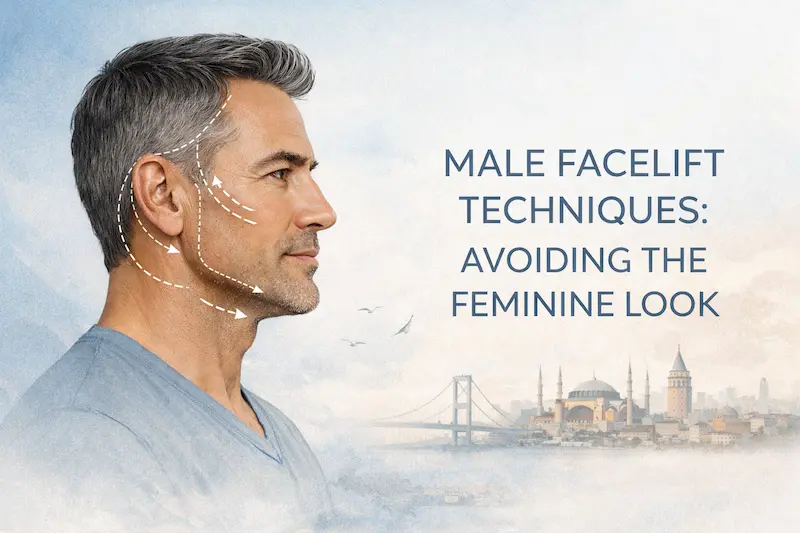
If you’re researching male facelift techniques, you’re probably not looking to “change your face.” You want to look rested, sharper, and more like yourself—without any hint of a pulled, softened, or feminized result. That concern is valid, and it’s exactly why modern male facelift planning is different from female facelift planning.
This guide explains the latest male facelift techniques and the surgical principles that help preserve masculine identity—jawline definition, a natural hairline/sideburn position, and the right neck-to-chin angle. We’ll also translate the essentials of medical science into practical checkpoints you can use when comparing surgeons and before/after results.
Key takeaway: The goal of the best male facelift techniques is not “tight skin.” It’s deep structural support with conservative surface tension—so you look refreshed, not operated on.
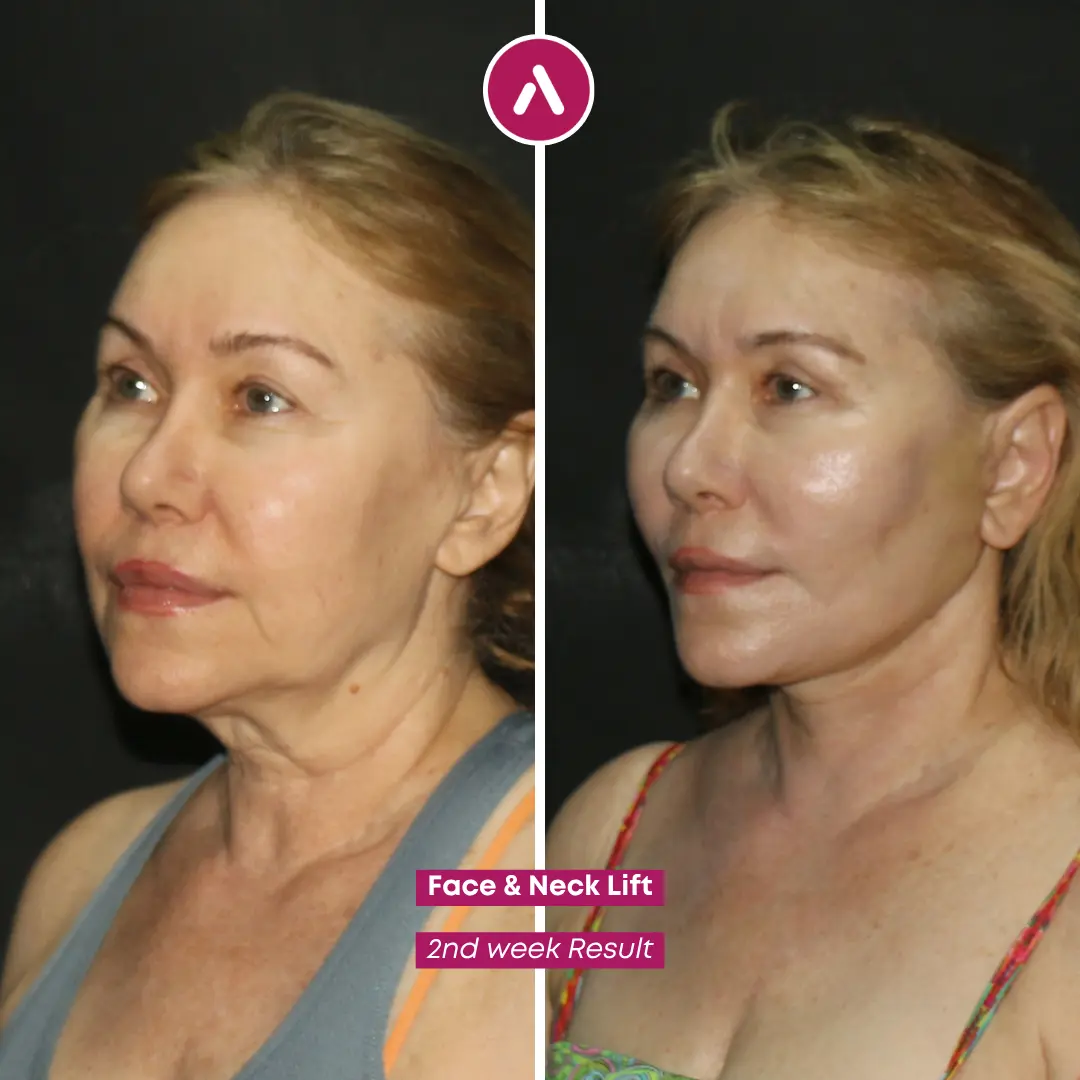
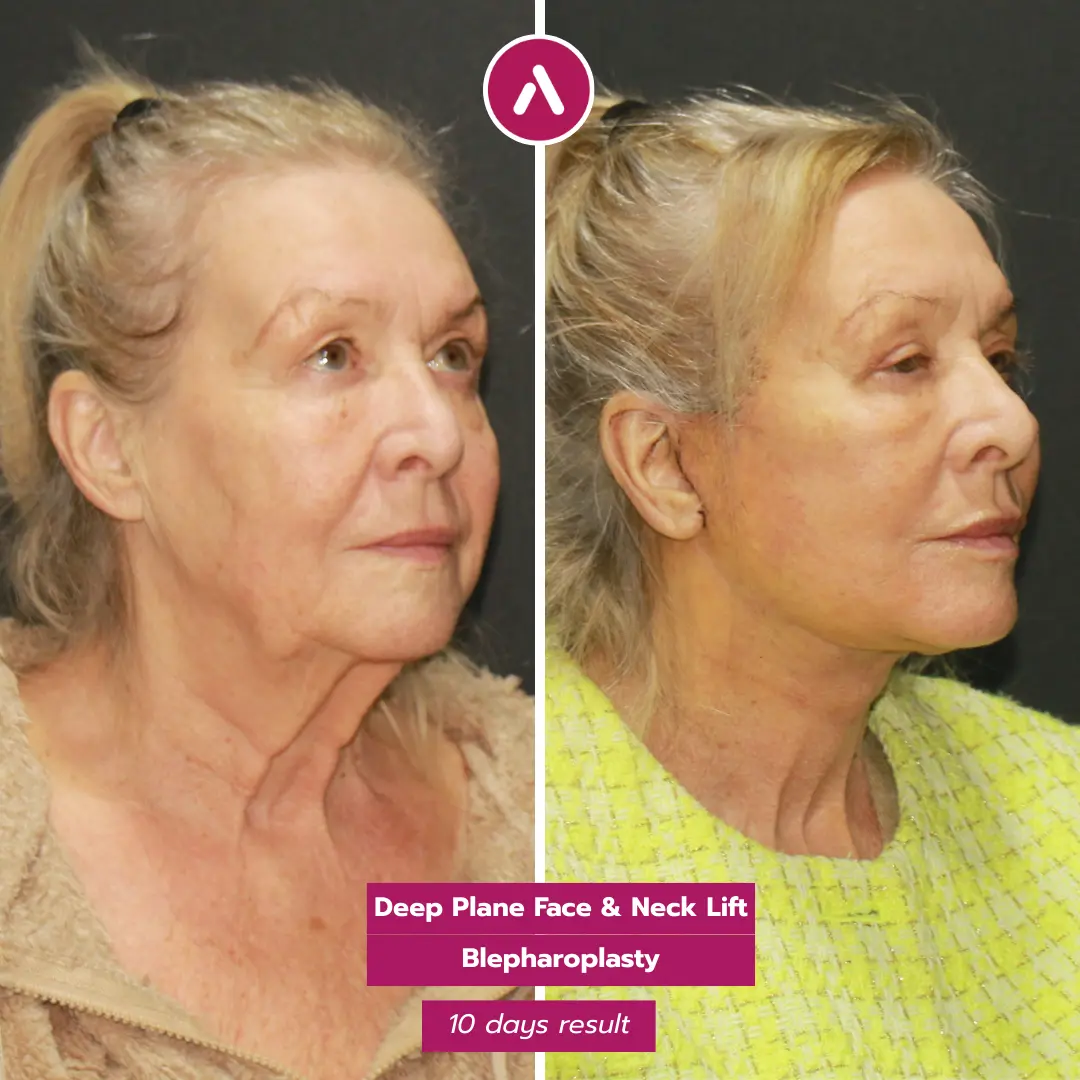
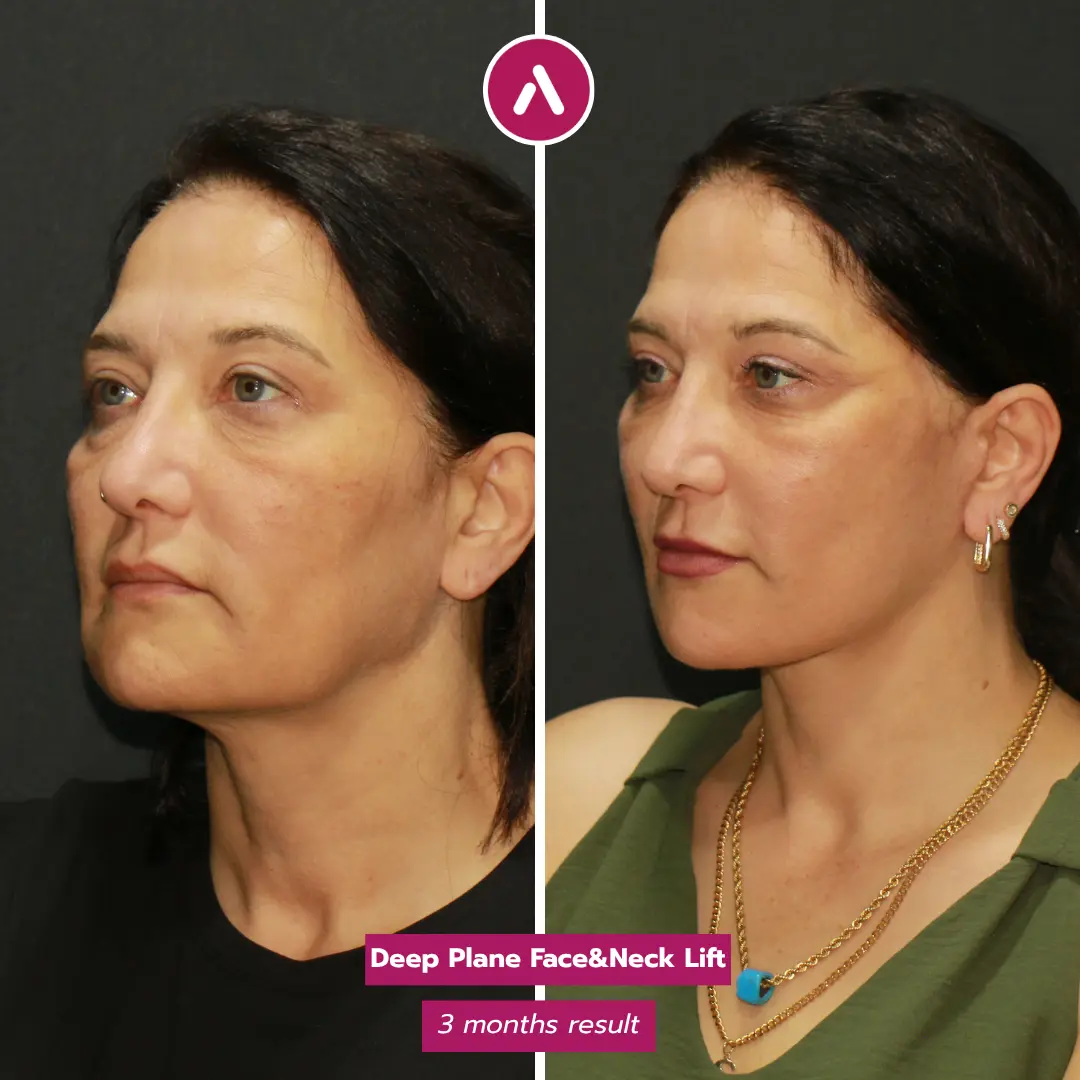
Table of Contents
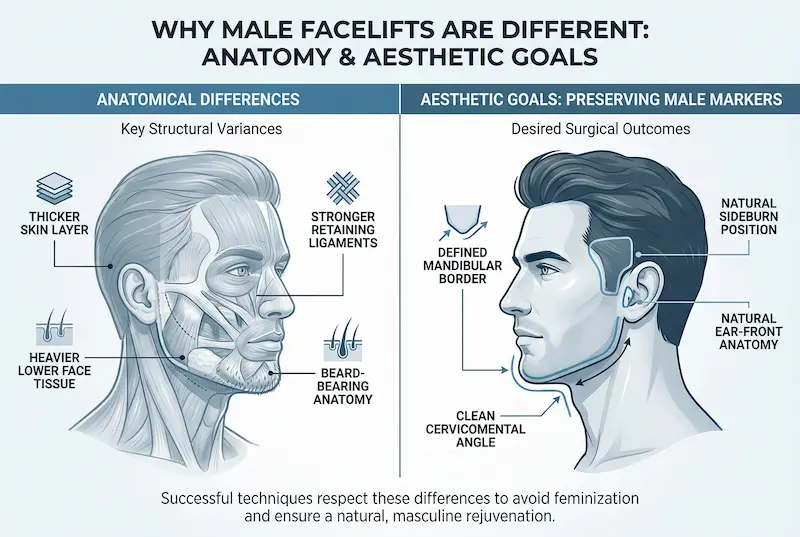
Why Male Facelifts Are Different: Anatomy & Aesthetic Goals
Men typically have thicker skin, stronger retaining ligaments, a heavier lower face, and different hairline and beard-bearing anatomy. Those differences affect incision placement, lift direction (vectors), and how much volume is restored or reduced. In other words: the same approach that looks beautiful on a female patient can look “off” on a male patient if masculine markers aren’t actively protected.
The “male markers” surgeons must preserve (jawline, neck angle, brow, hairline)
Successful male facelift surgical techniques protect the visual cues that read as masculine:
- Jawline structure: defined mandibular border, not rounded softness.
- Cervicomental angle: the neck-to-chin angle should stay clean and masculine, not overly sharpened in a way that looks “surgically sculpted.”
- Hairline & sideburn position: sideburn distortion is one of the most recognizable “tell” in male facelifts.
- Ear-front anatomy: the incision and closure must avoid the “operated ear” look (tragus distortion, pixie earlobe).
What creates a “feminine” facelift result (most common pitfalls)
A feminized or unnatural result is usually not caused by “doing too much lifting.” It’s caused by where the tension goes, how the incisions are designed, and what gets altered unintentionally.
| Common Pitfall | What It Looks Like | Masculine-Preserving Surgical Principle |
|---|---|---|
| Over-reliance on skin tension | “Pulled,” shiny, windblown appearance | Deep structural support (SMAS/deep-plane concepts) with minimal skin tension |
| Incorrect lift vector | Softened jawline or unnatural midface shape | Vector planning that respects male skeletal proportions and avoids over-elevating the lateral face |
| Sideburn/hairline displacement | Obvious surgery cues in men | Incision design that preserves sideburn placement and avoids “moving” the hairline |
| Ear/tragus distortion | Operated look around the ear | Natural tragus contour, careful closure, and tension distribution away from the ear |
| Over-filling the face | Puffy, softened facial planes | Conservative volume strategy: restore where needed, avoid blanket fat grafting |
Defining success: refreshed, not reshaped (realistic outcome targets)
In real life, the most convincing results are subtle. A male facelift should read as: “He looks well,” not “He had work done.” That’s why many modern male facelift techniques prioritize:
- Natural proportions over maximal tightening
- Neck-jaw harmony rather than an aggressively sharp jawline
- Scar strategy designed specifically for male hairline and beard patterns
Core Male Facelift Techniques (What Surgeons Actually Do)
When patients compare “techniques,” they often focus on names (SMAS, deep plane, mini facelift). The reality is that the best outcomes usually come from combining several steps into one coherent plan: addressing deep support, neck mechanics, volume balance, and scar placement. The latest male facelift techniques aim to create durable lift without broadcasting surgery—an approach supported by principles used widely in scientific research on facial anatomy and aging patterns.
SMAS vs. Deep Plane: when each is used for men
Two commonly discussed categories in male facelift surgical techniques are SMAS-based and deep-plane approaches. The “right” choice depends on your anatomy, degree of laxity, and what needs to move:
- SMAS concepts: reinforce deeper facial tissues so the skin doesn’t carry the tension. Often favored when the goal is a controlled, natural lift with careful adjustment.
- Deep-plane concepts: release and reposition deeper layers to address heavier midface/lower face descent more powerfully—when indicated.
For male patients, the decision should always be tied to preserving masculine landmarks and avoiding over-correction—especially around the midface and jawline.
Neck lift + platysma work: keeping a masculine cervicomental angle
In many men, the neck is the “tell” of aging—bands, fullness under the chin, or a blunted neck-to-chin angle. A masculine result often requires targeted neck work, potentially including platysma tightening when appropriate. The goal is a clean profile that looks like your neck—just younger—not a surgically “cinched” look.
Volume strategy: fat grafting vs. reduction (avoiding softness/puffiness)
Volume is where male facelifts can accidentally become feminizing. Some faces need selective restoration; others need debulking or refinement in specific areas. The best male plans typically use a conservative, anatomy-driven approach:
- Restore strategically: only where true deflation exists (not everywhere).
- Avoid blanket filling: over-filling can soften masculine planes and create a “puffy” look.
- Prioritize structure: deep support first; volume second.
From real patient outcomes: Patients consistently value results that look natural and recover comfortably—one patient described a “painless” recovery requiring only a single day of painkillers, and a US patient called her experience “fabulous” with “no pain.”
Clinic note (recovery optimization): At AKM Clinic in Istanbul, advanced recovery support such as HBOT (Hyperbaric Oxygen Therapy) and LLLT (Low-Level Laser Therapy) is integrated into postoperative care pathways to help manage swelling, tissue recovery, and scar quality—important for patients who want a discreet, faster-looking recovery.
Surgeon-led perspective: Technique selection matters, but so does the team’s expertise. At AKM Clinic, facial rejuvenation is approached with combined expertise—a Dermatosurgeon (skin quality + facial aesthetics) working alongside a Facial Plastic Surgeon—because a masculine result depends on both the underlying structure and the skin envelope.
Incision Planning in Men: Hairline, Sideburns & Beard-Bearing Skin
Among the best male facelift techniques, incision planning is one of the biggest “make-or-break” factors for a natural result. Men have unique camouflage challenges: short haircuts, visible sideburn landmarks, and beard-bearing skin that can shift if the plan isn’t precise. The goal of modern male facelift techniques is to hide scars while preserving masculine hairline geometry and natural contours around the ear.
Hairline/sideburn preservation (avoiding the “moved hairline” look)
One of the most obvious red flags in male facelift photos is a sideburn that looks “lifted” or displaced backward. In male facelift surgery, surgeons aim to preserve the sideburn’s natural position and thickness while avoiding tension that migrates hair-bearing skin.
- Key principle: The skin redraping plan should protect hair-bearing borders—especially around the sideburn and temple.
- What to look for in before/after: identical sideburn starting point and a natural temple transition, even at 3–6 months.
- What patients miss: a “great jawline” can still be a bad result if the hairline gives it away.
Tragus vs. pre-tragal incisions: natural ear-front anatomy in men
Incision placement around the ear is a classic area where a facelift can become noticeable. Many male facelift surgical techniques focus on keeping the natural shadow and cartilage shape of the tragus and the crease in front of the ear intact.
| Incision Strategy (Conceptual) | Primary Benefit | Main Risk If Done Poorly | What to Check in Photos |
|---|---|---|---|
| Pre-tragal (in front of tragus) | Can be straightforward access and closure | Visible scar line in front of the ear, especially with short hair | Look for a fine, nearly invisible line and undistorted ear-front contour |
| Tragal / hidden along natural contours | Better scar camouflage in many men | Tragus distortion or “operated” ear if cartilage/skin balance is off | Natural tragus shape + normal ear-front shadow |
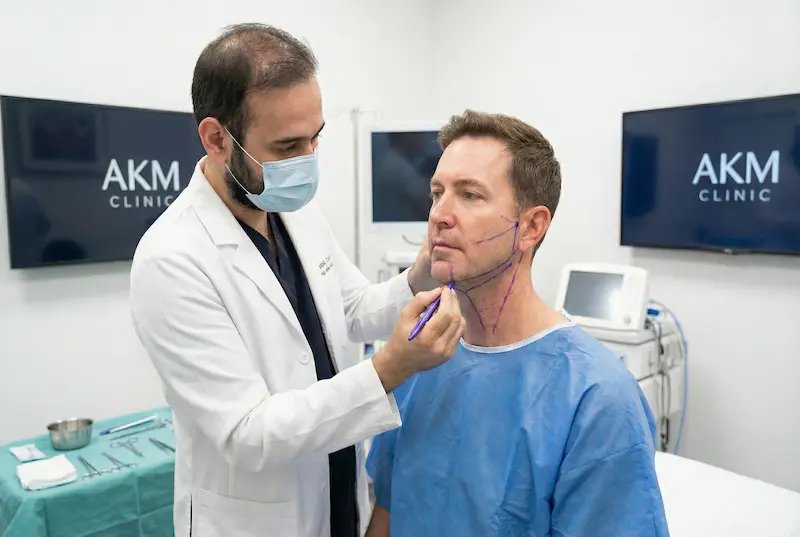
There isn’t a universally “right” incision for every man. The best approach depends on your ear anatomy, haircut preferences, skin thickness, and how much movement is planned. A surgeon should be able to draw your incision map and explain why it’s chosen—this is where evidence-based planning and medical science (anatomy, tension lines, blood supply) becomes practical.
Beard alignment & shaving considerations (preventing visible distortion)
Beard-bearing skin can shift in a facelift if vectors and closure aren’t designed for male patterns. That can cause awkward beard placement (for example, hair-bearing skin migrating onto the ear area) or changes in shaving lines.
- Ask specifically: “How will you prevent beard-bearing skin from moving onto the ear or changing my shaving line?”
- Check in follow-up photos: beard line symmetry near the sideburn and around the ear.
- Practical tip: plan your first 2–3 weeks of grooming around swelling—many men prefer a conservative trim rather than a sharp edge until tissues settle.
Checklist for a “stealth” male facelift: sideburn position preserved, natural ear-front shadow, no beard migration, and scars that disappear into anatomical creases.
How to Avoid the “Pulled” or Feminized Look: Key Technical Principles
The most reliable way to avoid a feminized or “done” appearance is not a single brand-name technique—it’s correct execution of core principles: deep support, correct vectors, and controlled tension distribution. Many of the latest male facelift techniques are essentially refinements of these fundamentals, backed by ongoing scientific research in facial anatomy, aging, and wound healing.
Correct lift vectors for male faces (tension direction matters)
Vector choice (the direction tissues are repositioned) influences whether you keep a masculine look or drift toward an unnatural, softened result. A male plan typically prioritizes:
- Jawline clarity without “sweeping” the face upward in a way that changes identity.
- Neck-jaw harmony rather than over-elevating the lateral face.
- Subtle midface refinement when needed—without creating a rounded, over-lifted cheek appearance.
When you review a surgeon’s gallery, look beyond “tightness.” Check whether facial planes still look masculine and whether the result stays believable in different angles.
Deep fixation vs. skin tension (why over-tight skin looks unnatural)
One consistent theme across best male facelift techniques is shifting the “work” away from the skin and onto deeper layers (where appropriate). Skin-only tightening can create the classic operated look: shine, flattening, and a tight ear region. In contrast, deeper support aims to keep the skin relaxed while still improving contour.
| Approach | What It Prioritizes | How It Can Look | Durability Trend |
|---|---|---|---|
| Skin-dominant tightening | Surface tension | Higher risk of pulled/obvious results | May relapse sooner, depending on tissue quality |
| Deeper support (SMAS/deep-plane concepts) | Structural repositioning | More natural skin drape; lower “operated” cues | Often more stable when well-executed |
“Deep” doesn’t automatically mean “better” for every patient. It means the plan should match anatomy and goals. The most important point: you want a surgeon who can explain their male facelift surgical techniques in plain language and show consistent, masculine results.
Ear & earlobe protection (avoiding pixie ear and “windblown” cues)
Two classic giveaways are pixie ear (earlobe pulled downward or attached unnaturally) and distortion of the ear-front anatomy. These happen when closure carries too much tension or when tissues aren’t anchored correctly.
- What to check: earlobe shape and position, tragus contour, and the fold behind the ear.
- What to ask: “How do you distribute tension away from the ear to protect the earlobe?”
- Why it matters in men: short hairstyles make even subtle ear changes more visible.
Recovery support note: Managing swelling and tissue stress is part of protecting delicate areas like the ear region. In AKM Clinic’s postoperative protocols, advanced recovery modalities such as HBOT and LLLT are used to support tissue healing and comfort—helpful for patients who want a discreet recovery window and scar optimization.
Patient perspective: In testimonials, patients frequently highlight a comfortable recovery experience—some reporting minimal pain and quick return to daily routines—reinforcing the value of structured postoperative care alongside surgical technique.
Add-On Procedures That Often Make Male Results Look More Natural
The latest male facelift techniques are rarely “facelift-only.” In men, a truly natural outcome often comes from balancing the entire face and neck—so the facelift doesn’t make one area look younger while another area still signals age. The goal is subtle harmony, guided by anatomy and medical science, not a dramatic change.
Eyelids/brow balance: avoiding a “surprised” or softened expression
For many men, eyelids and brow position are the hidden reason a facelift can look “off.” If the lower face looks refreshed but the eyes still look tired—or if the brow is over-elevated—the result can read as unnatural. A conservative eyelid plan can sharpen the look without feminizing it.
- Upper eyelids: removing excess skin carefully to avoid a hollowed or “over-operated” eyelid.
- Brow: in men, aggressive brow elevation can soften the face and change identity; the best male plans are subtle.
- Timing: many surgeons plan eyes and facelift together so swelling and healing align.
Jawline definition options: submental lipo, chin projection, structural balance
Men often judge facelift success by the jawline and neck. When the chin is naturally weaker or there’s submental fullness, a facelift alone may not deliver the crisp, masculine definition you want. That’s why best male facelift techniques frequently combine structural refinement:
- Submental liposuction: helps reduce fullness under the chin when appropriate, supporting a cleaner neck profile.
- Chin projection strategy: sometimes the “jawline problem” is actually a chin projection issue, not just skin laxity.
- Neck + jaw as a unit: combining neck work with lower-face lifting often reads more natural than pushing one area too far.
Skin quality optimization (dermatosurgeon-informed planning & resurfacing logic)
Even perfectly executed male facelift surgical techniques can look less impressive if the skin envelope is thin, sun-damaged, or crepey. This is where surgeon-led planning that includes skin expertise can make a difference.
At AKM Clinic, facial rejuvenation is approached with the combined perspective of a Dermatosurgeon and a Facial Plastic Surgeon—so the plan considers both the deeper structures and the skin quality. This team structure supports more natural outcomes because it addresses “what’s under the skin” and “the skin itself” in one integrated strategy.
| Add-On (When Appropriate) | Why Men Choose It | Masculine-Safety Check |
|---|---|---|
| Upper/Lower Eyelid Surgery | Eyes often age faster than the jawline | Avoid hollowing; keep natural lid shape |
| Neck Refinement (incl. platysma work) | Neck bands/fullness are common male concerns | Clean, masculine neck-to-chin angle without “over-cinched” look |
| Submental Lipo / Definition | Sharper profile without over-pulling the face | Definition should look athletic, not artificially sculpted |
| Skin Quality Treatments (timed to healing) | Improves texture, crepiness, and scar blending | Plan around healing biology; don’t compromise recovery |
Practical point: In modern male facelift techniques, add-ons aren’t about “more work.” They’re about preventing imbalance—so your result looks effortless and believable.
Recovery & “Back-to-Work” Timeline for Men
Recovery is where planning meets real life. Many men want a discreet timeline—especially executives, entrepreneurs, and public-facing professionals. While healing varies, understanding typical milestones helps you schedule travel, video calls, and social downtime realistically. The most trustworthy clinics will explain recovery with clarity and consistency, grounded in science (inflammation, lymphatic drainage, collagen remodeling) rather than vague promises.
Typical swelling/bruising milestones (week 1 → week 6)
Here’s a realistic, patient-friendly roadmap (your surgeon may adjust this based on your exact procedure and whether a neck lift or eyelid surgery is combined):
| Time Point | What You May Notice | What Looks “Normal” in Public |
|---|---|---|
| Days 1–3 | Most swelling/tightness, early bruising | Usually not camera-ready |
| Days 4–7 | Swelling begins to settle; bruising can migrate | Limited public exposure with concealment strategies |
| Weeks 2–3 | Noticeable improvement; residual swelling common | Many men return to work (especially remote) with careful angles/lighting |
| Weeks 4–6 | More natural movement; scars start to soften | Often socially comfortable for most settings |
Gym, business travel, camera-ready timing: practical planning
- Work-from-home: many men plan 10–14 days before important meetings or events.
- On-camera work: plan closer to 3–4 weeks if you want to reduce the risk of visible swelling.
- Exercise: heavy lifting is typically delayed; ask your surgeon for a staged return (walking → light cardio → weights).
Healing optimization: scar care + clinic recovery protocols (HBOT/LLLT)
Advanced recovery support can help reduce swelling, support tissue healing, and optimize scar quality. AKM Clinic highlights two technologies in its post-operative care pathway:
- HBOT (Hyperbaric Oxygen Therapy): described as a key strategy to support tissue survival/regeneration, reduce swelling and downtime, improve scar healing, and mitigate infection risk through enhanced oxygen delivery and immune support.
- LLLT (Low-Level Laser Therapy): a medical-grade laser system (650nm) described as supporting cellular repair (ATP), collagen synthesis, and reduced inflammation—used specifically for post-facelift skin healing.
Real patient emphasis: Testimonials consistently highlight comfort and low pain during recovery—one patient described a “fabulous” experience with “no pain” and minimal bruising, while another noted she only needed painkillers for “probably one day.”
Choosing the Right Surgeon/Clinic for a Masculine Result
The difference between an “okay” facelift and a convincingly natural one is often not the country, the brand name of the technique, or the marketing language—it’s the surgeon’s ability to apply male facelift surgical techniques with consistent control over vectors, tension, incision design, and scar strategy. If you want the outcome associated with the best male facelift techniques, you need a selection process that’s more analytical than emotional.
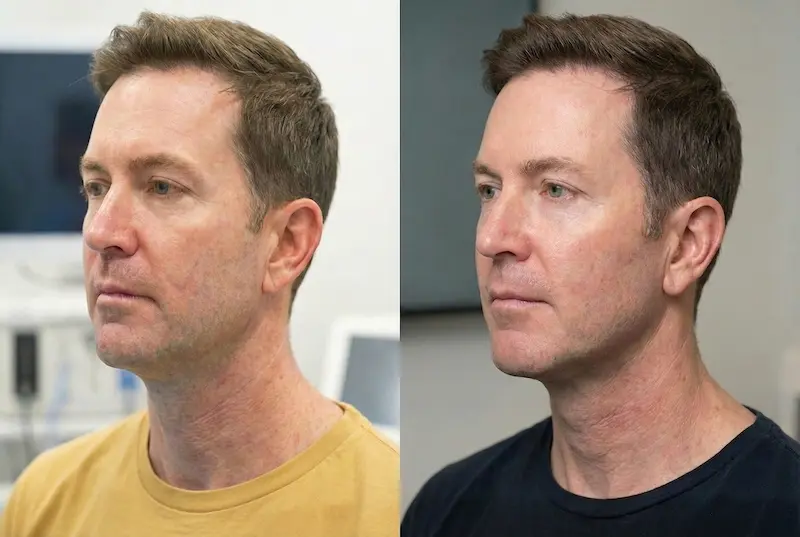
How to read male before/after photos critically (angles, hairline, ear shape)
Many galleries look impressive at first glance—until you know what to check. When reviewing “after” photos for modern male facelift techniques, focus on identity-preserving details, not just tightness.
- Sideburn position: Is it the same height and thickness? Does it look “pulled back”?
- Ear-front anatomy: Does the tragus look natural? Any visible distortion?
- Earlobe shape: Is there any downward pull (pixie ear) or unnatural attachment?
- Neck-jaw balance: Is the neck improved without looking artificially sculpted?
- Consistency across lighting/angles: Results should look good in standard lighting, not only in curated “hero” shots.
Pro tip: Ask for male examples at 3, 6, and 12 months. Early photos can look tight; what matters is how the result “settles” and whether it remains natural.
Questions to ask in consultation (technique choice, incision map, revision policy)
If a clinic offers a brief “yes/no” consultation without detailed planning, that’s a red flag—especially for men. The latest male facelift techniques still require fundamentals: a clear diagnosis, a drawn incision plan, and a rationale for why a specific approach is being recommended.
| Consultation Question | What a Strong Answer Includes | Why It Matters for Men |
|---|---|---|
| “Which technique are you recommending, and why for my anatomy?” | Explains SMAS/deep-plane concepts in plain language + shows male examples | Prevents one-size-fits-all recommendations |
| “Can you draw my incision map (hairline/sideburn/ear)?” | Clear plan to preserve sideburn and hide scars in natural contours | Hairline/sideburn errors are highly visible in men |
| “How do you avoid a pulled or feminized look?” | Discusses vector planning + deep fixation + minimal skin tension | Protects masculine planes and identity |
| “What’s your plan if scar visibility or contour needs refinement?” | Transparent revision policy + realistic timelines for healing | Men often keep shorter hair, making scars more noticeable |
| “What does follow-up look like for international patients?” | Structured schedule + remote monitoring + local care guidance | Continuity of care reduces anxiety and risk |
If you’re comparing options internationally, ask specifically about postoperative support. In AKM Clinic’s care model, recovery is treated as a medical process—not an afterthought—using structured follow-up and advanced recovery modalities such as HBOT and LLLT to support swelling control, comfort, and scar quality.
Safety + follow-up standards for international patients (continuity of care)
For US patients traveling for surgery, safety is not only “what happens in the operating room.” It’s also what happens in the first two weeks afterward: wound checks, swelling management, medication guidance, and early detection of complications. A reliable clinic should provide:
- A written postoperative plan: day-by-day guidance on wound care, showering, activity, and warning signs.
- Clear contact pathways: who you reach, how fast, and what happens if you’re back home.
- Clinical monitoring: scheduled checks while you’re in-country, and structured remote follow-up afterward.
- Evidence-based recovery guidance: swelling, bruising, and scar biology explained through medical science, not vague promises.
Bottom line: The “best” surgeon for a male facelift is the one who can show consistent masculine outcomes, explain their plan clearly, and support you through healing with real systems—not just reassurance.
Frequently Asked Questions (FAQ): Male Facelift Techniques
This FAQ focuses on the most common decision points men bring to consultation—especially concerns about looking “pulled,” changing hairlines/sideburns, and choosing between different male facelift techniques. Where possible, I’ll keep answers practical and aligned with how surgeons evaluate anatomy in real clinical practice.
What facelift technique is best for men—SMAS or deep plane?
There isn’t one universally “best” option. The best male facelift techniques are the ones matched to your anatomy and goals. Many men benefit from approaches that provide strong deep support (SMAS/deep-plane concepts) so the skin isn’t over-tightened. The right choice depends on the degree of tissue descent, midface heaviness, neck laxity, and your scar/hairline considerations.
How do surgeons prevent a “feminine” or over-tight result?
Most feminized outcomes come from incorrect vectors, too much skin tension, poor incision planning, or overly aggressive volume changes. In male facelift surgical techniques, surgeons reduce this risk by:
Building support in deeper layers (so the skin can drape naturally)
Planning vectors that preserve masculine planes and jawline geometry
Protecting hairline/sideburn position and ear anatomy
Using conservative, targeted volume strategy (avoid “puffy” softening)
Will my beard or hairline change after surgery?
With well-executed modern male facelift techniques, surgeons aim to preserve your sideburn and avoid shifting beard-bearing skin. That said, poor planning can move hair-bearing borders or distort shaving lines. You should ask your surgeon to draw the incision plan and explain how they prevent sideburn displacement and beard migration—this is a core quality marker in male facelift work.
Where are the scars, and how visible are they?
Scars are typically placed around the ear and into natural creases, with extensions tailored to hairline patterns. Visibility depends on incision strategy, closure technique, your skin quality, and how you heal. Men with short hairstyles should be especially strict when reviewing healed results at 6–12 months. Scar maturity is also influenced by healing biology—this is where medical science (collagen remodeling, inflammation control) matters, and why structured postoperative scar care is important.
How long do male facelift results last?
A facelift doesn’t stop aging, but it can “reset” laxity and contour. Longevity depends on your baseline anatomy, skin quality, lifestyle factors (sun exposure, smoking, weight changes), and how the deeper support was constructed. Many men choose techniques that emphasize deep support for more stable contour over time—an approach consistent with principles discussed in the broader scientific research on facial aging and tissue mechanics.
What’s realistic downtime for executives/remote workers?
Many men plan for:
10–14 days before camera-heavy meetings if the goal is “I look normal”
3–4 weeks if you want to look more “settled” and less puffy on video
4–6 weeks for broader social comfort in most settings (especially if combined with neck/eyes)
Swelling can linger subtly for weeks. A clinic’s recovery protocol (including swelling management strategies and comfort-focused care) can make the downtime feel more predictable.
Can I combine a male facelift with a neck lift or eyelid surgery?
Yes—this is common and often produces a more natural overall result. Men frequently combine lower-face lifting with neck refinement because the jawline and neck read as one unit. Eyelid surgery may be added when the eye area ages faster than the lower face. The key is balance: combining procedures should reduce “age mismatch,” not over-correct a single area. This integrated planning is a hallmark of the latest male facelift techniques.
If you’d like to go beyond the topic covered here, you can also explore related guides such as Questions to Ask Plastic Surgeon for consultation prep, Best Deep Plane Facelift Clinic in Turkey for facility-level evaluation, and combined procedure planning with Hair Transplant and Facelift. For a more defined lower-face aesthetic, you may find Beard Transplant Turkey helpful, while Stem Cell Facelift vs Traditional Facelift clarifies how regenerative add-ons compare with standard lifting approaches. Finally, if you’re risk-focused, reviewing Facelift Revision Rate can help you understand what influences revisions and how to reduce the likelihood of needing one.
Medical Disclaimer: This page is provided for general educational purposes only and does not replace a face-to-face medical consultation, diagnosis, or personalised treatment plan. All surgery carries risks and outcomes vary between individuals. Suitability for a male facelift, procedure selection, and anaesthesia choice can only be determined after a full clinical assessment by a qualified surgeon. Always follow your clinician’s instructions and seek urgent medical attention if you develop concerning symptoms during recovery.