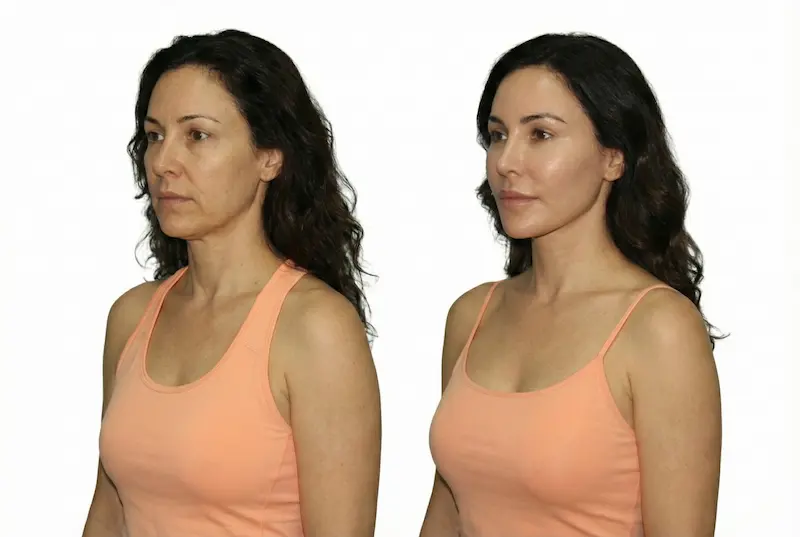
If you’re searching for awake facelift before after photos, you’re probably not just looking for dramatic “wow” pictures. You want to understand how an awake facelift changes the face in your 40s, 50s and 60s — and what is realistically possible without ending up with an over-pulled, unnatural look. As an expert patient, you also want to know how these results compare with traditional facelifts, fillers, and thread lifts, especially when the procedure is done under local anesthesia in Turkey.
At AKM Clinic in Istanbul, awake facelifts (also called “twilight” or local anesthesia facelifts) use the same deep plane, SMAS and mini facelift techniques you see in classic facelift before and after photos. The key difference is the anesthesia method, not the aesthetic potential. In this guide, we’ll walk through what realistic before and after awake facelift results look like by decade, so you can interpret those awake facelift Turkey before and after pictures with a more clinical, critical eye.
We’ll also touch on specific scenarios you might be searching for, such as awake deep plane facelift before and after, awake mini facelift before and after pictures, and lower facelift before and after results in patients in their 40s, 50s, 60s and even 70s.
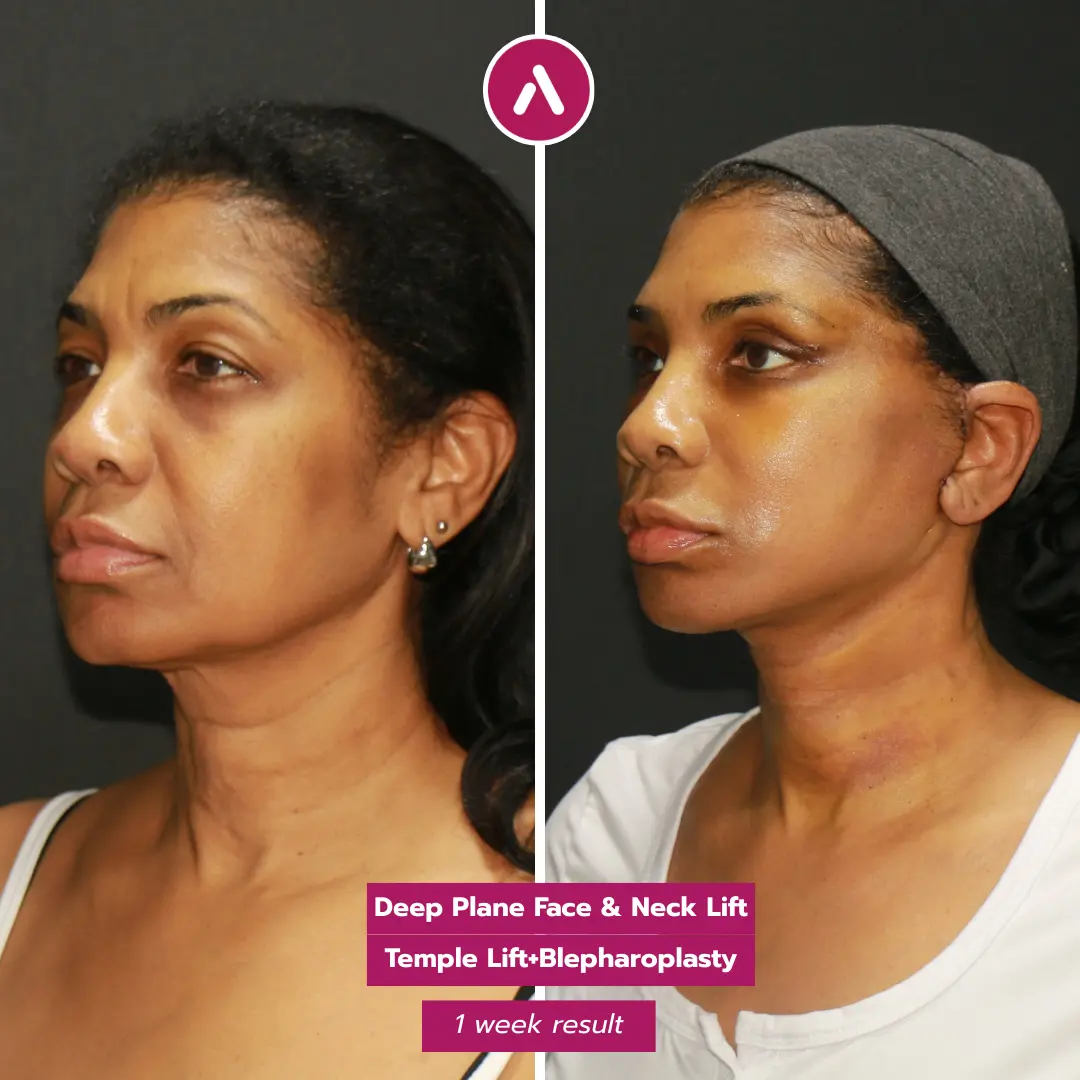
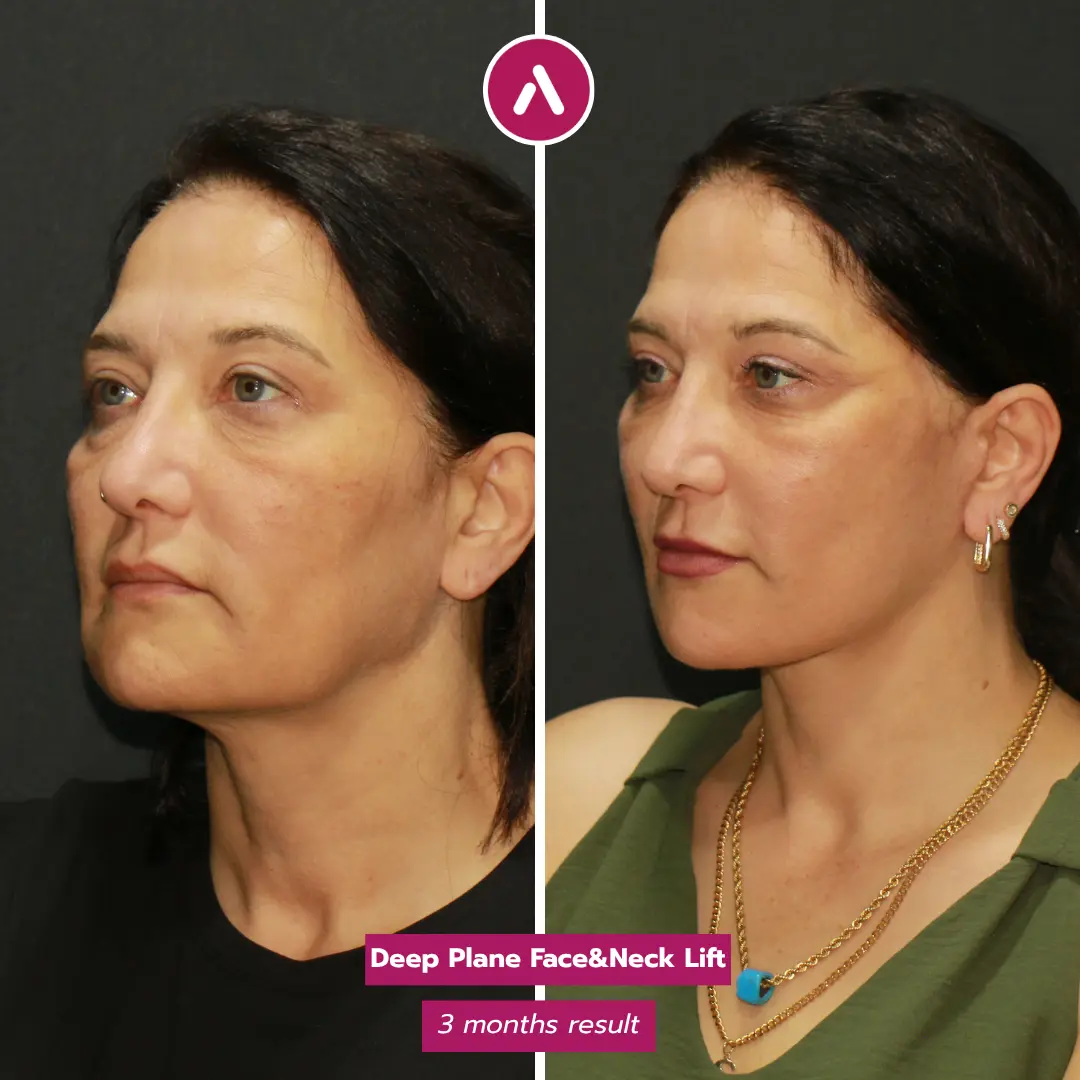
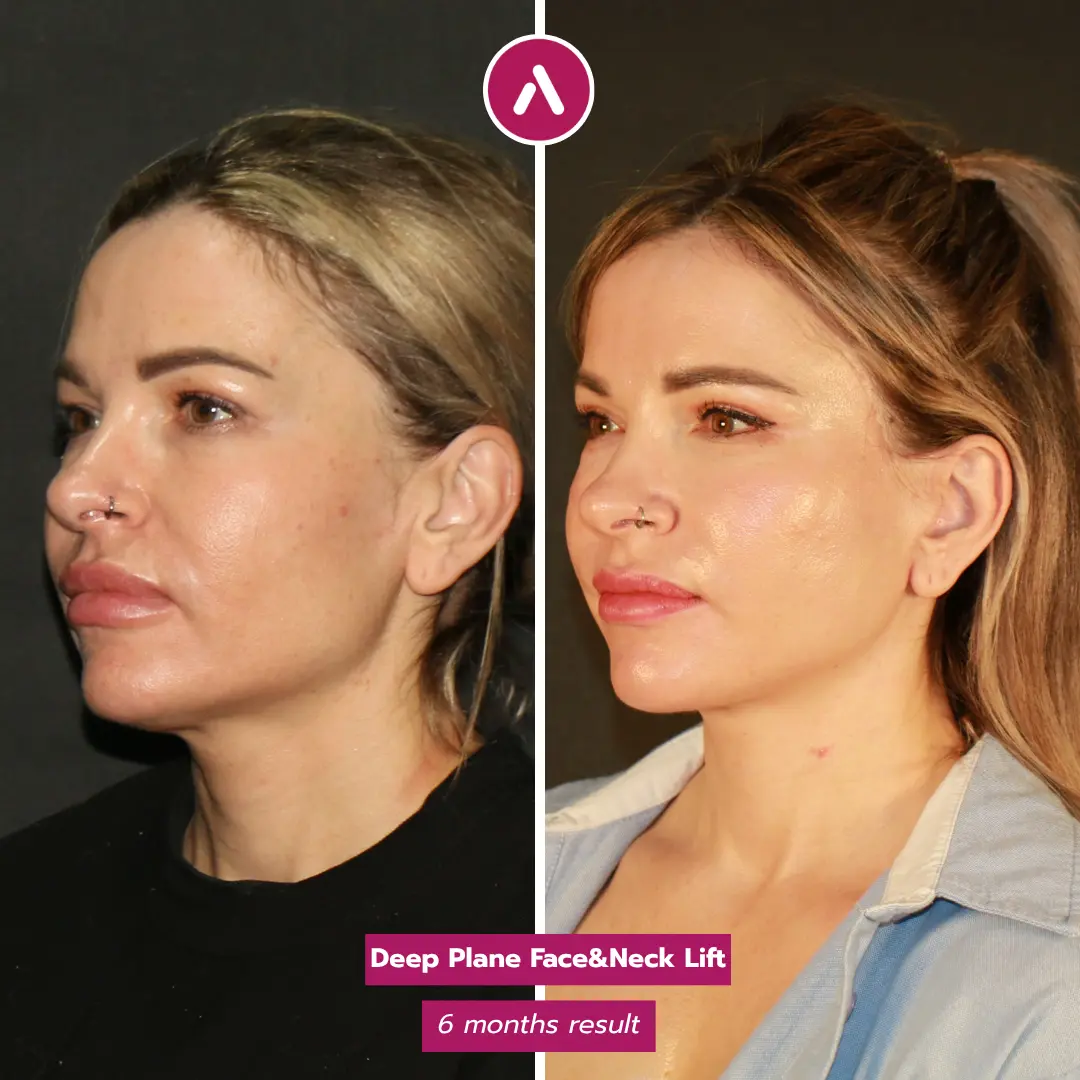
Table of Contents
What Results Look Like in Your 40s
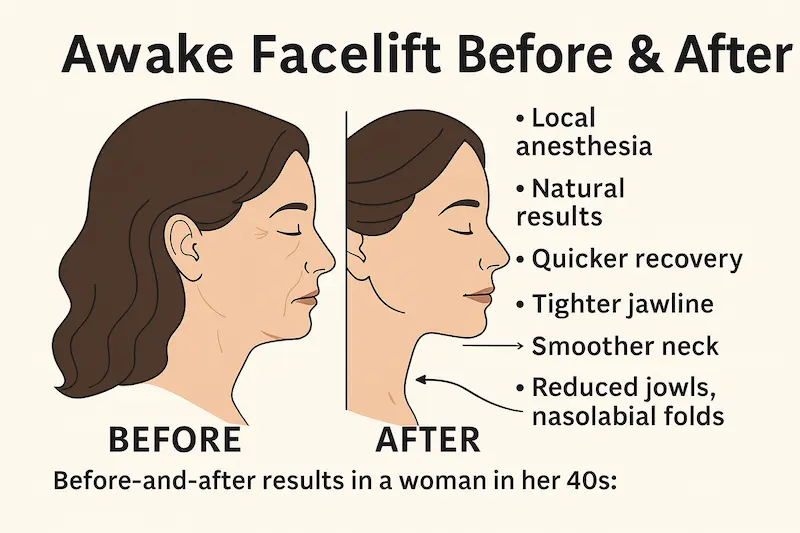
In your 40s, an awake facelift is rarely about “changing” your face. It is usually about correcting early aging signs and protecting the natural facial identity you already like. Most patients in this age group are good candidates for a more targeted approach, such as an awake mini facelift before and after transformation or a limited lower facelift before and after change, rather than a very aggressive, full-face lift.
Early aging correction
In many 40-something patients, the first issues are:
- Mild jowling along the jawline
- Softening of the angle between the jaw and neck
- Nasolabial folds starting to deepen
In this age group, before and after awake facelift photos tend to show:
- A cleaner jawline with the jowls gently lifted back to their original position
- A slightly sharper transition from face to neck (without a “done” neck lift look)
- Subtle softening of folds around the mouth, not complete erasure
Technically, the surgeon may use a mini or limited SMAS approach, or a mild awake SMAS facelift. The goal is structural correction with minimal detachment of tissues, which is why awake mini facelift before and after photos in this decade often look “fresh” rather than “operated”.
Subtle jawline definition without looking “done”
Many 40-something patients are afraid of the “wind tunnel” look. On high-quality awake facelift before and after photos in this age group, you will notice:
- The jawline is straighter and crisper, but the cheeks still move naturally when smiling.
- The corners of the mouth no longer turn down as much, without a strange lateral pull.
- The neck looks lighter and less heavy, yet the person is still recognizably themselves.
This is often the age bracket where patients say, “I just want to look less tired, not different.” A properly executed lower facelift before and after result in the 40s should make friends think you rested, not that you had surgery. That’s especially true when the facelift is done awake, because the surgeon gets real-time feedback from your facial movements during surgery.
How awake facelift compares to fillers and threads in your 40s
In your 40s, you might be comparing an awake mini facelift before and after result with what you’ve seen from:
- Dermal fillers to the cheeks and jawline
- Thread lifts to “suspend” mild jowls
- Energy-based devices (radiofrequency, ultrasound) for skin tightening
Here is the key difference:
- Fillers and threads can camouflage early sagging by adding volume or giving a temporary lift, but they do not reposition the deeper facial structures. Overuse can even make the face look heavier or distorted.
- An awake facelift in your 40s (whether mini, SMAS or even a conservative deep plane) physically repositions the descended tissues and tightens the muscular layer. The result is structural, not just volumetric.
This is why high-quality awake facelift before and after pictures often look more natural than faces that have been “chased” with fillers for years. The underlying architecture is corrected instead of being hidden.
When to combine an awake facelift with eyelid or brow procedures
In the 40s, some patients benefit from combining an awake facelift with:
- Upper eyelid surgery (to remove drooping skin)
- Lower eyelid tightening or fat repositioning (for under-eye bags)
- Temporal or mini brow lift (to open up the outer eye area)
In real-life AKM Clinic cases, for example, patients in their late 40s who combined an awake lower facelift with upper eyelid surgery often report comments like “you look less stressed” rather than “what did you have done?”. The key is harmony: your jawline, midface and eye area should all look like they belong to the same decade.
For an expert patient like you, the take-home point is this: in your 40s, an awake facelift is usually about gentle redirection of tissues. When you look at before/after photos, focus less on how “dramatic” the change is, and more on whether the person looks like a fresher, well-rested version of themselves.
Awake Facelift Before After Results in Your 50s
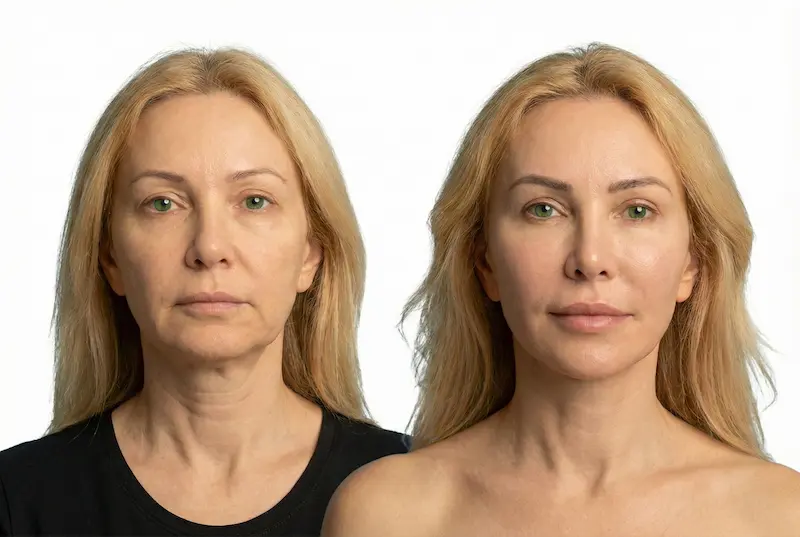
By your 50s, early aging has usually progressed into more visible structural changes. This is when many patients start searching for facelift before and after 50 year-old photos or specifically awake facelift before and after 50 year old examples to see what can truly be achieved without general anesthesia. The skin is thinner, ligaments are looser, and the lower face and neck often show a clear separation between “youthful” and “aged” appearance.
In this decade, an awake facelift is less about small corrections and more about multi-level rejuvenation: midface, jawline and neck often need to be addressed together. This is also the age group where awake deep plane facelift before and after images can be especially impressive, because deeper release of the retaining ligaments can reposition the midface in a way that fillers cannot.
Under-eye, jawline, SMAS impact
Common concerns in the 50s include:
- More obvious jowls and loss of jawline definition
- Flattened midface or “heavy” cheeks
- Deeper nasolabial folds and marionette lines
- Neck bands and skin laxity under the chin
On high-quality before and after awake facelift photos in this age range, you typically see:
- The jawline redrawn into a cleaner, more youthful contour
- The midface lifted so the cheeks sit back over the cheekbones
- Less shadowing in the nasolabial fold region
- A smoother transition from face to neck with reduced “wattle” under the chin
This often reflects a more robust awake SMAS facelift before and after transformation. The SMAS (the fibromuscular layer under the skin) is tightened and repositioned, which creates a longer-lasting change than skin-only tightening. In some patients, especially those with stronger midface descent, a deep plane approach (where the SMAS and skin are lifted together as a unit) may be used, leading to the kinds of awake deep plane facelift before and after outcomes you may have seen online.
Treating marionette lines and early neck bands in your 50s
Marionette lines (the shadows running from the corners of the mouth down to the chin) are a major reason 50-something patients feel they look “sad” or “tired” in photos. In many awake facelift before after galleries, you will notice:
- The corners of the mouth are gently elevated, not by cutting the skin at the lip, but by repositioning the tissues that drag them down.
- The marionette shadows are softened as the jawline is tightened and the lower face is lifted.
- Early neck bands appear less prominent because the tension is redistributed and excess laxity is removed.
Compared with repeated filler injections into marionette lines, a well-executed lower facelift before and after result in your 50s tends to look cleaner and more consistent, especially when you smile or speak. Instead of chasing each line individually, the facial framework is corrected.
How much younger can you realistically look after an awake facelift?
A frequent question in this decade is: “Will I look ten years younger?” The honest answer is that the number of years “reversed” varies by skin quality, anatomy, lifestyle, and whether additional procedures (like eyelids or neck work) are combined.
However, when evaluating facelift before and after 50 year-old photos, many expert patients report that a natural yet significant change often resembles a shift of 7–12 years in perceived age. In awake surgery, because deep structures can still be addressed, these changes are not inferior to results obtained under general anesthesia. The key variables are:
- The techniques used (SMAS vs deep plane vs mini)
- The surgeon’s experience with awake facial surgery
- How well the neck and midface are integrated into the plan
It’s important to remember that awake facelift before and after images are often taken at around 3–6 months post-op, once swelling has largely resolved. Earlier photos can look impressive but may not reflect the final, settled result.
Case-style scenarios: full-face rejuvenation vs targeted lower face lift
In your 50s, there are generally two main pathways:
- Full-face awake facelift – combining midface, jawline and neck. This is more common for patients who feel their whole face has aged out of sync with their inner energy.
- Targeted lower or mini facelift – focusing on the jawline and early neck changes. This is often chosen by patients who are otherwise happy with their upper face or who have recently done eyelid or brow surgery.
When you compare awake mini facelift before and after pictures with more extensive awake deep plane facelift before and after cases in the same age group, you’ll notice that:
- Mini lifts deliver softer, more localized change (especially along the jawline).
- Deep plane or full SMAS lifts produce more visible transformation of the midface and nasolabial folds.
- Both can look very natural when tension is applied to the deeper layers, not the skin.
For a 50-year-old patient who travels to Turkey specifically for an awake procedure, the choice often comes down to how much “reset” they want in one trip versus what can be handled later with non-surgical maintenance. An honest consultation should help you decide whether your goals match a mini, SMAS, or deep plane approach under local anesthesia.
Awake Facelift Before After Results in Your 60s
In your 60s, facial aging is usually more advanced and three-dimensional. This is the age range where you may specifically search for awake facelift before and after 60 year old or even awake facelift before and after 70 year old examples to see if awake surgery can still deliver meaningful improvement. The short answer: yes, it can—but expectations, technique and aftercare must all be aligned.
At this stage, the goal is often to restore structural support and harmony, not to chase every fine line. It is very possible to soften the heaviness of the lower face, improve the neck and redefine the jawline in an elegant, age-appropriate way. The ideal outcome is not a 60-year-old who looks 35, but someone who looks like a naturally refreshed, well-rested version of themselves in their 60s or early 70s.
Addressing advanced skin laxity and deeper jowls
In many 60+ patients, we see:
- Pronounced jowls that hang over the jawline
- Marked laxity in the neck (“turkey neck” appearance)
- Deep nasolabial folds and marionette lines
- Volume loss in the midface and temples
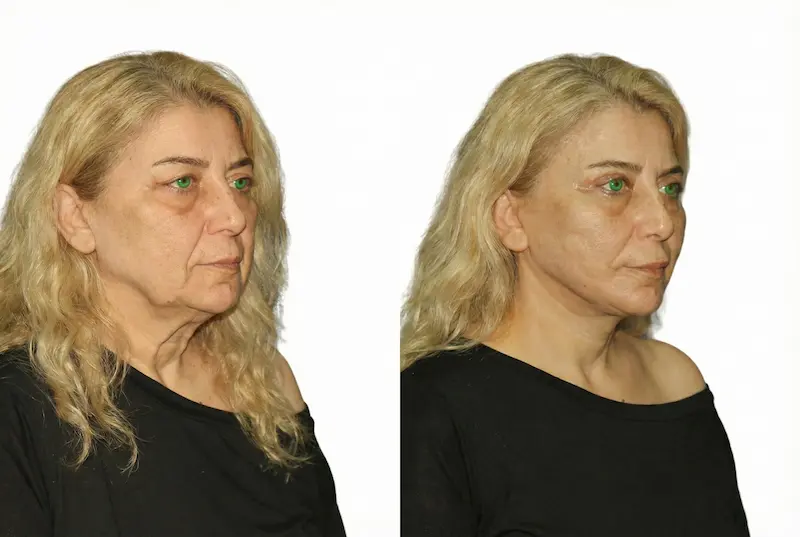
On high-quality awake facelift Turkey before and after photos in this age bracket, notice the following realistic yet significant changes:
- The jawline is re-drawn, with jowls lifted back where they belong, not just “pulled sideways”.
- The angle between the chin and neck is sharper, with less hanging skin or banding.
- The overall lower face looks lighter, so the mouth no longer appears as downturned or “stern”.
This kind of change usually requires more than a mini lift. Techniques such as a comprehensive awake SMAS facelift or even an awake deep plane facelift can be used under local anesthesia, especially when performed by surgeons who routinely operate on the SMAS and deep plane layers while the patient is comfortably awake. In some cases, fat grafting is combined to restore lost volume in a conservative way.
Neck and jawline transformation: what is possible, what is not
The neck is one of the main reasons patients in their 60s seek surgery. When you look at awake facelift before and after 60 year old examples, focus on:
- How much the submental area (under the chin) has been debulked or tightened
- Whether neck bands (platysmal bands) are less visible or more blended
- Whether the jaw-to-neck transition looks cleaner without appearing over-tightened
A well-performed lower facelift before and after in this decade can dramatically improve the neck, but there are limits:
- Very sun-damaged or crepey skin may still show fine lines and texture issues, even if the contour is greatly improved.
- Horizontal neck lines (from posture or genetics) can soften but may not disappear entirely.
- Severe fat deposits or previous surgeries may require more complex planning.
This is where being an expert patient helps. Instead of expecting a 100% “porcelain neck,” look for realistic contour improvements in before/after galleries, and evaluate whether the neck and face look harmonious for that patient’s age.
Are awake facelifts safe and effective for patients over 60?
Many 60- and 70-something patients are drawn to awake surgery precisely because they want to avoid general anesthesia if possible. In appropriately selected patients, awake facelifts can offer:
- Reduced systemic risk compared with prolonged general anesthesia
- Faster mobilisation after surgery
- The ability to provide feedback during critical steps (smiling, frowning, speaking)
When you review awake facelift before and after 70 year old examples, you’ll often see that the improvement is both structural and subtle. The best results in this age group are those where:
- The patient still looks like themselves, just “uprighted” and less heavy.
- The neck angle and jawline are clearly improved, but not so tight that the skin looks thinned or strained.
- The midface is gently lifted without creating a “pulled towards the ears” look.
In older patients, surgeon judgement is critical. An experienced, surgeon-led clinic will often prioritize a safe, anatomically respectful lift over extreme tightening. That philosophy is what keeps before/after results in the 60s and 70s looking refined rather than artificial.
When an awake facelift alone is not enough: combining procedures
In the 60+ age group, an awake facelift can dramatically improve sagging, but it cannot fully reverse:
- Severe sun damage and pigmentation
- Deep etched lines around the lips (smoker’s lines)
- Skin quality changes from decades of UV or lifestyle factors
For this reason, surgeons may recommend combining the facelift with:
- Resurfacing lasers or chemical peels for texture and pigmentation
- Targeted fat grafting or conservative fillers for volume restoration
- Eyelid surgery or brow lifting if the upper face is much older-looking than the lower face
In comprehensive awake facelift Turkey before and after cases in the 60s and 70s, it is often this combination—structural lifting plus skin and volume treatments—that produces the most satisfying, age-appropriate transformation. The key is not to overcorrect; you still want to look like a healthy, vibrant version of yourself, not like you are trying to “erase” your age entirely.
How Natural Awake Facelift Results Are Achieved
Whether you are in your 40s, 50s or 60s, the single most important question is: Will my results look natural? When you scroll through awake facelift before and after galleries, there are a few technical and philosophical factors, grounded in science, that strongly influence how “natural” the outcome appears.
Deep plane and SMAS techniques under local anesthesia
The term awake deep plane facelift before and after can sound intimidating, but it simply refers to the level at which the surgeon is working. In deep plane facelifts, the surgeon releases and repositions the SMAS and facial ligaments in a deeper layer, often providing:
- More effective lifting of the midface and nasolabial fold region
- Less tension on the skin, which reduces the risk of a “pulled” appearance
- Longer-lasting structural change compared with skin-only or very superficial lifts
When this is performed under local anesthesia in a surgeon-led setting, the patient is sedated but not intubated. The surgeon can:
- Ask the patient to smile or move certain muscles to assess natural tension
- Fine-tune the vector of lift in real time
- Ensure that the repositioned tissues move in harmony with facial expressions
The same principle applies to awake SMAS facelift before and after outcomes, where the SMAS is tightened and repositioned, but not necessarily via a full deep plane dissection. The shared goal is to anchor the lift in the deeper support layers rather than pulling the skin like a mask.
Why “rejuvenation, not alteration” matters for expert patients
As an expert patient, you’re not impressed by extreme transformations that make people unrecognizable. You are looking for rejuvenation, not alteration. In high-quality before and after awake facelift cases, you will often notice:
- The person’s core identity—their smile, their expressions—is preserved.
- The jawline, midface and neck look lighter and more supported, not “snatched”.
- Fine lines and volume changes are improved but not erased in a way that looks artificial.
Surgeons who share this philosophy plan the operation by asking: “What would this patient’s face look like if gravity and time had been gentler?” The operation then becomes a process of gently returning tissues towards that position, rather than forcing them into an idealized, template-like shape.
The role of surgeon experience and high case volume
Natural results are not just about technique names; they depend heavily on the surgeon’s judgement and experience. In a surgeon-led clinic with a high volume of facial cases, the team:
- Understands the nuances of different facial types and ethnic backgrounds
- Knows how far tissues can be safely mobilised under local anesthesia
- Recognises when a mini lift is sufficient versus when a more extensive approach is needed
This experience shows up in awake mini facelift before and after pictures as well as in more complex deep plane or SMAS lifts. Even “small” procedures benefit from the eye and hand of someone who performs facial rejuvenation surgery day in, day out, rather than occasionally.
Technology-assisted healing: HBOT and LLLT for smoother outcomes
Another often overlooked factor that influences how good the “after” looks is the quality of healing. Advanced technologies such as hyperbaric oxygen therapy (HBOT) and low-level laser therapy (LLLT) are increasingly used to:
- Improve oxygen delivery to healing tissues
- Reduce inflammation and swelling more quickly
- Support collagen remodelling for smoother scars and better skin quality
When you see particularly clean awake facelift before and after photos—where swelling has resolved and skin looks surprisingly healthy for the stage of healing—it is often because:
- The surgery itself was gentle and tissue-respecting, and
- The post-operative protocols, including technologies like HBOT and LLLT, were optimised.
For someone travelling internationally for surgery, this combination can make a real difference in how quickly you feel “presentable” in social and professional settings after returning home.
Realistic Expectations & Limitations
By now, you’ve seen how results differ in the 40s, 50s and 60s, and even how awake facelift before and after 70 year old cases can still show meaningful change. The final piece is aligning your expectations with what any before and after awake facelift gallery can realistically deliver—no matter how skilled the surgeon is.
How many years an awake facelift can “turn back” in each decade
Every face is unique, but a reasonable range for many patients is:
- 40s: Often a subtle shift of 5–8 years in perceived age, mostly through jawline refinement and early jowl correction.
- 50s: A more noticeable 7–12 year shift, especially in facelift before and after 50 year-old or awake facelift before and after 50 year old cases that include the neck and midface.
- 60s+: A structural improvement equivalent to 8–12 years, but with a strong focus on looking “refreshed for your age” rather than trying to look like a different decade entirely.
These ranges apply whether the surgery is performed under general or local anesthesia. The difference with awake techniques is the way the anesthesia is managed—not the ceiling of aesthetic potential.
What an awake facelift cannot fix: skin texture, pigmentation, volume loss
Even in the best awake deep plane facelift before and after or awake SMAS facelift before and after photos, you may notice that:
- Fine lines around the lips and eyes are improved but not erased.
- Brown spots, broken capillaries and general pigmentation remain unless specifically treated.
- Areas of hollowing (temples, under-eyes) may still need volume restoration.
That’s because facelifts—awake or not—are lifting surgeries, not skin-resurfacing or pigment-removal treatments. Skin quality, tone and volume often require:
- Laser resurfacing or chemical peels
- Medical-grade skincare and sun protection
- Fat grafting or very conservative filler in selected areas
When you evaluate any awake mini facelift before and after pictures, separate in your mind what is structural (lifted jawline, tighter neck) from what is surface-level (pores, pigmentation, fine lines). The operation is excellent for the former, and usually combined with other tools for the latter.
Timeline from swelling to final result: when “after” photos are truly final
A common source of confusion is timing. A patient may look “great” at 6 weeks, but the true after is usually a bit later:
- Week 1–2: Swelling, bruising and tightness are still visible. These are not the photos you should use to judge your final result.
- Week 3–6: Swelling gradually subsides, and most patients feel comfortable seeing friends and colleagues.
- Month 3–6: Tissues settle, scars mature and the face relaxes into its new contour. This is when most high-quality awake facelift before and after images are taken.
- Month 12: Final refinement of scars and soft tissues; small asymmetries and residual stiffness usually soften further.
So if you are looking at awake facelift Turkey before and after photos, check if the clinic indicates when they were taken. A gallery showing consistent 3–6 month results is generally more honest and informative than one dominated by very early post-op pictures.
Maintenance treatments after your facelift (skin care, lasers, minor tweaks)
No facelift freezes aging. Instead, it resets the clock—and then time continues. To keep your result looking its best, especially if you are investing in travel for your surgery, consider a maintenance plan that might include:
- Daily sun protection and evidence-based skincare (retinoids, antioxidants, moisturisers)
- Non-ablative lasers or light-based treatments for pigment and texture
- Occasional minor volume corrections with fat or filler, used conservatively
- Neck and jawline tightening devices scheduled years after surgery, not immediately
Patients like Barbara in her late 40s, Sarah in her early 50s and Dilek in her 60s—who combined an awake facelift with a tailored skincare and laser plan—often report that friends notice they “age well” over the years, rather than suddenly “looking done.” Their journeys highlight that surgery is powerful, but still only one piece of a long-term strategy.
Awake Facelift Before After Frequently Asked Questions (FAQ)
Below are concise answers to the questions most expert patients ask when they analyse awake facelift before and after photos by age.
Do awake facelift results last as long as facelifts under general anesthesia?
Yes—when the same deep plane, SMAS or mini facelift techniques are used, longevity is determined by the technique and tissue handling, not by the anesthesia. An awake deep plane facelift before and after has the same potential durability as a deep plane facelift done under general anesthesia.
Will being “awake” change how my before and after results look?
Being awake does not limit how much tissue can be lifted; it changes how comfort and safety are managed. In fact, real-time feedback (smiling, speaking) can help fine-tune the lift so your expressions remain natural, which you can often see in subtle, expressive before and after awake facelift photos.
Is there a best age (40s, 50s, 60s) to get an awake facelift for optimal results?
There is no single “best” age. In your 40s, awake mini facelift before and after outcomes often focus on early jawline and jowl correction. In your 50s, more comprehensive awake SMAS facelift before and after cases address the neck and midface. In your 60s and 70s, results are still meaningful but aim for age-appropriate rejuvenation rather than total reversal.
How soon after surgery are before and after photos usually taken?
Most honest galleries show “after” photos between 3 and 6 months, when swelling has largely resolved and scars have begun to mature. If a clinic labels photos as “2 weeks post-op,” use them only to understand short-term recovery, not the final contour you can expect.
Can I still look natural if I need a very strong lift in my 60s?
Yes, but it requires deep structural work rather than surface pulling. Well-planned awake facelift before and after 60 year old or even awake facelift before and after 70 year old results show that a strong lift can still look elegant if tension is placed on the SMAS or deep plane, not on the skin itself.
What if I’ve already had a previous facelift—can awake surgery still improve my results?
In many cases, yes. A secondary awake facelift can refine or correct previous work, especially if earlier surgery was skin-focused. The approach is more complex and should be handled by surgeons with a high volume of revision facelifts, but meaningful improvement in jawline and neck definition is still possible.
How do I know if my expectations are realistic before booking my trip to Turkey?
Look for a clinic that:
Shows age-specific awake facelift Turkey before and after galleries (40s, 50s, 60s+)
Explains which techniques were used (mini, SMAS, deep plane, lower facelift) in each case
Openly discusses what surgery can’t fix, such as severe sun damage or deep etched lines
During consultation, your surgeon should link your own photos to specific, comparable awake mini facelift before and after pictures or lower facelift cases, and clearly outline what is achievable in one operation under local anesthesia. If the plan sounds balanced and age-appropriate, your expectations are likely on the right track.
If you’d like to go beyond Awake Facelift Before and After results, you can also explore our related resources on Deep Plane Facelift Before and After, SMAS Facelift Before and After, and even body-focused transformations like Tummy Tuck Before & After. For patients planning multiple treatments or evaluating overall value, we also provide clear guidance on Hair Transplant Cost so you can compare timelines, expectations, and budgeting across procedures—all in one place.