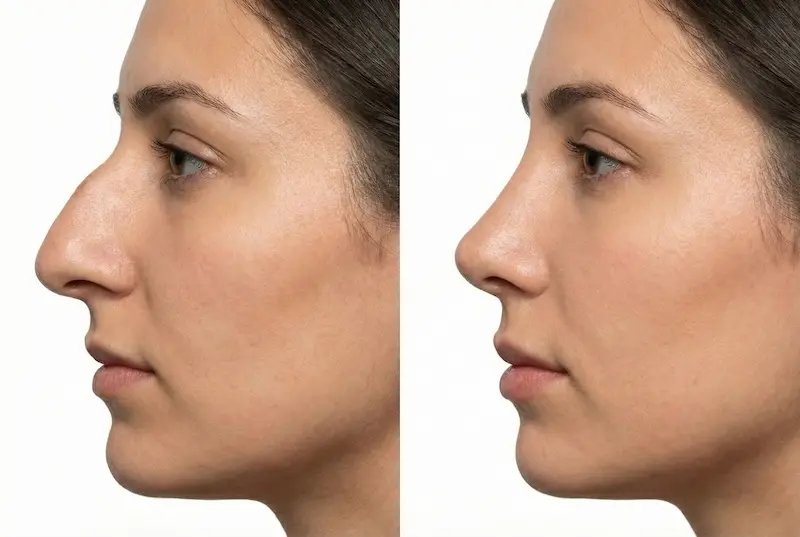
If you’ve been researching arched nose surgery Turkey, you’re likely not looking for a “new face”—you want a smoother profile that still looks like you. Aquiline (arched) noses—often described as a Roman nose or hooked nose—can be beautifully strong and distinctive. But when the dorsal bridge feels too prominent in photos, especially in side-profile shots, many patients explore dorsal hump removal Turkey options to refine the bridge while preserving identity.
This guide is written for the “expert patient”: someone who wants to understand the science behind outcomes, the surgical logic, and the trade-offs. We’ll cover candidacy, technique options (including preservation rhinoplasty Turkey), recovery, and how to judge results realistically—so you can make a confident, informed decision about aquiline rhinoplasty Turkey and related approaches.
Secondary keywords we’ll naturally address throughout: Turkey arched nose surgery, aquiline nose surgery Turkey, arched nose plastic surgery Turkey, aquiline nose correction Turkey, aquiline rhinoplasty Turkey, dorsal hump removal Turkey, dorsal hump rhinoplasty Turkey, roman nose surgery Turkey, hooked nose surgery Turkey, preservation rhinoplasty Turkey.
Table of Contents
What Is an Aquiline (Arched) Nose—and What “Correcting the Hump” Really Means
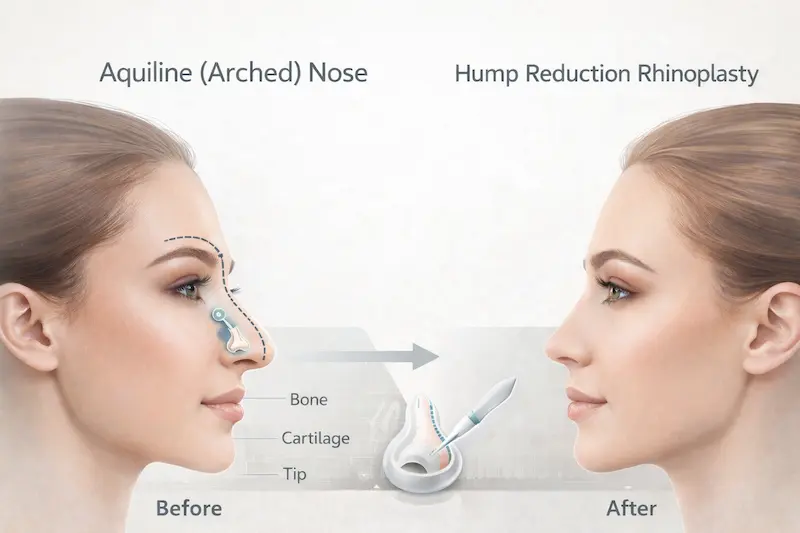
An aquiline (arched) nose typically refers to a bridge that curves outward—creating a pronounced profile line. In aesthetic terms, many patients aren’t trying to erase the entire bridge; they want a refined transition from the nasal bones to the tip, with a smoother dorsal line. That’s the core goal of aquiline nose correction Turkey and dorsal hump rhinoplasty Turkey: reducing the hump in a controlled way while keeping the nose structurally stable and natural-looking.
Aquiline vs. dorsal hump: definitions patients confuse
Patients often use “aquiline,” “Roman,” “hooked,” and “hump” interchangeably. Clinically, a dorsal hump is a localized prominence on the bridge (dorsum), while “aquiline/Roman/hooked” describes the overall profile shape. You might have a small hump but a strong tip, or a larger bony-cartilaginous hump with otherwise balanced features. That distinction matters because the best plan for roman nose surgery Turkey may differ from a straightforward hump reduction case.
Common causes (bone vs cartilage vs both)
A dorsal hump can be primarily bony (upper bridge), primarily cartilaginous (mid-bridge), or a combination. This is why two people can ask for “the same” arched nose plastic surgery Turkey result but need different surgical steps. Bone-dominant humps may require precise reshaping and controlled narrowing; cartilage-dominant humps may need careful contouring and support to prevent irregularities. In medical science terms, stable long-term outcomes depend on respecting anatomy and preserving structural support—especially in the mid-vault area.
What a “natural profile” means (not over-scooped, not “done”)
Many patients fear the “ski-slope” look—an overly concave bridge that can appear artificial. A natural outcome usually means a smooth, elegant dorsal line that matches your facial proportions, without collapsing the bridge or over-rotating the tip. The best aquiline nose surgery Turkey planning aims for refinement—not a trendy template—so your profile looks harmonious from multiple angles, not just the side view.
The 3 Profile Goals Patients Usually Want (And How Surgeons Plan Them)
Most patients exploring Turkey arched nose surgery share a similar wish list, but the safest results come from turning those wishes into a concrete surgical plan. In practice, surgeons map the bridge, tip, and overall facial balance. This is where scientific research and experience meet: changing one part of the nose affects light reflection, angles, and perceived symmetry—so planning must be three-dimensional, not “hump-only.”
Smoother dorsum without flattening the nose
The goal in dorsal hump removal Turkey is often a smoother dorsum (bridge line) while keeping enough height to avoid a “flattened” or weak profile. Over-resection can lead to an unnatural concavity and may increase the risk of irregularities. A balanced reduction focuses on creating a clean line that still fits your face—especially important for patients who like the strength of their profile but want less prominence.
Maintaining identity: keeping character while refining
Many patients pursuing hooked nose surgery Turkey or roman nose surgery Turkey are not trying to look like someone else. “Identity-preserving” refinement usually means reducing the hump and subtly optimizing the tip support so the nose looks elegant and intentional—without losing character. The most satisfying outcomes typically come from aligning expectations early: what “refined” means to you, what you want to keep, and what you truly want changed.
Balancing the hump with tip + chin (full-profile harmony)
In profile aesthetics, the hump is only one element. A slight tip adjustment or improved tip support can make the bridge look smoother even with a conservative reduction. Likewise, chin projection impacts how prominent the nose appears from the side. This is why consultations for aquiline rhinoplasty Turkey often include full-profile assessment: small, strategic changes can deliver a bigger “wow” than aggressive hump removal.
Am I a Good Candidate for Hump Reduction Rhinoplasty?
Most patients considering aquiline nose surgery Turkey are good candidates if they’re healthy, have stable facial growth (usually after the late teens), and have clear, realistic goals. But “candidate” isn’t just about wanting a smaller hump—excellent outcomes depend on anatomy (bone/cartilage), skin quality, and whether breathing function must be protected or improved. A careful evaluation helps tailor the plan for dorsal hump rhinoplasty Turkey so the bridge looks smoother without compromising structure.
Skin thickness and why it changes the outcome
Skin thickness influences how sharply the new bridge definition shows and how forgiving the surface looks during healing. Thicker skin may mask tiny imperfections but can also soften definition; thinner skin can reveal refined contours but may show small irregularities more easily. This is a key “expert patient” point: the same arched nose plastic surgery Turkey technique can look different depending on skin and soft tissue behavior. Your surgeon’s plan should match your skin type, not fight it.
Breathing / functional concerns that must be evaluated
Many people focused on profile aesthetics still have underlying functional issues—septal deviation, internal valve weakness, or turbinate problems—that affect airflow. The best approach integrates form and function so you don’t end up with a prettier nose but worse breathing. If you have nighttime congestion, mouth breathing, exercise intolerance, or prior trauma, your consultation for aquiline rhinoplasty Turkey should explicitly address function, not treat it as an afterthought.
Realistic expectations: what surgery can and can’t change
Rhinoplasty can refine the bridge and improve the profile significantly, but it won’t make skin behave like a different person’s skin, and it can’t guarantee “perfect symmetry” from every angle. A medically sound plan uses measurable goals (bridge smoothness, nasal width, tip support) rather than vague promises. In the spirit of science and evidence-based planning, you want a surgeon who explains trade-offs clearly—especially if you’re choosing between conservative refinement versus more dramatic reshaping in roman nose surgery Turkey or hooked nose surgery Turkey cases.
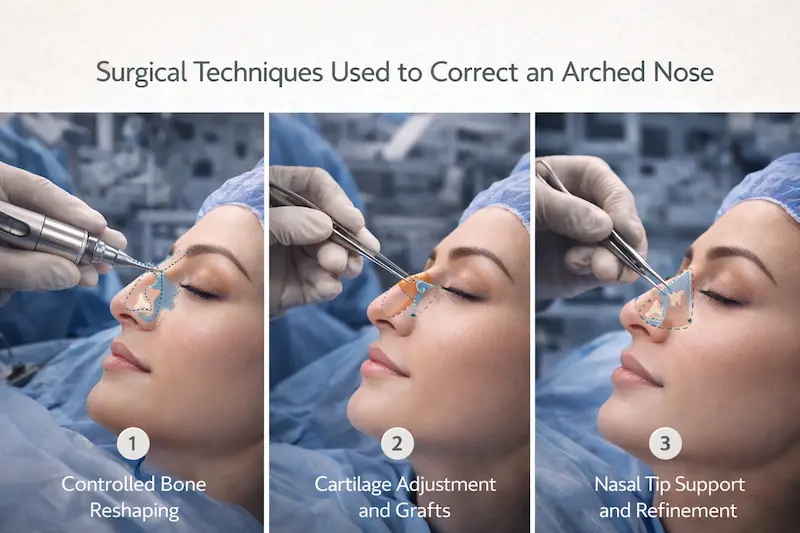
Surgical Techniques Used to Correct an Arched Nose
Correcting an aquiline profile can be done with different techniques, and “best” depends on your anatomy and goals. Some patients do well with a traditional hump reduction; others benefit from preservation rhinoplasty Turkey approaches designed to maintain more of the natural dorsum structure. In skilled hands, both can produce natural results—what matters is selecting the right method, then executing it precisely and conservatively.
Open vs. closed approach: when each is chosen
Closed rhinoplasty uses internal incisions and can be ideal for carefully selected cases where bridge work is straightforward and tip adjustments are limited. Open rhinoplasty uses a small external incision (typically on the columella) and provides more visibility—often helpful when more complex refinement, structural support, or asymmetry correction is needed. Many patients researching Turkey arched nose surgery assume “closed is always better,” but the right choice is the one that improves precision and long-term stability for your specific nose.
Preservation rhinoplasty vs. traditional hump reduction
Traditional hump reduction typically involves removing the hump directly and then reconstructing/narrowing the nasal bones and mid-vault as needed to keep the bridge stable. Preservation rhinoplasty Turkey techniques aim to keep the dorsal surface more intact by lowering the bridge “as a unit” (depending on anatomy), which can help maintain a natural dorsal aesthetic line in select patients. The key is candidacy: preservation is not automatically appropriate for every dorsal hump, especially when the hump shape, septal anatomy, or desired changes require more direct reshaping. A good consultation for aquiline nose surgery Turkey will explain why one approach fits your anatomy better.
Osteotomies (narrowing) & dorsal refinements: what they do
After hump correction, the nasal bones may need controlled repositioning (often called osteotomies) to close any “open roof” effect and refine width. This step is where precision matters: done thoughtfully, it creates a smoother bridge and harmonious width; done aggressively, it can lead to over-narrowing or instability. Dorsal refinements may also include careful smoothing and contouring to reduce irregularities—especially important for patients pursuing dorsal hump removal Turkey who want a clean profile line without looking over-operated.
Safety & Precision: Technologies That Reduce Trauma and Improve Predictability
Patients considering aquiline nose surgery Turkey often have two non-negotiables: safety and natural-looking outcomes. Beyond technique selection (traditional vs preservation rhinoplasty Turkey), modern tools can improve precision, reduce unnecessary trauma, and support clearer communication about realistic outcomes. While tools never replace surgical skill, they can meaningfully enhance planning and execution—especially for bridge work like dorsal hump rhinoplasty Turkey.
Piezotome (ultrasonic rhinoplasty): why bruising/swelling can be less
Ultrasonic instruments (commonly called “piezotome”) can allow more controlled bone work compared to traditional tools in certain steps, which may translate to less soft-tissue disruption in appropriate cases. For patients focused on a smoother bridge line and refined nasal bones after dorsal hump removal Turkey, precision matters: the goal is to shape and reposition bone in a way that supports a stable, symmetric dorsal aesthetic line.
3D imaging and objective planning: aligning goals and realistic outcomes
Many “botched” outcomes start as a communication problem: the patient imagines one change, the surgeon plans another. 3D analysis and structured photo planning can help translate your goal (“reduce the hump but keep my identity”) into measurable targets. The more you can discuss angles, proportions, and limits upfront, the less likely you are to feel surprised later. This is where scientific research principles—clear variables, clear constraints, and repeatable planning—apply to aesthetic medicine.
Surgical standards & patient care systems: what “safe” actually looks like
Safety isn’t a marketing word; it’s a system: pre-op evaluation, anesthesia protocols, sterile technique, and post-op monitoring. When researching Turkey arched nose surgery, look for surgeon-led evaluation, transparent risk discussion, and structured follow-up. For international patients, logistics also matter (who you contact after hours, how swelling is monitored, when you’re cleared to fly). These details often separate a smooth experience from a stressful one.
Surgeon Expertise Matters More in “Simple Humps” Than People Think
A dorsal hump can look “simple” from the outside, but the surgical challenge is maintaining stability and natural proportions after changing the bridge. The highest satisfaction outcomes in aquiline rhinoplasty Turkey tend to come from conservative, structural thinking: refine what’s prominent, preserve what supports the nose, and avoid over-resection that can create long-term functional or aesthetic issues.
The intersection of function and aesthetics
For many patients pursuing aquiline nose correction Turkey, the best result is both beautiful and breathable. The bridge and the internal nasal valves are connected anatomically; changes to the dorsum can influence airflow. A surgeon who evaluates function as part of the aesthetic plan is more likely to protect your breathing and reduce revision risk—especially if you already have congestion, prior trauma, or septal deviation.
Why detailed structural planning prevents “over-resection”
Over-resection is one of the most common pathways to an unnatural, “operated” look: an overly scooped bridge, pinched mid-vault, or loss of dorsal support. Good planning for dorsal hump rhinoplasty Turkey considers how much reduction is needed to meet your goal while keeping the mid-vault stable and the tip supported. The aim is a smooth line that’s consistent in different lighting and angles—not just a dramatic change on day one.
Choosing a rhinoplasty team: what to ask in consultation
- How will you decide between preservation rhinoplasty and traditional hump reduction?
- What do you do to protect breathing (septum/valves) during dorsal work?
- How do you manage mid-vault support after hump reduction?
- What is your strategy to avoid an over-scooped “ski-slope” look?
- What does follow-up look like for international patients?
These questions help you evaluate whether your surgeon’s approach aligns with the principles behind reliable outcomes in medical science: anatomy-first decision-making, risk mitigation, and clear postoperative protocols.
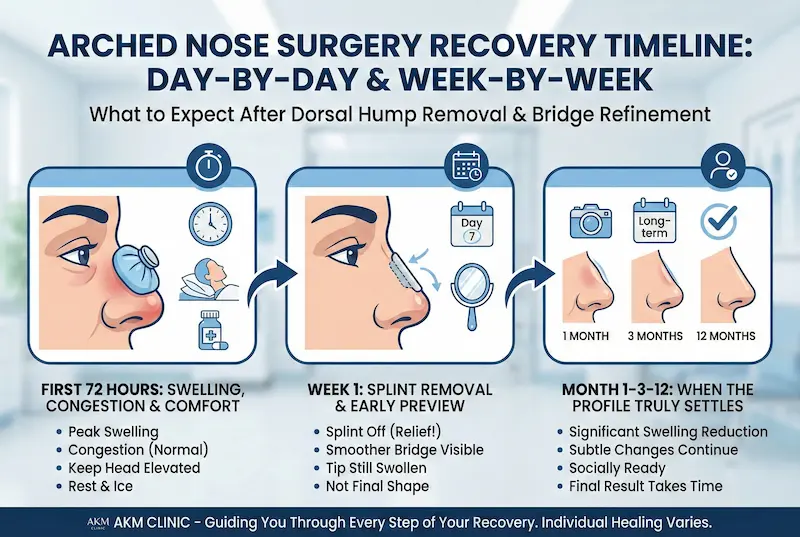
Recovery Timeline: What to Expect Day-by-Day and Week-by-Week
Recovery after arched nose surgery Turkey is a process—swelling and congestion are normal, and the “final” profile takes time. Understanding the timeline helps you plan travel, work, and social commitments realistically. While individual healing varies, the milestones below reflect what many patients experience after dorsal hump removal Turkey and bridge refinement procedures.
First 72 hours: swelling, congestion, and comfort
The first few days are usually about swelling control and rest. You may feel congested, especially if internal swelling is significant or functional work was done. Keeping your head elevated, following medication instructions, and avoiding strenuous activity can make this phase easier. Bruising varies by technique and anatomy, but it’s common to have some around the eyes and upper cheeks.
Week 1: splint removal and the “early preview”
Many patients feel relief when the external splint comes off, but it’s important to interpret what you see correctly. The bridge may look smoother, yet the tip and mid-vault can still be swollen. Early results are a preview—not the final shape. This is where patients sometimes panic and overanalyze tiny asymmetries that typically settle with time, especially after dorsal hump rhinoplasty Turkey where swelling distribution can be uneven.
Month 1–3–12: when the profile truly settles
Swelling reduces significantly over the first 4–6 weeks, but refinement continues for months. Most people feel “socially ready” within a few weeks, yet subtle changes can continue up to a year (sometimes longer) depending on skin thickness and the extent of structural work. If you’re comparing before-and-after photos, remember: the nose can look different in varied lighting and angles even at the same healing stage—so evaluate progress with consistent photos and professional guidance.
“Before & After” Thinking: How to Judge Results Like an Expert Patient
When you’re investing in aquiline nose surgery Turkey, judging results “like an expert patient” means looking beyond a single perfect side-profile photo. The nose is a 3D structure that changes with lighting, lens distortion, swelling stage, and facial expression. A reliable evaluation approach is grounded in scientific research principles: use consistent conditions, compare the same angles, and interpret changes over time—not just at day 7 or week 2.
The 5 angles that matter (profile, oblique, front, base, smile)
- Profile: The dorsal line and hump refinement (key for dorsal hump removal Turkey).
- Oblique (3/4 view): Often the most “real life” angle; reveals subtle contouring.
- Frontal: Width, symmetry, and whether the nose still fits your face.
- Base (nostril view): Tip support, nostril symmetry, and columella alignment.
- Smile view: Dynamic movement—important for natural appearance and tip support.
For Turkey arched nose surgery planning, reviewing these angles helps prevent a common mistake: optimizing the side profile at the cost of front-view harmony.
What “good hump correction” looks like (smooth dorsum + stable tip)
A strong result in dorsal hump rhinoplasty Turkey usually shows a smooth, continuous dorsal aesthetic line without harsh steps, shadows, or “dents.” Equally important: the tip looks supported and stable—not droopy, not over-rotated, and not pinched. In many aquiline cases, the best-looking outcome is a refined profile, not an aggressively concave bridge. That’s why aquiline nose correction Turkey should be evaluated for balance and stability as much as for “hump reduction.”
Red flags in photos (over-scooping, pinching, asymmetry cues)
- Over-scooping: Excessive concavity on the bridge (“ski-slope” look).
- Mid-vault pinching: The area between the nasal bones and tip looks too narrow, often paired with breathing complaints.
- Harsh shadows/lines: Can signal dorsal irregularities (especially in thinner skin).
- Front-view imbalance: A profile improvement that creates an unnatural narrowness or twist from the front.
Some early “red flags” are simply swelling patterns, so timing matters. A key expert-patient rule: judge final contour only after adequate healing milestones, not during peak swelling.
Aquiline Nose Surgery Cost in Turkey—and What’s Typically Included
Pricing for arched nose plastic surgery Turkey varies based on complexity, whether functional breathing work is needed, and whether the case involves prior trauma or revision risk. Rather than chasing the lowest quote, evaluate value: surgeon expertise, safety systems, and what the package truly includes. For patients comparing aquiline nose surgery Turkey options, “included services” can be as important as the headline number.
What drives price (complexity, functional work, revision risk)
Bridge-only refinement may be less complex than a case requiring septal correction, valve support, significant narrowing, or tip restructuring. Functional steps (breathing-related) can add complexity. Likewise, revision-risk features—very thin skin, notable asymmetry, or unstable support structures—may require more advanced planning and surgical time. This is why two quotes for dorsal hump removal Turkey can differ significantly even if both patients say, “I just want my hump gone.”
What “all-inclusive” should include to avoid hidden costs
- Pre-operative assessment and imaging/photo analysis
- Anesthesia and operating room fees
- Hospital/clinic stay details (if applicable)
- Medications and post-op supplies (as specified)
- Scheduled follow-up visits and clear travel guidance
- Support plan for international patients (contact pathway, after-hours support)
If you’re considering aquiline rhinoplasty Turkey, ask for a written inclusions list. Hidden costs typically come from unclear anesthesia/hospital fees, extra imaging, or add-on functional work not discussed upfront.
Why patients travel (value without compromising standards)
Many international patients pursue roman nose surgery Turkey or hooked nose surgery Turkey because they want strong surgeon expertise and comprehensive care at a better overall value than some high-cost markets. The smart strategy is to compare like-for-like: surgeon credentials, facility standards, aftercare, and revision policies—not just price. In evidence-based terms, a lower upfront cost that increases revision probability is not “value.”
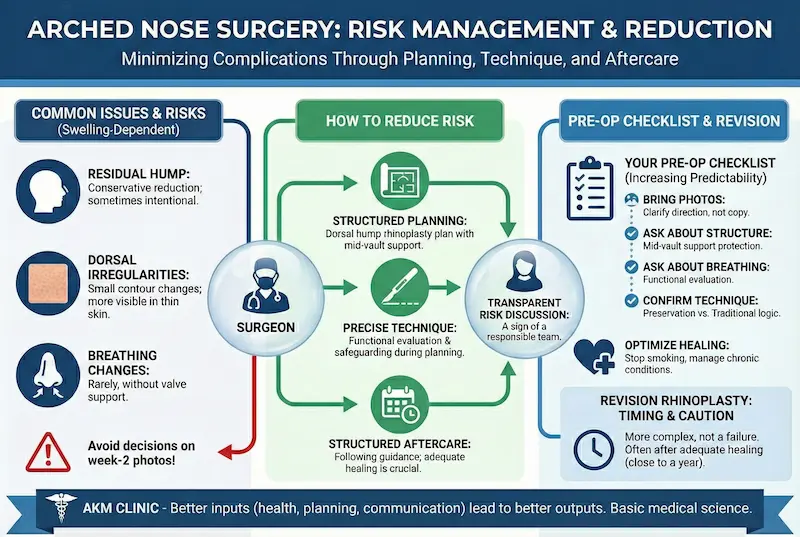
Risk Management: Complications, Revisions, and How to Reduce Risk
Every surgical procedure has risks, and rhinoplasty is no exception. The goal is not to pretend risks don’t exist—it’s to reduce them through proper candidacy selection, precise technique, and structured aftercare. Patients seeking aquiline nose surgery Turkey often worry about being “botched.” Most preventable issues relate to over-resection, inadequate structural support, weak communication, and poor follow-up. A transparent risk discussion is a sign of a responsible surgical team.
Common issues: residual hump, irregularities, breathing changes
- Residual hump: A conservative reduction may leave a mild prominence; sometimes intentional to preserve natural identity.
- Dorsal irregularities: Small contour changes can appear as swelling resolves, especially in thin skin.
- Breathing changes: Rarely, aesthetics-first planning without valve support can worsen airflow.
These risks can be reduced by a structured plan for dorsal hump rhinoplasty Turkey, including mid-vault support strategies and functional evaluation when needed.
Revision rhinoplasty: when it’s needed and timing
Revision is not automatically a “failure,” but it is more complex than primary surgery and should be approached cautiously. Many concerns early on are swelling-related; true structural assessment takes time. In general, surgeons prefer allowing adequate healing before considering revision planning (often close to a year, depending on the issue). If you’re evaluating aquiline nose correction Turkey outcomes, avoid making major decisions based on week-2 photos.
Your pre-op checklist: questions to ask, photos to provide, health optimization
- Bring reference photos: Not to copy a nose, but to clarify the direction (refined vs dramatic).
- Ask about structure: How will mid-vault support be protected after hump reduction?
- Ask about breathing: How will function be evaluated and safeguarded?
- Confirm technique logic: Why preservation rhinoplasty Turkey vs traditional (or vice versa) for your anatomy?
- Optimize healing: Stop smoking, manage chronic conditions, and follow pre-op medication guidance.
Taking these steps increases predictability—because better inputs (health, planning, communication) often lead to better outputs. That’s not marketing; it’s basic medical science.
Frequently Asked Questions (FAQ): Arched Nose Surgery Turkey
This FAQ is designed for patients comparing aquiline nose surgery Turkey options and trying to avoid common pitfalls (unnatural bridge lines, breathing issues, or rushed decision-making). The answers are intentionally practical and based on how experienced rhinoplasty surgeons plan and manage risk—because good outcomes are not luck; they’re process.
Will removing a hump make my nose look too small?
Not if the plan is proportion-based. The safest approach is usually a measured dorsal refinement—enough to smooth the profile but not so much that the bridge looks collapsed. In many cases, a conservative dorsal hump removal Turkey plan plus tip support delivers a bigger improvement than aggressive reduction.
Can a hump be corrected without breaking the nose?
Sometimes. Some cases can be managed with limited bone work, especially if narrowing isn’t needed. But if the nasal bones must be repositioned to maintain a stable bridge shape after hump reduction, controlled osteotomies may be recommended. The goal is structure and symmetry, not “avoiding breaking” at all costs.
What if my hump is mostly cartilage vs mostly bone?
This changes technique. Bone-dominant humps often require precise bone reshaping and possible narrowing. Cartilage-dominant humps may require careful contouring and support to avoid visible irregularities. A proper consult for aquiline nose correction Turkey should clearly explain which component is driving your profile.
Will my breathing improve or worsen after surgery?
It depends on anatomy and whether functional issues (septum/valves) are addressed. A functional-first evaluation is key. AKM Clinic emphasizes the “intersection of function and aesthetics” in facial plastic surgery, including advanced rhinoplasty with functional focus and preservation techniques in complex cases.
How long do I need to stay in Istanbul for rhinoplasty?
Most international patients plan enough time for surgery, early follow-ups, and safe travel clearance. Your surgeon should provide a personalized timeline based on swelling risk, splint removal scheduling, and whether functional work was performed.
When can I fly back to the US?
Flight timing is individualized. In general, you’ll want surgeon clearance after early follow-ups and once swelling/stability are assessed. Ask your clinic to provide written guidance that accounts for your procedure details and health profile.
When will I look “socially ready” for photos or work?
Many patients feel presentable a few weeks after surgery, but swelling (especially at the tip and mid-vault) can persist and evolve for months. The “final” refinement can continue up to a year. Evaluate progress with consistent photos—this is basic scientific research logic applied to aesthetics: same angle, same lighting, same distance.
What’s the difference between preservation and traditional rhinoplasty for humps?
Preservation rhinoplasty Turkey approaches aim to keep more of the natural dorsal structure in suitable candidates, while traditional hump reduction removes the hump more directly and then reconstructs stability and shape. Neither is “always better”—the best method is the one that matches your anatomy and goals without increasing risk.
How do I avoid an over-scooped or “ski-slope” look?
Choose a surgeon who prioritizes identity-preserving refinement and explains their bridge plan in measurable terms (how much reduction, how mid-vault support is protected, how tip support is maintained). Over-scooping is often the result of over-resection and trend-driven planning rather than anatomy-driven planning.
What are the signs I might need a revision—and when is it too early to judge?
Early swelling can mimic asymmetry, irregularities, or “residual hump.” True revision assessment usually requires significant healing time. If a clinic pushes revision decisions too early, that’s a red flag. A responsible team will monitor healing over time and reassess once tissues stabilize.