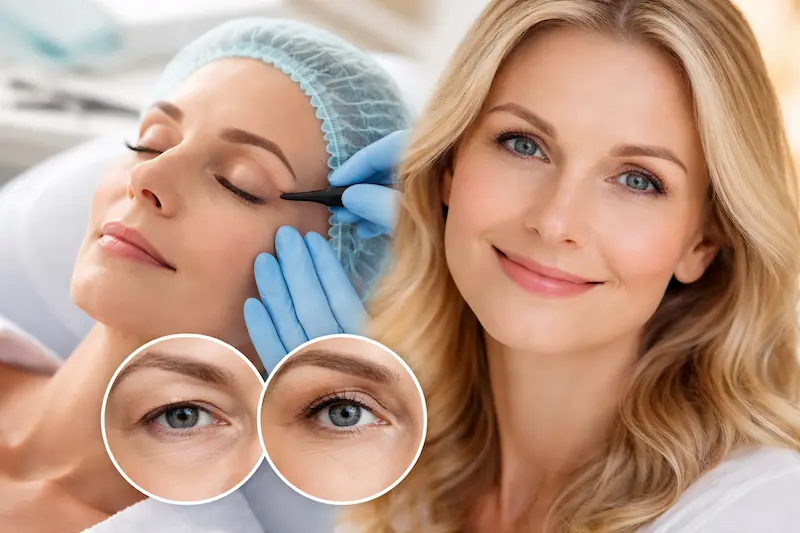
If you’re searching for natural looking facelift Turkey, you’re probably not looking for a “new face.” You’re looking for natural facelift outcomes that read as well-rested, not worked-on—the kind of natural facelift results that friends notice without being able to name the reason. Before reading the case-study breakdown below, it helps to see the surgical baseline that defines what we mean by “subtle” — our AKM Clinic’s complete facelift treatment program covers the technique families, anesthesia options, and recovery framework that make this kind of result reproducible rather than accidental.
“The goal is for people to notice you look refreshed—not that you had surgery.”
— Dr. Akif Mehmetoğlu, MD (Dermatosurgeon & Face Expert), AKM Clinic
In this case-study style breakdown, we’ll define what “subtle” actually means, how surgeons plan for it (diagnosis matters), and what patients should look for in before/after analysis—especially if your priority is natural looking facelift aesthetics rather than dramatic alteration.
- How “subtle facelift” results are created (and why “less surgery” isn’t the same as “more natural”).
- A real-world patient goal set: rejuvenation, not identity change.
- How AKM Clinic supports recovery with structured post-op care (including HBOT and LLLT).
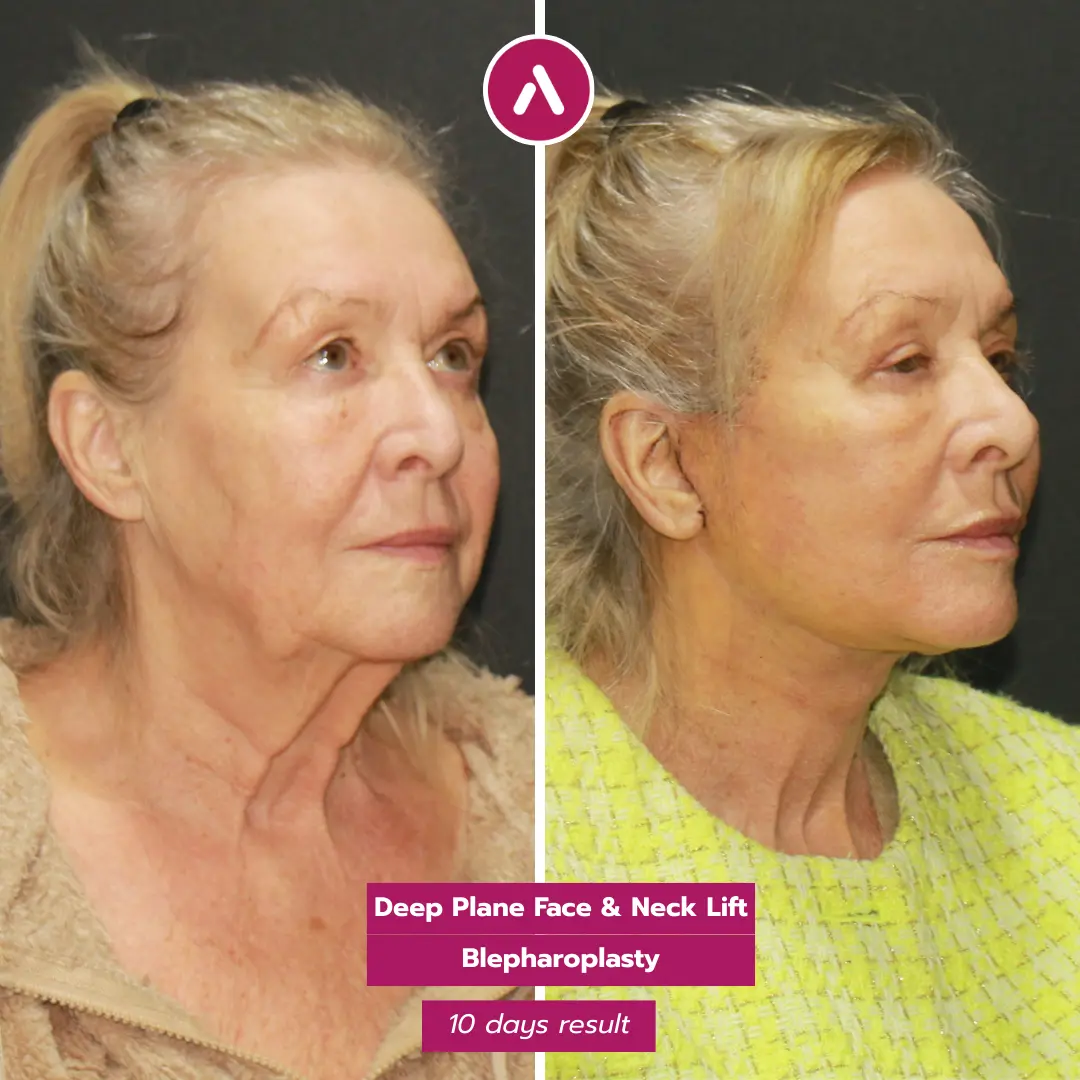
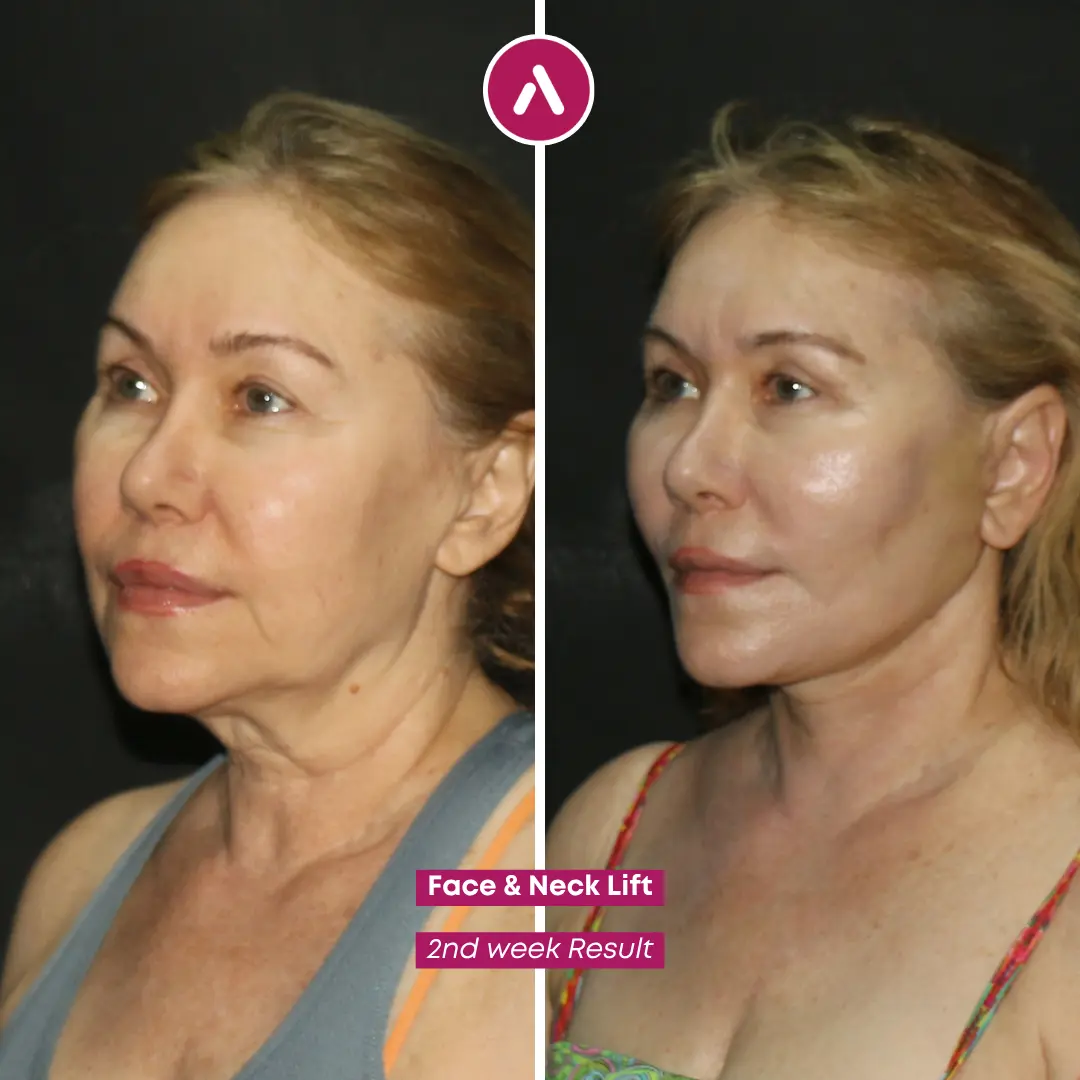
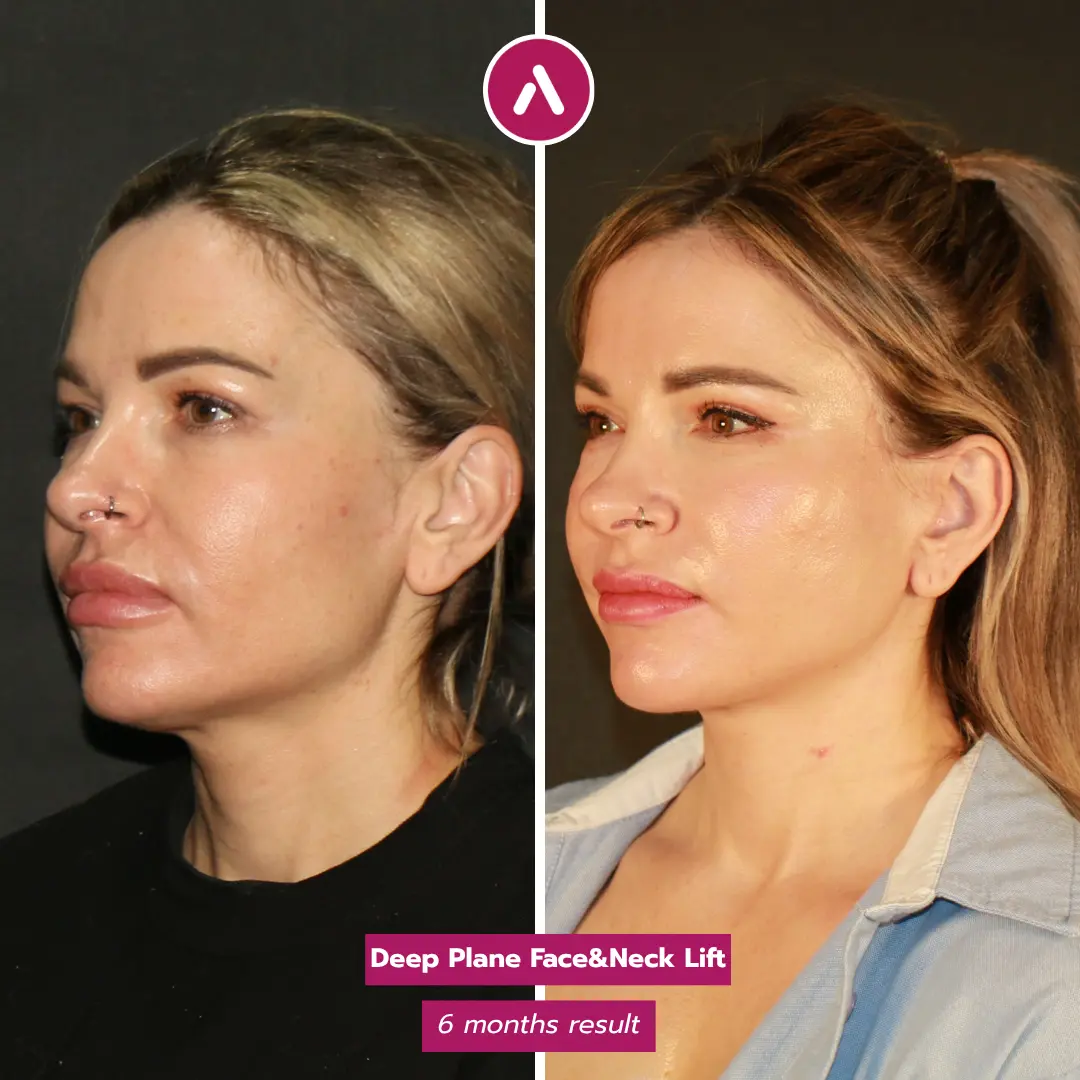
Table of Contents
What “Subtle” Facelift Results Actually Mean (natural looking facelift Turkey benchmark)
“Subtle” doesn’t mean “barely effective.” In modern facial rejuvenation, a subtle facelift is the result of correct structural correction with low-tension skin closure, so the face reads as younger—but still like you. This is what many patients describe as natural facelift results, and it’s exactly what terms like natural facelift, natural looking facelift in Turkey, and Turkey facelift natural results are trying to capture.
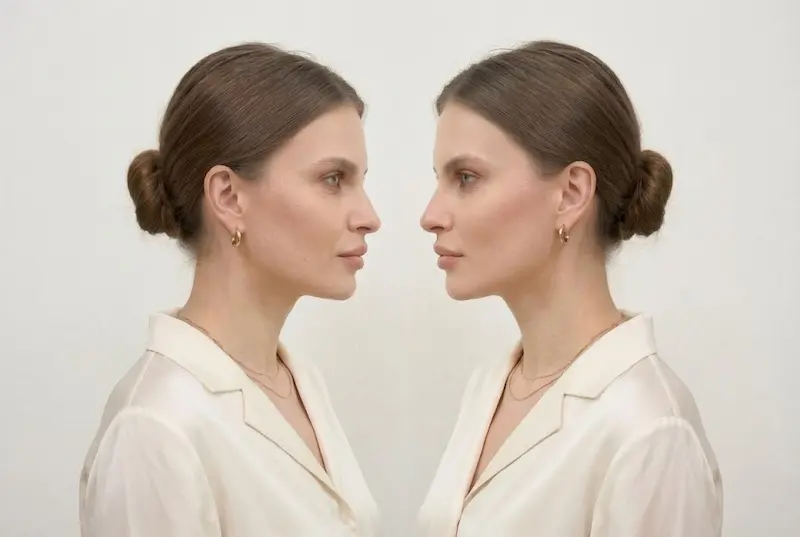
The difference between “refreshed” vs. “changed”
A refreshed look is typically about restoring facial architecture: cleaner jawline transitions, softened jowls, and a more defined neck angle—without changing the patient’s recognizable features. A “changed” look is often the byproduct of over-reliance on skin tightening (or incorrect vectors of pull) rather than deep support.
| Goal | What it looks like in real life | How it’s typically achieved |
|---|---|---|
| Rejuvenation (subtle) | “You look rested.” “Did you lose weight?” | Structural repositioning + low-tension closure |
| Alteration (overdone) | “Pulled” cheeks, distorted hairline/ears, tight smile | Excess skin tension / surface-level tightening emphasis |
Common signs of an overdone result (and how patients describe them)
Patients rarely say “over-resection” or “wrong vector.” They say:
- “Wind-swept” (pulled laterally)
- “Mask-like” (unnatural smoothness + reduced softness)
- “Not me” (identity shift rather than age reversal)
If your priority is subtle facelift results Turkey, your evaluation should focus on whether the face looks like it was repositioned (structural) rather than simply tightened (surface tension).
Why “subtle” is usually a structural goal—not a “less surgery” goal
Many “natural looking facelift outcomes require more precise work, not less—especially in the neck and jawline. A natural result is often created by correcting what actually descended (deep support layers) and then closing the skin without strain. This is the foundation of truly natural facelift results Turkey—results that look calm and undetectable.
Case Study Snapshot: Patient Goals, Fears, and the “Non-Negotiables”
To make “subtle” tangible, here’s the kind of goal set we see in an “expert patient” profile—someone who has researched extensively, compares results across countries, and wants measurable improvement without visible “surgery signals.” In AKM Clinic’s case-based outcomes analysis, one patient described her target as looking “well-rested,” not “surgically altered.” That sentence is the blueprint.
The patient’s main concerns (jawline, neck, midface, tired expression)
The most common “subtle rejuvenation” problem list is not one problem—it’s a pattern of descent:
- Jawline softening from jowl formation
- Neck laxity (loss of a clean neck angle; sometimes banding)
- Midface descent that can create a heavier or sad resting expression
In other words: patients aren’t asking to look different—they’re asking for their old structure back. That’s the core of natural facelift results.
The #1 fear: looking pulled, wind-swept, or “operated-on”
This fear is rational. Overdone results are typically associated with skin tension and the wrong direction of lift. If “subtle facelift Turkey” is your search term, you’re likely screening clinics for:
- Consistency of natural facelift outcomes across many before/after sets
- Neck and jawline improvements without “tight” facial expression changes
- Scar placement strategy and ear/hairline preservation
The success criteria: natural anatomy, invisible scarring, age-appropriate change
Here’s a practical checklist patients use when evaluating natural facelift results Turkey in real photos and videos:
- Anatomy stays believable: ears, hairline, smile, and eye shape look unchanged.
- Improvement is specific: jawline/neck angle is cleaner; cheeks look repositioned, not puffy.
- Scars “disappear” in context: placed strategically and expected to mature over time.
| Non-negotiable | Why it matters for subtlety | What to ask in consult |
|---|---|---|
| Low-tension closure | Reduces “pulled” look; supports natural expression | “How do you avoid skin tension and wind-swept appearance?” |
| Neck strategy | Neck often reveals surgery if under-treated | “How do you treat platysma/neck angle in my case?” |
| Scar plan | Subtle results fail if scars are obvious | “Where will my incisions be, and how do you manage scar maturation?” |
Surgical Diagnosis: Why Surface Tightening Fails for Natural Results
If your goal is a natural facelift—especially subtle facelift outcomes—your surgeon’s diagnosis matters as much as the technique. Many disappointing “operated-on” results don’t happen because the patient “wanted too much,” but because the plan targeted the wrong layer. When laxity and descent are treated like a skin problem alone, the skin becomes the main load-bearing structure—and that’s where the pulled, tight look can show up.
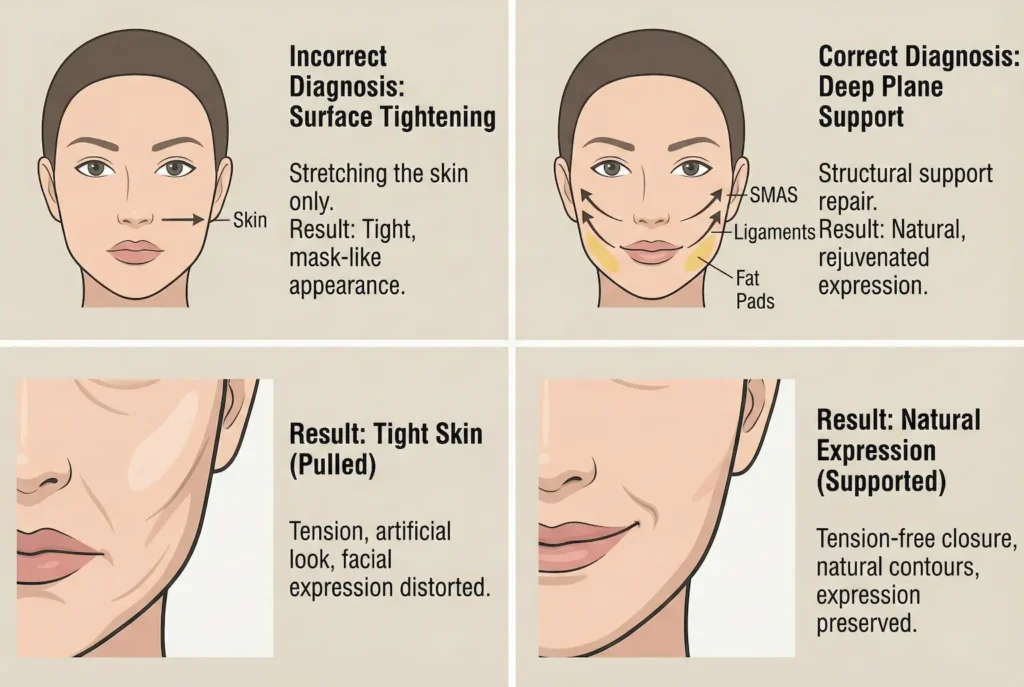
A 2025 systematic review and meta-analysis published in PubMed analyzing 47 studies and 10,766 facelift patients comparing SMAS and deep plane techniques reported a 94.4% patient satisfaction rate for deep plane approaches versus 87.8% for SMAS — confirming that where the correction is anchored (deeper layers vs. surface) materially affects how natural the result reads. Patients who want natural facelift results should understand this core principle: skin is the cover, not the foundation.
Subtle, natural-looking change is usually created by correcting deeper facial support and closing the skin with minimal tension.
Skin laxity vs. deeper descent (SMAS/ligaments/fat pads)
Aging typically involves a combination of:
- Skin laxity (loss of elasticity and collagen)
- Deeper layer descent (support structures and soft tissue shift)
- Volume and contour changes (some areas look heavier; others look deflated)
When a facelift plan treats the issue primarily as “extra skin,” the correction tends to rely on stretching the skin to create a result. That can look “tight,” especially in motion, and may compromise the goal of natural looking facelift aesthetics. By contrast, a plan designed for Turkey facelift natural results in the modern sense focuses on restoring support first, so the skin simply redrapes naturally.
| What you see | What it often means | What a “subtle” plan targets |
|---|---|---|
| Jowls + blurred jawline | Descent of support and soft tissue | Deeper repositioning + jawline definition |
| Neck laxity / poor neck angle | Layered laxity (skin + deeper structures) | Neck strategy that restores the angle, not just tightens skin |
| “Tired” or heavy lower face | Shift in facial balance and contour | Structural lift to restore a rested baseline |
How incorrect diagnosis leads to tension and unnatural contours
The most common pathway to unnatural results looks like this:
- The main issue is deeper descent (support shifts over time).
- The plan focuses heavily on skin tightening to “make it look better.”
- The skin becomes the primary structure holding the correction.
- As swelling resolves, the face can look tight, pulled, or “done.”
This is why patients specifically searching for subtle facelift Turkey should evaluate the clinic’s outcomes for natural facelift results in motion—not only still photos. A truly natural looking facelift in Turkey should preserve expression and identity, because the correction is built on support, not tension.
What “tension-free closure” means and why it matters for subtle outcomes
“Tension-free closure” is a simple concept with a huge impact: if deeper structures are properly supported, the skin can be closed without being “pulled” to do the heavy lifting. That matters for:
- Natural expression: less risk of a tight, overcorrected appearance
- Scar quality: lower tension can support better scar maturation over time
- Longevity: structural correction tends to maintain shape more reliably than skin tension
In practice, this is one of the key ingredients behind subtle facelift results Turkey patients describe as “no one could tell.” It’s also why “subtle” is not necessarily “minimal”—it’s strategic.
The Surgical Plan: Deep Plane Strategy for Natural, Long-Lasting Rejuvenation
A deep structural strategy (often discussed under “deep plane” principles) is designed to restore a youthful facial framework by addressing the deeper support system—so the skin can redrape naturally. The full surgical workflow — composite cheek flap dissection, midface ligament release, and SMAS-skin unit repositioning as one block — is documented on our deep plane facelift procedure page, which is also where you’ll find candidacy criteria, scar placement diagrams, and the longevity profile that distinguishes this approach from skin-only or standard SMAS lifts.
A subtle result is not “less correction.” It’s the right correction in the right layer—so the skin is not forced to pretend it’s a ligament.
Deep Plane facelift explained (vertical repositioning, not skin pulling)
A deep structural strategy (often discussed under “deep plane” principles) is designed to restore a youthful facial framework by addressing the deeper support system—so the skin can redrape naturally. For patients comparing subtle facelift Turkey options, the key concept is the direction and source of lift:
- Structural lift: the correction is built into deeper layers, reducing reliance on skin tension.
- Natural vectors: the face is repositioned in a way that respects how aging occurs (not just pulled to the side).
- Expression preservation: the goal is to look refreshed in motion, not just in still photos.
This is why patients often report “no one could tell, but everyone said I looked rested” after a truly natural facelift approach. It’s also one reason “natural facelift results Turkey” searches are so common: people want proof that the plan supports identity, not just tightness.
| Approach | Primary “holding” layer | How it can affect subtlety |
|---|---|---|
| Skin-dominant tightening | Skin | Higher risk of “pulled” look if skin bears the correction |
| SMAS-focused strategies | Support layer + skin redrape | Can improve naturalness when planned correctly |
| Deep structural (deep plane principles) | Deeper support with low skin tension | Often aligns with “rejuvenation not alteration” goals |
Neck refinement (e.g., platysma strategy) for a clean neck angle
If someone wants Turkey facelift natural results, the neck often determines whether the result reads as natural. Why? Because an under-treated neck can make the face look “done,” or simply leave the main complaint unchanged. A subtle plan frequently includes a tailored neck strategy, which may address neck angle definition, platysma-related changes, and harmony with the jawline.
When the neck issue is severe enough to warrant its own surgical plan rather than a facelift extension, our dedicated neck lift treatment in Istanbul walks through platysmaplasty steps, submental incision strategy, and the specific candidacy markers (heavy bands, deep cervicomental angle, isolated neck laxity) that make a standalone procedure the better choice.
- Neck angle definition (restoring a clean contour under the jaw)
- Platysma-related changes (when banding or laxity affects the neck profile)
- Harmony with the jawline (so the lower face and neck match in “age”)
In practical terms, many patients seeking subtle facelift results Turkey should ask a direct question: “What is your neck plan in my case?” A natural-looking outcome is often earned through the neck.
When combining procedures makes results look more natural (not “more done”)
It sounds counterintuitive, but combining the right procedures can sometimes make the final look more natural—not less. The reason is balance: if you correct one area aggressively while leaving adjacent areas untouched, the face can look uneven (and surgery becomes easier to detect).
A thoughtful plan may combine complementary steps when clinically appropriate, such as aligning:
- Jawline and neck correction (so the lower third reads as one cohesive unit)
- Midface support and lower-face refinement (so the face doesn’t look “separated” by age zones)
- Scar strategy and tissue handling (to prioritize healing and subtlety over dramatic early tightness)
For the “expert patient” who wants natural facelift results, the real question isn’t “Did they do more?” It’s “Did they do what was needed to make the changes look unforced?” That’s the difference between a visible facelift and a natural looking facelift.
“Subtle” Is Also Skin Quality: The Dermatosurgeon Advantage at AKM Clinic
When patients ask for a natural facelift—especially subtle facelift outcomes—the conversation often focuses on lift technique. But the “undetectable” factor is frequently decided by skin behavior: texture, thickness, elasticity, inflammation response, and how scars mature. That’s why a dermatosurgical lens can matter for patients prioritizing natural facelift results, including those comparing natural facelift results Turkey and searching specifically for natural looking facelift in Turkey.
A natural-looking result is a combination of correct structure and excellent skin healing—both must work together.
Why skin behavior (texture, laxity, healing) affects the final “natural” look
Two patients can have the same structural correction and still look different in the end because skin quality varies. For a natural looking facelift, the “subtlety layer” is often influenced by:
- Skin thickness: thinner skin can show swelling, bruising, and transitions more easily.
- Texture and elasticity: affects how smoothly skin redrapes after repositioning.
- Inflammatory tendency: impacts redness, swelling duration, and early “tightness” appearance.
- Scar biology: determines whether incisions fade quietly or remain noticeable longer.
This is one reason patients pursuing subtle facelift results Turkey should evaluate not only the “lift,” but also how consistently the clinic’s results show calm skin transitions, refined incision healing, and stable texture over time. In real life, truly Turkey facelift natural results look less like “tight skin” and more like a face that simply looks healthier and better supported.
How dermatosurgeon + facial plastic surgery teamwork supports harmony and scar quality
At AKM Clinic, facial rejuvenation is guided by a surgeon-led approach where a Dermatosurgeon & Face Expert brings deep expertise in facial aesthetics and dermatosurgery, alongside a Facial Plastic Surgeon with advanced training and board-level credentials in facial surgery. This dual-skill model — the foundation of AKM Clinic’s surgeon-led care philosophy — supports a key goal for the “expert patient”: achieving a natural looking facelift Turkey outcome that respects both form and tissue behavior. The about-clinic page details our credentialing standards, board memberships (ESCAD, ISD, Turkish Plastic Surgery Society), and the team structure behind every facelift plan.
In practice, teamwork matters for “subtle” because it helps align:
- Structural planning (how the face is repositioned for a natural vector)
- Skin management (how tissue is handled to support refined healing)
- Incision and scar strategy (so the final result is hard to detect)
If you’re screening for subtle facelift Turkey, a high-yield consultation question is: “How do you plan incisions and closure to minimize tension and optimize scar maturation in my skin type?” That question often reveals whether the clinic is truly targeting natural facelift results—not just immediate tightness.
Where patients usually notice the difference (midface transition, jawline, perioral area)
Most people don’t judge a natural facelift by how tight the skin is. They judge it by whether anything looks “off.” In subtle, high-quality results, the biggest “tells” are typically avoided in these zones:
- Midface transition: cheeks look supported without a “swept” direction.
- Jawline and neck harmony: the lower third looks cleaner, not over-tightened.
- Perioral area: natural movement is preserved (smile, speech, expression).
- Incision zones: ear and hairline anatomy remain believable and un-distorted.
This is why the best natural facelift results Turkey often feel “invisible”: the face looks younger, but the small identity-defining details remain intact. That’s the essence of subtle facelift results Turkey—rejuvenation without a signature.
Recovery as Part of the Result: The 14-Day Visibility Problem (and How AKM Addresses It)
If you want a natural looking facelift—especially subtle facelift outcomes—recovery is not a “side note.” It’s part of what your result looks like to the world in the first weeks. Many patients researching natural looking facelift in Turkey (or comparing subtle facelift Turkey options) have one practical question: “How soon can I look normal in public?”
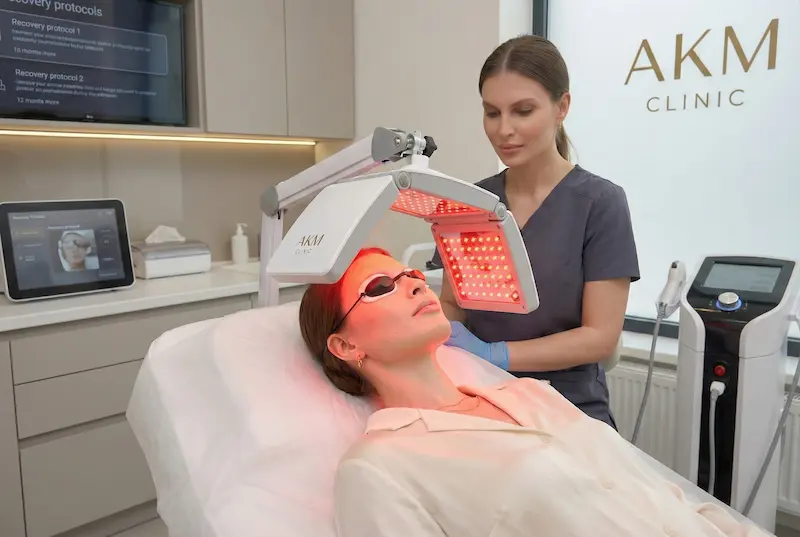
Here’s the reality: in the first 7–14 days, swelling patterns can temporarily exaggerate tightness or asymmetry, even when the plan is correct. That’s why AKM Clinic approaches recovery as an extension of the surgical strategy—supporting tissue healing and inflammation control with structured aftercare, including HBOT and LLLT protocols documented in our clinical technology and recovery standards page, which catalogs the equipment specifications, treatment session protocols, and safety certifications behind every post-op care plan.
What looks “too tight” early on (normal swelling patterns vs. real red flags)
A common fear for patients chasing natural facelift results is: “What if I look pulled?” In the early phase, some “tightness” can simply be post-op swelling and the way tissues settle. Early recovery can include:
- Swelling that changes daily (often shifting along the jawline and neck)
- Temporary firmness where deeper work was done
- Mild asymmetry that improves as inflammation resolves
However, you should also know what doesn’t fit the “normal healing” pattern and should be evaluated promptly:
- Rapidly increasing swelling on one side
- Severe, escalating pain that feels different from expected post-op discomfort
- Fever, spreading redness, or drainage suggestive of infection
- Sudden shortness of breath or chest symptoms (seek urgent care)
In subtle rejuvenation, the first two weeks can be emotionally “loud” even when the final result will be quiet and natural. Plan your calendar around swelling, not the finished outcome.
Accelerated healing protocols: HBOT + LLLT and what they’re intended to improve
AKM Clinic highlights two recovery-support technologies—Hyperbaric Oxygen Therapy (HBOT) and Low-Level Laser Therapy (LLLT)—as part of its post-operative care approach. The clinic positions HBOT as its “#1 safety promise” and presents both systems as tools designed to support healing and reduce downtime.
HBOT (Hyperbaric Oxygen Therapy)
In AKM Clinic’s framework, HBOT is used post-operatively with the intention of increasing oxygen availability in tissues during healing. The clinic describes key aims/benefits as:
- Tissue support: helping fragile, healing tissues receive enhanced oxygenation
- Reduced swelling & downtime: supporting inflammation control to potentially shorten “social downtime”
- Scar healing support: promoting favorable healing conditions for scar maturation
- Infection risk mitigation: supporting an environment that may help the body’s immune response
If you want to understand the underlying mechanism — how pressurized oxygen delivery influences fibroblast activity, collagen synthesis, and edema resolution at the cellular level — our deeper explainer on how Hyperbaric Oxygen Therapy supports surgical healing covers the science, session frequency, and patient eligibility criteria for post-facelift HBOT.
LLLT (Low-Level Laser Therapy)
AKM Clinic describes its LLLT system as a non-thermal light-based technology (not a heat-damage laser) used to support cellular activity. For facelift recovery specifically, it’s positioned to support:
- Cellular repair: assisting energy processes at the cellular level during healing
- Circulation and tissue recovery: supporting microcirculation and recovery conditions
- Reduced inflammation: working alongside HBOT to help diminish swelling and redness
For patients aiming for natural facelift results Turkey, these protocols matter because the “subtle look” often depends on how quickly swelling calms and how smoothly skin transitions settle. In other words: the best Turkey facelift natural results aren’t only created in the operating room—they’re protected during recovery.
A realistic timeline table: Day 1–7, Week 2, Month 1–3, Month 6–12
For patients aiming for natural facelift results Turkey, these protocols matter because the “subtle look” often depends on how quickly swelling calms and how smoothly skin transitions settle. In other words: the best Turkey facelift natural results aren’t only created in the operating room—they’re protected during recovery. Our practical guide on accelerating the first 14 days of facelift recovery with HBOT sessions details session timing (Day 1, Day 3, Day 7), expected swelling milestones with vs. without HBOT, and how to plan your in-country stay around treatment days.
| Timeframe | What you may experience | What “subtle/natural” looks like at this stage | Planning tip |
|---|---|---|---|
| Day 1–7 | Swelling, bruising, tightness, fatigue; daily changes common | Not representative of final result; “tight” can be swelling-driven | Assume you’ll want privacy and rest |
| Week 2 (Days 8–14) | Bruising often improving; swelling still present (especially jaw/neck) | Early “public-ready” for some patients with light makeup and styling | Many patients plan visibility around this window |
| Month 1–3 | Ongoing refinement; firmness softens; scars continue maturing | Face starts to read “refreshed” rather than “recovering” | Best window for professional photos/events begins to open |
| Month 6–12 | Scar maturation continues; contour and texture stabilize | Peak “undetectable” phase for many: natural facelift results | Evaluate your final outcome here, not at Week 2 |
If you want to see exactly what each of these timepoints looks like on a real patient’s face — Day 1 swelling, Day 7 bruising migration, Week 2 social readiness, Month 3 settling — our visual reference deep plane facelift recovery day-by-day photo journal documents the same patient across the entire 30-day window so you can calibrate expectations against actual healing rather than worst-case stock photos.
Results Analysis: How We Evaluate “Natural” in Before/After (Not Just Photos)
When patients search for natural facelift and natural looking facelift outcomes—especially natural looking facelift in Turkey—they often rely heavily on before/after galleries. That’s understandable, but it’s also risky: photos can be misleading if the evaluation is not structured. To practice the structured evaluation framework described in this section, our curated deep plane facelift before-and-after case archive presents each case at multiple timepoints (1 month, 3 months, 6+ months) and across angles, so you can apply the jawline/neck/expression/scar audit on real outcomes rather than highlight reels.
A more reliable way to judge natural facelift results (including natural facelift results Turkey and Turkey facelift natural results) is to analyze multiple signals across timepoints: contour, expression, scar behavior, and how the result looks in motion—not only the “best after” photo. This section gives you a practical “results audit” you can use to screen for subtle facelift results Turkey.
Natural results are not one photo. They are consistency across angles, expressions, and time.
Structural markers: jawline definition, jowl correction, neck angle
If the surgical plan is truly built for subtle facelift rejuvenation (not surface tightening), improvements tend to appear as cleaner structure, not “stretched skin.” Look for:
- Jawline clarity: reduced jowling, smoother mandibular border, better definition without sharp “cut lines.”
- Neck angle improvement: a more defined cervicomental angle (the transition under the chin) without a “tight collar” look.
- Harmony between face and neck: the lower face and neck should look the same “age,” not mismatched.
These are the core visual markers of natural facelift results because they reflect correct repositioning and support—not tension.
Expression markers: “rested” eyes/cheeks without distortion
A natural looking facelift should preserve identity in motion. Still photos can hide distortion, but expressions reveal it. When evaluating subtle facelift Turkey outcomes, pay attention to:
- Smile: does the smile look familiar and symmetric, or “tight” and restricted?
- Cheek transitions: is the midface supported in a natural direction, without a swept or “over-lifted” contour?
- Ear/hairline anatomy: are the ears and hairline preserved without visible traction changes?
Patients who love their natural facelift results Turkey often describe the result as “I look like myself—just less tired.” That “myself” component is best judged in expression and movement.
Longevity markers: why deep structural correction tends to hold up better
Longevity isn’t only about how long you look “tight.” It’s about how long your face maintains its balanced architecture. The most stable natural facelift results tend to show:
- Stable jawline contour rather than early relapse of jowls
- Neck refinement that remains coherent with the jawline over time
- Scars that continue to mature quietly as months progress
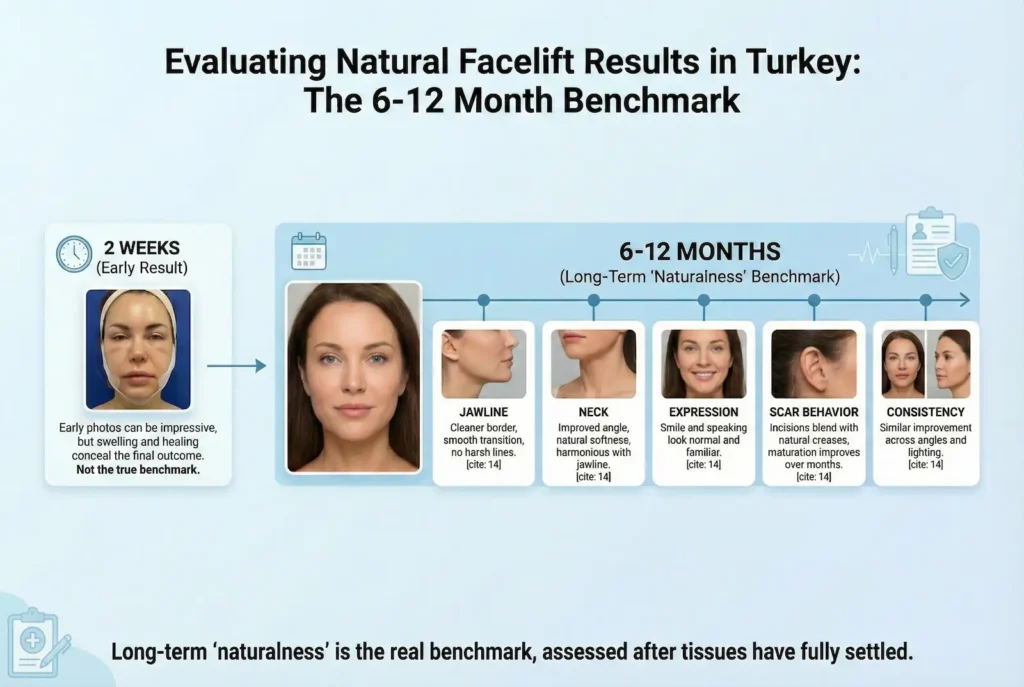
This is why the best Turkey facelift natural results are usually assessed closer to the 6–12 month window, not at 2 weeks. Early photos can be impressive, but long-term “naturalness” is the real benchmark.
| What to evaluate | What “natural” looks like | What can be a red flag |
|---|---|---|
| Jawline | Cleaner border, smooth transition, no harsh lines | Over-sharp edges, “pulled” look, tension cues near ears |
| Neck | Improved angle, natural softness, harmonious with jawline | Neck under-corrected (main complaint unchanged) or overly tight |
| Expression | Smile and speaking look normal and familiar | Restricted smile, unnatural cheek sweep, “mask-like” motion |
| Scar behavior | Incisions blend with natural creases; maturation improves over months | Widening scars, distortion of ear/hairline, persistent obvious incision lines |
| Consistency across photos | Similar improvement across angles and lighting | Only one “perfect” angle; inconsistent outcomes across views |
Frequently Asked Questions (FAQ): Natural Looking Facelift Turkey
Below are the questions “expert patients” most often ask when they want a natural facelift—especially a natural looking facelift in Turkey—with an outcome that feels like rejuvenation, not alteration. These answers are intentionally practical and concise, so you can use them as a consultation checklist.
What is the most natural-looking facelift technique in Turkey?
The most natural looking facelift outcomes typically come from plans that prioritize deeper support (structural correction) and low-tension skin closure, rather than relying on skin tightening alone. If you’re comparing options for natural looking facelift in Turkey, focus less on the label and more on whether the surgeon explains (1) what layers will be addressed, (2) the lift direction (vector), and (3) how they prevent a “pulled” look.
How do I avoid looking “pulled” or “wind-swept”?
To minimize the risk of a “pulled” look, the plan should avoid making the skin the primary load-bearing structure. Ask directly about tension-free closure, incision placement strategy, and how the deeper layers are supported. Also evaluate results in motion (smiling/talking videos when available), because truly natural facelift results stay believable during expression.
How long until I look normal in public after a facelift?
Many patients feel “public-ready” somewhere around 10–14 days, but this varies by swelling tendency, skin type, and the extent of neck work. Even when the end goal is subtle facelift, early swelling can temporarily exaggerate tightness. For subtle facelift Turkey travel planning, it’s wise to reserve a buffer so you’re not forced into social visibility too soon.
Can you get subtle results if you have significant jowls or neck laxity?
Yes—often that’s exactly when “subtle” matters most. Significant jowls or neck laxity can look unnatural if treated as a skin-only issue. When deeper support and the neck plan are handled correctly, you can still achieve natural facelift results Turkey that look calm and age-appropriate rather than “tight.”
What should I ask in a consultation to confirm a “rejuvenation not alteration” plan?
"Which layers will you correct, and why?" (structure vs. surface)
"How do you avoid skin tension and a wind-swept look?"
"What is your neck strategy in my case?"
"Where will my incisions be, and how do you support scar maturation?"
"What should I expect at 2 weeks vs. 3 months vs. 12 months?"
If the answers are clear, anatomy-based, and aligned with tissue healing—not vague promises—you're closer to the kind of natural facelift outcome you're seeking. The five questions above are technique-focused; for a deeper screening checklist focused specifically on the surgeon (not the clinic), our companion guide on how to evaluate a deep plane facelift surgeon's credentials and case portfolio covers fellowship verification, ISAPS membership lookup, and the specific case-volume thresholds that separate occasional practitioners from true deep-plane specialists.
What are red flags in before/after photos that suggest an overdone approach?
Only one “perfect” angle (no consistent improvement across views)
Hairline/ear distortion or visible traction cues
Overly sharp, “carved” contours that don’t match natural anatomy
A frozen or restricted-looking smile
If you’re aiming for Turkey facelift natural results that feel invisible, consistency across timepoints and expressions matters as much as the “after” photo.
How long do natural facelift results typically last?
A facelift does not stop aging, but well-planned structural rejuvenation can provide long-lasting improvement. Durability depends on factors like skin quality, lifestyle, and the surgical plan (especially neck and lower-face support). For patients prioritizing natural facelift results, the best benchmark is how stable the contour looks around the 6–12 month mark—when swelling is gone and tissues have fully settled. Our deeper analysis on deep plane facelift longevity at 5, 10, and 15 years presents long-term outcome data, the maintenance protocols (skin care, fillers, secondary procedures) that protect results over time, and the cost-per-year value calculation many "expert patients" use to compare techniques.
Medical Disclaimer: This content is for educational purposes only and does not replace medical advice. Facelift outcomes, risks, and recovery vary by individual. Always consult a qualified, board-certified surgeon for diagnosis and treatment decisions. If you have a medical emergency, seek immediate local care.