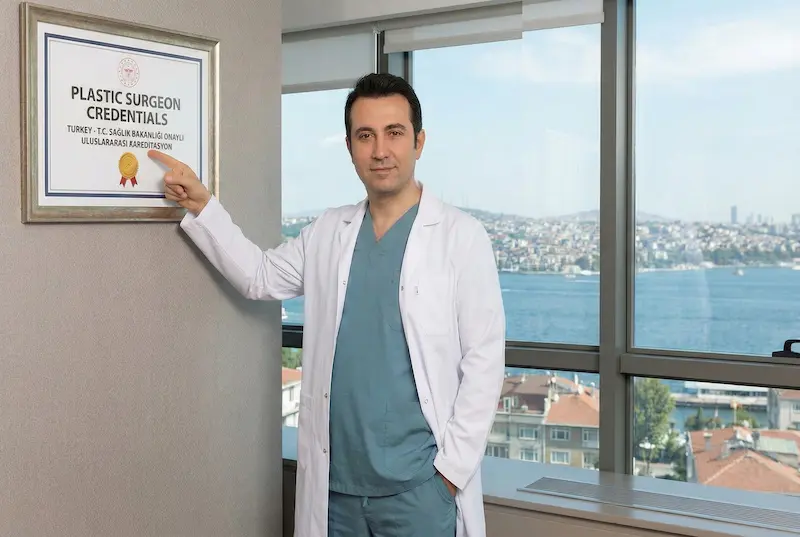
If you’re researching surgeon credentials turkey because you want safe plastic surgery in Turkey—you’re asking the right question. The safest outcomes rarely come from “best on Instagram.” They come from verifiable training, the right operating environment, and a team that can prove every claim with documentation.
This guide is designed for the “expert patient” mindset: you want to verify plastic surgeon credentials turkey using objective checks, not trust signals like logos, follower counts, or vague titles. We’ll start with the official registries and professional bodies that help you confirm a surgeon’s identity and specialty, then move into hospital accreditation, must-ask questions, and red flags.
Key takeaway: If you can’t independently verify a surgeon’s identity + specialty + operating facility, you don’t have “credentials”—you have marketing.
2-minute shortcut: Ask for the surgeon’s full legal name, confirm they appear in credible professional directories, confirm the facility is properly licensed, and insist on speaking directly with the medical team (not only a broker).
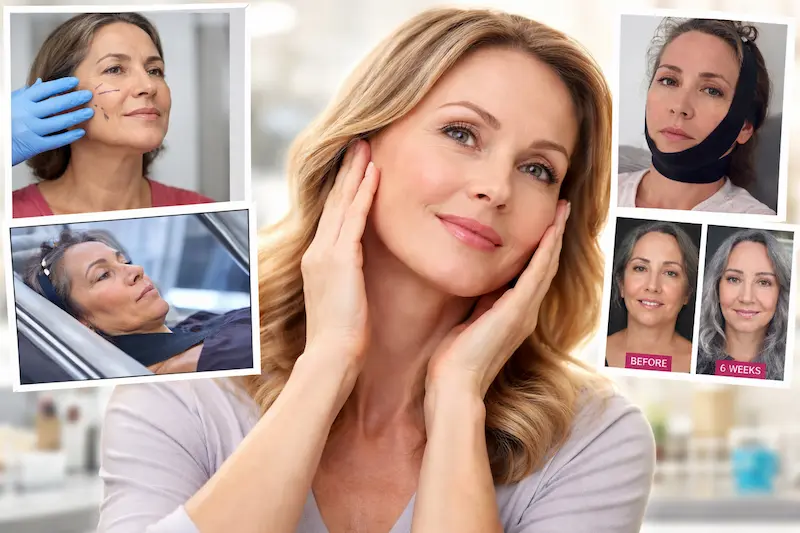
One U.S. facelift patient described her decision as a multi-year research process—and her goal was a natural change, not a dramatic “new face”: “I actually look like nothing happened but probably 20 years younger.”
Table of Contents
Official Registries You Should Check
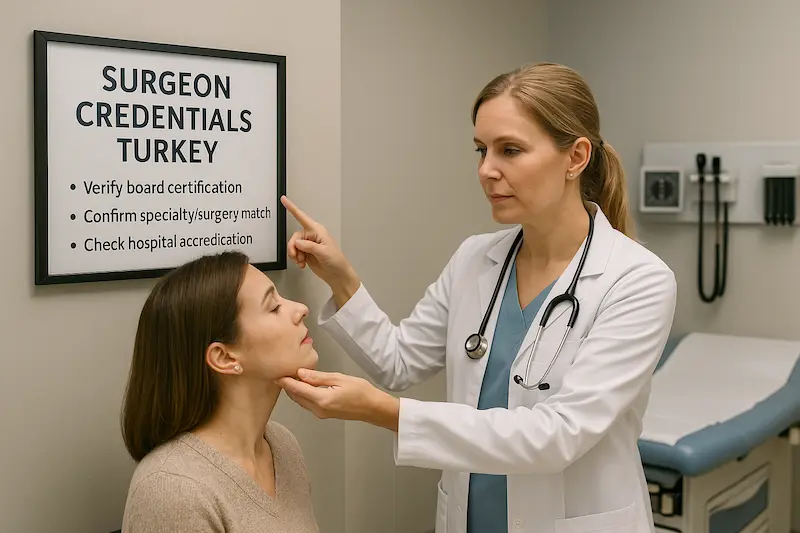
When people search plastic surgeon credentials turkey or check surgeon credentials, they usually want one thing: proof that the doctor is real, licensed, and appropriately specialized doctor. In Turkey, you’ll get the clearest picture by combining (1) official government information tools, (2) specialty society directories, and (3) internationally recognized membership verification (where applicable).
| What you’re verifying | What to request from the surgeon/clinic | How you verify (patient-friendly) |
|---|---|---|
| Identity (real doctor, real name) | Full legal name (as on diploma), clinic/hospital affiliation | Cross-check name across multiple independent directories (not just the clinic website) |
| Specialty training | Exact specialty title + proof of specialization | Confirm the surgeon is listed under the plastic surgery specialty in credible professional listings |
| Professional standing | Membership numbers / profile links (not screenshots) | Use “Find a Surgeon” tools (where available) to confirm active membership |
| Facility legitimacy | Hospital name, address, licensing/authorization documents | Confirm the operation will be in a properly licensed hospital setting (details in the next section) |
“Find a Surgeon” tools and member directories are one of the verifiable layers worth checking — they help confirm that the surgical team’s identity matches the marketing identity, with profile listings that exist independently of the clinic’s own website.
Useful as a cross-check: searching the surgeon’s full legal name in independent professional society directories, confirming active membership status (not just historical listing), and verifying the surgical team composition matches what the clinic publishes. A team that’s transparent about who’s on it usually maintains active third-party listings; a team that’s harder to find externally is a signal worth following up on.
Our full surgical and medical team with named clinical roles and verifiable independent listings is on the surgical team directory.
Start With the Surgeon’s Legal Name (Not the Brand Name)
Many patients get stuck because they’re searching a clinic’s brand instead of the surgeon’s legal name. For verify plastic surgeon credentials turkey checks to work, you need the exact name used in professional registrations—especially if the surgeon has multiple spellings in English.
- Request: Full legal name (as on medical diploma), and the name of the hospital where surgery is performed.
- Red flag: You’re pushed to book without being told the surgeon’s full identity.
“Start with the surgeon’s legal name, not the brand name” is the protective directive that exposes one of the most damaging patterns in medical tourism — the gap between the surgeon shown in marketing and the surgeon who actually performs the procedure. Ghost-surgery scenarios get reported in the medical-tourism complication literature with predictable frequency. The structural risk is highest where consultations happen via brokers who never name the operating surgeon, where the surgical team’s identity isn’t introduced before surgery day, and where the discharge paperwork doesn’t list the operating surgeon by name. Each of those is a documentation gap that can be checked before booking.
A ghost-surgery prevention checklist with surgeon-identity verification questions, paperwork audit points, and red-flag patterns specific to medical tourism sits in ghost surgery prevention.
“Start with the surgeon’s legal name, not the brand name” is the directive Section 1 leads with — and a verifiable individual profile is what fills in the substance behind the name. A surgeon’s verifiable profile worth booking against shows: full legal name as used in professional registrations (with diploma-matched spelling), specialty board with year of certification and verification link, dual-skillset documentation where applicable (e.g., dermatologic surgery plus facial plastic technique), procedure subset performed most frequently with case volume, and revision-rate transparency on similar cases.
Diploma-matched legal name, specialty board details, dermatologic-plus-facial dual-skillset documentation, and procedure focus for our lead surgeon are on verified surgeon documentation.
Turkish Specialty Recognition: What “Plastic, Reconstructive & Aesthetic Surgery” Should Look Like
When you Google what credentials should a plastic surgeon have, the most important credential is specialty recognition. Don’t confuse a general surgeon background (sometimes searched as “surgeon general credentials”) with specialist training in plastic surgery.
- If you’re checking facelift surgeon credentials turkey, prioritize surgeons whose daily work is facial surgery (and who can prove specialty training).
- Be cautious with vague labels like “cosmetic doctor” or “aesthetic surgeon” without clear specialty documentation.
Board Certification: What to Ask For and How to Validate It
“Board certification” as a phrase gets used loosely in plastic surgery marketing — and the question worth asking is what the specific board actually verifies, which body issued the credential, and where the credential can be independently confirmed.
Not all “board certified” claims point to equivalent training pathways. The European Board of Plastic Reconstructive and Aesthetic Surgery (EBOPRAS) has different requirements than the American Board of Plastic Surgery (ABPS), which differs from Turkish specialty boards. The credential’s value depends on which board, which year, and whether the listing remains active in the issuing body’s public directory.
A board-by-board breakdown of what each major plastic surgery certification means, how to verify it directly, and which claims warrant deeper checking sits in the board certification analysis.
In Turkey, “board” language can be used loosely in marketing—so treat it like a claim that needs evidence. Ask for the precise board/proficiency credential and where it can be verified. A good clinic won’t be offended by this; it’s a normal part of check plastic surgeon credentials due diligence.
- Request: The surgeon’s board/proficiency certificate details (organization name, year), and any publicly verifiable listing.
- Reality check: If a surgeon claims “board certified” but there’s no verifiable trail (directory entry, official listing, or professional society confirmation), pause.
International Memberships (ISAPS/others): How to Verify Without “Logo Trust”
International memberships can be useful—if you verify them properly. Don’t trust website badges. Trust searchable directories and direct profile links. This is especially helpful if you’re searching for the best plastic surgeon turkey credentials or best facelift surgeon turkey credentials, because “best” should mean “most verifiable,” not “most famous.”
- What to do: Ask for the surgeon’s direct membership profile link and confirm the status is active.
- Red flag: The clinic shows logos but won’t provide a verifiable profile link.
Hospital & Clinic Accreditation
When patients search verify plastic surgeon credentials turkey, they often focus only on the doctor. But a surgeon’s credentials are only one half of the safety equation. The other half is the environment: where the surgery takes place, who provides anesthesia, and whether the facility is officially licensed, externally audited, and equipped for emergencies.
If your goal is safe plastic surgery in Turkey (or you’re wondering is-it-safe-plastic-surgery-turkey / safe to travel to turkey for surgery), this section gives you a practical way to check surgeon credentials in context—because truly safe care is a system, not a single person.
| Safety item to verify | What to ask for | What “good” looks like |
|---|---|---|
| Licensed facility | Facility name + official licensing/authorization documents | A provider can show clear proof of Ministry-level licensing and oversight |
| Hospital-grade operating environment | Exact hospital name where the operation happens | Procedures performed in a full-service hospital setting (not a back-room OR) |
| International accreditation (if claimed) | Accreditation details (e.g., JCI) and the hospital’s accreditation status | Accreditation is verifiable and tied to the actual hospital used for surgery |
| Sterilization & infection control | Written sterilization workflow + equipment standards | Clear, multi-stage protocols and modern autoclaves; “zero-compromise” approach |
| Anesthesia safety | Anesthesiologist identity + role + monitoring plan | A qualified anesthesiologist is present and accountable throughout |
| Emergency readiness | Access to ICU / emergency services (if needed) | The facility has full emergency pathways—not “we’ll transfer you if something happens” |
Sterilization workflow and emergency readiness are the two verifiable safety layers most patients never inspect — partly because they sit behind closed sterilization rooms and emergency-equipment closets that don’t make it into clinic walkthroughs.
Equipment-level specifics worth requesting: autoclave models with maintenance and validation logs, sterile-field discipline with measurable audit cycles, anesthesia machine service intervals with manufacturer-recommended frequency, defibrillator readiness checks with date-stamped logs, blood-storage protocols, ICU-grade monitoring during recovery for higher-risk cases, and crash-cart inventory with expiration tracking. The list converts “we follow strict protocols” into something inspectable on request.
Specific equipment categories, sterilization audit cycles, emergency-readiness verification logs, and compliance frameworks are mapped on the verified safety infrastructure.
Reality check: If you can’t get the hospital name in writing, you can’t truly verify plastic surgeon credentials turkey—because the “credentials” you’re seeing may not match the environment where you’ll actually be operated.
Why “Hospital Privileges” Matter More Than Instagram Popularity
A highly skilled surgeon still needs a regulated, properly equipped operating environment. In practice, the safety difference is often less about marketing claims and more about whether your procedure happens in a fully-fledged hospital setting with strict perioperative protocols and a clear emergency pathway.
- Ask directly: “What is the exact name of the hospital where my surgery will take place?”
- Ask for clarity: “Will my procedure be performed in a full hospital operating theatre?”
- Red flag: “We do surgeries in our clinic” with no hospital details, no anesthesia team identity, and no ICU/emergency access plan.
“What is the exact name of the hospital where my surgery will take place?” is the verification question this section is built around — and the answer worth booking against is one specific facility name, not “we use multiple hospitals depending on the case.”
Specifics that should appear in writing: licensing authority (Ministry-level, with document number), facility address, operating theater specifications, ICU adjacency or contracted transfer hospital with documented response time, anesthesia team affiliation as employees of the same medical entity (not contracted per case), and external accreditation status with verification link.
Our facility’s licensing documentation, operating theater configuration, ICU access pathway, and accreditation status are on our accredited surgical facility.
Accountability matters. A surgeon-led medical institution should be willing to stand behind the care model—without hiding behind brokers or intermediaries.
JCI vs. Non-JCI: What Accreditation Does (and Doesn’t) Prove
If a hospital is JCI-accredited, that’s a meaningful trust signal because it suggests an internationally recognized framework for patient safety and quality processes. But it’s not a magic shield, and it doesn’t replace your due diligence on the surgeon, the anesthesia plan, or your aftercare.
- What JCI can indicate: Strong systems—documentation, infection control, medication safety, patient identification processes, and continuous quality improvement.
- What JCI does not guarantee: That your surgeon is the right surgeon for your procedure, or that your surgical plan matches your anatomy and goals.
- Best practice: Verify accreditation and verify the operating hospital name matches the accredited institution.
If you’re searching “best plastic surgeon turkey credentials” or “best facelift surgeon turkey credentials,” redefine “best” as most verifiable + safest system—not most visible online.
Ministry Licensing & Health Tourism Authorization: What Documents to Request
Official authorization matters because it means the clinic is not self-regulated. A serious provider should be properly licensed and able to demonstrate legal authorization to treat international patients.
- Request: Proof the clinic is licensed by national authorities and officially authorized for international health tourism.
- Request: Written confirmation of the operating hospital and the medical team roles (surgeon + anesthesiologist).
- Red flag: Screenshots, vague “certificates,” or documents that can’t be tied to a real institution.
Anesthesia Safety: Who Provides It and Where Emergency Support Exists
Anesthesia is not a detail—it’s a core safety pillar. Whether your procedure is done under general anesthesia or a twilight/awake approach (common in some modern facelift pathways), you should know who is responsible for your anesthesia and how you’ll be monitored.
- Ask: “Who is my anesthesiologist, and will they be present for the entire procedure?”
- Ask: “What monitoring will be used, and what is the escalation plan if anything changes?”
- Ask: “Is this done in a hospital environment with comprehensive emergency support if needed?”
For facelift patients specifically, if you’re comparing facelift surgeon credentials turkey options, remember that the anesthesia plan is part of the credential check. An “awake/twilight” facelift can offer advantages for selected patients—but only when it’s performed by an experienced surgical team and a qualified anesthesiologist in the right setting.
What to look for in recovery standards: Some clinics support healing with structured protocols and advanced non-invasive therapies such as Hyperbaric Oxygen Therapy (HBOT) and Low-Level Laser Therapy (LLLT)—not as spa “add-ons,” but as part of a documented post-op plan, especially after facelifts where swelling and tissue healing quality matter.
Questions You MUST Ask to Verify Plastic Surgeon Credentials Turkey
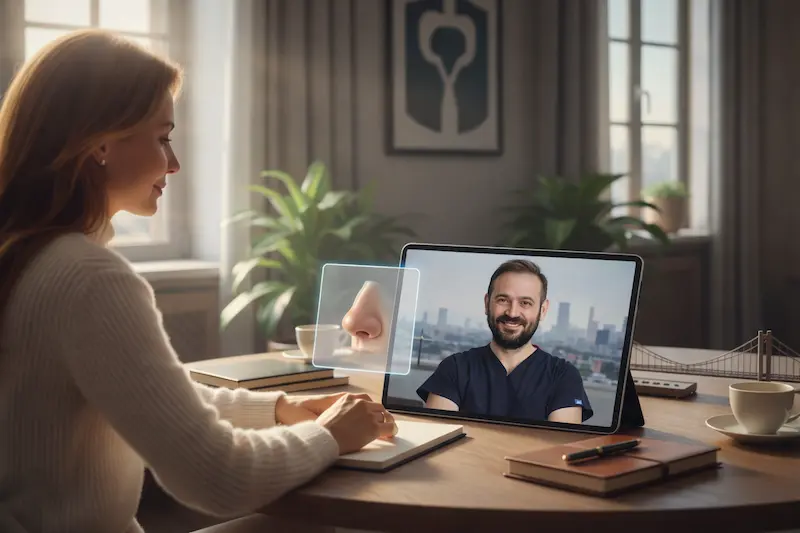
If you’re trying to verify plastic surgeon credentials turkey, the fastest way is to ask questions that force verifiable answers. Below is a practical script you can use on a call or in writing. (Pro tip: ask for answers in writing—it reduces misunderstandings and makes it harder for anyone to “spin” the truth.)
“Credentials” become especially important context against the most common myths about Turkish plastic surgery — because most of those myths persist precisely where credential verification gets skipped. The myth structure usually has the same shape: a sweeping claim (“Turkey is safe” / “Turkey is unsafe”) that bypasses the specifics that actually determine safety — which surgeon, which hospital, which anesthesia setup, which aftercare pathway. The verification framework in this article and the myth-debunking framework in its companion piece are designed to slot together.
A myth-by-myth breakdown of the most-believed Turkey-plastic-surgery generalizations and the verification points that resolve each is in Turkey surgery myths.
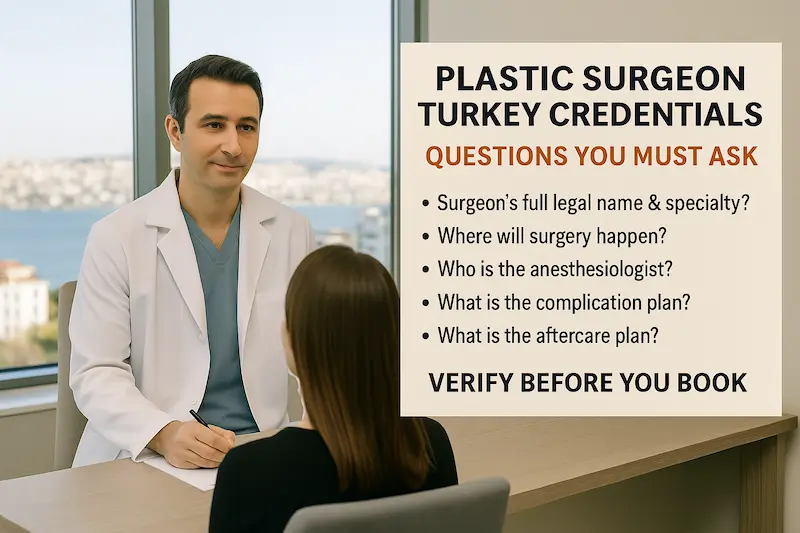
Rule of thumb: A credible team will welcome credential questions. Pushback, impatience, or “just trust us” language is itself a red flag.
| Question to ask | Why it matters | What proof looks like |
|---|---|---|
| “What is the surgeon’s full legal name and official specialty?” | Needed to cross-check identity and surgeon credentials across independent sources. | Full name + specialty title (not a brand name or nickname). |
| “Where will my surgery happen (exact hospital name)?” | Facility legitimacy is half of safe plastic surgery in Turkey. | Hospital name + address, confirmed before payment. |
| “Who is my anesthesiologist and what’s the monitoring plan?” | Anesthesia safety is non-negotiable. | Anesthesiologist name + credentials + monitoring details. |
| “What is your plan if a complication happens?” | Planning beats promises—especially for travelers asking safe to travel to turkey for surgery. | Written escalation pathway + hospital resources. |
“Are You Board-Certified?” (And Which Board, Exactly?)
Many patients searching plastic surgeon credentials turkey or best plastic surgeon turkey credentials get stuck on the phrase “board-certified.” Don’t accept the phrase—ask for specificity:
- Ask: “Which board? What is the exact name of the certification?”
- Ask: “How can I verify it independently (link, registry listing, or official confirmation)?”
- Reality check: A “certificate screenshot” is not verification.
Note on confusing searches: Some people search “surgeon general credentials” meaning a general surgery background. General surgery training is not the same thing as specialized training in facial aesthetics or plastic surgery—so you want the correct specialty for your procedure.
“Where Will My Surgery Happen?” (Operating room, hospital name, ICU access)
Ask this early—before deposits. A credible clinic can tell you the exact facility and explain why that environment is chosen. If you’re evaluating safe plastic surgery in Turkey, the hospital setting matters as much as the surgeon.
- Ask: “Is it a full hospital operating theatre?”
- Ask: “Do you have immediate access to emergency services and intensive care if needed?”
- Red flag: Vague answers like “don’t worry, we handle everything” without naming the facility.
“Who Is the Anesthesiologist?” (Credentials + who monitors you)
This is one of the most overlooked parts of check surgeon credentials. Even if you’re considering twilight/awake approaches, anesthesia oversight still matters.
- Ask: “Will a qualified anesthesiologist be present for the entire procedure?”
- Ask: “What monitoring is used continuously (oxygenation, heart rate, blood pressure)?”
- Ask: “What is the plan if nausea, anxiety, blood pressure changes, or breathing issues occur?”
“How Many Cases Like Mine Per Year?” (Experience + revision handling)
If you’re searching best facelift surgeon turkey credentials or facelift surgeon credentials turkey, focus on procedure-specific experience—not total “surgeries performed.” Ask:
- Ask: “How many facelifts (or deep plane facelifts) do you perform per year?”
- Ask: “What percentage of your work is facial surgery vs. other procedures?”
- Ask: “How do you handle revisions if a patient is traveling internationally?”
Why this matters for natural results: Advanced facelift techniques aim to reposition deeper structures rather than relying on skin tension—this is one of the key differences between “lifted” and “pulled.”
A 15-Minute Credential Audit You Can Do Before Booking
“What does ‘best’ actually mean when applied to a Turkish plastic surgery clinic?” is the question this verification framework is meant to answer — and it’s worth being explicit that “best” should resolve to “most verifiable,” not “most visible.”
The selection framework most useful for narrowing a shortlist combines (1) the credential verification this article walks through, (2) hospital-grade facility match for the procedure, (3) named accountability for who operates and who handles aftercare, and (4) transparent itemized pricing. Together these convert “best” from a marketing word into a checklist.
A 12-criterion selection framework that walks each of those dimensions in detail is on the best clinic framework.
Use this mini-audit to verify a provider’s claims before you pay a deposit. The goal is simple: confirm identity, confirm specialty, confirm where the operation happens, and confirm who is responsible for anesthesia and follow-up. If any step can’t be verified in writing, treat it as a safety signal to slow down.
Step 1: Confirm the Surgeon’s Identity and Specialty
Start by requesting the surgeon’s full legal name and exact specialty title in writing. Then cross-check the name across independent sources (not just the clinic’s website) to confirm you’re evaluating the right physician. For facial procedures, ask who assesses skin quality and scar risk, since natural results depend on both structure and skin.
Step 2: Validate Memberships Without “Logo Trust”
If a clinic displays society badges, ask for verifiable proof: direct profile links, membership numbers where applicable, and current status. Use official find-a-doctor tools whenever possible. For example, you may be directed to a turkish society of plastic reconstructive and aesthetic surgery member search; treat it as one supporting data point, not the only proof.
Step 3: Verify the Operating Environment and Safety Pathway
Credentials are incomplete without a safe setting. Confirm the exact hospital where surgery will occur, who the anesthesiologist is, and what continuous monitoring is used. Ask for a written complication escalation pathway and a structured aftercare plan that covers the first 72 hours and follow-ups after you return home. Save copies of key documents (surgical plan, anesthesia plan, consent forms) so you can compare answers across consultations and avoid last-minute surprises.
If any detail changes after you request it (surgeon name, hospital, anesthesia provider, or scope of surgery), ask for clarification in writing. When answers stay vague or shift repeatedly, it’s reasonable to get a second opinion and re-run this audit before committing.
“Patient video accounts” close the verification loop that written reviews and before-after photos can’t fully cover — they show recovery week-by-week, capture patient affect during the swelling phases, and document how the clinic responded when something unexpected came up. Video documentation worth weighing differs from social-media testimonials in specificity: named patient consent on file, procedure type disclosed alongside the recovery timeline, week-by-week footage rather than only the post-final-result frame, and content that includes rough patches rather than only the smooth highlights. Variation in the video archive is documentation; a uniformly positive archive without variation is a marketing artifact.
Our patient video accounts with disclosed procedures, week-by-week recovery footage, and full patient consent on file are catalogued in the patient video archive.
“What’s the Aftercare Plan for International Patients?” (Day-by-day follow-up + emergency pathway)
This is where “is-it-safe-plastic-surgery-turkey” becomes a practical checklist. You want a plan that exists even after you fly home.
- Ask: “What does the first 72 hours look like (nursing checks, surgeon visits, medications)?”
- Ask: “What is the follow-up schedule after I return home (1 month, 3 months, 6 months, 1 year)?”
- Ask: “Who do I contact after hours—and what is the response time expectation?”
Dermatosurgery Advantage: Ask Who Evaluates Skin Quality (Not Just ‘Lift Mechanics’)
If your goal is a refined, natural rejuvenation—especially in facelift candidates—ask whether your care includes dermatosurgery-level evaluation of skin quality (texture, collagen, pigmentation, scarring risk) alongside structural planning. This matters because the most convincing results often come from improving both structure and skin, not just tightening.
- Ask: “Will a dermatology-trained physician / dermatosurgeon be involved in my facial plan?”
- Ask: “How do you assess skin quality and scar behavior before surgery?”
- Ask: “Do you use any evidence-based recovery support protocols for swelling, bruising, and tissue healing?”
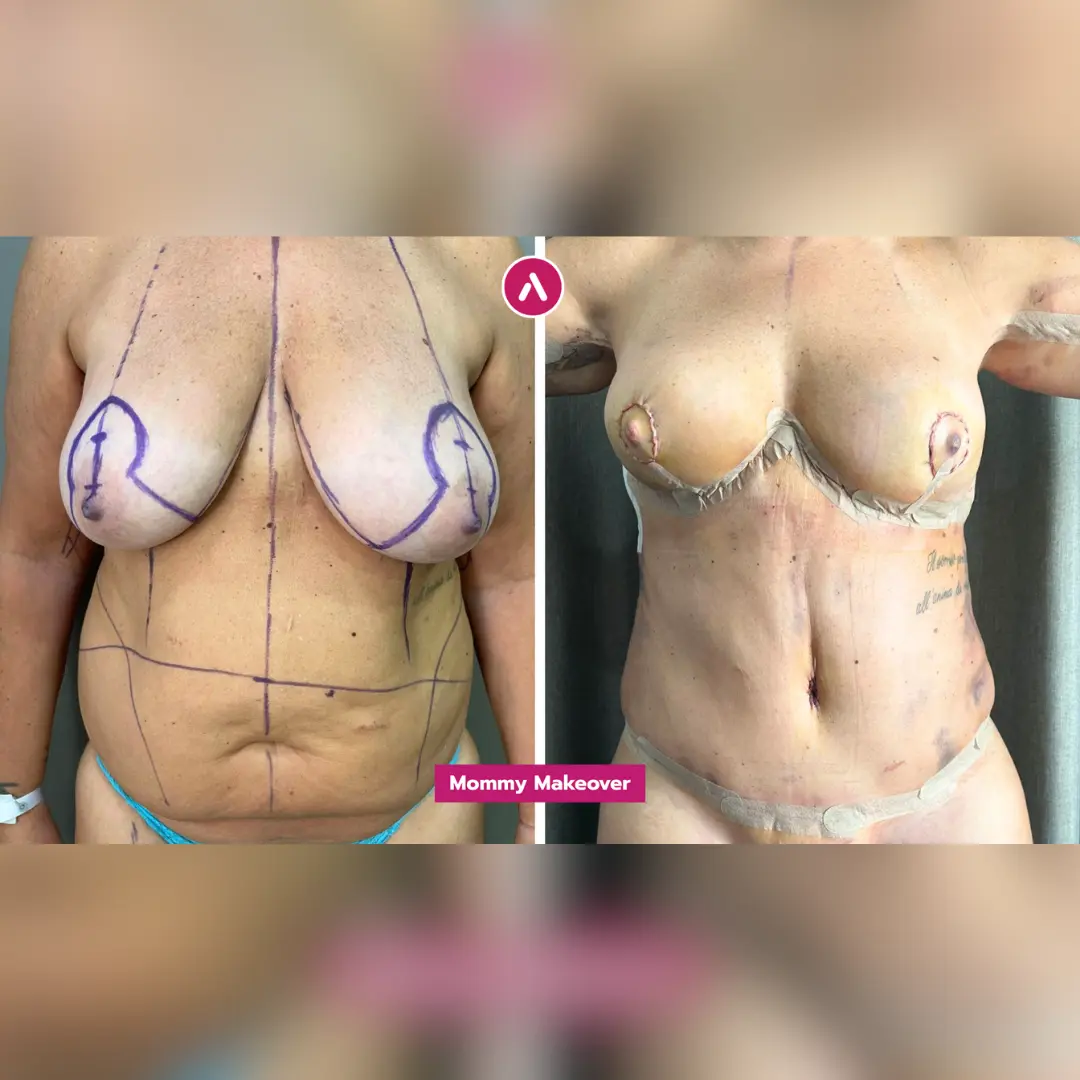
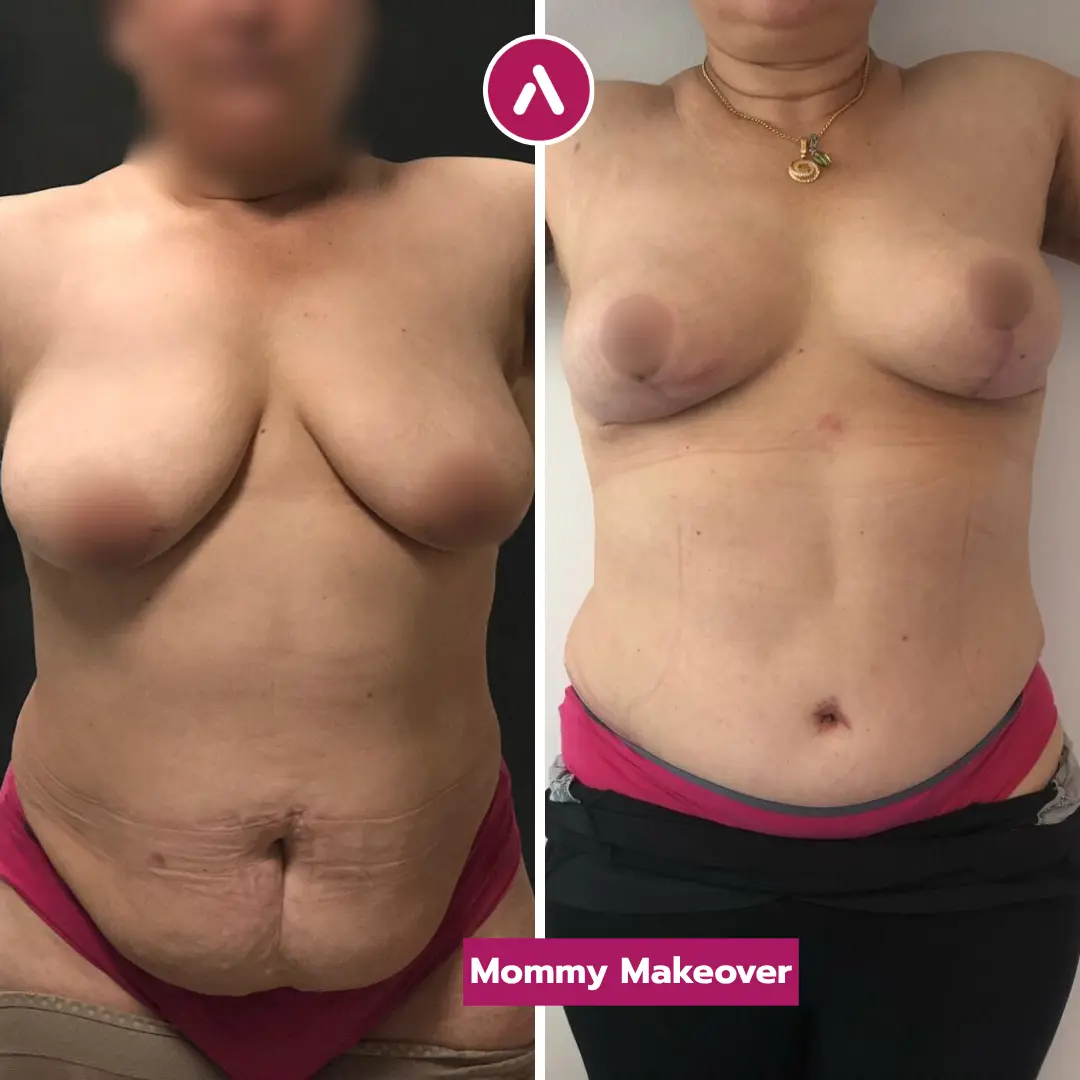
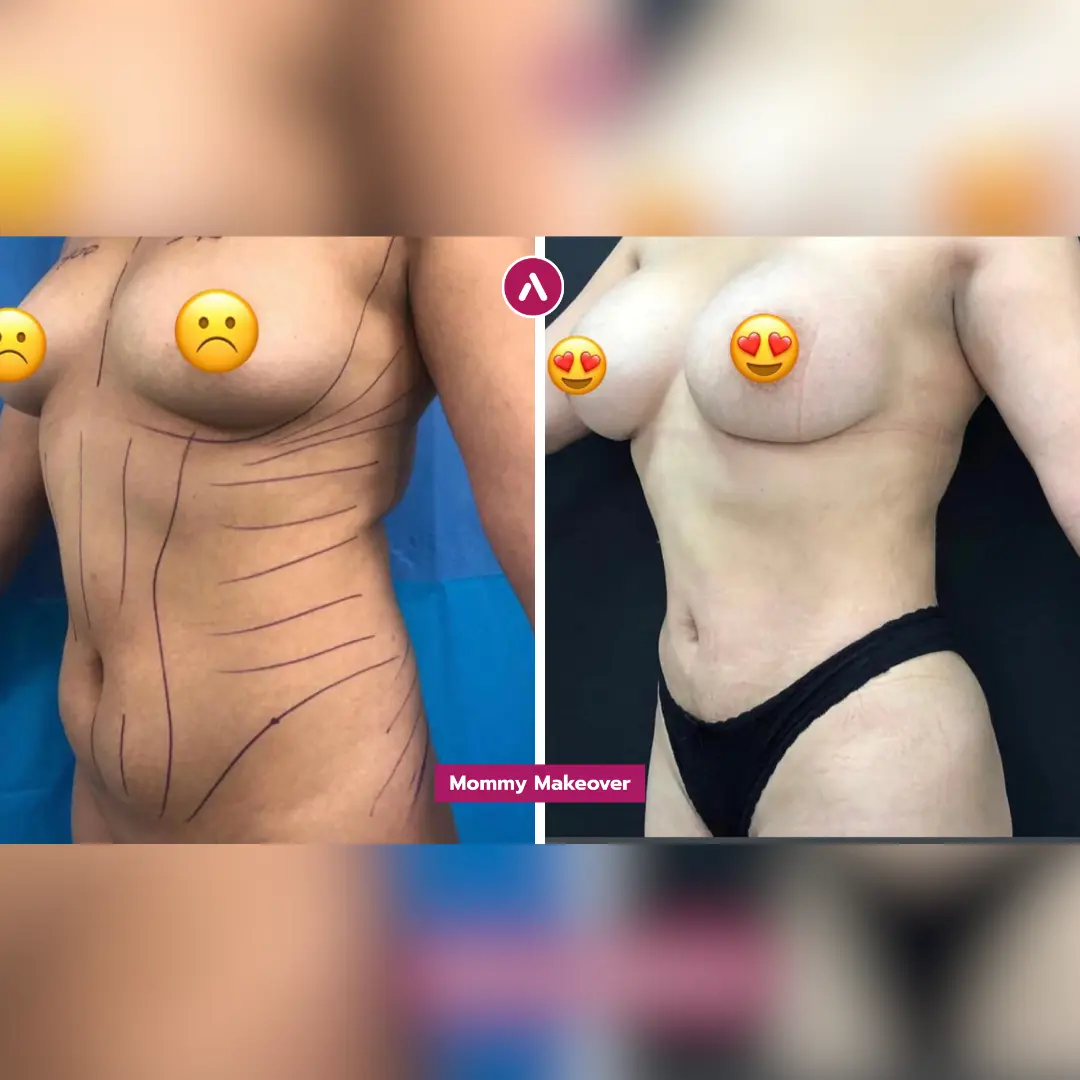
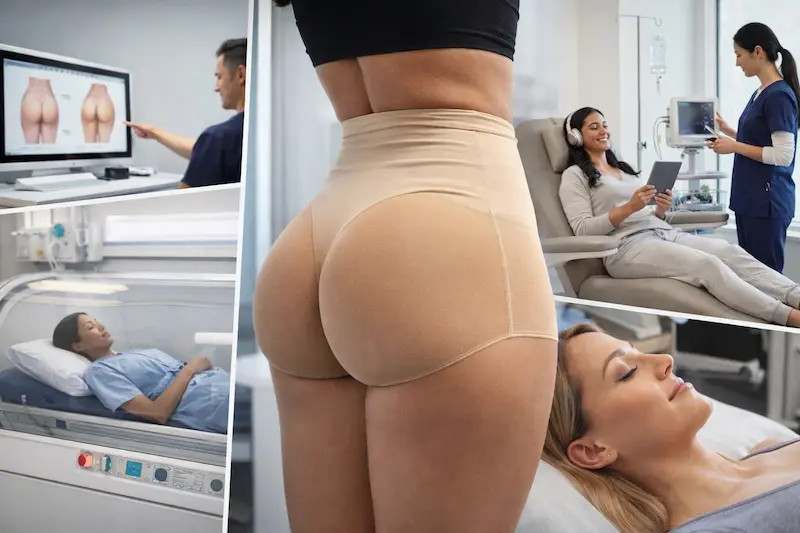
Mommy makeover outcomes are one of the procedure families where before-and-after evidence matters most — because the result depends on multiple combined techniques (abdominoplasty, breast lift or augmentation, liposuction) and the integration between them determines whether the result reads as natural or surgical.
What to look for in verifiable mommy-makeover documentation: consistent angles across before and after, disclosed post-op timing (3 months, 6 months, 1 year), anatomy-matched comparisons (similar starting BMI, similar age range, similar pregnancy history), and outcome documentation that includes scar placement at maturation rather than only the early “before swelling went down” frame.
Procedure-specific outcomes including the 50-year-old USA patient, 36-year-old UK patient, and 33-year-old USA patient cases displayed above are catalogued with full timing disclosure in our documented patient results.
How to Use EADV & Turkish Dermatology Society in Credential Checks
For patients comparing plastic surgeon credentials turkey options, professional affiliations can be a meaningful supporting signal—especially for facial work where dermatology/skin expertise strengthens planning. Here’s how to use these affiliations correctly:
- EADV (European Academy of Dermatology and Venereology): Ask if the doctor is an active member and what their membership category is. Then request proof that can be verified (membership confirmation, official documentation, or a formal letter if needed).
- Türk Dermatoloji Derneği (Turkish Dermatology Society): Ask for the doctor’s membership status and whether they participate in official working groups or national congresses—and request verifiable documentation.
Important: Membership in medical societies is not the same as a government license or a surgical specialty registry—but it can support credibility when it’s transparent and verifiable.
How to Spot Fake Certificates
Even if you’ve done a careful plastic surgeon credentials turkey search, it’s still possible to get misled by polished marketing. The most common credential “tricks” aren’t dramatic—they’re subtle: vague titles, unverifiable “board-certified” claims, borrowed logos, and before/after photos that can’t be trusted.
The honest evidence base on what happens when credential verification gets skipped sits in the cost-and-complications literature — specifically, papers tracking what happens domestically when medical-tourism patients present with complications they hoped to never have.
A December 2023 Aesthetic Surgery Journal Open Forum paper by Hery and colleagues at OhioHealth Riverside Methodist Hospital documented this pattern over a 7-year retrospective: surgery tourism complications study. Of 41 medical-tourism patients seen in postoperative consultation between January 2015 and January 2022, 28 admissions were classified as medically necessary and 13 as unnecessary; the total financial burden across the cohort reached $523,272. Most common complications: seromas and infections; most common procedures: abdominoplasty, liposuction, breast augmentation, and BBL.
Worth flagging the dataset boundary: 41 patients at a single academic center is a small inbound sample, so the value sits in pattern identification (cost magnitude + what complications cluster) rather than rate estimation. The practical read for pre-booking patients is that verification cost is essentially zero, while the post-complication cost — both financial and clinical — is documented in this paper at five-figure-per-patient magnitudes.
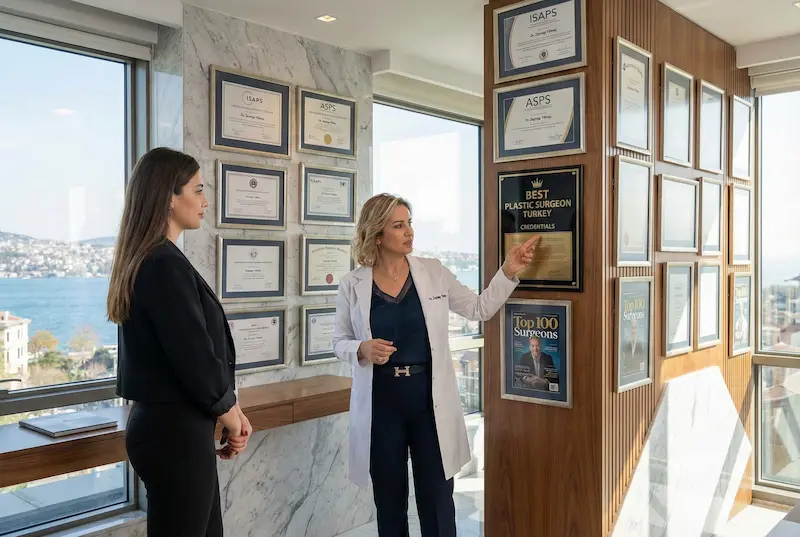
Safety principle: Real credentials create a trail you can verify independently. Fake credentials rely on you not asking for proof.
This section is your practical filter. Use it to check surgeon credentials and check plastic surgeon credentials with the same skepticism you’d use for a major financial decision—because that’s what this is: a high-stakes health decision.
| Common red flag | What it means | What you should do |
|---|---|---|
| “Board-certified” but no registry trail | Marketing language without accountable verification | Ask which board + how to confirm (directory entry, official listing) |
| Vague titles (“aesthetic doctor,” “cosmetic expert”) | May not match the surgical specialty you need | Ask for the exact specialty name and supporting documentation |
| Logos everywhere (ISAPS/EADV/JCI) but no proof | “Logo trust” instead of verifiable status | Request direct profile links or official confirmation |
| Before/after photos feel “too perfect” | Possible editing, angle tricks, or mismatched timepoints | Request standardized views + timelines + unfiltered sets |
| You can’t speak to the surgeon directly | Broker-driven model; unclear accountability | Insist on a surgeon-led consult before any payment |
Misleading Titles (Cosmetic/Aesthetic vs. Plastic Surgery Specialty)
One of the biggest reasons patients struggle with what credentials should a plastic surgeon have is that titles are used inconsistently online. Your goal is to confirm the doctor’s official specialty matches the procedure you want.
- What to request: The surgeon’s exact specialty title (in writing) and the legal name used for registration.
- Why it matters: A general surgery background (sometimes searched as “surgeon general credentials”) is not the same as specialist training in plastic surgery or facial plastic surgery.
- Practical move: For facial procedures, ask about the team’s facial focus and whether skin-quality planning (dermatology/dermatosurgery insight) is part of the pre-op evaluation.
“Board-Certified” Claims With No Verifiable Registry Trail
When you’re trying to verify plastic surgeon credentials turkey, “board-certified” should never be a checkbox—it should be a linkable, verifiable credential. If the clinic can’t tell you exactly which board and how to verify it, treat that as a decision-relevant risk.
- Ask: “Which board? What is the official name of the certification?”
- Ask: “Where can I verify it independently?”
- Red flag: Only screenshots, no direct confirmation route, or defensiveness when you ask.
Fake Logos, Screenshots, and Uncheckable “Membership Certificates”
Logos are easy to copy. Verification is harder—which is why it’s the right standard. This applies to international societies (for example, EADV), national societies (such as the Turkish Dermatology Society / Türk Dermatoloji Derneği), and facility quality claims.
- Don’t accept: “Here’s a certificate PDF” without a way to confirm it.
- Do request: Direct, verifiable proof (membership category/status, membership number when appropriate, and a route to validate it).
- Use societies correctly: Society membership can support credibility, especially for facial planning where dermatosurgery-level skin expertise matters—but it is not a substitute for licensing, specialty recognition, and hospital standards.
How to think about dermatosurgery credentials: For facelift patients, skin quality and scar behavior are not “secondary.” A dermatosurgeon’s involvement can strengthen planning for natural results—when that involvement is transparent and verifiable.
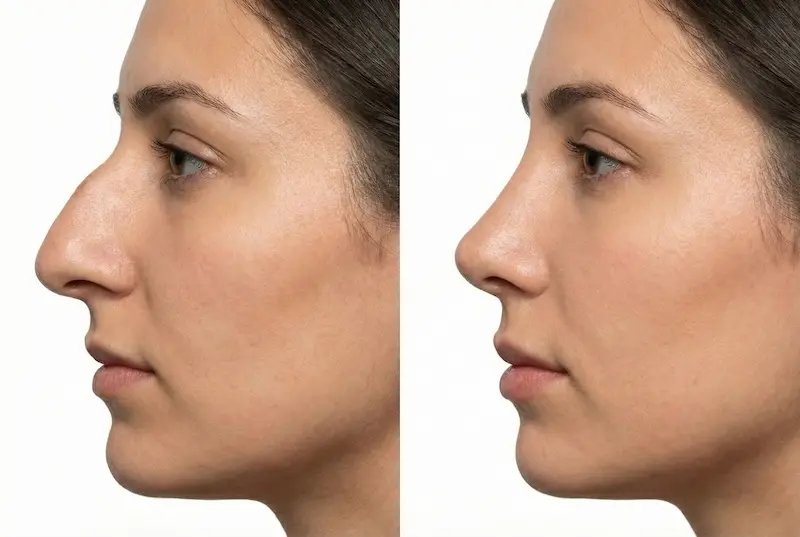
Before/After Red Flags (angles, lighting, filters) + Reverse Image Search Basics
Photos are powerful—but they’re also one of the easiest areas to manipulate. If you’re using galleries to decide on best facelift surgeon turkey credentials, evaluate the proof like an investigator, not a fan.
- Look for consistency: Same lighting, same angle, same facial expression, same camera distance.
- Demand timelines: “How many weeks/months post-op is this photo?” Early swelling can hide or exaggerate outcomes.
- Ask for sets, not singles: Front + both profiles + 45-degree views, with multiple timepoints.
- Quick check: Use reverse image search on a few “hero” photos to see if they appear on other websites under different names.
- Reality check for naturalness: A credible facelift result should look like “well-rested,” not “tight.”
Broker/Agency Warning Signs: When You Can’t Speak to the Surgeon Directly
This is one of the most important safety filters for anyone asking safe to travel to turkey for surgery or searching safe plastic surgery in turkey. If you are routed through intermediaries who won’t give you direct access to the surgeon—your ability to verify plastic surgeon credentials turkey is compromised.
- Red flag: “You don’t need to speak to the doctor yet—just book and we’ll tell you later.”
- Red flag: Different people answer basic medical questions each time, with inconsistent details.
- Green flag: A surgeon-led institution that makes accountability explicit and provides a structured, written care pathway.
What accountability sounds like: “We are not an agency; we are the surgeons.”
Bottom line: The “best” in best plastic surgeon turkey credentials should mean the most verifiable: surgeon identity + specialty + anesthesia accountability + hospital environment + aftercare continuity. If any piece is vague, you’re not being cautious—you’re being smart to pause.
Plastic Surgeon Credentials Turkey Frequently Asked Questions (FAQ):
Below are the most common questions patients ask while trying to check plastic surgeon credentials and decide if it’s truly safe to travel to Turkey for surgery. These answers are intentionally practical—focused on what you can verify, what you should request in writing, and what should make you pause.
What does “board-certified” mean in Turkey?
“Board-certified” should be a specific, verifiable credential—not a marketing phrase. Ask: Which board? and how can I verify it? A credible provider can name the exact board and explain what it represents (training standards, professional oversight, and ethical requirements), then point you to a verification path.
How can I confirm a surgeon’s specialty is officially recognized (not just “aesthetic” training)?
Start by confirming the surgeon’s exact specialty title in writing (and their full legal name). Then cross-check that identity and specialty across independent sources. Be cautious with vague labels (“cosmetic/aesthetic expert”) that don’t clearly state a surgical specialty. If you’re evaluating facial procedures, also ask whether skin-quality planning is part of the pre-op assessment (that’s where dermatosurgery expertise can add value).
Is JCI accreditation required for safety—or just a plus?
JCI accreditation is a meaningful plus because it signals a structured, externally audited safety framework. But it’s not the only requirement. True safety is the combination of: verified surgeon identity + verified specialty + qualified anesthesia + a properly licensed hospital environment + a clear complication pathway. If a clinic claims JCI, confirm the actual hospital you will be operated in is the one that’s accredited.
How do I verify the hospital/clinic is legally licensed and authorized for international patients?
Ask for the clinic’s licensing/authorization details and confirm your surgery will be performed in a full hospital setting. For international patients, you should also request proof the provider is officially authorized for health tourism (not just “we treat foreigners”). If the clinic can’t provide clear documentation—or refuses to put the operating hospital name in writing—pause.
What documents should I request before booking (license, consent forms, surgical plan, anesthesia plan)?
Surgeon identity: Full legal name, specialty title, and who will be the operating surgeon (not “our team”).
Facility proof: Exact hospital name/address where the operation will occur.
Anesthesia: Anesthesiologist name + anesthesia plan + monitoring approach.
Surgical plan: What procedures are included/excluded, expected scars, and what “natural result” means for your anatomy.
Informed consent: A clear list of risks, realistic recovery timeline, and what the complication pathway looks like.
Aftercare plan: Post-op schedule and who you contact after hours.
How can I evaluate before-and-after photos in a way that avoids being misled?
Request consistency: same angles, lighting, distance, and neutral expression. Ask for timelines (how many weeks/months post-op) and for multi-angle sets, not single “hero shots.” If you’re screening best facelift surgeon Turkey credentials, prioritize results that look refreshed—not tight—because advanced facial techniques focus on repositioning deeper structures rather than relying on skin tension alone.
What should a safe post-op follow-up plan include for US patients?
A safe plan should cover both the first 72 hours (medical checks, meds, swelling management) and continuity after you return home (scheduled follow-ups, fast access to the team, and a written pathway for concerns). If someone searches “is-it-safe-plastic-surgery-turkey” it’s often because they fear being alone after surgery—so look for clinics that build structured, long-term follow-up into the pathway and can explain recovery-support protocols (including evidence-based swelling/healing support where appropriate).
What’s the safest way to confirm I’m speaking to the actual surgeon—not a broker?
Ask for a surgeon-led video consultation before any payment, and request the surgeon’s full legal name in writing. A credible clinic will let you speak directly with the operating surgeon, answer clinical questions consistently, and provide the hospital name, anesthesia details, and post-op plan without deflection.
Can a “cosmetic/aesthetic doctor” perform plastic surgery procedures in Turkey?
Titles can be used loosely in marketing, so don’t rely on wording alone. Request the doctor’s official specialty title and verify it independently. If the clinic can’t clearly document specialty training aligned with your procedure (especially for facial surgery), treat that as a reason to pause and seek a second opinion.
How do I verify a surgeon’s society membership if the clinic shows logos but no proof?
Ask for a direct profile link or a verifiable confirmation route—never accept screenshots as “proof.” If they reference the turkish society of plastic reconstructive and aesthetic surgeons member directory, confirm the surgeon appears under the correct name and specialty, and cross-check with at least one additional independent source.
What should a credible revision and complication policy look like for international patients?
You should receive a written plan explaining: what qualifies as a complication vs. normal healing, how urgent issues are handled in Turkey, who you contact after hours, and how remote follow-up works after you return home. Be cautious if they avoid specifics, won’t document policies, or minimize risks.
Medical Disclaimer: This content is for educational purposes only and does not replace medical advice, diagnosis, or treatment. Surgical options, anesthesia choices, risks, costs, and recovery vary by individual. Always consult a qualified, board-certified clinician for personalized guidance. If you have urgent symptoms, seek emergency care.