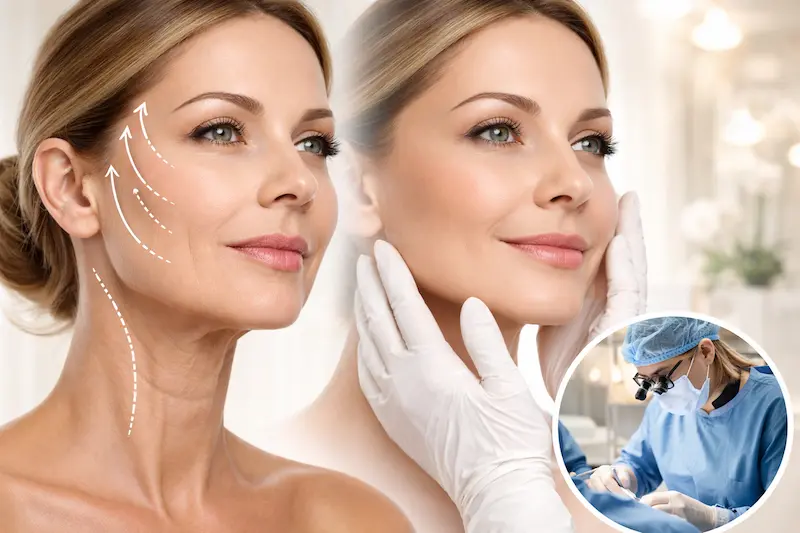

If you’re considering a deep plane facelift, you’re probably excited about fresher, more youthful contours — but also a bit worried about swelling, bruising and time away from work or social life. At AKM Clinic in Istanbul, our surgeons and medical team focus not only on the surgical result, but also on faster, safer deep plane facelift recovery using evidence-based aesthetic recovery technologies like Hyperbaric Oxygen Therapy (HBOT) and Low-Level Laser Therapy (LLLT). A December 2024 systematic review published in Aesthetic Plastic Surgery synthesized the contemporary evidence base for HBOT specifically in aesthetic medicine and anti-aging contexts — moving the conversation beyond “general wound healing” into procedure-specific aesthetic recovery applications.
This guide will walk you through what makes deep plane facelift recovery unique, what a realistic timeline looks like, and how HBOT & LLLT can help minimize downtime so you can get back to yourself sooner — especially if you’re traveling from the USA for surgery in Turkey.
Table of Contents
Understanding Deep Plane Facelift Recovery
Deep plane facelift surgery works on the deeper support layers of the face — the SMAS, retaining ligaments, and ligamentous releases that allow the midface to be repositioned without skin tension. Working at this deeper level means your body needs a carefully managed healing period. The full surgical methodology — incision design, ligament release sequence, and what makes deep plane different from skin-only or limited-SMAS techniques — is documented on our deep plane facelift procedure page. Understanding the surgery clarifies why the recovery protocol below matters.
What makes deep plane facelift recovery different from a traditional facelift?
In a traditional “skin-only” or limited SMAS facelift, more tension is placed on the surface tissues. With a deep plane facelift, your surgeon releases and repositions deeper structures instead, so the skin can be redraped gently without that tight, pulled look.
From a recovery perspective, this has a few important consequences:
- Bruising and swelling are usually deeper, following the lifted planes of the midface and neck rather than sitting just under the skin.
- The result often looks more natural earlier, but you still need time for the deeper tissues to settle into their new position.
- Initial stiffness, tightness or “heaviness” in the cheeks and lower face is common as swelling peaks and then slowly resolves.
- Long-term results tend to be more stable, because you’re lifting the structural layers, not stretching the skin.
Because of this, a smart deep plane facelift recovery plan aims to control swelling and protect those deeper, repositioned tissues while they heal. This is exactly where AKM Clinic’s HBOT and LLLT protocols come in — they are designed to support tissue survival, reduce inflammation, and improve scar and skin quality from the inside out.
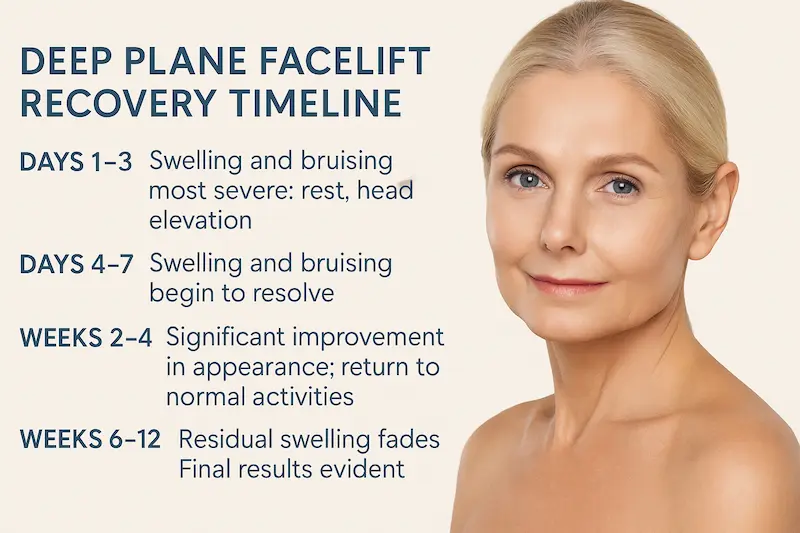
A realistic deep plane facelift recovery timeline from a surgeon’s perspective
Every patient heals at their own pace, but most healthy adults follow a similar pattern after deep plane facelift surgery:
- Days 1–3: Swelling and bruising begin and typically build toward a peak. You’ll feel tight, puffy and tired. Pain is usually well-controlled with medication.
- Days 4–7: Bruising begins to migrate downward, swelling starts to soften, and you may feel more comfortable moving around. Stitches are usually removed toward the end of this period.
- Week 2: A lot of the dramatic swelling decreases, but you still won’t look “normal” to yourself. Close friends or family will still notice you’ve had surgery.
- Weeks 3–4: Many people feel comfortable with light social activities, especially with makeup and hairstyle support. Subtle residual swelling and firmness can still be present.
- Months 2–3: The face looks softer and more natural, scars continue to fade, and most people feel fully confident in public without makeup “camouflage.”
When we talk about deep plane facelift recovery day by day, we’re really describing how swelling, bruising, sensation and energy levels gradually improve. Advanced therapies like HBOT and LLLT don’t “skip” the healing process, but they can make each phase smoother, shorten the most visible downtime and support higher-quality scar and skin outcomes.
Social vs full recovery: How Long is Recovery From Deep Plane Facelift?
It’s important to separate two concepts:
- Social recovery time: When you feel comfortable going out in public, seeing colleagues on video calls or meeting friends without drawing attention to your surgery.
- Full biological recovery: When deeper tissues have healed, swelling is fully resolved, scars have matured, and the final result is stable.
For many patients:
- Social recovery after a deep plane facelift can be around 2–3 weeks, especially with supportive therapies that reduce swelling and bruising.
- Full recovery continues to refine over 3–6 months, with scars and skin quality improving for up to a year.
At AKM Clinic, our goal is to shorten your social downtime as much as safely possible. By integrating HBOT and LLLT into your deep plane facelift recovery plan, we aim to help you:
- Move from the “I definitely look operated” phase to the “I look like myself, just a bit swollen” phase more quickly.
- Improve the quality and speed of scar fading along the hairline and around the ears.
- Feel more comfortable returning to normal life, travel and light work within a carefully monitored timeframe.
In the next section, we’ll look at the science behind these technologies and why they are central to the rapid recovery protocols used at AKM Clinic in Istanbul for facelift patients traveling from all over the world.
The Science of Healing: Why HBOT & LLLT Matter After Deep Plane Facelift
Deep plane facelift recovery is not only about time — it’s about how efficiently your tissues heal, how quickly swelling resolves, and how well scars mature. At AKM Clinic in Istanbul, two technologies are central to that process: Hyperbaric Oxygen Therapy (HBOT) and Low-Level Laser Therapy (LLLT)
Both are used in top-tier surgical centers around the world to support complex cosmetic and reconstructive procedures. At AKM Clinic they are built directly into your deep plane facelift recovery plan to improve tissue survival, control inflammation and enhance skin quality.
How HBOT supports deep plane facelift recovery at a cellular level
Hyperbaric Oxygen Therapy (HBOT) involves breathing highly concentrated oxygen in a pressurized chamber. This dramatically increases the amount of oxygen dissolved in your blood plasma, allowing oxygen to reach areas that are temporarily swollen, bruised or under stress after surgery. The full mechanism — including how HBOT supports tissue oxygenation across surgery, sports recovery, neurological conditions, and chronic wound contexts — is explained in our broader HBOT benefits overview.
For deep plane facelift recovery, this can be especially valuable because your surgeon has repositioned deeper facial structures that need a stable, well-oxygenated environment to heal optimally. HBOT helps by:
- Boosting tissue oxygenation: Oxygen is the “fuel” your cells need to repair incisions and deeper layers. HBOT bathes these tissues in a rich oxygen supply, even where swelling might otherwise restrict blood flow.
- Supporting tissue survival and regeneration: In areas where delicate tissues have been lifted, released or repositioned, HBOT helps them remain healthy while new microcirculation develops.
- Enhancing collagen production: Oxygen-dependent cells like fibroblasts work more efficiently, laying down the collagen needed for firm, smooth healing instead of weak or irregular scar tissue.
- Reducing infection risk: Many harmful bacteria struggle to thrive in a highly oxygenated environment, while your immune cells function better — an important safety layer for any surgery.
In practical terms, HBOT can help your bruises fade faster, swelling resolve more predictably, and incisions heal with stronger, more refined scars — all of which contribute to a smoother deep plane facelift recovery timeline.
How LLLT accelerates skin repair, scars and bruising after facelift surgery
Low-Level Laser Therapy (LLLT) is a non-thermal, non-ablative laser treatment that uses specific wavelengths of light to stimulate biological processes in the skin and underlying tissues. Unlike traditional “resurfacing” lasers, it doesn’t burn or peel the skin; instead, it works at a cellular level to improve healing.
For patients in recovery from deep plane facelift, LLLT is typically applied over:
- Incision lines (around the ears, hairline and under the chin)
- Areas of bruising and swelling in the cheeks, jawline and neck
- Sometimes the scalp, especially if hairline incisions or hair restoration are involved
Key benefits of LLLT after a deep plane facelift include:
- Enhanced collagen synthesis: The light energy stimulates fibroblasts, encouraging more organized collagen production for smoother, stronger skin and better-looking scars.
- Reduced inflammation & redness: LLLT helps calm the inflammatory cascade, which can translate into less redness and more comfortable tissues in the early recovery period.
- Faster resolution of bruising: By supporting microcirculation and lymphatic drainage, LLLT can help your body clear trapped blood pigments more quickly.
- Improved scar quality over time: Regular sessions can contribute to finer, flatter and less noticeable scars along facelift incisions.
Patients often describe LLLT sessions as relaxing: you simply lie comfortably while the device delivers controlled light energy to the treated areas. There is no downtime, no discomfort and no need for anesthesia.
Why combining HBOT & LLLT minimizes downtime after deep plane facelift
The real power of AKM Clinic’s protocol comes from using HBOT and LLLT together as complementary tools during deep plane facelift recovery:
- HBOT works systemically, flooding the body with oxygen to support overall tissue healing, reduce risk and accelerate recovery.
- LLLT works locally, targeting specific areas like incisions, bruising and swelling to refine how your skin and scars heal.
When combined, patients may experience:
- More predictable swelling patterns and earlier “softening” of the face
- Less pronounced bruising during the most visible days of recovery
- More comfortable early movement — turning the head, chewing, speaking
- Higher-quality scars along the ears and hairline as the months go by
- A rapid recovery deep plane facelift experience with shorter social downtime
While every body heals differently and no technology can “erase” recovery time, AKM Clinic’s approach is to make each phase of deep plane facelift recovery as efficient and safe as possible — particularly important for international patients who want to maximize their time in Istanbul and return home looking and feeling like themselves.
For patients exploring whether biologic adjuncts can layer on top of HBOT and LLLT to support faster sensation recovery, autologous stem cell augmentation is one option discussed alongside this oxygen + light protocol. The mechanism, candidacy criteria, and how stem cells fit into the post-op timeline alongside HBOT/LLLT are explained in our stem cell facelift recovery.
Deep Plane Facelift Recovery Day by Day With Advanced Therapies
Many patients search online for “deep plane facelift recovery day by day photos” to prepare themselves mentally — and visual milestones can be reassuring. While photos can be helpful, a personalized medical plan is far more important — especially when advanced tools like HBOT and LLLT are involved. The complete day-by-day visual journal — what swelling looks like at peak, how bruising migrates, when “ugly duckling” weeks pass, and what red flags require urgent review — is documented in our visual recovery timeline.
Below is a general outline of how your deep plane facelift day by day recovery may look at AKM Clinic when these therapies are incorporated. Exact timing can vary based on your age, health, surgical plan and your surgeon’s preferences.

Day 1–3: Early deep plane facelift recovery day by day with HBOT support
Immediately after surgery: You’ll wake up with a soft dressing or bandage, and sometimes a small drain. Your face will feel tight, numb and very swollen — this is normal. Pain is usually managed effectively with prescribed medications.
During these first days:
- Swelling and bruising increase and often peak around Day 2–3.
- You’ll spend most of your time resting, keeping your head elevated and using cold compresses as instructed.
- Short, gentle walks are encouraged to keep circulation moving and reduce the risk of blood clots.
If your surgeon includes HBOT in your plan, your deep plane facelift recovery timeline may feature:
- Early HBOT sessions to deliver high oxygen levels during the most critical period for tissue survival.
- Improved comfort due to reduced pressure and inflammation in the operated areas.
- A more controlled swelling curve, making the transition into the next phase smoother.
You may not yet start LLLT in these first 24–48 hours, depending on your surgeon’s protocol, but your care team is already planning when to introduce it for maximum benefit to your incisions and skin.
Day 4–7: Rapid recovery deep plane facelift — swelling, bruising and comfort
By Day 4, most patients at AKM Clinic are past the very worst of the swelling and are starting to see small improvements each day. You will still look noticeably operated, but the mirror begins to feel a little more encouraging.
During this period:
- Bruising starts to travel downward toward the neck and chest as gravity pulls residual blood pigments.
- Swelling gradually softens, especially around the cheeks and jawline.
- Your energy improves; many patients feel comfortable sitting up, reading, working on a laptop or watching movies.
For many individuals, this is when the “rapid recovery deep plane facelift” elements become more obvious:
- HBOT sessions may continue to enhance oxygen delivery and accelerate resolution of swelling and bruising.
- LLLT sessions are often introduced or increased, focusing on incision lines and areas of discoloration or tightness.
- Your clinical team monitors incision healing and early scar formation to adjust treatment as needed.
Toward the end of the first week, sutures are usually removed. This is also the stage where patients begin to see the earliest outline of their new facial contours beneath the swelling — a rewarding moment in recovery from deep plane facelift.
Week 2–4: Deep plane facelift day by day recovery as you return to social life
From Week 2 onward, your deep plane facelift recovery time becomes less about acute healing and more about refinement:
- Most of the dramatic bruising has faded.
- Swelling is still present, but it’s more subtle and often only obvious to you or your surgeon.
- Stiffness, lumpiness or mild asymmetries may appear and then gradually resolve as tissues settle.
For international patients recovering in Istanbul:
- This is often the window where light social activity becomes possible — short outings, café visits, or mild tourism with sunglasses and hairstyle support.
- Your HBOT sessions may taper, depending on how you’re healing and your return flight date.
- LLLT can continue to support scar maturation and skin texture as you approach social recovery.
By the end of Week 3–4, many people feel confident enough to appear on video calls or return to a non-physical job, especially if coworkers are used to seeing them on screen. This is where a carefully managed deep plane facelift recovery timeline with HBOT and LLLT can make a real difference in how “presentable” you feel, even if full biological healing is still ongoing.
In the next section, we’ll look more closely at recovery time for deep plane facelift week by week, and how scars evolve — including what you can realistically expect from recovery 1 week post op deep plane facelift scars and beyond.
Recovery Time & Scars: What to Expect Week by Week
One of the most common questions we hear is: “How long is recovery from deep plane facelift?” The honest answer is that healing is a process, not a single date on the calendar. However, understanding the typical deep plane facelift recovery timeline can help you plan travel, work and social life with much more confidence.
Recovery time for deep plane facelift: when most patients feel “normal” again
For most healthy patients, the recovery time for a deep plane facelift can be broken down into three overlapping phases:
- Phase 1 – Acute recovery (Days 1–10): Swelling and bruising are most visible. You are healing, but you don’t yet feel like yourself in the mirror. Rest, head elevation, HBOT and LLLT are key here.
- Phase 2 – Social recovery (Week 2–4): This is when many people feel comfortable being seen by others with makeup, hairstyle help and maybe glasses. For some, this is the effective recovery time deep plane facelift they care about most.
- Phase 3 – Refinement (Months 2–6): Swelling continues to fade, scars mature, and your results become softer and more natural. This phase is about detail and polish rather than “being able to go out.”
When patients ask about recovery time for deep plane facelift, they are usually asking:
- “When can I go back to work or social events?” – often around 2–3 weeks for many people.
- “When will I feel completely healed?” – usually several months as deeper tissues remodel.
At AKM Clinic, we design your recovery deep plane facelift plan around your calendar, not the other way around. If we know you must return to a public-facing job or a long-haul flight by a certain date, HBOT and LLLT can be scheduled strategically to support that goal as much as safely possible.
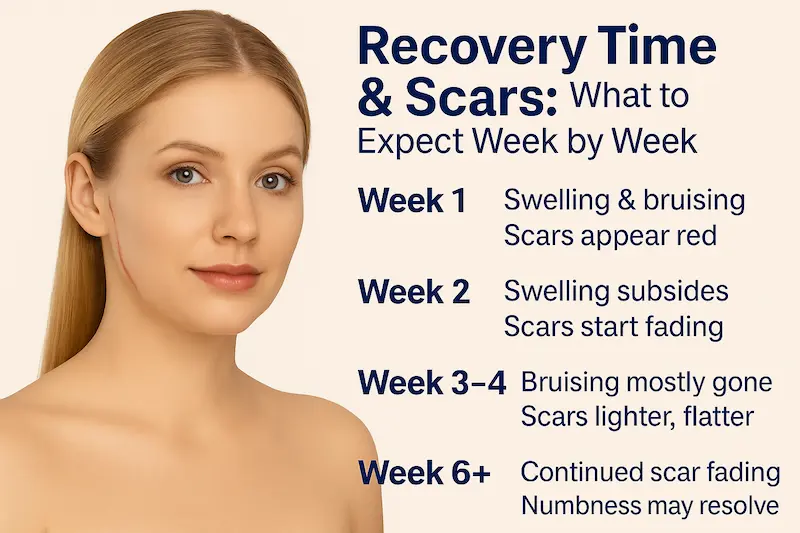
Recovery 1 week post op deep plane facelift: scars, stitches and swelling
The first week is when patients are often most anxious about how they look — and when support from an experienced medical team makes a huge difference.
Around recovery 1 week post op deep plane facelift, you can generally expect:
- Swelling to still be obvious, but improving: Your face will look fuller than your final result. The jawline may appear squared or puffy before it sharpens.
- Bruising to be shifting: It might appear yellow, green or fading purple, especially around the lower face and neck.
- Incisions to be closed but pink: The lines around your ears and hairline will be visible up close but usually hidden by hair and dressings.
- Sutures removed: In many cases, stitches are taken out toward the end of Week 1, which feels like a big step forward.
With HBOT and LLLT, the goal in this period is to:
- Support oxygen delivery so incisions and deeper layers heal efficiently.
- Start guiding collagen production so scars can mature into fine, discreet lines.
- Help swelling and bruising move through their natural cycle more quickly and predictably.
Even though you may feel far from your final result at one week, this stage is exactly where a thoughtfully designed, technology-supported deep plane facelift recovery plan pays off. It lays the foundation for smooth healing in the weeks and months that follow.
How your scars evolve over time: deep plane facelift recovery day by day photos guide
Many patients ask whether they’ll receive deep plane facelift recovery day by day photos or visual guidance. At AKM Clinic, your surgeon and care team walk you through what is normal at each stage and may use example images or diagrams to help you understand what to expect.
In general, recovery after deep plane facelift follows this pattern for scars:
- Week 1–2: Incisions are slightly raised and pink. They may feel tight or itchy as nerves start to wake up.
- Weeks 3–6: The lines begin to flatten and soften. With LLLT support and proper scar care, they can fade steadily.
- Months 3–6: Scars often turn a lighter shade and blend more naturally with surrounding skin.
- Up to 12 months: Final scar maturation. In most patients, facelift scars are very discreet once fully healed, often hidden in natural creases or hair.
While no clinic can promise invisible scars, the combination of precise surgical technique, gentle tissue handling and supportive technologies like LLLT gives your body the best chance to produce fine, well-camouflaged lines. This is a crucial part of the overall deep plane facelift recovery time that often gets overlooked when focusing only on swelling and bruising.
How AKM Clinic Uses HBOT & LLLT to Personalize Your Recovery
Every face is unique, and so is every recovery for deep plane facelift. At AKM Clinic in Istanbul, HBOT and LLLT are not “add-ons” — they are integrated into a structured, medical recovery program, especially for international patients who travel from the Los Angeles, New York, Las Vegas or Chicago.
Your tailored deep plane facelift recovery plan as an international patient
Before surgery, your surgeon and patient coordinator discuss:
- Your travel dates and how long you can stay in Istanbul
- Your job type and social obligations
- Any medical conditions that could affect healing, such as smoking history, diabetes or previous surgeries
Using this information, AKM Clinic builds a personalized deep plane facelift recovery timeline that may include:
- Scheduled HBOT sessions in the first days and week after surgery
- Planned LLLT sessions focusing on incisions and areas prone to swelling
- Regular in-clinic checkups to adjust your plan based on how your body responds
- Clear instructions for when you return home, including skincare, sun protection and follow-up
The goal is not only a beautiful surgical result, but a smoother and more predictable deep plane facelift recovery day by day, with as little stress and uncertainty as possible during your stay in Turkey.
Inside your HBOT protocol: session frequency, duration and safety at AKM Clinic
HBOT protocols are customized, but a typical approach for recovery after deep plane facelift starts early, uses short focused sessions in a controlled pressurized environment, and continues with monitored comfort and safety. The session frequency, optimal post-op timing window, and which facelift-specific recovery markers respond fastest to oxygen therapy are explained in our facelift HBOT protocol.
HBOT is widely used in surgical recovery around the world. At AKM Clinic, it becomes a key tool in creating a rapid recovery deep plane facelift experience, especially for patients who want to minimize visible downtime before flying back home.
LLLT sessions for scar optimization and skin quality after deep plane facelift
LLLT is usually introduced once your surgeon is satisfied with early incision healing. During these sessions, controlled light energy is applied over:
- Facelift incisions around the ears and hairline
- Under-chin or neck incisions if a neck lift was combined
- Areas with persistent swelling, redness or sensitivity
Within your deep plane facelift recovery, LLLT sessions aim to:
- Encourage smoother, more organized collagen in the scar
- Reduce redness and irritation as tissues remodel
- Improve overall skin texture and glow in the treated areas
Together, HBOT and LLLT help transform what could be a more uncertain recovery from deep plane facelift into a structured, medically supervised journey. Rather than simply waiting and hoping, you and your care team are actively supporting your body’s healing every step of the way.
In the next section, we’ll look at what your stay in Istanbul actually feels like — from airport pickup and hotel comfort to how many days you may want to plan in Turkey to complete the key stages of your deep plane facelift recovery before flying home.
Planning Your Trip to Istanbul: Comfort, Safety and Shorter Downtime
For many patients, choosing AKM Clinic is not only about surgical expertise, but also about combining deep plane facelift recovery with a comfortable, well-organized stay in one of Europe’s most fascinating cities. Istanbul offers modern medical infrastructure, experienced surgeons and a lower cost of care compared to major cities in the USA.
From airport pickup to hotel: what recovery looks like in Istanbul
As an international patient, you are not left to navigate your recovery from deep plane facelift alone. A typical journey at AKM Clinic includes airport pickup, pre-operative consultation, dedicated patient coordinator support, and recovery-friendly accommodation chosen for cleanliness, comfort and proximity to the clinic. The full list of partner hotels with HBOT-compatible scheduling, VIP transfer logistics, and proximity-to-clinic options is documented on our accommodation and transfer page.
Between appointments and HBOT/LLLT sessions, most patients spend their early deep plane facelift recovery resting in their room, enjoying room service, reading or watching movies. As swelling improves, some light walks around the neighborhood or short café visits can be added, always within the guidelines set by your surgeon.
How many days you should stay in Turkey for deep plane facelift recovery
While the exact length of stay is personalized, many international patients plan 4–5 days in Istanbul to cover surgery, early post-operative checks, suture removal and the most critical phase of HBOT and LLLT. The full operational sequence — pre-op consultation, surgery day, daily HBOT/LLLT scheduling, fit-to-fly clearance, and remote follow-up cadence — is mapped on our step-by-step patient pathway.
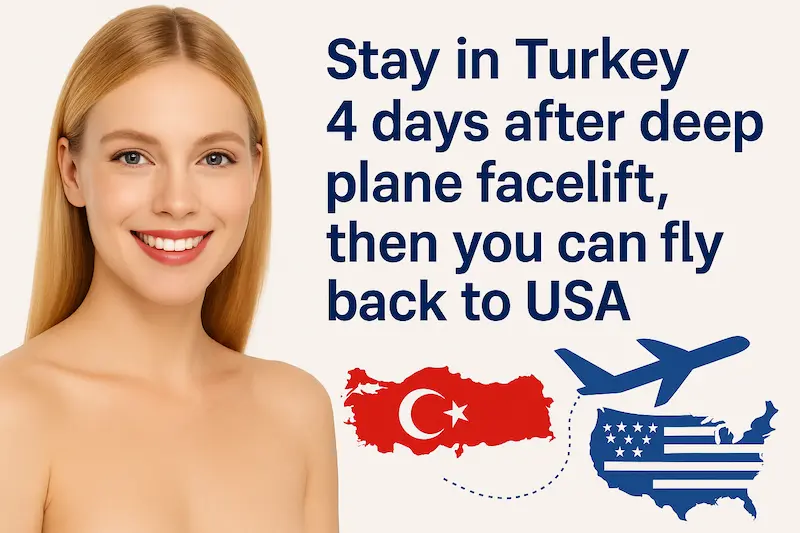
This allows you to complete the most intense phase of deep plane facelift day by day recovery with your surgical team right there, rather than at home. When you do return home, you are usually well into the “social recovery” phase, with clear written instructions for the remaining months of healing.
Recovery after deep plane facelift in Turkey vs USA: downtime and cost
In terms of medical quality, modern clinics in Istanbul offer standards and technologies comparable to many leading centers in the USA — including the use of HBOT and LLLT as part of advanced deep plane facelift recovery protocols. The full evaluation framework — including JCI-accreditation criteria, OR sterilization standards, anesthesia infrastructure, and recovery technology stack — is detailed in our companion facility evaluation guide.
Where you may notice the biggest difference is:
- Cost of care is often where you may notice the biggest difference: total costs for surgery and recovery support in Turkey are often significantly lower than in major cities like New York, Los Angeles, Chicago or San Francisco, even when you include flights and accommodation. The full pricing breakdown — including HBOT/LLLT package inclusions, currency comparison, and what “all-inclusive” actually covers — is detailed on our deep plane facelift cost page.
- Comprehensive care bundles: Packages often include pre-op tests, surgery, anesthesia, hospital or clinic stay, follow-up, and sometimes transfers and hotel arrangements.
- Focus on medical tourism: Teams are accustomed to caring for international patients and structuring a precise recovery time for deep plane facelift around a fixed return date.
For many patients, this means they can access a high-level deep plane facelift with advanced technologies like HBOT and LLLT, while also enjoying a discreet recovery away from their usual social environment — and still benefit from a more favorable overall cost compared to having the same procedure at home.
Frequently Asked Questions About Deep Plane Facelift Recovery, HBOT & LLLT
Below are concise answers to some of the most common questions about deep plane facelift recovery, especially when advanced therapies like HBOT and LLLT are used as part of your treatment plan at AKM Clinic.
How long is recovery from deep plane facelift when HBOT & LLLT are used?
HBOT and LLLT do not remove the need for healing, but they can make it more efficient. Many patients feel socially presentable around 2–3 weeks after surgery, while deeper healing and final refinement continue over several months. The exact recovery time for deep plane facelift depends on your age, health and surgical plan.
What is the typical deep plane facelift recovery timeline day by day?
In general, swelling and bruising peak in the first few days, then gradually improve. By the end of Week 1, you see early improvements; by Week 2–4, most people feel comfortable with light social activity, especially with makeup. Full results and scar maturation develop over 3–6 months or longer.
Will I receive deep plane facelift recovery day by day photos or visual guidance?
Your surgeon will guide you through each stage, often using example photos or diagrams to explain what is normal. While you may not receive a public “photo diary,” you can expect clear, personalized explanations of how your deep plane facelift day by day recovery should look and when to contact the clinic with concerns.
How visible are scars 1 week after deep plane facelift at AKM Clinic?
At around one week, facelift scars are closed but still pink and visible up close, especially around the ears and hairline. They are usually well-hidden by your hairstyle and dressings. Over the following weeks and months, with careful surgical technique, LLLT and proper scar care, they tend to fade and become much less noticeable.
Is rapid recovery deep plane facelift safe for patients traveling from the USA?
Yes, when planned properly. AKM Clinic is experienced in medical tourism and structures surgery, HBOT, LLLT and follow-up around your travel schedule. Safety is always the priority; your surgeon will only clear you for long-haul flights once your early recovery from deep plane facelift is stable. The procedure-specific safe-fly intervals, cabin pressure considerations, and DVT-prevention protocols are documented in our post-op flight clearance guide.
How many HBOT and LLLT sessions will I need after my deep plane facelift?
The number of sessions is individualized. Some patients receive several HBOT sessions in the first days after surgery, while LLLT may be scheduled regularly over the first weeks to support scar and skin healing. Your exact protocol is tailored to your health, healing speed and length of stay in Istanbul.
Can I benefit from HBOT & LLLT at AKM Clinic if I had my deep plane facelift elsewhere?
In many cases, yes. If you have already undergone surgery and are in the healing phase, HBOT and LLLT may still support your recovery. The medical team would first review your surgical history and current condition to design a safe, appropriate protocol for your needs.
Medical Disclaimer: This content is for educational purposes only and does not replace medical advice. Deep Plane Facelift outcomes, risks, and recovery vary by individual. Always consult a qualified, board-certified surgeon for diagnosis and treatment decisions. If you have a medical emergency, seek immediate local care.