If you’ve been researching facelift surgery, you’ve probably come across the phrase smas vs deep plane facelift over and over again. Both techniques are advanced, both can deliver impressive anti-aging results, and both are performed at high-level centers like AKM Clinic in Istanbul. But they are not the same operation – and understanding the difference is essential before you decide which approach is right for your face, your lifestyle, and your comfort level.
In this guide, we’ll break down how each technique works, what kind of results you can realistically expect, how long they last, and in which situations surgeons tend to favor SMAS vs deep plane facelift techniques.
Let’s start with the basics: what exactly is a SMAS facelift, and why has it been considered a gold standard for so many years?
Ready to explore your options? If you already know which technique you lean towards, you can jump straight into our complete care guides: explore the Deep Plane Facelift hub for advanced structural lifting, or visit our SMAS Facelift hub for foundational lower-face rejuvenation.
Table of Contents
What Is a SMAS Facelift?
A SMAS facelift is a modern facelift technique that targets the deeper support layer of the face rather than just pulling the skin. By focusing on the Superficial Musculo-Aponeurotic System (SMAS), surgeons can lift and reposition sagging tissues in a way that looks more natural and lasts longer. The full SMAS technique reference — including plication versus imbrication strategy, candidacy criteria, and where SMAS remains the preferred choice — is documented on our SMAS facelift overview.
How the SMAS facelift works: the basics of the SMAS layer
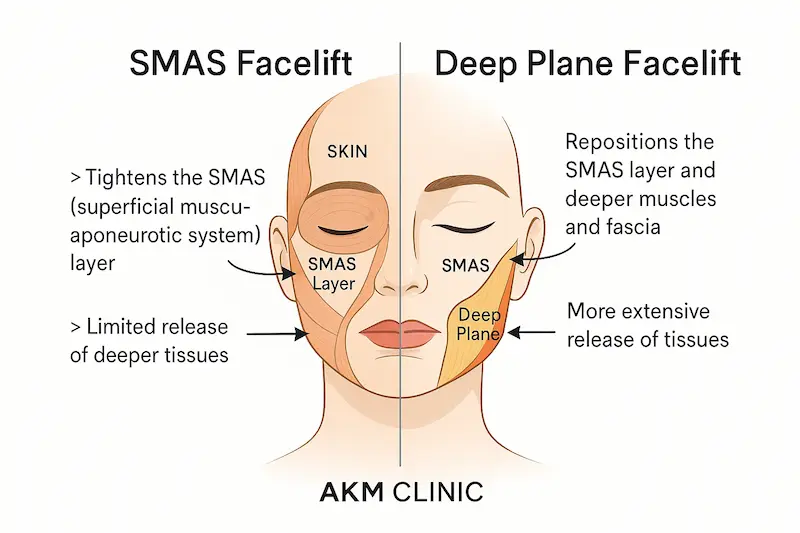
SMAS stands for Superficial Musculo-Aponeurotic System. It’s a thin but very important fibromuscular layer that sits just under the skin and fat of the face. Instead of simply pulling on the skin (which can look tight and “wind-tunnel”), a SMAS facelift focuses on tightening and repositioning this deeper support layer.
During a SMAS facelift, the surgeon typically makes incisions hidden around the ear and sometimes extending slightly into the hairline. The skin is gently lifted, the SMAS layer is exposed, and then it is either:
- Plicated (folded and tightened with sutures), or
- Elevated and repositioned as a SMAS “flap,” then secured in a more youthful position.
By lifting the SMAS rather than pulling the skin alone, the surgeon can restore jawline definition, soften jowls, and improve the lower face in a way that looks more natural and lasts longer than a simple skin-only lift. This is why, for many years, SMAS techniques have been a workhorse of modern facelift surgery.
Benefits and limitations of a SMAS facelift for facial aging
A SMAS facelift is a highly respected technique because it strikes a useful balance between safety, predictability, and improvement. In experienced hands, it can:
- Sharpen a soft or “blurry” jawline caused by jowls
- Lift sagging tissues in the lower face and part of the midface
- Smooth moderate skin laxity without making you look “over-pulled”
- Provide results that often last many years when combined with healthy lifestyle habits
However, when we compare smas vs deep plane facelift approaches, many surgeons feel that SMAS techniques have some limitations, especially in more advanced aging:
- Midface and deep cheek volume: SMAS lifts can improve these areas, but not always as dramatically as a deep plane facelift.
- Very heavy tissues: In patients with thicker skin or more severe sagging, results may be more modest compared with deeper techniques.
- Longevity: While results are long-lasting, some surgeons feel that deep plane techniques can maintain certain improvements for a longer period in selected patients.
This doesn’t mean SMAS is “worse” – it means the ideal choice in the smas vs deep plane facelift discussion depends on your anatomy, your age, and how dramatic or subtle you’d like your transformation to be.
Ideal candidates for SMAS facelift vs mini facelift
A SMAS facelift is usually recommended for patients who have more noticeable aging changes than what a mini facelift can address, but who may not need the most aggressive deep plane approach. Typical SMAS candidates:
- Are often in their late 40s, 50s, or early 60s
- Have visible jowls and a softened jawline
- Show moderate laxity in the lower face and sometimes the neck
- Want a clear but natural improvement, not a completely different face
By contrast, a mini facelift is a lighter lift with smaller incisions and more limited dissection. It can be great for earlier signs of aging, but it usually won’t provide the same level of structural repositioning as a SMAS or deep plane facelift. The candidacy framework, S-lift incision pattern, and exact use cases where a mini lift outperforms more invasive approaches are detailed on our mini facelift surgical page.
What Is a Deep Plane Facelift?
A deep plane facelift is a more advanced technique that works in a deeper anatomical layer beneath the SMAS. Instead of tightening the SMAS alone, it lifts the skin, fat and SMAS together as a unit, allowing the surgeon to address the cheeks, midface and deep folds more powerfully. The complete deep plane methodology — incision pattern, ligament release sequence, and how the composite flap is repositioned — is documented on our deep plane facelift surgical hub.
How the deep plane facelift works beneath the SMAS layer
When people compare smas vs deep plane facelift, the key difference is how deep the surgeon works. While a SMAS facelift tightens or repositions the SMAS layer itself, a deep plane facelift goes one step further: it releases and repositions the facial tissues beneath the SMAS and muscle layer as a single unit.
In a deep plane facelift, the surgeon carefully enters a deeper anatomic plane where the skin, fat, and SMAS remain connected. Instead of separating the skin from the underlying support structure, these layers are lifted together. This allows the surgeon to:
In a deep plane facelift, the surgeon carefully enters a deeper anatomic plane where the skin, fat, and SMAS remain connected. Instead of separating the skin from the underlying support structure, these layers are lifted together. This allows the surgeon to:
- Release key retaining ligaments that pull the face downward
- Lift the midface and cheek fat pads more effectively
- Improve deep nasolabial folds (smile lines) and jowls in a more structural way
- Redistribute volume in a way that mimics a younger, fuller face
Because the skin is not overly separated from the deeper tissues, many surgeons feel this can reduce excessive tension on the skin closure and help achieve a more natural, “unoperated” appearance. This is why, in the ongoing deep plane facelift vs SMAS facelift discussion, deep plane techniques are often associated with a softer, three-dimensional rejuvenation rather than just a tighter jawline.
Deep plane facelift results: who benefits the most?
A deep plane facelift is typically recommended for patients who need more than just a lower face lift. Ideal candidates often show:
- Significant midface drooping, with flat or hollow-looking cheeks
- Deep nasolabial folds that don’t respond well to fillers anymore
- Pronounced jowls and early to moderate neck laxity
- Thicker or heavier facial tissues that need a stronger lifting vector
In these patients, the deep plane vs SMAS facelift difference becomes very visible. Deep plane surgery can:
- Restore cheek fullness by lifting the midface tissues upward
- Soften deep folds around the mouth more effectively
- Improve jawline and jowl definition in a single, coordinated lift
- Create a more youthful, heart-shaped facial contour
It’s also important to understand that “stronger” does not have to mean “less natural.” When performed by an experienced facelift surgeon, a deep plane facelift should not make you look like a different person. Instead, the goal is to make you look like a well-rested, fresher version of yourself from 10–15 years ago. The credential verification framework — including TPCD/EBOPRAS/ISAPS public registries, fellowship pedigree, and the specific markers that distinguish a deep-plane-experienced surgeon — is detailed in our surgeon evaluation guide.
Deep plane vs traditional facelift: when surgeons go deeper
When patients search for deep plane facelift vs SMAS facelift differences, they often also see terms like “traditional facelift” or “skin and SMAS facelift.” Traditional techniques usually involve lifting the skin, tightening or plicating the SMAS, and then trimming excess skin. This can still give a very nice result for the right candidate, but it may be more limited in how much it can transform the midface and deep folds.
A deep plane facelift, by contrast, involves:
- More extensive work in a deeper anatomic plane
- Careful release of ligaments around the midface and jawline
- Repositioning the entire facial soft tissue “block” upward and back
Because of this, many surgeons reserve deep plane techniques for:
- Patients wanting more significant rejuvenation in one surgery
- Patients whose tissues have already been tightened before (e.g., prior facelift)
- Individuals in their 50s, 60s, or beyond who want a powerful but still natural upgrade
The trade-off is that deep plane surgery can be more technically demanding and must be performed by surgeons who are highly familiar with facial anatomy and nerve pathways. When you compare smas facelift vs deep plane facelift, the “right” choice is not always the more aggressive one; it is the technique that best matches your anatomy, your expectations, and your surgeon’s expertise.
SMAS vs Deep Plane Facelift: Key Differences You Should Know
Now that you understand each technique on its own, it’s helpful to look at smas vs deep plane facelift side by side. This section highlights how they differ in surgical approach, results, longevity and recovery, so you can see which option aligns best with your goals and lifestyle.
Deep plane facelift vs SMAS facelift: technique and anatomy differences
At a glance, both procedures may look similar from the outside: incisions are generally hidden around the ear and sometimes into the hairline, the operation targets the lower face and often the neck, and the goal is to lift sagging tissues. But in the conversation about smas vs deep plane facelift, what really matters is what happens under the skin.
In a classic SMAS facelift:
- The surgeon lifts the skin to access the SMAS layer underneath.
- The SMAS is tightened by folding (plication) or lifting it as a separate flap.
- The skin is then redraped over the newly supported framework and excess skin is removed.
In a deep plane facelift:
- The skin is not widely separated from the underlying tissues; instead, the skin, fat, and SMAS are kept connected.
- The surgeon enters the deeper “deep plane” beneath the SMAS and releases key ligaments.
- This whole unit is then repositioned as one block, particularly lifting the midface, cheeks, and jowls.
So, when comparing deep plane facelift vs SMAS facelift, you can think of it this way: SMAS facelift works on top of the SMAS, while deep plane facelift works beneath it. This deeper plane gives the surgeon more control over midface volume and deep folds, but it also requires advanced anatomical knowledge and experience.
SMAS facelift vs deep plane facelift results, longevity, and “natural look”
One of the main reasons patients research smas facelift vs deep plane facelift differences is to understand which option will give the most natural and long-lasting results. The truth is: both can look very natural and both can last for many years when performed by a skilled facial surgeon. The differences are more about where you see the biggest improvement and how dramatic the change is.
With a SMAS facelift, typical benefits include:
- Clear improvement in jowls and jawline definition
- Smoother transition between the face and neck
- A refreshed, “less tired” look without a drastic change in identity
With a deep plane facelift, the improvements often extend further up the face:
- More noticeable lifting of the cheeks and midface
- Softening of deep nasolabial folds and marionette lines
- More three-dimensional rejuvenation rather than a mainly “vertical” or “backward” pull
In terms of longevity, many surgeons feel that, in suitable candidates, deep plane results can remain impressive for a very long time because ligaments and deeper structures are repositioned, not just tightened. However, how long your facelift lasts also depends on:
- Your skin quality and genetics
- Sun exposure and lifestyle choices (smoking, weight changes, etc.)
- Your age at the time of surgery
From a “natural look” perspective, smas vs deep plane facelift is not about one being “fake” and the other “real.” Both techniques aim to restore youthful proportions and angles. Many patients love deep plane results because the cheeks and midface look softly full rather than flat, but a thoughtfully executed SMAS facelift can also look beautifully subtle and authentic.
Deep plane facelift vs SMAS lift: recovery, swelling, and downtime
Recovery is another key factor in the deep plane facelift vs SMAS lift decision. Although every patient is different, it helps to understand the general trends.
For a SMAS facelift, typical recovery features include:
- Swelling and bruising for the first 1–2 weeks
- Most patients feeling “presentable” with makeup and good hairstyling after 2–3 weeks
- Continued refinement of scars and contours over several months
For a deep plane facelift, because the work is deeper and involves more ligament release, some patients may experience:
- A similar or slightly longer period of swelling, especially in the midface and cheeks
- A feeling of tightness or fullness that gradually settles over a few weeks
- Final results taking a few months to fully “mature” as the tissues heal into their new position
Recovery time alone shouldn’t be your deciding factor. Both techniques offer surprisingly manageable downtimes when paired with elite aftercare. For a granular look at the healing timeline, including day-by-day expectations, peak swelling windows, and what each recovery phase looks like in real photos, see our complete visual recovery timeline.
High SMAS vs Deep Plane Facelift: Comparing Advanced Techniques
High SMAS and deep plane facelifts are often seen as “next-level” options beyond a standard facelift. This section explains what high SMAS is, how it differs from classic SMAS and deep plane techniques, and how surgeons choose between high smas vs deep plane facelift for different face types.

What is a high SMAS facelift and how is it different?
As you research SMAS vs deep plane techniques, you may also come across the term high SMAS facelift. This is an evolution of the classic SMAS technique. Instead of only tightening the lower SMAS along the jawline, the surgeon extends the dissection higher over the cheek area, closer to the zygomatic (cheekbone) region. A peer-reviewed study examining high-SMAS versus standard SMAS entry points in deep plane facelift work measured significantly greater tissue movement when the higher entry was used — nearly 77% more vertical lift along the jawline — providing the biomechanical evidence behind the “high SMAS” naming convention and explaining why this approach can deliver more powerful midface elevation than classic lower-SMAS technique.
In a high SMAS facelift:
- The SMAS is elevated and repositioned not just in the lower face but also in the midface region.
- The surgeon can better address sagging of the cheek fat pads and early drooping in the midface.
- The technique aims to combine the safety and familiarity of SMAS surgery with more powerful midface lifting.
Compared to a standard SMAS facelift, a high SMAS approach generally:
- Works over a wider area of the face
- Offers improved support to the cheek and nasolabial fold area
- Provides more vertical and “upward” lift rather than just pulling tissues back
When patients compare high smas vs deep plane facelift, they are usually trying to figure out which advanced technique offers the best balance between powerful lifting and safety. Both are designed to go beyond a basic lower face lift, but they do so in slightly different ways.
High SMAS vs deep plane facelift: midface, jowl, and neck improvement
In practical, everyday terms, the high SMAS vs deep plane facelift question often comes down to how each technique handles three key zones: the midface, the jowls, and the neck.
For the midface and cheeks:
- High SMAS allows the surgeon to lift the SMAS higher over the cheek, improving cheek position and contour.
- Deep plane facelift directly repositions the deeper midface tissues and releases retaining ligaments, which can create very noticeable cheek elevation and softening of deep folds.
For the jowls and jawline:
- Both high SMAS and deep plane techniques are effective at sharpening the jawline and reducing jowls.
- In some patients with heavier tissues, deep plane lifting can give a particularly defined, “clean” jawline.
For the neck: Neck improvement often depends on whether a dedicated neck lift or platysmaplasty is done at the same time, regardless of SMAS or deep plane choice. Both high SMAS and deep plane approaches are frequently combined with neck work to achieve a smooth, harmonious result from face to neck. The platysmaplasty technique, submental incision strategy, and how neck lift sequences alongside facelift work are detailed on our neck lift treatment hub.
It’s not accurate to say that one technique is “always better” than the other. Instead, the best option depends on your starting anatomy, how much midface lifting you need, and what your surgeon believes will give you the most stable, balanced result.
Choosing between High SMAS Facelift vs Deep Plane for different face types
A skilled facelift surgeon doesn’t just think about SMAS facelift vs deep plane in abstract terms. They look at your unique face type: bone structure, skin thickness, fat distribution, age, and even your personal style and expectations.
In general (and always with individual exceptions), a surgeon might lean toward:
- High SMAS facelift for:
- Patients with moderate midface descent but good underlying bone structure
- People who want a strong, yet not overly aggressive lift
- Those who may benefit from a technique that bridges classic SMAS and deeper lifting
- Deep plane facelift for:
- Patients with heavier or thicker facial tissues
- More advanced midface and lower face sagging
- Those seeking a more transformative rejuvenation in a single procedure
It’s also worth noting that terminology varies among surgeons. Some surgeons use high SMAS techniques in a way that overlaps with what others would call “deep plane.” This is why the most important step is not picking a label, but choosing a surgeon whose aesthetic sense you trust and who can clearly explain why they recommend one approach in the smas vs deep plane facelift spectrum for your specific face.
At AKM Clinic, surgeons assess each international patient individually – sometimes recommending a high SMAS-style approach, sometimes a deep plane facelift, and sometimes a hybrid technique combined with neck lift, eyelid surgery, or fat grafting to achieve a balanced, natural result. The donor site planning, microfat-versus-nanofat fractionation, and recipient site layering used in adjunctive volume restoration are documented on our fat transfer to face page.
Combining facelift work with eyelid surgery is one of the most common pairings — particularly when patients show midface descent alongside upper-lid skin redundancy or lower-lid hollowing. The upper and lower blepharoplasty technique, fat-conserving approach, and how eyelid surgery is sequenced alongside SMAS or deep plane work are documented on our eyelid surgery page.
Frequently Asked Questions (FAQ)
This FAQ section answers the most common questions patients ask when comparing smas vs deep plane facelift, from longevity and pain levels to combining procedures, scar placement and choosing the right technique at AKM Clinic in Istanbul.
Which is better: SMAS vs deep plane facelift for long-lasting results?
There is no single “best” option that fits everyone. In the smas vs deep plane facelift comparison, both techniques can provide long-lasting results when performed correctly and when you take care of your skin and overall health. Deep plane facelifts may have an advantage in certain patients because the deeper ligaments and midface structures are repositioned, not just tightened. This can help maintain cheek lift and softening of deep folds for many years.
However, a well-executed SMAS or high SMAS facelift can also age beautifully, especially in patients with good skin quality and moderate laxity. The “better” choice is the one that matches your anatomy, your facial aging pattern, and your surgeon’s expertise – not just the technique name.
Deep plane facelift vs SMAS facelift differences in scar placement?
In most cases, the scars for SMAS and deep plane facelift are very similar. Both techniques typically use incisions:
In front of the ear, following natural creases
Curving around the earlobe and behind the ear
Sometimes extending slightly into the hairline
The main difference between deep plane facelift vs SMAS facelift is the work done under the skin, not the visible scar pattern. At AKM Clinic, surgeons design incisions to blend into natural lines and hair-bearing areas as much as possible. Over time, with proper care and sun protection, most facelift scars become discreet and difficult to notice in everyday life.
Is high SMAS facelift vs deep plane facelift safer for older patients?
Safety depends more on your overall health, medical history and the experience of your surgical team than on the label of the technique alone. Both high SMAS and deep plane facelifts can be safely performed in older patients when modern anesthesia protocols, including awake or twilight options when appropriate, are used. The candidacy criteria, comfort protocol, and recovery differences for the awake pathway specifically are documented on our awake deep plane facelift hub.
How do I choose between deep plane vs SMAS facelift at AKM Clinic?
You don’t have to decide alone. The first step is to share clear photos and your main concerns (jowls, neck, deep folds, flat cheeks, etc.). The surgeon then evaluates:
How much midface and cheek lift you need
How advanced your jowls and neck laxity are
Your skin thickness and elasticity
Whether you’ve had previous facial surgery or fillers
Based on this, they will recommend SMAS, high SMAS, deep plane, or a combination – and explain why. You’ll see how each option in the deep plane vs SMAS facelift comparison would change your face, what recovery looks like and how the results are expected to age over time. Many patients find that once a surgeon they trust explains the logic, the choice becomes much clearer. The full operational sequence — from initial photo evaluation through surgeon consultation, technique selection, surgery day, daily recovery touchpoints, and 12-month remote follow-up — is mapped step-by-step on our patient pathway overview.
How long do SMAS facelift vs deep plane facelift results really last?
While everyone ages at a different pace, a properly performed facelift is designed to be a long-term investment, not a short fix. SMAS or high SMAS facelifts can keep you looking noticeably younger for many years, often 7–10 years or more, while deep plane facelifts may maintain midface and cheek improvements particularly well in some patients, helping the face age in a more graceful, natural way over a decade or longer. The full longevity comparison — including what changes at year 1, 5, and 10+, and how lifestyle affects results — is detailed in our companion deep plane longevity guide.