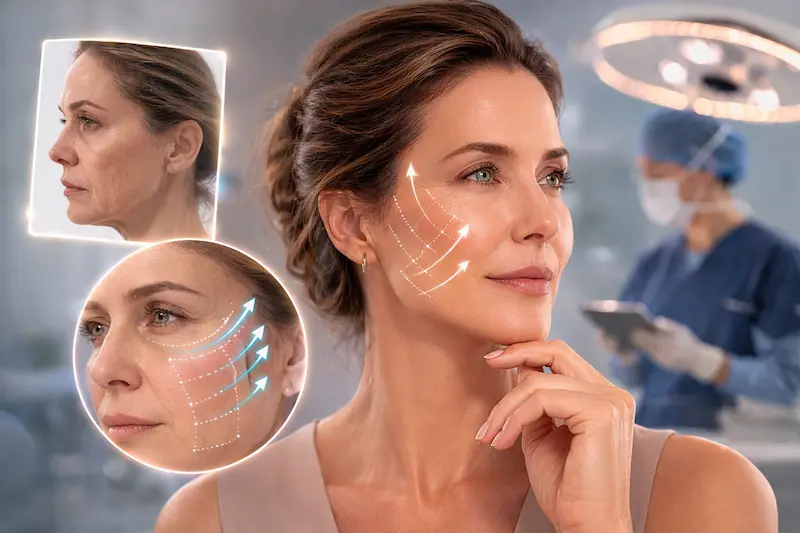
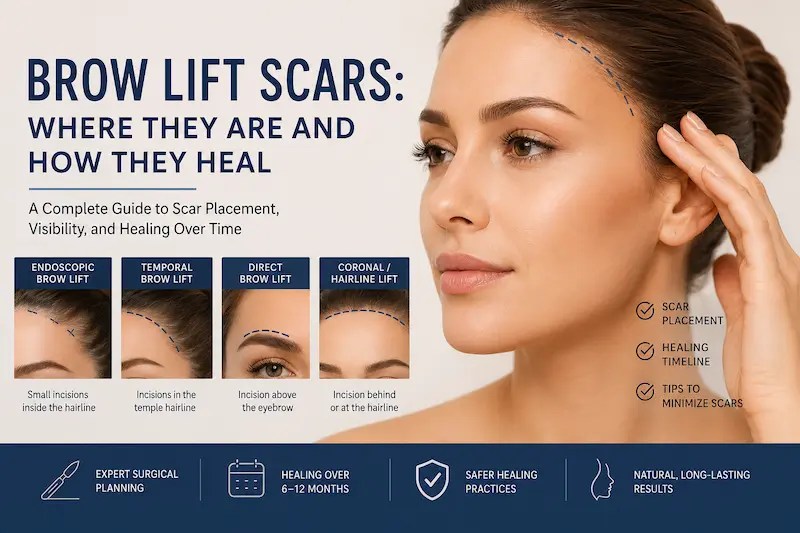
Answer-first: Brow lift scars vary by technique. Endoscopic and temporal brow lifts usually hide small incisions inside or just behind the hairline, while direct brow lifts place the incision above the eyebrow and can leave a more visible scar. Most scars fade over 6–12 months, but hairline position, skin type, incision tension, and aftercare all affect how noticeable they become.
If you are researching brow lift scars, the real question is not simply, “Will I have a scar?” Every surgical lift creates an incision. The better question is: where will that incision sit, how well can it be hidden, and does the scar trade-off make sense for your anatomy?
At AKM Clinic, planning starts with the patient’s hairline, brow heaviness, forehead height, skin quality, and long-term scar visibility. That is why the conversation around how a brow lift is performed should include scar placement from the beginning, not as an afterthought.
This guide explains where brow lift scars sit by technique, why some scars show more than others, and how they typically heal. It is not a technical comparison of every brow lift method, and it does not open the pricing discussion in detail. The focus is narrower: scar location, scar visibility, healing, and realistic expectations.
Table of Contents
Do Brow Lifts Leave Visible Scars?
Yes, a surgical brow lift leaves scars, but visibility depends heavily on the technique. A scar hidden within the scalp behaves very differently from a scar placed directly above the eyebrow. An expert and a careful researcher patient should think of brow lift scars as a planning issue rather than a surprise side effect.
Why every surgical brow lift leaves some scar
A surgical brow lift works by repositioning tissue, and that requires access through an incision. Even a minimally invasive endoscopic approach uses small scalp openings for instruments and fixation. The difference is size and placement: some incisions are short and hidden in hair-bearing scalp, while others sit closer to the brow for direct control.
That does not mean visible scarring is inevitable. It means the incision has to be chosen intelligently. A small hidden incision may suit one patient; a direct incision may be more appropriate for another patient with brow asymmetry, facial paralysis, a receding hairline, or specific functional concerns.
The trade-off: hidden incision versus lifting power
In general, the more hidden the incision, the more the surgeon relies on deeper release, fixation, and tissue movement from a distance. Endoscopic and temporal approaches aim to hide the scar in or behind the hairline. They are often preferred for cosmetic brow rejuvenation because the scar burden is low.
A direct brow lift gives precise control over brow position because the incision is placed immediately above the brow. That precision comes with a scar trade-off. The incision can be camouflaged by brow hair in selected patients, but it is still on the face rather than in the scalp. This is why the the non-surgical brow lift alternative may be discussed for patients who need only a small temporary lift and want to avoid surgical scars altogether.
What “visible” really means
Patients often hear “hidden scar” and imagine “no scar.” That is not accurate. A hidden scar is still present, but it is placed where hair, brow texture, natural creases, or shadow can make it hard to notice in normal conversation.
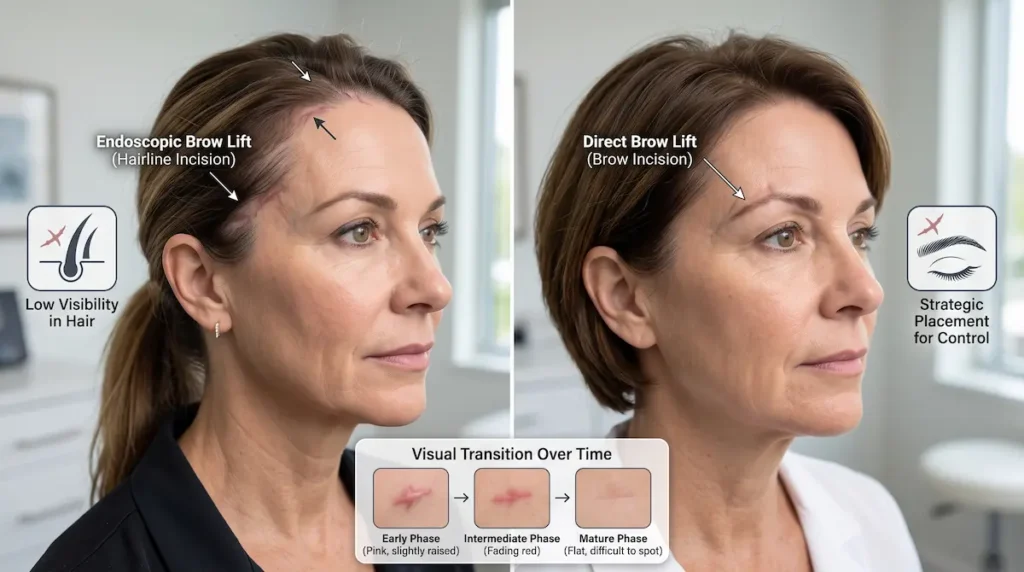
Visibility also changes over time. Early scars can look pink, raised, firm, or slightly uneven. Mature scars usually flatten and fade. In the face and scalp, a well-planned scar should be difficult to spot once healed, but it may still be visible under bright light, close inspection, short haircuts, thinning hair, or certain skin types.
“The best brow lift scar is not just the smallest one. It is the one placed in the right location for the patient’s hairline, brow weight, skin quality, and long-term aging pattern.”
Where the Scar Sits by Technique?
Scar location changes with the brow lift method. This is the part many short articles skip, but it is the key to informed consent. A patient with thick hair and a stable hairline has different scar options than a patient with a high forehead, receding hairline, or thin brows.
Endoscopic brow lift scars
Endoscopic brow lift scars are usually small and placed within or just behind the hairline. The surgeon uses several short scalp incisions to insert a camera and instruments. NIH/StatPearls explains how endoscopic brow lift incisions are placed, including short frontal incisions positioned behind the hairline and temporal incisions placed behind the temporal hairline.
Because the incisions sit in hair-bearing scalp, they are usually among the least visible brow lift scars. The main scar-related concern is not a long line on the forehead; it is the possibility of small scalp marks, temporary tenderness, or hair thinning around incision sites if the hair follicles are stressed.
For the right candidate, this approach offers a strong cosmetic advantage: the scars are hidden by hair. For someone with a very high or receding hairline, the trade-off changes. Endoscopic lifting can slightly affect perceived hairline height, so the surgeon must assess the hairline before recommending it.
Temporal and lateral brow lift scars
A temporal or lateral brow lift focuses more on the outer brow and temple region. The scars are usually placed in the temple hairline or just inside the hair-bearing scalp. Because the target is the lateral brow, the incision pattern is smaller than a full coronal lift and often easier to conceal than an open forehead approach.
This is why patients with outer-brow droop, lateral hooding, or a tired upper-eye look may be directed toward the lateral brow lift approach. The scar usually hides well when the hairline is stable and the patient does not wear very tight hairstyles that expose the temple area.
The limitation is scope. A lateral approach is not meant to correct every type of forehead aging. It is most relevant when the concern is the tail of the brow rather than the entire brow and forehead complex.
Direct brow lift scars
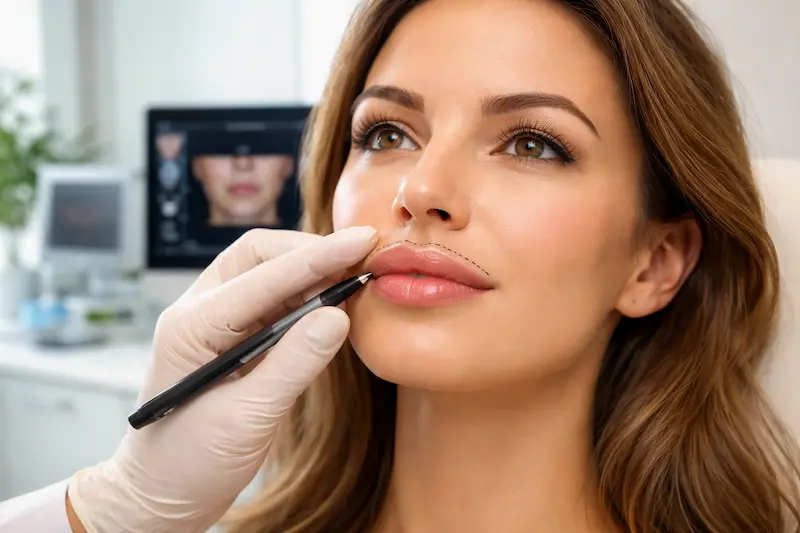
A direct brow lift places the incision immediately above the eyebrow, usually along the superior brow border. This gives the surgeon direct control over brow height and shape. It can be useful for selected patients, including those with facial paralysis, heavy brows, brow asymmetry, receding hairlines, or anatomy that makes scalp-based approaches less suitable.
The scar is also more exposed. NIH/StatPearls notes that unwillingness to accept a potentially visible facial scar is a contraindication to the direct approach, and that sebaceous brow skin can be more prone to scarring. In plain English: direct brow lift scars can heal beautifully in the right patient, but they require a frank conversation before surgery.
The incision is often designed within the upper eyebrow hairline or just above it to help camouflage the mark. Brow thickness matters. Thin eyebrows provide less coverage, making the scar harder to hide. For a deeper look at this specific approach, see where a direct brow lift incision sits.
Coronal and pretrichial brow lift scars
A coronal brow lift uses a long incision placed several centimeters behind the hairline. The advantage is that the scar can be hidden in the scalp. The disadvantage is that it may raise the hairline, and it can become a poor fit for patients with baldness, future hair loss risk, or an already long forehead.
A pretrichial, or hairline, brow lift places the incision at or just in front of the hairline. It can be useful when the surgeon wants to avoid raising the hairline further, and in some patients it may help manage a high forehead. The scar sits at the hairline, so it depends heavily on hair density, incision design, closure quality, and long-term hairline stability.
| Technique | Typical Scar Location | Visibility | Typical Healing Pattern |
|---|---|---|---|
| Endoscopic brow lift | Small incisions inside or just behind the hairline | Usually low when hair density is good | Small scalp scars fade and soften over months |
| Temporal / lateral brow lift | Temple hairline or hair-bearing temporal scalp | Usually hidden by hair; may show with tight hairstyles | Short scars mature gradually; swelling settles first |
| Direct brow lift | Immediately above the eyebrow | More visible; depends on brow hair, skin type, and closure | Early redness can be noticeable; careful scar care matters |
| Coronal brow lift | Long incision behind the hairline | Hidden in hair, but risky if hair thins later | Scalp scar may be concealed but can be exposed by hair loss |
| Pretrichial / hairline brow lift | At or just in front of the hairline | Moderate; depends on hairline design and density | Hairline scar fades over time but needs precise planning |
Why Some Brow Lift Scars Show More?
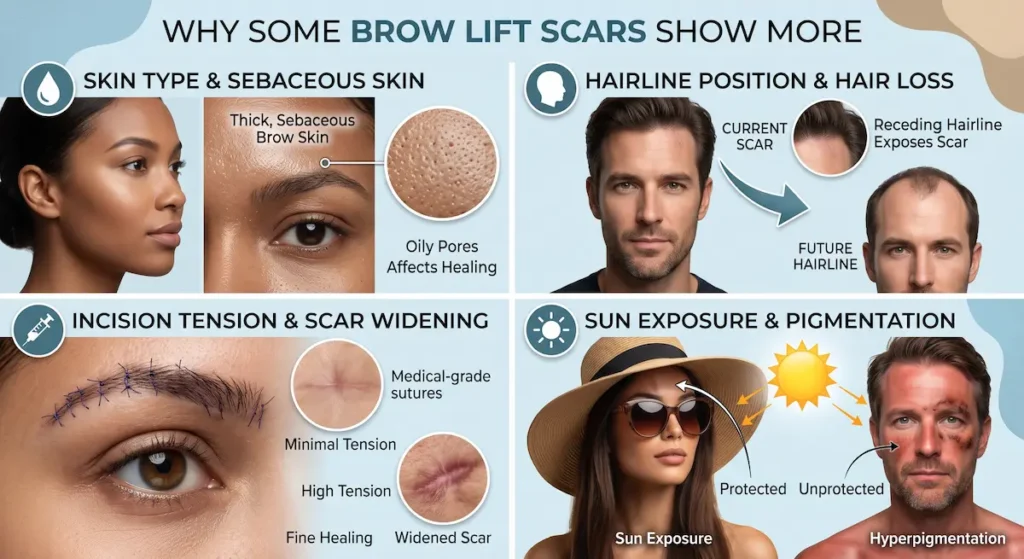
Not all brow lift scars behave the same way. Two patients can have the same technique and heal differently because scar visibility is shaped by skin quality, hair density, incision tension, genetics, sun exposure, and the exact location of the cut. This is where surgical planning becomes personal.
Skin type and sebaceous brow skin
Scalp skin, forehead skin, and eyebrow skin do not heal in identical ways. Scalp incisions are often easier to hide because surrounding hair breaks up the line of the scar. The skin above the eyebrow can be thicker, more textured, and more sebaceous, which is one reason direct brow lift scars need careful patient selection.
This does not make a direct brow lift a “bad” technique. It means the scar is part of the decision. In some patients, especially those with thick eyebrow hair, facial paralysis, major asymmetry, or a high/receding hairline, the direct approach may still be the most logical option. But it should never be presented as scar-free.
Clinical references on direct brow lifting note that the eyebrow region can carry a higher risk of visible scarring, especially when a patient is not willing to accept a facial scar. That is why a surgeon should assess brow hair density, skin texture, and scar history before choosing this route. For readers who want the medical background, this NIH/StatPearls review explains why direct brow incisions can scar more.
Hairline position and future hair loss
Hairline position is one of the most important scar variables in brow lift surgery. A scar hidden in dense scalp hair may be nearly invisible today, but future thinning can change that. This matters especially for patients with male-pattern hair loss, a family history of receding hairline, or already thin temporal hair.
Endoscopic and temporal scars are usually well hidden when the hairline is stable. But if the patient frequently wears very short hair, pulls the hair tightly back, or expects progressive hair thinning, scalp scars deserve more discussion. The goal is not only to hide the incision on surgery day. The goal is to hide it years later.
For coronal and pretrichial brow lifts, hairline planning is even more important. A coronal scar may be hidden behind the hairline, but it can raise the hairline and become less forgiving if the forehead is already long. A pretrichial scar sits at the hairline, so its quality depends on precise closure and how naturally hair grows around it.
Incision tension and scar widening
A scar is more likely to widen when the incision closes under too much tension. In brow lift surgery, tension can come from the amount of lift, the tissue resistance, closure technique, or early pulling during recovery. This is one reason “more lift” is not always better.
Good scar planning respects the balance between lift and closure. If the incision is placed well but closed under strain, the scar may stretch. If the technique gives a dramatic early lift but overloads the skin, the final scar can be less elegant than expected.
This principle applies beyond brow surgery. Facial procedures that heal poorly often share the same themes: poor tissue handling, poor candidate selection, excessive tension, smoking, inadequate aftercare, or unrealistic surgical goals. The same logic is discussed in relation to how other facial procedures can heal poorly.
Suture marks, pigmentation, and sun exposure
Small marks beside an incision can form when sutures irritate the skin or stay under tension. These usually fade, but they can be frustrating early on. Some patients also develop post-inflammatory hyperpigmentation, where the healing line looks darker before it fades.
Sun exposure makes this worse. A fresh scar exposed to UV light can darken and stay visible longer. For hairline scars, sunscreen can be difficult to apply evenly because the scar may sit within hair-bearing scalp. For direct brow scars, sun protection is more straightforward but more visible in daily life.
This is why aftercare should be discussed before surgery. Scar care is not complicated, but timing matters. Silicone, sun protection, avoiding picking, and following your surgeon’s wound-care plan all support a cleaner scar. They cannot erase the need for good surgical technique, but they help the body heal with less unnecessary irritation.
How Brow Lift Scars Heal Over Time?
Brow lift scar healing is not instant. The skin closes within days to weeks, but scar maturation takes months. A scar can look more noticeable before it looks better, especially during the red, firm, or slightly raised phase. That is normal as long as the trend is toward improvement.
Week 1: closed incision, swelling, and early redness
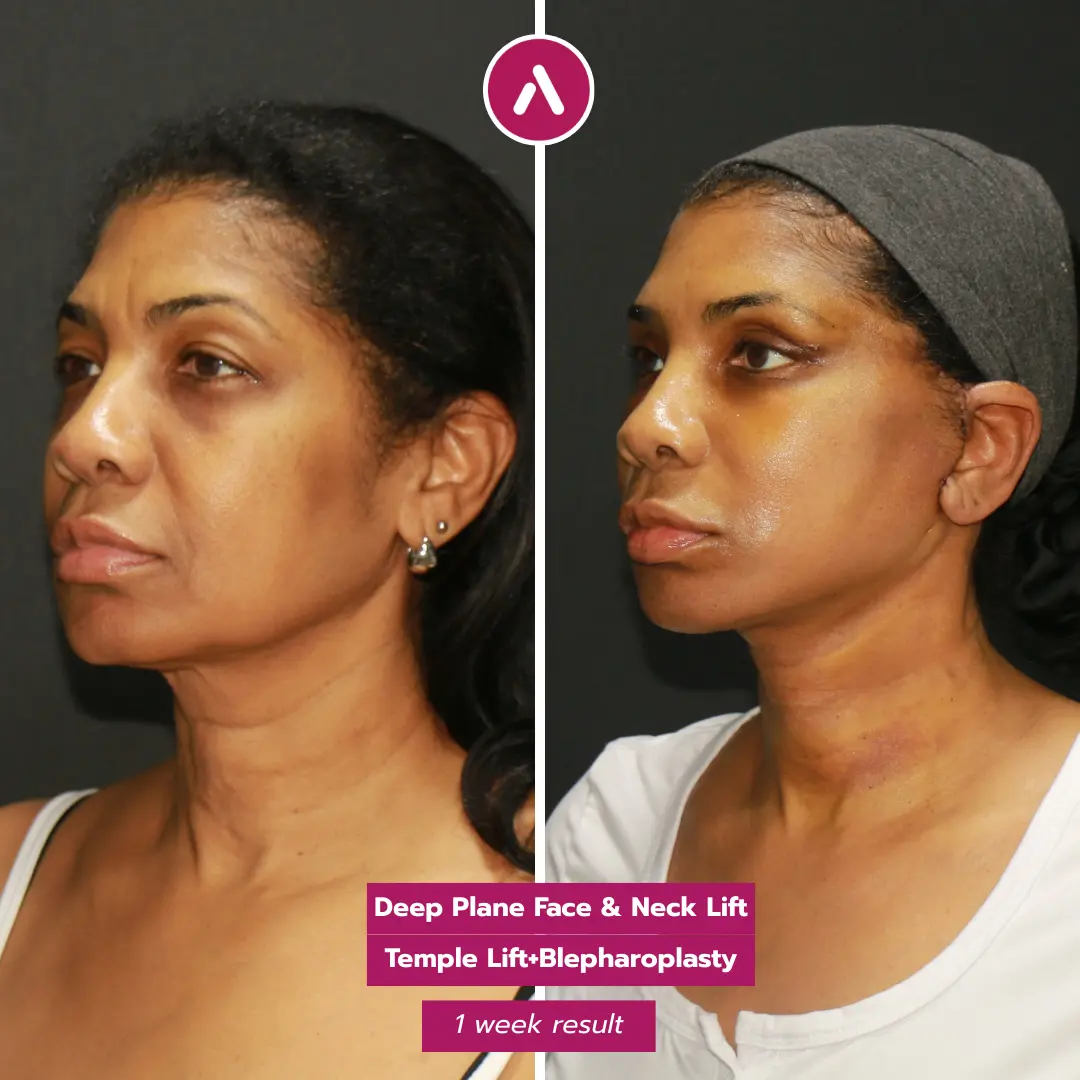
During the first week, the incision is fresh. There may be swelling, mild bruising, tenderness, and a pink or red line along the incision. Scalp incisions may feel tight or numb. Direct brow incisions may look more obvious because they sit on the visible face rather than under hair.
At this stage, the scar is not mature enough to judge. The priority is clean healing: no picking, no unnecessary friction, and no products that your surgeon has not approved. Patients should also avoid hairstyles, hats, or headbands that rub against scalp or temple incisions.
Weeks 2–6: the scar can look more noticeable
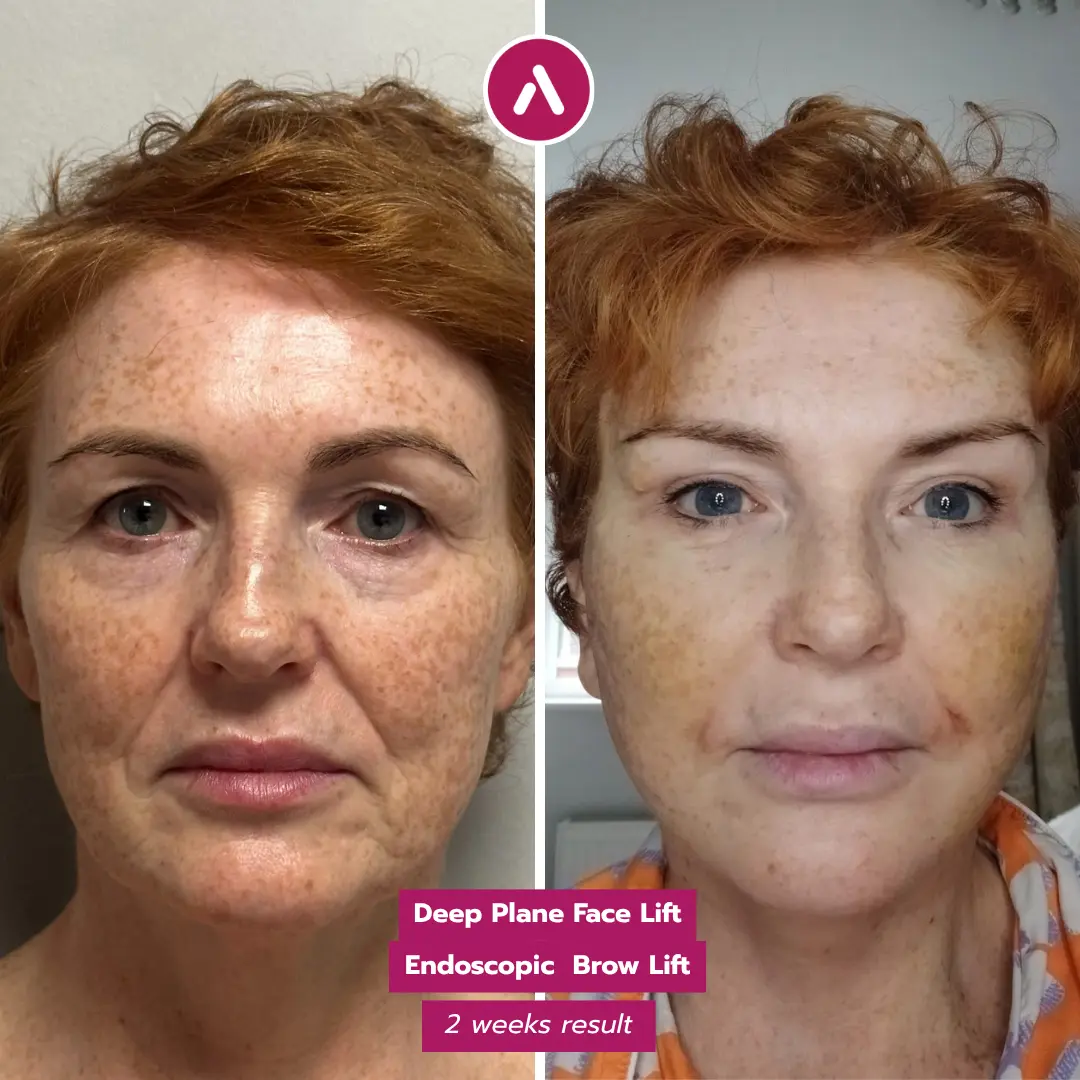
Many patients expect the scar to improve every single day. It often does not work that neatly. Around the second to sixth week, the incision may look pinker, firmer, or slightly raised as collagen is laid down. This can make the scar seem more visible for a while.
This phase is especially important for direct brow lift scars, because the incision is exposed. Makeup may be allowed once the skin is fully closed and the surgeon clears it, but applying makeup too early can irritate healing tissue. Patience matters. So does following the clinic’s specific instructions.
Months 2–6: flattening and fading
Between two and six months, most scars begin to soften and flatten. Redness gradually fades. The line becomes less angry-looking and more blended with surrounding skin. Scalp scars often become difficult to find unless the hair is parted directly over the incision.
Direct brow scars may still be visible during this period, but they should continue to improve. If the scar becomes thicker, itchy, raised, painful, or progressively wider, it should be reviewed. Early management is often easier than waiting until the scar is fully mature.
Months 6–12: scar maturation
By six to twelve months, most brow lift scars are much closer to their mature appearance. They are usually flatter, paler, and softer. Some patients continue to see subtle improvement beyond one year, especially if they had a thicker early scar.
Endoscopic and temporal scars are often hard to notice at this stage if the hairline is stable. Direct brow scars may mature into fine lines, but their final visibility depends on brow density, skin color, texture, closure quality, and how the individual scars.
Normal healing versus concerning healing
Normal healing usually follows a pattern: the scar may look red or firm early, then gradually improves. Concerning healing moves the other direction. A scar that becomes increasingly painful, opens, drains pus, smells unpleasant, spreads redness, or becomes hot to touch should be assessed promptly.
Cosmetic concerns are different from medical warning signs. A pink scar at four weeks is not the same as infection. A slightly raised scar at eight weeks is not automatically a bad result. But worsening pain, discharge, fever, spreading redness, or wound separation should not be ignored.
| Healing Stage | Typical Appearance | Usually Normal? | What Helps |
|---|---|---|---|
| First week | Redness, swelling, tenderness, mild crusting | Yes, if improving and clean | Gentle wound care and avoiding friction |
| Weeks 2–6 | Pink, firm, or slightly raised scar | Often normal | Follow-up review and surgeon-approved scar care |
| Months 2–6 | Flattening, softening, fading | Expected trend | Sun protection and silicone if cleared |
| Months 6–12 | Paler, softer, more mature scar | Yes | Patience; discuss revision only if needed |
| Any stage | Worsening pain, pus, spreading redness, wound opening | No | Contact your surgeon promptly |
Minimizing & Camouflaging Scars
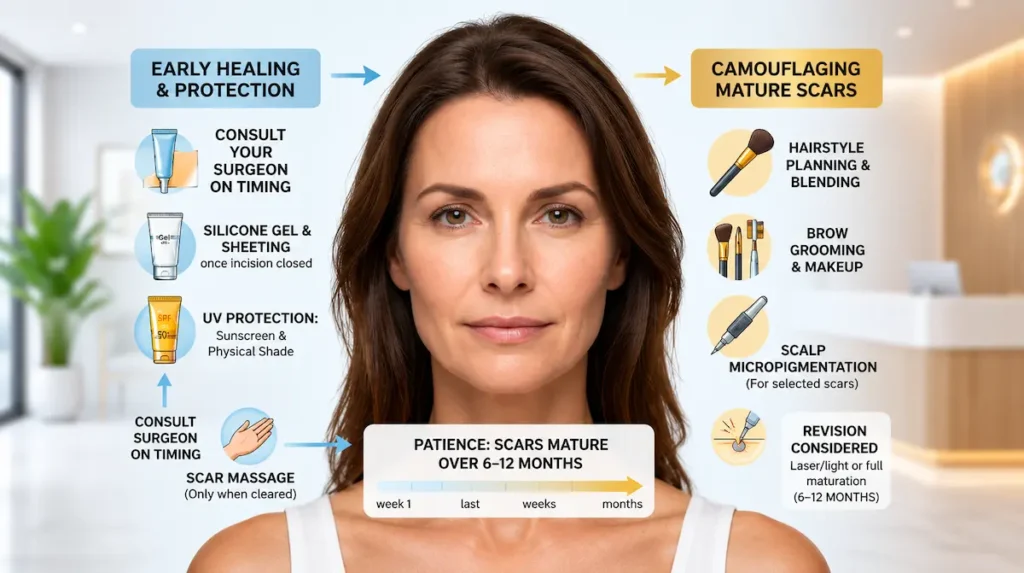
Scar visibility is shaped before, during, and after surgery. The surgeon chooses the incision site and closure method; the patient protects the healing tissue afterward. A good scar plan is not about pretending scars do not exist. It is about placing them where they make the most sense for your anatomy and helping them mature as cleanly as possible.
Choose the technique around your hairline
The best brow lift technique for scarring is not the same for every patient. A person with thick hair and a stable hairline may be a strong candidate for an endoscopic or temporal approach. Someone with a very high forehead, receding hairline, or significant brow asymmetry may need a different plan.
This is why a consultation should include direct questions about your hairline. Ask where the incision would sit, whether it could be exposed by future hair thinning, and how it would look with your usual hairstyle. A scar that is hidden in one hairstyle may be visible in another.
If your concern is mild brow heaviness and you are not ready for surgical scars, it may be reasonable to ask about non-surgical options. If your concern is true tissue descent, however, a temporary injectable lift will not replace a surgical repositioning. The point is not to choose the least invasive option automatically. It is to choose the option that matches the problem.
Use silicone and sun protection at the right time
Silicone gel or silicone sheeting is commonly used in scar care once the incision is fully closed and the surgeon clears it. It can help support a flatter, softer scar during maturation. Timing matters. Applying products too early can irritate the incision or trap moisture before the skin is ready.
Sun protection is equally important. UV exposure can darken a healing scar and make it more noticeable for longer. For direct brow lift scars, broad-spectrum sunscreen and physical shade are usually straightforward. For scalp or hairline scars, patients may need hats, careful parting, or surgeon-approved products that do not irritate the incision.
Scar massage may be recommended later in healing, but it should not be started until your surgeon says the incision is strong enough. Early aggressive rubbing can inflame tissue and may worsen swelling or redness.
Camouflage options for mature scars
Most brow lift scars improve enough that camouflage is minimal. Hairline scars may be covered by hairstyle. Direct brow scars may be softened with brow grooming, makeup, or careful blending once the skin is fully healed.
For selected mature scars, treatments such as laser resurfacing, microneedling, steroid injection for raised scars, scar revision, or scalp micropigmentation may be considered. These are not first-line solutions during early healing. A scar needs time to mature before anyone can fairly judge whether revision is needed.
If budget planning is part of your decision, keep it separate from scar education. This article does not open pricing in detail, but you can review the cost of a brow lift on AKM’s dedicated cost page.
When to ask about scar revision
Scar revision is usually discussed only after the scar has matured, often closer to the 6–12 month mark. Earlier intervention may be needed if there is infection, wound separation, or a clearly abnormal scar response, but most cosmetic scar concerns should be followed over time before making a final decision.
Good revision planning asks why the scar became visible in the first place. Was the incision placed in a difficult area? Was there too much tension? Did the patient have hair thinning? Was there inflammation, sun exposure, or a strong genetic tendency toward thick scarring? Without answering those questions, revision can repeat the same problem.
The safest mindset is measured patience. Most brow lift scars improve substantially with time. If they do not, an experienced surgical team can discuss options once the scar has declared its final behavior.
Frequently Asked Questions: Brow Lift Scars
These questions reflect the concerns patients most often raise before a brow lift: whether scars will show, how long they take to fade, and what happens if the hairline changes later. The answers below stay focused on scar placement and healing, not general brow lift technique or pricing.
Are endoscopic brow lift scars visible?
Endoscopic brow lift scars are usually small and hidden inside or just behind the hairline. In patients with good hair density, they are often difficult to see after healing. They may become more visible if the hair is very short, parted directly over the incision, or thins in the future.
Where are direct brow lift scars?
Direct brow lift scars sit immediately above the eyebrow, usually along the upper brow border. This gives the surgeon direct control of brow position, but the scar is on the visible face rather than hidden in the scalp. Thick eyebrow hair can help camouflage it, while thin brows may make it more noticeable.
Do brow lift scars fade?
Yes, most brow lift scars fade over time. Early scars may look pink, red, firm, or slightly raised. Over the next several months, they usually flatten, soften, and become paler. Full scar maturation often takes 6–12 months, and some scars continue to improve beyond one year.
Will baldness expose a brow lift scar?
It can. Scalp-based scars rely on hair coverage. If a patient has male-pattern hair loss, a receding hairline, thin temporal hair, or strong family history of hair loss, the surgeon should consider how the scar may look years later. This is especially important for coronal, temporal, and endoscopic approaches.
How long until brow lift scars settle?
The incision usually closes within the early healing period, but the scar itself takes much longer to settle. Many patients see major improvement by 3–6 months, with a more mature scar around 6–12 months. Direct brow lift scars may need especially careful aftercare because they are more visible during healing.
Can brow lift scars be revised?
Yes, some brow lift scars can be revised, but revision is usually considered after the scar has matured. Options may include scar revision, laser treatment, steroid treatment for raised scars, or camouflage strategies. The right choice depends on scar location, thickness, color, width, hairline position, and why the scar became noticeable.
Is a brow lift scar permanent?
A scar is permanent in the sense that the skin has been cut and healed. However, a well-planned brow lift scar often becomes very difficult to see. The goal is not “no scar”; the goal is a fine, well-placed, mature scar that blends with the hairline, eyebrow, or surrounding skin.
Which brow lift has the least visible scar?
For many cosmetic patients, endoscopic and temporal brow lifts create the least visible scars because the incisions are small and hidden in the hairline. That does not mean they are right for every patient. A high forehead, receding hairline, heavy brow, or asymmetry may change the recommendation.
Conclusion
Brow lift scars depend on the technique, the hairline, the skin, and the quality of the surgical plan. Endoscopic and temporal brow lift scars are usually hidden in or behind the hairline. Direct brow lift scars sit above the eyebrow and require a more explicit scar trade-off. Coronal and pretrichial scars depend heavily on hairline stability.
The most important step is matching the incision to the patient. A scar that works beautifully for one person may be the wrong choice for another. If you are considering surgery, ask AKM Clinic to assess your brow position, forehead height, hairline, and scar risk during a virtual consultation so your plan is built around both lift and long-term scar visibility.
Medical Disclaimer: This article is for educational purposes only and is not medical advice, diagnosis, or a substitute for consultation with a qualified physician. Healing patterns vary by patient. If you have worsening pain, spreading redness, pus, fever, wound separation, or any concern about your incision, contact your surgeon or seek medical care promptly.