
If you’re researching thread lift Turkey options, you’re probably trying to answer three discerning patient questions:
- Will it look natural?
- Is it safe in Turkey (and specifically Istanbul)?
- Is the price difference worth it—or a red flag?
This guide breaks down the real-world pros, cons, risks, and pricing—using a practical, evidence-based lens grounded in clinical practice. You’ll also learn how to evaluate Turkey thread lift procedures properly, so you can avoid unrealistic promises and choose a clinic based on standards, not hype.
Table of Contents
What Is a Thread Lift (and What It Can Realistically Do)
A thread lift is a minimally invasive facial rejuvenation procedure designed to create a subtle lifting effect and stimulate collagen. It’s often positioned as a “no-surgery facelift,” but the most reliable outcomes are achieved when it’s used for the right level of skin laxity and the right facial anatomy. The best results are typically described as “refreshed,” not dramatically transformed.
How thread lifting works (mechanical lift + collagen stimulation)
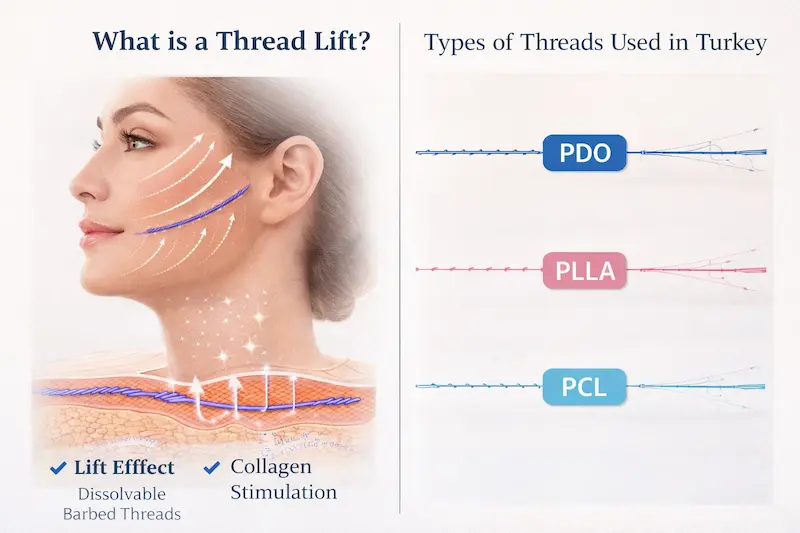
Threads are inserted under the skin using fine cannulas or needles. Depending on the thread type, they can:
- Provide a gentle mechanical lift by anchoring or “gripping” tissue (especially with barbed threads).
- Stimulate collagen production as the body responds to the thread material over time.
From a science perspective, the “lift” you see immediately can soften slightly as swelling resolves, while the longer-term improvement is often tied to collagen remodeling—an area that clinical literature continues to refine regarding longevity and predictability.
What results look like: “refreshed” vs “surgical-level lifting”
“Refreshed vs surgical-level lifting” is the single most important expectation to calibrate before a thread lift — and the longevity literature is unusually direct about the difference. The research consistently reports that thread-lift improvement is real but transient, which patients deserve to know before paying for it.
For the longevity synthesis specifically, 2025 systematic review of thread-lift suture longevity and aesthetic outcomes analyzing 192 publications (Aesthetic Plastic Surgery) — updating an earlier review after more than a decade of accumulated data — reported that absorbable thread-lift results provide meaningful initial improvement that declines as the sutures dissolve, with the lifting effect generally diminishing substantially within 12-18 months and collagen-stimulation benefits being more modest and harder to quantify than marketing typically suggests.
The takeaway isn’t “threads don’t work” — it’s “threads work temporarily.” A patient who understands and accepts the 12-18 month maintenance reality makes a good thread-lift candidate; a patient expecting surgical-level permanence does not.
Thread lifts can improve:
- Early jowling
- Mild cheek descent
- Light jawline blurring
However, they generally cannot replicate the structural repositioning of a surgical facelift. If a clinic promises a dramatic “10-year reversal” with threads alone, consider that a red flag—especially when comparing thread lift in Turkey packages that look “too good to be true.”
Best treatment zones: jawline, cheeks, neck, brows (and limitations)
The neck and jawline are among the most-requested thread-lift zones — and also among the zones where threads most often disappoint, because submental laxity and platysmal banding usually exceed what sutures can mechanically address.
When neck laxity is the primary concern, the honest assessment frequently points toward surgical neck lifting rather than threads. For patients with mild early jawline softening, threads can produce a meaningful refresh; for patients with established neck laxity, vertical platysmal bands, or significant submental fullness, threads tend to produce disappointment and a “wasted” maintenance cycle before the patient pursues surgery anyway.
For the surgical neck context specifically, the surgical neck lift option covers the candidacy criteria that distinguish thread-appropriate necks from surgery-appropriate necks, the platysmal anatomy that determines what’s mechanically possible, the recovery profile, and the decision framework that prevents patients from spending on threads that the anatomy was never going to support.
The neck is the zone where thread-lift over-promising causes the most patient regret. Honest candidacy assessment matters most here.
Commonly treated areas include the midface, lower face, jawline, and sometimes brows. For the neck, threads may help selected patients with mild laxity—but results vary significantly depending on skin thickness, muscle banding, and overall tissue descent.
If your main concern is thread lift for Turkey neck (neck laxity), the key question is whether you have mild looseness (good candidate) or more advanced laxity (threads may be disappointing). A responsible plan often includes a discussion of alternatives and realistic outcome boundaries.
Types of Threads Used in Turkey (PDO vs PLLA vs PCL)
When comparing Turkey thread lift options, thread material matters because it influences longevity, collagen response, and how the result evolves. Reputable clinics should be transparent about thread brand, material, and traceability—not just the number of threads used.
PDO threads: faster absorption, subtle lift
PDO (Polydioxanone) threads are widely used because they’re well-known and typically absorb faster than longer-lasting materials. They may be suitable for subtle tightening and early laxity, especially if your goal is refinement rather than a strong lift.
PLLA / PCL: longer collagen stimulation and longevity
PLLA (Poly-L-Lactic Acid) and PCL (Polycaprolactone) threads are often discussed for potentially longer collagen stimulation. In practice, “longer-lasting” still depends heavily on the patient’s tissue quality, technique, and aftercare. A clinic should explain what’s supported by clinical experience and what remains variable based on individual response.
Barbed vs smooth threads: which creates lift vs skin quality
- Barbed (cog) threads are designed for lifting because they can grip tissue.
- Smooth threads are more associated with skin texture support and collagen stimulation rather than meaningful lift.
If you’re seeing quotes that don’t specify thread type but promise major lifting—especially in “bundle” pricing—ask for clarity before you compare thread lift Istanbul price offers.
Thread Lift vs Liquid Facelift: Lift vs Volume
“Thread lift” and “liquid facelift” get grouped together as non-surgical options, but they solve opposite problems. A thread lift mechanically repositions sagging tissue using barbed sutures — it addresses descent. A liquid facelift adds volume with fillers and relaxes dynamic lines with neurotoxins — it addresses deflation, not descent.
The practical implication: a patient whose primary concern is jowl sagging or a softening jawline needs lifting (threads or surgery), and filler alone will overfill the face without lifting it. A patient whose primary concern is hollow temples, flat cheeks, or under-eye shadowing needs volume (filler), and threads will not restore what isn’t there. Many patients have both problems — and the right plan sometimes sequences both treatments rather than choosing one.
For the volume-and-relaxation side specifically, the liquid facelift volume framework covers filler-based volume restoration across temples, midface, and jawline, the difference between volume and lifting in anatomical terms, the 5-year cost comparison against surgical options, and the candidacy criteria that distinguish patients who need volume from patients who need mechanical lifting.
The simplest decision rule: sagging needs lifting; deflation needs volume. Diagnosing which problem dominates is the first real step.
Pros of Thread Lift in Turkey
For the right candidate, a thread lift in Turkey can offer a practical middle ground between “doing nothing” and committing to surgery. The key is separating real advantages from marketing language—especially when you’re comparing clinics, cities, and package-style offers that bundle services into a single quote.
Minimally invasive: no general anesthesia, shorter downtime
One of the biggest advantages of Turkey thread lift procedures is that they’re typically performed under local anesthesia (sometimes with mild sedation depending on the clinic). Compared with surgical lifting, most patients experience:
- Shorter appointment time
- Less swelling overall (though bruising is common)
- Faster return to daily activities
This is particularly appealing for international patients who want a procedure with a manageable recovery window while traveling.
Natural-looking improvement when indications are correct
When a thread lift is used appropriately—mild-to-moderate laxity, decent skin quality, and realistic goals—the outcome is often subtle and natural. In other words, it can “tidy up” the jawline or midface rather than dramatically changing your identity.
From an aesthetic medicine perspective, the most consistent results tend to come from conservative planning (proper vectors, appropriate thread selection, and avoiding over-tightening). Over-aggressive pulling can increase puckering, asymmetry, or an unnatural look.
Cost-efficiency: why pricing can be lower in Istanbul without “cutting corners” (when done right)
Many patients start with cost, searching thread lift Turkey cost, thread lift cost Turkey, or thread lift Istanbul price. Lower prices can be legitimate when they reflect differences in operating costs and packaged care logistics—not lower safety standards.
That said, “cheaper” is not automatically “better value.” True value includes:
- Clear medical assessment and candid suitability screening
- Known thread material and brand transparency
- Sterile technique and complication protocols
- Aftercare access (including follow-up when you return home)
If a quote is dramatically lower than the norm and the clinic cannot explain the “why” clearly, treat it as a risk signal—not a bargain.
Cons, Risks, and “Red Flags” to Know Before You Book
A thread lift is still a medical procedure. Even though it’s minimally invasive, it can produce complications—especially in inexperienced hands or when the plan doesn’t match your anatomy. Understanding the downside is essential if you’re an informed patient comparing Turkey thread lift options responsibly.
Common side effects: bruising, swelling, asymmetry, puckering
The most common short-term issues include:
- Bruising (often visible for 7–14 days, sometimes longer)
- Swelling and tenderness at entry points
- Puckering/dimpling along the thread path (usually improves but can persist)
- Asymmetry as swelling resolves (sometimes needs correction)
These are not always “complications” in the strict sense—often they are expected post-procedure effects—but they should be explained before treatment, not after.
Less common complications: infection, thread extrusion, nerve irritation
“Less common complications” deserves actual incidence data rather than reassuring vagueness. The thread-lift complication literature has been synthesized recently, and the numbers help patients calibrate risk honestly rather than relying on either alarmism or marketing minimization.
For the synthesis layer specifically, 2026 PRISMA-guided meta-analysis of thread-lifting complications across PubMed, Embase, and Web of Science studies — covering publications through April 2024 across prospective and retrospective cohort studies and RCTs — documented that most thread-lift complications are minor and self-limiting (bruising, swelling, asymmetry), while less common complications (infection, thread extrusion, nerve irritation, skin dimpling) occur at meaningfully measurable rates that depend on technique, thread type, and practitioner experience.
The honest reading: thread lifts are low-risk for serious complications but not zero-risk — and the complication rate tracks closely with practitioner skill and clinic standards, not with the marketing claims.
More serious (but less common) risks include:
- Infection (risk increases with poor sterility or inadequate aftercare guidance)
- Thread extrusion (thread becoming visible or poking through the skin)
- Nerve irritation (temporary numbness or discomfort; rarely more persistent problems)
These are the scenarios where clinic standards and clinician expertise matter most. If a provider dismisses your questions, downplays risks, or avoids discussing “what we do if something goes wrong,” it’s a warning sign.
Red flags: unrealistically cheap quotes, no medical assessment, unclear thread brand, no aftercare plan
When comparing thread lift Turkey neck or face-lift thread packages, watch for these red flags:
- “One-size-fits-all” pricing with no facial assessment (threads are not interchangeable across anatomies)
- No clarity on thread type (PDO vs PLLA vs PCL) or lack of brand/traceability
- Promises of dramatic surgical-level results (unrealistic expectation setting)
- Pressure tactics (“book today for a discount”) instead of clinical guidance
- No structured aftercare or unclear follow-up after you fly home
Expert tip: If a clinic can’t explain why you are (or aren’t) a good candidate, you don’t have enough information to judge the true thread lifting cost or safety profile.
Who Is a Good Candidate (and Who Should Avoid It)
Before you compare the procedure or focus only on the treatment cost, the most important factor is candidacy. Threads can be a smart choice for the right anatomy—and a frustrating, short-lived decision for the wrong one. A responsible provider will screen you out if the expected benefit is low.
Ideal candidate profile: mild-to-moderate laxity, good skin quality
You’re more likely to be a good candidate if you have:
- Mild-to-moderate sagging (early jowls, soft jawline blur, mild midface descent)
- Reasonable skin elasticity and thickness
- Realistic goals (subtle lift and refinement, not a surgical makeover)
In these cases, Turkey thread lift procedures can deliver a “cleaner” contour with relatively short downtime—especially when conservative vectors are chosen for natural movement.
When threads are NOT enough: significant jowls/neck laxity
If you have significant lower-face heaviness, advanced jowling, or pronounced neck laxity, a thread lift may not provide the lift you’re picturing. This is especially relevant if your main search is thread lift for Turkey neck or thread lift Turkey neck.
Threads may help some mild neck cases, but for more advanced “Turkey neck,” results can be:
- Too subtle to justify the cost
- Short-lived compared to expectations
- More prone to irregularities (puckering, visible thread contours) in thin neck skin
An ethical plan will include an honest discussion of alternatives (skin tightening devices, injectables, or surgical options if needed) rather than forcing a thread-only solution.
Age, weight changes, skin thickness, and lifestyle factors that affect outcomes
These factors significantly affect longevity and predictability:
- Skin thickness: very thin skin can show irregularities; very thick/heavy tissue may not “hold” lift well
- Weight fluctuation: frequent gain/loss can undo results faster
- Smoking: increases healing risks and can worsen skin quality
- Expectations: wanting a “facelift-level” result is usually a mismatch for threads
When comparing Turkey thread lift clinics, look for providers who adjust the plan to these realities—this is where safe, science-aligned decision-making matters.
The Procedure Step-by-Step (Clinic Standards & Patient Safety)
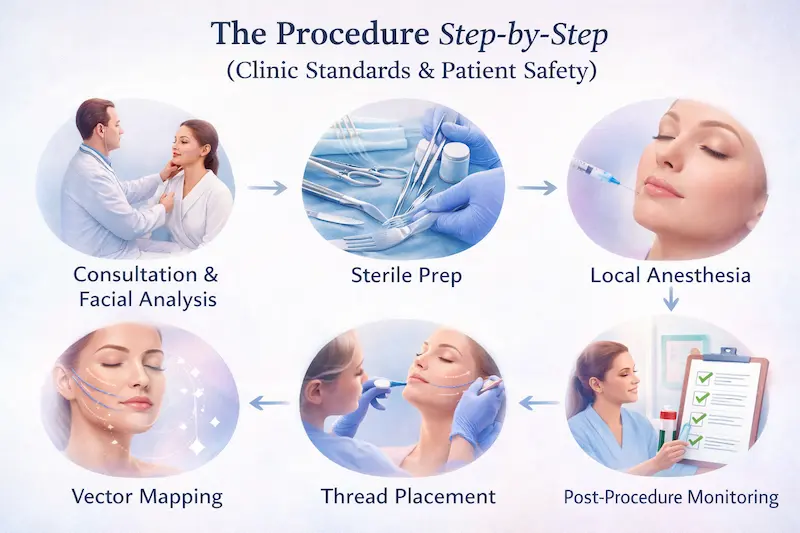
Understanding the process helps you judge quality beyond marketing—especially when quotes vary widely for thread lift Istanbul price. A high-standard clinic should provide transparent planning, sterile technique, and a clear pathway for aftercare and complications.
Consultation and facial analysis: mapping vectors for natural lift
A proper assessment should include:
- Facial and skin analysis (elasticity, thickness, laxity pattern)
- Discussion of goals and what “natural” means for your face
- Vector planning (direction of lift) to avoid over-pulling
- Thread selection (material, barbed vs smooth) based on your needs
This planning step is often the difference between a refined result and a “pulled” look. If a clinic skips or rushes it, it’s hard to trust the value behind the quoted thread lift cost Turkey.
Pain control options and what “local anesthesia” really feels like
Most thread lifts are performed with local anesthesia. Typically, you can expect:
- Brief stinging during numbing injections
- Pressure/tugging sensations during placement (not usually sharp pain)
- Soreness after the procedure, especially when smiling or chewing
Clinics may offer mild sedation in selected cases, but the goal should be comfort without compromising safety or post-procedure monitoring. Any sedation discussion should include who administers it and how you’re observed afterward.
Sterility, thread traceability, and post-procedure monitoring
“Thread traceability” is a specific, verifiable standard — and it’s one of the cleaner ways to separate serious thread-lift practices from corner-cutting ones. A clinic that can show you the thread brand, lot number, CE/FDA status, and expiration is a clinic operating under documented sterility and supply-chain standards. A clinic that can’t is improvising.
For the facility-standards context specifically, the Istanbul clinic facility standards covers the sterilization protocols, the procedure-room standards for minimally invasive treatments, the product traceability and documentation practices, and the licensing oversight under the Turkish Ministry of Health that legitimate aesthetic procedures operate under.
Thread traceability is a small detail that reveals a large amount about a clinic’s underlying standards. Ask to see it.
Safety standards should be explicit. At minimum, you should expect:
- Sterile field preparation and clean clinical environment
- Thread traceability (brand/material documentation when appropriate)
- Clear aftercare instructions (sleeping position, facial movements, skincare)
- A defined follow-up schedule and contact pathway for concerns
Because thread lifts rely on precise placement, the “system” around the procedure matters as much as the technique—this is where reputable clinics differ from volume-driven providers. If you’re comparing thread-based lifting cost between clinics, insist on clarity about what standards are included, not just how many threads you’ll receive.
Recovery Timeline & Results: Day-by-Day Expectations
Recovery after this treatment is usually quicker than surgery, but it’s not “zero downtime.” Knowing what’s normal helps you plan flights, social commitments, and when you’ll look presentable—especially if you’re combining travel with treatment. This section also matters when evaluating Turkey thread lift procedures, because good clinics provide clear aftercare and realistic milestones.
First 72 hours: swelling/bruising management
In the first 2–3 days, it’s common to experience:
- Swelling (often uneven at first)
- Bruising around entry points or along the thread path
- Tightness and tenderness (especially with facial movement)
Typical aftercare guidance includes sleeping on your back with your head elevated, avoiding heavy chewing, and limiting exaggerated facial expressions. A reputable clinic will give you a written plan and a “what’s normal vs not normal” checklist.
Weeks 1–2: when you can return to work/social life
Many patients feel comfortable returning to non-physical work in about a week, but “camera-ready” can take longer depending on bruising. During weeks 1–2, you may notice:
- Residual bruising (makeup may cover some of it)
- Mild asymmetry that improves as swelling settles
- Occasional puckering that gradually relaxes
Most clinics advise avoiding intense exercise, saunas/steam rooms, and facial massage during the early healing window to reduce thread displacement risk.
Months 1–6: collagen phase and final result timing
Thread lifts have a “two-phase” effect:
- Immediate: a subtle lift from the mechanical repositioning
- Progressive: collagen stimulation over the following months
This is where peer-reviewed evidence often focuses—on how different thread materials influence collagen remodeling and how long the improvement persists in real-world patients. Your final “settled” look is typically clearer by 6–12 weeks, while skin quality improvements can continue longer.
Thread Lift Cost in Turkey (What You Pay For and What Should Be Included)
Pricing searches about thread lifting cost are common because costs vary widely. The most helpful way to evaluate cost is to understand what drives it, what should be included, and how to compare across countries and cities without falling into “cheapest wins” thinking.
Typical price factors: number of threads, areas treated, thread type/brand
The total cost of this treatment usually depends on:
- Areas treated (jawline vs midface vs neck)
- Number of threads (more is not always better; it must match anatomy)
- Thread material (PDO vs PLLA vs PCL) and whether threads are barbed or smooth
- Clinician expertise and clinic standards (sterility, protocols, follow-up)
- Inclusions (consultation, medications, aftercare, follow-up access)
Beyond the factors above, cross-market price comparisons (US cities vs Istanbul, Turkey vs other destinations) belong in the dedicated cost resource rather than duplicated here.
For the full cost-comparison framework, the plastic surgery cost hub covers procedure-by-procedure pricing methodology, what’s included versus billed separately, and the Istanbul-versus-other-markets comparison on like-for-like terms.
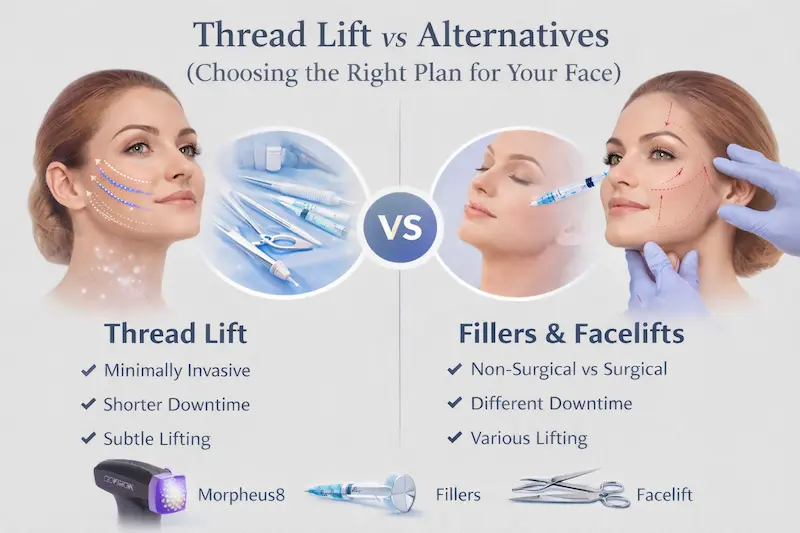
Thread Lift vs Alternatives (Choosing the Right Plan for Your Face)
When you compare thread lifting options, it helps to step back and ask: “What problem am I actually trying to solve—lifting, tightening, volume, or skin quality?” Threads can be excellent for selective lifting and refinement, but they’re not the answer for every anatomy or every goal. This section helps you decide whether Turkey thread lift procedures are the right tool—or whether another option is more predictable for your face and timeline.
Threads vs surgical facelift: longevity, downtime, predictability
“Threads vs surgical facelift” isn’t really a competition — it’s a comparison between two procedures that address different stages of facial aging. Threads work at the mild-to-moderate laxity stage; surgical facelifting works when tissue descent has progressed beyond what sutures can mechanically hold.
For the surgical-side context that thread-lift candidates should understand before assuming threads will substitute for surgery, the surgical facelift options overview covers the spectrum from mini and SMAS techniques through deep-plane lifting, the candidacy frameworks for each, the longevity profiles (8-12+ years for surgical versus 12-18 months for threads), and the decision architecture that determines whether a patient is genuinely in “thread territory” or whether threads would be a costly detour before inevitable surgery.
The honest framing: threads are not a smaller facelift. They’re a different intervention with a different ceiling.
When the “threads vs surgery” comparison narrows to a specific surgical technique, the SMAS facelift is the most common reference point — because it’s the technique that thread lifts are most often (incorrectly) marketed as replacing.
The mechanistic difference matters: a SMAS facelift surgically repositions and sutures the superficial musculoaponeurotic system — the deep structural layer that threads cannot reach or hold. Threads engage the subcutaneous layer; SMAS surgery engages the layer beneath it. This is why thread results fade as the sutures dissolve while SMAS results persist for years.
For the surgical-technique reference specifically, the SMAS facelift technique comparison covers what the SMAS layer is and why it matters, the difference between SMAS plication and deeper techniques, the longevity and recovery profiles, and the candidacy threshold where SMAS surgery becomes the more sensible investment than repeated thread maintenance.
Threads and SMAS surgery operate on different anatomical layers. That single fact explains most of the longevity difference.
The most important differences are:
- Thread lift: minimally invasive, faster recovery, subtle lift, variable longevity
- Surgical facelift: more downtime, higher upfront commitment, stronger lift, generally more predictable structural change
If your main concern is advanced jowls or significant neck laxity (often searched as thread lift for turkey neck / thread lift turkey neck), a surgical option may be more effective. Threads may still have a role for selected patients, but your provider should explain the realistic ceiling of improvement.
| Option | Best For | Downtime | Longevity (Typical) | Predictability |
|---|---|---|---|---|
| Thread Lift | Mild-to-moderate laxity, subtle contour refinement | ~3–14 days (bruising varies) | Often ~6–18 months (varies by material + patient factors) | Moderate |
| Surgical Facelift | Moderate-to-advanced laxity, jowls/neck improvement | Weeks (varies by technique) | Years (varies by aging + technique) | Higher |
Note: longevity varies widely; a clinic should explain what is supported by clinical experience and what depends on individual response—an important point in scientific research around minimally invasive lifting.
Threads vs fillers/biostimulators: different goals, different risks
Threads lift; fillers primarily restore volume; biostimulators aim to improve skin quality and collagen over time. The confusion happens when patients try to “fix sagging” with volume alone, which can create an overfilled look. A good plan often combines approaches carefully—or chooses one based on your facial aging pattern.
- If your problem is droop: threads (or surgery) may be more logical than adding volume.
- If your problem is deflation: carefully placed fillers/biostimulators can look natural.
- Risks differ: fillers carry vascular risks; threads carry puckering/extrusion risks.
Threads vs energy devices (HIFU/RF): tightening vs lifting
“Threads vs energy devices” frames the two as competitors, but for many patients the more useful framing is complementary: threads provide mechanical lift, energy-based radiofrequency microneedling improves skin quality and provides dermal tightening. Different mechanisms, different targets — often sequenced rather than chosen between.
Threads reposition tissue; they do not improve skin texture, pore size, or surface quality. A patient with both mild laxity and declining skin quality may get a better overall result from threads (for lift) combined with RF microneedling (for skin quality) than from either treatment alone.
For the skin-quality side that pairs with thread-based lifting, the Morpheus8 skin tightening framework covers what RF microneedling targets at the dermal and subdermal level, the candidacy criteria for combining energy-based skin tightening with thread lifting, the sequencing protocols that prevent inflammation conflicts, and the realistic outcome expectations when skin-quality treatment sits alongside mechanical lifting.
The strongest non-surgical plans usually address lift and skin quality as separate problems with separate tools — sequenced thoughtfully.
Energy devices such as HIFU or RF primarily target tightening and skin quality rather than a true lift. They can be useful when laxity is mild and skin quality is the main issue. Threads can provide more immediate contour change, but may be less predictable in thin skin or heavy tissue.
If you’re focused on thread lifting cost comparisons, it’s worth asking whether your goal could be met with tightening instead of lifting. The “best value” procedure is the one that matches your anatomy and produces a stable, natural result.
Thread Lift After Facelift: Can Threads Maintain Surgical Results?
One of the most useful — and least marketed — applications of thread lifting isn’t as an alternative to surgery, but as a maintenance tool after it. Patients who’ve had a facelift face an inevitable reality: aging continues. The facelift resets the clock; it doesn’t stop it.
For post-facelift patients, well-timed thread lifting can address early re-laxation in specific zones (jawline softening, mild midface descent) without committing to a revision facelift. The logic is sound: a small mechanical lift applied to early recurrence can extend the interval before a revision surgery becomes necessary — sometimes by a few years.
The candidacy is narrow but real: this works for patients 2-5 years post-facelift who are seeing early, localized recurrence — not for patients with widespread re-descent (who need revision surgery) and not as a substitute for the original facelift. The threads maintain; they don’t restore what surgery accomplished.
The honest caveat: thread lifting over previously operated tissue requires a surgeon who understands the altered anatomy and scar planes from the prior facelift. This is precisely the scenario where a surgeon-led practice (one that performs both facelifts and threads) produces safer outcomes than an injector-only thread practice unfamiliar with post-surgical anatomy.
How to Choose a Safe Clinic in Turkey (Checklist for Expert Patients)
Search terms like ‘thread lift Istanbul price’ and ‘thread lift cost Turkey’ make sense—but price alone doesn’t protect you. Quality varies widely, so informed patients should assess: (1) medical assessment quality, (2) transparency about materials, (3) hygiene and protocols, and (4) aftercare that still works when you’re back home.
Surgeon-led planning and conservative aesthetics (natural outcome focus)
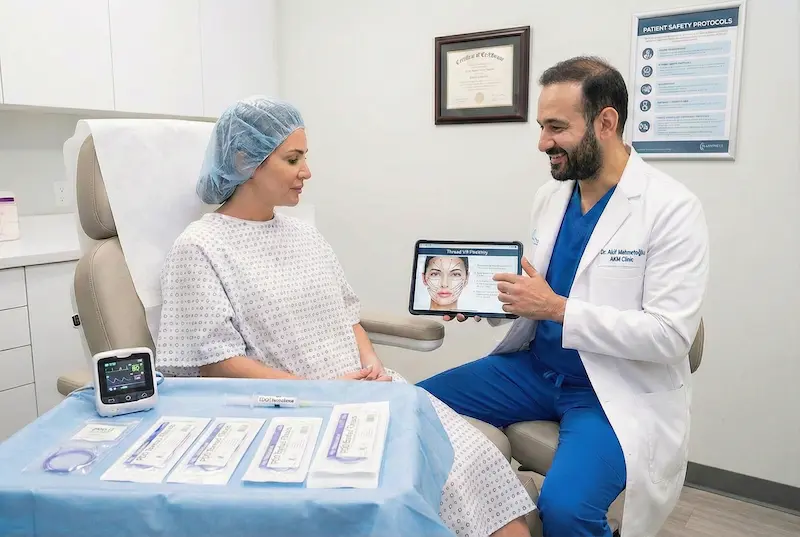
“Surgeon-led planning” is a phrase that distinguishes thread-lift practices more sharply than most patients realize. A thread lift performed by a surgeon who also performs facelifts brings a different judgment to candidacy — that surgeon knows when threads will work and when they’re a detour before inevitable surgery, because they perform both.
A practitioner who only offers threads has a structural incentive to recommend threads even for patients who need surgery. A surgeon who offers the full spectrum has no such incentive — they can route the patient to the right intervention.
For the surgeon-evaluation framework specifically, the surgeon evaluation guide covers the credentials and case-volume signals that indicate genuine surgical expertise, the difference between an injector-only practice and a surgeon-led practice, the questions that reveal whether a practitioner can honestly route you away from threads when threads aren’t enough, and the verification steps that separate qualified surgeons from high-volume thread mills.
The safest thread lift is often performed by someone qualified to tell you that you don’t need one.
Look for a clinic that prioritizes:
- Medical consultation before quoting (photos, candidacy screening, plan options)
- Conservative vector planning to reduce “pulled” results
- Clear explanation of what threads can and cannot do for your anatomy
If you’re pursuing thread lift for turkey neck, ensure the provider explains neck-specific limitations. The neck can be less forgiving than the face—thin skin and movement can increase visible irregularities if planning is aggressive.
Clinical governance: hygiene, complication protocols, transparency
“Clinical governance” sounds abstract until a thread complication appears — a thread extrusion, an infection, a vascular event — and the patient discovers whether the clinic has actual complication protocols or just a booking desk. Governance is the difference between a clinic equipped to manage the rare bad outcome and a clinic that disappears when one occurs.
For the governance context specifically, the AKM Clinic governance model covers the surgeon-led oversight structure, the complication-management protocols, the documentation and traceability standards, and the operating philosophy that determines whether a minimally invasive procedure is backed by genuine clinical infrastructure or marketed as low-risk because the clinic isn’t equipped to handle the risk.
The clinics worth trusting for “minimally invasive” procedures are the ones equipped to handle the moments when minimally invasive becomes complicated.
Ask direct questions. A high-standard provider should be comfortable answering:
- Which thread material is being used (PDO/PLLA/PCL), and is the brand disclosed?
- What sterility protocol is used (prep, instruments, environment)?
- What is the plan if I develop infection, extrusion, or asymmetry?
- What documentation will I receive about the procedure?
These questions help you evaluate the “why” behind the Turkey thread lift quote, not just the number.
Aftercare & remote follow-up: what a serious clinic provides
Aftercare is part of the product—especially for medical tourism. A serious clinic should provide:
- Written aftercare instructions (what to do, what to avoid, warning signs)
- Planned check-ins during your stay
- A clear remote follow-up channel once you’re home
- Guidance for coordination if you need local evaluation in your country
If aftercare is vague or “message us on WhatsApp and we’ll see,” that’s not a system. A system is what reduces risk and protects outcomes—one of the most overlooked parts of evaluating thread lift in Turkey.
Frequently Asked Questions (FAQ): Thread Lift Turkey
Below are the most common expert-patient questions about the procedure, including safety, longevity, travel logistics, and whether a thread lift is actually the right solution for your concerns (especially the neck).
“I actually look like nothing happened but probably 20 years younger.”
— Barbara (USA), reflecting on natural-looking facial rejuvenation results
How long does a thread lift last?
Longevity varies by thread material (PDO vs longer-stimulating options like PLLA/PCL), technique, and your tissue quality. Many patients see meaningful improvement for months rather than years. A responsible provider should explain a realistic range for thread lift in Turkey based on your photos and laxity level—not a one-size-fits-all promise.
Is a thread lift painful?
Most patients tolerate it well under local anesthesia. You’ll usually feel brief stinging from numbing injections and then pressure/tugging during placement. Soreness and tightness afterward are common for several days, especially when chewing or smiling.
How many threads do I need for jawline/cheeks/neck?
It depends on the areas treated, the degree of laxity, and whether the goal is lift (barbed threads) versus skin support (smooth threads). More threads are not automatically better. If a clinic quotes Turkey thread lift procedures purely by “thread count” without explaining the plan and vectors, the quote is incomplete.
Can threads be removed if I don’t like the result?
Some threads can be adjusted early, and some may be removable depending on type and how the tissue has integrated—however, removal is not always simple. This is why conservative planning matters. If you’re concerned about reversibility, discuss your risk tolerance before paying any thread lift cost Turkey deposit.
What’s the biggest risk of getting threads abroad?
The biggest risk is not “Turkey” itself—it’s choosing a low-governance provider. Red flags include unclear thread type/brand, no formal medical assessment, weak sterility transparency, and no structured aftercare once you return home. These matter more than the advertised thread lift Istanbul price.
When can I fly after a thread lift in Turkey?
Thread lifts carry a shorter flight-restriction window than surgical facelifts, but "shorter" isn't "none" — and the international thread-lift patient needs procedure-specific flight timing rather than the generic "you can fly right away" reassurance some clinics offer.
The thread-lift flight consideration is less about surgical risk and more about swelling, pressure sensitivity, and the early-healing window where facial movement and cabin pressure can affect comfort and early thread settling. Most thread-lift patients can fly within 1-3 days, but the specifics depend on the number of threads, the zones treated, and individual swelling response.
For the broader procedure-specific flight-timing framework, the post-procedure flight timing guide covers the timing differences across facial procedures, the cabin-pressure-and-swelling relationship, the DVT considerations for longer-haul flights, and the planning approach that prevents booking a return flight before the healing window genuinely allows it.
"You can fly right away" is a marketing answer. The real answer depends on what was done and how you heal.
Are thread lifts worth it, or should I save for a facelift?
"Should I save for a facelift?" is the right question for a specific patient profile: someone whose laxity is borderline, who is treating threads as a stopgap, and who will likely cross into surgical candidacy within a few years. For this patient, the maintenance-cost math often favors a one-time less-invasive surgical lift over repeated thread cycles.
For the lower-intervention surgical endpoint specifically, the mini facelift comparison covers the candidacy criteria for less-invasive surgical lifting, the recovery profile (typically 7-10 days), the longevity expectations, and the decision math that helps patients understand when thread maintenance has reached its productive ceiling and a mini facelift becomes the better aesthetic and financial choice.
Threads make sense as a refresh. They make less sense as an indefinite substitute for a surgery the anatomy will eventually require.